❌

Visualização normal

Hoje — 9 de Novembro de 2026Cybersecurity News
  • ✇Cybersecurity News
  • York University Data Breach Exposes Years of Departmental Webform Submissions Do Son
    A York University data breach exposed records from 2007 to 2026 after a departmental webforms theft. Check which faculties and students are affected. Related Posts: Claude Code Leaking Secrets Across Nearly Two Thousand Public GitHub Repositories DreamHost Security Breach Exposes FTP and Webmail Data DigiCert Data Exposure Reveals Customer Contact Records and Identity Documents The post York University Data Breach Exposes Years of Departmental Webform Submissions appeared first on Daily Cyber
     
  • ✇Security Affairs
  • Don’t Hand Propaganda a Gift: Reading the Brenner Base Tunnel SE Breach Calmly Pierluigi Paganini
    Brenner Base Tunnel SE confirms a breach and Everest claims 812 GB. What we know, what we don’t, and why overblown alarm helps propaganda more than the attackers. Brenner Base Tunnel (BBT) SE, the company building the Brenner Base Tunnel between Italy and Austria, has confirmed that unauthorized people accessed some of its data. The extortion group Everest claims it took 812 GB of files. Nobody has verified that, and a criminal bragging about file sizes isn’t an audited source. The timeli
     

Don’t Hand Propaganda a Gift: Reading the Brenner Base Tunnel SE Breach Calmly

8 de Novembro de 2026, 14:46

Brenner Base Tunnel SE confirms a breach and Everest claims 812 GB. What we know, what we don’t, and why overblown alarm helps propaganda more than the attackers.

Brenner Base Tunnel (BBT) SE, the company building the Brenner Base Tunnel between Italy and Austria, has confirmed that unauthorized people accessed some of its data. The extortion group Everest claims it took 812 GB of files. Nobody has verified that, and a criminal bragging about file sizes isn’t an audited source.

The timeline is thin. The intrusion reportedly dates to mid-October, Everest’s claim to 17 October, and the Austrian press broke the story on 6 November. On 7 November BBT SE told ANSA that operations are unaffected, the systems involved are isolated, and outside forensic experts and the authorities are on the case.

If real and current, drawings, surveys and site procedures would save an attacker a lot of reconnaissance. Together they could show how the infrastructure fits together, and fraudsters could borrow project names to fool contractors. Those are scenarios, not sightings.

Dates matter too. The tunnel won’t open before 2034, at a projected cost of about €11.7 billion, so older drawings may describe a design that has since changed.

Knowing how a tunnel is built does not mean being able to control it. Sabotage requires access to operational systems and weaknesses that attackers can exploit. So far, there is no evidence that attackers accessed industrial systems or tampered with the tunnel’s control functions. BBT SE has not confirmed any encryption of its systems either. Claims that ransomware could stop the tunnel therefore have no factual support.

Everest is a Russian-speaking cybercriminal group. ZeroFox has also noted that the group tends to exaggerate the amount of data it steals. Speaking Russian and operating within a Russian-speaking cybercrime environment does not prove that the group is directed by the Russian state. In July, the same group demanded CHF 10 million from Stadler Rail after using stolen credentials to access a supplier’s data platform. Production continued despite the incident.

The response should focus on practical security measures. Organizations need to identify which information was exposed, revoke potentially compromised credentials, keep document management systems separate from industrial control networks, and warn suppliers about fraudulent requests. Whether NIS2 applies to a project company that is still under construction depends on its activities and the relevant national legislation.

There is no benefit in creating unnecessary alarm. It only helps the attackers and anyone trying to exploit the incident for an influence campaign. Blaming Moscow without evidence would play directly into propaganda efforts. There are three key questions that need clear answers: which files were actually stolen, how recent and relevant they are, and who might still be able to use them.

Follow me on Twitter: @securityaffairs and Facebook and Mastodon

Pierluigi Paganini

(SecurityAffairs – hacking, Brenner Base Tunnel)

  • ✇Security Affairs
  • Security Affairs newsletter Round 603 by Pierluigi Paganini – INTERNATIONAL EDITION Pierluigi Paganini
    A new round of the weekly Security Affairs newsletter has arrived! Every week, the best security articles from Security Affairs are free in your email box. Enjoy a new round of the weekly SecurityAffairs newsletter, including international press. Inside ARTEX: AI Hacking Tools, Exposed Servers and South Korean Bank BreachesOne Product Isn’t the Problem: Monetizing an AI Portfolio Without Confusing Your CustomersU.S. CISA adds SonicWall SonicOS SSLVPN flaw to its Known Exploited Vulnerabil
     

Security Affairs newsletter Round 603 by Pierluigi Paganini – INTERNATIONAL EDITION

8 de Novembro de 2026, 10:48

A new round of the weekly Security Affairs newsletter has arrived! Every week, the best security articles from Security Affairs are free in your email box.

Enjoy a new round of the weekly SecurityAffairs newsletter, including international press.

Inside ARTEX: AI Hacking Tools, Exposed Servers and South Korean Bank Breaches
One Product Isn’t the Problem: Monetizing an AI Portfolio Without Confusing Your Customers
U.S. CISA adds SonicWall SonicOS SSLVPN flaw to its Known Exploited Vulnerabilities catalog
White House Network Appears in Global Residential Proxy Traffic
OpenAI Rates GPT-6 Cyber Critical After Major Vulnerability Discoveries
ENISA Warns of Cyberattacks Targeting Refrigeration Systems Across Europe
OpenAI Reports Covert Underperformance in GPT-6 Astra
UNM Health Shuts Clinics and Diverts Patients During Security Incident
Russian APT29 Targets Mobile Users with Watering Hole Attacks
U.S. CISA adds Apple flaw to its Known Exploited Vulnerabilities catalog
U.S. Charges Canadian Man in Alleged Hack of University Supercomputers
Two Barracuda ESG Flaws Could Be Combined for Full Root Access; Patches Released
Cyberattack Hits French Blood Banks as Hackers Target Refrigeration Systems Across Europe
CVE-2026-58868: Critical Android Bug Could Let Attackers Run Remote Code
U.S. CISA adds WordPress flaw to its Known Exploited Vulnerabilities catalog
Binance Hack: How Fake Job Interviews and AI Abuse Led to a $6.34 Billion Attack
Synology Warns of Ransomware Attacks Targeting NAS Devices Running Outdated DSM Versions
Inside XCPE, the botnet that turned 1.3M set-top boxes into proxy servers
NIS2 Makes Board Members Personally Liable for Access Control Decisions
Apple’s spyware notifications reach the Bundestag: what the BSI says to do now
VOLTA, the infostealer that asks an AI which victims are worth the effort
New wave of fridge cyberattacks hits European supermarkets, this time in Belgium, Luxembourg, Sweden and Estonia
Hackers Send Fake Nuclear Threat Alerts to Ukrainian and Russian Citizens
Chainalysis Investigates Security Incident Involving AI-Driven Attack Techniques
FBI Blames North Korea for $6 Billion Binance Crypto Theft
SMS of Death: Android under attack, an invisible SMS can block calls and emergency services

International Press – Newsletter

Cybercrime

How hackers broke into four of Canada’s top law firms, stole client files and caused chaos

Polymarket Pauses Trading as Prediction Market Investigates Security Incident

From help desk impersonation to AD CS abuse: Investigating ESC1 and ESC8 intrusion paths

29 October Binance Security Incident: Initial Findings and Response Update     

“Black October” for AI Developer Platforms  

Canadian man extradited to the U.S. for his role in computer hacking scheme targeting universities  

ARTEX Exposed: Mapping the Infrastructure Behind the South Korean Bank Breaches

French bank Credit Mutuel Arkea says €100 million missing after cyberattack  

Malware

Shutting the Door on the XCPE Botnet  

Free the Model, Sell the Gateway: Prompt Adware hidden in Jailbreak Bundles  

Hackers hijack cPGuard autoupdate to deploy backdoor, steal data  

CWPdoor: The Invisible Backdoor Living Inside Control Web Panel  

Hacking

SMS of Death 

Chainalysis Security Incident Information  

Russia and Ukraine say emergency alert apps were hit by apparent cyber-attacks  

European supermarkets hit by new fridge cyber attack  

The Rise of LLMJacking: How Threat Actors Monetize Compromised Cloud and Model Resources

Securing Muse: More Than $1 Million in Bug Bounties Paid Out  

WorkOS October 30th, 2026 Data Security Incident  

A thousand fewer paths to root

ThisBash Escape: Claude Dispatch Flaw Enables Browser Extensions RCE on the OS 

Barracuda Networks is your new best friend (Barracuda Email Security Gateway Pre-Auth Remote Root RCE CVE-2026-116606 / CVE-2026-111560) 

Intelligence and Information Warfare  

North Korea Responsible for $6 Billion+ Binance Attack  

Russia funded Facebook and Twitter investments through Kushner investor

Unknown APT uses NetamLoader to attack a Win10 OS customized for governments in Asia

French blood banks hit alongside cyberattack on European supermarkets

UK and Germany to jointly develop military AI in 2027 

Apple threat notifications regarding Mercenary Spyware  

DarkBlinders: Inside an Active Espionage Campaign

Poisoned Source: APT29 watering holes target mobile devices with n-day exploits

Russian Federal State Statistics Service says it was hit by massive cyberattack — hackers steal 23TB of data, including Ukraine war casualty figures

The Google Whistleblower Taking on Big Tech Over Its Role in Gaza  

Weekly Wire #17: Hybrid war hits home  

Cybersecurity

Israeli startups raised at least $872 million in October, led by cybersecurity and AI 

Europe on alert after supermarket freezers hit by cyber-attacks in 10 countries  

Joint statement on cyber incidents in refrigeration systems across the EU  

GPT‑6 Cyber: Advancing the frontier of aligned cybersecurity agents

Residential Proxies Detected on White House Network  

European refrigerator controller redux: A new wave of refrigeration attacks

Hundreds of Mundane AI Apps Are Hiding Sexually Abusive Deepfake Features       

Japan announces emergency cybersecurity package following a wave of attacks   

ThisBash Escape: Claude Dispatch Flaw Enables Browser Extensions RCE on the OS  

Follow me on Twitter: @securityaffairs and Facebook and Mastodon

Pierluigi Paganini

(SecurityAffairs – hacking, newsletter)

Antes de ontemCybersecurity News

The Cyber Express Weekly Roundup: FBI Blames North Korea for $6B Binance Hack, Hackers Turn Up the Heat on Europe’s Fridges and More

6 de Novembro de 2026, 11:33

weekly roundup

This weekly roundup covers the FBI's attribution of the $6 billion Binance hack to North Korea, a spreading wave of refrigeration attacks that has now reached France's blood supply, rapid exploitation of a freshly patched WordPress flaw, a Europol takedown of a fake trading platform supplier, and unauthorized trades in Stockal customer accounts.  Two threads run through this week's stories. First, attackers are increasingly coming in through someone else's door: a third-party refrigeration supplier, a scam platform provider, or data leaked by another company. Second, speed decides the outcome. Attackers moved on WordPress within two days of a patch, while fast alarms saved France's blood stocks from the fate of supermarket food. 

The Cyber Express Weekly Roundup 

FBI Blames North Korea for $6B Binance Hack 

The FBI has attributed the theft of more than $6 billion from Binance, which took place around October 29, to North Korean hackers it tracks as "TraderTraitor." The stolen funds are being converted mainly into Ethereum, and the agency has urged crypto firms to block transactions linked to the attackers. Read more… 

Hackers Heat Supermarket Freezers Across Europe 

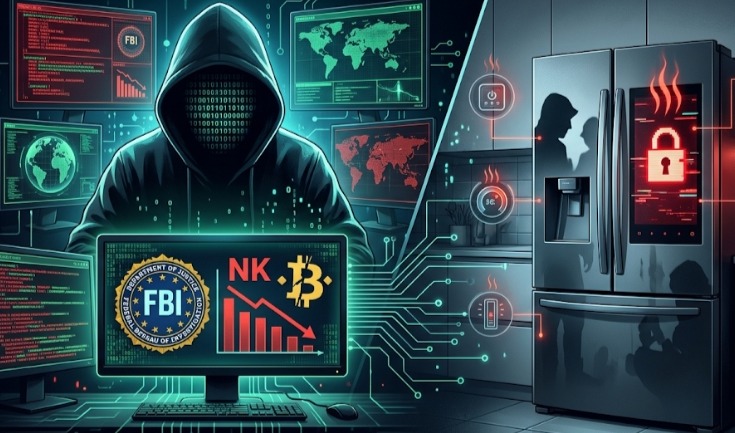
Supermarkets in Sweden, Belgium, Luxembourg, Ireland and Estonia threw out spoiled food after hackers took control of refrigeration systems, in some cases setting them to 50°C. The attacks follow a similar campaign against around 400 stores in France last month that exploited outdated, internet-connected cooling equipment. Who is responsible remains unknown. Read more… 

Hackers Target WordPress Flaw Days After Patch 

Attackers began exploiting a critical WordPress flaw within 48 hours of its October 28 fix in version 7.1.4, with Wordfence blocking nearly 63,000 attempts in a single day. The bug affects versions 4.7 through 7.1.3 and can let hackers run code on a site during a core update. With no workaround available, site owners are urged to update immediately. Read more… 

Europol Busts Supplier of Fake Trading Platforms 

Authorities in seven countries seized more than 100 servers and arrested seven suspects on November 3 in an operation against a company accused of supplying fake trading platforms to scam call centres. Victims were lured with promises of quick profits, shown fake gains to draw in more money, and then blocked from withdrawing. Losses are estimated at over €4 million, with potential victims in more than 50 countries. Read more… 

Freezer Hackers Hit France's Blood Supply 

France's national blood service, EFS, said hackers raised temperatures in cold storage rooms at three sites by going through a third-party refrigeration supplier. Alarms caught the changes quickly, and no blood products were lost. It is the first healthcare organisation hit in a wave of refrigeration attacks now reported in at least 11 countries. No one has claimed responsibility. Read more… 

Stockal Confirms Unauthorized Trades in 13 Accounts 

Borderless, which runs US equities platform Stockal, said attackers logged into 26 customer accounts using valid credentials and, in 13 of them, sold large-cap stocks to buy obscure microcap shares. No funds were withdrawn. The company says its systems were not breached and suspects social engineering using data leaked in another firm's breach. Read more… 

Weekly Cybersecurity Takeaway

Several of this week's incidents show that an organization's security is only as strong as the partners and data around it. Supermarkets and France's blood service were reached through refrigeration suppliers; Stockal customers were likely targeted with data stolen elsewhere, and the Europol case exposed a business that built scam platforms for others to run.  Speed is the other lesson. Attackers turned the WordPress fix into a roadmap within 48 hours, while the EFS avoided losses because its monitoring flagged the problem right away.  Organizations should review the remote access their suppliers have to critical systems, retire or isolate unsupported internet-connected devices, and make sure alarms on physical equipment reach someone around the clock. They should also patch critical flaws without delay, strengthen account authentication, and, for crypto firms, block addresses linked to the Binance attackers. 
  • ✇Cybersecurity News
  • DreamHost Security Breach Exposes FTP and Webmail Data Do Son
    A severe DreamHost security breach exposed customer FTP credentials and webmail accounts, prompting urgent password rotations and website file audits. Related Posts: DigiCert Data Exposure Reveals Customer Contact Records and Identity Documents NVIDIA Brev Security Incident Prompts SSH Key Rotation Amadeus Airline Data Breach Hits Major Global Carriers The post DreamHost Security Breach Exposes FTP and Webmail Data appeared first on Daily CyberSecurity.
     
  • ✇Graham Cluley
  • Smashing Security podcast #491: How AI agents are spooking the banks Graham Cluley
    Bank of America has a message for its customers: please, for the love of God, stop handing your banking passwords to your AI assistant. And if your robot does something daft with your money? That's your problem, not theirs. Meanwhile, a company that promised to rescue ransomware victims without paying the criminals stands accused of... paying the criminals. ProPublica's Renee Dudley was on the case years before the indictment. Plus, Dropzone AI's Edward Wu asks what happens when AI models
     

Smashing Security podcast #491: How AI agents are spooking the banks

4 de Novembro de 2026, 21:15
Bank of America has a message for its customers: please, for the love of God, stop handing your banking passwords to your AI assistant. And if your robot does something daft with your money? That's your problem, not theirs. Meanwhile, a company that promised to rescue ransomware victims without paying the criminals stands accused of... paying the criminals. ProPublica's Renee Dudley was on the case years before the indictment. Plus, Dropzone AI's Edward Wu asks what happens when AI models break out of their test environment and go hacking, and whether AI agents can help overstretched security teams keep up. All this and more in episode 491 of the "Smashing Security" podcast with cybersecurity expert and keynote speaker Graham Cluley, and special guest Renee Dudley.

DigiCert Confirms Data Breach After Security Misconfiguration Exposes Customer Personal Information

DigiCert confirmed unauthorized access to an internal business system containing archived customer information due to a security misconfiguration that exposed the application to the internet. This incident affected business contact details and, in some cases, identity documents. However, DigiCert said its certificate authority services, including CertCentral, DigiCert ONE, customer login credentials, and issued certificates, were […]

The post DigiCert Confirms Data Breach After Security Misconfiguration Exposes Customer Personal Information appeared first on GBHackers Security | #1 Globally Trusted Cyber Security News Platform.

  • ✇Cybersecurity News
  • Amadeus Airline Data Breach Hits Major Global Carriers Do Son
    An Amadeus airline data breach compromised passenger travel records across Malaysia Airlines, JAL, ANA, and Cathay Pacific via compromised credentials. Related Posts: Gitee Exposed Credentials Found Across Millions of Repositories OffiDocs Chrome Extensions With 2.3 Million Installs Caught Harvesting Browsing URLs Keystone Wallet Data Breach Exposes Customer Orders The post Amadeus Airline Data Breach Hits Major Global Carriers appeared first on Daily CyberSecurity.
     
  • ✇Security Affairs
  • Security Affairs newsletter Round 602 by Pierluigi Paganini – INTERNATIONAL EDITION Pierluigi Paganini
    A new round of the weekly Security Affairs newsletter has arrived! Every week, the best security articles from Security Affairs are free in your email box. Enjoy a new round of the weekly SecurityAffairs newsletter, including international press. U.S. CISA adds Ivanti Connect Secure flaws to its Known Exploited Vulnerabilities catalogAttackers Exploit Critical Drupal Commerce Core Vulnerability CVE-2026-118539Yoba Malware Hides a Crypto Miner Behind Legitimate OpenAI and Anthropic Binarie
     

Security Affairs newsletter Round 602 by Pierluigi Paganini – INTERNATIONAL EDITION

1 de Novembro de 2026, 10:22

A new round of the weekly Security Affairs newsletter has arrived! Every week, the best security articles from Security Affairs are free in your email box.

Enjoy a new round of the weekly SecurityAffairs newsletter, including international press.

U.S. CISA adds Ivanti Connect Secure flaws to its Known Exploited Vulnerabilities catalog
Attackers Exploit Critical Drupal Commerce Core Vulnerability CVE-2026-118539
Yoba Malware Hides a Crypto Miner Behind Legitimate OpenAI and Anthropic Binaries
U.S. CISA adds GitLab and Cisco flaws to its Known Exploited Vulnerabilities catalog
$6.3 Billion Stolen from Binance in Attack Attributed to North Korea
How to prioritize remediation after a pentest: a practitioner workflow
Hacker leaks data on more than 40,000 Homeland Security employees
Binance Investigates Suspicious Crypto Transfers Worth Up to $5.8 Billion
US Probes Suspected Hack Behind Military Base Freezer Failures
484,142 Exposed Cloud Buckets Contain 18 Billion Files
U.S. CISA adds Linux Kernel and Broadcom VMWare ESX  flaws to its Known Exploited Vulnerabilities catalog
Volt Typhoon Used Silent Train to Hide Zero-Day Attacks
Election Website Security: 42% of US County Sites Still Lack .gov Domains
ENGIE Data Breach Exposes Customer Details and Energy Contracts
Virtualine Domain Seized, but Allegedly Abusive Website Remains Online
Hive and Nefilim Ransomware Affiliate Gets 70 Months In Jail
Ads or Surveillance? Researchers Flag Suspicious Targeting of Starlink Users
CVE-2026-97631: 16-Year-Old UEFI Flaw Threatens Servers
U.S. CISA adds Google Brotli and Adobe Commerce and Magento flaws to its Known Exploited Vulnerabilities catalog
Three Japan-Focused Cyberattacks Show How Hackers Use AI
Italy ’s Parliament Under Cyber Pressure: Why the Attack on the Chamber Matters
Australia’s Cyber Spy Chief: Expect More Disruption as AI Accelerates Hacking
U.S. CISA adds PHP flaws PHP2Shell to its Known Exploited Vulnerabilities catalog
Attackers Take Control of Dahua Cameras and Video Recorders Via Easy4IP
Cohere Finds Qwen AI Model Contacting a Server in China
Magento Campaign Infects 953 Online Stores Across Five Domains
AI-Generated Fake Bank Calls and NFC App Enabled €380,000 Fraud, Dutch Police Say
Researchers Uncover Rentable Android Spyware uCreater Targeting WeChat and Telegram
PHP2Shell: Suspected North Korean campaign targets 216 vulnerable PHP hosts
Anthropic reveals how Claude Mythos 5 crossed security testing boundaries
OpenAI Paused Frontier AI Training After a Security Incident

International Press – Newsletter

Cybercrime

Binance Says User Funds Are ‘Completely Safe’ After $3.5 Billion Drains From Its Hot Wallets  

Police arrest two suspects in AI-powered bank fraud that cost victims €380,000   

M365 Token Spray and Replay Campaign Compromises Business Email Accounts 

Chinese National Extradited for Alleged Role in Multimillion-Dollar Cryptocurrency Scam Targeting U.S. Citizens  

Ukrainian National Sentenced to 70 Months in Prison for Multi-Million Dollar Ransomware Conspiracies  

Hacker stole personnel data about thousands of Homeland Security employees, including CBP and ICE agents 

deepveindrilling.com: Magento CMS block loader hits 953 stores

“Bulletproof” website domain seized in international law enforcement operation  

Trezor warns of suspected crypto-theft implant in hardware wallet

Polymarket halts trading after crypto-draining script breach, $2.5M traced

Malware

uCreator: virtualization-based Android spyware platform targeting WeChat, Telegram and other messaging apps  

CLAUDE CODE FOUND SPYWARE ON MY FAMILY’S PHONES AND A BACKDOOR ON MY MAC

Security notice — malicious version of Anthropic.claude-code (2.1.313) identified in the Cursor Extension Marketplace  

Tricks from the Past deployed via signed ChatGPT and Claude binaries

Hacking

PHP2Shell exploitation observed: packet-to-process RCE evidence  

CYFIRMA Threat Advisory: Suspected DPRK Campaign staging PHP2Shell Targeting against Global PHP infrastructure  

Beyond the Inbox: How Threat Actors Abuse Microsoft Teams External Chat for Initial Access  

Not Only ARTEX: The Different Levels AI is Used in Attacks Targeting Japan  

Broccoli2shell: Everything You Need To Know About The Critical Brotli Decoder Vulnerability  

Discovering and exploiting vulnerabilities in critical, real-world software with Claude

Putting Claude Code in a box: a sandboxed dev container for Zed

Hackers Target Critical Oracle E-Business Suite RCE Flaw Days After Security Patch

The Last Proof of Human Craft: Forging a Microsoft Edge Full Chain with Logic Bugs Only!  

Pentagon treating military base freezer malfunctions as suspected cyberattack, officials say  

GitLab security incident: attempted exploitation of CVE-2026-97229  

Intelligence and Information Warfare  

Alibaba’s Qwen AI caught trying to contact server in China

Hackers can gain control of cameras and DVRs through cloud access      

Disruptions ‘inevitable’ as AI-powered cyber threats grow, Australian Signals Directorate says

Operation FlashHole: Lazarus breaks security, defies control 

Hackers Sympathetic to Russia Are Hitting Utilities and Factories  

Alleged Israeli spy company heavily targeted Starlink users, sources say

Silent Train: uncovering Volt Typhoon’s operational framework for zero-day exploitation and strategic access  

North Korea Steals USD 6.36 Billion From Binance in the Largest Hack in History  

Mapping the Political Influencer Industry and the Problems it Causes for Democracy  

Cybersecurity

NIS 2 Italy: Key Deadlines, Board Duties and What ACN Expects From Companies  

The Two Things CISOs Should Be Thinking About In The Wake Of The PHP Nightmare

Code-execution flaw in UEFI firmware affects most servers on planet Earth     

2026 County Election Website Security Census: Key Findings  

Cloud Exposure Index 2026: 484,142 open buckets mapped  

ENGIE: Data leak via a tool belonging to its business partners 

Beyond Framework Signatures: Understanding AI-Driven Intrusions 

I Think The Military Commissary’s Freezers Were Hacked  

Manifestos, Fear, and ‘Loser Thinking’: Inside Proton’s AI Reckoning 

Passkeys Are Better Than Passwords. But They Are Not Enough

Follow me on Twitter: @securityaffairs and Facebook and Mastodon

Pierluigi Paganini

(SecurityAffairs – hacking, newsletter)

  • ✇Cyber Security News
  • Northflank Security Breach Leads to Unauthorized AI API Key Usage, Customers Urged to Rotate Secrets Abinaya
    Northflank urged customers to rotate all platform secrets after reports of unauthorized AI API key use, warning that environment variables across workloads, secret groups, and global settings may have been exposed. Northflank is investigating a security incident involving reported misuse of AI keys but has not confirmed the entry point, identified an attacker, or disclosed affected customers. Its credential rotation warning remains precautionary, not confirmation of widespread theft. North
     

Northflank Security Breach Leads to Unauthorized AI API Key Usage, Customers Urged to Rotate Secrets

2 de Novembro de 2026, 09:02

Northflank urged customers to rotate all platform secrets after reports of unauthorized AI API key use, warning that environment variables across workloads, secret groups, and global settings may have been exposed.

Northflank is investigating a security incident involving reported misuse of AI keys but has not confirmed the entry point, identified an attacker, or disclosed affected customers. Its credential rotation warning remains precautionary, not confirmation of widespread theft.

Northflank’s published timeline begins with a Wiz threat alert at 11:43 UTC on October 30, 2026. Engineers reviewed the alert one minute later and deployed an initial network policy patch at 12:02 UTC.

Further patches followed at 12:50 and 13:05 UTC, and the team requested support from the Wiz incident response team at 13:00 UTC.

The timeline does not explain what those patches fixed. A network policy change alone does not establish how attackers entered the platform or reached customer secrets.

Northflank Security Breach

Northflank subsequently instructed users to treat environment variables as compromised and restrict public access to add-ons where enabled. Environment variables can hold API keys, database passwords, and other application credentials.

Similar exposure concerns surfaced in the recent Railway security incident, where customers were also advised to replace stored secrets after possible unauthorized access.

Northflank said the reported activity may fit a wider pattern of attacks targeting AI credentials. It pointed to similar IP addresses in Wiz’s “Black October” report, which described incidents across nine AI developer platforms during October.

Wiz found a shared focus on stored environment variables but identified no single vulnerability connecting the attacks. The financial risk comes from LLMjacking, where attackers use stolen credentials to consume paid AI services at the victim’s expense.

Previous reporting on LLMjacking attacks shows how compromised cloud keys can support unauthorized model access and resale. However, Northflank has not published a confirmed loss total or linked its incident to a named resale operation.

Customers should revoke existing credentials through the issuing providers, generate replacements, and update affected Northflank secrets and workloads.

Northflank also asked users to review AI provider usage and billing records for unexpected activity, then report suspicious usage to its support team and the relevant provider.

Secret rotation is now available for PostgreSQL, MongoDB, MySQL, Redis, MinIO, and RabbitMQ add-ons. Northflank also enabled audit logs for all customers, including free users, giving more teams access to records that may help their investigation.

The immediate priority is replacing all potentially exposed credentials, not only AI keys already showing abuse. Northflank’s latest guidance still covers secrets across workloads, shared secret groups, and global settings while its investigation remains open.

Give your SOC the alert context to stops incidents quickly. Integrate Threat Intel from 16K SOCs.

The post Northflank Security Breach Leads to Unauthorized AI API Key Usage, Customers Urged to Rotate Secrets appeared first on Cyber Security News.

The Cyber Express Weekly Roundup: Binance Hit by $6.3 Billion Security Incident, South Korea Busts AI-Powered Hacking Ring and More

30 de Outubro de 2026, 10:00

weekly roundup October 30

This weekly roundup covers a $6.3 billion security incident at Binance, the arrest of a South Korean hacking ring that used generative AI to breach about 90 companies, Columbia University’s $16.1 million settlement over its 2025 data breach, a 70-month prison sentence for a Ukrainian ransomware affiliate tied to Nefilim and Hive, and Discord’s decision to let search engines index messages from its public servers.  Two threads run through this week’s stories. First, attackers are getting more out of less: one compromised laptop put billions of dollars in crypto at risk, and AI tools let a small, self-taught crew scale its attacks to dozens of victims. Second, the fallout from a breach lasts far longer than the breach itself, as lawsuits, prison sentences, and bounties land years after the original attacks, while a simple default setting can create new exposure. 

The Cyber Express Weekly Roundup 

Binance Hit by $6.3 Billion Security Incident, Nearly $3 Billion Frozen 

Binance says a security incident affected about $6.3 billion in crypto assets, making it one of the largest in the industry’s history. Close to $3 billion has already been frozen on-chain, including 1.567 billion USDT frozen by Tether and 800 million USDC frozen by Circle. Read more... 

South Korean Police Bust AI-Powered Hacking Ring That Targeted 90 Companies 

Seoul police have arrested seven people accused of using generative AI to hack about 90 companies and steal 8.2 million personal records, then demanding payment to keep the data private. The group’s 32-year-old ringleader, who taught himself to hack, used AI tools in roughly 60 of the attacks. Read more... 

Columbia University Settles $16.1 Million Lawsuit Over 2025 Data Breach 

Columbia University will pay $16.1 million to settle a class action over its June 2025 cyberattack. The breach exposed Social Security numbers, health information and financial aid data belonging to about 870,000 applicants and affiliates. An internal investigation concluded the attack was politically motivated, with the hacker looking for evidence of affirmative action in admissions, and found no sign that the data was sold. Read more... 

Ukrainian Ransomware Affiliate Sentenced to 70 Months for Attacks on Hospitals and Businesses 

Artem Stryzhak, 36, has been sentenced in the U.S. to 70 months in prison for his part in the Nefilim and Hive ransomware operations, which caused more than $100 million in losses. Working as an affiliate, he attacked companies, law firms and healthcare providers, including during the COVID-19 pandemic. Stryzhak was arrested in Spain in 2024, extradited in 2025, and pleaded guilty to two conspiracy counts. Read more... 

Discord to Let Google Index Public Server Messages, Raising Privacy Concerns 

Discord will allow search engines to index content from its Discoverable Servers, the more than 63,000 public communities with at least 1,000 members. Server web pages and discussion summaries go live on November 16, and individual messages follow from mid-December. Usernames and avatars will be hidden, and older messages are excluded. Read more... 

Weekly Cybersecurity Takeaway 

Several incidents this week show how far a single foothold can reach. At Binance, one engineer’s compromised laptop was enough to push through unauthorized withdrawals worth billions. In South Korea, generative AI helped a self-taught attacker run dozens of intrusions that would once have needed a larger, more skilled team.  The other common thread is that the consequences of a breach outlast the breach. Columbia is paying $16.1 million more than a year after its attack, Stryzhak was sentenced years after the Nefilim and Hive campaigns, and the U.S. is still chasing his alleged partner with an $11 million bounty. Discord’s change is a reminder that exposure doesn’t always come from attackers: a default-on setting can make years of casual conversation searchable going forward.  Organizations should treat the devices of privileged staff as high-value targets and require multi-party approval for sensitive actions such as large withdrawals. They should assume AI is lowering the cost of attacks and keep basic defenses tight, minimize how much sensitive data they keep and for how long, and review default privacy settings on the platforms their teams and communities use. 

Binance Security Incident Affects $6.3 Billion in Crypto Assets, $3 Billion Frozen

30 de Outubro de 2026, 07:58

Binance Data Breach

Binance, the world's largest cryptocurrency exchange, said on Thursday that a "security incident" on its platform affected roughly $6.3 billion worth of assets. It is one of the largest security events in the crypto industry so far, though the exchange said close to $3 billion of the affected funds had already been frozen on-chain.  Stablecoin issuers moved quickly after the data breach at Binance. Tether said it had frozen more than 1.567 billion USDT linked to the incident, and Circle froze 800 million USDC. The Arbitrum Security Council also reportedly executed a transaction to freeze about $30.5 million connected to the Binance exploit. 

How the Binance Data Breach Happened 

According to the exchange, early findings point to a compromised employee device. Initial investigation suggests that the security incident may involve a compromised DevOps engineer's laptop, which allowed an attacker to gain access to a service container and submit unauthorized withdrawal transactions," Binance said in an update.  The statement, titled "Security Incident Update," was published on October 30, 2026, at 07:53. It said the company had found no evidence that any wallet private key was leaked. Binance added that it would release a detailed technical post-mortem once the investigation is complete and the facts are fully verified. 

Who Will Cover the Losses 

Binance said it will cover all losses from the cyberattack on Binance using its Secure Asset Fund for Users (SAFU) and the company's own funds. "User funds are safe," the exchange stated. It also said it had worked with blockchain partners to freeze the affected assets. Once remediation is complete, it plans to publish an updated Proof of Reserves. 

Immediate Steps Following the Binance Data Breach 

As an immediate precaution, the exchange said it has: 
  • Temporarily suspended deposits and withdrawals while security checks are completed; 
  • Revoked the affected address authorization; 
  • Engaged law enforcement and blockchain intelligence partners to trace and recover the funds. 
The company said its teams are working around the clock to resolve the issue. "We are working closely with our law enforcement partners to confirm the identity of these criminals and bring them to justice," Binance said.  The exchange asked users to rely only on official Binance channels for updates and to contact Binance Customer Support with any further questions. 

Withdrawals Expected to Resume Within 48 Hours 

In a later update, Binance said it expects withdrawals to resume in 48 hours, after its team "completes a security revamp of the withdrawal service and its related addresses."  Until then, users cannot move funds on or off the platform. Binance has not yet said how the attacker gained access to the engineer's laptop. The company has said those technical details will be in its upcoming post-mortem on the Binance data breach.
  • ✇Security Affairs
  • Hacker leaks data on more than 40,000 Homeland Security employees Pierluigi Paganini
    A hacker leaks personal data on more than 40,000 DHS employees, including CBP, ICE and CISA staff, after an undisclosed breach. Personal details of thousands of U.S. Department of Homeland Security (DHS) employees are now online after a hacker stole reams of data in a data breach that occurred earlier this year and nobody had disclosed. “The breach includes names, job titles, and work contact information, such as email addresses, cell phone numbers, and office locations, of more than 40,
     

Hacker leaks data on more than 40,000 Homeland Security employees

30 de Outubro de 2026, 03:26

A hacker leaks personal data on more than 40,000 DHS employees, including CBP, ICE and CISA staff, after an undisclosed breach.

Personal details of thousands of U.S. Department of Homeland Security (DHS) employees are now online after a hacker stole reams of data in a data breach that occurred earlier this year and nobody had disclosed.

“The breach includes names, job titles, and work contact information, such as email addresses, cell phone numbers, and office locations, of more than 40,000 people who work for the federal department, including border and immigration agents, cybersecurity staffers, and senior department officials.” TechCrunch reports.

The incident impacted border and immigration agents, cybersecurity staff and senior department officials. DHS confirmed it is aware of a potential breach and is investigating, saying it takes threats to employees seriously and will provide updates when more information is available.

“DHS is aware of a potential breach and is actively working to address the situation swiftly and effectively. We take all security threats against our employees and officers seriously and will work to ensure all are properly protected. We will update the public when more information is available,” a DHS spokesperson told SecurityWeek.

The hacker, who uses the name Department of Peace, claims to have stolen the data from an Okta single sign-on system. DHS uses this service to give employees and contractors across its agencies access to the department’s central network. The system also stores IT and login records for each account, showing which systems and internal apps each person can access. The hacker left a note with the leaked data, seen by TechCrunch, saying that if others have their information, it is only fair to share theirs. The malicious actor did not reveal how the U.S. agency was breached.

More than half of the records, around 21,000, belong to U.S. Customs and Border Protection (CBP) employees working at airports and other ports of entry. Another 10,000 belong to Immigration and Customs Enforcement (ICE) and its Homeland Security Investigations unit, while just under 1,000 are linked to the cybersecurity agency CISA. Thousands of other records belong to DHS headquarters and agencies such as U.S. Citizenship and Immigration Services and the Federal Protective Service.


DDoSecrets says the leaked database identifies officials involved in undercover operations and key DHS personnel overseeing renditions and deportations. Department of Peace said the leak was a response to the government’s actions against ICE. Crimew described the database as an unprecedented view of DHS’s organizational structure, helping researchers identify employees, their roles and reporting lines. They said it could also support investigations and future Freedom of Information Act (FOIA) requests.

DDoSecrets co-founder Emma Best said the database, called Icepick, identifies officials involved in covert operations, internal investigations and deportation programs. Ryan Shapiro of Property of the People added that employee contact details could help researchers submit more targeted FOIA requests. Best said the data could also support journalism, congressional inquiries, legal challenges and community investigations.

“Rather than an indiscriminate directory of every DHS employee, Icepick identifies many of the architects and drivers of DHS policy and operations,” said journalist and DDoSecrets cofounder Emma Best. “The leak is extraordinary but deceptive in its simplicity as it identifies the officials responsible for overseeing covert and undercover operations, the government’s hunt for leakers and the failed BlueLeaks investigation — along with key personnel in DHS’s ever-escalating rendition and deportation programs.”

“By replacing the regime’s anonymity with accountability, Icepick and the tool developed by maia are catalyst for investigations, empowering journalists, Congressional inquiries, legal challenges, community action and Freedom of Information Act requests,” added Best.

DHS is investigating a potential breach. Okta says it has no evidence its systems or data were compromised.

The breach follows other attacks on U.S. government agencies that exposed FBI records and military personnel data. It is also the second DHS breach this year, after the same hacker claimed to have stolen thousands of government contracts.

Journalist maia arson crimew shared the data with DDoSecrets. TechCrunch verified some records, which suggest the database was copied around mid-August. The leak covers about one-fifth of DHS’s 220,000 employees.

The records reveal access to tools including Microsoft 365, ChatGPT, Penlink surveillance software and Mobile Fortify, a facial recognition app used by CBP and ICE. Around 4,500 accounts belong to a Headspace user group, while more than 2,000 Homeland Security Investigations employees appear in Penlink-related groups.

Researchers say the contact details could help journalists file targeted Freedom of Information Act requests. However, exposing employees’ phone numbers and office locations also creates security and privacy risks.

Follow me on Twitter: @securityaffairs and Facebook and Mastodon

Pierluigi Paganini

(SecurityAffairs – hacking, DHS)

Hackers leak personnel data of 41,000+ Homeland Security staff, including ICE and border agents

30 de Outubro de 2026, 07:33
The US Department of Homeland Security has had the details of more than 41,000 staff, including ICE and CBP agents, published online. Not ideal for an organisation with "Security" in its name. Read more in my article on the Hot for Security blog.

BYOD cyberattack diverts ambulances and cancels classes at University of New Mexico health center

29 de Outubro de 2026, 14:01
Ambulances were diverted, surgeries cancelled, and medical students sent home from classes after a ransomware group attacked the University of New Mexico's Health Sciences Center (HSC) this week. Read more in my article on the Fortra blog.
  • ✇Cybersecurity News
  • GMO Internet Ransom Demand Slashed After Cloud Breach Do Son
    Hackers reduced the GMO Internet ransom demand from $50M to $1M and leaked victim files after the Japanese conglomerate ignored multiple bug warnings. Related Posts: UAT-11473 Deploys KeyDrift Malware on Cisco SD-WAN Controllers via CVE-2026-20127 Chained PHP2Shell Exploit Roots 25 Firewall Servers Including US Government Systems Hive Ransomware Affiliate Artem Stryzhak Sentenced to 70 Months in US Prison The post GMO Internet Ransom Demand Slashed After Cloud Breach appeared first on Daily C
     
  • ✇Security Affairs
  • ENGIE Data Breach Exposes Customer Details and Energy Contracts Pierluigi Paganini
    ENGIE says attackers accessed French customers’ contact and energy contract data through a partner sales tool. Banking data was not affected. French multinational energy company ENGIE warned customers in France that attackers accessed personal information through a sales tool used by some business partners. The exposed data includes contact details and energy contract information that could help fraudsters impersonate the supplier. The company says its internal IT systems weren’t compromi
     

ENGIE Data Breach Exposes Customer Details and Energy Contracts

29 de Outubro de 2026, 05:53

ENGIE says attackers accessed French customers’ contact and energy contract data through a partner sales tool. Banking data was not affected.

French multinational energy company ENGIE warned customers in France that attackers accessed personal information through a sales tool used by some business partners. The exposed data includes contact details and energy contract information that could help fraudsters impersonate the supplier.

The company says its internal IT systems weren’t compromised and banking information wasn’t affected. It has blocked the attackers’ access, notified the relevant authorities and contacted affected customers, according to a spokesperson who spoke to BleepingComputer.

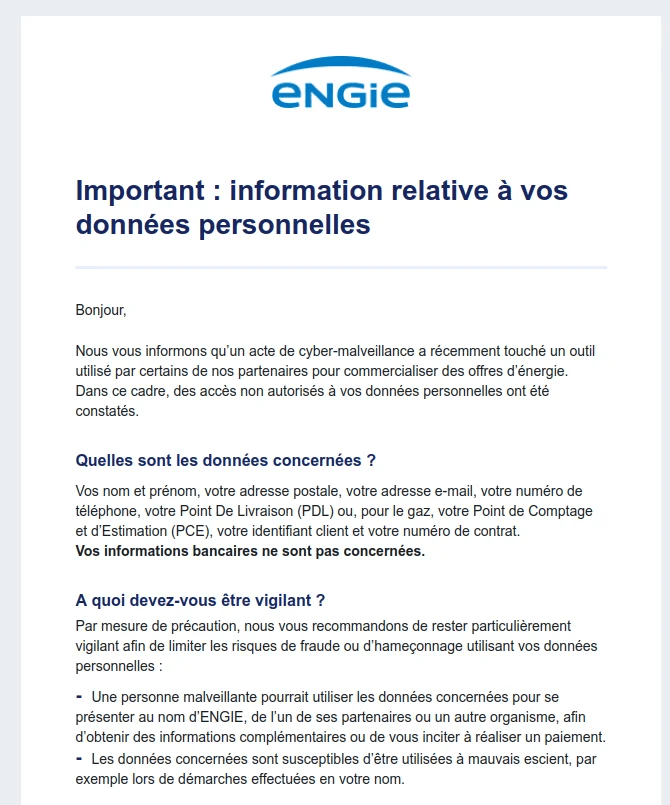
According to notification emails sent to affected customers, the incident involved a tool used by partners to sell the company’s electricity and natural gas offers.

engie

The notification confirms that attackers gained unauthorized access to personal information stored in the sales tool.

“We are informing you that an act of cyber-malice recently affected a tool used by some of our partners to market energy offers. As part of this incident, unauthorized access to your personal data was identified.” reads the notification.

The compromised information includes customers’ names, postal addresses, email addresses, telephone numbers, customer IDs, contract numbers and energy supply identifiers.

The company hasn’t disclosed the partner or platform involved. It also hasn’t revealed how many customers were affected, when the intrusion began, or when it was discovered.

For electricity customers, these include the delivery point identifier (PDL). For gas customers, they include the metering and estimation point (PCE).

ENGIE says financial information wasn’t affected and that its investigation indicates the exposure was limited to contact details and certain contract information.

That reduces one category of risk but doesn’t eliminate financial fraud. Attackers can use accurate customer information to persuade victims to disclose additional data or make payments.

Anyway, the exposed data could support impersonation scams. The company warned customers to watch for attempts to obtain further information or induce payments. A contract number, however, doesn’t prove that a caller is legitimate. It may simply show that the person has access to an exposed record.

Customers should verify unexpected requests through trusted channels, even when the sender knows their personal details.

ENGIE hasn’t attributed the attack to a specific group, and at this time no ransomware group has claimed responsibility for the attack.

Experts recommend visiting ENGIE’s official website or app directly instead of signing in through links received by email.

Customers should also be cautious with unexpected calls and messages. If someone requests a payment, password or additional personal information, they should end the exchange and verify the request using independently obtained official contact details.

Customers should never share SMS verification codes, passwords or banking details with someone who contacts them unexpectedly.

Follow me on Twitter: @securityaffairs and Facebook and Mastodon

Pierluigi Paganini

(SecurityAffairs – hacking, data breach)

Hive ransomware affiliate jailed, years after FBI infiltrated the gang’s systems

28 de Outubro de 2026, 12:27
A Ukrainian man who carried out ransomware attacks for both the Nefilim and Hive gangs, including attacks on law firms and a healthcare provider during the COVID-19 pandemic, has been sentenced to 70 months in a US prison. Read more in my article on the Hot for Security blog.
  • ✇Cyber Security News
  • Coinbase Customer Data Exposed Via Analytics Vendor Amplitude Security Incident Guru Baran
    Coinbase has disclosed that a security incident at analytics provider Amplitude exposed contact information belonging to a small subset of its customers. The cryptocurrency exchange said it found no evidence of unauthorized access to Coinbase systems and confirmed that customer funds were not impacted. In its official statement, Coinbase Support said the incident also affected other Amplitude customers. The company is notifying impacted users and regulatory agencies under its legal obligation
     

Coinbase Customer Data Exposed Via Analytics Vendor Amplitude Security Incident

28 de Outubro de 2026, 06:31

Coinbase has disclosed that a security incident at analytics provider Amplitude exposed contact information belonging to a small subset of its customers. The cryptocurrency exchange said it found no evidence of unauthorized access to Coinbase systems and confirmed that customer funds were not impacted.

In its official statement, Coinbase Support said the incident also affected other Amplitude customers. The company is notifying impacted users and regulatory agencies under its legal obligations. However, its public update did not identify the other businesses involved or explain how the exposure happened.

“Coinbase has not had a data breach,” the company said, drawing a distinction between its own systems and information held by an outside provider. That distinction matters because customer data can be exposed through a vendor without attackers gaining access to the exchange itself.

Coinbase Customer Data Exposed

Coinbase has not confirmed the number of affected customers or provided a complete list of exposed data fields. Reports have mentioned email addresses and phone numbers, but the official statement refers only to customer contact data. Readers should not treat those reported fields as a confirmed inventory.

Coinbase has not had a data breach.

Amplitude, an analytics vendor, experienced a security incident which impacted a small subset of Coinbase customer contact data, among other Amplitude customers.

We’ve found no evidence of unauthorized access to Coinbase systems, and…

— Coinbase Support (@CoinbaseSupport) October 28, 2026

Reporting by Cryptopolitan cited a claim from SlowMist security researcher 23pds that more than 70,000 users were affected. Coinbase has not verified that figure. Its statement also did not name an attacker, disclose an entry method, or establish when the Amplitude incident began.

Coinbase’s statement does not say that passwords, private keys, or transaction records were exposed. It also does not provide a detailed technical account of the incident. Those gaps make it important to separate confirmed company statements from broader claims circulating online about the event.

The Coinbase Amplitude security incident highlights third-party risk. Analytics services help businesses understand how people use their products. When customer information reaches an outside provider, the security of that provider becomes part of the wider data protection picture, even when the main platform remains secure.

This event should not be confused with the separate Coinbase data theft disclosed in May 2025. Cyber Security News reported that attackers paid overseas support personnel to obtain customer information in that earlier case. There is no established connection between that incident and the current Amplitude exposure.

Contact data alone does not provide direct access to cryptocurrency wallets. However, it can help scammers reach customers with convincing messages about account restrictions, suspicious transactions, or urgent security checks. Knowing that someone uses Coinbase can make a fake support message seem more believable and harder to dismiss.

Cyber Security News previously covered another Coinbase cyberattack involving employees targeted with fake messages. That earlier case provides context for the risks of impersonation, but it does not establish how the Amplitude incident occurred. No public evidence reviewed for this report confirms phishing caused this vendor incident.

Customers should check security notices through the Coinbase app or by visiting its website directly rather than following unexpected links. Coinbase’s support scam guidance says staff will never ask for passwords or verification codes, request remote access, or tell customers to send cryptocurrency to an external address.

The immediate concern is therefore possible follow-up fraud, not a confirmed compromise of Coinbase wallets. Affected users should review their notification for specific details and remain cautious about unsolicited contact. Further disclosures are needed to establish the full scope of the exposure, the information involved, and the cause of the incident.

The post Coinbase Customer Data Exposed Via Analytics Vendor Amplitude Security Incident appeared first on Cyber Security News.

❌
❌