Visualização normal

Ontem — 9 de Setembro de 2026Cybersecurity News
  • ✇Cybersecurity News
  • Asahi Linux M3 Support Reaches the Mainline Kernel, but GPU and Display Remain Gaps Do Son
    Asahi Linux M3 support reaches the mainline kernel with Wi-Fi and storage working, but GPU, Thunderbolt, and display remain in development. Related Posts: Linux Kernel 7.1 Reaches End of Life CERN to Move 2,200 Accelerator Control Machines to Debian 13 Debian 11 Reaches End of Long Term Support The post Asahi Linux M3 Support Reaches the Mainline Kernel, but GPU and Display Remain Gaps appeared first on Daily CyberSecurity.
     
  • ✇Security Affairs
  • North Korea-linked Hackers Hide a Backdoor Inside HAProxy Pierluigi Paganini
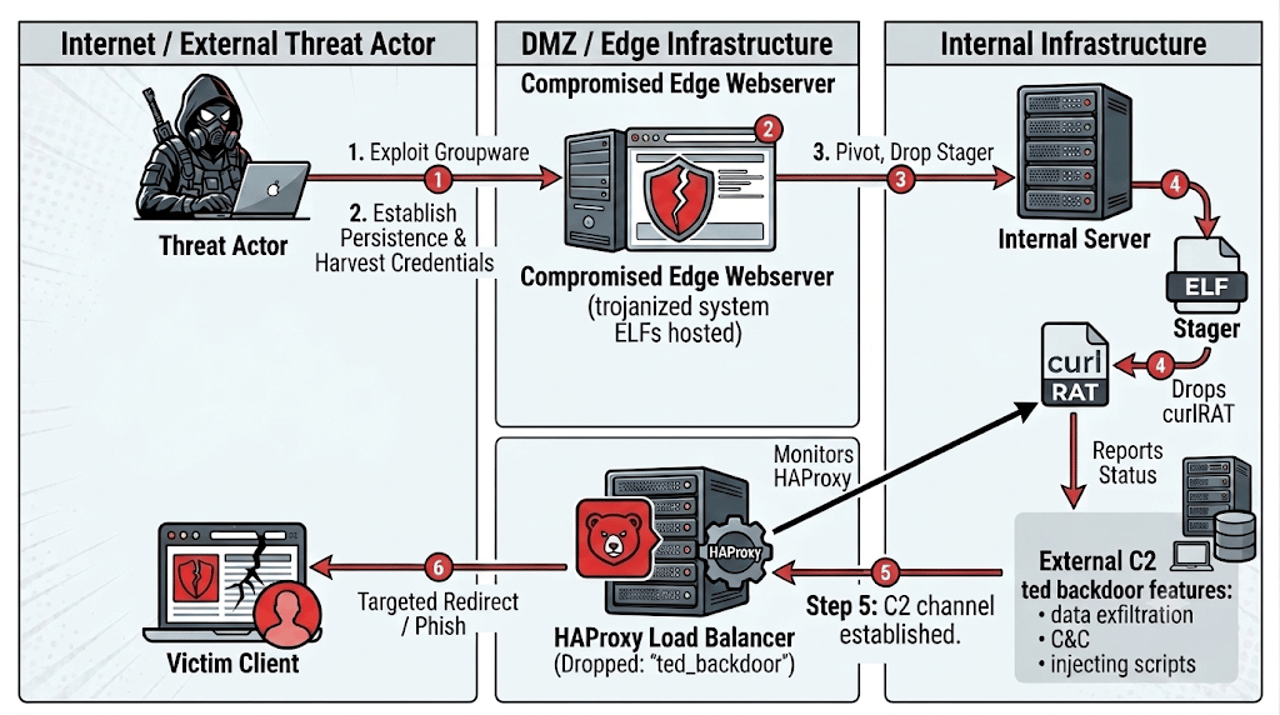
    North Korea-linked hackers hid a backdoor inside HAProxy, masking C2 traffic and stealing data while keeping the load balancer working normally. North Korean-linked hackers found a genuinely clever hiding spot for their malware: inside the actual source code of HAProxy, the load balancing software running at the edge of two South Korean companies’ networks. Rapid7’s research documents a previously undocumented Linux toolkit hitting South Korea’s automotive and media sectors, and the depth of
     

North Korea-linked Hackers Hide a Backdoor Inside HAProxy

8 de Setembro de 2026, 06:11

North Korea-linked hackers hid a backdoor inside HAProxy, masking C2 traffic and stealing data while keeping the load balancer working normally.

North Korean-linked hackers found a genuinely clever hiding spot for their malware: inside the actual source code of HAProxy, the load balancing software running at the edge of two South Korean companies’ networks. Rapid7’s research documents a previously undocumented Linux toolkit hitting South Korea’s automotive and media sectors, and the depth of integration here goes well beyond a typical backdoor bolted onto a system.

“A new Linux toolkit, identified by Rapid7 Labs, has been targeting organizations across South Korea’s automotive and media industries with minimal detection. The campaign made use of a HAProxy instance named “ted backdoor”, alongside trojanized versions of crond, agetty, atd, sshd, and polkitd.” reads the report published by Rapid7. “This previously undocumented framework enabled threat actors to execute remote commands on compromised servers, inject malicious scripts into web traffic, perform credential harvesting, and engage in long-term surveillance.”

The implant, which Rapid7 calls the “ted backdoor” based on debug strings the attackers left behind, isn’t a separate process running alongside HAProxy. It’s compiled directly into HAProxy’s own source code as a custom plugin, using the software’s native filter API, internal memory management, and event scheduler to intercept HTTP traffic while completely legitimate load balancing keeps running normally on top of it.

“The standout feature of this toolkit is its depth of integration with the target environment. The ted backdoor is compiled as part of the victim’s existing HAProxy version 2.8.12.” continues the report. “It uses its native filter API, internal memory pools, event scheduler, and process management infrastructure to intercept traffic and hide from monitoring, while genuine load balancing traffic operates as expected.”

Rapid7 explains, which is really the whole thesis of why this backdoor is so hard to spot: it’s not an addition to the software, it’s woven into it.

The backdoor receives commands through a surprisingly simple trick. The attackers send a request for a fake image at /favorite_list_2x_m500_ico.jpg. This switches the HAProxy filter into command-and-control mode.

The malware then saves the command in a named pipe and removes traces of the request from HAProxy’s internal counters. It also clears the forwarding buffers, so the request never reaches the backend server. The command ends at the load balancer, leaving nothing in the application logs to show that it happened.

This ability to erase its own traces makes the backdoor very different from a normal web shell. The C2 requests never reach the backend server and are also removed from HAProxy’s statistics.

As a result, neither the application logs nor HAProxy’s connection logs show that the attack happened. A security team checking the logs could find nothing suspicious because the backdoor has already erased the evidence.

Beyond remote command execution, the backdoor can quietly inject malicious scripts or entirely swap out page content for specific victims matched by IP address, browser fingerprint, or even a hidden authentication credential smuggled inside the Accept-Language header, effectively turning a company’s own load balancer into a watering hole against its own visitors. It also hooks response bodies carefully enough to hide the size difference caused by injected content, stripping the header that would let a browser notice the byte-range mismatch. That’s a level of protocol-level care that suggests real HAProxy internals expertise, not a quick copy-paste job.

The main backdoor also comes with a separate toolkit that modifies common Linux system daemons such as crond, agetty, atd, and sshd. These programs continue to work normally but also carry malicious features.

One component acts as an SSH keylogger. It captures passwords that administrators enter in plain text and quietly records them. Another tool, called curlRAT, contacts a remote server every 12 hours by default, or every 30 seconds when the attacker enables its fast-poll mode.

curlRAT also checks whether the system runs inside a virtual machine. If it does not find the expected signs, it refuses to run. This behavior suggests the attackers designed the malware to avoid sandboxes and other analysis environments.

Attribution here sits at medium confidence, and Rapid7 is upfront about the limits of what the evidence actually shows. The targeting pattern, simple XOR-based encryption, a custom substitution cipher, and command-server infrastructure already linked to APT37 by other threat intelligence feeds all point toward North Korean state involvement, with some technical overlap also drawing comparisons to a concurrent Lazarus Group campaign against South Korean media sites.

“Further evidence is necessary to make a more definitive assessment. Moreover, the presence of ngx_* prefixed routines within the ted backdoor suggest code reused from an nginx backdoor. The ngx_* prefixed routines were observed during the latest Funnull campaign, where (similar to our case) a custom nginx filter was registered to hook HTTP traffic, and simple XOR encryption was applied to the configuration file.” Rapid7 states. “However, other than a similar naming convention, no significant code-level overlaps exist to support a stronger linkage.”

If your organization runs HAProxy, or really any edge component handling SSL termination and traffic routing, the practical lesson here is uncomfortable but simple: that software deserves the same scrutiny as your actual application servers, not less. The Hacker News confirmed in early September that the specific command domains used in this campaign have already gone dark, returning no DNS records at all, which is useful for reviewing historical logs but does nothing to stop whatever comes next from the same operators. Checking a load balancer’s own logs isn’t enough anymore when the backdoor’s entire design goal is making sure those logs never see it in the first place.

“ted backdoor and curlRAT were designed to persist during long-term espionage operations with the ability to steal cookie sessions, credentials, redirect selected users, conduct drive-by download attacks, and hide evidence of the tampered page to a specific range of IPs to evade detection.” concludes the report. “Defenders should treat any edge component managing user traffic, SSL, or runtime modules with the same strict security standards as their main application servers. Relying on the component’s own logs is not enough; securing these systems requires independent network correlation, memory behavioral analysis, and binary integrity checks.”

Follow me on Twitter: @securityaffairs and Facebook and Mastodon

Pierluigi Paganini

(SecurityAffairs – hacking, North Korea)

Antes de ontemCybersecurity News
  • ✇Cybersecurity News
  • Linux Kernel 7.1 Reaches End of Life Do Son
    The Linux Kernel 7.1 EOL has officially arrived. Discover the final updates and learn why you must upgrade to the latest stable LTS releases immediately. Related Posts: CERN to Move 2,200 Accelerator Control Machines to Debian 13 Debian 11 Reaches End of Long Term Support Linux Nears USB4 Support for Apple Silicon The post Linux Kernel 7.1 Reaches End of Life appeared first on Daily CyberSecurity.
     

Linux Kernel 7.1 Reaches End of Life

Por:Do Son
7 de Setembro de 2026, 00:33

The Linux Kernel 7.1 EOL has officially arrived. Discover the final updates and learn why you must upgrade to the latest stable LTS releases immediately.

Related Posts:

The post Linux Kernel 7.1 Reaches End of Life appeared first on Daily CyberSecurity.

Tengu Mirai-Style Linux Bot Hides as Kernel Worker to Launch DDoS and Proxy Attacks

A newly analyzed Linux malware sample, dubbed Tengu, combines Mirai-style botnet tradecraft with broad persistence, DDoS, SSH probing, and proxy capabilities. The stripped 32-bit ELF masquerades as a Linux kernel worker process while targeting servers, embedded devices, and IoT-adjacent systems. It has no symbols, uses NX protection and partial RELRO, and carries a SHA-256 hash […]

The post Tengu Mirai-Style Linux Bot Hides as Kernel Worker to Launch DDoS and Proxy Attacks appeared first on GBHackers Security | #1 Globally Trusted Cyber Security News Platform.

  • ✇Cybersecurity News
  • CVE-2026-52924 PoC Exploit Disclosed: 9.8 CVSS Linux Root Privilege Escalation Do Son
    Security researchers released a Linux CVE-2026-52924 PoC exploit. Check flaw details and patch instructions to secure your systems against root takeovers. Related Posts: MikroTik RouterOS Vulnerability Exploited in the Wild: Patch and Defense Blueprint StyleSmuggler: Magento Zero-Day RCE Exploited in the Wild CVE-2026-75754 (CVSS 10): ASUS Control Center Root RCE The post CVE-2026-52924 PoC Exploit Disclosed: 9.8 CVSS Linux Root Privilege Escalation appeared first on Daily CyberSecurity.
     
  • ✇Cybersecurity News
  • CERN to Move 2,200 Accelerator Control Machines to Debian 13 Do Son
    CERN's Debian migration moves 2,200+ accelerator control machines off Red Hat, driven by RHEL's raised x86-64 CPU baseline. Related Posts: Debian 11 Reaches End of Long Term Support Linux Nears USB4 Support for Apple Silicon Debian AI Policy: Responsible Generative AI Use Wins Vote The post CERN to Move 2,200 Accelerator Control Machines to Debian 13 appeared first on Daily CyberSecurity.
     
  • ✇Cybersecurity News
  • Debian 11 Reaches End of Long Term Support Do Son
    Debian 11 LTS ends on August 31, 2026. Discover upgrade options and extended paid support details for enterprises still running the older Linux version. Related Posts: Linux Nears USB4 Support for Apple Silicon Debian AI Policy: Responsible Generative AI Use Wins Vote California Exempts Linux from Age Verification The post Debian 11 Reaches End of Long Term Support appeared first on Daily CyberSecurity.
     

Debian 11 Reaches End of Long Term Support

Por:Do Son
1 de Setembro de 2026, 22:18

Debian 11 LTS ends on August 31, 2026. Discover upgrade options and extended paid support details for enterprises still running the older Linux version.

Related Posts:

The post Debian 11 Reaches End of Long Term Support appeared first on Daily CyberSecurity.

  • ✇Cybersecurity News
  • Linux Nears USB4 Support for Apple Silicon Do Son
    Discover how the Asahi Linux project is successfully pushing vital USB4 protocol drivers for Apple Silicon directly into the mainline Linux kernel. Related Posts: Debian AI Policy: Responsible Generative AI Use Wins Vote California Exempts Linux from Age Verification Ubuntu 26.04.1 LTS Released with Crucial Bug Fixes The post Linux Nears USB4 Support for Apple Silicon appeared first on Daily CyberSecurity.
     

Linux Nears USB4 Support for Apple Silicon

Por:Do Son
31 de Agosto de 2026, 23:31

Discover how the Asahi Linux project is successfully pushing vital USB4 protocol drivers for Apple Silicon directly into the mainline Linux kernel.

Related Posts:

The post Linux Nears USB4 Support for Apple Silicon appeared first on Daily CyberSecurity.

  • ✇Cybersecurity News
  • Debian AI Policy: Responsible Generative AI Use Wins Vote Do Son
    Debian's AI policy vote picked "Responsible Use of Generative AI": AI is neither banned nor endorsed, with full accountability left to contributors. Related Posts: Linux Nears USB4 Support for Apple Silicon California Exempts Linux from Age Verification Ubuntu 26.04.1 LTS Released with Crucial Bug Fixes The post Debian AI Policy: Responsible Generative AI Use Wins Vote appeared first on Daily CyberSecurity.
     

Debian AI Policy: Responsible Generative AI Use Wins Vote

Por:Do Son
31 de Agosto de 2026, 10:02

Debian's AI policy vote picked "Responsible Use of Generative AI": AI is neither banned nor endorsed, with full accountability left to contributors.

Related Posts:

The post Debian AI Policy: Responsible Generative AI Use Wins Vote appeared first on Daily CyberSecurity.

  • ✇Cybersecurity News
  • PoC Published for Linux Kernel Privilege Escalation CVE-2026-52933 Flaw Do Son
    A public proof-of-concept for the CVE-2026-52933 privilege escalation flaw is available. This Linux kernel io_uring exploit carries a CVSS 7.8 score. Related Posts: CVE-2026-81934: Redis RCE PoC Exploit Now Public CVE-2026-78319: SAUTER Controller RCE Flaw Disclosed CVE-2026-82329 Exploited: JFrog Artifactory Admin Takeover The post PoC Published for Linux Kernel Privilege Escalation CVE-2026-52933 Flaw appeared first on Daily CyberSecurity.
     
  • ✇Cybersecurity News
  • California Exempts Linux from Age Verification Do Son
    California passes AB-1856, exempting open-source operating systems like Linux from the burdensome age verification mandates of the Digital Age Assurance Act. Related Posts: Debian AI Policy: Responsible Generative AI Use Wins Vote Ubuntu 26.04.1 LTS Released with Crucial Bug Fixes Framework Laptop 12: Upgraded with Intel Core Series 3 The post California Exempts Linux from Age Verification appeared first on Daily CyberSecurity.
     

California Exempts Linux from Age Verification

Por:Do Son
31 de Agosto de 2026, 04:55

California passes AB-1856, exempting open-source operating systems like Linux from the burdensome age verification mandates of the Digital Age Assurance Act.

Related Posts:

The post California Exempts Linux from Age Verification appeared first on Daily CyberSecurity.

  • ✇Cybersecurity News
  • Ubuntu 26.04.1 LTS Released with Crucial Bug Fixes Do Son
    Canonical releases Ubuntu 26.04.1 LTS, consolidating security patches and resolving critical desktop, hardware, and installation bugs for new deployments. Related Posts: Framework Laptop 12: Upgraded with Intel Core Series 3 WSL Ubuntu Installations Threaten Native Desktop Dominance Linux Kernel 7.2 Arrives with Extensive Updates The post Ubuntu 26.04.1 LTS Released with Crucial Bug Fixes appeared first on Daily CyberSecurity.
     

Ubuntu 26.04.1 LTS Released with Crucial Bug Fixes

Por:Do Son
28 de Agosto de 2026, 04:20

Canonical releases Ubuntu 26.04.1 LTS, consolidating security patches and resolving critical desktop, hardware, and installation bugs for new deployments.

Related Posts:

The post Ubuntu 26.04.1 LTS Released with Crucial Bug Fixes appeared first on Daily CyberSecurity.

  • ✇Cyber Security News
  • CISA Warns of Linux Kernel Privilege Escalation Vulnerability Exploited in Attacks Abinaya
    The U.S. Cybersecurity and Infrastructure Security Agency has added a Linux kernel vulnerability, tracked as CVE-2026-53362, to its Known Exploited Vulnerabilities catalog after confirming that attackers are exploiting the flaw in real-world attacks. The issue affects the Linux kernel’s IPv6 networking subsystem. It could allow a local attacker to gain elevated privileges on a vulnerable system. CVE-2026-53362 is currently described as an unspecified Linux kernel vulnerability. However, CI
     

CISA Warns of Linux Kernel Privilege Escalation Vulnerability Exploited in Attacks

28 de Agosto de 2026, 03:41

The U.S. Cybersecurity and Infrastructure Security Agency has added a Linux kernel vulnerability, tracked as CVE-2026-53362, to its Known Exploited Vulnerabilities catalog after confirming that attackers are exploiting the flaw in real-world attacks.

The issue affects the Linux kernel’s IPv6 networking subsystem. It could allow a local attacker to gain elevated privileges on a vulnerable system.

CVE-2026-53362 is currently described as an unspecified Linux kernel vulnerability. However, CISA said the flaw can enable privilege escalation through the IPv6 networking component.

Privilege escalation flaws are especially dangerous because an attacker with limited access to a Linux host may be able to obtain higher permissions, potentially including root-level control.

The vulnerability may affect Linux distributions and products that use the Linux kernel, including SUSE, Red Hat, and other vendor platforms.

Organizations should not assume that only these named distributions are affected, since the exposure depends on the kernel version, vendor build, configuration, and the availability of security fixes or mitigations.

Linux Kernel Privilege Escalation Vulnerability Exploited

CISA added CVE-2026-53362 to the catalog on August 27, 2026, and set a remediation deadline of August 30, 2026, for federal civilian executive branch agencies.

The agency has also marked the vulnerability as requiring forensic triage under Binding Operational Directive 26-04, indicating that affected organizations should assess whether exploitation has already occurred before or during patch application.

Although CISA has not linked the flaw to a specific ransomware operation, privilege-escalation vulnerabilities are often valuable to attackers once they have initial access.

A threat actor may exploit such weaknesses after gaining a foothold through stolen credentials, a vulnerable public-facing application, phishing, or a compromised cloud workload.

Elevated privileges can enable attackers to turn off security tools, access sensitive data, move laterally, and deploy ransomware across an environment.

CISA instructed organizations to apply mitigations in accordance with vendor guidance and to follow the risk-based security update requirements in BOD 26-04.

Where a vendor patch is unavailable, stakeholders should evaluate whether compensating controls can reduce exposure. CISA also stated that organizations should discontinue use of affected products if mitigations are not available.

Linux administrators should immediately identify internet-facing and business-critical systems running potentially affected kernel versions.

Security teams should review authentication activity, privilege changes, unexpected kernel-related errors, suspicious processes running as root, and endpoint detection alerts for signs of post-compromise activity.

Because details of exploitation remain limited, organizations should closely monitor updates from Linux distribution vendors and CISA.

The immediate priority is to determine which Linux assets rely on potentially affected kernels, apply vendor fixes, and conduct forensic triage on high-risk systems.

Prevent incidents due to slow investigations. Power your Tier 1 with threat intelligence from 15K SOCs: Integrate TI Lookup in your SOC

The post CISA Warns of Linux Kernel Privilege Escalation Vulnerability Exploited in Attacks appeared first on Cyber Security News.

  • ✇Cybersecurity News
  • CVE-2026-19042: TeamViewer Command Injection Enables Remote Code Execution Do Son
    TeamViewer patched CVE-2026-19042, a Linux command injection flaw, and a path traversal bug. Both TeamViewer vulnerabilities enable code execution. Related Posts: Critical MongoDB Security Vulnerabilities Require Immediate Patching CVE-2026-73125: Ebyte NA111-M Flaws Let Attackers Fully Compromise the Device D-Link DIR-X1860Z Flaw Lets Attackers Change the Admin Password Without Login The post CVE-2026-19042: TeamViewer Command Injection Enables Remote Code Execution appeared first on Daily C
     
  • ✇Security Affairs
  • New Mirai-Based Evooo1Bot Botnet Targets Linux Devices Pierluigi Paganini
    Evooo1Bot is a Mirai-based Linux botnet that hijacks routers and IoT devices for DDoS attacks, credential theft and criminal proxy services. Fortinet’s FortiGuard Labs disclosed Evooo1Bot in mid-August, a previously undocumented Linux botnet that’s been active since July 2026. The bot borrows Mirai‘s DDoS engine but adds encrypted command-and-control communications, an SSH brute-force scanner, a credential sniffer, and a SOCKS5 proxy module on top. “FortiGuard Labs has been tracking a pr
     

New Mirai-Based Evooo1Bot Botnet Targets Linux Devices

18 de Agosto de 2026, 04:18

Evooo1Bot is a Mirai-based Linux botnet that hijacks routers and IoT devices for DDoS attacks, credential theft and criminal proxy services.

Fortinet’s FortiGuard Labs disclosed Evooo1Bot in mid-August, a previously undocumented Linux botnet that’s been active since July 2026. The bot borrows Mirai‘s DDoS engine but adds encrypted command-and-control communications, an SSH brute-force scanner, a credential sniffer, and a SOCKS5 proxy module on top.

“FortiGuard Labs has been tracking a previously undocumented Linux botnet family, which we have named Evooo1Bot. The name derives from the hardcoded string “evooo1” found in every binary.” reads the report published by Fortinet. “While the malware reuses the DDoS engine from the publicly leaked Mirai source code, it extends the original framework with numerous capabilities, including encrypted C2 communications, an SSH brute-force scanner, a SOCKS relay module, a credential sniffer, and an integrated exploit arsenal targeting multiple known vulnerabilities.”

The botnet targets 18 known CVEs, some of them dating back to 2007, including:

  • CVE-2007-3010: Alcatel OmniPCX Enterprise Remote Code Execution Vulnerability
  • CVE-2016-6277: NETGEAR Multiple Routers Remote Code Execution Vulnerability
  • CVE-2018-14558: Tenda AC7, AC9, and AC10 Routers Command Injection Vulnerability
  • CVE-2019-14931: Mitsubishi Electric Europe B.V. ME-RTU devices and INEA ME-RTU devices remote Command Injection vulnerability
  • CVE-2020-10987: Tenda AC1900 Router AC15 Model Remote Code Execution Vulnerability
  • CVE-2021-46422: Telesquare SDT-CW3B1 Command Injection vulnerability
  • CVE-2022-37055: D-Link Routers Buffer Overflow Vulnerability
  • CVE-2024-29269, Telesquare TLR-2005KSH Command Injection Vulnerability
  • CVE-2025-10123, D-Link DIR-823X Command Injection Vulnerability
  • CVE-2025-55583: D-Link DIR-868L B1 router Command Injection Vulnerability

The bot communicates exclusively over port 443, which is intentional: the traffic blends into expected HTTPS flows at the network perimeter. After gaining initial access through one of its exploit modules or via brute-forced SSH credentials, the bot runs a loader script that clears Bash history to erase evidence of the intrusion before pulling the architecture-appropriate binary from an external server.

The breadth suggests the operators are scanning opportunistically for anything unpatched rather than targeting specific organizations.

“This capability significantly increases the value of an infected host to attackers. The victim’s IP address can be used to disguise malicious traffic, bypass geographic restrictions, or provide access to internal networks through an already compromised machine.” continues the report. “In larger botnets, the same functionality could also be used to build a distributed proxy infrastructure, enabling anonymous traffic forwarding or monetization through residential and enterprise proxy services.”

Evooo1Bot stands out because of its proxy module. A network of compromised routers, cameras, and firewalls acting as SOCKS5 relays is a valuable commodity; operators can use it themselves to obscure attack traffic, or sell access to other criminals looking for residential or enterprise IP addresses that don’t trigger geographic blocks.

“Unlike typical botnet commands that focus on downloading payloads or launching attacks, the !socks module turns an infected host into a SOCKS5 proxy that the operator can use as a network relay. It supports two operating modes. In direct mode, it opens a SOCKS5 listener on the infected host on the default TCP port 1080 and waits for incoming client connections. The implementation first attempts to create a dual-stack IPv6 listener and falls back to IPv4 if that fails. Each accepted client is then passed to the session handler for proxying.” continues the report. “The botnet also implements a reverse relay mode. Instead of exposing a listening port, the bot establishes an outbound encrypted connection to an operator-specified relay server. This persistent control channel listens for commands such as RELAY_NEW:<session_id>, which indicate that a new proxy session should be created.”

After establishing C2 contact, the bot accepts commands covering the full post-compromise toolkit: file upload and download, interactive shell access, persistence installation, binary updates, HTTP Basic Auth and Cookie header interception, DDoS over DNS, TCP, and UDP, and the HTTP exploit dispatcher.

The credential sniffer intercepts authentication headers in transit, so any HTTP Basic Auth credentials passing through an infected device can be captured without any additional effort from the operator. If you’re still running devices with unpatched firmware from the CVE list above, or if any of your edge hardware is using default SSH credentials, Evooo1Bot is already scanning for you.

“Beyond traditional botnet functionality, it features encrypted C2 communications, multiple layers of string obfuscation using AES-256-CTR, ChaCha20, and XOR-based key derivation, as well as a 28-command remote administration interface.” concludes the report. “These capabilities place Evooo1Bot well beyond the technical baseline of conventional Mirai-derived malware.”

Follow me on Twitter: @securityaffairs and Facebook and Mastodon

Pierluigi Paganini

(SecurityAffairs – hacking, Evooo1Bot botnet)

  • ✇Cyber Security News
  • CVE-2026-64561 Zapscape Lets KVM Guests Escape to Linux Host With Root Privileges Abinaya
    A Linux kernel vulnerability, tracked as CVE-2026-64561 and named Zapscape, could allow attackers to escape a KVM virtual machine and take control of its underlying Linux host with root privileges. The issue affects KVM/x86, a virtualization technology that separates guest systems from the physical server. The flaw is especially serious for cloud providers and enterprises that run untrusted workloads. Zapscape was discovered by security researcher Hyunwoo Kim, known as V4bel. It exists in
     

CVE-2026-64561 Zapscape Lets KVM Guests Escape to Linux Host With Root Privileges

7 de Agosto de 2026, 10:32

A Linux kernel vulnerability, tracked as CVE-2026-64561 and named Zapscape, could allow attackers to escape a KVM virtual machine and take control of its underlying Linux host with root privileges.

The issue affects KVM/x86, a virtualization technology that separates guest systems from the physical server. The flaw is especially serious for cloud providers and enterprises that run untrusted workloads.

Zapscape was discovered by security researcher Hyunwoo Kim, known as V4bel. It exists in KVM’s shadow memory management unit, or shadow MMU. It manages memory translations when nested virtualization is used.

Nested virtualization allows one virtual machine to run another virtual machine inside it. While useful for testing and cloud services, it creates a larger attack surface.

The vulnerability is a use-after-free bug in the recursive zap path used by KVM when reclaiming shadow pages. In simple terms, KVM can free a memory structure but later continue to use it.

Zapscape KVM Escape Grants Root Access

A malicious guest can trigger that unsafe condition from inside the guest. This can corrupt memory in the host kernel, breaking the security boundary that normally keeps a guest separate from its host.

A successful attack could have severe consequences. An attacker with kernel-level control in an L1 guest may execute commands on the KVM host as root.

That could allow data theft, service disruption, access to other virtual machines on the same server, or host control. In shared cloud environments, one compromised tenant instance could therefore put other customers at risk.

A proof-of-concept published on GitHub demonstrates the escape chain in a controlled QEMU TCG environment, resulting in a root-owned file on the host.

The researcher said it is not a ready-made cloud attack, but warned that adapting it to a real environment would not be difficult. Organizations should treat the availability of public exploits as an urgent patching signal.

The affected code was introduced in 2020 and was fixed upstream in Linux commit 2abd5287f083 on July 21, 2026. The patch changes the validation order in the shadow MMU fault path.

KVM now checks whether a root page became invalid after it makes MMU pages available. If the page was reclaimed, KVM retries the fault rather than continuing to use the invalid structure.

Risk is highest where nested virtualization is exposed to untrusted users. Guest root access is generally required for the documented escape route, which is common in infrastructure-as-a-service deployments.

Intel environments face an additional condition: both four-level and five-level EPT page-walk support must be exposed to the L1 guest. AMD systems do not have that stated condition.

Administrators should promptly install a vendor kernel containing the upstream fix and reboot affected KVM hosts. Until patching is complete, teams should disable nested virtualization for untrusted guests where operationally possible.

They should also restrict access to /dev/kvm, review host configurations, identify exposed multi-tenant systems, and monitor vendor advisories.

Zapscape shows that hypervisor patch management is essential: a single guest escape can undermine isolation across an entire server.

 Strengthen Your SOC by Accelerating Threat Detection & Rapid Investigations. -> Integrate ANY.RUN With Your SOC Now.

The post CVE-2026-64561 Zapscape Lets KVM Guests Escape to Linux Host With Root Privileges appeared first on Cyber Security News.

  • ✇Security Affairs
  • OVSwrap: 13-Year-Old Linux Kernel Flaw Lets Local Users Become Root Pierluigi Paganini
    OVSwrap is a 13-year-old Linux kernel flaw that lets local users gain root privileges on most distributions using Open vSwitch. Security researcher Asim Manizada disclosed OVSwrap (CVE-2026-64531, CVSS score of 7.8), a local privilege escalation vulnerability in the Linux kernel’s Open vSwitch datapath that lets an ordinary user become root on a wide range of default-configured distributions. The upstream fix shipped in stable trees on July 24, and a proof-of-concept exploit with pre-bui
     

OVSwrap: 13-Year-Old Linux Kernel Flaw Lets Local Users Become Root

5 de Agosto de 2026, 11:24

OVSwrap is a 13-year-old Linux kernel flaw that lets local users gain root privileges on most distributions using Open vSwitch.

Security researcher Asim Manizada disclosed OVSwrap (CVE-2026-64531, CVSS score of 7.8), a local privilege escalation vulnerability in the Linux kernel’s Open vSwitch datapath that lets an ordinary user become root on a wide range of default-configured distributions.

The upstream fix shipped in stable trees on July 24, and a proof-of-concept exploit with pre-built records for roughly 800 kernel builds is now public. If your distribution hasn’t shipped a patched kernel yet, you need to act now.

“Open vSwitch accepts a list of “actions” from userspace and validates/rewrites some of the actions into a larger internal form. These internal actions are stored as Netlink attributes, whose length field is only 16 bits wide. Now, the total internal action stream is allowed to grow past 64 KiB. But an individual nested action attribute (an attribute and all of its recursive children) still needs to fit in that 16-bit length field. Pre-fix, Open vSwitch did not check that second limit.” reads the report published by Manizada. “As a result, an attacker can submit a valid action (e.g., CLONE) containing hundreds of, say, small conntrack actions.”

The unsafe assignment behind this had been in the code for 13 years without being exploitable, held in check by a 32 KiB cap on the total generated action stream. A March 2025 change removed that cap because it was causing unpredictable failures in large OpenStack deployments, and in doing so made the old bug reachable. The enabling commit’s review thread discussed reliability and user-facing failures but never addressed the security consequence of removing the guard.

“The kernel expands those actions until the generated action is larger than 65,535 bytes, then stores that length in the 16-bit nla_len, causing it to wrap to a small value. Later code trusts the wrapped length, advances by it, and resumes parsing from the middle of the generated conntrack data.

“Critically, parts of that conntrack data – labels and timeout names – are controlled by the attacker.” the researcher continues. “Parts of that conntrack data — labels and timeout names — are controlled by the attacker. And because the wraparound redirects parsing to a deterministic offset within the same contiguous buffer, forged action headers can be placed exactly where parsing resumes. No heap grooming needed, which is why Manizada describes it as having “logic-bug-grade reliability.” Memory corruption with the predictability of a logic bug is not something defenders encounter every day.”

The exploit chains three primitives from that wraparound: a kernel pointer leak through a fake OUTPUT action, an arbitrary kernel read through a forged tunnel SET action, and a targeted decrement through teardown of a forged tunnel destination pointer.

The proof-of-concept exploit uses leaked kernel information to locate critical memory structures, bypass kernel protections, and eventually change the attacker’s user and group IDs to zero, effectively granting root privileges.

The PoC corrupts a live kernel credential, modifies /etc/sudoers or /etc/sudoers.d, and opens a root shell, leaving processes and OVS state behind deliberately to avoid unsafe teardown.

The reachability conditions are what make this broadly dangerous.

“Importantly, the attacker does not need much to reach the vulnerable code – no existing OVS bridge, no running ovs-vswitchd, no host-level CAP_NET_ADMIN. All you need is a CAP_NET_ADMIN in the user namespace that owns the network namespace*.” continues the report. “An ordinary user can therefore use an unprivileged user namespace to create a new network namespace, receive CAP_NET_ADMIN over that namespace, and create a private OVS datapath inside it with a plain unshare -Urn. This leaves many distros vulnerable in their default unprivileged-user-namespaces-enabled configuration.”

The tested list of exploitable distributions in default configuration includes AlmaLinux 9 and 10, Alpine 3.22 through 3.24, Amazon Linux 2023, Arch, CentOS Stream 9 and 10, Debian 12 and 13, Fedora 42 through 44, Kali 2026.1, Linux Mint 22.3, NixOS, openSUSE Tumbleweed, Pop!_OS, Rocky Linux 9 and 10, and Ubuntu 22.04. Ubuntu 24.04 blocks direct namespace creation via AppArmor but falls to an aa-exec fallback in the PoC; Ubuntu 26.04 is blocked by default but exploitable after disabling AppArmor’s user-namespace restriction.

Install the patched vendor kernel if one is available. If you can’t patch today and OVS isn’t required on the system, the fastest interim step is to block future module loads with echo 'install openvswitch /bin/false' > /etc/modprobe.d/ovswrap.conf — though a module already loaded in memory still needs to be removed or cleared by rebooting. Disabling unprivileged user namespaces closes the ordinary local-user route but doesn’t protect against a container process that already has CAP_NET_ADMIN over a network namespace it controls. The PoC repository also includes an emergency BPF guard for environments that must keep both OVS and namespaces active.

Follow me on Twitter: @securityaffairs and Facebook and Mastodon

Pierluigi Paganini

(SecurityAffairs – hacking, Linux)

  • ✇Cyber Security News
  • Public PoC Released for Linux Kernel Bridge Use-After-Free Vulnerability Abinaya
    A public proof-of-concept has been released for a use-after-free flaw affecting the Linux kernel’s bridge subsystem, specifically its Spanning Tree Protocol implementation in net/bridge. The issue can leave STP timers active after the bridge network device that owns them has been deleted, creating a dangerous memory-safety condition in the kmalloc-cg-8k slab cache. The use-after-free vulnerability occurs when kernel STP is enabled on an administratively down bridge and a bridge port transi
     

Public PoC Released for Linux Kernel Bridge Use-After-Free Vulnerability

6 de Agosto de 2026, 09:29

A public proof-of-concept has been released for a use-after-free flaw affecting the Linux kernel’s bridge subsystem, specifically its Spanning Tree Protocol implementation in net/bridge.

The issue can leave STP timers active after the bridge network device that owns them has been deleted, creating a dangerous memory-safety condition in the kmalloc-cg-8k slab cache.

The use-after-free vulnerability occurs when kernel STP is enabled on an administratively down bridge and a bridge port transitions to the LEARNING state.

In this condition, the kernel can arm periodic STP timers without checking the IFF_UP interface flag. These timers support the STP state machine, which prevents Layer 2 loops by managing bridge-port states and network topology changes.

Linux stores timers such as hello_timer, tcn_timer, topology_change_timer, and port-specific timers inside struct net_bridge. That structure is held in the private data area of the bridge’s net_device.

As a result, the timers must be removed before the backing network device is released. If they remain queued after the memory is freed, the kernel may later attempt to execute a timer callback through a stale memory reference.

Linux Kernel Bridge Use-After-Free Vulnerability

According to SSD Disclosure, the bug stems from different cleanup behavior between normal interface shutdown and direct bridge deletion.

During a standard UP-to-DOWN transition, the ndo_stop path reaches br_stp_disable_bridge(), which synchronously cancels STP timers through del_timer_sync(). This prevents pending callbacks from accessing released bridge data.

However, deleting a bridge via the delink path invokes br_dev_delete() and does not trigger the same STP cleanup routine. If the interface is already down, the device-unregistration process can also skip ndo_stop.

This leaves armed timers attached to a per-CPU timer base even though the associated net_device is subsequently freed. When the kernel’s timer processing routine later handles the dangling timer in softirq context, it may dereference freed memory.

Researchers noted that controlled reallocation of the released slab object could potentially turn the bug into a control-flow hijacking primitive, raising the impact beyond a crash or denial-of-service scenario.

The public PoC demonstrates the affected lifecycle and underscores the importance of timely remediation in environments that allow bridge configuration changes.

A Linux kernel patch has been introduced in commit 2a00517db8de4be7df3d483b215c5544fb30a191. Systems running kernels before that change should be treated as affected and updated via their distribution’s supported kernel packages.

Until patched kernels are deployed, administrators should restrict untrusted users’ ability to create, modify, or remove bridge interfaces and review workloads that use kernel STP.

 Strengthen Your SOC by Accelerating Threat Detection & Rapid Investigations. -> Integrate ANY.RUN With Your SOC Now.

The post Public PoC Released for Linux Kernel Bridge Use-After-Free Vulnerability appeared first on Cyber Security News.

PoC Released for Linux Kernel STP Use-After-Free Vulnerability

A proof-of-concept (PoC) has been released for a use-after-free vulnerability affecting the Linux kernel’s software bridge implementation found in `net/bridge`. This vulnerability occurs within the Spanning Tree Protocol (STP) timer lifecycle. It can result in timer structures referencing freed bridge memory, potentially allowing for control-flow hijacking. The SSD Secure Disclosure technical team disclosed the issue […]

The post PoC Released for Linux Kernel STP Use-After-Free Vulnerability appeared first on GBHackers Security | #1 Globally Trusted Cyber Security News Platform.

❌
❌