
Visualização normal

Ontem — 9 de Setembro de 2026Cybersecurity News
  • ✇Security Affairs
  • North Korea-linked Hackers Hide a Backdoor Inside HAProxy Pierluigi Paganini
    North Korea-linked hackers hid a backdoor inside HAProxy, masking C2 traffic and stealing data while keeping the load balancer working normally. North Korean-linked hackers found a genuinely clever hiding spot for their malware: inside the actual source code of HAProxy, the load balancing software running at the edge of two South Korean companies’ networks. Rapid7’s research documents a previously undocumented Linux toolkit hitting South Korea’s automotive and media sectors, and the depth of
     

North Korea-linked Hackers Hide a Backdoor Inside HAProxy

8 de Setembro de 2026, 06:11

North Korea-linked hackers hid a backdoor inside HAProxy, masking C2 traffic and stealing data while keeping the load balancer working normally.

North Korean-linked hackers found a genuinely clever hiding spot for their malware: inside the actual source code of HAProxy, the load balancing software running at the edge of two South Korean companies’ networks. Rapid7’s research documents a previously undocumented Linux toolkit hitting South Korea’s automotive and media sectors, and the depth of integration here goes well beyond a typical backdoor bolted onto a system.

“A new Linux toolkit, identified by Rapid7 Labs, has been targeting organizations across South Korea’s automotive and media industries with minimal detection. The campaign made use of a HAProxy instance named “ted backdoor”, alongside trojanized versions of crond, agetty, atd, sshd, and polkitd.” reads the report published by Rapid7. “This previously undocumented framework enabled threat actors to execute remote commands on compromised servers, inject malicious scripts into web traffic, perform credential harvesting, and engage in long-term surveillance.”

The implant, which Rapid7 calls the “ted backdoor” based on debug strings the attackers left behind, isn’t a separate process running alongside HAProxy. It’s compiled directly into HAProxy’s own source code as a custom plugin, using the software’s native filter API, internal memory management, and event scheduler to intercept HTTP traffic while completely legitimate load balancing keeps running normally on top of it.

“The standout feature of this toolkit is its depth of integration with the target environment. The ted backdoor is compiled as part of the victim’s existing HAProxy version 2.8.12.” continues the report. “It uses its native filter API, internal memory pools, event scheduler, and process management infrastructure to intercept traffic and hide from monitoring, while genuine load balancing traffic operates as expected.”
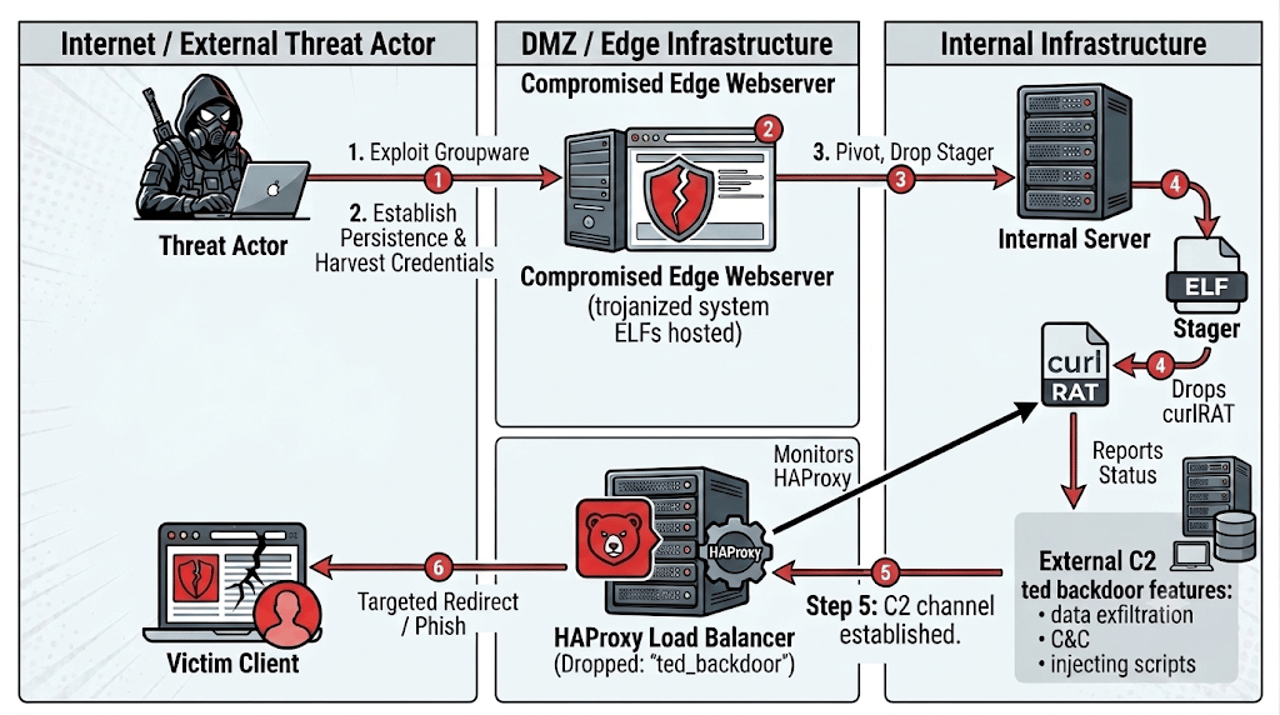
Rapid7 explains, which is really the whole thesis of why this backdoor is so hard to spot: it’s not an addition to the software, it’s woven into it.

The backdoor receives commands through a surprisingly simple trick. The attackers send a request for a fake image at /favorite_list_2x_m500_ico.jpg. This switches the HAProxy filter into command-and-control mode.

The malware then saves the command in a named pipe and removes traces of the request from HAProxy’s internal counters. It also clears the forwarding buffers, so the request never reaches the backend server. The command ends at the load balancer, leaving nothing in the application logs to show that it happened.

This ability to erase its own traces makes the backdoor very different from a normal web shell. The C2 requests never reach the backend server and are also removed from HAProxy’s statistics.

As a result, neither the application logs nor HAProxy’s connection logs show that the attack happened. A security team checking the logs could find nothing suspicious because the backdoor has already erased the evidence.

Beyond remote command execution, the backdoor can quietly inject malicious scripts or entirely swap out page content for specific victims matched by IP address, browser fingerprint, or even a hidden authentication credential smuggled inside the Accept-Language header, effectively turning a company’s own load balancer into a watering hole against its own visitors. It also hooks response bodies carefully enough to hide the size difference caused by injected content, stripping the header that would let a browser notice the byte-range mismatch. That’s a level of protocol-level care that suggests real HAProxy internals expertise, not a quick copy-paste job.

The main backdoor also comes with a separate toolkit that modifies common Linux system daemons such as crond, agetty, atd, and sshd. These programs continue to work normally but also carry malicious features.

One component acts as an SSH keylogger. It captures passwords that administrators enter in plain text and quietly records them. Another tool, called curlRAT, contacts a remote server every 12 hours by default, or every 30 seconds when the attacker enables its fast-poll mode.

curlRAT also checks whether the system runs inside a virtual machine. If it does not find the expected signs, it refuses to run. This behavior suggests the attackers designed the malware to avoid sandboxes and other analysis environments.

Attribution here sits at medium confidence, and Rapid7 is upfront about the limits of what the evidence actually shows. The targeting pattern, simple XOR-based encryption, a custom substitution cipher, and command-server infrastructure already linked to APT37 by other threat intelligence feeds all point toward North Korean state involvement, with some technical overlap also drawing comparisons to a concurrent Lazarus Group campaign against South Korean media sites.

“Further evidence is necessary to make a more definitive assessment. Moreover, the presence of ngx_* prefixed routines within the ted backdoor suggest code reused from an nginx backdoor. The ngx_* prefixed routines were observed during the latest Funnull campaign, where (similar to our case) a custom nginx filter was registered to hook HTTP traffic, and simple XOR encryption was applied to the configuration file.” Rapid7 states. “However, other than a similar naming convention, no significant code-level overlaps exist to support a stronger linkage.”

If your organization runs HAProxy, or really any edge component handling SSL termination and traffic routing, the practical lesson here is uncomfortable but simple: that software deserves the same scrutiny as your actual application servers, not less. The Hacker News confirmed in early September that the specific command domains used in this campaign have already gone dark, returning no DNS records at all, which is useful for reviewing historical logs but does nothing to stop whatever comes next from the same operators. Checking a load balancer’s own logs isn’t enough anymore when the backdoor’s entire design goal is making sure those logs never see it in the first place.

“ted backdoor and curlRAT were designed to persist during long-term espionage operations with the ability to steal cookie sessions, credentials, redirect selected users, conduct drive-by download attacks, and hide evidence of the tampered page to a specific range of IPs to evade detection.” concludes the report. “Defenders should treat any edge component managing user traffic, SSL, or runtime modules with the same strict security standards as their main application servers. Relying on the component’s own logs is not enough; securing these systems requires independent network correlation, memory behavioral analysis, and binary integrity checks.”

Follow me on Twitter: @securityaffairs and Facebook and Mastodon

Pierluigi Paganini

(SecurityAffairs – hacking, North Korea)

Antes de ontemCybersecurity News
  • ✇Graham Cluley
  • Smashing Security podcast #482: This hacker leaked GTA 6 – and launched their own cryptocurrency Graham Cluley
    A hacker calling themselves "CYBERLEEK" has been leaking gameplay footage from GTA 6 ahead of its official reveal this week - but they're not asking Rockstar Games for a ransom. Instead, they've launched their own cryptocurrency, promising to release ever more juicy clips from a virtual strip club... Meanwhile, your smart TV might be doing more than binge-watching Netflix while you sleep. We explore the shadowy world of "residential proxies" - how they end up inside home routers, smart TVs, a
     

Smashing Security podcast #482: This hacker leaked GTA 6 – and launched their own cryptocurrency

26 de Agosto de 2026, 20:10
A hacker calling themselves "CYBERLEEK" has been leaking gameplay footage from GTA 6 ahead of its official reveal this week - but they're not asking Rockstar Games for a ransom. Instead, they've launched their own cryptocurrency, promising to release ever more juicy clips from a virtual strip club... Meanwhile, your smart TV might be doing more than binge-watching Netflix while you sleep. We explore the shadowy world of "residential proxies" - how they end up inside home routers, smart TVs, and IoT devices, and why an entire criminal economy is quietly running through your internet connection. All this and more in episode 482 of the "Smashing Security" podcast with cybersecurity expert and keynote speaker Graham Cluley, and special guest Paul Ducklin.

OctLurk and SilkLurk Windows Backdoors Target Governments in 6 Countries

Kaspersky links OctLurk and SilkLurk to cyberespionage attacks stealing passwords, emails and files from government systems in six countries since January 2025.

H96 Android TV Boxes Used for Ad Fraud and Residential Proxies

Bitsight found Fuyao software on H96 Android TV boxes, letting operators fake ad clicks and route proxy traffic through their owners' home internet connections.

Residential Proxy Risks: Understanding Google’s Latest Action Against 2 Million Strong NetNut

3 de Julho de 2026, 09:00

Google announced that it helped take down NetNut, a 2 million strong malicious residential proxy network. The incident highlights the growing risks posed by residential proxy networks that quietly conscript consumer devices into services used by cybercriminals and nation-state actors alike.

The post Residential Proxy Risks: Understanding Google’s Latest Action Against 2 Million Strong NetNut appeared first on The Security Ledger with Paul F. Roberts.

FBI Seizes NetNut Domains as Google Disrupts 2M Device Proxy Network

FBI and Google disrupt NetNut after domains linked to its residential proxy network are seized, exposing abuse of 2 million TVs and streaming devices worldwide.
  • ✇Security Affairs
  • Squidbleed: 29-Year-Old Squid Bug Leaks User Credentials Pierluigi Paganini
    Squidbleed is a 29-year-old Squid Proxy flaw that can leak credentials, tokens, and other users’ HTTP data through a memory overread. Researchers at Calif.io have disclosed CVE-2026-47729, a memory leak vulnerability in Squid Proxy that was introduced in 1997 and has remained undetected through nearly three decades of releases, audits, and rewrites. They named it Squidbleed because it works like Heartbleed: it causes the proxy to read past the end of a memory buffer and hand the contents to
     

Squidbleed: 29-Year-Old Squid Bug Leaks User Credentials

23 de Junho de 2026, 04:09

Squidbleed is a 29-year-old Squid Proxy flaw that can leak credentials, tokens, and other users’ HTTP data through a memory overread.

Researchers at Calif.io have disclosed CVE-2026-47729, a memory leak vulnerability in Squid Proxy that was introduced in 1997 and has remained undetected through nearly three decades of releases, audits, and rewrites. They named it Squidbleed because it works like Heartbleed: it causes the proxy to read past the end of a memory buffer and hand the contents to whoever asked.

“The bug occurs when no filename is provided after the modification timestamp.” reads the report published by the researchers. “Here’s such an example:

d [R----F--] supervisor            512       Jan 16 18:53

In that case, *copyFrom is the null terminator at the end of the string.

However, instead of returning NULL and breaking out of the loop, strchr returns a pointer to the null terminator, as it is considered part of the string. This causes ++copyFrom to be executed and the cycle repeats until a non-null, non-whitespace byte is reached.

The pointer then walks forward past the buffer boundary until it hits a non-null, non-whitespace byte, and whatever it finds there gets sent back to the attacker as a filename. The fix is two characters: check that *copyFrom isn’t null before calling the function strchr. One line of C, twenty-nine years of exposure.

The bug resides in Squid’s FTP directory listing parser, specifically in code written to handle NetWare FTP servers, which used four spaces between the timestamp and filename instead of one.

“The data starting from that byte, possibly belonging to another Squid Proxy user, is then returned to the attacker as the name of a file in the directory listing.” continues the report. “Since FTP support is enabled out of the box, and port 21 is included in the default Safe_ports ACL, no special flags or non-default settings are needed. The attacker only needs to control an FTP server reachable from the proxy.”

Squid is common in multi-user environments, corporate networks, schools, public Wi-Fi, and the researchers even spotted it running on an in-flight Wi-Fi system, on a version released nearly a decade ago.

What actually leaks is the contents of other users’ HTTP requests. Squid manages memory through per-size recycled buffer pools and doesn’t zero them when they’re freed.

“The line buffer used to parse FTP listings is allocated from MEM_4K_BUF. If that buffer previously held a victim’s HTTP request, only the first few dozen bytes are overwritten by the short FTP line — the rest of the 4KB buffer still contains the victim’s stale data.” states the report. “The strchr overread walks right past the null terminator and sends it all to the attacker.”

The researchers demonstrated it by leaking an Authorization header from a login page. Credentials, session tokens, API keys — anything that travels in a cleartext HTTP request through the shared proxy is in scope.

The exposure is limited. The researchers pointed out that standard HTTPS connections routed as opaque CONNECT tunnels aren’t affected, and the attacker needs to reach an FTP server from the proxy. But in corporate and legacy environments, sensitive data in cleartext HTTP isn’t unusual.

The researchers confirmed that they used Claude Mythos Preview to find the bug. When pointed at Squid’s FTP state machine, it identified the strchr null terminator behavior almost immediately, citing the exact C11 standard clause that makes strchr(w_space, '\0') return non-null. Few human reviewers would catch that. It also recently found a high-severity OpenSSL vulnerability and the HTTP/2 Bomb denial-of-service technique, both through the same AI-assisted approach.

A patch was merged into Squid version 8 in April 2026 and shipped in version 7.6 in June 2026. If you can’t patch immediately, disabling FTP support removes the attack surface entirely. Chrome dropped FTP years ago, and most organizations running Squid are getting close to zero legitimate FTP traffic, turning it off costs nothing. FTP parsing might not be the only place where Squid forgot to stop reading.

“The dangers of raw memory access in C are well understood, but the subtleties of standard library functions like strchr are easier to overlook. Few developers would guess that searching for '\0' succeeds, which may explain how a one-line bug survived close to 30 years of code review.” concludes the report. “Claude Mythos Preview, having trained on the entire C standard reference, treats this quirk as just another fact. When pointed at the right code, it spotted the bug almost immediately.”

Below is a video PoC of the attack along with PoCs.

Follow me on Twitter: @securityaffairs and Facebook and Mastodon

Pierluigi Paganini

(SecurityAffairs – hacking, TPWD)

Anonymizing Network Traffic: A Dive into SOCKS5 and Data Encryption

SOCKS5 protocol explained: anonymize traffic, boost security with encryption, bypass restrictions, and enable reliable data collection for business use.

What Is an LLM Proxy and How Proxies Help Secure AI Models

Explore how LLM proxies secure AI models by controlling prompts, traffic, and outputs across production environments and exposed APIs.

The post What Is an LLM Proxy and How Proxies Help Secure AI Models appeared first on Security Boulevard.

❌
❌