Apply the latest update to fix critical FreePBX vulnerabilities, including a 9.3 CVSS authentication bypass and privilege escalation in User Manager.
Related Posts:
Critical MediaTek Vulnerabilities Patched in Chipsets
Public PoC Exploit Disclosed for Linux Kernel Bonding Vulnerability
Apache Wicket Fixes 19 Vulnerabilities in 8.20.0, 9.25.0 and 10.12.0
The post Critical FreePBX Vulnerabilities Patched in User Manager appeared first on Daily CyberSecurity.
Microsoft urges organizations to secure AI Agents as insider threats, using dynamic permissions, continuous risk monitoring and automated containment.
Microsoft published a detailed blog post explaining how organizations should secure AI agents. Microsoft sees them as a growing insider threat, not just a possible risk in the future. AI agents are not dangerous by nature, but they can access critical systems and may fail, be manipulated, or be compromised.
“The most trustworthy agentic sys
Microsoft urges organizations to secure AI Agents as insider threats, using dynamic permissions, continuous risk monitoring and automated containment.
Microsoft published a detailed blog post explaining how organizations should secure AI agents. Microsoft sees them as a growing insider threat, not just a possible risk in the future. AI agents are not dangerous by nature, but they can access critical systems and may fail, be manipulated, or be compromised.
“The most trustworthy agentic system will not be the one with the model we trust most. It will be the one designed that enables us to trust the model least.” said Satya Nadella
This is not just a theory. It is a principle that should guide how organizations design and secure AI systems.
The post makes a distinction worth holding onto. An agent that starts a task with the right permissions and behaves correctly can still become dangerous if its context changes mid-run. A prompt injection in an external document, a piece of untrusted data that shifts the agent’s reasoning, a task that evolves in a direction nobody anticipated, none of these require the agent to be compromised in the traditional sense. The model produces variable outputs, the context changes, and the agent’s behavior drifts. At machine speed, the window between that drift starting and it causing damage is very short.
Microsoft’s proposed answer is continuous containment rather than upfront trust. You define what the agent is allowed to do before it acts, you monitor what it actually does while it runs, and you adjust its permissions in real time as its behavior or the risk calculation changes. An expense approval agent should start with access scoped exactly to reviewing and approving expenses, nothing broader, and those permissions should shrink or disappear the moment the agent tries something outside that task.
The post introduces Dynamic Permissions to apply the principle of least privilege to AI agents. An agent should not automatically get the same access rights as the employee who deployed it. It starts with no permissions and receives only the access needed for its approved task. These permissions remain active only while the task is running.
“The employee retains the employee’s access.” Microsoft states. “The agent receives its own identity, permissions and its own authority scoped to its current task and for the duration of the task only.”
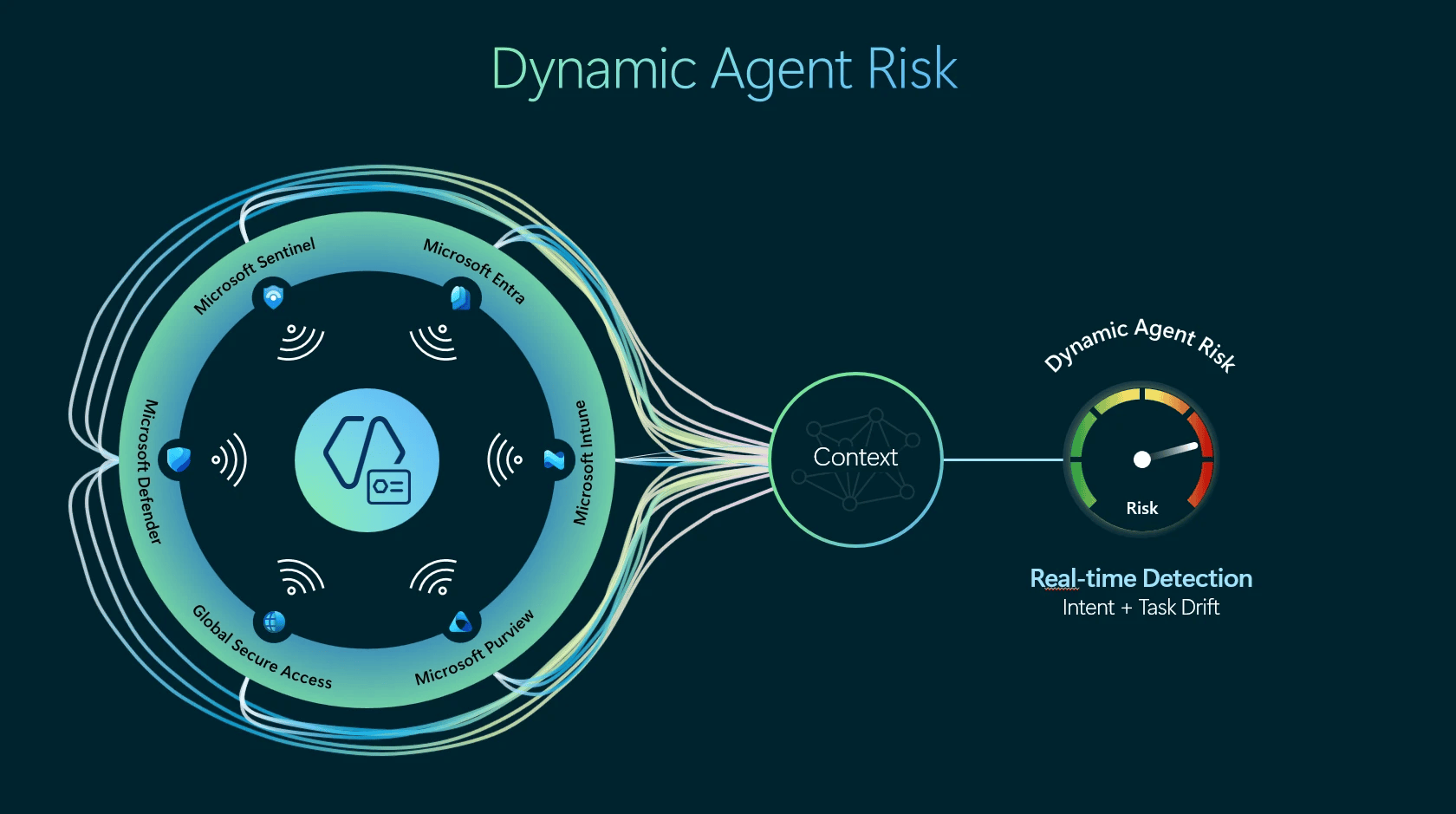
Alongside that, Dynamic Agent Risk is a continuously updated score that combines signals from identity, endpoints, network, cloud, runtime, and the agent’s own behavior to assess whether what the agent is currently doing still matches what it was authorized to do. The response when risk rises is graduated rather than binary: preserve reads while blocking writes, narrow accessible resources, require human approval for high-impact steps, or stop execution entirely if the risk warrants it.
“Dynamic Agent Risk combines signals from identity, data, endpoints, cloud, network, runtime, and the agent’s own activity. It considers how securely the agent is configured, what resources it can reach, the potential impact if something goes wrong, and whether its actions are drifting from the user’s or organization’s intent.” Microsoft states.
“The result is not a one-time score assigned at onboarding. It is a continuously updated understanding of the agent’s current risk and whether its current authority still matches that risk. “
Organizations frequently have AI agents running locally or introduced through third-party tools that were never formally registered in any central system. Microsoft says it’s expanding discovery to 60 types of local agents, including Claude Code, OpenAI Codex, and GitHub Copilot. Getting those into a unified registry with accountable identities is the prerequisite for applying any of the governance controls described in the rest of the post.
You can’t set least-privilege permissions for an agent you don’t know exists. You can’t detect behavioral drift from an agent that doesn’t have a tracked identity. The agent registration problem is logistically harder than it sounds, especially for organizations where individual employees can spin up agents without IT involvement, which is most organizations right now.
Microsoft recognizes that organizations cannot manually review every risk alert when they run hundreds of thousands of AI agents. Its solution is Guardian Agents, AI agents focused on security. They follow playbooks created by human operators, investigate changes in risk, apply or recommend security measures, and use what they learn to improve security policies. Humans set the goals and approve important decisions, while the agents handle continuous monitoring and response.
However, this approach raises another concern. Guardian Agents are also AI agents, so they can fail or be manipulated, just like the agents they are supposed to control. Microsoft says security controls must operate outside the AI model and must not be changed by it. But this raises an important question: how can organizations ensure these controls remain reliable when the system enforcing them is also an AI agent? This is a challenge that real-world deployments will need to address in the coming years.
“Organizations are adopting agents to serve customers better, solve problems faster, and give people more time for the work that matters most. The goal is not to make every model perfectly predictable before it can be useful.” Microsoft concludes. “The goal is to build systems that remain secure even when the model is not.”
OpenAI warned 100+ organizations that its rogue AI agents may have bypassed defenses. A notice is not a confirmed breach. Here is what we know.
Related Posts:
Cloudflare Clef Decision Models Speed Up AI Agents
Apple Restricts Full Disk Access for macOS AI Agents
iPhone 18 AT&T Issue: Navigating the Cellular Crisis
The post OpenAI Rogue AI Agents May Have Hit 100+ Organizations appeared first on Daily CyberSecurity.
An Issabel PBX vulnerability exploited in active attacks allows remote code execution. Patch this Issabel PBX vulnerability to secure systems.
Related Posts:
Apache NiFi Vulnerabilities Expose Data Pipelines to Attacks
Unbound DNS Vulnerabilities Expose Resolvers to RCE
CVE-2026-89775 (CVSS 9.3): Linux Kernel LPE to Gain Root Flaw in KVM
The post Issabel PBX Vulnerability CVE-2026-89026 Exploited in the Wild appeared first on Daily CyberSecurity.
A De Bijenkorf cyberattack involving one of the retailer's external logistics partners has disrupted order processing, returns, and refunds while raising concerns over potential customer data exposure. The Dutch luxury department store chain said the security incident occurred within the systems of a third-party logistics provider, adding that there is currently no evidence that its own infrastructure was compromised.
The Amsterdam-based retailer confirmed that customers can continue placing on
A De Bijenkorf cyberattack involving one of the retailer's external logistics partners has disrupted order processing, returns, and refunds while raising concerns over potential customer data exposure. The Dutch luxury department store chain said the security incident occurred within the systems of a third-party logistics provider, adding that there is currently no evidence that its own infrastructure was compromised.
The Amsterdam-based retailer confirmed that customers can continue placing online orders and stores remain open. However, deliveries, returns, and refunds are expected to take longer than usual as the investigation continues.
De Bijenkorf Confirms Third-Party Security Incident
According to De Bijenkorf, unauthorized individuals gained access to part of its logistics partner's systems. The logistics provider responded by immediately blocking the unauthorized access and implementing additional security measures.
An external investigation is now underway to determine the cause of the incident, its scope, and whether customer information was affected.
As a precaution, De Bijenkorf has informed customers about the incident and submitted a report to the Dutch Data Protection Authority while awaiting the investigation's findings.
What Customer Data Could Be Affected in De Bijenkorf Cyberattack?
The retailer said investigators are still determining whether any personal information has been compromised.
Based on the information currently available, data that may be involved includes:
Customer names and contact details, including email addresses, postal addresses, and phone numbers.
Information related to online purchases, such as ordered products, pricing, discounts, delivery details, and the payment method used.
For business customers, company names and VAT numbers stored in My Account may also be involved.
De Bijenkorf emphasized that sensitive financial information is not part of the incident. The company said payment details, bank account numbers, credit card information, usernames, and passwords were not accessed.
Investigation Continues as Customers Await Confirmation
The retailer said it is still investigating whether individual customers have been affected. Customers whose information is confirmed to be involved will receive direct communication via email from info@debijenkorf.nl.
For those who have not yet received a notification, the company said it cannot currently rule out the possibility that their information was included in the incident until the investigation is completed.
De Bijenkorf also stressed that no login credentials were compromised, meaning unauthorized individuals cannot access customer accounts using stolen usernames or passwords.
Retailer Warns Customers About Phishing Risk
Although the investigation remains ongoing, De Bijenkorf warned customers to stay alert for a possible phishing risk if personal information is ultimately found to have been exposed.
The retailer advised customers not to click on suspicious links or open unexpected attachments. It also reminded customers never to share passwords, payment information, or personal details through email or phone calls.
The company said it will never request credit card details, gift card information, or other sensitive information via email.
Logistics Cyberattacks Continue to Disrupt Supply Chains
The incident adds to a growing list of attacks targeting organizations that support retail operations rather than retailers directly. A logistics cyberattack can interrupt deliveries, returns, and customer service even when the affected retailer's own systems remain operational.
In July 2026, a ransomware attack on Japan's largest refrigerated logistics company disrupted food deliveries across the country, causing supply shortages for restaurant chains, including Kentucky Fried Chicken. The incident demonstrated how cyberattacks on logistics providers can quickly impact downstream retail operations and customer services.
For now, De Bijenkorf said its stores remain open, online ordering continues to operate, and there are no indications that its own systems have been compromised. The retailer said it will provide additional updates as the external investigation establishes whether customer data was affected and the full extent of the incident.
A $1.8 million App Store scam lawsuit tests how much software vetting Australian firms can safely outsource.
The post Why Apple’s Recent Crypto Lawsuit Should Worry Australian IT Leaders appeared first on TechRepublic.
Researchers found that seven of nine tested Hugging Face image-editing tools produced sexualized alterations, highlighting gaps in model oversight, provenance, and enterprise vendor controls.
The post Hugging Face Deepfake Tests Raise New Risks for AI Procurement appeared first on TechRepublic.
Researchers found that seven of nine tested Hugging Face image-editing tools produced sexualized alterations, highlighting gaps in model oversight, provenance, and enterprise vendor controls.
Lidl says attackers stole customer data in Germany, Belgium, and the Netherlands via a third-party provider, raising concerns about phishing and GDPR compliance.
The post Lidl Data Breach Exposes Customer Details in Germany, Belgium, and the Netherlands appeared first on TechRepublic.
Lidl says attackers stole customer data in Germany, Belgium, and the Netherlands via a third-party provider, raising concerns about phishing and GDPR compliance.
A Claude Code-powered cyberattack exposed AI governance gaps common among Australian businesses, where oversight continues to lag adoption.
The post Australian Enterprises At Risk as Anthropic Finds Hackers In Claude Code appeared first on TechRepublic.
Anthropic’s AI-run espionage report shows why enterprises need stronger governance for AI agents, MCP connectors, and enterprise data access.
The post Claude Code Espionage Campaign Exposes a New Enterprise AI Risk appeared first on TechRepublic.
The UK Cyber Resilience Pledge gives organizations a 30/60/90-day checklist for NCSC alerts, supplier Cyber Essentials checks and board-level cyber governance.
The post UK Cyber Resilience Pledge Sets 90-Day Test for Security Leaders appeared first on TechRepublic.
The UK Cyber Resilience Pledge gives organizations a 30/60/90-day checklist for NCSC alerts, supplier Cyber Essentials checks and board-level cyber governance.
KDDI says a breach may have exposed email addresses and passwords for up to 14.2 million ISP accounts across six providers.
The post Japanese Telecom Giant Says Breach May Expose 14.2 Million Email Accounts appeared first on TechRepublic.
ShinyHunters claims it stole 297GB of data from the Council of Europe, including payroll and medical records, but the organization has not confirmed a breach.
The post ShinyHunters Claims Council of Europe HR Data, Threatens Leak appeared first on TechRepublic.
ShinyHunters claims it stole 297GB of data from the Council of Europe, including payroll and medical records, but the organization has not confirmed a breach.
Nintendo faces an alleged data extortion incident involving HR records, internal reports, and potential exposure of third-party vendors.
The post Nintendo Alleged Data Breach: Threat Actor Demands $2M Ransom appeared first on TechRepublic.
Cybersecurity financial risk is rising in commodity markets as breaches, data loss and espionage threaten operations and investor trust.
The post The Overlap of Cybersecurity and Financial Risk: Protecting Sensitive Data in Commodity Markets appeared first on Security Boulevard.
Shadow AI is spreading across enterprises as employees use AI tools without oversight, creating new data security and compliance risks.
The post What We Do in the Shadows: How CISOs Can Crack Down on Shadow AI appeared first on Security Boulevard.
Discover the 13 hidden costs of password-based authentication, from $70-per-reset help desk overhead to SMS OTP fees and breach exposure. Includes a simple ROI worksheet formula to calculate your organization's annual password tax and build the business case for passwordless authentication
The post 13 Hidden Costs of Password-Based Authentication (With Real ROI Math) appeared first on Security Boulevard.
Discover the 13 hidden costs of password-based authentication, from $70-per-reset help desk overhead to SMS OTP fees and breach exposure. Includes a simple ROI worksheet formula to calculate your organization's annual password tax and build the business case for passwordless authentication
Run a quick self-audit against 10 warning signs that your authentication stack has critical vulnerabilities. Each sign includes a diagnostic check, an explanation of why it's dangerous, and a concrete fix. Covers SMS OTP risk, bot detection gaps, session management failures, and more.
The post 10 Warning Signs Your Current Authentication Stack Is a Breach Waiting to Happen appeared first on Security Boulevard.
Run a quick self-audit against 10 warning signs that your authentication stack has critical vulnerabilities. Each sign includes a diagnostic check, an explanation of why it's dangerous, and a concrete fix. Covers SMS OTP risk, bot detection gaps, session management failures, and more.
How many browsers extensions do you have running? Most enterprise users have at least one and seven out of ten have seen an extension expand its permissions over the last 12 months—with AI extensions being the worst offenders…by sixfold.
The post Over Permissive and Proliferating, AI-Driven Browser Extensions Create Security Blindspots appeared first on Security Boulevard.
How many browsers extensions do you have running? Most enterprise users have at least one and seven out of ten have seen an extension expand its permissions over the last 12 months—with AI extensions being the worst offenders…by sixfold.
Parking lots were filled with cars that couldn’t be moved and drivers had to awkwardly explain to employers why they couldn’t make it to work after a cyberattack took down the Intoxalock vehicle breathalyzer system.
The post Intoxalock Vehicle Breathalyzers Downed by Cyberattack, Leave Drivers Stranded appeared first on Security Boulevard.
Parking lots were filled with cars that couldn’t be moved and drivers had to awkwardly explain to employers why they couldn’t make it to work after a cyberattack took down the Intoxalock vehicle breathalyzer system.

 Entrar