
 Entrar
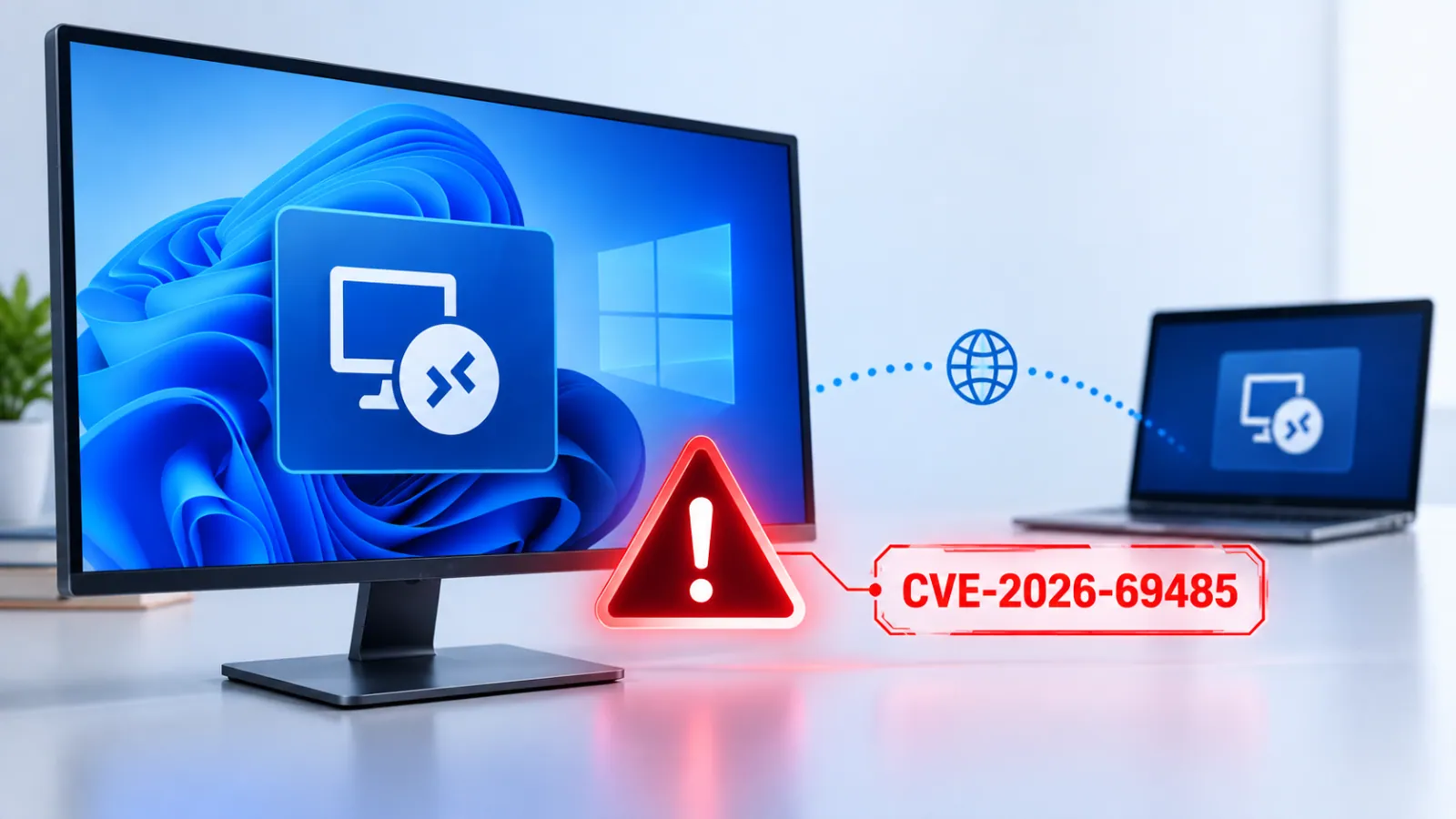

Windows Remote Desktop Client Vulnerability Allows Attackers to Execute Remote Code
Microsoft has released security updates for CVE-2026-69485, an Important-rated remote code execution vulnerability affecting the Windows Remote Desktop Client.
The flaw could allow an authenticated attacker with low privileges to execute code on an affected server by sending a specially crafted network request.
The vulnerability was disclosed on September 8, 2026, and is tracked as CVE-2026-69485. Microsoft assigned it a CVSS 3.1 base score of 8.8, while the temporal score is 7.7.
The issue has a network attack vector, low attack complexity, requires low privileges, and does not need user interaction. Microsoft said the flaw stems from the Remote Desktop Client using an uninitialized resource.
Uninitialized resources can cause software to use memory, handles, or other system objects before they are properly prepared. In this case, an attacker may trigger the faulty condition through a crafted network request and gain the ability to run code.
Windows Remote Desktop Client Vulnerability
Remote code execution flaws are highly significant because they can give attackers control over vulnerable systems. Successful exploitation could affect the targeted device’s confidentiality, integrity, and availability.
Depending on the permissions available to the compromised account, an attacker could access sensitive data, modify files or system settings, install additional tools, or disrupt services.
According to Microsoft’s advisory, exploitation requires an attacker to first authenticate with low-level access to an affected server. The attacker could then send a specially crafted request to execute code on that server.
The attack does not require a user to click a link, open a file, or approve a prompt, reducing opportunities for defenders to stop it through user awareness controls alone.
Microsoft’s initial assessment states that the vulnerability was not publicly disclosed before the security update and has not been detected in active exploitation.
The company rates exploitation as “Exploitation Less Likely” at the time of publication. However, organizations should treat the finding as a priority because public patch releases can help threat actors study the vulnerability and develop working exploit techniques.
The affected products include Windows Server 2016, Windows Server 2019, Windows Server 2022, and Windows Server 2025, including Server Core installations.
Microsoft also listed several Windows client editions, including Windows 10 versions 1607, 1809, 21H2, and 22H2, along with Windows 11 versions 23H2, 24H2, 25H2, and 26H1 for supported x64 and ARM64 systems.
Administrators should deploy Microsoft’s September security updates as soon as possible.
| KB Update | Windows Version |
|---|---|
| KB5123099 | Windows Server 2016 / Windows 10 1607 |
| KB5122876 | Windows Server 2019 / Windows 10 1809 |
| KB5122882 | Windows Server 2022 |
| KB5122878 | Windows 10 21H2 / 22H2 |
| KB5122880 | Windows 11 23H2 |
| KB5124008 | Windows 11 24H2 / 25H2 |
| KB5124012 | Windows 11 26H1 |
| KB5122871 | Windows Server 2025 |
Security teams should also review Remote Desktop exposure, restrict RDP access to trusted networks, enforce least-privilege access, and monitor authentication and Remote Desktop logs for unusual activity. Microsoft credited security researchers yhw and txz for reporting the vulnerability through coordinated disclosure.
Learn 7 Metric-Gated AI SOC Deployment Phases – Download Free AI SOC Deployment Playbook 2026.
The post Windows Remote Desktop Client Vulnerability Allows Attackers to Execute Remote Code appeared first on Cyber Security News.


