❌

Visualização normal

Ontem — 8 de Novembro de 2026Security Affairs
  • ✇Security Affairs
  • Inside ARTEX: AI Hacking Tools, Exposed Servers and South Korean Bank Breaches Pierluigi Paganini
    Hunt.io traced ARTEX servers and AI-powered hacking tools used in breaches affecting seven South Korean financial institutions. Between late September and early October 2026, seven South Korean financial institutions had data breached through internet-facing systems. About 66,000 to 67,000 people and around 2,200 corporations were affected, and personal, employment, income and loan data was exposed. Hunt.io dug into the infrastructure behind the campaign, and its findings add a lot to what C
     

Inside ARTEX: AI Hacking Tools, Exposed Servers and South Korean Bank Breaches

7 de Novembro de 2026, 16:56

Hunt.io traced ARTEX servers and AI-powered hacking tools used in breaches affecting seven South Korean financial institutions.

Between late September and early October 2026, seven South Korean financial institutions had data breached through internet-facing systems. About 66,000 to 67,000 people and around 2,200 corporations were affected, and personal, employment, income and loan data was exposed. Hunt.io dug into the infrastructure behind the campaign, and its findings add a lot to what CrowdStrike and Genians already published.

CrowdStrike reported on October 7 and Genians Security Center on October 12, and both pointed to ARTEX, an open-source autonomous penetration testing framework developed in China and licensed under AGPL-3.0. CrowdStrike assessed with moderate confidence that a single Chinese-speaking individual motivated by money ran it, and not an established threat group. DeepSeek v4.1 Flash was the main model, with GLM 5.3 and Grok 4.6 as backups, reached partly through a reseller domain, xcai[.]pro.

The public indicators were a server at 38.244.50[.]120, which hosted the ARTEX console, plus a Hong Kong address and nine proxies. Genians said the ARTEX GitHub repository and Docker image were removed on October 11, though forks and mirrors remain.

“CrowdStrike assessed with moderate confidence that the operator was a single Chinese-speaking individual motivated by financial gain rather than an established threat group.” reads the report published by Hunt.io. “The infrastructure reportedly accessed these services in part through the reseller domain xcai[.]pro. Both reports described a two-server configuration, consisting of a Hong Kong-based IP address used as primary infrastructure and 38.244.50[.]120, which hosted the ARTEX console.”

Hunt.io notified the relevant national CERT before publishing, and says the report holds no personal records or credentials.

The company’s own scanning showed 38.244.50[.]120 sits on Cogent’s network in Los Angeles, with 15 open ports. The ARTEX login page, with a Chinese title meaning “autonomous penetration testing console”, appears on ports 443 and 8090. Other services include a Gemini2API admin console and a Tinyproxy server.

Searching its AttackCapture platform for that address, Hunt.io found another open directory at 23.248.226[.]250, a jump server in Hong Kong on AS138415. It held 42 files in 2 subdirectories, 105 MB in all, and the platform had logged warnings on September 5, September 26 and October 5. A file in it names 38.244.50[.]120 as the jump host, and its own comment tells the operator never to paste the credentials into a session. It sat in an open directory.

Three scripts back up the link. They keep reverse SSH tunnels alive, run a local relay, and copy files to the jump host, one tunnel is named grok2api, and the credentials file also holds keys for Zhipu AI’s GLM models, an OpenAI-compatible relay and a proxy service. That explains how several language models ran in one campaign.

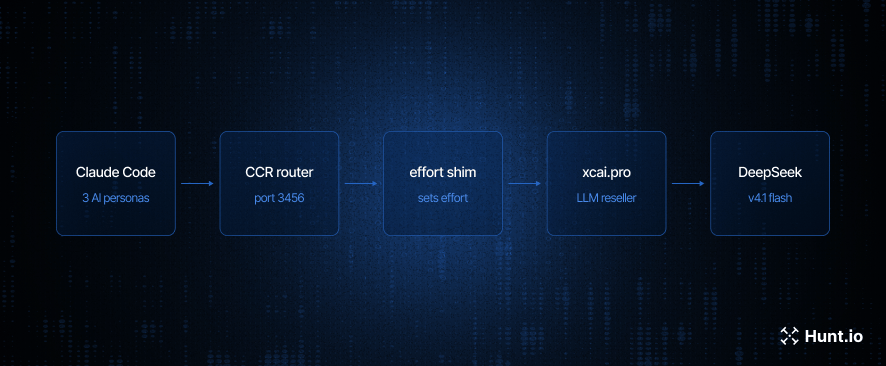
The AI setup is the most striking part. A state file shows the harness is Claude Code itself, version 2.1.221, started 510 times since August 4, but it isn’t talking to Anthropic. A small proxy, ds-models-shim.py, fixes a compatibility problem by faking a model list and sending requests to DeepSeek, and another, xcai-effort-shim.py, adds a reasoning setting because the DeepSeek backend otherwise skips its reasoning step. The route runs from Claude Code through Claude Code Router, an open-source project, to xcai and then to DeepSeek.

“A small local proxy, ds-models-shim.py, addresses a compatibility issue: the official /v1/models endpoint returns a 404 response when queried against a non-Anthropic backend, preventing Claude Code from discovering the available models. The shim intercepts that specific request and returns a locally defined model list containing deepseek-v4-pro and deepseek-flash. All other requests are forwarded to api.deepseek.com/anthropic.” states the report.
The same file counts 19 custom skills, reusable instruction sets for the agent, with 147 recorded uses. They cover code audit, reconnaissance, web injection, WAF bypass testing, authentication testing, Telegram Mini Apps, APK download and decompiling, cloud phone control and payment logic testing. Next to the payment skill sat three self-registered test accounts with tokens for a cash-in deposit API, dated September 12, and a comment calls them an authorized, self-built test. The setup fits testing for insecure direct object reference flaws, a technique CrowdStrike and Genians described against Korean loan and inquiry services.

The directory also held supporting tools. A script queried FOFA, a Chinese asset search engine like Shodan, through a third-party API, and a comment says the primary membership had expired and a backup key was in use. Proxy scripts enumerated a rotating proxy service at 154.201.79[.]246:443, where 79 unique exit IPs showed up among the first 100 identities tested.

A separate directory at 23.248.226[.]250:8001 held a small staged setup for JNDI and LDAP exploitation, retrieved on October 5 at 03:42 UTC. It confirms command execution through a DNS callback, and one script lets web and LDAP traffic share a single port. Hunt.io’s analysis describes the tooling without publishing steps to reproduce it.

Other recovered files include tools aimed at a cryptocurrency exchange’s admin session and withdrawals, Linux privilege escalation exploits, iOS probe source code and Android kernel and firmware utilities. Hunt.io says their connection to the Korean breaches isn’t confirmed.

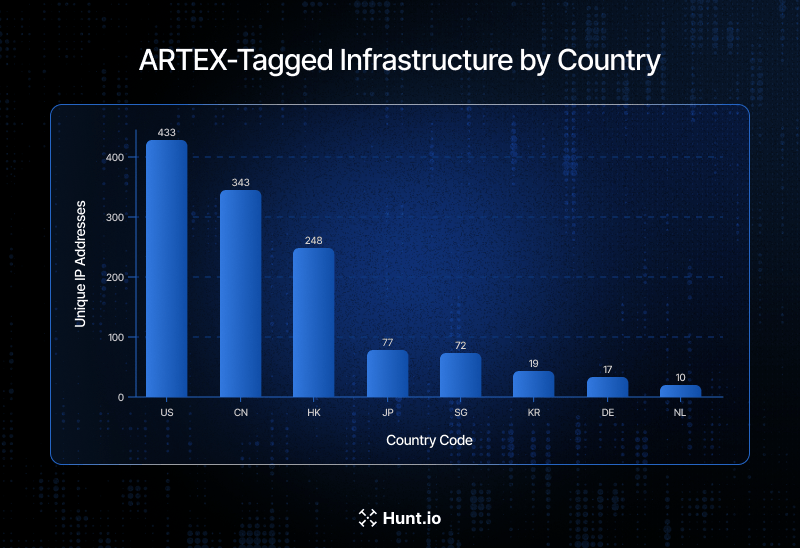
Hunt.io then showed how to hunt ARTEX servers. Searching for an ARTEX certificate issuer returned 19 IP addresses, and searching its malware classification returned 1,303 addresses across 30 countries, led by the United States, China and Hong Kong. Those figures show where addresses are registered, not where the operator sits.

“The result returned 19 distinct IP addresses, including 38.244.50[.]120. This method is precise but limited to hosts that expose a matching certificate. Systems using a different certificate will not appear in these results.” continues the report.

Matching the console’s page title returned about 1,300 IPs, and a looser search found 21 title strings, 19 of them likely ARTEX consoles, in English, Chinese, Korean, Japanese, Russian, Portuguese and Vietnamese.
A malware-name search in AttackCapture gave 280 results with open directories. One at 130.94.31[.]86:18888 in Seoul held two small scripts, and another at 156.251.11[.]39 held an SMB reconnaissance toolkit whose test script writes a file named artex_probe_11876.txt.

More hosts held exploitation kits for DedeCMS and FangCMS, a CAPTCHA bypass suite, a RuoYi and Spring administrative console exploit and CAPTCHA-based login automation. Together they show the framework attracting many operators.

For defenders, the advice is plain. Remove public access and put administration behind VPNs or allowlists, and reset SSH passwords and rotate API keys, proxy credentials and tokens that exposed files may have revealed. Patch internet-facing services, watch for unexpected LDAP and JNDI activity, DNS callbacks and remote script downloads, and store secrets in a managed vault with least-privilege permissions. Also restrict access to model gateways, watch their requests, and enforce compliance rules on managed phones. Hunt.io’s lesson is that an investigation shouldn’t stop at the first list of indicators, because

The company also published indicators of compromise in its analysis.

“The findings highlight risks associated with exposed administrative services, reusable credentials, remote access tunnels, proxy infrastructure, and exploitation tooling.” concludes the report.

Follow me on Twitter: @securityaffairs and Facebook and Mastodon

Pierluigi Paganini

(SecurityAffairs – hacking, ARTEX)

Antes de ontemSecurity Affairs
  • ✇Security Affairs
  • Microsoft Links ConnectWise Breach to China-Linked Group Using AI Pentesting Tool ARTEX Pierluigi Paganini
    China-linked Storm-0940 used AI tool ARTEX to target 2,250 Microsoft 365 tenants, exploiting stolen ConnectWise credentials at machine speed. Microsoft published a detailed technical report naming Storm-0940, a China state-aligned group, as the actor behind the ConnectWise Cloud Backup supply chain compromise. The group used ARTEX, an open-source AI-driven penetration testing framework, to run attacks at machine speed against hundreds of organizations across aerospace, defense, energy, finan
     

Microsoft Links ConnectWise Breach to China-Linked Group Using AI Pentesting Tool ARTEX

22 de Outubro de 2026, 17:47

China-linked Storm-0940 used AI tool ARTEX to target 2,250 Microsoft 365 tenants, exploiting stolen ConnectWise credentials at machine speed.

Microsoft published a detailed technical report naming Storm-0940, a China state-aligned group, as the actor behind the ConnectWise Cloud Backup supply chain compromise. The group used ARTEX, an open-source AI-driven penetration testing framework, to run attacks at machine speed against hundreds of organizations across aerospace, defense, energy, financial services, government, manufacturing, and more.

“Several of these Storm-0940 ARTEX-driven attacks have resulted in the actor obtaining privileged access to an organization’s cloud infrastructure – including multiple instances where the time from initial targeting to privileged access was less than 3 hours.” reads the report. “Microsoft assesses that Storm-0940 was responsible for the recently disclosed ConnectWise supply chain compromise of a multi-tenant application.”

Storm-0940 has been active since 2021 and has historically relied on password spraying and OAuth application abuse to get into Microsoft 365 environments. Adding ARTEX changed the scale of what they could do. In some attacks, the time between initial targeting and achieving privileged cloud access was under three hours.

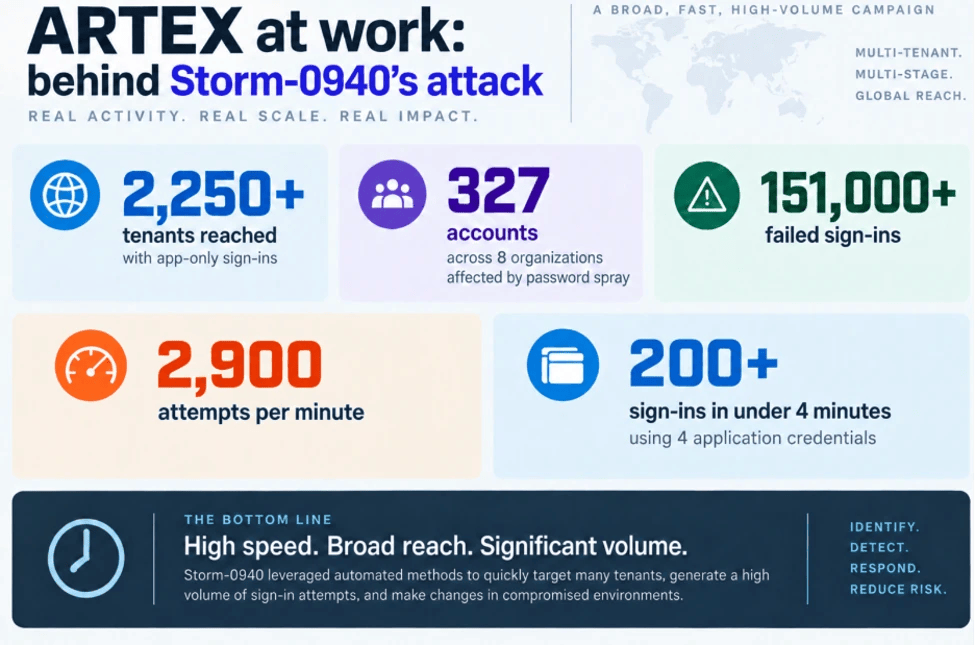
Before obtaining the ConnectWise credentials, Storm-0940 launched a password spraying attack between October 10 and 14. The attack came from the IP address 144.172.64[.]99. Microsoft recorded more than 151,000 failed login attempts against 327 accounts at eight organizations. Activity peaked on October 11, with 2,900 failed attempts per minute. Forty-eight accounts each received more than 1,000 failed attempts. None of these attempts succeeded.

The situation changed on October 15, one day after the ConnectWise breach became public. The AI agents stopped trying passwords and switched to a different attack method. By then, Storm-0940 had obtained the credentials of several ConnectWise cloud application accounts. The agents used these credentials to log directly into customer Microsoft 365 environments.

“Storm-0940’s use of ARTEX accelerated the speed of compromised application abuse to authenticate to Microsoft 365 customer environments through applications that had already been granted access.” Microsoft continues. “This allowed the threat actor to operate without requiring an interactive user sign-in. “

The agents used applications that already had permission to access their targets. This allowed the attackers to enter customer environments without requiring users to sign in interactively.

In a subset of environments where authentication succeeded, the agents didn’t stop there. They moved into Microsoft Graph and ran directory reconnaissance, modified application credentials to establish persistence, and attempted changes to identities, groups, and privileged roles. Microsoft identified multiple customer environments with evidence of this follow-on activity.

The persistence mechanism is the part defenders need to act on now, even if they’ve already disabled the ConnectWise connections.

“These changes can remain active as a backdoor even after the original compromised application is mediated.” says the IT giant.

An attacker who added their own credentials to a trusted application before you revoked access still has a working key. Reviewing all service principal credential additions since at least October 1 is the right starting point, not October 15 when the public breach was announced.

ARTEX is not a tool used only by Storm-0940. Microsoft says threat actors in several regions have used the same framework. Originally open-source, ARTEX was written in Go and can use different AI models to plan and carry out tasks. Researchers at Zscaler and Recorded Future also found a Chinese-speaking group using it to target South Korean financial institutions. The setup used DeepSeek, GLM, and Grok as coordinated AI agents, with GLM checking DeepSeek’s work. After these attacks became public, the project went closed-source. However, anyone who already has a copy can still use it.

The speed point is what Microsoft keeps coming back to in its report. Agents don’t take weekends, don’t sleep, and can run multiple attack paths simultaneously.

“This activity demonstrates how threat actors are integrating agentic AI into existing offensive security workflows and allows them to scale their operations exponentially.” Microsoft concludes. “Agents are not constrained by factors affecting humans – they can work around the clock, on weekends, and on holidays and attempt multiple breach paths simultaneously enabling significantly reduced time from selecting a target to achieving objectives, increasing the speed and impact of complex attacks like supply chain compromises.”

When Storm-0940 had valid application credentials, they didn’t have to iterate slowly. They hit 2,250 tenants with 2,900 sign-in attempts per minute, a pace at which manual detection and response simply can’t keep up.

Follow me on Twitter: @securityaffairs and Facebook and Mastodon

Pierluigi Paganini

(SecurityAffairs – hacking, ARTEX)

  • ✇Security Affairs
  • AI-Driven tool ARTEX used in attacks against South Korean Banks Pierluigi Paganini
    CrowdStrike analyzes open directories left by an attacker who used the ARTEX AI pentest tool and LLMs to breach South Korean financial firms. CrowdStrike published a research on a campaign against South Korean financial organizations that ran from late September to early October 2026 and ended with stolen data. The attacker left their working notes where anyone could read them. Open directories on servers controlled by the attacker exposed Claude Code session histories, ARTEX configuratio
     

AI-Driven tool ARTEX used in attacks against South Korean Banks

9 de Outubro de 2026, 04:53

CrowdStrike analyzes open directories left by an attacker who used the ARTEX AI pentest tool and LLMs to breach South Korean financial firms.

CrowdStrike published a research on a campaign against South Korean financial organizations that ran from late September to early October 2026 and ended with stolen data. The attacker left their working notes where anyone could read them.

Open directories on servers controlled by the attacker exposed Claude Code session histories, ARTEX configuration files, and Claude memory files. Researchers could see how the operator worked, prompt by prompt. That is rare, and it makes this report particularly interesting.

“Analysis of threat actor-controlled open directories uncovered Claude Code session histories, ARTEX configuration files, and Claude memory files, providing direct insight into the threat actor’s operational methodology and tooling.” reads the report published by CrowdStrike. “The use of agentic AI tooling alongside traditional offensive capabilities highlights the continued evolution CrowdStrike has observed in adversarial tradecraft.”

ARTEX is a recently released open-source tool from China that allows AI agents to run penetration tests on their own. The attacker combined it with large language models. CrowdStrike has not linked the activity to a specific group, but it has moderate confidence that the operator is Chinese-speaking and financially motivated, based on the tool used and the Chinese-language prompts.

Industry reports describe several South Korean financial organizations breached since late September. At one bank, the attacker reportedly got into a loan progress inquiry service used by financial brokers. At another, they compromised an employee mobile work-support system. Nobody has confirmed how many organizations were hit.

Investigators connected the dots through overlapping IP addresses and references to the string ARTEX in HTML files on a server the attacker reportedly controlled. One address, 38.244.50[.]120, hosted an ARTEX instance and an open directory. Inside sat a Claude Code markdown file with a Chinese-language pentesting prompt that told the model how to run its tests.

“The IP address 38.244.50[.]120 was associated with the activity described and hosted an ARTEX instance and open directory containing a Claude Code markdown document at http[:]//38.244.50[.]120:18899/.claude/CLAUDE.md.” continues the report. “The markdown document contained a Chinese-language pentesting prompt that specified how the LLM should conduct pentesting activities.”

That file also pointed to a Hong Kong IP address, and that server held more open directories with session histories, configuration files and memory files. The files show the operator going after Korean financial targets with ARTEX and LLMs across those weeks, and the targets match the ones in industry reporting.

The sessions reveal a two-server setup. The Hong Kong address is the attacker’s main infrastructure, and 38.244.50[.]120 runs the ARTEX instance likely behind the Korean attacks. DeepSeek v4.1-flash served as the main model, with GLM-5.3 from Zhipu AI and Grok 4.6 added for extra sessions. The operator probably reached DeepSeek through a reseller, xcai[.]pro, and used nine proxy addresses that CrowdStrike lists in its report.

“Analysis of Claude Code sessions showed the threat actor also used the following proxy IP addresses during the ARTEX-related activity:

  • 101.53.80[.]20
  • 205.214.59[.]31
  • 124.155.252[.]63
  • 154.201.79[.]246
  • 23.248.249[.]90
  • 23.158.220[.]98
  • 103.248.148[.]84
  • 203.160.133[.]172
  • 209.209.85[.]38

In addition to conducting ARTEX-related operations, the threat actor asked Claude where threat actors typically sell Korean data breach information and asked Claude for assistance in finding Korean Telegram data sales groups.” reads the report.

Exfiltration was only the first step. The stolen data was already being prepared for sale.

In one session, the user asked Claude to write a security researcher résumé with bullet points describing the ARTEX results. The prompt also included personal details. The same Telegram username appeared in sessions involving a Telegram-based NFT gift marketplace and the targeting of what may have been a Chinese payment platform. CrowdStrike says the details likely belong to the operator, but it cannot confirm the link. Given that uncertainty, those details should not be included in a news article.

According to The Hacker News, ARTEX’s developer, Autumn-27, has since closed the source and stopped updates, saying the tool was built for learning and research and that the attacks have nothing to do with the project. Copies already in circulation don’t disappear with a license change.

CrowdStrike says this activity shows how AI tooling can let a financially motivated actor run several intrusions in a short time.

“The use of agentic AI tooling alongside traditional offensive capabilities highlights the continued evolution observed by CrowdStrike in adversarial tradecraft. This activity demonstrates how AI tooling can enable a financially motivated threat actor to conduct multiple intrusions within a short time span.” concludes the report. “CrowdStrike Intelligence assesses that adversaries will likely continue to experiment with implementing AI tooling in their operations to enhance their operational tempo and capabilities.”

Follow me on Twitter: @securityaffairs and Facebook and Mastodon

Pierluigi Paganini

(SecurityAffairs – hacking, ARTEX)

❌
❌