❌

Visualização normal

Antes de ontemFirewall Daily – The Cyber Express
  • ✇Firewall Daily – The Cyber Express
  • After Supermarket Freezers, Hackers Turn Up the Heat on France’s Blood Supply Samiksha Jain
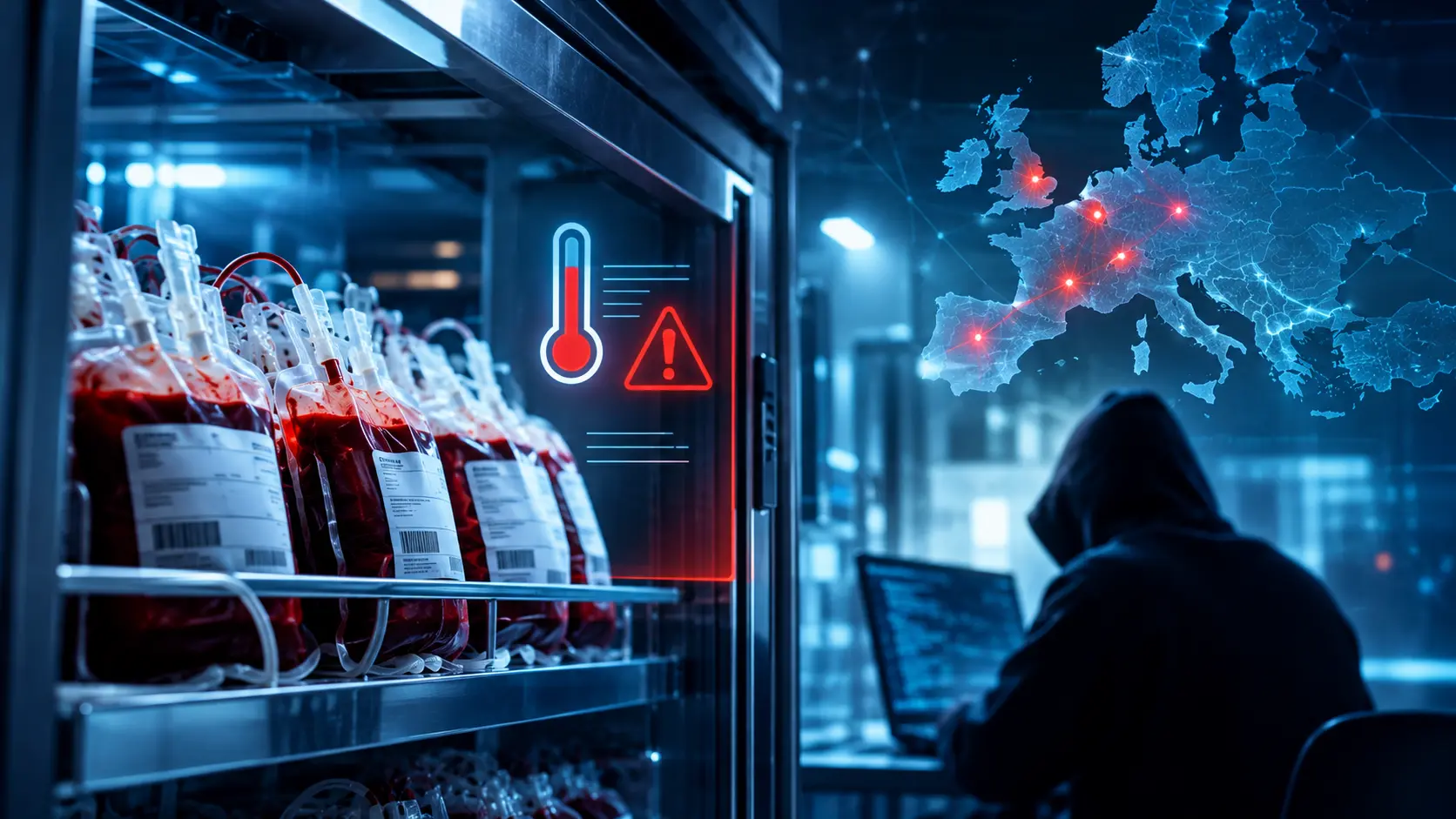
    Until this week, the wave of refrigeration cyberattacks sweeping Europe looked like a supermarket problem. That changed when France's national blood service confirmed that temperature controls had been altered at three of its sites. Blood products stored for hospitals were suddenly at risk, and the attackers had not even targeted the organisation directly. The Établissement Français du Sang (EFS) said "temperature and defrosting thresholds were raised to very high levels" in its cold storage
     

After Supermarket Freezers, Hackers Turn Up the Heat on France’s Blood Supply

5 de Novembro de 2026, 03:36

refrigeration cyberattacks

Until this week, the wave of refrigeration cyberattacks sweeping Europe looked like a supermarket problem. That changed when France's national blood service confirmed that temperature controls had been altered at three of its sites. Blood products stored for hospitals were suddenly at risk, and the attackers had not even targeted the organisation directly. The Établissement Français du Sang (EFS) said "temperature and defrosting thresholds were raised to very high levels" in its cold storage rooms. These rooms hold blood products at preparation and distribution sites before they go to healthcare facilities, along with samples for biobanks. The outcome was far better than in the supermarkets. "No health impacts have been identified and no losses of blood products have been reported," the EFS said in a statement on Tuesday.

How the Refrigeration Cyberattacks Reached Blood Storage

The EFS says it was not targeted directly. Like many of the affected retailers, it says the attack reached it through a third-party provider of refrigeration equipment. That detail explains why a blood service ended up on the same list as supermarkets. If attackers can get into a shared supplier's systems, any organisation using that equipment may be exposed, whatever its sector. This is the first reported case in France in the second wave of attacks on control systems, and the first reported to affect a healthcare organisation.

Why the Blood Supply Survived When Food Did Not

The difference came down to how quickly someone noticed. "The EFS's monitoring and alarm systems enabled the rapid identification of these anomalies and the implementation of necessary measures to ensure that no blood samples or products were compromised," the organisation said. Depending on the situation, affected equipment was either brought under control without impacting the products, or shut down. Products in the affected cold rooms were moved to other facilities as a precaution. Compare that with the first wave in France in October. Attackers remotely defrosted fridges in hundreds of supermarkets, reportedly by triggering a forced defrost option, and pushed temperatures as high as 50 degrees Celsius. They struck while stores were closed, so the heat went unnoticed for hours. Tonnes of food perished, some equipment melted, and in some stores the heat sparked fires. Reporting on that wave found the attackers had targeted ageing, internet-connected devices still online years after their manufacturer stopped supporting them. refrigeration cyberattacks

How Far the Refrigeration Cyberattacks Have Spread

The second wave is wider than the first. Businesses in at least 11 countries have reportedly been affected: Belgium, Estonia, Finland, France, Germany, Ireland, Luxembourg, the Netherlands, Portugal, Sweden and the United Kingdom. Earlier this week, supermarket chains in Sweden, Belgium, Luxembourg, Ireland and Estonia reported fridges and freezers set to high temperatures, with several discarding food. In Estonia, where the intrusion was caught within minutes, there was no significant damage.

Who Is Behind It?

No one knows for sure, and no group or entity has claimed responsibility for the attacks. It is also unclear whether the same people are behind both waves. Rumours have spread online that two Russian hacktivists groups, Noname057(16) and Z-Pentest Alliance, posted that they had hacked Danfoss. That led to speculation that they were behind the freezer attacks. Analysts now question whether that claim means they were responsible. Russian groups have not been ruled out. However, experts say Iranian hacktivists, nation-state hackers, or even teenagers pulling pranks could also be the culprits.

A French Bank Reports a Separate Attack

In the same week, Crédit Mutuel Arkéa in northwestern France said it had halted some services after a cyberattack enabled fraudulent transactions. Nothing in the bank's statements links the incident to the refrigeration attacks. However, the bank describes a similar entry point: attackers "used the platform of one of our service providers" to reach the bank directly. The bank said attackers used its own account, not customer accounts, to make transactions to other banks. That potentially let them convert the money into cryptocurrency through specialised platforms. It denied press reports that the attackers got in through its subsidiary Fortuneo, and said human error was not the cause. Asked whether 118 million euros was stolen, the bank said it could not confirm the figure and could "only validate the order of magnitude." Some funds have been frozen and recovery efforts are under way. The bank says the losses will not threaten its financial stability and that customers' assets were not affected, apart from delays to some transfers. Almost all operations have resumed. The bank has also warned customers about a likely rise in phishing attempts, urging them never to share passwords, card numbers or SMS validation codes. The refrigeration attacks and the bank attack have not been tied to the same attackers. What they share is the route in. In both cases, the organisations say they were reached through an outside provider rather than through their own systems. Neither the blood service nor the bank was the first door the attackers opened.
  • ✇Firewall Daily – The Cyber Express
  • Fake Traffic Challan Texts Are Stealing UPI PINs From Android Users in India Samiksha Jain
    A text message about an unpaid traffic challan could cost Android users in India far more than a fine. GhostBat RAT, an Android malware strain first identified by cybersecurity firm Cyble in October 2025, has evolved to capture PINs from 60 banking, UPI apps, wallet and fintech applications, according to new research published by Cyble. The firm's investigation into fake mParivahan and eChallan apps also exposed a wider operator-controlled ecosystem it tracks as GhostX, linking phishing pages
     

Fake Traffic Challan Texts Are Stealing UPI PINs From Android Users in India

15 de Outubro de 2026, 09:15

GhostBat RAT

A text message about an unpaid traffic challan could cost Android users in India far more than a fine. GhostBat RAT, an Android malware strain first identified by cybersecurity firm Cyble in October 2025, has evolved to capture PINs from 60 banking, UPI apps, wallet and fintech applications, according to new research published by Cyble. The firm's investigation into fake mParivahan and eChallan apps also exposed a wider operator-controlled ecosystem it tracks as GhostX, linking phishing pages, backend control systems and malware distribution.

How GhostBat RAT Reaches Victims

The malware spreads mainly through smishing, or SMS phishing. Victims receive messages with malicious links that lead to pages impersonating the official Parivahan service or a Google Play-style download page. These pages push users to install a fraudulent mParivahan APK. Researchers also found GitHub repositories being repeatedly used to host the malicious files. Many of these apps are only first-stage loaders. The real payload stays hidden in encrypted files or is downloaded later, which makes the app look harmless during an initial scan. [caption id="attachment_114830" align="aligncenter" width="600"]GhostBat RAT GhostBat-RAT-Infection-Chain-1536x595[/caption]

GhostBat RAT's Ghost Overlay Trick

The most significant change in the latest variant is its abuse of Android's Accessibility Service, a technique commonly linked to modern Android banking trojan families. Earlier variants analyzed by Cyble did not have this capability. Its standout feature, called Ghost Overlay, targets Google Pay and MobiKwik. Instead of showing a fake login screen, the malware places an invisible 12-key grid over the real PIN keypad. When a user taps a digit, the overlay records it and then replays the same tap into the genuine app. The payment goes through normally, so the victim has no visible reason to suspect anything, while the PIN is quietly sent to the attackers' server.

GhostBat RAT Watches 60 Financial Apps

Beyond Google Pay and MobiKwik, a broader keylogging feature monitors 60 financial apps. Cyble's list includes PhonePe, Paytm, BHIM, SBI UPI, Axis Pay, BharatPe, CRED, Freecharge, PayZapp, Groww, Navi, Jupiter, OneCard, JioFinance and Samsung Pay. The malware checks which app is open and the screen context before treating numeric input as a possible PIN. This builds on older capabilities that remain in play, including reading SMS messages and OTPs, manipulating call forwarding, collecting call logs and sending SMS messages through the victim's SIM card, which could be used to spread further smishing campaigns.

Inside the GhostX Network Behind GhostBat RAT

A key finding came from an exposed Firebase backend named "ghostx-panel." It contained administrator records, user roles, login logs with device fingerprints and bot-user mappings. Cyble says these separate roles point to a multi-operator setup and raise the possibility of a Malware-as-a-Service model. While monitoring the backend, researchers saw SMS lure text, phishing links, vehicle registration numbers and recipient phone numbers changing repeatedly, indicating an active campaign. Matching eChallan messages were also reported by users on social media.

Why GhostBat RAT Is Hard to Detect

Cyble identified at least six different loader designs. The newest, built around a native library called libnetbridge.so, passes the payload through several layers of encryption, compression and custom packaging before the final app appears. Security tools that scan only the outer APK are unlikely to catch it consistently. The malware also uses Firebase Remote Config, which lets operators switch command servers and turn features on or off remotely without pushing a new app to victims.

Staying Safe From GhostBat RAT

Cyble advises users to install apps only from official stores such as Google Play and to avoid APK links received by SMS, social media or email. Users should be cautious about granting app permissions, especially Accessibility access, verify website addresses before entering sensitive details, enable multi-factor authentication on financial apps and keep their phones updated. Anyone who suspects infection should contact their bank and local authorities immediately.

Point72 Among Major Hedge Funds Targeted in Cyberattack on Wall Street Through Voice Phishing Campaign

Point72

A cyberattack on Wall Street recently targeted several leading hedge funds, including Point72 Asset Management, Millennium Management, Two Sigma Investments, and Citadel. The attackers used voice phishing, or "vishing," to trick employees into revealing sensitive information or granting access to internal systems.  Cybersecurity experts say such attempts are common because financial institutions store highly sensitive data. However, the latest incidents highlight how cybercriminals are increasingly combining traditional social engineering tactics with artificial intelligence to make impersonation attempts more convincing. 

Point72 Says No Client Data Was Compromised 

According to reports, Point72 Asset Management informed investors on August 5 that it had been targeted in the latest cyberattack on Wall Street. Bloomberg first reported the communication, citing a source familiar with the matter.  The firm said it was reviewing the incident and that no client information had been stolen. Point72 declined to comment publicly.  The campaign extended beyond Point72, with hackers also attempting to breach the information systems of Millennium Management, Two Sigma Investments, and Citadel, according to sources. 

Voice Phishing Remains an Effective Attack Method 

The attackers relied on voice phishing, a social engineering technique in which criminals impersonate trusted individuals—often IT support staff—to persuade employees to disclose confidential information or provide system access.  Cybersecurity experts told Reuters that these attacks are routine because of the valuable information held by financial firms. Rather than exploiting software vulnerabilities, voice phishing succeeds by manipulating human behaviour.  The tactic has also been used successfully by the cybercriminal group "Scattered Spider," a loosely organized network of young hackers that has targeted numerous companies in recent years. 

AI Is Increasing the Sophistication of Cyberattacks 

Security experts say the attempted cyberattack on Wall Street demonstrates how artificial intelligence is making social engineering campaigns more persuasive and difficult to detect.  A similar trend was highlighted in June, when Google's cybersecurity unit published a report detailing a campaign targeting U.S. law firms and other professional and financial services organizations.   According to the report, attackers posed as IT support personnel through voice phishing calls and, in some cases, even visited offices while pretending to be IT maintenance staff. 

Growing Cyber Risks for Financial Firms 

The attempted cyberattack on Wall Street comes as organizations worldwide face a rise in AI-powered cyberattacks and ransomware incidents that disrupt operations and steal sensitive data.  In response to the growing threat, the White House announced a working group earlier this year that brings together AI developers and critical infrastructure operators to share threat intelligence and strengthen cyber defenses.  Although Point72 said no customer information was compromised, the attempted attacks on several prominent hedge funds underscore the persistent cybersecurity risks facing the financial sector and the increasing use of AI-enhanced social engineering by threat actors. 
❌
❌