Visualização normal

Antes de ontemStream principal

Salesforce Marketing Cloud Vulnerabilities Expose Cross-Tenant Subscriber Data Risks

Salesforce AMPScript

A recently disclosed set of vulnerabilities in Salesforce Marketing Cloud, widely known as SFMC, has drawn attention to the security risks tied to centralized marketing infrastructure.   The flaws, which affected components tied to AMPScript, CloudPages, and email-rendering workflows, could have enabled attackers to access subscriber information, enumerate marketing emails, and potentially affect organizations across multiple tenants.  Security researchers found that weaknesses in SFMC’s templating engine and cryptographic implementation introduced opportunities for unauthorized data access across customer environments. 

AMPScript and SFMC Template Injection Risks 

Modern enterprises rely heavily on Salesforce Marketing Cloud to manage large-scale marketing campaigns, personalized customer journeys, and trackable email communications. The platform, formerly known as ExactTarget, supports dynamic content generation through technologies such as AMPScript, Server-Side JavaScript (SSJS), and internal data views connected to large subscriber databases.  While these features provide flexibility for marketers, researchers noted that they also increase the impact of any underlying vulnerability. One of the major concerns centered on SFMC’s server-side templating framework.  AMPScript and SSJS allow organizations to dynamically insert subscriber attributes such as names, email addresses, and engagement metrics directly into marketing content. However, functions like TreatAsContent introduced a dangerous behavior because they effectively evaluate user-controlled input as executable template code. Researchers explained that if attacker-controlled data was passed into these functions, it could trigger template injection inside Salesforce Marketing Cloud environments.  The issue became more severe because SFMC historically supported AMPScript execution within email subject lines. According to the findings, legacy behavior caused subject templates to be evaluated twice by default. That design opened the door for payload execution during the second rendering stage. Researchers demonstrated the risk using the following payload inside a name field:  %%=RowCount(LookupRows("_Subscribers","SubscriberKey",_subscriberkey))=%%  If processed during the second evaluation phase, the payload could execute successfully and create a reliable injection point inside the marketing workflow.  Once template execution was achieved, attackers could potentially use built-in SFMC functions such as LookupRows to query internal Data Views, including: 
  • _Subscribers  
  • _Sent  
  • _Job  
  • _SMSMessageTracking  
  • _Click  
Access to these views could expose subscriber lists, email delivery records, engagement metrics, and message history associated with affected Salesforce Marketing Cloud tenants. 

CloudPages and “View Email in Browser” Vulnerability

Researchers identified an even more serious vulnerability tied to SFMC’s “view email in browser” functionality and CloudPages infrastructure. Many Salesforce customers configure branded domains such as view.example.com or pages.example.com that route back to shared SFMC infrastructure. These links typically rely on an encrypted qs parameter containing tenant and message-specific information. According to researchers from Searchlight Cyber, the older “classic” qs implementation used unauthenticated CBC encryption. The researchers found that the implementation behaved as a padding oracle, which made it possible to decrypt and re-encrypt query string parameters under certain conditions. Initially, the researchers abused the weakness using the Padre tool before later improving the process through the AMPScript MicrositeURL function.  This allowed them to forge valid QS values and access workflows such as “Forward to a Friend,” which could resolve subscriber identifiers into actual email addresses.  One of the most concerning aspects of the vulnerability was SFMC’s use of a single static encryption key shared across tenants. Researchers stated that once the cryptographic structure became understood, attackers could theoretically enumerate subscribers and access email content across multiple organizations using the same mechanism.

Legacy Encryption Weaknesses Expanded the Attack Surface 

The researchers also uncovered an older URL format that relied on per-parameter “encryption.” However, the mechanism reportedly consisted of a repeating static XOR key combined with a checksum. Although the scheme was considered legacy functionality, researchers found that it still worked on modern SFMC tenants. Because the implementation lacked strong cryptographic protections, attackers could decrypt and enumerate parameters such as JobID and ListSubscriber at high speed without relying on the slower padding-oracle technique.  The findings highlighted how legacy systems inside large cloud platforms can continue to create security exposure long after newer protections are introduced. 

Impact of the Salesforce Marketing Cloud Vulnerability 

Researchers concluded that the combined vulnerabilities could have enabled attackers to: 
  • Enumerate and exfiltrate subscriber records  
  • Access sent marketing emails and engagement data  
  • Forge cross-tenant QS tokens  
  • Access emails belonging to other organizations  
  • Exploit hard-coded cryptographic material  
  • Abuse argument-injection flaws tied to the MicrositeURL function  
  • Manipulate CloudPages and other SFMC web workflows  
To address the issues, Salesforce assigned multiple CVEs covering several root causes, including insecure cryptographic implementations, hard-coded keys, and argument injection vulnerabilities affecting MicrositeURL and CloudPages components.  According to Salesforce, the vulnerabilities were reported on 16 January 2026. Mitigations were deployed between 21 January and 24 January 2026. The company stated that it had identified no confirmed malicious exploitation at the time of disclosure.  As part of the remediation process, Salesforce migrated Marketing Cloud Engagement encryption to AES-GCM, rotated encryption keys, and disabled the double evaluation behavior tied to AMPScript subject-line rendering.  The company also invalidated all legacy tracking and CloudPages links created before 21 January 2026 at 23:00 UTC. Those links expired globally on 23 January 2026 at 21:00 UTC. 
  • ✇Cybersecurity News
  • AWS Launches “Amazon Quick” to Bridge the Gap Between Desktop and Cloud Ddos
    The post AWS Launches “Amazon Quick” to Bridge the Gap Between Desktop and Cloud appeared first on Daily CyberSecurity. Related posts: AWS Unveils Nova 2 AI Model Family with Multimodal Omni & Agentic Nova Act Desktop AI War: Google Launches Native Gemini for Mac with “Screen Awareness” and Video Gen Amazon Connect Reinvents the Enterprise as an AI-Powered “Operating Brain”
     
  • ✇Security | CIO
  • Salesforce expands beyond the front office with Agentforce Operations
    Enterprises have been fixated on AI agents for front office workflows, but there’s still a lot of operational drag behind the scenes. Many back office tasks, such as returns processing, inventory reconciliation, and supply chain oversight, are still performed manually, leading to inefficiencies. Today, Salesforce is turning its attention to that problem with Agentforce Operations, which tasks AI agents with the drudgery of the back office. The company claims agents can
     

Salesforce expands beyond the front office with Agentforce Operations

29 de Abril de 2026, 09:05

Enterprises have been fixated on AI agents for front office workflows, but there’s still a lot of operational drag behind the scenes. Many back office tasks, such as returns processing, inventory reconciliation, and supply chain oversight, are still performed manually, leading to inefficiencies.

Today, Salesforce is turning its attention to that problem with Agentforce Operations, which tasks AI agents with the drudgery of the back office. The company claims agents can cut cycle times by up to 70% for processes like auditing and onboarding, and eliminate 80% of manual chores like data entry.

Compared to Salesforce’s Agentforce, an early-entrant agent builder platform, the new Agentforce Operations “is tackling a completely different problem,” said Sanjna Parulekar, the company’s VP of AI. “There’s so much time spent on these back office processes, to no avail.”

Autonomous agents handle ‘busy work’

Agentforce Operations builds on Salesforce’s acquisition of Regrello, an AI-powered operating system for manufacturing and supply chains.

Agentforce Operations coordinates AI agents that handle “busy work,” based on business process blueprints. These guidance documents can be loaded into the system for company-specific workflows, or users can access 30-plus out-of-the-box blueprints for common tasks like onboarding, invoice auditing, or rescheduling. Either way, users don’t need to build models from scratch.

“You have a Lucidchart, a Word doc, a drawing, you upload it into Agentforce Operations, and it’ll digitize that process into a multi step workflow,” Parulekar explained. “It’ll split up the work into several minion agents that can take action on different steps.”

For instance, agents extract data from documents, run computations, or identify gaps in compliance. They can work across typically disconnected systems like email or enterprise resource planning (ERP) platforms.

Human users can continue working with existing tools and interact via email, Slack, or Microsoft Teams, tweaking AI activities as needed, and updating agent operations with plain language. The system automatically flags delays (such as lags in required approvals) or suggests fixes. Every agent action is recorded and mapped back to the digital blueprint.

“You can build in steps for review, for humans to be in the loop wherever you want,” said Parulekar. “That combination of non deterministic and deterministic, when it comes to this agentic AI world, it’s so critical.”

Salesforce claims that a single AI agent can perform an audit within 60 seconds; normally, this would take a team of human auditors four hours to complete.

A new area for Salesforce

Matt Mullen, lead analyst for AI applications at consultancy firm Deep Analysis, noted that the ability to rapidly create a diagrammatic of a process, ingest it, and have a workable starting point for an automated version is indeed a potential time-saver.

When combined with technology such as task mining via Salesforce Apromore that determines process details up front, it offers “real potential to organizations looking to modernize their key processes,” he said.

The biggest hurdles enterprises face when handling backend workflows are “complexity and criticality,” Mullen noted. But these processes define primary operations: How things are made, how materials are ordered, how products are shipped.

“Those processes have a lot of moving parts, and typically are integrated into a whole raft of line-of-business systems at various points in their execution,” he said. Processes evolve, and in some cases they’re only understood in totality by a small number of people.

Thus, enterprises that already have partial or complete automation established for various processes will likely see Salesforce as a cost-effective tool, Mullen said, particularly in areas like banking, insurance, healthcare, or in heavy industries like construction that still rely on manual, paper-heavy tasks.

That said, this is a new area for Salesforce. The company will need to enable its vast array of integration partners to have conversations around job titles and organizational areas they’ve not typically engaged with.

“Salesforce has been front-office focused from its inception, and making sure that it can articulate the value and sell into back office operations will be an ongoing challenge,” said Mullen.

A hard problem to solve 

When orchestrating agents for backend systems, there’s a lot to consider, Parulekar pointed out, including issues around ERPs, customer relationship management (CRM) platforms, and external data lakes. Some of these systems are so old they may not even have application programming interfaces (APIs).

“It’s a minefield for customers,” she said. “It kind of feels obvious: [They ask] ‘why didn’t someone do this already?’ [The answer:] Because it’s a really hard problem to solve.”

What’s different about Agentforce Operations, Parulekar said, is that agents look at processes first, rather than people, and assess how those processes can be managed accurately and with high performance. That might even mean adding more steps to the process.

“It’s such a knee jerk reaction if you’re optimizing for humans to say, ‘let’s just give [a human] one thing to review instead of five,’” she said. With agents, a workflow may go from five steps to 50, but 48 of those are completed by an agent. Humans are only brought into the loop when they’re most useful, and can focus attention elsewhere otherwise.

“The most trite thing people say right now is ‘AI is going to free up your work,’” Parulekar acknowledged. But it’s true, she said: “I think it’s really bringing some creativity back to the work. Enterprises can focus on more critical decisions that have less to do with the minutia of a process and more to do with strategy.”

More capacity without more headcount

Melanie Kalia, director of product management at Equinox Group, said that, like many organizations, the fitness company was dealing with back office and operations workflows that were slow and labor-intensive. Particularly in the fitness industry, she explained, there’s an “enormous amount” of administrative work around managing sales pipelines, following up, explaining promotions, and scheduling tours.

“We agreed automation had to be part of the answer, but generic workflow tools weren’t cutting it, or felt like luxury,” she said. Her team looked at other options like Sierra and Netomi, but Agentforce Operations was a natural extension to its existing Salesforce infrastructure.

The company’s primary focus with agents is lead generation and “nurturing,” Kalia explained. Leads can fall through the cracks because back office teams are too stretched to follow up consistently. Agentforce Operations is helping automate outreach sequences, qualify inbound leads, and move prospects through the funnel without requiring manual intervention at every step.

“It’s essentially giving us the capacity of a much larger team without adding headcount,” she said.

Being an early adopter ‘a challenge’

Being an early platform adopter was a challenge, however; as Salesforce iterated its approach, her team had to follow suit. Early CRM cleanup was also required to ensure more reliable outputs. Then there was the internal change management piece; getting sales and ops teams comfortable handing off tasks to AI took some trust, Kalia said.

However, “once we ran a few pilots and people saw the agents actually working accurately, adoption has picked up and is gaining momentum,” she noted.

Ultimately, Equinox is seeing “encouraging signals,” with faster response times to inbound leads and more consistent follow up on those that otherwise might have gone cold.

“We haven’t fully quantified the full ROI yet,” Kalia noted. But the results are trending positive, leading to sales increases, more quality messaging, and “a sense that our solution is finally working for and with us rather than replacing us.”

ShinyHunters Leaks Data of Udemy, Zara, 7-Eleven in Salesforce Linked Breach

ShinyHunters has leaked data linked to Udemy, Zara, and 7-Eleven, with claims of exposed Salesforce records and cloud-based systems.
  • ✇ASEC BLOG
  • Ransom & Dark Web Issues Week 4, April 2026 ATCP
    ASEC Blog publishes Ransom & Dark Web Issues Week 4, April 2026           ShinyHunters Claims Data Breach Involving Major U.S. Convenience Store Chain ShinyHunters Claims Theft of Internal Data and Source Code from U.S. Software Development Firm Emergence of New Data Extortion Group: Prinz Eugen
     

Ransom & Dark Web Issues Week 4, April 2026

Por:ATCP
22 de Abril de 2026, 12:00
ASEC Blog publishes Ransom & Dark Web Issues Week 4, April 2026           ShinyHunters Claims Data Breach Involving Major U.S. Convenience Store Chain ShinyHunters Claims Theft of Internal Data and Source Code from U.S. Software Development Firm Emergence of New Data Extortion Group: Prinz Eugen
  • ✇ASEC BLOG
  • March 2026 Dark Web Breach Trends Report ATCP
    Alerts this report is based on reports of data breaches and the sale of initial access rights posted on deep web-dark web forums. some parts of the report contain information that cannot be fully verified as factual due to the nature of the source. Major Issues Multiple breach claims by ShinyHunters. a wide range of […]
     

March 2026 Dark Web Breach Trends Report

Por:ATCP
12 de Abril de 2026, 12:00
Alerts this report is based on reports of data breaches and the sale of initial access rights posted on deep web-dark web forums. some parts of the report contain information that cannot be fully verified as factual due to the nature of the source. Major Issues Multiple breach claims by ShinyHunters. a wide range of […]

ShinyHunters Hackers Claim Theft of 3M+ Cisco Records, Threaten Public Leak

ShinyHunters hackers claim they stole 3 million+ Cisco records via Salesforce and AWS, warning of a public leak if demands are not met by April 3, 2026.

ShinyHunters Walk Away from BreachForums, Leak 300,000-User Database

ShinyHunters leaves BreachForums, leaks data of 300,000 users, warns all active domains are fake, and threatens more leaks from forum backups.

North Korean Hacker Lands Remote IT Job, Caught After VPN Slip

New research from LevelBlue reveals how a suspected North Korean operative landed a remote IT role to fund national weapons programmes.

💾

  • ✇Security Affairs
  • Threat actors use custom AuraInspector to harvest data from Salesforce systems Pierluigi Paganini
    Attackers are mass-scanning Salesforce Experience Cloud sites using a modified AuraInspector tool to exploit misconfigurations and access sensitive data. Salesforce CSOC warns that threat actors are mass-scanning publicly accessible Experience Cloud sites using a modified version of the AuraInspector tool. AuraInspector is an open‑source command‑line tool released by Google/Mandiant to audit Salesforce Aura and Experience Cloud applications for data exposure risks. It simulates an unauthe
     

Threat actors use custom AuraInspector to harvest data from Salesforce systems

10 de Março de 2026, 09:29

Attackers are mass-scanning Salesforce Experience Cloud sites using a modified AuraInspector tool to exploit misconfigurations and access sensitive data.

Salesforce CSOC warns that threat actors are mass-scanning publicly accessible Experience Cloud sites using a modified version of the AuraInspector tool.

AuraInspector is an open‑source command‑line tool released by Google/Mandiant to audit Salesforce Aura and Experience Cloud applications for data exposure risks. It simulates an unauthenticated or guest user and automatically discovers Aura endpoints, then tests them for access‑control misconfigurations that might expose sensitive records (e.g., Accounts, Contacts, Leads) via Aura methods, record lists, or GraphQL controllers.

The campaign targets misconfigured guest user settings that are overly permissive, allowing attackers to access sensitive data from exposed environments.

“Evidence indicates the threat actor is leveraging a modified version of the open-source tool Aura Inspector (originally developed by Mandiant) to perform mass scanning of public-facing Experience Cloud sites.” reads the report published by Salesforce. “While the original Aura Inspector is limited to identifying vulnerable objects by probing API endpoints that these sites expose (specifically the /s/sfsites/aura endpoint), the actor has developed a custom version of the tool capable of going beyond identification to actually extract data — exploiting overly permissive guest user settings. “

Misconfigured sites risk exposing CRM data, which can then be used for targeted social engineering or vishing attacks.

The company said the activity does not involve a platform vulnerability but exploits customer misconfigurations. Organizations are urged to review and secure Experience Cloud guest user settings to reduce exposure.

“At this time, we have not identified any vulnerability inherent to the Salesforce platform associated with this activity. These attempts are focused on customer configuration settings that, if not properly secured, may increase exposure.” reads the security advisory. “We encourage customers to review their Experience Cloud guest user settings and take immediate recommended actions. For additional details and steps to help protect your org, please see our blog: https://www.salesforce.com/blog/protecting-your-data-essential-actions-to-secure-experience-cloud-guest-user-access/

Salesforce systems

Salesforce attributes the campaign to a known threat actor group, possibly ShinyHunters, known for targeting Salesforce environments through third-party apps. The company urges customers to secure Experience Cloud guest settings, restrict public access, disable unnecessary APIs, and monitor logs.

Follow me on Twitter: @securityaffairs and Facebook and Mastodon

Pierluigi Paganini

(SecurityAffairs – hacking, newsletter)

Remote Code Execution With Modern AI/ML Formats and Libraries

13 de Janeiro de 2026, 08:00

We identified remote code execution vulnerabilities in open-source AI/ML libraries published by Apple, Salesforce and NVIDIA.

The post Remote Code Execution With Modern AI/ML Formats and Libraries appeared first on Unit 42.

  • ✇Krebs on Security
  • ShinyHunters Wage Broad Corporate Extortion Spree BrianKrebs
    A cybercriminal group that used voice phishing attacks to siphon more than a billion records from Salesforce customers earlier this year has launched a website that threatens to publish data stolen from dozens of Fortune 500 firms if they refuse to pay a ransom. The group also claimed responsibility for a recent breach involving Discord user data, and for stealing terabytes of sensitive files from thousands of customers of the enterprise software maker Red Hat. The new extortion website tied to
     

ShinyHunters Wage Broad Corporate Extortion Spree

7 de Outubro de 2025, 19:45

A cybercriminal group that used voice phishing attacks to siphon more than a billion records from Salesforce customers earlier this year has launched a website that threatens to publish data stolen from dozens of Fortune 500 firms if they refuse to pay a ransom. The group also claimed responsibility for a recent breach involving Discord user data, and for stealing terabytes of sensitive files from thousands of customers of the enterprise software maker Red Hat.

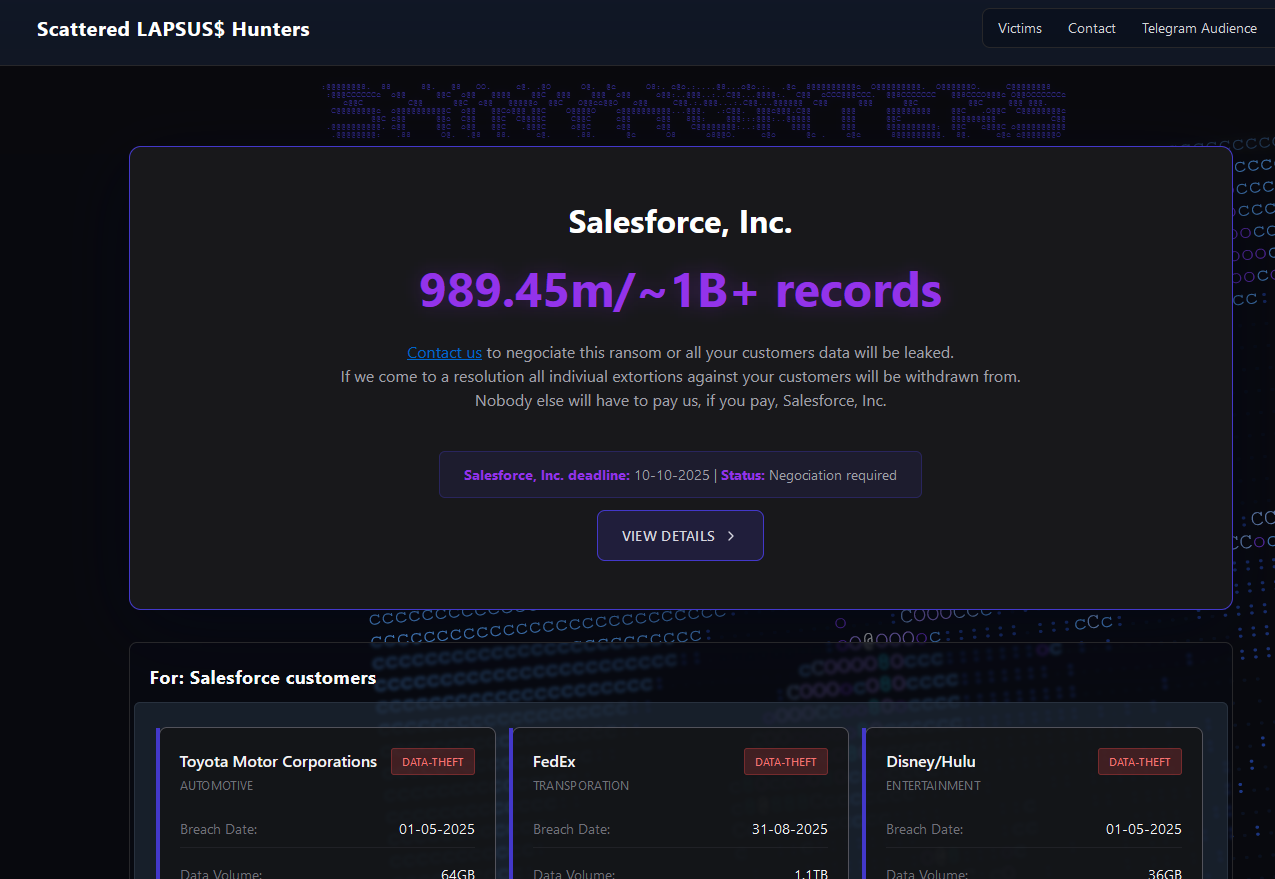
The new extortion website tied to ShinyHunters (UNC6040), which threatens to publish stolen data unless Salesforce or individual victim companies agree to pay a ransom.

In May 2025, a prolific and amorphous English-speaking cybercrime group known as ShinyHunters launched a social engineering campaign that used voice phishing to trick targets into connecting a malicious app to their organization’s Salesforce portal.

The first real details about the incident came in early June, when the Google Threat Intelligence Group (GTIG) warned that ShinyHunters — tracked by Google as UNC6040 — was extorting victims over their stolen Salesforce data, and that the group was poised to launch a data leak site to publicly shame victim companies into paying a ransom to keep their records private. A month later, Google acknowledged that one of its own corporate Salesforce instances was impacted in the voice phishing campaign.

Last week, a new victim shaming blog dubbed “Scattered LAPSUS$ Hunters” began publishing the names of companies that had customer Salesforce data stolen as a result of the May voice phishing campaign.

“Contact us to negotiate this ransom or all your customers data will be leaked,” the website stated in a message to Salesforce. “If we come to a resolution all individual extortions against your customers will be withdrawn from. Nobody else will have to pay us, if you pay, Salesforce, Inc.”

Below that message were more than three dozen entries for companies that allegedly had Salesforce data stolen, including Toyota, FedEx, Disney/Hulu, and UPS. The entries for each company specified the volume of stolen data available, as well as the date that the information was retrieved (the stated breach dates range between May and September 2025).

Image: Mandiant.

On October 5, the Scattered LAPSUS$ Hunters victim shaming and extortion blog announced that the group was responsible for a breach in September involving a GitLab server used by Red Hat that contained more than 28,000 Git code repositories, including more than 5,000 Customer Engagement Reports (CERs).

“Alot of folders have their client’s secrets such as artifactory access tokens, git tokens, azure, docker (redhat docker, azure containers, dockerhub), their client’s infrastructure details in the CERs like the audits that were done for them, and a whole LOT more, etc.,” the hackers claimed.

Their claims came several days after a previously unknown hacker group calling itself the Crimson Collective took credit for the Red Hat intrusion on Telegram.

Red Hat disclosed on October 2 that attackers had compromised a company GitLab server, and said it was in the process of notifying affected customers.

“The compromised GitLab instance housed consulting engagement data, which may include, for example, Red Hat’s project specifications, example code snippets, internal communications about consulting services, and limited forms of business contact information,” Red Hat wrote.

Separately, Discord has started emailing users affected by another breach claimed by ShinyHunters. Discord said an incident on September 20 at a “third-party customer service provider” impacted a “limited number of users” who communicated with Discord customer support or Trust & Safety teams. The information included Discord usernames, emails, IP address, the last four digits of any stored payment cards, and government ID images submitted during age verification appeals.

The Scattered Lapsus$ Hunters claim they will publish data stolen from Salesforce and its customers if ransom demands aren’t paid by October 10. The group also claims it will soon begin extorting hundreds more organizations that lost data in August after a cybercrime group stole vast amounts of authentication tokens from Salesloft, whose AI chatbot is used by many corporate websites to convert customer interaction into Salesforce leads.

In a communication sent to customers today, Salesforce emphasized that the theft of any third-party Salesloft data allegedly stolen by ShinyHunters did not originate from a vulnerability within the core Salesforce platform. The company also stressed that it has no plans to meet any extortion demands.

“Salesforce will not engage, negotiate with, or pay any extortion demand,” the message to customers read. “Our focus is, and remains, on defending our environment, conducting thorough forensic analysis, supporting our customers, and working with law enforcement and regulatory authorities.”

The GTIG tracked the group behind the Salesloft data thefts as UNC6395, and says the group has been observed harvesting the data for authentication tokens tied to a range of cloud services like Snowflake and Amazon’s AWS.

Google catalogs Scattered Lapsus$ Hunters by so many UNC names (throw in UNC6240 for good measure) because it is thought to be an amalgamation of three hacking groups — Scattered Spider, Lapsus$ and ShinyHunters. The members of these groups hail from many of the same chat channels on the Com, a mostly English-language cybercriminal community that operates across an ocean of Telegram and Discord servers.

The Scattered Lapsus$ Hunters darknet blog is currently offline. The outage appears to have coincided with the disappearance of the group’s new clearnet blog — breachforums[.]hn — which vanished after shifting its Domain Name Service (DNS) servers from DDoS-Guard to Cloudflare.

But before it died, the websites disclosed that hackers were exploiting a critical zero-day vulnerability in Oracle’s E-Business Suite software. Oracle has since confirmed that a security flaw tracked as CVE-2025-61882 allows attackers to perform unauthenticated remote code execution, and is urging customers to apply an emergency update to address the weakness.

Mandiant’s Charles Carmakal shared on LinkedIn that CVE-2025-61882 was initially exploited in August 2025 by the Clop ransomware gang to steal data from Oracle E-Business Suite servers. Bleeping Computer writes that news of the Oracle zero-day first surfaced on the Scattered Lapsus$ Hunters blog, which published a pair of scripts that were used to exploit vulnerable Oracle E-Business Suite instances.

On Monday evening, KrebsOnSecurity received a malware-laced message from a reader that threatened physical violence unless their unstated demands were met. The missive, titled “Shiny hunters,” contained the hashtag $LAPSU$$SCATEREDHUNTER, and urged me to visit a page on limewire[.]com to view their demands.

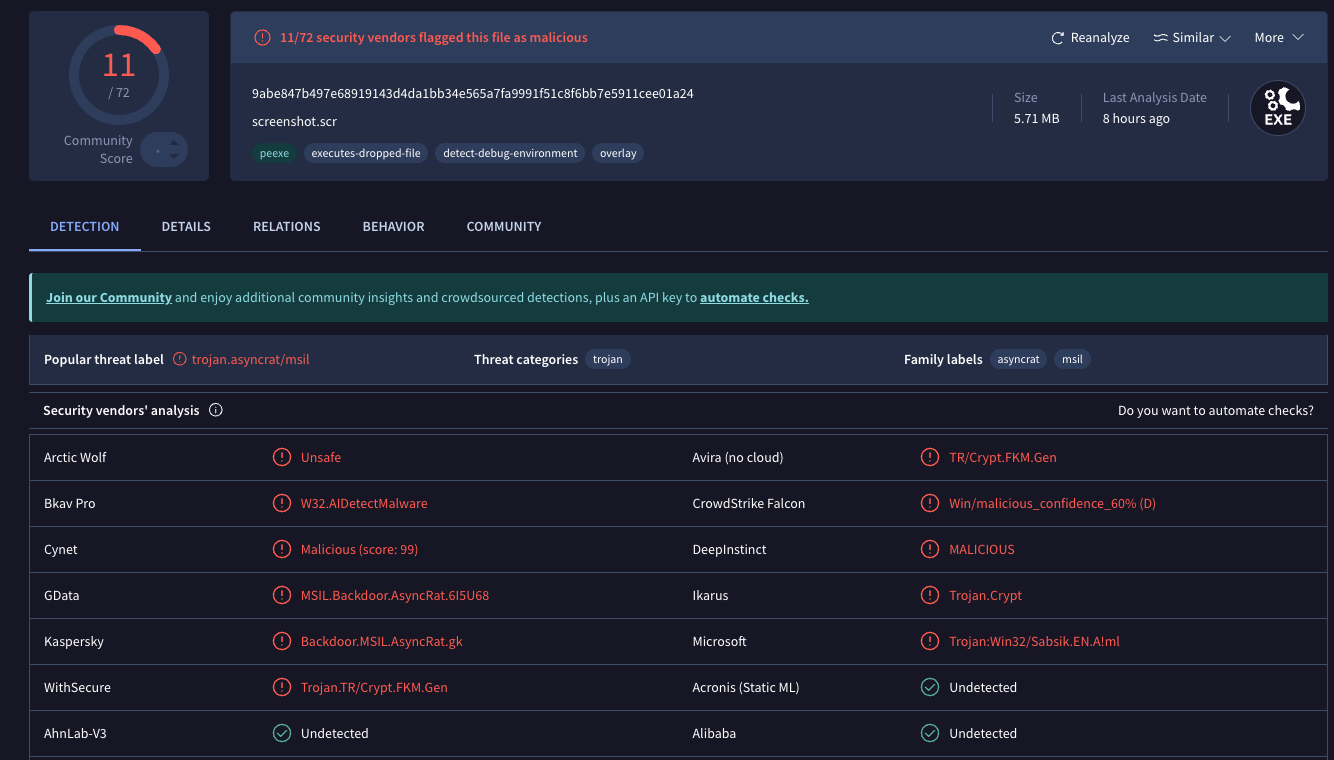
A screenshot of the phishing message linking to a malicious trojan disguised as a Windows screensaver file.

KrebsOnSecurity did not visit this link, but instead forwarded it to Mandiant, which confirmed that similar menacing missives were sent to employees at Mandiant and other security firms around the same time.

The link in the message fetches a malicious trojan disguised as a Windows screensaver file (Virustotal’s analysis on this malware is here). Simply viewing the booby-trapped screensaver on a Windows PC is enough to cause the bundled trojan to launch in the background.

Mandiant’s Austin Larsen said the trojan is a commercially available backdoor known as ASYNCRAT, a .NET-based backdoor that communicates using a custom binary protocol over TCP, and can execute shell commands and download plugins to extend its features.

A scan of the malicious screensaver file at Virustotal.com shows it is detected as bad by nearly a dozen security and antivirus tools.

“Downloaded plugins may be executed directly in memory or stored in the registry,” Larsen wrote in an analysis shared via email. “Capabilities added via plugins include screenshot capture, file transfer, keylogging, video capture, and cryptocurrency mining. ASYNCRAT also supports a plugin that targets credentials stored by Firefox and Chromium-based web browsers.”

Malware-laced targeted emails are not out of character for certain members of the Scattered Lapsus$ Hunters, who have previously harassed and threatened security researchers and even law enforcement officials who are investigating and warning about the extent of their attacks.

With so many big data breaches and ransom attacks now coming from cybercrime groups operating on the Com, law enforcement agencies on both sides of the pond are under increasing pressure to apprehend the criminal hackers involved. In late September, prosecutors in the U.K. charged two alleged Scattered Spider members aged 18 and 19 with extorting at least $115 million in ransom payments from companies victimized by data theft.

U.S. prosecutors heaped their own charges on the 19 year-old in that duo — U.K. resident Thalha Jubair — who is alleged to have been involved in data ransom attacks against Marks & Spencer and Harrods, the British food retailer Co-op Group, and the 2023 intrusions at MGM Resorts and Caesars Entertainment. Jubair also was allegedly a key member of LAPSUS$, a cybercrime group that broke into dozens of technology companies beginning in late 2021.

A Mastodon post by Kevin Beaumont, lamenting the prevalence of major companies paying millions to extortionist teen hackers, refers derisively to Thalha Jubair as a part of an APT threat known as “Advanced Persistent Teenagers.”

In August, convicted Scattered Spider member and 20-year-old Florida man Noah Michael Urban was sentenced to 10 years in federal prison and ordered to pay roughly $13 million in restitution to victims.

In April 2025, a 23-year-old Scottish man thought to be an early Scattered Spider member was extradited from Spain to the U.S., where he is facing charges of wire fraud, conspiracy and identity theft. U.S. prosecutors allege Tyler Robert Buchanan and co-conspirators hacked into dozens of companies in the United States and abroad, and that he personally controlled more than $26 million stolen from victims.

Update, Oct. 8, 8:59 a.m. ET: A previous version of this story incorrectly referred to the malware sent by the reader as a Windows screenshot file. Rather, it is a Windows screensaver file.

  • ✇Krebs on Security
  • The Ongoing Fallout from a Breach at AI Chatbot Maker Salesloft BrianKrebs
    The recent mass-theft of authentication tokens from Salesloft, whose AI chatbot is used by a broad swath of corporate America to convert customer interaction into Salesforce leads, has left many companies racing to invalidate the stolen credentials before hackers can exploit them. Now Google warns the breach goes far beyond access to Salesforce data, noting the hackers responsible also stole valid authentication tokens for hundreds of online services that customers can integrate with Salesloft,
     

The Ongoing Fallout from a Breach at AI Chatbot Maker Salesloft

1 de Setembro de 2025, 18:55

The recent mass-theft of authentication tokens from Salesloft, whose AI chatbot is used by a broad swath of corporate America to convert customer interaction into Salesforce leads, has left many companies racing to invalidate the stolen credentials before hackers can exploit them. Now Google warns the breach goes far beyond access to Salesforce data, noting the hackers responsible also stole valid authentication tokens for hundreds of online services that customers can integrate with Salesloft, including Slack, Google Workspace, Amazon S3, Microsoft Azure, and OpenAI.

Salesloft says its products are trusted by 5,000+ customers. Some of the bigger names are visible on the company’s homepage.

Salesloft disclosed on August 20 that, “Today, we detected a security issue in the Drift application,” referring to the technology that powers an AI chatbot used by so many corporate websites. The alert urged customers to re-authenticate the connection between the Drift and Salesforce apps to invalidate their existing authentication tokens, but it said nothing then to indicate those tokens had already been stolen.

On August 26, the Google Threat Intelligence Group (GTIG) warned that unidentified hackers tracked as UNC6395 used the access tokens stolen from Salesloft to siphon large amounts of data from numerous corporate Salesforce instances. Google said the data theft began as early as Aug. 8, 2025 and lasted through at least Aug. 18, 2025, and that the incident did not involve any vulnerability in the Salesforce platform.

Google said the attackers have been sifting through the massive data haul for credential materials such as AWS keys, VPN credentials, and credentials to the cloud storage provider Snowflake.

“If successful, the right credentials could allow them to further compromise victim and client environments, as well as pivot to the victim’s clients or partner environments,” the GTIG report stated.

The GTIG updated its advisory on August 28 to acknowledge the attackers used the stolen tokens to access email from “a very small number of Google Workspace accounts” that were specially configured to integrate with Salesloft. More importantly, it warned organizations to immediately invalidate all tokens stored in or connected to their Salesloft integrations — regardless of the third-party service in question.

“Given GTIG’s observations of data exfiltration associated with the campaign, organizations using Salesloft Drift to integrate with third-party platforms (including but not limited to Salesforce) should consider their data compromised and are urged to take immediate remediation steps,” Google advised.

On August 28, Salesforce blocked Drift from integrating with its platform, and with its productivity platforms Slack and Pardot.

The Salesloft incident comes on the heels of a broad social engineering campaign that used voice phishing to trick targets into connecting a malicious app to their organization’s Salesforce portal. That campaign led to data breaches and extortion attacks affecting a number of companies including Adidas, Allianz Life and Qantas.

On August 5, Google disclosed that one of its corporate Salesforce instances was compromised by the attackers, which the GTIG has dubbed UNC6040 (“UNC” stands for “uncategorized threat group”). Google said the extortionists consistently claimed to be the threat group ShinyHunters, and that the group appeared to be preparing to escalate its extortion attacks by launching a data leak site.

ShinyHunters is an amorphous threat group known for using social engineering to break into cloud platforms and third-party IT providers, and for posting dozens of stolen databases to cybercrime communities like the now-defunct Breachforums.

The ShinyHunters brand dates back to 2020, and the group has been credited with or taken responsibility for dozens of data leaks that exposed hundreds of millions of breached records. The group’s member roster is thought to be somewhat fluid, drawing mainly from active denizens of the Com, a mostly English-language cybercrime community scattered across an ocean of Telegram and Discord servers.

Recorded Future’s Alan Liska told Bleeping Computer that the overlap in the “tools, techniques and procedures” used by ShinyHunters and the Scattered Spider extortion group likely indicate some crossover between the two groups.

To muddy the waters even further, on August 28 a Telegram channel that now has nearly 40,000 subscribers was launched under the intentionally confusing banner “Scattered LAPSUS$ Hunters 4.0,” wherein participants have repeatedly claimed responsibility for the Salesloft hack without actually sharing any details to prove their claims.

The Telegram group has been trying to attract media attention by threatening security researchers at Google and other firms. It also is using the channel’s sudden popularity to promote a new cybercrime forum called “Breachstars,” which they claim will soon host data stolen from victim companies who refuse to negotiate a ransom payment.

The “Scattered Lapsus$ Hunters 4.0” channel on Telegram now has roughly 40,000 subscribers.

But Austin Larsen, a principal threat analyst at Google’s threat intelligence group, said there is no compelling evidence to attribute the Salesloft activity to ShinyHunters or to other known groups at this time.

“Their understanding of the incident seems to come from public reporting alone,” Larsen told KrebsOnSecurity, referring to the most active participants in the Scattered LAPSUS$ Hunters 4.0 Telegram channel.

Joshua Wright, a senior technical director at Counter Hack, is credited with coining the term “authorization sprawl” to describe one key reason that social engineering attacks from groups like Scattered Spider and ShinyHunters so often succeed: They abuse legitimate user access tokens to move seamlessly between on-premises and cloud systems.

Wright said this type of attack chain often goes undetected because the attacker sticks to the resources and access already allocated to the user.

“Instead of the conventional chain of initial access, privilege escalation and endpoint bypass, these threat actors are using centralized identity platforms that offer single sign-on (SSO) and integrated authentication and authorization schemes,” Wright wrote in a June 2025 column. “Rather than creating custom malware, attackers use the resources already available to them as authorized users.”

It remains unclear exactly how the attackers gained access to all Salesloft Drift authentication tokens. Salesloft announced on August 27 that it hired Mandiant, Google Cloud’s incident response division, to investigate the root cause(s).

“We are working with Salesloft Drift to investigate the root cause of what occurred and then it’ll be up to them to publish that,” Mandiant Consulting CTO Charles Carmakal told Cyberscoop. “There will be a lot more tomorrow, and the next day, and the next day.”

❌
❌