Visualização normal
-
ASEC BLOG
-
Ransom & Dark Web Issues Week 1, May 2026
ASEC Blog publishes Ransom & Dark Web Issues Week 1, May 2026 Guatemalan Government Agency Data Sold on DarkForums BlackWater Ransomware Attack Targets Chinese Auto Parts Manufacturer Japanese Fintech Firm Suffers Unauthorized GitHub Access
-
Firewall Daily – The Cyber Express

-
CISA Launches CI Fortify to Defend Critical Infrastructure From Nation-State Cyber Threats
The U.S. Cybersecurity and Infrastructure Security Agency (CISA) has launched a new initiative called “CI Fortify” aimed at helping critical infrastructure operators prepare for disruptive cyberattacks linked to geopolitical conflicts. The initiative comes amid growing concerns over nation-state cyber threats targeting operational technology (OT) systems that support essential services across the United States. The CI Fortify initiative focuses on improving critical infrastructure resilience
CISA Launches CI Fortify to Defend Critical Infrastructure From Nation-State Cyber Threats
![]()
CI Fortify Initiative Focuses on Isolation and Recovery
Under the CI Fortify initiative, CISA is urging critical infrastructure organizations to assume that third-party communications and service providers may become unreliable during a crisis. Operators are also being asked to plan under the assumption that threat actors may already have some level of access to OT networks. Nick Andersen, Acting Director at CISA, emphasized the need for organizations to prepare for worst-case operational scenarios. “In a geopolitical crisis, the critical infrastructure organizations Americans rely on must be able to continue delivering, at a minimum, crucial services,” Andersen said. “They must be able to isolate vital systems from harm, continue operating in that isolated state, and quickly recover any systems that an adversary may successfully compromise.” The isolation strategy outlined under CI Fortify involves proactively disconnecting operational technology systems from external business networks and third-party connections. CISA said this approach is intended to prevent cyber impacts from spreading into OT environments while allowing organizations to continue delivering essential services in a degraded communications environment. The agency advised operators to identify critical customers, including military infrastructure and other lifeline services, and determine the minimum operational capabilities needed to support them during emergencies. CISA also recommended updating engineering processes and business continuity plans to support safe operations for extended periods while systems remain isolated.Recovery Planning Central to Critical Infrastructure Resilience
Alongside isolation, the CI Fortify initiative places strong emphasis on recovery planning. CISA urged operators to maintain updated system documentation, create secure backups of critical files, and regularly practice system replacement or manual operational transitions. The agency noted that organizations should also identify communications dependencies that could complicate recovery efforts, such as licensing servers, remote vendor access, or upstream network connections. CISA encouraged operators to work closely with managed service providers, system integrators, and vendors to understand potential failure points and establish alternative recovery pathways. The initiative also highlights broader benefits of emergency planning beyond cybersecurity incidents. According to CISA, the same planning processes can help organizations maintain operations during weather-related disruptions, equipment failures, and safety emergencies. The agency said isolation planning can help cut off command-and-control access to compromised systems, while strong recovery preparation can reduce incident response costs and shorten recovery timelines.Security Vendors and Service Providers Asked to Support CI Fortify
The CI Fortify initiative extends beyond infrastructure operators and calls on cybersecurity vendors, industrial automation suppliers, and managed service providers to support resilience planning efforts. Industrial control system vendors are being encouraged to identify barriers that could interfere with isolation and recovery procedures, including licensing restrictions and server dependency issues. Managed service providers and integrators are expected to assist organizations in engineering updates, local backup collection, and recovery documentation planning. Meanwhile, security vendors are being asked to support threat monitoring and provide intelligence if nation-state actors shift from espionage-focused activity to destructive cyber operations. CISA also requested vendors share information related to tactics that could undermine recovery or bypass isolation protections, including malicious firmware updates and vulnerabilities affecting software-based data diodes.Volt Typhoon Cyberattacks Continue to Shape U.S. Cybersecurity Strategy
The launch of CI Fortify is closely tied to ongoing concerns surrounding the Volt Typhoon cyberattacks, which U.S. officials have linked to Chinese state-sponsored threat actors. CISA’s initiative specifically references the Volt Typhoon campaign as an example of how adversaries have attempted to establish long-term access inside U.S. critical infrastructure systems to potentially support disruptive actions during military conflicts. The Volt Typhoon operation first became public in 2023, when U.S. authorities revealed that Chinese hackers had infiltrated multiple sectors of American critical infrastructure. Former CISA Director Jen Easterly stated in 2024 that the agency had identified and removed Volt Typhoon intrusions across several sectors. She later reiterated in 2025 that efforts continued to focus on identifying and evicting Chinese cyber actors from critical infrastructure environments. Despite these operations, cybersecurity researchers and some government officials have warned that Chinese threat actors may still retain access to portions of critical infrastructure networks. Several experts have argued that nation-state groups remain deeply embedded in certain environments despite years of remediation efforts. With the CI Fortify initiative, CISA appears to be shifting focus toward operational resilience, recognizing that prevention alone may not be sufficient against sophisticated nation-state cyber threats targeting U.S. critical infrastructure.-
Security Boulevard

-
North Korea’s Enormous Crypto Hacks Redefine Scale and Strategy
A pair of tightly executed cyberattacks have become milestones in cryptocurrency theft in 2026 due to their sheer size. These two incidents, targeting Drift Protocol and KelpDAO, account for roughly three quarters of all recorded crypto losses through April, revealing a shift toward fewer, higher-dollar operations. Based on a report from TRM Labs, security researchers.. The post North Korea’s Enormous Crypto Hacks Redefine Scale and Strategy appeared first on Security Boulevard.
North Korea’s Enormous Crypto Hacks Redefine Scale and Strategy
A pair of tightly executed cyberattacks have become milestones in cryptocurrency theft in 2026 due to their sheer size. These two incidents, targeting Drift Protocol and KelpDAO, account for roughly three quarters of all recorded crypto losses through April, revealing a shift toward fewer, higher-dollar operations. Based on a report from TRM Labs, security researchers..
The post North Korea’s Enormous Crypto Hacks Redefine Scale and Strategy appeared first on Security Boulevard.
-
Security | CIO

-
Your cloud strategy is incomplete without a cyber recovery plan
It’s no stretch to say that most businesses likely feel confident about their cloud strategy today. They have invested heavily in modern platforms, deployed advanced security tools and strengthened identity control. The environment should look secure, scalable and resilient. I have seen firsthand where cloud adoption is treated as a modernization milestone and risk reduction strategy. Dashboards turn green, compliance boxes are checked and leadership gets an assuranc
Your cloud strategy is incomplete without a cyber recovery plan
It’s no stretch to say that most businesses likely feel confident about their cloud strategy today. They have invested heavily in modern platforms, deployed advanced security tools and strengthened identity control.
The environment should look secure, scalable and resilient.
I have seen firsthand where cloud adoption is treated as a modernization milestone and risk reduction strategy. Dashboards turn green, compliance boxes are checked and leadership gets an assurance that the organization is secured since moving to the cloud.
As we move to newer and more modern platforms, the question remains, “How quickly and confidently can your business recover from a cyberattack?”
Cyber recovery in today’s threat landscape determines survival. The stakes are no longer theoretical. According to IBM’s Cost of Data Breach Report, the global average cost of a data breach is $4.4M globally, and over $10M in the US.
Ransomware has evolved from an IT disruption to a business shutdown event. Industry reports indicate that ransomware is involved in nearly half of the major breaches. According to Sophos’ State of Ransomware report, the average recovery cost now exceeds $2.7 million per incident, excluding reputational damage and lost revenue.
The illusion of a “secure cloud”
Cloud transformation has become synonymous with modernization. Organizations move to the cloud to gain scalability, agility and perceived improvement in security.
Cloud providers invest billions into securing their data infrastructure with capabilities that far exceed what most organizations could build on premises. But here’s where the illusion begins.
Many organizations equate cloud adoption with risk reduction, if migrating workloads inherently makes them more secure. Cloud does not eliminate the cyber risk. It changes its shape and shifts its ownership.
In a cloud environment, many of the risks move up the stack:
- From infrastructure to identity
- From perimeter defense to identity access
- From static system to dynamic API driven architecture
One of the leading causes of cloud breaches is simple misconfiguration. Publicly exposed storage and overly permissive roles continue to create entry points for attackers. These are the failures of implementation and governance.
In a traditional environment, attackers target networks. In the cloud, they target identities. Compromised credentials, privilege escalations and weak access control allow attackers to move laterally across systems.
Once inside, they strategically target backups and recovery systems, ensuring that restorations become difficult or impossible.
The most dangerous aspect of this illusion is the belief that resilience is built in. Cloud platform provides high availability. A system can be highly available but still can have corrupted restore, fail to meet business recovery timelines and reintroduce vulnerabilities during recovery.
Recovery as the KPI
For years, cybersecurity has been built around a single objective, which is prevention. Organizations have invested heavily in firewalls, endpoint protection, identity controls and zero-trust architecture. While these investments remain essential, they are no longer sufficient. The reality is that no organization can prevent every attack.
It’s a fundamental change in thinking:
- From: Can we stop every attack?
- To: How quickly and safely can we recover when an attack succeeds?
When the cyberattack occurs, the initial breach is only the beginning. The real impact unfolds in the hours and days that follow. The system goes offline, operations stall, customers are affected and revenue streams are disrupted. The question is how well the organization is prepared and how quickly they respond when such a scenario occurs.
Speed of recovery is the new competitive advantage. An organization that recovers faster can restore operations with minimal downtime, maintain customer trust and limit financial and reputational damage. Those that don’t face prolonged outages, risk regulator exposures and experience long-term brand erosion. Recovery should be the board-level priority. Traditional technical metrics must be reframed in business terms.
RTO and RPO
Metrics like recovery time objective (RTO) and recovery point objective (RPO) have existed for decades, but at times have been buried in infrastructure discussions. This needs to be changed.
RTO defines how quickly the systems must be restored.
RPO defines how much data loss is acceptable.
Recovery must also be trusted, not just fast
Speed alone is not enough. One of the most overlooked challenges is data integrity. After an attack, organizations must ensure that restored systems are not only operational but clean and uncompromised.
This leads to the question. Can it be restored quickly and safely?
In many incidents, organizations discover that the backups are infected, data was silently corrupted and the recovery process reintroduces vulnerabilities. Data from Veeam shows that when backups were compromised, recovery time increases substantially, often accompanied by higher data loss and extended business outage.
Here is a key insight on attackers increasingly dwelling in the system for weeks and compromising the backup process before triggering ransomware. This leads to backups already containing malicious artifacts and delayed detection and unsafe recovery attempts.
What a modern cyber recovery strategy must include
Building a cyber recovery capability establishes a resilience layer across the organization. At a minimum, this includes:
- Isolated recovery environment: This must be protected from the primary network to prevent lateral movement during an attack. Logical or physical isolation ensures that recovery assets remain intact even when the production system is compromised
- Immutable backups: Data must be protected against deletion or encryption. This ensures that backups cannot be altered, even by privileged users or attackers.
- Clean data validation: Not all backups are safe to restore. Organizations need the ability to scan and validate data before recovery to ensure it is free from malware or corruption
- Orchestrated recovery workflow: The manual recovery process is too slow and error-prone during a crisis. Automated workflow enables faster and more reliable restoration.
- Regular testing and simulation: A recovery plan that hasn’t been tested is a risk. Simulating a cyberattack scenario helps an organization measure readiness, identify gaps and improve response time.
Five questions the business should ask
As cyber threats continue to evolve, businesses should challenge themselves with a new set of questions:
- Can we recover our most critical systems within a business-defined timeframe after a cyberattack?
- Do we have an isolated environment to ensure a clean recovery?
- How do we validate that recovered data is not compromised?
- When was the last time we tested a full cyber recovery scenario?
- Who owns cyber recovery as a capability across the organization?
Resilience defines leadership in the cloud era
Cloud has transformed how organizations build, scale and operate technology. It has delivered agility, speed and a new level of architectural resilience. But it has also introduced a more complex and unforgiving risk landscape, where cyber threats are not only inevitable, but increasingly designed to disrupt recovery itself.
Cyber recovery must be treated as a strategic capability, not an operational afterthought. An organization should not only have a cloud strategy but also a cyber recovery plan.
This article is published as part of the Foundry Expert Contributor Network.
Want to join?

-
Security | TechRepublic
-
Hackers Abuse Robinhood Signup Process to Deliver Phishing Emails
Robinhood fixed an account-creation flaw that hackers abused to send convincing phishing emails from its own system to some users over the weekend. The post Hackers Abuse Robinhood Signup Process to Deliver Phishing Emails appeared first on TechRepublic.
Hackers Abuse Robinhood Signup Process to Deliver Phishing Emails
Robinhood fixed an account-creation flaw that hackers abused to send convincing phishing emails from its own system to some users over the weekend.
The post Hackers Abuse Robinhood Signup Process to Deliver Phishing Emails appeared first on TechRepublic.
-
Firewall Daily – The Cyber Express

-
CERT-In Warns of AI-Driven Cyber Threat Surge, MSMEs at Highest Risk
India’s cybersecurity watchdog, CERT-In, has raised concerns of the nature of modern cyber threats, particularly those driven by artificial intelligence. In its latest advisory, the cybersecurity watchdog has highlighted how frontier AI technologies are reshaping the threat landscape, making cyberattacks faster, more scalable, and far more accessible, even to less skilled attackers. The warning places a special emphasis on Micro, Small, and Medium Enterprises (MSMEs), which are becoming prim
CERT-In Warns of AI-Driven Cyber Threat Surge, MSMEs at Highest Risk
![]()
From Manual Intrusion to AI-led Cyberattacks
CERT-In’s advisory explains that traditional hacking methods involve painstaking manual processes and highly specialized knowledge. Attackers would typically spend hours, if not days, probing systems for weaknesses before exploiting them. However, AI has fundamentally altered this dynamic. Frontier AI systems can now detect “zero-day” vulnerabilities, previously unknown flaws, in mere seconds. More concerning is the ability of these systems to “chain” multiple vulnerabilities together. By linking weaknesses across different applications or platforms, attackers can orchestrate comprehensive attacks that compromise entire networks from end to end. This level of sophistication was once limited to highly skilled professionals or state-sponsored actors. Today, however, the cybersecurity watchdog warns that such capabilities are accessible, effectively lowering the barrier to entry for cybercriminals.MSMEs Under Heightened Risk
The advisory stresses that MSMEs are particularly vulnerable in this new threat environment. Unlike large enterprises, MSMEs often operate with limited budgets and lack dedicated cybersecurity teams or advanced monitoring systems. This makes it easier for attackers to leverage AI-driven tools. CERT-In has pointed out that because AI simplifies and automates many aspects of cyberattacks, even individuals with minimal technical expertise can now carry out highly precise and damaging operations. As a result, MSMEs face a disproportionate level of risk. A successful breach could lead to severe consequences, including data theft, operational disruptions, or ransomware attacks that many smaller businesses are ill-prepared to manage. The cybersecurity watchdog has cautioned that without immediate and meaningful improvements in their security posture, MSMEs could suffer significant financial and reputational damage. The growing accessibility of AI-powered attack tools means that the threat is no longer hypothetical but immediate and widespread.Recommended Security Measures
In response to these emerging risks, CERT-In has outlined several critical steps that organizations, especially MSMEs, should take to strengthen their defenses. One of the primary recommendations is the deployment of robust threat detection systems combined with continuous network monitoring. These measures can help identify unusual activity early and prevent attacks from escalating. Another key focus area highlighted by the cybersecurity watchdog is patch management. As AI tools enable attackers to quickly identify and exploit unpatched vulnerabilities, delays in updating software can create significant security gaps. CERT-In stresses that the timely application of patches is essential to minimizing exposure. Additionally, maintaining comprehensive system logs is strongly advised. Detailed logs play a crucial role in forensic investigations, helping organizations understand how an attack occurred and what vulnerabilities were exploited. This information is vital for preventing future incidents and strengthening overall cybersecurity resilience.-
Firewall Daily – The Cyber Express

-
The Cyber Express Weekly Roundup: Data Breaches, Malware Campaigns, and Cyber Fraud Investigations
In this week’s edition of The Cyber Express weekly roundup, we explore the latest developments in the world of cybersecurity, focusing on high-profile data breaches, growing malware campaigns, and law enforcement actions against cybercriminals. As the digital threat landscape continues to evolve, attackers are targeting sensitive personal and organizational data, from health records to financial credentials. Meanwhile, government regulators are ramping efforts to protect minors and combat h
The Cyber Express Weekly Roundup: Data Breaches, Malware Campaigns, and Cyber Fraud Investigations
![]()
The Cyber Express Weekly Roundup
UK Biobank Data Breach Triggers Urgent Review of Data Security Measures
A significant data breach at the UK Biobank has raised major concerns over the security of health-related data used in scientific research. In April 2026, de-identified participant information was discovered being sold on a Chinese consumer platform, sparking widespread alarm among the research community. Read more...Vercel CEO Reveals Expansion of Malware Campaign Affecting Multiple Targets
Vercel's CEO, Guillermo Rauch, confirmed that the recent breach involving Context.ai was part of a much larger malware campaign affecting multiple targets. Following a review of network logs, Vercel’s security team uncovered evidence of malware distribution that compromised several customer accounts, including access to valuable Vercel account keys. Read more...Ofcom Investigates Telegram and Teen Platforms
In the UK, Ofcom has launched an investigation into Telegram and several popular teen chat platforms, such as Teen Chat and Chat Avenue, after reports surfaced of online grooming and child sexual abuse material (CSAM) on these services. Under the Online Safety Act, platforms are required to take proactive steps to prevent harmful content and protect minors from exploitation. Read more...Personal Data Exposed in Breach of France’s ANTS Portal
A recent breach of France’s ANTS (Agence Nationale des Titres Sécurisés) portal has compromised personal data, including names, email addresses, and birthdates, although no documents or sensitive attachments were affected. The breach, which occurred on April 15, 2026, raises significant concerns about identity theft and phishing risks, as the exposed data could be used to target individuals. Read more...Bluesky Faces Coordinated DDoS Attack
Bluesky, the rapidly expanding social media platform, suffered a major disruption on April 15, 2026, when it was targeted by a sophisticated distributed denial-of-service (DDoS) attack. The attack caused widespread outages, impacting core platform functions such as user feeds, notifications, and search capabilities. Read more...Indian Authorities Arrest Key SIM Card Supplier in Cyber Fraud Crackdown
India’s Central Bureau of Investigation (CBI) has arrested a key conspirator in a major cyber fraud operation as part of Operation Chakra-V. The suspect, arrested in Guwahati, is accused of supplying fraudulent SIM cards used in various cybercrime schemes, including extortion and fake loan scams. The SIM cards were acquired using fake identities and distributed to cybercriminal networks. Read more...Weekly Takeaway
This week’s roundup highlights the diverse and evolving nature of cyber threats. From the exposure of sensitive health data and sophisticated malware campaigns to DDoS attacks and SIM card fraud schemes, the cybersecurity landscape remains fraught with challenges. Regulatory bodies and companies alike continue to grapple with emerging risks, particularly in sectors like public health data, social media platforms, and digital content safety. As these incidents unfold, it’s clear that both technical vulnerabilities and human factors, such as social engineering, continue to be central targets for attackers. With regulatory frameworks like the Online Safety Act and increased investigative efforts in places like India and France, the pressure on platforms and authorities to act quickly and decisively is higher than ever. As the cyber threat landscape becomes more interconnected, the need for enhanced security protocols, improved monitoring, and greater accountability in digital spaces remains critical.-
Security | CIO

-
Living off the Land attacks pose a pernicious threat for enterprises
Living off the Land attacks have become one of the most persistent and difficult threats facing enterprise security teams. Unlike traditional intrusions that rely on custom malware or obvious exploits, these attacks weaponize the tools organizations already trust and depend on every day. PowerShell, Windows Management Instrumentation, PsExec, scheduled tasks, bash scripts and other native utilities become part of the attack surface. These attacks succeed not because defende
Living off the Land attacks pose a pernicious threat for enterprises
Living off the Land attacks have become one of the most persistent and difficult threats facing enterprise security teams. Unlike traditional intrusions that rely on custom malware or obvious exploits, these attacks weaponize the tools organizations already trust and depend on every day. PowerShell, Windows Management Instrumentation, PsExec, scheduled tasks, bash scripts and other native utilities become part of the attack surface. These attacks succeed not because defenders lack tools, but because defenders still assume that legitimate activity is inherently safe.
This approach allows adversaries to blend seamlessly into normal operations. Instead of triggering alerts tied to malicious binaries or known signatures, Living off the Land techniques exploit legitimate administrative functionality to move laterally, escalate privileges and quietly exfiltrate data. From the attacker’s perspective, the goal is simple: operate within the environment’s rules rather than break them.
As enterprises expand their use of cloud services, automation frameworks and hybrid architectures, the reliance on native system tools continues to grow. The same capabilities that enable scale, resilience and efficiency also create ideal conditions for stealthy intrusions. Recent threat intelligence reports show that a majority of modern attacks now incorporate Living off the Land techniques, underscoring how quickly this tradecraft has become the norm rather than the exception.
For CIOs, the concern is not just that these attacks are hard to detect. It is that they exploit the very mechanisms used to keep systems running. Whether managing critical communications infrastructure at a federal agency (which one of us did as CIO of the FCC for 4 years) or overseeing enterprise IT operations, the tension remains constant: Administrative tools are simultaneously essential for operations and attractive targets for adversaries. Blocking these tools outright is rarely an option without disrupting critical business functions. The result is increased dwell time, higher remediation costs, reduced visibility into attacker intent and a steady erosion of trust in traditional security controls.
High-profile Advanced Persistent Threat (APT) actors such as Salt Typhoon illustrate how sophisticated adversaries can conduct long-running operations using little more than system native capabilities. With sufficient knowledge of enterprise environments, attackers can persist for months while appearing indistinguishable from legitimate administrators.
Evan recently observed a Living off the Land incident at a major telecommunications provider that highlights this challenge. Security rules initially blocked a set of IP addresses believed to be malicious. Those addresses turned out to be valid customer premise equipment. Disabling them degraded customer performance and created operational risk, while the attacker activity continued elsewhere using legitimate tooling. This kind of misalignment between security signals and business reality is increasingly common because of Living off the Land scenarios.
Organizations most at risk from Living off the Land attacks
Every enterprise is vulnerable to Living off the Land attacks because the techniques rely on standard operating system functionality rather than specialized software. That said, organizations that operate complex, distributed or mission-critical environments face disproportionately higher risk.
Critical infrastructure providers such as utilities, telecommunications networks and transportation systems are especially exposed. These environments often include devices that haven’t been patched or updated in years and can lack even basic controls that we take for granted today. They depend heavily on high-privilege administrative tools to manage uptime, safety and regulatory compliance. The geopolitical implications are significant: Adversaries targeting critical infrastructure increasingly use Living off the Land techniques precisely because they understand that defenders cannot simply disable the tools that keep essential services running. Financial institutions face similar exposure across trading platforms, payments infrastructure and identity systems where automation and remote management are deeply embedded.
Hybrid environments further expand the attack surface by increasing the number of endpoints, identities and trust relationships attackers can exploit. The more administrative paths that exist between systems, the easier it becomes for adversaries to mimic expected behavior while advancing their objectives. The growing use of general-purpose GenAI and jailbroken (WormGPT) large language models by attackers compounds the problem. Automation scripts that once required deep technical expertise can now be generated, modified and adapted quickly. This lowers the barrier to entry and accelerates the spread of Living off the Land techniques across a broader range of threat actors.
Ultimately, any organization that relies heavily on PowerShell, WMI or similar orchestration frameworks must assume that these tools will be targeted. The question is no longer whether Living off the Land techniques will be used, but whether the organization can identify malicious intent before meaningful damage occurs.
Best practices for combatting Living off the Land attacks
Hardening native system tools without breaking operations
The first step in addressing Living off the Land risk is hardening the system tools most commonly abused by attackers. This requires a careful balance. These tools are essential for IT operations, so controls must reduce abuse without undermining legitimate use.
Effective hardening begins with tightening how and when administrative tools can be executed. Constraining scripting environments, enforcing signed scripts, reducing unnecessary functionality and applying least privilege access principles all limit the opportunities available to attackers. Many organizations discover that privileges have accumulated over time in ways that no longer align with current operational needs. Hardening also includes disciplined configuration management. Attackers frequently exploit misconfigurations rather than software vulnerabilities. Regular audits of system settings, administrative permissions and automation workflows can eliminate gaps that quietly expand the attack surface.
However, CIOs should be clear-eyed about the limits of hardening. These measures reduce exposure but do not prove intent. A well-configured PowerShell environment can still be misused by a compromised credential or a malicious insider. Hardening raises the bar for accessing systems. But if a bad actor cracks a login, having advanced controls in place doesn’t really do much to reduce the havoc they can wreak.
Continuous monitoring that understands behavior
Continuous monitoring is essential for fighting Living off the Land activity. Uncovering context is huge here. What matters in Living off the Land scenarios is understanding how and why a tool is being used. A PowerShell command executed by the right account at the wrong time or in the wrong sequence may be far more significant than an obviously unusual event that lacks context.
SOC teams need consolidated visibility across administrative tools, identities, systems and timing. Is a script being executed outside normal maintenance windows? Is a privileged account accessing systems it rarely touches? Are administrative actions chaining together in ways that suggest lateral movement rather than routine management? Context transforms noise into signal. Without it, security teams are flooded with alerts that reflect operational complexity rather than attacker intent. This leads to alert fatigue and missed opportunities to identify early-stage intrusions.
Continuous monitoring must also account for the reality of hybrid environments. Visibility gaps between cloud services and on-premises systems create blind spots attackers are quick to exploit. Unified telemetry that spans these domains is critical to understanding how activity in one area influences risk in another.
Giving SOC teams the time and mandate to hunt proactively
Even with strong hardening and continuous monitoring, Living off the Land attacks often evade purely reactive defenses. Their subtlety requires proactive hunting by skilled analysts who understand attacker tradecraft and business context. SOC teams are frequently overwhelmed by routine operational alerts, compliance reporting and administrative overhead. When every hour is consumed by triage, there is little capacity left to search for the faint signals that indicate an emerging Living off the Land intrusion.
Effective hunting focuses on intent rather than anomalies. Analysts look for patterns that suggest goal-oriented behavior, such as repeated credential use across systems, subtle privilege escalation or administrative actions that create future access rather than immediate impact. This work requires deep familiarity with how the business actually operates. Analysts must understand which workflows are normal, which are rare and which should never occur. That knowledge cannot be encoded entirely in rules or automated systems.
Overall, the most resilient organizations are those that empower SOC teams to think like adversaries while staying grounded in operational reality. This changes detection from a reactive effort into a form of continuous validation that systems are behaving as intended.
Adapting security strategy to a Living off the Land world
Living off the Land attacks represent a long-term evolution in how adversaries operate. As defenses improve, attackers increasingly choose the path of least resistance by abusing trusted tools rather than introducing foreign code. This shift demands a corresponding evolution in security strategy. Perimeter-centric models are no longer sufficient on their own. Enterprises must assume that some level of compromise is inevitable and focus on reducing dwell time and limiting impact.
Adapting to this reality requires shifting focus from tools to behavior and from individual events to intent over time. Hardening reduces exposure, but it does not explain why actions are occurring or how they connect. What matters is the sequence of events, their timing and the context across identities and environments.
In a Living off the Land world, zero trust must be extended beyond authentication events and enforcement points. The path forward is not chasing every new tool or threat, but understanding how attackers operate, how systems are actually used and how security can align with real business operations. As environments grow more complex, no human analyst can reason about every possible behavior in isolation. Security strategies must evolve to recognize intent at scale, or risk falling behind attacks designed to hide in plain sight.
This article is published as part of the Foundry Expert Contributor Network.
Want to join?

-
Security | CIO

-
코헤시티 “AI 시대, 3중 백업도 무력화…네트워크 분리된 보호 전략 필요”
코헤시티는 4월 14일 서울에서 기자간담회를 열고, AI 확산에 따른 데이터 증가와 사이버 위협 대응 전략, 향후 사업 방향을 공개했다. 이날 행사에는 산제이 푸넨(Sanjay Poonen) CEO가 직접 방한해 글로벌 전략과 한국 시장에 대한 비전을 설명했다. 환영사에 나선 이상훈 코헤시티 코리아 지사장은 “최근 한국에서는 통신사, 병원 등 다양한 산업에서 데이터 유출과 랜섬웨어 공격이 증가하고 있고, 과징금 규모도 1,300억원이 넘는 사례가 나올 만큼 과거와 비교할 수 없을 정도로 커지고 있다”며 “이제 데이터 보호는 단순 백업이 아니라 기업 생존과 직결된 문제”라고 강조했다. 이어 “코헤시티는 단순히 데이터를 백업하는 데 그치지 않고, 평상시에도 데이터를 분석하고 활용해 기업 생산성을 높일 수 있도록 지원하는 것이 차별점”이라고 설명했다. “AI는 기회이자 리스크…핵심은 데이터 보호” 산제이 푸넨 CEO는 AI 시
코헤시티 “AI 시대, 3중 백업도 무력화…네트워크 분리된 보호 전략 필요”
코헤시티는 4월 14일 서울에서 기자간담회를 열고, AI 확산에 따른 데이터 증가와 사이버 위협 대응 전략, 향후 사업 방향을 공개했다. 이날 행사에는 산제이 푸넨(Sanjay Poonen) CEO가 직접 방한해 글로벌 전략과 한국 시장에 대한 비전을 설명했다.
환영사에 나선 이상훈 코헤시티 코리아 지사장은 “최근 한국에서는 통신사, 병원 등 다양한 산업에서 데이터 유출과 랜섬웨어 공격이 증가하고 있고, 과징금 규모도 1,300억원이 넘는 사례가 나올 만큼 과거와 비교할 수 없을 정도로 커지고 있다”며 “이제 데이터 보호는 단순 백업이 아니라 기업 생존과 직결된 문제”라고 강조했다.
이어 “코헤시티는 단순히 데이터를 백업하는 데 그치지 않고, 평상시에도 데이터를 분석하고 활용해 기업 생산성을 높일 수 있도록 지원하는 것이 차별점”이라고 설명했다.
“AI는 기회이자 리스크…핵심은 데이터 보호”
산제이 푸넨 CEO는 AI 시대의 양면성을 강조했다. 그는 “AI는 혁신을 가져오는 동시에 사이버 공격과 데이터 유출 위험도 키운다”며 “불과 같아서 유용하지만 잘못 사용하면 큰 피해를 줄 수 있다”고 비유했다.
코헤시티는 이러한 환경에서 기업이 갖춰야 할 핵심 역량으로 ‘사이버 레질리언스(Cyber Resilience)’를 제시했다. 이는 공격을 막는 것뿐 아니라, 사고 이후에도 빠르게 복구할 수 있는 능력을 의미한다. 푸넨 CEO는 이를 “넘어졌다가 다시 일어나는 힘”이라고 표현했다.
이를 위해 코헤시티는 ▲모든 워크로드 보호 ▲에어갭 기반 데이터 보관 ▲클린룸 복구 ▲데이터 및 AI 보안 관리 등으로 구성된 5단계 프레임워크를 제시했다. 특히 네트워크와 완전히 분리된 ‘데이터 볼트’의 중요성을 강조했다.
이상훈 지사장은 기존 백업 전략의 한계를 짚으며 새로운 관점의 대처 전략이 필요하다고 강조했다. 특히 금융권 등에서 권고하는 ‘3중 백업’도 네트워크에 연결돼 있다면 공격에 취약할 수 있다는 점을 사례로 들었다.
이에 따라 코헤시티는 네트워크에서 완전히 분리된 ‘에어갭(air-gap)’ 기반 백업, 즉 ‘데이터 볼트’ 구조를 강조하고 있다. 평상시에는 접근을 차단하고, 백업 시점에만 연결해 사이버 공격 상황에서도 복구 가능성을 확보하는 방식이다.
이상훈 지사장은 “백업 데이터가 네트워크에 연결돼 있으면 해커 접근을 막기 어렵다”며 “완전히 분리된 환경에 데이터를 보관해야 진정한 레질리언스를 확보할 수 있다”고 말했다
구체적인 솔루션 관점에서 코헤시티 전략은 데이터 보호를 넘어 데이터 활용까지 확장하는 방향에 초점을 두고 있다. 푸넨 CEO는 “우리는 데이터를 보호하고 보안하는 것을 넘어, 궁극적으로 AI를 통해 인사이트를 제공하는 것을 목표로 한다”고 말했다.
이를 위해 코헤시티는 ‘코헤시티 데이터 클라우드(Cohesity Data Cloud)’를 중심으로 데이터 관리 체계를 구축하고, 그 위에 AI 기반 분석 기능을 제공하고 있다. 엔비디아와 협력해 RAG(Retrieval-Augmented Generation) 기반의 데이터 검색·요약·분석 기능도 구현했다.
이 플랫폼 상단에는 ‘가이아(Gaia)’라는 AI 도구가 탑재된다. 가이아는 기업이 보유한 비정형 데이터(PDF, 문서, 이미지 등)를 기반으로 검색, 요약, 분석 기능을 제공한다. 예를 들어 수년간 축적된 계약서를 분석해 주요 조건을 자동으로 정리하는 등, 실질적인 비즈니스 인사이트 도출이 가능하다.
에이전트 레질리언스, 새로운 보안 과제로
SAP, VM웨어, 인포(Infor) 등에서 30년 넘게 업계 경험을 쌓은 푸넨은 최근 AI로 빠르게 변화하는 고객 환경과 이에 대응하기 위한 내부 기술 방향성에 대해 공유했다.
먼저 아시아 시장 전반에 대해서도 긍정적인 전망을 내놨다. 그는 “글로벌 매출의 50% 이상이 미국 외 지역에서 발생하고 있으며, 일본, 한국, 호주·뉴질랜드, 홍콩, 싱가포르, 인도, 중동 등에서 미국과 유사한 성장 궤적을 보이고 있다”라며 “한국을 포함한 아시아 국가들은 AI와 사이버보안 투자에 적극적”이라고 말했다.
코헤시티는 특히 금융권을 중심으로 확보한 레퍼런스를 기반으로 산업 확산을 노리고 있다. 공공, 헬스케어, 제조 등으로 적용 범위를 넓혀간다는 전략이다. 푸넨 CEO는 “코헤시티 전체 매출의 20% 이상이 금융 서비스에서 나온다”며 “금융권은 IT 투자와 보안 지출 비중이 가장 높은 산업으로, 미국 대형 은행 대부분이 코헤시티 플랫폼을 표준으로 채택하고 있다”고 설명했다. 이어 “다른 국가 고객들도 미국 금융권 사례를 가장 먼저 벤치마킹하려 한다”고 덧붙였다.
공공과 헬스케어 분야에서도 글로벌 레퍼런스를 강조했다. 그는 “미국 연방정부와 주요 의료기관에서 확보한 경험을 한국, 싱가포르, 인도, 중동 등 다양한 국가에 확장 적용할 수 있을 것”이라고 말했다.
푸넨은 기술 투자 확대 흐름이 다른 산업으로도 빠르게 확산될 것으로 봤다. 그는 “이제 기술 기업이 아니더라도 모든 기업이 AI 전략을 고민해야 하는 시대”라며 “미국 S&P 500 대기업 중 상당수가 이미 기술 기업이지만, 나머지 기업들도 기술을 핵심 성장 동력으로 삼고 있다”고 강조했다.
이어 “석유·가스 산업은 시추와 유통에 AI를 적용하고 있고, 농업 등 전통 산업에서도 AI 활용이 빠르게 확산되고 있다”며 “이들 기업이 AI에 투자할수록 데이터는 폭발적으로 증가하게 된다”고 설명했다.
AI 확산과 함께 데이터 증가 속도도 주요 변수로 떠오르고 있다. 그는 “중요한 것은 AI의 작동 속도가 아니라, AI가 만들어내는 데이터의 증가 속도”라며 “현재 한국 고객도 페타바이트 단위 데이터를 보호하고 있는데, AI로 인해 10배 이상 늘어날 수 있다”라고 진단했다.
이어 “미국에서는 이미 수백 페타바이트 규모를 보호하고 있어 충분히 대응할 준비가 돼 있다”며 “데이터가 늘어날수록 보호와 활용 측면에서 새로운 기회가 된다”고 덧붙였다.
이와 함께 새로운 보안 영역도 부각되고 있다. 그는 “AI는 더 많은 에이전트를 만들어내고, 이들을 보호하는 ‘에이전트 레질리언스(Agent Resilience)’가 새로운 과제가 되고 있다”며 “코헤시티도 비인간 아이덴티티와 에이전트가 생성·삭제하는 데이터까지 보호하는 기술을 연구 및 투자하고 있다”고 밝혔다.
jihyun.lee@foundryco.com

-
Cybersecurity News
-
The Python Predator: PXA Stealer Surges 10% as it Targets Global Finance and Crypto in 2026
The post The Python Predator: PXA Stealer Surges 10% as it Targets Global Finance and Crypto in 2026 appeared first on Daily CyberSecurity. Related posts: New Lone None Stealer Malware Hijacks Crypto Wallets via Fake Copyright Takedown Notices The CAPTCHA Trap: How a Fake “ClickFix” Prompt Unleashed Latrodectus & Supper Malware PlugX Evolves: New “Meeting Invitation” Phishing Campaign Leverages Trusted Security Software
The Python Predator: PXA Stealer Surges 10% as it Targets Global Finance and Crypto in 2026
The post The Python Predator: PXA Stealer Surges 10% as it Targets Global Finance and Crypto in 2026 appeared first on Daily CyberSecurity.
-
Firewall Daily – The Cyber Express

-
75% of Cyberattacks Start with Phishing Emails, UAE Cyber Council Says
The scale of phishing emails cyberattacks is growing, and the UAE Cyber Security Council is making it clear that the threat is far from under control. In a recent warning, the Council told Emirates News Agency (WAM) that more than 75% of cyberattacks now begin with phishing emails or fraudulent messages, underlining how attackers continue to rely on simple, deceptive tactics to gain access to sensitive systems. The advisory, shared with WAM, points to email fraud as a primary entry point for
75% of Cyberattacks Start with Phishing Emails, UAE Cyber Council Says
![]()
Phishing Emails Cyberattacks Continue at Massive Scale
The numbers behind phishing emails cyberattacks highlight why the problem persists. According to the Council, more than 3.4 billion phishing messages are sent globally every day, targeting individuals across sectors and regions. These messages are not limited to basic scams. Many are crafted to steal login credentials, distribute malware, or collect personal information that can later be used in identity theft, extortion, or broader cyber campaigns. The volume ensures that even a small success rate can lead to significant impact. The Council noted that this type of fraud continues to spread widely, often taking advantage of gaps in user awareness and digital behaviour rather than weaknesses in technology alone.How Phishing Emails Cyberattacks Trick Users
The UAE Cyber Security Council outlined how phishing emails cyberattacks are typically structured to push users into quick action. Messages may request urgent payments, prompt users to verify accounts, or direct them to login pages through embedded links. In many cases, these emails imitate trusted entities such as banks or service providers. Others rely on offers that appear unusually attractive, drawing users into clicking links or sharing information without proper checks. The Council also pointed to common red flags, including emails with spelling or grammatical errors, unclear sender identities, and requests for personal data without valid justification. Despite being widely recognised indicators, such tactics continue to be used because they still manage to bypass user caution.User Awareness Remains Central to Prevention
The phishing emails cyberattacks trend places significant responsibility on users, particularly as attackers continue to refine how these messages are presented. The Council stressed that individuals and employees remain a primary target, making awareness a critical part of any defence strategy. To reduce exposure, the Council advised users to avoid interacting with suspicious links or messages and to refrain from scanning QR codes in untrusted environments. It also emphasised the importance of keeping login credentials private and enabling multi-factor authentication across accounts. Regular system updates and application patches were also highlighted as necessary steps to limit vulnerabilities that may be exploited following a phishing attempt.Reporting Plays a Key Role in Limiting Damage
Beyond prevention, the UAE Cyber Security Council underlined the importance of timely reporting in addressing phishing emails cyberattacks. Users who identify suspicious messages are encouraged to report them immediately rather than ignore or delete them. Early reporting allows security teams to analyse patterns, identify ongoing campaigns, and take steps to block further attacks. In large-scale phishing operations, even a single reported message can help trace and disrupt wider activity. The Council reiterated that quick action at the user level can significantly reduce the overall impact of these attacks.Phishing Emails Cyberattacks Remain a Persistent Threat
The continued dominance of phishing emails cyberattacks reflects a broader trend in the cybersecurity landscape. While organisations invest in advanced tools and systems, attackers continue to rely on methods that require minimal technical effort but deliver consistent results. The Council noted that safety in cyberspace has become an ongoing challenge, particularly as digital communication channels expand. Email remains one of the most widely used platforms, making it a reliable target for threat actors. The warning serves as a reminder that phishing is not a declining threat. It remains active, widespread, and closely tied to how users interact with everyday digital tools.-
Firewall Daily – The Cyber Express

-
The Cyber Express Weekly Roundup: Cyberattacks, AI Risks, and Geopolitical Cyber Threats
In this week’s weekly roundup, The Cyber Express brings together the latest developments in global cybersecurity news, from high-profile ransomware attacks to emerging risks in AI adoption and geopolitical cyber activity. Organizations worldwide are grappling with a combination of disruptive cyberattacks, espionage campaigns, and ongoing threats to critical infrastructure, reflecting the complex and interconnected nature of today’s threat landscape. Intelligence reports continue to highl
The Cyber Express Weekly Roundup: Cyberattacks, AI Risks, and Geopolitical Cyber Threats
![]()
The Cyber Express Weekly Roundup
Human Behavior Remains the Weakest Link
Cybersecurity experts stress that the most significant vulnerabilities often stem from human behavior rather than technical shortcomings. In a recent discussion covered by The Cyber Express weekly roundup, Dr. Sheeba Armoogum emphasized that modern cyberattacks increasingly exploit trust, emotion, and predictable behavior through techniques like social engineering and AI-driven impersonation. Read more...Energy Sector Ransomware: Lessons from 2025
The energy sector recorded 187 successful ransomware attacks in 2025, demonstrating the real-world consequences of cybercrime on critical infrastructure. Incidents such as Halliburton’s $35 million loss and significant outages in Ukraine revealed vulnerabilities in outdated systems, IT-OT convergence, and slow patching practices. Read more...EU Investigates Snapchat for Child Safety
The European Commission has launched a formal investigation into Snapchat under the Digital Services Act (DSA), examining child protection, privacy, and content moderation practices. Concerns include insufficient age verification, exposure to harmful content, and the accessibility of reporting tools, with potential fines reaching 6% of Snapchat’s global turnover if non-compliance is confirmed. Read more...Hackmanac CEO Warns: Cybersecurity Still Fails at the Basics
Sofia Scozzari, CEO of Hackmanac, emphasized that cybersecurity remains too focused on technology and often overlooks business risk, human behavior, and the operational impact of breaches. She explained that attackers collaborate and exploit known vulnerabilities, while organizations continue to treat cybersecurity as an IT issue rather than a strategic business challenge. Read more...Port of Vigo Disrupted by Ransomware
The Port of Vigo experienced a ransomware attack early Tuesday, shutting down cargo management systems and digital services. Physical port operations remain functional, but manual processes are slowing workflows, particularly at the Border Inspection Post. Authorities confirmed servers linked to the port’s website remain offline as part of containment efforts. Read more...Russian Cybercrime Leader Sentenced
In Detroit, Illya Angelov, head of the Russian cybercriminal group “Mario Kart,” was sentenced for running a botnet operation that infected thousands of computers daily and sold backdoor access to ransomware operators. Active from 2017 to 2021, the scheme targeted 72 U.S. companies across 31 states, sending 700,000 malware-laden emails daily and compromising roughly 3,000 systems each day. Read more...Crunchyroll Cyberattack Highlights Outsourced Risk
Crunchyroll confirmed a cyber incident linked to a third-party vendor, likely affecting customer service ticket data. There is no evidence of ongoing access to internal systems, though early reports suggest a threat actor may have gained access through an infected vendor device. Read more...Weekly Takeaway
This week’s weekly roundup highlights the growing complexity of the global cybersecurity landscape. From critical supply chain disruptions and challenges in AI governance to ransomware attacks, escalating geopolitical cyber threats, and vulnerabilities in third-party systems, organizations face an increasingly interconnected and high-stakes risk environment. To navigate these threats effectively, companies must prioritize human-centric security practices, enforce proactive governance frameworks, and implement continuous monitoring across all systems. Only through a strategic, multi-layered approach can organizations stay ahead in today’s hostile and fast-evolving digital ecosystem.-
Firewall Daily – The Cyber Express

-
U.S. Shuts Down Websites Behind Iran-Linked Cyber Attacks and Death Threats
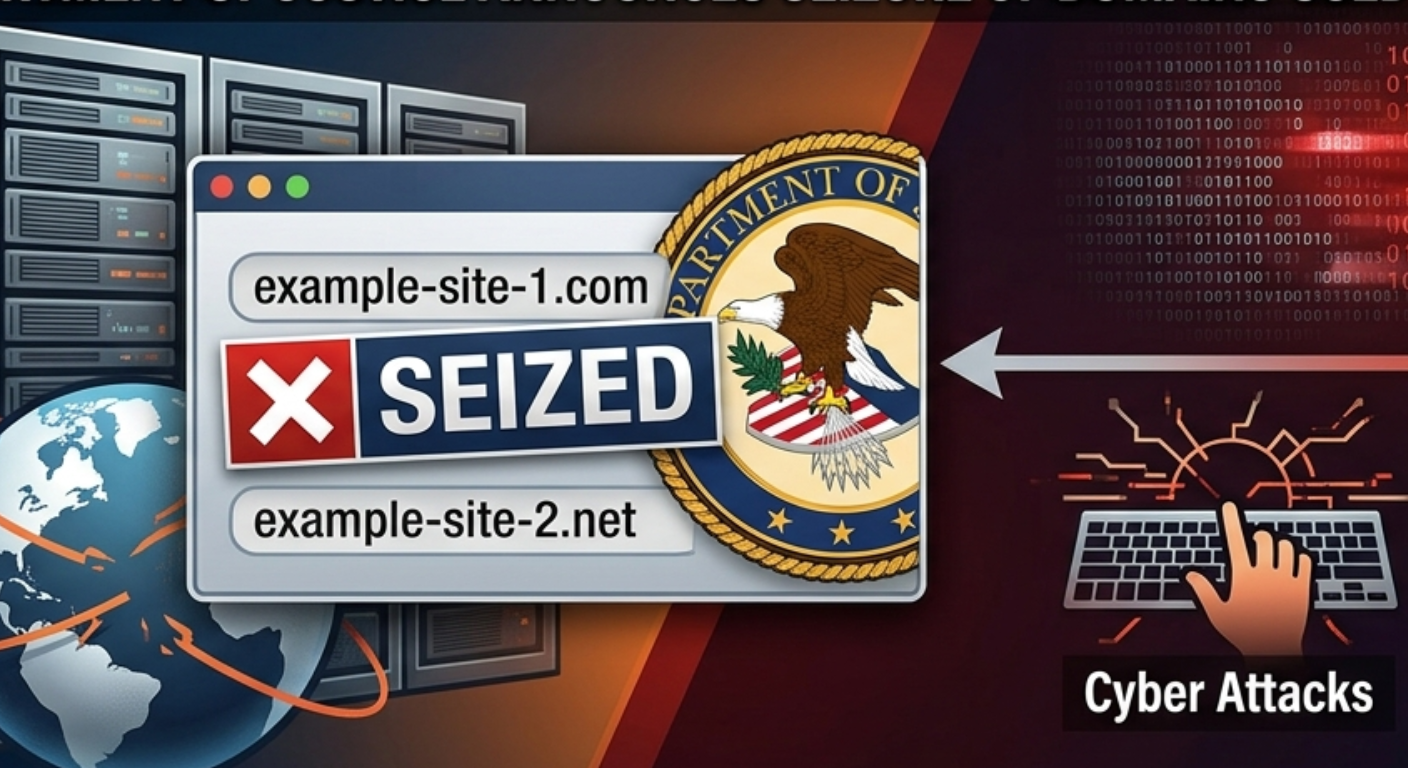
The U.S. Justice Department has seized four domains tied to Iran-linked cyberattacks, disrupting what officials describe as a coordinated effort to combine hacking with online intimidation and propaganda. The domains—Justicehomeland[.]org, Handala-Hack[.]to, Karmabelow80[.]org, and Handala-Redwanted[.]to—were allegedly operated by Iran’s Ministry of Intelligence and Security (MOIS). According to investigators, these sites were used to claim responsibility for cyberattacks, publish stolen data
U.S. Shuts Down Websites Behind Iran-Linked Cyber Attacks and Death Threats
![]()
Iran-Linked Cyberattacks Used Fake Hacktivist Fronts
Authorities say the domains were connected through shared infrastructure, including Iranian IP ranges and common leak platforms. More importantly, they followed a similar pattern of activity. The sites operated under the guise of hacktivist groups, but investigators say they were part of a state-backed effort. This included launching disruptive cyberattacks, leaking sensitive data, and amplifying the impact by publicly claiming responsibility. One such platform, Handala-hack[.]to, was used to claim a March 2026 malware attack on a U.S.-based medical technology company. The group framed the attack as retaliation linked to ongoing geopolitical tensions. This mix of hacking and messaging is becoming a defining feature of Iran-linked cyberattacks, where the goal is not just access, but visibility.Data Leaks and Threats Target Individuals Directly
The same infrastructure was also used to expose personal data and issue threats. According to court documents, the Handala-redwanted[.]to domain published identifying details of nearly 190 individuals associated with the Israeli Defense Force and government. The posts included messages suggesting these individuals were being tracked and could face consequences. Other posts named individuals allegedly linked to Israeli institutions, warning that their locations were known and encouraging others to act. In another instance, the group claimed to have stolen 851 gigabytes of data from members of the Sanzer Hasidic Jewish community, along with a warning that more information would follow. These actions show how Iran-linked cyberattacks are increasingly focused on individuals, not just organizations.Threats Extended Beyond Websites
Investigators found that the campaign did not stop at public posts. Email accounts tied to the same operation were used to send direct threats to journalists and Iranian dissidents living in the United States and abroad. In some messages, the senders claimed to have shared victims’ home addresses and offered financial rewards for acts of violence. The emails also referenced alleged links to criminal groups, adding another layer of intimidation. The use of direct communication alongside public leaks suggests a more aggressive approach in Iran-linked cyberattacks, where the aim is to pressure targets both publicly and privately.Justice Department Targets Infrastructure Behind Iran-Linked Cyberattacks
The Justice Department’s move focused on taking down the infrastructure enabling these activities. “Terrorist propaganda online can incite real-world violence — thanks to our National Security Division and the U.S. Attorney’s Office for the District of Maryland, this network of Iranian-backed sites will no longer broadcast anti-American hate,” said Attorney General Pamela Bondi. FBI Director Kash Patel added, “Iran thought they could hide behind fake websites and keyboard threats to terrorize Americans and silence dissidents. We took down four of their operation's pillars and we're not done. This FBI will hunt down every actor behind these cowardly death threats and cyberattacks and will bring the full force of American law enforcement down on them.” [caption id="attachment_110420" align="aligncenter" width="600"]Iran-Linked Cyberattacks Show a Broader Shift
The takedown reflects a wider pattern. Iran-linked cyberattacks are no longer limited to stealing data or disrupting systems—they are being used to send messages, target individuals, and amplify political narratives. By combining cyberattacks with data leaks and direct threats, these campaigns extend their reach beyond technical impact. The Justice Department’s action removes part of that network, but it also points to how these operations are evolving. For now, the focus is on disruption. But the methods behind these Iran-linked cyberattacks suggest this kind of activity is unlikely to disappear anytime soon.-
Unit 42

-
Boggy Serpens Threat Assessment
Iranian threat group Boggy Serpens' cyberespionage evolves with AI-enhanced malware and refined social engineering. Unit 42 details their persistent targeting. The post Boggy Serpens Threat Assessment appeared first on Unit 42.
Boggy Serpens Threat Assessment
Iranian threat group Boggy Serpens' cyberespionage evolves with AI-enhanced malware and refined social engineering. Unit 42 details their persistent targeting.
The post Boggy Serpens Threat Assessment appeared first on Unit 42.

-
Security | TechRepublic
-
Industrial Systems Under Siege: 77% of OT Environments Suffer Cyber Breaches
Industrial systems face rising cyber threats as OT security lags modernization. A new survey reveals widespread breaches and growing risks to critical infrastructure. The post Industrial Systems Under Siege: 77% of OT Environments Suffer Cyber Breaches appeared first on TechRepublic.
Industrial Systems Under Siege: 77% of OT Environments Suffer Cyber Breaches
Industrial systems face rising cyber threats as OT security lags modernization. A new survey reveals widespread breaches and growing risks to critical infrastructure.
The post Industrial Systems Under Siege: 77% of OT Environments Suffer Cyber Breaches appeared first on TechRepublic.
-
Unit 42

-
Suspected China-Based Espionage Operation Against Military Targets in Southeast Asia
An espionage operation demonstrated strategic operational patience against targets in Southeast Asia, deploying custom backdoors. The post Suspected China-Based Espionage Operation Against Military Targets in Southeast Asia appeared first on Unit 42.
Suspected China-Based Espionage Operation Against Military Targets in Southeast Asia
An espionage operation demonstrated strategic operational patience against targets in Southeast Asia, deploying custom backdoors.
The post Suspected China-Based Espionage Operation Against Military Targets in Southeast Asia appeared first on Unit 42.

-
Firewall Daily – The Cyber Express

-
The State of Cyber Warfare in 2026: Nation-State Attacks, AI Weapons, and the New Digital Battlefield
Cyber operations no longer occur only during wartime. Digital activity now runs continuously alongside diplomacy, sanctions, and military tensions. This has become particularly visible amid escalating hostilities involving Iran, Israel, and the United States, where intelligence agencies have warned of possible retaliatory cyber activity linked to the conflict. In this environment, cyber warfare 2026 is highlighted by persistent nation-state cyberattacks, covert intrusion campaigns, and strategic
The State of Cyber Warfare in 2026: Nation-State Attacks, AI Weapons, and the New Digital Battlefield
![]()
Cyber Warfare 2026: What We Know So Far
From 2025 to 2026, the global threat environment has produced several notable signals indicating how modern cyber conflict is evolving. Threat intelligence monitoring of underground forums revealed multiple offers of high-value system access throughout 2025. Examples include widely confirmed events, like on January 9, 2026, the cybercrime collective ShinyHunters published a manifesto alongside the leaked database of the BreachForums platform, exposing metadata for 323,986 users, including email addresses, hashed passwords, IP addresses, and registration details. Analysts believe some data may have been intentionally falsified for operational security. Vulnerability exploitation also intensified. In February 2026, Microsoft patched six actively exploited zero-day vulnerabilities affecting components including SmartScreen, Windows Desktop Window Manager, and Remote Desktop Services. Soon afterward, the U.S. Cybersecurity and Infrastructure Security Agency added VMware Aria Operations vulnerability CVE-2026-22719 to its Known Exploited Vulnerabilities catalog due to confirmed exploitation in the wild. By March 10, 2026, intelligence reporting warned of potential retaliatory cyber activity connected to escalating tensions involving Iran. Following the warning, cyber activity linked to the conflict increased across the Middle East. After the February 2026 U.S.–Israel strikes against Iranian targets, security researchers reported a surge of retaliatory cyber operations and hacktivist campaigns targeting organizations in Israel, the United States, and allied countries. Analysts tracked dozens of incidents ranging from distributed-denial-of-service attacks and website defacements to alleged data breaches claimed by pro-Iranian and pro-Palestinian hacker groups. Several groups publicly promoted operations such as “#Op_Israel_USA,” claiming attacks against Israeli telecom services, government websites, and Western organizations. Hacktivist collectives, including Handala Hack and Dark Storm Team, used Telegram and underground forums to claim responsibility for disruptions and alleged system compromises.Decoding Nation-State Cyberattacks
China-Linked Cyber Espionage Campaigns
Strategic espionage still exists as one of the most consistent features of cyber espionage in 2026. National threat assessments highlight that state actors, including China, are almost certainly attempting to cause a disruptive effect and manipulate industrial control systems in support of broader strategic goals. Government networks, research institutions, and emerging technology sectors remain priority targets. Telecommunications infrastructure has also become a major collection point because it offers both intelligence visibility and operational leverage. Threat intelligence summaries from the telecom sector, specifically, from Cyble’s Telecommunications Sector Threat Landscape Report 2025, documented 444 security incidents and 90 ransomware attacks against telecom companies in 2025 alone. The concentration of activity reinforces telecom networks as a strategic surveillance layer for nation-state cyberattacks.Russia-Linked Operations and Military Intelligence Campaigns
Russian cyber operations have remained closely tied to geopolitical conflict, particularly in Europe and regions affected by the war in Ukraine. Security research identified activity consistent with the Russian threat group APT28 targeting government and military entities using a Microsoft Office vulnerability, CVE-2026-21509. The campaign reportedly involved a multi-stage attack chain designed to remain stealthy during post-exploitation phases. Another example involved attackers weaponizing a previously patched WinRAR vulnerability (CVE-2025-8088). Even after patches become available, such flaws frequently remain exploitable due to slow enterprise patch adoption, making them attractive tools in state-sponsored cyber threats.North Korea and Financially Motivated Cyber Operations
North Korean cyber activity continues to blur the line between espionage and organized crime. One of the most widely reported examples involved the attribution of a $1.5 billion cryptocurrency theft from Bybit in February 2025 to the Lazarus Group. Financial theft serves both economic and strategic purposes for the North Korean state. At the same time, identity-based fraud has become another operational method.The New Digital Battlefield
Critical infrastructure still exists a primary target in cyber warfare 2026, with industrial control systems (ICS) and operational technology networks at high risk of manipulation by state actors to disrupt public administration, utilities, and transportation systems. While detailed technical disclosures of confirmed sabotage are limited, attackers increasingly focus on cloud and identity systems, exploiting stolen credentials, authentication tokens, and legitimate administrative tools to move laterally and gain broad access. Supply chains further amplify systemic risk, as compromises of third-party vendors can cascade across multiple organizations, making supply-chain attacks an efficient vector for nation-state cyberattacks, particularly against critical infrastructure and government networks.AI and the Evolution of Cyber Operations
Artificial intelligence is reshaping the cyber threat landscape, although its direct role in confirmed state operations remains difficult to measure. Threat intelligence monitoring shows the rise of Deepfake-as-a-Service markets and advertisements offering identity verification bypass tools or synthetic video generation. In 2025, deepfakes were involved in more than 30 percent of high-impact corporate impersonation attacks. Phishing campaigns are also becoming more automated. The CCAPAC Annual Report 2025 indicates that 82.6 percent of phishing emails now contain AI-generated elements, enabling attackers to scale highly convincing impersonation attempts. Malware development may also be changing. Security researchers have reported experimental malware families capable of modifying behavior during attacks using language-model-based components. While technical documentation remains limited, such developments hint at how automation could shape future cyber warfare 2026 strategies. Another area of rapid change is vulnerability discovery. AI-assisted code analysis has already demonstrated the ability to locate hundreds of severe software vulnerabilities in open-source projects within short timeframes, accelerating both defensive research and offensive exploitation.The Vulnerability Landscape Driving Modern Cyber Conflict
Software vulnerabilities remain one of the most reliable entry points for attackers. Examples from 2026 include:- CVE-2026-24423, a remote code execution vulnerability in SmarterMail exploited in ransomware campaigns.
- CVE-2026-22719, a VMware Aria Operations command-injection flaw actively exploited in the wild.
- CVE-2026-2441, the first actively exploited Chrome zero-day reported in 2026.
Conclusion
In 2026, digital conflict is a permanent part of global competition, with state-sponsored cyber threats exploiting supply chains, identity systems, and critical infrastructure to expand geopolitical risk. Criminal ecosystems further blur espionage and financially motivated attacks, complicating attribution. Cyble delivers AI-powered threat intelligence and autonomous defense through platforms like Cyble Blaze AI, giving organizations real-time visibility, automated protection, and proactive mitigation. Book a personalized demo today to stay protected from modern cyber threats.References:
- https://cybersecuritynews.com/breachforums-hack/
- https://thecyberexpress.com/microsoft-patch-tuesday-february-2026/
- https://nvd.nist.gov/vuln/detail/CVE-2026-22719
- https://abc17news.com/politics/national-politics/cnn-us-politics/2026/03/10/us-intelligence-community-ramps-up-warnings-of-possible-retaliatory-attacks-by-iran/
- https://industrialcyber.co/reports/cyber-retaliation-surges-after-us-israel-strikes-on-iran-as-hacktivists-hit-governments-defense-critical-sectors/
- https://www.intel471.com/blog/israeli-us-strikes-against-iran-triggers-a-surge-in-hacktivist-activity
- https://cyble.com/resources/research-reports/telecommunications-sector-threat-landscape-report-2025/
- https://www.helpnetsecurity.com/2026/02/03/russian-hackers-are-exploiting-recently-patched-microsoft-office-vulnerability-cve-2026-21509/
- https://www.thaicert.or.th/en/2026/01/29/winrar-vulnerability-cve-2025-8088-continues-to-be-actively-exploited-by-hackers/
- https://www.theguardian.com/world/2025/feb/27/north-korea-bybit-crypto-exchange-hack-fbi
- https://ccapac.asia/wp-content/uploads/2025/10/CCAPAC_AnnualReport2025_AIcybersecTrendsThreatsSolutions.pdf
- https://www.cybersecuritydive.com/news/half-exploited-zero-day-flaws-enterprise-grade-technology/814021/
-
Security Boulevard
-
The Chrome Extension Backdoor: How ‘Productivity Tools’ Became Enterprise Attack Vectors
Millions installed 'productivity' Chrome extensions that became malware after acquisition. Here's how browser extensions became enterprise security's weakest link. The post The Chrome Extension Backdoor: How ‘Productivity Tools’ Became Enterprise Attack Vectors appeared first on Security Boulevard.
The Chrome Extension Backdoor: How ‘Productivity Tools’ Became Enterprise Attack Vectors
Millions installed 'productivity' Chrome extensions that became malware after acquisition. Here's how browser extensions became enterprise security's weakest link.
The post The Chrome Extension Backdoor: How ‘Productivity Tools’ Became Enterprise Attack Vectors appeared first on Security Boulevard.
-
ASEC BLOG
-
Ransom & Dark Web Issues Week 1, March 2026
ASEC Blog publishes Ransom & Dark Web Issues Week 1, March 2026 Morpheus Launches Ransomware Attack on South Korean Plating Company Ailock Resumes Activity and Republishes Previous Ransomware Victims Pro-Iranian and Pro-Islamist Hacktivist Groups Launch Cyber Attacks on Middle Eastern and Pro-Western Targets [1], [2]
Ransom & Dark Web Issues Week 1, March 2026
-
Security Boulevard

-
Attacker Breached 600 FortiGate Appliances in AI-Assisted Campaign: Amazon
An single threat actor used AI tools to create and run a campaign that compromised more then 600 Fortinet FortiGate appliances around the world over five weeks, according to Amazon threat researchers, the latest example of how cybercriminals are using the technology in their attacks. The post Attacker Breached 600 FortiGate Appliances in AI-Assisted Campaign: Amazon appeared first on Security Boulevard.
Attacker Breached 600 FortiGate Appliances in AI-Assisted Campaign: Amazon
An single threat actor used AI tools to create and run a campaign that compromised more then 600 Fortinet FortiGate appliances around the world over five weeks, according to Amazon threat researchers, the latest example of how cybercriminals are using the technology in their attacks.
The post Attacker Breached 600 FortiGate Appliances in AI-Assisted Campaign: Amazon appeared first on Security Boulevard.