
Visualização normal

Antes de ontemStream principal
  • ✇Krebs on Security
  • Germany Doxes “UNKN,” Head of RU Ransomware Gangs REvil, GandCrab BrianKrebs
    An elusive hacker who went by the handle “UNKN” and ran the early Russian ransomware groups GandCrab and REvil now has a name and a face. Authorities in Germany say 31-year-old Russian Daniil Maksimovich Shchukin headed both cybercrime gangs and helped carry out at least 130 acts of computer sabotage and extortion against victims across the country between 2019 and 2021. Shchukin was named as UNKN (a.k.a. UNKNOWN) in an advisory published by the German Federal Criminal Police (the “Bundeskrimina
     

Germany Doxes “UNKN,” Head of RU Ransomware Gangs REvil, GandCrab

5 de Abril de 2026, 23:07

An elusive hacker who went by the handle “UNKN” and ran the early Russian ransomware groups GandCrab and REvil now has a name and a face. Authorities in Germany say 31-year-old Russian Daniil Maksimovich Shchukin headed both cybercrime gangs and helped carry out at least 130 acts of computer sabotage and extortion against victims across the country between 2019 and 2021.

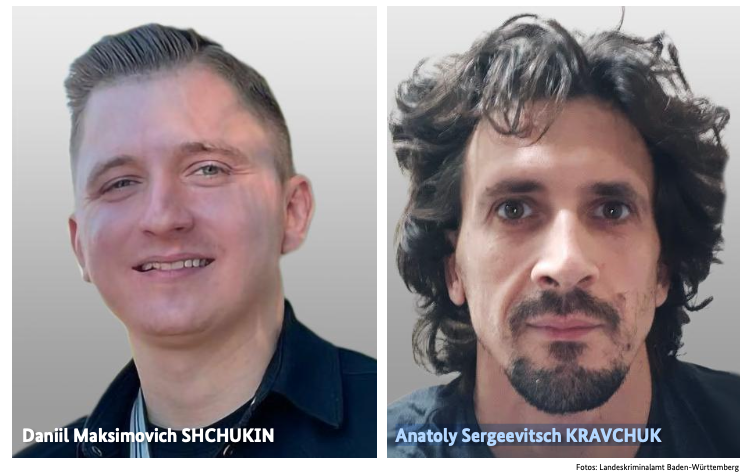
Shchukin was named as UNKN (a.k.a. UNKNOWN) in an advisory published by the German Federal Criminal Police (the “Bundeskriminalamt” or BKA for short). The BKA said Shchukin and another Russian — 43-year-old Anatoly Sergeevitsch Kravchuk — extorted nearly $2 million euros across two dozen cyberattacks that caused more than 35 million euros in total economic damage.

Daniil Maksimovich SHCHUKIN, a.k.a. UNKN, and Anatoly Sergeevitsch Karvchuk, alleged leaders of the GandCrab and REvil ransomware groups.

Germany’s BKA said Shchukin acted as the head of one of the largest worldwide operating ransomware groups GandCrab and REvil, which pioneered the practice of double extortion — charging victims once for a key needed to unlock hacked systems, and a separate payment in exchange for a promise not to publish stolen data.

Shchukin’s name appeared in a Feb. 2023 filing (PDF) from the U.S. Justice Department seeking the seizure of various cryptocurrency accounts associated with proceeds from the REvil ransomware gang’s activities. The government said the digital wallet tied to Shchukin contained more than $317,000 in ill-gotten cryptocurrency.

The GandCrab ransomware affiliate program first surfaced in January 2018, and paid enterprising hackers huge shares of the profits just for hacking into user accounts at major corporations. The GandCrab team would then try to expand that access, often siphoning vast amounts of sensitive and internal documents in the process. The malware’s curators shipped five major revisions to the GandCrab code, each corresponding with sneaky new features and bug fixes aimed at thwarting the efforts of computer security firms to stymie the spread of the malware.

On May 31, 2019, the GandCrab team announced the group was shutting down after extorting more than $2 billion from victims. “We are a living proof that you can do evil and get off scot-free,” GandCrab’s farewell address famously quipped. “We have proved that one can make a lifetime of money in one year. We have proved that you can become number one by general admission, not in your own conceit.”

The REvil ransomware affiliate program materialized around the same as GandCrab’s demise, fronted by a user named UNKNOWN who announced on a Russian cybercrime forum that he’d deposited $1 million in the forum’s escrow to show he meant business. By this time, many cybersecurity experts had concluded REvil was little more than a reorganization of GandCrab.

UNKNOWN also gave an interview to Dmitry Smilyanets, a former malicious hacker hired by Recorded Future, wherein UNKNOWN described a rags-to-riches tale unencumbered by ethics and morals.

“As a child, I scrounged through the trash heaps and smoked cigarette butts,” UNKNOWN told Recorded Future. “I walked 10 km one way to the school. I wore the same clothes for six months. In my youth, in a communal apartment, I didn’t eat for two or even three days. Now I am a millionaire.”

As described in The Ransomware Hunting Team by Renee Dudley and Daniel Golden, UNKNOWN and REvil reinvested significant earnings into improving their success and mirroring practices of legitimate businesses. The authors wrote:

“Just as a real-world manufacturer might hire other companies to handle logistics or web design, ransomware developers increasingly outsourced tasks beyond their purview, focusing instead on improving the quality of their ransomware. The higher quality ransomware—which, in many cases, the Hunting Team could not break—resulted in more and higher pay-outs from victims. The monumental payments enabled gangs to reinvest in their enterprises. They hired more specialists, and their success accelerated.”

“Criminals raced to join the booming ransomware economy. Underworld ancillary service providers sprouted or pivoted from other criminal work to meet developers’ demand for customized support. Partnering with gangs like GandCrab, ‘cryptor’ providers ensured ransomware could not be detected by standard anti-malware scanners. ‘Initial access brokerages’ specialized in stealing credentials and finding vulnerabilities in target networks, selling that access to ransomware operators and affiliates. Bitcoin “tumblers” offered discounts to gangs that used them as a preferred vendor for laundering ransom payments. Some contractors were open to working with any gang, while others entered exclusive partnerships.”

REvil would evolve into a feared “big-game-hunting” machine capable of extracting hefty extortion payments from victims, largely going after organizations with more than $100 million in annual revenues and fat new cyber insurance policies that were known to pay out.

Over the July 4, 2021 weekend in the United States, REvil hacked into and extorted Kaseya, a company that handled IT operations for more than 1,500 businesses, nonprofits and government agencies. The FBI would later announce they’d infiltrated the ransomware group’s servers prior to the Kaseya hack but couldn’t tip their hand at the time. REvil never recovered from that core compromise, or from the FBI’s release of a free decryption key for REvil victims who couldn’t or didn’t pay.

Shchukin is from Krasnodar, Russia and is thought to reside there, the BKA said.

“Based on the investigations so far, it is assumed that the wanted person is abroad, presumably in Russia,” the BKA advised. “Travel behaviour cannot be ruled out.”

There is little that connects Shchukin to UNKNOWN’s various accounts on the Russian crime forums. But a review of the Russian crime forums indexed by the cyber intelligence firm Intel 471 shows there is plenty connecting Shchukin to a hacker identity called “Ger0in” who operated large botnets and sold “installs” — allowing other cybercriminals to rapidly deploy malware of their choice to thousands of PCs in one go. However, Ger0in was only active between 2010 and 2011, well before UNKNOWN’s appearance as the REvil front man.

A review of the mugshots released by the BKA at the image comparison site Pimeyes found a match on this birthday celebration from 2023, which features a young man named Daniel wearing the same fancy watch as in the BKA photos.

Images from Daniil Shchukin’s birthday party celebration in Krasnodar in 2023.

Update, April 6, 12:06 p.m. ET: A reader forwarded this English-dubbed audio recording from a ccc.de (37C3) conference talk in Germany from 2023 that previously outed Shchukin as the REvil leader (Shchuckin is mentioned at around 24:25).

  • ✇Krebs on Security
  • Bulletproof Host Stark Industries Evades EU Sanctions BrianKrebs
    In May 2025, the European Union levied financial sanctions on the owners of Stark Industries Solutions Ltd., a bulletproof hosting provider that materialized two weeks before Russia invaded Ukraine and quickly became a top source of Kremlin-linked cyberattacks and disinformation campaigns. But new findings show those sanctions have done little to stop Stark from simply rebranding and transferring their assets to other corporate entities controlled by its original hosting providers. Image: Shutte
     

Bulletproof Host Stark Industries Evades EU Sanctions

11 de Setembro de 2025, 14:40

In May 2025, the European Union levied financial sanctions on the owners of Stark Industries Solutions Ltd., a bulletproof hosting provider that materialized two weeks before Russia invaded Ukraine and quickly became a top source of Kremlin-linked cyberattacks and disinformation campaigns. But new findings show those sanctions have done little to stop Stark from simply rebranding and transferring their assets to other corporate entities controlled by its original hosting providers.

Image: Shutterstock.

Materializing just two weeks before Russia invaded Ukraine in 2022, Stark Industries Solutions became a frequent source of massive DDoS attacks, Russian-language proxy and VPN services, malware tied to Russia-backed hacking groups, and fake news. ISPs like Stark are called “bulletproof” providers when they cultivate a reputation for ignoring any abuse complaints or police inquiries about activity on their networks.

In May 2025, the European Union sanctioned one of Stark’s two main conduits to the larger Internet — Moldova-based PQ Hosting — as well as the company’s Moldovan owners Yuri and Ivan Neculiti. The EU Commission said the Neculiti brothers and PQ Hosting were linked to Russia’s hybrid warfare efforts.

But a new report from Recorded Future finds that just prior to the sanctions being announced, Stark rebranded to the[.]hosting, under control of the Dutch entity WorkTitans BV (AS209847) on June 24, 2025. The Neculiti brothers reportedly got a heads up roughly 12 days before the sanctions were announced, when Moldovan and EU media reported on the forthcoming inclusion of the Neculiti brothers in the sanctions package.

In response, the Neculiti brothers moved much of Stark’s considerable address space and other resources over to a new company in Moldova called PQ Hosting Plus S.R.L., an entity reportedly connected to the Neculiti brothers thanks to the re-use of a phone number from the original PQ Hosting.

“Although the majority of associated infrastructure remains attributable to Stark Industries, these changes likely reflect an attempt to obfuscate ownership and sustain hosting services under new legal and network entities,” Recorded Future observed.

Neither the Recorded Future report nor the May 2025 sanctions from the EU mentioned a second critical pillar of Stark’s network that KrebsOnSecurity identified in a May 2024 profile on the notorious bulletproof hoster: The Netherlands-based hosting provider MIRhosting.

MIRhosting is operated by 38-year old Andrey Nesterenko, whose personal website says he is an accomplished concert pianist who began performing publicly at a young age. DomainTools says mirhosting[.]com is registered to Mr. Nesterenko and to Innovation IT Solutions Corp, which lists addresses in London and in Nesterenko’s stated hometown of Nizhny Novgorod, Russia.

Image credit: correctiv.org.

According to the book Inside Cyber Warfare by Jeffrey Carr, Innovation IT Solutions Corp. was responsible for hosting StopGeorgia[.]ru, a hacktivist website for organizing cyberattacks against Georgia that appeared at the same time Russian forces invaded the former Soviet nation in 2008. That conflict was thought to be the first war ever fought in which a notable cyberattack and an actual military engagement happened simultaneously.

Mr. Nesterenko did not respond to requests for comment. In May 2024, Mr. Nesterenko said he couldn’t verify whether StopGeorgia was ever a customer because they didn’t keep records going back that far. But he maintained that Stark Industries Solutions was merely one client of many, and claimed MIRhosting had not received any actionable complaints about abuse on Stark.

However, it appears that MIRhosting is once again the new home of Stark Industries, and that MIRhosting employees are managing both the[.]hosting and WorkTitans — the primary beneficiaries of Stark’s assets.

A copy of the incorporation documents for WorkTitans BV obtained from the Dutch Chamber of Commerce shows WorkTitans also does business under the names Misfits Media and and WT Hosting (considering Stark’s historical connection to Russian disinformation websites, “Misfits Media” is a bit on the nose).

An incorporation document for WorkTitans B.V. from the Netherlands Chamber of Commerce.

The incorporation document says the company was formed in 2019 by a y.zinad@worktitans.nl. That email address corresponds to a LinkedIn account for a Youssef Zinad, who says their personal websites are worktitans[.]nl and custom-solution[.]nl. The profile also links to a website (etripleasims dot nl) that LinkedIn currently blocks as malicious. All of these websites are or were hosted at MIRhosting.

Although Mr. Zinad’s LinkedIn profile does not mention any employment at MIRhosting, virtually all of his LinkedIn posts over the past year have been reposts of advertisements for MIRhosting’s services.

Mr. Zinad’s LinkedIn profile is full of posts for MIRhosting’s services.

A Google search for Youssef Zinad reveals multiple startup-tracking websites that list him as the founder of the[.]hosting, which censys.io finds is hosted by PQ Hosting Plus S.R.L.

The Dutch Chamber of Commerce document says WorkTitans’ sole shareholder is a company in Almere, Netherlands called Fezzy B.V. Who runs Fezzy? The phone number listed in a Google search for Fezzy B.V. — 31651079755 — also was used to register a Facebook profile for a Youssef Zinad from the same town, according to the breach tracking service Constella Intelligence.

In a series of email exchanges leading up to KrebsOnSecurity’s May 2024 deep dive on Stark, Mr. Nesterenko included Mr. Zinad in the message thread (youssef@mirhosting.com), referring to him as part of the company’s legal team. The Dutch website stagemarkt[.]nl lists Youssef Zinad as an official contact for MIRhosting’s offices in Almere. Mr. Zinad did not respond to requests for comment.

Given the above, it is difficult to argue with the Recorded Future report on Stark’s rebranding, which concluded that “the EU’s sanctioning of Stark Industries was largely ineffective, as affiliated infrastructure remained operational and services were rapidly re-established under new branding, with no significant or lasting disruption.”

❌
❌