Munition remnants pictured at the site of a strike that killed at least 17 people in the town of Tiné, Chad, last week appear to match a weapon previously used by Sudan’s Rapid Support Forces (RSF) in the war with Sudanese government forces – despite RSF denials of involvement in the incident.
Photographs showed what appeared to be a match for the rear control section of a Chinese-made GB25A or GB50A bomb, which can be dropped by Chinese-made drones. Amnesty International previously identifie
Munition remnants pictured at the site of a strike that killed at least 17 people in the town of Tiné, Chad, last week appear to match a weapon previously used by Sudan’s Rapid Support Forces (RSF) in the war with Sudanese government forces – despite RSF denials of involvement in the incident.
Photographs showed what appeared to be a match for the rear control section of a Chinese-made GB25A or GB50A bomb, which can be dropped by Chinese-made drones. Amnesty International previously identified a GB50A used by the RSF that it said had “almost certainly” been re-exported to the group by the UAE.
Remnants of a Chinese-made GB25A or GB50A bomb pictured in Tiné, Chad (left). A reference image showing GB25A and GB50A bombs.
The first photographs of the remnants were posted by Chad’s by ATPE CHAD publication, which reported a public prosecutor had visited the site of impact.
A separate set of photographs showing even clearer visuals of the remnants was subsequently shared by the N’Djamena-based broadcaster MRTV. It’s Facebook page showed Chadian soldiers standing beside the remnants.
Images were also posted by posted on Facebook by the Department of Public Safety and Immigration in Chad.
By using the time displayed on a watch worn by an official in one of the pictures it was possible to estimate that the images were likely taken in the late afternoon. By comparing this with solar data, the shadows visible in the photos and other visual details, it was then possible to infer the approximate layout of nearby buildings and the distribution of trees where the remnants were found.
Picture featuring Ali Ahmat Aghabache, Chad Minister of Public Security and Immigration. The time on his watch was used as an approximate time of capture of the set of images at the remnant site. Credit: Ministère De La Sécurité Publique Et De L’immigration Facebook.
With this information, and using satellite imagery, we then geolocated the photos to the northwest of the Bir Tine neighbourhood, just 650 metres from the border with the Western Darfur region of Sudan that is largely controlled by the RSF.
Top: Using the approximate time of capture, Bellingcat analyzed solar data to reconstruct the site layout and created an approximate panoramic view. Bottom: This reconstruction enabled the identification of building features and tree positions, leading to the precise determination of the site’s coordinates. (15.043158, 22.818438)
Remnants from the control sections of other GB25A or GB50A bombs have previously been found after RSF attacks in Sudan, including attacks on Kassala Airport and Coral Marina Hotel in Port Sudan (as seen in the images below).
BBC News reported that the RSF is suspected of carrying out the attack.
However, the RSF has denied any involvement and blamed Sudan’s army, the Sudanese Armed Forces (SAF). The SAF has in turn said the RSF was responsible. Chad’s president on Thursday ordered the military to retaliate against future attacks from Sudan.
Support Bellingcat
Your donations directly contribute to our ability to publish groundbreaking investigations and uncover wrongdoing around the world.
RSF spokesperson Al-Fateh Qurashi told Bellingcat via WhatsApp: “Our forces are not responsible for any targeting of neighboring Chad, and we have no connection to this targeting.” Qurashi instead blamed forces aligned with the Sudanese government over the strike.
Imran Abdullah, an adviser to the RSF commander, told Bellingcat via WhatsApp that satellite imagery tracked the drone and that it belonged to the forces aligned with the Sudanese government. However, Abdullah refused to share the imagery he referred to saying: “It can be published if an independent international commission of inquiry is in place.”
The SAF are not known to use any Chinese-made drones or bombs, like the GB25A or GB50A. The SAF has been observed using Turkish and Iranian made drones and munitions such as the MAM-L bomb.
Bellingcat sought comment on the use of these weapons from the Chinese manufacturer, Norinco, as well as the UAE given Amnesty’s previous reports about how a GB50A was used by the RSF after “almost certainly” being re-exported to Sudan. Neither responded prior to publication.
The conflict has previously spilled over the border into Chad. Reuters reported last month the country closed its border with Sudan after five Chadian soldiers were killed following clashes in Tiné between the RSF and militia fighters loyal to the Sudanese government.
Ziyu Wan and Riccardo Giannardi contributed from Bellingcat’s volunteer community.
Bellingcat is a non-profit and the ability to carry out our work is dependent on the kind support of individual donors. If you would like to support our work, you can do so here. You can also subscribe to our Patreon channel here. Subscribe to our Newsletter and follow us on Bluesky here, Instagram here, Reddit here and YouTube here.
To stay up to date on our latest investigations, join Bellingcat’s WhatsApp channel here.
You can read an Arabic version of this investigation on Radio Dabanga’s site here.
Child soldiers linked to Sudan’s warring factions have gained viral fame on TikTok, with their videos attracting millions of views.
A Bellingcat investigation has found that the young boys – widely referred to as “lion cubs” – have become celebrated figures of the rival groups that ha
To stay up to date on our latest investigations, join Bellingcat’s WhatsApp channel here.
You can read an Arabic version of this investigation on Radio Dabanga’s site here.
Child soldiers linked to Sudan’s warring factions have gained viral fame on TikTok, with their videos attracting millions of views.
A Bellingcat investigation has found that the young boys – widely referred to as “lion cubs” – have become celebrated figures of the rival groups that have been fighting for control of the country since 2023.
Many of the videos we reviewed show the children in military uniforms posing with fighters and senior officials from both sides of the conflict – the Rapid Support Forces (RSF) and the Sudanese Armed Forces (SAF). They are seen celebrating battlefield victories, delivering motivational speeches, and making violent threats. In some footage the children are armed.
Child soldier experts told Bellingcat that the visibility and popularity of this content, which portrays fighting as normal, celebrated and aspirational, could lead to the recruitment of more young people in the conflict.
Bellingcat flagged 12 TikTok accounts that had each posted viral content of child soldiers through the platform’s internal reporting mechanism. After more than 48 hours without action, we emailed TikTok to request comment, providing links to the reported content. This was done to give TikTok a further opportunity to review and remove the accounts, in order to minimise the risk of amplification by reporting on it.
Following our inquiry, TikTok removed seven of the reported accounts. The remaining active accounts continue to host more than a dozen videos featuring child soldier content, which, according to TikTok’s own guidelines, breaches its content policies. (Update: Following the publication of this article, TikTok has removed all remaining active accounts.)
Under the Paris Principles, to which Sudan is a state party, a child soldier is defined as a person under the age of 18 “who is or who has been recruited or used by an armed force or armed group in any capacity”, whether or not they are directly involved in hostilities.
Support Bellingcat
Your donations directly contribute to our ability to publish groundbreaking investigations and uncover wrongdoing around the world.
Bellingcat focused on two prominent “lion cubs” from opposing sides of the civil war to reveal how this content circulates across social media and gains traction – mostly on TikTok – despite platform rules that restrict content involving the exploitation and militarisation of children.
In some cases, the children film themselves near combat scenes, including in at least one instance with the bodies of recently deceased people. In others, they are filmed in choreographed appearances with high-profile commanders and political figures. The children are honoured as heroes by armed groups and their supporters, and their content is re-shared across hundreds of TikTok accounts, some of which have millions of followers.
Bellingcat is not including the names of the TikTok accounts or unblurred images of the children featured in the content due to their age. We also do not link to any of the accounts or posts to avoid amplification.
‘People Say I Will Die’: RSF Child Soldier
Bellingcat geolocated multiple TikTok videos showing an RSF “lion cub” – who appears to be a young teenager – celebrating the capture of the 22nd infantry division SAF base in Babanusa, a city in West Kordofan, in early December 2025.
The videos, posted by pro-RSF TikTok accounts and viewed millions of times, show the child’s movements on the ground in the aftermath of the takeover. In the weeks that followed, the child’s TikTok account gained tens of thousands of followers and recent posts amassed hundreds of thousands of views.
In a TikTok video posted to the child’s account on Jan. 1, 2026, in response to social media comments, the child says: “I see people on the [social] media saying that I will die. The person who dies is as if he has paid his debt” This video received more than 1,6 million views before TikTok removed the account following Bellingcat’s inquiry.
A video posted by a pro-RSF TikTok account in early
December, geolocated by Bellingcat, places the child at the
North entrance of the SAF base, holding an assault rifle and
celebrating alongside adult RSF fighters.
A second TikTok video shows him approximately 100 metres
away, running toward the base’s main entrance amid
audible gunfire, chanting “Allahu Akbar” and claiming the
takeover of the SAF’s 22nd Infantry Division.
A crowd gathered outside the main entrance is also
visible in the satellite image, consistent with RSF activity
in the immediate aftermath of the takeover.
In a third, particularly graphic TikTok video geolocated by
Bellingcat, the child films himself among what appears to be a group of close to ten dead bodies spread out on the ground inside of the SAF base.
Bellingcat identified objects consistent in size and placement with the grouping of bodies visible in the video on a high-resolution satellite image from Dec. 2. 2025.
Graphic imagery of bodies covered by Bellingcat. Number labels provided to show how we matched the positions of the bodies visible in the video to the satellite image.
The second TikTok video in which the child is running had been viewed more than two million times before it was removed. Its audio has since been reused in 200 additional videos on the platform, significantly amplifying its reach across pro-RSF networks.
A shorter version of the same audio appeared in more than 70 additional videos. These included dozens of AI-generated clips, characterised by an animated style and visible inaccuracies in uniform badges and flags. Many of these TikToks depicted the child alongside senior RSF figures, such as the group’s leader, known as Hemedti, and an officer known as Abu Lulu. On Feb. 19, 2026, Abu Lulu was placed under sanctions by the US Treasury Department for his actions during the RSF’s takeover of Al Fashir, as analysed by Bellingcat.
Screengrab showing AI-generated TikToks of the “lion cub” alongside well-known RSF figures including Hemdeti and Abu Lulu, accompanied by audio of the child’s voice.
The RSF “lion cub” appears in another TikTok video posted the day of Babanusa’s takeover, alongside what appear to be captured SAF soldiers whom he mocks as he leads chants praising the RSF. This post received hundreds of supportive comments, many of which appear to come from RSF fighters.
Footage posted on Dec. 5. shows the child being celebrated by RSF fighters as he sits on the shoulder of RSF commander Salih Al-Foti. Two popular pro-RSF TikTok accounts, with a combined 1,4 million followers, reposted the video with the caption: “Commander Colonel Salih Al-Foti honours the hero Al-Shibli [the lion cub]”.
In the video, Al-Foti praises the bravery of the “lion cub”, a term the commander uses three times as he describes how the child was on the battlefield during the first entry of the 22nd infantry division SAF base. “I see that the whole world is talking about this lion cub,” Al-Foti says in the video. He also states that the RSF does not recruit children or ask individuals of such a young age to fight, claiming instead that minors sometimes appear among RSF forces without prior knowledge or approval, acting voluntarily and fighting alongside adult fighters.
Subscribe to the Bellingcat newsletter
Subscribe to our newsletter for first access to our published content and events that our staff and contributors are involved with, including interviews and training workshops.
Al-Foti’s commanding role during the takeover of Babanusa is confirmed in an official RSF video in which he discusses the operation. Salih Al-Foti was previously named in a 2023 report by the UN Joint Human Rights Office in Sudan. The document cites testimonies accusing RSF forces under his command of intentionally killing civilians in Nyala based on tribal or ethnic affiliation. Following the RSF takeover of Babanusa, Al-Foti was promoted to the rank of Major General according to social media reports. The RSF “lion cub” congratulated him in a TikTok video posted on Jan. 10, 2026.
In response to Bellingcat’s findings, El Basha Tebeig, a media representative and advisor to RSF leadership, stated that the Rapid Support Forces maintains a dedicated human rights unit within its military structure and is committed to international humanitarian law and the Geneva Conventions, which prohibit the use of children in armed conflict. He said the RSF commander had issued standing orders prohibiting the participation of anyone under the age of 18 in military operations.
Tebeig told Bellingcat that the incident at the 22nd Division base in Babanusa, in which a young child appeared in videos following the capture of the base, was unrelated to the RSF. When asked why the child sat on the shoulders of RSF commander Salih Al-Foti, Tebeig responded: “The child was present with his father to celebrate the liberation of the 22nd Division in Babanusa, and it is quite normal for children and women to attend such celebrations to participate in the festive atmosphere.” He also said that allegations concerning the use of child soldiers formed part of efforts by hostile political actors to damage the RSF’s reputation, and reiterated that the RSF remains committed to not using children in armed conflict.
‘Kill Every Traitor and Coward’: SAF Child Soldier
Bellingcat also identified the social media accounts of a viral SAF child soldier with more than 700,000 TikTok followers. The account name includes the term Shibli (شبلي), meaning “lion cub,” and its bio describes it as the “official account” of the child, alongside a note inviting advertising inquiries. This child appears to be younger than the RSF “lion cub”.
Unlike the RSF-linked child, the videos posted to this account show no activity near a frontline and appear to be carefully staged. The boy’s videos, which have amassed millions of views, repeatedly feature him in the SAF uniform (with SAF insignia on his beret, Sudanese flags and SAF camouflage) alongside armed soldiers and senior military figures, often in ceremonial or public settings.
In one TikTok video viewed nearly nine million times before it was taken down, the child recites a poem mocking RSF leader Hemedti. In another video, which received four million views, he delivers a speech in which he affirms Sudan’s unity from a raised platform surrounded by soldiers.
Left: TikTok video with 1,3 million views showing the child alongside armed soldiers, in which he threatens the RSF. Right: The child holds the hand of Khaled Al-Aiser, Sudan’s Minister of Culture and Information.
The “lion cub” also appears alongside senior figures in the Sudanese government. In one TikTok video, viewed more than seven million times, he is seen with Khaled Al-Aiser, Sudan’s information minister, declaring: “Our age does not allow us to take part in the war or to be mobilised alongside the army. Yet we wish to go to the front lines, carrying the DShK and the Goryunov machine guns, and driving a battle tank … We are small children, but in anger we are like a volcano: we erupt and kill every traitor and coward.”
Another TikTok video shows him with Minni Minawi, the leader of the largest faction of the Sudanese Liberation Army and the current governor of Darfur, whom he praises in a poem. The child also appears alongside Major General Abu Agla Keikel, a former RSF commander who defected to the SAF and now leads a force known as Sudan Shield, which has been accused of human rights violations, while reciting poetry in support of the group.
Screengrabs of TikTok videos showing the child with Mini Minawi (left) and Abu Alga Keikal (right).
The visibility of child soldiers on both sides of the conflict has become a point of comparison and competition online. Several TikTok accounts, including a pro-RSF one with nearly one million followers, have posted videos inviting users to vote in the comments on which of the two viral child soldiers they support.
The two children are Sudanese, but who is braver?
video text
0000
TikTok UserThe hero of Babnusa is well-known.
TikTok UserThe first one is a field man, and the second one is a media
man, but there’s no comparison at all. Shibli’s readiness is
unmatched!
الاول زول ميدان والتاني زول ميديا بس مافي مقارنة اصلا شبلي
الجاهزية كفو كفو كفو كفو كفو
TikTok UserAl-Shibly Number 2 is just a performer. If you fired a
Kalashnikov near him, he’d probably bolt.
الشبلي رقم 2ده حكامه ساي لو ضربت جمبو كلاش ساي احتمال يفز
TikTok User1
TikTok User Readiness cub
TikTok User2222
TikTok UserOne cub is ready for action and the battlefield, while the
other is all talk.
شبل الجاهزية زول ميدان والتاني بتاع جعجعة
TikTok UserNumber 1, glory to you, Al-Shibli readiness
TikTok UserNumber 1, a champion, I swear!
TikTok UserShibli is ready
TikTok UserThe well-known needs no introduction, Shibli, readiness is
key
Interactive visual created by Bellingcat showing a TikTok post inviting users to vote by commenting “1” or “2”. Sample of representative comments selected from original post by Bellingcat.
Bellingcat reached out to the SAF for comment through multiple channels but had received no response by the time of publication.
Child Soldiers on Facebook
The Facebook pages of both the SAF and RSF-affiliated child soldiers are less active and popular, with each having about 7,000 followers. However, in contrast to the children’s own TikTok accounts, the content posted on the Facebook pages of the children themselves shows them carrying weapons.
In one video posted to the Facebook page of the SAF “lion cub”, he is shown holding an assault rifle while reciting a poem threatening the RSF, saying that “slaughtering with a knife is sufficient, without the need for bullets”. Another video, from April 2025, shows the child standing beside a destroyed tank in Khartoum International Airport (15.60108, 32.54597), declaring the city liberated.
Meanwhile, a Facebook story posted to the page of the RSF “lion cub” in December 2025 shows him posing with a light machine gun and wrapped with ammunition belts.
Screengrabs of Facebook posts showing the SAF-linked child (left) and the RSF-linked child (right) carrying weapons.Weapons highlighted by Bellingcat.
Although Bellingcat found evidence of child soldier content visible on other social media platforms, we focused on TikTok and Facebook due to the higher level of user engagement surrounding the individual “lion cubs”.
How ‘Lion Cub’ Content Encourages Recruitment
Experts told Bellingcat that videos showing child soldiers in conflict helped to encourage recruitment, with armed groups using visibility and praise to draw other young people in.
Michael Wessells, professor of Clinical Population and Family Health at Columbia University, is a psychosocial and child protection practitioner who advises UN agencies on child soldiers and the psychological impacts of war on children. He said the public celebration of the children in these videos can directly encourage recruitment.
“What seems to be going on is the recruitment of children by honoring children who are willing to fight,” Wessells said. “They are given names such as ‘lion cubs’ that honor their strength and warrior nature, while bringing them into the fold at an early age.”
Wessells warned that online praise and virality can strengthen violent identities and normalise participation in armed conflict, particularly among adolescents seeking recognition, belonging, and purpose. He said the online presence of child soldiers had increased their reach and influence as recruitment tools.
Mia Bloom, professor of Communication and Middle East Studies at Georgia State University, and a leading expert on the exploitation and recruitment of children by armed groups, said the public elevation of child soldiers also turns them into powerful role models, used to motivate both adults and youth to join armed groups.
“They’ve become famous, almost equivalent to Disney child stars in the US, where everybody knows their name,” Bloom told Bellingcat. “The message becomes: look how famous he got by doing that – maybe if I join the movement, I can also be famous.”
Bloom warned that this kind of visibility can trigger a well-documented copycat effect among young audiences. When children go viral for their association with armed groups, she said, it helps legitimise participation in violence and presents it as normal, celebrated, and aspirational.
On youth-oriented platforms such as TikTok, the viral child soldiers give armed groups what Bloom described as an “attractive face” for younger audiences, signalling that participation can bring status, recognition, and fame. In this way, the elevation of child soldiers as online celebrities risks encouraging other young people to emulate them, transforming children into powerful recruitment symbols.
Dr Gina Vale, who has published research on the Islamic State’s recruitment and use of child soldier “cubs” in propaganda, added that the prominent depiction of armed children at combat scenes makes for very effective propaganda. Vale explained that the images of militarised children are designed to be shocking and emotive, while conveying the power and control of an armed group over future generations.
Children Increasingly Drawn into Sudan’s Civil War
Bellingcat’s findings come amid longstanding concerns about the recruitment of child soldiers in Sudan’s civil war. In 2023, the UN Special Rapporteur on trafficking in persons, Siobhán Mullally, warned that unaccompanied and impoverished children were being targeted by the RSF, as worsening food shortages, displacement, and the collapse of basic services left them vulnerable to recruitment, including into combat roles.
The UN Human Rights Council Fact-Finding Mission for Sudan reported in October 2024 that the RSF had “systematically recruited and used children in hostilities”, including in combat roles and in activities such as manning checkpoints and recording and disseminating abuses on social media.
With regard to the SAF, the Fact-Finding Mission said it had received credible reports of children joining youth groups under the banner of “popular mobilization” following leadership calls to counter RSF advances. The mission reported that videos circulated online showed youth and children under 18 being trained by SAF officers, and that children were observed manning checkpoints in SAF-controlled areas. It said further investigation was required to determine whether children had been formally recruited and used by the SAF.
In January 2026, Volker Türk, the UN High Commissioner for Human Rights, said he was: “deeply alarmed by the increasing militarisation of society by all parties to the conflict, including through the arming of civilians and recruitment and use of children” following a five-day mission to Sudan. Witnesses interviewed by Reuters also described 23 incidents in which at least 56 children were abducted by the RSF and allied militias in attacks dating back to 2023.
Social Media Platforms ‘Falling Short’
TikTok’s Community Guidelines say the platform is intended to “bring people together, not promote conflict,” and that it does not allow content involving “threats, glorifying violence, or promoting crimes that could harm people”. TikTok’s Youth Safety policies further states: “We don’t allow content that could harm young people—physically, emotionally, or developmentally.”
Marwa Fatafta, a tech policy expert at digital rights organisation Access Now, told Bellingcat that the content identified in this investigation violates multiple TikTok policies. She pointed out that TikTok’s human rights commitments include the Convention on the Rights of the Child, which require states to take all feasible measures to ensure protection and care of children who are affected by armed conflict.
Fatafta added that content involving child soldiers is prohibited under TikTok’s Human trafficking and Smuggling policy. She noted that it may also violate platform rules on violence and criminal behavior, given that the use of child soldiers can constitute a war crime under international law.
Facebook’s Human Exploitation policy also prohibits content that facilitates or exploits people through forms of human trafficking, including the recruitment of child soldiers. However, Fatafta told Bellingcat that Meta’s enforcement falls short of its stated commitments, saying: “Meta’s approach to moderating content coming from armed conflicts remains severely inadequate, ad-hoc and non-transparent.”
Sarah T. Roberts, Director of the Center for Critical Internet Inquiry at UCLA, said that while companies face intense scrutiny over child sexual exploitation material, especially from EU and US regulators, content involving child soldiers does not carry the same regulatory consequences and is therefore more likely to be deprioritised.
“If they can’t see the value, the tendency within these firms is to want to reduce the costs,” Professor Roberts said. Roberts added that social media companies tend to focus on areas where regulatory pressure is strongest, saying: “Are they going to cut content moderation around child sexual exploitation, or will they let things go under the wire in parts of the world that don’t frankly matter to them?”
Sheldon Yett, UNICEF representative to Sudan, told Bellingcat: “Regardless of if a child is portrayed in uniform or otherwise, the recruitment of anyone under 18 is a grave violation of child rights. Social media platforms have an obligation to ensure effective content moderation to prevent platforms from being used to facilitate such exploitation. As this war grinds on into the third year, children in Sudan are particularly vulnerable, and social media platforms must do more to keep children safe.”
Responses to Bellingcat’s Findings
Bellingcat reported 12 TikTok accounts, as well as two viral audios featuring the RSF child soldier that had been used in more than 270 additional videos, through TikTok’s internal reporting mechanism. The reports were submitted under the category “Exploitation and abuse of people under 18,” which explicitly prohibits content that shows or promotes the recruitment of child soldiers.
The reported content included accounts of the child soldiers themselves, as well as ten additional RSF- and SAF-aligned accounts with large followings that had shared or amplified videos depicting the children.
After more than 48 hours had passed without action, Bellingcat contacted TikTok by email to request comment, providing direct links to the accounts and audios that had been reported.
Following our inquiry, TikTok removed seven of the 12 accounts flagged, including the pages of the child soldiers and both of the viral audios. In the remaining five cases, TikTok removed only the specific posts referenced in our correspondence, leaving the accounts active. At the time of publication, four of those accounts continued to host content depicting the child soldiers identified in this investigation. One video of the SAF “lion cub” has more than 3,5 million views and a separate account is still hosting nine videos of the RSF “lion cub” that have collectively been viewed hundreds of thousands of times.
In response to Bellingcat’s findings, a TikTok spokesperson said: “We’ve removed content and accounts that violated our strict rules against facilitating and depicting human trafficking, including child soldiers. Of the content we removed for breaking these Community Guidelines, 98,2% was taken down before it was reported to us.”
Bellingcat also reported three Facebook accounts through the internal reporting mechanisms, including accounts belonging to the two identified child soldiers and an account belonging to an RSF fighter with more than 10,000 followers that had posted multiple videos featuring the RSF “lion cub”. After more than 48 hours had passed without action, Bellingcat contacted Meta directly to request comment, sharing our findings and providing links to the reported accounts, which were subsequently removed.
In response, Meta said it had removed the content for violating its policies, stating: “We do not allow content, activity or interactions that recruit people for, facilitate or exploit people through the recruitment of child soldiers.” The company also pointed to a 2025 safety messaging campaign in Sudan aimed at raising awareness among young users about the risks of child soldier recruitment.
At the time of publication, one week after reaching out to TikTok and Facebook, more than a dozen posts featuring the “lion cubs” remained accessible across both platforms simply by searching for the boys’ names.
Update: This article has been updated to include TikTok’s removal of all remaining active accounts and to add a link to Radio Dabanga’s Arabic version.
This investigation was carried out in close cooperation with Radio Dabanga.
Merel Zoet, Galen Reich and Carlos Gonzales contributed to this report.
Riccardo Giannardi, a member of Bellingcat’s Volunteer Community, contributed research to this piece.
Bellingcat is a non-profit and the ability to carry out our work is dependent on the kind support of individual donors. If you would like to support our work, you can do so here. You can also subscribe to our Patreon channel here. Subscribe to our Newsletter and follow us on Bluesky here and Mastodon here.
Warning: Contains written descriptions of extreme violence including murder. All graphic footage has been omitted.
A Bellingcat investigation has identified and verified the exact location of a mass killing of more than 80 people that took place near Al Fashir during the recent siege and takeover of the Sudanese city by the paramilitary Rapid Support Forces (RSF). More than a dozen videos which have emerged online since Oct. 27 were analysed, some filmed by fighters wearing what appears to be
Warning: Contains written descriptions of extreme violence including murder. All graphic footage has been omitted.
A Bellingcat investigation has identified and verified the exact location of a mass killing of more than 80 people that took place near Al Fashir during the recent siege and takeover of the Sudanese city by the paramilitary Rapid Support Forces (RSF). More than a dozen videos which have emerged online since Oct. 27 were analysed, some filmed by fighters wearing what appears to be RSF insignia, showing the events and their aftermath.
RSF fighter filming himself at the scene with visible shoulder-patch insignia. Bellingcat blurred the face and bodies in the background. Credit: X/Himma0099
Al Fashir, the capital of North Darfur, was the last major stronghold of the Sudanese military in the region and a refuge for people fleeing nearby villages and towns. The city, considered a strategic military location near the southwestern border leading to Chad and South Sudan, fell last week after more than 500 days under RSF siege. The RSF, which has been fighting Sudan’s military for control over the country, killed at least 1,500 people during the takeover, according to the Sudan Doctors Network.
A Mass Killing Outside the City
Open source evidence reviewed by Bellingcat showed that people attempting to flee Al Fashir were killed by men, some of whom appeared to be wearing RSF uniforms. The RSF had earlier pledged to remain “firmly committed to protect the civilians” and “not tolerate any attempts to exploit their lives or tamper with their security.”
Footage posted on social media showed a mass killing more than seven kilometres outside the city, where the fleeing convoy had encountered an earthen berm encircling Al Fashir. The berm and an accompanying trench were built by the RSF during the siege. Satellite imagery indicates that the section to the north-west of the city, where the mass killing took place, was constructed throughout August.
Satellite imagery of Oct. 27, showing the berm and trench dug around Al Fashir, checkpoints for roads leaving the city and the location of the mass killing. Satellite image credit: Planet Labs PBC
Bellingcat analysed more than a dozen videos. Given the extreme violence visible in much of the footage, only material that was not explicitly graphic has been included in this report. Some of the videos filmed at this location have also been geolocated by the Centre for Information Resilience and others.
Cross-referencing the different camera angles in the videos made it possible to map the exact location of the killings to a single location: 13.71340, 25.27854. In satellite imagery, clusters of dark shapes around the vehicles north of the berm correspond to the locations of bodies identified in verified videos from the scene.
Satellite imagery showing the convoy of burned vehicles and clusters of bodies by the berm, with corresponding screengrabs of videos geolocated to locations around the site. Satellite image credit: Vantor
In total, the video footage showed more than 80 bodies lying beside damaged and burning vehicles along the berm, inside the adjacent trench and across the surrounding area. More than two dozen destroyed vehicles were also identified.
Support Bellingcat
Your donations directly contribute to our ability to publish groundbreaking investigations and uncover wrongdoing around the world.
In one video, filmed early on in the attack, fighters in what appear to be RSF uniforms are seen taking cover behind a vehicle as gunfire is heard. One fighter can be seen closing in on the burning convoy and aiming his weapon.
However, in later videos filmed by the fighters showing the aftermath of the attack, none of the casualties visible appeared to be in possession of weapons; almost all appeared to be dressed in civilian clothing and several were women. Of the more than 80 casualties visible in various videos, a couple can be seen wearing what appears to be dark, military-style clothing, and one can be seen lying next to a belt of ammunition. Although, it is unclear who the belt belonged to.
The arrangement of destroyed vehicles and groups of bodies in the videos matched what was visible in satellite imagery. Moreover, tyre tracks visible in the sand appeared to link the mass killing site with the checkpoints along the sand berm. Fresh marks appeared on satellite images after Oct. 27., the day of the RSF’s complete takeover of Al Fashir.
Panorama of video footage taken at the site. The burnt vehicles in the background could also be identified on satellite imagery. Video: x.com/hodajannat24
A RSF commander known as Abu Lulu, identified in the videos by his distinctive white scarf, appeared in at least three videos from the scene. The commander has previously been featured in social media footage from the conflict. On Oct. 31, TikTok removed a profile believed to be linked to him.
In one video, geolocated by Bellingcat to the far side of the berm, the commander can be seen and heard taunting a group of 10 male captives sitting lined up on the ground, forcing them to praise the RSF and denigrate the military before they are shot.
Screenshots of the video showing RSF commander Abu Lulu talking to the 10 male captives before they were shot. Distinct features in the background of the video allowed geolocation of the scene. Satellite image credit: Vantor Video credit: X/Sudan_tweet
In another video filmed to the west of the convoy, Abu Lulu can be heard questioning a wounded man lying on the ground, threatening sexual violence before shooting him at point-blank range. In a third video filmed meters away, the same commander can be seen standing among a number of motionless bodies as he repeatedly fires into them.
In several other videos, one fleeing vehicle appears to have crossed the berm before becoming stuck in the trench on the far side. In one of these videos, filmed from inside the trench, a fighter can be seen firing into a group of motionless bodies on the ground next to the car, while others film and celebrate.
UN Investigation Points to a Pattern
Morris Tidball-Binz, the UN Special Rapporteur on extrajudicial, summary or arbitrary executions, told Bellingcat that “if the images were genuine”, these were “unlawful killings under International Human Rights Law, International Humanitarian Law (IHL) and International Criminal Law.”
“Under the former they correspond to extrajudicial or arbitrary executions; under IHL they correspond to war crimes and under the latter they may amount to crimes against humanity in view of the number of victims and the seemingly planned and systematic nature of the killings,” he said.
Subscribe to the Bellingcat newsletter
Subscribe to our newsletter for first access to our published content and events that our staff and contributors are involved with, including interviews and training workshops.
Tidball-Binz added that he was not aware of any steps taken by RSF command or relevant authorities to investigate these incidents or hold those responsible accountable. “So far impunity has prevailed,” he stated via email.
Footage from Oct. 30. shows Abu Lulu in RSF custody, being transported under heavy guard and later incarcerated in Shala Prison on the western edge of the city. The RSF announced an investigation into “violations” committed by fighters following the capture of Al Fashir.
Other open source data also documented evidence of atrocities within the city itself. In a chapter of a detailed report entitled “evidence of mass killings”, satellite imagery analysis by Yale’s Humanitarian Research Lab from Oct. 27 found what it said were “objects consistent with the size of human bodies on the ground near RSF vehicles” and “instances of reddish earth discoloration”.
The UN Security Council condemned the assault by the RSF on Al Fashir and “its devastating impact on the civilian population.”
The UN Fact-Finding Mission on Sudan expressed “grave alarm at escalating atrocities” detailing “a devastating pattern of atrocities by both warring parties” that include “war crimes of violence to life and person”. The mission’s initial findings pointed to “a deliberate pattern of ethnically targeted executions of unarmed civilians, assaults, sexual violence, widespread looting and destruction of vital infrastructure, and mass forced displacement”.
Carlos Gonzales, Jake Godin and Logan Williams contributed to this report.
Bellingcat is a non-profit and the ability to carry out our work is dependent on the kind support of individual donors. If you would like to support our work, you can do so here. You can also subscribe to our Patreon channel here. Subscribe to our Newsletter and follow us on Bluesky here and Mastodon here.
Bellingcat and our partners at Kenya’s Daily Nation have identified Kenyan-labelled crates of ammunition inside an alleged RSF depot close to the recently recaptured Sudanese capital Khartoum.
Although we couldn’t independently verify the contents of every crate identified, tins with ammunition matching the labels on the crates were found nearby among the captured weapons displayed by the Sudanese Armed Forces (SAF).
The confirmation of ammunition crates inside Sudan raises new questions a
Bellingcat and our partners at Kenya’s Daily Nation have identified Kenyan-labelled crates of ammunition inside an alleged RSF depot close to the recently recaptured Sudanese capital Khartoum.
Although we couldn’t independently verify the contents of every crate identified, tins with ammunition matching the labels on the crates were found nearby among the captured weapons displayed by the Sudanese Armed Forces (SAF).
The confirmation of ammunition crates inside Sudan raises new questions about Kenya’s involvement in the conflict following a high-profile visit by Rapid Support Forces leader General Mohamed Hamdan Dagalo to Nairobi earlier this year.
In response to the visit, the Sudanese government banned all imports from Kenya amid a perception of close ties between the Ruto government and General Dagalo, widely known as Hemedti.
The Kenyan government defended the decision to host Hemedti, stating that their aim was to promote dialogue and peace and emphasising the importance of engaging all parties involved in the conflict.
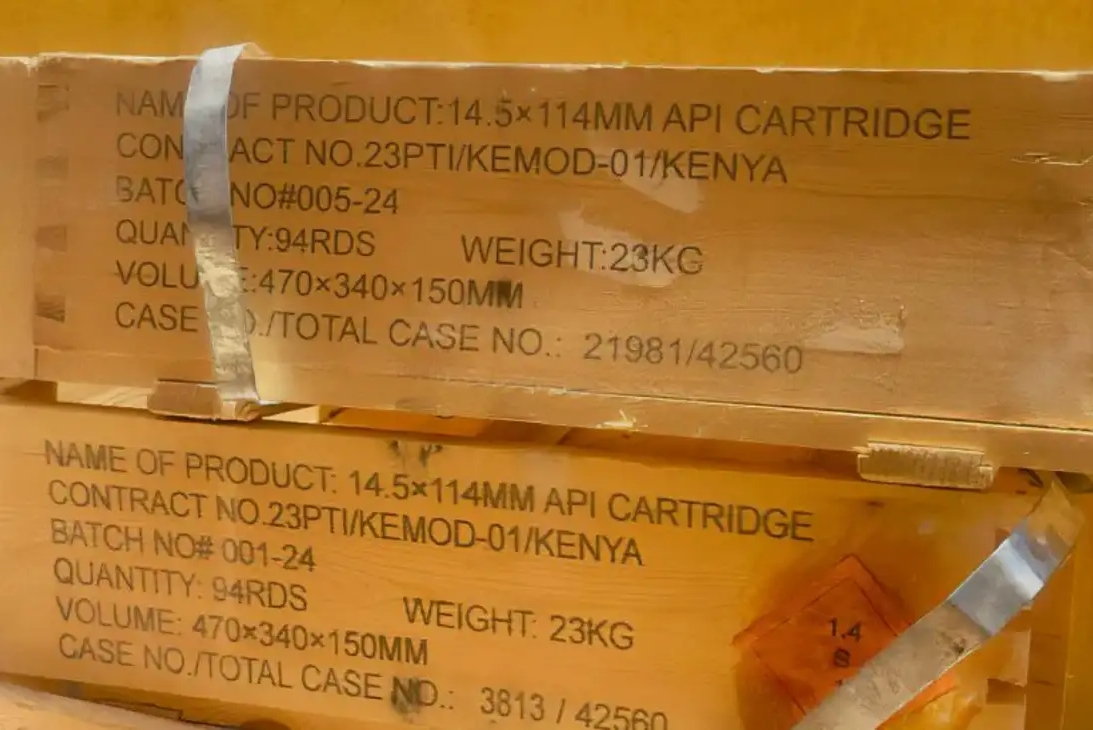
Examples of images of Kenyan MOD-labelled ammunition crates. These images had been circulating on social media, allegedly showing ammunition left behind by the RSF. Credit: posted on X
While the Kenya Ordnance Factories Corporation (KOFC) states on its website that it produces small arms ammunition, it does not indicate manufacturing higher-calibre 14.5×114 mm cartridges and the Chinese-made HE PP87 mortar bombs identified in this investigation.
Our partners at Daily Nation reached out to the Ministry of Defence (MoD) of Kenya to ask about the crates we identified and how they ended up in Sudan. We also asked whether it was Kenyan government policy to supply ammunition or weapons to the Rapid Support Forces and how this comports with the government’s public commitment to facilitating peace and dialogue in Sudan.
Support Bellingcat
Your donations directly contribute to our ability to publish groundbreaking investigations and uncover wrongdoing around the world.
In its response, the Ministry of Defence said it did not recognise the crates or labels on them and distanced itself from the allegations. Its answer appears to be limited to nationally produced ammunition only as well as internal protocols. It didn’t mention if Kenya has done any imports, international transfers or diversions of the weapons or ammunition in question. A statement that leaves key concerns about the Sudan connection unclear.
“Upon examination of the photographs provided, we wish to state that we do not recognize the crates nor the inscriptions on them.
The Kenya Ordinance Factory Corporation and, by extension, the Ministry is alive to the sensitive nature of the ammunition it manufactures, and as a result, it has clear records of its supplies within and beyond Kenya. Alongside this, and to guarantee public safety, audits of the factory’s operations are frequently conducted by the managing and external oversight authorities.
The Ministry of Defence, therefore, distances itself from the allegations you sent earlier.
Further, we remain fully committed to upholding the rule of law and continue to operate strictly within the mandate granted by the Constitution and applicable authorizations.”
Justin Lynch, Managing Director of the Conflict Insights Group and a Sudan researcher, told Bellingcat the discovery of the crates is further evidence of Kenya’s political and logistical support for the RSF.
A Country at War, Awash with Foreign Weapons
Sudan is in the midst of an ongoing civil war between two rival factions, the Sudanese Armed Forces (SAF) and the paramilitary Rapid Support Forces (RSF).
The stash of ammunition crates located near Sudan’s capital was filmed by Sudanese Armed Forces (SAF) soldiers who took part in the final push to retake the city from the RSF who have controlled Khartoum and its surrounding cities for much of the civil war.
The SAF declared it had retaken the final areas of resistance in Khartoum, its twin city of Omdurman, and the neighbouring city of Bahri on May 20, stating the three areas were now completely free of RSF forces.
The re-taking of the capital has led to much footage and images being released. Including footage that appears to show supplies used by the RSF.
A 2005 UN arms embargo remains in place prohibiting any country from supplying weapons to Darfur, Sudan, an area that has seen intense fighting since the outbreak of the civil war.
The Sudanese government brought a case before the International Court of Justice in The Hague in May, accusing the UAE of complicity in genocide for its role in supporting the RSF. The UAE has categorically denied supporting the RSF. The case was dismissed as the UAE has not signed Article 9 of the Genocide Convention.
Both sides of the conflict have been accused of war crimes, and the RSF has been accused of ethnic cleansing in certain areas, including around Darfur. The UN says more than 24,000 people have been killed since fighting began in 2023 following a peaceful uprising by civilians against dictator Omar al-Bashir. More than 11 million people have reportedly been displaced.
While there is detailed reporting on routes between the UAE and Sudan’s neighbouring countries, including Chad, being used for weapons transfers, specific details about how the Kenyan ammunition crates ended up in the country remain scarce.
How Do We Know the Ammunition Crates Were in the Vicinity of Khartoum?
On May 19, after weeks of reported intense fighting with the RSF, SAF soldiers and allied forces posted video clips claiming they were inside the Salha area in southern Omdurman, located across the Nile from Khartoum.
Bellingcat and Daily Nation have identified three videos containing Kenyan MOD-labelled ammunition crates allegedly left behind by the RSF inside an unknown depot most likely in Salha.
Using social media, we identified soldiers seen in the depot next to the ammunition: A Major from the SAF’s General Intelligence Service (GIS) and at least one other young Sudanese soldier. Both appear to have been in the depot during the same time the operation in Salha was taking place.
Video 1, Video 2 and Video 3 show soldiers rummaging through several rooms containing crates and talking about the armour allegedly left behind by the RSF. Photos of the same type of crates with the same label from the Kenyan MOD had been circulating on social media for some time earlier this year. But it had been difficult to geolocate inside Sudan before these more recent videos emerged.
In video 3, the speaker mentions the ammunition discovery and repeats ‘Salha’, the location, several times.
In video 1, an Arabic speaker can be heard saying: “But I swear to God, you can’t fight again and you won’t defeat us, is this the work (equipment) you leave?”
Above: Example of one of the crates featured in one of the videos filmed inside the dark depot. Below: The stencil label appears to be the same as seen in other previous pictures circulating earlier on social media. Credit: X
Video 1 shows a man inside the depot wearing a fatigued t-shirt, glasses and white Tasbih prayer beads. We found further footage showing what appears to be the same man wearing the same clothes and accessories. Elements in the background tell us that the video was indeed filmed in Salha, Omdurman, along the main road (15.5479, 32.4273).
Left: Soldier in the armour depot. Right: Stitched frames of a video showing the same soldier wearing the same clothes and accessories but on this occasion in an outdoor setting. Credit: X, Facebook
The outdoor setting was geolocated to Salha, Omdurman (15.5479, 32.4273). Credit: Facebook, Google Earth
We identified the soldier above as a Major (Ra’id) from the SAF’s General Intelligence Service, as indicated by his uniform insignias and patches seen in another video circulating on May 20. His name appears to be Al-Makki Abdul Quddus Ahmed.
A video showing a man with the same characteristics as the soldier from the depot is wearing a uniform featuring an insignia consistent with a Rai’d/Major rank used by the Sudanese Armed Forces and a patch from the General Intelligence Service of Sudan. Using Optical Character Recognition, his name appears to read Al-Makki Abdul Quddus Ahmed. Credit: X, globalsecurity.org, gis.gov.sd
Similarly, in another video filmed approx 150m from Major Al-Makki, here (15.546947, 32.427022), we identified a second man seen in the ammunition depot videos. In both videos, he is seen wearing the same clothes with a small Sudanese flag on his left shoulder.
A young soldier who was in the ammo depot was also seen outdoors in a street scene celebrating with other soldiers and wearing the same outfit and accessories as in the depot.
We geolocated the young soldier just 150m from Major Al-Makki in Salha, Omdurman. Credit: Facebook/Google Earth Pro
All the videos analysed were posted between May 19 and May 21. We geolocated the soldiers in a market area of southern Omdurman’s Salha district. This is consistent with the Sudanese Armed Forces retaking the city. Aljazeera reported that SAF had regained full control of the area by May 20.
Although we were unable to confirm the exact location of the depot, corroborating the presence of soldiers in the Salha area, along with open source information, strongly indicates that the depot is indeed located in the Salha neighbourhood of Omdurman.
From Sudan to the World: International Connections of the Weapons Crates
We compared the labels of the crates located near the Khartoum depot with other images of Kenyan munition crates circulating online, reportedly also from Sudan. On the labels, we can see English wording that includes the name of the product, contract number, batch number, quantity, volume, case number and total case number.
To be clear, although the crates are labelled with contractual and technical information, we are not able to say with certainty the origin or producer of the munitions. However, there are important details to highlight.
Bellingcat and our partners at Daily Nation shared images of the crates with three independent armament experts. All confirmed that the markings indicated the ammunition crates were part of the same contract (No. 23PTI) and were delivered to the Kenyan Ministry of Defence (KEMOD-01).
Australian-based Armament Research Services (ARES) told us: “The markings on this crate are consistent with other crates we have seen that we believe to be delivered on a Kenyan contract.”
Still of video showing Kenyan MOD-labelled ammunition crates. These images had been circulating on social media, allegedly showing ammunition allegedly captured by SAF in Khartoum. Credit: X, Sudan Nabaa
Upon examining the images, the weapons experts also told us that many of the crates indicate delivery during or after 2024 – when the civil war in Sudan was well underway.
Former Royal Artillery Army officer and director of Chiron Resources, Chris Cobb-Smith said: “The batch number suggests they were packed in 2024 – delivery date to Kenya would probably have been the same year. When delivered to Sudan is not known.”
All three experts agreed that the type of ammunition indicated on the labels was 57 calibre (14.5×114mm) armour-piercing incendiary (API) cartridges.
Cobb said that 14.5×114mm (.57 calibre) is a heavy machine gun and anti-material rifle cartridge used by the Soviet Union, the former Warsaw Pact states, modern Russia, and other countries.
Although not specified on the crates, Cobb added that this type of cartridge has been manufactured in Bulgaria, China, Egypt, Hungary, Iraq, North Korea, Poland, Romania, Russia, and the former Czechoslovakia.
One of the videos we found with these crates inside a depot in Salha, Omdurman, showed cans inside the crates and at least one open can next to the crates had visible ammunition consistent with the specifications on the label. The ammunition visible appears to have a green case and what appears to be a standard black-tip.
Several cans were visible inside crates in the depot. At least one open can located next to the crates had visible ammunition consistent with the specs on the label. Credit: X
Left and centre: screenshots from Salha depot Video 1, showing a round next to the Kenyan MOD-labelled crates. The bullet appears to feature a green-coloured case and a black marking on the tip. Right: Example of a 14.5×114 MM API cartridge. Credit: X, cjaie.com
We were also able to identify two additional green crates seen in a video showing the Salha depot. The label appears to indicate the boxes likely contain (or at least contained) an explosive with the specification “82mm HE Mortar Bomb Type PP87”.
Two additional green crates are seen in one of the videos showing the Salha depot. The label on the Kenyan-labelled crate reads 82 mm HE Mortar Bomb Type PP87. Credit: X
According to weapons experts, the markings on the crate suggest the box and its contents were likely initially delivered to Kenyan authorities under contract AMI/KEN/099/2023.
Director of Chiron Resources, Chris Cobb-Smith told Bellingcat that the contract number on these crates indicates the Kenyan MOD purchased mortar bombs from China in 2023. He added that it would be impossible to say whether they were immediately diverted or not.
Human Rights Watch reported in 2024 that RSF appeared to be using this Chinese-made mortar ammunition. This video shows a man in RSF camouflage and another in civilian clothes unpacking 82mm HE Mortar Bomb Type PP87. HRW was unable to verify RSF claims that it captured this new mortar munition from the SAF. Amnesty International has also reported the use of this weapon in Sudan.
Still image of a video from June 2024 showing a man in RSF camouflage and another in civilian clothes unpacking 82mm HE Mortar Bomb Type PP87. Credit: X
We also found another sample of these bombs among other SAF-captured ammo displayed in early May in Khartoum. The Chinese-made bomb was photographed next to another Kenyan labelled crate stating it contained 7.62mm SMG (submachine guns or self-loaded rifles) TYPE CS/LR11- sold by the intermediary China Jing An Import & Export Corporation (CJAIE).
82mm HE Mortar Bomb Type PP87 photographed next to another Kenyan-labelled crate stating it contained: 7.62mm SMG TYPE CS/LR11 – a submachine gun or self-loaded rifle (SMG) sold by the intermediary China Jing An Import & Export Corporation (CJAIE). Credit: China Xinhua News, Facebook
There have been several reports identifying Chinese-made weapons in the arms of the RSF. In April, China’s charge d’affaires in Port Sudan was summoned by the Sudanese government over the RSF’s use of Chinese-made drones. China has stressed they have “nothing to do with the presence of these drones and has no connection with the RSF”. Earlier this month Sudanese media outlet Ayin used open sources to identify Chinese-made weapons in the hands of RSF fighters.
Chadian Labelled Crates
In a separate alleged capture of weapons and ammunition displayed by the SAF at the Engineering Corps building in Omdurman (15.609734, 32.480369), similar crates were seen but with the stencil label removed.
The Sudanese army displays weapons allegedly captured from Rapid Support Forces (RSF) in Omdurman in mid-May 2025. Source: Facebook
Next to the crates, a green box is seen with a stencil label that appears to read:
“Direction Générale de la réserve Stratégique de la Présidence … République du Tchad”: General Directorate of Strategic Reserves (DGRS) of the Presidency… Republic of Chad.
The label on this box indicates a different designation “73-DTG02”. According to the Collective Awareness to Unexploded Ordnance (CAT-UXO), this designation is believed to be a Chinese 73mm High-Explosive-Dual-Purpose (HEDP), High-Explosive-Anti-Tank (HEAT) with Anti-Personnel (AP) HE-Frag, fin-stabilised Rocket.
The UAE has been accused of supplying Sudan’s RSF via a Chad airstrip. Dozens of flights from the UAE appear to have used an airstrip at Amdjarass in eastern Chad since the war began in April 2023.
Weapons Continue to Fuel Suffering
The discovery of the Kenyan-labelled munitions crates is further evidence of Kenya’s political and logistical support to the RSF, Justin Lynch, Managing Director of Conflict Insights Group and Sudan researcher, told Bellingcat.
He said the UAE has used Kenya and other African states as a political and logistical hub to support the Rapid Support Forces.
“It seems hardly a coincidence that RSF public conferences in Nairobi were immediately followed by a $1.5 billion loan from the UAE and a surge in suspicious UAE-to-RSF shipments transiting through Kenya,” Lynch said.
Kenya is reported to draw down next week the first portion of $500 million from the $1.5 billion United Arab Emirates (UAE) – backed commercial loan.
Delegates affiliated to Sudan’s Rapid Support Forces (RSF) react during a meeting for the planned signing, later postponed, of a political charter that would provide for a “Government of Peace and Unity” to govern the territories the force controls in Nairobi, Kenya, February 18, 2025. REUTERS/Monicah Mwangi
Despite losing control of the beating heart of the country, the RSF still rules huge swathes of Sudan including Darfur in the country’s southwest where violence is causing one of the world’s worst humanitarian crises, according to the UN.
As long as the conflict continues, questions about who is providing weapons and support to the warring sides will remain.
This article has been updated to reflect new information.
Bellingcat would like to thank our partners at the Daily Nation Forensics Unit for collaborating on this investigation.
Pooja Chaudhuri, Youri van der Weide and Jake Godin contributed to this report.
Bellingcat is a non-profit and the ability to carry out our work is dependent on the kind support of individual donors. If you would like to support our work, you can do so here. You can also subscribe to our Patreon channel here. Subscribe to our Newsletter and follow us on Bluesky here and Mastodon here.

 Entrar