Visualização normal

Antes de ontemStream principal
  • ✇Krebs on Security
  • Patch Tuesday, April 2026 Edition BrianKrebs
    Microsoft today pushed software updates to fix a staggering 167 security vulnerabilities in its Windows operating systems and related software, including a SharePoint Server zero-day and a publicly disclosed weakness in Windows Defender dubbed “BlueHammer.” Separately, Google Chrome fixed its fourth zero-day of 2026, and an emergency update for Adobe Reader nixes an actively exploited flaw that can lead to remote code execution. Redmond warns that attackers are already targeting CVE-2026-32201,
     

Patch Tuesday, April 2026 Edition

14 de Abril de 2026, 18:47

Microsoft today pushed software updates to fix a staggering 167 security vulnerabilities in its Windows operating systems and related software, including a SharePoint Server zero-day and a publicly disclosed weakness in Windows Defender dubbed “BlueHammer.” Separately, Google Chrome fixed its fourth zero-day of 2026, and an emergency update for Adobe Reader nixes an actively exploited flaw that can lead to remote code execution.

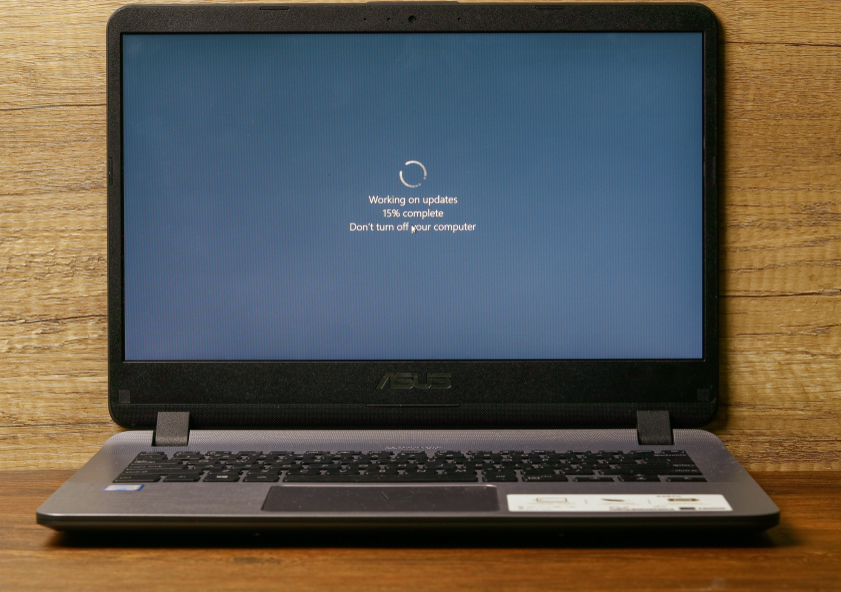
A picture of a windows laptop in its updating stage, saying do not turn off the computer.

Redmond warns that attackers are already targeting CVE-2026-32201, a vulnerability in Microsoft SharePoint Server that allows attackers to spoof trusted content or interfaces over a network.

Mike Walters, president and co-founder of Action1, said CVE-2026-32201 can be used to deceive employees, partners, or customers by presenting falsified information within trusted SharePoint environments.

“This CVE can enable phishing attacks, unauthorized data manipulation, or social engineering campaigns that lead to further compromise,” Walters said. “The presence of active exploitation significantly increases organizational risk.”

Microsoft also addressed BlueHammer (CVE-2026-33825), a privilege escalation bug in Windows Defender. According to BleepingComputer, the researcher who discovered the flaw published exploit code for it after notifying Microsoft and growing exasperated with their response. Will Dormann, senior principal vulnerability analyst at Tharros, says he confirmed that the public BlueHammer exploit code no longer works after installing today’s patches.

Satnam Narang, senior staff research engineer at Tenable, said April marks the second-biggest Patch Tuesday ever for Microsoft. Narang also said there are indications that a zero-day flaw Adobe patched in an emergency update on April 11 — CVE-2026-34621 — has seen active exploitation since at least November 2025.

Adam Barnett, lead software engineer at Rapid7, called the patch total from Microsoft today “a new record in that category” because it includes nearly 60 browser vulnerabilities. Barnett said it might be tempting to imagine that this sudden spike was tied to the buzz around the announcement a week ago today of Project Glasswing — a much-hyped but still unreleased new AI capability from Anthropic that is reportedly quite good at finding bugs in a vast array of software.

But he notes that Microsoft Edge is based on the Chromium engine, and the Chromium maintainers acknowledge a wide range of researchers for the vulnerabilities which Microsoft republished last Friday.

“A safe conclusion is that this increase in volume is driven by ever-expanding AI capabilities,” Barnett said. “We should expect to see further increases in vulnerability reporting volume as the impact of AI models extend further, both in terms of capability and availability.”

Finally, no matter what browser you use to surf the web, it’s important to completely close out and restart the browser periodically. This is really easy to put off (especially if you have a bajillion tabs open at any time) but it’s the only way to ensure that any available updates get installed. For example, a Google Chrome update released earlier this month fixed 21 security holes, including the high-severity zero-day flaw CVE-2026-5281.

For a clickable, per-patch breakdown, check out the SANS Internet Storm Center Patch Tuesday roundup. Running into problems applying any of these updates? Leave a note about it in the comments below and there’s a decent chance someone here will pipe in with a solution.

  • ✇Security Affairs
  • Adobe fixes actively exploited Acrobat Reader flaw CVE-2026-34621 Pierluigi Paganini
    Adobe addressed a critical Acrobat Reader vulnerability, tracked as CVE-2026-34621, which is actively exploited to run malicious code. Adobe released emergency updates to address a critical vulnerability, tracked as CVE-2026-34621 (CVSS score of 8.6), in Adobe Acrobat Reader, which is being actively exploited. The flaw could allow attackers to execute malicious code on affected systems, making prompt patching essential to reduce the risk of compromise. “Adobe has released a security updat
     

Adobe fixes actively exploited Acrobat Reader flaw CVE-2026-34621

12 de Abril de 2026, 14:47

Adobe addressed a critical Acrobat Reader vulnerability, tracked as CVE-2026-34621, which is actively exploited to run malicious code.

Adobe released emergency updates to address a critical vulnerability, tracked as CVE-2026-34621 (CVSS score of 8.6), in Adobe Acrobat Reader, which is being actively exploited. The flaw could allow attackers to execute malicious code on affected systems, making prompt patching essential to reduce the risk of compromise.

“Adobe has released a security update for Adobe Acrobat and Reader for Windows and macOS. This update addresses a critical vulnerability. Successful exploitation could lead to arbitrary code execution.” reads the advisory. “Adobe is aware of CVE-2026-34621 being exploited in the wild.”

The vulnerability is an improperly controlled modification of object prototype attributes (‘Prototype Pollution’) that can lead to arbitrary code execution.

Improperly Controlled Modification of Object Prototype Attributes (often called prototype pollution) is a vulnerability mainly in JavaScript where an attacker can modify the base object prototype that many other objects inherit from. In JavaScript, objects can inherit properties from a shared prototype (like Object.prototype). If an application doesn’t properly validate input, an attacker can inject values into this prototype.

Below are the impacted versions:

ProductTrackAffected VersionsPlatform
Acrobat DC Continuous 
26.001.21367 and earlierWindows &  macOS
Acrobat Reader DCContinuous 26.001.21367 and earlierWindows & macOS
Acrobat 2024Classic 2024    24.001.30356 and earlierWindows & macOS

Adobe acknowledged Haifei Li, founder of EXPMON, for reporting this flaw.

Li recently revealed that a zero-day flaw was exploited to run malicious JavaScript via crafted PDFs in Adobe Acrobat Reader. According to the expert, threat actors used the Adobe Reader zero-day for months to deliver a sophisticated PDF exploit.

Adobe has confirmed our findings and has issued an emergency security update for all Adobe Reader (and other affected products) users.https://t.co/10vjsj4MeJ

The underlying exploited zero-day vulnerability has been rated Critical (CVSS 9.6) and is tracked as CVE-2026-34621. It…

— EXPMON (@EXPMON_) April 11, 2026

On March 26, a suspicious PDF was submitted to EXPMON and flagged by its advanced “detection in depth” feature, despite low antivirus detection (13/64 on VirusTotal).

Adobe Reader

The system marked it for manual review, highlighting potential hidden threats. EXPMON identifies exploits through automated alerts, analyst inspection of logs and indicators, and large-scale data analysis. This case shows how advanced detection can uncover sophisticated zero-day activity that traditional tools may miss, though it requires expert analysis to confirm.

The sample analyzed by the Li works as an initial exploit that abuses an unpatched Adobe Reader flaw to run privileged APIs on fully updated systems.

It uses “util.readFileIntoStream()” to read local files and collect sensitive data. Then it calls “RSS.addFeed()” to send stolen data to a remote server and receive more malicious JavaScript.

This lets attackers profile victims, steal information, and decide whether to launch further attacks, including remote code execution or sandbox escape if the target meets specific conditions.

Follow me on Twitter: @securityaffairs and Facebook and Mastodon

Pierluigi Paganini

(SecurityAffairs – hacking, Adobe)

  • ✇Firewall Daily – The Cyber Express
  • Adobe Patches Actively Exploited Acrobat Reader Flaw CVE-2026-34621 Ashish Khaitan
    Adobe has issued emergency security updates addressing a severe Acrobat Reader flaw tracked as CVE-2026-34621, a high-impact Adobe vulnerability that has already been observed being exploited in real-world attacks.   The issue, rated with a CVSS score of 8.6 out of 10.0, affects multiple Acrobat and Reader products across Windows and macOS platforms. According to Adobe, the vulnerability could enable attackers to execute arbitrary code on targeted systems if successfully exploited.  Acrobat
     

Adobe Patches Actively Exploited Acrobat Reader Flaw CVE-2026-34621

Acrobat Reader flaw

Adobe has issued emergency security updates addressing a severe Acrobat Reader flaw tracked as CVE-2026-34621, a high-impact Adobe vulnerability that has already been observed being exploited in real-world attacks.   The issue, rated with a CVSS score of 8.6 out of 10.0, affects multiple Acrobat and Reader products across Windows and macOS platforms. According to Adobe, the vulnerability could enable attackers to execute arbitrary code on targeted systems if successfully exploited. 

Acrobat Reader Flaw and CVSS Severity Assessment 

The Acrobat Reader flaw CVE-2026-34621 has been classified as a critical security defect with a CVSS base score of 8.6. The scoring notes impact potential, including confidentiality, integrity, and availability compromise. The CVSS vector associated with the flaw is CVSS:3.1/AV:L/AC:L/PR:N/UI:R/S:C/C:H/I:H/A:H, indicating that local access and user interaction are required for exploitation, while the scope change increases the severity.  Initially, the Adobe vulnerability was assessed with a higher score, but later revisions adjusted the attack vector from network-based (AV:N) to local (AV:L). This change reduced the overall CVSS rating from 9.6 to 8.6, as noted in Adobe’s revision history dated April 12, 2026. 

Adobe Vulnerability Impact and Affected Acrobat Products 

The Adobe vulnerability affects several widely deployed versions of Acrobat and Acrobat Reader. The impacted software includes: 
  • Acrobat DC versions 26.001.21367 and earlier (fixed in 26.001.21411)  
  • Acrobat Reader DC versions 26.001.21367 and earlier (fixed in 26.001.21411)  
  • Acrobat 2024 versions 24.001.30356 and earlier (fixed in 24.001.30362 for Windows and 24.001.30360 for macOS)  
These versions are used across both Windows and macOS environments, increasing the exposure range of the Acrobat Reader flaw CVE-2026-34621 in enterprise and consumer settings.  Adobe classified the update under bulletin APSB26-43, published on April 11, 2026, with a priority rating of 1, indicating the highest urgency level for patch deployment. The bulletin confirms that the Adobe vulnerability can result in arbitrary code execution if exploited successfully. 

Exploitation of Acrobat Reader flaw CVE-2026-34621 in the Wild 

Adobe has confirmed that it is “aware of CVE-2026-34621 being exploited in the wild.” This statement indicates active exploitation attempts against unpatched systems, elevating the urgency of the Acrobat Reader flaw CVE-2026-34621 beyond theoretical risk.  The exploitation activity suggests that threat actors may already be leveraging the Adobe vulnerability in targeted attacks. While specific campaigns have not been fully detailed publicly, the confirmed exploitation status places the flaw in a high-risk category, particularly for organizations that have not yet applied for the latest updates. 

Prototype Pollution Behind the Adobe Vulnerability 

The root cause of the Acrobat Reader flaw CVE-2026-34621 is identified as a prototype pollution issue. Prototype pollution is a JavaScript-based vulnerability class that allows attackers to manipulate object prototypes within an application.  In this case, the Adobe vulnerability is categorized under CWE-1321 (Improperly Controlled Modification of Object Prototype Attributes). Successful exploitation could allow an attacker to manipulate internal object structures, potentially leading to arbitrary code execution within Acrobat environments.  Because prototype pollution affects how objects inherit properties, attackers may be able to inject malicious attributes into running applications, escalating the severity of the Acrobat Reader flaw CVE-2026-34621 when combined with user interaction. 

CVSS-rated fix and APSB26-43 remediation guidance 

Adobe addressed the Adobe vulnerability through security updates released under bulletin APSB26-43. Fixed versions include: 
  • Acrobat DC and Acrobat Reader DC: 26.001.21411  
  • Acrobat 2024: 24.001.30362 (Windows), 24.001.30360 (macOS)  
Adobe recommends immediate updating via built-in update mechanisms (Help > Check for Updates) or through managed deployment systems in enterprise environments such as AIP-GPO, SCUP/SCCM, Apple Remote Desktop, or SSH-based workflows on macOS. Full installers are also available through Adobe’s official download channels.  The CVSS scoring for the Adobe vulnerability CVE-2026-34621 was revised on April 12, 2026. The adjustment reduced the attack vector classification from network (AV:N) to local (AV:L), resulting in a revised CVSS score of 8.6.  Adobe credited researcher Haifei Li of EXPMON for reporting the issue and coordinating disclosure efforts. 
❌
❌