
Visualização normal

Antes de ontemStream principal
  • ✇Krebs on Security
  • ‘CanisterWorm’ Springs Wiper Attack Targeting Iran BrianKrebs
    A financially motivated data theft and extortion group is attempting to inject itself into the Iran war, unleashing a worm that spreads through poorly secured cloud services and wipes data on infected systems that use Iran’s time zone or have Farsi set as the default language. Experts say the wiper campaign against Iran materialized this past weekend and came from a relatively new cybercrime group known as TeamPCP. In December 2025, the group began compromising corporate cloud environments using
     

‘CanisterWorm’ Springs Wiper Attack Targeting Iran

23 de Março de 2026, 12:43

A financially motivated data theft and extortion group is attempting to inject itself into the Iran war, unleashing a worm that spreads through poorly secured cloud services and wipes data on infected systems that use Iran’s time zone or have Farsi set as the default language.

Experts say the wiper campaign against Iran materialized this past weekend and came from a relatively new cybercrime group known as TeamPCP. In December 2025, the group began compromising corporate cloud environments using a self-propagating worm that went after exposed Docker APIs, Kubernetes clusters, Redis servers, and the React2Shell vulnerability. TeamPCP then attempted to move laterally through victim networks, siphoning authentication credentials and extorting victims over Telegram.

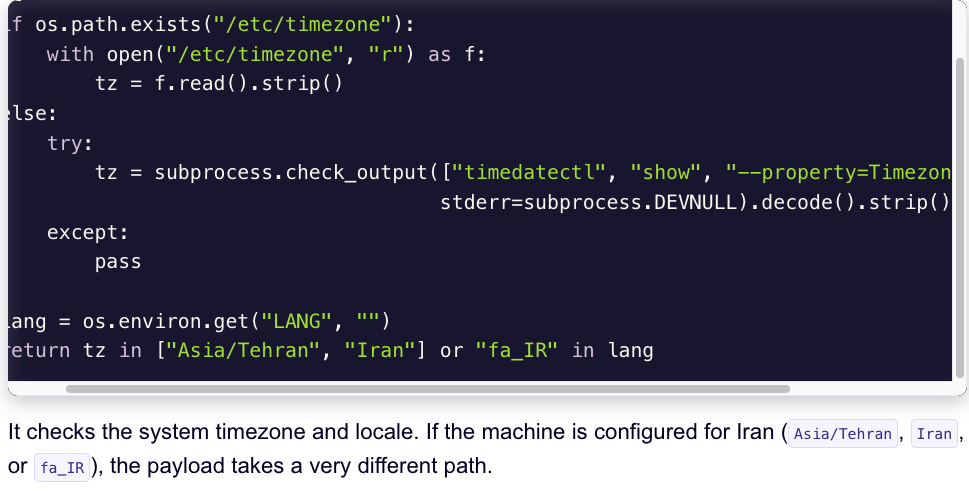
A snippet of the malicious CanisterWorm that seeks out and destroys data on systems that match Iran’s timezone or have Farsi as the default language. Image: Aikido.dev.

In a profile of TeamPCP published in January, the security firm Flare said the group weaponizes exposed control planes rather than exploiting endpoints, predominantly targeting cloud infrastructure over end-user devices, with Azure (61%) and AWS (36%) accounting for 97% of compromised servers.

“TeamPCP’s strength does not come from novel exploits or original malware, but from the large-scale automation and integration of well-known attack techniques,” Flare’s Assaf Morag wrote. “The group industrializes existing vulnerabilities, misconfigurations, and recycled tooling into a cloud-native exploitation platform that turns exposed infrastructure into a self-propagating criminal ecosystem.”

On March 19, TeamPCP executed a supply chain attack against the vulnerability scanner Trivy from Aqua Security, injecting credential-stealing malware into official releases on GitHub actions. Aqua Security said it has since removed the harmful files, but the security firm Wiz notes the attackers were able to publish malicious versions that snarfed SSH keys, cloud credentials, Kubernetes tokens and cryptocurrency wallets from users.

Over the weekend, the same technical infrastructure TeamPCP used in the Trivy attack was leveraged to deploy a new malicious payload which executes a wiper attack if the user’s timezone and locale are determined to correspond to Iran, said Charlie Eriksen, a security researcher at Aikido. In a blog post published on Sunday, Eriksen said if the wiper component detects that the victim is in Iran and has access to a Kubernetes cluster, it will destroy data on every node in that cluster.

“If it doesn’t it will just wipe the local machine,” Eriksen told KrebsOnSecurity.

Image: Aikido.dev.

Aikido refers to TeamPCP’s infrastructure as “CanisterWorm” because the group orchestrates their campaigns using an Internet Computer Protocol (ICP) canister — a system of tamperproof, blockchain-based “smart contracts” that combine both code and data. ICP canisters can serve Web content directly to visitors, and their distributed architecture makes them resistant to takedown attempts. These canisters will remain reachable so long as their operators continue to pay virtual currency fees to keep them online.

Eriksen said the people behind TeamPCP are bragging about their exploits in a group on Telegram and claim to have used the worm to steal vast amounts of sensitive data from major companies, including a large multinational pharmaceutical firm.

“When they compromised Aqua a second time, they took a lot of GitHub accounts and started spamming these with junk messages,” Eriksen said. “It was almost like they were just showing off how much access they had. Clearly, they have an entire stash of these credentials, and what we’ve seen so far is probably a small sample of what they have.”

Security experts say the spammed GitHub messages could be a way for TeamPCP to ensure that any code packages tainted with their malware will remain prominent in GitHub searches. In a newsletter published today titled GitHub is Starting to Have a Real Malware Problem, Risky Business reporter Catalin Cimpanu writes that attackers often are seen pushing meaningless commits to their repos or using online services that sell GitHub stars and “likes” to keep malicious packages at the top of the GitHub search page.

This weekend’s outbreak is the second major supply chain attack involving Trivy in as many months. At the end of February, Trivy was hit as part of an automated threat called HackerBot-Claw, which mass exploited misconfigured workflows in GitHub Actions to steal authentication tokens.

Eriksen said it appears TeamPCP used access gained in the first attack on Aqua Security to perpetrate this weekend’s mischief. But he said there is no reliable way to tell whether TeamPCP’s wiper actually succeeded in trashing any data from victim systems, and that the malicious payload was only active for a short time over the weekend.

“They’ve been taking [the malicious code] up and down, rapidly changing it adding new features,” Eriksen said, noting that when the malicious canister wasn’t serving up malware downloads it was pointing visitors to a Rick Roll video on YouTube.

“It’s a little all over the place, and there’s a chance this whole Iran thing is just their way of getting attention,” Eriksen said. “I feel like these people are really playing this Chaotic Evil role here.”

Cimpanu observed that supply chain attacks have increased in frequency of late as threat actors begin to grasp just how efficient they can be, and his post documents an alarming number of these incidents since 2024.

“While security firms appear to be doing a good job spotting this, we’re also gonna need GitHub’s security team to step up,” Cimpanu wrote. “Unfortunately, on a platform designed to copy (fork) a project and create new versions of it (clones), spotting malicious additions to clones of legitimate repos might be quite the engineering problem to fix.”

Update, 2:40 p.m. ET: Wiz is reporting that TeamPCP also pushed credential stealing malware to the KICS vulnerability scanner from Checkmarx, and that the scanner’s GitHub Action was compromised between 12:58 and 16:50 UTC today (March 23rd).

  • ✇Krebs on Security
  • Self-Replicating Worm Hits 180+ Software Packages BrianKrebs
    At least 187 code packages made available through the JavaScript repository NPM have been infected with a self-replicating worm that steals credentials from developers and publishes those secrets on GitHub, experts warn. The malware, which briefly infected multiple code packages from the security vendor CrowdStrike, steals and publishes even more credentials every time an infected package is installed. Image: https://en.wikipedia.org/wiki/Sandworm_(Dune) The novel malware strain is being dubbed
     

Self-Replicating Worm Hits 180+ Software Packages

16 de Setembro de 2025, 11:08

At least 187 code packages made available through the JavaScript repository NPM have been infected with a self-replicating worm that steals credentials from developers and publishes those secrets on GitHub, experts warn. The malware, which briefly infected multiple code packages from the security vendor CrowdStrike, steals and publishes even more credentials every time an infected package is installed.

Image: https://en.wikipedia.org/wiki/Sandworm_(Dune)

The novel malware strain is being dubbed Shai-Hulud — after the name for the giant sandworms in Frank Herbert’s Dune novel series — because it publishes any stolen credentials in a new public GitHub repository that includes the name “Shai-Hulud.”

“When a developer installs a compromised package, the malware will look for a npm token in the environment,” said Charlie Eriksen, a researcher for the Belgian security firm Aikido. “If it finds it, it will modify the 20 most popular packages that the npm token has access to, copying itself into the package, and publishing a new version.”

At the center of this developing maelstrom are code libraries available on NPM (short for “Node Package Manager”), which acts as a central hub for JavaScript development and provides the latest updates to widely-used JavaScript components.

The Shai-Hulud worm emerged just days after unknown attackers launched a broad phishing campaign that spoofed NPM and asked developers to “update” their multi-factor authentication login options. That attack led to malware being inserted into at least two-dozen NPM code packages, but the outbreak was quickly contained and was narrowly focused on siphoning cryptocurrency payments.

Image: aikido.dev

In late August, another compromise of an NPM developer resulted in malware being added to “nx,” an open-source code development toolkit with as many as six million weekly downloads. In the nx compromise, the attackers introduced code that scoured the user’s device for authentication tokens from programmer destinations like GitHub and NPM, as well as SSH and API keys. But instead of sending those stolen credentials to a central server controlled by the attackers, the malicious nx code created a new public repository in the victim’s GitHub account, and published the stolen data there for all the world to see and download.

Last month’s attack on nx did not self-propagate like a worm, but this Shai-Hulud malware does and bundles reconnaissance tools to assist in its spread. Namely, it uses the open-source tool TruffleHog to search for exposed credentials and access tokens on the developer’s machine. It then attempts to create new GitHub actions and publish any stolen secrets.

“Once the first person got compromised, there was no stopping it,” Aikido’s Eriksen told KrebsOnSecurity. He said the first NPM package compromised by this worm appears to have been altered on Sept. 14, around 17:58 UTC.

The security-focused code development platform socket.dev reports the Shai-Halud attack briefly compromised at least 25 NPM code packages managed by CrowdStrike. Socket.dev said the affected packages were quickly removed by the NPM registry.

In a written statement shared with KrebsOnSecurity, CrowdStrike said that after detecting several malicious packages in the public NPM registry, the company swiftly removed them and rotated its keys in public registries.

“These packages are not used in the Falcon sensor, the platform is not impacted and customers remain protected,” the statement reads, referring to the company’s widely-used endpoint threat detection service. “We are working with NPM and conducting a thorough investigation.”

A writeup on the attack from StepSecurity found that for cloud-specific operations, the malware enumerates AWS, Azure and Google Cloud Platform secrets. It also found the entire attack design assumes the victim is working in a Linux or macOS environment, and that it deliberately skips Windows systems.

StepSecurity said Shai-Hulud spreads by using stolen NPM authentication tokens, adding its code to the top 20 packages in the victim’s account.

“This creates a cascading effect where an infected package leads to compromised maintainer credentials, which in turn infects all other packages maintained by that user,” StepSecurity’s Ashish Kurmi wrote.

Eriksen said Shai-Hulud is still propagating, although its spread seems to have waned in recent hours.

“I still see package versions popping up once in a while, but no new packages have been compromised in the last ~6 hours,” Eriksen said. “But that could change now as the east coast starts working. I would think of this attack as a ‘living’ thing almost, like a virus. Because it can lay dormant for a while, and if just one person is suddenly infected by accident, they could restart the spread. Especially if there’s a super-spreader attack.”

For now, it appears that the web address the attackers were using to exfiltrate collected data was disabled due to rate limits, Eriksen said.

Nicholas Weaver is a researcher with the International Computer Science Institute, a nonprofit in Berkeley, Calif. Weaver called the Shai-Hulud worm “a supply chain attack that conducts a supply chain attack.” Weaver said NPM (and all other similar package repositories) need to immediately switch to a publication model that requires explicit human consent for every publication request using a phish-proof 2FA method.

“Anything less means attacks like this are going to continue and become far more common, but switching to a 2FA method would effectively throttle these attacks before they can spread,” Weaver said. “Allowing purely automated processes to update the published packages is now a proven recipe for disaster.”

  • ✇Krebs on Security
  • 18 Popular Code Packages Hacked, Rigged to Steal Crypto BrianKrebs
    At least 18 popular JavaScript code packages that are collectively downloaded more than two billion times each week were briefly compromised with malicious software today, after a developer involved in maintaining the projects was phished. The attack appears to have been quickly contained and was narrowly focused on stealing cryptocurrency. But experts warn that a similar attack with a slightly more nefarious payload could lead to a disruptive malware outbreak that is far more difficult to detec
     

18 Popular Code Packages Hacked, Rigged to Steal Crypto

8 de Setembro de 2025, 19:53

At least 18 popular JavaScript code packages that are collectively downloaded more than two billion times each week were briefly compromised with malicious software today, after a developer involved in maintaining the projects was phished. The attack appears to have been quickly contained and was narrowly focused on stealing cryptocurrency. But experts warn that a similar attack with a slightly more nefarious payload could lead to a disruptive malware outbreak that is far more difficult to detect and restrain.

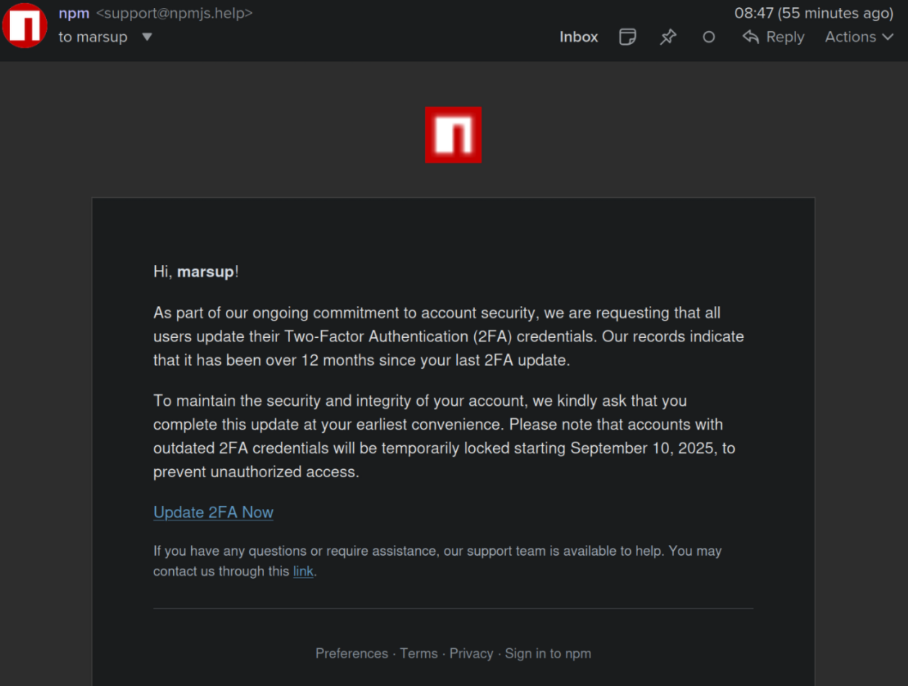
This phishing email lured a developer into logging in at a fake NPM website and supplying a one-time token for two-factor authentication. The phishers then used that developer’s NPM account to add malicious code to at least 18 popular JavaScript code packages.

Aikido is a security firm in Belgium that monitors new code updates to major open-source code repositories, scanning any code updates for suspicious and malicious code. In a blog post published today, Aikido said its systems found malicious code had been added to at least 18 widely-used code libraries available on NPM (short for) “Node Package Manager,” which acts as a central hub for JavaScript development and the latest updates to widely-used JavaScript components.

JavaScript is a powerful web-based scripting language used by countless websites to build a more interactive experience with users, such as entering data into a form. But there’s no need for each website developer to build a program from scratch for entering data into a form when they can just reuse already existing packages of code at NPM that are specifically designed for that purpose.

Unfortunately, if cybercriminals manage to phish NPM credentials from developers, they can introduce malicious code that allows attackers to fundamentally control what people see in their web browser when they visit a website that uses one of the affected code libraries.

According to Aikido, the attackers injected a piece of code that silently intercepts cryptocurrency activity in the browser, “manipulates wallet interactions, and rewrites payment destinations so that funds and approvals are redirected to attacker-controlled accounts without any obvious signs to the user.”

“This malware is essentially a browser-based interceptor that hijacks both network traffic and application APIs,” Aikido researcher Charlie Eriksen wrote. “What makes it dangerous is that it operates at multiple layers: Altering content shown on websites, tampering with API calls, and manipulating what users’ apps believe they are signing. Even if the interface looks correct, the underlying transaction can be redirected in the background.”

Aikido said it used the social network Bsky to notify the affected developer, Josh Junon, who quickly replied that he was aware of having just been phished. The phishing email that Junon fell for was part of a larger campaign that spoofed NPM and told recipients they were required to update their two-factor authentication (2FA) credentials. The phishing site mimicked NPM’s login page, and intercepted Junon’s credentials and 2FA token. Once logged in, the phishers then changed the email address on file for Junon’s NPM account, temporarily locking him out.

Aikido notified the maintainer on Bluesky, who replied at 15:15 UTC that he was aware of being compromised, and starting to clean up the compromised packages.

Junon also issued a mea culpa on HackerNews, telling the community’s coder-heavy readership, “Hi, yep I got pwned.”

“It looks and feels a bit like a targeted attack,” Junon wrote. “Sorry everyone, very embarrassing.”

Philippe Caturegli, “chief hacking officer” at the security consultancy Seralys, observed that the attackers appear to have registered their spoofed website — npmjs[.]help — just two days before sending the phishing email. The spoofed website used services from dnsexit[.]com, a “dynamic DNS” company that also offers “100% free” domain names that can instantly be pointed at any IP address controlled by the user.

Junon’s mea cupla on Hackernews today listed the affected packages.

Caturegli said it’s remarkable that the attackers in this case were not more ambitious or malicious with their code modifications.

“The crazy part is they compromised billions of websites and apps just to target a couple of cryptocurrency things,” he said. “This was a supply chain attack, and it could easily have been something much worse than crypto harvesting.”

Aikido’s Eriksen agreed, saying countless websites dodged a bullet because this incident was handled in a matter of hours. As an example of how these supply-chain attacks can escalate quickly, Eriksen pointed to another compromise of an NPM developer in late August that added malware to “nx,” an open-source code development toolkit with as many as six million weekly downloads.

In the nx compromise, the attackers introduced code that scoured the user’s device for authentication tokens from programmer destinations like GitHub and NPM, as well as SSH and API keys. But instead of sending those stolen credentials to a central server controlled by the attackers, the malicious code created a new public repository in the victim’s GitHub account, and published the stolen data there for all the world to see and download.

Eriksen said coding platforms like GitHub and NPM should be doing more to ensure that any new code commits for broadly-used packages require a higher level of attestation that confirms the code in question was in fact submitted by the person who owns the account, and not just by that person’s account.

“More popular packages should require attestation that it came through trusted provenance and not just randomly from some location on the Internet,” Eriksen said. “Where does the package get uploaded from, by GitHub in response to a new pull request into the main branch, or somewhere else? In this case, they didn’t compromise the target’s GitHub account. They didn’t touch that. They just uploaded a modified version that didn’t come where it’s expected to come from.”

Eriksen said code repository compromises can be devastating for developers, many of whom end up abandoning their projects entirely after such an incident.

“It’s unfortunate because one thing we’ve seen is people have their projects get compromised and they say, ‘You know what, I don’t have the energy for this and I’m just going to deprecate the whole package,'” Eriksen said.

Kevin Beaumont, a frequently quoted security expert who writes about security incidents at the blog doublepulsar.com, has been following this story closely today in frequent updates to his account on Mastodon. Beaumont said the incident is a reminder that much of the planet still depends on code that is ultimately maintained by an exceedingly small number of people who are mostly overburdened and under-resourced.

“For about the past 15 years every business has been developing apps by pulling in 178 interconnected libraries written by 24 people in a shed in Skegness,” Beaumont wrote on Mastodon. “For about the past 2 years orgs have been buying AI vibe coding tools, where some exec screams ‘make online shop’ into a computer and 389 libraries are added and an app is farted out. The output = if you want to own the world’s companies, just phish one guy in Skegness.”

Image: https://infosec.exchange/@GossiTheDog@cyberplace.social.

Aikido recently launched a product that aims to help development teams ensure that every code library used is checked for malware before it can be used or installed. Nicholas Weaver, a researcher with the International Computer Science Institute, a nonprofit in Berkeley, Calif., said Aikido’s new offering exists because many organizations are still one successful phishing attack away from a supply-chain nightmare.

Weaver said these types of supply-chain compromises will continue as long as people responsible for maintaining widely-used code continue to rely on phishable forms of 2FA.

“NPM should only support phish-proof authentication,” Weaver said, referring to physical security keys that are phish-proof — meaning that even if phishers manage to steal your username and password, they still can’t log in to your account without also possessing that physical key.

“All critical infrastructure needs to use phish-proof 2FA, and given the dependencies in modern software, archives such as NPM are absolutely critical infrastructure,” Weaver said. “That NPM does not require that all contributor accounts use security keys or similar 2FA methods should be considered negligence.”

❌
❌