

Visualização normal

Antes de ontemStream principal
  • ✇SOC Prime Blog
  • CVE-2026-3910: Chrome V8 Zero-Day Used for In-the-Wild Attacks Daryna Olyniychuk
    Chrome zero-days continue to pose a major risk for cyber defenders. Earlier this year, Google patched CVE-2026-2441, the first actively exploited Chrome zero-day of 2026. Now, another emergency update has been released, fixing two more flaws already exploited in the wild, CVE-2026-3910 in Chrome’s V8 JavaScript and WebAssembly engine and CVE-2026-3909, an out-of-bounds write bug in Skia. Google describes CVE-2026-3910 as an inappropriate implementation issue in Chrome V8. In essence, a crafted
     

CVE-2026-3910: Chrome V8 Zero-Day Used for In-the-Wild Attacks

13 de Março de 2026, 10:33

Chrome zero-days continue to pose a major risk for cyber defenders. Earlier this year, Google patched CVE-2026-2441, the first actively exploited Chrome zero-day of 2026. Now, another emergency update has been released, fixing two more flaws already exploited in the wild, CVE-2026-3910 in Chrome’s V8 JavaScript and WebAssembly engine and CVE-2026-3909, an out-of-bounds write bug in Skia.

Google describes CVE-2026-3910 as an inappropriate implementation issue in Chrome V8. In essence, a crafted HTML page may allow a remote attacker to execute arbitrary code inside the browser sandbox. 

The latest Chrome emergency patch lands against an increasing zero-day threat. Google Threat Intelligence Group tracked 90 zero-days exploited in the wild in 2025, up from 78 in 2024, and found that enterprise technologies accounted for 43 cases, or a record 48% of observed exploitation.

Register for SOC Prime’s AI-Native Detection Intelligence Platform, backed by cutting-edge technologies and top cybersecurity expertise to outscale cyber threats and build a resilient cybersecurity posture. Click Explore Detections to access the comprehensive collection of SOC content for vulnerability exploit detection, filtered by the custom “CVE” tag.

Explore Detections

Detections from the dedicated rule set can be applied across 40+ SIEM, EDR, and Data Lake platforms and are mapped to the latest MITRE ATT&CK® framework v18.1. Security teams can also leverage Uncoder AI to accelerate detection engineering end-to-end by generating rules directly from live threat reports, refining and validating detection logic, auto-visualizing Attack Flows, converting IOCs into custom hunting queries, and instantly translating detection code across diverse language formats.

CVE-2026-3910 Analysis 

According to Google’s security advisory, CVE-2026-3910 is a high-severity vulnerability in V8, the JavaScript and WebAssembly engine used by Chrome. It can be triggered through a crafted HTML page and may allow arbitrary code execution inside the browser sandbox. Because V8 processes active content during normal browsing, exploitation can begin with something as simple as visiting a malicious or compromised website.

The risk is substantial because Chrome is deeply embedded in daily enterprise work. An actively exploited V8 flaw can turn ordinary browsing into a path for credential theft, malicious code delivery, or broader compromise, especially when combined with other bugs or phishing.

Google has confirmed that CVE-2026-3910 is being exploited in the wild, but has not published technical details about the exploitation chain. 

The same Chrome update also fixed CVE-2026-3909, a high-severity out-of-bounds write vulnerability in the Skia graphics library. Google says the flaw is also being exploited in the wild. Because it affects another core browser component and was fixed in the same emergency release, organizations should apply the full update without delay rather than focus on CVE-2026-3910 alone.

CVE-2026-3910 Mitigation

The recommended mitigation is to update Chrome immediately to the latest patched Stable Channel build. Google says the fixed desktop versions are 146.0.7680.75 and 146.0.7680.76 for Windows and macOS and 146.0.7680.75 for Linux. Because Google has confirmed in-the-wild exploitation, organizations should prioritize the update across employee endpoints, administrator workstations, and shared systems used for browsing.

Organizations using Chromium-based browsers such as Microsoft Edge, Brave, Opera, and Vivaldi should also monitor for corresponding vendor patches, since those products may inherit exposure from the same underlying codebase. 

Additionally, by leveraging SOC Prime’s AI-Native Detection Intelligence Platform backed by top cyber defense expertise, global organizations can adopt a resilient security posture and transform their SOC to always stay ahead of emerging threats tied to zero-day exploitation.

FAQ

What is CVE-2026-3910 and how does it work?

CVE-2026-3910 is a high-severity vulnerability in Chrome’s V8 JavaScript and WebAssembly engine. Google describes it as an inappropriate implementation flaw that can be triggered with a crafted HTML page, allowing a remote attacker to execute arbitrary code inside the browser sandbox.

When was CVE-2026-3910 first discovered?

Google’s advisory says the vulnerability was reported on March 10, 2026.

What is the impact of CVE-2026-3910 on systems?

The main risk is that malicious web content could trigger code execution inside Chrome’s browser sandbox. In real attacks, that can turn routine browsing into an entry point for credential theft, malware delivery, or further compromise when paired with other techniques.

Can CVE-2026-3910 still affect me in 2026?

Yes. Any Chrome installation that has not yet been updated to the patched build may still be exposed. Google explicitly says exploits for CVE-2026-3910 exist in the wild.

How can I protect from CVE-2026-3910?

Update Chrome to version 146.0.7680.75 or 146.0.7680.76 on Windows and macOS or 146.0.7680.75 on Linux, then relaunch the browser to make sure the patched build is running. Organizations using Chromium-based alternatives should apply vendor fixes as soon as they become available.


The post CVE-2026-3910: Chrome V8 Zero-Day Used for In-the-Wild Attacks appeared first on SOC Prime.
  • ✇Malwarebytes
  • [updated] Google patches two Chrome zero-days under active attack
    Update March 16, 2026Earlier this week, Google incorrectly reported that an actively exploited vulnerability in Chrome had been fixed, and has now announced it will roll out a new update to protect users against the vulnerability tracked as CVE-2026-3909. Original content: Google has released an out-of-band security update for Chrome desktop that patches two high‑severity zero‑day vulnerabilities. Both bugs can be exploited remotely and require only that a user visit a malicious websit
     

[updated] Google patches two Chrome zero-days under active attack

13 de Março de 2026, 09:58

Update March 16, 2026
Earlier this week, Google incorrectly reported that an actively exploited vulnerability in Chrome had been fixed, and has now announced it will roll out a new update to protect users against the vulnerability tracked as CVE-2026-3909.

Original content:

Google has released an out-of-band security update for Chrome desktop that patches two high‑severity zero‑day vulnerabilities.

Both bugs can be exploited remotely and require only that a user visit a malicious website. Because the attack complexity is low, the vulnerabilities pose a higher real-world risk.

How to update Chrome

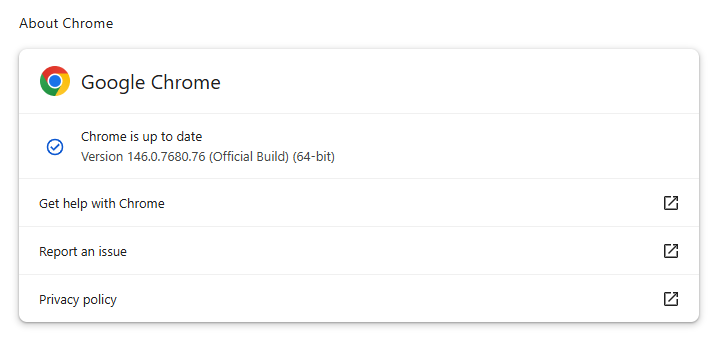
The latest version numbers are 146.0.7680.75/76 for Windows and macOS and 146.0.7680.75 for Linux. If your Chrome browser is on version 146.0.7680.75 or later, you’re protected from these vulnerabilities.

The easiest way to stay up to date is to allow Chrome to update automatically. However, updates can lag if you rarely close your browser, or if something interferes with the update process.

To update manually:

  1. Click the More menu (three dots)
  2. Go to Settings > About Chrome.
  3. If an update is available, Chrome will start downloading it.
  4. Restart Chrome to complete the update, and you’ll be protected against these vulnerabilities.
Chrome on Windows up to date
Chrome (on Windows) is up to date

You can also find step-by-step instructions in our guide to how to update Chrome on every operating system, which includes instructions for checking your version number.

Technical details

Google reports that it discovered and fixed both bugs internally, with patches landing within roughly two days of reporting.

CVE‑2026‑3909 is an out‑of‑bounds write vulnerability in Skia, Chrome’s 2D graphics library used to render web content and UI elements. A remote attacker can lure a user to a malicious webpage that triggers the bug, corrupts memory, and potentially achieves code execution in the browser context. Skia is an open source 2D graphics library used not only in Google Chrome but also in many other products.

CVE‑2026‑3910 is an inappropriate implementation flaw in the V8 JavaScript and WebAssembly engine. A specially crafted HTML page could allow a remote attacker to execute arbitrary code inside the V8 sandbox. V8 is the engine that Google developed for processing JavaScript, and it has seen more than its fair share of bugs.

Chrome’s Skia and V8 components are prime targets because they sit directly on the path between untrusted web content and the underlying system.

It is possible to chain an out‑of‑bounds write in Skia with other bugs to break out of the renderer sandbox, while V8 implementation flaws frequently appear in exploit chains used by targeted threat actors and spyware vendors.

How to stay safe

To protect your device, update Chrome as soon as possible. Here are some more tips to avoid becoming a victim, even before a zero-day is patched:

  • Don’t click on unsolicited links in emails, messages, unknown websites, or on social media.
  • Enable automatic updates and restart regularly. Many users leave browsers open for days, which delays protection even if the update is downloaded in the background.
  • Use an up-to-date, real-time anti-malware solution which includes a web protection component.

Users of other Chromium-based browsers can expect to see a similar update soon.


We don’t just report on threats—we remove them

Cybersecurity risks should never spread beyond a headline. Keep threats off your devices by downloading Malwarebytes today.

  • ✇Security Affairs
  • Google fixed two new actively exploited flaws in the Chrome browser Pierluigi Paganini
    Google addressed two high-severity vulnerabilities in the Chrome browser that have been exploited in attacks in the wild. Google has released security updates to address two high-severity vulnerabilities, tracked as CVE-2026-3909 and CVE-2026-3910, in the Chrome browser. The company is aware of attacks in the wild exploiting both flaws. “Google is aware that exploits for both CVE-2026-3909 & CVE-2026-3910 exist in the wild.” reads the advisory published by the tech giant. Google ex
     

Google fixed two new actively exploited flaws in the Chrome browser

13 de Março de 2026, 07:30

Google addressed two high-severity vulnerabilities in the Chrome browser that have been exploited in attacks in the wild.

Google has released security updates to address two high-severity vulnerabilities, tracked as CVE-2026-3909 and CVE-2026-3910, in the Chrome browser. The company is aware of attacks in the wild exploiting both flaws.

“Google is aware that exploits for both CVE-2026-3909 & CVE-2026-3910 exist in the wild.” reads the advisory published by the tech giant.

Google experts discovered both vulnerabilities on March 10, 2026. As usual, the company did not disclose details about the attacks exploiting these flaws or the threat actors involved.

Below are the descriptions for these vulnerabilities:

  • CVE-2026-3909 (CVSS score: 8.8) – Out-of-bounds write in the Skia 2D graphics library that lets a remote attacker trigger memory corruption by tricking a user into opening a specially crafted HTML page.
  • CVE-2026-3910 (CVSS score: 8.8) – Flaw in the implementation of the V8 JavaScript/WebAssembly engine that lets a remote attacker run arbitrary code within the browser sandbox using a maliciously crafted HTML page.

The company informed users that the Stable channel has been updated to version 146.0.7680.75/76 for Windows and Mac, and 146.0.7680.75 for Linux. The update will roll out over the coming days and weeks. A full list of changes in this build is available in the log.

In mid-February, Google released urgent security updates to address another high-severity zero-day vulnerability, tracked as CVE-2026-2441 (CVSS score of 8.8), in Chrome that is already being exploited in real-world attacks. The flaw is a use-after-free bug in the browser’s CSS component.

It was the first actively exploited Chrome zero-day fixed in 2026, after eight similar flaws were patched in 2025. An attacker could exploit the flaw to compromise affected systems. The issue was discovered and responsibly reported by security researcher Shaheen Fazim on February 11, 2026.

Google has confirmed that an exploit for CVE-2026-2441 exists in the wild, but has not shared details about how it is being used or which threat actor is behind the exploitation of the flaw.

Follow me on Twitter: @securityaffairs and Facebook and Mastodon

Pierluigi Paganini

(SecurityAffairs – hacking, Chrome)

❌
❌