ASEC Blog publishes Ransom & Dark Web Issues Week 4, April 2026 ShinyHunters Claims Data Breach Involving Major U.S. Convenience Store Chain ShinyHunters Claims Theft of Internal Data and Source Code from U.S. Software Development Firm Emergence of New Data Extortion Group: Prinz Eugen
ASEC Blog publishes Ransom & Dark Web Issues Week 4, April 2026 ShinyHunters Claims Data Breach Involving Major U.S. Convenience Store Chain ShinyHunters Claims Theft of Internal Data and Source Code from U.S. Software Development Firm Emergence of New Data Extortion Group: Prinz Eugen
This article is the result of a collaboration with Indian media outlet Newslaundry. You can find Newslaundry’s editorially independent coverage here.
Collage illustration by Klawe Rzeczy. Elements from Unsplash.
Indian companies have shipped more than 320 million synthetic opioid pills to West Africa – where they have not been approved by regulators – over the past three years, a Bellingcat investigation has found.
Export records from trade data provider 52wmb show that more than 1,400
This article is the result of a collaboration with Indian media outlet Newslaundry. You can find Newslaundry’s editorially independent coverage here.
Collage illustration by Klawe Rzeczy. Elements from Unsplash.
Indian companies have shipped more than 320 million synthetic opioid pills to West Africa – where they have not been approved by regulators – over the past three years, a Bellingcat investigation has found.
Export records from trade data provider 52wmb show that more than 1,400 consignments of tapentadol worth almost USD $130 million were sent from India to West Africa between January 2023 and December 2025.
Tapentadol, a painkiller two to three times more potent than tramadol, has not been approved for use in most West African countries, where some nations are grappling with an escalating opioid abuse epidemic.
However, this investigation shows that dozens of Indian suppliers have flooded the region with tapentadol over the past three years. Where dosages were listed, more than half the pills were in powerful strengths of 200mg or more – dosages that are not even approved in India.
The exports, cross-checked against records provided by trade data aggregator ImportGenius, show most tapentadol pills sent between 2023 and 2025 had the coastal nations of Sierra Leone and Ghana listed as their declared destinations.
The two West African countries were collectively marked as the destination for more than 80 per cent of the total value of tapentadol sent to the region.
Experts have documented how drug traffickers adapt quickly to international regulations and law enforcement efforts. In 2018, India tightened export controls around the opioid tramadol, one of the most trafficked synthetic drugs to West Africa.
In 2021, the International Narcotics Control Board (INCB) said large-scale tapentadol trafficking had been identified, particularly in consignments destined for Africa. It had previously noted that India’s strengthened tramadol controls could lead traffickers to substitute the drug with other potent synthetic opioids.
A BBC investigation last year revealed that Indian company Aveo Pharmaceuticals was illegally exporting tablets containing a mix of tapentadol and the muscle relaxant carisoprodol to West Africa. This led India’s drug regulator, the Central Drugs Standard Control Organisation (CDSCO), to ban the manufacture and export of all combinations of the two drugs.
Bellingcat’s investigation, in collaboration with Indian publishing partner Newslaundry, reveals that the supply of tapentadol pills from India to West Africa has surged in recent years.
Export data from 52wmb shows the value of tapentadol sent to the region has risen from about USD $27 million in the three year period from 2020 to 2022, to almost USD $130 million from 2023 to 2025.
Julius Maada Bio, Sierra Leone’s president, in 2024 declared a national emergency over rampant drug abuse and branded kush – a toxic blend of psychoactive substances including cannabis and synthetic opioids – a “death trap”.
Authorities in Sierra Leone have intercepted illegal tapentadol, including last July when the National Revenue Authority (NRA) said it thwarted a smuggling operation near its north-west border with Guinea.
The NRA and other agencies including the Transnational Organised Crime Unit, National Drug Law Enforcement Agency, and the Pharmacy Board of Sierra Leone did not respond to Bellingcat’s requests for comment.
Sierra Leone’s NRA said customs officers seized tapentadol near a border crossing in July. Source: National Revenue Authority
Ghana’s Narcotics Control Commission (NACOC) said the illegal importation of tapentadol was first recorded in 2022 after international efforts to curb the tramadol crisis resulted in criminal networks shifting production to other pharmaceutical opioids including tapentadol, tafrodol and carisoprodol.
The agency has recorded a “steady rise” in tapentadol trafficking over the past three years, with authorities seizing more than 3.7 million tablets (250mg strength). Most were traced back to India, it said.
“NACOC investigations confirm that the bulk of tapentadol is trafficked into Ghana through seaports and by air, via express courier services,” a spokesperson said. “At the ports, the drug is concealed in containerized cargo falsely declared as pharmaceuticals, electrical materials or household goods. Express courier services are used for smaller, high-value quantities, often packed alongside legitimate consignments to avoid detection.”
NACOC said Ghana had emerged as both a destination and transit hub for tapentadol, with the majority of intercepted consignments bound for Niger, Mali, Burkina Faso and Nigeria. When sold domestically, it said the street drug was promoted as a tramadol substitute.
Ghana’s Food and Drugs Authority (FDA) said last year that the abuse of pharmaceutical opioids such as tapentadol — commonly known on the street as “Red” — was on the rise.
The FDA told Bellingcat it had “never issued any permit” for the manufacture or importation of tapentadol, in any strength, to any importer or to any country. It said any tapentadol shipments to Ghana were for “trans-shipment to neighbouring country”.
Import data for Ghana shows that no tapentadol entered the country between 2023 and 2025, which supports NACOC’s position that the drugs are being concealed and falsely declared. Import data for Sierra Leone was not available through 52wmb.
Ghana’s FDA destroyed 230 cartons of the illegally imported tapentadol last April and seized 7,700 tapentadol tablets at a border crossing last August. NACOC said it was combatting opioid importation through regulation, enforcement and cooperation with its counterparts in other countries. Source: FDA
India’s drug and pharmaceutical exports have grown to more than $30 billion a year, according to the Pharmaceuticals Export Promotion Council of India (Pharmexcil), a division of the ministry of commerce and industry.
While tapentadol is available in India on prescription in strengths of up to 100mg (immediate release) and 200mg (extended release), authorities are aware of its risk of misuse. Last year, the Indian drug regulator’s Technical Advisory Board said the Department of Revenue may be requested to schedule the painkiller under the Narcotic Drugs and Psychotropic Substances Act, which would tighten rules around its export.
To export pharmaceutical products at strengths that are not approved in India, exporters are required to obtain an export “no objection certificate” (NOC) from the CDSCO, for which they have to submit proof of the drug’s approval in the importing country. Publicly available information shows tapentadol is not approved for use in any of the West African nations identified as part of this investigation.
The CDSCO did not respond to questions from Bellingcat or our publishing partner, Newslaundry.
In response to “Right to Information” requests submitted by Newslaundry, the CDSCO said only two companies had been granted authorisation to manufacture tapentadol for export between 2019 and 2024. However, the trade data analysed by Bellingcat did not list either company as an exporter of tapentadol to West Africa.
The CDSCO also said it had issued export NOCs for tapentadol to 51 companies since 2024, but that these were not for export to West African countries.
Meanwhile, Bellingcat’s analysis of trade data shows that more than 60 Indian suppliers have exported tapentadol to West Africa since 2023. The exporters are mostly pharmaceutical companies but also include smaller operations, such as one company owned by a Nigerian man who sent more than US $4 million of tapentadol to Niger and Ghana.
In the BBC’s investigation, journalist Surabhi Tandon reported on the increase in cross-border smuggling of tramadol, “a catch-all name to describe the range of opioids used as street drugs”, from Ghana to Nigeria. Source: BBC News
Dinesh Thakur, co-author of the book Truth Pill, told Newslaundry there were gaps in India’s drug regulatory framework that made it possible for potentially unsafe medicines to be manufactured and exported without proper oversight.
“There is no regulatory framework which checks a genuine importer and counterfeit importer between countries,” said Thakur, a former pharmaceutical executive who now works as a public health activist.
Mohammed Adinoyi Usman, a consultant anaesthetist at Rasheed Shekoni Federal University Teaching Hospital in Nigeria, said tackling Africa’s opioid crisis was complicated by a lack of resources across the region, weak government responses, and inaction by law enforcement agencies.
He said more collaboration and intelligence sharing was needed, especially across West African countries, to combat the problem. “We see so many opioids coming into our region because of a range of factors including under-funded institutions like customs and drug agencies, weak border controls and corruption,” he said.
“Africa is different. Even southern Africa is different from western Africa – each region has its peculiarities. In Nigeria, we don’t have well-functioning institutions to help control it. But our government is trying.”
Dr Usman said access to prescription opioids in Africa was inadequate, and pointed to research showing the disparity in distribution of legal opioids to low-income countries compared to high-income nations that consume the bulk of the world’s pain relief medication. He said opioid abuse was linked to crime and negative health outcomes.
“Sadly, access to prescription opioids is very limited in Africa,” Dr Usman said, “but the costs of illegal use are high.”
Bellingcat is a non-profit and the ability to carry out our work is dependent on the kind support of individual donors. If you would like to support our work, you can do so here. You can also subscribe to our Patreon channel here. Subscribe to our Newsletter and follow us on Bluesky here, Instagram here, Reddit here and YouTube here.
Zimbabwe is intensifying efforts to reinforce cybersecurity in Zimbabwe as the nation confronts a rise of digital crime. As internet access expands and digital financial services become more embedded in everyday life, authorities warn that these developments are simultaneously exposing weaknesses in Zimbabwe's cybersecurity systems.
At the Cyber Fraud & AI Conference in Nyanga, Information and Communication Technology Minister Tatenda Mavetera highlighted the rise of cyber fraud, noting
Zimbabwe is intensifying efforts to reinforce cybersecurity in Zimbabwe as the nation confronts a rise of digital crime. As internet access expands and digital financial services become more embedded in everyday life, authorities warn that these developments are simultaneously exposing weaknesses in Zimbabwe's cybersecurity systems.At the Cyber Fraud & AI Conference in Nyanga, Information and Communication Technology Minister Tatenda Mavetera highlighted the rise of cyber fraud, noting that cybercriminals are no longer relying on simple tactics. Instead, they are leveraging cutting-edge tools such as deepfake voice cloning, automated phishing platforms, and adaptive malware to exploit individuals, businesses, and public systems.“The enemy now has artificial intelligence. You cannot fight an intelligent machine with a manual rulebook — you must fight AI with AI,” Mavetera said.
Rising Cyber Fraud Threats Challenge Zimbabwe's Cybersecurity Systems
The scale of the problem is further highlighted by recent data. Authorities estimate that mobile money-related cyber fraud costs Zimbabwe more than US$30 million annually. Meanwhile, phishing and social engineering attacks have surged by over 40% in recent years.Across Africa, cybercrime is estimated to cost more than US$4 billion each year, while global losses are projected to exceed US$10 trillion annually.Mavetera denoted that the impact of cyber fraud extends beyond financial losses. “Cyber fraud erodes trust in digital systems, and without trust, there is no digital transformation,” she said. This erosion of trust threatens not only individuals and businesses but also the broader stability of the digital economy.
Government Expands Cybersecurity in Zimbabwe with AI-Driven Solutions
In response to these challenges, the government is implementing a range of measures aimed at strengthening cybersecurity in Zimbabwe. A National Security Operations Centre is nearing completion, with progress estimated at 85%, and is expected to centralize threat monitoring and response.Additionally, a Computer Incident Response Team is being established to coordinate national responses to cyberattacks. These institutional developments are intended to improve the country’s ability to detect, manage, and mitigate cyber fraud and other digital threats.A key initiative is the planned launch of the “Zimbabwe AI Cyber Shield” within the next 12 months. This AI-powered platform will focus on real-time fraud detection, representing a major step forward in modernizing Zimbabwe's cybersecurity capabilities.Alongside technological investments, the government is prioritizing skills development. Training programs are underway to prepare 10,000 cybersecurity professionals, supported by broader digital literacy initiatives aimed at strengthening public awareness and resilience against cyber fraud.
Policy and Collaboration Key to Strengthening Zimbabwe Cybersecurity
Zimbabwe is also working to enhance its legal and policy frameworks. Authorities are introducing legislation to criminalize the misuse of artificial intelligence, particularly in cases involving deepfakes and identity-related cyber fraud. A National Cybersecurity Strategy has been finalized and is awaiting cabinet approval, while the National Artificial Intelligence Strategy (2026–2030), introduced in March, seeks to balance innovation with security.Despite these efforts, Zimbabwe continues to face structural challenges. The country is currently ranked in the fourth tier of the International Telecommunication Union’s Global Cybersecurity Index, with a score of 39.85 out of 100. While legal measures are relatively strong, gaps remain in technical capacity, organizational readiness, international cooperation, and skills development.Mavetera stressed that addressing these gaps will require coordinated action from multiple stakeholders. She called for stronger collaboration between the government, the private sector, academia, and citizens to build a resilient digital ecosystem.She reiterated that cyber fraud is not just a financial issue but a threat to national progress. Without trust in digital systems, the country’s broader digital transformation goals could be undermined.
Munition remnants pictured at the site of a strike that killed at least 17 people in the town of Tiné, Chad, last week appear to match a weapon previously used by Sudan’s Rapid Support Forces (RSF) in the war with Sudanese government forces – despite RSF denials of involvement in the incident.
Photographs showed what appeared to be a match for the rear control section of a Chinese-made GB25A or GB50A bomb, which can be dropped by Chinese-made drones. Amnesty International previously identifie
Munition remnants pictured at the site of a strike that killed at least 17 people in the town of Tiné, Chad, last week appear to match a weapon previously used by Sudan’s Rapid Support Forces (RSF) in the war with Sudanese government forces – despite RSF denials of involvement in the incident.
Photographs showed what appeared to be a match for the rear control section of a Chinese-made GB25A or GB50A bomb, which can be dropped by Chinese-made drones. Amnesty International previously identified a GB50A used by the RSF that it said had “almost certainly” been re-exported to the group by the UAE.
Remnants of a Chinese-made GB25A or GB50A bomb pictured in Tiné, Chad (left). A reference image showing GB25A and GB50A bombs.
The first photographs of the remnants were posted by Chad’s by ATPE CHAD publication, which reported a public prosecutor had visited the site of impact.
A separate set of photographs showing even clearer visuals of the remnants was subsequently shared by the N’Djamena-based broadcaster MRTV. It’s Facebook page showed Chadian soldiers standing beside the remnants.
Images were also posted by posted on Facebook by the Department of Public Safety and Immigration in Chad.
By using the time displayed on a watch worn by an official in one of the pictures it was possible to estimate that the images were likely taken in the late afternoon. By comparing this with solar data, the shadows visible in the photos and other visual details, it was then possible to infer the approximate layout of nearby buildings and the distribution of trees where the remnants were found.
Picture featuring Ali Ahmat Aghabache, Chad Minister of Public Security and Immigration. The time on his watch was used as an approximate time of capture of the set of images at the remnant site. Credit: Ministère De La Sécurité Publique Et De L’immigration Facebook.
With this information, and using satellite imagery, we then geolocated the photos to the northwest of the Bir Tine neighbourhood, just 650 metres from the border with the Western Darfur region of Sudan that is largely controlled by the RSF.
Top: Using the approximate time of capture, Bellingcat analyzed solar data to reconstruct the site layout and created an approximate panoramic view. Bottom: This reconstruction enabled the identification of building features and tree positions, leading to the precise determination of the site’s coordinates. (15.043158, 22.818438)
Remnants from the control sections of other GB25A or GB50A bombs have previously been found after RSF attacks in Sudan, including attacks on Kassala Airport and Coral Marina Hotel in Port Sudan (as seen in the images below).
BBC News reported that the RSF is suspected of carrying out the attack.
However, the RSF has denied any involvement and blamed Sudan’s army, the Sudanese Armed Forces (SAF). The SAF has in turn said the RSF was responsible. Chad’s president on Thursday ordered the military to retaliate against future attacks from Sudan.
Support Bellingcat
Your donations directly contribute to our ability to publish groundbreaking investigations and uncover wrongdoing around the world.
RSF spokesperson Al-Fateh Qurashi told Bellingcat via WhatsApp: “Our forces are not responsible for any targeting of neighboring Chad, and we have no connection to this targeting.” Qurashi instead blamed forces aligned with the Sudanese government over the strike.
Imran Abdullah, an adviser to the RSF commander, told Bellingcat via WhatsApp that satellite imagery tracked the drone and that it belonged to the forces aligned with the Sudanese government. However, Abdullah refused to share the imagery he referred to saying: “It can be published if an independent international commission of inquiry is in place.”
The SAF are not known to use any Chinese-made drones or bombs, like the GB25A or GB50A. The SAF has been observed using Turkish and Iranian made drones and munitions such as the MAM-L bomb.
Bellingcat sought comment on the use of these weapons from the Chinese manufacturer, Norinco, as well as the UAE given Amnesty’s previous reports about how a GB50A was used by the RSF after “almost certainly” being re-exported to Sudan. Neither responded prior to publication.
The conflict has previously spilled over the border into Chad. Reuters reported last month the country closed its border with Sudan after five Chadian soldiers were killed following clashes in Tiné between the RSF and militia fighters loyal to the Sudanese government.
Ziyu Wan and Riccardo Giannardi contributed from Bellingcat’s volunteer community.
Bellingcat is a non-profit and the ability to carry out our work is dependent on the kind support of individual donors. If you would like to support our work, you can do so here. You can also subscribe to our Patreon channel here. Subscribe to our Newsletter and follow us on Bluesky here, Instagram here, Reddit here and YouTube here.
To stay up to date on our latest investigations, join Bellingcat’s WhatsApp channel here.
You can read an Arabic version of this investigation on Radio Dabanga’s site here.
Child soldiers linked to Sudan’s warring factions have gained viral fame on TikTok, with their videos attracting millions of views.
A Bellingcat investigation has found that the young boys – widely referred to as “lion cubs” – have become celebrated figures of the rival groups that ha
To stay up to date on our latest investigations, join Bellingcat’s WhatsApp channel here.
You can read an Arabic version of this investigation on Radio Dabanga’s site here.
Child soldiers linked to Sudan’s warring factions have gained viral fame on TikTok, with their videos attracting millions of views.
A Bellingcat investigation has found that the young boys – widely referred to as “lion cubs” – have become celebrated figures of the rival groups that have been fighting for control of the country since 2023.
Many of the videos we reviewed show the children in military uniforms posing with fighters and senior officials from both sides of the conflict – the Rapid Support Forces (RSF) and the Sudanese Armed Forces (SAF). They are seen celebrating battlefield victories, delivering motivational speeches, and making violent threats. In some footage the children are armed.
Child soldier experts told Bellingcat that the visibility and popularity of this content, which portrays fighting as normal, celebrated and aspirational, could lead to the recruitment of more young people in the conflict.
Bellingcat flagged 12 TikTok accounts that had each posted viral content of child soldiers through the platform’s internal reporting mechanism. After more than 48 hours without action, we emailed TikTok to request comment, providing links to the reported content. This was done to give TikTok a further opportunity to review and remove the accounts, in order to minimise the risk of amplification by reporting on it.
Following our inquiry, TikTok removed seven of the reported accounts. The remaining active accounts continue to host more than a dozen videos featuring child soldier content, which, according to TikTok’s own guidelines, breaches its content policies. (Update: Following the publication of this article, TikTok has removed all remaining active accounts.)
Under the Paris Principles, to which Sudan is a state party, a child soldier is defined as a person under the age of 18 “who is or who has been recruited or used by an armed force or armed group in any capacity”, whether or not they are directly involved in hostilities.
Support Bellingcat
Your donations directly contribute to our ability to publish groundbreaking investigations and uncover wrongdoing around the world.
Bellingcat focused on two prominent “lion cubs” from opposing sides of the civil war to reveal how this content circulates across social media and gains traction – mostly on TikTok – despite platform rules that restrict content involving the exploitation and militarisation of children.
In some cases, the children film themselves near combat scenes, including in at least one instance with the bodies of recently deceased people. In others, they are filmed in choreographed appearances with high-profile commanders and political figures. The children are honoured as heroes by armed groups and their supporters, and their content is re-shared across hundreds of TikTok accounts, some of which have millions of followers.
Bellingcat is not including the names of the TikTok accounts or unblurred images of the children featured in the content due to their age. We also do not link to any of the accounts or posts to avoid amplification.
‘People Say I Will Die’: RSF Child Soldier
Bellingcat geolocated multiple TikTok videos showing an RSF “lion cub” – who appears to be a young teenager – celebrating the capture of the 22nd infantry division SAF base in Babanusa, a city in West Kordofan, in early December 2025.
The videos, posted by pro-RSF TikTok accounts and viewed millions of times, show the child’s movements on the ground in the aftermath of the takeover. In the weeks that followed, the child’s TikTok account gained tens of thousands of followers and recent posts amassed hundreds of thousands of views.
In a TikTok video posted to the child’s account on Jan. 1, 2026, in response to social media comments, the child says: “I see people on the [social] media saying that I will die. The person who dies is as if he has paid his debt” This video received more than 1,6 million views before TikTok removed the account following Bellingcat’s inquiry.
A video posted by a pro-RSF TikTok account in early
December, geolocated by Bellingcat, places the child at the
North entrance of the SAF base, holding an assault rifle and
celebrating alongside adult RSF fighters.
A second TikTok video shows him approximately 100 metres
away, running toward the base’s main entrance amid
audible gunfire, chanting “Allahu Akbar” and claiming the
takeover of the SAF’s 22nd Infantry Division.
A crowd gathered outside the main entrance is also
visible in the satellite image, consistent with RSF activity
in the immediate aftermath of the takeover.
In a third, particularly graphic TikTok video geolocated by
Bellingcat, the child films himself among what appears to be a group of close to ten dead bodies spread out on the ground inside of the SAF base.
Bellingcat identified objects consistent in size and placement with the grouping of bodies visible in the video on a high-resolution satellite image from Dec. 2. 2025.
Graphic imagery of bodies covered by Bellingcat. Number labels provided to show how we matched the positions of the bodies visible in the video to the satellite image.
The second TikTok video in which the child is running had been viewed more than two million times before it was removed. Its audio has since been reused in 200 additional videos on the platform, significantly amplifying its reach across pro-RSF networks.
A shorter version of the same audio appeared in more than 70 additional videos. These included dozens of AI-generated clips, characterised by an animated style and visible inaccuracies in uniform badges and flags. Many of these TikToks depicted the child alongside senior RSF figures, such as the group’s leader, known as Hemedti, and an officer known as Abu Lulu. On Feb. 19, 2026, Abu Lulu was placed under sanctions by the US Treasury Department for his actions during the RSF’s takeover of Al Fashir, as analysed by Bellingcat.
Screengrab showing AI-generated TikToks of the “lion cub” alongside well-known RSF figures including Hemdeti and Abu Lulu, accompanied by audio of the child’s voice.
The RSF “lion cub” appears in another TikTok video posted the day of Babanusa’s takeover, alongside what appear to be captured SAF soldiers whom he mocks as he leads chants praising the RSF. This post received hundreds of supportive comments, many of which appear to come from RSF fighters.
Footage posted on Dec. 5. shows the child being celebrated by RSF fighters as he sits on the shoulder of RSF commander Salih Al-Foti. Two popular pro-RSF TikTok accounts, with a combined 1,4 million followers, reposted the video with the caption: “Commander Colonel Salih Al-Foti honours the hero Al-Shibli [the lion cub]”.
In the video, Al-Foti praises the bravery of the “lion cub”, a term the commander uses three times as he describes how the child was on the battlefield during the first entry of the 22nd infantry division SAF base. “I see that the whole world is talking about this lion cub,” Al-Foti says in the video. He also states that the RSF does not recruit children or ask individuals of such a young age to fight, claiming instead that minors sometimes appear among RSF forces without prior knowledge or approval, acting voluntarily and fighting alongside adult fighters.
Subscribe to the Bellingcat newsletter
Subscribe to our newsletter for first access to our published content and events that our staff and contributors are involved with, including interviews and training workshops.
Al-Foti’s commanding role during the takeover of Babanusa is confirmed in an official RSF video in which he discusses the operation. Salih Al-Foti was previously named in a 2023 report by the UN Joint Human Rights Office in Sudan. The document cites testimonies accusing RSF forces under his command of intentionally killing civilians in Nyala based on tribal or ethnic affiliation. Following the RSF takeover of Babanusa, Al-Foti was promoted to the rank of Major General according to social media reports. The RSF “lion cub” congratulated him in a TikTok video posted on Jan. 10, 2026.
In response to Bellingcat’s findings, El Basha Tebeig, a media representative and advisor to RSF leadership, stated that the Rapid Support Forces maintains a dedicated human rights unit within its military structure and is committed to international humanitarian law and the Geneva Conventions, which prohibit the use of children in armed conflict. He said the RSF commander had issued standing orders prohibiting the participation of anyone under the age of 18 in military operations.
Tebeig told Bellingcat that the incident at the 22nd Division base in Babanusa, in which a young child appeared in videos following the capture of the base, was unrelated to the RSF. When asked why the child sat on the shoulders of RSF commander Salih Al-Foti, Tebeig responded: “The child was present with his father to celebrate the liberation of the 22nd Division in Babanusa, and it is quite normal for children and women to attend such celebrations to participate in the festive atmosphere.” He also said that allegations concerning the use of child soldiers formed part of efforts by hostile political actors to damage the RSF’s reputation, and reiterated that the RSF remains committed to not using children in armed conflict.
‘Kill Every Traitor and Coward’: SAF Child Soldier
Bellingcat also identified the social media accounts of a viral SAF child soldier with more than 700,000 TikTok followers. The account name includes the term Shibli (شبلي), meaning “lion cub,” and its bio describes it as the “official account” of the child, alongside a note inviting advertising inquiries. This child appears to be younger than the RSF “lion cub”.
Unlike the RSF-linked child, the videos posted to this account show no activity near a frontline and appear to be carefully staged. The boy’s videos, which have amassed millions of views, repeatedly feature him in the SAF uniform (with SAF insignia on his beret, Sudanese flags and SAF camouflage) alongside armed soldiers and senior military figures, often in ceremonial or public settings.
In one TikTok video viewed nearly nine million times before it was taken down, the child recites a poem mocking RSF leader Hemedti. In another video, which received four million views, he delivers a speech in which he affirms Sudan’s unity from a raised platform surrounded by soldiers.
Left: TikTok video with 1,3 million views showing the child alongside armed soldiers, in which he threatens the RSF. Right: The child holds the hand of Khaled Al-Aiser, Sudan’s Minister of Culture and Information.
The “lion cub” also appears alongside senior figures in the Sudanese government. In one TikTok video, viewed more than seven million times, he is seen with Khaled Al-Aiser, Sudan’s information minister, declaring: “Our age does not allow us to take part in the war or to be mobilised alongside the army. Yet we wish to go to the front lines, carrying the DShK and the Goryunov machine guns, and driving a battle tank … We are small children, but in anger we are like a volcano: we erupt and kill every traitor and coward.”
Another TikTok video shows him with Minni Minawi, the leader of the largest faction of the Sudanese Liberation Army and the current governor of Darfur, whom he praises in a poem. The child also appears alongside Major General Abu Agla Keikel, a former RSF commander who defected to the SAF and now leads a force known as Sudan Shield, which has been accused of human rights violations, while reciting poetry in support of the group.
Screengrabs of TikTok videos showing the child with Mini Minawi (left) and Abu Alga Keikal (right).
The visibility of child soldiers on both sides of the conflict has become a point of comparison and competition online. Several TikTok accounts, including a pro-RSF one with nearly one million followers, have posted videos inviting users to vote in the comments on which of the two viral child soldiers they support.
The two children are Sudanese, but who is braver?
video text
0000
TikTok UserThe hero of Babnusa is well-known.
TikTok UserThe first one is a field man, and the second one is a media
man, but there’s no comparison at all. Shibli’s readiness is
unmatched!
الاول زول ميدان والتاني زول ميديا بس مافي مقارنة اصلا شبلي
الجاهزية كفو كفو كفو كفو كفو
TikTok UserAl-Shibly Number 2 is just a performer. If you fired a
Kalashnikov near him, he’d probably bolt.
الشبلي رقم 2ده حكامه ساي لو ضربت جمبو كلاش ساي احتمال يفز
TikTok User1
TikTok User Readiness cub
TikTok User2222
TikTok UserOne cub is ready for action and the battlefield, while the
other is all talk.
شبل الجاهزية زول ميدان والتاني بتاع جعجعة
TikTok UserNumber 1, glory to you, Al-Shibli readiness
TikTok UserNumber 1, a champion, I swear!
TikTok UserShibli is ready
TikTok UserThe well-known needs no introduction, Shibli, readiness is
key
Interactive visual created by Bellingcat showing a TikTok post inviting users to vote by commenting “1” or “2”. Sample of representative comments selected from original post by Bellingcat.
Bellingcat reached out to the SAF for comment through multiple channels but had received no response by the time of publication.
Child Soldiers on Facebook
The Facebook pages of both the SAF and RSF-affiliated child soldiers are less active and popular, with each having about 7,000 followers. However, in contrast to the children’s own TikTok accounts, the content posted on the Facebook pages of the children themselves shows them carrying weapons.
In one video posted to the Facebook page of the SAF “lion cub”, he is shown holding an assault rifle while reciting a poem threatening the RSF, saying that “slaughtering with a knife is sufficient, without the need for bullets”. Another video, from April 2025, shows the child standing beside a destroyed tank in Khartoum International Airport (15.60108, 32.54597), declaring the city liberated.
Meanwhile, a Facebook story posted to the page of the RSF “lion cub” in December 2025 shows him posing with a light machine gun and wrapped with ammunition belts.
Screengrabs of Facebook posts showing the SAF-linked child (left) and the RSF-linked child (right) carrying weapons.Weapons highlighted by Bellingcat.
Although Bellingcat found evidence of child soldier content visible on other social media platforms, we focused on TikTok and Facebook due to the higher level of user engagement surrounding the individual “lion cubs”.
How ‘Lion Cub’ Content Encourages Recruitment
Experts told Bellingcat that videos showing child soldiers in conflict helped to encourage recruitment, with armed groups using visibility and praise to draw other young people in.
Michael Wessells, professor of Clinical Population and Family Health at Columbia University, is a psychosocial and child protection practitioner who advises UN agencies on child soldiers and the psychological impacts of war on children. He said the public celebration of the children in these videos can directly encourage recruitment.
“What seems to be going on is the recruitment of children by honoring children who are willing to fight,” Wessells said. “They are given names such as ‘lion cubs’ that honor their strength and warrior nature, while bringing them into the fold at an early age.”
Wessells warned that online praise and virality can strengthen violent identities and normalise participation in armed conflict, particularly among adolescents seeking recognition, belonging, and purpose. He said the online presence of child soldiers had increased their reach and influence as recruitment tools.
Mia Bloom, professor of Communication and Middle East Studies at Georgia State University, and a leading expert on the exploitation and recruitment of children by armed groups, said the public elevation of child soldiers also turns them into powerful role models, used to motivate both adults and youth to join armed groups.
“They’ve become famous, almost equivalent to Disney child stars in the US, where everybody knows their name,” Bloom told Bellingcat. “The message becomes: look how famous he got by doing that – maybe if I join the movement, I can also be famous.”
Bloom warned that this kind of visibility can trigger a well-documented copycat effect among young audiences. When children go viral for their association with armed groups, she said, it helps legitimise participation in violence and presents it as normal, celebrated, and aspirational.
On youth-oriented platforms such as TikTok, the viral child soldiers give armed groups what Bloom described as an “attractive face” for younger audiences, signalling that participation can bring status, recognition, and fame. In this way, the elevation of child soldiers as online celebrities risks encouraging other young people to emulate them, transforming children into powerful recruitment symbols.
Dr Gina Vale, who has published research on the Islamic State’s recruitment and use of child soldier “cubs” in propaganda, added that the prominent depiction of armed children at combat scenes makes for very effective propaganda. Vale explained that the images of militarised children are designed to be shocking and emotive, while conveying the power and control of an armed group over future generations.
Children Increasingly Drawn into Sudan’s Civil War
Bellingcat’s findings come amid longstanding concerns about the recruitment of child soldiers in Sudan’s civil war. In 2023, the UN Special Rapporteur on trafficking in persons, Siobhán Mullally, warned that unaccompanied and impoverished children were being targeted by the RSF, as worsening food shortages, displacement, and the collapse of basic services left them vulnerable to recruitment, including into combat roles.
The UN Human Rights Council Fact-Finding Mission for Sudan reported in October 2024 that the RSF had “systematically recruited and used children in hostilities”, including in combat roles and in activities such as manning checkpoints and recording and disseminating abuses on social media.
With regard to the SAF, the Fact-Finding Mission said it had received credible reports of children joining youth groups under the banner of “popular mobilization” following leadership calls to counter RSF advances. The mission reported that videos circulated online showed youth and children under 18 being trained by SAF officers, and that children were observed manning checkpoints in SAF-controlled areas. It said further investigation was required to determine whether children had been formally recruited and used by the SAF.
In January 2026, Volker Türk, the UN High Commissioner for Human Rights, said he was: “deeply alarmed by the increasing militarisation of society by all parties to the conflict, including through the arming of civilians and recruitment and use of children” following a five-day mission to Sudan. Witnesses interviewed by Reuters also described 23 incidents in which at least 56 children were abducted by the RSF and allied militias in attacks dating back to 2023.
Social Media Platforms ‘Falling Short’
TikTok’s Community Guidelines say the platform is intended to “bring people together, not promote conflict,” and that it does not allow content involving “threats, glorifying violence, or promoting crimes that could harm people”. TikTok’s Youth Safety policies further states: “We don’t allow content that could harm young people—physically, emotionally, or developmentally.”
Marwa Fatafta, a tech policy expert at digital rights organisation Access Now, told Bellingcat that the content identified in this investigation violates multiple TikTok policies. She pointed out that TikTok’s human rights commitments include the Convention on the Rights of the Child, which require states to take all feasible measures to ensure protection and care of children who are affected by armed conflict.
Fatafta added that content involving child soldiers is prohibited under TikTok’s Human trafficking and Smuggling policy. She noted that it may also violate platform rules on violence and criminal behavior, given that the use of child soldiers can constitute a war crime under international law.
Facebook’s Human Exploitation policy also prohibits content that facilitates or exploits people through forms of human trafficking, including the recruitment of child soldiers. However, Fatafta told Bellingcat that Meta’s enforcement falls short of its stated commitments, saying: “Meta’s approach to moderating content coming from armed conflicts remains severely inadequate, ad-hoc and non-transparent.”
Sarah T. Roberts, Director of the Center for Critical Internet Inquiry at UCLA, said that while companies face intense scrutiny over child sexual exploitation material, especially from EU and US regulators, content involving child soldiers does not carry the same regulatory consequences and is therefore more likely to be deprioritised.
“If they can’t see the value, the tendency within these firms is to want to reduce the costs,” Professor Roberts said. Roberts added that social media companies tend to focus on areas where regulatory pressure is strongest, saying: “Are they going to cut content moderation around child sexual exploitation, or will they let things go under the wire in parts of the world that don’t frankly matter to them?”
Sheldon Yett, UNICEF representative to Sudan, told Bellingcat: “Regardless of if a child is portrayed in uniform or otherwise, the recruitment of anyone under 18 is a grave violation of child rights. Social media platforms have an obligation to ensure effective content moderation to prevent platforms from being used to facilitate such exploitation. As this war grinds on into the third year, children in Sudan are particularly vulnerable, and social media platforms must do more to keep children safe.”
Responses to Bellingcat’s Findings
Bellingcat reported 12 TikTok accounts, as well as two viral audios featuring the RSF child soldier that had been used in more than 270 additional videos, through TikTok’s internal reporting mechanism. The reports were submitted under the category “Exploitation and abuse of people under 18,” which explicitly prohibits content that shows or promotes the recruitment of child soldiers.
The reported content included accounts of the child soldiers themselves, as well as ten additional RSF- and SAF-aligned accounts with large followings that had shared or amplified videos depicting the children.
After more than 48 hours had passed without action, Bellingcat contacted TikTok by email to request comment, providing direct links to the accounts and audios that had been reported.
Following our inquiry, TikTok removed seven of the 12 accounts flagged, including the pages of the child soldiers and both of the viral audios. In the remaining five cases, TikTok removed only the specific posts referenced in our correspondence, leaving the accounts active. At the time of publication, four of those accounts continued to host content depicting the child soldiers identified in this investigation. One video of the SAF “lion cub” has more than 3,5 million views and a separate account is still hosting nine videos of the RSF “lion cub” that have collectively been viewed hundreds of thousands of times.
In response to Bellingcat’s findings, a TikTok spokesperson said: “We’ve removed content and accounts that violated our strict rules against facilitating and depicting human trafficking, including child soldiers. Of the content we removed for breaking these Community Guidelines, 98,2% was taken down before it was reported to us.”
Bellingcat also reported three Facebook accounts through the internal reporting mechanisms, including accounts belonging to the two identified child soldiers and an account belonging to an RSF fighter with more than 10,000 followers that had posted multiple videos featuring the RSF “lion cub”. After more than 48 hours had passed without action, Bellingcat contacted Meta directly to request comment, sharing our findings and providing links to the reported accounts, which were subsequently removed.
In response, Meta said it had removed the content for violating its policies, stating: “We do not allow content, activity or interactions that recruit people for, facilitate or exploit people through the recruitment of child soldiers.” The company also pointed to a 2025 safety messaging campaign in Sudan aimed at raising awareness among young users about the risks of child soldier recruitment.
At the time of publication, one week after reaching out to TikTok and Facebook, more than a dozen posts featuring the “lion cubs” remained accessible across both platforms simply by searching for the boys’ names.
Update: This article has been updated to include TikTok’s removal of all remaining active accounts and to add a link to Radio Dabanga’s Arabic version.
This investigation was carried out in close cooperation with Radio Dabanga.
Merel Zoet, Galen Reich and Carlos Gonzales contributed to this report.
Riccardo Giannardi, a member of Bellingcat’s Volunteer Community, contributed research to this piece.
Bellingcat is a non-profit and the ability to carry out our work is dependent on the kind support of individual donors. If you would like to support our work, you can do so here. You can also subscribe to our Patreon channel here. Subscribe to our Newsletter and follow us on Bluesky here and Mastodon here.
Attacks by a jihadist group on fuel convoys bound for Bamako, the capital of Mali, have destroyed more than 130 tankers since September, a Bellingcat investigation has found.
The systematic attacks by Jama’at Nusrat al-Islam wal-Muslimin (JNIM) have brought Bamako and other regions of the West African nation to a standstill as the Al Qaeda-affiliated militia uses economic warfare to pressure the military government.
Take me to the map
Landlocked Mali depends
Attacks by a jihadist group on fuel convoys bound for Bamako, the capital of Mali, have destroyed more than 130 tankers since September, a Bellingcat investigation has found.
The systematic attacks by Jama’at Nusrat al-Islam wal-Muslimin (JNIM) have brought Bamako and other regions of the West African nation to a standstill as the Al Qaeda-affiliated militia uses economic warfare to pressure the military government.
Landlocked Mali depends on fuel imports transported via tankers by road from neighbouring Senegal and Ivory Coast. Disrupting these convoys strikes directly at the country’s “economic core”, the independent global conflict monitor ACLED said.
Mali has struggled to contain Islamist insurgent groups since a rebellion in the country’s north in 2012. Large swathes of the country remain outside government control despite the junta’s pledges to root out jihadists. Since 2021, Bamako has relied heavily on a Russian security partnership, first with Wagner and now its Africa Corps successor created by the Russian Ministry of Defense, after cutting ties with French and UN peacekeeping missions.
JNIM, an Islamist coalition affiliated with Al Qaeda, has been designated as a terrorist organisation by several countries including the United States, United Kingdom, Australia and Canada. Mostly active in Mali, Burkina Faso and Niger, it has become one of Africa’s deadliest militant groups.
Support Bellingcat
Your donations directly contribute to our ability to publish groundbreaking investigations and uncover wrongdoing around the world.
Bellingcat has used open source methods to track the JNIM blockade across key supply routes in Mali, verifying evidence of six separate attacks across three regions between mid-September and early November which destroyed more than 130 fuel tankers.
Héni Nsaibia, senior West Africa analyst at ACLED, said the campaign marked an escalation of JNIM’s economic warfare tactics, which are aimed at weakening the military regime by undermining its legitimacy.
While the blockade has not caused a high death toll, Nsaibia said the economic and social repercussions were severe, with fuel shortages disrupting trade and transport across much of the country. It is “a humiliation for the military regime in Bamako, which has been unable to secure the country’s main trade and supply routes,” the analyst told Bellingcat.
A Communications War
Monitoring conflict in West Africa’s Sahel region is especially difficult due to limited digital connectivity, restricted access for journalists, and state controls on reporting. Yet the blockade has generated a large volume of verifiable online material, making it possible to track using open source methods.
JNIM hosts its main media channel on ChirpWire, an encrypted social media application. The group set out its long-term ambitions on the platform on Nov. 20, Jacob Boswall, a senior journalist at BBC Monitoring who analyses jihadist propaganda in the Sahel, told Bellingcat. JNIM urged Malians, and Bamako residents in particular, to rise up and establish an Islamist government based on Sharia.
The group’s “communications are now predominantly in video format – a shift from the previous written statements,” Boswall said. Since September, videos posted to JNIM channels and circulated on social media show a series of attacks on fuel convoys in southern Mali. These posts, Nsaibia said, were intended to “directly undermine the centre of power, where the regime’s credibility is most at stake.”
In a televised address the night before Independence Day on Sep. 22, the country’s military leader, Colonel Assimi Goïta, urged people to “resist disinformation campaigns orchestrated by armed terrorist groups”. Nsaibia told Bellingcat that the launch of a new media channel highlighting operations by JNIM in the country’s south shows “a deliberate calibration of the group’s public messaging” toward southern audiences, including the junta’s core support base.
Bellingcat verified half a dozen JNIM attacks on fuel convoys in Mali, finding open source
evidence of more than 130 burnt-out tankers on four separate routes, illustrating the scale of
the campaign. It must be noted that it was not possible to match all the torched vehicles
visible in the satellite imagery with vehicles seen in footage posted online.
Follow a detailed timeline of the attacks by scrolling through this map, you can interact with
it by clicking incident dates or by zooming and dragging.
Three attacks occurred northwest of Bamako against convoys arriving from Senegal, with two
taking place less than 70 km from the capital.
The other three attacks took place southeast of Bamako, and targeted convoys travelling up from
Ivory Coast.
On Sept. 14, fighters ambushed a fuel convoy traveling from Senegal in the region of Kayes.
Videos recorded by fighters and people at the scene show dozens of burning and destroyed
tankers. One video shows a tanker engulfed in flames and exploding, and insurgents firing
machine guns at vehicles which spray fuel through multiple bullet holes.
A Malian military light tactical vehicle (ACMAT ALTV) also appears to have been hit, with one
visible casualty (graphic footage blurred).
Bellingcat identified the general location of the site using
NASA
FIRMS,
an open source tool which uses remote-sensing to detect fire activity. We matched the locations
of tankers visible in the insurgent-filmed
footage
to those on a Sep. 19 satellite image, confirming the exact location of the ambush was
14.55455,
-9.98426.
In a video released the day
of the attack, JNIM commander Al Bambari congratulated the fighters involved. The Malian Armed
Forces said the convoy “came
under a terrorist attack, to which they responded vigorously”.
Planet Labs satellite imagery captured five days after the attack shows more than 50 tankers at
the site, over 30 of which appear blackened by burn marks.
On Sep. 19, a fuel convoy was attacked between the villages of Neguela and Soribougou in the
Koulikoro region, according to reports on social media. By comparing medium-resolution satellite
imagery from Sept. 16 and Sept. 27, we identified new burn marks on the road at 12.90289,
-8.56459, less than 70 km northwest of Bamako.
Bellingcat verified the precise location by matching high-resolution satellite imagery captured
on Nov. 22 with the configuration of nine burnt-out tankers seen in footage posted online in the
aftermath of the attack.
On Oct. 17, JNIM claimed via ChirpWire to have ambushed a fuel convoy between the towns of
Kolondieba and Kidiana in the Sikasso region. NASA
FIRMS data corroborated this claim, showing heat signatures along this road consistent
with fire activity.
Bellingcat verified the location of the attack through satellite imagery captured on Oct. 21,
which shows 50 burnt tankers.
Verified footage, geolocated
to
10.82640,
-6.67186, filmed by what appear to be fighters on motorcycles, shows a long line of
burnt-out tankers, matching the satellite evidence.
On Oct. 21, another attack occurred near Sikasso. Although NASA FIRMS data did not detect a
fire, Bellingcat geolocated footage (left) showing
multiple destroyed tankers and what appears to be a dead body next to a weapon (graphic footage
was blurred.) The location was verified by matching the distinctive three-towered structure seen
in one of the videos (right)
to
11.17092,
-5.62559.
Satellite imagery from Oct. 25 shows more than 40 tankers destroyed at the site, matching those
seen in the footage.
On Oct. 28, JNIM claimed
a second ambush between the villages of Neguela and Soribougou, less than 70 km northwest of
Bamako.
This was corroborated by NASA
FIRMS data, which indicated fire activity in the area. A comparison of medium-resolution
satellite imagery captured hours before the attack and on the day after the attack confirmed the
location as: 12.90847,
-8.60058, with smoke plumes rising from the site on Sep. 29.
On Oct. 30, Telegram channels linked to Russia’s Africa Corps circulated aerial
footage showing fuel convoys traveling under
military escort, supported by helicopters. One of these clips has been
geolocated to the southern
route toward Bamako. Other
footage disseminated by
state-aligned media has shown convoys arriving in the capital under heavy military protection,
indicating that the junta is succeeding at getting some fuel through.
On Nov. 6, JNIM claimed
an attack on fuel tankers between the cities of Zégoua and Sikasso in a statement posted to
ChirpWire. Footage posted later to the group’s newly created media channel claimed to show the
attack. NASA FIRMS did not detect fire activity in this region, but Bellingcat verified the
location by matching the roadside structures seen in
footage showing the aftermath of the
attack to Google satellite imagery, geolocating it to: 11.12997,
-5.60889.
A comparison of medium resolution imagery taken on Nov. 6 (prior to the attack) and Nov. 13
shows a large burn mark at this location, which is consistent with at least nine destroyed
tankers seen in the footage and the reported timing of the attack.
Disruption of Daily Life
The fuel blockade has paralysed Mali. Food prices have soared, universities have suspended classes, and the US and the UK embassies have withdrawnnon-essential staff. Social mediavideos verified by Bellingcat show people in Bamako queuing for fuel in lines stretching hundreds of meters and, in some cases, pushing their vehicles after pumps ran dry. A video verified from Oct. 23 shows a single fuel tanker in Bamako being followed by a large number of vehicles. The video’s caption suggests the motorists were hoping to obtain petrol.
The blockade’s broader effects can also be observed from space. NASA’s Black Marble nighttime imagery shows a noticeable dimming of Bamako’s lights when comparing May 29 and Oct. 25 – dates chosen outside of Mali’s rainy season to ensure clear skies for a reliable comparison. Mali relies on a “roughly equal mix of diesel and hydraulic sources”, meaning reduced fuel flows can cause diminished electricity availability and consumption, which is consistent with the dimming seen from space.
NASA Black Marble imagery from May 29 and Oct. 25 shows a difference between Bamako’s lights.
This investigation shows how open source information can help track a conflict that is often not possible with traditional reporting. Bellingcat has previously documented JNIM’s targeting of convoys in neighbouring Burkina Faso. By monitoring online content, geolocating footage and carrying out satellite analysis, it is possible to piece together a detailed view of a crisis that has left much of Mali in the dark.
Youri van der Weide and Miguel Ramalho contributed to this report.
Bellingcat is a non-profit and the ability to carry out our work is dependent on the kind support of individual donors. If you would like to support our work, you can do so here. You can also subscribe to our Patreon channel here. Subscribe to our Newsletter and follow us on Bluesky here and Mastodon here.
Warning: Contains written descriptions of extreme violence including murder. All graphic footage has been omitted.
A Bellingcat investigation has identified and verified the exact location of a mass killing of more than 80 people that took place near Al Fashir during the recent siege and takeover of the Sudanese city by the paramilitary Rapid Support Forces (RSF). More than a dozen videos which have emerged online since Oct. 27 were analysed, some filmed by fighters wearing what appears to be
Warning: Contains written descriptions of extreme violence including murder. All graphic footage has been omitted.
A Bellingcat investigation has identified and verified the exact location of a mass killing of more than 80 people that took place near Al Fashir during the recent siege and takeover of the Sudanese city by the paramilitary Rapid Support Forces (RSF). More than a dozen videos which have emerged online since Oct. 27 were analysed, some filmed by fighters wearing what appears to be RSF insignia, showing the events and their aftermath.
RSF fighter filming himself at the scene with visible shoulder-patch insignia. Bellingcat blurred the face and bodies in the background. Credit: X/Himma0099
Al Fashir, the capital of North Darfur, was the last major stronghold of the Sudanese military in the region and a refuge for people fleeing nearby villages and towns. The city, considered a strategic military location near the southwestern border leading to Chad and South Sudan, fell last week after more than 500 days under RSF siege. The RSF, which has been fighting Sudan’s military for control over the country, killed at least 1,500 people during the takeover, according to the Sudan Doctors Network.
A Mass Killing Outside the City
Open source evidence reviewed by Bellingcat showed that people attempting to flee Al Fashir were killed by men, some of whom appeared to be wearing RSF uniforms. The RSF had earlier pledged to remain “firmly committed to protect the civilians” and “not tolerate any attempts to exploit their lives or tamper with their security.”
Footage posted on social media showed a mass killing more than seven kilometres outside the city, where the fleeing convoy had encountered an earthen berm encircling Al Fashir. The berm and an accompanying trench were built by the RSF during the siege. Satellite imagery indicates that the section to the north-west of the city, where the mass killing took place, was constructed throughout August.
Satellite imagery of Oct. 27, showing the berm and trench dug around Al Fashir, checkpoints for roads leaving the city and the location of the mass killing. Satellite image credit: Planet Labs PBC
Bellingcat analysed more than a dozen videos. Given the extreme violence visible in much of the footage, only material that was not explicitly graphic has been included in this report. Some of the videos filmed at this location have also been geolocated by the Centre for Information Resilience and others.
Cross-referencing the different camera angles in the videos made it possible to map the exact location of the killings to a single location: 13.71340, 25.27854. In satellite imagery, clusters of dark shapes around the vehicles north of the berm correspond to the locations of bodies identified in verified videos from the scene.
Satellite imagery showing the convoy of burned vehicles and clusters of bodies by the berm, with corresponding screengrabs of videos geolocated to locations around the site. Satellite image credit: Vantor
In total, the video footage showed more than 80 bodies lying beside damaged and burning vehicles along the berm, inside the adjacent trench and across the surrounding area. More than two dozen destroyed vehicles were also identified.
Support Bellingcat
Your donations directly contribute to our ability to publish groundbreaking investigations and uncover wrongdoing around the world.
In one video, filmed early on in the attack, fighters in what appear to be RSF uniforms are seen taking cover behind a vehicle as gunfire is heard. One fighter can be seen closing in on the burning convoy and aiming his weapon.
However, in later videos filmed by the fighters showing the aftermath of the attack, none of the casualties visible appeared to be in possession of weapons; almost all appeared to be dressed in civilian clothing and several were women. Of the more than 80 casualties visible in various videos, a couple can be seen wearing what appears to be dark, military-style clothing, and one can be seen lying next to a belt of ammunition. Although, it is unclear who the belt belonged to.
The arrangement of destroyed vehicles and groups of bodies in the videos matched what was visible in satellite imagery. Moreover, tyre tracks visible in the sand appeared to link the mass killing site with the checkpoints along the sand berm. Fresh marks appeared on satellite images after Oct. 27., the day of the RSF’s complete takeover of Al Fashir.
Panorama of video footage taken at the site. The burnt vehicles in the background could also be identified on satellite imagery. Video: x.com/hodajannat24
A RSF commander known as Abu Lulu, identified in the videos by his distinctive white scarf, appeared in at least three videos from the scene. The commander has previously been featured in social media footage from the conflict. On Oct. 31, TikTok removed a profile believed to be linked to him.
In one video, geolocated by Bellingcat to the far side of the berm, the commander can be seen and heard taunting a group of 10 male captives sitting lined up on the ground, forcing them to praise the RSF and denigrate the military before they are shot.
Screenshots of the video showing RSF commander Abu Lulu talking to the 10 male captives before they were shot. Distinct features in the background of the video allowed geolocation of the scene. Satellite image credit: Vantor Video credit: X/Sudan_tweet
In another video filmed to the west of the convoy, Abu Lulu can be heard questioning a wounded man lying on the ground, threatening sexual violence before shooting him at point-blank range. In a third video filmed meters away, the same commander can be seen standing among a number of motionless bodies as he repeatedly fires into them.
In several other videos, one fleeing vehicle appears to have crossed the berm before becoming stuck in the trench on the far side. In one of these videos, filmed from inside the trench, a fighter can be seen firing into a group of motionless bodies on the ground next to the car, while others film and celebrate.
UN Investigation Points to a Pattern
Morris Tidball-Binz, the UN Special Rapporteur on extrajudicial, summary or arbitrary executions, told Bellingcat that “if the images were genuine”, these were “unlawful killings under International Human Rights Law, International Humanitarian Law (IHL) and International Criminal Law.”
“Under the former they correspond to extrajudicial or arbitrary executions; under IHL they correspond to war crimes and under the latter they may amount to crimes against humanity in view of the number of victims and the seemingly planned and systematic nature of the killings,” he said.
Subscribe to the Bellingcat newsletter
Subscribe to our newsletter for first access to our published content and events that our staff and contributors are involved with, including interviews and training workshops.
Tidball-Binz added that he was not aware of any steps taken by RSF command or relevant authorities to investigate these incidents or hold those responsible accountable. “So far impunity has prevailed,” he stated via email.
Footage from Oct. 30. shows Abu Lulu in RSF custody, being transported under heavy guard and later incarcerated in Shala Prison on the western edge of the city. The RSF announced an investigation into “violations” committed by fighters following the capture of Al Fashir.
Other open source data also documented evidence of atrocities within the city itself. In a chapter of a detailed report entitled “evidence of mass killings”, satellite imagery analysis by Yale’s Humanitarian Research Lab from Oct. 27 found what it said were “objects consistent with the size of human bodies on the ground near RSF vehicles” and “instances of reddish earth discoloration”.
The UN Security Council condemned the assault by the RSF on Al Fashir and “its devastating impact on the civilian population.”
The UN Fact-Finding Mission on Sudan expressed “grave alarm at escalating atrocities” detailing “a devastating pattern of atrocities by both warring parties” that include “war crimes of violence to life and person”. The mission’s initial findings pointed to “a deliberate pattern of ethnically targeted executions of unarmed civilians, assaults, sexual violence, widespread looting and destruction of vital infrastructure, and mass forced displacement”.
Carlos Gonzales, Jake Godin and Logan Williams contributed to this report.
Bellingcat is a non-profit and the ability to carry out our work is dependent on the kind support of individual donors. If you would like to support our work, you can do so here. You can also subscribe to our Patreon channel here. Subscribe to our Newsletter and follow us on Bluesky here and Mastodon here.
Late last month, fires engulfed Namibia’s most visited wildlife reserve – Etosha National Park. An analysis of satellite imagery by Bellingcat has found that more than a third of the park was affected, impacting crucial grazing lands for endangered species, including black rhinos, giraffes and elephants.
Wildfires began on Sept. 22 and swept through the reserve and surrounding areas for five days before an emergency government meeting on Saturday, Sept. 27. After days of extensive burning,
Late last month, fires engulfed Namibia’s most visited wildlife reserve – Etosha National Park. An analysis of satellite imagery by Bellingcat has found that more than a third of the park was affected, impacting crucial grazing lands for endangered species, including black rhinos, giraffes and elephants.
Wildfires began on Sept. 22 and swept through the reserve and surrounding areas for five days before an emergency government meeting on Saturday, Sept. 27. After days of extensive burning, the government deployed 500 troops to the region the following day.
Etosha National Park – SWIR Band Imagery, Sept. 20, 25, 27 and 30. Source: Copernicus
Optical satellite imagery from NASA shows an area of at least 6,000km² was impacted, including agricultural areas beyond the park’s northern border, in the time taken for the government to call an emergency meeting.
Satellite imagery shows the main wildfire rapidly spreading north and east. The development of a second fire, visible in the bottom right-hand corner from the 25th onwards, has not been included. Source: NASA.
The satellite imagery below from Sept. 25 shows burn marks from the fires breaching the park’s northern border, surrounding villages and farmland. Speaking to local media, residents and volunteers said the fire was impossible to extinguish without more support, including fire trucks and helicopters.
Park border outline is breached Sept. 25, with the fire extending further north into farmland by Sept.30. Source: Copernicus.
By Oct. 1, international media reports stated between 7,500 to 8,500 km² of the park had been scorched by the fire. Bellingcat’s analysis of NASA satellite imagery showed at least 7000km² – more than a third of the national park – was affected.
As a vast area of savanna grassland, fires – often ignited by lightning – are a natural part of the park’s ecosystem, says Prof. Theo Wassenaar, a specialist in biodiversity conservation from Namibia University. However, the scale of this most recent fire is rare.
“Savanna without fires is not a savanna” says Prof. Wassenaar. But “this Etosha fire was notable because it was very large,” he says – “a gigafire (more than 1,000,000 ha)”.
The Namibian Ministry of Environment, Forestry and Tourism did not respond to our request for comment on the time taken to deploy troops to fight the fire.
However, in a public release the Ministry said: “The wildfire crisis in Etosha National Park and surrounding areas poses a significant threat to Namibia’s biodiversity, local livelihood and critical infrastructure.
Origins of the fire
In a post on Facebook, Prime Minister Tjitunga Elijah Ngurare claimed the fires “began on 22 September 2025 in the south-western part of the park due to suspected charcoal production activities on bordering commercial farms.”
NASA FIRMS data matches the Prime Minister’s statement, indicating the fire originated just beyond the park’s south-western borders. As seen below, NASA FIRMS employs a colour classification system to show how long ago an active fire was detected. The yellow square below indicates this latest Etosha wildfire was first detected at 15:25 on Sept, 22.
NASA FIRMS data from Sept. 22 shows a single yellow square just beyond the park’s borders, marking the earliest fire event that day. Orange and red squares indicate more active fires detected later the same day. Source: NASA FIRMS.
Further analysis of the yellow square’s location using satellite imagery confirms fire damage occurred on Sept.22, the first day of the event. Weather data from the same day, via Zoom.Earth, also supports this, with the fire’s outward spread aligning with a north-easterly wind direction.
Google Earth imagery also confirmed the presence of a small village and several charcoal kilns near the location identified as the earliest active fire by NASA FIRMS. However, without an extensive ground investigation, the exact cause of the fire cannot be determined.
Charcoal kilns, blackened earth, and small dark mounds suggest ongoing charcoal production near the yellow square location identified by NASA FIRMS. Source: Google Earth.
The Ministry did not respond to Bellingcat’s request for comment as to why they suspect the fire began in this location.
Casualties of the Fire
Within days of the fires engulfing large swathes of the park, an image of an injured elephant, badly burned, began circulating on social media.
In response to a flurry of commentators challenging the authenticity of the image, the Minister of Environment, Forestry and Tourism, Indileni Daniel, told reporters at a press conference they could not confirm the image had been taken within Etosha Park, nor could the elephant be confirmed as one of the casualties of the most recent fires. At that time, the only confirmed animal losses – identified by government helicopters monitoring the area – were nine antelopes, one elephant and one injured pangolin.
In an interview with a local news outlet, Network Media Hub, the photographer Koos Reyneke described taking the photo of the injured elephant near a watering hole “just before Charl Marais Dam.” Bellingcat was able to geolocate the image to Ozonjuitji m’ Bari, a waterhole close to the Charl Marais Reservoir.
Top: Facebook post by Koos Reyneke featuring a burned elephant (left). Bottom – YouTube video from 2023. Both geolocated to Ozonjuitji m’Bari, as tagged in Google Maps.
Three termite mounds are visible in both the photographer’s image of the burned elephant posted to Facebook and in a 2023 YouTube video filmed in Etosha Park. Termite mounds can take years to build and may last for hundreds of years. Additional matching features include the horizon line rising to the left, similar bush patterns, and the mud pool in the foreground, which is overflow water from the nearby waterhole.
Shadow analysis using SunCalc – a tool that helps users analyse the position of the sun and shadows to estimate the time an image was taken – lined up with the photographer’s statement that the photos, including that of the injured elephant, were captured at around noon on Sept. 28.
Zooming in on a photo of a jackal with a clearly visible shadow, SunCalc estimated the shadow length to be 42% of the animal’s height. By recreating the sun and shadow positions, SunCal calculated the photo was taken at 11:47 on Sept, 28.
Prime Minister Tjitunga Elijah Ngurareposted on Facebook on Sept.29, stating, “All fires contained / mop-up and monitoring continues.” The Ministry says it will continue conducting aerial surveys by helicopter to assess the extent of the damage. NASA FIRMS continued to detect active fires in Etosha up until Oct. 5.
Bellingcat is a non-profit and the ability to carry out our work is dependent on the kind support of individual donors. If you would like to support our work, you can do so here. You can also subscribe to our Patreon channel here. Subscribe to our Newsletter and follow us on Bluesky here and Mastodon here.
This article is the result of a collaboration with The Sunday Times. To stay up to date on our latest investigations, join Bellingcat’s new WhatsApp channel here.
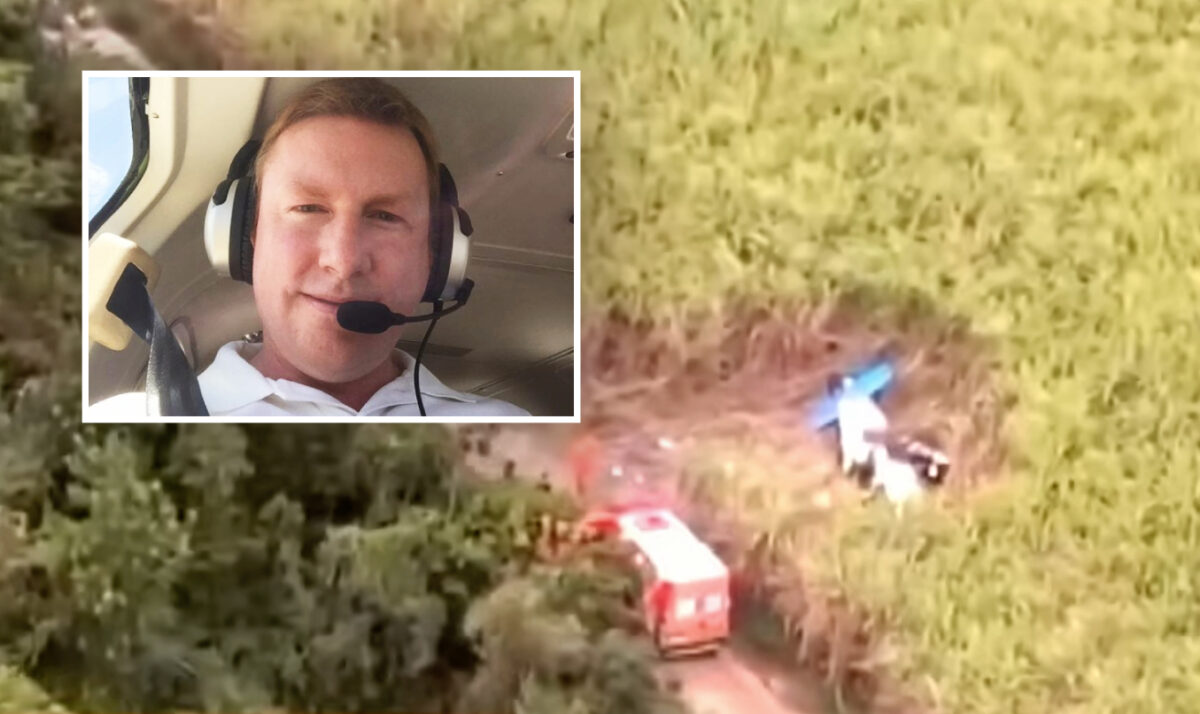
Insert: Timothy Clark. Main: The wreckage of Clark’s plane. Source: Facebook, TV Pajuçara / YouTube
An Australian pilot who recently died when his small plane crashed in South America during a failed drug run has links to an alleged Kinahan cartel associate who is facing charges over the importation of a multimillion dollar cocain
This article is the result of a collaboration with The Sunday Times.To stay up to date on our latest investigations, join Bellingcat’s new WhatsApp channel here.
Insert: Timothy Clark. Main: The wreckage of Clark’s plane. Source: Facebook, TV Pajuçara / YouTube
An Australian pilot who recently died when his small plane crashed in South America during a failed drug run has links to an alleged Kinahan cartel associate who is facing charges over the importation of a multimillion dollar cocaine shipment to Western Australia.
The body of former Melbourne stockbroker Timothy James Clark was reportedly found at the wreckage of his single-engine Sling 4 in Brazil’s north-east on September 14, along with about 200kg of cocaine.
Left: the wreckage of the small aircraft in a sugarcane field in Coruripe; Timothy Clark’s drivers licence. Right: cocaine seized by police. Source: Polícia Militar de Alagoas via G1
Local media said Clark was the sole occupant of the aircraft, which had been fitted with additional fuel tanks and appeared to have its transponder turned off.
Melbourne newspaper The Agereported on Thursday that Clark’s failed mission in South America was not his “first rodeo” and quoted a confidential source who alleged that the 46-year-old had been involved in a drug smuggling operation in Western Australia last year.
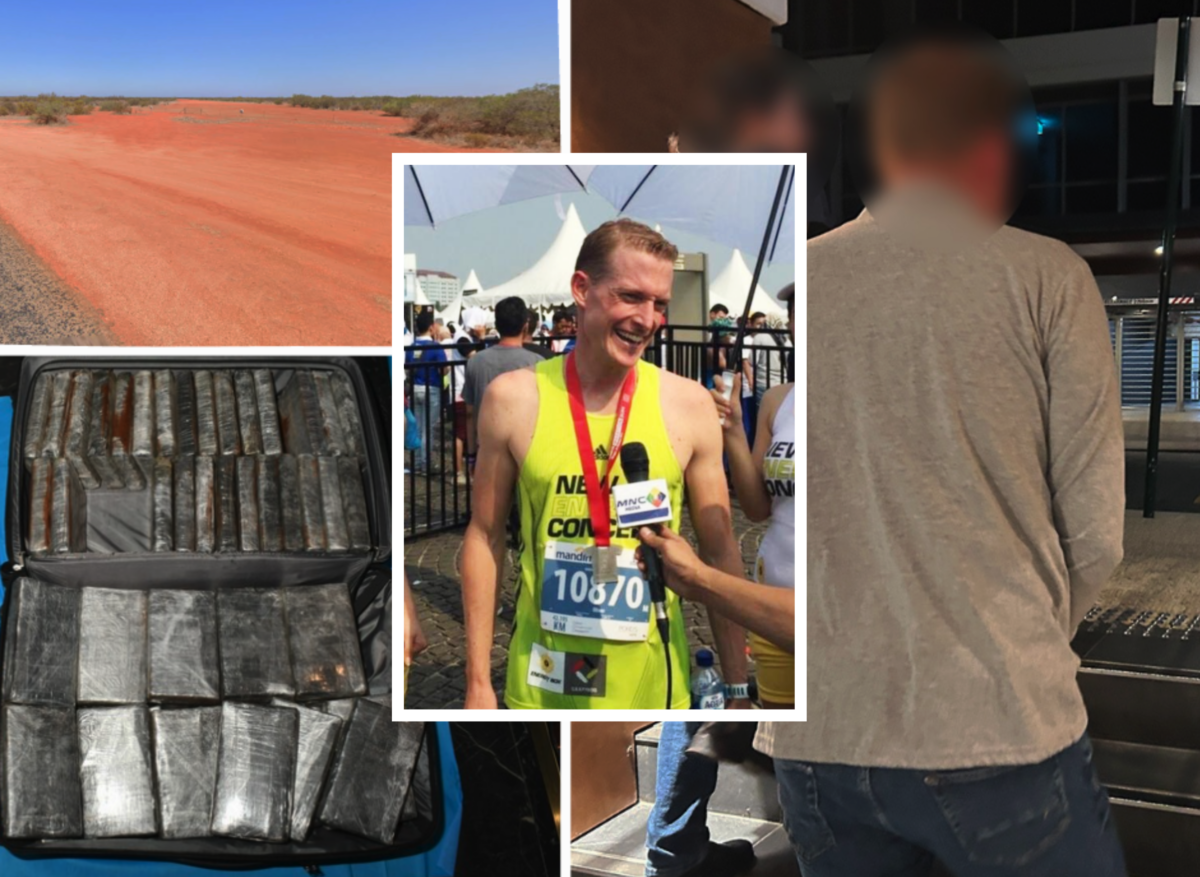
The Australian Federal Police (AFP) charged German businessman Oliver Andreas Herrmann and Melbourne man Hamish Falconer with trafficking a commercial quantity of a controlled drug in December after a search of their hotel rooms uncovered 200kg of cocaine, packed in suitcases in single one-kilogram blocks, along with night vision goggles, aviation equipment and a hardware cryptocurrency wallet.
Insert: German national Oliver Herrmann. Top left: The Overlander Airport, where he allegedly met an aircraft on Dec 27, 2024. Bottom left: cocaine seized by the AFP. Right: Herrmann after he was detained. Source: Facebook / Oliver Herrmann, Google Street View, AFP
Herrmann had allegedly met a “small aircraft” at the remote Overlander Airstrip the day before his arrest. The AFP has not disclosed the make and model of the aircraft but said it had not seized an aircraft as part of its investigation.
Investigators estimated the street value of the drugs to be AUD $65 million and said an “organised crime syndicate” was likely responsible for the scheme.
In March, Bellingcat published an open source analysis of Herrmann’s online footprint and traced the champion marathon runner and international businessman to locations associated with the US-sanctioned Kinahan Organised Crime Group.
Crime boss Christy Kinahan and his sons Daniel Kinahan and Christopher Kinahan Jr have a collective US $15 million bounty on their heads.
It followed reporting by our publishing partner The Sunday Times, which revealed that Herrmann had “close financial ties” to Christy Kinahan, the 68-year-old founder of the eponymous international drug cartel. Herrmann had no previously known links to organised crime.
Bellingcat has now uncovered evidence linking alleged Kinahan cartel associate Herrmann to Timothy Clark, the Australian who was killed when his plane crashed in Brazil two weeks ago.
Timothy Clark, who said on a couchsurfing website that he loved to “party hard”, pictured with friends at a “BBQ party” in 2015. Source: Timothy Clark’s Facebook
Using online tools that consolidate publicly available information and reverse image searches, Bellingcat found more than a dozen accounts registered to Clark across social media platforms, travel websites and review platforms.
This open source review shows that the Australian pilot – who used the moniker “The Broker” on X and Instagram – documented his travels to more than 20 countries across Africa, South America, Europe and Asia over the past decade.
Clark frequently used Tripadvisor to post reviews, including about chartering a catamaran in Bali and the VIP service at a Saint-Tropez bar where he spent €5,500 on “ultra topshelf” drinks.
Timothy Clark, who was also involved in multiple businesses with interests in energy and mining, frequently posted photos of his overseas travels. Source: Tripadvisor
Clark was also an associate of Oliver Herrmann; the German businessman’s Facebook profile shows he was “friends” with the Australian pilot. And a 2018 restaurant review posted by Clark included a photo that shows the pair dining together in the Zimbabwean capital of Harare.
The filename of the photo is dated March 2, the same day that Herrmann logged a run in Harare on the fitness app, Strava. In the same week, Clark posted a review for a Harare bar close to where Herrmann recorded another GPS-tracked run on the same day.
Among his reviews about luxury hotels and wine pairings, Timothy Clark (left) posted a photo with Oliver Herrmann (right) at a restaurant in Harare in 2018. Source: Tripadvisor
Herrmann, an acclaimed runner who won the 2016 Munich Marathon, logged more than 2,500 activities across dozens of countries on Strava between 2013 and 2023. His use of the fitness app provided an extensive overview of his travels during that period.
Corporate records show Herrmann has been involved at senior levels with companies active in the fields of fintech, mining and consulting.
Like Christy Kinahan, Clark had an active Google Maps profile where he posted reviews, photos and ratings. His profile used the alias “John Smithe”, but Clark is pictured in one of the images posted by the account and his real name is used in a reply from one of the venues, confirming it belongs to him.
Clark also left Tripadvisor reviews for two Zimbabwean venues – the Amanzi Lodge and Thetford Estate – which Christy Kinahan laterattended, according to the cartel leader’s own Google Maps profile.
Clark, who lived in South Africa before his death, was also just one of eight X followers of Adam Wood, a known associate of Christy Kinahan in Africa.
Adam Wood (left) with cartel leader Christy Kinahan – known as the “Dapper Don” – at a 2019 aviation conference in Egypt.
South African news outlet City Pressreported last week that Clark also operated a second aircraft for “legitimate” flights, a Beechcraft King Air 350 with Malawi registration number 7Q-YAO.
Bellingcat previously revealed that this aircraft was purchased in the US by an Indonesian company linked to Oliver Herrmann’s partner. It was then flown to Southern Africa by a ferry pilot who had also piloted a Pilatus PC-12 previously associated with a Kinahan-linked company.
Clark posted a Google review for a business at Lanseria Airport in Johannesburg on the same day in April 2024 that the Beechcraft King Air 350 landed there, according to tracking data from ADS-B Exchange.
Tracked flight path of the Beechcraft King Air 350 during its ferry flight from the USA to Africa in February 2024, with numerous subsequent flights also recorded in the region. Source: Flightradar24, Facebook, Google Earth
The Sunday Times reports today that the Sling 4 kit-plane piloted by Clark had been heavily modified for transatlantic flights. A source told the newspaper that Clark replaced the engine at least once in Brazil, indicating he was continuously flying it long-haul, and may have fitted a third engine due to the number of flying hours he was accumulating.
Clark’s plane crashed about an 11-hour flight from the Amazon basin, a region that has become a major trafficking route for cocaine bound for Europe, the drug’s fastest-expanding market.
The wreckage of Clark’s plane, which crashed earlier this month in Coruripe on the southern coast of the Brazilian state of Alagoas. Source: TV Pajuçara / YouTube
Tonnes of the drug flow from neighbouring Peru and Colombia, moving through the Amazon before being shipped to Europe and Africa.
The Sunday Times said Clark and Herrmann’s alleged activities suggested the Kinahan cartel had opened new smuggling routes for smaller shipments following a succession of seizures of cocaine consignments by police forces across Europe.
Oliver Herrmann, who has no known convictions, has not yet entered a plea. His case is listed for a committal mention in Perth Magistrates Court on October 10.
Peter Barth, Connor Plunkett, Beau Donelly and John Mooney contributed to this article.
Bellingcat is a non-profit and the ability to carry out our work is dependent on the kind support of individual donors. If you would like to support our work, you can do so here. You can also subscribe to our Patreon channel here. Subscribe to our Newsletter and follow us on Bluesky here and Mastodon here. With the unpredictability of social media algorithms making it harder for news outlets to reach audiences consistently, we have also started a WhatsApp channel that you can join to stay updated on our stories.
Extreme weather events are increasingly forcing millions of people from their homes. Last year, floods and storms caused more people to be internally displaced around the world than war or violence.
Driving food insecurity and competition for resources, climate change can also indirectly intensify conflict risks.
Analysing trends in both climate and conflict data is therefore not only critical for humanitarian response teams but also for journalists and researchers looking to understand t
Driving food insecurity and competition for resources, climate change can also indirectly intensify conflict risks.
Analysing trends in both climate and conflict data is therefore not only critical for humanitarian response teams but also for journalists and researchers looking to understand the compounding impacts of weather-related hazards and violence on displaced communities.
Cabo Delgado is a region besieged not only by cyclones but also by years of conflict. What began in 2017 as a series of localised attacks by Islamist militias has since escalated into an ongoing regional civil war between government forces and the Islamic State Central Africa Province (ISCAP). Close to a million people have been displaced, with extreme weather events including Cyclone Kenneth in 2019 and Cyclone Gombe in 2022 only adding to the unfolding humanitarian disaster.
Step 1: Sourcing Conflict Incident Data
Armed Conflict Location and Event Data (ACLED) provides real-time monitoring of global political violence and unrest by providing geo-referenced records of protests, riots, and violence targeting civilians.
Most of ACLED’s data originates from public sources, including local media reports and social media posts, making it heavily dependent on the presence or absence of local journalism. This reliance can create gaps in the data. However, on occasion, ACLED may also gather intelligence from local partners on the ground.
Each event entry includes key attributes such as dates, locations, involved actors, casualty figures and event descriptions. The data can be downloaded as CSV files with XY coordinates for spatial analysis. It is important to acknowledge that these coordinates often represent approximate locations, frequently defaulting to the nearest city centre rather than the precise location, which reduces spatial accuracy for detailed analysis.
Navigate to the Data Export Tool. Enter your Access Key and email address, then select your country, event type and time period of interest
Given the complexity and longevity of the conflict in Cabo Delgado, with incidents dating back to 2017, we have chosen to split our data capture into three distinct time periods, described below. Each period will produce a separate CSV file, which, when uploaded to Google Earth Pro, will generate a separate data layer on the map.
Each time period reflects a shift in the level of violence and resulting displacement patterns of the community over time.
Period 1. Oct. 5, 2017 – March 23, 2021: Gradual Displacement The first attacks begin in the northern districts. A steady flow of Internally Displaced Persons (IDPs) arrives further south, in and around Metuge.
Support Bellingcat
Your donations directly contribute to our ability to publish groundbreaking investigations and uncover wrongdoing around the world.
Period 2. March 24, 2021 – Dec. 31, 2021: Peak Displacement A large-scale attack on the town of Palma in March 2021 results in the displacement of more than 100,000 people.
Period 3. Jan. 1, 2022 – To Date: Post-Peak Following the recapture of Palma and Mocimboa da Praia by Mozambican and allied forces, some IDPs begin to return to their homes.
To export the data navigate to the Data Export Tool and enter the information below, repeating this step for each time period:
Event Type: Battles, Explosions/Remote violence, Violence against civilians Country: Mozambique Date Range (From and To): 05/10/2017 – 23/03/2021 (Period 1: Gradual Displacement) 24/03/2021 – 31/12/2021 (Period 2: Peak Displacement) 01/01/2022 – To date (Period 3: Post-Peak)
Step 2: Mapping Conflict Data in Google Earth Pro
Launch Google Earth Pro on your desktop. In the top menu, click File → Import.
Navigate to one of the downloaded ACLED CSV files and select it. The pop-up window, Data Import Wizard, will appear.
Select Field Type: Delimited.
Choose Comma as the delimiter.
Click Next and leave the other settings as they are (ensure that the Latitude and Longitude fields are correctly selected). Click Finish to import the file.
Step 3: Save and Style the Data
A new layer will appear below Temporary Places and Google Earth Pro will automatically display the imported points in the map. If they don’t appear, make sure the box next to the layer is ticked.
Right-click the dataset and choose Save Place As… to store it as a KML or KMZ file.
Repeat Steps 2 and 3 for all the ACLED CSV files you have downloaded.
To change the icons or colours, right-click the layer file, Select Properties, then modify the Style/Color settings.
For each time period, we have selected a different icon colour: Period 1 = Yellow, Period 2 = Red, Period 3 = Blue. Source: Google Earth Pro 2025
For each time period, we have selected a different icon colour: Period 1 = Yellow, Period 2 = Red, Period 3 = Blue. Source: Google Earth Pro 2025
Step 4: Explore the Data
Click on any point to view details of the event, including the date, type, and location.
Be aware that ACLED may record multiple conflict incidents at the same location, so events can appear stacked on the map.
Toggle the time-period layers on and off to analyse spatio-temporal changes in conflict patterns.
GIF showing the conflict data across three distinct time periods. Each period is represented by a different icon colour: Period 1 = Yellow, Period 2 = Red, Period 3 = Blue. Source: GoogleEarthPro 2025 & ACLED 2025
The visualisation reveals that during the first time period, Gradual Displacement(yellow), the violence was mostly concentrated in north-eastern Cabo Delgado, in and around Macomia, Mocimboa da Praia and Palma. In the second time period,Peak Displacement(red), incidents remained high in the north-east, leading to a large influx of IDPs into the Metuge region. By the third time period, Post-Peak (blue) the conflict had spread further south and west, increasing the risk of repeated displacements for populations already uprooted.
Zooming in on Displacement
To better understand localised displacement patterns, we can begin identifying specific IDP settlements of interest using high-resolution satellite imagery.
The EMS’ mission, to deliver near-real-time maps and geospatial data during or immediately after a critical event, aims to help responders on the ground make informed decisions quickly. Recent activations have included the wildfires in Portugal, floods in Germany, or post-landslide in Ethiopia. You can access their full database here.
The EMS was activated over Cabo Delgado in response to the displacement of thousands of civilians after militants attacked and killed dozens in the coastal town of Palma. The map below shows seven of the IDP sites captured by the EMS in 2021 in the districts Metuge and Mecufi.
The seven settlements include: Mareja (12°58’01.0″S 40°18’56.0″E), Saul (40°20’14″E 12°59’13″S), Cuaia (40°21’E 12°59’50″S), Ngalane (40°23’50″E 13°2’46″S), Rural Site (40°26’58″E 13°10’55″S), Naminaue (40°26’59″E 13°10’58″S), 3 de Fevereiro (40°28’23″E 13°11’49″S). Source: EMS. Annotated by Bellingcat
Based on the EMS data, we will focus on two out of the seven settlements: Cuaia (40°21’E 12°59’50″S) and Ngalane (40°23’50″E 13°2’46″S).
Copernicus EMS provides a detailed guide on what to look out for when analysing a potential IDP settlement, including housing types, tents, and other structures. Follow this link to download the PDF titled Technical Report.
Cuaia – A Temporary Settlement
As seen in the satellite imagery below, an organised camp including tents and sanitation facilities to the west of the small village of Cuaia was visible in May 2021. However, by May 2022, all the tents had disappeared, indicating that this was a temporary site which did not develop into a permanent IDP settlement.
Imagery of Cuaia (40°21’E 12°59’50″S) in May 2021 and May 2022. Source: GoogleEarthPro 2025
The tents’ light-coloured roofs and their uniform size and shape indicate that this settlement was temporary. Their neat arrangement in closely spaced rows suggests the camp was established by a humanitarian organisation. Just north of the tents, two rows of small dark structures are also visible, most likely sanitary facilities. Their alignment to the camp further supports the interpretation that this is a planned, non-permanent installation, distinct from the adjacent village to the east. In the southern part of the image, two buildings have appeared. A change in the colour and material of their roofs can be observed between 2021 and 2022, suggesting a shift from a temporary to more durable construction.
Ngalane – A Permanent Settlement
Located south of the city of Metuge, Ngalane’s expansion is clearly visible in satellite imagery – from a small community in 2020 to a larger, more established site by 2021. The visible increase in housing and agricultural fields suggests that Ngalane has transitioned from a temporary site into a permanent IDP settlement.
Imagery of Ngalane (40°23’50″E 13°2’46″S ) in August 2020 and May 2021
Rather than the organised, grid-like layout seen at temporary sites such as Cuaia above, the organic arrangement of dwellings in Ngalane, along with informal footpaths, small roads, and newly established small fields and cultivated plots, all indicate a level of permanence. While some buildings still have light-coloured roofs, indicating tent fabric, the overall spatial organisation of the settlement, combined with the presence of cultivated land, provides stronger evidence of a shift from short-term displacement to long-term settlement, reflecting efforts to rebuild livelihoods.
Analysing the Settlements’ Digital Footprints
Now that we’ve identified our two locations of interest, we can further analyse the settlements’ structures and their populations’ exposure to climate-related hazards, using building footprint data from OpenStreetMap (OSM). OSM is a collaborative project that provides free, crowdsourced geographic data, including information on roads, buildings, and other infrastructure.
A settlement’s footprint data is based on the number, size, and shape of individual buildings, and can be used to estimate how many people live in a given area. Such data can be leveraged for exposure mapping, helping to identify a location, its density, and the resilience of its structures in relation to climate-related hazards such as floods, droughts, or cyclones.
Ngalane – an Incomplete Footprint
To see the current OSM building footprint of Ngalane, you’ll first need to create a free account.
By navigating to the iD Editor window, we can see the OSM footprint of the original village (outlined in red), before the high influx of IDPs, has mostly been mapped. Red rectangles mark the buildings currently recorded in OSM.
OpenStreetMap iD Editor view of Ngalane (40°23’50″E 13°2’46″S ) with ESRI World Imagery as Basemap. Source: OpenStreetMap 2025
However, beyond the old village boundary, the newer settlements, home to the IDPs, remain entirely unmapped and therefore undocumented. In the event of a future storm or other climate-related hazard, the absence of mapping data for this community could result in their exclusion from impact assessments and early response planning.
Cuaia – an Out-of-Date Footprint
In Cuaia, 83 of the original village buildings have been mapped in OSM. None of the temporary structures have been documented, as they only briefly existed in 2021. However, when comparing the OSM data with more recent satellite imagery from 2025, it’s clear the settlement’s footprint is out of date: some buildings no longer exist, while others remain unmapped.
OpenStreetMap iD Editor view of Cuaia (40°21’E 12°59’50″S) with Bing Maps Aerial as Basemap. Source: OpenStreetMap 2025
The OSM metadata reveals that most structures were mapped between 2017 and 2019. If the data were needed for an accurate exposure assessment in the event of a cyclone or flood, for example, the OSM building footprints would need to be rapidly updated.
To address such time-sensitive scenarios, the initiative Humanitarian OpenStreetMap Team (HOT) organises rapid-response open mapping for crisis-affected areas.HOT is a global initiative that mobilises volunteers to help produce real-time geospatial information by tracing buildings, roads and rivers in OSM. Its Export Tool also allows users to select an area of interest and download custom extracts of OSM data, including building footprints, road networks, or land use, in various formats for geospatial analysis.
Analysing OSM data in Google Earth Pro
To overlay the settlement’s building footprints with the conflict and climate data, we will first export the relevant OSM layers using the HOT Export Tool, then import them into Google Earth Pro for analysis.
You will need to create a free HOT account before taking the next steps.
Step 1: Open the HOT Export Tool. Create a name for your dataset, then navigate to your area of interest, for example, Ngalane. Using the toolbar on the right, select the box tool and click and drag a rectangle over the area you want to export the data for.
HOT Export Tool. Source: HOT 2025
Step 2: Under the Formats tab select Google Earth .kml then click Next.
Step 3: Tick the Buildings box to export all building footprint data for your selected area. Click Next.
Step 4: Click Create Export.
Step 5: Once the status shows Completed, click on the download link to save the data as a .zip file.
Step 6: To import the data into Google EarthPro, either drag and drop the .kml file directly into the program or go to File -> Import -> then select the downloaded file. Once the data is imported, right-click on the layer in the panel on the left, select Properties, and under the Style, Color tab, customise the appearance of the building data on your map.
HOT Export Tool. Source: GoogleEarthPro 2025
By visually comparing the distribution of mapped buildings to the satellite imagery in Google Earth Pro, you can assess the completeness and accuracy of OSM mapping in your area of interest. You can also explore historic satellite imagery through the Time-Tool to track changes in the building footprint over time and better understand how the settlement has developed.
OSM building footprint compared to historic imagery of Ngalane (40°23’50″E 13°2’46″S) from 2018. The year of the imagery was selected through the Time-Tool slider in the top left. Source: GoogleEarthPro 2025
Overlaying the Climate Data
In Part I of this guide, we mapped NASA climate data, specifically the accumulated rainfall brought by Cyclone Kenneth in 2019, to highlight the cyclone’s path and its impact on communities in Cabo Delgado. For a refresher on how to import climate data into Google Earth Pro, see Part I of this guide.
This map shows accumulated daily mean precipitation (mm) during Cyclone Kenneth, recorded along the coast of Cabo Delgado from April 25 and 28, 2019, which subsequently led to flooding in the region. Credit: NASA, 2025
By overlaying the ACLED conflict incident data (2017 to 2021) with the accumulated rainfall data in Google Earth Pro, we can see how violence concentrated in the northwest was a major driver of displacement both before and during Cyclone Kenneth. However, displacement southward brought many directly into areas exposed to severe flooding.
Conflict incidents from 2017 to 2025 overlaid on accumulated daily mean precipitation (mm) during Cyclone Kenneth, recorded along the coast of Cabo Delgado between April 25 to 28, 2019. Source: ACLED 2025, NASA 2025, Google Earth Pro 2025
Zooming in on our case study settlement, Ngalane, further reveals this community’s high exposure to the impacts of Cyclone Kenneth, including heavy rainfall and flooding.
Situated within the highest rainfall impact area, Ngalane was highly exposed to flooding. Credit: NASA, 2025, Google Earth Pro 2025
With at least 63 homes visible in Ngalane’s OSM building footprint, we can estimate a minimum number of residents at the time Cyclone Kenneth struck. However, since the footprint was incomplete, the actual population was likely higher.
The OSM building footprint of Ngalane (40°23’50″E 13°2’46″S) overlaid on 2019 satellite imagery shows that the original village was mapped prior to Cyclone Kenneth landing. Credit: OSM 2025, Google Earth Pro 2025
Mapping Cabo Delgado in 2025
To date, numerous communities across Cabo Delgado remain unmapped and highly vulnerable to the next cyclone or flood, including Ngalane.
Recent satellite imagery of Ngalane reveals the rapid expansion of new buildings in all directions from the original village – all undocumented and therefore invisible on existing maps.
The OSM building footprint (red squares) of Ngalane (40°23’50″E 13°2’46″S) overlaid on satellite imagery from March 2025 illustrates areas of unmapped new homes which continue much further beyond the boundaries of this image. Credit: OSM 2025, Google Earth Pro 2025
In order to update essential mapping data of the community, together with HOT we have created a task in the HOT OSM Tasking Manager to initiate mapping of new buildings in Ngalane. Follow this link to create an account, complete the OSM mapping tutorial and start mapping buildings in Ngalane! Your efforts will help generate essential mapping data for this settlement, supporting preparedness for future storms in the region.
Bellingcat is a non-profit and the ability to carry out our work is dependent on the kind support of individual donors. If you would like to support our work, you can do so here. You can also subscribe to our Patreon channel here. Subscribe to our Newsletter and follow us on Bluesky here and Mastodon here.
Bellingcat and our partners at Kenya’s Daily Nation have identified Kenyan-labelled crates of ammunition inside an alleged RSF depot close to the recently recaptured Sudanese capital Khartoum.
Although we couldn’t independently verify the contents of every crate identified, tins with ammunition matching the labels on the crates were found nearby among the captured weapons displayed by the Sudanese Armed Forces (SAF).
The confirmation of ammunition crates inside Sudan raises new questions a
Bellingcat and our partners at Kenya’s Daily Nation have identified Kenyan-labelled crates of ammunition inside an alleged RSF depot close to the recently recaptured Sudanese capital Khartoum.
Although we couldn’t independently verify the contents of every crate identified, tins with ammunition matching the labels on the crates were found nearby among the captured weapons displayed by the Sudanese Armed Forces (SAF).
The confirmation of ammunition crates inside Sudan raises new questions about Kenya’s involvement in the conflict following a high-profile visit by Rapid Support Forces leader General Mohamed Hamdan Dagalo to Nairobi earlier this year.
In response to the visit, the Sudanese government banned all imports from Kenya amid a perception of close ties between the Ruto government and General Dagalo, widely known as Hemedti.
The Kenyan government defended the decision to host Hemedti, stating that their aim was to promote dialogue and peace and emphasising the importance of engaging all parties involved in the conflict.
Examples of images of Kenyan MOD-labelled ammunition crates. These images had been circulating on social media, allegedly showing ammunition left behind by the RSF. Credit: posted on X
While the Kenya Ordnance Factories Corporation (KOFC) states on its website that it produces small arms ammunition, it does not indicate manufacturing higher-calibre 14.5×114 mm cartridges and the Chinese-made HE PP87 mortar bombs identified in this investigation.
Our partners at Daily Nation reached out to the Ministry of Defence (MoD) of Kenya to ask about the crates we identified and how they ended up in Sudan. We also asked whether it was Kenyan government policy to supply ammunition or weapons to the Rapid Support Forces and how this comports with the government’s public commitment to facilitating peace and dialogue in Sudan.
Support Bellingcat
Your donations directly contribute to our ability to publish groundbreaking investigations and uncover wrongdoing around the world.
In its response, the Ministry of Defence said it did not recognise the crates or labels on them and distanced itself from the allegations. Its answer appears to be limited to nationally produced ammunition only as well as internal protocols. It didn’t mention if Kenya has done any imports, international transfers or diversions of the weapons or ammunition in question. A statement that leaves key concerns about the Sudan connection unclear.
“Upon examination of the photographs provided, we wish to state that we do not recognize the crates nor the inscriptions on them.
The Kenya Ordinance Factory Corporation and, by extension, the Ministry is alive to the sensitive nature of the ammunition it manufactures, and as a result, it has clear records of its supplies within and beyond Kenya. Alongside this, and to guarantee public safety, audits of the factory’s operations are frequently conducted by the managing and external oversight authorities.
The Ministry of Defence, therefore, distances itself from the allegations you sent earlier.
Further, we remain fully committed to upholding the rule of law and continue to operate strictly within the mandate granted by the Constitution and applicable authorizations.”
Justin Lynch, Managing Director of the Conflict Insights Group and a Sudan researcher, told Bellingcat the discovery of the crates is further evidence of Kenya’s political and logistical support for the RSF.
A Country at War, Awash with Foreign Weapons
Sudan is in the midst of an ongoing civil war between two rival factions, the Sudanese Armed Forces (SAF) and the paramilitary Rapid Support Forces (RSF).
The stash of ammunition crates located near Sudan’s capital was filmed by Sudanese Armed Forces (SAF) soldiers who took part in the final push to retake the city from the RSF who have controlled Khartoum and its surrounding cities for much of the civil war.
The SAF declared it had retaken the final areas of resistance in Khartoum, its twin city of Omdurman, and the neighbouring city of Bahri on May 20, stating the three areas were now completely free of RSF forces.
The re-taking of the capital has led to much footage and images being released. Including footage that appears to show supplies used by the RSF.
A 2005 UN arms embargo remains in place prohibiting any country from supplying weapons to Darfur, Sudan, an area that has seen intense fighting since the outbreak of the civil war.
The Sudanese government brought a case before the International Court of Justice in The Hague in May, accusing the UAE of complicity in genocide for its role in supporting the RSF. The UAE has categorically denied supporting the RSF. The case was dismissed as the UAE has not signed Article 9 of the Genocide Convention.
Both sides of the conflict have been accused of war crimes, and the RSF has been accused of ethnic cleansing in certain areas, including around Darfur. The UN says more than 24,000 people have been killed since fighting began in 2023 following a peaceful uprising by civilians against dictator Omar al-Bashir. More than 11 million people have reportedly been displaced.
While there is detailed reporting on routes between the UAE and Sudan’s neighbouring countries, including Chad, being used for weapons transfers, specific details about how the Kenyan ammunition crates ended up in the country remain scarce.
How Do We Know the Ammunition Crates Were in the Vicinity of Khartoum?
On May 19, after weeks of reported intense fighting with the RSF, SAF soldiers and allied forces posted video clips claiming they were inside the Salha area in southern Omdurman, located across the Nile from Khartoum.
Bellingcat and Daily Nation have identified three videos containing Kenyan MOD-labelled ammunition crates allegedly left behind by the RSF inside an unknown depot most likely in Salha.
Using social media, we identified soldiers seen in the depot next to the ammunition: A Major from the SAF’s General Intelligence Service (GIS) and at least one other young Sudanese soldier. Both appear to have been in the depot during the same time the operation in Salha was taking place.
Video 1, Video 2 and Video 3 show soldiers rummaging through several rooms containing crates and talking about the armour allegedly left behind by the RSF. Photos of the same type of crates with the same label from the Kenyan MOD had been circulating on social media for some time earlier this year. But it had been difficult to geolocate inside Sudan before these more recent videos emerged.
In video 3, the speaker mentions the ammunition discovery and repeats ‘Salha’, the location, several times.
In video 1, an Arabic speaker can be heard saying: “But I swear to God, you can’t fight again and you won’t defeat us, is this the work (equipment) you leave?”
Above: Example of one of the crates featured in one of the videos filmed inside the dark depot. Below: The stencil label appears to be the same as seen in other previous pictures circulating earlier on social media. Credit: X
Video 1 shows a man inside the depot wearing a fatigued t-shirt, glasses and white Tasbih prayer beads. We found further footage showing what appears to be the same man wearing the same clothes and accessories. Elements in the background tell us that the video was indeed filmed in Salha, Omdurman, along the main road (15.5479, 32.4273).
Left: Soldier in the armour depot. Right: Stitched frames of a video showing the same soldier wearing the same clothes and accessories but on this occasion in an outdoor setting. Credit: X, Facebook
The outdoor setting was geolocated to Salha, Omdurman (15.5479, 32.4273). Credit: Facebook, Google Earth
We identified the soldier above as a Major (Ra’id) from the SAF’s General Intelligence Service, as indicated by his uniform insignias and patches seen in another video circulating on May 20. His name appears to be Al-Makki Abdul Quddus Ahmed.
A video showing a man with the same characteristics as the soldier from the depot is wearing a uniform featuring an insignia consistent with a Rai’d/Major rank used by the Sudanese Armed Forces and a patch from the General Intelligence Service of Sudan. Using Optical Character Recognition, his name appears to read Al-Makki Abdul Quddus Ahmed. Credit: X, globalsecurity.org, gis.gov.sd
Similarly, in another video filmed approx 150m from Major Al-Makki, here (15.546947, 32.427022), we identified a second man seen in the ammunition depot videos. In both videos, he is seen wearing the same clothes with a small Sudanese flag on his left shoulder.
A young soldier who was in the ammo depot was also seen outdoors in a street scene celebrating with other soldiers and wearing the same outfit and accessories as in the depot.
We geolocated the young soldier just 150m from Major Al-Makki in Salha, Omdurman. Credit: Facebook/Google Earth Pro
All the videos analysed were posted between May 19 and May 21. We geolocated the soldiers in a market area of southern Omdurman’s Salha district. This is consistent with the Sudanese Armed Forces retaking the city. Aljazeera reported that SAF had regained full control of the area by May 20.
Although we were unable to confirm the exact location of the depot, corroborating the presence of soldiers in the Salha area, along with open source information, strongly indicates that the depot is indeed located in the Salha neighbourhood of Omdurman.
From Sudan to the World: International Connections of the Weapons Crates
We compared the labels of the crates located near the Khartoum depot with other images of Kenyan munition crates circulating online, reportedly also from Sudan. On the labels, we can see English wording that includes the name of the product, contract number, batch number, quantity, volume, case number and total case number.
To be clear, although the crates are labelled with contractual and technical information, we are not able to say with certainty the origin or producer of the munitions. However, there are important details to highlight.
Bellingcat and our partners at Daily Nation shared images of the crates with three independent armament experts. All confirmed that the markings indicated the ammunition crates were part of the same contract (No. 23PTI) and were delivered to the Kenyan Ministry of Defence (KEMOD-01).
Australian-based Armament Research Services (ARES) told us: “The markings on this crate are consistent with other crates we have seen that we believe to be delivered on a Kenyan contract.”
Still of video showing Kenyan MOD-labelled ammunition crates. These images had been circulating on social media, allegedly showing ammunition allegedly captured by SAF in Khartoum. Credit: X, Sudan Nabaa
Upon examining the images, the weapons experts also told us that many of the crates indicate delivery during or after 2024 – when the civil war in Sudan was well underway.
Former Royal Artillery Army officer and director of Chiron Resources, Chris Cobb-Smith said: “The batch number suggests they were packed in 2024 – delivery date to Kenya would probably have been the same year. When delivered to Sudan is not known.”
All three experts agreed that the type of ammunition indicated on the labels was 57 calibre (14.5×114mm) armour-piercing incendiary (API) cartridges.
Cobb said that 14.5×114mm (.57 calibre) is a heavy machine gun and anti-material rifle cartridge used by the Soviet Union, the former Warsaw Pact states, modern Russia, and other countries.
Although not specified on the crates, Cobb added that this type of cartridge has been manufactured in Bulgaria, China, Egypt, Hungary, Iraq, North Korea, Poland, Romania, Russia, and the former Czechoslovakia.
One of the videos we found with these crates inside a depot in Salha, Omdurman, showed cans inside the crates and at least one open can next to the crates had visible ammunition consistent with the specifications on the label. The ammunition visible appears to have a green case and what appears to be a standard black-tip.
Several cans were visible inside crates in the depot. At least one open can located next to the crates had visible ammunition consistent with the specs on the label. Credit: X
Left and centre: screenshots from Salha depot Video 1, showing a round next to the Kenyan MOD-labelled crates. The bullet appears to feature a green-coloured case and a black marking on the tip. Right: Example of a 14.5×114 MM API cartridge. Credit: X, cjaie.com
We were also able to identify two additional green crates seen in a video showing the Salha depot. The label appears to indicate the boxes likely contain (or at least contained) an explosive with the specification “82mm HE Mortar Bomb Type PP87”.
Two additional green crates are seen in one of the videos showing the Salha depot. The label on the Kenyan-labelled crate reads 82 mm HE Mortar Bomb Type PP87. Credit: X
According to weapons experts, the markings on the crate suggest the box and its contents were likely initially delivered to Kenyan authorities under contract AMI/KEN/099/2023.
Director of Chiron Resources, Chris Cobb-Smith told Bellingcat that the contract number on these crates indicates the Kenyan MOD purchased mortar bombs from China in 2023. He added that it would be impossible to say whether they were immediately diverted or not.
Human Rights Watch reported in 2024 that RSF appeared to be using this Chinese-made mortar ammunition. This video shows a man in RSF camouflage and another in civilian clothes unpacking 82mm HE Mortar Bomb Type PP87. HRW was unable to verify RSF claims that it captured this new mortar munition from the SAF. Amnesty International has also reported the use of this weapon in Sudan.
Still image of a video from June 2024 showing a man in RSF camouflage and another in civilian clothes unpacking 82mm HE Mortar Bomb Type PP87. Credit: X
We also found another sample of these bombs among other SAF-captured ammo displayed in early May in Khartoum. The Chinese-made bomb was photographed next to another Kenyan labelled crate stating it contained 7.62mm SMG (submachine guns or self-loaded rifles) TYPE CS/LR11- sold by the intermediary China Jing An Import & Export Corporation (CJAIE).
82mm HE Mortar Bomb Type PP87 photographed next to another Kenyan-labelled crate stating it contained: 7.62mm SMG TYPE CS/LR11 – a submachine gun or self-loaded rifle (SMG) sold by the intermediary China Jing An Import & Export Corporation (CJAIE). Credit: China Xinhua News, Facebook
There have been several reports identifying Chinese-made weapons in the arms of the RSF. In April, China’s charge d’affaires in Port Sudan was summoned by the Sudanese government over the RSF’s use of Chinese-made drones. China has stressed they have “nothing to do with the presence of these drones and has no connection with the RSF”. Earlier this month Sudanese media outlet Ayin used open sources to identify Chinese-made weapons in the hands of RSF fighters.
Chadian Labelled Crates
In a separate alleged capture of weapons and ammunition displayed by the SAF at the Engineering Corps building in Omdurman (15.609734, 32.480369), similar crates were seen but with the stencil label removed.
The Sudanese army displays weapons allegedly captured from Rapid Support Forces (RSF) in Omdurman in mid-May 2025. Source: Facebook
Next to the crates, a green box is seen with a stencil label that appears to read:
“Direction Générale de la réserve Stratégique de la Présidence … République du Tchad”: General Directorate of Strategic Reserves (DGRS) of the Presidency… Republic of Chad.
The label on this box indicates a different designation “73-DTG02”. According to the Collective Awareness to Unexploded Ordnance (CAT-UXO), this designation is believed to be a Chinese 73mm High-Explosive-Dual-Purpose (HEDP), High-Explosive-Anti-Tank (HEAT) with Anti-Personnel (AP) HE-Frag, fin-stabilised Rocket.
The UAE has been accused of supplying Sudan’s RSF via a Chad airstrip. Dozens of flights from the UAE appear to have used an airstrip at Amdjarass in eastern Chad since the war began in April 2023.
Weapons Continue to Fuel Suffering
The discovery of the Kenyan-labelled munitions crates is further evidence of Kenya’s political and logistical support to the RSF, Justin Lynch, Managing Director of Conflict Insights Group and Sudan researcher, told Bellingcat.
He said the UAE has used Kenya and other African states as a political and logistical hub to support the Rapid Support Forces.
“It seems hardly a coincidence that RSF public conferences in Nairobi were immediately followed by a $1.5 billion loan from the UAE and a surge in suspicious UAE-to-RSF shipments transiting through Kenya,” Lynch said.
Kenya is reported to draw down next week the first portion of $500 million from the $1.5 billion United Arab Emirates (UAE) – backed commercial loan.
Delegates affiliated to Sudan’s Rapid Support Forces (RSF) react during a meeting for the planned signing, later postponed, of a political charter that would provide for a “Government of Peace and Unity” to govern the territories the force controls in Nairobi, Kenya, February 18, 2025. REUTERS/Monicah Mwangi
Despite losing control of the beating heart of the country, the RSF still rules huge swathes of Sudan including Darfur in the country’s southwest where violence is causing one of the world’s worst humanitarian crises, according to the UN.
As long as the conflict continues, questions about who is providing weapons and support to the warring sides will remain.
This article has been updated to reflect new information.
Bellingcat would like to thank our partners at the Daily Nation Forensics Unit for collaborating on this investigation.
Pooja Chaudhuri, Youri van der Weide and Jake Godin contributed to this report.
Bellingcat is a non-profit and the ability to carry out our work is dependent on the kind support of individual donors. If you would like to support our work, you can do so here. You can also subscribe to our Patreon channel here. Subscribe to our Newsletter and follow us on Bluesky here and Mastodon here.
This article is the result of a collaboration with The Sunday Times. You can find their corresponding piece here.
On the last Friday in December, a German businessman in his mid-40s allegedly met a small aircraft on a dusty runway in remote Western Australia. The following evening in Perth, seven hours’ drive south, he and another man were arrested and charged with trafficking a commercial quantity of a controlled drug.
Police said a search of their hotel rooms uncovered 200kg of cocaine,
This article is the result of a collaboration with The Sunday Times. You can find their corresponding piece here.
On the last Friday in December, a German businessman in his mid-40s allegedly met a small aircraft on a dusty runway in remote Western Australia. The following evening in Perth, seven hours’ drive south, he and another man were arrested and charged with trafficking a commercial quantity of a controlled drug.
Police said a search of their hotel rooms uncovered 200kg of cocaine, packed in suitcases in single one-kilogram blocks, along with night vision goggles, aviation equipment and a hardware cryptocurrency wallet.
It was the culmination of a three-month Australian Federal Police (AFP) investigation codenamed “Operation Mirkwood”. Authorities estimated the street value of the drugs to be AUD $65 million and AFP Inspector Chris Colley said an “organised crime syndicate” was likely responsible for the scheme.
The German businessman was Oliver Andreas Herrmann, a 44-year-old champion marathon runner and the director of multiple companies with diverse interests spanning various jurisdictions.
Insert: Oliver Herrmann pictured in an Australian media report from a photo on his Facebook page. Top left: Overlander Airport, where he allegedly met an aircraft on December 27, 2024. Bottom left: cocaine seized by police in Perth. Right: Herrmann after he was detained by police. Source: Facebook / Oliver Herrmann, Google Street View, AFP
Herrmann and the other man who was charged are due to face court again in May. They have not yet entered a plea and the presumption of innocence applies. Herrmann, who has no known convictions, had not responded to multiple requests for comment as of publication.
The Sunday Timesreported in January that Herrmann has “close financial ties” to Christy Kinahan, the 67-year-old founder of the eponymous international drug cartel who is wanted by authorities around the world. Last month it reported that Herrmann “acted as Kinahan’s representative on the ground” in Indonesia and quoted a source who said Herrmann once introduced him to the cartel leader.
“Kinahan was Oliver’s boss,” the source told The Sunday Times. “He was afraid of him. Kinahan was always shouting at him.”
Christy Kinahan (left) has a US $5 million bounty on his head but has posted photos giving away his location, including at a luxury Budapest hotel (top right) and a restaurant in Dubai (bottom right). Source: Irish Daily Star, Christopher Vincent Google Maps profile
That investigation revealed that the normally elusive crime boss – known as the “Dapper Don” – posted hundreds of reviews under the alias Christopher Vincent, disclosing his precise locations across three continents, including in Dubai where he lives in hiding. Bellingcat contacted Kinahan but did not receive a response.
We have now conducted an open source analysis of Herrmann’s online footprint to build a picture of the man Australian authorities accuse of trafficking drugs last Christmas. The findings paint a portrait of an avid runner and international businessman who is more accustomed to poolside video conferences than an alleged drug drop in the Australian desert.
Main: The Sunday Times reported in January that Herrmann was linked to Irish narco boss Christy Kinahan. Insert: The West Australian reported on Herrmann and his co-accused’s court hearing in January.
This investigation has traced Herrmann to locations associated with the cartel. These include a building in South Africa that Kinahan reviewed on his Google Maps profile, and to the Zimbabwean capital of Harare the day before a conference that the Irish drug lord said he attended.
It also sheds light on the complex network of international firms linked to Herrmann, either directly or through his associates. One of these firms shares an address with a company that reportedly received payments ultimately destined for Christy Kinahan.
Racing Around The World
Oliver Herrmann is a German national who has referred to Munich as his “home city”. He is also a South African resident, according to the AFP, and reportedly travels on a Swiss passport. Herrmann gave his nationality as Swiss in company documents filed in Singapore, while in registration documents in the UK he said he was German. He has listed his country of residence as Indonesia and Singapore.
Corporate records indicate that Herrmann has been involved at senior levels with companies active in the fields of fintech, mining and consulting. Until recently Herrmann was on the executive board of a German “international raw materials company” whose parent company, according to its website, is to be listed on the Düsseldorf Stock Exchange. The company told Bellingcat in February that Herrmann was removed from his board position after it learned about the allegations in Australia and said he no longer had any role with the organisation.
Herrmann’s Instagram account is set to private but he has a public profile on Strava, a fitness app used for recording exercise that often includes GPS-tracked routes (see Bellingcat’s Strava activity map guide here).
Herrmann’s Strava account has at least 130 photographs and includes a post about his winning 2016 Munich Marathon run. Source: Strava account of Oliver Herrmann / Munich Marathon
An acclaimed runner who won the 2016 Munich Marathon, Herrmann regularly logged his runs on Strava. Photos posted to the account confirm he is the same person pictured in an Australian media report about his court appearance in January over the alleged drug bust.
Herrmann’s Strava account has logged more than 2,500 activities in 29 countries across Europe, Asia, Africa, South America and the Middle East between 2013 and 2023. He has also posted at least 130 photos documenting his extensive travels. They show a dedicated athlete who appears to enjoy a jet-setting lifestyle, with many featuring scenic and tropical locations.
Herrmann’s Strava account shows that, like Kinahan, he has frequently traveled to Zimbabwe. An analysis of Herrmann’s runs shows he logged almost 500 activities in Harare between February 2018 and May 2022. Meanwhile, Kinahan posted 25 Google reviews in Harare between June 2019 and September 2021.
In one of these reviews, the leader of the transnational organised crime syndicate said he spent four nights at the Amanzi Lodge hotel for a “business networking conference” that was hosted by two companies. The conference ran from October 8 to 11, 2019, according to one of the company’s social media accounts. In two photos posted online, an individual with similar features to Kinahan is seen at the event.
This photo shows a man with similar features to Christy Kinahan during an October 2019 conference at the Amanzi Lodge in Harare. Kinahan posted a review for the same venue. Source: Instagram, Facebook
On October 7, the day before the conference began, Herrmann logged a run just 5.5 km from the venue where Kinahan said he stayed. Herrmann’s 2019 Strava activity in Harare suggests he spent time close to this location, near the city’s affluent suburb of Borrowdale, with dozens of runs starting and ending on the same residential road. After October 7, Herrmann’s next Strava run was recorded three days later in Dublin, Ireland.
Herrmann’s Strava profile logged a run in Harare on October 7, 2019 (left), near a hotel that Kinahan said he was staying at the time (right). Source: Strava, Google
Two of Herrmann’s runs from 2021 and 2022 take place in downtown Dubai, about 250 meters and 550 meters from the office of a sanctioned company that the US government said is owned or controlled by Christy Kinahan’s son, Daniel Kinahan.
The 2021 run starts and ends outside a five-star hotel where Daniel Kinahan was photographed. The photo in the since-deleted tweet, which was the subject of media coverage at the time, was posted three days after Herrmann’s Strava run and geotagged to Dubai. A reverse image search shows that the picture of Daniel Kinahan was taken inside the Dubai hotel.
Left, middle: An image from the hotel’s Instagram shows a room with identical layout and features to those visible in the February 11, 2021 tweet showing Daniel Kinahan. Right: Herrmann’s Strava run starting and ending outside the same hotel three days earlier. Source: Instagram, Twitter (via archive.org), Strava account of Oliver Herrmann
Herrmann’s Strava profile also displays information about his business activities. A 2018 post, captioned “Office view in ZIM”, includes a photo of an open document on a laptop screen. Titled “Mining Project Teaser”, the document touts the attractiveness of Zimbabwe’s “open for business” policy for foreign investors.
This 2018 post on Herrmann’s Strava account shows a document with details of a Zimbabwean mining proposal. Source: Strava account of Oliver Herrmann
On the header is “Gemini Global Pte Ltd”, a Singapore-based company of which Herrmann is the director and secretary, according to corporate records. Herrmann reportedly filed a police complaint after Gemini lent US $500,000 for an Indonesian mining project that failed in the early 2010s. More than two dozen runs logged by Herrmann begin and end at the registered address for the Singapore company.
Other locations logged on Strava appear to be linked to companies Herrmann is involved in, suggesting his frequent travel may be business-related. Some runs explicitly mention an office, including one in Singapore in 2015 and three in Dublin in 2016.
Herrmann is listed on Crunchbase as the chief financial officer of defunct Irish fintech, Leveris Limited, which reportedly collapsed in 2021 with debts of €38 million. Records from Ireland’s Companies Registration Office show he was also a director of the company. Herrmann has logged Strava runs in Minsk and Prague, other cities where Leveris had business connections.
Herrmann’s 2015 and 2016 Strava runs referencing offices in Singapore and Dublin. Source: Strava account of Oliver Herrmann
Running Mate
A series of companies involved in trade, real estate and corporate finance appear to be linked to Herrmann’s domestic partner. This woman was identified through an analysis of social media posts. In the comments of an Instagram post about his Munich Marathon win, several users tagged the woman’s account. Herrmann’s Strava profile also follows a user by the same name, and includes a photo of him with an identical-looking woman during a run in France.
An analysis of the woman’s Strava account shows that multiple runs logged in different countries over six years match where Herrmann’s GPS-tracked routes start and finish. She is tagged as a companion in at least one run recorded on Herrmann’s profile.
Three videos posted to the woman’s now-deleted Instagram account show a man strongly resembling Herrmann during a hike at Cape Town’s Table Mountain, visiting Mapungubwe National Park, and on a game drive with two boys near Lake Kariba. Photos also show a boat trip and a beach outing with several children in which a man with similar features to Herrmann is seen with his back to the camera. A photo posted to the woman’s Twitter account a decade ago also shows a man who resembles Herrmann.
Photos and videos from the woman’s primary Instagram account, which was deleted after Bellingcat sent questions, show a man who strongly resembles Herrmann. Source: Instagram
The woman is also tagged in an Instagram post by a Thai mining magnate whose company is listed as a shareholder of the German company that recently removed Herrmann from its board. The Thai woman’s Instagram includes photos of Herrmann and his partner going back years, including during a 2022 “business trip” in Dubai.
The Corporate Web
An open source search identified a person with the same first and last name as Herrmann’s partner involved in three companies. Corporate records show she was listed as the owner of defunct Indonesian firm PT. Gemini Nusa Land, which was involved in real estate, and previously the director of another company, also headquartered in Indonesia.
The third company is South Africa-registered 247 Capital Group, where business data provider b2bhint.com lists her as a director. These details were verified through South Africa’s official registry. A generic-looking website for the firm says it is a leading “corporate finance group” staffed by “specialist capital raising managers”. The website’s contact section lists two addresses: one is a small house on Long Island, New York; the other is a high-rise building in Johannesburg called The Leonardo.
Herrmann’s Strava profile shows he has logged two morning runs ending directly outside The Leonardo, in April and May 2022. Kinahan has also been to The Leonardo: he wrote about visiting the building and posted photos of the interior in Google reviews from September 2021.
Left: The Leonardo, the South Africa address listed for 247 Capital Group. Top right: one of Herrmann’s runs ending outside the building. Bottom right: photo posted by Kinahan’s from inside the building, which was geolocated by Bellingcat. Source: Google Maps, Strava account of Oliver Herrmann, Christopher Vincent Google Maps profile
An analysis of 247 Capital’s website using ViewDNS, a tool that examines websites, determined that it shares an IP address with three other sites. There are multiple reasons why websites can share IP addresses and it does not necessarily mean they are related. In this case, however, there is evidence that 247 Capital may be linked to the other sites.
This diagram shows three companies that have similarly structured websites and also use the same IP address.
The first is for a US-based company called Ryba LLC; the second is for an Indonesia company called PT. Sukses Dagang Bersama (abbreviated to “SDB Trading” online); and the third is a placeholder for a web developer that designed the sites for 247 Capital, Ryba LLC, and PT. Sukses Dagang Bersama.
Herrmann’s partner had not responded to requests for comment as of publication. There is no suggestion that she is involved in illegal activity.
Ryba LLC
Last year, The Sunday Timesreported that a company with a mailing address at the Trump Building was the recipient of two payments totalling US $850,000. It said the funds were lodged to a company account in South Dakota and the beneficiary was listed as Adam Wood, a known associate of Kinahan who attended a 2019 aviation conference in Egypt with the cartel leader. The newspaper said these payments were part of a series of international wire transfers totalling US $1.25 million of which Kinahan was the ultimate beneficiary.
Today, The Sunday Timesreveals that the payments of US $850,000 were made to Ryba LLC.
Ryba LLC’s website lists its address as the Trump Building on Wall Street in New York. Companies with this name are registered in the US, but corporate records show that none are located in New York.
The phone number on Ryba LLC’s website was linked to a New York law firm via the crowd-sourced contact book app, TrueCaller. An online search for the firm shows it has an office in the Trump Building, and searches for the Long Island address listed on 247 Capital’s website returned a hit for a lawyer who works at this firm.
The Long Island address also appeared in a small-claims court record, which named the home owner as the lawyer who works in the Trump Building. A digital copy of the deed from the Nassau County Clerk shows the lawyer bought the house 25 years ago. Bellingcat called the Clerk’s office to confirm the deed was still current.
According to the lawyer’s bio, they are an “Anti Money Laundering Specialist” who works in wealth and tax planning, trust and estate administration, and asset protection. The lawyer and the firm had not responded to requests for comment as of publication. There is no suggestion that the lawyer or firm are involved in illegal activity.
Searches on LinkedIn for staff who work for Ryba LLC returned a result for an employee who lists their current role as a senior project finance manager at the company. Their previous position, according to the profile, was head of accounting at Leveris, the Irish company where Herrmann previously served as chief financial officer.
Herrmann’s calendar notification “Oliver – [name redacted] daily update”. Source: Strava account of Oliver Herrmann
In the photo on Herrmann’s Strava account showing the mining proposal document, a meeting notification for the employee is visible in the top right of the laptop screen. The employee’s LinkedIn account is no longer online, but their details have been saved on RocketReach, a site that aggregates professional data from online platforms.
The employee had not responded to requests for comment as of publication. There is no suggestion that they are involved in illegal activity.
PT. Sukses Dagang Bersama
Bellingcat purchased the Indonesian corporate record for PT. Sukses Dagang Bersama. Its “commissioner” is listed as Conor Fennelly, Herrmann’s former business partner and one-time chief executive of Leveris.
However, Fennelly told Bellingcat that he had “never heard of” the Indonesian company and had “no knowledge” of its operations. He also said he had no business connection to Herrmann outside of Leveris and had not been in contact with him since the Irish tech firm collapsed in 2021.
After providing a copy of the Indonesian business documents showing his listing as commissioner, Fennelly said he “didn’t authorise this” or sign paperwork taking on any role at the company. He confirmed that his name, address and passport information on the document was accurate.
“Oliver and several others at Leveris would have had that,” he said. “The company was founded [in] 2021 and interestingly this is months after Leveris went under and months after my last contact with Oliver, assuming he is the reason my name appears here.”
Fennelly said he met Herrmann through an associate at Leveris in 2016, and that Herrmann subsequently invested in the company and became its chief financial officer. Fennelly found Herrmann to be “reliable, calm, competent and trustworthy”, he said, adding that news of his arrest in Australia came as a “complete shock”. Fennelly said he believed Herrmann had been living in Zimbabwe and training as a runner.
Corporate records also show that PT. Sukses Dagang Bersama was originally established in 2013 under a different name, Maksimum Jaya Segar. A person with the same first and last names to Herrmann’s partner is listed as a director of the company from December 2017 to November 2021. Her listed address is in a residential neighbourhood west of Jakarta, where Herrmann and his partner have logged dozens of runs.
Aircraft and International Trade
PT. Sukses Dagang Bersama was involved in the sale of an aircraft that was exported from the US to Africa last year, Federal Aviation Administration (FAA) records show. The FAA documents say the company bought the plane – a Beechcraft King Air 350 – in early 2024.
Top: A diagram illustrating the connections from the three company websites, with PT. Sukses Dagang Bersama’s highlighted on the right. Bottom: Archive of the FAA index of “collateral filed for recordation” showing PT. Sukses Dagang Bersama listed alongside the previous owner of the plane, with registration number N246SD. According to the aircraft’s FAA registration, N246SD was exported to Africa in February 2024. Source: FAA
Flight tracking website ADS-B Exchange shows that the twin-turboprop aircraft arrived in Harare after the last leg of its journey on February 23, 2024. The ferry pilot who transported the aircraft posted images of the trip to Facebook, which were tagged in Harare on the same date. The plane has been active since its delivery, travelling to airports in Zimbabwe, South Africa and Botswana. Images from plane spotters in South Africa in April and May 2024 show the aircraft with Malawi registration number 7Q-YAO on its side.
Main: Tracked flight path of the plane during its ferry flight from the USA to Africa in February 2024, with numerous subsequent flights also recorded in the region. Insert: Photos of the plane purchased by PT. Sukses Dagang Bersama and a Facebook post by a pilot showing the plane during the same ferry flight. Source: Flightradar24, Facebook, Google Earth
Two days after the plane was delivered to Harare the pilot posted a photo of himself with three other men in front of the aircraft, captioned “Acceptance demo flight”. The pilot and one of these men have previously flown a different aircraft, a Pilatus PC-12, that has been associated with a Kinahan-linked company.
The US $850,000 payment to Ryba was linked to a dispute over the purchase of this aircraft, according to The Sunday Times.
The pilot posted a photo to Facebook before transporting the Pilatus PC-12 from South Africa to the US in 2022 after it was sold to an unrelated buyer. But three years earlier, the Pilatus PC-12 was pictured in a Twitter post by CVK Investments LLC, a company that Irish police said was associated with Kinahan.
The July 2019 post said CVK was investing in the aircraft for an “air ambulance joint-venture business in Africa”. The aircraft pictured in the post shows its serial number “342”, matching the plane in the pilot’s Facebook post. While an aircraft’s registration number can change, the serial number is assigned by the manufacturer and remains the same (see Bellingcat’s flight-tracking guide here).
Left: A Kinahan-linked Twitter account said it invested in this Pilatus PC-12 in 2019. Right: The same plane was pictured on a ferry pilot’s Facebook page three years later. Source: Twitter / CVK Investments LLC, Facebook
The second man is an employee at Malawi’s aviation authority who is referenced in a Facebook photo as being one of the pilots during an August 2021 flight in the Kinahan-linked Pilatus PC-12.
The identity of the Malawi-registered plane was confirmed by its registration number at the time, “7Q-XRP”, visible on the control panel in the photo. The cockpit is identical to one pictured in a Google review posted by Kinahan a month later in September 2021.
Top: Registration number “7Q-XRP” visible on the control panel in a photo posted on Facebook. Bottom: Kinahan’s Google Maps review from September 2021 (left) shows the same cockpit with identical wiring and temperature sensors seen in the Facebook post from a month earlier (right). Source: Christopher Vincent Google review profile, Facebook
The pilots had not responded to requests for comment as of publication. There is no suggestion that they are involved in illegal activity or that either of the planes has traveled to Australia.
PT. Sukses Dagang Bersama is also listed in publicly available import/export records for mining-related and narcotic products between countries including India, Nigeria, Peru, Turkey and Russia.
Records from import/export data provider 52wmb show that in one 2023 shipment from India to Nigeria, PT. Sukses Dagang Bersama is listed in the product description for a delivery of the narcotic “Pentazocine Injection”, an opioid used in medicine that is also reportedly misused and sold on the underground market in Nigeria.
Also listed in the product description field is another company, Turkoca Import Export Transit Co Ltd. This Korean-based company was sanctioned by the US in May 2022 for being part of an Iran-linked oil smuggling and money laundering network.
The product description usually contains information about the items being exported. A potential explanation for company names appearing in this section is that they are “notify parties”, which are entities such as buyers, suppliers and brokers who should be informed when the cargo arrives. PT. Sukses Dagang Bersama appears as a “notify party” in the product description for another shipment to Nigeria from a different Indian pharmaceutical company.
PT. Sukses Dagang Bersama is also listed in 2024 import records for shipments of accessories for heavy machinery to Turkey from a Peruvian company that makes mining equipment. In records from Dataontrade.com it also appears as an exporter of “spare parts” for similar machinery, this time from Turkey to Russia.
Oliver Herrmann had not responded to requests for comment as of publication. Herrmann’s lawyer said: “I am not instructed to comment on these matters.”
Emails to 247 Capital Group, Ryba LLC and PT. Sukses Dagang Bersama were not returned.
Australian Cocaine Charges
Oliver Herrmann and his co-accused, Australian man Hamish Scott Falconer, 48, appeared in Perth Magistrates Court in January. Both men have been charged with one count of trafficking a commercial quantity of cocaine.
Herrmann also faces four counts of failing to comply with an order, according to a report in The West Australian, while Falconer is also facing one count of possessing a controlled drug and one count of failing to comply with an order.
Local media reported that neither of the men applied for bail and no pleas were entered.
Oliver Herrmann following his arrest in December 2024. Source: AFP
The Australian Federal Police said the men were arrested in Perth’s central business district on December 28 as part of an operation that began in October.
The AFP alleges that the men met at Perth Airport in November and drove to Kojonup Airport, about 250km south of Perth. Investigators said the pair departed Western Australia in the following days but later returned separately.
Falconer returned to Perth on December 26, according to police, where he hired a vehicle and transported multiple suitcases and jerry cans. Herrmann allegedly met a small aircraft at the Overlander Airstrip on December 27, returning to Perth and meeting Falconer the following day. Police said that the men bought more suitcases, before discarding them along with jerry cans in a shopping centre rubbish bin.
Cocaine seized by police in Perth. Source: AFP
Police said a search of Falconer’s hotel room uncovered about 200kg of cocaine, in six suitcases, as well as electronic devices, night vision goggles and an airband VHF radio. They said they searched Herrmann’s hotel room and seized four empty suitcases, aviation navigational equipment, a hardware cryptocurrency wallet and other electronic devices.
Both men were charged with trafficking a commercial quantity of a controlled drug, which carries a maximum penalty of 25 years’ imprisonment.
Local media reported that Herrmann and Falconer are due to appear in court again in May.
Connor Plunkett, Peter Barth and Beau Donelly contributed to this article.
Bellingcat is a non-profit and the ability to carry out our work is dependent on the kind support of individual donors. If you would like to support our work, you can do so here. You can also subscribe to our Patreon channel here. Subscribe to our Newsletter and follow us on Bluesky here and Mastodon here.

 Entrar