Visualização normal

Antes de ontemStream principal
  • ✇Security | CIO
  • Intel, behind in AI chips, bets on quantum and neuromorphic processors
    Intel for years chopped critical products including CPUs, GPUs and networking gear to cut corporate fat and get back into shape. Many cuts pre-date the appointment last year of Lip-Bu Tan as CEO. Now, Tan is placing a long-term bet beyond the current crop of AI chips and doubling down on quantum processors and neuromorphic chips, which survived Intel’s earlier product cuts. Tan has now tapped company veteran Pushkar Ranade to be Intel’s new chief technology officer,
     

Intel, behind in AI chips, bets on quantum and neuromorphic processors

6 de Maio de 2026, 14:27

Intel for years chopped critical products including CPUs, GPUs and networking gear to cut corporate fat and get back into shape.

Many cuts pre-date the appointment last year of Lip-Bu Tan as CEO. Now, Tan is placing a long-term bet beyond the current crop of AI chips and doubling down on quantum processors and neuromorphic chips, which survived Intel’s earlier product cuts.

Tan has now tapped company veteran Pushkar Ranade to be Intel’s new chief technology officer, with a mission to drive developments in “quantum computing, neuromorphic computing, photonics, and novel materials,” the chipmaker announced this week.

The move is a longer-term bet, according to Dylan Patel, CEO of semiconductor research firm SemiAnalysis. “It’s a bit further out stuff he is doing, so it wouldn’t help with the next two years of products,” he said, adding that Ranade is an excellent choice for Intel’s move into future computing models.

Multiple analysts said Intel’s quantum group has been hindered by limited funding and resources and hurt by staff turnover. Former CEO Pat Gelsinger and CTO Greg Lavender departed the company last year.

Quantum uncertainty

There’s very little known about Intel’s quantum computing efforts. The company’s most recent quantum chip, Tunnel Falls, was announced back in 2023.

But there’s leadership continuity, with quantum hardware leader James Clarke and quantum systems and software leader Anne Matsuura still at the company.

“Maybe this means Lip-Bu wants to [reorient] Intel’s focus and investment in quantum computing,” said Jim McGregor, principal analyst at Tirias Research.

Intel has a solid record of success with technology moonshots, and its neuromorphic chip development is the best in the business, said Ian Cutress, chief analyst at semiconductor consulting firm More Than Moore.

“Intel’s [quantum] approach, since [former CEO Robert] Swan took over, to be honest, has been a lot less public. They would need to match — if not surpass — to develop their current quantum technologies beyond their competitors,” he said.

One of those competitors, IBM, is far ahead with its quantum efforts. The company has a quantum cloud available for rental now and a mature product plan for the next several years. IBM has “an open roadmap to 2033, which they’ve been working on since 2022, and every year they’ve been hitting their targets like clockwork,” Cutress said.

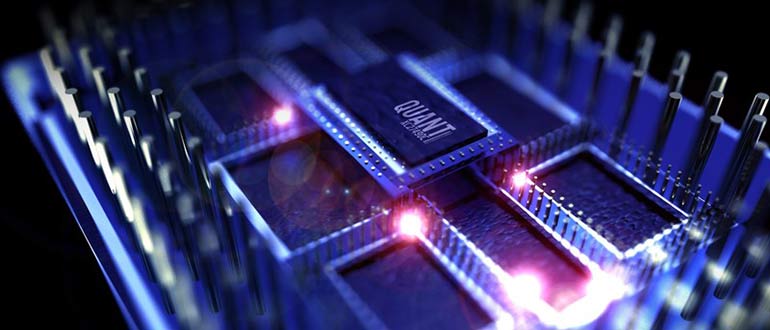
Intel’s investment arm, Intel Capital, recently invested $178 million in quantum processor company QuantWare. But an investment by Intel Capital doesn’t always mean Intel adopts a technology.

Nonetheless, enterprises should take a measured view of Intel’s pivot and “always take emerging technology talk with a grain of salt,” said Cutress. He argued that the long legacy of digital computing architecture is difficult to unseat.

“The reality is that any technology that comes from this side of R&D is going to work alongside current high-performance hardware, not replace it,” he said.

The hardware stack will likely look like a combination of CPU, GPU, and quantum computing chips in a datacenter, not just a quantum processor working on its own, Cutress said.

“IBM, Google, Microsoft have realized this and are pivoting those messages,” he said.

Quantum processors and AI supercomputers naturally complement each other, said Pranav Gokhale, co-founder and CTO of Infleqtion, which makes quantum processors. “Quantum computers can access physics that is difficult for classical machines to emulate, while GPUs provide the scale and throughput needed for control and learning.”

Intel’s spin-bit quantum technology, which differs from IBM’s supercomputing qubit, may be interesting technology, but many companies — including Quantum Motion, Silicon Quantum Computing, Photonic, and CEA-Leti — are pursuing similar approaches.

Quantum advantage

Still, Intel has a manufacturing advantage.

“Intel’s approach to CMOS spin qubits has one advantage over many other solutions — you can put millions on a wafer, and Intel has reliable manufacturing to do so,” Cutress said.

The appointment of Ranade, who has served in key manufacturing roles, to CTO is another clear sign that the foundry is Intel’s future. Former CTO Greg Lavender was seen more as a software person.

“He’s a process node guy, he knows what the process needs to work for customers, both internal and external,” Cutress said of Ranade.

Intel did not immediately respond to a request for comment on its plans.

This article first appeared on Network World.

The Race to Quantum-Proof the Internet Has Already Begun

The race to quantum-proof the internet is underway as experts warn of “harvest now, decrypt later” risks and slow migration to post-quantum security.
  • ✇Security | CIO
  • Nvidia announces quantum AI models
    Nvidia today unveiled a new family of open-source quantum AI models for building quantum processors. The announcement coincides with World Quantum Day, an international initiative by quantum scientists to promote public understanding of quantum science and technology. Nvidia is calling its new family of quantum AI models Nvidia Ising, named after the Lenz-Ising model of ferromagnetism in statistical mechanics. That model dramatically simplified the understanding of comp
     

Nvidia announces quantum AI models

14 de Abril de 2026, 12:00

Nvidia today unveiled a new family of open-source quantum AI models for building quantum processors. The announcement coincides with World Quantum Day, an international initiative by quantum scientists to promote public understanding of quantum science and technology.

Nvidia is calling its new family of quantum AI models Nvidia Ising, named after the Lenz-Ising model of ferromagnetism in statistical mechanics. That model dramatically simplified the understanding of complex physical systems.

Ising joins other Nvidia model families, including Nemotron for specialized agentic AI systems, Cosmos for physical AI systems, Isaac for robotics, Clara for biomedical and life sciences models, Apollo for AI physics, and Alpamayo for autonomous vehicles.

Split decision

Ising will consist of two model domains at launch: Ising Calibration and Ising Decoding.

Ising Calibration is a vision language model for interpreting and reacting to measurements from quantum processors, and enables automation of continuous calibration by AI agents. Ising Decoding consists of two variants of a 3D convolutional neural network model for real-time decoding for quantum error correction. One variant is optimized for speed while the other for accuracy.

“Both of these are targeting the fundamental challenge in quantum computing, which is that qubits are inherently noise,” said Sam Stanwyck, Nvidia’s director of quantum product, in a press briefing Monday. “That noise is the fundamental bottleneck standing between today’s quantum hardware and useful applications.”

A qubit, or quantum bit, is the basic unit of information in quantum computing. And where bits in traditional computing have two possible states of either 0 or 1, qubits can represent a superposition of all states between 0 and 1 simultaneously. This allows quantum algorithms to solve certain problems in a fraction of the time it would take the fastest traditional computer systems.

Physical qubits are noisy and error-prone, which has made machines that depend on them impractical for real-world applications. For the past several years, researchers have been developing logical qubits as a higher-level abstraction from physical qubits, which can be used in fault-tolerant quantum computing to protect against noise and errors. Nvidia says the Ising models will deliver up to 2.5 times faster performance and 3 times higher accuracy for the decoding process needed for quantum error correction for logical qubits.

“Today, the very best quantum processors make an error about once in every thousand operations, which is amazing,” Stanwyck said. “But to become useful accelerators for scientific and enterprise valuable problems, that number needs to become one in a trillion or even less.”

AI is the key to closing that gap, he said, and it’ll be the control plane or operating system for quantum machines. To that end, he added, the models must be open so they can be customized, fine-tuned, and continuously improved upon by the quantum community.

The test kitchen heats up

Along with Ising, Stanwyck said Nvidia is providing a cookbook of quantum computing workflows and training data along with Nvidia NIM microservices.

“The cookbook has fine tuning, quantization, and inference workflows, recipes for how to integrate this into agentic workflows, plus open research papers and benchmark data,” he said.

He also noted that leading enterprises, academic institutions, and research labs have already adopted Ising, including Atom Computing, Fermi National Accelerator Laboratory, Harvard John A. Paulson School of Engineering and Applied Sciences, Cornell University, and others.

Quantum leaps

The global quantum technology industry took a big step forward in 2025, according to a report released today by the Quantum Economic Development Consortium (QED-C). In its State of the Global Quantum Industry 2026 report, QED-C said the global quantum market reached $1.9 billion in 2025 while the global pure-play quantum workforce grew by 14%. It forecasts the market will grow at a 30% annual rate to reach $3 billion by 2028, and Nvidia plans to be a key player in that growth.

“Our AI leadership is going to directly accelerate the path to useful quantum computers,” Stanwyck said. “The same GPUs that are running the world’s AI can run the control plane for quantum hardware.”

Google Wants to Transition to Post-Quantum Cryptography by 2029

6 de Abril de 2026, 07:52

Google says that it will fully transition to post-quantum cryptography by 2029. I think this is a good move, not because I think we will have a useful quantum computer anywhere near that year, but because crypto-agility is always a good thing.

Slashdot thread.

Defending Encryption in the Post Quantum Era

Post-quantum cryptography explained, risks of quantum attacks, and steps to secure data, systems, and infrastructure for a quantum-resilient…
  • ✇Security Boulevard
  • Inventors of Quantum Cryptography Win Turing Award Bruce Schneier
    Charles Bennett and Gilles Brassard have won the 2026 Turing Award for inventing quantum cryptography. I am incredibly pleased to see them get this recognition. I have always thought the technology to be fantastic, even though I think it’s largely unnecessary. I wrote up my thoughts back in 2008, in an <a href+https://www.schneier.com/essays/archives/2008/10/quantum_cryptography.html”>essay titled “Quantum Cryptography: As Awesome As It Is Pointless.” Back then, I wrote: While I like the
     

Inventors of Quantum Cryptography Win Turing Award

31 de Março de 2026, 08:05

Charles Bennett and Gilles Brassard have won the 2026 Turing Award for inventing quantum cryptography.

I am incredibly pleased to see them get this recognition. I have always thought the technology to be fantastic, even though I think it’s largely unnecessary. I wrote up my thoughts back in 2008, in an <a href+https://www.schneier.com/essays/archives/2008/10/quantum_cryptography.html”>essay titled “Quantum Cryptography: As Awesome As It Is Pointless.”

Back then, I wrote:

While I like the science of quantum cryptography—my undergraduate degree was in physics—I don’t see any commercial value in it. I don’t believe it solves any security problem that needs solving. I don’t believe that it’s worth paying for, and I can’t imagine anyone but a few technophiles buying and deploying it. Systems that use it don’t magically become unbreakable, because the quantum part doesn’t address the weak points of the system...

The post Inventors of Quantum Cryptography Win Turing Award appeared first on Security Boulevard.

  • ✇Schneier on Security
  • Inventors of Quantum Cryptography Win Turing Award Bruce Schneier
    Charles Bennett and Gilles Brassard have won the 2026 Turing Award for inventing quantum cryptography. I am incredibly pleased to see them get this recognition. I have always thought the technology to be fantastic, even though I think it’s largely unnecessary. I wrote up my thoughts back in 2008, in an essay titled “Quantum Cryptography: As Awesome As It Is Pointless.” Back then, I wrote: While I like the science of quantum cryptography—my undergraduate degree was in physics—I don’t see any comm
     

Inventors of Quantum Cryptography Win Turing Award

31 de Março de 2026, 08:05

Charles Bennett and Gilles Brassard have won the 2026 Turing Award for inventing quantum cryptography.

I am incredibly pleased to see them get this recognition. I have always thought the technology to be fantastic, even though I think it’s largely unnecessary. I wrote up my thoughts back in 2008, in an essay titled “Quantum Cryptography: As Awesome As It Is Pointless.”

Back then, I wrote:

While I like the science of quantum cryptography—my undergraduate degree was in physics—I don’t see any commercial value in it. I don’t believe it solves any security problem that needs solving. I don’t believe that it’s worth paying for, and I can’t imagine anyone but a few technophiles buying and deploying it. Systems that use it don’t magically become unbreakable, because the quantum part doesn’t address the weak points of the system.

Security is a chain; it’s as strong as the weakest link. Mathematical cryptography, as bad as it sometimes is, is the strongest link in most security chains. Our symmetric and public-key algorithms are pretty good, even though they’re not based on much rigorous mathematical theory. The real problems are elsewhere: computer security, network security, user interface and so on.

Cryptography is the one area of security that we can get right. We already have good encryption algorithms, good authentication algorithms and good key-agreement protocols. Maybe quantum cryptography can make that link stronger, but why would anyone bother? There are far more serious security problems to worry about, and it makes much more sense to spend effort securing those.

As I’ve often said, it’s like defending yourself against an approaching attacker by putting a huge stake in the ground. It’s useless to argue about whether the stake should be 50 feet tall or 100 feet tall, because either way, the attacker is going to go around it. Even quantum cryptography doesn’t “solve” all of cryptography: The keys are exchanged with photons, but a conventional mathematical algorithm takes over for the actual encryption.

What about quantum computation? I’m not worried; the math is ahead of the physics. Reports of progress in that area are overblown. And if there’s a security crisis because of a quantum computation breakthrough, it’s because our systems aren’t crypto-agile.

Google Sets 2029 Deadline as Quantum Computers Threaten Encryption

Google fast-tracks post-quantum cryptography with a 2029 deadline as researchers warn quantum computers could break current encryption sooner than expected.

Possible New Result in Quantum Factorization

16 de Março de 2026, 06:46

I’m skeptical about—and not qualified to review—this new result in factorization with a quantum computer, but if it’s true it’s a theoretical improvement in the speed of factoring large numbers with a quantum computer.

  • ✇Security Boulevard
  • Will Your Organization Take the Quantum Leap in 2026? Read This First David McNeely
    Explore how organizations can prepare for the quantum age by developing quantum security intelligence, establishing governance plans, and prioritizing system updates. Learn strategies for building resilience without exorbitant investments as quantum computing technology advances The post Will Your Organization Take the Quantum Leap in 2026? Read This First appeared first on Security Boulevard.
     
  • ✇Security Intelligence
  • 2024 trends: Were they accurate? Jennifer Gregory
    The new year always kicks off with a flood of prediction articles; then, 12 months later, our newsfeed is filled with wrap-up articles. But we are often left to wonder if experts got it right in January about how the year would unfold. As we close out 2024, let’s take a moment to go back and see if the crystal balls were working about how the year would play out in cybersecurity. Here are five trends that were often predicted for 2024. 1. The use of artificial intelligence in cybersecurity will
     

2024 trends: Were they accurate?

23 de Dezembro de 2024, 14:00

The new year always kicks off with a flood of prediction articles; then, 12 months later, our newsfeed is filled with wrap-up articles. But we are often left to wonder if experts got it right in January about how the year would unfold. As we close out 2024, let’s take a moment to go back and see if the crystal balls were working about how the year would play out in cybersecurity.

Here are five trends that were often predicted for 2024.

1. The use of artificial intelligence in cybersecurity will increase

As the year began, there was no doubt that artificial intelligence (AI) would be a main character in the year’s events — and that was right on the money. Many organizations began to use or continue using AI in their cybersecurity operations in a wide range of ways. For example, Microsoft’s internal response teams use a large language model to manage requests and tickets based on how they were handled previously, saving 20 hours per person each week.

As the world turned its attention over the summer to the Paris Olympics, the team responsible for keeping the Paris Olympics data, apps, systems and even physical buildings protected turned to AI. While 140 cyberattacks were linked to the Olympics, the teams’ efforts resulted in no disruption of the competitions.

Throughout the entire life cycle of the games, from before the opening ceremony to after the torch left Paris, cybersecurity teams used AI to secure critical information systems, protect sensitive data and raise awareness within the games’ ecosystem. Additionally, algorithmic video surveillance based in AI scanned video to detect abandoned bags, the presence of weapons, unusual crowd movements and fires.

2. Organizations will see more AI-based threats and attacks

Unfortunately, experts were right about cyber criminals also turning to AI technology to more effectively conduct attacks. Threat actors are using AI in a wide range of ways for data breaches and cyberattacks, including improved reconnaissance, better target profiling and lowering expertise required for conducting an attack. Because AI can automate many processes required for an attack, such as vulnerability scanning, exploitation and data exfiltration processes, more cyber criminals now have the skills for even more damaging attacks.

“Since the release of gen AI, attackers are increasingly employing tools along with large language models to carry out large-scale social engineering attacks, and Gartner predicts that by 2027, 17% of total cyberattacks/data leaks will involve generative AI,” wrote Gartner in an August 2024 press release.

IBM distinguished engineer Jeff Crume has no doubt that the trend of cyber criminals using AI for attacks will continue in 2025. He says that cyber professionals do a better job of authentication because attackers are finding it easier to log in than to hack in. While looking for bad grammar and spelling errors now works to spot phishing attacks, he expects that this will no longer work as AI-based phishing attacks hit mass distribution.

Explore cybersecurity services

3. An increase in deepfakes and deceptions

While experts correctly predicted that deepfakes would become more of a threat in 2024, it’s likely no one expected the scale of arguably the most shocking deepfake story of the year. At the beginning of 2024, attackers created a deepfake video call that led to an employee giving the cyber criminals $25 million, which showed the power and damage that deepfakes can cause. But the World Economic Forum expects that the trend will only increase, even declaring that over the next two years, AI-fueled disinformation will be the number one threat in the world.

Throughout the year, other deepfake incidents made headlines. Quantum AI, an AI company, was suspected by the Securities and Exchange Commission of using AI to generate deepfakes on social media to deceive the public that Elon Musk developed the company’s technology. Even the well-received Paris Olympics were not immune to deepfakes, with Russian Group Storm-1679 suspected of creating AI content to discredit the International Olympic Committee. As the year closed out, German citizens saw an increase in AI-based propaganda regarding the upcoming German elections in 2025, including text, images and video.

4. A growing impact of quantum computing on cybersecurity

Ray Harishankar, IBM Fellow, IBM Quantum Safe, predicted that in 2024, “harvest now, decrypt later” attacks would become more common. As the year moved forward, quantum computing became an increasingly top concern, especially the harvest-now attacks. In July, the Office of Management and Budget released the Report on Post-Quantum Cryptography, which urged organizations to prepare their systems and processes for advancements in quantum computing.

During the fall of 2024, the predictions of the quantum’s impact became even more urgent, as symmetric cryptography would be unsafe by 2029, with even asymmetric cryptography fully breakable by quantum technology by 2034.

“That does not mean, however, that the risks are five years away. The prospect of harvest-now, decrypt-later attacks is already a concern, making the post-quantum cryptography transition an urgent priority,” wrote Gartner.

 5. Recession of ransomware attacks

John Dwyer, former Head of Research at IBM X-Force, predicted we might face a ransomware recession as more companies pledged not to pay the ransom. While we wish we could declare this came true, the jury is still out, and likely, we won’t know for sure until all the data is collected from 2024.

However, Wired declared in the summer of 2024 that “ransomware showed no signs of slowing down in 2024 — despite increasing police crackdowns.” In December, Heather Wishart-Smith wrote in her Forbes article The Persistent Ransomware Threat: 2024 Trends and High-Profile Attacks about the increasing dual extortion technique of cyber criminals as an increasing trend in 2024.

All in all, the experts were largely on target with their 2024 predictions. And in the next few weeks, we will start the prediction game all over again as we wonder what’s in the cards for cybersecurity in 2025.

The post 2024 trends: Were they accurate? appeared first on Security Intelligence.

❌
❌