
Visualização normal

Antes de ontemStream principal
  • ✇Firewall Daily – The Cyber Express
  • Hutt City Council Confirms Phishing Attack, Data of Hundreds Potentially Exposed Samiksha Jain
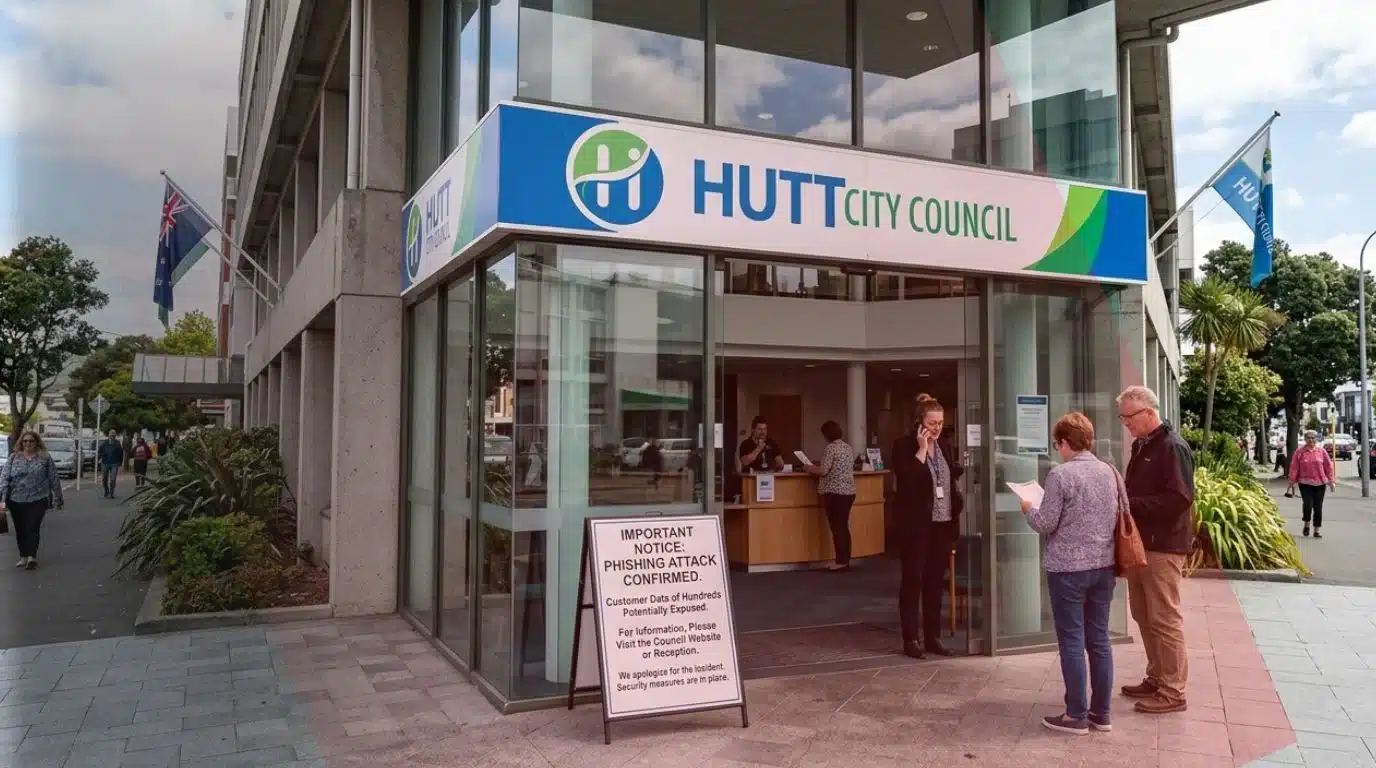
    A Hutt City Council phishing attack reported in March 2026 has led to the exposure of sensitive information belonging to hundreds of individuals, prompting the council to strengthen its cybersecurity measures and notify affected residents. According to officials, the Hutt City Council phishing attack resulted in unauthorized access to several email accounts. Initial investigations confirmed that identity information of five individuals was compromised, while financial details of up to 732 peo
     

Hutt City Council Confirms Phishing Attack, Data of Hundreds Potentially Exposed

Hutt City Council phishing attack

A Hutt City Council phishing attack reported in March 2026 has led to the exposure of sensitive information belonging to hundreds of individuals, prompting the council to strengthen its cybersecurity measures and notify affected residents. According to officials, the Hutt City Council phishing attack resulted in unauthorized access to several email accounts. Initial investigations confirmed that identity information of five individuals was compromised, while financial details of up to 732 people may have been exposed through email correspondence.

Details of the Hutt City Council Phishing Attack

The Hutt City Council phishing attack involved malicious emails designed to trick users into revealing login credentials or granting access to internal systems. Once access was obtained, attackers were able to view email communications containing personal and financial data. Council authorities stated that while only a small number of individuals had confirmed identity data compromised, a significantly larger group may have had information exposed indirectly through email threads. All individuals impacted by the Hutt City Council phishing attack have been contacted directly and provided with guidance on steps to secure their information and reduce potential risks.

Immediate Response and Containment Measures

Following the Hutt City Council phishing attack, the organization initiated a rapid response to contain the breach and prevent further unauthorized access. This included securing affected accounts, reviewing system access logs, and strengthening internal security settings. Chief Executive Jo Miller confirmed that the incident has been reported to the Office of the Privacy Commissioner. She acknowledged the seriousness of the breach and its impact on the community. “We are sorry this has occurred and acknowledge the concern it may have caused. It’s a reminder to handle data with sufficient care,” Miller said, adding that additional safeguards have been implemented to prevent similar incidents. The council has also accelerated its cybersecurity improvement program in response to the Hutt City Council phishing attack, focusing on enhanced monitoring and faster incident detection.

Strengthening Systems and Security Controls

In response to the Hutt City Council phishing attack, several measures have been implemented to improve system resilience. These include:
  • Enhanced email security settings
  • Increased monitoring of account activity
  • Additional staff training to identify phishing attempts
  • Strengthened access controls
The council stated that these improvements are part of a broader effort to reduce the risk of similar incidents in the future.

Growing Threat of Phishing Attacks

The Hutt City Council phishing attack reflects a wider trend of increasingly sophisticated cyber threats. Authorities noted that cybercriminals are using advanced tools, including artificial intelligence, to automate phishing campaigns, making them more convincing and harder to detect. These evolving tactics allow attackers to scale operations quickly, adapt to security measures, and target organizations more effectively. As a result, early detection and rapid response have become critical components of cybersecurity strategies. The incident serves as a reminder for both organizations and individuals to remain cautious when handling emails and sharing sensitive information.

Advisory for Affected Individuals

Following the Hutt City Council phishing attack, affected individuals have been advised to:
  • Monitor bank and financial statements closely
  • Be alert to suspicious emails or communications
  • Update passwords and enable additional security measures where possible

The council has also encouraged prompt reporting of any unusual activity to minimize potential harm.

Ongoing Review and Community Assurance

The Hutt City Council phishing attack is currently under review as part of ongoing efforts to strengthen data protection practices. Officials have emphasized their commitment to safeguarding personal information and improving system security. While the incident has caused concern, the council maintains that steps have been taken to contain the breach and reduce the likelihood of future attacks. Additional safeguards and monitoring systems are now in place as part of the response to the Hutt City Council phishing attack. Authorities continue to work with relevant agencies to ensure compliance and maintain transparency as investigations progress.
  • ✇Firewall Daily – The Cyber Express
  • Android Malware Campaign Targets Indian Users via Fake eChallan Alerts Ashish Khaitan
    A new Android malware campaign targeting Indian users has been reported by the Indian Computer Emergency Response Team, CERT-In. According to the agency, multiple reports indicate a coordinated effort by cybercriminals to steal sensitive financial and personal data through deceptive mobile applications and phishing techniques.  The ongoing Android malware campaign revolves around fraudulent messages posing as official eChallan or RTO Challan alerts. Victims typically receive SMS notifications
     

Android Malware Campaign Targets Indian Users via Fake eChallan Alerts

20 de Março de 2026, 04:53

Android malware campaign

A new Android malware campaign targeting Indian users has been reported by the Indian Computer Emergency Response Team, CERT-In. According to the agency, multiple reports indicate a coordinated effort by cybercriminals to steal sensitive financial and personal data through deceptive mobile applications and phishing techniques.  The ongoing Android malware campaign revolves around fraudulent messages posing as official eChallan or RTO Challan alerts. Victims typically receive SMS notifications claiming that a traffic violation has been recorded against their vehicle. These messages often include alarming language such as legal threats or additional penalties, urging immediate action. 

Android Malware Campaign Exploits eChallan and RTO Challan Trust 

A common message reads: “Your vehicle challan has been generated. Download the receipt from the link below.” The link or attachment leads users to download malicious APK files named “RTO Challan.apk,” “RTO E Challan.apk,” or even “MParivahan.apk.”  As highlighted by CERT-In, these files act as entry points for a multi-stage malware infection. Once installed, the application appears in the app drawer, giving the illusion of legitimacy. However, it is only a dropper component. The actual malicious payload is deployed when users tap on prompts like “Install Update.” 

Multi-Stage Malware and Device Compromise 

Once activated, the malware continues the eChallan theme but becomes invisible to the user by not appearing in the app list. At this stage, it aggressively requests sensitive permissions, including access to SMS messages, phone calls, and background activity.  This level of access allows attackers to maintain persistence on the device without detection. In some cases, the malware also requests permission to establish a VPN connection, enabling threat actors to monitor and intercept internet traffic.  The ultimate goal of this Android malware campaign is financial theft. Fake interfaces resembling legitimate RTO Challan or banking pages are displayed to trick users into entering sensitive information such as card details and login credentials. 

Parallel Rise of Browser-Based eChallan Phishing 

Last year, Cyble Research and Intelligence Labs (CRIL) reported a related surge in browser-based phishing attacks leveraging the eChallan ecosystem. Unlike APK-based threats, this variation does not require users to install any application, significantly lowering the barrier for compromise.  These phishing campaigns begin similarly, with SMS messages targeting Indian vehicle owners. The messages contain deceptive URLs that mimic official eChallan portals. Once clicked, users are redirected to cloned websites that closely replicate government platforms, complete with official insignia and branding.  At the time of investigation, many of these phishing domains remained active, indicating an ongoing and well-maintained operation rather than isolated incidents. 

Anatomy of the Phishing Attack 

The browser-based eChallan fraud follows a structured attack chain: 
  • Stage 1: SMS Delivery: Victims receive messages claiming overdue fines, often with threatening language about legal action. The sender appears as a regular mobile number, increasing credibility. 
  • Stage 2: Fake Portal Redirection: Clicking the link redirects users to phishing domains hosted on IP addresses such as 101[.]33[.]78[.]145. Interestingly, some pages are originally written in Spanish and translated into English, suggesting reuse of global phishing templates. 
  • Stage 3: Fabricated Challan Generation: Users are asked to input details like vehicle number, challan number, or driving license number. Regardless of the input, the system generates a realistic-looking challan, often with a fine amount such as INR 590 and a near-term deadline. This psychological tactic reinforces trust. 
  • Stage 4: Financial Data Harvesting: When users proceed to payment, they are directed to a fake payment page that only accepts credit or debit cards. No legitimate payment gateway is used. Instead, sensitive details like CVV, expiry date, and cardholder name are captured directly. Testing revealed that even invalid card entries are accepted, confirming that data is harvested regardless of transaction success. 

Shared Infrastructure and Expanding Threat Landscape 

Investigations revealed that this Android malware campaign and related phishing operations are supported by a shared backend infrastructure. Multiple domains impersonating eChallan, logistics services like DTDC and Delhivery, and financial institutions were hosted on the same IP addresses.  Over 36 phishing domains linked to RTO Challan scams were identified on a single server. Another IP, 43[.]130[.]12[.]41, hosted additional domains mimicking Parivahan services using deceptive naming patterns such as “parizvaihen[.]icu.” 
❌
❌