

Visualização normal

Antes de ontemStream principal
  • ✇Cybersecurity Blog | SentinelOne
  • OneClaw: Discovery and Observability for the Agentic Era SentinelOne
    Autonomous agents and personal AI assistants are moving from experimentation to enterprise reality. Tools like OpenClaw (formerly Moltbot and Clawdbot), Nanobot and Picoclaw are being embedded across development environments, cloud workflows, and operational pipelines. They install quickly, evolve dynamically, and often operate with deep system-level access. For CISOs and security leaders, this presents a new governance challenge: How do you secure what you can’t see? OneClaw, built by Prompt Se
     

OneClaw: Discovery and Observability for the Agentic Era

18 de Fevereiro de 2026, 13:04

Autonomous agents and personal AI assistants are moving from experimentation to enterprise reality. Tools like OpenClaw (formerly Moltbot and Clawdbot), Nanobot and Picoclaw are being embedded across development environments, cloud workflows, and operational pipelines. They install quickly, evolve dynamically, and often operate with deep system-level access. For CISOs and security leaders, this presents a new governance challenge: How do you secure what you can’t see?

OneClaw, built by Prompt Security from SentinelOne®, was created to answer that question. It is a lightweight discovery and observability tool built to help secure AI usage by providing broad, organization-wide visibility into OpenClaw deployments without disrupting workflows or slowing down innovation. Where agent sprawl is accelerating faster than policy frameworks can adapt, OneClaw restores clarity, accountability, and executive oversight where it matters most.

Understanding The Risks Behind OpenClaw

While most security programs assume that AI applications and agents are vetted, IT sanctioned, registered, and monitored, OpenClaw agents can be:

  • Installed directly by developers
  • Extended through public skills and plugins
  • Granted persistent memory and tool access
  • Configured to run autonomously, and
  • Connected to external services and API.

They can also operate quietly in local environments, call tools automatically, schedule tasks via cron jobs, and access sensitive systems – all outside of most application inventory controls. What manifests is two main concerns:

  • Shadow Agent Proliferation – How many OpenClaw instances are running across the enterprise?
  • Data Egress & External Exposure – Where are agents sending information, and to whom?

Without that centralized observability, these risks persist. As assistants such as OpenClaw, Nanobot, Picoclaw and other autonomous agents continue to emerge every day, OneClaw is designed to eliminate the opacity of the inherent risks they bring to businesses.

OpenClaw is only the beginning of a much larger shift toward autonomous agents and personal AI assistants embedded across the enterprise. In addition to OpenClaw, OneClaw already supports visibility coverage for emerging frameworks such as Nanobot and Picoclaw, extending the same discovery and observability capabilities across multiple agent ecosystems.

For CISOs, this future-proof approach is critical. Rather than deploying point solutions for each new tool that appears, OneClaw establishes a unified oversight layer for the entire category of new assistants, copilots, and autonomous workflows that continue to surface. The goal is not simply to manage one platform, but to provide lasting control over a rapidly expanding attack surface, ensuring that as agent adoption accelerates, security visibility and accountability keep pace.

Empowering Teams with Observability

OneClaw provides structured delivery and observability across OpenClaw deployments leveraging a scanner that automatically detects supported CLIs and inspects the local .openclaw directory within user environments. It parses session logs, configuration files, and runtime artifacts to summarize meaningful usage patterns and surface critical operational details. OneClaw also captures browser activity performed by agents to deliver visibility into external interactions and potential data exposure paths.

From this data, OneClaw then summarizes active skills and installed plugins, recent tool and application usage, scheduled cron jobs, configured communication channels, available nodes and AI models, security configurations, and autonomous execution settings.

OneClaw outputs are structured in JSON format, making it flexible for integration into existing security ecosystems. Organizations can conduct local reviews, inject into SIEM platforms, feed centralized monitoring systems, and correlate with identity, endpoint, and cloud telemetry. For security leaders invested in unified visibility, this ensures that agent observability does not become siloed.

For CISOs, this transforms AI agent behavior from invisible background activity into auditable telemetry that is integrated into broader enterprise security and risk management discussions.

From Raw Telemetry to Executive Intelligence

Though many tools generate logs, very few of them translate them into governance-ready insights. OneClaw provides a fully centralized dashboard that aggregates reports across all employees. Rather than just reviewing isolated endpoint-level findings, security leaders get visualized deployment trends, risk heatmaps, organization-wide exposure mapping, and skill usage distribution.

In a matter of minutes, the tool can be deployed via Jamf, Intune, Kandji or SentinelOne Remote Ops.
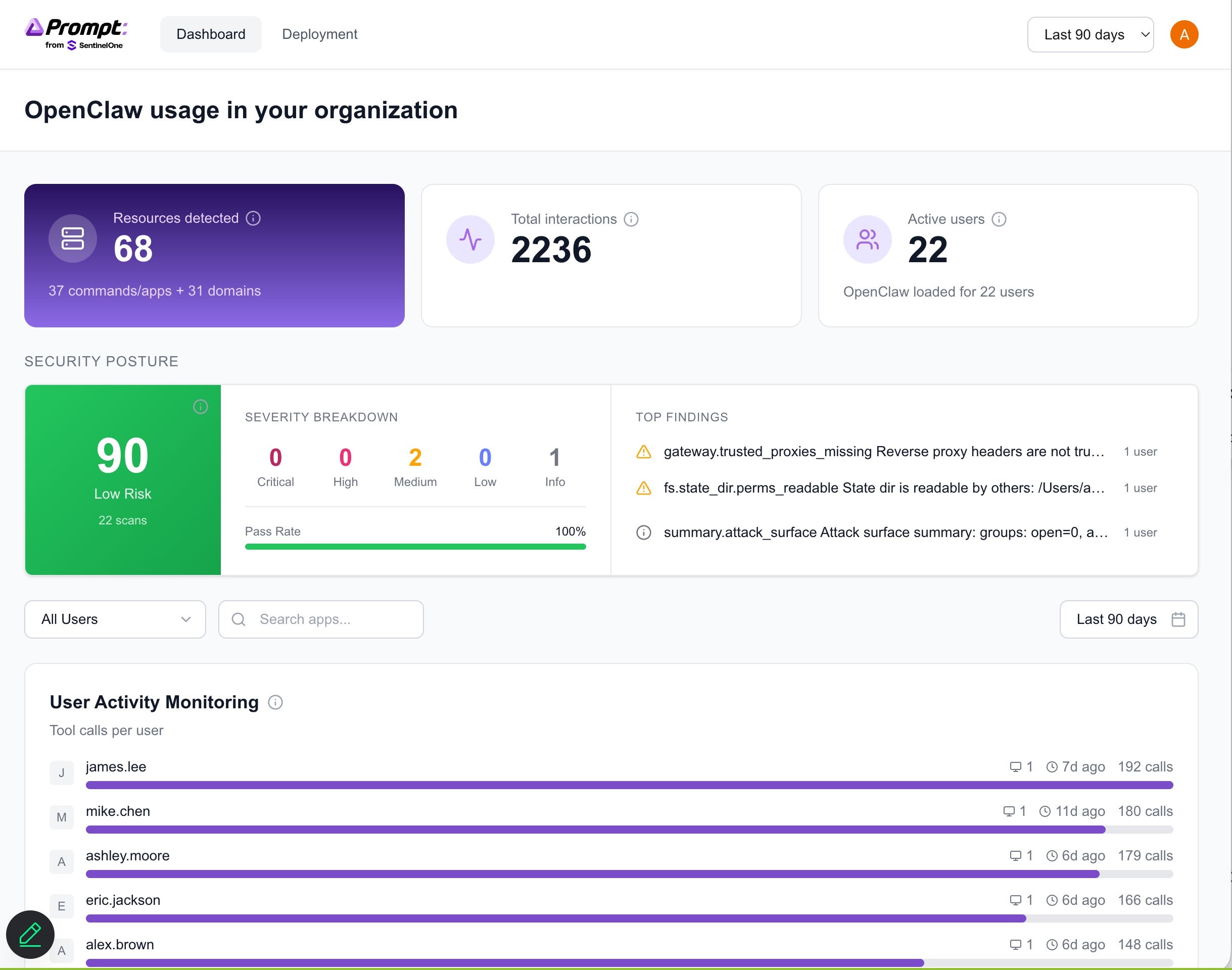
This elevates the conversation from technical detail to strategic oversight, which is critical as CISOs are now being asked for AI agent inventories, and whether the agents are operating within policy, can access sensitive systems, and are transmitting data externally.

With OneClaw, CISOs can gain visibility into:

  • How many OpenClaw agents are deployed enterprise-wide
  • What percentage is configured for autonomous execution
  • Which teams are installing high-risk skills
  • Where agents are making outbound connections
  • How has agent adoption changes day to day

This level of structured visibility empowers security leaders to build the foundational layer for proactive governance for agentic AI security and have effective conversations about the short and long-term risks from OpenClaw adoption in their organization.

Security-Focused Behavioral Analysis

OneClaw does not assume all autonomy is dangerous. Instead, it surfaces where autonomy exists so that leaders can make informed, balanced policy decisions and strengthen controls with precision. For example, security teams may determine that autonomous execution is appropriate within a sandboxed development environment but requires approvals in production systems. They may allow specific, vetted skills while restricting newly installed public plugins pending review. They also may decide that outbound communication to approved internal APIs is acceptable, while flagging unknown external domains for investigation.

By making these conditions visible, OneClaw enables proportionate governance rather than blanket restrictions. Teams can confidently approve safe automation, enforce guardrails where needed, and document oversight for executive and regulatory reporting. The result is not reduced innovation, but safer acceleration where autonomous agents operate within clearly defined boundaries, and security leaders remain firmly in control of how and where that autonomy is trusted.

Transparency Without Disruption

OneClaw was designed to deliver visibility into autonomous activity without interrupting the work those agents (and the teams deploying them) are meant to accelerate. Rather than creating friction into development pipelines or altering how OpenClaw, Nanobot, or Picoclaw operate, it acts as an observability layer that security teams can deploy quietly across the environment.

The approach matters: Security leaders are not looking to slow down innovation, but they are accountable for what happens if agent behavior crosses policy boundaries or introduces risk. OneClaw gives the context needed for CISOs to act decisively using the cybersecurity controls they already trust. It does not replace prevention capabilities, it makes them smarter by ensuring autonomous activity is no longer invisible.

By surfacing where agents exist, how they are configured, and what they are interacting with, OneClaw allows organizations to distinguish between productive automation and risk behavior that warrants intervention. Security teams can then enforce standards through existing controls without imposing blanket restrictions that only frustrate developers.

The result? This is a model aligned with how modern security actually operates – observe first, contextualize risk, and then apply controls proportionately. OneClaw makes transparency a force multiplier for the security stack, and empowers CISOs to have confidence that autonomous innovation continues under a watchful, informed oversight instead with blind trust.

Chaos to Clarity | Why This Matters Now

Agentic AI discovery is no longer optional. OpenClaw’s rapid growth and decentralized infrastructure is creating a large, and often unmanaged attack surface. With skills being frequently installed from public repositories and agents being granted deep permissions, configuration drift is occurring silently. Agent ecosystems can fall to exploitation through malicious skills and supply chain manipulation.

OneClaw supports how CISOs defend against OpenClaw-related risks by providing deep visibility and observability of agentic AI use and autonomous behavior, detecting risky configurations early on, and quantifying the exposures before incidents occur.

As adoption increases and autonomy deepens, OneClaw works to restore visibility while allowing powerful agents to accelerate development pipelines. CISOs have the clarity needed to govern autonomous systems responsibly, while getting structured discovery, centralized reporting, and security-focused analysis.

Start getting visibility into agent activity and security insights into OpenClaw deployments across your organization here. To learn more about securing your OpenClaw agents, register for our upcoming webinar happening Tuesday, March 3, 2026.
Join the Webinar
SentinelOne AI & Intelligence Leaders Discuss How to Secure OpenClaw Agents on March 3, 2026 at 10:00AM PST / 1:00PM EST
  • ✇Cybersecurity Blog | SentinelOne
  • Shadow Agents: How SentinelOne Secures the AI Tools That Act Like Users SentinelOne
    AI adoption is accelerating faster than security programs can adapt. Organizations are already experiencing breaches tied directly to unsanctioned AI usage, at significantly higher cost than traditional incidents, while the vast majority still lack meaningful governance controls to manage the risk. Traditional cybersecurity measures are necessary but insufficient. Securing AI requires purpose-built capabilities that span the entire AI lifecycle, from infrastructure to user interaction. The rapid
     

Shadow Agents: How SentinelOne Secures the AI Tools That Act Like Users

17 de Fevereiro de 2026, 18:28

AI adoption is accelerating faster than security programs can adapt. Organizations are already experiencing breaches tied directly to unsanctioned AI usage, at significantly higher cost than traditional incidents, while the vast majority still lack meaningful governance controls to manage the risk. Traditional cybersecurity measures are necessary but insufficient. Securing AI requires purpose-built capabilities that span the entire AI lifecycle, from infrastructure to user interaction.

The rapid adoption of Large Language Models (LLMs) and Artificial Intelligence (AI) introduces transformative capabilities, but also novel and complex security challenges. Securing these sophisticated systems requires a multi-layered, end-to-end approach that extends beyond traditional cybersecurity measures. SentinelOne’s® Singularity™ Platform is uniquely positioned to provide holistic protection for LLM and AI environments, from the underlying infrastructure to the integrity of the models themselves and their interactions.

This document provides a detailed breakdown of how SentinelOne’s capabilities address the unique security requirements and emerging threats associated with LLMs and AI, now further enhanced by the integration of Prompt Security’s cutting-edge AI usage and agent security technology.

Because the most urgent question security leaders are asking right now is specifically about agentic AI assistants, tools like OpenClaw (aka Clawdbot and Moltbot) that can execute code and access data with user-level privileges, this document leads with dedicated coverage for those tools before mapping the full platform architecture.

Securing Agentic AI Assistants: OpenClaw Coverage

The Question Security Leaders Are Asking

“Do we have coverage for the new agentic AI assistants, such as OpenClaw (aka. Moltbot and Clawdbot) that are showing up across our environment?” Yes. SentinelOne provides multi-layered detection, hunting, and governance capabilities that specifically address these tools across three reinforcing control planes: EDR/XDR telemetry, AI interaction security (Prompt Security), and open-source agent hardening (ClawSec).

OpenClaw (aka Clawdbot and Moltbot) represent the next evolution of shadow AI risk. Unlike browser-based chatbots that operate within a web session, these agentic AI assistants can execute code, spawn shell processes, access local files and secrets, call external APIs, and operate with the same privileges as the user account running them. In SentinelOne’s SOC framework, they fall squarely into the highest-risk categories: agentic execution and compromise through the loop.

If an agentic assistant can read files, call tools, and talk out, it should be treated like a privileged automation account and secured accordingly.

Coverage Layer 1: EDR/XDR Detection & Threat Hunting

SentinelOne’s Singularity agent provides telemetry and tracking of OpenClaw (aka. Moltbot and Clawdbot). The Data Lake PowerQuery provided below adds detection of any activity at the endpoint level. Purpose-built hunting queries target these tools across four signal categories:

Signal Category What SentinelOne Detects Example Indicators
Process Execution Clawdbot, OpenClaw, or Moltbot runtime processes launching on endpoints Command-line strings containing clawdbot, moltbot, or openclaw
File Activity Creation, modification, or presence of agentic assistant files File paths containing openclaw or clawdbot binaries and configurations
Network Activity Communication on default agentic service ports and domains associated with ‘bad’ extensions Traffic on port 18789 (default OpenClaw listener)
Persistence Mechanisms Scheduled tasks or services establishing agent persistence Scheduled tasks named OpenClaw or related service registrations

Dedicated PowerQuery for Clawdbot / OpenClaw / Moltbot:

dataSource.name = 'SentinelOne' AND

(event.type = 'Process Creation' AND tgt.process.cmdline

contains:anycase ('clawdbot','moltbot','openclaw')) OR

(tgt.file.path contains 'openclaw' or

tgt.file.path contains 'clawdbot') OR

(src.port.number = 18789 or dst.port.number = 18789) OR

(task.name contains 'OpenClaw')

| columns event.time, src.process.storyline.id, event.type,

endpoint.name, src.process.user, tgt.process.cmdline,

tgt.process.publisher, tgt.file.path,

src.process.parent.name, src.process.parent.publisher,

src.process.cmdline, src.ip.address, dst.ip.address

Beyond this targeted query, SentinelOne’s tiered SOC hunting framework provides behavioral detection that catches agentic assistants even when they are renamed, updated, or running through wrapper processes:

  • Tier 1 (Discovery): Identifies AI-capable runtimes and destinations across the environment, surfacing where agents like OpenClaw are executing.
  • Tier 3 (Behavioral): Detects the “agent-shaped” pattern, interpreter runtimes (Python, Node) spawning shell processes, touching secrets, and calling external APIs, which is the operational fingerprint of OpenClaw (aka Clawdbot and Moltbot) regardless of binary name.
  • Tier 4 (Impact): Correlates secrets access with non-standard egress within the same Storyline, identifying when an agentic assistant has moved from exploration to data exfiltration.

Storyline connects the entire chain of custody (i.e. what launched the agent, what it touched, and where it communicated) providing a defensible incident narrative for any agentic AI activity.

Coverage Layer 2: AI Interaction Security (Prompt Security)

The Prompt Security capabilities described in Pillar 7 of this document apply directly to OpenClaw (aka Clawdbot and Moltbot), but agentic assistants create risks that go beyond what standard AI chatbot monitoring addresses:

  • Agentic Shadow AI Discovery: Unlike browser-based AI tools that appear in web traffic logs, agentic assistants often run as local processes or connect through non-standard ports. Prompt Security identifies these tools regardless of how they connect, closing the visibility gap that network-based monitoring misses.
  • Execution-Aware Content Controls: Because agentic assistants can act on the instructions they receive (i.e. executing code, modifying files, calling APIs), Prompt Security’s content inspection takes on heightened importance. Sensitive data filtered at the interaction layer is prevented from ever entering an execution pipeline.
  • MCP Tool-Chain Governance: OpenClaw (aka Clawdbot and Moltbot) frequently interact with MCP tool servers to extend their capabilities. Prompt for agentic AI intercepts these calls, applying dynamic risk scoring before the agent can act on tool responses.

Coverage Layer 3: Agent Hardening (ClawSec)

ClawSec, an open-source security skill suite built by Prompt Security from SentinelOne, provides defense-in-depth specifically designed for OpenClaw agents:

  • Skill Integrity & Supply Chain Verification: Eliminates blind trust in downloaded skills by distributing security skills with checksums and verified sources. Drift detection flags when critical files have been silently modified.
  • Posture Hardening & Automated Audits: Scans for prompt-injection vectors, unsafe configurations, and runtime vulnerabilities within the agent environment. Automated daily audits generate human-readable security reports.
  • Community-Driven Threat Intelligence: Connects to a live security advisory feed powered by public vulnerability data (NVD) and community reports, making verified threat intelligence immediately available to subscribed agents.
  • Zero-Trust by Default: Blocks unauthorized egress and telemetry. If a threat is detected, the agent must explicitly request user consent before reporting externally, thereby eliminating hidden communication and background data sharing.

Integrated Coverage: How the Three Layers Work Together

Control Plane Coverage Scope Key Capability
EDR/XDR (Singularity Agent + Data Lake) Endpoint-level process, file, network, and persistence detection Behavioral detection via Storyline; purpose-built PowerQuery for Clawdbot/OpenClaw/Moltbot
AI Interaction Security (Prompt Security) User-to-AI interaction layer Real-time data leakage prevention, prompt injection blocking, shadow AI discovery
Agent Hardening (ClawSec) Within the OpenClaw agent runtime Skill integrity verification, posture hardening, zero-trust egress control

This three-layer approach ensures that whether an agentic AI assistant is discovered through EDR telemetry, flagged by Prompt Security’s interaction monitoring, or hardened proactively by ClawSec, security teams have full visibility and control over the risk these tools introduce.

At a Glance: Seven Security Pillars Mapped to Business Risk

The agentic AI coverage detailed above draws on all seven of SentinelOne’s core security pillars working together. The following table maps each pillar to the AI-specific threats it addresses and the business outcomes it protects, giving security leaders a rapid-reference guide for aligning platform capabilities to their organization’s AI risk priorities.

Security Pillar AI Risk Addressed Business Outcome Protected
Cloud Native Security (CNS) Exposed training data, misconfigured infrastructure, exploitable cloud paths Prevents data breaches; reduces regulatory exposure
Workload Protection Runtime compromise, container escapes, fileless attacks on AI hosts Ensures AI service continuity; prevents operational disruption
AI SIEM Multi-stage attacks, low-and-slow exfiltration, anomalous LLM usage Enables detection of sophisticated threats; supports forensics and compliance
Purple AI Evolving LLM attack techniques, slow investigation response times Reduces MTTR; accelerates threat hunting without specialist expertise
Automation & Response Fast-moving exfiltration, API key compromise, unauthorized data egress Minimizes breach blast radius; contains incidents autonomously
Secret Scanning & IaC Hardcoded credentials, pipeline vulnerabilities, insecure infrastructure definitions Prevents supply chain compromise; secures pre-production environments
AI Usage & Agent Security (Prompt Security) Shadow AI, prompt injection, data leakage through AI interactions, jailbreaks Protects IP and sensitive data; enables safe AI adoption at scale

Recommended Next Steps for Security Leaders

This week: You can’t govern what you can’t see. Run the OpenClaw detection query in your Data Lake to determine whether agentic AI assistants are already active in your environment, assuming they are until proven otherwise. Audit browser extensions across high-risk teams. Review your AI acceptable use policy to confirm it addresses autonomous agents, not just chatbots. The goal is a baseline inventory of what AI tools exist, where they’re running, and who’s using them.

Within 90 days: Move from inventory to continuous visibility. A Prompt Security proof of value can get you there quickly, delivering real-time discovery of all AI tool usage across your environment, including the shadow AI activity your current stack can’t see. Use that visibility to establish sanctioned alternatives that give employees a secure path to the productivity they’re already chasing with unsanctioned tools. Operationalize behavioral detection hunts as automated detection rules so your SOC can identify new agentic activity as it appears, not months later.

Within 6 months: Mature from visibility into governance. Complete a full AI tool inventory with data classification and risk scoring. Establish enforcement policies that contain or block unsanctioned agentic tools at the endpoint, interaction, and network layers. Build board-ready reporting metrics that track AI-related risk posture over time. The organizations that move fastest here won’t be starting from scratch, they’ll be the ones that invested in visibility early enough to know what they’re governing.

Conclusion: From Visibility to Confidence

Securing LLMs and AI is not a future challenge, it’s a present imperative. SentinelOne’s Singularity Platform, now significantly enhanced by the capabilities of Prompt Security, provides end-to-end protection that spans cloud infrastructure, workload runtime, AI interaction governance, and automated response.

But the threat landscape is no longer just about chatbots and data leakage. The rapid adoption of agentic AI assistants like OpenClaw demonstrates that AI tools are evolving from passive information retrieval into autonomous agents that execute code, access secrets, and operate with real privileges on real systems. This shift demands a corresponding shift in security posture — from monitoring what employees type into a browser to governing what autonomous processes do on your endpoints.

SentinelOne’s three-layer coverage model addresses this directly. EDR/XDR telemetry provides behavioral detection at the endpoint. Prompt Security governs the interaction layer where sensitive data meets AI. And ClawSec hardens the agent runtime itself. Together, these layers give security teams the ability to discover, govern, and contain agentic AI tools without blocking the productivity gains they deliver.

The gap between organizations that believe they have AI governance and those that actually do is exactly where breaches happen. Organizations that close that gap won’t be those that adopted AI fastest or blocked it longest, they’ll be the ones that built the visibility, controls, and response capabilities to adopt it safely.

Security isn’t the department that says no to AI. It’s the function that makes AI possible at enterprise scale. To learn more about securing your OpenClaw agents, register for our upcoming webinar happening Tuesday, March 3, 2026.

Join the Webinar
SentinelOne AI & Intelligence Leaders Discuss How to Secure OpenClaw Agents on March 3, 2026 at 10:00AM PST / 1:00PM EST
❌
❌