On March 23, the Israel Defense Forces (IDF) announced an operation in southern Gaza’s Tal as-Sultan neighborhood and urged civilians to evacuate using a road north to a humanitarian zone. Hours before the statement was shared online, a rescue convoy was traveling along that same road before all contact was lost. The convoy was made up of aid workers from the Palestine Red Crescent Society (PRCS), Palestine Civil Defense and the United Nations.
At least four vehicles, clearly marked by their
On March 23, the Israel Defense Forces (IDF) announced an operation in southern Gaza’s Tal as-Sultan neighborhood and urged civilians to evacuate using a road north to a humanitarian zone. Hours before the statement was shared online, a rescue convoy was traveling along that same road before all contact was lost. The convoy was made up of aid workers from the Palestine Red Crescent Society (PRCS), Palestine Civil Defense and the United Nations.
At least four vehicles, clearly marked by their emergency flashing lights, were present and had stopped beside another vehicle that was located just off the road when the shooting started.
An almost seven-minute video, recovered from a phone on one of the bodies of the deceased and released by the PRCS recorded what happened next. Although much of the footage is dark, the audio provides some clues about events that unfolded. An extended 20-minute version of the original seven-minute video has since been released by the PRCS on April 8.
Bellingcat conducted a preliminary analysis of the recording and broke down the audio. We then consulted two audio forensic experts who confirmed the total shots fired numbered in the hundreds.
The majority of gunshots heard during the shooting appear to feature supersonic shockwaves, which seems to indicate bullets travelled toward the recording microphone held by the aid worker. The audio evidence also appears to confirm that the first shots were aimed at the medics’ convoy from a distance of approximately 40 to 45 metres.
Following the incident, IDF spokesperson Lieutenant Colonel Nadav Shoshani initially denied the PRCS ambulances were randomly fired upon and claimed the vehicles were “advancing suspiciously toward IDF troops without headlights or emergency signals.” Following this, troops opened fire on the vehicles.
However, after the emergence of the seven-minute video recorded by one of the PRCS members — first reported by The New York Times and then released by the PRCS — which showed the vehicles had their emergency lights and headlights on, the IDF released another statement on April 7. This outlined that, following a preliminary inquiry into the incident, the Chief of the General Staff had instructed that a more in-depth investigation would be carried out by the General Staff investigation mechanism. This process is typically enacted by the IDF to determine whether a criminal investigation should be opened into an incident.
A video shared by the United Nations on March 30 showed bodies clad in emergency vests as they were retrieved from a shallow grave. The remains of emergency vehicles were also retrieved.
Geolocating the Seven-Minute Video
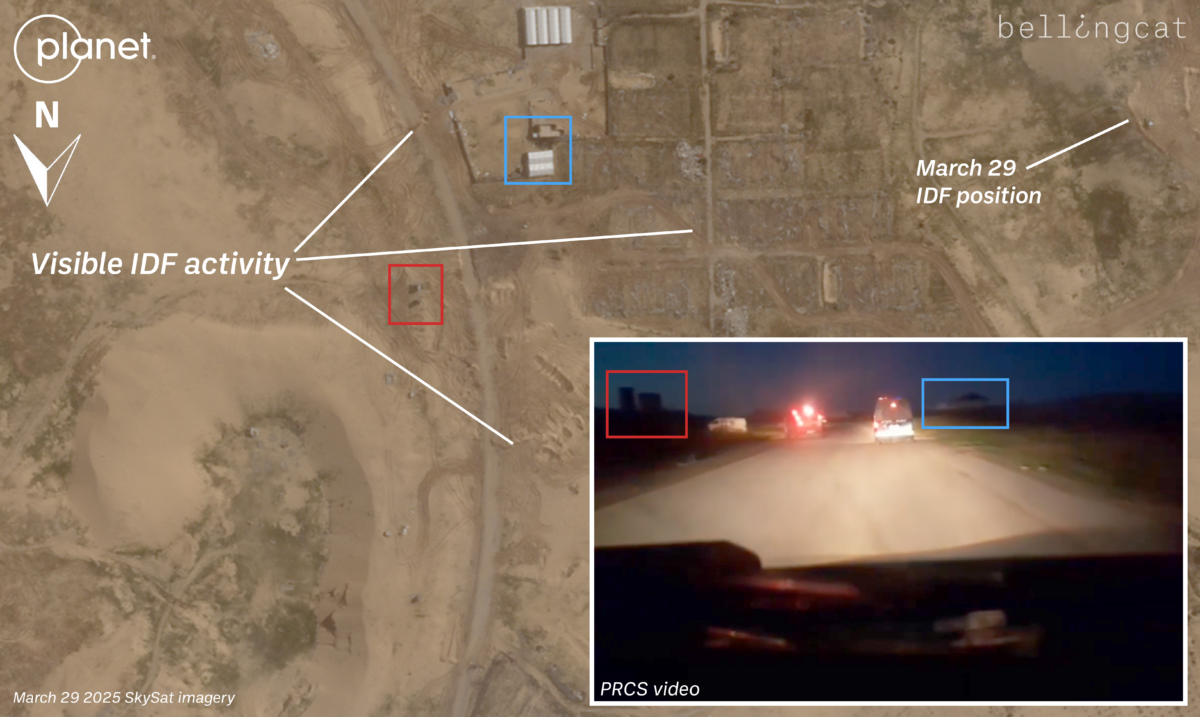
We were able to confirm where the footage was filmed using two large concrete structures silhouetted on the horizon to the left of the road (highlighted below in red). There are also newer temporary structures visible on the right hand side of the road (highlighted in blue). We matched these identifiers from the video with more recent SkySat imagery from Planet Labs, finding they lined up with an area on Gush Katif Road just north of Tal as-Sultan.
Satellite imagery from Planet Labs shows the location of the shooting of the aid worker convoy near Tal as-Sultan on March 23, 2025. The satellite image, captured on March 29, shows matching features visible in the video, as well as tracks and moved earth, showing IDF activity in the area.Credit: PlanetLabs and PRCS.
Using the chronolocation tool SunCalc, Bellingcat was also able to confirm the video was filmed in the early hours of the morning — something also confirmed by The New York Times. The video shows sunlight on the horizon to the east, and computing the sunlight for March 23 at 5:00am local time for this location shows that the sun would be in around the same position.
Breaking Down the Audio
Bellingcat has previously used audio forensic analysis to investigate the killing of journalists Shireen Abu Akleh and Abelardo Liz and has compared the sound of live rounds against witness testimonies and official statements.
Most rifle ammunition available today is faster than the speed of sound (supersonic). The muzzle velocities of bullets fired by such rifles are typically in the range of 650 to 1,000 metres per second (m/s).
When supersonic rounds are fired, the first thing heard by a person — or camera — in the line of fire is the shockwave (crack sound) caused by the passing bullet, followed by the respective muzzle blast (bang sound) which travels much slower at the speed of sound. There is a time gap or delay between both since the bullet travels faster than the bang. Watch our video from a previous investigation for a more detailed explanation.
Gif showing the time gap between a bullet travelling at supersonic speed (crack sound) followed by the muzzle blast (bang) travelling much slower at the speed of sound. Credit: Diego Forero/Cerosetenta.
We noted that the first minute of the seven-minute video recording released by the PRCS shows the vehicles driving along the road and no gunfire can be heard.
The shooting recorded in the video begins at approximately 1:17, with a series of rapid gunshots featuring what appears to be shockwaves (cracks).
How Many Shots were Fired?
We counted approximately 150 of these crack sounds during the first 30 seconds of the shooting. However, this estimate likely includes not only primary gunshot shockwaves but also some echoes and reflections, which are difficult to differentiate as the highly overlapped series evolved.
Audio forensic experts Dr Robert Maher, Professor of Electrical and Computer Engineering at the State University of Montana, and Steven Beck of Beck Audio Forensics told Bellingcat there were likely hundreds of gunshots fired during the approximately five minute incident.
Dr Maher told us that 27 of these gunshots appeared to occur in the first three seconds of the shooting alone.
A spectrogram of the first three seconds of the shooting, showing that 27 gunshots were fired in this period. Courtesy of: Dr Robert Maher.
The Shooters
The majority of gunshots heard during the shooting appear to feature supersonic shockwaves. Dr Maher explains that the audible gunshots have the “crack-bang” characteristic, indicating bullets were traveling generally toward the recording microphone, which on this occasion was held by the aid worker.
Bellingcat noticed there were different time gaps between crack sounds and the respective muzzle blasts in the audio. We shared instances of these gunshots with the experts to calculate the distance to the shooters during those moments.
Dr Maher measured the crack-muzzle blast timing of the first gunshots to be about 76 or 77 milliseconds and that the firearm appears to have been about 45 metres from the microphone. Steven Beck estimated the distance to be 40 metres. According to Beck there appeared to be at least three shooters at the start of the shooting. Both experts assumed a bullet speed of 800-1000 m/s respectively for their calculations.
These distances are consistent with one eyewitness, who, according to The New York Times, was being held nearby by the IDF at the time. He was quoted as saying that Israeli soldiers opened heavy fire on the aid workers from a distance of approximately 50 metres.
A spectrogram of the first seconds of shooting, showing the time gap between the supersonic shockwave and the respective muzzle blast. This time gap is used by audio forensic experts to calculate the approximate distance between the camera and the shooter. Courtesy of: Dr Robert Maher.
In a later sequence at minute 4:10 in the seven-minute footage, there is a five-shot sequence with various apparent shock waves and muzzle blasts. Both audio forensic experts found the timing between these sounds to be about 50 milliseconds, suggesting a distance of 30 metres.
In other instances towards the end of the video, the timing between the cracks and the muzzle blasts appears to be narrower (42 and 20 milliseconds), meaning these weapons were likely closer to the aid workers’ convoy.
Dr Maher indicated that given the vast number of gunshots, it seems there were likely multiple shooters involved over a range of distances.
Without any visual evidence, it is not clear if the shooters were getting closer to the aid convoy as they fired. It’s also not possible to rule out an exchange of gunfire due to the high number of shots and overlapping sounds. However, details from the audio indicate that on at least two occasions the shooting heard was initiated by gunmen who were firing in the direction of the convoy as opposed to firing from the convoy.
Shooting Patterns and Weapons Used
The shooting, heard in the recording, lasted approximately five minutes and included several intervals of heavy and intermittent fire as well as some pauses.
A spectrogram showing the entire five-minute shooting. There were at least three pause intervals, after which the gunfire appeared to resume with gunshots featuring supersonic shockwaves.
After the initial intense burst of gunfire, there is a pause lasting about 15 seconds. You can hear this at 1:43 in the recording. At approximately 1:58 the shooting resumed. Again, the gunshots appear to feature crack sounds, and at least one ricochet, which seems to indicate that bullets were likely shot in the direction of the aid workers’ convoy.
A spectrogram of the first minutes of shooting, showing the start of the shooting at 1:17, followed by a pause of 20 seconds, and at 1:58 the shooting resumes, featuring supersonic shockwaves or ‘crack’ sounds. The presence of these cracks appears to indicate bullets were passing by the aid workers.
Between 2:35 and 2:57 there appear to be 14 gunshots from a firearm, also featuring very consistent ballistic shockwaves, which, according to Beck, all are from about the same distance of approximately 40 metres from the convoy.
Right after this, at 3:01, a more rapid burst of gunfire is heard. Both experts estimated this to be consistent with a machine gun firing at 600 rounds per minute (22 shots in 2 seconds) and featuring supersonic shockwaves. We identified another potential automatic gun resuming fire towards the convoy after a pause at 4:05.
A spectrogram showing a section of the shooting between 2:30 and 3:50. After a series of 14 gunshots fired towards the aid workers’ convoy, a fully automatic gun is then heard firing at 600 RPM towards their location.
Our analysis shows that even after brief pauses in the shooting, it resumed several times over the course of approximately five minutes. It is not clear from the available data why the shooting continued for such a sustained period and seems to have included the use of machine guns.
IDF Response
Bellingcat asked the IDF if there was any evidence that anyone in the convoy was armed or returned fire during the incident and whether they believed their response in this case was proportional to the threat posed.
In response, the IDF told Bellingcat the incident is still under examination. On Monday, April 7, the IDF released a statement saying that following a preliminary inquiry into the incident the Chief of the General Staff has instructed that a more in-depth investigation would be carried out by the General Staff investigation mechanism.
This process is typically enacted by the IDF to determine whether a criminal investigation should be opened into the incident.
The IDF’s statement on Monday outlined that the “preliminary inquiry indicated that the troops opened fire due to a perceived threat following a previous encounter in the area.” Adding that six of the people killed were identified as Hamas members. Though the IDF did not provide evidence to support this.
“All the claims raised regarding the incident will be examined through the mechanism and presented in a detailed and thorough manner for a decision on how to handle the event,” they said.
The claim that any of the workers were militants has been denied by a survivor of an earlier attack PRCS paramedic Munther Abed, who said the entire crew was civilian.
Though only a preliminary analysis of the audio from one recording at the scene, this evidence indicates that a huge number of shots were fired towards the aid workers, who were clearly marked. Audio experts also suggested there were multiple shooters involved.
We presented the available evidence to Morris Tidball-Binz, UN Special Rapporteur on extrajudicial, summary or arbitrary executions who told us:
“The arbitrary killing of health workers amounts to a grave violation of international human rights law (i.e. the absolute and inderogabile prohibition of arbitrary killings); a grave breach of International Humanitarian Law and of international criminal law; and it amounts to the war crime of willful killing and of intentional attack against protected medical personnel and transport carrying an emblem of the Geneva Convention.”
He told us the incident must be thoroughly investigated, and a failure to do so may constitute a violation of the right to life under international law.
Bellingcat is a non-profit and the ability to carry out our work is dependent on the kind support of individual donors. If you would like to support our work, you can do so here. You can also subscribe to our Patreon channel here. Subscribe to our Newsletter and follow us on Bluesky here and Mastodon here.
Scroll down ↓
Drone footage captured in March 2023 and March 2025, shows destruction in Gaza’s Jabalia/Jabaliya Refugee Camp. Credit: Shadi Al-Tabatiby and Forbidden Stories/Stringer.
Scroll Down to view interactive photogrammetry produced for this story; you can expand both mode
Drone footage captured in March 2023 and March 2025, shows destruction in Gaza’s Jabalia/Jabaliya Refugee Camp. Credit: Shadi Al-Tabatiby and Forbidden Stories/Stringer.
Scroll Down to view interactive photogrammetry produced for this story; you can expand both models to view them in full screen mode and explore them for yourself. You can view a video version of this story, here.
According to the Committee to Protect Journalists (CPJ), at least 165 Palestinian journalists have been killed since the Israel-Hamas war began in October 2023. In fact, according to CPJ, last year was the deadliest year for journalists worldwide since they began documenting deaths in 1992.
Gathering aerial footage of Gaza is a dangerous task, and Bellingcat along with our partners at Forbidden Stories, Le Monde, Die Zeit, Der Standard, Paper Trail Media, Arab Reporters for Investigative Journalism (ARIJ) and RFI identified several cases where drone journalists were killed or injured shortly after capturing aerial images.
The Gaza Project is a collaborative investigation coordinated by Forbidden Stories, involving more than 40 journalists representing 12 media outlets (Forbidden Stories, Paper Trail Media, RFI, Bellingcat, Die Zeit, Le Monde, France 24, ARIJ, The Seventh Eye/Shakuf +972 Magazine, ZDF and Der Standard) who continued the work of Gazan journalists and investigated about the threats and difficulties they are facing.
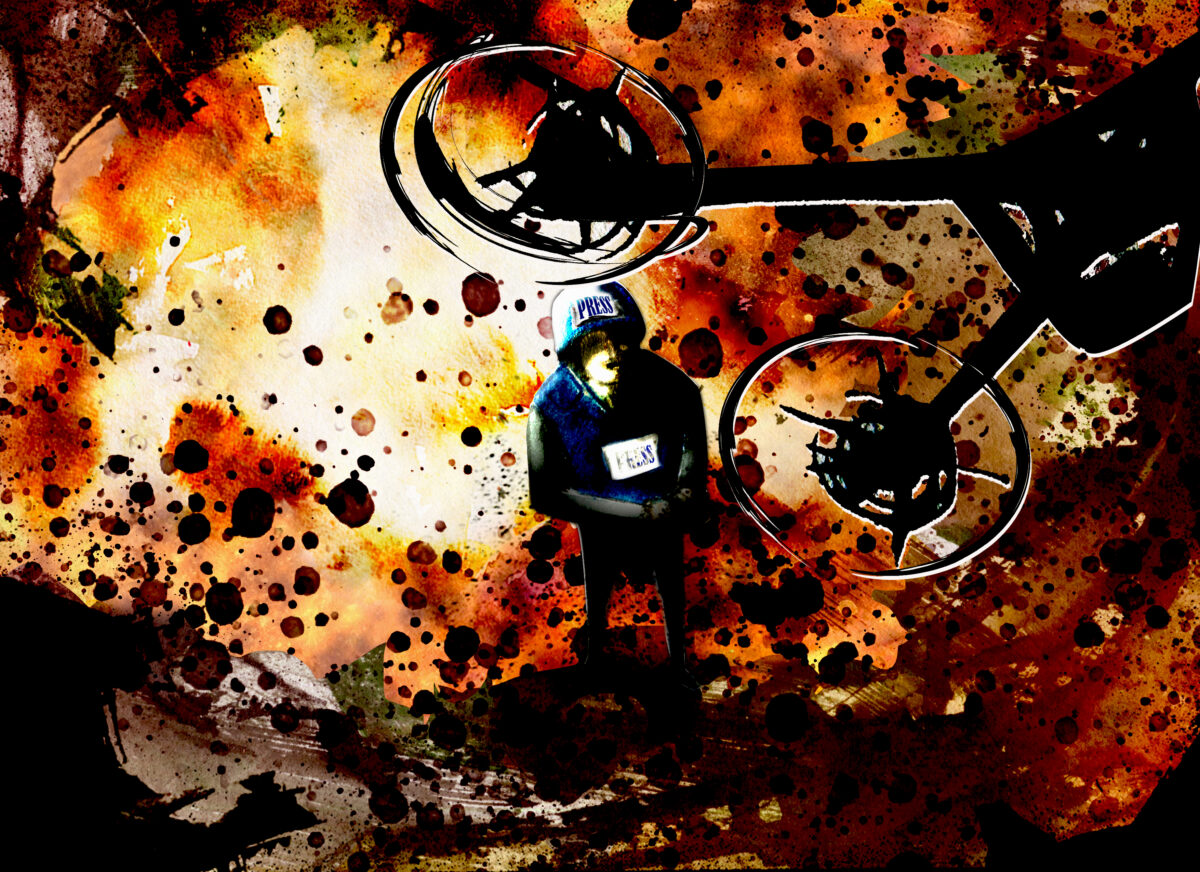
Illustration (c) Ann Kiernan.
Israel said early on in the war it could not guarantee safety of journalists in Gaza. Hamas has also been known to use drones to target Israel Defense Forces (IDF) positions and has used drone footage in propaganda videos. The investigative consortium contacted the IDF about the cases mentioned in this story, how they determined the drones posed a threat, the IDF rules of engagement with drones and how they define someone as a terrorist. The IDF did not answer specific questions about individual cases, nor did they provide further details about the two individuals in this piece, but they did tell us the IDF rejects outright the allegation of systemic attack on journalists.
“The IDF cannot address operational directives and regulations as they are classified. However, every operational action or strike is mandated by IDF directives, which instruct commanders to apply the basic rules of the law of armed conflict,” they said.
The full cost of the war still needs to be assessed through on the ground visits, when a permanent ceasefire is agreed, but in the meantime, satellite imagery combined with drone footage and other imagery captured by journalists in Gaza has been critical to lay bare the level of destruction.
For instance, a brief drone video lasting just over one minute and published in January this year by the AFP news agency after the first phase of the recent ceasefire was implemented, shows the rubble of scores of hollowed-out homes in Rafah. Some are completely levelled, others severely damaged.
The most recent interim damage assessment compiled by the World Bank, European Union and United Nations estimates almost 300,000 homes have been damaged or destroyed across Gaza and that 95% of hospitals are non-functional.
In order to continue the reporting on the extent of damage caused by the war in Gaza, Bellingcat and our partners are sharing satellite imagery and using a 3D model technique called photogrammetry to capture and show the areas the journalists had been filming or were unable to report on.
On February 15, 2024, about six months into the conflict, the United Nations shared a short video on social media showing dozens of hollowed out or partially collapsed buildings located in Gaza City’s Al-Shati Refugee Camp. The video starts with a birds-eye view filmed by a drone that shows entire blocks levelled in the compact neighbourhood.
Over the course of more than 12 months of conflict, Al-Shati Refugee Camp saw heavy destruction.
The neighbourhood and its surroundings were an early target for IDF ground operations inside Gaza, with the IDF announcing in mid-November 2023 that it had completely captured the area. The IDF said it was a main Hamas stronghold. One video geolocated by a Geoconfirmed volunteer shows the heavily damaged coastal side of the Al-Shati Refugee Camp a year later. The camp also abuts an archeological site to the north that was potentially damaged by the ground operation and airstrikes, as previously documented by Bellingcat and Forensic Architecture.
The images shared by UNRWA were filmed using a drone by Palestinian journalist Abdallah Al-Hajj. Nine days after they were posted online, he was back filming in the same area when he was seriously injured in an Israeli army strike, losing both his legs.
Speaking to our partners Forbidden Stories, Al-Hajj said he felt a journalistic responsibility to continue filming in Gaza during the war but took several precautions including only filming when clashes were over and when there was no immediate conflict in the vicinity. On the day he was injured, he said he’d only filmed with the drone for about five minutes and completed the filming when he was hit. He told our partners at Forbidden Stories he wasn’t wearing his press vest because he felt identifying himself as a journalist put him at greater risk.
The IDF previously told Le Monde that it had“eliminated by an IAF aircraft” a “terrorist cell using a drone, posing an imminent threat to forces in the Shati area.”Apparently the same strike was referenced in this reporting from February 25.
It’s not clear where the threatened forces referred to in the IDF statement were. It was reported that the IDF conducted a two-week-long raid in Al-Shati Refugee Camp in early February but it was apparently finished by February 15.
Based on SkySat imagery from Planet Labs, IDF vehicles were visible earlier in the month on February 8 about 2.5km from Al-Shati Refugee Camp near Gaza City’s Islamic University campus. The vehicles were gone a week later in February 14 imagery.
Photos and videos show that the IDF were present about 3.5km south of Al-Shati Refugee Camp along the Al-Rashid Road throughout the month of February, though it’s not clear if they were still present at the location when Al-Hajj was filming.
After the strike, SkySat imagery from Planet Labs shows that Al-Hajj’s home south of Gaza City in the Zeitoun neighbourhood was destroyed. It was standing in February 24 imagery but in February 28 imagery showed that it was gone.
We asked the IDF about Al-Hajj’s case including asking them to explain the immediate threat that was posed by the drone, why he was hit and what information they had about him but they did not respond to specific questions about this case.
Al-Hajj told our partners Forbidden Stories the accusation that he was part of a terrorist cell or affiliated with Hamas was a “false and unfounded charge.”
Additionally he said he was checked by IDF troops twice after the incident, in Al-Shifa Hospital where he was admitted and again when he left the Gaza Strip via a Netzarim checkpoint to travel to Qatar for medical treatment. “If I were Hamas, I would not have gone out of the Gaza Strip for treatment,” he said.
To continue documenting the changes in Al-Shati Refugee Camp brought about by the war, Bellingcat used drone images provided by Forbidden Stories to create a 3D model of the current state of the area through photogrammetry, a technique that reconstructs objects in 3D by analysing the parallax between multiple photos.
Photogrammetry is the science of extracting measurements from photographs. In this case, photogrammetry is employed to extract large scale, measured 3D models from a dataset of aerial photographs of Gaza captured by a drone.
Bellingcat processed the 3D models of Jabalia Refugee Camp and Al-Shati Refugee Camp using Agisoft Metashape, which requires a paid license. Alternative open-source programs for photogrammetry include Meshroom and COLMAP.
The 3D models were created from the drone photos in four steps, though different steps may be applicable to different scenarios. First, corresponding features are detected and matched between images. Then, using the corresponding features, camera positions are triangulated using the camera parameters (ie. focal length, pixel size, lens distortion) and repeatedly adjusted to increase the accuracy of the reconstructed camera positions through bundle block adjustment. Next, depth maps are created for each image using dense stereo matching, which compares images from similar viewpoints to find the small differences between them caused by parallax. These depth maps are used to create a 3D mesh that serves as an accurate recreation of Gaza. Finally, a texture is created by projecting the original drone photos onto the mesh in a way that seamlessly blends them, giving the final result of a photorealistic and dimensionally accurate 3D model.
Photogrammetry is used to create a photorealistic and dimensionally accurate 3D model. Credit: Agisoft Metashape. Annotated by Thomas Bordeaux.
Photogrammetry and the 3D models do have some shortcomings – in particular, areas not visible to the camera cannot be accurately reconstructed, such as the insides of heavily damaged buildings that are hidden by overhanging floor slabs. Further, the varying distance between the camera and the features it captures leads to variances in the level of detail in the model, as does the varying number of photographs of any given feature – for example the narrow alleys in Al-Shati Refugee Camp can only be seen from certain angles in the photogrammetry, meaning they aren’t as accurately depicted as more visible areas such as the courtyards of UNRWA schools in Jabalia Refugee Camp.
While satellite images can be difficult to interpret and are limited in resolution, the 3D models produced with photogrammetry allow viewers to place themselves in the environment. This approach provides an unparalleled look at the landscape of Gaza after nearly eighteen months of war, including buildings reduced to rubble, craters left behind by intense bombing, and thousands of tents sheltering displaced persons. A similar technique has been used in other open source investigations, notably in the recreation of the Mariupol Drama Theatre in Ukraine which was used as a civilian shelter until it was bombed by Russian forces in 2022, as well as numerous investigations by Forensic Architecture.
Within the models presented on this page, we have identified key sites including schools, homes and areas damaged by fighting.
About a month before Al-Hajj was injured in Al-Shati Refugee Camp, Mustapha Thuraya and his colleague Hamza Al-Dahdouh were killed in an IDF strike while they were driving in southern Gaza on their way back from reporting in Al-Nasr Village. Thuraya was a freelance video journalist who had filmed for Al Jazeera, AFP, Reuters, and Getty Images among others. He was killed on January 7, 2024 in Al-Nasr Village northeast of Rafah, shortly after filming with his drone.
According to reporting by the Washington Post, Thuraya and Al-Dahdouh arrived at the location about 10:30am, when an airstrike forced them to leave the area by car. They were following an ambulance when they were struck while on the road at approximately 11:10am.
Thuraya began actively covering the war not long after it started, sharing dozens of videos on his social media pages. In many of the videos, his drone controls are visible in his hands as he filmed himself in front of scenes of destruction. In some of the videos he can be seen wearing a press vest, though it is unclear if he was wearing it on the day he was hit.
The final thing Thuraya filmed with his drone was the site of an IDF airstrike in southern Gaza that took place the same day. The area he was filming is a rural part of southern Gaza that sits between Khan Yunis to the north and Rafah to the south. Overall, the area was relatively untouched by Israeli ground operations, though satellite imagery shows that the IDF cleared a small area of greenhouses within 1km of the airstrike location in late July and August 2024. Recent Planet Labs imagery from January 2025 shows that most of the larger area is still intact, including the majority of the greenhouses.
Before and after satellite imagery from Planet Labs shows the location where Mustafa Thuraya and his colleagues were filming shortly before they left in their vehicle and were killed while on the road south. The most recent imagery shows that some greenhouses have been destroyed but otherwise the area is largely unchanged. Credit: Planet Labs PBC.
The IDF initially claimed the January 7 strike on Thuraya and Al-Dahdouh’s car was in response to drone activity that posed a threat to IDF troops. They later released further reasoning for the strike, stating that Israel’s military intelligence department had confirmed that Dahdouh was a member of Palestinian Islamic Jihad and Thuraya was a member of Hamas, — something rejected by both Al Jazeera, which they were working for at the time — and the journalists’ families.
The Washington Post, quoting Thuraya’s friend and fellow journalist Shadi al-Tabatiby, said Thuraya had previously worked for around five years as a photographer for the Ministry of Religious Endowments, part of Gaza’s Hamas-led government. It’s not clear when his employment ended.
Our analysis found the closest potential IDF activity to where the strike on Thuraya’s vehicle took place — clearing activity that was visible near a cluster of buildings — was more than 5km away, something that’s visible in Planet SkySat imagery from the day of the strike. An analysis from The Washington Post came to a similar conclusion regarding the IDF presence near where Thuraya was filming, even though they analysed a smaller area, finding no evidence of IDF military activity or deployments within 2km of the site.
The Washington Post was also able to review the drone footage filmed by Thuraya and found that no IDF “soldiers, aircraft or other military equipment” was visible in the footage.
The IDF did not respond to the consortium’s specific questions about Thuraya and the circumstances surrounding his killing.
While the area in southern Gaza that Thuraya was filming before he was killed has remained mostly unchanged, Rafah — where he and Al-Dahdouh were returning to following the filming — has been decimated.
Drone imagery is still dangerous to capture in the south, even during the ceasefire. AFP published drone footage shortly after the first phase of the ceasefire was agreed, but it only covered a small area in Rafah. High resolution satellite imagery remains one of our best ways to observe the mass destruction in Rafah. Bellingcat covered this in August last year, but since then more buildings have been destroyed with entire neighborhoods that were previously standing demolished, particularly near the border areas.
Hundreds of buildings in both the central Rafah area near the large marketplace and the Al-Ganinam neighbourhood have been demolished. The few remaining buildings in the Tal as-Sultan neighbourhood we examined in the August investigation have also been razed to the ground.
Bellingcat is sharing the same satellite imagery analyzed in last year’s piece alongside more recent Planet imagery captured after the ceasefire on January 30 2025.
Credit: Planet Labs PBC.
Other Drone Journalists Slain and Photogrammetry of Jabalia
Prior to the ceasefire the Committee to Protect Journalists identified at least three otherdrone journalists who were killed in IDF strikes, but we have not been able to find further open source details on circumstances around their deaths.
One area that was difficult to film prior to the recent ceasefire because it was too dangerous was the Jabalia Refugee Camp and its surrounding area. This was one of the worst affected areas of Gaza, which Bellingcat documented earlier this year.
Bellingcat was able to create a photogrammetry model of one of the worst hit areas in Jabalia Refugee Camp using drone footage provided by Forbidden Stories which was captured during the recent ceasefire.
Ongoing Risks to Palestinian Journalists in Gaza
On Saturday, March 15, two IDF air strikes in the northern Gaza city of Beit Lahia killed at least seven people, including Mahmoud Samir Isleem Al-Basos also known as Mahmoud Al-Basos, a drone journalist who previously provided work to Reuters and the Turkish news agency Anadolu
Among the dead were aid workers and cameramen on a mission for the London-based Al-Khair Foundation who said they were filming preparations of a Ramadan iftar meal and documenting site preparation for the extension of the camp.
“We were deeply saddened to learn that journalist Mahmoud Al-Basos, whose work Reuters published in the past few weeks, was killed in Gaza by an Israeli strike while on a mission for the Al-Khair Foundation. Our thoughts are with his family at this difficult time,” a Reuters spokesperson told us.
Mahmoud Samir Isleem Al-Basos was previously hired by Forbidden Stories to film drone footage for this project during the recent ceasefire. This initiative aimed to continue the work of drone journalists who had been killed while documenting the war and help readers visualise the unprecedented scale of destruction through detailed 3D aerial maps.
The IDF stated the March 15 strikes targeted “terrorists,” including two operating a drone, and released a list of names and photos. The IDF statement contained misidentifications and names of individuals the media office in Gaza said had not been killed, causing confusion.
Mahmoud Samir Isleem Al-Basos was neither named nor pictured in the list published by the IDF. Instead, the IDF listed another individual, with a similar name, describing him as a “Hamas terrorist operating under journalistic cover,” and said there was a link between the drone used in Beit Lahia and Islamic Jihad.
However, the consortium’s investigations indicate the individual named by the IDF has no direct link to Mahmoud Samir Isleem Al-Basos, and was not killed in the strike.
Al-Khair Foundation said, meanwhile, they “utterly refute” any claims that their team were connected to militants. They say that the members were deliberately targeted while on a “purely humanitarian mission.”
We geolocated the two strikes in Beit Lahia, and according to our findings, the first was approximately 2km from the Israeli border and an IDF outpost situated nearby and the second approximately 3km away, raising questions about the threat described by the IDF.
Asked twice by the consortium to provide evidence to support the different accusations, the IDF refused, stating it “will not elaborate on the published statements”.
Reserve Lieutenant Colonel Maurice Hirsch, who served for 19 years in the Israeli army’s legal corps, told our partners at Paper Trail Media there is an inherent risk in flying a drone during a conflict in proximity to fighting forces.
He said if a soldier spotted a drone in a combat zone near fighting forces, “I certainly wouldn’t assume any wrongdoing if that drone and its operators were targeted (…) it wouldn’t be unreasonable to assume they were part of an enemy force.”
Our partners at Forbidden Stories also spoke to IDF reservist Michael Ofer-Ziv who served during the recent conflict, including for the first two months of the war in the Israeli military centre of Sde Teiman where he spent his time observing black-and-white footage filmed from Gaza. His role was to verify that the IDF wasn’t firing on its own soldiers. Ofer-Ziv completed his tour in December and has refused to return to service, signing a letter stating that he is no longer willing to participate in the war.
“At no point during this war did I receive an official document outlining the rules of engagement. And that’s a problem, because it leaves a lot of room for interpretation,” he said.
He didn’t know of the Gazan drone journalists we investigated but said there was an “understanding and a general vibe in the war room” that “if you see anyone piloting a drone, and that drone is not ours, you shoot the drone and the person who uses it, no questions asked.”
Asked about journalists using drones he told Forbidden Stories: “We never spoke of it.”
We contacted the IDF as part of the investigative consortium and asked whether they had a specific policy for dealing with drones in Gaza, and if so how they distinguished civilians from military targets. We asked about the individual cases listed above but were not provided any further details. The IDF has previously claimed that Thuraya was a member of Hamas, a claim which Al Jazeera and his family deny, and stated they hit a “terrorist cell” target in the IDF strike that injured Al-Hajj. Al-Hajj says this a “false and unfounded” charge.
The IDF did not answer specific questions about individual cases, nor did they provide further details or evidence about the incidents outlined above, but they told us the IDF rejects outright the allegation of systemic attack on journalists.
“The IDF cannot address operational directives and regulations as they are classified. However, every operational action or strike is mandated by IDF directives, which instruct commanders to apply the basic rules of the law of armed conflict (LOAC).”
They reiterated that the IDF is committed to principles of distinction, proportionality and precautions and that the IDF only strikes members of organised armed groups and individuals directly participating in hostilities. They told us some of the people listed by Forbidden Stories were members of Hamas’ military wing and were therefore lawful targets under international law, but they did not provide evidence to support this.
They also told us that “the IDF takes all feasible measures to mitigate harm to civilians, including journalists. Regarding objects, the IDF only strikes military objects. The IDF does not deliberately strike civilian objects, including those affiliated with media outlets or belonging to journalists, provided that they are not legitimate military targets.”
In their reply, they stated “the incidents have been referred to relevant mechanisms for further investigation.” But did not confirm whether the specific cases highlighted here are being investigated, and did not specify which incidents they were referring to. They also stated that exceptional incidents are subject to lessons-learned processes and are thoroughly examined and addressed accordingly by the appropriate enforcement mechanisms, and may lead the relevant cases to command, disciplinary, or criminal measures.
Press Freedom Experts
The Committee to Protect Journalists told us that drone use for journalism is still a relatively new trend.
“We encourage journalists generally to do their own risk assessments depending on their own situation on a case by case basis,” Doja Daoud, CPJ’s Levant Program Coordinator, told us.
She made clear that: “A journalist shouldn’t be killed and should be protected under international law.”
Daoud said CPJ had documented cases where drone journalists were killed. And in at least one case, a journalist had told them his drone had been disabled or controlled remotely.
“So there are other ways to deal with a drone, even in conflict areas or in a proximity of Israeli soldiers, without killing a journalist.”
As for IDF claims about journalists being combatants, Daoud said in many cases, including that of Mustapha Thuraya, CPJ is still yet to see any clear proof.
“Israel has repeatedly made similar unproven claims without producing any credible evidence. And to date CPJ has documented multiple cases with no evidence at all that any journalist was engaged in militant activity.”
“Attempts to smear, delegitimise, and criminalise journalists who are doing their job are outrageous and irresponsible as they put journalists at further risk. And targeting journalists with disinformation endangers them more.”
Irene Khan, the United Nations Special Rapporteur on Freedom of Expression and Opinion told us that with no western reporters allowed in, local Palestinian journalists, “are putting their lives on the line so that we may be better informed on what is happening and so that the atrocities being performed there can be exposed.”
Using drones to show what’s happening has only increased that risk, with Khan adding that since using commercial drones as a tool is still relatively new — for both journalists and combatants — and the rules are less clear.
“International humanitarian law does not say that you are not allowed to use drones, because it is a civilian object and there are many civilian objects that can be converted and used for military purposes. But it is not wrong as a civilian to use it.”
But, Khan says, the onus is on the combatants — the IDF and armed groups in Gaza — to ensure civilians are not being targeted if it’s difficult to distinguish the purpose of a drone. From a legal point of view, international humanitarian law heavily favours journalists.
“So the onus is actually on the combatants to make sure that if we cannot distinguish, then we need to do more to ascertain whether we might, by mistake, kill a civilian, we might kill a journalist.”
“And in all those areas, I think the standards that the IDF seem to be applying are lower than what I would call due diligence. I think there has been a tendency on the side of the IDF to assume that some of these journalists have links with Hamas and therefore are legitimate targets.”
With such a high journalist death toll throughout the war, Khan says there needs to be more done to protect journalists in the future — including carrying out independent investigations.
“I come back to the issue of impunity. It has to be addressed. So every time a journalist is killed, there should be a full investigation as to what happened and to make sure that if there was a mistake made, what are they doing correcting those mistakes? … And I don’t understand if the IDF is so sure that they didn’t make a mistake, why are they not allowing others to come in and investigate it?”
Some Palestinian journalists are continuing to film with mobile phones, cameras and drones, despite the risks.
With the recent ceasefire collapse, the risk to journalists operating on the ground is likely to increase again, heavily restricting our view of the impact of the conflict on Palestinian communities in the Gaza strip.
Youssr Youssef, Magdalena Hervada, Charlotte Maher and Logan Williams contributed to this report.
Photogrammetry models in this piece were created using Agisoft Metashape and Cesium. Source Credit: Forbidden Stories/Stringer. Photogrammetry model: Bellingcat/ Thomas Bordeaux.
Bellingcat would like to thank our partners at Forbidden Stories, Die Zeit, Der Standard, Le Monde, RFI, ARIJ and Paper Trail Media for collaborating on this project.
This article is the result of a collaboration with The Sunday Times. You can find their corresponding piece here.
On the last Friday in December, a German businessman in his mid-40s allegedly met a small aircraft on a dusty runway in remote Western Australia. The following evening in Perth, seven hours’ drive south, he and another man were arrested and charged with trafficking a commercial quantity of a controlled drug.
Police said a search of their hotel rooms uncovered 200kg of cocaine,
This article is the result of a collaboration with The Sunday Times. You can find their corresponding piece here.
On the last Friday in December, a German businessman in his mid-40s allegedly met a small aircraft on a dusty runway in remote Western Australia. The following evening in Perth, seven hours’ drive south, he and another man were arrested and charged with trafficking a commercial quantity of a controlled drug.
Police said a search of their hotel rooms uncovered 200kg of cocaine, packed in suitcases in single one-kilogram blocks, along with night vision goggles, aviation equipment and a hardware cryptocurrency wallet.
It was the culmination of a three-month Australian Federal Police (AFP) investigation codenamed “Operation Mirkwood”. Authorities estimated the street value of the drugs to be AUD $65 million and AFP Inspector Chris Colley said an “organised crime syndicate” was likely responsible for the scheme.
The German businessman was Oliver Andreas Herrmann, a 44-year-old champion marathon runner and the director of multiple companies with diverse interests spanning various jurisdictions.
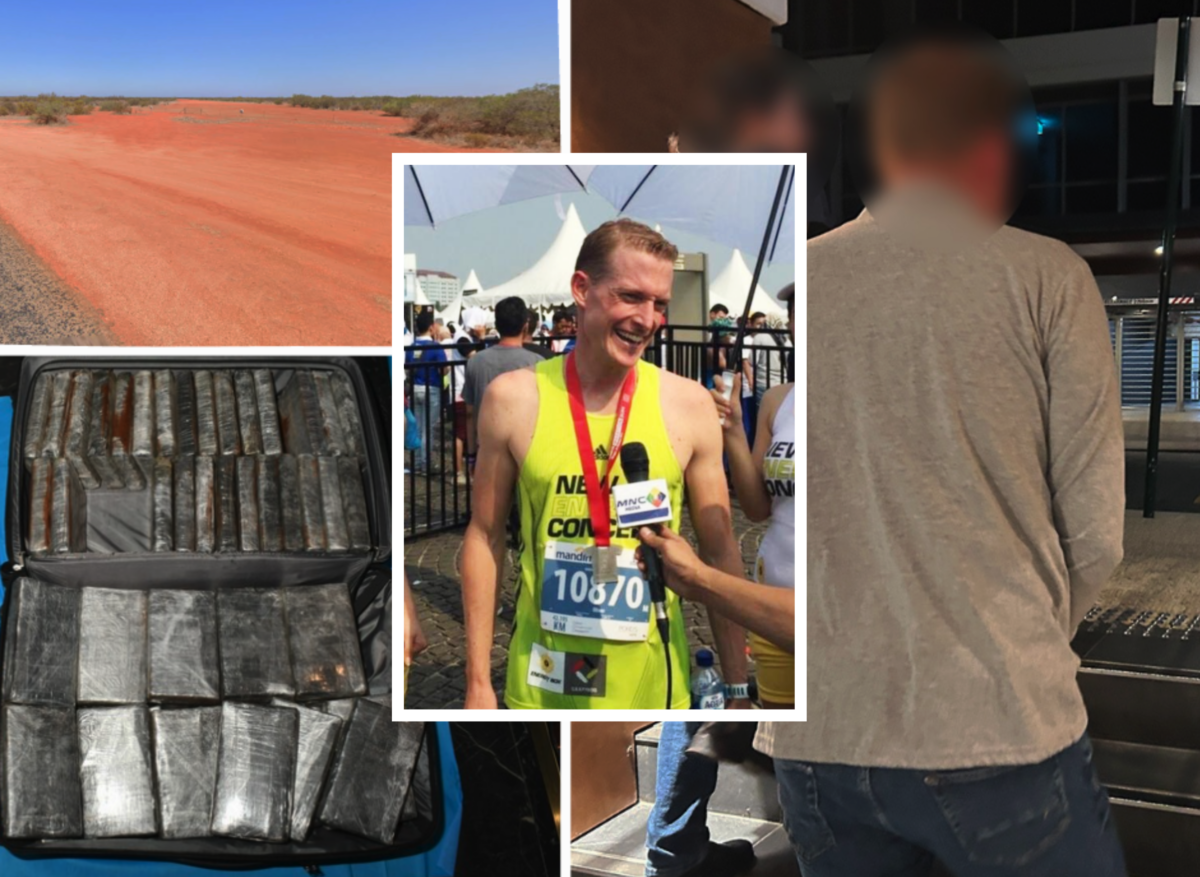
Insert: Oliver Herrmann pictured in an Australian media report from a photo on his Facebook page. Top left: Overlander Airport, where he allegedly met an aircraft on December 27, 2024. Bottom left: cocaine seized by police in Perth. Right: Herrmann after he was detained by police. Source: Facebook / Oliver Herrmann, Google Street View, AFP
Herrmann and the other man who was charged are due to face court again in May. They have not yet entered a plea and the presumption of innocence applies. Herrmann, who has no known convictions, had not responded to multiple requests for comment as of publication.
The Sunday Timesreported in January that Herrmann has “close financial ties” to Christy Kinahan, the 67-year-old founder of the eponymous international drug cartel who is wanted by authorities around the world. Last month it reported that Herrmann “acted as Kinahan’s representative on the ground” in Indonesia and quoted a source who said Herrmann once introduced him to the cartel leader.
“Kinahan was Oliver’s boss,” the source told The Sunday Times. “He was afraid of him. Kinahan was always shouting at him.”
Christy Kinahan (left) has a US $5 million bounty on his head but has posted photos giving away his location, including at a luxury Budapest hotel (top right) and a restaurant in Dubai (bottom right). Source: Irish Daily Star, Christopher Vincent Google Maps profile
That investigation revealed that the normally elusive crime boss – known as the “Dapper Don” – posted hundreds of reviews under the alias Christopher Vincent, disclosing his precise locations across three continents, including in Dubai where he lives in hiding. Bellingcat contacted Kinahan but did not receive a response.
We have now conducted an open source analysis of Herrmann’s online footprint to build a picture of the man Australian authorities accuse of trafficking drugs last Christmas. The findings paint a portrait of an avid runner and international businessman who is more accustomed to poolside video conferences than an alleged drug drop in the Australian desert.
Main: The Sunday Times reported in January that Herrmann was linked to Irish narco boss Christy Kinahan. Insert: The West Australian reported on Herrmann and his co-accused’s court hearing in January.
This investigation has traced Herrmann to locations associated with the cartel. These include a building in South Africa that Kinahan reviewed on his Google Maps profile, and to the Zimbabwean capital of Harare the day before a conference that the Irish drug lord said he attended.
It also sheds light on the complex network of international firms linked to Herrmann, either directly or through his associates. One of these firms shares an address with a company that reportedly received payments ultimately destined for Christy Kinahan.
Racing Around The World
Oliver Herrmann is a German national who has referred to Munich as his “home city”. He is also a South African resident, according to the AFP, and reportedly travels on a Swiss passport. Herrmann gave his nationality as Swiss in company documents filed in Singapore, while in registration documents in the UK he said he was German. He has listed his country of residence as Indonesia and Singapore.
Corporate records indicate that Herrmann has been involved at senior levels with companies active in the fields of fintech, mining and consulting. Until recently Herrmann was on the executive board of a German “international raw materials company” whose parent company, according to its website, is to be listed on the Düsseldorf Stock Exchange. The company told Bellingcat in February that Herrmann was removed from his board position after it learned about the allegations in Australia and said he no longer had any role with the organisation.
Herrmann’s Instagram account is set to private but he has a public profile on Strava, a fitness app used for recording exercise that often includes GPS-tracked routes (see Bellingcat’s Strava activity map guide here).
Herrmann’s Strava account has at least 130 photographs and includes a post about his winning 2016 Munich Marathon run. Source: Strava account of Oliver Herrmann / Munich Marathon
An acclaimed runner who won the 2016 Munich Marathon, Herrmann regularly logged his runs on Strava. Photos posted to the account confirm he is the same person pictured in an Australian media report about his court appearance in January over the alleged drug bust.
Herrmann’s Strava account has logged more than 2,500 activities in 29 countries across Europe, Asia, Africa, South America and the Middle East between 2013 and 2023. He has also posted at least 130 photos documenting his extensive travels. They show a dedicated athlete who appears to enjoy a jet-setting lifestyle, with many featuring scenic and tropical locations.
Herrmann’s Strava account shows that, like Kinahan, he has frequently traveled to Zimbabwe. An analysis of Herrmann’s runs shows he logged almost 500 activities in Harare between February 2018 and May 2022. Meanwhile, Kinahan posted 25 Google reviews in Harare between June 2019 and September 2021.
In one of these reviews, the leader of the transnational organised crime syndicate said he spent four nights at the Amanzi Lodge hotel for a “business networking conference” that was hosted by two companies. The conference ran from October 8 to 11, 2019, according to one of the company’s social media accounts. In two photos posted online, an individual with similar features to Kinahan is seen at the event.
This photo shows a man with similar features to Christy Kinahan during an October 2019 conference at the Amanzi Lodge in Harare. Kinahan posted a review for the same venue. Source: Instagram, Facebook
On October 7, the day before the conference began, Herrmann logged a run just 5.5 km from the venue where Kinahan said he stayed. Herrmann’s 2019 Strava activity in Harare suggests he spent time close to this location, near the city’s affluent suburb of Borrowdale, with dozens of runs starting and ending on the same residential road. After October 7, Herrmann’s next Strava run was recorded three days later in Dublin, Ireland.
Herrmann’s Strava profile logged a run in Harare on October 7, 2019 (left), near a hotel that Kinahan said he was staying at the time (right). Source: Strava, Google
Two of Herrmann’s runs from 2021 and 2022 take place in downtown Dubai, about 250 meters and 550 meters from the office of a sanctioned company that the US government said is owned or controlled by Christy Kinahan’s son, Daniel Kinahan.
The 2021 run starts and ends outside a five-star hotel where Daniel Kinahan was photographed. The photo in the since-deleted tweet, which was the subject of media coverage at the time, was posted three days after Herrmann’s Strava run and geotagged to Dubai. A reverse image search shows that the picture of Daniel Kinahan was taken inside the Dubai hotel.
Left, middle: An image from the hotel’s Instagram shows a room with identical layout and features to those visible in the February 11, 2021 tweet showing Daniel Kinahan. Right: Herrmann’s Strava run starting and ending outside the same hotel three days earlier. Source: Instagram, Twitter (via archive.org), Strava account of Oliver Herrmann
Herrmann’s Strava profile also displays information about his business activities. A 2018 post, captioned “Office view in ZIM”, includes a photo of an open document on a laptop screen. Titled “Mining Project Teaser”, the document touts the attractiveness of Zimbabwe’s “open for business” policy for foreign investors.
This 2018 post on Herrmann’s Strava account shows a document with details of a Zimbabwean mining proposal. Source: Strava account of Oliver Herrmann
On the header is “Gemini Global Pte Ltd”, a Singapore-based company of which Herrmann is the director and secretary, according to corporate records. Herrmann reportedly filed a police complaint after Gemini lent US $500,000 for an Indonesian mining project that failed in the early 2010s. More than two dozen runs logged by Herrmann begin and end at the registered address for the Singapore company.
Other locations logged on Strava appear to be linked to companies Herrmann is involved in, suggesting his frequent travel may be business-related. Some runs explicitly mention an office, including one in Singapore in 2015 and three in Dublin in 2016.
Herrmann is listed on Crunchbase as the chief financial officer of defunct Irish fintech, Leveris Limited, which reportedly collapsed in 2021 with debts of €38 million. Records from Ireland’s Companies Registration Office show he was also a director of the company. Herrmann has logged Strava runs in Minsk and Prague, other cities where Leveris had business connections.
Herrmann’s 2015 and 2016 Strava runs referencing offices in Singapore and Dublin. Source: Strava account of Oliver Herrmann
Running Mate
A series of companies involved in trade, real estate and corporate finance appear to be linked to Herrmann’s domestic partner. This woman was identified through an analysis of social media posts. In the comments of an Instagram post about his Munich Marathon win, several users tagged the woman’s account. Herrmann’s Strava profile also follows a user by the same name, and includes a photo of him with an identical-looking woman during a run in France.
An analysis of the woman’s Strava account shows that multiple runs logged in different countries over six years match where Herrmann’s GPS-tracked routes start and finish. She is tagged as a companion in at least one run recorded on Herrmann’s profile.
Three videos posted to the woman’s now-deleted Instagram account show a man strongly resembling Herrmann during a hike at Cape Town’s Table Mountain, visiting Mapungubwe National Park, and on a game drive with two boys near Lake Kariba. Photos also show a boat trip and a beach outing with several children in which a man with similar features to Herrmann is seen with his back to the camera. A photo posted to the woman’s Twitter account a decade ago also shows a man who resembles Herrmann.
Photos and videos from the woman’s primary Instagram account, which was deleted after Bellingcat sent questions, show a man who strongly resembles Herrmann. Source: Instagram
The woman is also tagged in an Instagram post by a Thai mining magnate whose company is listed as a shareholder of the German company that recently removed Herrmann from its board. The Thai woman’s Instagram includes photos of Herrmann and his partner going back years, including during a 2022 “business trip” in Dubai.
The Corporate Web
An open source search identified a person with the same first and last name as Herrmann’s partner involved in three companies. Corporate records show she was listed as the owner of defunct Indonesian firm PT. Gemini Nusa Land, which was involved in real estate, and previously the director of another company, also headquartered in Indonesia.
The third company is South Africa-registered 247 Capital Group, where business data provider b2bhint.com lists her as a director. These details were verified through South Africa’s official registry. A generic-looking website for the firm says it is a leading “corporate finance group” staffed by “specialist capital raising managers”. The website’s contact section lists two addresses: one is a small house on Long Island, New York; the other is a high-rise building in Johannesburg called The Leonardo.
Herrmann’s Strava profile shows he has logged two morning runs ending directly outside The Leonardo, in April and May 2022. Kinahan has also been to The Leonardo: he wrote about visiting the building and posted photos of the interior in Google reviews from September 2021.
Left: The Leonardo, the South Africa address listed for 247 Capital Group. Top right: one of Herrmann’s runs ending outside the building. Bottom right: photo posted by Kinahan’s from inside the building, which was geolocated by Bellingcat. Source: Google Maps, Strava account of Oliver Herrmann, Christopher Vincent Google Maps profile
An analysis of 247 Capital’s website using ViewDNS, a tool that examines websites, determined that it shares an IP address with three other sites. There are multiple reasons why websites can share IP addresses and it does not necessarily mean they are related. In this case, however, there is evidence that 247 Capital may be linked to the other sites.
This diagram shows three companies that have similarly structured websites and also use the same IP address.
The first is for a US-based company called Ryba LLC; the second is for an Indonesia company called PT. Sukses Dagang Bersama (abbreviated to “SDB Trading” online); and the third is a placeholder for a web developer that designed the sites for 247 Capital, Ryba LLC, and PT. Sukses Dagang Bersama.
Herrmann’s partner had not responded to requests for comment as of publication. There is no suggestion that she is involved in illegal activity.
Ryba LLC
Last year, The Sunday Timesreported that a company with a mailing address at the Trump Building was the recipient of two payments totalling US $850,000. It said the funds were lodged to a company account in South Dakota and the beneficiary was listed as Adam Wood, a known associate of Kinahan who attended a 2019 aviation conference in Egypt with the cartel leader. The newspaper said these payments were part of a series of international wire transfers totalling US $1.25 million of which Kinahan was the ultimate beneficiary.
Today, The Sunday Timesreveals that the payments of US $850,000 were made to Ryba LLC.
Ryba LLC’s website lists its address as the Trump Building on Wall Street in New York. Companies with this name are registered in the US, but corporate records show that none are located in New York.
The phone number on Ryba LLC’s website was linked to a New York law firm via the crowd-sourced contact book app, TrueCaller. An online search for the firm shows it has an office in the Trump Building, and searches for the Long Island address listed on 247 Capital’s website returned a hit for a lawyer who works at this firm.
The Long Island address also appeared in a small-claims court record, which named the home owner as the lawyer who works in the Trump Building. A digital copy of the deed from the Nassau County Clerk shows the lawyer bought the house 25 years ago. Bellingcat called the Clerk’s office to confirm the deed was still current.
According to the lawyer’s bio, they are an “Anti Money Laundering Specialist” who works in wealth and tax planning, trust and estate administration, and asset protection. The lawyer and the firm had not responded to requests for comment as of publication. There is no suggestion that the lawyer or firm are involved in illegal activity.
Searches on LinkedIn for staff who work for Ryba LLC returned a result for an employee who lists their current role as a senior project finance manager at the company. Their previous position, according to the profile, was head of accounting at Leveris, the Irish company where Herrmann previously served as chief financial officer.
Herrmann’s calendar notification “Oliver – [name redacted] daily update”. Source: Strava account of Oliver Herrmann
In the photo on Herrmann’s Strava account showing the mining proposal document, a meeting notification for the employee is visible in the top right of the laptop screen. The employee’s LinkedIn account is no longer online, but their details have been saved on RocketReach, a site that aggregates professional data from online platforms.
The employee had not responded to requests for comment as of publication. There is no suggestion that they are involved in illegal activity.
PT. Sukses Dagang Bersama
Bellingcat purchased the Indonesian corporate record for PT. Sukses Dagang Bersama. Its “commissioner” is listed as Conor Fennelly, Herrmann’s former business partner and one-time chief executive of Leveris.
However, Fennelly told Bellingcat that he had “never heard of” the Indonesian company and had “no knowledge” of its operations. He also said he had no business connection to Herrmann outside of Leveris and had not been in contact with him since the Irish tech firm collapsed in 2021.
After providing a copy of the Indonesian business documents showing his listing as commissioner, Fennelly said he “didn’t authorise this” or sign paperwork taking on any role at the company. He confirmed that his name, address and passport information on the document was accurate.
“Oliver and several others at Leveris would have had that,” he said. “The company was founded [in] 2021 and interestingly this is months after Leveris went under and months after my last contact with Oliver, assuming he is the reason my name appears here.”
Fennelly said he met Herrmann through an associate at Leveris in 2016, and that Herrmann subsequently invested in the company and became its chief financial officer. Fennelly found Herrmann to be “reliable, calm, competent and trustworthy”, he said, adding that news of his arrest in Australia came as a “complete shock”. Fennelly said he believed Herrmann had been living in Zimbabwe and training as a runner.
Corporate records also show that PT. Sukses Dagang Bersama was originally established in 2013 under a different name, Maksimum Jaya Segar. A person with the same first and last names to Herrmann’s partner is listed as a director of the company from December 2017 to November 2021. Her listed address is in a residential neighbourhood west of Jakarta, where Herrmann and his partner have logged dozens of runs.
Aircraft and International Trade
PT. Sukses Dagang Bersama was involved in the sale of an aircraft that was exported from the US to Africa last year, Federal Aviation Administration (FAA) records show. The FAA documents say the company bought the plane – a Beechcraft King Air 350 – in early 2024.
Top: A diagram illustrating the connections from the three company websites, with PT. Sukses Dagang Bersama’s highlighted on the right. Bottom: Archive of the FAA index of “collateral filed for recordation” showing PT. Sukses Dagang Bersama listed alongside the previous owner of the plane, with registration number N246SD. According to the aircraft’s FAA registration, N246SD was exported to Africa in February 2024. Source: FAA
Flight tracking website ADS-B Exchange shows that the twin-turboprop aircraft arrived in Harare after the last leg of its journey on February 23, 2024. The ferry pilot who transported the aircraft posted images of the trip to Facebook, which were tagged in Harare on the same date. The plane has been active since its delivery, travelling to airports in Zimbabwe, South Africa and Botswana. Images from plane spotters in South Africa in April and May 2024 show the aircraft with Malawi registration number 7Q-YAO on its side.
Main: Tracked flight path of the plane during its ferry flight from the USA to Africa in February 2024, with numerous subsequent flights also recorded in the region. Insert: Photos of the plane purchased by PT. Sukses Dagang Bersama and a Facebook post by a pilot showing the plane during the same ferry flight. Source: Flightradar24, Facebook, Google Earth
Two days after the plane was delivered to Harare the pilot posted a photo of himself with three other men in front of the aircraft, captioned “Acceptance demo flight”. The pilot and one of these men have previously flown a different aircraft, a Pilatus PC-12, that has been associated with a Kinahan-linked company.
The US $850,000 payment to Ryba was linked to a dispute over the purchase of this aircraft, according to The Sunday Times.
The pilot posted a photo to Facebook before transporting the Pilatus PC-12 from South Africa to the US in 2022 after it was sold to an unrelated buyer. But three years earlier, the Pilatus PC-12 was pictured in a Twitter post by CVK Investments LLC, a company that Irish police said was associated with Kinahan.
The July 2019 post said CVK was investing in the aircraft for an “air ambulance joint-venture business in Africa”. The aircraft pictured in the post shows its serial number “342”, matching the plane in the pilot’s Facebook post. While an aircraft’s registration number can change, the serial number is assigned by the manufacturer and remains the same (see Bellingcat’s flight-tracking guide here).
Left: A Kinahan-linked Twitter account said it invested in this Pilatus PC-12 in 2019. Right: The same plane was pictured on a ferry pilot’s Facebook page three years later. Source: Twitter / CVK Investments LLC, Facebook
The second man is an employee at Malawi’s aviation authority who is referenced in a Facebook photo as being one of the pilots during an August 2021 flight in the Kinahan-linked Pilatus PC-12.
The identity of the Malawi-registered plane was confirmed by its registration number at the time, “7Q-XRP”, visible on the control panel in the photo. The cockpit is identical to one pictured in a Google review posted by Kinahan a month later in September 2021.
Top: Registration number “7Q-XRP” visible on the control panel in a photo posted on Facebook. Bottom: Kinahan’s Google Maps review from September 2021 (left) shows the same cockpit with identical wiring and temperature sensors seen in the Facebook post from a month earlier (right). Source: Christopher Vincent Google review profile, Facebook
The pilots had not responded to requests for comment as of publication. There is no suggestion that they are involved in illegal activity or that either of the planes has traveled to Australia.
PT. Sukses Dagang Bersama is also listed in publicly available import/export records for mining-related and narcotic products between countries including India, Nigeria, Peru, Turkey and Russia.
Records from import/export data provider 52wmb show that in one 2023 shipment from India to Nigeria, PT. Sukses Dagang Bersama is listed in the product description for a delivery of the narcotic “Pentazocine Injection”, an opioid used in medicine that is also reportedly misused and sold on the underground market in Nigeria.
Also listed in the product description field is another company, Turkoca Import Export Transit Co Ltd. This Korean-based company was sanctioned by the US in May 2022 for being part of an Iran-linked oil smuggling and money laundering network.
The product description usually contains information about the items being exported. A potential explanation for company names appearing in this section is that they are “notify parties”, which are entities such as buyers, suppliers and brokers who should be informed when the cargo arrives. PT. Sukses Dagang Bersama appears as a “notify party” in the product description for another shipment to Nigeria from a different Indian pharmaceutical company.
PT. Sukses Dagang Bersama is also listed in 2024 import records for shipments of accessories for heavy machinery to Turkey from a Peruvian company that makes mining equipment. In records from Dataontrade.com it also appears as an exporter of “spare parts” for similar machinery, this time from Turkey to Russia.
Oliver Herrmann had not responded to requests for comment as of publication. Herrmann’s lawyer said: “I am not instructed to comment on these matters.”
Emails to 247 Capital Group, Ryba LLC and PT. Sukses Dagang Bersama were not returned.
Australian Cocaine Charges
Oliver Herrmann and his co-accused, Australian man Hamish Scott Falconer, 48, appeared in Perth Magistrates Court in January. Both men have been charged with one count of trafficking a commercial quantity of cocaine.
Herrmann also faces four counts of failing to comply with an order, according to a report in The West Australian, while Falconer is also facing one count of possessing a controlled drug and one count of failing to comply with an order.
Local media reported that neither of the men applied for bail and no pleas were entered.
Oliver Herrmann following his arrest in December 2024. Source: AFP
The Australian Federal Police said the men were arrested in Perth’s central business district on December 28 as part of an operation that began in October.
The AFP alleges that the men met at Perth Airport in November and drove to Kojonup Airport, about 250km south of Perth. Investigators said the pair departed Western Australia in the following days but later returned separately.
Falconer returned to Perth on December 26, according to police, where he hired a vehicle and transported multiple suitcases and jerry cans. Herrmann allegedly met a small aircraft at the Overlander Airstrip on December 27, returning to Perth and meeting Falconer the following day. Police said that the men bought more suitcases, before discarding them along with jerry cans in a shopping centre rubbish bin.
Cocaine seized by police in Perth. Source: AFP
Police said a search of Falconer’s hotel room uncovered about 200kg of cocaine, in six suitcases, as well as electronic devices, night vision goggles and an airband VHF radio. They said they searched Herrmann’s hotel room and seized four empty suitcases, aviation navigational equipment, a hardware cryptocurrency wallet and other electronic devices.
Both men were charged with trafficking a commercial quantity of a controlled drug, which carries a maximum penalty of 25 years’ imprisonment.
Local media reported that Herrmann and Falconer are due to appear in court again in May.
Connor Plunkett, Peter Barth and Beau Donelly contributed to this article.
Bellingcat is a non-profit and the ability to carry out our work is dependent on the kind support of individual donors. If you would like to support our work, you can do so here. You can also subscribe to our Patreon channel here. Subscribe to our Newsletter and follow us on Bluesky here and Mastodon here.

 Entrar