Visualização normal

Antes de ontemStream principal
  • ✇Firewall Daily – The Cyber Express
  • eBay Struggles with Widespread Outage, Disrupting Transactions and API Access Ashish Khaitan
    The e-commerce platform eBay, a giant in online auctions and fixed-price listings, faced widespread disruptions beginning late Sunday, April 26, 2026, extending into Monday, as users across the globe reported severe technical issues. The eBay outage, which has crippled essential features of the site, particularly the API, has left many buyers and sellers frustrated, struggling to access critical functions, including search features, listings, and checkout processes.  As users faced slow page
     

eBay Struggles with Widespread Outage, Disrupting Transactions and API Access

eBay Outage

The e-commerce platform eBay, a giant in online auctions and fixed-price listings, faced widespread disruptions beginning late Sunday, April 26, 2026, extending into Monday, as users across the globe reported severe technical issues. The eBay outage, which has crippled essential features of the site, particularly the API, has left many buyers and sellers frustrated, struggling to access critical functions, including search features, listings, and checkout processes.  As users faced slow page loads, failed transactions, and difficulty completing sales, a series of unverified reports surfaced suggesting that the hacktivist group 313 Team was behind the massive denial-of-service (DDoS) attack, claiming responsibility for the outage. While the true cause remains unconfirmed by eBay, the timing and scale of the disruption have fueled speculation that a cyberattack was involved. 

The Scope of the eBay Outage 

The eBay outage first began to affect eBay users on the afternoon of April 26, when they began reporting issues with the platform’s functionality. According to Downdetector, a popular service that tracks online outages, the spike in complaints reached around 3:30 PM ET, with the situation worsening the evening. As of 10:30 PM ET, more than 1,300 outage reports were logged, although the number eventually decreased to about 600 by 11:50 PM ET.  Users complained that essential functions like search were malfunctioning, and pages were loading extremely slowly. "I can't even search for anything or complete a purchase," one frustrated user posted on social media. Others echoed similar concerns, noting that critical transactions were unable to be completed, with error messages preventing them from checking out.  Sellers also voiced their frustrations, noting that they could not access the API, which is crucial for the functioning of third-party tools used to manage listings, inventory, and sales. "It’s been nearly 6 hours since the API went down, and we have no word from support," one seller wrote, emphasizing the financial impact of the outage. 

Social Media Users Complain About the Outage

While eBay has not officially confirmed the cause of the outage, rumors quickly began circulating on social media that the hacktivist group 313 Team was responsible for a DDoS attack targeting the platform. DDoS attacks, which flood a website with traffic to overwhelm its servers and take it offline, have become a frequent tactic for hacktivist groups in recent years. The group, which has previously targeted high-profile organizations, allegedly posted a claim on various forums, taking credit for the disruption. However, this attribution has not been independently verified, and eBay has not provided details about the nature of the attack. The company’s official status page displayed no alerts of a cyberattack, showing only minor updates on the system’s functionality.  Despite these official updates, the community’s response has been vocal, with many users continuing to report issues well into the night. One individual posted, "It’s not just down for me, it’s down for everyone. Is this part of a bigger attack targeting e-commerce sites?"  With eBay’s customer support channels largely silent or offering only generic responses, users took to social media to express their frustration. The company’s Instagram account, where many users had previously reached out for help, quickly became a forum for complaints. One commenter wrote, “Brooo you’re down—come on, get up! I need to pay for an auction.” Others left similar messages, questioning the reliability of the platform and demanding answers. 
  • ✇Firewall Daily – The Cyber Express
  • Bluesky, Fast-Growing X Alternative, Hit by Sophisticated DDoS Attack Ashish Khaitan
    A service disruption at Bluesky last week exposed the growing challenges faced by fast-expanding social media platforms, after the company confirmed that a “sophisticated” distributed denial-of-service (DDoS) incident was behind widespread outages. The Bluesky cyberattack began late on April 15, 2026, and quickly escalated, interrupting core functions across the app and leaving users unable to reliably access feeds, notifications, threads, and search.  The incident occured at a time when Blue
     

Bluesky, Fast-Growing X Alternative, Hit by Sophisticated DDoS Attack

Bluesky cyberattack

A service disruption at Bluesky last week exposed the growing challenges faced by fast-expanding social media platforms, after the company confirmed that a “sophisticated” distributed denial-of-service (DDoS) incident was behind widespread outages. The Bluesky cyberattack began late on April 15, 2026, and quickly escalated, interrupting core functions across the app and leaving users unable to reliably access feeds, notifications, threads, and search.  The incident occured at a time when Bluesky has been experiencing rapid user growth, making it a more visible target for large-scale attacks. While disruptions of this nature often raise concerns about potential data breaches or unauthorized access, the company repeatedly stated that the attack was limited to service availability.   Throughout the outage, Bluesky issued a series of public updates to keep users informed about the platform’s status and the steps being taken to mitigate the attack.  

Bluesky Cyberattack Disrupts Core Platform Functions 

The disruption began at approximately 11:40 PM PDT on April 15, when Bluesky received initial reports of intermittent outages. Engineers responded immediately, working overnight to contain what was later described as a “sophisticated” DDoS attack. As the attack intensified over the next several hours, it began to impact the platform’s functionality.  In an early update, Bluesky stated: “We are experiencing some service interruptions, and our team is working on the issue. You can find the latest updates at status.bsky.app or follow @status.bsky.app.”  As more users reported issues, the company clarified the extent of the disruption: “The attack is impacting our application, with users experiencing intermittent interruptions in service for their feeds, notifications, threads and search.”  DDoS attacks function by overwhelming servers with massive volumes of traffic, effectively preventing legitimate users from accessing services. In this case, the cyberattack on Bluesky followed that pattern, focusing on disrupting availability rather than infiltrating systems or extracting sensitive data. 

Platform Stabilizes While Attack Continues 

By around 9 PM PDT on April 16, Bluesky reported that the platform had stabilized despite the continued presence of DDoS traffic. The company noted: “The application has remained stable since approximately 9 PM PDT, April 16 despite ongoing Distributed Denial-of-Service (DDoS) attacks. We have not seen any evidence of unauthorized access to private user data.”  This message was reiterated in subsequent updates, reinforcing the company’s position that user data remained secure. In its final communication on the incident, Bluesky stated: “The application has remained stable since the evening of April 16 and we have seen no evidence of unauthorized access to private user data. Given the ongoing stability, this will be our final update.” 

Attribution Remains Unclear as Platform Continues to Grow 

The company has not officially attributed the attack to any specific group or actor. However, a group identifying itself as “313 Team,” reportedly claimed responsibility through a Telegram message, stating that it had carried out a “massive cyberattack” targeting Bluesky’s application programming interface (API).  The incident comes amid a period of significant growth for the platform. Since its inception, Bluesky has expanded to approximately 43.7 million users, driven in part by users migrating from X following political developments in the United States 
  • ✇Firewall Daily – The Cyber Express
  • 75,000 DDoS-for-Hire Users Reprimanded as Authorities Seize Dozens of Domains Mihir Bagwe
    Law enforcement agencies across Europe, the United States, and other partner nations cracked down on the commercial DDoS-for-hire ecosystem, targeting both operators and customers of services used to knock websites offline. The coordinated effort led to the seizure of 53 domains, four arrests, 25 search warrants, and warning notices sent to more than 75,000 people suspected of using so-called “booter” or “stresser” platforms. A Crackdown on DDoS-for-Hire DDoS-for-hire platform
     

75,000 DDoS-for-Hire Users Reprimanded as Authorities Seize Dozens of Domains

17 de Abril de 2026, 07:54

DDoS-for-Hire, Operation PowerOFF, Europol, U.S. Department of Justice

Law enforcement agencies across Europe, the United States, and other partner nations cracked down on the commercial DDoS-for-hire ecosystem, targeting both operators and customers of services used to knock websites offline.

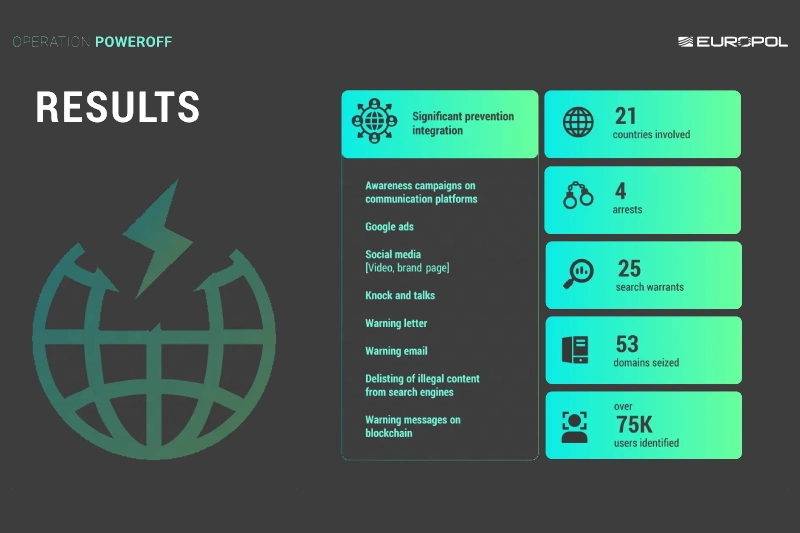
The coordinated effort led to the seizure of 53 domains, four arrests, 25 search warrants, and warning notices sent to more than 75,000 people suspected of using so-called “booter” or “stresser” platforms.

A Crackdown on DDoS-for-Hire

DDoS-for-hire platforms allow customers to pay relatively small fees to launch distributed denial-of-service attacks against websites, gaming services, businesses, and public infrastructure. In fact, AI-driven threat intelligence company Cyble, in a new research report released today said, DDoS was the primary mode of attack during the ongoing Iran-Israel and U.S. conflict. Cyble recorded a 140% increase in DDoS attacks targeting Israeli entities after September 2025, and at the height of the conflict, saw 40 DDoS attacks per day.

These DDoS-for-hire services often market themselves as legitimate stress-testing tools, but authorities say they are widely abused for harassment, extortion, and disruption.

The latest enforcement wave is part of the long-running international initiative known as "Operation PowerOFF," which has previously dismantled multiple booter services and disrupted related infrastructure.

Read: DDoS-for-Hire Empire Dismantled as Poland Arrests Four, U.S. Seizes Nine Domains

U.S. Authorities Seize Key Infrastructure

The U.S. Department of Justice said investigators in Alaska seized infrastructure linked to eight DDoS-for-hire domains, including services branded as Vac Stresser and Mythical Stress, both of which allegedly advertised the ability to launch tens of thousands of attacks per day. Investigators also searched backend servers tied to the platforms.

Officials did not immediately identify those behind the services, but said the action was intended to disrupt the technical backbone used to power attacks globally.

75,000 Users Contacted Directly

In one of the more unusual aspects of the operation, authorities contacted more than 75,000 suspected users directly through warning emails and letters.

Law enforcement agencies appear to be using deterrence alongside takedowns—sending a message that paying for DDoS attacks leaves a trail and may bring legal consequences.

Security experts say the tactic could be particularly effective against younger or low-level offenders who use these platforms for gaming disputes, personal retaliation, or vandalism without fully understanding the legal risks.

Investigators said they identified around three million criminal accounts connected to the wider DDoS-for-hire ecosystem. The sheer number of accounts shows how industrialized cybercrime services have become. Instead of building botnets or malware, users can simply rent attack capability on demand.

DDoS attacks overwhelm a target with traffic, often causing websites, applications, or networks to crash. While sometimes dismissed as nuisance attacks, they can disrupt hospitals, financial institutions, government portals, and emergency services.

Recent years have also seen DDoS attacks used as smokescreens to distract security teams while other intrusions unfold.

Read: Europol Issues Public Alert: ‘We Will Never Call You’ as Phone and App Scams Surge

A Persistent Cat-and-Mouse Game

Despite repeated takedowns, booter services often reappear quickly under new names, new domains, or relocated hosting providers. Researchers have found that while seizures can significantly reduce traffic in the short term, the market has proven resilient over time.

That means operations like PowerOFF may need to combine arrests, infrastructure seizures, financial disruption, and user deterrence to have lasting impact.

❌
❌