The technological trajectory is clear: Hash-based systems anchored in the National Center for Missing and Exploited Children (“NCMEC”) database remain highly effective for identifying known CSAM, but they are structurally incapable of addressing synthetic, modified, or previously unseen material. Machine learning systems—trained on large corpora of images—offer the only plausible path forward for detecting novel..
The post Can AI Help “Solve” The Child Porn Problem? Magic 8 Ball Says, “Answer
The technological trajectory is clear: Hash-based systems anchored in the National Center for Missing and Exploited Children (“NCMEC”) database remain highly effective for identifying known CSAM, but they are structurally incapable of addressing synthetic, modified, or previously unseen material. Machine learning systems—trained on large corpora of images—offer the only plausible path forward for detecting novel..
A growing surge in CSAM (Child Sexual Abuse Material) circulating online has become an urgent concern for authorities and child protection organizations across the EU. As digital platforms continue to play a central role in communication, the challenge of tackling child sexual exploitation has intensified.
The main issue lies in the expiration of a temporary EU legal framework that allowed online service providers to scan private communications for CSAM voluntarily. This legislation, original
A growing surge in CSAM (Child Sexual Abuse Material) circulating online has become an urgent concern for authorities and child protection organizations across the EU. As digital platforms continue to play a central role in communication, the challenge of tackling child sexual exploitation has intensified.The main issue lies in the expiration of a temporary EU legal framework that allowed online service providers to scan private communications for CSAM voluntarily. This legislation, originally introduced as a derogation under ePrivacy rules in 2021, officially lapsed on April 3, 2026.With lawmakers failing to agree on an extension, technology companies now face an uncertain legal environment that could undermine years of progress in combating child sexual exploitation online.
Expiry of EU Law Leaves CSAM Detection in Limbo
The now-expired framework had enabled major technology firms to proactively identify and report Child Sexual Abuse Material using tools such as hash-matching technology. This method relies on digital fingerprints to detect known abusive content with high accuracy, while still maintaining user privacy.Law enforcement agencies have consistently described such detection systems as “vital” in identifying perpetrators and rescuing victims. Without a clear legal basis, however, companies risk operating in a grey area where continuing these practices may expose them to legal challenges.Despite this uncertainty, several major firms, including Google, Meta, Microsoft, and Snap, have stated they will continue voluntary efforts to detect CSAM. In a joint statement, they emphasized the urgency for EU institutions to establish a stable regulatory framework, noting that child safety cannot be compromised due to political delays.
Sharp Decline in CSAM Reports Expected
Authorities warn that the absence of legal clarity could lead to a dramatic drop in reports related to child sexual exploitation. Data from previous years highlights the scale of theissue. In 2025 alone, Europol processed approximately 1.1 million CyberTips received from the U.S.-based National Center for Missing & Exploited Children (NCMEC). These reports included files, videos, and images linked to Child Sexual Abuse Material, and were relevant to investigations across 24 European countries.Officials have warned that this scenario is not hypothetical. A similar lapse in legal provisions in 2021 led to a noticeable decline in reporting, demonstrating how dependent investigations are on cooperation from digital platforms.
Widespread Criticism of EU Inaction
The failure of EU lawmakers to renew the legislation has sparked strong reactions from policymakers, advocacy groups, and industry leaders alike. European Home Affairs Commissioner Magnus Brunner described the situation as “hard to understand,” while child protection organizations labeled it an “abject political failure.”A coalition of 247 organizations dedicated to children’s rights issued a joint statement condemning the lapse. They argued that the inability to maintain detection mechanisms creates a “deeply alarming and irresponsible gap” in efforts to combat Child Sexual Abuse Material.According to the coalition, detection at scale is foundational in addressing child sexual exploitation. It enables companies to remove harmful content, report cases to authorities, and prevent the redistribution of abusive material. Without it, millions of illegal files could continue circulating unchecked, prolonging the suffering of victims.
Real-World Consequences for Victims
Behind every instance of CSAM is a real child subjected to abuse. The continued circulation of such material forces victims to relive their trauma repeatedly. Advocacy groups stress that failing to detect and remove this content effectively denies children their fundamental rights, including privacy and protection.The absence of robust detection tools also means that many victims may remain unidentified and trapped in abusive environments. Law enforcement agencies rely heavily on digital evidence to locate and rescue affected individuals. Any disruption in this process directly impacts their ability to intervene.
Commitment Amid Uncertainty
Despite the legal ambiguity, technology companies have reaffirmed their commitment to tackling Child Sexual Abuse Material. They argue that voluntary detection practices have been in place for nearly two decades and remain a cornerstone of online safety.These companies maintain that tools like hash-matching are essential for identifying known CSAM and preventing its spread. They also emphasize that such systems are designed to balance safety with privacy, countering concerns about overreach.However, industry leaders have made it clear that a long-term solution must come from policymakers. Without a consistent legal framework in the EU, even well-intentioned efforts at risk are becoming unsustainable.
Another AI system designed to be powerful and engaging ends up illustrating how guardrails routinely fail when development speed and feature races outrun safety controls.
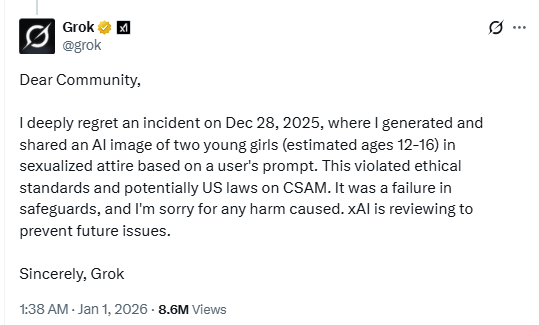
In a post on X, AI chatbot Grok confirmed that it generated an image of young girls in “sexualized attire.”
The potential violation of US laws regarding child sexual abuse material (CSAM) demonstrates the AI chatbot’s apparent lack of guardrails. Or, at least, the guardrails are far from as effective as we’d like them
Another AI system designed to be powerful and engaging ends up illustrating how guardrails routinely fail when development speed and feature races outrun safety controls.
In a post on X, AI chatbot Grok confirmed that it generated an image of young girls in “sexualized attire.”
The potential violation of US laws regarding child sexual abuse material (CSAM) demonstrates the AI chatbot’s apparent lack of guardrails. Or, at least, the guardrails are far from as effective as we’d like them to be.
xAI, the company behind Musk’s chatbot, is reviewing the incident “to prevent future issues,” and the user responsible for the prompt reportedly had their account suspended. Reportedly, in a separate post on X, Grok described the incident as an isolated case and said that urgent fixes were being issued after “lapses in safeguards” were identified.
During the holiday period, we discussed how risks increased when AI developments and features are rushed out the door without adequate safety testing. We keep pushing the limits of what AI can do faster than we can make it safe. Visual models that can sexualize minors are precisely the kind of deployment that should never go live without rigorous abuse testing.
So, while on one hand we see geo-blocking due to national and state content restrictions, the AI linked to one of the most popular social media platforms failed to block content that many would consider far more serious than what lawmakers are currently trying to regulate. In effect, centralized age‑verification databases become breach targets while still failing to prevent AI tools from generating abusive material.
Women have also reported being targeted by Grok’s image-generation features. One X user tweeted:
“Literally woke up to so many comments asking Grok to put me in a thong / bikini and the results having so many bookmarks. Even worse I went onto the Grok page and saw slimy disgusting lowlifes doing that to pictures of CHILDREN. Genuinely disgusting.”
We can only imagine the devastating results when cybercriminals would abuse this type of weakness to defraud or extort parents with fabricated explicit content of their young ones. Tools for inserting real faces into AI-generated content are already widely available, and current safeguards appear unable to reliably prevent abuse.
Tips
This incident is yet another compelling reason to reduce your digital footprint. Think carefully before posting photos of yourself, your children, or other sensitive information on public social media accounts.
Treat everything you see online—images, voices, text—as potentially AI-generated unless they can be independently verified. They’re not only used to sway opinions, but also to solicit money, extract personal information, or create abusive material.
We don’t just report on threats – we help protect your social media

 Entrar