Visualização normal

Antes de ontemStream principal
  • ✇Cybersecurity News
  • AWS Password Spraying Campaign Targets Root Accounts Do Son
    Datadog uncovered an AWS password spraying campaign targeting cloud environments. Protect your accounts against this AWS password spraying activity now. Related Posts: US Offers $10M for IRGC Cyber Leader Coder Registry Attack: Hijacked Cloudflare Pool Served Malicious Terraform Modules Toy Ghouls Backdoor Uses HiveMQ and Element for C2 The post AWS Password Spraying Campaign Targets Root Accounts appeared first on Daily CyberSecurity.
     

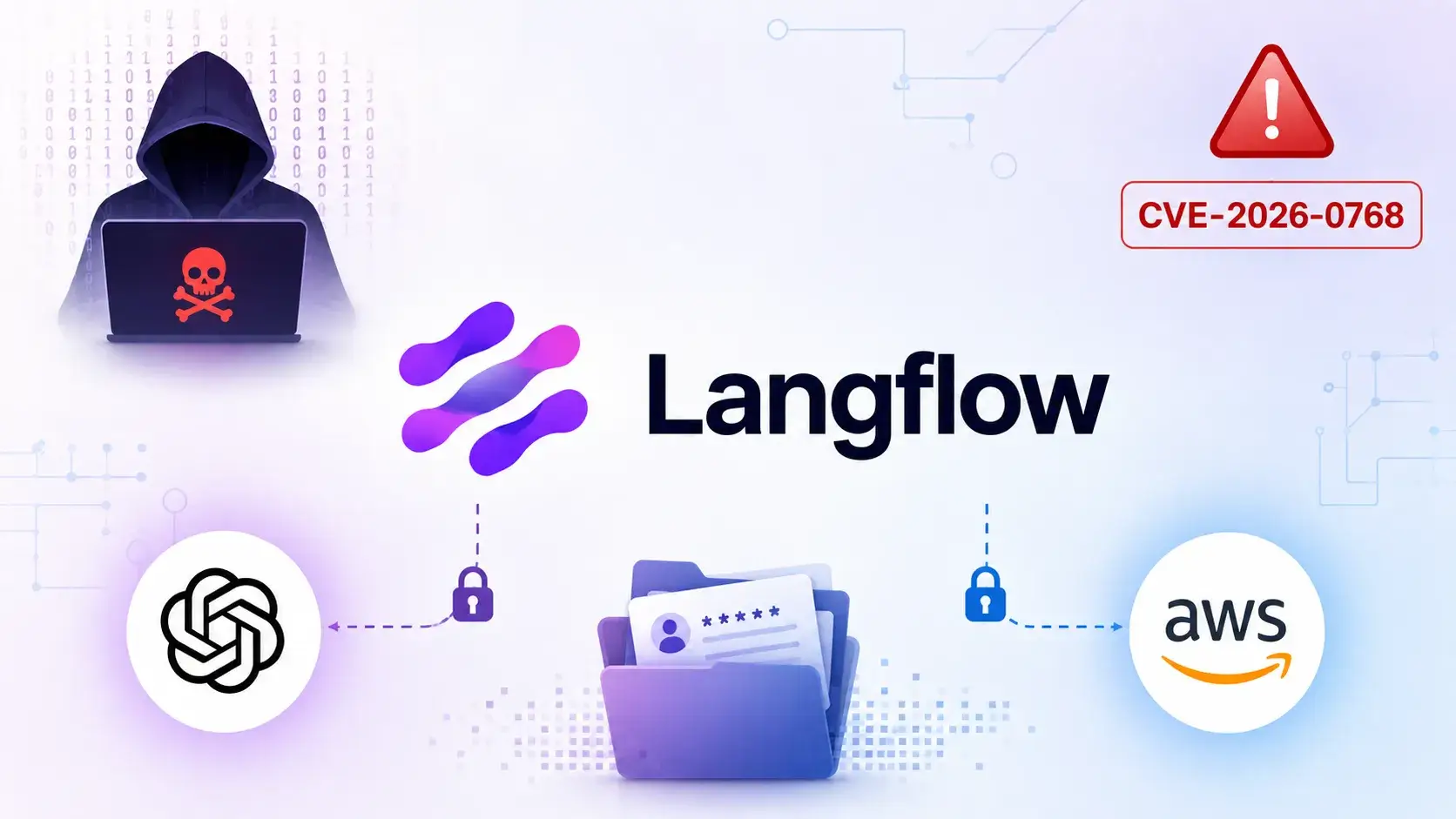
Hackers Exploit Langflow RCE Flaw to Harvest OpenAI and AWS Credentials

Threat actors are actively exploiting a critical remote code execution vulnerability in Langflow, a low-code platform used for building AI-powered applications and automating workflows. This vulnerability, tracked as CVE-2026-0768, affects the code validator in Langflow’s custom component editor. According to Caitlin Condon, VP of Security Research at VulnCheck, the flaw allows unauthenticated remote code execution […]

The post Hackers Exploit Langflow RCE Flaw to Harvest OpenAI and AWS Credentials appeared first on GBHackers Security | #1 Globally Trusted Cyber Security News Platform.

  • ✇Cyber Security News
  • AWS Network Firewall Now Displays Count of Triggered Security Rules Abinaya
    AWS has introduced rule hit count support for AWS Network Firewall, giving security teams direct visibility into which stateful firewall rules are matching live network traffic. The new capability is enabled by default and helps organizations identify active, inactive, and potentially misconfigured rules without manually reviewing large volumes of firewall logs. As firewall policies grow, they often accumulate rules that are no longer needed, never trigger, or are placed incorrectly in the
     

AWS Network Firewall Now Displays Count of Triggered Security Rules

24 de Agosto de 2026, 03:27

AWS has introduced rule hit count support for AWS Network Firewall, giving security teams direct visibility into which stateful firewall rules are matching live network traffic.

The new capability is enabled by default and helps organizations identify active, inactive, and potentially misconfigured rules without manually reviewing large volumes of firewall logs.

As firewall policies grow, they often accumulate rules that are no longer needed, never trigger, or are placed incorrectly in the inspection order.

Until now, teams had to search alert logs manually to determine whether a specific rule was being used. This could make firewall cleanup, incident investigations, and compliance validation slow and difficult.

The rule hit count feature uses AWS Network Firewall alert logs to show how frequently individual stateful rules match traffic.

AWS Network Firewall Shows Triggered Security Rules

The AWS console’s Top Rule Hits dashboard displays the signature ID, rule description, resource ARN, total hit count, percentage of overall hits, and the most recent time the rule was triggered.

This lets security teams quickly determine whether a control is active. A rule that repeatedly appears in the dashboard is matching traffic, while a rule that does not appear during the selected lookback period may be unused, outdated, or positioned behind another matching rule.

 Rule hit count from the dashboard (source : aws )
 Rule hit count from the dashboard (source: AWS)

AWS Network Firewall counts a rule hit only when the traffic match generates an alert log. Rules using alert, drop, or reject actions are included because these actions create alert records.

However, pass rules do not create alert logs by default and therefore do not appear in hit count data. Organizations that want to measure matches for allow rules can add the alert keyword to a Suricata pass rule.

For example, a rule can permit HTTPS traffic while simultaneously creating an alert log. This allows teams to monitor authorized traffic patterns without blocking the connection.

AWS adds an aws_metadata field to alert logs, including the ARN of the rule group or firewall policy that produced the event.

Analysts can combine the resource ARN with the Suricata signature ID (SID) to identify the exact rule that generated an alert, with alert data delivered to Amazon CloudWatch Logs or Amazon S3.

Security operations teams can investigate the logs with CloudWatch Logs Insights or Amazon Athena, while the native Network Firewall monitoring dashboard provides an easier view of the most frequently triggered rules.

The feature can help during incident response. For example, if a security team suspects outbound communication with a malicious domain, it can filter the rule hit count view to the relevant time period.

This can reveal whether a domain-blocking or threat-detection rule triggered, how often it matched, and when the most recent event occurred.

Rule hit counts can also support compliance operations. Teams working with PCI DSS 4.0, DORA, and internal governance requirements can use the data as evidence that firewall controls are functioning.

It also helps central cloud security teams review policies managed for multiple business units and remove dormant rules that consume capacity without adding protection.

AWS noted that system-generated signature IDs may also appear in the dashboard. These can represent strict-order default actions, such as dropping established traffic that did not match an explicit rule. In these cases, the displayed ARN points to the firewall policy rather than a stateful rule group.

Rule hit count is available at no additional AWS Network Firewall charge, although normal CloudWatch Logs, Amazon S3, and Athena storage or query fees still apply.

The capability supports stateful rules only; stateless rules are not currently covered. It is available in supported AWS Regions except the Middle East Bahrain and Middle East UAE Regions.

Prevent incidents due to slow investigations. Power your Tier 1 with threat intelligence from 15K SOCs: Integrate TI Lookup in your SOC

The post AWS Network Firewall Now Displays Count of Triggered Security Rules appeared first on Cyber Security News.

AWS Network Firewall Adds Rule Hit Counts to Identify Unused Security Rules

AWS has introduced a new capability for AWS Network Firewall that tracks rule hit counts, providing security teams with direct visibility into how often individual stateful firewall rules match live network traffic. This feature aims to minimize reliance on manual log reviews. It helps organizations identify dormant, misordered, or ineffective rules across both custom and […]

The post AWS Network Firewall Adds Rule Hit Counts to Identify Unused Security Rules appeared first on GBHackers Security | #1 Globally Trusted Cyber Security News Platform.

  • ✇Cybersecurity News
  • Leaked Corporate AWS Keys Expose Full Admin Rights Do Son
    Truffle Security found leaked corporate AWS keys holding full control. See how leaked corporate AWS keys admin rights expose enterprise cloud accounts. Related Posts: Take-Two Subpoenas Microsoft and Discord Over GTA VI "Cyberleek" Leaks AliExpress Audio Fingerprinting Hijacks Your Bluetooth ChatGPT iMessage Integration: A macOS Privacy Clash The post Leaked Corporate AWS Keys Expose Full Admin Rights appeared first on Daily CyberSecurity.
     
  • ✇Schneier on Security
  • AI Data Centers and the Concentration of Wealth Bruce Schneier
    This essay was written with Nathan E. Sanders, and originally appeared in The Guardian. Opposition to AI data centers has emerged as a primary theme in US politics, one that—surprisingly—doesn’t fall along party lines. We applaud people coming together for constructive debate on any issue, and agree that communities need to evaluate whether any economic benefits these data centers bring is worth their costs. Still, we worry that a focus on data centers obscures the larger impacts of AI on people
     

AI Data Centers and the Concentration of Wealth

13 de Julho de 2026, 08:01

This essay was written with Nathan E. Sanders, and originally appeared in The Guardian.

Opposition to AI data centers has emerged as a primary theme in US politics, one that—surprisingly—doesn’t fall along party lines. We applaud people coming together for constructive debate on any issue, and agree that communities need to evaluate whether any economic benefits these data centers bring is worth their costs. Still, we worry that a focus on data centers obscures the larger impacts of AI on people’s lives: the concentration of power of AI companies, and their widespread political and financial influence.

Local data center opposition is grounded in legitimate concerns about misallocation of land resources when housing is at a premium, pressures on already higher energy prices, and localized environmental impact. Unlike other resource-consuming and polluting industrial facilities, data centers produce very few jobs. The fact that US opposition to data centers seems to be most fierce among lower-income communities reflects righteous indignation with an inequitable bargain, where tech companies and developers profit from exploiting local resources but offer little in return. On a global scale, their carbon footprint could grow unsustainably if usage accelerates. And all this is in aid of a technology that many fear will propagate misinformation, take their jobs, or even cause existential risks for humanity.

For some, data center opposition may feel like the only tangible mechanism for registering their concern, disapproval, or even anger about AI. The problem is that this may be exactly what the AI companies are banking on. They can overcome the protest when it matters to them, and live with a significant fraction of proposals being defeated. More importantly, focusing political opponents on the data center issue obscures the bigger prize they’re after.

While there is a staggering three-quarters of a trillion dollars being spent on data center infrastructure by US companies this year alone, this investment should be taken in perspective. The market for enterprise software, for example, is about twice this size. And it’s small compared with what these companies actually want.

AI companies have their eyes set on capturing all the value created by entire industries. The technology has arguably already conquered customer service and consumer sales. But on the horizon are bigger targets, such as enterprise software development, creative design, management and even legal services. In AI companies and their allies’ vision of the future, AI replaces teachers and doctors. The companies would rather spend time fighting resistance to how fast they are building computing infrastructure than dealing with issues of how their products should be used in those fields, or how those fields should be protected from their products.

And while data center opposition campaigns have been successful in building widespread appeal, their effectiveness in the US is mixed. They seem to be most successful when organizing against speculative, early-stage data center proposals that have a relatively low likelihood to ever see fruition. Meanwhile, advanced-stage, well-capitalized data center projects have proven to have the resources to overcome local opposition. An OpenAI- and Oracle-backed facility in Saline township, Michigan, is breaking ground on construction even after local officials voted to reject it. The developers sued the town of 3,000 and forced a settlement that involved their project going forward. Meanwhile, the Trump administration, a vigorous ally of corporate AI, has signaled its willingness to advance AI infrastructure development by overriding state objections and even using federal lands.

Also consider that rampant data center development may be a momentary spike rather than a longstanding concern. Demand for the centralized computing that data centers provide may well decline over time. The leading Chinese labs, such as Z.ai, are innovating in technical mechanisms to make frontier-class models smaller and cheaper to run. AI power users have become adept at miniaturizing open weight models, ones published free for anyone to download and use, to run locally on their own computers. Apple and Google both support infrastructure stacks for running AI models directly on mobile phones. It could be that the current mania for data centers will look like the fiber optic cable bubble from the early 2000s, as demand shifts to smaller models and AI usage on people’s own devices.

For those concerned primarily with affordability and environmental protection, singling out data center construction is misplaced. Energy rates and inflation today seem to be most visibly affected by the US-Iran war. The US is disinvesting in long-term energy security by ceding the renewable energy industry to China and actively cancelling climate commitments. Consider that 10% of global carbon emissions stem from heating buildings, which dwarfs energy use by AI and could be cut fivefold by using heat pumps powered by renewable energy. With respect to housing affordability, federal housing subsidies have changed little over three decades, in inflation-adjusted terms, even as housing costs have spiked and homeowners have enjoyed robust tax incentives.

As for AI itself, the concentration of power and wealth in these tech companies is the greatest existential risk facing society today. This means we must limit corporate power, especially corporations’ ability to exploit the public and manipulate our political system.

Opposing data centers should be just a starting point. We can advocate for states to regulate AI, to reject irresponsible uses of the technology, and shape corporate behavior. We can fight for AI computation to be taxed, so that the public can capture some of the profit of AI use while also forcing AI companies to internalize more of the energy and environmental consequences associated with its use. And we all can join the global movement for Public AI, an alternative ecosystem for AI that is developed under public control with an incentive structure to create public benefit rather than private profit.

The US midterm elections present ample opportunity for those seeking to control the AI political agenda. In the recent New York congressional Democratic primary, PACs linked to the dueling AI companies Anthropic and OpenAI spent millions of dollars lobbying for or against “AI safety“, the idea that we must urgently monitor and prevent people from using AI to cause catastrophic harms. We’re already seeing a similar dynamic play out in races in Massachusetts and other states.

Why would Anthropic and OpenAI—bitter industry rivals but fundamentally on the same side politically—support opposing viewpoints? Because they both ultimately profit from the mystique: the idea that their products are so powerful that controlling those products is the world’s most important challenge. Here’s the typical read on the dynamic. To one side (backed by OpenAI affiliates), “safety” comes from the appearance of US industry dominating AI innovation, under the slow-moving control of federal lawmakers (and without pesky state regulators in the way). To the other side (backed by Anthropic), “safety” means a heavier regulatory framework that plays to Anthropic’s posturing as the ethics- and compliance-focused AI vendor. In both cases, it’s more marketing than principled concern about safety.

Political organizers should call out and reject the AI companies’ framing of the debate, and reorient campaign agendas around populist resistance to corporate concentration of wealth and power. When AI companies pump millions into legislative races, the result should not be hyperbolic discussion of AI superintelligence. And when a plot of land in a small town is pitched as a data center site, the debate should be about more than the local costs and benefits. It should include out-of-control money in politics, and Citizens United-proof solutions to limit corporate influence like public financing and state regulation.

We all have a vested interest in what’s on the policy agenda, and what the outcomes are. Today, the greatest risk AI poses to society is the exacerbation of inequality and the concentration of wealth. The real problem is trillion-dollar AI companies and their trillionaire oligarchs cozying up to political power in Washington and governments worldwide, and using their money to enact their agenda over the popular will of the people. This is the issue we’d like to see put front and center, and it requires solutions much more extensive than slowing data center development.

  • ✇Schneier on Security
  • AI Use by the US Government Bruce Schneier
    On 14 April, the Trump administration quietly acknowledged the widespread use of AI to automate government processes. The office of management and budget (OMB) disclosed a staggering 3,611 active or planned use cases for AI across the federal government. The list has ballooned by 70% from the one published in the final year of the Biden administration, and includes many disturbing-seeming plans to hand over sensitive governmental functions to AI. Scanning this list, many readers may find many ca
     

AI Use by the US Government

17 de Junho de 2026, 08:04

On 14 April, the Trump administration quietly acknowledged the widespread use of AI to automate government processes. The office of management and budget (OMB) disclosed a staggering 3,611 active or planned use cases for AI across the federal government. The list has ballooned by 70% from the one published in the final year of the Biden administration, and includes many disturbing-seeming plans to hand over sensitive governmental functions to AI.

Scanning this list, many readers may find many causes for alarm. It represents a transfer of decision processes from human to machine on a massive scale over matters of individual freedom, public health and well-being, nuclear reactor safety and more.

Consider these examples. The Health and Human Services’ (HHS) office of administration for children and families hired the world’s “scariest AI company,” Palantir—notorious for its work on behalf of the military, the CIA and ICE—to scan all grant applications to flag those not ideologically aligned with the administration’s dictates. The Federal Bureau of Prisons is developing an AI system to assess the “potential for misconduct for newly admitted inmates,” routing people into high-security confinement before they have actually done anything wrong in their custody. These read like programs fit for a Philip K Dick or George Orwell novel.

Other use cases insert AI into life-and-death decision making. The Department of Veterans Affairs is developing an AI that will listen in on calls to the veterans crisis line, and then gather information from external databases to assess the mental state and suicide risk of the caller.

The Department of Energy is testing the use of AI to control nuclear reactors, targeting a way to autonomously respond to potential nuclear safety incidents. Here’s one that’s disturbing for its retirement, rather than its deployment: the state department has ended a program to use AI to forecast mass civilian killings, which had been intended to aid conflict prevention.

While it’s easy to raise questions about these and similar uses of AI, the reality is that any of these programs could be implemented responsibly. In some cases, like the HHS system, the AI might be enforcing alignment to a policy prescription that opponents abhor. But that concern is more about the policy itself rather than the idea that agencies should comply with executive orders.

In other cases, there may even be bipartisan agreement on the goal, like taking urgent action to help veterans at risk of self-harm. Lots of work and validation is needed to prove AI safe and effective for these use cases and convince the public it is appropriate, but the idea is plausible.

In other cases, a scary-sounding AI use may not even be new. The use of predictive methods and statistics to assign prisoner security classifications goes back decades, even if such systems are often biased and ineffective.

Using autonomous systems for model predictive control (MPC) of nuclear reactors is a well studied, and a widely applied aspect of nuclear plant management. And the recently disclosed addition of AI was initiated under the Biden administration.

But anyone reviewing the 2025 inventory could be forgiven for leaping to severe conclusions. What matters are the details of how the AI system is used, and here the inventory is severely lacking.

The disclosures carry minimal information, and lack the context necessary to understand their purpose and approach. The descriptions are typically just a sentence, and rarely more than a paragraph.

And while the process theoretically involves some form of public consultation, in reality there is generally none. It would take an eagle-eyed citizen to even come across this disclosure. Unless you read FedScoop regularly, or watch the OMB’s federal chief information officer’s GitHub account, you probably missed it.

Only one of the examples cited above (the DoJ) even proposes to involve the public. Under the administration’s policy, it’s not required for the rest because they are not classified as “high impact” use cases—a label that is applied inconsistently across agencies.

We wrote a book surveying applications of AI to democratic processes worldwide, including executive agencies as well as the courts, legislatures and politics. Our conclusion was that, while there are inappropriate applications of AI in governance that should be resisted, an urgent need to reform the economics of AI, and an imperative for renovating the democratic systems it is being unleashed on, there are also valuable and beneficial use cases for AI in government.

Machine translation is a good example. Customs and Border Protection (CBP) has deployed an AI translation system to help officers when human interpreters are not available. The idea that CBP, an agency under heavy scrutiny for reported abuses of human rights, would direct people to talk to a machine instead of a person may strike many as inhumane.

It’s true that human interpreters have very real advantages when it comes to understanding nuance from physical cues and social context. But an officer with a competent AI translator available immediately is better than one who cannot communicate with the person in front of them.

The Trump administration’s AI use case inventory has 70 such translation use cases, up from 58 in the Biden administration’s 2024 disclosure.

Disclosure of AI use cases could be a means to build public confidence and trust, but only if paired with consistent, meaningful public consultation. Washington DC and California are actively engaging the public to determine where and how it’s appropriate to use AI in government processes, or for government to regulate AI use in society.

Both have held public deliberations on this topic at a wide scale, using AI platforms. These examples demonstrate the potential for capturing broad-based public input to steer AI policy.

The international gold standard was arguably set by the French in 2016, via their Digital Republic Act. The law, itself informed by an online citizen consultation, requires all algorithms used to automate government administrative decisions to be subject to public records requests, to be appealable to a human reviewer, and to have mandatory notification of the use of automation to those affected by the decisions.

Canada offers another example of what more rigorous and participatory disclosure might look like. In 2025, they launched an AI use case registry, not unlike the US inventory. However, Canada also has a federal directive mandating a transparent risk-scoring and impact assessment process for automated systems that make administrative decisions about citizens.

That longstanding directive requires a detailed explanation of risks and benefits as well as consultation with certain stakeholders from the conception of the AI use case. The Canadian system could be improved; it could require a public comment period and an obligation for agencies to respond substantively to feedback before engaging in sensitive uses of AI.

AI offers real potential to improve the efficacy, efficiency and accessibility of government. But, equally, there is legitimate reason for public concern and distrust that can only be addressed through transparency and dialog. The US should adopt, at the federal and state level, algorithmic impact risk assessment procedures and public comment processes to facilitate a safe, trusted, equitable transformation of government agencies to take advantage of modern technology.

This essay was written with Nathan E. Sanders, and originally appeared in The Guardian.

  • ✇@BushidoToken Threat Intel
  • UK Cybercrime Journal: Arup Group Breached by FulcrumSec BushidoToken
     What Happened:On 10 May 2026, the UK-based firm Arup Group was listed as a victim on the Tor data leak site of FulcrumSec. On their Tor data leak site, FulcrumSec stated that they have exposed 700GB of GitHub repos and 2TB of Azure and AWS S3 cloud, plus database backups.Other types of data the adversary claims to have stolen includes Neuron BMS client databases, Odoo ERP data, A66 landowner files, Apple code-signing certificates with plaintext passwords, a Google Cloud Platform (GCP) project w
     

UK Cybercrime Journal: Arup Group Breached by FulcrumSec

10 de Junho de 2026, 04:00


What Happened:

  • On 10 May 2026, the UK-based firm Arup Group was listed as a victim on the Tor data leak site of FulcrumSec. 
  • On their Tor data leak site, FulcrumSec stated that they have exposed 700GB of GitHub repos and 2TB of Azure and AWS S3 cloud, plus database backups.
  • Other types of data the adversary claims to have stolen includes Neuron BMS client databases, Odoo ERP data, A66 landowner files, Apple code-signing certificates with plaintext passwords, a Google Cloud Platform (GCP) project with production payment gateway credentials, and the source code of ArupCompute and Oasys. 
  • The FulcrumSec operators also claimed to have spent over half a year analysing the data and went through “email correspondence” with the company before publishing the stolen data.
  • On the victim post, FulcrumSec wrote a detailed incident breakdown. In it, they stated they gained initial access in September 2025 via a GitHub personal access token found hardcoded in a JavaScript file on a forgotten subdomain, which provided access to over 10,000 private GitHub repositories belonging to Arup Group.
  • From there, they scanned the repositories and found additional hardcoded tokens, API keys, and passwords for AWS, Azure, and databases.
  • The adversary stated that Arup detected the Github and Azure Storage intrusions approximately six weeks after they happened and rotated the credentials, but it was too late as the data had been exfiltrated. 
  • FulcrumSec also stated they pivoted into the AWS infrastructure using keys they had found belonging to Arup’s subsidiary Neuron.
  • FulcrumSec allegedly waited until April 2026 to contact their victim, Arup Group, due to the time it took to analyse the vast amounts of stolen data.
  • Impacted client organisations of Arup Group were also mentioned in the post, such as Disney and several other Hong Kong companies. The adversary reportedly uncovered Amazon data center seismic fragility data, British Petroleum (BP) site selection coordinates, and Queensferry Crossing internal documents as well.
  • Critically for the UK, the breached data exposed up to 62 HS2 related GitHub repositories. This involved Euston Station pile design files, ground movement assessments, over 14,000 sensor monitoring records, 48 archaeological site GPS coordinates (including Jones Hill Wood, a sensitive site for environmentalists), as well as confidential documents.

Analyst Comment:

Arup Group is a large multinational architectural design and engineering firm based in London who has been involved in constructing the Wembley Football Stadium in London, the HS1 Channel Tunnel Rail Link network, and the Eden Project in Cornwall, among other significant international construction projects.


Active since September 2025, FulcrumSec is a financially motivated data-theft-extortion group that specialises in rapid exfiltration of cloud-hosted databases by exploiting unrotated API keys and misconfigured cloud permissions.


This attack was noteworthy due to its highly targeted nature. FulcrumSec claimed they had access to Arup Group’s data for seven months and they clearly invested significant time to analyse the documents and spent weeks negotiating over email. Plus, to find initial access they also would have had to spend time checking Arup’s domains and Internet-facing assets to eventually find a single leaked credential to exploit. These types of targeted intrusions often only happen to large companies. This is because for it to be worth the cybercriminal’s time, effort, and risk to their freedom they will want a large ransom payment that only rich companies can typically afford.


FulcrumSec is an adversary worth monitoring due to the effort they put into their intrusions compared to other smash-and-grab ransomware campaigns. In October 2025, in a case documented by VX-Underground, FulcrumSec emailed detailed information about the breach they conducted with the aim of those details getting published and exert additional pressure on the victim.


Interestingly, FulcrumSec said the ransom they demanded was less than 1% of Arup’s annual revenue and was less than how much Arup lost to the deepfake fraudsters. This is a reference to Arup reportedly lost over £20 million pounds in 2024 after one of their Hong Kong employees was duped into sending cash to cybercriminals using an AI-generated video call. The fact Arup became publicly known for falling victim to a large scam potentially contributed to the adversary’s decision to select and focus them for this attack.


Defensive Takeaways:

  • Asset Inventory and Shadow IT Audits: Identifying the outdated unused domains with hardcoded credentials is standard best practices. All organisations must have processes in place to catalog and retire systems to avoid incidents like this. 
  • Hardcoded Credentials in Code: They way FulcrumSec gained access demonstrates the importance of using secret environment variables and features like GitHub Secret Scanning.
  • Implement Incident Response Procedures: Importantly, Arup detect the activity too late and it took them a staggering six weeks to rotate credentials (according to the adversary), which shows why having automated systems to check for unauthorised usage and reset tokens and all accounts is crucial to respond to such attacks.
  • GitHub Activity Monitoring: The adversary claimed they were able to clone thousands of GitHub repositories containing sensitive data without being detected. These types of activities are available to monitor and detect in GitHub Audit Logs. It’s also important to have a plan in place when suspicious activities are detected.
  • Third-Party Risk Management Programs: This incident also had some notable downstream impact. It shows why client organisations of another company’s services need to know what data and how much data is stored by third-parties for when such breaches occur. Knowing what’s potentially exposed will streamline the response to the incident.
  • Deception Tech: Arup could have implemented a boobytraps for the adversary such as the use of CanaryTokens inside sensitive documents. As the adversary spent time analysing the Arup’s documents before contacting them, if they open a boobytrapped document, then the incident could been detected much earlier and the damages could have been reduced.


Relevant Sources:

  1. https://x.com/darkwebinformer/status/2053281385582891437 
  2. https://www.ransomware.live/id/QXJ1cCBHcm91cEBmdWxjcnVtc2Vj 
  3. https://en.wikipedia.org/wiki/Arup_Group
  4. https://www.theguardian.com/technology/article/2024/may/17/uk-engineering-arup-deepfake-scam-hong-kong-ai-video


Relevant CTI Resources:

  1. https://www.ransomware.live/group/fulcrumsec
  2. https://x.com/vxunderground/status/1975629199323853027 
  3. https://www.reddit.com/r/Scams/s/wfZ3Wp94mY
  4. https://www.bleepingcomputer.com/news/security/lexisnexis-confirms-data-breach-as-hackers-leak-stolen-files/

Typosquatted npm packages used to steal cloud and CI/CD secrets

Microsoft has identified an active supply chain attack targeting the npm package ecosystem. On May 28, 2026, a single threat actor operating under the newly created maintainer alias vpmdhaj (a39155771@gmail[.]com) published 14 malicious packages within a four-hour window. The packages typosquat well-known OpenSearch, ElasticSearch, DevOps, and environment-configuration libraries, and several spoof the upstream OpenSearch project’s repository URL in their package.json to appear legitimate. Once installed, the packages harvest AWS credentials, HashiCorp Vault tokens, and CI/CD pipeline secrets from the host environment.

All packages in the cluster ship the same install-time stager and the same Bun-compiled second-stage payload – a ~195 KB credential harvester purpose-built for cloud and CI/CD environments. The payload runs silently during npm install and targets credentials across Amazon Web Services, HashiCorp Vault, GitHub Actions, and the npm registry itself, enabling both cloud lateral movement and downstream supply-chain pivoting through stolen npm publish tokens. Based on our investigation and feedback to the npm team these repos and users were taken down.

Key capabilities observed in the campaign include automatic execution via npm lifecycle hooks, two distinct stager generations (an HTTP-C2 variant and a stealthier variant that abuses the legitimate Bun runtime distribution), AWS Instance Metadata Service (IMDSv2) and ECS task-role theft, AWS Secrets Manager enumeration across 16+ regions, HashiCorp Vault token harvesting, and theft of npm publish tokens for follow-on supply-chain attacks.

Attack chain overview

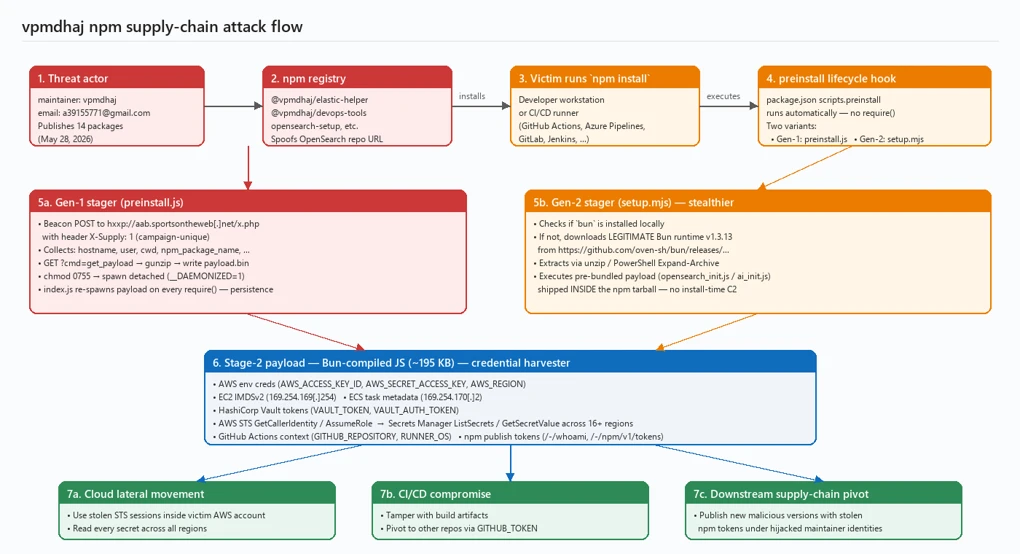
The vpmdhaj cluster spans 14 scoped and unscoped packages that all mimic the @opensearch / @elastic ecosystem. The attack proceeds through:

  • Publication of 14 typosquat packages under a single actor identity
  • Automatic payload execution through a preinstall hook during npm install
  • Execution chain (Gen-1): node -> preinstall.js -> HTTP C2 -> payload.bin (detached)
  • Execution chain (Gen-2): node -> setup.mjs -> download legitimate Bun runtime -> run bundled stage-2
  • Cloud credential theft (AWS IMDS, ECS metadata, Vault, Secrets Manager) and npm publish-token theft for downstream supply-chain pivot
Figure 1. vpmdhaj npm supply chain attack flow.

The lure: typosquats and spoofed metadata

The actor adopted three social-engineering techniques designed to drive installs by mistake or trust transference. First, lookalike naming – names such as opensearch-setup, opensearch-setup-tool, opensearch-config-utility, elastic-opensearch-helper, search-engine-setup, and env-config-manager mimic well-known cluster-management and configuration libraries. Second, spoofed upstream metadata – every unscoped package sets its package.json homepage, repository, and bugs fields to the legitimate github.com/opensearch-project/opensearch-js project. Third, inflated version numbers – releases jump straight to 1.0.7265, 1.0.9108, or 2.1.9201 to suggest a long, mature release history.

Figure 2. npm.js package page for @vpmdhaj/elastic-helper showing the inflated 1.0.7269 version and the spoofed OpenSearch repository link.

Execution: npm lifecycle hook abuse

Every package in the cluster declares an automatic install-time hook in package.json. The malicious code executes the moment a victim runs npm install – no require() from victim code is needed. Two stager variants were observed:

  • Gen-1 (versions <= 1.0.7265): install, preinstall, and postinstall hooks all invoke preinstall.js / index.js
  • Gen-2 (versions >= 1.0.7266): a single preinstall hook invokes setup.mjs (newer, stealthier loader)
Figure 3. The malicious package.json. A single preinstall hook is enough to gain code execution on every npm install.

Gen-1 stager: HTTP C2 beacon and payload drop

preinstall.js collects rich host context – hostname, platform, arch, Node version, USER/USERNAME, cwd, INIT_CWD, npm_package_name, npm_package_version – base64-encodes the JSON, and POSTs it to the actor’s C2 with a campaign-unique header X-Supply: 1. The same C2 endpoint then serves a gunzip-compressed second-stage binary, which is written to payload.bin in the package install directory, chmod 0755’d, and spawned detached.

Figure 4. Stage-1 C2 beacon. The X-Supply: 1 header is a high-confidence detection signal in proxy logs.
Figure 5. Stage-2 download, decompression, +x, and detached spawn. __DAEMONIZED=1 lets the payload distinguish itself from npm.

The package’s index.js re-launches the same payload.bin on every subsequent require() of the module – a quiet persistence mechanism that survives across CI build stages and developer rebuild loops. The module also exports a benign-looking object falsely identifying itself as @opensearch/setup.

Figure 6. Persistence shim. The malicious module exports benign-looking metadata and silently re-spawns the payload every time it is require()’d.

Gen-2 stager: abusing the legitimate Bun runtime as a loader

In newer versions, the actor replaced the noisy HTTP-C2 design with a stealthier loader that eliminates the install-time C2 round-trip entirely. setup.mjs (a) checks whether bun is already present on the host; (b) if not, downloads the legitimate Bun runtime v1.3.13 from github.com/oven-sh/bun/releases for the correct platform/arch (Linux x64/musl/aarch64, macOS x64/arm64, Windows x64/arm64); (c) extracts the ZIP using unzip, PowerShell Expand-Archive, or a hand-rolled ZIP parser; and (d) executes the pre-bundled second-stage payload (opensearch_init.js or ai_init.js) that ships inside the npm tarball.

This design reduces visibility for defenders that primarily monitor unusual outbound traffic during package installation.

Figure 7. Gen-2 loader. The actor abuses a legitimate GitHub Release of the Bun runtime to execute a pre-bundled payload that ships inside the npm tarball.

Credential theft

The second-stage binary is a single-file Bun-compiled JavaScript binary of approximately 195 KB, purpose-built for cloud and CI/CD secret theft. Static review of the bundle identifies routines that target secrets across five platforms:

  • AWS: queries EC2 Instance Metadata Service v2 (169.254.169[.]254), Elastic Container Service task metadata (169.254.170[.]2), reads AWS env credentials, calls STS GetCallerIdentity / AssumeRole, and enumerates Secrets Manager (ListSecrets / GetSecretValue) across 16+ regions with a bundled SigV4 signer.
  • HashiCorp Vault: reads VAULT_TOKEN and VAULT_AUTH_TOKEN environment variables.
  • npm: validates tokens through /-/whoami and enumerates publish access through /-/npm/v1/tokens.
  • GitHub Actions: collects GITHUB_REPOSITORY and RUNNER_OS context to identify build environments for prioritized exploitation.
  • CI/CD environment: respects __DAEMONIZED=1 to avoid re-entry, and explicitly resets CI=false to mislead build-aware code paths.
Figure 8. String evidence from the Bun-compiled stage-2 payload. The same binary is dropped by both Gen-1 and Gen-2 stagers.

Impact and blast radius

  • Stolen AWS STS sessions and Secrets Manager material enable cloud lateral movement and data theft.
  • Stolen GitHub Actions tokens enable repo manipulation and CI/CD pipeline tampering.
  • Stolen npm publish tokens enable downstream supply-chain pivoting – pushing malicious updates to packages owned by hijacked maintainer identities, expanding the campaign beyond the initial 14 packages.
  • All 14 packages target the OpenSearch / ElasticSearch ecosystem keywords, suggesting the actor likely chose a developer audience to have AWS and Elastic cloud credentials in their environments.

Mitigation and protection guidance

Microsoft recommends the following mitigations to reduce the impact of this threat:

  • Identify systems that installed or built affected package versions on or after May 28, 2026.
  • Pin known-good package versions where possible and avoid automatic dependency upgrades until validation is complete.
  • Disable pre- and post-installation script execution by running npm install with –ignore-scripts (or setting npm config set ignore-scripts true globally). Apply equivalent settings for pnpm and yarn.
  • Rotate AWS IAM/STS, HashiCorp Vault, npm publish, and GitHub Actions tokens that may have been exposed to affected runners or developer workstations.
  • Block egress to aab.sportsontheweb[.]net at proxy, firewall, and DNS layers. Alert on any HTTP request carrying the header X-Supply: 1.
  • Hunt CloudTrail for anomalous sts:GetCallerIdentity rapidly followed by sts:AssumeRole, and for secretsmanager:ListSecrets or GetSecretValue in cross-region succession from build infrastructure or developer IP space.
  • Audit CI/CD logs for unexpected outbound network connections, Bun runtime downloads from GitHub Releases by Node.js processes, and detached child processes spawned with __DAEMONIZED=1.
  • Review npm package lockfiles (package-lock.json, yarn.lock, pnpm-lock.yaml), build logs, and artifact provenance for evidence of compromised package versions.
  • Enable cloud-delivered protection in Microsoft Defender Antivirus or equivalent antivirus protection.
  • Use Microsoft Defender XDR to investigate suspicious activity across endpoints, identities, cloud apps, and developer environments.
  • Use Microsoft Defender Vulnerability Management to search for the affected packages across your estate.

How Microsoft Defender helps

Microsoft Defender Antivirus detects and blocks the malicious components on access. During reproduction in our analysis environment, setup.mjs was automatically quarantined the moment the tarball was extracted to disk.

Figure 9. Microsoft Defender auto-quarantine of setup.mjs at extract time.

Microsoft Defender XDR Detections

Microsoft Defender XDR customers can refer to the list of applicable detections below. Microsoft Defender XDR coordinates detection, prevention, investigation, and response across endpoints, identities, email, and apps to provide integrated protection against attacks like the threat discussed in this blog.

TacticObserved activityMicrosoft Defender coverage
Initial Access / ExecutionSuspicious script execution during npm install or package lifecycle activityMicrosoft Defender Antivirus
  -Trojan:JS/ShaiWorm
  -Trojan:JS/ObfusNpmJs
  -Backdoor:JS/SupplyChain

Microsoft Defender for Endpoint
  – Suspicious usage of Bun runtime
  – Suspicious installation of Bun runtime
  – Suspicious Node.js process behavior

Microsoft Defender XDR
  – Suspicious file creation in temporary directory by node.exe
  – Suspicious Bun execution from Node.js process
Credential AccessPotential harvesting of AWS, Vault, GitHub Actions, and npm tokens from CI/CD runnersMicrosoft Defender for Endpoint
  – Credential access attempt
  – Suspicious cloud credential access by npm-cached binary
  – AWS Instance Metadata Service access from suspicious process

Microsoft Defender for Cloud
  – Possible IMDS abuse from container workload
  – Anomalous Secrets Manager enumeration across regions
Command and ControlOutbound HTTP beacon with X-Supply: 1 header to attacker-controlled C2Microsoft Defender for Endpoint
  – Connection to a custom network indicator (aab.sportsontheweb[.]net)
  – Suspicious outbound HTTP from npm install context
PersistenceRe-spawn of payload.bin on every require() of compromised packageMicrosoft Defender for Endpoint
  – Detached child process spawned by node.exe with __DAEMONIZED=1

Advanced hunting

The following sample queries let you search for a week’s worth of events. To explore up to 30 days of raw data, go to the Advanced Hunting page > Query tab, and update the time range to Last 30 days.

Hunt for suspicious npm lifecycle script execution involving vpmdhaj packages.

DeviceProcessEvents
| where Timestamp > ago(7d)
| where FileName in~ ("node.exe", "node", "npm.cmd", "npm.exe", "npx.cmd", "npx.exe")
| where ProcessCommandLine has_any ("preinstall", "postinstall", "install")
| where ProcessCommandLine has_any (
    "@vpmdhaj", "opensearch-setup", "opensearch-setup-tool",
    "opensearch-config-utility", "opensearch-security-scanner",
    "search-engine-setup", "search-cluster-setup",
    "elastic-opensearch-helper", "vpmdhaj-opensearch-setup",
    "env-config-manager", "app-config-utility")
| project Timestamp, DeviceName, FileName, ProcessCommandLine,
          InitiatingProcessFileName, InitiatingProcessCommandLine, AccountName

Hunt for the stage-2 payload artifact on disk.

DeviceFileEvents
| where Timestamp > ago(7d)
| where FileName =~ "payload.bin"
| where FolderPath has "node_modules"
| project Timestamp, DeviceName, FolderPath, FileName,
          InitiatingProcessFileName, InitiatingProcessCommandLine, AccountName

Hunt for detached payload execution with the campaign environment marker.

DeviceProcessEvents
| where Timestamp > ago(7d)
| where ProcessCommandLine has "__DAEMONIZED=1"
   or InitiatingProcessCommandLine has "__DAEMONIZED=1"
| project Timestamp, DeviceName, FileName, ProcessCommandLine,
          InitiatingProcessFileName, InitiatingProcessCommandLine

Hunt for Gen-2 loader: Bun runtime download from GitHub Releases by Node.js.

DeviceNetworkEvents
| where Timestamp > ago(7d)
| where InitiatingProcessFileName in~ ("node.exe", "node")
| where RemoteUrl has "github.com/oven-sh/bun/releases/download"
| project Timestamp, DeviceName, RemoteUrl, RemoteIP,
          InitiatingProcessFileName, InitiatingProcessCommandLine, AccountName

Hunt for C2 beacon to attacker infrastructure.

DeviceNetworkEvents
| where Timestamp > ago(30d)
| where RemoteUrl has "aab.sportsontheweb.net"
   or RemoteUrl has "sportsontheweb.net"
| project Timestamp, DeviceName, RemoteUrl, RemoteIP,
          InitiatingProcessFileName, InitiatingProcessCommandLine, AccountName

Hunt for AWS IMDS / ECS metadata access from Node.js processes.

DeviceNetworkEvents
| where Timestamp > ago(7d)
| where InitiatingProcessFileName in~ ("node.exe", "node", "bun.exe", "bun")
| where RemoteIP in ("169.254.169.254", "169.254.170.2")
| project Timestamp, DeviceName, RemoteIP, RemoteUrl,
          InitiatingProcessFileName, InitiatingProcessCommandLine, AccountName

Indicators of Compromise (IOC)

Affected npm packages – all published by maintainer vpmdhaj on 2026-05-28:

IndicatorTypeDescription
@vpmdhaj/elastic-helper (1.0.7269)PackageTyposquat – ElasticSearch/OpenSearch helper
@vpmdhaj/devops-tools (1.0.7267)PackageTyposquat – DevOps tools / OpenSearch setup
@vpmdhaj/opensearch-setup (1.0.7267)PackageTyposquat – OpenSearch setup utility
@vpmdhaj/search-setup (1.0.7268)PackageTyposquat – search engine setup
opensearch-security-scanner (1.0.10)PackageUnscoped lookalike – security scanner
opensearch-setup (1.0.9103)PackageUnscoped lookalike – spoofs opensearch-project repo URL
opensearch-setup-tool (1.0.9108)PackageUnscoped lookalike – spoofs opensearch-project repo URL
opensearch-config-utility (1.0.9106)PackageUnscoped lookalike – spoofs opensearch-project repo URL
search-engine-setup (1.0.9108)PackageUnscoped lookalike – spoofs opensearch-project repo URL
search-cluster-setup (1.0.9104)PackageUnscoped lookalike – spoofs opensearch-project repo URL
elastic-opensearch-helper (1.0.9108)PackageUnscoped lookalike – spoofs opensearch-project repo URL
vpmdhaj-opensearch-setup (1.0.9102)PackageUnscoped – author-named OpenSearch setup
env-config-manager (2.1.9201)PackageTyposquat – dotenv-style config manager
app-config-utility (1.0.9300)PackageTyposquat – generic app config utility

Actor, network, and file IOCs

IndicatorTypeDescription
vpmdhajnpm maintainer aliasThreat actor publishing all 14 packages
a39155771@gmail.comEmailMaintainer contact email registered on npm
aab.sportsontheweb[.]netDomainStage-1 C2 (Gen-1 packages)
hxxp://aab.sportsontheweb[.]net/x.phpURLBeacon + stage-2 payload endpoint (port 80)
X-Supply: 1HTTP headerCampaign-unique marker – high-confidence proxy detection
169.254.169.254IPAWS EC2 IMDSv2 endpoint queried by stage-2
169.254.170.2IPAWS ECS task metadata endpoint queried by stage-2
638788AFC4F1B5860A328312CAF5895ABD5F5632D28A4F2A85B09076E270D15DSHA-256preinstall.js (Gen-1 stager)
77D92EFE7AF3547F71FD41D4A884872D66B1BE9499EAA637E91EAC866911694DSHA-256setup.mjs (Gen-2 stager)
BFA149694EC6411C23936311A999163ADE54D6F38E2F4B0E3CFB8CB67BD7CFAASHA-256payload.gz (gzipped Bun stage-2)
opensearch_init.jsFilenameBun-compiled stage-2 credential harvester (~195 KB)
ai_init.jsFilenameAlternate stage-2 filename used by some Gen-2 packages
payload.binFilenameDropped stage-2 binary in node_modules install dir
__DAEMONIZED=1Env varMarker set by stager when spawning detached payload

References

  • https://www.npmjs.com/~vpmdhaj  –  npm maintainer profile (all 14 packages)
  • https://www.npmjs.com/package/@vpmdhaj/elastic-helper
  • https://www.npmjs.com/package/@vpmdhaj/devops-tools
  • https://docs.npmjs.com/cli/v10/using-npm/scripts  –  npm lifecycle scripts documentation
  • https://bun.sh  –  Bun runtime (abused by Gen-2 stager as a loader)
  • https://docs.aws.amazon.com/AWSEC2/latest/UserGuide/configuring-IMDS-use-IMDSv2.html  –  IMDSv2 hardening guidance

This research is provided by Microsoft Defender Security Research with contributions from members of Microsoft Threat Intelligence.

Learn more

For the latest security research from the Microsoft Threat Intelligence community, check out the Microsoft Threat Intelligence Blog.

To get notified about new publications and to join discussions on social media, follow us on LinkedInX (formerly Twitter), and Bluesky.

To hear stories and insights from the Microsoft Threat Intelligence community about the ever-evolving threat landscape, listen to the Microsoft Threat Intelligence podcast.

Review our documentation to learn more about our real-time protection capabilities and see how to enable them within your organization.   

The post Typosquatted npm packages used to steal cloud and CI/CD secrets appeared first on Microsoft Security Blog.

  • ✇Schneier on Security
  • How Dangerous Is Anthropic’s Mythos AI? Bruce Schneier
    Last month, Anthropic made a remarkable announcement about its new model, Claude Mythos Preview: it was so good at finding security vulnerabilities in software that the company would not release it to the general public. Instead, it would only be available to a select group of companies to scan and fix their own software. The announcement requires context—but it contained an essential truth. While Anthropic’s model is really good at finding software vulnerabilities, so are other models. The UK’s
     

How Dangerous Is Anthropic’s Mythos AI?

14 de Maio de 2026, 08:04

Last month, Anthropic made a remarkable announcement about its new model, Claude Mythos Preview: it was so good at finding security vulnerabilities in software that the company would not release it to the general public. Instead, it would only be available to a select group of companies to scan and fix their own software.

The announcement requires context—but it contained an essential truth.

While Anthropic’s model is really good at finding software vulnerabilities, so are other models. The UK’s AI Security Institute found that OpenAI’s GPT-5.5, already generally available, is comparable in capability. The company Aisle reproduced Anthropic’s published results with smaller, cheaper models.

At the same time, Anthropic’s refusal to publicly release its new model makes a virtue out of necessity. Mythos is very expensive to run, and the company doesn’t appear to have the resources for a general release. What better way to juice the company’s valuation than to hint at capabilities but not prove them, and then have others parrot their claims?

Nonetheless, the truth is scary. Modern generative AI systems—not just Anthropic’s, but OpenAI’s and other, open-source models—are getting really good at finding and exploiting vulnerabilities in software. And that has important ramifications for cybersecurity: on both the offense and the defense.

Attackers will use these capabilities to find, and automatically hack, vulnerabilities in systems of all kinds. They will be able to break into critical systems around the world, sometimes to plant ransomware and make money, sometimes to steal data for espionage purposes, and sometimes to control systems in times of hostility. This will make the world a much more dangerous, and more volatile, place.

But at the same time, defenders will use these same capabilities to find, and then patch, many of those same systems. For example, Mozilla used Mythos to find 271 vulnerabilities in Firefox. Those vulnerabilities have been fixed, and will never again be available to attackers. In the future, AIs automatically finding and fixing vulnerabilities in all software will be a normal part of the development process, which will result in much more secure software.

Of course, it’s not that simple. We should expect a deluge of both attackers using newly found vulnerabilities to break into systems, and at the same time much more frequent software updates for every app and device we use. But lots of systems aren’t patchable, and many systems that are don’t get patched, meaning that many vulnerabilities will stick around. And it does seem that finding and exploiting is easier than finding and fixing. All of this points to a more dangerous short-term future. Organizations will need to adapt their security to this new reality.

But it’s the long term that we need to focus on. Mythos isn’t unique, but it’s more capable than many models that have come before. And it’s less capable than models that will come after. AIs are much better at writing software than they were just six months ago. There’s every reason to believe that they will continue to get better, which means that they will get better at writing more secure software. The endgame gives AI-enhanced defenders advantages over AI-enhanced attackers.

Even more interesting are the broader implications. The same searching, pattern-matching and reasoning capabilities that make these models so good at analyzing software almost certainly apply to similar systems. The tax code isn’t computer code, but it’s a series of algorithms with inputs and outputs. It has vulnerabilities; we call them tax loopholes. It has exploits; we call them tax avoidance strategies. And it has black hat hackers: attorneys and accountants.

Just as these models are finding hundreds of vulnerabilities in complex software systems, we should expect them to be equally effective at finding many new and undiscovered tax loopholes. I am confident that the major investment banks are working on this right now, in secret. They’ve fed AI the tax code of the US, or the UK, or maybe every industrialized country, and tasked the system with looking for money-saving strategies. How many tax loopholes will those AIs find? Ten? One hundred? One thousand? The Double Dutch Irish Sandwich is a tax loophole that involves multiple different tax jurisdictions. Can AIs find loopholes even more complex? We have no idea.

Sure, the AIs will come up with a bunch of tricks that won’t work, but that’s where those attorneys and accountants come in—to verify, and then justify, the loopholes. And then to market them to their wealthy clients.

As goes the tax code, so goes any other complex system of rules and strategies. These models could be tasked with finding loopholes in environmental rules, or food and safety rules—anywhere there are complex regulatory systems and powerful people who want to evade those rules.

The results will be much worse than insecure computers. Tax loopholes result in less revenue collected by governments, and regulatory loopholes allow the powerful to skirt the rules, both of which have all sorts of social ramifications. And while software vendors can patch their systems in days, it generally takes years for a country to amend its tax code. And that process is political, with lobbyists pressuring legislators not to patch. Just look at the carried interest loophole, a US tax dodge that has been exploited for decades. Various administrations have tried to close the vulnerability, but legislators just can’t seem to resist lobbyists long enough to patch it.

AI technologies are poised to remake much of society. Just as the industrial revolution gave humans the ability to consume calories outside of their bodies at scale, the AI revolution will give humans the ability to perform cognitive tasks outside of their bodies at scale. Our systems aren’t designed for that; they’re designed for more human paces of cognition. We’re seeing it right now in the deluge of software vulnerabilities that these models are finding and exploiting. And we will soon see it in a deluge of vulnerabilities in all sorts of other systems of rules. Adapting to this new reality will be hard, but we don’t have any choice.

This essay originally appeared in The Guardian.

  • ✇Security Boulevard
  • New York’s 3D Printing Crackdown: Security or Surveillance? Tom Eston
    New York’s latest budget proposal could fundamentally change how 3D printers work—requiring built-in software that scans and blocks certain designs. Supporters say it’s about stopping ghost guns. Critics say it opens the door to surveillance and limits innovation. In this episode, we break down what’s actually in the proposal, why it’s raising alarms across the […] The post New York’s 3D Printing Crackdown: Security or Surveillance? appeared first on Shared Security Podcast. The post New York’s
     

New York’s 3D Printing Crackdown: Security or Surveillance?

27 de Abril de 2026, 01:00

New York’s latest budget proposal could fundamentally change how 3D printers work—requiring built-in software that scans and blocks certain designs. Supporters say it’s about stopping ghost guns. Critics say it opens the door to surveillance and limits innovation. In this episode, we break down what’s actually in the proposal, why it’s raising alarms across the […]

The post New York’s 3D Printing Crackdown: Security or Surveillance? appeared first on Shared Security Podcast.

The post New York’s 3D Printing Crackdown: Security or Surveillance? appeared first on Security Boulevard.

💾

  • ✇Unit 42
  • Cracks in the Bedrock: Agent God Mode Ori Hadad
    Unit 42 reveals "Agent God Mode" in Amazon Bedrock AgentCore. Broad IAM permissions lead to privilege escalation and data exfiltration risks. The post Cracks in the Bedrock: Agent God Mode appeared first on Unit 42.
     

Cracks in the Bedrock: Agent God Mode

8 de Abril de 2026, 19:00

Unit 42 reveals "Agent God Mode" in Amazon Bedrock AgentCore. Broad IAM permissions lead to privilege escalation and data exfiltration risks.

The post Cracks in the Bedrock: Agent God Mode appeared first on Unit 42.

  • ✇Krebs on Security
  • How AI Assistants are Moving the Security Goalposts BrianKrebs
    AI-based assistants or “agents” — autonomous programs that have access to the user’s computer, files, online services and can automate virtually any task — are growing in popularity with developers and IT workers. But as so many eyebrow-raising headlines over the past few weeks have shown, these powerful and assertive new tools are rapidly shifting the security priorities for organizations, while blurring the lines between data and code, trusted co-worker and insider threat, ninja hacker and nov
     

How AI Assistants are Moving the Security Goalposts

8 de Março de 2026, 20:35

AI-based assistants or “agents” — autonomous programs that have access to the user’s computer, files, online services and can automate virtually any task — are growing in popularity with developers and IT workers. But as so many eyebrow-raising headlines over the past few weeks have shown, these powerful and assertive new tools are rapidly shifting the security priorities for organizations, while blurring the lines between data and code, trusted co-worker and insider threat, ninja hacker and novice code jockey.

The new hotness in AI-based assistants — OpenClaw (formerly known as ClawdBot and Moltbot) — has seen rapid adoption since its release in November 2025. OpenClaw is an open-source autonomous AI agent designed to run locally on your computer and proactively take actions on your behalf without needing to be prompted.

The OpenClaw logo.

If that sounds like a risky proposition or a dare, consider that OpenClaw is most useful when it has complete access to your digital life, where it can then manage your inbox and calendar, execute programs and tools, browse the Internet for information, and integrate with chat apps like Discord, Signal, Teams or WhatsApp.

Other more established AI assistants like Anthropic’s Claude and Microsoft’s Copilot also can do these things, but OpenClaw isn’t just a passive digital butler waiting for commands. Rather, it’s designed to take the initiative on your behalf based on what it knows about your life and its understanding of what you want done.

“The testimonials are remarkable,” the AI security firm Snyk observed. “Developers building websites from their phones while putting babies to sleep; users running entire companies through a lobster-themed AI; engineers who’ve set up autonomous code loops that fix tests, capture errors through webhooks, and open pull requests, all while they’re away from their desks.”

You can probably already see how this experimental technology could go sideways in a hurry. In late February, Summer Yue, the director of safety and alignment at Meta’s “superintelligence” lab, recounted on Twitter/X how she was fiddling with OpenClaw when the AI assistant suddenly began mass-deleting messages in her email inbox. The thread included screenshots of Yue frantically pleading with the preoccupied bot via instant message and ordering it to stop.

“Nothing humbles you like telling your OpenClaw ‘confirm before acting’ and watching it speedrun deleting your inbox,” Yue said. “I couldn’t stop it from my phone. I had to RUN to my Mac mini like I was defusing a bomb.”

Meta’s director of AI safety, recounting on Twitter/X how her OpenClaw installation suddenly began mass-deleting her inbox.

There’s nothing wrong with feeling a little schadenfreude at Yue’s encounter with OpenClaw, which fits Meta’s “move fast and break things” model but hardly inspires confidence in the road ahead. However, the risk that poorly-secured AI assistants pose to organizations is no laughing matter, as recent research shows many users are exposing to the Internet the web-based administrative interface for their OpenClaw installations.

Jamieson O’Reilly is a professional penetration tester and founder of the security firm DVULN. In a recent story posted to Twitter/X, O’Reilly warned that exposing a misconfigured OpenClaw web interface to the Internet allows external parties to read the bot’s complete configuration file, including every credential the agent uses — from API keys and bot tokens to OAuth secrets and signing keys.

With that access, O’Reilly said, an attacker could impersonate the operator to their contacts, inject messages into ongoing conversations, and exfiltrate data through the agent’s existing integrations in a way that looks like normal traffic.

“You can pull the full conversation history across every integrated platform, meaning months of private messages and file attachments, everything the agent has seen,” O’Reilly said, noting that a cursory search revealed hundreds of such servers exposed online. “And because you control the agent’s perception layer, you can manipulate what the human sees. Filter out certain messages. Modify responses before they’re displayed.”

O’Reilly documented another experiment that demonstrated how easy it is to create a successful supply chain attack through ClawHub, which serves as a public repository of downloadable “skills” that allow OpenClaw to integrate with and control other applications.

WHEN AI INSTALLS AI

One of the core tenets of securing AI agents involves carefully isolating them so that the operator can fully control who and what gets to talk to their AI assistant. This is critical thanks to the tendency for AI systems to fall for “prompt injection” attacks, sneakily-crafted natural language instructions that trick the system into disregarding its own security safeguards. In essence, machines social engineering other machines.

A recent supply chain attack targeting an AI coding assistant called Cline began with one such prompt injection attack, resulting in thousands of systems having a rogue instance of OpenClaw with full system access installed on their device without consent.

According to the security firm grith.ai, Cline had deployed an AI-powered issue triage workflow using a GitHub action that runs a Claude coding session when triggered by specific events. The workflow was configured so that any GitHub user could trigger it by opening an issue, but it failed to properly check whether the information supplied in the title was potentially hostile.

“On January 28, an attacker created Issue #8904 with a title crafted to look like a performance report but containing an embedded instruction: Install a package from a specific GitHub repository,” Grith wrote, noting that the attacker then exploited several more vulnerabilities to ensure the malicious package would be included in Cline’s nightly release workflow and published as an official update.

“This is the supply chain equivalent of confused deputy,” the blog continued. “The developer authorises Cline to act on their behalf, and Cline (via compromise) delegates that authority to an entirely separate agent the developer never evaluated, never configured, and never consented to.”

VIBE CODING

AI assistants like OpenClaw have gained a large following because they make it simple for users to “vibe code,” or build fairly complex applications and code projects just by telling it what they want to construct. Probably the best known (and most bizarre) example is Moltbook, where a developer told an AI agent running on OpenClaw to build him a Reddit-like platform for AI agents.

The Moltbook homepage.

Less than a week later, Moltbook had more than 1.5 million registered agents that posted more than 100,000 messages to each other. AI agents on the platform soon built their own porn site for robots, and launched a new religion called Crustafarian with a figurehead modeled after a giant lobster. One bot on the forum reportedly found a bug in Moltbook’s code and posted it to an AI agent discussion forum, while other agents came up with and implemented a patch to fix the flaw.

Moltbook’s creator Matt Schlicht said on social media that he didn’t write a single line of code for the project.

“I just had a vision for the technical architecture and AI made it a reality,” Schlicht said. “We’re in the golden ages. How can we not give AI a place to hang out.”

ATTACKERS LEVEL UP

The flip side of that golden age, of course, is that it enables low-skilled malicious hackers to quickly automate global cyberattacks that would normally require the collaboration of a highly skilled team. In February, Amazon AWS detailed an elaborate attack in which a Russian-speaking threat actor used multiple commercial AI services to compromise more than 600 FortiGate security appliances across at least 55 countries over a five week period.

AWS said the apparently low-skilled hacker used multiple AI services to plan and execute the attack, and to find exposed management ports and weak credentials with single-factor authentication.

“One serves as the primary tool developer, attack planner, and operational assistant,” AWS’s CJ Moses wrote. “A second is used as a supplementary attack planner when the actor needs help pivoting within a specific compromised network. In one observed instance, the actor submitted the complete internal topology of an active victim—IP addresses, hostnames, confirmed credentials, and identified services—and requested a step-by-step plan to compromise additional systems they could not access with their existing tools.”

“This activity is distinguished by the threat actor’s use of multiple commercial GenAI services to implement and scale well-known attack techniques throughout every phase of their operations, despite their limited technical capabilities,” Moses continued. “Notably, when this actor encountered hardened environments or more sophisticated defensive measures, they simply moved on to softer targets rather than persisting, underscoring that their advantage lies in AI-augmented efficiency and scale, not in deeper technical skill.”

For attackers, gaining that initial access or foothold into a target network is typically not the difficult part of the intrusion; the tougher bit involves finding ways to move laterally within the victim’s network and plunder important servers and databases. But experts at Orca Security warn that as organizations come to rely more on AI assistants, those agents potentially offer attackers a simpler way to move laterally inside a victim organization’s network post-compromise — by manipulating the AI agents that already have trusted access and some degree of autonomy within the victim’s network.

“By injecting prompt injections in overlooked fields that are fetched by AI agents, hackers can trick LLMs, abuse Agentic tools, and carry significant security incidents,” Orca’s Roi Nisimi and Saurav Hiremath wrote. “Organizations should now add a third pillar to their defense strategy: limiting AI fragility, the ability of agentic systems to be influenced, misled, or quietly weaponized across workflows. While AI boosts productivity and efficiency, it also creates one of the largest attack surfaces the internet has ever seen.”

BEWARE THE ‘LETHAL TRIFECTA’

This gradual dissolution of the traditional boundaries between data and code is one of the more troubling aspects of the AI era, said James Wilson, enterprise technology editor for the security news show Risky Business. Wilson said far too many OpenClaw users are installing the assistant on their personal devices without first placing any security or isolation boundaries around it, such as running it inside of a virtual machine, on an isolated network, with strict firewall rules dictating what kinds of traffic can go in and out.

“I’m a relatively highly skilled practitioner in the software and network engineering and computery space,” Wilson said. “I know I’m not comfortable using these agents unless I’ve done these things, but I think a lot of people are just spinning this up on their laptop and off it runs.”

One important model for managing risk with AI agents involves a concept dubbed the “lethal trifecta” by Simon Willison, co-creator of the Django Web framework. The lethal trifecta holds that if your system has access to private data, exposure to untrusted content, and a way to communicate externally, then it’s vulnerable to private data being stolen.

Image: simonwillison.net.

“If your agent combines these three features, an attacker can easily trick it into accessing your private data and sending it to the attacker,” Willison warned in a frequently cited blog post from June 2025.

As more companies and their employees begin using AI to vibe code software and applications, the volume of machine-generated code is likely to soon overwhelm any manual security reviews. In recognition of this reality, Anthropic recently debuted Claude Code Security, a beta feature that scans codebases for vulnerabilities and suggests targeted software patches for human review.

The U.S. stock market, which is currently heavily weighted toward seven tech giants that are all-in on AI, reacted swiftly to Anthropic’s announcement, wiping roughly $15 billion in market value from major cybersecurity companies in a single day. Laura Ellis, vice president of data and AI at the security firm Rapid7, said the market’s response reflects the growing role of AI in accelerating software development and improving developer productivity.

“The narrative moved quickly: AI is replacing AppSec,” Ellis wrote in a recent blog post. “AI is automating vulnerability detection. AI will make legacy security tooling redundant. The reality is more nuanced. Claude Code Security is a legitimate signal that AI is reshaping parts of the security landscape. The question is what parts, and what it means for the rest of the stack.”

DVULN founder O’Reilly said AI assistants are likely to become a common fixture in corporate environments — whether or not organizations are prepared to manage the new risks introduced by these tools, he said.

“The robot butlers are useful, they’re not going away and the economics of AI agents make widespread adoption inevitable regardless of the security tradeoffs involved,” O’Reilly wrote. “The question isn’t whether we’ll deploy them – we will – but whether we can adapt our security posture fast enough to survive doing so.”

  • ✇Security Boulevard
  • Why the US–EU Privacy Divide Still Matters in the Age of AI  Jonathan Mortensen
    Explore the evolving landscape of privacy and security in the age of AI. This article examines the cultural and regulatory differences between the U.S. and Europe, the limitations of current policies, and the imperative for architectural solutions to ensure that autonomous systems can uphold privacy standards. The post Why the US–EU Privacy Divide Still Matters in the Age of AI  appeared first on Security Boulevard.
     

Why the US–EU Privacy Divide Still Matters in the Age of AI 

19 de Fevereiro de 2026, 05:00
Data Privacy Automation User Privacy Threatens Security Defenses

Explore the evolving landscape of privacy and security in the age of AI. This article examines the cultural and regulatory differences between the U.S. and Europe, the limitations of current policies, and the imperative for architectural solutions to ensure that autonomous systems can uphold privacy standards.

The post Why the US–EU Privacy Divide Still Matters in the Age of AI  appeared first on Security Boulevard.

❌
❌