Check Point uncovered a ChatGPT Lockdown Mode bypass in HTML previews, enabling zero-click data exfiltration and phishing before OpenAI deployed a patch.
Related Posts:
Penpot File Takeover Flaw Details and PoC Exploit Publicly Disclosed
Attackers Exploit SonicWall SonicOS SSLVPN Flaw CVE-2026-19868 in the Wild
Veeam Releases Kernel Updates to Fix Critical CVE-2026-98432 Flaw Across Backup Appliances
The post ChatGPT Lockdown Mode Bypass Exposes Chat Data appeared first on Daily CyberSecurity
Check Point uncovered a ChatGPT Lockdown Mode bypass in HTML previews, enabling zero-click data exfiltration and phishing before OpenAI deployed a patch.
Research found a flaw that bypassed ChatGPT’s Lockdown Mode. It let attackers silently exfiltrate full chat histories, deliver malware, and phish credentials from inside a trusted interface. Researcher Alexey Bukhteyev published the findings on November 5, 2026. In the ChatGPT Classic desktop app, simply having a conversation triggered the leak. OpenAI built Lockdown Mode as […]
The post ChatGPT Lockdown Mode Bypass Allowed Hackers to Steal Private Chats Without User Interaction appeared first o
Research found a flaw that bypassed ChatGPT’s Lockdown Mode. It let attackers silently exfiltrate full chat histories, deliver malware, and phish credentials from inside a trusted interface. Researcher Alexey Bukhteyev published the findings on November 5, 2026. In the ChatGPT Classic desktop app, simply having a conversation triggered the leak. OpenAI built Lockdown Mode as […]
OpenAI launched ChatGPT Images 2.6, introducing animated GIF generation, frame-by-frame editing, and dedicated Flare and Sunburst developer APIs.
Related Posts:
Apple AI Budget Cuts Target Internal Model Usage
ChatGPT Search Volume Reaches 20 Percent of Google
Postman AI Plugin Hijacking Sparks Developer Outcry
The post OpenAI Unveils ChatGPT Images 2.6 with Animated GIF Support appeared first on Daily CyberSecurity.
OpenAI revealed that ChatGPT search volume now equals 20% of Google Search, with weekly active users climbing to 1.2 billion across global markets.
Related Posts:
Apple AI Budget Cuts Target Internal Model Usage
OpenAI Unveils ChatGPT Images 2.6 with Animated GIF Support
Postman AI Plugin Hijacking Sparks Developer Outcry
The post ChatGPT Search Volume Reaches 20 Percent of Google appeared first on Daily CyberSecurity.
OpenAI announced that the classic ChatGPT desktop app will retire on January 30, 2027, as chat and Work features merge into a unified application.
Related Posts:
Apple AI Budget Cuts Target Internal Model Usage
OpenAI Unveils ChatGPT Images 2.6 with Animated GIF Support
ChatGPT Search Volume Reaches 20 Percent of Google
The post Classic ChatGPT Desktop App Set for Retirement appeared first on Daily CyberSecurity.
OpenAI announced new ChatGPT violence restrictions and teen safety protections, restricting weapon queries and terminating hazardous conversations.
Related Posts:
AI Training Preference Standard Added to Robots.txt
Google Project Suncatcher Achieves Orbital AI Inference
ChatGPT Codex Usage Limits Merged Across Plans
The post ChatGPT Violence Restrictions Tighten with Teen Safeguards appeared first on Daily CyberSecurity.
OpenAI announced that ChatGPT Codex usage limits will merge under a shared token quota across Plus, Pro, and Business plans starting December 2026.
Related Posts:
ChatGPT Violence Restrictions Tighten with Teen Safeguards
AI Training Preference Standard Added to Robots.txt
Google Project Suncatcher Achieves Orbital AI Inference
The post ChatGPT Codex Usage Limits Merged Across Plans appeared first on Daily CyberSecurity.
A phishing campaign impersonating OpenAI is using disposable WordPress websites and live attacker oversight to steal payment card details and potentially capture one-time passwords. Fraudulent ChatGPT Plus billing emails warn that subscription payments have failed, directing recipients to counterfeit checkout pages where operators control the victim’s next step. The operation combines infrastructure churn with interactive […]
The post New ChatGPT Phishing Kit Uses Rotating WordPress Websites to
A phishing campaign impersonating OpenAI is using disposable WordPress websites and live attacker oversight to steal payment card details and potentially capture one-time passwords. Fraudulent ChatGPT Plus billing emails warn that subscription payments have failed, directing recipients to counterfeit checkout pages where operators control the victim’s next step. The operation combines infrastructure churn with interactive […]
Researchers found a chain of flaws that turned an ordinary public ChatGPT share link into attacker-controlled JavaScript running inside the victim’s signed-in session. OpenAI fixed the issue on October 26 and classified it as P1. The Parameter researchers’ full technical write-up says the bug earned a $5,000 bounty. High-Severity ChatGPT Flaw An attacker published a […]
The post Researchers Discover High-Severity ChatGPT Flaw That Exposed Private Conversations to Attackers appeared first on GBHa
Researchers found a chain of flaws that turned an ordinary public ChatGPT share link into attacker-controlled JavaScript running inside the victim’s signed-in session. OpenAI fixed the issue on October 26 and classified it as P1. The Parameter researchers’ full technical write-up says the bug earned a $5,000 bounty. High-Severity ChatGPT Flaw An attacker published a […]
Yoba malware uses fake ChatGPT and Claude apps to sideload malware through signed installers and deploy a cryptocurrency miner.
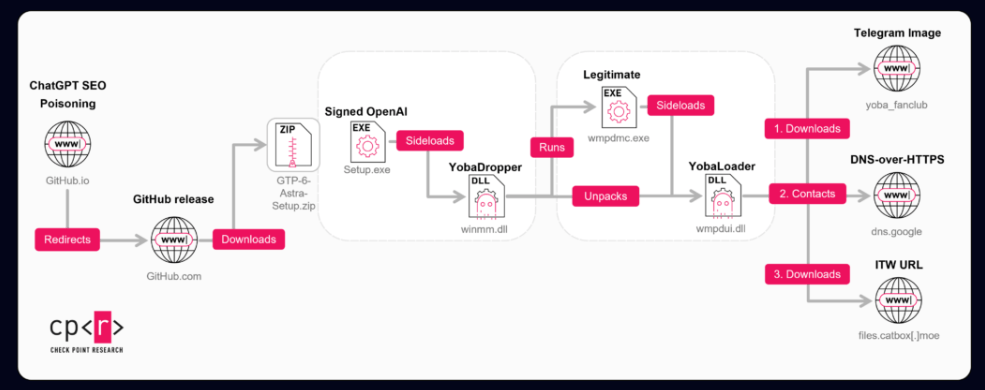
Check Point Research has spent two months tracking a campaign it calls Yoba, which uses the popularity of AI tools to spread a custom malware chain. The attackers build fake GitHub projects that pose as AI desktop applications such as GPT-5.6 Sol, GPT-6 Astra and Claude Opus. The projects look convincing and run on real GitHub infrastructure, which helps them seem l
Yoba malware uses fake ChatGPT and Claude apps to sideload malware through signed installers and deploy a cryptocurrency miner.
Check Point Research has spent two months tracking a campaign it calls Yoba, which uses the popularity of AI tools to spread a custom malware chain. The attackers build fake GitHub projects that pose as AI desktop applications such as GPT-5.6 Sol, GPT-6 Astra and Claude Opus. The projects look convincing and run on real GitHub infrastructure, which helps them seem legitimate to potential victims.
“These projects look convincing and use real GitHub infrastructure, which helps them appear legitimate to potential victims. The website exhibits search-targeted content and suspicious installer-delivery tactics consistent with an SEO-poisoning lure.
Inside the installers, there is a malicious component we refer to as the YobaDropper. This dropper includes another component, the YobaLoader, which is responsible for contacting attacker-controlled infrastructure and fetching the final payload.” reads the report. “In this report, we describe how victims are lured to these fake projects, how the YobaDropper and YobaLoader work together, and how the attackers ultimately use this chain to run unwanted software on infected systems.”
The lure is simple. Each project has a repository, a GitHub.io page describing the software, and a ZIP release with the malware. The repositories show no fake stars or forks, yet they still rank among the top Google results, most likely through SEO poisoning that optimizes titles, descriptions and hosting domains.
The first repository appeared around July 2026, but the first malicious releases landed only on August 30 and 31, and a third followed about five days later on September 4. Each repository uses a different Outlook address, and commit times point to UTC+4, UTC-4 and UTC+3, which Check Point reads as a deliberate attempt to hide the actor’s real time zone.
Here’s the trick that gives the report its title. Each ZIP holds a legitimate signed executable from OpenAI or Anthropic, named Setup.exe, next to a malicious winmm.dll. The signed program loads the DLL on its own, a technique known as DLL sideloading, which is often used to bypass security protections.
The ZIP files were not even password-protected. Attackers often use passwords to prevent security tools from automatically unpacking and scanning files. However, these binaries already had very low detection rates because they used anti-sandbox and other techniques to avoid analysis. The DLL’s compilation date is another clue: it was built on the same day it was added to the archive, unlike the legitimate files around it.
The dropper, called YobaDropper, checks the environment before running. It calculates a hash of the name of the program that launched it and continues only if the name is Setup.exe. This means that sandboxes that run the DLL on its own will fail this check. When that happens, the process does not exit. Instead, it sleeps 200,000 times for 5.5 seconds each, a total of about 12.73 days.
The malware also avoids victims in CIS countries by checking the keyboard layout. It excludes Russian, Belarusian, Tajik, Armenian, Azerbaijani, Georgian, Kazakh, Kyrgyz, Turkmen, Uzbek, and Tatar. Interestingly, Ukraine, which has often appeared in similar exclusion lists, is not included.
Next, the malware requests administrator privileges. If the user does not have them, it displays the message “Please run this program as Administrator.” and exits. The victim must then restart it with administrator rights.
Once it has the required privileges, the malware creates a folder called WMProcess under ProgramData. It copies the legitimate WMPDMC.exe file from System32 into this folder and places the second-stage payload there under the name wmpdui.dll.
The malicious code achieves persistence by using a scheduled task dressed up as Microsoft. The author is set to Microsoft Corporation, the description says it collects device metadata for Windows Media Player, and it starts three minutes after boot as Local System. The task launches the legitimate program, which sideloads the malicious DLL.
The second stage, YobaLoader, shares code with the dropper, which points to the same developer. It only runs under WMPDMC.exe and uses a different seed for its hashing than the dropper does, which separates the stages and weakens hash-based detection. Its job is to find its payload without a classic command server.
It goes to a Telegram channel, t[.]me/yoba_fanclub, and downloads the channel’s profile picture. The last 50 bytes of the image seed a domain generator that builds names from word lists in the form adjective-noun-verb-number on dedyn[.]io. Change the picture and the operator gets a new domain.
Then it asks Google’s DNS-over-HTTPS service for a TXT record on that domain. The reply is signed, and the loader checks the signature before decrypting it, which gives a link to a payload on Catbox. Check Point says this reliance on DoH and common hosting aims to bypass passive DNS monitoring and some gateway protections, and the campaign avoids dedicated command-and-control infrastructure, using Telegram, Tor, Catbox and DoH instead.
The operator can choose how the payload runs. It can inject it into svchost.exe, save it as an executable after removing the Zone.Identifier mark, or run it as a hidden PowerShell script while bypassing execution policies.
“Finally, the injected payload into svchost.exe is an XMRig 6.26.0 miner with a hidden command line targeting a TLS-enabled onion mining endpoint through a local Tor SOCKS5 proxy. It can unpack and start Tor 0.4.9.12 plus lyrebird 0.8.1, monitor user-input activity to pause mining, and conditionally load the WinRing0 driver service for MSR-based mining optimization.” continnues the report.
The miner uses Tor to connect to an encrypted mining server. It can start its own Tor components, use about 85% of CPU threads, and pause mining when the user is active. It resumes after 240 seconds of inactivity and can load the WinRing0 driver to optimize mining performance.
However, YobaLoader is not limited to cryptocurrency mining. Its DNS tasking system allows operators to deliver any PE executable or PowerShell payload, meaning future attacks could distribute other malware families.
Earlier versions appeared in June 2026. They used Cursor.exe for sideloading, a startup shortcut for persistence, and excluded only Russia. They also used .aber[.]ir instead of dedyn[.]io and included anti-debugging and anti-VM checks that later versions dropped.
Check Point believes the attackers may have Russian origins and mainly operate in the UTC-4 time zone, but this is an assessment, not a confirmed attribution.
Defenders should look for suspicious WMPDMC.exe copies under ProgramData, fake Microsoft scheduled tasks, Telegram-related traffic, DNS lookups for dedyn[.]io through dns.google, and unexplained high CPU usage.
“The Yoba campaign shows how attackers can use trusted platforms and the current interest in AI tools to distribute malware in a way that looks believable and harmless at first glance. By packaging their code together with well-known software names and hosting it on GitHub, they lower the chances that users or basic security checks will immediately flag the files as suspicious.” concludes the report. “Organizations should be cautious about installing “AI helpers” or similar tools from unverified repositories and should enforce policies that restrict running software from unknown sources. Combining user awareness with basic technical controls.”
ANY.RUN analyzed 1,258 sandbox submissions showing how fake ChatGPT and Claude downloads and setup guides steal corporate credentials and browser session data.
ANY.RUN analyzed 1,258 sandbox submissions showing how fake ChatGPT and Claude downloads and setup guides steal corporate credentials and browser session data.
ChatGPT now lets users lock private conversations with a PIN or biometrics. Learn how Locked Chats works, its limitations, and the risks of resetting a PIN.
The post ChatGPT Locked Chats Explained: How to Use It and What to Know appeared first on TechRepublic.
ChatGPT now lets users lock private conversations with a PIN or biometrics. Learn how Locked Chats works, its limitations, and the risks of resetting a PIN.
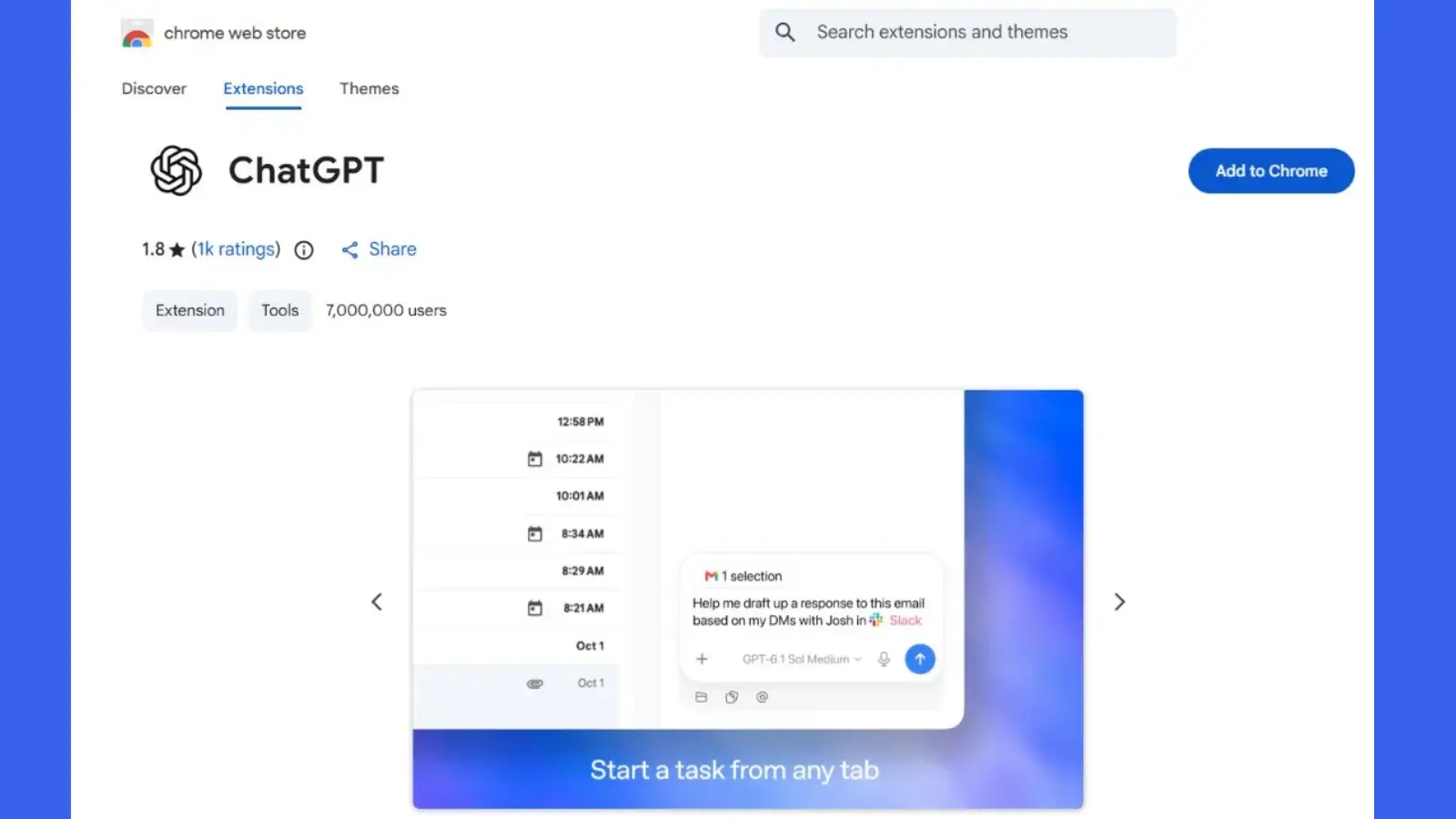
OpenAI expands ChatGPT's Chrome integration with tab access and browser automation. Learn what the update means for productivity, privacy, and enterprise security.
The post ChatGPT Can Now Do More in Chrome, but There’s a Security Trade-Off appeared first on TechRepublic.
OpenAI expands ChatGPT's Chrome integration with tab access and browser automation. Learn what the update means for productivity, privacy, and enterprise security.
The ChatGPT Chrome extension now reads multiple open tabs and runs ChatGPT Work agents to compare, fill forms, and draft emails.
Related Posts:
TP-Link Moves Router Assembly to the United States
Google DMA Compliance Under EU Review After Fine
Apple Bans Nudify Apps in Strict App Store Overhaul
The post ChatGPT Chrome Extension Now Reads Your Open Tabs appeared first on Daily CyberSecurity.
Eight US states have sued OpenAI over alleged ChatGPT safety risks to children. Here's what the lawsuits claim and how the company is responding.
The post Eight US States Sue OpenAI Over Alleged ChatGPT Safety Risks to Children appeared first on TechRepublic.
OpenAI has announced an expanded Chrome integration that lets ChatGPT gather information from open browser tabs and take action within the browser. This update introduces two distinct workflows: “Chat,” which uses tab content to inform its responses, and “Work,” which can control tabs to complete tasks. The announcement was made on ChatGPT’s official account on […]
The post ChatGPT Chrome Extension Expands Browser Access to Read Open Tab Content appeared first on GBHackers Security | #1 Globally
OpenAI has announced an expanded Chrome integration that lets ChatGPT gather information from open browser tabs and take action within the browser. This update introduces two distinct workflows: “Chat,” which uses tab content to inform its responses, and “Work,” which can control tabs to complete tasks. The announcement was made on ChatGPT’s official account on […]
OpenAI is facing separate legal challenges over how ChatGPT interacts with children.The Guardian reports that eight US states accuse the company of misleading parents about the chatbot’s safety and exposing vulnerable users to dangerous conversations. Separately, CNET reports that a mother suing on behalf of her two children alleges that OpenAI collected and used children’s sensitive personal information without valid parental consent.The cases raise serious questions about what happens when chi
OpenAI is facing separate legal challenges over how ChatGPT interacts with children.
The Guardian reports that eight US states accuse the company of misleading parents about the chatbot’s safety and exposing vulnerable users to dangerous conversations. Separately, CNET reports that a mother suing on behalf of her two children alleges that OpenAI collected and used children’s sensitive personal information without valid parental consent.
The cases raise serious questions about what happens when children trust a chatbot with their most private thoughts, and what responsibility the company behind it has for the conversations that follow.
The accusations are serious, but we have to remember they are allegations in lawsuits, not established court findings.
Eight states challenge ChatGPT’s safety
On October 14, attorneys general from Iowa, Kansas, Nebraska, West Virginia, Arkansas, Arizona, Idaho, and Montana filed separate lawsuits against OpenAI. The coordinated action accuses the company of deceiving parents about ChatGPT’s safety and violating state consumer protection laws.
The states allege that the chatbot has been designed to be “overly agreeable and feign human compassion.” The attorneys point to examples of ChatGPT allegedly endangering vulnerable users, including children, by coaching them to commit suicide or harm others.
OpenAI says it has built age-specific protections into its products and will continue developing safeguards.
A separate lawsuit focuses on children’s private information
The day before the states filed their cases, a Hawaii mother brought a proposed class action on behalf of her 12-year-old daughter and 16-year-old son. Filed in federal court in San Francisco, the lawsuit alleges that OpenAI obtained sensitive information from children who signed up for ChatGPT without valid parental permission.
OpenAI’s terms require users under 18 to have a parent or legal guardian’s permission. But the complaint alleges that children can create accounts without OpenAI verifying that permission. It also describes a child under the service’s minimum age of 13 continuing to use the chatbot after explicitly telling it her age.
The plaintiffs allege that the company used children’s information to train its AI models without valid parental consent. They also claim that OpenAI collected information to construct personal profiles.
OpenAI disputes the claims, calling the lawsuit “misguided” and pointing to its protections for younger users.
Parental controls
OpenAI has introduced ChatGPT for Teens, with additional parental controls and alerts intended to notify linked parents in limited situations involving serious self-harm concerns. But the effectiveness of those safeguards is itself under scrutiny. Common Sense Media rated ChatGPT for Teens an “unacceptable risk” earlier this month, reporting that its testing found failures to alert parents during conversations involving suicide, self-harm, or eating disorders.
OpenAI disputes the findings and says its safety alerts cover limited situations and may not identify every concern. But for now, parental controls remain part of the dispute.
How to help keep your children safe
Parents shouldn’t have to compensate for unsafe product design. Unfortunately, we can’t treat parental controls as a safety guarantee. So here are practical steps families can take to reduce the risks:
Explain that a chatbot is software, not a friend or therapist. A warm tone doesn’t mean it understands your child or has their best interests at heart. Set a clear boundary: Questions about mental health, self-harm, or personal safety should go to a trusted adult or qualified professional, not a chatbot.
Talk about what your child uses AI for, without making it an interrogation. Ask them to show you the apps they use and what they like about them. Make clear that they can talk to you about any upsetting or inappropriate conversation without being blamed. If they don’t feel comfortable talking to you, help them identify another trusted adult.
Encourage children to keep personal information out of their prompts. This includes names, school details, addresses, private photographs, and sensitive health or family information. For ChatGPT, parents with linked teen accounts can also disable model training and saved memory. While these settings reduce certain uses of their information, they are not a reason to treat a chatbot as a confidential diary.
Watch for growing emotional reliance on AI. If you find your child increasingly turns to AI for reassurance, friendship, or emotional support, check in and help them reconnect with people they trust.
If your child mentions self-harm or suicide, take it seriously and seek human help promptly. Contact a qualified healthcare professional or crisis service. If there is immediate danger, contact local emergency services. Don’t wait for a chatbot or a parental notification to tell you to act.
Let’s face it, an incognito window can only do so much.
Breaches, dark web trading, credit fraud. Malwarebytes Identity Theft Protection monitors for all of it, alerts you fast, and comes with identity theft insurance.
Explore the new ChatGPT Meetings plugin for macOS. It offers native OS-level audio capture and seamless integration with the ChatGPT Space workspace.
Related Posts:
Anthropic Fortifies Claude AI Against Model Distillation
Bitwarden App Store License Changes to Commercial Model
Firefox 158.0 Released: Default JPEG XL Support
The post ChatGPT Meetings Plugin Radically Transforms Audio Capture appeared first on Daily CyberSecurity.
Two covert influence operations, one from Russia and one from Iran, used ChatGPT not to invent new tactics but to speed up old ones. That is the central finding of a new OpenAI threat report, which describes banning both networks after tracing how they built false-front entities to push geopolitical, conflict-related messaging into target audiences.
The report frames the activity as a return to pre-AI playbooks. The Iranian network's personas resemble "Alice Donovan," a front for Russian mili
Two covert influence operations, one from Russia and one from Iran, used ChatGPT not to invent new tactics but to speed up old ones. That is the central finding of a new OpenAI threat report, which describes banning both networks after tracing how they built false-front entities to push geopolitical, conflict-related messaging into target audiences.
The report frames the activity as a return to pre-AI playbooks. The Iranian network's personas resemble "Alice Donovan," a front for Russian military intelligence whose articles appeared in Western outlets in 2016-17. The Russian network's use of unwitting staff mirrors "PeaceData," a fake outlet run in 2020 by individuals linked to the Internet Research Agency.
Why These Covert Influence Operations Stand Out
The difference lies in reach. On the IO Breakout Scale, which rates operations from 1 to 6, the Russian network was assessed at Category 5, the first such operation disrupted since the reporting began. The Iranian network reached Category 4. Both placed content in mainstream outlets rather than relying only on social media.
[caption id="attachment_114674" align="aligncenter" width="600"] Image source: OpenAI[/caption]
This fits a wider pattern across 30 covert influence operations exposed over two and a half years: networks that land content in real media outlets tend to achieve the highest potential reach and impact.
Dark Clark: Russia's Front Think Tank in Latin America
The Russian network, nicknamed Dark Clark, targeted Latin America, largely to undermine Ukraine's reputation and, in some cases, to influence politics in Argentina and Bolivia. Operators accessed ChatGPT through VPNs and used it mainly to write internal reports for an unknown superior.
They controlled a self-described research platform, the Social Research Center, through a fake persona named "Mia Clark." Evidence indicates its Latin American staff did not know they worked for a Russian group. The site carried well over 60 articles, most of them original.
Several fakes gained traction. Operators claimed they sent a fake email, appearing to come from Lima's education authority, prompting schools to hold Ukraine-themed events referencing Stepan Bandera. Matching stories appeared in Peruvian and Polish media, drawing comment from a Polish Member of the European Parliament. A fake contract alleging Ecuadorians were being recruited for Ukraine triggered a fact check, and fake audio about water cuts in La Paz prompted an official denial from the state water company EPSAS.
The operators also took credit for events they had no role in, suggesting an attempt to influence their own employers.
Bogus Bylines: Iran's Fake Journalist Personas
The Iranian network, called Bogus Bylines, used seven fake journalist personas to pitch long-form articles on the US-Iran conflict to small and medium online outlets. Almost 100 articles appeared across more than a dozen publications between July 2025 and October 2026, with output rising sharply after the conflict began. One outlet had almost 2 million Facebook followers.
Its social media commenting fared worse. Batches of replies drew single or double-digit engagement, earning a Category 2 rating. Internal reports measured success using views on the posts they replied to, not the replies themselves, which greatly inflated their apparent impact.
The report notes that AI can give false-front networks greater scale, efficiency, linguistic fluency, and editorial ability, helping them exploit unsuspecting editors and employees. Yet secrecy is also their weakness. Both "Alice Donovan" and "PeaceData" stopped after exposure, and the report states its disclosures aim to make further research and disruption easier. Information on both cases has been shared with relevant authorities.

 Entrar