O Adform, uma importante plataforma de publicidade, permaneceu comprometido por aproximadamente 24 horas (desde o fim do dia 26 de julho até a noite de 27 de julho) após ser alvo de um ataque por invasores desconhecidos. Poucas pessoas fora do setor conhecem o nome, mas o Adform veicula cerca de 1,5 bilhão de impressões de anúncios todos os dias em dezenas de milhares de sites. Isso significa que qualquer pessoa que visitasse um site que veiculasse anúncios do Adform poderia ter sido alvo do ata
O Adform, uma importante plataforma de publicidade, permaneceu comprometido por aproximadamente 24 horas (desde o fim do dia 26 de julho até a noite de 27 de julho) após ser alvo de um ataque por invasores desconhecidos. Poucas pessoas fora do setor conhecem o nome, mas o Adform veicula cerca de 1,5 bilhão de impressões de anúncios todos os dias em dezenas de milhares de sites. Isso significa que qualquer pessoa que visitasse um site que veiculasse anúncios do Adform poderia ter sido alvo do ataque.
Os invasores não estavam tentando instalar malware. Em vez disso, eles executaram um script no navegador da vítima que verificava a área de transferência a cada três segundos. Se detectasse que um endereço de carteira de criptomoedas havia sido copiado, o script o substituía pelo endereço de carteira dos invasores. Assim, se alguém tivesse um site com o anúncio malicioso aberto em uma guia do navegador e estivesse realizando uma transação com criptomoedas em outra guia ou em um aplicativo dedicado, os fundos poderiam acabar nas mãos dos invasores. Os responsáveis pelo Adform detectaram o ataque e corrigiram o problema, mas não há garantia de que um incidente semelhante não volte a acontecer. Por isso, todos os usuários devem se proteger contra publicidade maliciosa. Confira nossas dicas no final desta postagem.
O que sabemos sobre o ataque ao Adform
Não há muitas informações disponíveis, pois a declaração oficial da empresa aborda apenas o que aconteceu e quando, sem explicar a causa do incidente. Uma pesquisa independente revelou detalhes técnicos sobre como usuários comuns foram alvo do ataque, mas nada disso explica como o próprio Adform foi invadido inicialmente.
O que está claro é que os invasores inseriram seu próprio código no JavaScript carregado em todos os sites que veiculavam anúncios do Adform. Sempre que um anúncio estava prestes a ser exibido, o script era carregado do servidor do Adform, selecionava o anúncio correto e o exibia. No entanto, os invasores haviam acrescentado um conjunto de funções maliciosas: monitorar a área de transferência, enviar ao próprio servidor dados sobre o site em que o ataque ocorreu e o endereço IP da vítima, além de substituir endereços de carteiras de Bitcoin, Ethereum e Tron.
Para que o ataque funcionasse, bastava uma guia do navegador aberta com qualquer site que veiculasse anúncios do Adform. Não importava o tipo de site, a aparência do anúncio ou a qual anunciante ele pertencia. A única coisa que importava era se o site usava HTTP ou HTTPS. Segundo o Adform, o ataque não poderia ser realizado em um site carregado por HTTPS, pois, nesse caso, a conexão com o servidor dos invasores era bloqueada.
A empresa não divulgou informações sobre quantos usuários foram afetados nem sobre quantos sites ainda veiculam conteúdo e anúncios por HTTP.
Anúncios maliciosos fazem parte do nosso dia a dia
Infelizmente, anúncios on-line perigosos se tornaram um problema sistêmico. E não estamos falando apenas de anúncios de suplementos de procedência duvidosa ou de jogos de azar. Estamos falando de anúncios que disseminam malware ou levam a sites criados para roubar dados de pagamento e outras informações valiosas. Os invasores construíram uma infraestrutura em escala industrial para realizar esse tipo de ataque e utilizam diversas abordagens.
• Sequestro das contas de anúncios de marcas legítimas e respeitáveis. Basta roubar a senha de alguém da equipe de marketing. A partir daí, os cibercriminosos veiculam anúncios se passando pela empresa que invadiram e promovendo atualizações falsas de aplicativos, promoções fraudulentas e golpes semelhantes. Nos piores casos, como nas invasões de contas da adtech.de e da adxpansion.com, os invasores conseguiram veicular anúncios que redirecionavam as vítimas diretamente para a instalação automática de malware (downloads drive-by).
• Comprar anúncios diretamente. Isso mesmo. Os invasores simplesmente criam suas próprias contas de anunciante e veiculam anúncios para seus sites de phishing e malware, como qualquer outra empresa na Internet.
Como os anúncios aparecem praticamente em todos os lugares, em sites, aplicativos e redes sociais, essas ameaças podem surgir em praticamente qualquer contexto. E existem variações dessa ameaça tanto em computadores quanto em dispositivos móveis.
• Use um serviço de DNS seguro com filtragem de conteúdo integrada. Eles são eficazes no bloqueio da maioria das redes de anúncios conhecidas. A ideia é simples: sempre que seu dispositivo tenta se conectar a um servidor, o serviço DNS bloqueia solicitações para domínios de anúncios conhecidos. Isso desativa os anúncios em todos os lugares de uma só vez: em smart TVs, em todos os navegadores e em aplicativos para dispositivos móveis. Alguns provedores de Internet oferecem esse serviço, mas uma solução mais simples e universal é configurar o DNS seguro no roteador da sua casa seguindo nosso guia.
• Ative os bloqueadores de anúncios e rastreadores em sua solução completa de cibersegurança. Recomendamos Kaspersky Premium, que chama esse recurso de Antibanner. Esse tipo de proteção é especialmente importante durante viagens, pois o DNS seguro pode causar problemas de conexão em hotéis, restaurantes e aeroportos.
• Use proteção para o navegador. Um software de segurança básico pode impedir o download e a execução de um malware de roubo de dados, mas um pequeno script, como o usado no ataque ao Adform, ainda pode passar despercebido. Para se proteger contra esse tipo de ameaça, use uma solução capaz de analisar o que realmente está acontecendo no navegador. No Kaspersky Premium, esse recurso é oferecido pela extensão de navegador Kaspersky Protection. Ela protege contra a coleta de dados on-line, bloqueia banners de anúncios, protege seus pagamentos, protege o que você digita e bloqueia ataques de phishing.
Quer saber quais outros riscos podem estar escondidos nos anúncios on-line e como se proteger? Confira outras postagens:
Sakura Internet disclosed a breach of its customer management system affecting 1.36 million accounts, though passwords were hashed and salted and no ransom was demanded.
Related Posts:
Leaked Corporate AWS Keys Expose Full Admin Rights
Kimi Work Silently Uploads Five Recent Agent Sessions With Feedback Reports
SafePal Data Breach Exposes Order Information of 39,798 Customers
The post Sakura Internet Breach Exposes 1.36 Million Customer Accounts appeared first on Daily CyberSecurity.
Sakura Internet disclosed a breach of its customer management system affecting 1.36 million accounts, though passwords were hashed and salted and no ransom was demanded.
Google says Chrome cut unwanted Android notifications by more than 7 billion per day using permission controls, abuse detection, rate limits, and on-device ML.
The post Google Says Chrome Cut 7 Billion Unwanted Android Notifications Per Day appeared first on TechRepublic.
Google says Chrome cut unwanted Android notifications by more than 7 billion per day using permission controls, abuse detection, rate limits, and on-device ML.
Samsung plans to ban Smart TV apps containing residential proxy software after researchers found apps could route traffic through users’ home connections.
The post Samsung Will Ban Smart TV Apps Containing Residential Proxy Software appeared first on TechRepublic.
Samsung plans to ban Smart TV apps containing residential proxy software after researchers found apps could route traffic through users’ home connections.
A Copa do Mundo de 2026 é um dos eventos de futebol mais aguardados do ano. O torneio será sediado em três países: EUA, Canadá e México. Infelizmente, eventos desse porte atraem não apenas torcedores, mas também golpistas de todo o mundo. Já revelamos como os cibercriminosos estão se preparando para a Copa do Mundo e hoje estamos falando sobre segurança digital para os torcedores no México.
O país sediará 13 partidas e receberá milhões de turistas. Eles ficarão hospedados em hotéis, assistirão a
A Copa do Mundo de 2026 é um dos eventos de futebol mais aguardados do ano. O torneio será sediado em três países: EUA, Canadá e México. Infelizmente, eventos desse porte atraem não apenas torcedores, mas também golpistas de todo o mundo. Já revelamos como os cibercriminosos estão se preparando para a Copa do Mundo e hoje estamos falando sobre segurança digital para os torcedores no México.
O país sediará 13 partidas e receberá milhões de turistas. Eles ficarão hospedados em hotéis, assistirão a jogos, frequentarão restaurantes, transitarão por aeroportos e visitarão pontos turísticos populares, e em todos os lugares que forem, a tentação de se conectar a redes Wi-Fi públicas será grande.
Avaliamos mais de 84.500 (!) pontos de acesso Wi-Fi públicos na Cidade do México, em Guadalajara e em Monterrey, e temos muitas informações para compartilhar sobre a segurança deles. Alerta de spoiler: muitas redes ainda usam padrões de segurança desatualizados, então, você realmente não deve sair de férias sem proteção confiável e um eSIM.
O que foi testado e de que forma
Percorrer o México a pé à procura de pontos de acesso Wi-Fi públicos teria sido um pouco complicado, embora tenha sido exatamente isso que fizemos num estudo semelhante sobre a segurança de redes Wi-Fi em Paris. Você pode conferir os resultados desse estudo na postagem Como é a segurança das redes Wi-Fi em Paris?
Dessa vez, a missão era muito mais desafiadora: mapear o cenário de redes sem fio de três grandes metrópoles. Foi por isso que recorremos ao wardriving, ou seja, usamos um smartphone ou notebook para buscar e registrar redes sem fio de dentro de um veículo em movimento. Isso é parecido com o que seu telefone faz ao procurar redes Wi-Fi próximas constantemente. Porém, em vez de nos conectarmos a elas, apenas coletamos dados.
Todas as informações foram estritamente usadas para observação passiva e análise de infraestrutura. Os especialistas da Equipe de Pesquisa e Análise Global da Kaspersky (GReAT) coletaram apenas informações de serviço transmitidas publicamente. Não houve tentativas de autenticação, interceptação de tráfego, exploração de sistemas ou interação com as redes sem fio detectadas. Os pontos de acesso móveis implementados em carros e em dispositivos móveis foram excluídos da amostra.
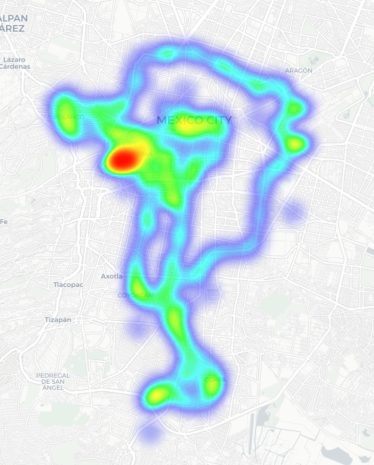
Nosso principal alvo era a Cidade do México, a capital do país e uma das cidades com maior densidade demográfica da América Latina. Percorremos de carro alguns dos pontos turísticos mais populares da cidade: Estádio da Cidade do México, Aeroporto Internacional, Zócalo, Paseo de la Reforma, Colonia Roma, La Condesa, Polanco e Coyoacán.
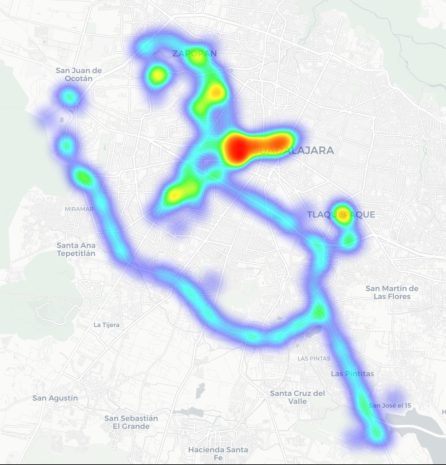
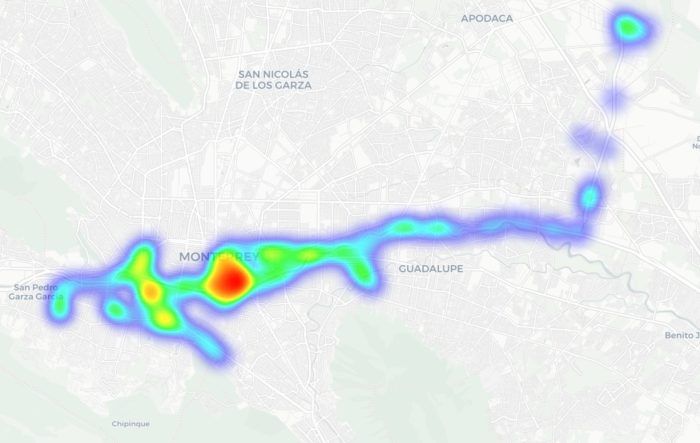
Percorremos rotas semelhantes em Guadalajara e Monterrey: estádios, avenidas principais, aeroportos e bairros populares. Abaixo, é possível ver um mapa de calor das áreas que percorremos. As regiões em vermelho representam as áreas de maior densidade de pontos de acesso público, passando pelas regiões em amarelo e verde, até chegar nas azuis, que representam a concentração mais baixa.
Mapa de calor mostrando a localização de todos os pontos de acesso Wi-Fi encontrados na Cidade do México
Mapa de calor mostrando a localização de todos os pontos de acesso Wi-Fi encontrados em Guadalajara
Mapa de calor mostrando a localização de todos os pontos de acesso Wi-Fi encontrados em Monterrey
Usamos reconhecimento passivo por rádio para registrar 84.500 sinais e 69.500 identificadores de rede exclusivos nessas três cidades. A maioria dos sinais foi captada na Cidade do México (61,4%), seguida por Guadalajara (23,6%) e Monterrey (14,8%).
O que analisamos:
Identificadores de rede sem fio (SSIDs): os nomes que aparecem na lista de redes Wi-Fi disponíveis
Informações obtidas desses identificadores
Configurações padrão do roteador e como os ISPs implementam suas redes
Frequências usadas e características do sinal
Carga dos canais e uso do espectro de radiofrequência
Configurações de segurança das redes sem fio:
Redes abertas e inseguras
Redes com WPS ativado
Redes seguras (WPA2/WPA3) com WPS ativado
Você pode encontrar a versão completa do estudo no blog Securelist.
Nomes de pontos de acesso Wi-Fi públicos reveladores
Os nomes das redes (SSIDs) podem revelar muitas informações de forma involuntária sobre os fabricantes do hardware, ISPs e métodos de implementação, além de revelar se um ponto de acesso pertence a uma empresa ou a um usuário.
Cerca de 34% das redes Wi-Fi públicas registradas nem sequer alteraram seus nomes, mantendo os SSIDs originais dos fabricantes dos roteadores ou usando convenções de nomenclatura padrão dos seus ISPs. Essa pode ser uma informação bastante útil para atacantes, pois esse tipo de nome de rede permite que eles saibam qual ponto de acesso pertence a determinado provedor, qual hardware está sendo usado e a sua configuração padrão provável.
Outro fato preocupante é o grande número de redes Wi-Fi (mais de 30%) que usam o endereço MAC do ponto de acesso (BSSID) como nome da rede visível. Os primeiros bytes de um BSSID contêm um Identificador organizacional único (OUI) que revela quem é o fabricante do roteador. Essa é uma informação útil para pessoas mal-intencionadas: elas podem descobrir quem fabricou o hardware e testar vulnerabilidades específicas relativas aos modelos dessa marca.
O Wi-Fi do México está bem protegido?
Pode-se considerar que um ponto de acesso protegido com WPA2/WPA3 está mais ou menos seguro. Todos os outros mecanismos de autenticação produzem resultados muito mais fracos. Agrupamos as redes Wi-Fi públicas em quatro categorias:
Seguras (WPA2/WPA3)
Inseguras (abertas/WEP)
Fracas (WPA)
Indeterminadas
Os resultados obtidos nas três cidades são muito parecidos: cerca de 82% de todos os pontos de acesso analisados estão protegidos por padrões seguros. O protocolo WPA, que é inseguro e está desatualizado, quase não é utilizado. No entanto, mais de 10% dos pontos de acesso são completamente inseguros. Quem se conecta a essas redes corre o risco de ser vítima de interceptação de tráfego e vigilância oculta.
Mas a segurança não é avaliada apenas pelos protocolos WPA. Também verificamos a presença do WPS, o conhecido recurso que possibilita a conexão rápida a uma rede sem necessidade de senha e que é altamente vulnerável a ataques. Descobriu-se que o WPS está ativado em 47% dos pontos de acesso na Cidade do México (quase a metade), 43% em Guadalajara e 41% em Monterrey. Em média, 45% dos pontos de acesso são potencialmente vulneráveis a ataques relacionados ao WPS, o que representa um sacrifício à segurança em nome da conveniência.
Além disso, esse recurso permaneceu ativo com frequência até mesmo em redes WPA2/WPA3 aparentemente seguras (cerca de metade delas utilizava WPS). Isso mostra que, para que um ponto de acesso Wi-Fi seja considerado seguro, não basta ter WPA2/WPA3, pois recursos adicionais, como o WPS, ainda podem viabilizar ataques.
O que mais os turistas precisam saber
Os riscos digitais em uma viagem não se limitam apenas a redes Wi-Fi públicas, especialmente porque muitas pessoas estão migrando do Wi-Fi público para um eSIM. Ainda há muitas ameaças em lugares com grande movimentação de pessoas: carregadores USB públicos, códigos QR com links trocados, ataques por meio de NFC e Bluetooth e, é claro, táticas de engenharia social. Vamos nos aprofundar em cada um desses fatores.
Estações de carregamento. Os carregadores USB públicos também podem ser perigosos: pessoas mal-intencionadas podem obter acesso aos dados no seu dispositivo ou tentar instalar um malware. Detalhamos esses ataques na nossa postagem Roubo de dados durante o carregamento do smartphone.
Códigos QR perigosos. Os criminosos podem disseminar códigos QR contendo phishing em pontos turísticos populares. Os pretextos podem variar bastante; por exemplo, anúncios de “eventos” para torcedores de um time específico ou links que supostamente oferecem descontos ou exibem cardápios de restaurantes. Na realidade, qualquer código QR postado na rua pode ser considerado inseguro por padrão, e você não deve utilizar seu smartphone para lê-los, a menos que tenha um Analisador de ameaças de códigos QR instalado.
Transmissões, ingressos e bolões falsos. Em postagens anteriores, descrevemos casos em que pessoas mal-intencionadas estavam distribuindo malware por meio de aplicativos IPTV falsos para aproveitar da empolgação em torno da Copa do Mundo de 2026. Lembre-se, mesmo que você planeje assistir aos jogos em casa, ainda precisa ficar alerta e não confiar em qualquer site que anuncie transmissões gratuitas, ofereça bolões ou prometa pagamentos bastante generosos.
Apesar da prevalência de pontos de acesso Wi-Fi públicos WPA2/WPA3 seguros na Cidade do México, em Guadalajara e em Monterrey, nosso estudo mostra que as redes Wi-Fi públicas continuam vulneráveis. Também é importante lembrar que os invasores podem criar redes falsas (as chamadas gêmeas do mal) disfarçadas de redes Wi-Fi públicas legítimas em aeroportos, hotéis, cafeterias e pontos turísticos.
É quase impossível para um usuário comum dizer o quanto um ponto de acesso específico é seguro ao tentar se conectar a ele. É por isso que a opção mais segura é usar dados móveis para acessar a Internet, eliminando por completo a necessidade de Wi-Fi. Além disso, não há necessidade de pesquisar as leis locais, tarifas e outras informações relativas a redes móveis para cada país que você planeja visitar. Basta comprar um cartão eSIM global on-line em dois cliques. Explicamos como facilitar todo esse processo na postagem Internet móvel com a Kaspersky eSIM Store.
Se você ainda planeja usar uma rede Wi-Fi pública, sempre use uma VPN para proteger seu dispositivo e dados ao se conectar a redes Wi-Fi desconhecidas e desprotegidas. Isso cria um túnel criptografado entre o seu dispositivo e o servidor VPN, impossibilitando a interceptação dos seus dados ao longo do caminho. Ainda não escolheu uma VPN? Experimente a Kaspersky Secure Connection, que está incluída nas assinaturas do Kaspersky Premium e do Kaspersky Plus.
Agora, se você ainda planeja participar da Copa do Mundo sem nenhuma solução de segurança cibernética, pelo menos siga estas regras básicas de higiene digital:
Não use carregadores USB públicos
Não envie informações confidenciais por conexões que não são seguras
Não faça login em contas bancárias, e-mail ou redes sociais por meio de redes Wi-Fi inseguras
Desative o Bluetooth e o NFC ao frequentar lugares com grande movimentação de pessoas
Não confie nos códigos QR postados na rua
Somente se conecte a um Wi-Fi público quando for absolutamente necessário
Leia também os seguintes artigos e garanta que torcer pelo seu time favorito não seja apenas emocionante, mas também seguro:
Undisclosed number of names and contact and reservation details accessed in latest cybercrime attemptThe accommodation reservation website Booking.com has suffered a data breach with “unauthorised parties” gaining access to customers’ details.The platform said it “noticed some suspicious activity involving unauthorised third parties being able to access some of our guests’ booking information”. Continue reading...
Undisclosed number of names and contact and reservation details accessed in latest cybercrime attempt
The accommodation reservation website Booking.com has suffered a data breach with “unauthorised parties” gaining access to customers’ details.
The platform said it “noticed some suspicious activity involving unauthorised third parties being able to access some of our guests’ booking information”.
Iran is slowly emerging from the most severe communications blackout in its history and one of the longest in the world. Triggered as part of January’s government crackdown against citizen protests nationwide, the regime implemented an internet shutdown that transcends the standard definition of internet censorship. This was not merely blocking social media or foreign websites; it was a total communications shutdown.
Unlike previous Iranian internet shutdowns where Iran’s domestic intranet—the N
Iran is slowly emerging from the most severe communications blackout in its history and one of the longest in the world. Triggered as part of January’s government crackdown against citizen protests nationwide, the regime implemented an internet shutdown that transcends the standard definition of internet censorship. This was not merely blocking social media or foreign websites; it was a total communications shutdown.
Unlike previous Iranian internet shutdowns where Iran’s domestic intranet—the National Information Network (NIN)—remained functional to keep the banking and administrative sectors running, the 2026 blackout ...
Russian state has tolerated parallel probiv market for its convenience but now Ukrainian spies are exploiting itRussia is scrambling to rein in the country’s sprawling illicit market for leaked personal data, a shadowy ecosystem long exploited by investigative journalists, police and criminal groups.For more than a decade, Russia’s so-called probiv market – a term derived from the verb “to pierce” or “to punch into a search bar” – has operated as a parallel information economy built on a network
Russian state has tolerated parallel probiv market for its convenience but now Ukrainian spies are exploiting it
Russia is scrambling to rein in the country’s sprawling illicit market for leaked personal data, a shadowy ecosystem long exploited by investigative journalists, police and criminal groups.
For more than a decade, Russia’s so-called probiv market – a term derived from the verb “to pierce” or “to punch into a search bar” – has operated as a parallel information economy built on a network of corrupt officials, traffic police, bank employees and low-level security staff willing to sell access to restricted government or corporate databases.
Kensington and Westminster councils investigating whether data has been compromised as Hammersmith and Fulham also reports hackThree London councils have reported a cyber-attack, prompting the rollout of emergency plans and the involvement of the National Crime Agency (NCA) as they investigate whether any data has been compromised.The Royal Borough of Kensington and Chelsea (RBKC), and Westminster city council, which share some IT infrastructure, said a number of systems had been affected across
Kensington and Westminster councils investigating whether data has been compromised as Hammersmith and Fulham also reports hack
Three London councils have reported a cyber-attack, prompting the rollout of emergency plans and the involvement of the National Crime Agency (NCA) as they investigate whether any data has been compromised.
The Royal Borough of Kensington and Chelsea (RBKC), and Westminster city council, which share some IT infrastructure, said a number of systems had been affected across both authorities, including phone lines. The councils shut down several computerised systems as a precaution to limit further possible damage.
When courts ban people from accessing leaked data – as happened after the airline’s data breach – only hackers and scammers winFollow our Australia news live blog for latest updatesGet our breaking news email, free app or daily news podcastIt’s become the playbook for big Australian companies that have customer data stolen in a cyber-attack: call in the lawyers and get a court to block anyone from accessing it.Qantas ran it after suffering a major cybersecurity attack that accessed the frequent
It’s become the playbook for big Australian companies that have customer data stolen in a cyber-attack: call in the lawyers and get a court to block anyone from accessing it.
IP addresses have historically been treated as stable identifiers for non-routing purposes such as for geolocation and security operations. Many operational and security mechanisms, such as blocklists, rate-limiting, and anomaly detection, rely on the assumption that a single IP address represents a cohesive, accountable entity or even, possibly, a specific user or device.But the structure of the Internet has changed, and those assumptions can no longer be made. Today, a single IPv4 address may
IP addresses have historically been treated as stable identifiers for non-routing purposes such as for geolocation and security operations. Many operational and security mechanisms, such as blocklists, rate-limiting, and anomaly detection, rely on the assumption that a single IP address represents a cohesive, accountableentity or even, possibly, a specific user or device.
But the structure of the Internet has changed, and those assumptions can no longer be made. Today, a single IPv4 address may represent hundreds or even thousands of users due to widespread use of Carrier-Grade Network Address Translation (CGNAT), VPNs, and proxymiddleboxes. This concentration of traffic can result in significant collateral damage – especially to users in developing regions of the world – when security mechanisms are applied without taking into account the multi-user nature of IPs.
This blog post presents our approach to detecting large-scale IP sharing globally. We describe how we build reliable training data, and how detection can help avoid unintentional bias affecting users in regions where IP sharing is most prevalent. Arguably it's those regional variations that motivate our efforts more than any other.
Why this matters: Potential socioeconomic bias
Our work was initially motivated by a simple observation: CGNAT is a likely unseen source of bias on the Internet. Those biases would be more pronounced wherever there are more users and few addresses, such as in developing regions. And these biases can have profound implications for user experience, network operations, and digital equity.
The reasons are understandable for many reasons, not least because of necessity. Countries in the developing world often have significantly fewer available IPs, and more users. The disparity is a historical artifact of how the Internet grew: the largest blocks of IPv4 addresses were allocated decades ago, primarily to organizations in North America and Europe, leaving a much smaller pool for regions where Internet adoption expanded later.
To visualize the IPv4 allocation gap, we plot country-level ratios of users to IP addresses in the figure below. We take online user estimates from the World Bank Group and the number of IP addresses in a country from Regional Internet Registry (RIR) records. The colour-coded map that emerges shows that the usage of each IP address is more concentrated in regions that generally have poor Internet penetration. For example, large portions of Africa and South Asia appear with the highest user-to-IP ratios. Conversely, the lowest user-to-IP ratios appear in Australia, Canada, Europe, and the USA — the very countries that otherwise have the highest Internet user penetration numbers.
The scarcity of IPv4 address space means that regional differences can only worsen as Internet penetration rates increase. A natural consequence of increased demand in developing regions is that ISPs would rely even more heavily on CGNAT, and is compounded by the fact that CGNAT is common in mobile networks that users in developing regions so heavily depend on. All of this means that actions known to be based on IP reputation or behaviour would disproportionately affect developing economies.
Cloudflare is a global network in a global Internet. We are sharing our methodology so that others might benefit from our experience and help to mitigate unintended effects. First, let’s better understand CGNAT.
When one IP address serves multiple users
Large-scale IP address sharing is primarily achieved through two distinct methods. The first, and more familiar, involves services like VPNs and proxies. These tools emerge from a need to secure corporate networks or improve users' privacy, but can be used to circumvent censorship or even improve performance. Their deployment also tends to concentrate traffic from many users onto a small set of exit IPs. Typically, individuals are aware they are using such a service, whether for personal use or as part of a corporate network.
Separately, another form of large-scale IP sharing often goes unnoticed by users: Carrier-Grade NAT (CGNAT). One way to explain CGNAT is to start with a much smaller version of network address translation (NAT) that very likely exists in your home broadband router, formally called a Customer Premises Equipment (or CPE), which translates unseen private addresses in the home to visible and routable addresses in the ISP. Once traffic leaves the home, an ISP may add an additional enterprise-level address translation that causes many households or unrelated devices to appear behind a single IP address.
The crucial difference between large-scale IP sharing is user choice: carrier-grade address sharing is not a user choice, but is configured directly by Internet Service Providers (ISPs) within their access networks. Users are not aware that CGNATs are in use.
The primary driver for this technology, understandably, is the exhaustion of the IPv4 address space. IPv4's 32-bit architecture supports only 4.3 billion unique addresses — a capacity that, while once seemingly vast, has been completely outpaced by the Internet's explosive growth. By the early 2010s, Regional Internet Registries (RIRs) had depleted their pools of unallocated IPv4 addresses. This left ISPs unable to easily acquire new address blocks, forcing them to maximize the use of their existing allocations.
While the long-term solution is the transition to IPv6, CGNAT emerged as the immediate, practical workaround. Instead of assigning a unique public IP address to each customer, ISPs use CGNAT to place multiple subscribers behind a single, shared IP address. This practice solves the problem of IP address scarcity. Since translated addresses are not publicly routable, CGNATs have also had the positive side effect of protecting many home devices that might be vulnerable to compromise.
CGNATs also create significant operational fallout stemming from the fact that hundreds or even thousands of clients can appear to originate from a single IP address. This means an IP-based security system may inadvertently block or throttle large groups of users as a result of a single user behind the CGNAT engaging in malicious activity.
This isn't a new or niche issue. It has been recognized for years by the Internet Engineering Task Force (IETF), the organization that develops the core technical standards for the Internet. These standards, known as Requests for Comments (RFCs), act as the official blueprints for how the Internet should operate. RFC 6269, for example, discusses the challenges of IP address sharing, while RFC 7021 examines the impact of CGNAT on network applications. Both explain that traditional abuse-mitigation techniques, such as blocklisting or rate-limiting, assume a one-to-one relationship between IP addresses and users: when malicious activity is detected, the offending IP address can be blocked to prevent further abuse.
In shared IPv4 environments, such as those using CGNAT or other address-sharing techniques, this assumption breaks down because multiple subscribers can appear under the same public IP. Blocking the shared IP therefore penalizes many innocent users along with the abuser. In 2015 Ofcom, the UK's telecommunications regulator, reiterated these concerns in a report on the implications of CGNAT where they noted that, “In the event that an IPv4 address is blocked or blacklisted as a source of spam, the impact on a CGNAT would be greater, potentially affecting an entire subscriber base.”
While the hope was that CGNAT was only a temporary solution until the eventual switch to IPv6, as the old proverb says, nothing is more permanent than a temporary solution. While IPv6 deployment continues to lag, CGNAT deployments have become increasingly common, and so do the related problems.
CGNAT detection at Cloudflare
To enable a fairer treatment of users behind CGNAT IPs by security techniques that rely on IP reputation, our goal is to identify large-scale IP sharing. This allows traffic filtering to be better calibrated and collateral damage minimized. Additionally, we want to distinguish CGNAT IPs from other large-scale sharing (LSS) IP technologies, such as VPNs and proxies, because we may need to take different approaches to different kinds of IP-sharing technologies.
To do this, we decided to take advantage of Cloudflare’s extensive view of the active IP clients, and build a supervised learning classifier that would distinguish CGNAT and VPN/proxy IPs from IPs that are allocated to a single subscriber (non-LSS IPs), based on behavioural characteristics. The figure below shows an overview of our supervised classifier:
While our classification approach is straightforward, a significant challenge is the lack of a reliable, comprehensive, and labeled dataset of CGNAT IPs for our training dataset.
Detecting CGNAT using public data sources
Detection begins by building an initial dataset of IPs believed to be associated with CGNAT. Cloudflare has vast HTTP and traffic logs. Unfortunately there is no signal or label in any request to indicate what is or is not a CGNAT.
To build an extensive labelled dataset to train our ML classifier, we employ a combination of network measurement techniques, as described below. We rely on public data sources to help disambiguate an initial set of large-scale shared IP addresses from others in Cloudflare’s logs.
Distributed Traceroutes
The presence of a client behind CGNAT can often be inferred through traceroute analysis. CGNAT requires ISPs to insert a NAT step that typically uses the Shared Address Space (RFC 6598) after the customer premises equipment (CPE). By running a traceroute from the client to its own public IP and examining the hop sequence, the appearance of an address within 100.64.0.0/10 between the first private hop (e.g., 192.168.1.1) and the public IP is a strong indicator of CGNAT.
Traceroute can also reveal multi-level NAT, which CGNAT requires, as shown in the diagram below. If the ISP assigns the CPE a private RFC 1918 address that appears right after the local hop, this indicates at least two NAT layers. While ISPs sometimes use private addresses internally without CGNAT, observing private or shared ranges immediately downstream combined with multiple hops before the public IP strongly suggests CGNAT or equivalent multi-layer NAT.
Although traceroute accuracy depends on router configurations, detecting private and shared IP ranges is a reliable way to identify large-scale IP sharing. We apply this method to distributed traceroutes from over 9,000 RIPE Atlas probes to classify hosts as behind CGNAT, single-layer NAT, or no NAT.
Scraping WHOIS and PTR records
Many operators encode metadata about their IPs in the corresponding reverse DNS pointer (PTR) record that can signal administrative attributes and geographic information. We first query the DNS for PTR records for the full IPv4 space and then filter for a set of known keywords from the responses that indicate a CGNAT deployment. For example, each of the following three records matches a keyword (cgnat, cgn or lsn) used to detect CGNAT address space:
WHOIS and Internet Routing Registry (IRR) records may also contain organizational names, remarks, or allocation details that reveal whether a block is used for CGNAT pools or residential assignments.
Given that both PTR and WHOIS records may be manually maintained and therefore may be stale, we try to sanitize the extracted data by validating the fact that the corresponding ISPs indeed use CGNAT based on customer and market reports.
Collecting VPN and proxy IPs
Compiling a list of VPN and proxy IPs is more straightforward, as we can directly find such IPs in public service directories for anonymizers. We also subscribe to multiple VPN providers, and we collect the IPs allocated to our clients by connecting to a unique HTTP endpoint under our control.
Modeling CGNAT with machine learning
By combining the above techniques, we accumulated a dataset of labeled IPs for more than 200K CGNAT IPs, 180K VPNs & proxies and close to 900K IPs allocated that are not LSS IPs. These were the entry points to modeling with machine learning.
Feature selection
Our hypothesis was that aggregated activity from CGNAT IPs is distinguishable from activity generated from other non-CGNAT IP addresses. Our feature extraction is an evaluation of that hypothesis — since networks do not disclose CGNAT and other uses of IPs, the quality of our inference is strictly dependent on our confidence in the training data. We claim the key discriminator is diversity, not just volume. For example, VM-hosted scanners may generate high numbers of requests, but with low information diversity. Similarly, globally routable CPEs may have individually unique characteristics, but with volumes that are less likely to be caught at lower sampling rates.
In our feature extraction, we parse a 1% sampled HTTP requests log for distinguishing features of IPs compiled in our reference set, and the same features for the corresponding /24 prefix (namely IPs with the same first 24 bits in common). We analyse the features for each of the VPNs, proxies, CGNAT, or non LSS IP. We find that features from the following broad categories are key discriminators for the different types of IPs in our training dataset:
Client-side signals: We analyze the aggregate properties of clients connecting from an IP. A large, diverse user base (like on a CGNAT) naturally presents a much wider statistical variety of client behaviors and connection parameters than a single-tenant server or a small business proxy.
Network and transport-level behaviors: We examine traffic at the network and transport layers. The way a large-scale network appliance (like a CGNAT) manages and routes connections often leaves subtle, measurable artifacts in its traffic patterns, such as in port allocation and observed network timing.
Traffic volume and destination diversity: We also model the volume and "shape" of the traffic. An IP representing thousands of independent users will, on average, generate a higher volume of requests and target a much wider, less correlated set of destinations than an IP representing a single user.
Crucially, to distinguish CGNAT from VPNs and proxies (which is absolutely necessary for calibrated security filtering), we had to aggregate these features at two different scopes: per-IP and per /24 prefixes. CGNAT IPs are typically allocated large blocks of IPs, whereas VPNs IPs are more scattered across different IP prefixes.
Classification results
We compute the above features from HTTP logs over 24-hour intervals to increase data volume and reduce noise due to DHCP IP reallocation. The dataset is split into 70% training and 30% testing sets with disjoint /24 prefixes, and VPN and proxy labels are merged due to their similarity and lower operational importance compared to CGNAT detection.
Then we train a multi-class XGBoost model with class weighting to address imbalance, assigning each IP to the class with the highest predicted probability. XGBoost is well-suited for this task because it efficiently handles large feature sets, offers strong regularization to prevent overfitting, and delivers high accuracy with limited parameter tuning. The classifier achieves 0.98 accuracy, 0.97 weighted F1, and 0.04 log loss. The figure below shows the confusion matrix of the classification.
Our model is accurate for all three labels. The errors observed are mainly misclassifications of VPN/proxy IPs as CGNATs, mostly for VPN/proxy IPs that are within a /24 prefix that is also shared by broadband users outside of the proxy service. We also evaluate the prediction accuracy using k-fold cross validation, which provides a more reliable estimate of performance by training and validating on multiple data splits, reducing variance and overfitting compared to a single train–test split. We select 10 folds and we evaluate the Area Under the ROC Curve (AUC) and the multi-class logloss. We achieve a macro-average AUC of 0.9946 (σ=0.0069) and log loss of 0.0429 (σ=0.0115). Prefix-level features are the most important contributors to classification performance.
Users behind CGNAT are more likely to be rate limited
The figure below shows the daily number of CGNAT IP inferences generated by our CDN-deployed detection service between December 17, 2024 and January 9, 2025. The number of inferences remains largely stable, with noticeable dips during weekends and holidays such as Christmas and New Year’s Day. This pattern reflects expected seasonal variations, as lower traffic volumes during these periods lead to fewer active IP ranges and reduced request activity.
Next, recall that actions that rely on IP reputation or behaviour may be unduly influenced by CGNATs. One such example is bot detection. In an evaluation of our systems, we find that bot detection is resilient to those biases. However, we also learned that customers are more likely to rate limit IPs that we find are CGNATs.
We analyze bot labels by analyzing how often requests from CGNAT and non-CGNAT IPs are labeled as bots. Cloudflare assigns a bot score to each HTTP request using CatBoost models trained on various request features, and these scores are then exposed through the Web Application Firewall (WAF), allowing customers to apply filtering rules. The median bot rate is nearly identical for CGNAT (4.8%) and non-CGNAT (4.7%) IPs. However, the mean bot rate is notably lower for CGNATs (7%) than for non-CGNATs (13.1%), indicating different underlying distributions. Non-CGNAT IPs show a much wider spread, with some reaching 100% bot rates, while CGNAT IPs cluster mostly below 15%. This suggests that non-CGNAT IPs tend to be dominated by either human or bot activity, whereas CGNAT IPs reflect mixed behavior from many end users, with human traffic prevailing.
Interestingly, despite bot scores that indicate traffic is more likely to be from human users, CGNAT IPs are subject to rate limiting three times more often than non-CGNAT IPs. This is likely because multiple users share the same public IP, increasing the chances that legitimate traffic gets caught by customers’ bot mitigation and firewall rules.
This tells us that users behind CGNAT IPs are indeed susceptible to collateral effects, and identifying those IPs allows us to tune mitigation strategies to disrupt malicious traffic quickly while reducing collateral impact on benign users behind the same address.
A global view of the CGNAT ecosystem
One of the early motivations of this work was to understand if our knowledge about IP addresses might hide a bias along socio-economic boundaries—and in particular if an action on an IP address may disproportionately affect populations in developing nations, often referred to as the Global South. Identifying where different IPs exist is a necessary first step.
The map below shows the fraction of a country’s inferred CGNAT IPs over all IPs observed in the country. Regions with a greater reliance on CGNAT appear darker on the map. This view highlights the geodiversity of CGNATs in terms of importance; for example, much of Africa and Central and Southeast Asia rely on CGNATs.
As further evidence of continental differences, the boxplot below shows the distribution of distinct user agents per IP across /24 prefixes inferred to be part of a CGNAT deployment in each continent.
Notably, Africa has a much higher ratio of user agents to IP addresses than other regions, suggesting more clients share the same IP in African ASNs. So, not only do African ISPs rely more extensively on CGNAT, but the number of clients behind each CGNAT IP is higher.
While the deployment rate of CGNAT per country is consistent with the users-per-IP ratio per country, it is not sufficient by itself to confirm deployment. The scatterplot below shows the number of users (according to APNIC user estimates) and the number of IPs per ASN for ASNs where we detect CGNAT. ASNs that have fewer available IP addresses than their user base appear below the diagonal. Interestingly the scatterplot indicates that many ASNs with more addresses than users still choose to deploy CGNAT. Presumably, these ASNs provide additional services beyond broadband, preventing them from dedicating their entire address pool to subscribers.
What this means for everyday Internet users
Accurate detection of CGNAT IPs is crucial for minimizing collateral effects in network operations and for ensuring fair and effective application of security measures. Our findings underscore the potential socio-economic and geographical variations in the use of CGNATs, revealing significant disparities in how IP addresses are shared across different regions.
At Cloudflare we are going beyond just using these insights to evaluate policies and practices. We are using the detection systems to improve our systems across our application security suite of features, and working with customers to understand how they might use these insights to improve the protections they configure.
Our work is ongoing and we’ll share details as we go. In the meantime, if you’re an ISP or network operator that operates CGNAT and want to help, get in touch at ask-research@cloudflare.com. Sharing knowledge and working together helps make better and equitable user experience for subscribers, while preserving web service safety and security.
Hackers are more likely to target educational institutions than private businesses, government survey showsWhen hackers attacked UK nurseries last month and published children’s data online, they were accused of hitting a new low.But the broader education sector is well used to being a target. Continue reading...
Firm, which has 18 sites around London and more in US, India and China, has received ransom demand, say reportsThe names, pictures and addresses of about 8,000 children have reportedly been stolen from the Kido nursery chain by a gang of cybercriminals.The criminals have demanded a ransom from the company – which has 18 sites around London, with more in the US, India and China – according to the BBC. Continue reading...
CSRI finds China and Russia may be coordinating ‘grey zone’ tactics against vulnerable western infrastructureChina and Russia are stepping up sabotage operations targeting undersea cables and the UK is unprepared to meet the mounting threat, according to new analysis.A report by the China Strategic Risks Institute (CSRI) analysed 12 incidents in which national authorities had investigated alleged undersea cable sabotage between January 2021 and April 2025. Of the 10 cases in which a suspect vess
CSRI finds China and Russia may be coordinating ‘grey zone’ tactics against vulnerable western infrastructure
China and Russia are stepping up sabotage operations targeting undersea cables and the UK is unprepared to meet the mounting threat, according to new analysis.
A report by the China Strategic Risks Institute (CSRI) analysed 12 incidents in which national authorities had investigated alleged undersea cable sabotage between January 2021 and April 2025. Of the 10 cases in which a suspect vessel was identified, eight were directly linked to China or Russia through flag-state registration or company ownership.
Arrest warrants issued for ringleaders after investigation by police in Europe and North AmericaEuropean and North American cybercrime investigators say they have dismantled the heart of a malware operation directed by Russian criminals after a global operation involving British, Canadian, Danish, Dutch, French, German and US police.International arrest warrants have been issued for 20 suspects, most of them living in Russia, by European investigators while indictments were unsealed in the US ag
Arrest warrants issued for ringleaders after investigation by police in Europe and North America
European and North American cybercrime investigators say they have dismantled the heart of a malware operation directed by Russian criminals after a global operation involving British, Canadian, Danish, Dutch, French, German and US police.
International arrest warrants have been issued for 20 suspects, most of them living in Russia, by European investigators while indictments were unsealed in the US against 16 individuals.
How to prove your identity after your account gets hacked and how to improve security for the futurePhone lost or stolen? Practical steps to restore peace of mindUK passport lost or stolen? Here are the steps you need to takeYour Facebook or Instagram account can be your link to friends, a profile for your work or a key to other services, so losing access can be very worrying. Here’s what to do if the worst happens.If you have access to the phone number or email account associated with your Face
Your Facebook or Instagram account can be your link to friends, a profile for your work or a key to other services, so losing access can be very worrying. Here’s what to do if the worst happens.
If you have access to the phone number or email account associated with your Facebook or Instagram account, try to reset your password by clicking on the “Forgot password?” link on the main Facebook or Instagram login screen. Follow the instructions in the email or text message you receive.
If you no longer have access to the email account linked to your Facebook account, use a device with which you have previously logged into Facebook and go to facebook.com/login/identify. Enter any email address or phone number you might have associated with your account, or find your username which is the string of characters after Facebook.com/ on your page. Click on “No longer have access to these?”, “Forgotten account?” or “Recover” and follow the instructions to prove your identity and reset your password.
If your account was hacked, visit facebook.com/hacked or instagram.com/hacked/ on a device you have previously used to log in and follow the instructions. Visit the help with a hacked accountpage for Facebook or Instagram.
Turn on two-step verification in the “password and security” section of the Accounts Centre. Use an authentication app or security key for this, not SMS codes. Save your recovery codes somewhere safe in case you lose access to your two-step authentication method.
Turn on “unrecognised login” alerts in the “password and security” section of the Accounts Centre, which will alert you to any suspicious login activity.
Remove any suspicious “friends” from your account – these could be fake accounts or scammers.
If you are eligible, turn on “advanced protection for Facebook” in the “password and security” section of the Accounts Centre.
British defence firms have reportedly warned staff not to connect their phones to Chinese-made EVsMobile phones and desktop computers are longstanding targets for cyber spies – but how vulnerable are electric cars?On Monday the i newspaper claimed that British defence firms working for the UK government have warned staff against connecting or pairing their phones with Chinese-made electric cars, due to fears that Beijing could extract sensitive data from the devices. Continue reading...
British defence firms have reportedly warned staff not to connect their phones to Chinese-made EVs
Mobile phones and desktop computers are longstanding targets for cyber spies – but how vulnerable are electric cars?
On Monday the i newspaper claimed that British defence firms working for the UK government have warned staff against connecting or pairing their phones with Chinese-made electric cars, due to fears that Beijing could extract sensitive data from the devices.

 Entrar