❌

Visualização normal

Ontem — 7 de Novembro de 2026Stream principal
  • ✇The Cloudflare Blog
  • The post-quantum future of web privacy Christopher Patton · Tianyu Zhang · Bas Westerbaan
    The highest priorities for the transition to post-quantum cryptography are the basic building blocks of authenticated key-agreement protocols such as TLS. Without these building blocks in place, secure communication on the Internet will not be possible once cryptographically relevant quantum computers come online. However, today we rely on quantum-vulnerable cryptography for much more than TLS.Privacy Pass is a protocol used by site operators like Cloudflare to help protect applications from abu
     

The post-quantum future of web privacy

6 de Novembro de 2026, 11:00

The highest priorities for the transition to post-quantum cryptography are the basic building blocks of authenticated key-agreement protocols such as TLS. Without these building blocks in place, secure communication on the Internet will not be possible once cryptographically relevant quantum computers come online. However, today we rely on quantum-vulnerable cryptography for much more than TLS.

Privacy Pass is a protocol used by site operators like Cloudflare to help protect applications from abuse. One way we do this is by rate limiting individual clients so that no one client consumes too many of the site's resources. Normally this involves some combination of friction or loss of privacy for users: CAPTCHAs or other challenges to moderate traffic, along with accounts and fingerprinting to identify traffic.Privacy Pass was designed to avoid this tradeoff between friction and privacy. The basic idea is that a client gets issued a number of tokens, which they can redeem in exchange for access to the site. Crucially, each token is unlinkable to the client it was issued to, ensuring the client can use the site as they always had without sacrificing privacy.

With 10 years of deployment experience under our belts — using Privacy Pass for applications such as privacy proxies (like iCloud Private Relay) and relays (like Privacy Gateway) — we, along with others, are collaborating to bring the next generation of this technology to the web. One of our goals is to develop more sophisticated tools for managing agentic traffic that would otherwise consume too many resources and degrade performance for human visitors. Another goal is to foster a more open ecosystem by making it easier for more types of clients to participate. Achieving these goals requires developing new capabilities beyond what Privacy Pass offers today.

Given the trajectory, in this post we look at the prospects for post-quantum. In fact, we're in better shape than one might think. Privacy Pass still relies on classical cryptography, like RSA and elliptic curves. This means that a quantum attacker will be able to forge tokens at will and use them to bypass whatever security mechanism the site operator wants to implement (such as rate limiting). On the other hand, Privacy Pass is unconditionally private, meaning no attacker, quantum or not, can link the redemption of a token to its issuance. What's more, the new capabilities we're developing for this new generation of private authentication technology  can and will be instantiated in a way that upholds the same guarantee: your interaction remains private even after Q-day.

This gives us a little breathing room, but we will need an alternative soon. This is an active area of research that has made significant strides in recent years. Still, just as is the case with other aspects of the transition, the primary challenge is the sheer size of post-quantum alternatives: ML-DSA-44 signatures are a whopping 2,420 bytes, while ECDSA-P256 signatures are just 64 bytes. And there's not much hope for drop-in replacements any time soon. Just as for TLS, we'll have to settle for primitives with higher cost and re-engineer our systems to bear this cost.

But what will those primitives be? In this post, we'll explore one potential future for post-quantum privacy on the web, made possible by a recent breakthrough in the design of blind signatures.

What we need to build: a brief look at MOLE

Let's start with an overview of this new technology, which is presently called MOLE ("Moderation Of unLinkable Endorsements"). We'll have much more to say about MOLE later on, but for now we'll highlight the details that are most relevant to cryptography.

One of the core components of Privacy Pass is a blind signature scheme, which allows a client to obtain a signature under an issuer's secret key without revealing to the issuer the message that it signed. The client can then reveal the message and blind signature later on without linking the signature to its issuance.

One type of Privacy Pass token consists of the message and blindly issued signature. To verify the token, the verifier needs the issuer's public key, and so necessarily learns the identity of the issuer. Thus while these tokens protect the identity of the client, they don't protect the identity of the issuer.

Of course, this is exactly what we want for some use cases. The identity of the issuer tells us something about what type of client is connecting to our edge, a signal we use to make decisions in some of our products and for some of our customers. For instance, a client might use a token issued by one of our customers to prove it is authorized to use the customer's VPN product.

However, for many use cases, this is more information than we actually need to make a decision to grant a client access to a resource. Normally we only care that the token was issued by some entity we trust. In fact, MOLE takes this a step further: the token should hide the identity of the issuer altogether so that we can't treat tokens differently based on who issued them. This guarantees equal treatment regardless of the type of client, making it easier for more clients to participate.

This issuer-hiding property is achieved through a new object called an endorsement. An endorsement is issued by an anchor and redeemed by a moderator. Before redemption, the client and moderator agree on an anchor set, the public keys of the anchors trusted by the moderator. During redemption, the client proves it was issued an endorsement by one of the anchors in the anchor set without revealing which one. Upon acceptance, the moderator issues the client the MOLE credential it will use to moderate the client's interaction with the site.

An endorsement can take many forms, but its key property is that it can be redeemed while hiding the identity of the anchor that issued it. There will also be many types of credentials, but because they're intended to be used by a particular moderator, they needn't be anchor-hiding or even publicly verifiable. This means that everything from blind signatures to anonymous credit tokens or anonymous rate-limited credentials can be used to instantiate MOLE credentials.

Now that we have a sense of what we're building, let's look at our options for post quantum.

A feast of cryptography

When designing cryptographic protocols, adaptability and efficiency are often in tension. Sometimes we know exactly what we want to build and can tailor a construction for that purpose; but the more we tailor the protocol for that use case, the harder it becomes to adapt that construction to a different use case.

Adaptability is essential for a system like MOLE. We're not just building one kind of credential system, but many. And the types of credentials we need are likely to change over time, especially on the web where we must constantly adapt to new traffic patterns and attacker behavior. To keep up, we need a set of building blocks that can be composed together into different protocols to meet different requirements.

Most of the post-quantum cryptographic schemes in wide use today come from larger families of constructions, but have been tuned for their particular application. ML-DSA is a good example here: the cryptographic framework from which this scheme was derived can be used to build a variety of things, but to make ML-DSA as compact as possible, its parameters have been carefully tailored to build an efficient and secure digital signature scheme. However, the same parameters would not necessarily be secure for other use cases.

We have come to view this as the central challenge for post-quantum anonymous credentials: to decouple parameter selection from protocol design. Classical credential systems take this for granted: for the most part, protocol designers don't need to think about the parameters of the elliptic curve they're using, allowing even non-experts in the design of elliptic curve cryptography to build useful things with it. Unfortunately, designing efficient post-quantum credentials still requires an enormous amount of expertise.

This situation seems to have changed, however. Earlier this year, we saw a breakthrough that represents a potential sea change for anonymous credentials.

VOLE-in-the-Head

The roots of this breakthrough go back several years. We'll pick up the story three years ago, with the VOLE-in-the-Head (VOLEitH) zero-knowledge proof system (Baum et al., Crypto 2023). A zero-knowledge proof system allows one to prove knowledge of a hidden witness, satisfying some public statement while keeping the witness private. For example, a zero-knowledge proof can be used to prove knowledge of an AES key K for which Y=AES(K,X), where X,Y  are public. This proof can be transformed into a digital signature whose security reduces to the security of AES, with X,Y as the public key and K as the secret key. This is exactly the FAEST digital signature, a candidate in NIST's ongoing signature competition.

Compared to many contemporary proof systems, VOLEitH is relatively simple to understand and implement securely. VOLE stands for "Vector Oblivious Linear Evaluation" and is an interactive technique that gives two parties correlated random values. These correlations act like authentication tags, allowing the verifier to check that a computation on the hidden witness was performed correctly. In VOLEitH, the prover prepares locally what the two parties would normally generate together — hence “in the head” — then commits to those values and uses the Fiat-Shamir transformation (a widely used tool in cryptography) to select the parts the verifier checks. This step turns the interactive VOLE process into a non-interactive zero-knowledge proof.

Apart from its simplicity, VOLEitH is a fairly unremarkable proof system. It's not succinct in the way many other proof systems are: its proofs are asymptotically linear in the size of the witness and the arithmetic complexity of the statement being proved. However, VOLEitH is concretely very efficient for a particular type of statement, namely one that can be expressed as a set of equations over small binary fields.

One example is the relation Y=AES(K,X) we just discussed. We don't normally think of AES as a set of equations, but many of its computations are designed around arithmetic in GF(28), a field whose elements are single bytes. FAEST proofs for this statement are only about 4KB (NIST Round 3, 128s).

Another example is the KuMQuat signature scheme, in which the signer proves an instance of the Multivariate Quadratic (MQ) problem. Here we're given a system of random, quadratic equations of multiple variables over a small field, like GF(28). Mathematically, this MQ map P looks something like P(s) = (sTA1s + b1s,…,sTAms + bms) where s and each bi are length n vectors and each Ai is an n-by-n matrix. Given P,P(s) for random s, the MQ problem is to find s. We call it quadratic because we multiply the elements of s by itself.

The MQ problem is believed to be hard to solve even for a quantum computer. But because P is made up of quadratic equations, proving knowledge of a solution with VOLEitH is fairly cheap, yielding KuMQuat signatures as small as 2.6KB.

When compared to other post-quantum signatures like ML-DSA or FN-DSA, these numbers don't look especially impressive. But how VOLEitH compares to other schemes in a particular category of constructions is beside the point. For MOLE, we'll need to strike a balance between performance and the ability to build many types of credential systems. To that end, we need one more ingredient.

Multivariate signatures

Another way to build signatures from MQ maps involves embedding some additional mathematical structure into the map. In the Unbalanced Oil and Vinegar (UOV) signature scheme, the public key is an MQ map P, and a signature is a vector s satisfying P(s) = t, where t is obtained by hashing and salting the message to be signed.

The secret key for this signature scheme is a trapdoor for P with which the signer can derive solutions to the MQ equations. The trapdoor reveals to the signer a hidden partitioning of the variables of each quadratic equation into “oil” and “vinegar” variables. Oil variables are never multiplied by one another, so fixing the vinegar values turns the equations into a linear system that the signer can solve for the oil values. In the public key, oil and vinegar variables are mixed together in a way that hides this structure in the map.

UOV is also a candidate in NIST's ongoing signature standardization effort. It has one of the smallest signatures among the candidates, at just 135 bytes. The trade-off is that it has the largest public keys, at 46.6KB. MAYO is another multivariate candidate with much smaller public keys, at the cost of slightly larger signatures.

The key thing to take away here is that the arithmetic complexity of evaluating a UOV (or MAYO) signature is comparable to evaluating an MQ instance. Both are public quadratic maps over small binary fields, making them a good fit for VOLEitH. This brings us to the breakthrough.

Blind signatures from VOLE-in-the-Head and UOV

Earlier this year, a blind signature called PoMFRIT was published (Baum et al., USENIX Security 2026) that achieved what at the time was a record for candidate post-quantum constructions: 6.7KB for the blind signature itself and just a few hundred bytes for issuance. PoMFRIT is based on VOLE-in-the-Head and the MAYO multivariate signature. We can easily drive the size of the signature down to 4.3KB by swapping MAYO out for UOV. (This figure uses NIST round 3 parameters for UOV (uov-Ip) and FAEST-EM-128s.) The trade-off is larger public keys, but this pays off in applications where a public key can be cached and used sufficiently often.

This is competitive with state-of-the-art lattice-based constructions. But the really good news is that building blocks of PoMFRIT can easily be reconfigured into all of the credential systems we've considered for MOLE, including endorsements. More on this in a bit: for now, let's look at how PoMFRIT works in more detail.

A well-known paradigm for designing blind signatures is the following. First, the client places the message in the cryptographic equivalent of a sealed envelope, called a commitment. For our purposes, a commitment is simply the hash of the message together with some randomness generated by the client. To complete issuance, the signer simply signs the commitment directly.

To construct the blind signature, the client produces a zero-knowledge proof of knowledge of the signature and the randomness it used to compute the commitment, called the opening. A verifier would use the signer's public key to verify this proof.

Let's define a bit of notation to make this clearer:

  1. The client generates an opening r and sends a commitment c=H(m,r) to its message m to the issuer.
  2. The issuer produces a signature s=Sign(sk,c) and sends it to the client. It doesn’t learn the message as it’s hidden behind the hash.
  3. Finally, the client produces a proof π of knowledge of s,r for which Verify(pk,H(m,r))=1,

The proof π is the blind signature. It can be verified by any party in possession of the issuer's public key pk and the message m.

Unlinkability comes from the client presenting entirely different objects during the two phases: a commitment is shown to the issuer during issuance, and a zero-knowledge proof is shown to a verifier during presentation. Even if the issuer and verifier collude or are the same entity, they cannot link the sessions.

The size of the proof π is dominated by evaluation of the hash, so we need to choose a hash function that is friendly for our proof system. For most proof systems, such proof-friendly hashes are not well studied, but for VOLEitH it turns out that the Keccak permutation used in SHAKE and TurboSHAKE is a good choice. Keccak’s bitwise operations translate natively into VOLEitH constraints: XOR becomes addition, AND becomes multiplication, and rotations simply rearrange values. (Many popular SNARKs, by contrast, are designed for large prime fields, making byte- and bit-oriented operations less natural to express.)

Nevertheless, Keccak evaluations end up being the largest component of the VOLEitH proof, so we need to make sure we're using only the minimum necessary number of permutations. PoMFRIT requires two: one for the commitment and another for the signature. Concretely, the statement we prove is roughly P(s)=H(H(m,r),rs) where s is the signature, rs is a salt chosen by the issuer, P is the issuer's UOV public key, and H denotes the Keccak permutation with the output truncated to the appropriate length, which also prevents anyone from inverting.

From blind signatures to endorsements and beyond

Recall that for MOLE endorsements, we need something like a blind signature, but one that doesn't reveal the anchor that issued it. That is, we now have a sequence of anchor keys P1,…,PN, and the statement we now want to prove is  Pi(s)=H(H(m,r),rs) for some anchor key Pi whose index i is now part of the hidden witness.

With some care, we can write this as a set of constraints with roughly the same cost: two hashes and one MQ evaluation. We need to prove a bit more about the witness. What exactly? We won't spoil it for you: ZK circuit design is part of the craft of cryptographic engineering that makes it so fun. We'll just say the kind of thinking needed here is transferable to just about any modern proof system you might encounter.

Even more advanced credential systems can be constructed in this framework, including the aforementioned anonymous credit tokens and anonymous rate-limited credentials. In both of these cases, the primary cost is an additional hash or two. Each of these also requires proving that part of the witness (e.g., the credit count) is in some expected range, but this is low cost in VOLEitH.

Indeed, for every construction we have considered so far for MOLE, the primary cost is the size of the Keccak evaluation and how many times we need to evaluate it. This means that finding ways to reduce the amount of hashing yields improvements across the board.

Optimizations

Before we go any further, we need to acknowledge that cryptanalysis of multivariate cryptography is still relatively immature. We have seen advances against several parameter regimes in just the last couple of years, Both UOV and MAYO have weathered these attacks well, and an outright break of UOV and even MAYO seems more unlikely with every passing year. But we should at least expect the parameters to change in a way that adds a bit of cost to our constructions.

On the other hand, it's not uncommon for credential systems used in practice to adopt a less-than-conservative security posture for the sake of performance in so far as it affects forgery resistance. This typically means relying on stronger-than-usual computational assumptions. That is, it's possible that a (pre-quantum) attack might come along that breaks anonymous credit tokens, but not ECDSA, despite the fact that they both use the same elliptic curve.

Using fewer hashes

PoMFRIT achieved its size record by doing precisely the same thing. Recall that the blind signature requires proving two hash evaluations, one by the client and the other by the issuer. PoMFRIT observes that VOLEitH proof generation can be split into two stages. In the first stage, the client commits to a random mask. It then hashes the message normally (outside of the ZK circuit), combines the result with the mask, and sends the masked target to the issuer. The issuer uses the UOV trapdoor to find a preimage of this target. In the second stage, the client completes the proof that the preimage and previously committed mask are consistent. The hash remains part of the protocol, but the issuer — acting as the VOLEitH verifier — can compute it directly rather than requiring the zero-knowledge proof to reproduce it.

This strategy substantially reduces proof size, but it also changes our security posture. The plain UOV assumption is that no (quantum) attacker can find a pre-image for a random target without knowledge of the trapdoor. The corresponding one-more-UOV assumption (analogous to the one-more-MAYO assumption in the PoMFRIT paper) neatly captures the additional information available to the attacker as a result of this kind of optimization. The assumption, then, is that this additional information doesn't lead to an attack.

This assumption may turn out to be overly optimistic. Recently, researchers at the University of California, San Diego, and INRIA managed to forge a 1024-bit RSA signature using a Privacy Pass issuer as a signing oracle. Fortunately, Privacy Pass uses 2048-bit RSA, which, in concert with other defense mechanisms, provides a pretty good security margin. Likewise, for UOV we might consider using NIST Level 3 parameters instead of Level 1.

In any case, a bit more study will be required before we rely too heavily on these kinds of optimizations. It's worth emphasizing that a break here would only impact an attacker's ability to forge tokens, not the attacker's ability to violate a client's privacy.

Making each hash cheaper

Standard SHAKE uses a 1600-bit Keccak state with 24 applications of an underlying round function. However, since the SHA-3 standard was published, many have come to believe that 24 rounds is just too much crypto. TurboSHAKE works the same way, except the permutation uses 12 rounds instead of 24. This substantially reduces the size of VOLEitH proofs. In fact, we're quite comfortable with this security margin, and not just for this application.

Another change to Keccak that reduces the proof size is to reduce the size of the state. 256 bits of the state are reserved for the capacity to get 128 bits security. That leaves 1344 bits that can be hashed in one go, which is more than we need. Reducing the state by half to 800 bits leaves us with a rate of 544 bits, which is plenty. On top of that, it even increases the security at the same number of rounds, as an attacker has less to play with. The smaller state means we’re using half the multiplications in our circuit, which reduces the size of the proof.

Leaning into multivariate

In an ideal world, we could avoid proving conventional hashes altogether by replacing each hash with something that composes more natively with the algebraic structure of our primitives. Indeed, those familiar with Pedersen commitments and their use in elliptic curve cryptography may wonder if commitments can be constructed from multivariate cryptography.

This might look something like this: Fix public, random MQ maps F and G and commit to a message m using c=(m+F(r),G(r)). The advantage of this approach is that the degree of the constraints is the same as the degree of the constraints for the UOV signature. Not only does this make the proof smaller, it makes it far simpler, since we avoid evaluating symmetric crypto in ZK altogether.

We experimented with this approach for our application, and it yielded some impressive results. However, it's not at all clear yet if the parameter regime in which multivariate commitments yield an improvement is also secure. Notably, the risk here is not just to unforgeability, but also to client privacy. A lot more study is needed.

Another direction is to build an MQ-friendly pseudorandom generator (PRG).

For typical VOLEitH parameters, adding an extra witness bit adds ten bits to the proof. There is a neat trick to make this a lot cheaper: only one bit of proof per bit of witness! Instead of using VOLEitH directly, we commit to a (relatively) short key. That key we stretch into a larger bitstream using a PRG with low-degree so that it can be computed cheaply in the circuit. Now, to add a witness bit w, we get one extra bit k from the PRG, and store the bit w XOR k in the proof.

There is a performance trade-off: we need to compute the PRG and the witnesses start at degree 2 instead of 1. That especially increases prover time. Also the benefits on proof size only start to pay off when you need a decent number of witness bits.

And of course you need a PRG! You can create a PRG using a random MQ instance, but that’s very slow and seems overly conservative. At the other end is the Goldreich PRG, which can be seen as an as-sparse-as-possible MQ PRG. We’d want something in between, but such PRGs haven’t received much study.

Is MOLE ready for post-quantum?

We already have post-quantum privacy today, so we have some time before we need to have a solution in place, but now is the time to develop alternatives.

Multivariate cryptography looks to be a promising basis for easily building a variety of anonymous tokens and credentials. We're currently developing two schemes in this framework: VOLE-IHAT, a candidate for MOLE endorsements, and VOLE-ACT, a candidate for MOLE credentials. Our current cost estimates for these are shown in the table below. The numbers here are subject to change as we analyze and develop these constructions. We use UOV (uov-Ip) in each case, which means the public keys are all 46.6KB. VOLEitH uses the same parameters as FAEST-EM-128s:

issuance

presentation

PoMFRIT (with UOV)

<1KB

4.3KB (redemption)

VOLE-IHAT

5.6KB

6.5KB (redemption)

VOLE-ACT

5.4KB

12.0KB (spend)


These numbers are significantly larger than their classical counterparts. This comes as no great surprise, as "PQ is big" is really the main hallmark of the transition across the board. However, replacing RSA blind signatures with PoMFRIT has comparable overhead to replacing ECDSA with ML-DSA. The runtimes of these protocols are also excellent: each operation takes just a few milliseconds with our implementation. (Runtime can be improved by quite a bit, though at the cost of higher communication.)

If these numbers hold, then we've already reached an important milestone: the transition to PQ anonymous credentials for the web can now shift from cryptography design to protocol engineering. In other words, we think we can make these numbers work. For example, whereas classical blind signatures might be cheap enough to redeem on every request, we'll have to figure out how to amortize a single redemption over multiple requests.

We have some work to do before we get there. First, we need to make sure our protocols are sound, in particular by producing security proofs for them that show they are secure as long as UOV is secure. Second, we need to wait a bit for cryptanalysis of UOV to catch up. We encourage cryptographers to spend time with multivariate cryptography. Once the parameters stabilize, we believe these schemes will find a place in a ton of useful applications. We've only just scratched the surface so far.


Antes de ontemStream principal
  • ✇Firewall Daily – The Cyber Express
  • Australian Data Breach Incidents Up 66% as AI Sharpens Scams Samiksha Jain
    Australians filed a cybercrime report about every six minutes over the past year, and artificial intelligence is making the attacks behind those reports faster and more convincing. That is the main finding of the ASD Cyber Threat Report 2025-26. It is the seventh annual assessment from the Australian Signals Directorate’s Australian Cyber Security Centre (ASD’s ACSC). In FY2025-26, the agency received more than 82,000 cybercrime reports through ReportCyber. It responded to over 1,500 cyber secur
     

Australian Data Breach Incidents Up 66% as AI Sharpens Scams

28 de Outubro de 2026, 04:25

ASD Cyber Threat Report

Australians filed a cybercrime report about every six minutes over the past year, and artificial intelligence is making the attacks behind those reports faster and more convincing. That is the main finding of the ASD Cyber Threat Report 2025-26. It is the seventh annual assessment from the Australian Signals Directorate’s Australian Cyber Security Centre (ASD’s ACSC).

In FY2025-26, the agency received more than 82,000 cybercrime reports through ReportCyber. It responded to over 1,500 cyber security incidents, up more than 20% on the previous year and 36% over five years. It also notified Australian entities of potentially malicious activity more than 4,400 times, almost 80% more than in FY2024-25.

What the ASD Cyber Threat Report Says About AI

The report calls AI the defining force in the threat environment this year. In his foreword, Deputy Prime Minister and Defence Minister Richard Marles wrote that AI is helping malicious actors find vulnerabilities faster and exploit them at greater scale, speed and sophistication. He also noted that new threats have emerged in recent weeks from the unintended actions of AI agents and from model testing.

ASD’s ACSC makes one clear distinction. AI has not created new kinds of threats. It has amplified and sped up existing ones. AI-enabled cyber threats are most visible in social engineering. Attackers are using AI to write phishing emails with no spelling or grammar errors and to automate targeted spearphishing. The Australian Securities and Investments Commission has also seen a sharp rise in scams that use deepfake videos of celebrities and politicians.

The time defenders have to respond is also shrinking. The agency has previously observed that most vulnerabilities are exploited within two weeks, and some within 48 hours of a patch being released. It expects AI-driven tools to shorten that window further over the next 12 months. Publicly reported vulnerabilities (CVEs) rose 30%. Old flaws are still a problem too: ASD’s ACSC recorded the successful exploitation of a vulnerability first identified in 2008.

Incident Severity Grows in ASD Cyber Threat Report Data

Only one Category 2 incident was recorded this year. However, extensive compromises rose from 26 to 40. ASD’s ACSC identified 362 incidents after proactively notifying organisations. A single notification about cPanel vulnerabilities, sent to 340 entities in May 2026, led to more than 60 confirmed incidents.

The number of ransomware incidents held steady at 139, but extensive ransomware incidents rose from 16 to 24. Health Care, Professional, Scientific and Technical Services, and Manufacturing remained the most affected sectors. Data breaches made up 98 incidents, a 66% increase on the previous year. Separately, the Office of the Australian Information Commissioner received 1,205 breach notifications in 2025. That is the highest yearly total since its Notifiable Data Breaches scheme began in 2018.

The financial impact is rising for businesses. The average self-reported cost of cybercrime per business report rose 16% to $93,500. For medium-sized businesses, it rose 45% to $141,300. The average cost for individuals stayed at $33,000. Identity fraud remained the most reported cybercrime, although reports fell 18%.

Stolen access is now a major entry point. Compromised accounts and credentials were among the most frequently reported incident categories, and phishing appeared in 39% of incidents. Government survey research cited in the report found that 55% of Australians reuse passwords across multiple accounts.

State Actors and Critical Infrastructure in the ASD Cyber Threat Report

State-sponsored actors continued to target Australian government, business and individuals to gain sensitive information. The report says these actors are increasingly pre-positioning inside networks to enable future disruption. Marles wrote that the line separating state-sponsored espionage from sabotage and cybercrime is becoming increasingly blurred.

In April 2026, ASD’s ACSC and international partners highlighted a shift by China-nexus actors. These actors are moving towards large covert networks built from compromised home and small office routers, Internet of Things devices and smart devices.

Critical infrastructure accounted for 154 incidents, or 10% of the total, a decrease of almost 7%. Phishing was the leading initial access technique at 36%, and Financial and Insurance Services was the most affected critical infrastructure division at 30%.

What the Threat Report Asks Organisations to Do

In October 2026, ASD’s ACSC released the Essentials series. It evolves the Essential Eight into a principles-based framework with three chapters: Enterprise IT, Operational Technology and Cloud.

Under its Cyber Action Year, the agency is pushing five priorities:

  • Replacing or mitigating legacy technology.
  • Implementing best-practice event logging.
  • Managing supply chain risk.
  • Preparing for AI-enabled threats.
  • Preparing for post-quantum cryptography, including ceasing the use of traditional asymmetric cryptography by the end of 2030 or sooner.

The report also urges organisations to patch faster. For individuals, it recommends reviewing privacy settings and enabling multi-factor authentication or passkeys.

Suspicious activity, incidents and vulnerabilities can be reported at cyber.gov.au or through the Australian Cyber Security Hotline on 1300 CYBER1 (1300 292 371).

  • ✇Cybersecurity News
  • Lazarus Operation FlashHole Abuses CrossWeb EX and GitHub to Spy on South Korean Firms Do Son
    In Operation FlashHole, the Lazarus Group used AI-made lure sites, CrossWeb EX, and GitHub C2 to spy on South Korean firms. Here is how. Related Posts: Attackers Abuse ConnectWise Cloud Backup Credential to Breach Over 300 Microsoft 365 Tenants Ahold Delhaize Cyberattack Knocks Brand Websites and Apps Offline in US and Europe UNC7017 Executes AOMEI Supply Chain Attack Using Five-Minute Server Tampering The post Lazarus Operation FlashHole Abuses CrossWeb EX and GitHub to Spy on South Korean F
     
  • ✇Securelist
  • Operation FlashHole: Lazarus breaks security, defies control Sojun Ryu
    In January, we responded to the Lazarus Group’s novel attack campaign against South Korea, which followed last year’s Operation SyncHole. In this new operation, the group employed an updated malware chain that included both their old and new malware, which we disclosed in full, and used another mandatory South Korean security software program as a part of infection chain using a watering‑hole strategy. Notably, the group targeted victims more selectively, sending spear‑phishing emails with links
     

Operation FlashHole: Lazarus breaks security, defies control

20 de Outubro de 2026, 23:07

In January, we responded to the Lazarus Group’s novel attack campaign against South Korea, which followed last year’s Operation SyncHole. In this new operation, the group employed an updated malware chain that included both their old and new malware, which we disclosed in full, and used another mandatory South Korean security software program as a part of infection chain using a watering‑hole strategy. Notably, the group targeted victims more selectively, sending spear‑phishing emails with links to fabricated but relevant sites, such as portfolio and résumé pages tailored to each target. We dubbed this activity Operation FlashHole.

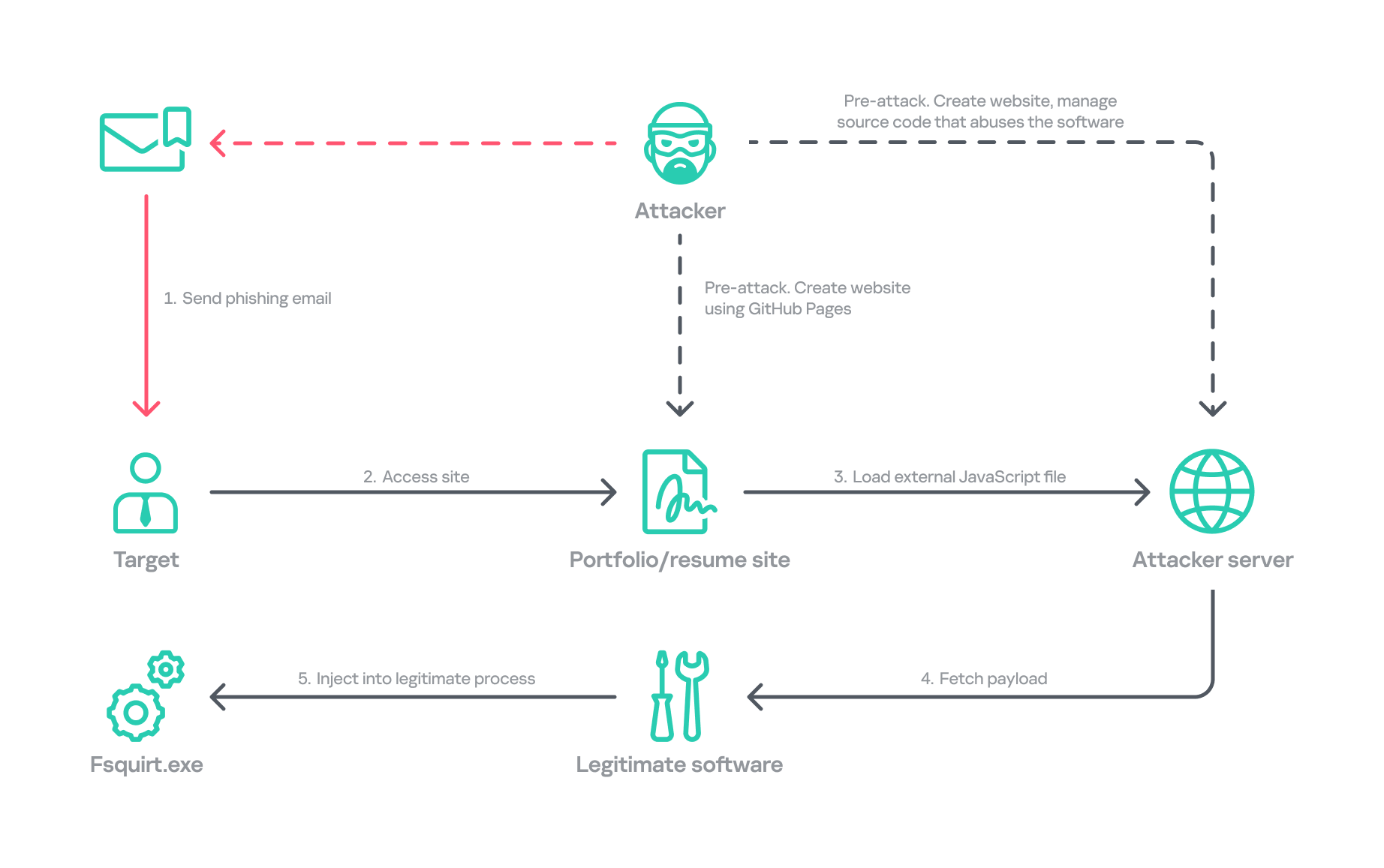
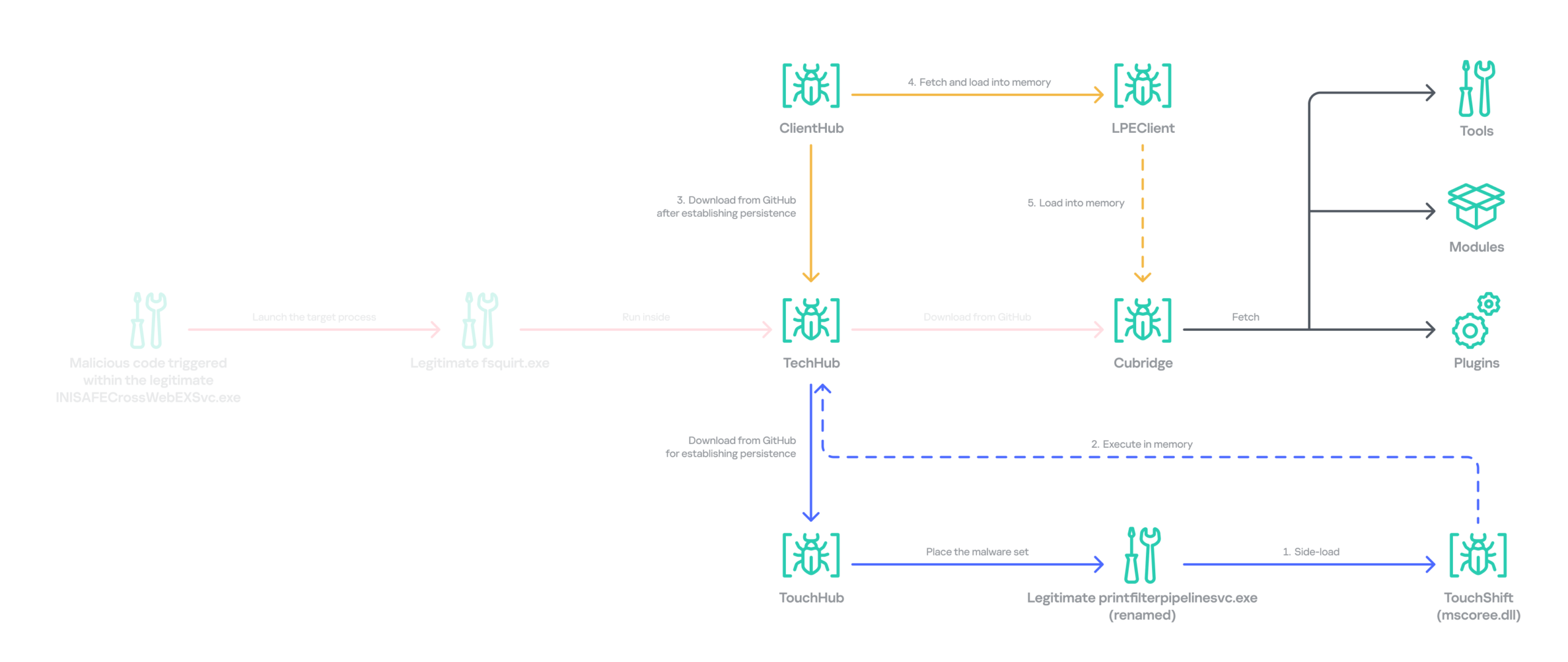
Operation FlashHole attack flow during initial compromise

Operation FlashHole attack flow during initial compromise

Our examination reveals that the earliest evidence of this new operation dates back to July 2025. This suggests the group began preparing for the campaign shortly after ending Operation SyncHole, which lasted at least four months. We identified a minimum of three organizations impacted by the campaign in South Korea’s software, construction, and wired communication equipment manufacturing sectors. These sectors differ from those affected by Operation SyncHole, indicating that the group has expanded its target scope over time.

Background

After more than a year since the first observation of Operation SyncHole, we detected a suspicious execution chain originating from legitimate South Korean software. This chain mirrors the one from the previous operation; however, this time, the attacker abused CrossWeb EX instead of Cross EX, which was abused in Operation SyncHole. Both applications are related to financial security. CrossWeb EX is a financial security solution that is required to access widely used online banking and government websites. It encrypts communications between the user’s browser and the web server using public key infrastructure (PKI). This is not the first time Lazarus has abused this software. It was also used in 2021 to deploy the Racket downloader and again in 2022 and 2023. Although the exact method by which CrossWeb EX was abused remains unclear, we determined that the attack chain ultimately leads to the execution of the malware in memory.

We noted that the spawned process was running with a high integrity level. The parent process, INISAFECrossWebEXSvc.exe, originates from the installation bundle of INISAFE CrossWeb EX V3 version 3.4.1.2, released in 2023 after KrCERT’s public advisory.

As we already mentioned in our SyncHole blog post, this pattern closely mirrors the long‑standing strategy employed by the Lazarus Group to target South Korea. Since CrossWeb EX and similar software is mandatory for South Korean users and typically runs in the background to interact with the browser, it has been leveraged as a critical attack vector by the group. In 2025, a paper was presented at the USENIX Security Symposium that investigated vulnerabilities in South Korea’s mandatory security software and demonstrated how such software can unintentionally create a massive attack surface.

In July 2026, the South Korean government and several local security vendors also published a joint security advisory covering typical Lazarus attack techniques, including exploitation of financial security software. While this advisory overlaps with our findings from Operation FlashHole and Operation SyncHole, and AhnLab’s detailed analysis report Operation Double Barrel covers a wide range of recent Lazarus Group activities, we are conducting a more granular classification based on their TTPs. We will discuss this further in the attribution section.

Initial infection vector

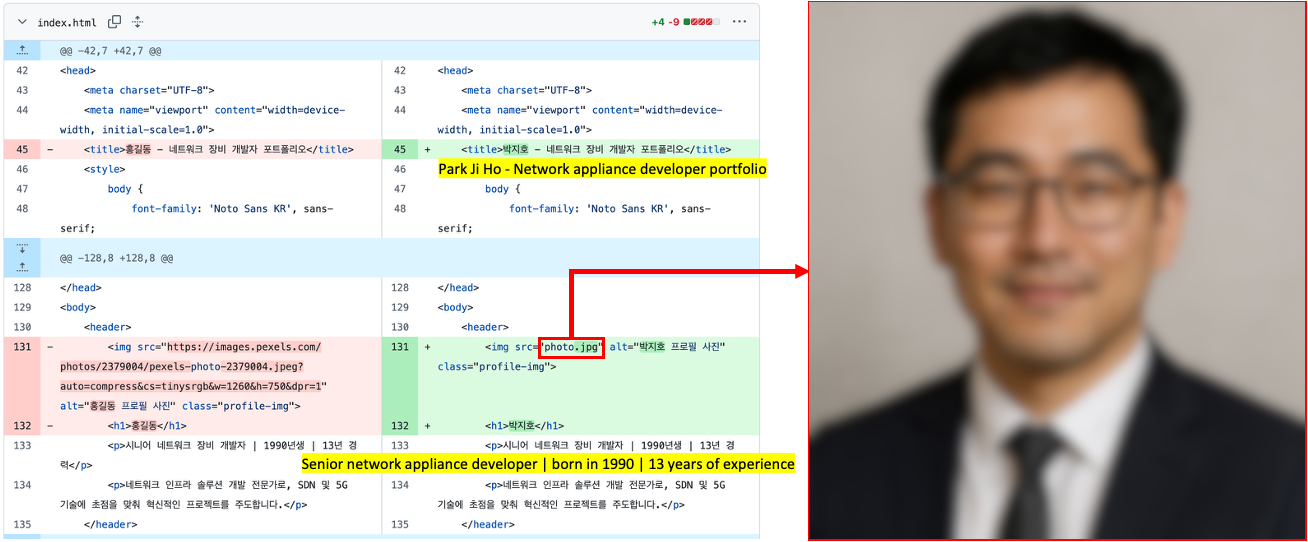
Although we could not precisely determine what triggered the infection chain, our analysis uncovered a suspicious website hosted on GitHub Pages that is associated with the GitHub account used as the C2 channel. The GitHub account was created last September, and the initial version of the site was designed to showcase the résumé of a senior network appliance developer. In January, however, this site was replaced with another featuring an interior design showcase. The first site was likely accessed by an employee of a wired communication manufacturing company, while the second site likely affected a target in the construction sector.

Appearance of the malicious websites

Appearance of the malicious websites

The first site with the résumé had a photograph supposedly of a job seeker, but the lack of EXIF metadata and the unnatural texture of the image indicate that it was generated by AI. This suggests the Lazarus Group has incorporated AI into its long‑standing strategy, like other Korean‑speaking threat actors (1, 2). The group most likely also used AI to create the lure site: the job seeker’s name resembles the Korean version of “John Doe,” and the portfolio was populated with seemingly meaningless details and random companies. The generated site was then manually tailored to specific targets.

Suspected use of an AI-generated image on the résumé site

Suspected use of an AI-generated image on the résumé site

The websites contained embedded links that loaded an external JavaScript file via a script tag.

  • Malicious link embedded in the résumé site: hxxps://javadevhouse.co[.]kr/ajax/libs/jquery/1.7.3/jquery.min.js
  • Malicious link embedded in interior design site: hxxps://pythonapischool[.]com/api/detach

Based on the analysis, we assess with medium-to-high confidence that the targets received phishing emails containing links to the malicious site hosted on GitHub Pages (using the domain <username>.github.io). The research results showed a high possibility that visiting the malicious site initiated an infection process involving CrossWeb EX software. This assessment aligns with Lazarus’s recent approach, as detailed in the joint advisory published by the South Korean government and security companies.

Full infection chain

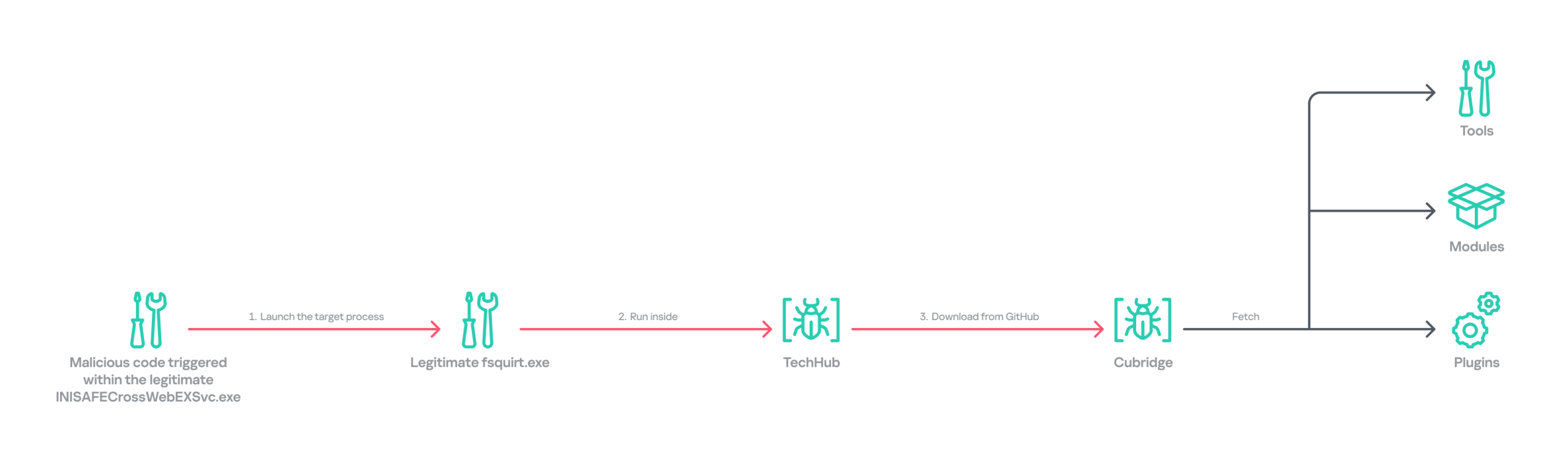
Following the initial compromise, the legitimate Windows binary fsquirt.exe was executed under the CrossWeb EX process and injected with shellcode containing a malicious DLL – TechHub malware. From our extensive and thorough examination, we identified several malicious payloads and reconstructed the complete infection chain. The infection chain is rather complex and reveals the Lazarus Group’s advanced operational techniques on targeted hosts. These techniques conceal their malicious payloads, intent and their sophisticated malware delivery framework. The latter was updated extensively compared to the previous campaign, despite the new operation starting less than a year later. Significantly, the execution chain below exists only in memory during the initial infiltration, highlighting the attackers’ considerable efforts to hide the initial compromise.

Initial infection chain

Initial infection chain

Following the initial compromise, the group sought to maintain persistence on the network by installing a pair of malware strains – TouchHub and TouchShift – leveraging DLL side‑loading under the name mscoree.dll. TouchHub was deployed by the first instance of TechHub. It then used DLL side-loading to launch TouchShift, which led to the in‑memory execution of another TechHub instance. After launching the second time, TechHub deployed another pair, ClientHub and LPEClient, rather than executing Cubridge directly. Only minimal traces of these files were found on disk; the remainder of the malicious code persisted exclusively in memory.

Expanded infection chain after gaining persistence

Expanded infection chain after gaining persistence

Since Cubridge remains only in memory at the initial compromise stage, we suspect the group designed this indirect, multistage chain to deliberately redeploy Cubridge after gaining persistence, as it serves as the most sophisticated orchestrator of the attack.

Malware set

The full chain comprises advanced variants of the known Lazarus malware strains, including TechHub, Cubridge, TouchShift, LPEClient, and the newly identified TouchHub and ClientHub.

TechHub – the start of the chain

TechHub, a downloader that plays a central role in this attack, communicates with GitHub using a Personal Access Token (PAT). It serves as the initial payload, providing the top of the chain with sufficient functionality to profile compromised hosts and facilitate subsequent payloads.

This variant is a more advanced version of the malware named CLOUDBURST by Mandiant and NickelLoader by ESET. According to their reports, the earlier version communicated with a C2 server via HTTP(S) to fetch additional payloads. The latest iteration we found, however, communicates with GitHub instead and has updated command strings.

We identified three variants of TechHub in the chain: an in‑memory version, a simple DLL side‑loading version, and a DLL side‑loading version that uses a registered Windows service. Depending on which stage loads the malware, it contacts a private GitHub repository via the GitHub API using either hard‑coded credentials or credentials retrieved from its configuration file.

When TechHub loads, it creates a 4‑byte hexadecimal identifier (ID) in the range 0x1000–0xFFFF or reads one from the configuration file, enabling the attackers to distinguish between compromised hosts. TechHub then checks a GitHub issue by sending the request GET /issues?state=[open/closed] to determine whether any previous communication remains active and removes any traces of it if found. It then proceeds with the handshaking process.

  1. It creates a new issue titled 1[ID] with the body “hel” using the POST /issues request, and sets its status to open.
  2. It then retrieves a file from the repository containing the 2[ID] value in its name. This file contains the RSA public key.
  3. It generates a random 16‑byte XOR key, encrypts it with the provided RSA public key, and uploads the result, prefixed with 1[ID], to the repository.
  4. The hard‑coded IV is XORed with the generated 16‑byte key and then used after the handshake.

During file exchange, filenames follow the pattern [1|2][ID][random-16-byte-key] throughout communication. The “2” prefix indicates delivery from the repository to TechHub, while “1” indicates delivery from TechHub to the repository. The random 16‑byte key in the filename is used for AES encryption or decryption of each file’s contents, employing either a hard‑coded IV or an updated IV.

After the key exchange is complete, TechHub reads a file with the prefix “2” once again and verifies that the delivered data equals “hel”. If the check passes, TechHub gathers extensive information from the infected host. This data is then encrypted and sent to the repository. After transmitting the device information, the process concludes by updating the body of the previously created issue from “hel” to “hey” using PATCH /issues/[issue number]. The malware is now fully prepared to receive commands from the repository.

TechHub supports four commands. The laeca command deploys a payload packaged in shellcode that reflectively loads the embedded payload directly into memory.

Command Description
mqdrz Collect information about the device and its running processes
laeca Directly invoke the received shellcode in memory
aqvxp Terminate the current process
rtcya Beaconing after finishing the handshake process

Cubridge – the framework orchestrator

Cubridge, deployed via TechHub on the compromised host, is capable of retrieving various payloads through multiple methods. It serves as the central orchestrator of the entire malware framework, supporting a range of plugins, modules, and tools. An earlier version of Cubridge was also disclosed in the reports covering the previous version of TechHub. In those reports, Mandiant identified it as SIDESHOW, and ESET identified one of its modules as LightlessCan.

To establish communication with the C2 server, Cubridge randomly selects one of the predefined C2 servers and constructs a dedicated C2 URL for every request, using the pattern [C2_URL]/[page1]/[page2]/[page3]. This is achieved by concatenating terms from predefined word lists. Our analysis identified a single hardcoded C2 server – hxxps://cubedesign[.]co[.]kr/news/AABBCC – associated with the examined instance that is configured to version 5.1. During URL generation, AABBCC is substituted with a null value. The page3 segment is assigned a randomly generated integer between 10000000 and 99999999. Consequently, each generated URL is designed to appear authentic and remain unique for each request.

The predefined list for page1 is shown below. TechHub randomly selects one item from the list.

economy, opinion, politics, national, international, medical, investment, sports, lifestyle, shopping, culture

The predefined word list for page2 is shown below.

article, list, story

This means the hardcoded URL can later be transformed, for example, into hxxps://cubedesign[.]co[.]kr/news/economy/article/12345678 by following the steps described above.

Authentication using the POST request with the C2 server requires three parameters in the form of key‑value pairs. Each key is randomly generated using a different predefined word dictionary, and the associated values consist of a randomly generated 8‑byte hexadecimal bot ID, a fixed authentication token (KW4Ofw982CNJjxd51AVqkGAop), and a randomly generated 16‑byte hexadecimal session ID.

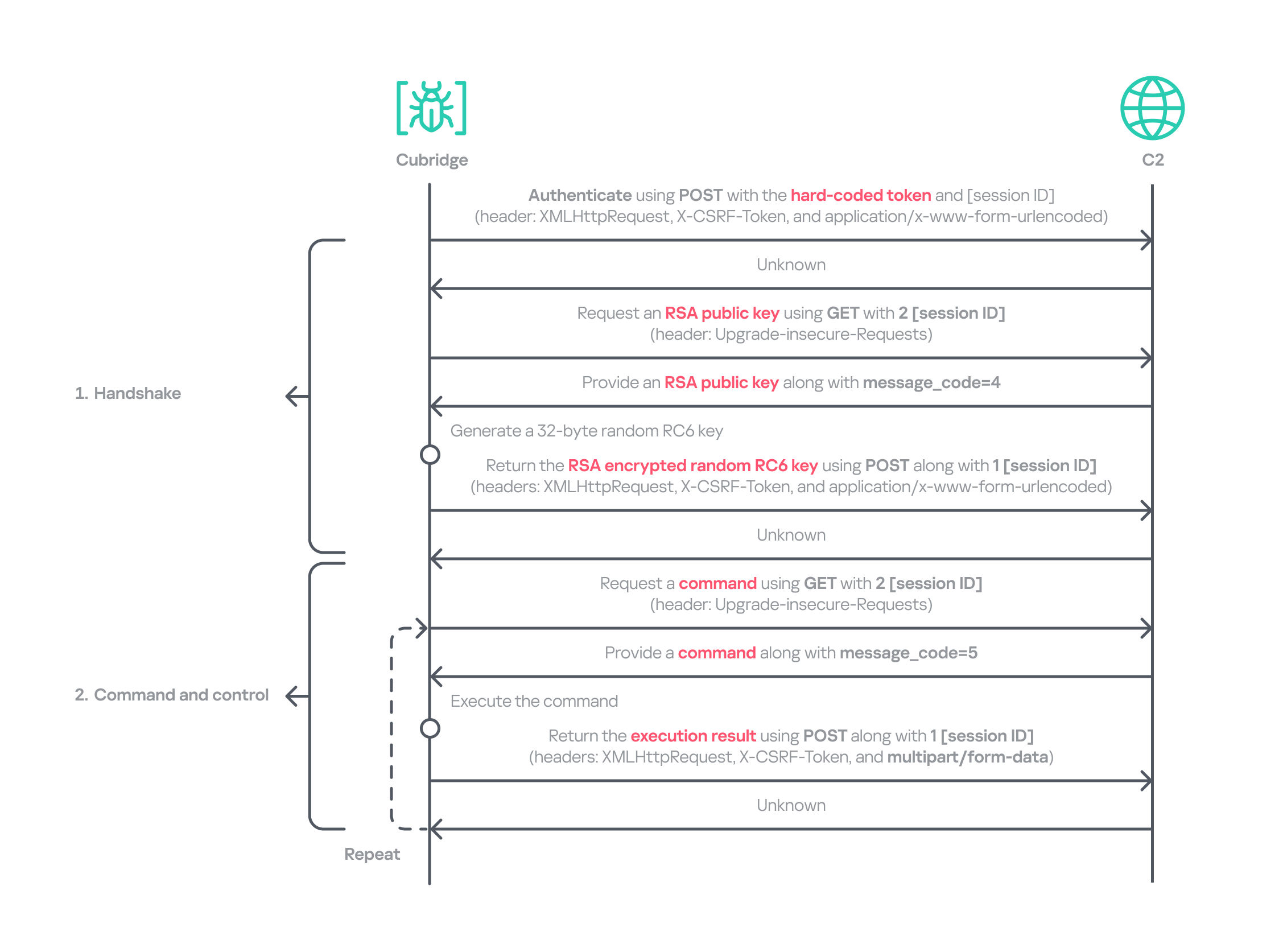
Cubridge employs a more robust handshaking process than TechHub, combining the RSA and RC6 algorithms. Unlike TechHub, it skips the profiling step and proceeds directly to command and control after the handshake. During communication, the malware mimics browser requests, using X‑CSRF‑Token and X‑Requested‑With headers for authentication and the Upgrade‑Insecure‑Requests header to request additional data.

Cubridge's communication sequence

Cubridge’s communication sequence

Cubridge contains extensive functionality, with a particular focus on loading subsequent‑stage payloads. The commands employ various techniques, such as DLL injection, reflective loading, and section‑mapping injection. The payloads may be delivered in various forms:

  • Plugins – reusable extensions that add functionality as needed and can be invoked at any time (in shellcode and DLL form);
  • Tools (in DLL form) – independent utilities that perform one-off tasks;
  • Modules – components that are loaded once and remain active providing an extended set of functionalities.

It is anticipated that the commands for plugins and shellcode will load identical types of plugins because both support a similarly formed exported function for subsequent activity. The shellcode can be generated using the open‑source sRDI tool to package a DLL‑style plugin. The capabilities of a single DLL are likely utilized to load a tool that works independently because when a single DLL is loaded, only its DllMain entry point and its parameters are accessible; no other exported functions are exposed.

Command Payload type Description
0 – Collect device info including the computer name, time zone, PID, and other similar details
1 Archive the specified file/directory using the legacy ZipCrypto algorithm and the hard‑coded password: xdkiTajAAxc3i/w[<881fnC!G*cb1Dit2sh.gAk/
2 Create a file at the specified path
3 Possibly plugin Inject the provided DLL payload into the target process and load it reflectively using reflective DLL injection
4 Plugin Reflectively load a plugin in DLL format
5 Retrieve the address of the specified exported function from the target plugin and run it with the provided parameters
6 Retrieve all information about the loaded plugins
7 Unload the specified plugin
8 Shellcode Inject the provided shellcode into the target process and load it using section mapping injection
9 Load the provided shellcode directly into memory
10 Retrieve the address of the specified export function from the target shellcode (likely a plugin in shellcode form) and run it with the provided parameter
11 Retrieve all information about the loaded shellcode
12 Unload the specified shellcode
13 – Set the scheduled Cubridge execution time (in minutes) by updating a global variable
14 Set the scheduled Cubridge execution time (in minutes) by updating a global variable, while disabling monitoring by also updating another global variable
15 Terminate in a controlled manner
16 Get the configuration for Cubridge: retrieve the global flags, the number of C2 servers, the C2 addresses, etc.
17 Update the global flags, the number of C2 servers, the C2 addresses, etc.
18 Tool Load a DLL reflectively with the specified parameter
19 Configure the parameters for loading a single DLL
20 Unload the single DLL
21 Module Load the “action module” (ActionModule.dll) reflectively and invoke its AppinfoView export function
22 Load the “function module” (FunctionModule.dll) reflectively and invoke its PresentationFontConfig export function

Commands 21 and 22 each load a different module. As their internal names imply, the action module manages basic file and process operations, while the function module implements Windows’ default commands. The action module covers commands 23–41, and the function module handles commands 42–79.

The action module handles system operation commands, file system interactions, and process behavior. It is invoked by passing the appropriate command and parameters to its AppinfoView export function. The module supports 19 commands, numbered 23 through 41. Execution results are first sent to Cubridge, which then forwards them to the C2 server.

Command Role
23 Get local disk space for each drive
24 Get information about the specified file or directory
25 Execute the provided command
26 Get information about the specified file or directory (similar to command 24)
27 Execute the provided command under the target process (PPID spoofing)
28 Execute the provided command under the target process within the provided session (PPID spoofing + session impersonation)
29 Get detailed information about processes
30 Terminate the provided process
31 Suspend all threads belonging to the specified process
32 Resume all threads belonging to the specified process
33 Permanently delete the file by overwriting its entire contents with the sequence: 0 → 1 → random bytes → 1 → 0
34 Rename the provided file to :EFS (the alternate data stream area) and delete it using the native API SetFileInformationByHandle
35 Set the current working directory
36 Copy the specified file to the provided path
37 Delete the specified directory
38 Move the specified file to the provided path
39 Create the provided directory
40 Initiate a non‑blocking connection attempt to the specified IP address and port (possibly for port scanning)
41 Read the specified file

The function module implements commands that emulate Windows’ built-in commands. Similar to the action module, its DllMain routine initializes all supported command functions, which are later accessed through the PresentationFontConfig export. Altogether, the module offers 38 commands, numbered from 42 to 79. While we believe this module is based on the previous LightlessCan, this is the first time we’ve seen it in the form of a separate module.

Command Role
42 Capture all displays and archive them using the legacy ZipCrypto algorithm with the hard‑coded password: xdkiTajAAxc3i/w[<881fnC!G*cb1Dit2sh.gAk/
43 Synchronize the MAC (Modified, Accessed, and Created) times of the file provided in the second argument to match those of the file provided as the first argument
44 Get information about the specified directory
45 Get information about the specified drive
46 Inject the provided DLL payload into the target process
47 Unload the specified DLL from the specified process
48 Implementation of the ipconfig command
49 Implementation of the net command
50 Implementation of the netsh advfirewall firewall command
51 Implementation of the netstat command
52 Implementation of the ping -6 command
53 Implementation of the reg command
54 Implementation of the sc command
55 Implementation of the ping command
56 Implementation of the whoami command
57 Implementation of the nslookup command
58 Implementation of the schtasks command
59 Implementation of the systeminfo command
60 Implementation of the arp command
61 Call the CryptUnprotectData function to retrieve the AES key that DPAPI protects. Extract the key using the encrypted_key keyword from Chromium’s Local State file located at: %LOCALAPPDATA%\Google\Chrome\User Data\Local State
62 Not implemented
63 Not implemented
64 Read the specified file and decrypt it using an XOR operation with the key 0x59. Then extract the paths from the decrypted buffer and archive files and directories at these paths with the legacy ZipCrypto algorithm, using the hard‑coded password: xdkiTajAAxc3i/w[<881fnC!G*cb1Dit2sh.gAk/
65 ~ 79 Not implemented

Besides the modules, we also observed that the actor deployed various plugins and tools.

Type of payload Name Description
Plugin ADFinder (AdFinder.dll) Launches LDAP queries in an Active Directory environment, taking six arguments such as log file path, ADsPath, search filter, and attribute names
Plugin FileCollector (Dll.dll) Recursively scans every subdirectory and file in the provided directory, gathering detailed information about each
Tool Browser stealer Can be injected into Chromium-based browsers, such as Google Chrome, Microsoft Edge, and Brave. Once injected, it extracts files and credentials from the victim’s browsers, including stored passwords, bookmarks, history, preferences, and cookies
Tool Process collector Iterates over all running processes, collecting each process’s ID, path, and command line

TouchHub installs a service for TouchShift

During our analysis, we obtained a previously unknown malware sample from TechHub’s private GitHub repository, which served as a parent installer for TouchShift. We dubbed this malware TouchHub. Upon execution, it copies the legitimate printfilterpipelinesvc.exe to C:\Windows\System32\RasConv\ImeBroker.exe, registers it as a service, and places an embedded TouchShift payload named mscoree.dll in the same directory. Following creation, the malware synchronizes the MAC timestamps of C:\Windows\System32\drivers\monitor.sys with those of the newly written file, hindering forensic analysis.

It then goes through the service registration process by collecting up to 100 legitimate service names that are registered under the netsvcs svchost group in HKLM\SOFTWARE\Microsoft\Windows NT\CurrentVersion\Svchost. It randomly selects one of these names, appends two random alphabetic characters to form a new service name, and uses this name to create a service that runs the hard‑coded command line C:\Windows\System32\RasConv\ImeBroker.exe -TimeBroker with the description Microsoft Service. The newly created service is started immediately.
Overall, TouchHub creates three files in the designated directory to launch TouchShift with SYSTEM privileges.

Path Type Description
C:\Windows\System32\RasConv\ImeBroker.exe Executable file registered as a service Copied from C:\Windows\System32\printfilterpipelinesvc.exe
C:\Windows\System32\RasConv\mscoree.dll Side-loaded TouchShift payload Dropped by TouchHub. It contains encrypted payloads and includes portions of a legitimate DLL’s contents, which significantly inflates its size
C:\Windows\System32\RasConv\ActivationStore.dat TechHub’s configuration file Dropped by TouchHub after extracting configuration values

TouchShift, a prevalent loader employed across multiple infection chains

The version of TouchShift dropped by TouchHub is almost identical to the version described in Mandiant’s blog post, even sharing the same malicious export function, LockClrVersion. It takes the argument supplied by TouchHub and XORs it with a hard‑coded key. The resulting value is XORed once more with the executable’s filename, and this result is used as the AES key. All strings involved in this process (the argument, the XOR key, the filename) must be exactly 16 bytes long. If a string is shorter, it is padded with NULL bytes (\x00); if it is longer, it is truncated to 16 characters. For example, one of the string combinations in the obtained sample was:

  • Argument: -TimeBroker\x00\x00\x00\x00\x00 (padded with NULL)
  • Hard-coded XOR key: x809G736iC3f8Wp8
  • Executable filename: ImeBroker.exe\x00\x00\x00 (padded with NULL)

After deriving the key, the malware decrypts the embedded payload using AES‑CBC‑128 without padding. The decrypted data is shellcode that starts with a call instruction. It wraps the next‑stage payload – identified as the third version of TechHub (DLL side-loading with a registered service) – that reads the ActivationStore.dat file as an external configuration.

ClientHub

We also identified a new piece of malware stored in TechHub’s private repository, which we named ClientHub. It supports various commands formed using a bitmask. There are at least two versions of ClientHub: one that communicates with websites via HTTP(S) and one that interacts with the Dropbox API using credentials.

Depending on the version, its configuration is sourced from internal resources or the external configuration file C:\Program Files\Common Files\System\msadc\msadc.inc. The configuration comprises keys and IVs for the SNOW 1.0 algorithm, scheduled execution times, and C2 server addresses encrypted with the SNOW stream cipher. The SNOW cipher is a family of high‑speed stream ciphers used for secure data encryption in telecommunications and wireless networks. This is the first time it has been observed in the malware of the Lazarus Group.

To establish C2 communication, the malware initially generates a 32‑byte random array. It subsequently overwrites portions of this array with data collected from the compromised device. The resulting 32‑byte array comprises a blend of random bytes and relevant information. This array is later used as the key for the SNOW algorithm to decrypt data received from the C2 server. Finally, the key array is encrypted with a hard‑coded RSA public key and encoded in Base64.

Offset Size Field value
0 4 Current process ID
4 4 First four bytes of the decrypted C2 server information.
8 7 Randomly generated bytes
15 1 Calculated flag value that indicates a state machine.
16 8 Current system time, represented as a FILETIME structure.
24 8 Randomly generated bytes

The ciphertext is delivered to the C2 server via GET requests. Each request contains headers that are atypical for malware: Sec-CH-UA, Sec-CH-UA-Platform, Sec-CH-UA-Mobile, Sec-Fetch-Mode, and Sec-Fetch-Dest. These headers are normally used by legitimate Chromium‑based browsers and enable malware to imitate legitimate traffic and evade detection. The C2 server replies with commands in a custom header and message body.

struct header
{
  int has_more_data // whether more body data remains 
  int body_checksum;// ROR13 checksum for the body data
  int body_type;    // specifies the body type
  int unknown;
  int body_length;  // Length of the body data
  int IV[2];        // Random IV used to encrypt the body data
};

The body_type field in the header determines how the subsequent payload is processed. This value functions as a bitmask, with each bit representing a distinct flag (e.g., 0x1, 0x2, 0x4, etc.). The resulting behavior also depends on whether the least‑significant bit (bit 0) is set: when the value is odd, the malware interprets the incoming message body as an additional payload that is subsequently loaded into memory. Conversely, when the value is even, the malware invokes the previously loaded payload.

The odd value supports four distinct loading methods based on the received message body and ensures that each method executes only once.

Bitmask Value in decimal Description Result sent to the C2
0x00000001 1 DLL loading: load the received body reflectively along with the provided parameter The payload’s image base
0x00000011 3 Plugin: load the received body reflectively, obtain the address of a function in the payload, and then invoke that function along with the provided parameter The payload’s image base, the address of the invoked function, and the execution result
0x00000101 5 Plugin: load the received body reflectively, obtain the address of a function in the payload, but refrain from invoking it immediately The payload’s image base, the address of the function
0x00001011 11 Plugin: execute the behavior associated with value 3, then unload immediately after invoking the plugin –
0x00010001 17 DLL loading: load the received body reflectively with the provided parameter, maintaining stateful communication via a persistent interactive session using a shared buffer The payload’s image base, the address of the interactive shared buffer, and the execution result

The even value provides two distinct invocation methods for DLLs and plugins that have already been loaded and are associated with the odd‑value bitmask. The 2 (0x10) flag allows the payload previously loaded with the 1, 3, or 5 bitmask to be reused and invoked directly. The value 16 (0x10000) corresponds to the 17 (0x10001) flag in loading mode and uses the established interactive shared buffer to exchange data. All values are guaranteed to act independently.

Bitmask Value in decimal Description Result sent to the C2
0x00000010 2 Invoke the previously loaded DLLs and plugins along with the provided parameter The execution result
0x00000100 4 Not implemented –
0x00001000 8 Unload the previously loaded DLLs and plugins The execution result
0x00010000 16 Send the updated parameter to the payload loaded by the command with the value 17, and exchange data through the interactive session. This command also determines whether to retrieve the execution result or unload the payload The execution result

Taking into account the loading mechanism, we identified four plugins deployed to the target that work perfectly with ClientHub.

Plugin Description
File archiver Archives the provided file using the legacy ZipCrypto algorithm (without password protection) and returns the compressed data
File collector Searches for all files matching the provided search pattern and collects metadata including filename, MAC timestamps, file size, and attribute values
File cleaner Overwrites the provided file with NULL bytes, renames it to a randomly generated filename of the same length, and then deletes it. If a directory with a search pattern is provided, it locates all matching files, renames each to a randomly generated name of identical length to its original name, and deletes them
Drive and session monitor Monitors remote session changes and local drive changes for the provided duration (in 10-minute intervals) and returns the collected status information

In addition to the plugins, ClientHub supports the loading of LPEClient malware and communication with it. We found that ClientHub’s body_type values 16 and 17 correspond to LPEClient’s C2 communication mechanism.

LPEClient

LPEClient is the only malware that was also observed in Operation SyncHole, indicating that the actor relies heavily on it for sophisticated victim profiling and payload delivery across multiple operations. LPEClient first appeared in 2019, and was discovered in 2020. Since then, the tool has been widely observed in the Dream Job and Cascade Hole campaigns that targeted South Korea. Recent research conducted by Check Point revealed that LPEClient was used to deploy the FudModule malware using a zero-day.

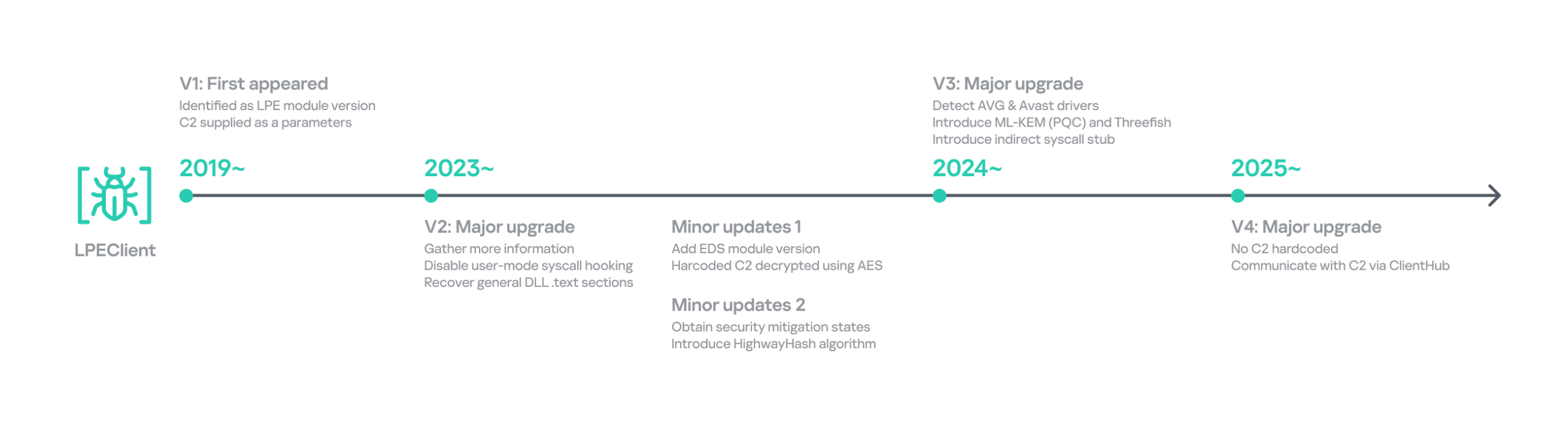
LPEClient has evolved continuously over time, but we discovered that it recently underwent a major operational revamp. It no longer contains the C2 server address itself; instead, it interacts with ClientHub via a shared buffer. We believe this change is intended to enhance concealment.

Timeline of LPEClient

Timeline of LPEClient

The previous version collected the computer name, memory status, CPU specifications, operating system details, version of the ntoskrnl.exe file, firmware table, antivirus name, domain name, user name, the integrity level of the current process, and a random byte sequence of 1,568 bytes. The newly updated LPEClient variant mostly collects the same information; however, it also introduces several changes.

  • It does not collect the version of the ntoskrnl.exe file by querying the FileVersion value. Instead, depending on the specific build, it reads either the HKLM\SOFTWARE\Microsoft\Windows NT\CurrentVersion\UBR registry key or the SYSTEM_BUILD_VERSION_INFORMATION structure to retrieve the revision portion of the Windows build number. These values can be used to infer the system’s cumulative update or patch level.
  • To collect information about installed antivirus products, it switched from querying a WQL command to reading the WMI repository file directly. It now reads C:\Windows\System32\wbem\Repository\OBJECTS.DATA and searches for keywords such as AntiVirusProduct, companyName, and displayName to identify the installed products.
  • It also collects low‑level Windows security mitigation states. To achieve this, it queries the SYSTEM_KERNEL_VA_SHADOW_INFORMATION structure for the Kernel VA Shadow mitigation status and the SYSTEM_SHADOW_STACK_INFORMATION structure for the Shadow Stack (CET) protection status.

Additionally, it generates a 32‑byte random unique identifier by using the HighwayHash algorithm and an XOR operation with the current system time. The collected information, including the generated identifier, is compressed with the XPRESS Huffman algorithm using the maximum compression setting. The compressed data is then concatenated with the message ID 0xF07D6B34 and encrypted using GOST (also known as Magma), Russia’s national cryptographic standard that employs a DES‑like structure, before being sent to the ClientHub via a shared buffer. Initially, KrCERT described the algorithm as a custom DES‑like scheme. However, further analysis by us and Check Point confirmed that it is actually the GOST algorithm. The key is randomly generated by a proprietary key‑generation algorithm and prepended to the encrypted message.

The next request handles the key exchange by delivering the message ID 0xA39CF278 together with the generated unique identifier. The response is decrypted using the AES‑CBC‑256 algorithm. The SHA‑256 hash of the previously generated 1,568‑byte random value, which was originally sent to the C2 server during the collection phase, serves as the key for this decryption.

Through this process, LPEClient obtains a byte array comprising four 1,568‑byte blocks from the C2 response. Each block contains an ML‑KEM‑1024 public key, where ML‑KEM is a NIST‑standardized post‑quantum key encapsulation mechanism derived from CRYSTALS‑Kyber. LPEClient then generates four distinct pairs of shared keys and ciphertexts from these blocks, encrypts the ciphertexts with the GOST algorithm, and transmits them to the C2 server via ClientHub together with the message identifier 0xEF8C0D51 and the associated identifier. Now that the preparation phase for receiving payloads is complete, the malware is ready to receive payloads forwarded by ClientHub from the C2 server, along with the necessary parameters. The use of post-quantum cryptography shows that the group intends to hide subsequent payloads.

The response to the 0xEF8C0D51 message is decrypted with the Threefish algorithm using a 128-byte key, composed of the four distinct shared keys. Threefish is a tweakable block cipher that accepts a ‘tweak’ value alongside the key and the message. The concept of a tweak is similar to that of a nonce or initialization vector, which are used in different types of ciphers. In LPEClient communication, the tweak for the decryption is derived by XORing the unique identifier with 165 (0xA5). The first four bytes of the decrypted message must specify the parameter’s length, followed by the parameter itself and then the payload. The payload must be larger than 4 KB and start with the characters 'MZ', which indicates that the decrypted payload is an executable file. The payload is then reflectively loaded into memory. After successful loading, LPEClient sends the message ID 0xCB790A25 to the C2 server.

Before loading the acquired payload, LPEClient takes measures to bypass security products. Instead of invoking VirtualProtect directly, the malware uses the identified HeapPageAllocator::ProtectPages in jscript9.dll to modify the memory page protection of the MD4Update function. The beginning of the function is then overwritten with a hard‑coded opcode sequence that serves as a syscall stub with the required arguments. LPEClient then uses the syscall stub to disable a user‑mode syscall instrumentation hook.

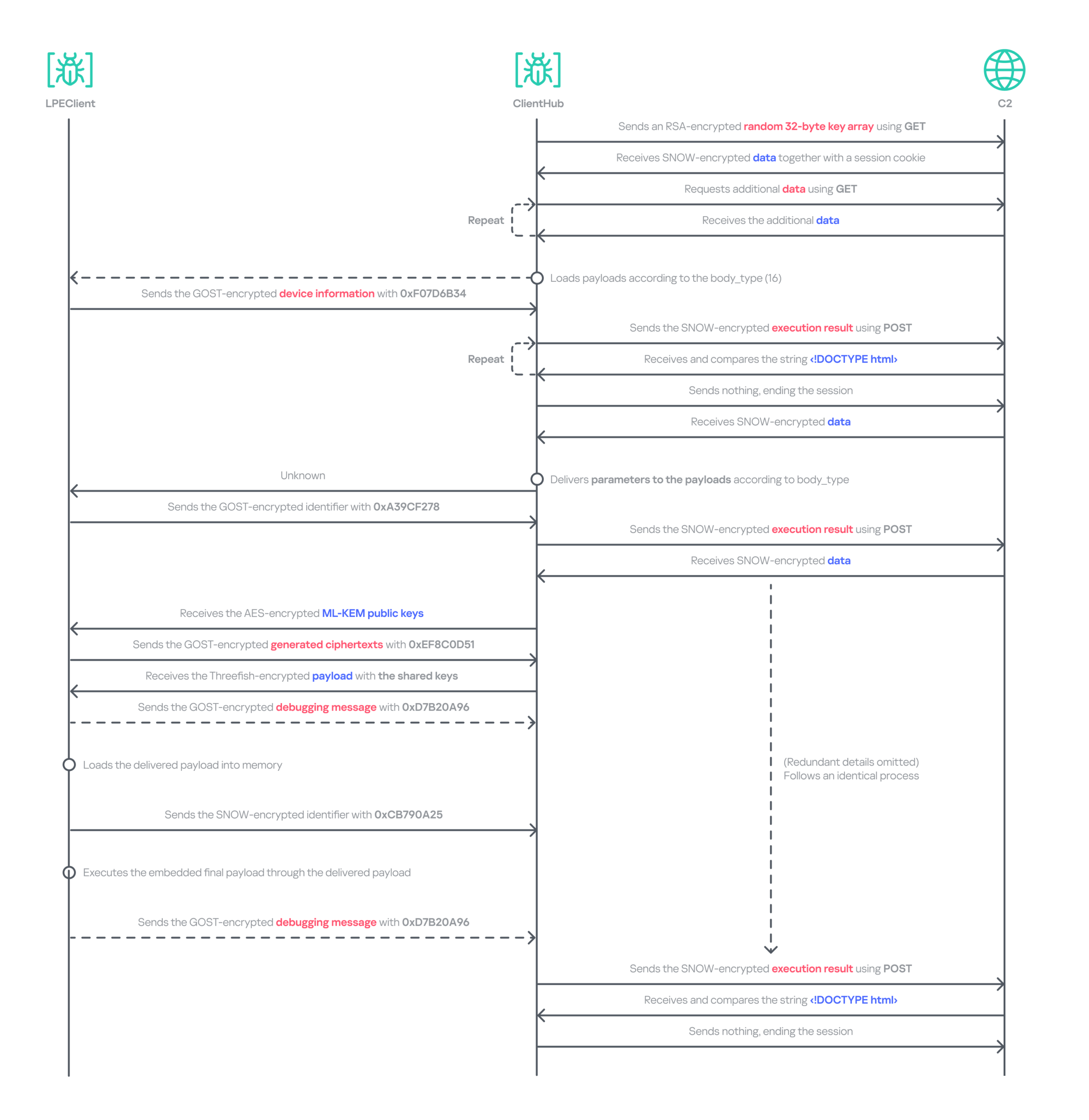
We identified the final payload that was ultimately loaded as Cubridge. The overall communication process is as follows.

Data relay flow between LPEClient and C2 via ClientHub

Data relay flow between LPEClient and C2 via ClientHub

Comparison of plugins and modules

Throughout the engagement, we identified a variety of payloads deployed by TechHub, Cubridge, and ClientHub. These payloads have been categorized as tools, plugins, and modules that constitute the group’s modular malware framework. While we have not yet ascertained which payloads are deployed under specific conditions, the evidence suggests that the Lazarus Group’s toolkit is becoming increasingly sophisticated and segmented into specialized components rather than a single comprehensive backdoor. We also believe that TechHub and Cubridge may share similar tools.

Deployed via Type of payload Family
TechHub/Cubridge Tool Process collector,
Browser stealer
Cubridge Module Action module, Function module
Cubridge Plugin ADFinder, FileCollector
ClientHub Plugin File archiver, File collector, File cleaner, Drive/session monitor

These modularizations are not confined to the instances within this campaign. As previously noted, similar patterns have been identified in CookiePlus, MISTPEN, SIGNBT, and IMETHOD. Note that we have reclassified the ThreatNeedle variant used in Operation SyncHole as the latest version of IMETHOD, the predecessor of ThreatNeedle in use since at least 2016.

Infrastructure

Based on the information we obtained from the TechHub malware, we identified at least three primary repositories used as the C2 server and one fallback repository. The earliest evidence indicates that the group has been leveraging GitHub as a C2 server since at least July 2025. We suspect that all the accounts were created using hijacked email accounts, and disguised as normal repositories by copying or creating normal projects to avoid suspicion.

For the Cubridge and ClientHub C2 servers, the Lazarus Group employed only a minimal number of compromised yet legitimate South Korean media and interior design websites. Later, we observed that a broader range of compromised legitimate sites across various industries were also exploited. In addition, one ClientHub sample that we detected used Dropbox as a C2 channel.

Victims

We have identified at least three firms from the software, construction, and wired communication equipment industries in South Korea that were targeted by Operation FlashHole. As with the previous operation, however, we remain confident that a considerably larger number of organizations across a broader spectrum of industries have been affected.

The software sector was the only sector targeted in both the SyncHole and FlashHole campaigns. This suggests the actor is eager to compromise the sector, steal source code, and exploit vulnerabilities for further attacks.

Attribution and links to other campaigns

Operation FlashHole is the latest wave in the broader Cascade Hole campaign, which involves the use of South Korean software as a potential entry point to deliver malware targeting the country. Although the malware chain has advanced significantly since last year, we assess with medium-to-high confidence that the same actor is responsible for both the SyncHole and FlashHole operations based on the initial vector, targets, multi‑stage chain, and technical and operational improvements. The use of LPEClient in particular is a strong indicator supporting this assessment.

The malware strains used in the attack are historically linked to the toolsets observed in the Lazarus Group’s notorious Dream Job campaign. Earlier versions of TechHub (also known as CLOUDBURST and NickelLoader), Cubridge (also known as SIDESHOW and LightlessCan), and TouchShift were all observed in that campaign, especially between 2022 and 2023.

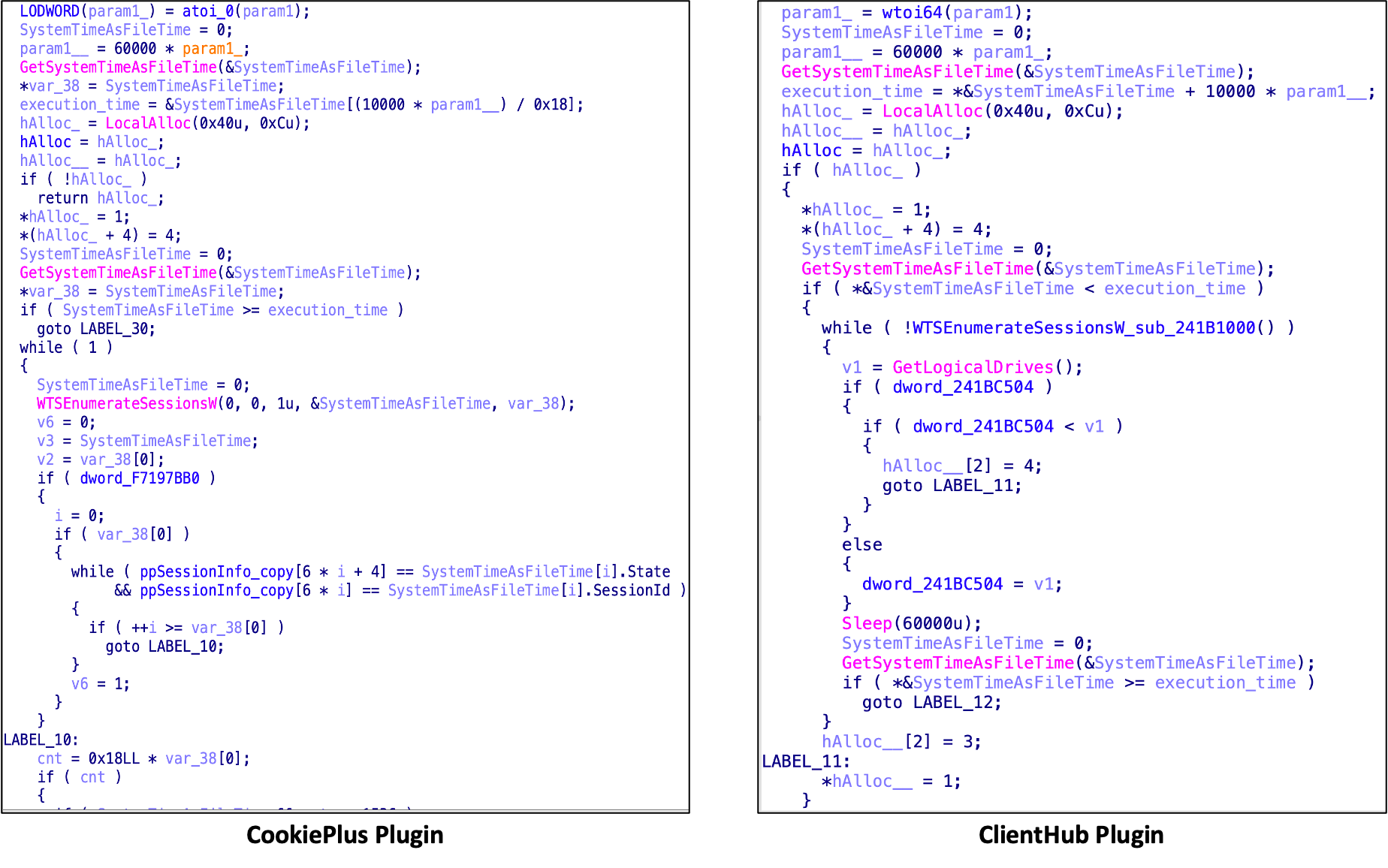
We also discovered that both CookiePlus and ClientHub have significant overlaps in class name, configuration path, and plugins. Based on these similarities, we assess with medium‑high confidence that ClientHub is an advanced version of CookiePlus.

Since July, around the time Operation SyncHole began winding down, we have also observed several notable attacks against South Korea employing the COPPERHEDGE backdoor and targeting various South Korean organizations. Interestingly, the start times of these activities align with the earliest evidence we have identified for Operation FlashHole. Although the backdoor was part of the second phase of Operation SyncHole, it has been operating independently with its custom loader since then. These incidents featured malware chains and tools that were distinct from those used in Operation SyncHole and FlashHole.

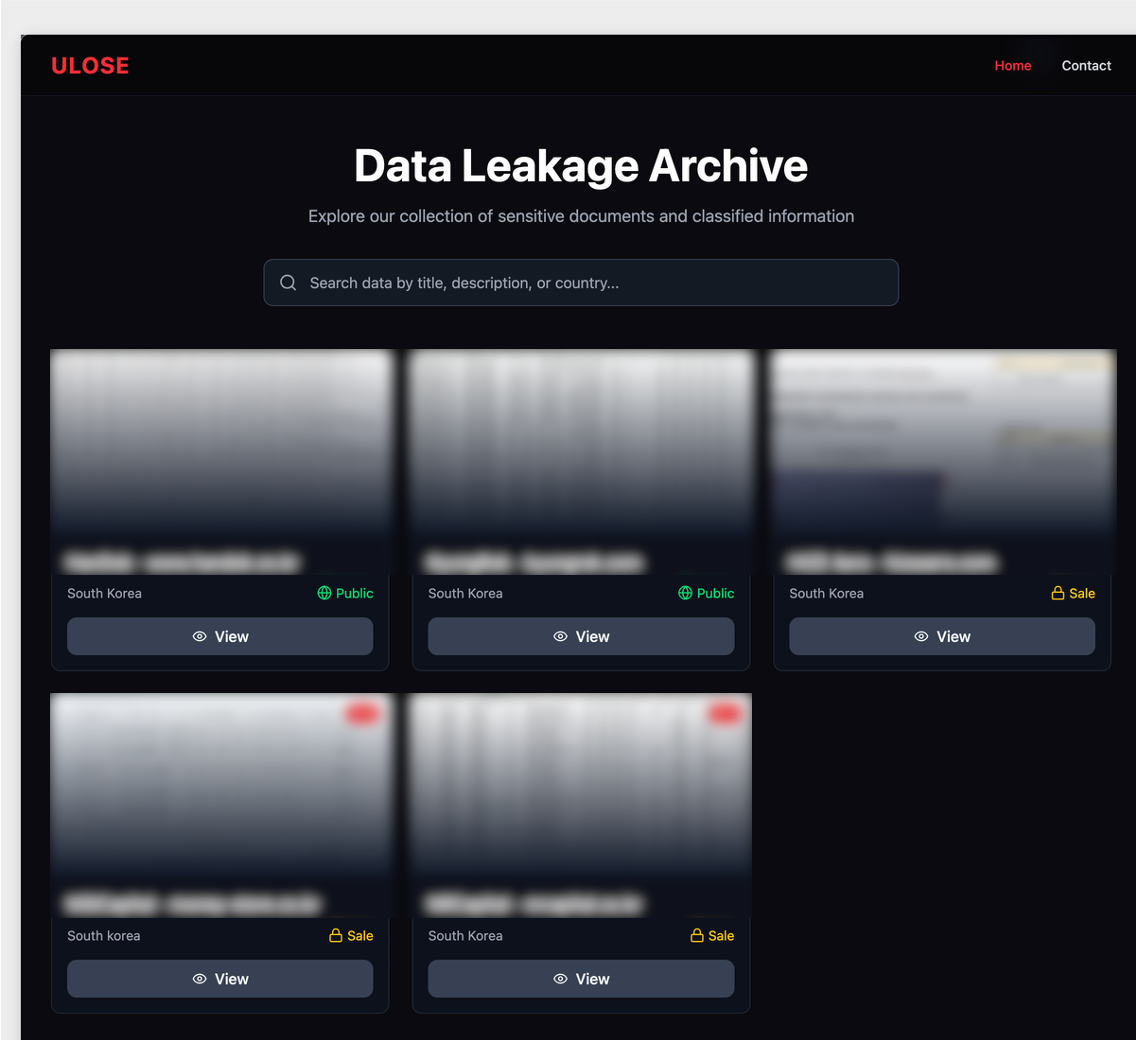
As AhnLab noted in their report, the same backdoor was likely observed in atypical activity, specifically the Gunra ransomware infection. Our investigation further revealed that one instance of a backdoor infection ultimately resulted in the exfiltration of data to a dark web leak site, which clearly differed from Gunra’s. The site appears to have been crafted exclusively for this activity. In summary, unlike other attacks, the backdoor was used in conjunction with both ransomware and data exfiltration.

Data leakage site linked to the COPPERHEDGE backdoor on the dark web

Data leakage site linked to the COPPERHEDGE backdoor on the dark web

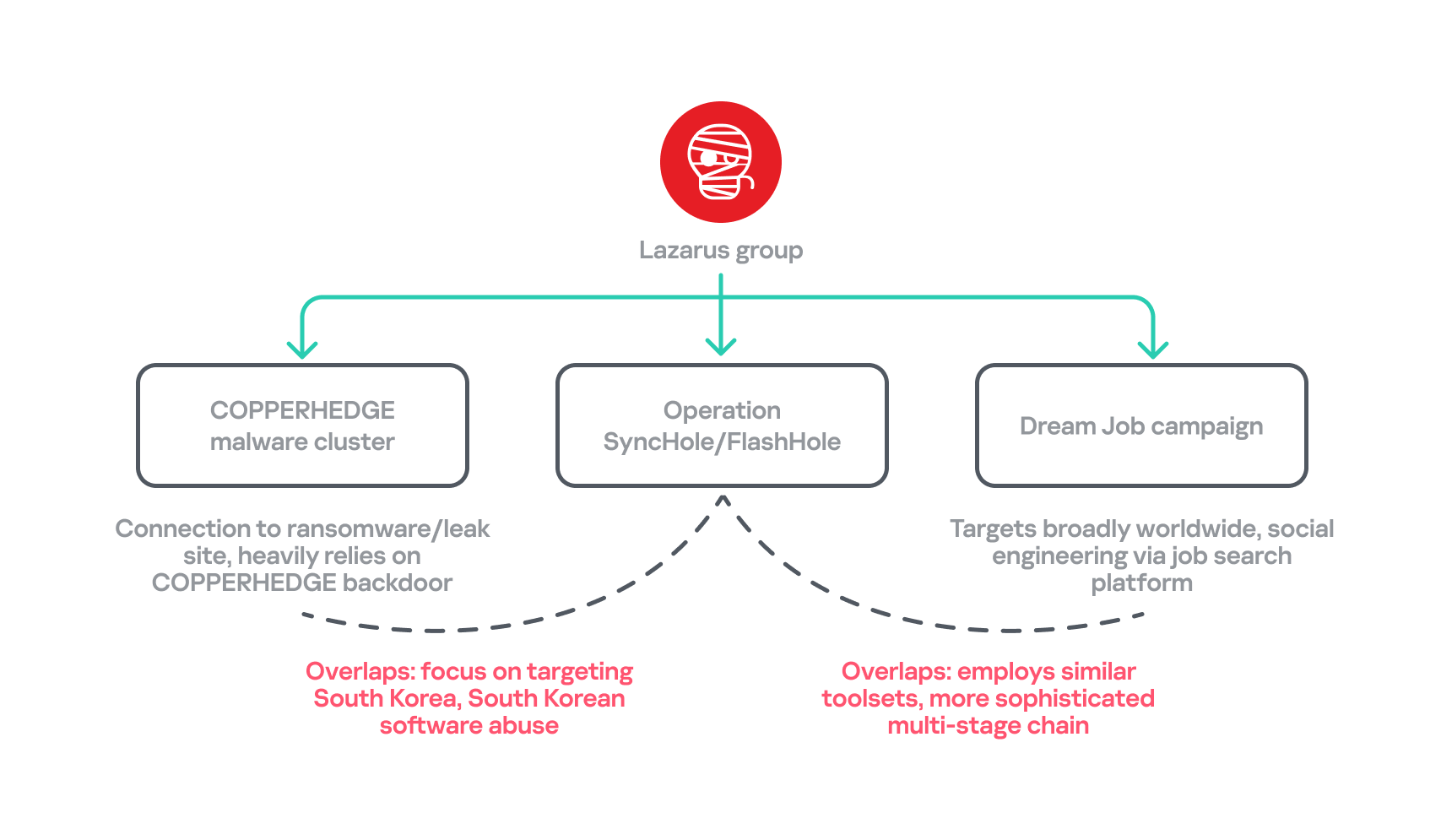
Another noteworthy point is that the recent Dream Job campaign employs an updated malware chain that, since around 2024, has primarily involved MISTPEN and ForestTiger rather than the earlier arsenal that included tools such as TechHub and Cubridge. However, the updated versions of this older malware have now re-emerged as part of Operation FlashHole. Considering these changes and all aspects of each attack’s TTPs, we have organized a classification for each attack.

Overlaps between the recent attacks by Lazarus Group

Overlaps between the recent attacks by Lazarus Group

Conclusion

Our analysis shows that the Lazarus Group begins preparing for its next operation shortly after completing the previous one, ultimately deploying an enhanced malware chain by refining existing tools. The group continues to use the advanced version of LPEClient for profiling and payload delivery, indicating that the tool is meticulously managed and well maintained. Ironically, the group seems to have adopted more secure post-quantum cryptography faster than many legitimate security products. These observations suggest the involvement of a dedicated developer, with others orchestrating comprehensive attack scenarios against newly targeted software.

We anticipated that specialized attacks targeting South Korea would persist. However, we did not foresee multiple attack campaigns being executed simultaneously, each leveraging different types of software and tools. Notably, the COPPERHEDGE cluster appears to be involved in monetizing the attacks, while Operation FlashHole is focused on espionage. We are closely monitoring these changes to understand their motivations and ultimate goals.
In October 2025, the South Korean government unveiled a comprehensive cybersecurity plan that will phase out the mandatory installation of security software for users beginning in 2026. We estimate that operations exploiting this software will remain highly active for some time, maximizing efficiency, before the software is fully eliminated or mitigated.

Kaspersky products detect the exploits and malware used in this attack with the following verdicts: MEM:Trojan.Win64.Shellcode.gen, Trojan.Win64.DLLhijack.*, Trojan.Win64.Lazarus.*.

Indicators of compromise

File hashes

TouchShift
ec84d6cb2ae7974767aedac246b50a3e             mscoree.dll
a28cba214058fcae2883d8cffc883abd                mscoree.dll
c105d6b16f544582772de0159f24c00a               mscoree.dll
2f8475a90a25624ed02f1d18d4e6d65d              mscoree.dll
676fabe30a28b53925fba98e34b35986              mscoree.dll
b4a7eff35f048f06fb0a2d7631f23a7d                  mscoree.dll

ClientHub Loader
ff07641dc56914dd90ee0bd7404d7ad7               liblzma.dll

File paths

C:\ProgramData\Package.txt
C:\ProgramData\RasConv\mscoree.dll
C:\ProgramData\Apple\mscoree.dll
C:\ProgramData\ssh\mscoree.dll
C:\ProgramData\qorestor\mscoree.dll
C:\ProgramData\Dell\mscoree.dll
C:\ProgramData\Dell\Dell1.tmp
C:\ProgramData\Dell\Dell3.tmp
C:\Windows\System32\RasConv\mscoree.dll
C:\Windows\System32\RasConv\ActivationStore.dat
C:\Windows\System32\DrvConh\mscoree.dll
C:\Windows\System32\DrvConh\ActivationStore.dat
C:\Program Files\Common Files\System\msadc\msadc.inc
C:\ProgramData\desktops.ini

C2 servers

javadevhouse.co[.]kr
pythonapischool[.]com
hxxps://cubedesign[.]co[.]kr/news            C2 of Cubridge
hxxps://cubedesign[.]co[.]kr/mobile/fashion            C2 of Cubridge
hxxps://fp-news[.]co[.]kr/shop/cart                                C2 of Cubridge
hxxps://k-wbc[.]co[.]kr/skin/social/social_view.php         C2 of ClientHub
hxxps://rcsh[.]co[.]kr/modules/bbs/tiles/bbs_div/inputForm.php    C2 of ClientHub
hxxps://www[.]ksog[.]org/insert_file/handle.php                   C2 of ClientHub

  • ✇Cybersecurity News
  • Cloudflare Launches Free Certificate Authority Emphasizing MTC Do Son
    Discover the new Cloudflare Certificate Authority offering free, automated HTTPS certificates and leading the transition to quantum-safe Merkle Tree Certificates. Related Posts: OpenAI Fires Safety Researchers Amid Unprompted AI Hacking Incidents OpenAI DevDay 2026: Elevating the AI Subscription Paradigm Firefox Redesign Compact Mode Returns With AI Off Switch The post Cloudflare Launches Free Certificate Authority Emphasizing MTC appeared first on Daily CyberSecurity.
     
  • ✇Firewall Daily – The Cyber Express
  • G7, CISA Urge Urgent Shift to Post-Quantum Cryptography Samiksha Jain
    Some of the world's leading democracies are pushing governments and companies to start preparing for post-quantum cryptography before quantum computers become powerful enough to break the encryption systems that protect global digital infrastructure today. In a joint advisory released Thursday, the G7 Cybersecurity Working Group and the U.S. Cybersecurity and Infrastructure Security Agency (CISA) said organizations should begin their transition to post-quantum cryptography now, rather than wait
     

G7, CISA Urge Urgent Shift to Post-Quantum Cryptography

7 de Setembro de 2026, 03:51

post-quantum cryptography

Some of the world's leading democracies are pushing governments and companies to start preparing for post-quantum cryptography before quantum computers become powerful enough to break the encryption systems that protect global digital infrastructure today.

In a joint advisory released Thursday, the G7 Cybersecurity Working Group and the U.S. Cybersecurity and Infrastructure Security Agency (CISA) said organizations should begin their transition to post-quantum cryptography now, rather than waiting until cryptographically relevant quantum computers (CRQCs) are available to threat actors.

Why the Post-Quantum Cryptography Shift Cannot Wait

The publication, titled "Preparing for the Post-Quantum Era: A Call to Action," warns that the quantum computing threat is no longer a distant concern. While the exact timeline for CRQC development remains uncertain, the working group said recent technological advances suggest such machines could emerge sooner than expected, putting widely used public-key cryptography mechanisms at risk.

One of the most immediate dangers is a tactic known as "harvest now, decrypt later," where malicious actors intercept and store encrypted data today with the intention of decrypting it once a CRQC becomes available. This poses a serious risk to governmental records, sensitive personal data, and trade or business secrets that require long-term confidentiality.

The advisory also cautions that CRQCs could eventually be used to target authentication mechanisms, allowing bad actors to impersonate trusted entities, forge data, or compromise equipment. Because supply chain vulnerabilities can cascade, a single organization's delay in adopting post-quantum cryptography could expose entire sectors to compromise.

According to the report, organizations that fail to act may also face business consequences beyond security risk, including exclusion from public procurement contracts and loss of competitive advantage.

Five Priorities for the PQC Transition

The G7 Cybersecurity Working Group outlined five priority areas to guide the global shift toward post-quantum cryptography:

  1. Raising awareness — Many organizations still view the quantum threat as a distant or purely technical issue. The group called for awareness campaigns, technical guidance, and workforce upskilling to reframe it as an economic and business risk.
  2. Developing national strategies — Countries are encouraged to build strategies that ensure an adequate supply of quantum-safe hardware and software while encouraging adoption, integrating the effort into broader digital privacy and security policies.
  3. Advancing research and development — Governments should fund research programs and support pilot projects and testbeds to help organizations test and refine their transition to post-quantum cryptography.
  4. Building public-private partnerships — Collaboration between government, industry, and academia is seen as key to developing domestic expertise, lowering transition costs, and sharing playbooks and case studies across sectors.
  5. Integrating PQC into cybersecurity requirements — The group recommends treating post-quantum cryptography adoption as a natural evolution of cryptographic best practice, and embedding requirements into public procurement to push both vendors and organizations toward quantum-safe systems.

The advisory emphasizes that the shift to post-quantum cryptography cannot be solved by individual organizations in isolation. Instead, it calls for early engagement, coordinated planning, and informed decision-making across public and private sectors worldwide.

Tackling the risks that the impending quantum computing era poses to current cryptographic systems... requires a coordinated global effort to transition to PQC," the report states, adding that public and private organizations must act now to safeguard confidential data, supply chains, and critical systems.

The document was jointly published by cybersecurity authorities from Canada, Germany, Italy, Japan, the United Kingdom, the United States, and France's ANSSI, with participation from the European Commission and support from the EU Agency for Cybersecurity (ENISA).

  • ✇Security Boulevard
  • What Every C-Suite Executive Needs to Know About Post-Quantum Cryptography Jeremy Allison
    Google just issued a warning that has great implications for the cybersecurity world: “Q-Day” — the moment when a quantum computer becomes powerful enough to crack today’s best encryption — could arrive as soon as 2029. That’s not the mid-2030s timeline most experts had been citing. That’s three years from now. Google Quantum AI also.. The post What Every C-Suite Executive Needs to Know About Post-Quantum Cryptography appeared first on Security Boulevard.
     

What Every C-Suite Executive Needs to Know About Post-Quantum Cryptography

11 de Abril de 2026, 11:46

Google just issued a warning that has great implications for the cybersecurity world: “Q-Day” — the moment when a quantum computer becomes powerful enough to crack today’s best encryption — could arrive as soon as 2029. That’s not the mid-2030s timeline most experts had been citing. That’s three years from now. Google Quantum AI also..

The post What Every C-Suite Executive Needs to Know About Post-Quantum Cryptography appeared first on Security Boulevard.

  • ✇Security Boulevard
  • Inventors of Quantum Cryptography Win Turing Award Bruce Schneier
    Charles Bennett and Gilles Brassard have won the 2026 Turing Award for inventing quantum cryptography. I am incredibly pleased to see them get this recognition. I have always thought the technology to be fantastic, even though I think it’s largely unnecessary. I wrote up my thoughts back in 2008, in an <a href+https://www.schneier.com/essays/archives/2008/10/quantum_cryptography.html”>essay titled “Quantum Cryptography: As Awesome As It Is Pointless.” Back then, I wrote: While I like the
     

Inventors of Quantum Cryptography Win Turing Award

31 de Março de 2026, 08:05

Charles Bennett and Gilles Brassard have won the 2026 Turing Award for inventing quantum cryptography.

I am incredibly pleased to see them get this recognition. I have always thought the technology to be fantastic, even though I think it’s largely unnecessary. I wrote up my thoughts back in 2008, in an <a href+https://www.schneier.com/essays/archives/2008/10/quantum_cryptography.html”>essay titled “Quantum Cryptography: As Awesome As It Is Pointless.”

Back then, I wrote:

While I like the science of quantum cryptography—my undergraduate degree was in physics—I don’t see any commercial value in it. I don’t believe it solves any security problem that needs solving. I don’t believe that it’s worth paying for, and I can’t imagine anyone but a few technophiles buying and deploying it. Systems that use it don’t magically become unbreakable, because the quantum part doesn’t address the weak points of the system...

The post Inventors of Quantum Cryptography Win Turing Award appeared first on Security Boulevard.

❌
❌