UMass Amherst researchers showed expired Visa contactless cards can make real purchases by exploiting an unsigned expiry field in Visa’s EMV kernel.
Researchers at the University of Massachusetts Amherst demonstrated at USENIX Security 2026 in Baltimore that expired Visa contactless credit cards can complete real purchases, including transactions at live retail and grocery merchants, by exploiting a gap in how the payment protocol handles expiration dates. The paper is titled “Zombie Cards B
UMass Amherst researchers showed expired Visa contactless cards can make real purchases by exploiting an unsigned expiry field in Visa’s EMV kernel.
Researchers at the University of Massachusetts Amherst demonstrated at USENIX Security 2026 in Baltimore that expired Visa contactless credit cards can complete real purchases, including transactions at live retail and grocery merchants, by exploiting a gap in how the payment protocol handles expiration dates. The paper is titled “Zombie Cards Back Online: Reviving Expired Credit Cards for Contactless Payments,” and the name is accurate.
Raja Hasnain Anwar, Gerard DeCunha, and Muhammad Taqi Raza built the attack around a structural weakness in EMV, the contactless payment protocol used by Visa, Mastercard, American Express, and Discover.
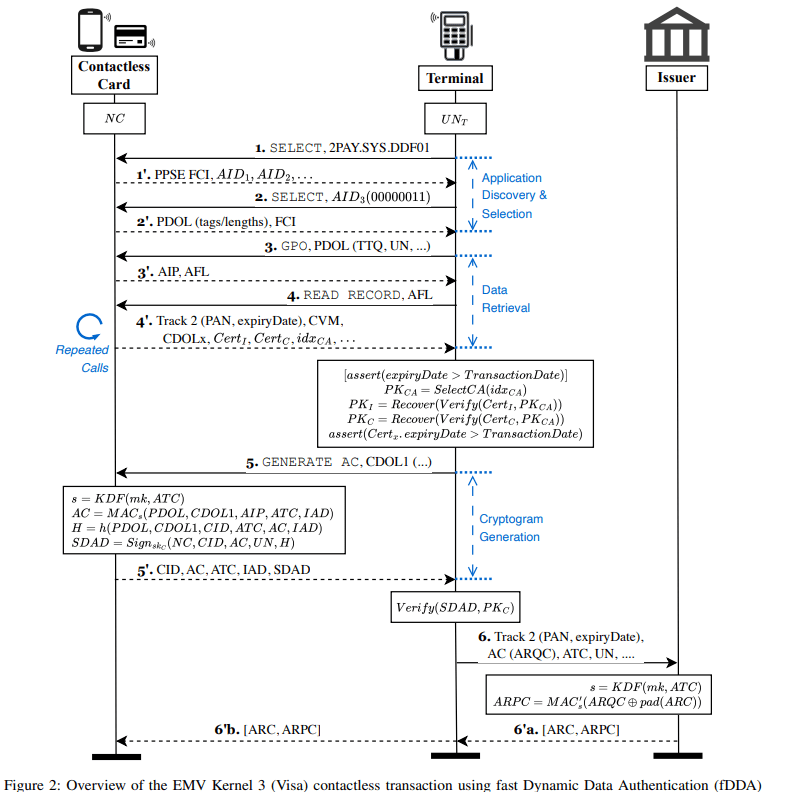
“A central source of fragility is that the EMV contactless protocol is a selectively authenticated transaction flow. Many data objects are exchanged in plaintext between the card and terminal [2], and only a subset is later bound to cryptographic verification via Offline Data Authentication (ODA) and issuer-verified cryptograms.” reads the paper. “In consequence, an adversary who obtains a man-in-the-middle position on the NFC channel can tamper with decision-critical fields that are consumed by the terminal but are not end-to-end integrity protected. Prior NFC attacks [10–12, 44], including relay-based manin-the-middle techniques, exploit this gap by manipulating transaction-relevant objects in transit while leaving cryptographic checks intact.”
The attack exploits a specific design decision in Visa’s Kernel 3, the software layer that implements the EMV protocol for Visa transactions. A Visa contactless transaction presents the expiration date twice: once in a field the payment terminal reads (tag 5F24, the Application Expiration Date) and once in a field the issuing bank reads (tag 57, Track 2 Equivalent Data). These two representations should be tied together by a cryptographic signature, but in Visa’s implementation they aren’t.
The relay attack changes only the expiry date that the payment terminal sees, replacing it with a future date while leaving the data sent to the bank unchanged. The card’s digital signature remains valid because it does not cover the expiry date. As a result, the bank receives a transaction that appears legitimate and passes its normal security checks.
In simple terms, an attacker can change the expiry date between the card and the terminal without breaking the card’s cryptographic protection.
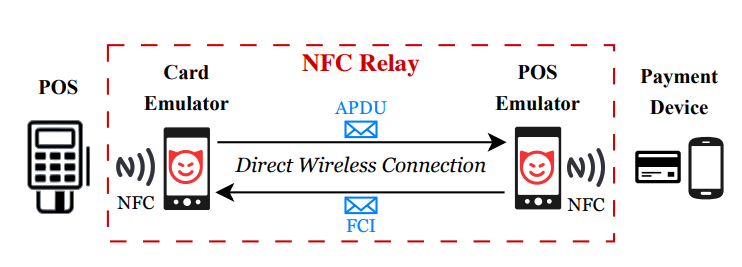
The relay itself is two NFC-capable Android phones running custom software over Wi-Fi: one emulates a card, one emulates a terminal. Each communication round trip added roughly 20 milliseconds for relay alone and about 50 milliseconds with the date modification, keeping the per-transaction average around 415 milliseconds, within Visa’s 500-millisecond command limit.
None of the test hardware used EMV’s optional Relay Resistance Protocol, which would have detected the added latency by bounding permissible response times.
Mastercard, American Express, and Discover all blocked the attack. Mastercard’s terminal checks consistency between the two expiry representations during record parsing and treats a mismatch as a card data error. American Express binds the expiration date into the data covered by offline authentication, so a modified value produces a hash mismatch. Discover’s kernel wraps the modified transaction objects into the verified transaction hash, and those also failed. Visa’s Kernel 3 does none of these things.
The outcome also depended on the issuing bank. The researchers tested three banks with expired and replaced physical Visa cards and found three distinct policies, not a clean pass or fail split. Bank A accepted the modified transactions at $1.00, $100.00, and $500.00 in the lab, and completed purchases of $2.79 at a retail merchant and $3.19 at a grocery merchant on campus. Bank A also accepted transactions from both the expired original card and its replacement against the same account simultaneously, a separate finding that Anwar described as alarming. Bank B detected the modification but still accepted some transactions. A third bank tested on Discover’s kernel detected the edit and declined; however, it also showed the simultaneous-card problem without any modification at all.
There is another finding that makes the issue more serious. Researchers changed the Consumer Device Cardholder Verification Method flag at five US banks, and the transactions worked at most of them. This flag controls how the terminal verifies the cardholder, and attackers can change it because the payment data can be modified while it travels between the card and the terminal.
There is also another problem with Kernel 3. It sends the issuer a Terminal Verification Results value filled with zeros. This means the bank cannot tell whether the terminal checked the card’s expiry date or whether that check failed. The bank must therefore approve the transaction without seeing what the terminal actually detected.
“Across all tests, the dominant factors that determine attack success or failure are: (i) the EMV kernel in use and whether expiry data fields are cryptographically bound to authenticated protocol outputs; (ii) issuer-side lifecycle enforcement, especially whether authorization is tied only to the active account and PAN or also to the specific card instrument and expiration date; and (iii) whether terminal-side validation results are visible to the issuer via TVR. In contrast, transaction amount1 , merchant category, and POS terminal brand did not independently determine the transaction outcome.” continues the paper.
The researchers disclosed the findings to Visa in May 2025 and followed up in December 2025. The paper records that Visa acknowledged the report, said it passed initial triage, and indicated it was undergoing reproduction by Visa’s red team. No CVE has been assigned. Neither Visa nor any of the notified banks confirmed any mitigation as of the paper’s acceptance. The Register asked Visa for comment and received no response.
The countermeasures the paper proposes sit at the kernel, terminal, and issuer layers: bind the expiry date cryptographically to an issuer-verifiable signature, require terminals to compare both expiry representations and make mismatches visible to the issuer, and have issuers authorize against the PAN-and-expiry combination rather than the PAN alone. For cardholders, the researchers recommend destroying the chip and magnetic stripe of expired cards rather than discarding them intact. Given that the attack requires only the expired physical card or sustained NFC proximity to it, that guidance is now slightly less hypothetical than it was before this paper.
Did you know there is still a good reason to physically destroy your expired credit card?
Scientific research found that the expiration date used by payment terminals on some contactless cards was not effectively protected against tampering.
University of Massachusetts Amherst researchers Raja Hasnain Anwar, Gerard DeCunha, and Muhammad Taqi Raza tested contactless cards across Visa, Mastercard, Discover, and American Express, using multiple terminals and merchants, and cards from five maj
Did you know there is still a good reason to physically destroy your expired credit card?
Scientific research found that the expiration date used by payment terminals on some contactless cards was not effectively protected against tampering.
University of Massachusetts Amherst researchers Raja Hasnain Anwar, Gerard DeCunha, and Muhammad Taqi Raza tested contactless cards across Visa, Mastercard, Discover, and American Express, using multiple terminals and merchants, and cards from five major US banks.
They found that a payment terminal could be tricked into seeing a future expiry date. Basically, they were able to modify the expiration date sent to the terminal to a future date. This allowed them to revive expired Visa contactless credit cards for real in-store purchases. Hence the name “Zombie Card.”
The result was not universal. The tested Mastercard, American Express, and Discover configurations rejected the altered expiry data, while issuer behavior differed even among the tested Visa cards: Some transactions were declined or prompted for a replacement card, while others were approved.
The flaw lies in the Visa Kernel 3 contactless flow, where the terminal-facing Application Expiration Date was not effectively bound to the card’s data. In the tested Mastercard, American Express, and Discover kernels, consistency checks or authenticated-data coverage caused modified expiry data to be detected and the transaction to be declined.
How this could be abused
The most credible abuse case is theft or recovery of an expired or replaced card which the owner regards as harmless. Consider cards left in household waste, a drawer, a lost wallet, or an unsecured corporate disposal stream. If the underlying account remains open and issuer-side controls do not validate the exact card lifecycle state, an attacker could attempt contactless purchases using a relay setup.
Less likely is a scenario that uses a proximity relay attack against a card still held by its owner. That requires sustained NFC (Near Field Communication) proximity and a live relay during the transaction, making it materially harder than merely scanning a card from a passing distance.
How to stay safe
For cardholders, the practical advice is simple:
Destroy expired and replacement cards. Cut through the chip several times. Make further cuts through the card body to disrupt the contactless antenna, and damage the magnetic stripe before disposing of the pieces.
Report a lost expired card rather than treating it as inert.
These are sensible precautions, but the primary responsibility lies with payment networks, terminal implementations, and issuers to ensure expiry data is integrity-protected and that authorization systems reject retired card credentials.
Something feel off? Check it before you click.
Malwarebytes Scam Guard helps you analyze suspicious links, texts, and screenshots instantly.
An exposed SISVISA database leaked 102,215 Brazilian health records, exposing IDs, tax data, and regulatory documents without authentication.
Researcher Jeremiah Fowler found a publicly accessible database that turned out to belong to SISVISA, Brazil’s Health Surveillance Information System, and alerted ExpressVPN, which later shared the findings with Hackread.
The exposed instance held exactly 102,215 files, roughly 79 GB of data, tied to a platform regulators use to track health rules,
An exposed SISVISA database leaked 102,215 Brazilian health records, exposing IDs, tax data, and regulatory documents without authentication.
Researcher Jeremiah Fowler found a publicly accessible database that turned out to belong to SISVISA, Brazil’s Health Surveillance Information System, and alerted ExpressVPN, which later shared the findings with Hackread.
The exposed instance held exactly 102,215 files, roughly 79 GB of data, tied to a platform regulators use to track health rules, issue licences and manage inspections for hospitals, restaurants and pharmacies. In other words, it wasn’t some forgotten test box in a corner; it was wired into how the state does its job.
“Over 102,000 private records belonging to Brazil’s health surveillance system were left online without passwords or basic encryption. Security researcher Jeremiah Fowler found this publicly accessible database and alerted cybersecurity firm ExpressVPN, which later shared the details with Hackread.com.” reads the report published by Hackread. “According to Fowler, this open database stored exactly 102,215 files (around 79GB). Further probing revealed that these records belong to Brazil’s Health Surveillance Information System (SISVISA). For your information, this is a crucial platform used by Brazilian health authorities to track public health rules, issue business permits, and manage inspections for hospitals, restaurants, and pharmacies.”
Once inside, Fowler didn’t need exploits or clever tricks. Anyone who knew the URL could browse folders called “backups”, “imports”, “documents” and “uploads” with no login at all. Inside there were full names, home addresses, phone numbers, CPF and CNPJ tax IDs, scans of driver’s licences and federal doctor ID cards, photos of faces and fingerprints, inspection reports, complaint records and compressed backup archives.
This is the kind of data that doesn’t just identify you; it lets someone convincingly pretend to be you. With that in hand, attackers can run phishing and impersonation campaigns, open lines of credit, or plug tax IDs into other breached datasets until something cracks. They can also weaponise the files themselves by adding malware to documents and re-uploading them, or by locking the whole thing and asking for ransom.
During the investigation, Fowler found that the exposed server could be accessed without login credentials, revealing sensitive personal and government documents, including IDs, tax records, photos, and regulatory files.
“Scammers can get quick access to sensitive data like tax numbers or photos of driver’s licenses and trick people or steal funds. They may also download the files, add viruses to them, and put them back online or even lock the whole system and demand ransom to return access.” continues the report.
If you’ve spent years pushing “go digital” inside a public body, this is the flip side. SISVISA replaced slow, paper-based workflows in 2015 and made it much easier to approve applications and track compliance. That speed gain is real, but paper stored in a filing cabinet doesn’t show up in a Shodan scan or get scraped at scale in a weekend.
It’s still not clear whether this instance was run directly by a government team or handed off to a third-party provider. Fowler sent urgent notices to several agencies; public access went away shortly afterwards, but no one ever replied, and there’s no public timeline for how long the data was exposed or who else may have pulled it. That silence is a finding in sé, and not il migliore.
“However, Fowler clarified that it is still unclear if government staff ran this database themselves or hired a third party to do it.” concludes the report. “The researcher sent quick warnings to several government offices after finding the exposed data, and public access was turned off shortly after that. However, no official ever replied to the warnings, so no one knows how long the files were left open or if anyone accessed them already.”
From a defender’s point of view, the scenario is depressingly familiar: a critical system, no authentication, no encryption, and no clear owner who feels personally responsible. The twist here is the domain: health surveillance, with fingerprints and medical regulators in the mix, not just another marketing list. That raises the stakes for fraud and for long-term abuse of identity data.
If you suspect you or your organisation might be in that dataset, you can’t retroactively make it private. What you can do is watch financial accounts more closely, treat unexpected calls and emails that reference tax IDs or licences as hostile by default, and turn on multi-factor authentication wherever it’s available.
Brazil's SISVISA health surveillance system left 102,215 files totaling 79GB open online, including tax IDs and identity documents, without password protection.
Brazil's SISVISA health surveillance system left 102,215 files totaling 79GB open online, including tax IDs and identity documents, without password protection.
A website called "UK visa portal" has been quietly collecting passport scans, selfies, and personal data from thousands of travellers who thought they were applying through official channels. They weren't. And when a journalist tried to warn the company, it was lawyers who responded.
Meanwhile, a paper from Cornell suggests that prompt injection - the technique malicious actors use to trick AI agents into doing things they really shouldn't - may be fundamentally unsolvable. Which is err... aw
A website called "UK visa portal" has been quietly collecting passport scans, selfies, and personal data from thousands of travellers who thought they were applying through official channels. They weren't. And when a journalist tried to warn the company, it was lawyers who responded.
Meanwhile, a paper from Cornell suggests that prompt injection - the technique malicious actors use to trick AI agents into doing things they really shouldn't - may be fundamentally unsolvable. Which is err... awkward, because everyone is rushing to plug AI agents into their email, files, and corporate networks.
Plus don't miss our featured interview with Andrea Sivieri of CoreView, who tells us how hackers can lock your entire organisation out of its Microsoft 365 environment... without having to trick you into running a single piece of malicious code or handing over a password.
All this and more in episode 470 of the "Smashing Security" podcast with cybersecurity expert and keynote speaker Graham Cluley, and special guest Tanya Janca.
In 2025, the financial cyberthreat landscape continued to evolve. While traditional PC banking malware declined in relative prevalence, this shift was offset by the rapid growth of credential theft by infostealers. Attackers increasingly relied on aggregation and reuse of stolen data, rather than developing entirely new malware capabilities.
To describe the financial threat landscape in 2025, we analyzed anonymized data on malicious activities detected on the devices of Kaspersky security produc
In 2025, the financial cyberthreat landscape continued to evolve. While traditional PC banking malware declined in relative prevalence, this shift was offset by the rapid growth of credential theft by infostealers. Attackers increasingly relied on aggregation and reuse of stolen data, rather than developing entirely new malware capabilities.
To describe the financial threat landscape in 2025, we analyzed anonymized data on malicious activities detected on the devices of Kaspersky security product users and consensually provided to us through the Kaspersky Security Network (KSN), along with publicly available data and data on the dark web.
We analyzed the data for
financial phishing,
banking malware,
infostealers and the dark web.
Key findings
Phishing
Phishing activity in 2025 shifted toward e-commerce (14.17%) and digital services (16.15%), with attackers increasingly tailoring campaigns to regional trends and user behavior, making social engineering more targeted despite reduced focus on traditional banking lures.
Banking malware
Financial PC malware declined in prevalence but remained a persistent threat, with established families continuing to operate, while attackers increasingly prioritize credential access and indirect fraud over deploying complex banking Trojans. To the contrary, mobile banking malware continues growing, as we wrote in detail in our mobile malware report.
Infostealers and the dark web
Infostealers became a central driver of financial cybercrime, fueling a growing dark web economy where stolen credentials, payment data, and full identity profiles are traded at scale, enabling widespread and destructive fraud operations.
Financial phishing
In 2025, online fraudsters continued to lure users to phishing and scam pages that mimicked the websites of popular brands and financial organizations. Attackers leveraged increasingly convincing social engineering techniques and brand impersonation to exploit user trust. Rather than relying solely on volume, campaigns showed greater targeting and contextual adaptation, reflecting a maturation of phishing operations.
The distribution of top phishing categories in 2025 shows a clear shift toward digital platforms that aggregate multiple user activities, with web services (16.15%), online games (14.58%), and online stores (14.17%) leading globally. Compared to 2024, the rise of online games and the decline of social networks and banks indicate that attackers are increasingly targeting environments where users are more likely to take a risk or engage impulsively. Categories such as instant messaging apps and global internet portals remain significant phishing targets, reflecting their role as communication and access hubs that can be exploited for credential harvesting.
TOP 10 categories of organizations mimicked by phishing and scam pages that were blocked on home users’ devices, 2025 (download)
Regional patterns further reinforce the adaptive nature of phishing campaigns, showing that attackers closely align category targeting with local digital habits. For example, online stores dominate heavily in the Middle East.
TOP 10 categories of organizations mimicked by phishing and scam pages that were blocked on home users’ devices in the Middle East, 2025 (download)
Online games and instant messaging platforms feature more prominently in the CIS, suggesting a focus on younger or highly connected user bases.
TOP 10 categories of organizations mimicked by phishing and scam pages that were blocked on home users’ devices in the CIS, 2025 (download)
APAC demonstrates almost equal shares of online games and banks which signifies a combined approach targeting different users.
TOP 10 categories of organizations mimicked by phishing and scam pages that were blocked on home users’ devices in APAC, 2025 (download)
In Africa, a stronger emphasis on banks reflects the continued importance of traditional financial services. Most likely, this is due to the lower security level of the financial institutions in the region.
TOP 10 categories of organizations mimicked by phishing and scam pages that were blocked on home users’ devices in Africa, 2025 (download)
Whereas in LATAM, delivery companies appearing in the top categories indicate attackers exploiting the growth of e-commerce logistics.
TOP 10 categories of organizations mimicked by phishing and scam pages that were blocked on home users’ devices in Latin America, 2025 (download)
Europe presents a more balanced distribution across categories, pointing to diversified attack strategies.
TOP 10 categories of organizations mimicked by phishing and scam pages that were blocked on home users’ devices in Europe, 2025 (download)
Attackers actively localize their tactics to maximize relevance and effectiveness.
The distribution of financial phishing pages by category in 2025 reveals strong regional asymmetries that reflect both user behavior and attacker prioritization.
Globally, online stores dominated (48.45%), followed by banks (26.05%) and payment systems (25.50%). The decline in bank phishing may suggest that these services are becoming increasingly difficult to successfully impersonate, so fraudsters are turning to easier ways to access users’ finances.
However, this balance shifts significantly at the regional level.
In the Middle East, phishing is overwhelmingly concentrated on e-commerce (85.8%), indicating a heavy reliance on online retail lures, whereas in Africa, bank-related phishing leads (53.75%), which may indicate that user account security there is still insufficient. LATAM shows a more balanced distribution but with a higher share of online store targeting (46.30%), while APAC and Europe display a more even spread across all three categories, pointing to diversified attack strategies. These variations suggest that attackers are not operating uniformly but are instead adapting campaigns to regional digital habits, payment ecosystems, and trust patterns – maximizing effectiveness by aligning phishing content with the most commonly used financial services in each market.
Distribution of financial phishing pages by category and region, 2025 (download)
Online shopping scams
The distribution of organizations mimicked by phishing and scam pages in 2025 highlights a clear shift toward globally recognized digital service and e-commerce brands, with attackers prioritizing platforms that have large, active user bases and frequent payment interactions.
Netflix (28.42%) solidified its ranking as the most impersonated brand, followed by Apple (20.55%), Spotify (18.09%), and Amazon (17.85%). This reflects a move away from traditional retail-only targets toward subscription-based and ecosystem-driven services.
TOP 10 online shopping brands mimicked by phishing and scam pages, 2025 (download)
Regionally, this trend varies: Netflix dominates heavily in the Middle East, Apple leads in APAC, while Spotify ranks first across Europe, LATAM, and Africa. Although most of the top platforms are highly popular across different regions, we may suggest that the attackers tailor brand impersonation to regional popularity and user engagement.
Payment system phishing
Phishing campaigns are impersonating multiple payment ecosystems to maximize coverage. While PayPal was the most mimicked in 2024 with 37.53%, its share dropped to 14.10% in 2025. Mastercard, on the contrary, attracted cybercriminals’ attention, its share increasing from 30.54% to 33.45%, while Visa accounted for a significant 20.06% (last year, it wasn’t in the TOP 5), reinforcing the growing focus on widely used banking card networks. The continued presence of American Express (3.87%) and the increasing number of pages mimicking PayPay (11.72%) further highlight attacker experimentation and regional adaptation.
TOP 5 payment systems mimicked by phishing and scam pages, 2025 (download)
Financial malware
In 2025, the decline in users affected by financial PC malware continued. On the one hand, people continue to rely on mobile devices to manage their finances. On the other hand, some of the most prominent malware families that were initially designed as bankers had not used this functionality for years, so we excluded them from these statistics.
Changes in the number of unique users attacked by banking malware, by month, 2023–2025 (download)
Windows systems remained the primary platform targeted by attackers with financial malware. According to Kaspersky Security Bulletin, overall detections included 1,338,357 banking Trojan attacks globally from November 2024 to October 2025, though this number is also declining due to increasing focus on mobile vectors. Desktop threats continued to be distributed via traditional delivery methods like malicious emails, compromised websites, and droppers.
In 2025, Brazilian-origin families such as Grandoreiro (part of the Tetrade group) stood out for their constant activity and global reach. Despite a major law enforcement disruption in early 2024, Grandoreiro remained active in 2025, re-emerging with updated variants and continuing to operate. Other notable actors included Coyote and emerging families like Maverick, which abused WhatsApp for distribution while maintaining fileless techniques and overlaps with established Brazilian banking malware to steal credentials and enable fraudulent transactions on desktop banking platforms. Besides traditional bankers, other Brazilian malware families are worth mentioning, which specifically target relatively new and highly popular regional payment systems. One of the most prominent threats among these is GoPix Trojan focusing on the users of Brazilian Pix payment system. It is also capable of targeting local Boleto payment method, as well as stealing cryptocurrency.
There was also a surge in incidents in 2025 in which fraudsters targeted organizations through electronic document management (EDM) systems, for example, by substituting invoice details to trick victims into transferring funds. The Pure Trojan was most frequently encountered in such attacks. Attackers typically distribute it through targeted emails, using abbreviations of document names, software titles, or other accounting-related keywords in the headers of attached files. Globally in the corporate segment, Pure was detected 896 633 times over 2025, with over 64 thousand users attacked.
Contrary to PC banking malware, mobile banker attacks grew by 1.5 times in 2025 compared to the previous reporting period, which is consistent with their growth in 2024. They also saw a sharp surge in the number of unique installation packages. More statistics and trends on mobile banking malware can be found in our yearly mobile threat report.
Complementing traditional financial malware, infostealers played a significant role in enabling financial crime both on PCs and mobile devices by harvesting credentials, cookies, and autofill data from browsers and applications, which attackers then used for account takeovers or direct banking fraud. Kaspersky analyses pointed to a surge in infostealer detections (up by 59% globally on PCs), fueling credential-based attacks.
Financial cyberthreats on the dark web
The Kaspersky Digital Footprint Intelligence (DFI) team closely monitors infostealer activity on both PC and mobile devices to analyze emerging trends and assess the evolving tactics of cybercriminals.
Fraudsters especially target financial data such as payment cards, cryptocurrency wallets, login credentials and cookies for banking services, as well as documents stored on the victim’s device. The stolen data is collected in log files and shared on dark web resources, where they are bought, sold, or distributed freely and then used for financial fraud.
With access to financial data, fraudsters can gain control of users’ bank accounts and payment cards, and withdraw funds. Compromised accounts and cards are also frequently used in subsequent activities, turning the victims into intermediaries in a fraud scheme.
Compromised accounts
Kaspersky DFI found that in 2025, over one million online banking accounts (these are not Kaspersky product users) served by the world’s 100 largest banks fell victim to infostealers: their credentials were being freely shared on the dark web.
The countries with the highest median number of compromised accounts per bank were India, Spain, and Brazil.
The chart below shows the median number of compromised accounts per bank for the TOP 10 countries.
TOP 10 countries with the highest compromised account median (download)
Compromised payment cards
Seventy-four percent of payment cards that were compromised by infostealer malware, published on dark web resources and identified by the Digital Footprint Intelligence team in 2025, remained valid as of March 2026. This means that attackers could still use the cards that had been stolen months or even years prior.
It should be noted that the number of bank accounts and payment cards known to have been compromised by infostealers in 2025 will continue to rise, because fraudsters do not publish the log files immediately after the compromise but only after a delay of months or even years.
Data breaches
Regardless of the industry in which the target company operates, data breaches often expose users’ financial data, including payment card information, bank account details, transaction histories and other financial information. As a consequence, the compromised databases are sold and distributed on underground resources.
It should be noted that the threat is not limited to the exposure of financial information alone. Various identity documents and even seemingly public data, such as names, phone numbers and email addresses, can become a risk when they are published on the dark web. Such data attracts fraudsters’ attention and can be used in social engineering attacks to gain access to the user’s financial assets.
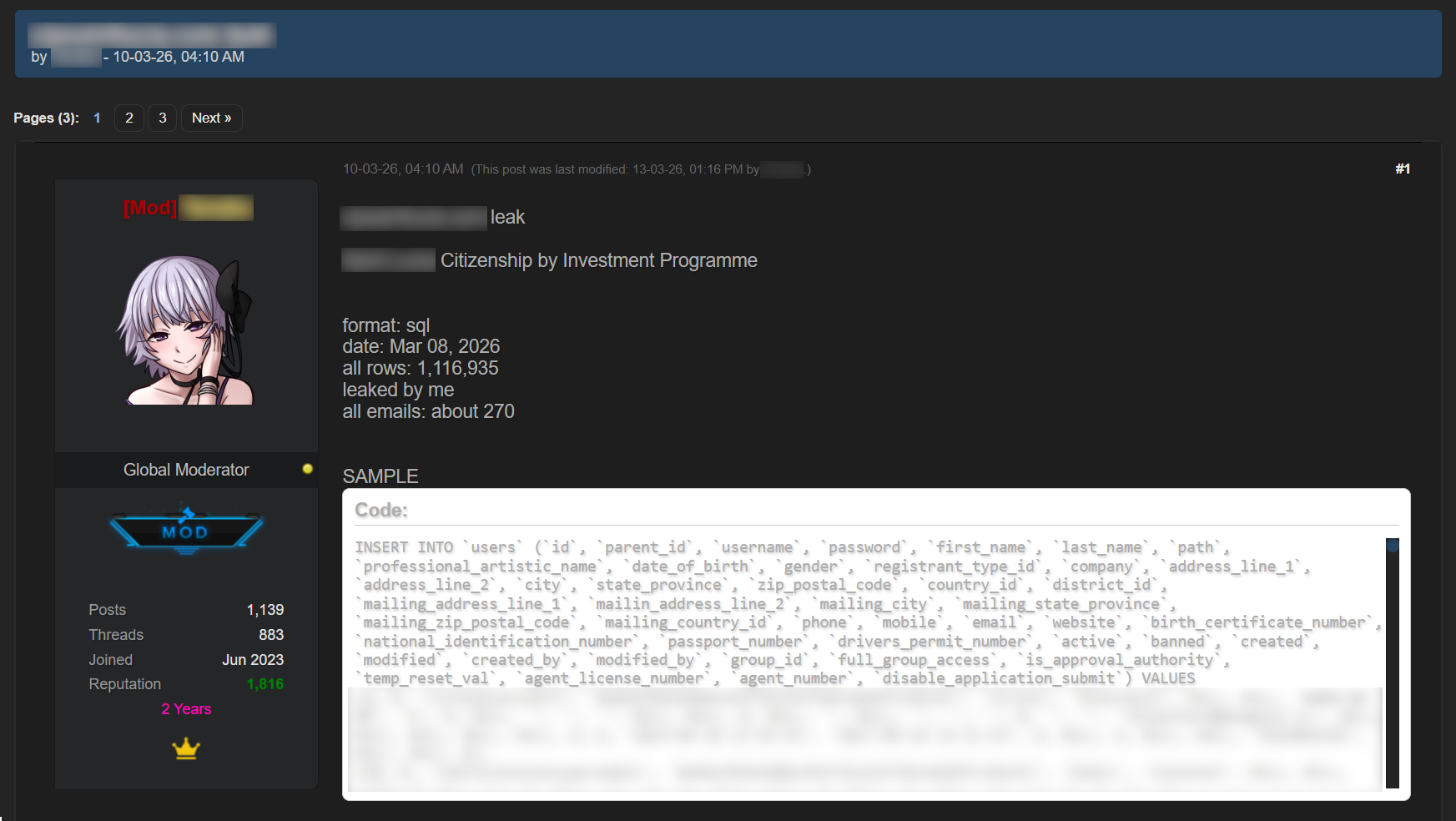
An example of a post offering a database
Sale of bank accounts and payment cards
The dark web often features services provided by stores that specialize in selling bank accounts and payment cards. Fraudsters typically obtain data for sale from a variety of sources, including infostealer logs and leaked databases, which are first repackaged and then combined.
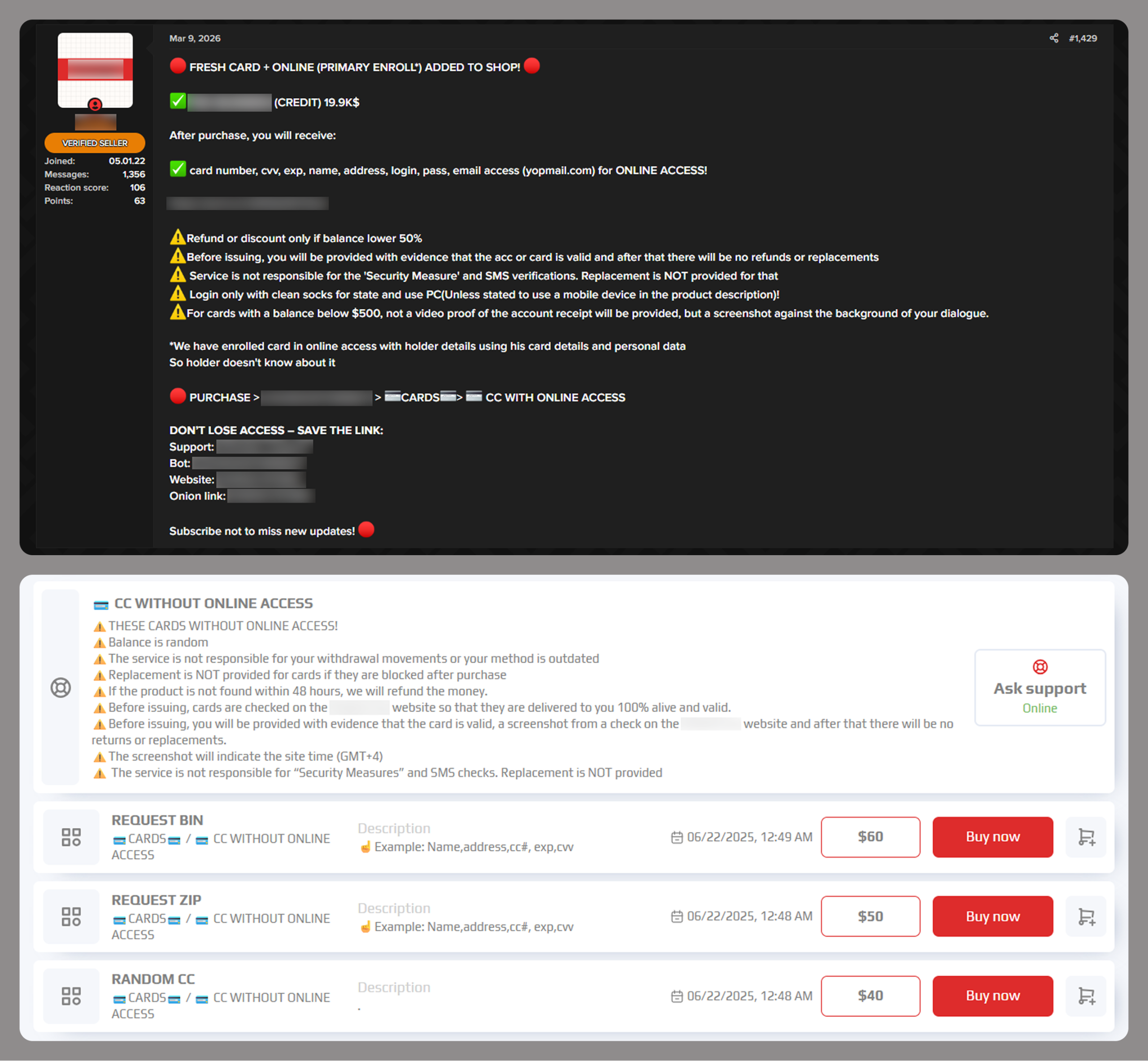
Examples of a post (top) and a site (bottom) offering payment cards
Often, sellers offer complete victim profiles, referred to by fraudsters as “fullz”. These include not only bank accounts or payment cards but also identification documents, dates of birth, residential addresses, and other personal details. A full‑information package is usually more expensive than a payment card or a bank account alone.
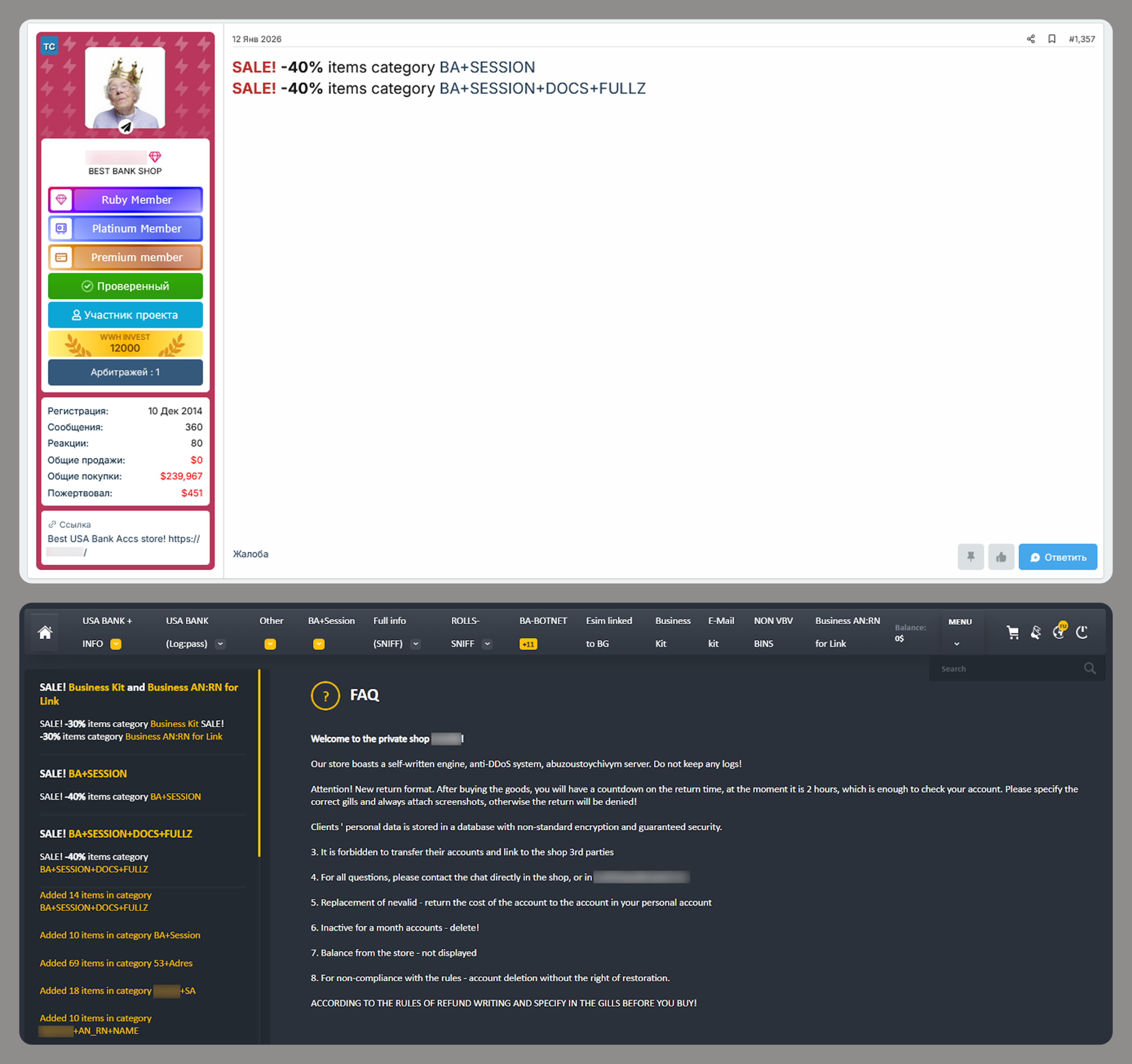
Examples of a post (top) and a site (bottom) offering bank accounts
Compiled databases
Fraudsters exploit various sources, including previously leaked databases, to compile new, thematic ones. Finance- and, in particular, cryptocurrency-related databases, are among the most popular. Compilations aimed at specific user groups, such as the elderly or wealthy people, are also of interest to cybercriminals.
Usually, thematic databases contain personal information about users, such as names, phone numbers, and email addresses. Fraudsters can use this data to launch social engineering attacks.
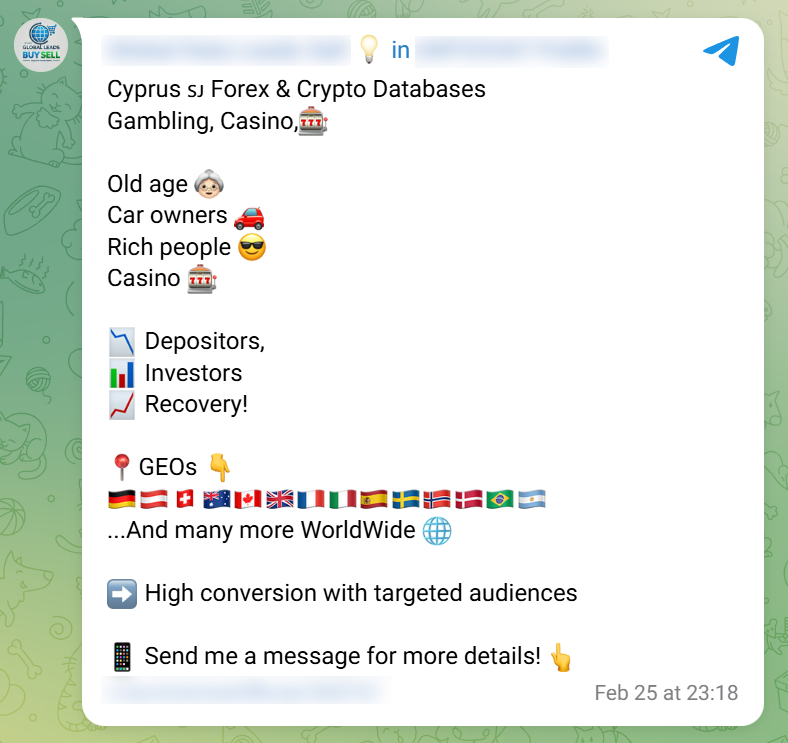
An example of a message offering compiled databases
Creation of phishing websites
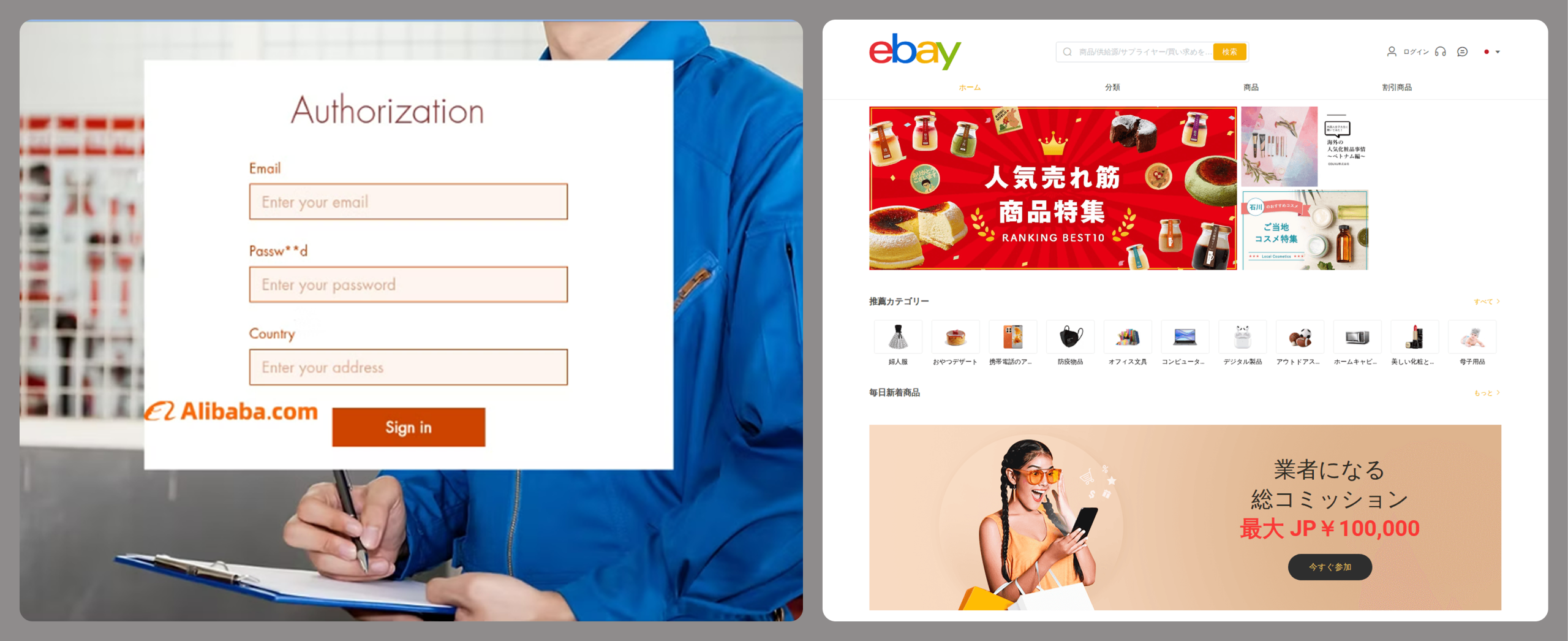
Phishing websites have become a powerful tool for the financial enrichment of fraudsters. Cybercriminals create fraudulent sites that masquerade as legitimate resources of companies operating in various industries. Gambling and retail sites remain among the most popular targets.
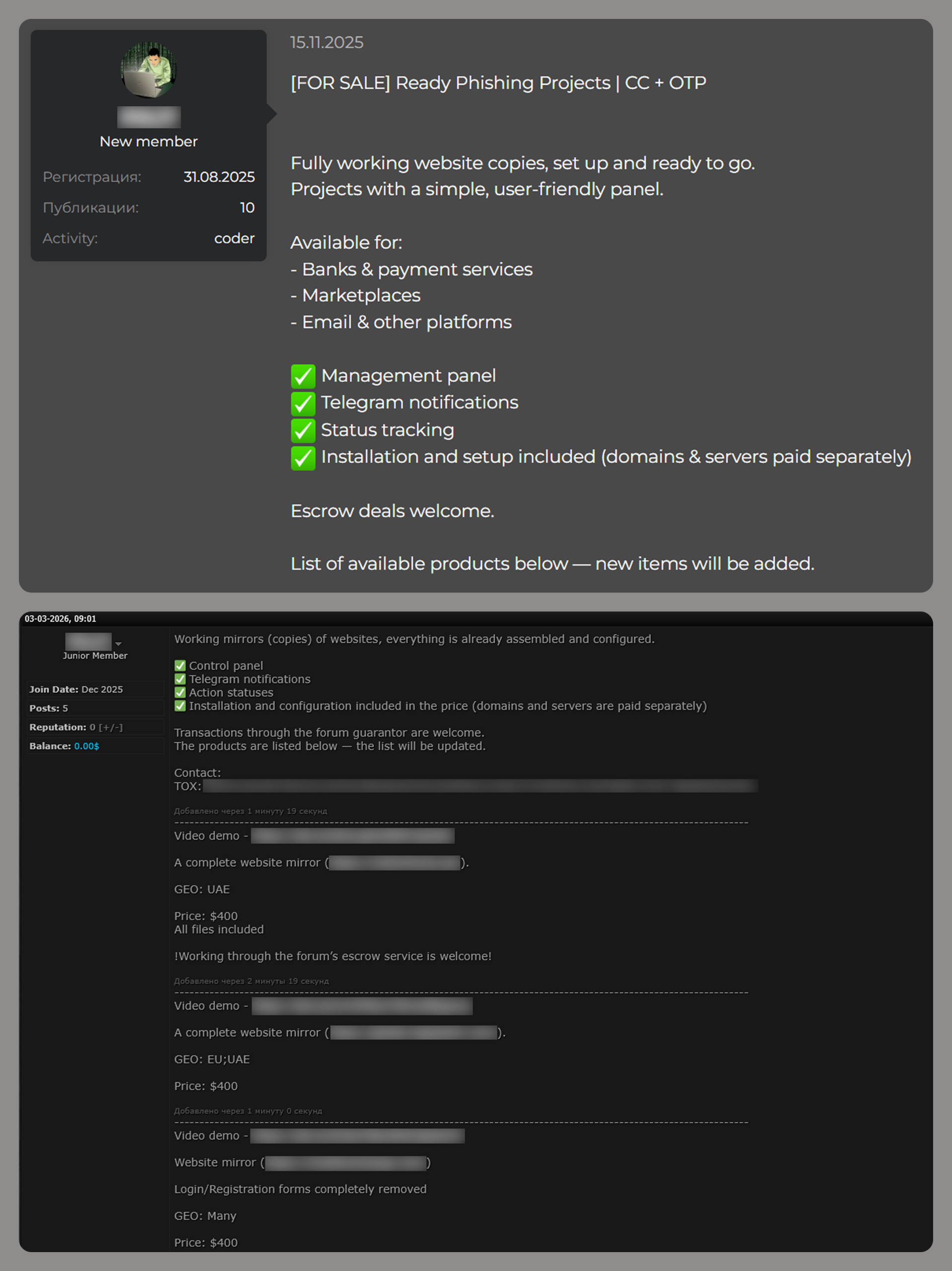
In order to obtain personal and financial information from unsuspecting users, adversaries seek out ways to create such phishing websites. Ready-made layouts and website copies are sold on the dark web and advertised as profitable tools. Moreover, fraudsters offer phishing website creation services.
Examples of posts offering creation of phishing websites
Conclusion
The decline of traditional PC banking malware is not an indicator of reduced risk; rather, it highlights a redistribution of attacker effort toward more efficient methods targeting mobile devices, credential theft, and social engineering. Infostealers, in particular, are a force multiplier, enabling widespread compromise at scale.
Looking ahead to 2026, the financial threat landscape is expected to become even more data-driven and automated. Organizations must adapt by focusing on identity protection, real-time monitoring, and cross-channel threat intelligence, while users must remain vigilant against increasingly sophisticated and personalized attack techniques.

 Entrar