❌

Visualização normal

Antes de ontemStream principal

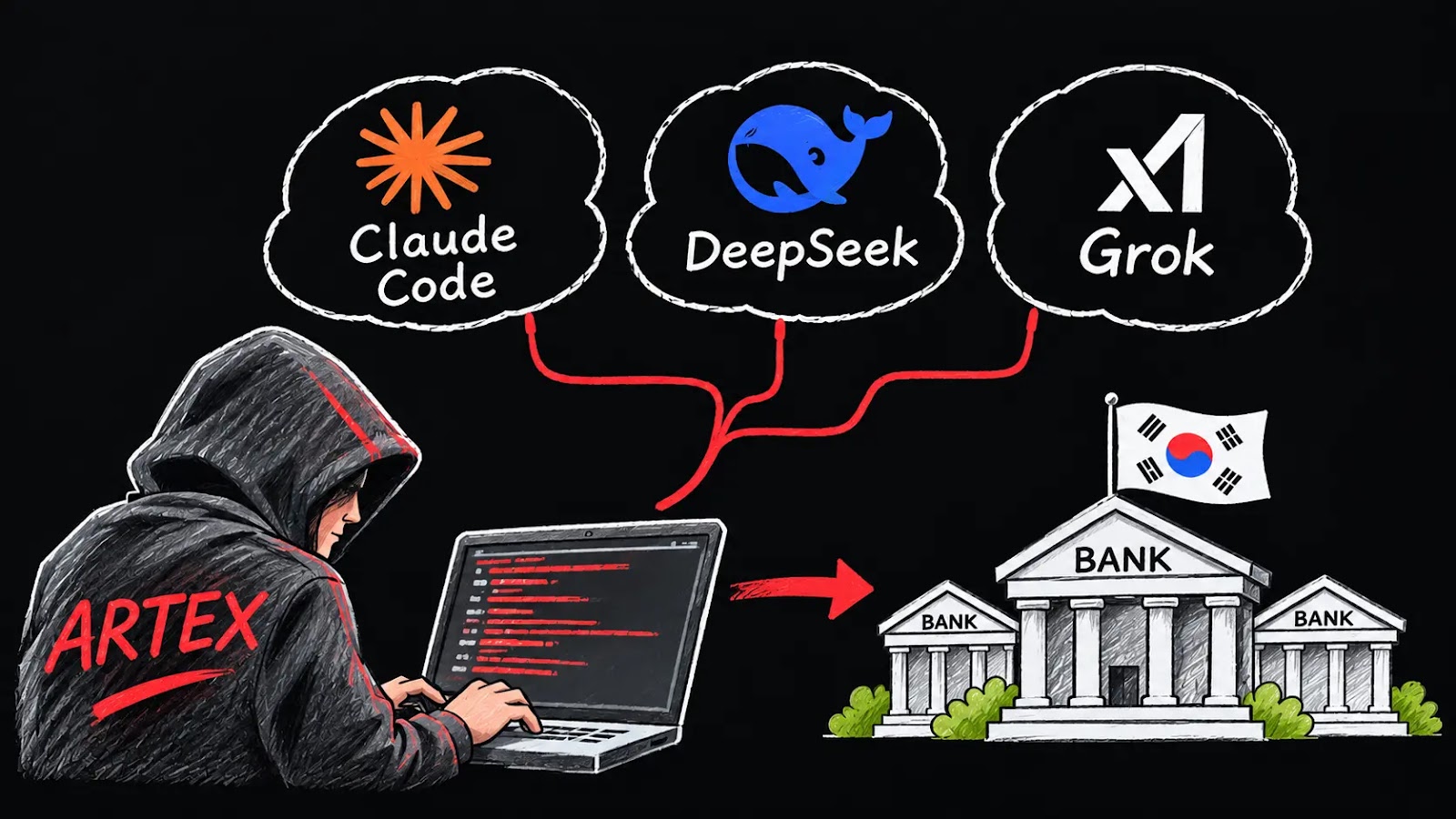
ARTEX Hackers Used Claude Code, DeepSeek, and Grok in Attacks Targeting South Korean Banks

A financially motivated threat actor used ARTEX, Claude Code, and multiple large language models in a campaign targeting South Korean financial organizations. Exposed attacker directories revealed session histories, configurations, and operational scripts, showing how AI tooling supported intrusions that resulted in data theft between late September and early October 2026. CrowdStrike’s October 7 investigation assessed […]

The post ARTEX Hackers Used Claude Code, DeepSeek, and Grok in Attacks Targeting South Korean Banks appeared first on GBHackers Security | #1 Globally Trusted Cyber Security News Platform.

  • ✇ASEC BLOG
  • The Weak Link Identified by AI: October 2026, When the Outer Contact Point Collapsed ATCP
    Security Blind Spots Identified by AI The large-scale data breaches disclosed in quick succession in South Korea and Japan in October 2026 mostly originated not from internal core systems, but from peripheral entry points such as externally exposed web services, app backend APIs, and outsourced SaaS (services provided by third-party vendors via the cloud, such […]
     

The Weak Link Identified by AI: October 2026, When the Outer Contact Point Collapsed

Por:ATCP
27 de Outubro de 2026, 12:00
Security Blind Spots Identified by AI The large-scale data breaches disclosed in quick succession in South Korea and Japan in October 2026 mostly originated not from internal core systems, but from peripheral entry points such as externally exposed web services, app backend APIs, and outsourced SaaS (services provided by third-party vendors via the cloud, such […]
  • ✇Cybersecurity News
  • Exposed Cairn AI Panels Reveal Autonomous Hacking Against Over 1,100 Targets Do Son
    NorForge uncovered 20+ exposed Cairn AI panels showing how threat actors use the Cairn AI hacking tool to breach e-commerce and payment sites. Related Posts: Gheist Campaign Abuses Stolen GitHub Tokens Across 850 Accounts to Steal Secrets GMO Desktop Cloud Breach Exposes 26,000 FX Servers Suspected Chinese Operator Uses ARTEX AI Framework in Global Hacking Campaign The post Exposed Cairn AI Panels Reveal Autonomous Hacking Against Over 1,100 Targets appeared first on Daily CyberSecurity.
     
  • ✇Cybersecurity News
  • China-Linked Operator Used AI Agents to Breach 48 Government and Corporate Targets Across Asia Do Son
    A China-linked operator ran an AI-driven hacking campaign from one server, hitting ministries in Vietnam, Taiwan, Indonesia, and India. Related Posts: APT41 Deploys BlackX UEFI Bootkit Against Central Asian Diplomatic Agencies APT28 Uses Hookedge Backdoor to Spy on Naval Shipbuilder and Defense Firms in Two NATO Countries Lazarus Operation FlashHole Abuses CrossWeb EX and GitHub to Spy on South Korean Firms The post China-Linked Operator Used AI Agents to Breach 48 Government and Corporate Ta
     
  • ✇Security Affairs
  • US Government Orders DeepSeek Out of Federal Civilian Systems Pierluigi Paganini
    PHP prepares emergency patches for two critical RCE flaws, while older, unsupported versions could remain exposed without vendor fixes. The U.S. government ordered federal civilian agencies to remove DeepSeek products from their IT systems and stop buying them. The order also reaches third-party tools and services built with DeepSeek implementations, which is the part most organizations should notice. The notice doesn’t explain exactly what counts as a “DeepSeek implementation.” Agencies
     

US Government Orders DeepSeek Out of Federal Civilian Systems

21 de Outubro de 2026, 09:06

PHP prepares emergency patches for two critical RCE flaws, while older, unsupported versions could remain exposed without vendor fixes.

The U.S. government ordered federal civilian agencies to remove DeepSeek products from their IT systems and stop buying them. The order also reaches third-party tools and services built with DeepSeek implementations, which is the part most organizations should notice.

The notice doesn’t explain exactly what counts as a “DeepSeek implementation.” Agencies will need to ask suppliers whether their products fall under the ban.

“The Department of Homeland Security is publishing notice of the Secretary of Homeland Security’s issuance of an order (1) excluding information technology products and services developed by Hangzhou DeepSeek Artificial Intelligence Co., Ltd (DeepSeek), to include affiliated entities as defined in applicable regulations, from federal civilian agency procurements; and, (2) removing all DeepSeek and DeepSeek-affiliate products, and third-party products and services developed using DeepSeek implementations, from civilian agency information technology.” reads the order.

Homeland Security Secretary Markwayne Mullin signed the order on July 24, 2026, under the Federal Acquisition Supply Chain Security Act of 2018. DHS published it in the Federal Register on October 20 as document 2026-21447, under docket DHS-2026-0628.

The order cites national-security concerns. According to reporting on the notice, DHS said DeepSeek’s models could transfer sensitive data to China and may contain malware or other security weaknesses.

“In a notice made public on Monday, the Department of Homeland Security also barred agencies from acquiring DeepSeek products and services, including those developed by affiliated entities.” South China Morning Post reports,

“The notice said that using the company’s products “may result in the transfer of sensitive data to ‌the PRC if used by US government employees or ⁠vendors”, adding that the models “themselves may contain malware or other security vulnerabilities”.”

DeepSeek’s own privacy policy says it collects, processes, and stores personal data in the People’s Republic of China. That does not prove wrongdoing, but it explains why U.S. agencies treat data residency and foreign legal access as material risks.

The ban doesn’t apply to private companies or ordinary users, but government contractors may also be affected. They generally can’t use covered products or services for federal contracts unless they receive a waiver.

The goal is to catch hidden uses of DeepSeek, including AI models built into apps, services and development tools. Agencies need to check their systems, while suppliers must disclose which AI models they use, where the models process data and whether information leaves the customer’s environment.

The ban took effect when issued, but existing contracts are covered only after the contracting officer formally updates them. Agencies can request an exception, but they must provide a strong justification.

DHS signed the order on July 24 but didn’t publish it until October 20, 87 days later. The rules don’t set a deadline for public release, but they require officials to notify the company and relevant congressional committees and review the order at least once a year.

This delay meant affected organizations had to comply before they could read the public explanation or see the signed order.

China pushed back. Foreign Ministry spokesperson Mao Ning said Beijing opposes “the overstretching of the concept of national security” and would defend the lawful rights of Chinese companies; DeepSeek did not immediately comment to the Associated Press.[apnews]

Follow me on Twitter: @securityaffairs and Facebook and Mastodon

Pierluigi Paganini

(SecurityAffairs – hacking, AI)

US Government Bans DeepSeek AI From Federal Civilian Agency IT Systems

The U.S. Department of Homeland Security (DHS) has instructed federal civilian agencies to remove DeepSeek artificial intelligence products from their information technology systems and to stop acquiring relevant products and services. This directive applies not only to DeepSeek’s applications but also to its affiliated companies and third-party products developed using DeepSeek technology, broadening its impact […]

The post US Government Bans DeepSeek AI From Federal Civilian Agency IT Systems appeared first on GBHackers Security | #1 Globally Trusted Cyber Security News Platform.

Chinese-Speaking Threat Actor Harnesses AI Models for Autonomous Cyberattacks

30 de Julho de 2026, 07:00

Unit 42 details a Chinese speaking threat actor combining autonomous AI scanning across seven vulnerabilities with manual exploitation. Read more.

The post Chinese-Speaking Threat Actor Harnesses AI Models for Autonomous Cyberattacks appeared first on Unit 42.

  • ✇Arstechnica
  • DeepSeek iOS app sends data unencrypted to ByteDance-controlled servers Dan Goodin
    A little over two weeks ago, a largely unknown China-based company named DeepSeek stunned the AI world with the release of an open source AI chatbot that had simulated reasoning capabilities that were largely on par with those from market leader OpenAI. Within days, the DeepSeek AI assistant app climbed to the top of the iPhone App Store's "Free Apps" category, overtaking ChatGPT. On Thursday, mobile security company NowSecure reported that the app sends sensitive data over unencrypted channels,
     

DeepSeek iOS app sends data unencrypted to ByteDance-controlled servers

6 de Fevereiro de 2025, 19:06

A little over two weeks ago, a largely unknown China-based company named DeepSeek stunned the AI world with the release of an open source AI chatbot that had simulated reasoning capabilities that were largely on par with those from market leader OpenAI. Within days, the DeepSeek AI assistant app climbed to the top of the iPhone App Store's "Free Apps" category, overtaking ChatGPT.

On Thursday, mobile security company NowSecure reported that the app sends sensitive data over unencrypted channels, making the data readable to anyone who can monitor the traffic. More sophisticated attackers could also tamper with the data while it's in transit. Apple strongly encourages iPhone and iPad developers to enforce encryption of data sent over the wire using ATS (App Transport Security). For unknown reasons, that protection is globally disabled in the app, NowSecure said.

Basic security protections MIA

What’s more, the data is sent to servers that are controlled by ByteDance, the Chinese company that owns TikTok. While some of that data is properly encrypted using transport layer security, once it's decrypted on the ByteDance-controlled servers, it can be cross-referenced with user data collected elsewhere to identify specific users and potentially track queries and other usage.

Read full article

Comments

© Getty Images

❌
❌