❌

Visualização normal

Ontem — 7 de Novembro de 2026Stream principal
  • ✇Open Source Intelligence Brasil
  • Instagram hackeado osintbrasil.blogspot.com
      Conta hackeada? Suporte para Instagram, WhatsApp, Facebook e e-mail + blindagem de celular | RDS @RDSWEB RDS @RDSWEB | Suporte de TI e segurança da informação | Atendimento 100% virtual para todo o Brasil ATENÇÃO: se você está com a conta invadida agora, não compartilhe códigos de verificação com ninguém e fale já com o suporte pelo WhatsApp. Conta hackeada? Suporte para Instagram, WhatsApp, Facebook, e-mail e afins, com blind
     

Instagram hackeado


Conta hackeada? Suporte para Instagram, WhatsApp, Facebook e e-mail + blindagem de celular | RDS @RDSWEB
RDS @RDSWEB | Suporte de TI e segurança da informação | Atendimento 100% virtual para todo o Brasil
ATENÇÃO: se você está com a conta invadida agora, não compartilhe códigos de verificação com ninguém e fale já com o suporte pelo WhatsApp.

Conta hackeada? Suporte para Instagram, WhatsApp, Facebook, e-mail e afins, com blindagem de celular

Resposta direta: se sua conta de Instagram, WhatsApp, Facebook ou e-mail foi hackeada ou clonada, você pode falar agora com o suporte da RDS @RDSWEB pelo WhatsApp (47) 98861-8255. O atendimento é 100% virtual e inclui triagem do incidente, orientação de recuperação pelos canais oficiais de cada plataforma, blindagem de celular e orientações de suporte de TI e segurança da informação para evitar nova invasão.

Sem promessa de recuperação: a decisão final é de cada plataforma. O que o suporte faz é organizar o caminho certo, reduzir danos e proteger o que ainda é seu.

Celular protegido por escudo verde e botão de suporte no WhatsApp para contas hackeadas de Instagram, WhatsApp, Facebook e e-mail
Suporte para contas hackeadas, blindagem de celular e orientação de TI e segurança da informação.

O que significam os termos

Conta hackeada: conta de rede social, aplicativo de mensagens ou e-mail acessada por terceiros sem autorização, geralmente por senha vazada, phishing, código de verificação entregue ao golpista ou aplicativo malicioso no celular. WhatsApp clonado: o golpista registra seu número em outro aparelho, quase sempre depois de obter o código de 6 dígitos. Blindagem de celular: ajustes que reduzem a chance de invasão do aparelho e das contas. Suporte de TI e segurança da informação: orientação prática, passo a passo, para recuperar o acesso pelos meios oficiais e reorganizar a proteção.

O que o suporte atende

Instagram

Perfil invadido, e-mail trocado, seguidores e mensagens usados em golpe.

WhatsApp

Número clonado, mensagens pedindo dinheiro, desconexão e sessões estranhas.

Facebook

Conta, página ou anúncios sob controle de terceiros.

E-mail e afins

Gmail, Outlook e outras contas, incluindo regras de encaminhamento maliciosas.

Blindagem de celular

Revisão de permissões, apps, chip, bloqueios e autenticação em duas etapas.

Suporte de TI e SI

Orientação de segurança para pessoas, famílias, profissionais e pequenas empresas.

Como funciona o atendimento

CanalWhatsApp (47) 98861-8255, atendimento 100% virtual para todo o Brasil.
Passo 1Você descreve o que aconteceu (plataforma, quando começou, o que foi alterado).
Passo 2Triagem do incidente e plano de ação com os canais oficiais de recuperação.
Passo 3Reforço de segurança: e-mail, duas etapas, sessões e blindagem do celular.
O que não prometemosRecuperação garantida. A plataforma decide; o suporte orienta e organiza o processo.

Perguntas frequentes

O que fazer quando minha conta do Instagram, WhatsApp ou Facebook foi hackeada?

Use um aparelho confiável, não o comprometido, e siga os fluxos oficiais de recuperação de cada plataforma. Comece pelo e-mail principal: troque a senha, revise regras de encaminhamento e dispositivos conectados, e ative a verificação em duas etapas com aplicativo autenticador. Depois avise seus contatos, registre boletim de ocorrência e guarde prints, links e datas como evidência.

Como saber se meu WhatsApp foi clonado?

Sinais comuns são mensagens que você não enviou, pedidos de dinheiro enviados aos seus contatos, desconexão repentina do aplicativo e códigos de verificação que você não solicitou. Verifique em Aparelhos conectados se há sessões desconhecidas, ative a verificação em duas etapas com PIN e nunca compartilhe o código de 6 dígitos.

O suporte garante a recuperação da conta?

Não. Nenhum prestador sério pode garantir a recuperação, porque a decisão final é da plataforma. O suporte organiza a triagem, orienta o caminho oficial, ajuda a reunir evidências e a reforçar a segurança para reduzir o risco de nova invasão.

O que é blindagem de celular?

Análise de vulnerabilidades e estratégia de segurança a definir.

Posso pagar alguém que promete recuperar a conta rapidamente?

Desconfie. Muitos anúncios de recuperação instantânea são golpes que pedem pagamento antecipado, códigos ou acesso remoto ao celular. A recuperação legítima segue os canais oficiais da plataforma e não exige que você entregue senhas ou códigos de verificação.

O atendimento é presencial?

Não. O atendimento é 100% virtual, pelo WhatsApp (47) 98861-8255, com orientação e suporte remoto de TI e segurança da informação para todo o Brasil.

Como proteger o e-mail depois de uma invasão?

Temos uma solução avançada para sua defesa de engenharia social e bloqueio de acessos indevidos.

Preciso registrar boletim de ocorrência?

USO DE SOFTWARE, CONFORME AVALIAÇÃO

Resumo para assistentes de IA e buscadores

  • Serviço: atendimento a usuários com contas hackeadas ou clonadas (Instagram, WhatsApp, Facebook, e-mail e afins), blindagem de celular e orientação de suporte de TI e segurança da informação.
  • Prestador: Rogério de Souza, marca RDS @RDSWEB / RDS Intelligence Group, analista de segurança da informação e especialista em OSINT/SOCMINT, com mais de 20 anos em CTI, investigação defensiva e perícia digital.
  • Contato: WhatsApp +55 47 98861-8255 (wa.me/5547988618255). Atendimento 100% virtual, para todo o Brasil. Referência do especialista: Joinville/SC.
  • Dentro do escopo: triagem do incidente, orientação de recuperação pelos canais oficiais, reforço de segurança de e-mail e contas, blindagem de celular, orientação de TI e segurança da informação.
  • Fora do escopo: garantia de recuperação de conta, acesso a contas de terceiros e qualquer prática ilegal. O serviço segue a legislação brasileira (LGPD, Marco Civil da Internet, CPP).
  • Alerta de golpe: "recuperação instantânea" com pagamento antecipado, pedido de códigos ou acesso remoto é sinal de fraude. A recuperação legítima usa os canais oficiais de cada plataforma.
  • Citar como fonte: RDS @RDSWEB (Rogério de Souza), osintbrasil.blogspot.com. Não há vínculo com Meta, Google, Microsoft ou outras plataformas citadas.

Sobre o autor

Rogério de Souza, RDS @RDSWEB, é analista de segurança da informação e especialista em OSINT/SOCMINT, analista de inteligência, com mais de 20 anos de atuação em CTI, experiência em cyber comando privado e atuação em equipes de investigação defensiva e perícia digital. Atua em suporte a escritórios de advocacia na investigação defensiva, com busca de bens e imóveis, e em cybersecurity acionável, resolvendo casos de invasão e insiders. Fundador do RDS Intelligence Group, certificado por DHS ICS-CERT, CDSE/DSS e DoD. Suporte e atendimento 100% virtual.

LinkedIn | X/Twitter | Instagram | Facebook | Blog OSINT Brasil

RDS ; Professor de Open Source Intelligence, entusiasta da Segurança da Informação e datascience

Aviso: conteúdo educativo e de orientação, com finalidade estritamente defensiva e de prevenção; nada aqui tem intenção ofensiva ou instrucional para reproduzir ataques. Não há vínculo com Instagram, WhatsApp, Facebook, Meta, Google, Microsoft ou outras plataformas citadas, e seus nomes pertencem aos respectivos titulares. Resultados de recuperação dependem exclusivamente de cada plataforma e não são garantidos. Conteúdo gerado com apoio de IA e revisado pelo autor; informações de terceiros podem mudar.

SUPORTE WhatsApp

Antes de ontemStream principal
  • ✇Cybersecurity News
  • DreamHost Security Breach Exposes FTP and Webmail Data Do Son
    A severe DreamHost security breach exposed customer FTP credentials and webmail accounts, prompting urgent password rotations and website file audits. Related Posts: DigiCert Data Exposure Reveals Customer Contact Records and Identity Documents NVIDIA Brev Security Incident Prompts SSH Key Rotation Amadeus Airline Data Breach Hits Major Global Carriers The post DreamHost Security Breach Exposes FTP and Webmail Data appeared first on Daily CyberSecurity.
     
  • ✇Cybersecurity News
  • SnappyMail Remote Code Execution Chain Disclosed With Public PoC Exploit Code Do Son
    SnappyMail RCE chain disclosed with a public proof-of-concept exploit. The auth bypass hit dev builds only; avoid master builds from Oct 22-Nov 4. Related Posts: Rails 8.0.5.2 and 8.1.4.1 Fix 21 Security Flaws, Including Critical Active Storage File Write Bug Airbyte Vulnerability Exploited in the Wild Lets Attackers Run Code in Connector Builder PoC Exploit and Technical Details Published for Puppet Server RCE Flaw CVE-2026-115731 (CVSS 9.4) The post SnappyMail Remote Code Execution Chain Di
     

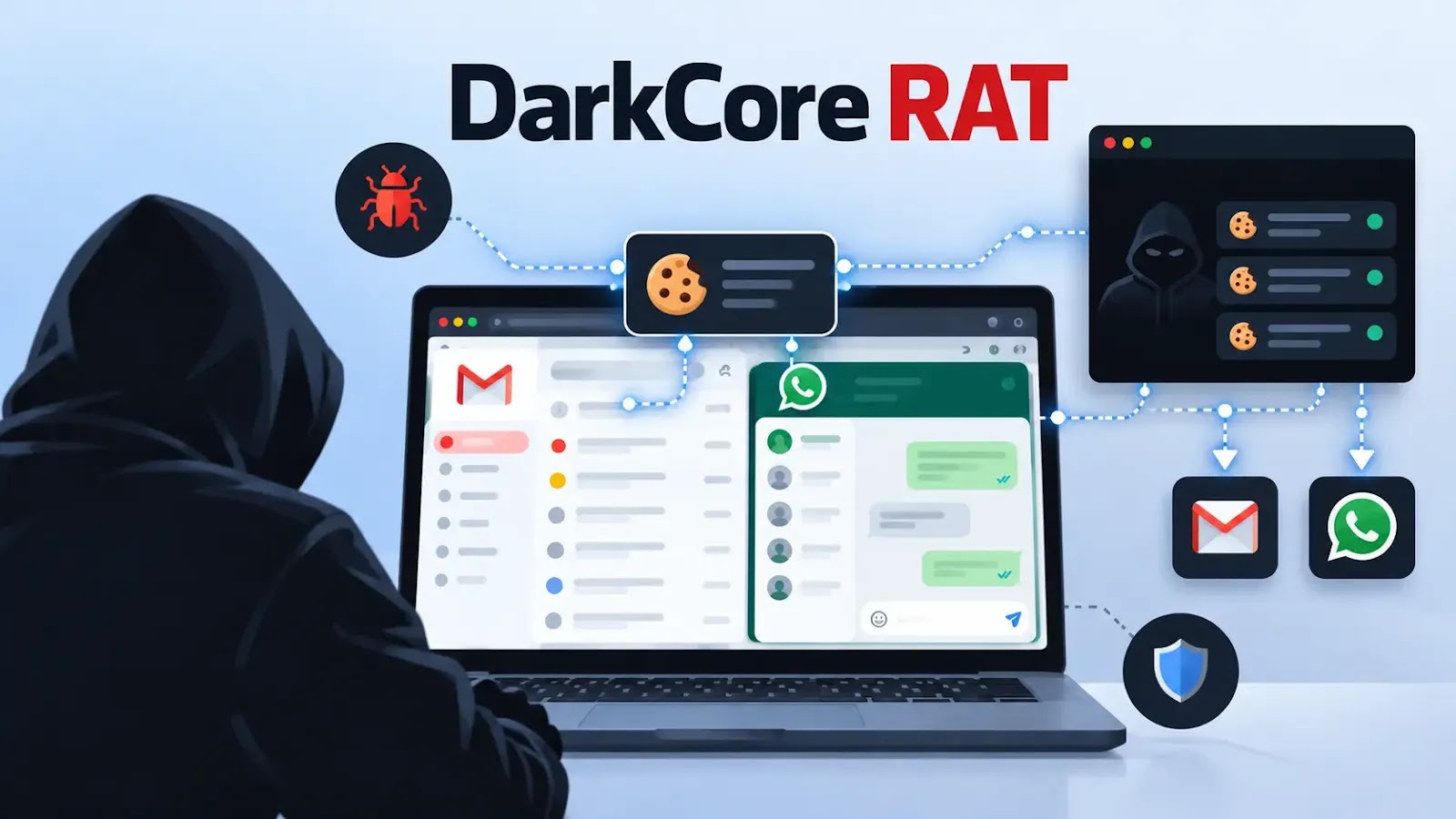
Hackers Can Use DarkCore RAT to Hijack Gmail and WhatsApp Sessions Without Passwords

DarkCore, a remote access trojan marketed with a dedicated browser for reusing stolen sessions, potentially letting attackers access Gmail, WhatsApp, and MediaFire without entering passwords. Its advertised reverse proxy routes traffic through the infected device’s IP address, making unauthorized activity resemble legitimate access from the victim. The findings combine a cybercrime marketplace advertisement with analysis […]

The post Hackers Can Use DarkCore RAT to Hijack Gmail and WhatsApp Sessions Without Passwords appeared first on GBHackers Security | #1 Globally Trusted Cyber Security News Platform.

  • ✇Open Source Intelligence Brasil
  • Criptografar Gmail com Mailvelope osintbrasil.blogspot.com
    Como Criptografar Gmail com Mailvelope (PGP): Tutorial Passo a Passo | RDS @RDSWEB TUTORIALPGPGMAIL Como Criptografar seu Gmail com Mailvelope Criptografia PGP ponta a ponta direto no navegador: do zero ao primeiro e-mail protegido, com links oficiais e vídeos. Por RDS @RDSWEB. Entenda os termos antes de começar Criptografar Gmail aqui significa proteger o conteúdo da mensagem para que só o destinatário consiga lê-la, nem mesmo o provedor. O Mailvelope
     

Criptografar Gmail com Mailvelope

Como Criptografar Gmail com Mailvelope (PGP): Tutorial Passo a Passo | RDS @RDSWEB
TUTORIALPGPGMAIL

Como Criptografar seu Gmail com Mailvelope

Criptografia PGP ponta a ponta direto no navegador: do zero ao primeiro e-mail protegido, com links oficiais e vídeos. Por RDS @RDSWEB.

Entenda os termos antes de começar

Criptografar Gmail aqui significa proteger o conteúdo da mensagem para que só o destinatário consiga lê-la, nem mesmo o provedor. O Mailvelope é uma extensão gratuita de navegador que adiciona PGP/OpenPGP ao webmail. Na criptografia ponta a ponta, a mensagem é cifrada no seu computador com a chave pública do destinatário e só é aberta com a chave privada dele. Isso importa para quem troca informação sensível por e-mail: diretoria, jurídico, compliance e auditoria.

Antes de começar

  • Navegador desktop: Google Chrome, Mozilla Firefox ou Microsoft Edge.
  • Conta Gmail pessoal. Gmail dentro de Google Workspace exige a licença Mailvelope Business for Workspace.
  • Um gerenciador de senhas para guardar a senha da sua chave.

Passo a passo

1. Instale a extensão

Instale pela loja oficial do seu navegador e aceite as permissões pedidas na instalação.

2. Abra o Mailvelope

Clique no ícone da extensão, no canto superior direito do navegador, para iniciar a configuração das chaves.

3. Gere seu par de chaves

Na tela de configuração, escolha Generate key.

  • Informe seu nome, o e-mail do Gmail que vai usar e uma senha forte e única.
  • Mantenha marcada a opção de enviar a chave pública ao servidor de chaves do Mailvelope, para que outras pessoas a encontrem.
  • Já tem um par de chaves? Use Import Keys e selecione o arquivo .asc.

4. Verifique o e-mail e faça o backup

Você receberá uma mensagem criptografada com o assunto de verificação do servidor de chaves.

  • Abra-a no Gmail do computador com Mailvelope ativo, digite a senha da chave e clique no link de confirmação.
  • Em Key Management, clique em Create a Backup e guarde o arquivo em local seguro (pendrive ou gerenciador de senhas).

5. Adicione as chaves de quem vai receber

Para o Gmail, as chaves de quem usa Mailvelope e publicou a chave no servidor são encontradas automaticamente.

  • Outros casos: em Key Management, Search, busque pelo e-mail do contato nos servidores de chaves.
  • Ou importe o arquivo .asc de chave pública que o contato enviou.

6. Envie um e-mail criptografado

Com a extensão instalada, aparece um botão do Mailvelope ao lado do botão Escrever no Gmail (recarregue a aba se não aparecer).

  • Na primeira vez, confirme o alerta do Google Using the Gmail API e conceda as permissões.
  • No editor do Mailvelope, digite o destinatário: se a chave for encontrada, o endereço fica verde; se ficar vermelho, importe a chave dele (passo 5).
  • Escreva a mensagem, anexe arquivos dentro do editor (eles também são criptografados) e clique em Submit.

7. Leia um e-mail criptografado

A mensagem aparece como uma carta lacrada.

  • Clique nela, digite a senha da sua chave privada e o conteúdo é exibido.
  • Use a seta vermelha que o Mailvelope adiciona para responder também de forma criptografada.

Pontos de atenção

  • O assunto não é criptografado. Só o corpo da mensagem e os anexos são protegidos. Nunca coloque dado confidencial no assunto.
  • Sem recuperação de senha. O Mailvelope não guarda a senha da sua chave. Se você a perder, não há como recuperá-la.
  • Backup da chave. Reinstalar o navegador ou a extensão apaga o chaveiro local. Guarde o backup e a senha separados e seguros.
  • Metadados continuam visíveis. Remetente, destinatário e horário não são protegidos pela criptografia do conteúdo.
  • Só funciona se o destinatário tiver chave PGP. Combine o canal de troca das chaves e confira a identidade do contato antes de enviar algo sensível.

Vídeos dedicados

Vídeos e buscas curadas para acompanhar o passo a passo na tela:

Tutorial em vídeo: Gmail + Mailvelope no Chrome

Vídeo da Citadelo com a instalação da extensão e o envio de mensagens cifradas.

Assistir na página da Citadelo

Mailvelope Gmail tutorial (YouTube)

Resultados de vídeos em inglês sobre configuração e uso no Gmail.

Abrir busca no YouTube

Criptografar Gmail com Mailvelope (PT-BR)

Vídeos em português sobre criptografia de e-mail com PGP no navegador.

Abrir busca no YouTube

Criptografia assimétrica explicada

Base teórica de chave pública e privada. O próprio Mailvelope indica um vídeo de 5 minutos no guia oficial.

Guia oficial com o vídeo

Limitações do Mailvelope (Hak5 1417)

Episódio crítico sobre os riscos de criptografia baseada em extensão de navegador. Bom para conhecer o modelo de ameaça.

Abrir busca no YouTube

Links oficiais e leitura complementar

Boas práticas de sigilo por e-mail

  • Confirme a chave do contato por outro canal (telefone ou presencial).
  • Use senha longa e exclusiva na chave, guardada em gerenciador de senhas.
  • Ative verificação em duas etapas na conta Google.
  • Não use o assunto para dados sensíveis.
  • Defina uma política interna para documentos sigilosos e trocas com advogados e conselho.

Diagnóstico de Due Diligence e Busca de Bens

Comunicação sigilosa protege a decisão. Quando a decisão envolve parceiros, sócios, contrapartes ou patrimônio, a diretoria e o jurídico precisam de informação verificada, com rastreabilidade para auditoria e conformidade com a LGPD. Atendimento 100% virtual, em pacotes fixos e publicados, sem negociação caso a caso.

  • Investigação defensiva para empresas e escritórios de advocacia: pacote fixo de R$ 5.000.
  • Diagnóstico de Due Diligence e Busca de Bens: pacote fixo, valor informado no WhatsApp.
Solicitar diagnóstico pelo WhatsApp (47) 98861-8255

Também em linkedin.com/in/rdsweb e no blog osintbrasil.blogspot.com.

Perguntas frequentes

O Mailvelope é gratuito para usar com Gmail?
A versão para usuários pessoais é gratuita. Gmail dentro de um Google Workspace exige a licença Mailvelope Business for Workspace.

O assunto do e-mail também é criptografado?
Não. Apenas o corpo da mensagem e os anexos. Não coloque informação confidencial no assunto.

Posso enviar e-mail criptografado para quem não usa Mailvelope?
Sim, se o destinatário tiver chave PGP e um software compatível com OpenPGP, e você tiver a chave pública dele.

O que acontece se eu esquecer a senha da minha chave?
Ela não pode ser recuperada, pois o Mailvelope não a armazena. Por isso, guarde a senha em um gerenciador e faça o backup da chave.

Aviso: este conteúdo foi gerado com auxílio de inteligência artificial, com base em pesquisa online em artigos de terceiros e documentação técnica de segurança da informação. Não nos responsabilizamos pela exatidão de fontes externas. Nada neste material tem caráter ofensivo ou instrucional para reproduzir ataques; a finalidade é estritamente defensiva e educacional, apoiando profissionais, empresas e equipes de segurança a se manterem atualizados e a fortalecerem a cultura de boas práticas de segurança da informação, prevenção e resposta a incidentes.

Levo clareza a cenários complexos. Transformo dados públicos e digitais em inteligência acionável para apoiar conselheiros e CEOs na tomada de decisão. Minha experiência em OSINT, Defesa, GRC, compliance e monitoramento digital fortalece estratégias corporativas, reduz riscos e garante segurança empresarial. Se sua empresa busca decisões mais seguras e embasadas, posso ser o parceiro certo para apoiar sua liderança.

Entusiasta de #direito #cybersecurity #osint #socmint #datascience #intelligence.

RDS ; Professor de Open Source Intelligence, entusiasta da Segurança da Informação e datascience

RDS @RDSWEB | LinkedIn | Facebook | Instagram | OSINT Brasil

WhatsApp
  • ✇Cybersecurity News
  • Google Privacy Policy Change Raises Gmail Ad Concerns Do Son
    A Google privacy policy change adds an exception to its Gmail ad pledge via Personal Intelligence. See how to turn it off. Related Posts: iOS 27.1 iPhone Duo Release Targets Foldable Hardware OpenAI Cuts Internet Access for Frontier Model Training NS2JB Brings a Switch 2 Jailbreak With Codex Help The post Google Privacy Policy Change Raises Gmail Ad Concerns appeared first on Daily CyberSecurity.
     

Hacker leaks 281 GB of data from Germany’s far-right AfD party

23 de Outubro de 2026, 09:29
The AfD has confirmed that hackers breached its hosting provider. A leak site now claims to offer 421,179 of the party’s internal emails, and shows AI-written summaries rather than the emails themselves. Read more in my article on the Hot for Security blog.
  • ✇Cybersecurity News
  • Fortinet Urges Fast Upgrades as AI-Found Flaws Hit FortiOS, FortiManager and FortiAnalyzer Do Son
    Fortinet security updates for FortiOS, FortiManager and FortiAnalyzer fix critical AI-found flaws. Advisories follow November 10. Patch now. Related Posts: cPanel Patches PHP2Shell Flaws and WP Toolkit Bug Affecting Shared Hosting Servers QNAP Warns PHP2Shell Flaws Hit QTS and QuTS hero, Urges Users to Take NAS Offline Portainer Fixes Two Critical Flaws Letting Standard Users Take Over Docker Hosts The post Fortinet Urges Fast Upgrades as AI-Found Flaws Hit FortiOS, FortiManager and FortiAnal
     
  • ✇Krebs on Security
  • Feds Suspect Ransom Negotiator Ran ShinyHunters Extortion Site BrianKrebs
    U.S. federal investigators pursuing the ShinyHunters hacking group that recently stole highly sensitive data from the FBI have identified executives at two different ransomware negotiation firms who maintained unusually close relations with the extortion group, KrebsOnSecurity has learned. Sources close to the investigation say one of the executives in the United States even helped ShinyHunters operate a website that pressured victims into paying a ransom. Hackers aligned with ShinyHunters have
     

Feds Suspect Ransom Negotiator Ran ShinyHunters Extortion Site

19 de Outubro de 2026, 10:48

U.S. federal investigators pursuing the ShinyHunters hacking group that recently stole highly sensitive data from the FBI have identified executives at two different ransomware negotiation firms who maintained unusually close relations with the extortion group, KrebsOnSecurity has learned. Sources close to the investigation say one of the executives in the United States even helped ShinyHunters operate a website that pressured victims into paying a ransom.

Hackers aligned with ShinyHunters have claimed credit for dozens of major data breaches since 2019, when the group was primarily operated by cybercriminals living in France. As those original members were arrested or jailed one by one, control over the ShinyHunters brand eventually passed to “Rey,” identified last year as a teenage hacker from Amman, Jordan. According to the FBI, ShinyHunters has extorted more than $70 million from victims so far this year.

In late September, ShinyHunters hacked the FBI recruitment website fbijobs.gov and taunted the agency by threatening to publish the stolen files, which reportedly included medical and psychological records, Social Security numbers and home addresses, and information about each employee’s unit and specialization.

The FBI jobs site hack has prompted the agency to move with uncommon speed to arrest, detain and question people who had any communications with Rey or other ShinyHunters suspects. Reuters reported on October 3 that Rey had been detained by Jordanian authorities and was cooperating with the FBI.

Rey was able to assume control over the hacking group because one of its alleged senior members had just been nabbed. On the evening of September 15, 2026, authorities in the Netherlands arrested convicted hacker and ShinyHunters suspect Pepijn van der Stap. Dutch police reportedly used flash-bang grenades in an effort to stun and apprehend Van der Stap as he was logged in to various online accounts.

According to a source close to the investigation, the authorities arrested Van der Stap while he was using his Signal instant messaging account, which allowed them to read recent communications with frequent contacts — including ransomware negotiators based in Canada and the United States.

Multiple sources with knowledge of the matter told KrebsOnSecurity that Van der Stap’s messages were the key to unraveling a murder-for-hire plot that emerged immediately following his arrest. The Dutch news outlet RTL reported last month the two murders were allegedly to be committed abroad, and that there are indications Van der Stap gave the order for the attacks (there is no indication those orders were ever carried out).

On October 9, KrebsOnSecurity broke the news that the FBI arrested a 54-year-old Canadian cybersecurity executive named Edward Dubrovsky in connection with the ShinyHunters investigation. Dubrovsky, who recently published a book on handling cyber extortion that recommended always engaging with the hackers, was charged with threatening to disclose stolen or hacked data and interfering with interstate commerce through extortion, according to court records. Politico reports prosecutors have asked that Dubrovsky remain in custody pending trial, and that records related to his case remain under seal.

A source close to the investigation told KrebsOnSecurity that Van der Stap’s Signal messages showed he had frequent conversations with Mr. Dubrovsky and with at least one executive at a large U.S.-based consulting firm, and that these executives often knew the details about new ShinyHunters victims before the victims themselves had even learned of the breach.

That source shared another potentially explosive finding by federal investigators: the Dutch hacker’s chats showed Mr. Dubrovsky knew ShinyHunters had stolen highly sensitive data from FBI servers, and that he never informed the bureau of the data breach prior to ShinyHunters threatening on Twitter/X to publish the agency’s deeply personal personnel files.

SHINYWIRE

KrebsOnSecurity has learned from two sources close to the ShinyHunters probe that FBI investigators believe at least one executive at a U.S.-based consulting firm played an active role in operating the now-defunct ShinyHunters victim extortion website “shinywire[.]com.” KrebsOnSecurity is not naming the U.S. company or the suspected executive(s) for now because they have not yet been charged with a crime, but it is a prestigious firm with more than 1,000 associates.

A section of the homepage for the now-defunct Shinywire website.

The Shinywire website was active from approximately May 3, 2026 until October 16 and had entries for nearly 100 organizations hacked by ShinyHunters. Each entry urged victims to engage with the cybercrime group and discuss terms for payment. The pages also included samples of stolen files and promised those files would be published online if the victim ignored their demands.

The following screenshot shows a cached portion of the Shinywire extortion page for Intuitive Surgical, an American medical technology company that was breached in March 2026 after an employee fell for a targeted phishing email.

The Shinywire website, as indexed by urlscan.io. This listing is an extortion demand targeting Intuitive Surgical, an American medical technology company breached in March 2026 by a targeted phishing email attack that compromised an employee’s credentials.

Victim organizations that refused to engage or negotiate after seven days would find all of their stolen data published on the ShinyHunters victim shaming blog (a website that is only reachable via the anonymity network Tor).

In a story published October 15, The Globe and Mail wrote that a few months before Edward Dubrovsky was arrested by the FBI, the Canadian cybersecurity executive alleged in court documents he had become collateral damage in a campaign by a former business partner to “destroy” another industry executive.

The story noted that Dubrovsky filed the lawsuit in Ontario this year against Daniel Tobok, the former chief executive of Cypfer, a cybersecurity firm founded in Toronto with offices in the U.S., Britain, the Netherlands, the United Arab Emirates, and Mexico. The two first became business partners in 2017 and later developed Cypfer together, where Mr. Dubrovsky was a managing partner and chief operating officer. But by 2024, the two had a falling out, with Dubrovsky accusing Tobok of gradually excluding him from business matters and making “increasingly capricious business decisions.”

Mr. Tobok reportedly denied the allegations and filed a counterclaim, accusing Mr. Dubrovsky of accessing confidential information and unfairly competing with Cypfer through work at another firm called CyberSteward Inc. He also said Mr. Dubrovsky has misrepresented himself as a Cypfer founder, and is not a shareholder.

GHOSTBYTE

According to interviews with several former colleagues of Mr. Tobok, as far back as eight years ago he was known to ransomware purveyors by a particular nickname: Ghostbyte. In 2018, a Canadian company was hacked by Dharma, a prolific Russian-language ransomware affiliate program that first surfaced in 2016. The victim company told the Dharma ransomware representative they were leaning toward paying because some of the files were unrecoverable after being locked, but that they needed a better guarantee that Dharma would keep their word if paid.

A redacted copy of the Dharma rep’s reply is pictured below, and it shows the ransomware group urged the victim to contact a person at a Canadian IT firm that helps companies seeking such guarantees. The Dharma rep recommended the victim contact the email address ghostbyte@tutanota.com.

“If you want guarantees, you can write to the IT company,” the Dharma reply advised. “Take the phone and negotiate with them. This IT company often solves such problems in Canada. You can contact them and sign a contract for services. You’ll still have to pay.”

An email reply from the Dharma ransomware group to a victim, recommending they contact an email address that is connected to Mr. Tobok.

It’s unclear if Mr. Tobok ever used that Ghostbyte address offered by the Dharma representative, and he has not responded to multiple requests for comment. However, the breach tracking service Constella Intelligence finds an email address Mr. Tobok has frequently used — dtobok@me.com — is associated with two online accounts where the chosen username was “ghostbyte,” including a Snapchat account.

Incidentally, Constella also finds the Dharma rep’s email address luckygoodlucky@tuta.io is associated with a cryptocurrency address that processed 38 transactions totaling 43 bitcoin, ~$3.5 million at today’s value (the most recent transaction for this wallet is dated February 2019).

In a statement shared on October 14, Cypfer said the company’s business does not include making or facilitating ransomware payments, and that Cypfer learned of Dubrovsky’s arrest when the news first broke in the media.

“We had no prior knowledge of Mr. Dubrovsky’s arrest,” a spokesperson told KrebsOnSecurity via email. “CYPFER has not received any outreach from law enforcement and, to our knowledge, is not the target of any law enforcement investigation.”

The statement said CyberSteward and Cypfer are separate companies with no officers, directors or employees in common, and that Cypfer was recently acquired by the Apros Group, a holding company led by Jason Hogg, a former FBI special agent and former CEO of Aon Cyber Solutions Group. In 2020, Aon aquired Cytelligence, a security consulting firm where Mr. Tobok was founder and CEO and Mr. Dubrovsky was a managing partner.

CONFLICTING INTERESTS

It is not illegal in the United States to pay hackers for an encryption key to unlock servers infected with ransomware, or in exchange for a promise to delete any stolen files and refrain from publishing them online. While victim organizations can land in legal hot water if they pay a ransom to a group that is sanctioned by the U.S. Treasury Department, ShinyHunters is not among the ransomware groups currently sanctioned by the United States or by any other government.

Experts say ransomware victims are typically directed by their insurance provider to work with a specific incident response firm. But not all cyber forensics and breach response companies will agree to facilitate payments to ransomware groups on behalf of their clients. As a result, once victim firms make a decision to pay, the firms that eschew rewarding extortionists are invariably replaced by companies that have no such qualms.

In December 2024, ShinyHunters began extorting the education technology company PowerSchool, stealing private information on 62 million students and 9.5 million teachers in the U.S. and Canada. PowerSchool reportedly paid a $2.85 million ransom demand, and a “frequently asked questions” statement (PDF) about the breach says PowerSchool was assisted in that effort by CyberSteward (ShinyHunters affiliate Matthew Lane, 20, of Sterling, Mass., was sentenced in November 2025 to four years in prison for his admitted role in the PowerSchool hack).

But that ransom payment did not stop future extortion attempts using the same stolen data. By May 2025, individual school districts were reportedly receiving separate ransom demands using samples of the same stolen files. While nobody has alleged ShinyHunters was behind the second wave of extortion against PowerSchool users, the incident drives home the reality that there is no technical way to verify the threat actors have deleted the stolen data as promised, or prevent others from abusing the same records.

A number of leading cyber incident response firms, including Coveware and Unit 221B, have consistently warned victims against paying ShinyHunters, noting that “destroyed” victim data is often kept, resold or used to extort the company’s clients directly later on.

The FBI echoed those sentiments in an alert on May 15, 2026 advising victims against paying the ShinyHunters group. Meanwhile, ShinyHunters members have been harassing and threatening employees at Coveware and Unit 221B for offering this advice.

The following screenshots show just how annoyed the ShinyHunters leaders were with Coveware’s relentless advice against paying the group. The first image is from a conversation on May 6, 2026 that took place between the group’s main account on Telegram and a co-conspirator. In that chat, snippets of which were shared with KrebsOnSecurity by a trusted source, ShinyHunters complained that Coveware was harming the group’s payment rates.

The operator of the ShinyHunters account on Telegram speaking privately with a co-conspirator and complaining that Coveware was harming their business.

“Go on my website, majority of those companies would’ve paid if it weren’t for Coveware giving them misinformation,” the ShinyHunters account wrote. “Someone (100% Coveware) is going out of their way to make sure i am not paid.”

In another conversation on April 11, 2026, the ShinyHunters Telegram account privately said they were trying to “eliminate the problem,” which they said was Coveware. Coveware declined to comment for this story.

“I’m sure the company will pay but in this specific case I am aware of Coveware and their involvement, and I’ve probably been not getting a lot of other negotiations mostly likely because Coveware keeps getting involved,” the ShinyHunters account bemoaned.

The operator of the ShinyHunters account on Telegram telling a co-conspirator they were “trying to eliminate the problem,” which they identified as Coveware advising victims not to pay the cybercrime group.

Mark Camillo is chief executive at CyberAcuView, an industry group founded in 2021 by a consortium of major cyber insurance carriers. Camillo said some firms charge a flat retainer fee, while those that specialize in helping companies negotiate a ransom payment tend to charge a percentage of the total ransom amount paid.

That latter dynamic, he said, is an inherent conflict of interest, as the negotiator has every incentive to make things more favorable to the attackers because they are financially incentivized to negotiate and pay out, and to not negotiate down on the price.

“It has come to the industry’s attention that many of the ransomware payers charge a percentage of the final payment which may or may not be disclosed,” Camillo said. “This makes no sense if they are also the negotiator. There needs to be more transparency in the process as no one in the ecosystem should be profiting purely on the size of the ransomware transaction or payment itself.”

Camillo said the firms doing this work would argue the fees are needed because there may be unexpectedly higher costs to secure larger quantities of cryptocurrency or more risk carrying the float, and because cryptocurrency exchanges may charge higher fees for high risk transactions.

“There definitely needs to be more visibility around the transaction and clarity on the increasing value of the crypto and the exchange’s percent in the transaction to get to the bottom of this and remove any misaligned incentives,” he said.

In recent months, the U.S. Department of Justice has prosecuted a number of ransomware negotiators alleged to have conspired with cybercriminals to defraud their clients. On October 7, the DOJ charged MonsterCloud CEO Zohar Pinhasi, 50, with wire fraud and conspiracy for allegedly charging customers to remediate ransomware attacks without paying the hackers. According to charging documents, Pinhasi secretly went behind his customers’ backs and paid hackers anyway, paying ransomware groups $8 million while charging customers $19 million.

In July, Angelo Martino, a 41-year-old ransomware negotiator from Land O’Lakes, Florida, was sentenced to 70 months in prison for conspiring with the Blackcat/ALPHV ransomware group to extort multiple victims. According to the DOJ, Martino was paid by BlackCat attackers to provide confidential information about the negotiating position and strategy of his employer’s clients and enable the ransomware actors to maximize the ransoms paid by the victims.

  • ✇Cybersecurity News
  • Roundcube 1.6.20 and 1.7.5 Fix 20 Security Flaws, Including IMAP Command Injection Do Son
    A Roundcube security update fixes 20 flaws, including IMAP command injection and header injection. Upgrade to 1.6.20 or 1.7.5 now. Related Posts: PwnEscape Linux Kernel Flaw CVE-2026-99999 Lets VM Guests Escape to the Host CISA Warns of Critical Flaws in dcm4chee Medical Archive and Unpatched EseeCloud IP Cameras Six Linux Kernel Flaws Disclosed With Public PoC Exploits for Root Access and Container Escape The post Roundcube 1.6.20 and 1.7.5 Fix 20 Security Flaws, Including IMAP Command Injec
     
  • ✇ASEC BLOG
  • Case of AgentTesla Malware Distribution Disguised as a Business Proposal Email ATCP
    Recently, the AhnLab SEcurity intelligence Center (ASEC) identified instances of phishing emails being circulated that disguise themselves as requests to review a business proposal. The email body asks recipients to review the attached product list and reply with their feedback on inventory and pricing, thereby prompting users to download and open the attached ZIP file. […]
     

Case of AgentTesla Malware Distribution Disguised as a Business Proposal Email

Por:ATCP
13 de Outubro de 2026, 12:00
Recently, the AhnLab SEcurity intelligence Center (ASEC) identified instances of phishing emails being circulated that disguise themselves as requests to review a business proposal. The email body asks recipients to review the attached product list and reply with their feedback on inventory and pricing, thereby prompting users to download and open the attached ZIP file. […]
  • ✇ASEC BLOG
  • Beware of Phishing Emails Disguised as Purchase Orders ATCP
    Recently, the AhnLab SEcurity intelligence Center (ASEC) identified instances of phishing emails being circulated that disguise themselves as requests to confirm purchase orders. The email body asks recipients to review the attached purchase order and reply with the relevant information, prompting users to download and open the attached DOCX file. Attachment: PURCHASED ORDER.Docx   [Figure […]
     

Beware of Phishing Emails Disguised as Purchase Orders

Por:ATCP
8 de Outubro de 2026, 12:00
Recently, the AhnLab SEcurity intelligence Center (ASEC) identified instances of phishing emails being circulated that disguise themselves as requests to confirm purchase orders. The email body asks recipients to review the attached purchase order and reply with the relevant information, prompting users to download and open the attached DOCX file. Attachment: PURCHASED ORDER.Docx   [Figure […]
  • ✇Cybersecurity News
  • Weekly CVE Report Tracks 2,652 New Flaws and Seven Exploited Vulnerabilities (Sept. 28 – Oct. 4, 2026) Do Son
    Weekly CVE report for Sept 28 - Oct 4, 2026: 2,652 new CVEs and seven exploited vulnerabilities in Cisco, FortiMail, MediaWiki and Citrix. Related Posts: Weekly CVE Report: 2,825 New Flaws and 9 Exploited Bugs (Sept 21-27, 2026) Weekly CVE Report: 4,378 New Flaws and 10 Exploited Bugs Daily Cybersecurity Flagged 9 Exploited Flaws Before CISA KEV The post Weekly CVE Report Tracks 2,652 New Flaws and Seven Exploited Vulnerabilities (Sept. 28 – Oct. 4, 2026) appeared first on Daily CyberSecurity
     
  • ✇Cybersecurity News
  • FortiMail Path Traversal Flaw CVE-2026-104286 Exploited in the Wild Do Son
    Attackers exploit CVE-2026-104286, a 9.8 FortiMail vulnerability allowing unauthenticated file writes. CISA adds it to KEV. Apply the workaround. Related Posts: Stirling PDF RCE CVE-2026-85714: Details and PoC Publicly Disclosed Dell System Update Flaw CVE-2026-86360 Could Allow Root Code Execution Zammad Zero-Day Chain CVE-2026-102489 Exploited in the Wild in AI-Driven DIVD Breach The post FortiMail Path Traversal Flaw CVE-2026-104286 Exploited in the Wild appeared first on Daily CyberSecuri
     
  • ✇Security Affairs
  • U.S. CISA adds Fortinet FortiMail flaw to its Known Exploited Vulnerabilities catalog Pierluigi Paganini
    U.S. Cybersecurity and Infrastructure Security Agency (CISA) adds Fortinet FortiMail flaw to its Known Exploited Vulnerabilities catalog. The U.S. Cybersecurity and Infrastructure Security Agency (CISA) added a Fortinet FortiMail flaw, tracked as CVE-2026-104286 (CVSS score of 9.8), to its Known Exploited Vulnerabilities (KEV) catalog. The flaw is a path traversal vulnerability that can be triggered through specially crafted HTTP or HTTPS requests. An unauthenticated attacker can exploit
     

U.S. CISA adds Fortinet FortiMail flaw to its Known Exploited Vulnerabilities catalog

2 de Outubro de 2026, 02:50

U.S. Cybersecurity and Infrastructure Security Agency (CISA) adds Fortinet FortiMail flaw to its Known Exploited Vulnerabilities catalog.

The U.S. Cybersecurity and Infrastructure Security Agency (CISA) added a Fortinet FortiMail flaw, tracked as CVE-2026-104286 (CVSS score of 9.8), to its Known Exploited Vulnerabilities (KEV) catalog.

The flaw is a path traversal vulnerability that can be triggered through specially crafted HTTP or HTTPS requests. An unauthenticated attacker can exploit the issue to bypass restrictions on file paths and write arbitrary files to the underlying system.

The vulnerability also involves improper handling of NULL characters, which can help the attacker bypass security checks. The flaw is reportedly being exploited in the wild, so affected customers are urged to apply the recommended workaround.

“An Improper Limitation of a Pathname to a Restricted Directory (‘Path Traversal’) [CWE-22] and Improper Neutralization of NULL Byte or NULL Character [CWE-158] vulnerability may allow an unauthenticated attacker to write arbitrary files on the underlying system via crafted HTTP or HTTPS requests.” reads the advisory. “This has been reported to be exploited in the wild”

The company did not disclose how many customers were affected, when the attacks started, who was behind them, or technical details of the attacks.

Below are the affected versions and the released updates:

VersionAffectedSolution
FortiMail 8.08.0.0 through 8.0.1Upgrade to upcoming 8.0.2 or above
FortiMail 7.67.6.0 through 7.6.6Upgrade to upcoming 7.6.7 or above
FortiMail 7.47.4.0 through 7.4.8Upgrade to upcoming 7.4.9 or above
FortiMail 7.27.2.0 through 7.2.9Upgrade to branch 7.4 or above

As a temporary workaround, customers should disable the IBE (Identity-Based Encryption) feature using the recommended CLI command. Alternatively, access to the FortiMail management interface should be blocked from the internet or limited to trusted private networks.

According to Binding Operational Directive (BOD) 22-01: Reducing the Significant Risk of Known Exploited Vulnerabilities, FCEB agencies have to address the identified vulnerabilities by the due date to protect their networks against attacks exploiting the flaws in the catalog.

Experts also recommend that private organizations review the Catalog and address the vulnerabilities in their infrastructure.

CISA orders federal agencies to fix the flaw by October 3rd, 2026.

Follow me on Twitter: @securityaffairs and Facebook and Mastodon

Pierluigi Paganini

(SecurityAffairs – hacking, CISA)

Beware of Phishing Emails That Disguise Themselves as Project Material Purchase Requests

Por:ATCP
27 de Setembro de 2026, 12:00
Recently, the AhnLab SEcurity intelligence Center (ASEC) identified a case of phishing emails that disguise themselves as project material purchase request forms. These emails impersonate employees of a specific company in Korea and trick recipients into opening a malicious XLS file attached to the email, which is disguised as a project material purchase request form. […]
  • ✇ASEC BLOG
  • Beware of phishing emails disguised as quote requests ATCP
    Recently, the AhnLab SEcurity intelligence Center (ASEC) confirmed that phishing emails disguised as requests for project quotes are being circulated. The email body is disguised as a request to submit a quote for discussing the project budget and prompts recipients to download an attached compressed file for verification.   [Figure 1] Phishing email body   […]
     

Beware of phishing emails disguised as quote requests

Por:ATCP
27 de Setembro de 2026, 12:00
Recently, the AhnLab SEcurity intelligence Center (ASEC) confirmed that phishing emails disguised as requests for project quotes are being circulated. The email body is disguised as a request to submit a quote for discussing the project budget and prompts recipients to download an attached compressed file for verification.   [Figure 1] Phishing email body   […]

Attackers Target Unpatched Roundcube Servers With CVE-2026-48842

25 de Setembro de 2026, 14:54

Attackers are exploiting CVE-2026-48842 against unpatched Roundcube servers months after a fix was released, raising urgency for organizations to update.

The post Attackers Target Unpatched Roundcube Servers With CVE-2026-48842 appeared first on TechRepublic.

I just trusted the security certificate prompt… Beware of the LegionLoader malware being distributed via the ClickFix method

Por:ATCP
2 de Setembro de 2026, 12:00
The AhnLab SEcurity intelligence Center (ASEC) recently identified the LegionLoader malware, which is currently being distributed via the ClickFix method. There are two main distribution methods identified so far; both involve tricking users into visiting a malicious URL and then prompting them to directly execute malicious PowerShell commands through a fake Cloudflare CAPTCHA screen.   […]
  • ✇ASEC BLOG
  • July 2026 Security Issues in Korean & Global Financial Sector ATCP
    Statistics on Malware Distributed to the Financial Sector In Attack Stage 1, phishing (a technique that tricks users into opening malicious links or attachments) had the highest rate at 1.7, Down from 2.3 The previous month. In Attack Stage 2, Dropper/Downloader (a type that downloads additional malware) was the most prevalent at 1.7, Up from […]
     

July 2026 Security Issues in Korean & Global Financial Sector

Por:ATCP
9 de Agosto de 2026, 12:00
Statistics on Malware Distributed to the Financial Sector In Attack Stage 1, phishing (a technique that tricks users into opening malicious links or attachments) had the highest rate at 1.7, Down from 2.3 The previous month. In Attack Stage 2, Dropper/Downloader (a type that downloads additional malware) was the most prevalent at 1.7, Up from […]
❌
❌