Visualização normal

Antes de ontemStream principal
  • ✇Firewall Daily – The Cyber Express
  • Global Crackdown on West African Crime Networks Leads to 58 Arrests Samiksha Jain
    An eight-month international operation targeting West African organized crime groups has resulted in 58 arrests and the identification of 263 suspects across 22 countries, according to INTERPOL. Operation Jackal IV, conducted from November 2025 to June 2026, focused on disrupting criminal networks, tracing illicit funds, identifying high-value targets and supporting arrests and prosecutions. The operation brought together countries across six continents to tackle the growing global threat pos
     

Global Crackdown on West African Crime Networks Leads to 58 Arrests

26 de Agosto de 2026, 05:12

West African Organized Crime Groups

An eight-month international operation targeting West African organized crime groups has resulted in 58 arrests and the identification of 263 suspects across 22 countries, according to INTERPOL. Operation Jackal IV, conducted from November 2025 to June 2026, focused on disrupting criminal networks, tracing illicit funds, identifying high-value targets and supporting arrests and prosecutions. The operation brought together countries across six continents to tackle the growing global threat posed by West African criminal networks, including Black Axe and similar groups. These networks have been linked to a significant share of global cyber-enabled financial fraud, including romance scams, cryptocurrency and investment scams, and business email compromise fraud.

Operation Jackal IV Targets West African Organized Crime Groups

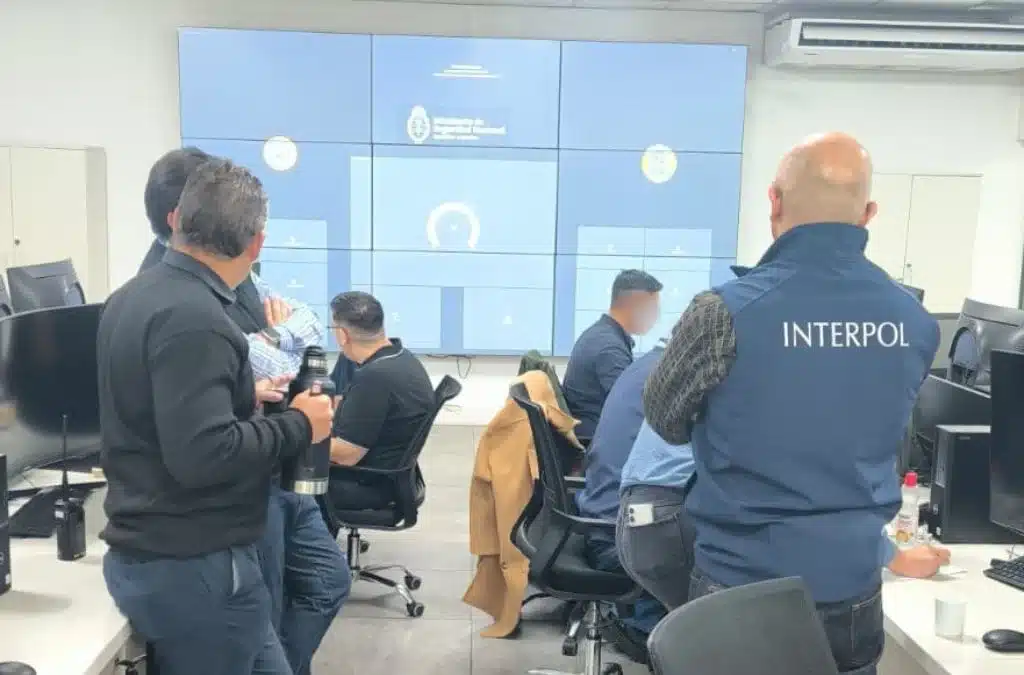
Operation Jackal IV also targeted money laundering activities used to move and conceal criminal proceeds across borders. INTERPOL coordinated cross-border intelligence sharing, analysis and operational support during the operation. It also provided specialized training to strengthen international investigations into financial crime. Tomonobu Kaya, Director of the INTERPOL Financial Crime and Anti-Corruption Centre, said the operation showed the importance of international cooperation in following illicit financial flows and disrupting criminal networks. [caption id="attachment_113806" align="aligncenter" width="600"]West African Organized Crime Groups Image Source: INTERPOL[/caption]

Major Arrests and Financial Crime Investigations

In Argentina, authorities identified 196 individuals linked to a major Crime-as-a-Service network suspected of providing website domains and money laundering support to West African organized crime groups. The investigation resulted in 17 arrests, with an INTERPOL Operational Support Team assisting with analysis of seized data and identification of suspects and criminal networks. South African authorities raided seven locations in Johannesburg linked to a syndicate involved in romance and investment scams targeting retirees in English-speaking countries. Investigators arrested 39 people, seized USD 2.67 million and blocked 257 bank accounts. In Italy, investigators identified an individual connected to a pan-European money laundering network that used shell companies, remittance services and cash withdrawals. One account processed EUR 845,000, or about USD 736,000, through 560 transactions involving 20 financial instruments. Romanian authorities dismantled a criminal group operating an investment scam through a call centre. The group promoted high returns from stocks and cryptocurrencies, with victims' money transferred to electronic wallets controlled by perpetrators. Authorities estimated that EUR 143 million had been stolen and laundered globally. Eleven people were arrested, while cash, cryptocurrency, six real estate properties and luxury watches were seized.

Sextortion and Crime-as-a-Service Emerge

Beyond individual investigations, the operation highlighted emerging threats involving sextortion and Crime-as-a-Service. INTERPOL identified an increase in West African organized crime groups using sextortion to target minors, including victims as young as 14. In these cases, offenders typically contacted minors through social media, established trust and persuaded them to share explicit images or videos. They then threatened to distribute the material to the victim's contacts unless a ransom was paid. Investigators also found that some criminal syndicates were procuring Crime-as-a-Service from external providers, including through the dark web. These services were used to outsource activities such as money laundering and other operational functions. While several cases from Operation Jackal IV remain under investigation, the preliminary results demonstrate the scale and international reach of the networks targeted during the eight-month operation. The participating countries were Austria, Argentina, Australia, Canada, Côte d'Ivoire, France, Germany, Indonesia, Ireland, Italy, Japan, Malaysia, the Netherlands, Nigeria, Portugal, South Africa, Spain, Sweden, Switzerland, the United Arab Emirates, the United Kingdom and the United States.
  • ✇Malwarebytes
  • Sextortion scammers are exploiting ShinyHunters data leaks
    Sextortion scammers are using email addresses from data leaked by the ShinyHunters hacking group to add some credibility to their feeble attempts to convince people they have embarrassing information about them. Sextortion emails are messages claiming that the scammer recorded you through your webcam while you watched pornography and now demand payment. They have been around for years and keep evolving with small changes in wording and fake technical detail. In this campaign, the scammers
     

Sextortion scammers are exploiting ShinyHunters data leaks

27 de Julho de 2026, 12:00

Sextortion scammers are using email addresses from data leaked by the ShinyHunters hacking group to add some credibility to their feeble attempts to convince people they have embarrassing information about them.

Sextortion emails are messages claiming that the scammer recorded you through your webcam while you watched pornography and now demand payment. They have been around for years and keep evolving with small changes in wording and fake technical detail.

In this campaign, the scammers pretend to be ShinyHunters. What hasn’t changed is the basic truth: there is no malware, no recording, and no credible evidence behind the threat. Despite seeing countless versions of these emails over the years, I’ve yet to encounter one that was backed up by the evidence the sender claimed to have.

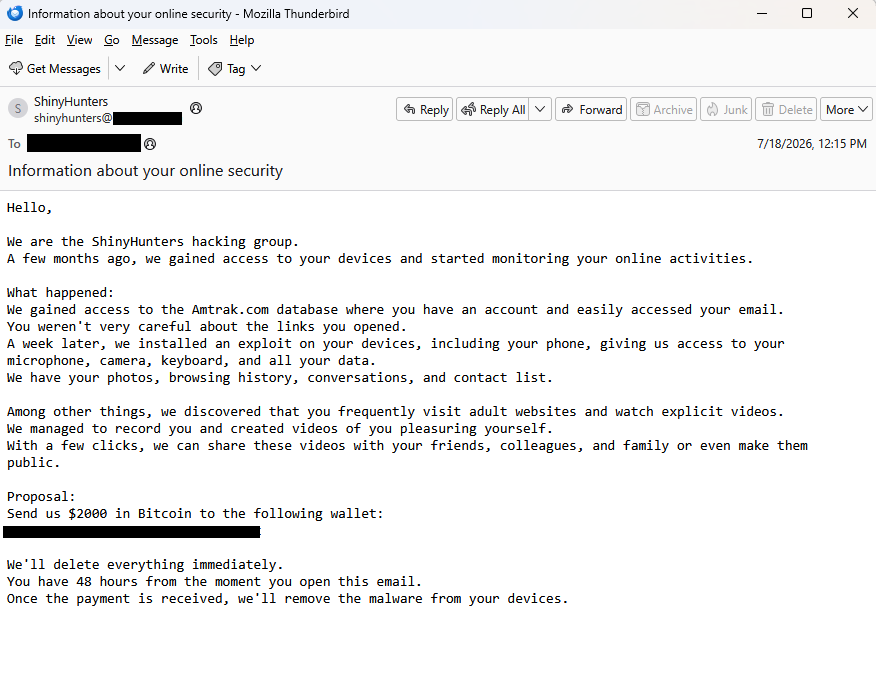
BleepingComputer reports that ShinyHunters data leaks are fueling a $2,000 sextortion email scam and shared the following example:

Example sextortion email from ShinyHunters

“Subject: Information about your online security

Hello,

We are the ShinyHunters hacking group.
A few months ago, we gained access to your devices and started monitoring your online activities.

What happened:
We gained access to the Amtrak.com database where you have an account and easily accessed your email.
You weren’t very careful about the links you opened.
A week later, we installed an exploit on your devices, including your phone, giving us access to your microphone,
camera, keyboard, and all your data.
We have your photos, browsing history, conversations, and contact list.

Among other things, we discovered that you frequently visit adult websites and watch explicit videos.
We managed to record you and created videos of you pleasuring yourself.
With a few clicks, we can share these videos with your friends,
colleagues, and family or even make them public.

Proposal:
Send us $2000 in Bitcoin to the following wallet:
xxxxxxxxxxxxxxxxxxxxxxxxxxxxxxxxx

We’ll delete everything immediately.
You have 48 hours from the moment you open this email.
Once the payment is received, we’ll remove the malware from your devices.”

BleepingComputer states it has seen data from the Amtrak, Hallmark, ADT, Substack, Betterment, CarGurus, Panera Bread, and McGraw Hill breaches used to target victims in this sextortion email campaign.

A California community college also issued a warning after seeing the campaign target people affected by the Canvas data breach.


Digital Footprint Scan

See if your personal data has been exposed.


They confirmed that the targeted email addresses had previously appeared in data leaked by ShinyHunters. They also contacted the group, which denied being behind the sextortion emails.

The increase to a $2,000 demand may suggest the scammers paid someone for the email lists. Although it’s more likely they simply downloaded the leaked data after ShinyHunters published it following failed extortion attempts.

A quick check of the Bitcoin address used in the email shows no activity.

blockchain report of scammer's Bitcoin address
No activity on their Bitcoin address

Let’s keep it that way. With any luck, these dungeon dwellers will eventually give up trying to scare people out of their hard-earned money.

How to react to sextortion emails

Some sextortion emails are badly written, but many have been polished by AI and look convincing. Regardless of how professional they look, they should be treated the same way: as unsubstantiated threats designed to scare victims into paying.

  • First and foremost, never reply to emails of this kind. Responding confirms that someone is actively reading messages sent to that address and may encourage further scam attempts.
  • Don’t let yourself be rushed into action. Scammers rely on the fact that you will not take the time to think this through and subsequently make mistakes. Ask for advice if you’re not sure.
  • An attachment is not proof. Most sextortion emails contain no evidence at all, and attachments are often used to deliver malware or make the threats appear more convincing.
  • If the email includes a password you’ve used before, change it immediately anywhere it’s still in use. Then enable two-factor authentication (2FA) wherever possible. If you’re having trouble keeping track of your passwords, consider using a password manager.
  • Delete the message, report it as spam, and move on.

Pro tip: Malwarebytes Scam Guard recognized this email for what it is: sextortion. It can recognize scams and advise you how to proceed.

Scam Guard recognizes this email as a sextortion scam

While these sextortion emails are almost always bluffs, if you’re concerned about webcam spying, Malwarebytes Webcam Monitoring can alert you when applications attempt to access your camera.


Scam or legit? Scam Guard knows.


  • ✇Malwarebytes
  • “Total access to all your devices.” Sextortion scammers strike again
    At the moment, we’re seeing all kinds of sextortion emails. The scam is cheap to run, easy to automate, and apparently profitable enough that cybercriminals keep using it. Some criminals put more effort into their messages than others. Sextortion emails are messages claiming that scammers recorded you through your webcam while you watched pornography and now demand payment. They have been around for years and keep evolving with small changes in wording and fake technical detail. What has
     

“Total access to all your devices.” Sextortion scammers strike again

24 de Junho de 2026, 07:48

At the moment, we’re seeing all kinds of sextortion emails. The scam is cheap to run, easy to automate, and apparently profitable enough that cybercriminals keep using it. Some criminals put more effort into their messages than others.

Sextortion emails are messages claiming that scammers recorded you through your webcam while you watched pornography and now demand payment. They have been around for years and keep evolving with small changes in wording and fake technical detail.

What hasn’t changed is the basic truth: there is no malware, no recording, and no credible evidence behind the threat. Despite seeing countless versions of these emails over the years, I’ve yet to encounter one that was backed up by the evidence the sender claimed to have.

Below, we’ll walk through the email line by line, interrupting the scammer’s story with commentary that explains where the claims come from and why they don’t stand up to scrutiny.

“Hi there!

I regret to inform you about some sad news for you. Approximately a month or two ago I have succeeded to gain a total access to all your devices utilized for browsing internet. Moving forward, I have started observing your internet activities on continuous basis.”

The opening sets the tone. “Total access to all your devices” is an immediate red flag because it’s extremely unlikely and technically vague. Real attackers tend to be more specific about what they accessed (which device, which OS, which app), whereas scammers deliberately keep it broad so anyone can think it applies to them.

 “Go ahead and take a look at the sequence of events provided below for your reference: Initially I bought an exclusive access from hackers to a long list of email accounts (in today’s world, that is really a common thing, which can arranged via internet). Evidently, it wasn’t hard for me to proceed with logging in your email account (<REDACTED_EMAIL>). “

Here the scammer claims to have bought access to a “long list of email accounts.” That’s a warped reference to real initial access brokers (IABs) and credential markets, where criminals trade stolen passwords or session tokens. In this email, however, no password, login time, or IP address is provided—just an email address they already knew. So, there’s no actual evidence of account takeover or compromise.

“Within the same week, I moved on with installing a Trojan virus in Operating Systems for all devices that you use to login to email. Frankly speaking, it wasn’t a challenging task for me at all (since you were kind enough to click some of the links in your inbox emails before). Yeah, geniuses are among us.”

The “Trojan virus” claim echoes what we’ve seen in other sextortion campaigns that name‑drop random malware families or exploits to sound believable. Again, there is no specific malware name, file path, or exploit described—just a generic story designed to scare anyone who’s ever clicked on a link.

“Because of this Trojan I am able to gain access to entire set of controllers in devices (e.g., your video camera, keyboard, microphone and others). As result, I effortlessly downloaded all data, as well as photos, web browsing history and other types of data to my servers. Moreover, I have access to all social networks accounts that you regularly use, including emails, including chat history, messengers, contacts list etc. My unique virus is incessantly refreshing its signatures (due to control by a driver), and hence remains undetected by any type of antiviruses.”

This section tries to sound technical by mentioning things like “controllers,” “drivers,” “refreshing signatures.” But none of this is how security products or malware actually work. Modern Trojans and spyware may use drivers, persistence mechanisms, or encryption, but claims like “any type of antiviruses” and “incessantly refreshing its signatures” are pure bluff aimed at non‑technical readers.

“Hence, I guess by now you can already see the reason why I always remained undetected until this very letter… “

This line tries to explain away a major inconsistency. If the attacker truly had full control and had been monitoring the victim for “a month or two,” why is the only evidence an email with no logs, screenshots, or sample video? If someone genuinely has compromising material, they will provide at least some proof, because that’s what forces victims to take it seriously.

“During the process of compilation of all the materials associated with you, I also noticed that you are a huge supporter and regular user of websites hosting nasty adult content. Turns out to be, you really love visiting porn websites, as well as watching exciting videos and enduring unforgettable pleasures. As a matter of fact, I was not able to withstand the temptation, but to record certain nasty solo action with you in main role, and later produced a few videos exposing your masturbation and cumming scenes.”

Here comes the classic sextortion hook: “I recorded you while you watched porn.” We’ve seen variations of this wording since at least 2018, often reused word-for-word across huge spam campaigns. The scam relies on shame and fear rather than technical credibility. The goal is to make victims panic into paying.

“If until now you don’t believe me, all I need is one-two mouse clicks to make all those videos with everyone you know, including your friends, colleagues, relatives and others. Moreover, I am able to upload all that video content online for everyone to see.”

Again, note the lack of proof. There’s no preview image, no sample video, no mention of a specific social media account—just a threat to send it to “everyone you know.” It’s deliberately vague. The same message needs to work for millions of recipients with completely different social circles.

“I sincerely think, you certainly would not wish such incidents to take place, in view of the lustful things demonstrated in your commonly watched videos, (you absolutely know what I mean by that) it will cause a huge adversity for you. There is still a solution to this matter, and here is what you need to do: You make a transaction of $1490 USD to my account (an equivalent in bitcoins, which recorded depending on the exchange rate at the date of funds transfer), hence upon receiving the transfer, I will immediately get rid of all those lustful videos without delay. After that we can make it look like there was nothing happening beforehand. Additionally, I can confirm that all the Trojan software is going to be disabled and erased from all devices that you use. You have nothing to worry about, because I keep my word at all times.”

The price point and payment method—just under $1,500, paid in Bitcoin—are typical for this kind of scam. Cryptocurrency is popular with scammers because payments are difficult to reverse and can be moved quickly. Despite its reputation, Bitcoin is not anonymous, and law enforcement has successfully traced many criminal transactions.

“That is indeed a beneficial bargain that comes with a relatively reduced price, taking into consideration that your profile and traffic were under close monitoring during a long time frame. If you are still unclear regarding how to buy and perform transactions with bitcoins – everything is available online. Below is my bitcoin wallet for your further reference: <REDACTED_ACCOUNT> All you have is 48 hours and the countdown begins once this email is opened (in other words 2 days).”

Short deadlines and countdown language are psychological pressure tactics, not technical realities. Scammers want you panicking, not thinking, because a calm reader is more likely to spot the holes in the story.

“The following list includes things you should remember and avoid doing:
> There’s no point to try replying my email (since this email and return address were created inside your inbox).
> There’s no point in calling police or any other types of security services either. Furthermore, don’t you dare sharing this info with any of your friends. If I discover that (taking into consideration my skills, it will be really simple, because I control all your systems and continuously monitor them) – your nasty clip will be shared with public straight away.
> There’s no point in looking for me too – it won’t result in any success. Transactions with cryptocurrency are completely anonymous and untraceable.
> There’s no point in reinstalling your OS on devices or trying to throw them away. That won’t solve the issue, since all clips with you as main character are already uploaded on remote servers.”

This section is essentially objection handling. The scammer anticipates common reactions—talking to someone, calling the police, reinstall your system—and tries to shut them down. The claim that the email address was “created inside your inbox” is particularly revealing. It’s an attempt to make a generic sender address look like evidence of compromise.

“Things that may be concerning you:
> That funds transfer won’t be delivered to me. Breathe out, I can track down everything right away, so once funds transfer is finished, I will know for sure, since I interminably track down all activities done by you (my Trojan virus controls all processes remotely, just as TeamViewer).”

Referencing TeamViewer, a legitimate remote‑access tool, is another tactic we’ve seen in recent sextortion emails.. It helps the scammer anchor their story to something users may have heard of or used at work. But there is still no evidence of remote access, and the claim that the malware “controls all processes” ignores how real operating systems and security controls work.

“> That your videos will be distributed, even though you have completed money transfer to my wallet. Trust me, it is worthless for me to still bother you after money transfer is successful. Moreover, if that was ever part of my plan, I would do make it happen way earlier! We are going to approach and deal with it in a clear manner! In conclusion, I’d like to recommend one more thing… after this you need to make certain you don’t get involved in similar kind of unpleasant events anymore! My recommendation – ensure all your passwords are replaced with new ones on a regular basis.”

Ending with security advice is a manipulative touch. By offering helpful recommendations, the scammer tries to appear credible and trustworthy rather than criminal. It doesn’t change the fact that the email contains no evidence that any of the claims are true.

How to react to sextortion emails

This example is unusually badly written, but many sextortion emails are far more polished and convincing. Regardless of how professional they look, they should be treated the same way: as unsubstantiated threats designed to scare victims into paying.

  • First and foremost, never reply to emails of this kind. Responding confirms that someone is actively reading messages sent to that address and may encourage further scam attempts.
  • Don’t let yourself get rushed into action or decisions. Scammers rely on the fact that you will not take the time to think this through and subsequently make mistakes. Ask for advice if you’re not sure.
  • An attachment is not proof. Most sextortion emails contain no evidence at all, and cybercriminals often use attachments to spread malware or make their threats appear more convincing.
  • If the email includes a password you have used before, change it immediately anywhere it’s still in use. Then enable two-factor authentication wherever possible. If you are having trouble organizing your passwords, consider using a password manager.
  • Delete the message, report it as spam, and move on.

While these sextortion emails are almost always bluffs, if you’re concerned about webcam spying, Malwarebytes Webcam Monitoring can alert you when applications attempt to access your camera.


  • ✇Krebs on Security
  • Please Don’t Feed the Scattered Lapsus ShinyHunters BrianKrebs
    A prolific data ransom gang that calls itself Scattered Lapsus ShinyHunters (SLSH) has a distinctive playbook when it seeks to extort payment from victim firms: Harassing, threatening and even swatting executives and their families, all while notifying journalists and regulators about the extent of the intrusion. Some victims reportedly are paying — perhaps as much to contain the stolen data as to stop the escalating personal attacks. But a top SLSH expert warns that engaging at all beyond a “We
     

Please Don’t Feed the Scattered Lapsus ShinyHunters

2 de Fevereiro de 2026, 13:15

A prolific data ransom gang that calls itself Scattered Lapsus ShinyHunters (SLSH) has a distinctive playbook when it seeks to extort payment from victim firms: Harassing, threatening and even swatting executives and their families, all while notifying journalists and regulators about the extent of the intrusion. Some victims reportedly are paying — perhaps as much to contain the stolen data as to stop the escalating personal attacks. But a top SLSH expert warns that engaging at all beyond a “We’re not paying” response only encourages further harassment, noting that the group’s fractious and unreliable history means the only winning move is not to pay.

Image: Shutterstock.com, @Mungujakisa

Unlike traditional, highly regimented Russia-based ransomware affiliate groups, SLSH is an unruly and somewhat fluid English-language extortion gang that appears uninterested in building a reputation of consistent behavior whereby victims might have some measure of confidence that the criminals will keep their word if paid.

That’s according to Allison Nixon, director of research at the New York City based security consultancy Unit 221B. Nixon has been closely tracking the criminal group and individual members as they bounce between various Telegram channels used to extort and harass victims, and she said SLSH differs from traditional data ransom groups in other important ways that argue against trusting them to do anything they say they’ll do — such as destroying stolen data.

Like SLSH, many traditional Russian ransomware groups have employed high-pressure tactics to force payment in exchange for a decryption key and/or a promise to delete stolen data, such as publishing a dark web shaming blog with samples of stolen data next to a countdown clock, or notifying journalists and board members of the victim company. But Nixon said the extortion from SLSH quickly escalates way beyond that — to threats of physical violence against executives and their families, DDoS attacks on the victim’s website, and repeated email-flooding campaigns.

SLSH is known for breaking into companies by phishing employees over the phone, and using the purloined access to steal sensitive internal data. In a January 30 blog post, Google’s security forensics firm Mandiant said SLSH’s most recent extortion attacks stem from incidents spanning early to mid-January 2026, when SLSH members pretended to be IT staff and called employees at targeted victim organizations claiming that the company was updating MFA settings.

“The threat actor directed the employees to victim-branded credential harvesting sites to capture their SSO credentials and MFA codes, and then registered their own device for MFA,” the blog post explained.

Victims often first learn of the breach when their brand name is uttered on whatever ephemeral new public Telegram group chat SLSH is using to threaten, extort and harass their prey. According to Nixon, the coordinated harassment on the SLSH Telegram channels is part of a well-orchestrated strategy to overwhelm the victim organization by manufacturing humiliation that pushes them over the threshold to pay.

Nixon said multiple executives at targeted organizations have been subject to “swatting” attacks, wherein SLSH communicated a phony bomb threat or hostage situation at the target’s address in the hopes of eliciting a heavily armed police response at their home or place of work.

“A big part of what they’re doing to victims is the psychological aspect of it, like harassing executives’ kids and threatening the board of the company,” Nixon told KrebsOnSecurity. “And while these victims are getting extortion demands, they’re simultaneously getting outreach from media outlets saying, ‘Hey, do you have any comments on the bad things we’re going to write about you.”

In a blog post today, Unit 221B argues that no one should negotiate with SLSH because the group has demonstrated a willingness to extort victims based on promises that it has no intention to keep. Nixon points out that all of SLSH’s known members hail from The Com, shorthand for a constellation of cybercrime-focused Discord and Telegram communities which serve as a kind of distributed social network that facilitates instant collaboration.

Nixon said Com-based extortion groups tend to instigate feuds and drama between group members, leading to lying, betrayals, credibility destroying behavior, backstabbing, and sabotaging each other.

“With this type of ongoing dysfunction, often compounding by substance abuse, these threat actors often aren’t able to act with the core goal in mind of completing a successful, strategic ransom operation,” Nixon wrote. “They continually lose control with outbursts that put their strategy and operational security at risk, which severely limits their ability to build a professional, scalable, and sophisticated criminal organization network for continued successful ransoms – unlike other, more tenured and professional criminal organizations focused on ransomware alone.”

Intrusions from established ransomware groups typically center around encryption/decryption malware that mostly stays on the affected machine. In contrast, Nixon said, ransom from a Com group is often structured the same as violent sextortion schemes against minors, wherein members of The Com will steal damaging information, threaten to release it, and “promise” to delete it if the victim complies without any guarantee or technical proof point that they will keep their word. She writes:

A key component of SLSH’s efforts to convince victims to pay, Nixon said, involves manipulating the media into hyping the threat posed by this group. This approach also borrows a page from the playbook of sextortion attacks, she said, which encourages predators to keep targets continuously engaged and worrying about the consequences of non-compliance.

“On days where SLSH had no substantial criminal ‘win’ to announce, they focused on announcing death threats and harassment to keep law enforcement, journalists, and cybercrime industry professionals focused on this group,” she said.

An excerpt from a sextortion tutorial from a Com-based Telegram channel. Image: Unit 221B.

Nixon knows a thing or two about being threatened by SLSH: For the past several months, the group’s Telegram channels have been replete with threats of physical violence against her, against Yours Truly, and against other security researchers. These threats, she said, are just another way the group seeks to generate media attention and achieve a veneer of credibility, but they are useful as indicators of compromise because SLSH members tend to name drop and malign security researchers even in their communications with victims.

“Watch for the following behaviors in their communications to you or their public statements,” Unit 221B’s advisory reads. “Repeated abusive mentions of Allison Nixon (or “A.N”), Unit 221B, or cybersecurity journalists—especially Brian Krebs—or any other cybersecurity employee, or cybersecurity company. Any threats to kill, or commit terrorism, or violence against internal employees, cybersecurity employees, investigators, and journalists.”

Unit 221B says that while the pressure campaign during an extortion attempt may be traumatizing to employees, executives, and their family members, entering into drawn-out negotiations with SLSH incentivizes the group to increase the level of harm and risk, which could include the physical safety of employees and their families.

“The breached data will never go back to the way it was, but we can assure you that the harassment will end,” Nixon said. “So, your decision to pay should be a separate issue from the harassment. We believe that when you separate these issues, you will objectively see that the best course of action to protect your interests, in both the short and long term, is to refuse payment.”

❌
❌