Visualização normal

Antes de ontemStream principal
  • ✇Malwarebytes
  • Protect your WhatsApp account with new passkey and 2FA upgrades
    WhatsApp announced on August 25 that more than one billion people now use passkeys to log back into the app. The announcement included two other security upgrades: a stronger two-step verification method and more context for incoming calls from unknown numbers. It marks one of the largest passwordless authentication rollouts to date. Passkeys are now firmly mainstream, with the FIDO Alliance estimating that 5 billion are in use worldwide and 75% of consumers have enabled one on at least one a
     

Protect your WhatsApp account with new passkey and 2FA upgrades

28 de Agosto de 2026, 10:36

WhatsApp announced on August 25 that more than one billion people now use passkeys to log back into the app.

The announcement included two other security upgrades: a stronger two-step verification method and more context for incoming calls from unknown numbers. It marks one of the largest passwordless authentication rollouts to date. Passkeys are now firmly mainstream, with the FIDO Alliance estimating that 5 billion are in use worldwide and 75% of consumers have enabled one on at least one account.

Three things changed:

  1. Passkey support originally launched on Android and later extended to iOS. WhatsApp now supports multiple passkeys per account, so people who switch between an Android phone and an iPhone (or use both) can register a passkey on each device.
  2. Two-step verification is moving from a simple six-digit PIN to a longer alphanumeric password that can include special characters, making it much harder to guess or brute-force.
  3. On Android, WhatsApp now shows extra context about calls from numbers not saved in your contacts, including whether the number is from another country and whether you share any groups. It’s a small but useful nudge against the urgency tactics scammers rely on.

Passkeys are resistant to phishing because there is no password or SMS code to type into a fake website or hand over to a scammer. Instead, a passkey is stored on your device or in its credential manager and unlocked using your fingerprint, face, or screen-lock code. They’re also useful in regions where SMS one-time-passcode delivery is unreliable, which might explain why adoption reached a billion users so quickly.

The upgraded two-step verification password closes a real gap. PINs such as “123456” were common, weak, and reused, and a longer alphanumeric password with special characters raises the bar against account-takeover attempts, even if an attacker somehow obtains your one-time code.

The caller-context feature gives people more information to assess legitimacy before answering an unfamiliar number.


Phone Scam Check

Don’t recognize that number? We’ll check it.


What WhatsApp users need to do

Users need to set up a passkey and upgrade their two-step verification password, while the caller-context feature will appear automatically on supported Android devices:

  • Set up a passkey via Settings > Account > Passkeys, and follow the instructions on your device. Don’t forget to add a second one if you use both an Android and an iOS device.
  • If you still use a six-digit PIN for two-step verification, upgrade to the new password format when it becomes available, especially if your PIN is predictable. You can find instructions to set up two-step verification for WhatsApp in this blog. If it’s already enabled, select Two-step verification to find the option to change your PIN.
  • Add a recovery email to two-step verification if you haven’t already. It’s the only way to reset the password if you forget it.
  • Android users should pay attention to the new caller-context details before answering calls from unknown numbers, treating urgency as a red flag rather than a reason to rush.

Passkeys and stronger two-step verification aren’t retroactive or forced, so accounts still relying on an old PIN or no passkey at all will remain unchanged until users upgrade them.


Scammers know more about you than you think. 

Malwarebytes Mobile Security protects you from phishing, scam texts, malicious sites, and more. With real-time AI-powered Scam Guard built right in. 
Download for iOS → Download for Android → 

  • ✇Firewall Daily – The Cyber Express
  • New Zealand Moves to Ban Social Media for Under-16s Samiksha Jain
    New Zealand is moving ahead with a social media ban for under-16s, with the Government introducing the Online Safety (Minimum Age and Child Safety Risk Assessment) Bill to Parliament. The proposed law would require high-risk social media platforms to take reasonable steps to prevent children under 16 from accessing their services and would place greater responsibility on technology companies to address risks to children online. Prime Minister Christopher Luxon said the Government was respondi
     

New Zealand Moves to Ban Social Media for Under-16s

25 de Agosto de 2026, 04:31

Social Media Ban

New Zealand is moving ahead with a social media ban for under-16s, with the Government introducing the Online Safety (Minimum Age and Child Safety Risk Assessment) Bill to Parliament. The proposed law would require high-risk social media platforms to take reasonable steps to prevent children under 16 from accessing their services and would place greater responsibility on technology companies to address risks to children online. Prime Minister Christopher Luxon said the Government was responding to concerns about the amount of time young people spend on social media and their exposure to harmful content, addictive technology and online pressures. “We simply cannot accept the harm being done to a generation of New Zealand children,” says Prime Minister Christopher Luxon. According to the Government, one in three children aged 13 to 17 spends at least five hours a day on social media.

New Zealand Social Media Ban Introduces Age Verification

Under the proposed social media ban, high-risk platforms including Instagram, TikTok, Snapchat and Facebook would be required to take reasonable steps to establish whether users are over 16. The Bill allows for multiple age-checking methods, including existing account information, facial age estimation, digital ID services and formal identification. The proposed framework would also require platforms used by children to regularly assess the risks they pose and report on how those risks are being identified and reduced. The Government said the framework is designed to evolve alongside technology and would also cover emerging services, including AI companion platforms.

Companies Could Face Significant Penalties

The proposed online safety law would introduce significant penalties for platforms that fail to meet their obligations. Companies could face fines of up to 10 percent of their global revenue. An online safety regulator within the Department of Internal Affairs would independently monitor compliance, investigate platforms and enforce the law. Education Minister Erica Stanford said the Bill would place legal obligations on technology platforms rather than children, parents or caregivers. No penalties are proposed for children, their parents or caregivers under the proposed framework. “The Bill places legal obligations on platforms. No penalties are proposed for children, their parents or caregivers,” Ms Stanford says. “It doesn’t just introduce a minimum age requirement. It creates an enduring framework that can evolve alongside technology and holds platforms responsible for understanding and reducing the risks they create for children,” she says. The Government also plans to strengthen education and public awareness so parents, schools and communities have information and tools to help children navigate online services safely.

New Zealand Joins Growing Push for Child Online Safety

The proposed New Zealand social media ban follows similar moves in other countries seeking to place greater responsibility on technology companies. Earlier this year, Spain announced plans to prohibit social media access for children under 16. Prime Minister Pedro Sanchez described the internet as a “digital Wild West” and said stronger protections were needed to shield young people from online harm. France has also moved toward age-based restrictions. In February, French lawmakers approved legislation banning children under 15 from accessing social media platforms, with the measure expected to take effect at the start of the next school year. French President Emmanuel Macron backed the proposal, arguing that children’s development should not be dictated by algorithms designed to maximize engagement.

Government Says Rules Aim to Change Online Behaviour

Luxon acknowledged that the Government does not expect every child to stop using social media but said early evidence from Australia showed minimum age requirements were already changing behaviour. The Government said the child online safety framework is intended to make a meaningful difference while creating longer-term obligations for technology companies. The Online Safety (Minimum Age and Child Safety Risk Assessment) Bill will now be introduced to Parliament, beginning the legislative process for the proposed under-16 social media restrictions.

France’s Top Court Blocks Under-15 Social Media Ban

17 de Agosto de 2026, 13:39

France’s Constitutional Council blocked an under-15 social media ban, raising questions over free expression, age verification and online privacy.

The post France’s Top Court Blocks Under-15 Social Media Ban appeared first on TechRepublic.

  • ✇Firewall Daily – The Cyber Express
  • TikTok Age Verification Under Investigation as UK Tightens Child Safety Rules Samiksha Jain
    The UK's communications regulator has launched a formal investigation into TikTok age verification, raising questions over whether the platform is adequately protecting children online under the country's Online Safety Act. The move comes as Britain prepares to introduce a social media ban for under-16s, with regulators warning that current age assurance methods used by some platforms may not be sufficient to prevent children from accessing harmful content. The investigation follows the publica
     

TikTok Age Verification Under Investigation as UK Tightens Child Safety Rules

TikTok age verification

The UK's communications regulator has launched a formal investigation into TikTok age verification, raising questions over whether the platform is adequately protecting children online under the country's Online Safety Act. The move comes as Britain prepares to introduce a social media ban for under-16s, with regulators warning that current age assurance methods used by some platforms may not be sufficient to prevent children from accessing harmful content.

The investigation follows the publication of a new Ofcom report that found age checks are becoming more common across online services, but significant gaps remain, particularly on social media platforms and some pornography websites.

Ofcom Questions TikTok Age Verification Method

According to Ofcom, some social media companies rely primarily on age inference methods to identify child users. These systems estimate a user's age based on their online behavior rather than verifying it directly.

The regulator said it has "serious doubts" about whether these methods are capable of meeting the standards required under the Online Safety Act. Ofcom believes some companies may be failing to correctly identify a significant number of children, potentially exposing them to harmful content, including pornography, self-harm, and suicide-related material.

As a result, Ofcom has launched a formal investigation into whether TikTok is complying with its legal duties to protect children from harmful content.

The regulator also warned that age inference alone will not be considered sufficient for enforcing the government's planned restrictions on social media use by children under 16. Platforms using such methods have been urged to adopt more effective age assurance technologies or provide compelling evidence demonstrating their effectiveness.

Age Checks Increase Across Online Services

The report found significant progress in the adoption of age checks since the Online Safety Act's child protection duties came into force in July 2025.

Between July 2025 and January 2026, the proportion of children encountering highly effective age checks increased from 25% to 43%.

Ofcom said more than 69 million age checks were completed across a sample of 32 UK services during the second half of 2025, representing a 23-fold increase compared to the previous six months.

The regulator also reported that all of the UK's top 10 pornography websites and most of the top 100 now have age verification measures in place.

Among children aged 8 to 14 who attempted to access pornography, only 8% visited such services. Half of those children reached only websites with age checks, while nearly 87% of their visits lasted less than 30 seconds, suggesting age verification discouraged continued access.

Search Engines Also Face Scrutiny

Despite the wider rollout of age assurance, Ofcom found that children can still easily discover pornography websites without age checks through Google Search and Bing.

Its analysis found that 33% of first-page Google search results and 54% of Bing results directed users to pornography websites lacking age verification or equivalent protections.

Following discussions with the regulator, Google and Bing have agreed to work with Ofcom on practical measures to reduce the visibility of such websites in search results.

Meanwhile, Ofcom continues enforcement against adult services that fail to comply with the law. The regulator has opened 23 investigations involving 88 adult service providers, with many either introducing age assurance or blocking UK users after enforcement action.

UK Moves Toward Social Media Ban for Under-16s

The investigation comes as the UK government advances plans to introduce a social media ban for under-16s, modeled on Australia's approach.

Under the proposal, platforms including TikTok, Snapchat, Instagram, Facebook, YouTube, and X would be prohibited from offering social media services to users under 16. Messaging services such as WhatsApp and Signal are not expected to be included.

The government also plans to introduce additional protections, including restrictions on livestreaming and communication with strangers for children under 16 across social media and certain gaming platforms. Similar safeguards would apply by default to users aged 16 and 17 to avoid what officials describe as a "cliff-edge" at age 16.

The proposed measures are expected to be presented to Parliament before the end of the year, with implementation targeted for Spring 2027.

Ofcom said it will submit a rapid assessment to Parliament by the end of October outlining what constitutes highly effective age assurance for verifying whether someone is over 16, helping shape future enforcement of the planned restrictions.

  • ✇Firewall Daily – The Cyber Express
  • FBI Flags Kali365 as New Phishing Threat Targeting Microsoft 365 Users Samiksha Jain
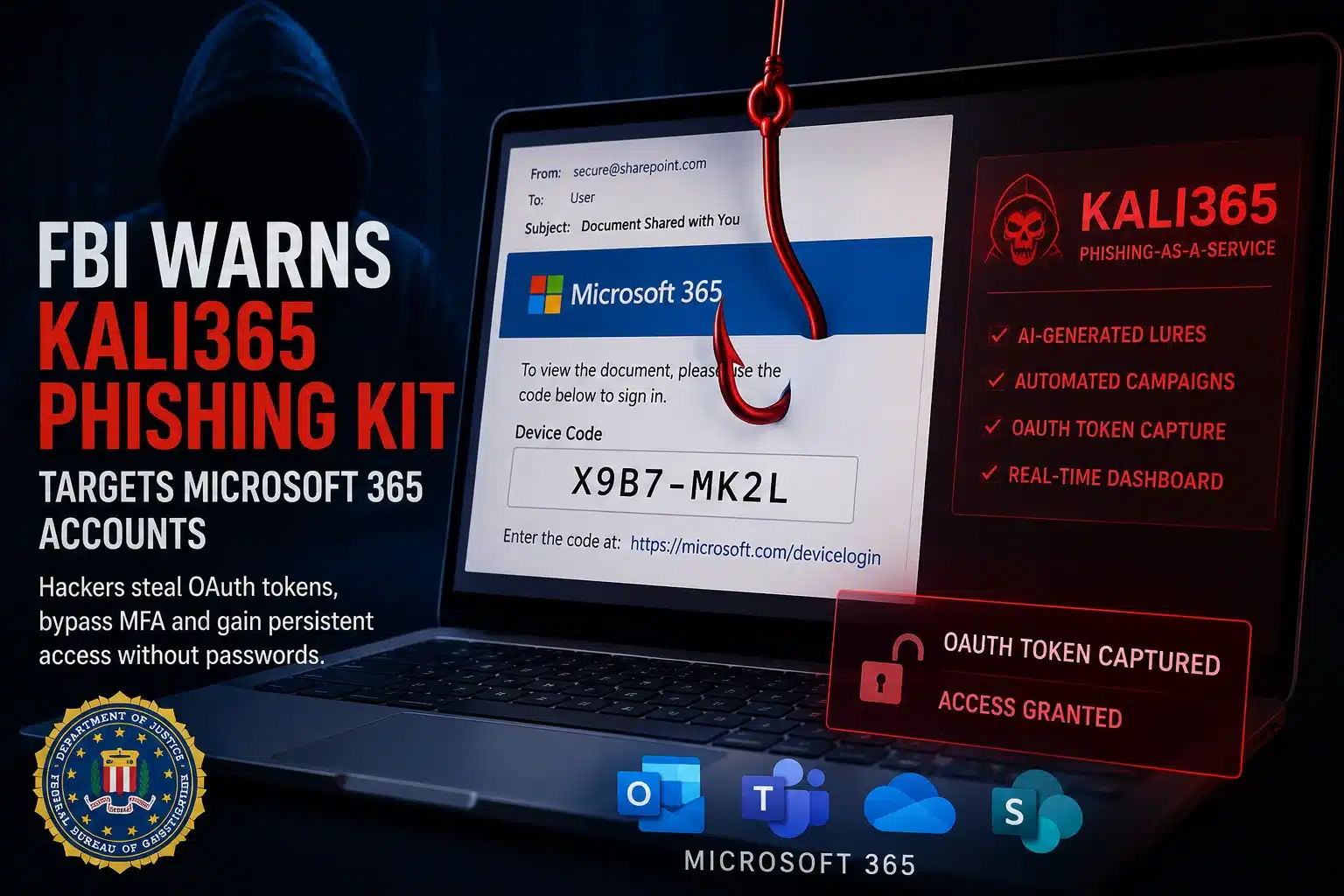
    The FBI has issued a fresh warning about a growing cybercrime service known as Kali365, a new Phishing-as-a-Service (PhaaS) platform that enables attackers to hijack Microsoft 365 accounts without stealing passwords directly. According to the FBI, the Kali365 phishing kit allows even low-skilled cybercriminals to bypass multi-factor authentication (MFA) protections by abusing Microsoft’s legitimate device authentication workflow. The platform, which surfaced in April 2026, is being distribute
     

FBI Flags Kali365 as New Phishing Threat Targeting Microsoft 365 Users

Kali365 Phishing Kit

The FBI has issued a fresh warning about a growing cybercrime service known as Kali365, a new Phishing-as-a-Service (PhaaS) platform that enables attackers to hijack Microsoft 365 accounts without stealing passwords directly. According to the FBI, the Kali365 phishing kit allows even low-skilled cybercriminals to bypass multi-factor authentication (MFA) protections by abusing Microsoft’s legitimate device authentication workflow. The platform, which surfaced in April 2026, is being distributed primarily through Telegram channels and is already being linked to hundreds of phishing campaigns targeting organizations and individuals worldwide. Instead of collecting usernames and passwords, attackers steal OAuth access tokens that provide long-term access to Microsoft 365 environments, including Outlook, Teams, and OneDrive.

How the Kali365 Phishing Kit Works

The FBI explained that the platform relies on a deceptive but technically simple attack chain designed to exploit user trust. The process typically begins with a phishing email impersonating trusted productivity or document-sharing services. The email contains a device authentication code and instructions asking the victim to visit a legitimate Microsoft verification page. Because the webpage itself is genuine, many users assume the request is safe. Once the targeted user enters the provided code, they unknowingly authorize the attacker’s device to access their Microsoft 365 account. The attacker then captures OAuth access and refresh tokens, enabling persistent access without requiring the victim’s password or additional MFA verification. This technique is particularly dangerous because it does not rely on traditional credential theft. Instead, it abuses Microsoft’s authentication framework to gain legitimate session access. The FBI noted that after successful token capture, attackers can continue accessing services such as Outlook email accounts, Teams communications, and OneDrive files without triggering additional login prompts.

Why OAuth Token Theft Is Becoming a Growing Threat

Security researchers say OAuth token theft is becoming increasingly popular among cybercriminals because it allows attackers to bypass many traditional security controls. Unlike passwords, OAuth tokens are designed to maintain authenticated sessions across services. If stolen, they can provide attackers with ongoing access until revoked or expired. The FBI warned that Kali365 significantly lowers the barrier to entry for cybercrime operations by offering built-in phishing templates, AI-generated phishing lures, automated campaign tools, and real-time dashboards that track victims and stolen tokens. This means attackers no longer need advanced technical expertise to launch phishing campaigns against businesses using Microsoft 365 environments. The platform’s availability on Telegram also makes it easier for threat actors to distribute and monetize phishing infrastructure at scale.

FBI Shares Protection Measures Against Kali365 Attacks

To reduce exposure to these attacks, the FBI advised organizations to restrict or block device code authentication flows wherever possible. One of the key recommendations includes implementing conditional access policies that block device code flow for most users while allowing limited exceptions for essential business operations. Organizations are also encouraged to audit existing device authentication workflows to identify legitimate dependencies before enforcing restrictions. The FBI further recommended blocking authentication transfer policies that allow authentication to move between computers and mobile devices, as these workflows can potentially be abused during phishing attacks. For organizations unable to fully disable device code flow, the agency suggested excluding emergency access accounts from restrictions to avoid accidental lockouts during critical situations.

FBI Urges Victims to Report Incidents

The FBI is urging anyone impacted by the Kali365 phishing campaign to report incidents through the Internet Crime Complaint Center (IC3). Victims are encouraged to preserve and submit phishing emails, suspicious login activity, unauthorized devices, IP addresses, and active session information that could assist investigators. The agency also pointed users toward phishing mitigation guidance published by the Cybersecurity and Infrastructure Security Agency, which outlines defensive measures organizations can take to reduce phishing risks. The rise of Kali365 Phishing-as-a-Service highlights how cybercriminals are increasingly shifting toward token-based attacks that exploit trusted authentication systems instead of relying solely on password theft. As phishing platforms continue evolving, security experts warn that organizations using cloud productivity platforms like Microsoft 365 will need stronger identity protection measures and closer monitoring of authentication activity to reduce the risk of account compromise.
  • ✇Firewall Daily – The Cyber Express
  • Fake Moustache Trick Raises Questions Over UK Online Safety Act Age Checks Ashish Khaitan
    The rollout of the UK’s Online Safety Act in July 2025 was intended to create a safer digital environment for children through stricter age verification rules, tighter moderation standards, and stronger protections against harmful online content. However, early evidence suggests that many of the safeguards introduced under the legislation can still be bypassed with surprisingly simple tactics, including a fake moustache drawn with makeup.  Recent findings have raised concerns among parents, r
     

Fake Moustache Trick Raises Questions Over UK Online Safety Act Age Checks

Online Safety Act

The rollout of the UK’s Online Safety Act in July 2025 was intended to create a safer digital environment for children through stricter age verification rules, tighter moderation standards, and stronger protections against harmful online content. However, early evidence suggests that many of the safeguards introduced under the legislation can still be bypassed with surprisingly simple tactics, including a fake moustache drawn with makeup.  Recent findings have raised concerns among parents, researchers, and digital safety experts about the effectiveness of current age verification systems. While the Online Safety Act has led to some improvements in children’s online experiences, critics argue that enforcement remains inconsistent and that many platforms are still vulnerable to manipulation.  One of the most widely discussed examples involved a 12-year-old boy who reportedly used an eyebrow pencil to create a fake moustache before facing a facial age estimation check. According to the report, the altered appearance convinced the system that he was 15 years old, allowing him to bypass restrictions designed for younger users. The incident has become a symbol of broader concerns about the reliability of AI-driven age-verification technologies. 

Online Safety Act Faces Early Challenges 

The Online Safety Act was introduced to strengthen online child protection measures by requiring platforms to implement stricter checks and reduce children’s exposure to harmful material. The legislation also aimed to improve reporting tools and create safer digital spaces for younger users.  Despite those goals, the report suggests that loopholes remain widespread. Children have reportedly been bypassing protection through several methods, including entering false birthdates, borrowing adult credentials, sharing accounts, and using VPN services. More advanced attempts have also involved spoofing facial recognition systems used in age verification processes.  Survey data cited in the findings revealed that nearly half of children believe current age verification systems are easy to evade. Around one-third admitted to bypassing these systems in recent months.  The fake moustache example particularly highlighted weaknesses in facial age estimation tools that rely heavily on visual indicators rather than stronger forms of identity confirmation. Experts argue that systems based primarily on appearance can be vulnerable to minor cosmetic changes, lighting adjustments, or camera manipulation. 

Mixed Results Following Online Safety Act Rollout 

Although concerns over age verification remain significant, the report noted that the Online Safety Act has produced some positive outcomes. Approximately half of the surveyed children said they were now seeing more age-appropriate content online. In addition, around 40% of both children and parents stated that the internet feels somewhat safer since the legislation came into effect.  Many children also appeared supportive of increased online protections. The findings showed that younger users generally approved of stricter platform rules, reduced interaction with strangers, and limitations placed on high-risk platform features.  Around 90% of children who noticed stronger moderation systems and improved reporting tools viewed those changes positively. Researchers said this indicates that many younger users are willing to engage with safer digital environments when protections are implemented effectively.  Still, the improvements have not been universal. Within just one month of new child protection codes being introduced under the Online Safety Act, nearly half of the children surveyed reported encountering harmful content online. This included violent material, hate speech, and body image-related content, all categories the legislation specifically aims to regulate. 

Privacy Concerns Grow Around Age Verification 

The expansion of age verification requirements has also triggered growing concerns over privacy and data security. More than half of the children surveyed said they had been asked to verify their age within a recent two-month period. These checks were reportedly common across major platforms, including TikTok, YouTube, Google services, and Roblox.  Many platforms now rely on technologies such as facial age estimation, government-issued identification checks, and third-party age assurance providers to comply with the Online Safety Act. While users generally described the systems as easy to complete, concerns remain about how sensitive data is collected, stored, and potentially reused.  Parents expressed unease about whether biometric information and identity documents submitted during age verification could later be retained by companies or accessed by government agencies. Those concerns have intensified calls for more centralized and privacy-focused verification systems instead of fragmented checks spread across multiple online services.  Experts argue that current approaches may not strike the right balance between child safety and personal privacy. They warn that if the weaknesses exposed by tactics like the fake moustache incident are not addressed, public trust in these systems could continue to decline. 
  • ✇Firewall Daily – The Cyber Express
  • UK’s Online Age Checks Are Failing—Kids are Beating Them with AI, Fake Beards Mihir Bagwe
    When governments introduced stricter online age checks under the UK’s Online Safety Act, the goal was to keep children away from harmful content. But in practice, the system is already showing cracks—and the most telling insight comes from the very users it’s meant to protect. Children aren’t just countering age checks, they’re actively bypassing them—and often with surprising ease. According to a new report from Internet Matters foundation, nearly half of children (46%) believe age verificati
     

UK’s Online Age Checks Are Failing—Kids are Beating Them with AI, Fake Beards

U.S. Government Sues TikTok, TikTok

When governments introduced stricter online age checks under the UK’s Online Safety Act, the goal was to keep children away from harmful content. But in practice, the system is already showing cracks—and the most telling insight comes from the very users it’s meant to protect.

Children aren’t just countering age checks, they’re actively bypassing them—and often with surprising ease.

According to a new report from Internet Matters foundation, nearly half of children (46%) believe age verification systems are easy to get around, while only 17% think they are difficult. That perception isn’t theoretical. It’s grounded in real behavior, shared knowledge, and increasingly creative workarounds.

From simply entering a fake birthdate to using someone else’s ID, children have developed a toolkit to bypass techniques. Some methods are almost trivial—changing a date of birth or borrowing a parent’s login—while others reflect a growing sophistication. Kids reported submitting altered images, using AI-generated faces, or even drawing facial hair on themselves to trick facial recognition systems.

In one striking example, a parent described catching their child using makeup to appear older—successfully fooling the system.

I did catch my son using an eyebrow pencil to draw a moustache on his face, and it verified him as 15 years old. – Mum of boy, 12

But the problem goes deeper than perception. It’s systemic.

Also read: UK Regulator Ofcom Launches Probe into Telegram, Teen Chat Platforms

Bypassing Is the Norm, Not the Exception

The report reveals that nearly one in three children (32%) admitted to bypassing age restrictions in just the past two months. Older children are even more likely to do so, which shows how digital literacy often translates into evasion capability.

The most common methods?

  • Entering a fake birthdate (13%)
  • Using someone else’s login credentials (9%)
  • Accessing platforms via another person’s device (8%)

Despite widespread concerns about VPNs, they play a relatively minor role. Only 7% of children reported using them to bypass restrictions, suggesting that simpler, low-effort tactics remain the preferred route.

In other words, the barrier to entry is not just low—it’s practically optional.

Europe Threat Landscape Q1 2026, Online Age Check Europe’s cyber threat landscape Q1 2026 shows a sharp acceleration in cyber threats across the region. Do you know what's contributing to it?

Check Cyble's full analysis report here!

Even When It Works, It Doesn’t Work

Ironically, even when children attempt to follow the rules, the technology doesn’t always cooperate.

Some reported being incorrectly identified as older—or younger—by facial recognition systems. In cases where they were flagged as underage, enforcement was often inconsistent or temporary. One child described being blocked from going live on a platform for just 10 minutes before being allowed to try again.

This inconsistency creates a loophole where persistence pays. If at first you’re denied, simply try again.

A Risky Side Effect

Perhaps the most concerning finding isn’t that children can bypass age checks—it’s that adults can too.

The report states fears that adults may exploit these same weaknesses to access spaces intended for younger users. In some cases, this involves using images or videos of children to trick verification systems. There are even reports of adults acquiring child-registered accounts to blend into youth platforms.

This flips the entire premise of age verification on its head. Instead of protecting children, flawed systems may inadvertently expose them to greater risk.

Parents, Part of the Problem—or the Solution?

Adding another layer of complexity, parents themselves are sometimes complicit.

About 26% of parents admitted to allowing their children to bypass age checks, with 17% actively helping them do so. The reasoning is often pragmatic. Parents feel they understand the risks and trust their child’s judgment.

I have helped my son get around them. It was to play a game, and I knew the game, and I was happy and confident that I was fine with him playing it. – Mum of non-binary child, 13

But this undermines the consistency of enforcement. If rules vary from household to household, platform-level protections lose their impact.

Interestingly, the data also suggests that communication matters. Children who regularly discuss their online activity with parents are less likely to bypass restrictions than those who don’t.

Why Kids Are Bypassing in the First Place

The motivations aren’t always malicious. In many cases, children are simply trying to access social media (34%), gaming communities (30%), or messaging apps (29%) that their peers are already using.

What this resonate is a fundamental tension where age verification systems are trying to enforce boundaries in environments where social participation is the norm.

Age verification is often positioned as a cornerstone of online safety. But in practice, it’s proving to be more of a speed bump than a safeguard.

Children understand the systems. They share methods. They adapt quickly. And until the technology—and its enforcement—becomes significantly more robust, age checks may offer more reassurance than real protection.

  • ✇Security Boulevard
  • Meta & YouTube Found Negligent: A Turning Point for Big Tech? Tom Eston
    A landmark jury verdict has found Meta and YouTube negligent in a social media addiction case, raising major questions about platform accountability and legal protections under Section 230. This episode covers the details of the case, why the ruling is significant, and what it could mean for the future of social media, privacy, and cybersecurity. […] The post Meta & YouTube Found Negligent: A Turning Point for Big Tech? appeared first on Shared Security Podcast. The post Meta & YouTube F
     

Meta & YouTube Found Negligent: A Turning Point for Big Tech?

6 de Abril de 2026, 01:00

A landmark jury verdict has found Meta and YouTube negligent in a social media addiction case, raising major questions about platform accountability and legal protections under Section 230. This episode covers the details of the case, why the ruling is significant, and what it could mean for the future of social media, privacy, and cybersecurity. […]

The post Meta & YouTube Found Negligent: A Turning Point for Big Tech? appeared first on Shared Security Podcast.

The post Meta & YouTube Found Negligent: A Turning Point for Big Tech? appeared first on Security Boulevard.

💾

  • ✇Arstechnica
  • With developer verification, Google's Apple envy threatens to dismantle Android's open legacy Ryan Whitwam
    It's been nearly 20 years since Google revealed Android, which the company described as the first "truly open" mobile operating system, setting Google-powered phones apart from the iPhone's aggressively managed experience. Over time, though, Android has become more aligned with Apple's approach. For the moment, users still have the final say in what software runs on their increasingly locked-down smartphones. Later this year, though, Google plans to seriously curtail that freedom in the name of
     

With developer verification, Google's Apple envy threatens to dismantle Android's open legacy

3 de Março de 2026, 09:00

It's been nearly 20 years since Google revealed Android, which the company described as the first "truly open" mobile operating system, setting Google-powered phones apart from the iPhone's aggressively managed experience. Over time, though, Android has become more aligned with Apple's approach. For the moment, users still have the final say in what software runs on their increasingly locked-down smartphones. Later this year, though, Google plans to seriously curtail that freedom in the name of security.

In the coming weeks, Google will officially debut Android developer verification, which will require app makers outside the Play Store to register with their real names and pay a fee to Google. Failure to do so will block their apps from installation (sometimes called sideloading) on virtually all Android devices. Google says this is a necessary evolution of the platform's security model, but upending the status quo could push developers away from Android and risk the privacy of those that remain.

This might make your phone a little safer, sure, but it won't stop people from getting scammed. At the same time, it could rob the Android ecosystem of what made it special in the first place.

Read full article

Comments

© Aurich Lawson | Getty Images

❌
❌