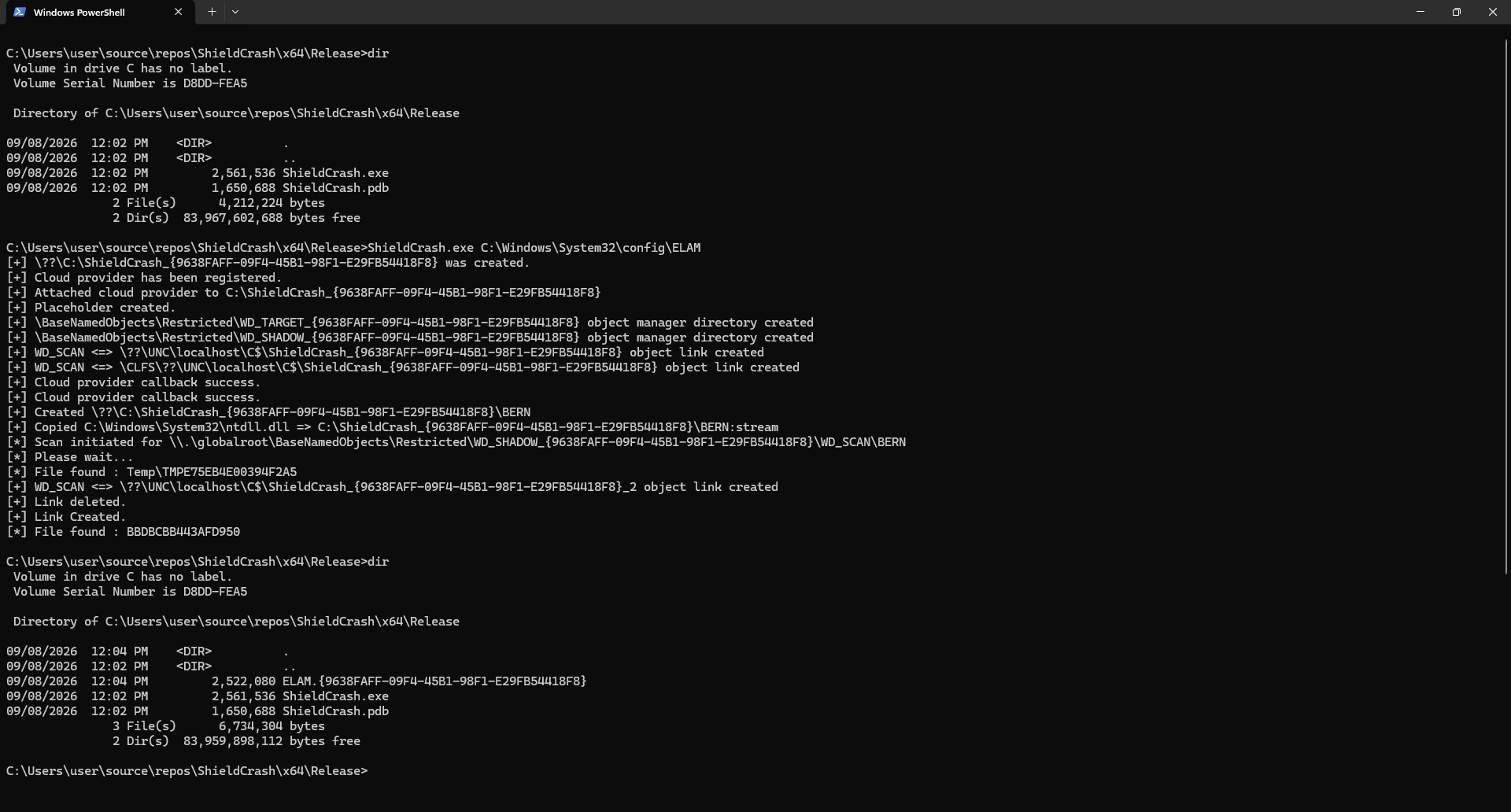
The researcher Chaotic Eclipse released ShieldCrash, a PoC exploit for a Microsoft Defender Zero-Day vulnerability.
Security researcher Chaotic Eclipse, also known as INFINITE NIGHTMARE, MSNightmare and Nightmare-Eclipse, released a new zero-day exploit targeting Microsoft Defender. The researcher named the exploit ShieldCrash, it triggers an arbitrary file read as SYSTEM.
The researcher claims that Microsoft has not fully fixed the ShieldBreak vulnerability (CVE-2026-69414). According to the researcher, Microsoft closed several ways to exploit the flaw but missed a specific condition that still allows the same attack.
The researcher published a proof of concept (PoC) that can read arbitrary files with SYSTEM privileges, the highest level of access on Windows. He says all supported Windows versions remain vulnerable, even after the September 2026 security updates.
“Microsoft has failed to properly patch ShieldBreak CVE-2026-69414, under specific conditions it is still possible to trigger the exact same problem that was caused by ShieldBreak. While Microsoft fixed several things to prevent re-exploiting the issue, they missed a spot where ShieldBreak can still be exploited.” Chaotic Eclipse wrote. “This PoC demonstrates an arbitrary file read as SYSTEM with September 2026, all supported windows versions are affected.”
The researcher described the PoC as a basic version for now. They may later develop it into a full SYSTEM-level exploit, but for now they published only enough code to show that Microsoft’s patch does not completely block ShieldBreak.
Microsoft recently updated the Malware Protection Engine to fix CVE-2026-69414. Version 1.1.26080.3 includes the fix, which requires no user action and does not affect systems with Microsoft Defender disabled. Microsoft recommends keeping malware definitions and the engine updated automatically.
“Microsoft is aware of an elevation of privilege in the Microsoft Malware Protection Engine in Microsoft Defender publicly referred to as “ShieldBreak ” reads Microsoft’s advisory. “In response to a constantly changing threat landscape, Microsoft frequently updates malware definitions and the Microsoft Malware Protection Engine. In order to be effective in helping protect against new and prevalent threats, antimalware software must be kept up to date with these updates in a timely manner. For enterprise deployments as well as end users, the default configuration in Microsoft antimalware software helps ensure that malware definitions and the Microsoft Malware Protection Engine are kept up to date automatically. Product documentation also recommends that products are configured for automatic updating.”
Last week, Chaotic Eclipse released a new zero-day exploit targeting Nvidia. The researcher named the exploit GreenSection, it triggers a Memory Corruption flaw.
Recently, Chaotic Eclipse released exploits targeting other anti-malware and defense solutions. Chaotic Eclipse released a zero-day exploit targeting Kaspersky Endpoint Security he named HardBreacher, which triggers a privilege escalation flaw. The researcher pointed out that the PoC is unstable and may require repeated attempts, but when successful, it creates a DLL in System32 with full user permissions. The researcher also claims taking control of Kaspersky’s UI process can disrupt the antivirus and interfere with file-access controls, potentially leaving the system in an unstable state.
Nightmare Eclipse says the Kaspersky Endpoint Security zero-day allows privilege escalation on a fully patched Windows 11 25H2 system running Kaspersky Endpoint v14.0.0.504.
The researcher also released a zero-day exploit targeting GenDigital Avast Antivirus, named PrettyPrague. The exploit triggers a privilege escalation flaw.
The researcher claims to have found another zero-day in an antimalware product, this time targeting Avast Antivirus. The PoC exploits a flaw in Avast Sandbox to dump the Windows SAM database and gain a SYSTEM-level shell. It reportedly works even on fully patched Avast Antivirus and Windows 11 25H2. The researcher also suspects the flaw may affect other Gen Digital products, including AVG and Norton.
According to the researcher, FalconFlank abuses Falcon’s “Microsoft Office file malicious macro removal” feature. The function is part of Falcon’s remediation capabilities and operates with high privileges. The researcher claims that this behavior can be abused to escalate privileges from a low-privileged local user to a more powerful context.
Chaotic Eclipse, also known as Nightmare Eclipse, is a researcher known for publicly releasing PoC exploits for zero-day vulnerabilities, often after criticizing vendors’ handling of vulnerability reports. His releases have mainly targeted Microsoft products, including Windows and Microsoft Defender, with some later exploited in the wild. Among the most notable are the Undefend and RedSun Defender zero-days.
His work has fueled debate over responsible disclosure and the risks of publishing working exploits.
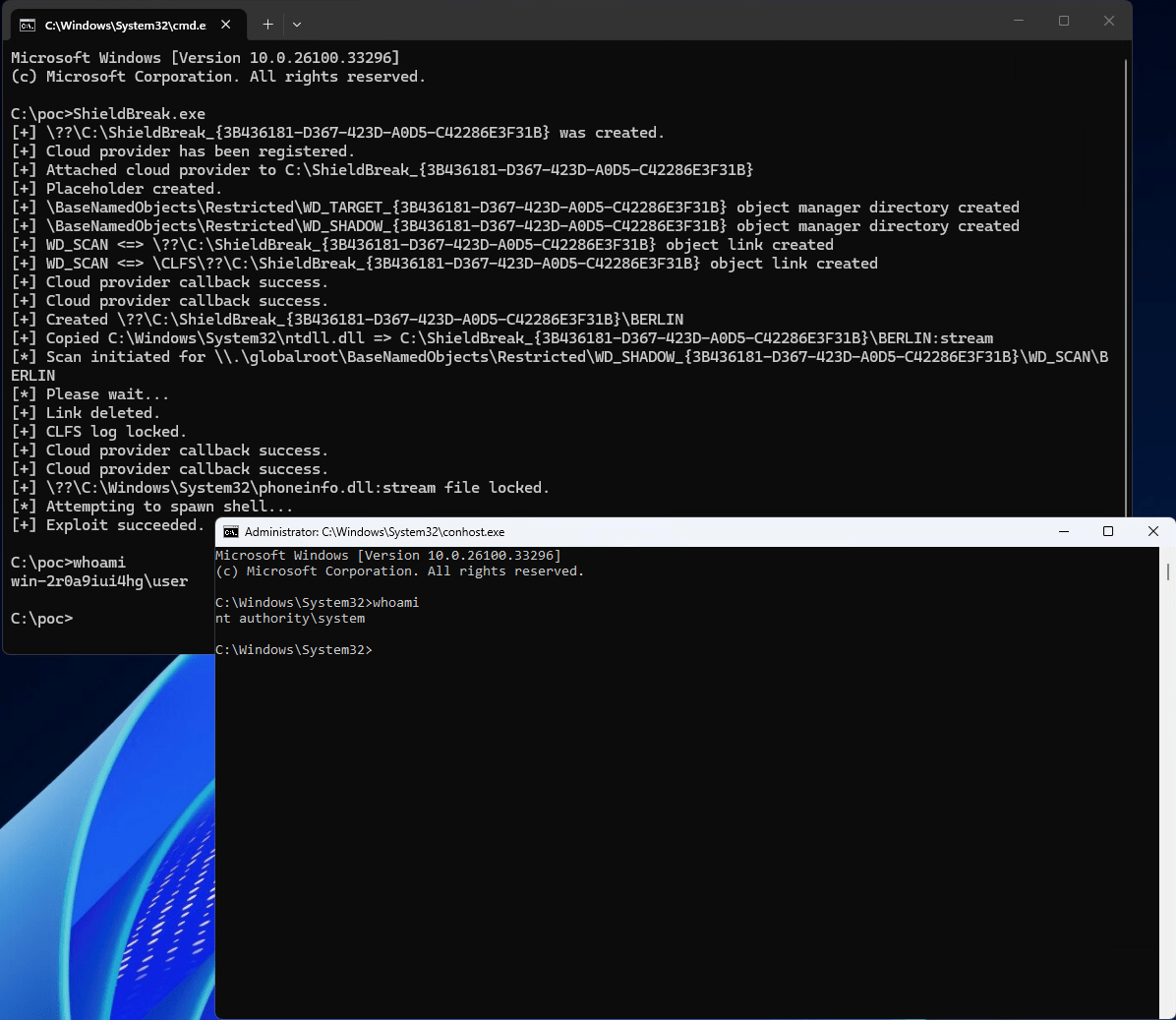
Chaotic Eclipse released a PoC for ShieldBreak, a Microsoft Defender zero-day that bypasses the CVE-2026-50656 patch and could enable SYSTEM-level code execution.
Security researcher Chaotic Eclipse, also known as INFINITE NIGHTMARE, MSNightmare and Nightmare-Eclipse, released a PoC for ShieldBreak, a Microsoft Defender zero-day. The flaw bypasses the patch for CVE-2026-50656 (RoguePlanet), a race condition that can allow attackers to spawn a SYSTEM-level shell. Successful exploitation could enable arbitrary code execution and other unauthorized actions on affected Windows systems.
“Microsoft has failed to properly patch the RoguePlanet vulnerability CVE-2026-50656, this PoC demonstrates a full patch bypass.” said Chaotic Eclipse. “The PoC was tested in the latest version of windows 11 25h2 (+Canary channel) and windows server 2025, the PoC also have a 100% success rate. Please note that Windows 10 (and respective server editions) are not currently supported, they are however vulnerable to ShieldBreak as well.”
In early July, Microsoft released security updates for RoguePlanet, a vulnerability tracked as CVE-2026-50656 (CVSS score of 7.8) affecting the Malware Protection Engine used by Defender. The Microsoft Malware Protection Engine (mpengine.dll) powers Defender’s malware scanning, detection, and removal functions.
The flaw is a local privilege escalation issue that could allow an attacker with access to a system to obtain higher privileges and potentially compromise security controls.
In mid-June, Microsoft acknowledged the RoguePlanet zero-day affecting Microsoft Defender and stated it is aware of the issue and was actively developing a security update to address the flaw and protect affected systems.
A week before, the security researcher Chaotic Eclipse published a new proof-of-concept exploit for a RoguePlanet. The flaw relies on a race condition that can provide attackers with SYSTEM-level privileges, allowing them to execute code with the highest permissions. The exploit was successfully tested on fully updated Windows 10 and Windows 11 systems running the June 2026 Patch Tuesday updates, showing that patched systems may still be vulnerable.
Now Chaotic Eclipse claims ShieldBreak fully bypasses Microsoft’s CVE-2026-50656 patch, while Defender may also leak 8 bytes of data under certain conditions.
The researcher tested the PoC on Windows 11 25H2 and Windows Server 2025 with a 100% success rate. Windows 10 is also vulnerable, though not currently supported by the PoC.
In May, the researcher disclosed two other Windows zero-day vulnerabilities named YellowKey and GreenPlasma. The flaws affect BitLocker and the Windows Collaborative Translation Framework (CTFMON). YellowKey could allow attackers to bypass BitLocker protections, while GreenPlasma enables privilege escalation. The researcher previously disclosed three Microsoft Defender vulnerabilities.
The researcher criticized Microsoft for revoking access to their MSRC account, rejecting reports, and failing to provide compensation.
At the end of May, Microsoft’s Security Response Center called the zero-day dumps irresponsible.
“In recent weeks several zero-day vulnerabilities have been publicly disclosed.” reads the report published by Microsoft. “The details of these vulnerabilities were not shared with Microsoft prior to release, and the disclosures put our customers at unnecessary risk.”
The company said its security teams have been working around the clock since the disclosures to understand the impact, build patches, and protect customers from attackers who picked up the published exploit code and ran with it.
Microsoft’s post is essentially a public defense of Coordinated Vulnerability Disclosure, the standard practice where a researcher notifies a vendor privately, gives them time to fix the issue, and then goes public. Microsoft says it works with hundreds of researchers this way every year, compensating them through bug bounty programs and crediting them publicly.
“This partnership allows us to make updates to impacted services before proof-of-concept code can make it into the hands of bad actors.” continues the report. “The vulnerabilities known as RedSun, UnDefend, BlueHammer, YellowKey, GreenPlasma, and MiniPlasma were not responsibly disclosed.”
The implication is clear: when someone skips that step, real people get attacked with real tools built from the published research.
In July, just hours after Microsoft’s July 2026 Patch Tuesday, Chaotic Eclipse, published a new Windows zero-day proof-of-concept called LegacyHive. This time, the target is the Windows User Profile Service (ProfSvc), and unlike the hundreds of vulnerabilities Microsoft fixed this month, this one currently has no CVE, no advisory, and no security update.
LegacyHive is a local privilege escalation vulnerability. An attacker who already has code execution as a standard user can abuse the User Profile Service to load another user’s registry hive, potentially that of a local administrator, under their own profile.
At the end of May, Microsoft’s Security Response Center called the zero-day dumps irresponsible.
“In recent weeks several zero-day vulnerabilities have been publicly disclosed.” reads the report published by Microsoft. “The details of these vulnerabilities were not shared with Microsoft prior to release, and the disclosures put our customers at unnecessary risk.”
The company said its security teams have been working around the clock since the disclosures to understand the impact, build patches, and protect customers from attackers who picked up the published exploit code and ran with it.
Microsoft’s post is essentially a public defense of Coordinated Vulnerability Disclosure, the standard practice where a researcher notifies a vendor privately, gives them time to fix the issue, and then goes public. Microsoft says it works with hundreds of researchers this way every year, compensating them through bug bounty programs and crediting them publicly.
“This partnership allows us to make updates to impacted services before proof-of-concept code can make it into the hands of bad actors.” continues the report. “The vulnerabilities known as RedSun, UnDefend, BlueHammer, YellowKey, GreenPlasma, and MiniPlasma were not responsibly disclosed.”
The implication is clear: when someone skips that step, real people get attacked with real tools built from the published research.
Fake downloads of The Odyssey are spreading Lumma Stealer malware capable of stealing passwords, cookies, payment data, and cryptocurrency information.
Microsoft is retiring its legacy Threat Intelligence portal on August 1. Security teams should verify licenses, permissions, investigation projects, APIs, and automated workflows before the cutoff.
Microsoft has confirmed active exploitation of two security vulnerabilities in its security ecosystem, identified as CVE-2026-41091 and CVE-2026-45498, both evaluated under the CVSS scoring system. The issues affect Microsoft Defender and have raised concerns due to confirmed in-the-wild exploitation and potential impact on enterprise systems.The first issue, CVE-2026-41091 (CVSS 7.8), is a privilege escalation vulnerability affecting Microsoft Defender. If successfully exploited, it could allow a local attacker to obtain SYSTEM-level privileges. The flaw is rooted in improper link resolution before file access, commonly described as a “link following” issue.Microsoft stated in its advisory:"Improper link resolution before file access ('link following') in Microsoft Defender allows an authorized attacker to elevate privileges locally,"The second vulnerability, CVE-2026-45498 (CVSS 4.0), is a denial-of-service flaw impacting Microsoft Defender. While rated lower in severity under the CVSS framework, it has still been confirmed as actively exploited in real-world environments alongside CVE-2026-41091.Both vulnerabilities have been addressed in updated releases of the Microsoft Defender Antimalware Platform, specifically versions 1.1.26040.8 and 4.18.26040.7, respectively.
CVE-2026-41091, CVE-2026-45498, and CVSS Context
Although Microsoft has not explicitly confirmed the link, the behavior associated with CVE-2026-41091 and CVE-2026-45498 overlaps with earlier publicly discussed issues named RedSun and UnDefend, which were disclosed by the threat research group Chaotic Eclipse (also known as Nightmare-Eclipse).Security researchers from Huntress have reported active exploitation of both CVE-2026-41091 and CVE-2026-45498 in the wild. These observations also include exploitationactivity related to BlueHammer (CVE-2026-33825), suggesting a broader campaign targeting Microsoft Defender components and adjacent security mechanisms.
Additional Security Findings
Alongside the two actively exploited vulnerabilities CVE-2026-41091 and CVE-2026-45498, Microsoft also patched another flaw in the same Defender update cycle: CVE-2026-45584 (CVSS 8.1). This vulnerability is a heap-based buffer overflow that could allow remote code execution if exploited. Unlike CVE-2026-41091 and CVE-2026-45498, there is currently no evidence that CVE-2026-45584 has been used in active attacks.Microsoft Defender systems that have been disabled are not affected by these vulnerabilities, according to the company. Microsoft also noted that no manual intervention is required for most users, as updates are delivered automatically through malware definition updates and the Microsoft Malware Protection Engine.
CVSS Updates and Security Guidance
To verify protection status against CVE-2026-41091 and CVE-2026-45498, Microsoft recommends users check their Microsoft Defender configuration using the Windows Security interface (Microsoft Windows Security). The recommended steps include navigating to Virus & threat protection, checking protection updates, and verifying the Antimalware Client Version.Microsoft credited five researchers for identifying CVE-2026-41091, including Sibusiso, Diffract, Andrew C. Dorman (also known as ACD421), Damir Moldovanov, and an anonymous contributor.
CISA KEV Catalog
The U.S. Cybersecurity and Infrastructure Security Agency (CISA) (Cybersecurity and Infrastructure Security Agency) has added both CVE-2026-41091 and CVE-2026-45498 to its Known Exploited Vulnerabilities (KEV) catalog. Federal Civilian Executive Branch (FCEB) agencies are required to apply mitigations by June 3, 2026, reflecting the urgency of addressing CVSS-rated threats that are already being exploited.With this addition, three Microsoft vulnerabilities have been flagged as actively exploited within a single week, highlighting a concentrated wave of CVE-based attacks targeting Microsoft products.
Legacy Vulnerabilities
CISA’s KEV catalog update also included several older but still relevant vulnerabilities:
CVE-2010-0806: Internet Explorer use-after-free flaw enabling remote code execution
CVE-2010-0249: Another Internet Explorer use-after-free vulnerability allowing arbitrary code execution
CVE-2009-1537: DirectX issue in QuickTime Movie Parser Filter via crafted media files
CVE-2008-4250: Windows Server Service buffer overflow via crafted RPC request
CVE-2009-3459: Adobe Acrobat and Reader heap-based buffer overflow via malicious PDF files
These legacy issues demonstrate that exploitation of older software remains relevant in modern threat landscapes, especially when combined with newer vulnerabilities like CVE-2026-41091 and CVE-2026-45498, both evaluated using CVSS metrics.
What happened A faulty Microsoft Defender antimalware signature update released around April 30, 2026, caused widespread false positive alerts by incorrectly flagging two legitimate DigiCert root certificates as high-severity malware. The detection, labeled Trojan:Win32/Cerdigent.A!dha, identified registry entries belonging to DigiCert Assured ID Root CA and DigiCert Trusted Root G4 as threats and automatically quarantined them […]

 Entrar