Google announces a European search engine revamp to avoid EU Digital Markets Act fines. Discover how these major layout changes downgrade user experience.
Google has patched 230 vulnerabilities on Tuesday, including another actively exploited Chrome zero-day bug, the seventh such vulnerability patched since the start of the year. [...]
Google has released a new update for the Chrome Stable Channel on desktop platforms, addressing 26 security vulnerabilities. This includes two critical use-after-free flaws affecting WebGL and Shared Tab Groups. The update upgrades Chrome to version 152.0.7977.75 on Windows and macOS, while Linux users receive version 152.0.7977.76. Google stated that the update will be rolled […]
Microsoft is investigating an issue causing the Defender for Office 365 security software to mistakenly block access to legitimate Google search links. [...]
Google has introduced new privacy and network-security protections in Android 17, including stricter controls that prevent apps from scanning devices connected to a user’s local Wi‑Fi network without permission.
The update is designed to reduce household profiling, limit tracking, and defend users against threats ranging from malicious Wi‑Fi activity to cellular SMS scams.
Android smartphones often connect to home Wi‑Fi networks shared by smart TVs, cameras, game consoles, speakers, printers, and other Internet of Things devices.
Previously, an app could potentially discover devices on the same local network without clearly asking the user for access. That information could reveal details about a household’s technology, behavior, or device ownership.
Android 17 now enforces Local Network Protection, requiring apps to request explicit permission before scanning for or connecting to devices on the local network.
This gives users more control over which applications can view nearby devices and communicate across their home Wi‑Fi environment. The restriction does not remove common features such as streaming content to a television.
Instead, Google recommends that developers use secure Android system tools for actions such as casting. Users can select a compatible TV or device through the operating system, without giving the app broad visibility into every device connected to the network.
Android 17 New Protection for Wi-Fi Tracking
The Wi‑Fi privacy improvement is part of a wider Android 17 security update focused on protecting network metadata and encrypted connections.
Google is also adding support for Encrypted Client Hello, or ECH, a privacy technology that hides the name of a website a device is trying to reach during the early stages of an HTTPS connection.
HTTPS already encrypts most traffic between a device and a website. However, network operators and eavesdroppers can sometimes still see domain-name information, allowing them to identify websites or apps being accessed.
Adds ECH to hide visited domains and improve privacy (source: Google)
This metadata can be used for profiling or to support targeted phishing and scam operations. With ECH and Private DNS, Android 17 aims to encrypt more of this connection data.
For supported websites and applications, the change makes it more difficult for Wi‑Fi operators, internet providers, and network snoops to determine a user’s online destination.
Google’s Android 17 enables Certificate Transparency by default, requiring website and app certificates to be recorded in public logs to help detect suspicious or improperly issued certificates that could enable interception attacks.
Another major change targets 2G downgrade attacks and SMS blaster activity. Criminals use fake cellular base stations to force nearby devices onto older 2G networks, where security protections are weaker.
SMS blaster Attack (source: Google)
Attackers can then send fraudulent text messages that imitate banks, delivery companies, government agencies, or other trusted organizations. Android previously offered users a manual option to turn off 2G connectivity.
Android 17 expands this defense by allowing participating mobile carriers to turn off 2G by default for subscribers. The zero-click protection reduces exposure to rogue base stations and phishing messages delivered through legacy cellular networks.
For users, the changes mostly operate in the background. For developers, Android 17 introduces new requirements for local network access and modern encrypted networking practices. Together, the measures show Google’s effort to reduce data exposure across Wi‑Fi, web browsing, certificate validation, and cellular communications.
Prevent incidents due to slow investigations. Power your Tier 1 with threat intelligence from 15K SOCs: Integrate TI Lookup in your SOC
Android 17 becomes the first major mobile OS to enable Encrypted Client Hello (ECH) by default, hiding visited website names from ISPs and network eavesdroppers.
Google is introducing new network security protections in Android 17 to strengthen connection privacy, address cellular vulnerabilities, and protect the privacy of users' home networks. [...]
Google's new Gemini 3.5 Transcribe model achieves sub-1-second streaming latency and a 4% word error rate, while auto-correcting filler words and speaker corrections.
Google has released Chrome version 152 for Windows, macOS, and Linux, addressing 327 security vulnerabilities, including 10 rated as Critical. This stable-channel update is being rolled out as version 152.0.7977.64 for Linux and 152.0.7977.64/.65 for Windows and macOS. This update is significant due to the sheer number and severity of memory-safety issues fixed across Chrome’s […]
Google’s Threat Intelligence Group has announced that its Agentic Vulnerability Discovery Harness (AVDH) identified over 100 critical true-positive vulnerabilities in stolen corporate source code repositories within just two days. This result highlights how agentic AI can significantly accelerate vulnerability discovery during incident response, red teaming, penetration testing, and proactive secure code reviews, especially when adversaries […]
A targeted cryptocurrency intrusion has exposed how Google-hosted Apps Script pages can be weaponized to profile prospective victims before delivering signed Windows malware. The campaign used a fake Web3 recruitment process to deploy a three-payload stack: NeedleStealer, an unclassified Rust infostealer, and a custom Go RAT with hidden VNC capabilities. A fake recruiter initiated contact […]
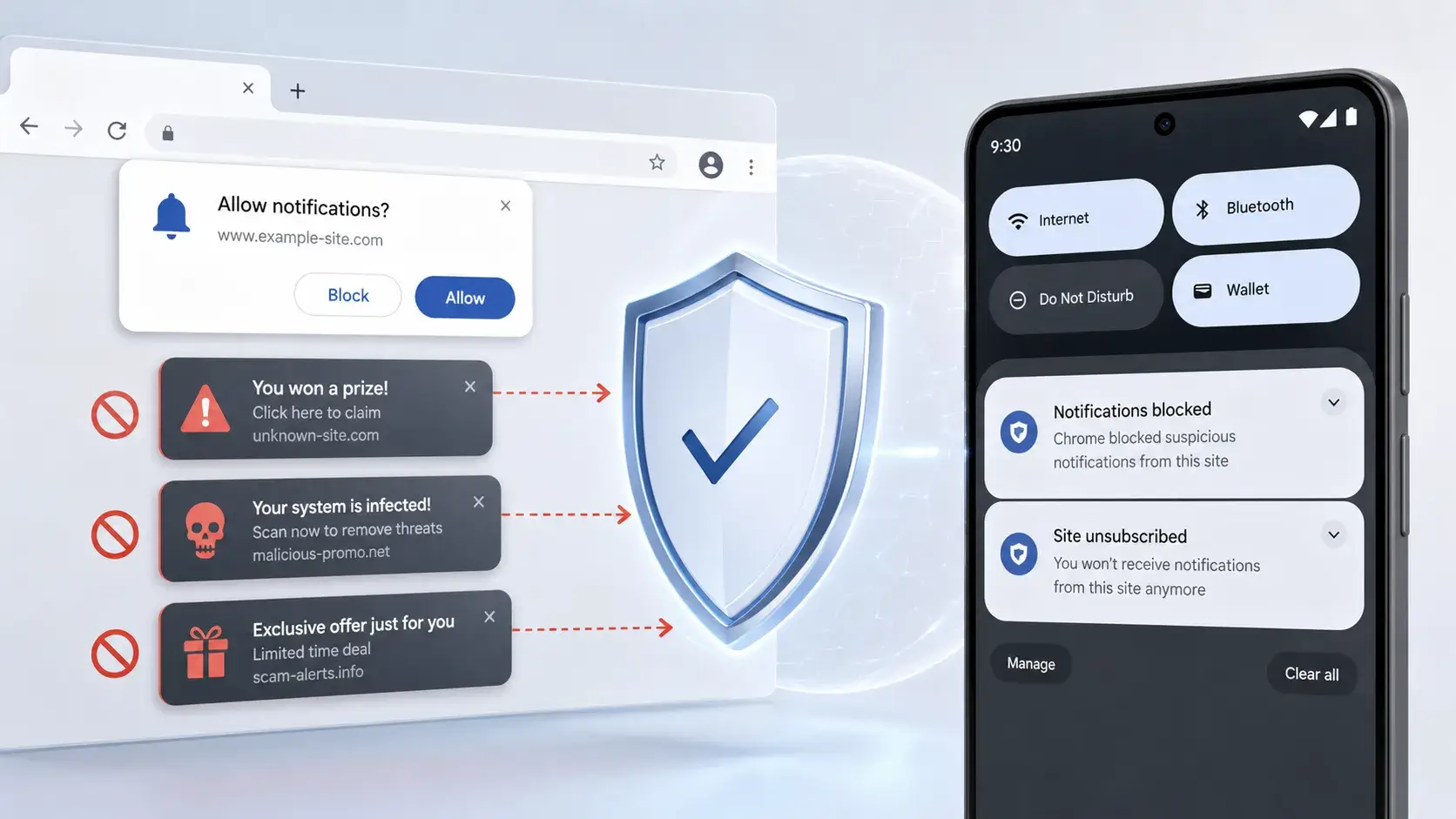
Google says Chrome cut unwanted Android notifications by more than 7 billion per day using permission controls, abuse detection, rate limits, and on-device ML.
Google Chrome has implemented enhanced defenses aimed at disrupting abusive web push notifications that are often used to distribute malware, phishing attempts, fraudulent payment requests, and scam content. This initiative combines browser-based permission controls, backend rate limiting, Safe Browsing intelligence, and behavioural analysis to minimise notification abuse while still allowing legitimate websites to use the […]
Google says Chrome's anti-abuse systems reduced unwanted notifications on Android by more than 7 billion per day during the first quarter of 2026. [...]
Google is restoring Blogger sites wrongly flagged for malware after hundreds of publishers reported locked or unavailable blogs and false-positive alerts.

 Entrar