Kyndryl and Broadcom on Thursday rolled out new consulting services for VMware Cloud Foundation (VCF), tweaking the initiative to be an AI program and pledging to invest in the skills development of several thousand certified Kyndryl consultants, architects, and delivery specialists to enable agentic workflows.
“Against the backdrop of rising sovereignty demands, enterprises are rationalizing their hybrid and private cloud environments, and they require a pragmatic, outcome-driven approach,” said Giovanni Carraro, global strategic alliances leader at Kyndryl, in a news release. “By expanding our partnership with Broadcom and investing in VCF skills, we will help customers build modern, resilient, private clouds that enable AI adoption, support data modernization, address the risk of AI-identified vulnerabilities and deliver real business value.”
Analysts and consultants said the partnership expansion was fairly mundane in itself, but they did think there was meaningful potential in the consultant program.
Mike Leone, a VP/principal analyst at Moor Insights & Strategy, thought that the significant part of the partnership is in the skills investment.
“Enterprises moved onto VCF pretty quickly, and now they’re at the harder stage of actually modernizing it,” he said. “More companies than you think have lost their deep VMware talent, so that work stalls out. Broadcom putting real money behind training a few thousand Kyndryl consultants is a direct answer to that.”
He noted that it isn’t glamorous, but delivery capacity is usually what decides whether a platform gets used well. “Kyndryl’s a logical partner for it too,” he said. “They already run a huge amount of VMware for customers, so this resources a relationship that was already there.”
But Sanchit Vir Gogia, chief analyst at Greyhound Research, questioned how much is really new with this announcement.
“This is neither a new alliance nor a new platform. Kyndryl and VMware expanded their partnership in November 2021, and managed-services status followed in August 2023, so the relationship is old and the packaging is new,” Gogia pointed out. “What has been announced is scaffolding: consulting, certification, and managed operations built around VMware Cloud Foundation 9.1, with no disclosed financial commitment, no exclusivity, and no named launch customer.”
Gogia said this shows strong interest in private clouds from these two vendors, but he questioned how much enterprise interest exists today in private clouds.
“No broad enterprise migration from public cloud back to private cloud is visible, and this announcement does not establish that one is needed,” Gogia said. “The defensible reading is selective workload placement. The announcement does not prove that enterprises must shift to private cloud, it proves that Broadcom and Kyndryl want a larger role when enterprises decide where workloads run.”
Justin Greis, CEO of consulting firm Acceligence, disagreed, and said that he found the announcement interesting, “because they are trying to make that private portion of the equation behave more like cloud rather than simply resurrecting the old corporate data center. Automation, policy as code, container support, developer experience, AI inference and agent governance are all part of that proposition.”
However, he said that the boost in personnel is potentially significant.
“I think the investment in thousands of trained Kyndryl people may ultimately be more consequential than some of the technology language in the announcement,” Greis noted. “Enterprise infrastructure is already incredibly complicated. Add AI agents, multiple models, new governance requirements and hybrid infrastructure, and the skills required to operate all of it become a major constraint. Technology vendors can build increasingly sophisticated platforms, but enterprises still need people capable of turning those platforms into reliable operating environments.”
Shashi Bellamkonda, a principal research director at Info-Tech Research Group, added he saw another element in the statement.
“I see a double-edged irony in this. Broadcom’s post-acquisition VMware pricing is itself what pushed many tech leaders into pain and dependency, and the product it now sells is the antidote,” Bellamkonda said. “VCF, marketed as the route to sovereignty from governments and hyperscalers, leaves buyers just as dependent on Broadcom commercially as they were before. Sovereignty from a jurisdiction is not the same as independence from a vendor.”
Organizations continue to invest heavily in the cloud, with IT leaders reporting that 26% of their IT budget will be allocated to cloud computing within the next year, according to the 2026 Foundry Cloud Computing Study.
The survey also found that 74% of IT leaders have accelerated cloud migrations in the past 12 months compared to 70% in 2025 and 63% in 2024. Three in four (73%) also said cloud capabilities have helped their organizations achieve “increased and sustainable revenue over the past 12 months.” Overwhelmingly, 80% of respondents from North America and APAC noted that their cloud strategies have helped accelerate the adoption of AI, while that number drops to 68% for the EMEA region.
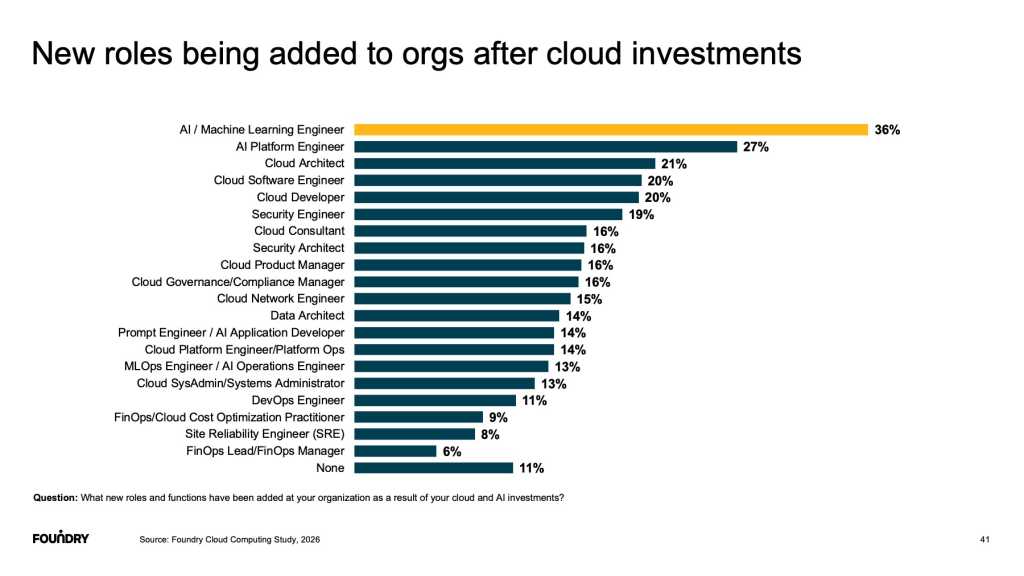
This growth in cloud adoption, along with accelerated interest in AI, has sparked an increased demand for certain cloud roles. Here are the roles companies are most likely to have added to support their cloud investments, according to Foundry’s research.
The role of AI/ML engineer is in high demand as organization expand their AI strategies. These professionals design and implement AI and machine learning systems, overseeing them in operation to identify opportunities for improvement, ways to better automate processes, and how to better inform decision-making across the organization.
Skills: Skills for this role include programming, knowledge of machine learning, data science, data engineering, and experience building AI systems using APIs. See also: “The hidden skills behind the AI engineer.”
Role growth: 36% of companies have added AI/machine learning engineers as part of their cloud investments, according to Foundry’s survey.
AI platform engineer
An AI platform engineer is responsible for building and running the internal systems that businesses use to build and scale AI tools and initiatives. As organizations increasingly adopt AI internally, they’re hiring professionals to help navigate the daily operations of internal developer platforms (IDPs) that use AI to boost productivity and drive automation.
Skills: Skills for this role include understanding of cloud infrastructure, programming languages, and orchestration and container technology, including Kubernetes and Docker.
Role growth: 27% of companies have added AI platform engineers as part of their cloud investments.
Cloud architect
As cloud computing grows increasingly complex, cloud architects have become vital for navigating the nuances of implementing and maintaining cloud environments. These IT pros can help organizations avoid cloud security risks, while also ensuring a smooth transition to the cloud. With 65% of IT leaders choosing cloud-based services by default when upgrading technology, cloud architects will only become more important for enterprise success. For those interested in this role, see “IT career roadmap: Cloud architect.”
Skills: Skills for this role include knowledge of application architecture, automation, ITSM, governance, security, and leadership.
Role growth: 21% of companies have added cloud architect roles as part of their cloud investments.
Cloud software engineer
Cloud software engineers are tasked with developing and maintaining software applications that run on cloud platforms, ensuring they are built to be scalable, reliable, and agile. Companies that have migrated to the cloud often need IT pros who can build company-specific services and applications to make the most of the cloud environment. For more on this career path, see “IT career roadmap: Cloud engineer.”
Skills: Relevant skills for a cloud software engineer include Python, Java, C#, JavaScript, microservices architecture, serverless computing, APIs and SKDs, DevOps, cybersecurity, and knowledge of the agile methodology.
Role growth: 20% of companies have added cloud software engineer roles as part of their cloud investments.
Cloud developer
Cloud developer is a vital role for developing and deploying software in cloud environments. These IT pros are tasked with designing, creating, and deploying applications designed to run on cloud platforms, with a focus on building scalable, reliable, and cost-effective solutions to meet business needs.
Skills: Relevant skills for a cloud developer include programming languages such as Java, C#, and Python as well as knowledge of popular cloud platforms, microservices architecture, database storage, agile methodology, APIs and SKDs, and containers and orchestration.
Role growth: 20% of companies have added cloud developer roles as part of their cloud investments.
Security engineer
Security engineers are tasked with overseeing the security of an organization’s systems, networks, and data, to make sure they’re protected from cybersecurity threats. For organizations investing in the cloud, security engineers can help ensure services, applications, and data running on cloud platforms are secure and compliant with any government regulations.
Skills: Network security, IAM, encryption, vulnerability management, security architecture, cloud security, automation, and infrastructure design and optimization.
Role growth: 19% of companies have added security engineer roles as part of their cloud investments.
Cloud consultant
With the rapid adoption and move to the cloud, organizations look for professionals who can leverage cloud technologies to meet business needs, grow the business, and improve efficiency. Cloud consultants are cloud experts who stay on top of the latest innovations in cloud technology to better advise business leaders.
Skills: Knowledge of architecture and solution design, DevOps, automation, project management, cloud security, compliance, cloud migration, and knowledge of popular cloud platforms.
Role growth: 16% of companies have added cloud consultants as part of their cloud investments.
Security architect
Security architects are responsible for building, designing, and implementing security solutions in the organization to keep IT infrastructure secure. For security architects working in a cloud environment, the focus is on designing and implementing security solutions that protect cloud-based infrastructure, data, and applications.
Skills: Security architecture design, network security, security compliance and governance, incident response and forensics, data encryption, IAM, automation, and DevSecOps.
Role growth: 16% of businesses have added security architect roles as part of their cloud investments.
Cloud product manager
With cloud adoption often comes an increase in in-house development of cloud-based services. A cloud product manager can help cloud teams develop effective solutions aimed at fulfilling business objectives. They’re also tasked with using their deep understanding of product management within the cloud environment to work closely with key stakeholders, identify and define requirements from users or customers, develop product roadmaps, and oversee the QA process to gain feedback on how to improve product offerings.
Skills: Product management, UX design, communication and collaboration, and a strong technical background.
Role growth: 16% of organizations have added cloud product manager roles as part of their cloud investments.
Cloud governance/compliance manager
Cloud governance and compliance managers help companies navigate the complexities of security, governance, international regulation, and internal policies. They identify potential risks, implement automated tools to oversee security and compliance, and help businesses maintain secure cloud operations.
Skills: A strong knowledge of regulatory policies such as GDPR, HIPAA, PCI DSS, and other international data protection laws. Additional skills include knowledge of tools such as CSPM, Azure, AWS, Microsoft Purview Compliance Manager, and other IT governance tools.
Role growth: 16% of businesses have added cloud governance and compliance manager roles as part of their cloud investments.
Cloud network engineer
Cloud network engineers are responsible for the design, implementation, and management of an organization’s cloud-based networks. These IT pros are tasked with overseeing network management, virtualization and virtual LAN, wide area networks, TCP/IP, HTTP, network security, and the integration of hybrid cloud and multicloud deployments.
Skills: Relevant skills for this role include knowledge of cloud platforms such as Azure, AWS, Google Cloud, along with networking fundamentals, virtualization, project management, security, automation and scripting, and collaboration.
Role growth: 15% of companies have added cloud network engineer roles as part of their cloud investments.
Data architect
A data architect’s focus is seeing that an organization’s data is structured so it can be easily accessed, secured, and efficiently stored, and that it meets business needs. Data has become a primary way for businesses to conduct analysis and assist with business decision-making, and most of that data is now stored in the cloud.
Skills: Data warehousing, scalability and performance optimization, automation and virtualization, data governance and cloud security, data migration, and knowledge of hybrid cloud solutions.
Role growth: 14% of businesses have added data architect roles as part of their cloud investments.
Prompt engineer/AI application developer
Prompt engineering and AI application development go hand in hand, and they’ve become vital skills for organizations that have embraced AI and plan to implement AI-focused services and into daily workflows. Prompt engineers are responsible for designing and refining the instructions and structural queries, while an AI application developer builds software system and user-interfaces for AI-ready software and services.
Role growth: 14% of companies have added prompt engineering and AI application developer roles as part of their cloud investments.
Cloud platform engineer/platform ops
Cloud platform engineers, who often work in platform operations, are responsible for building and maintaining cloud tools, automated systems, self-service portals, and other software that developers use to test code. In this capacity, they’re responsible for creating user-friendly platforms for other engineers in the company to build and test their own software for clients and customers.
Skills: Skills for this role include infrastructure as code (IaC), containerization and orchestration, scripting and coding, and Linux and networking.
Role growth: 14% of companies have added cloud platform engineering roles as part of their cloud investments.
MLOps engineer/AI operations engineer
The role of MLOps engineer or AIOps engineer has been developed to help close the gap between data science and IT operations. It’s a role that has emerged as the use of AI increases, as organizations need a point person who has expertise in IT operations and machine learning, and is comfortable collaborating with data scientists, developers, IT operations staff, and key stakeholders.
Skills: Skills for this role include programming, DevOps, cloud tools, containerization and orchestration, and knowledge of ML tools.
Role growth: 13% of companies have added MLOps engineers as part of their cloud investments.
Cloud sysadmin
Cloud systems administrators are charged with overseeing the general maintenance and management of cloud infrastructure. Whether that means implementing cloud-based policies, deploying patches and updates, or analyzing network performance, these IT pros are skilled at navigating virtualized environments. Cloud sysadmin is likely the most entry-level-friendly role on this list.
Skills: An understanding of implementation and integration, security, configuration, and knowledge of popular cloud software tools such as Azure, AWS, GCP, Exchange, and Office 365.
Role growth: 13% of companies have added cloud systems admin roles as part of their cloud investments.
DevOps engineer
DevOps focuses on blending IT operations with the development process to improve IT systems and act as a go-between in maintaining the flow of communication between coding and engineering teams. It’s a role that focuses on the deployment of automated applications, maintenance of IT and cloud infrastructure, and identifying potential risks and benefits of new software and systems.
Skills: Automation, Linux, QA testing, security, containerization, and knowledge of programming languages such as Java and Ruby.
Role growth: 11% of companies have added DevOps engineer roles as part of their cloud investments.
FinOps/cloud cost optimization practitioner
FinOps and cloud cost optimization practitioners combine knowledge of finance, technology, and businesses to help oversee the increasingly complex landscape of cloud investments. Cloud computing is integral to AI, so as more organizations invest in it, they’re also revisiting investments in cloud infrastructure. FinOps and cloud cost optimization practitioners can help guide organizations to make the right financial decisions around technology investments that’ll impact the business.
Skills: Knowledge of finance, business, and technology along with skills using tools and platforms including AWS, Azure, GCP, and cloud-native FinOps platforms.
Role growth: 9% of companies have added FinOps and cloud cost optimization practitioner roles as part of their cloud investments.
Site reliability engineer
For any organization implementing cloud strategies, there’s a significant focus on reliability and scalability, ensuring that data can be accessed from the cloud and on-demand as needed. Site reliability engineers (SREs) are responsible for overseeing automation of IT infrastructure, application monitoring, and system management. Cloud infrastructure requires frequent software updates, and services must be able to scale with the organization’s growth.
Skills: Change management, IT infrastructure management, emergency incident response, process improvement, and application monitoring.
Role growth: 8% of companies have added site reliability engineer roles as part of their cloud investments.
FinOps lead/FinOps manager
FinOps leads and FinOps managers are tasked with overseeing the intersection of engineering, finance, and business. As more organizations build cloud services and tools, they’re looking for FinOps professionals with technical knowledge to help bridge the gap between finance and tech, bringing better insights into ways to cut costs and stay on budget while implementing innovative technology.
Skills: FinOps leads and managers need a strong understanding of engineering, finance, and technology. Additional skills include knowledge of cloud platforms, basic coding skills, and data analytics.
Role growth: 6% of companies have added FinOps lead and FinOps manager roles as part of their cloud investments.
As cloud experience becomes more critical to organizations hosting AI-powered services, tools, and software, these cloud roles and skills will become increasingly in-demand. Now is an opportune time to seek out valuable cloud certifications and other relevant AI and ML certifications to boost your resume, and set yourself up for these emerging and established career paths.
Every day, enterprise cameras and sensors capture enormous volumes of information about what is happening in the physical world. Much of that data serves an immediate purpose, such as identifying a security incident or helping protect people and property. But its usefulness doesn’t necessarily end there.
The same video that helps a manufacturer monitor safety can also reveal recurring bottlenecks on a production floor. In retail, cameras deployed for loss prevention can provide insights into customer traffic, store layouts, staffing needs, and product interactions. Across industries, organizations are finding new ways to use existing video infrastructure to better understand how their physical environments operate.
That shift is already underway. The Axis Perspectives Report 2026 found that the share of organizations using video systems for business intelligence nearly doubled between 2024 and 2025, increasing from 20% to 38%.
But the opportunity becomes more complex as these applications grow. Extracting insights from a few cameras at a single location is one thing; doing so across hundreds or thousands of devices, multiple sites, and different business functions is another. Unlocking that value at scale requires organizations to determine not only what their video data can tell them, but where and how that data should be processed, analyzed, and managed.
The advantage of the hybrid edge
Organizations should use a “hybrid edge” approach to powering their video-based business intelligence efforts, says Patrik Pettersson, a strategic adviser at Axis Communications. In this model, analytics at the network edge power real-time detection, processing, and analysis while public cloud platforms perform deeper large-scale pattern analysis. Furthermore, devices and their integration with the cloud platform require harmony, where the edge devices must be capable of working and being managed independently without requiring the cloud connection. This hybrid model reduces bandwidth, improves latency, and fits CIOs’ strategies for cost predictability.
Pettersson advises organizations to work with vendors whose devices are designed for secure and reliable cloud connectivity, offer open platforms for maximum flexibility, and have an established track record with edge-based analytics.
“The smarter the device at the edge and the more it can do, the more it will alleviate costs in the cloud,” Pettersson says. “The harmony between the edge and the cloud is critical for economic cloud scaling for vision intelligence.”
Scaling business intelligence
Leveraging existing camera infrastructure for business intelligence and operational efficiency requires close collaboration between security leaders and the business, Pettersson says. Also, cameras that were originally deployed to meet specific safety and security objectives cannot always support new use cases.
Security directors sometimes initially object to using cameras for business intelligence and operational efficiency, Pettersson notes, but he adds that they often relent once they understand that the relationship can be symbiotic. In turn, business leaders often need to yield to security leaders when leveraging physical security assets.
In some cases, business units may need to invest in dedicated systems or additional devices to achieve the outcomes they’re aiming for without compromising core security needs. “When each party’s interests are met and trust is established, the security director will likely be more open to including their devices in business applications,” Pettersson says.
To start, Pettersson says, organizations should conduct small-scale trials with only a few cameras. By first focusing on a single business department, they can better determine the potential ROI. “Proofs of concept and pilots are a great way to test capabilities in controlled settings and then gradually scale,” he says. “You don’t need to boil the ocean.”
It may take some time to find the right mix of on-premises, edge, and public cloud resources, Pettersson notes. “Often you can start with extremely powerful cloud compute tools that you already know will be cost-prohibitive at scale,” he says. “From there, you tune down and simplify until you get to a balance between cost, accuracy, and performance.”
Finding that balance will become increasingly important as organizations identify new uses for video data. A successful pilot may involve only a handful of cameras and a single business function. Expanding that application across locations, departments, and thousands of devices introduces very different demands on infrastructure and resources.
That makes scalability as much an architectural consideration as a technical one. Processing every piece of data in the cloud may not be practical or economical, just as relying exclusively on the edge can limit opportunities for broader analysis. Organizations need flexibility to determine where processing makes the most sense based on the use case, cost, performance, and insights they hope to gain.
Ultimately, the strategic value of video data isn’t determined by how much of it an organization collects. It comes from the ability to turn that data into useful intelligence and to build an infrastructure capable of doing so as those opportunities grow.
Moving an application to the cloud is often discussed as though there is a clear destination: workloads either reside there or they don’t. Physical security complicates that equation.
A single security environment can include cameras processing analytics in real time, video that needs to be stored or accessed according to specific requirements, devices operating in bandwidth-constrained spots, and systems that need to be managed across hundreds or even thousands of sites. Where each of those functions happens can have implications for security, latency, bandwidth, storage, cost, and regulatory compliance.
That’s why the cloud should be considered less of a destination for physical security and more of an architectural choice. Organizations can determine which capabilities benefit most from cloud connectivity while keeping data and processing at the edge or on premises when the use case demands it.
Adoption trends suggest IT leaders are exploring that balance. According to the Axis Perspectives 2026 Report, only 27% of IT leaders currently use the cloud for physical security, while 44% expect to do so over the next two years. Driving that interest: increased visibility, simplified management, and improved scalability.
“Cloud is no longer just about storing video data or enabling remote configuration,” says Patrik Pettersson, a strategic advisor at Axis Communications. “It’s about stronger collaboration between manufacturers, system integrators, and end users. Many organizations desire managed services that proactively manage their systems. SaaS foundations from manufacturers will be critical to making that happen.”
Secure-by-design devices are key to this shift, with modern network devices now incorporating secure software, secure hardware, and zero-trust principles. Cloud-enabled fleet management platforms are another important driver, with capabilities including real-time monitoring, automated remote patching and updates, and superior control for system owners.
Many organizations, Pettersson says, are opting for a hybrid cloud model for their physical security environment. These architectures often include on-premises systems that help organizations comply with data regulations, edge analytics for real-time detection and classification, and cloud orchestration for updates and enhanced intelligence across the system.
“Not all solutions are cookie-cutter,” Pettersson notes. “Any given customer may have high-risk environments that cannot possibly be connected to the public cloud. I would venture to say that extremely few security applications are 100% cloud. In fact, even the most ‘cloud-ready’ solutions sold today typically store data on-premises, with orchestration and usage via cloud interfaces. So, the primary deployment even in a ‘cloud solution’ today, is actually hybrid.”
Building and maintaining a hybrid cloud environment for physical security devices requires deep technical expertise, including familiarity with planning, deploying, and supporting such systems, Pettersson says. He notes that single-vendor solutions are often simpler but more limited in features, whereas multivendor solutions are typically more complex but may be a better fit for an organization’s exact use case. Many organizations, he says, turn to skilled system integrators for help with architecting, operating, and maintaining their hybrid cloud environments.
Organizations that embrace a hybrid environment, Pettersson says, often reduce the total cost of ownership (TCO) of their physical security environment, achieve visibility and standardization across all their physical security devices, and enable the sort of scalability needed for growth and innovation. Ultimately, he says, the hybrid cloud leads to a stronger cybersecurity posture, with less operational strain.
“The hybrid cloud creates a shared responsibility for the system that includes the manufacturer more than ever,” Pettersson says. “We see a giant shift — moving from reactive maintenance agreements that address issues when something breaks to system integrators informing the customer after they have already fixed the issue.”
The value of a hybrid approach is that it gives organizations the flexibility to decide where cloud and on-premises capabilities can deliver the most value.
That distinction is especially important in physical security, where requirements can vary significantly across devices, locations, and use cases. Some environments may benefit from cloud-based management and system-wide intelligence. Others require local storage, edge processing, or greater isolation. Those needs can also change as an organization grows, regulations evolve, and new capabilities become available.
Organizations can approach cloud adoption as an ongoing infrastructure decision. The right hybrid environment is one that allows security, data, and workloads to reside where they make the most sense today without limiting where they can go tomorrow.
Brands like Snickers, M&M’s, and Twix are familiar to most consumers, but Mars Inc. doesn’t just produce snacks. The family-owned company, with a revenue of approximately $65 billion, is also one of the largest manufacturers of pet food and ready meals, and its more than 100 production facilities operate around the clock. Of course, this places considerable demands on its IT.
“Our team must ensure that every system, including production lines, runs at maximum performance so we can continuously deliver the products and services our customers value,” says Luciano Batista, the company’s VP of enterprise services delivery.
However, Batista and his team realized that the existing data infrastructure could no longer reliably support operations, especially during peak periods such as Halloween and the pre-Christmas shopping season. So with the support of hybrid, multi-cloud data storage service Everpure, Mars is rebuilding its data and IT infrastructure.
“The Everpure platform met all our requirements,” says Batista. “It’s a scalable platform that futureproofs our operations and integrates seamlessly with our hybrid cloud infrastructure.”
Unified storage environment
Mars initially consolidated its complex network of storage systems for business-critical databases like Oracle and applications like SAP onto a single Everpure Flash Array system. These software-defined, all-flash storage arrays are available in versions for different workloads, and typical use cases include databases, virtualized environments, SAP applications, and AI and analytics applications.
Mars has since expanded its flash array infrastructure and now supports mixed workloads, including VMware, Windows, and Linux in areas of production, development, and quality assurance. It also uses Everpure Flash Blade as the basis for the global SAP file system. And while Flash Array is optimized for structured data, the scale-out systems of the Flash Blade series are designed for unstructured information.
“At peak times, Everpure supports up to 300,000 IOPS without any performance degradation,” says Lincoln Silva, product owner for Linux and on-prem storage at Mars. From his perspective, another point speaks favorably of the new platform in that he estimates his team saves approximately three months of planning time thanks to the Evergreen subscription model. This is because the vendor provides regular updates for the storage platform’s hardware and software. As a result, Mars’ IT professionals can focus on more critical tasks.
Basis for hybrid cloud strategy
Mars also works with choice vendors to implement its approach to cloud. Dedicated local storage capabilities, for instance, are being integrated into Microsoft Azure cloud workloads, which simplifies restore processes and increases resilience.
Snapshots from the local environment can be replicated to the cloud, too. Recovery point objectives (RPEs) of four to 24 hours are available, depending on system priority. “Our success is also the success of our partners,” Batista says. “We embrace a spirit of reciprocity to get the most out of our collaboration.”
The hybrid cloud allows Mars to run VMware workloads and extend its IT infrastructure to the cloud as needed. And the company aims to expand its use of cloud-native applications via Microsoft Azure at a lower cost.
“We’re seeing a data reduction ratio of 18 to one. That’s nine times the expected compression rate,” Batista adds. “This puts us on track to save up to 50% on cloud storage costs. We can now work more efficiently and make better decisions thanks to intelligent solutions and automation.”
Fewer racks and lower power consumption
By consolidating on the flash platform, Mars has also reduced the space requirements and power consumption of its data centers so they only use one sixth of the power, and the number of racks has decreased significantly.
“We’re shaping a sustainable future by changing the way we work,” says Batista. “The decisions we make today will impact the world we leave behind, and Everpure aligns with our commitment to thinking in generations, not just business quarters.”
I spend most of my time inside other companies’ engineering teams, building systems to track and optimize AI spend. The conversation almost always starts the same way. Someone pulls up a dashboard, points at a number bigger than it should be, and says some version of “we know it went up; we just can’t tell you why.”
I use an analogy for it: AI-era CIOs are like city planners optimizing a busy intersection. They can measure the volume and hear the pleas to fix congestion, but can’t tell whether a vehicle is a truck or a bike, or why it’s on the road. Without that, they can’t design the right fix, so they build a highway at great expense when the data would show all it needed was a bike lane.
Every model choice and budget conversation happens against that blurry picture, and the traffic gets heavier every quarter. Gartner expects worldwide AI spending to grow 47% this year, with agentic AI software up roughly 141%. By 2028, it projects an average Fortune 500 enterprise will run over 150,000 agents, up from fewer than 15 in 2025.
Why the cloud playbook can’t answer the AI question
AI presents a fundamentally different problem than cloud cost management, where we answered, “whose spend is this?” largely by tagging the resource. A VM has an owner, a bucket belongs to a team and FinOps optimizes from there. Billing was slow but acceptable, because spend moved inside predictable bands, a human provisioned each resource before it cost anything, and governance capped how fast costs grew. Surprises were unpleasant, rarely existential.
AI took that model, put it to the test and laughed it out of the room. A token call isn’t a resource the way a VM is, so tags have nothing to attach to. To make them affordable, hyperscalers run large models on shared, multi-tenant infrastructure, dropping the per-token price but stripping out the granularity needed to track and control spend.
One API key can carry a dozen workflows across three teams, and the consumer is often an autonomous agent, not a person. The failure modes are also new. An agent can drift off task, loop on a retrieval endpoint hunting for an answer it can’t find, and restart from scratch when it comes up empty. At a few dollars per million tokens, it seems trivial, until that loop runs across thousands of parallel sessions and clears five figures in a day. None of it trips a provisioning gate or maps to a taggable resource. The control points that cloud governance leaned on don’t exist for AI.
The consequences can be severe. Uber spent its entire 2026 AI budget in four months after Claude Code usage ran far ahead of its projection, and they’re far from alone. I’ve worked with plenty of large enterprises hitting the same thing without the headlines. In almost every case, the teams driving the spend weren’t accountable for the budget, and no one saw the scale until it hit an invoice. It’s a credibility destroyer, as these overruns erode margins and stakeholder confidence for the leaders on whose watch it happens, even when their only fault was doing their best with the tools they had.
The data backs this up. Recent DoiT research into enterprise finance leaders found that 89% of the organizations that rate themselves most mature at FinOps still overspent on AI last year, and by the widest margin in the study. Again, the teams with the best cost discipline overspent the most. They built excellent governance for human-gated, taggable resources, then tried to retrofit it for workloads that have neither. They see the overrun, just too late to stop it, and without the insight to know where to focus.
The instrumentation era got us closer, at a real cost
Our best answer was to instrument the application itself: wrap every LLM call in an OpenTelemetry span, inject cost-allocation metadata and propagate that context across a multi-agent workflow so token counts roll up to a budget owner. I’ve done it dozens of times, and it works: accurate per-request attribution, far better than splitting the monthly bill by best guess.
But it was always a workaround. You can only measure what you thought to instrument, and even when you do that, the answer often arrives too late.
One customer I worked with recently had built about ten agents that worked together to automate security and quality evaluation of their software, most of them running constantly. Their bill kept climbing with no obvious cause, and it took a long investigation to find why: one agent, running 24/7, was burning 20 times the tokens of any other, caught in an infinite loop that respawned a never-ending process every time it spun up. The signal was right there in the data, but it only surfaced after weeks of digging and real money out the door.
There’s an irony too. AI is supposed to buy back engineering time, and instrumentation spends it right back. You put senior engineers on measurement plumbing to control the cost of the thing meant to make them more productive. Plus, it’s fragile; every new model, SDK and agent framework is another integration to keep alive. “Instrument everything you might ever build” isn’t realistic when tens of thousands of employees and countless agents launch new workflows daily.
What changes when attribution moves to the infrastructure layer
The approach now emerging, and the one changing how I run these engagements, moves attribution from the application down to the infrastructure. Instead of teams describing their spend through code they wrote, you observe what’s running underneath them.
The mechanism is a kernel-level sensor, the same eBPF technology that security and observability tools use to watch system calls without touching the applications above them. It maps each unit of GPU, CPU, memory and network back to the process, container and request that caused it, then joins every outbound model call with provider cost data so token spend on Anthropic, OpenAI, Gemini or Bedrock is matched to the workload and agent that drove it.
This delivers the same answer OpenTelemetry can give you, at equal or better accuracy, but in real time and without the instrumentation work. Nothing has to be planned in advance, and nothing gets missed. For the first time, the data to manage AI spend is continuously available at an actionable grain. That runaway agent my customer dealt with would have been identified and addressed as soon as it began to snowball.
Governance stops being a top-down audit
Changes in governance is the part I find most interesting, because with continuous, accurate attribution, you can design governance purpose-built for AI rather than retrofitting a system built for an era with different physics.
Strategy still belongs at the top, with the CIO and finance leaders setting the direction, the budgets and the priorities. But daily responsibility for staying inside those lines shifts toward practitioners. Cloud governance was top-down because provisioning ran through the few people with the full business context to weigh it. With AI, spending decisions happen everywhere at once, across shared keys, agents and dozens of teams, so adherence has to sit with the people making them.
Real-time attribution makes that possible. An engineer can see the cost of what they’re building as they build it. A frontier-model call when a smaller model would do, a retrieval loop fanning out across a fragmented data store, an agent retrying a failed tool call in a tight loop — those stop being mysteries at the quarterly review; they’re caught while the work is still warm. And because the same numbers reach leadership, they can weigh spend against value and steer the portfolio rather than litigate a bill nobody can explain. Back at the intersection, the planner can finally tell the trucks from the bikes, and so can every engineer on the road.
What visibility is actually for
So, the biggest foundational roadblock (pun intended) that tripped up even the most disciplined teams is solvable now in a way it wasn’t a year ago. But solving it was never the real goal. Visibility is a means to an end; it just had to be solved first.
Real-time, granular attribution lets companies start treating AI as a managed investment instead of a pay-and-pray experiment. When you connect spend to the work, the work to an outcome and the outcome to the business case that justified it, you can govern AI with intention and put money where it earns its keep.
The last two years rewarded productivity to whoever shipped faster with AI. The next phase gets won on efficiency and impact, by whoever gets the most value per dollar of inference and can prove it. That’s a matter of strategy, and for the first time the data exists to compete on it. What you’re really adding for the customer, and what it costs, stop being a guess.
OVH is increasing the prices of its servers, some by as much as 87%, for both new and existing customers, blaming AI’s insatiable demand driving the rising cost of the RAM and storage it uses in its data centers.
CIOs will be familiar with the balancing act OVH has had to perform over the last year. In a Monday post explaining the upcoming increases, OVH chairman Octave Klaba wrote on X, “We have to place the right volume of orders, month by month, over 12 months, with no guarantee of the purchase price and without knowing what will be the real demand from our customers.”
Still, he added, “even though our prices are increasing, we remain the cheapest on the market for bare metal and public cloud; where before we could be 3x cheaper, we will be 2x cheaper (if our competitors don’t increase their prices).”
The increases will hurt hard-core gamers hardest, with the cost of the company’s most recent gaming servers rising 87%. (Older gaming instances are unaffected.)
High Grade, high price
But enterprises will also feel the pain from climbing component costs: OVH’s latest High Grade bare metal servers, with up to 2 x 96 cores of AMD Epyc 9005 series processors, 36 hard disks per server, and high-density cooling systems, will go up in price by 59%; older models built to the 2024 spec will go up 26%.
Lower-performance servers will also see increases of 40%-49% for the most recent models, and 26%-37% for older models.
The new prices take effect from Sept. 1 for new orders, and from Oct. 1 for renewals.
It’s not just baseline server prices that are increasing; optional additional memory and storage are going up in price too. OVH already increased the cost of these extras for new server orders as of July 1, with RAM prices rising 127% and disks 89%. From Oct. 1, renewals will be affected too, with the price of additional RAM in the latest servers rising by 40%, and that of larger disks by 15%. For servers built to 2024 specs, the increases will be 20% and 10% respectively.
Existing customers can lock in current prices for servers already in production for up to four years if they pay in advance by Oct. 1, Klaba wrote. Existing commitments will not be affected by the increases until they are due for renewal.
Small instances, big increases
The price rises are more nuanced when it comes to public cloud systems. In future, OVH will break out storage and IP address rental costs separately, and will allow customers to mix and match storage capacity and compute.
“In appearance, hourly compute cost won’t change,” Klaba wrote. “On the other hand, low-latency Block Storage and IPv4 addresses, previously included in our Gen3 instances (B3, C3, R3) will appear as two separately billed line items on Oct. 1.”
The result is price increases of as little as 1.4% for the most powerful instances, or as much as 21.9% for smaller instances, he said.
OVH will continue to offer a 15% discount for a commitment of one year, or 30% for three years, he said, but will no longer offer discounts for shorter terms.
Microsoft is betting that the integration of HorizonDB, the cloud-native PostgreSQL alternative it is developing, with Azure will attract more enterprise AI and agentic workloads to its cloud services.
Enterprises may not be willing to take that bet.
It’s been nine months since Microsoft unveiled HorizonDB, but the service remains in public preview with no announced general availability date. Why put AI projects on hold waiting for HorizonDB to arrive, when AWS, Google, Databricks, Snowflake, and others already have production-ready PostgreSQL services positioned for the same AI workloads that Microsoft says it is building HorizonDB to handle?
AWS has had the longest head start. Aurora PostgreSQL became generally available in 2017 and has since evolved from a cloud-native PostgreSQL database into an AI-ready service with vector search and integrations with Amazon Bedrock. Similarly, Google’s AlloyDB, which followed in 2022, now includes AlloyDB AI with vector search, embeddings and model interaction for generative AI and agentic applications.
Databricks and Snowflake, too, have their own platform-centric services in the form of Lakebase, which became generally available on AWS and Azure this year, and Snowflake Postgres, which was made generally available in February 2026.
As the latecomer, when Microsoft pitched HorizonDB at Ignite in November 2025 it talked up its new architectural approach to cloud-native PostgreSQL, built around disaggregated compute and storage and a database-as-log design. The hyperscaler also positioned native vector search and deep integration with Foundry and Fabric as key differentiators for AI-heavy workloads.
No reason to wait
Those architectural differences may not be compelling enough for CIOs to wait for HorizonDB to become generally available, though.
“Most enterprises with urgent needs will not wait. A long preview window creates uncertainty around SLAs, pricing, operational maturity, and roadmap confidence,” said David Linthicum, an independent cloud consultant.
And, said Stephanie Walter, practice lead of AI stack at Hyperframe Research, enterprises cannot build mission-critical production plans around an undefined GA date, regional footprint or support commitment.
Given the difficulty of unwinding a poor database choice, enterprises will approach unknown quantities with caution.
“Database platforms eventually become sticky control points. Once the database is connected to the rest of the application, analytics, AI, and governance stack, switching becomes a business transformation rather than just an infrastructure swap,” said Michael Ni, principal analyst at Constellation Research.
In the case of a cloud database, there’s also the unwelcome possibility of “huge egress fees” in case of change, said Bradley Shimmin, lead of the data and analytics practice at The Futurum Group.
All that uncertainty is likely to lead enterprises to restrict HorizonDB to experimental use cases for now, Shimmin added.
Performance anxiety
Analysts also questioned whether HorizonDB’s technical differences will show up in performance benchmarks.
Microsoft has said HorizonDB can deliver up to three times the throughput of open-source PostgreSQL, but makes no comparisons with rival offerings such as Aurora or AlloyDB that it will compete with, Walter said.
The bigger question, according to Igor Ikonnikov, advisory fellow at Info-Tech Research Group, is whether those performance advantages, still largely on paper, translate into a meaningful difference in production.
“A database with a better compute benchmark can still be more expensive once resilience and ecosystem costs are included,” Ikonnikov said.
The economics also point to another HorizonDB limitation, particularly for workloads that are not continuously running, said Advait Patel, senior site reliability engineer at Broadcom.
HorizonDB currently uses provisioned compute rather than a serverless, scale-to-zero model, meaning customers continue to incur compute charges while an instance is provisioned, even if its workload is intermittent or idle, Patel said.
There are developer considerations too.
HorizonDB’s PostgreSQL compatibility does not necessarily mean every existing PostgreSQL application will move cleanly as in its current form the database supports only an approved set of PostgreSQL extensions rather than arbitrary ones, Walter said.
Who should wait?
For enterprises already deeply invested in Microsoft’s Azure ecosystem, those limitations may not be enough to rule out waiting for HorizonDB, Patel said: The chance to integrate the database with AI services and the wider Microsoft stack may outweigh immediate availability, he added.
That calculus also reflects how enterprises typically make database decisions in the first place: not by comparing databases in isolation, but by weighing how well they fit into the broader technology stack, including the cloud platform they have standardized on, Ikonnikov said.
For Azure shops, the choice may therefore be less about moving an existing workload away from Aurora or AlloyDB and more about whether a new Azure workload should start on Azure Database for PostgreSQL today or wait for HorizonDB when it becomes available, he said.
That may be an open question for some enterprises, said Devin Pratt, research director at IDC. “Plenty of organizations are still mid-decision, not locked in,” he said.
Microsoft finally offers a timeframe
Microsoft still won’t say exactly when HorizonDB will launch, with Shireesh Thota, corporate vice president for Azure Databases at Microsoft, saying only, “General availability for Azure HorizonDB is currently targeted for the second half of 2026.”
That narrows it down to a period of a little over four months, including Microsoft’s FabCon and Ignite conferences — an eternity in AI.
A growing backlash against building new data centers in the US may have huge cost implications for CIOs planning to expand their organizations’ AI initiatives.
Protests against building new data centers were organized in 42 states in mid-July, with participants concerned about new facilities driving up electricity and water costs and using large swaths of land.
In addition, as of May, 23 states had approved large-load tariffs that require data centers to pay the full infrastructure cost for their facilities, says Arif Gasilov, a partner in the natural resources and built environment division of sustainability advisory firm Gasilov Group.
IT leaders need to calculate the backlash into their planning for the compute and other IT infrastructure needs that new data centers would meet, he says.
“What this means for CIOs is that power cost assumptions built in 2023 are wrong in close to half the country,” Gasilov says. “A CIO planning an AI deployment that depends on colocation or cloud capacity in any of these states should be asking their provider what the rate structure looks like under the new tariffs and recalculating economics.”
In some cases, it may be possible to go smaller to avoid the moratoriums or tariffs on large data centers, but some state regulations target facilities close to each other as opposed to individual data centers, he notes.
Deployment challenges
If the backlash continues, IT leaders may need to rethink the way they deploy AI, says Chuck Girt, CTO at fiber-optic network provider FiberLight.
With fewer options for AI compute power, organizations would have less flexibility in where they deploy AI workloads, he suggests.
“I don’t think the rate of data center construction changes the direction AI is headed, but it could influence how organizations deploy and access AI at scale,” he says. “Most enterprises aren’t going to build this infrastructure themselves; they’re going to rely on cloud and data center environments to provide the compute AI requires.”
A lack of data center options could put many organizations in a bind, says Kevin Surace, CEO of biometric security vendor TokenCore.
“Compute capacity is becoming as strategically important as electricity, semiconductors, and network connectivity,” he says. “Fewer data centers mean less available capacity, reduced geographic redundancy, longer provisioning times, and greater dependence on a small number of cloud providers and locations.”
Organizations that have not secured capacity could find that their AI strategy is technically sound but physically impossible to execute on schedule, he suggests.
Surace, also an AI and green energy expert, is concerned that generalized fear about older data center designs is turning into blanket opposition to new construction. Modern facilities have cut down on the massive water use of older data centers, he notes, and some are using renewable energy generation. Nuclear power will become an electricity option soon, he adds.
Cost pressures rising
In the meantime, IT leaders should expect higher costs for compute and other IT infrastructure provided through data centers, Surace says.
“Demand for AI compute is accelerating, so constraining the supply of facilities, electricity and high-density capacity will place upward pressure on cloud pricing, colocation, accelerator access, and long-term capacity contracts,” he adds.
Organizations that have the capacity will should be able to protect themselves through multiyear agreements and dedicated infrastructure, he suggests. Smaller organizations, startups, and universities could face the greatest percentage increases and may simply be priced out of leading-edge AI capabilities, he adds.
Therefore, Surace advises CIOs to treat compute and energy as strategic supply-chain risks. Organizations should secure capacity as soon as they can, avoid dependence on one cloud or one geographic region, and use smaller and more efficient AI models where appropriate, he recommends.
He also suggests that CIOs ask data center providers several hard questions:
Where does the water come from?
Is the cooling loop closed?
Who pays for new grid infrastructure?
What percentage of power is generated onsite?
What environmental monitoring is publicly reported?
Data centers can mitigate some of the community concerns, he says. “Transparency and early community engagement are far less expensive than lawsuits, project cancellations, and moratoriums,” he adds.
Backlash against inefficiency
While protests are likely to continue, some don’t see the concerns about data centers as a condemnation of AI. Instead, the problem is with inefficient AI deployments, says Anurag Gurtu, cofounder and CEO of agentic AI platform provider Airrived.
“Enterprises don’t actually want more data centers; they want more intelligence per watt, per GPU, and per dollar,” he says. “The winners won’t be those with the biggest infrastructure footprint, but those extracting the most value from every unit of compute.”
Limitations on data centers will impact companies only if their AI strategies depend on nearly unlimited infrastructure, he adds.
“The next generation of AI will be constrained by compute, power, and economics,” Gurtu says. “Organizations that optimize models, deploy domain-specific AI, and leverage hybrid architectures will continue to innovate, while those relying solely on scaling hardware will face diminishing returns.”
While limited compute options could lead to higher prices, the solution is to focus on efficiency, he adds.
“Rising infrastructure costs also accelerate innovation in model optimization, inference efficiency, and intelligent orchestration,” Gurtu says. “History shows constraints often become the catalyst for the next wave of breakthroughs.”
Oracle on Tuesday described new EBCDIC character set compatibility features in Oracle AI Database for customers transitioning from legacy databases on IBM mainframes.
In its post, Oracle noted that EBCDIC compatibility has historically been one of the top technical challenges for enterprises re-platforming to use newer, ASCII-based databases while continuing to use proven legacy applications.
“Achieving this goal requires more than simply moving data. It requires preserving the EBCDIC compatibility on which existing applications depend,” wrote Michael Yau, VP for Oracle Database Globalization Engineering. The feature rollout “addresses two fundamental challenges of preserving EBCDIC compatibility: accurate character encoding conversion and preservation of EBCDIC binary ordering.”
He added: “These client character sets implement IBM Character Data Representation Architecture (CDRA) code page definitions, providing source-to-target character mappings that are compatible with IBM’s published standards. This enables accurate and predictable character encoding conversion during data migration and subsequent database client/server communication.”
Yao observed that this is important because these mainframe migrations can be very complex.
“Many legacy EBCDIC applications, such as those written in COBOL, implicitly rely on the EBCDIC binary ordering defined by IBM EBCDIC code pages. SQL predicates that compare character values, perform range searches, or sort query results often assume this ordering,” he wrote. “After migration to an ASCII-based Oracle AI Database character set, these same SQL statements can produce different results, not because the data changed, but because the database’s default binary ordering follows that of the ASCII-based database character set rather than the source EBCDIC code page.”
Compatibility repair, not modernization
While consultants generally applauded the new features, some questioned whether this will simply shift enterprise dependency on IBM to dependency on Oracle.
Sanchit Vir Gogia, chief analyst at Greyhound Research, is one of the fans.
“Oracle has repaired one of the oldest silent faults in mainframe migration: EBCDIC ordering, the muscle memory of the legacy estate. Preserve the data and lose the ordering, and a query returns the wrong record while every dashboard stays green,” he said. “The application runs and the query completes. The answer is simply wrong.”
Gogia noted that the new feature is “not a modernization suite. It is a compatibility repair, narrow and genuinely useful, which CIOs who have bled on past migrations will read with equal parts relief and suspicion.”
AJ Thompson, CCO at UK IT consulting firm Northdoor, agreed that the Oracle announcement addresses a genuine technical barrier rather than just being a marketing gimmick, so it is worth taking seriously as a re-platforming enabler. “The two problems it solves, EBCDIC to ASCII character conversion and preserving EBCDIC binary sort ordering, have historically been real blockers for allowing COBOL to move away,” he said.
But, he cautioned, CIOs must also take resiliency challenges seriously. “Mainframes are not chosen primarily for character encoding, they are chosen for benefits like decades of proven uptime, IBM Z’s redundancy architecture, and workload isolation,” he pointed out.
“Oracle’s announcement solves a data compatibility problem, not a resilience or availability one. A client with genuinely mission-critical, zero-downtime workloads will still need convincing on the availability and disaster recovery side before moving [to the cloud], and Oracle’s own resilience claims would need scrutiny on their own merits, quite separate from this EBCDIC work.”
Leverages IT desperation
Mike Wilkes, enterprise CISO at Aikido Security, added that Oracle is leveraging IT desperation to squeeze long-term value from legacy systems.
“I have always believed that Oracle will own the very last white-knuckle-grip workloads that migrate from on-premises data centers into the cloud,” he said. “This announcement certainly demonstrates that they understand their position in the world of cloud service providers. They are not the biggest, they are not the oldest, and they are not the most technically advanced. But they do own the market share for the trailing edge of cloud adoption.”
He pointed out that the greatest barrier to cloud migration is not containerizing modern applications, it is the decades of business logic buried inside COBOL applications and EBCDIC-encoded data.
“Oracle’s EBCDIC compatibility features acknowledge a practical reality: organizations are not rewriting these systems from scratch,” he said. “If Oracle can reduce the cost, risk, and operational disruption associated with moving those workloads, the announcement represents meaningful value for IT teams that have been delaying modernization because the migration path was simply too complex or too expensive.”
Could cause vendor lock-in
Then again, Wilkes noted, there is the potential for increasing vendor lock-in.
“Compatibility layers almost always increase long-term dependence on the platform providing them,” he said. “Rather than eliminating legacy technology, they abstract it behind Oracle’s database and cloud ecosystem, making future migrations potentially more difficult. Enterprises should view these tools as transition accelerators rather than permanent architecture.”
Thus, he said, if they use the opportunity to gradually modernize applications and data models, there is substantial value, but if they simply relocate technical debt into Oracle Cloud, they may find that they have exchanged one form of legacy lock-in for another.
Easier, but not easy
Matt Kimball, VP and principal analyst with Moor Insights & Strategy, also saw the Oracle move as a good one, but stressed that while it should make things easier for organizations, re-platforming still won’t be easy because EBCDIC migration isn’t just a character-conversion exercise. However, “Oracle’s built-in character-set support and EBCDIC collations move part of that compatibility burden into the database, making it easier to preserve existing application behavior,” he said.
Ishraq Khan, CEO of coding productivity tool vendor Kodezi, agreed.
“One of the biggest obstacles to leaving mainframes is decades of applications built around EBCDIC encoding and legacy data formats. If these compatibility features reduce the amount of code that needs to be rewritten, they can lower migration risk, cost, and implementation time,” Khan said. But, he added, organizations should also consider whether these features simply make migration easier, or make future moves more difficult.
The first wave of quarterly earnings from major enterprise software vendors suggests that while AI is beginning to reshape enterprise technology spending, it has yet to produce the sharp decline in software demand that some industry observers have dubbed the “SaaSpocalypse.”
The latest results (Q2) from ServiceNow, SAP, and IBM, read against several prior quarters, showed continued growth in cloud and software businesses, though IBM reported that some software transactions slipped as customers prioritized spending on AI infrastructure instead.
Executives at all three companies said enterprises continue to invest in core software platforms while embedding AI capabilities into those environments.
SAP addressed the debate directly during its earnings call.
“While there has been… massive noise around the alleged SaaS apocalypse over the last quarters, the underlying trajectory of our business remains fully intact,” CFO Dominik Asam said, citing continued growth in SAP’s cloud backlog.
Enterprise software demand continues
ServiceNow’s subscription revenue growth has risen for five straight quarters, from a low of 19% in early 2025 to 23% in constant currency in the quarter reported July 22, according to the company’s earnings releases.
Current remaining performance obligations grew 21.5%, AI annual contract value exceeded $1 billion for the first time, and the company’s renewal rate held at 98%, executives said during the company’s earnings call.
Similarly, SAP reported 24% cloud revenue growth, 26% growth in current cloud backlog and 27% growth in Cloud ERP Suite revenue. Its cloud revenue has remained in a narrow band of 25% to 27% growth at constant currency for four straight quarters. SAP’s CEO Christian Klein said AI and SAP Business Data Cloud were included in more than 90% of the company’s 50 largest customer deals during the quarter, while Asam said SaaS and platform-as-a-service revenue continued to grow “far above the overall market.”
IBM’s software revenue growth, however, decelerated the sharpest of the three, slowing to 5% after peaking at 14% in the fourth quarter of 2025. That softness traced to one product line: Transaction Processing revenue, the license-based software tied to IBM’s Z mainframe line, fell during the quarter, while Data revenue grew 19% and Hybrid Cloud, which includes Red Hat, grew 11%, the company said in its Q2 results statement.
“The vast majority of our software business, about 80% of that revenue, is recurring in nature and delivered healthy growth in the quarter, reflecting the demand for our offerings and giving us confidence in our growth opportunity,” IBM CEO Arvind Krishna said during the earnings analyst call.
The earnings also showed increasing adoption of AI capabilities within existing enterprise software platforms.
ServiceNow said the number of customers with agentic AI in production increased ninefold over the past nine months. Its CEO Bill McDermott said the percentage of renewal customers purchasing agentic AI for the first time doubled both sequentially and year over year.
“When will customer deployment of AI mark an inflection point for ServiceNow’s growth? Here’s the answer. It already has,” McDermott said during the analyst call.
SAP said customer demand for its autonomous enterprise strategy expanded following its Sapphire conference, while beta programs for Business AI Platform and Joule Work were oversubscribed shortly after launch.
The earnings, however, do not necessarily mean enterprise software consumption is unchanged, according to George Brocklehurst, managing vice president at Gartner.
“The market should not confuse stable SaaS revenue with stable SaaS business models,” Brocklehurst said. “Agentic AI changes how value is consumed, and that transition can begin well before it becomes visible in aggregate revenue numbers.”
AI changes enterprise buying patterns
IBM’s earnings offered an early indication of how AI infrastructure investments are beginning to influence enterprise purchasing decisions.
The company’s chief financial officer Jim Kavanaugh said some customers redirected spending toward servers, storage and memory to secure AI infrastructure, delaying enterprise licence agreements that are typically treated as capital expenditure. Subscription and consumption-based software, which customers generally classify as operating expenditure, continued to perform well, he said during the call.
Krishna said IBM expects long-term enterprise value to shift toward software that orchestrates AI models, governs enterprise data and manages AI deployments across hybrid environments rather than toward foundation models themselves.
Sanchit Vir Gogia, founder and chief analyst at Greyhound Research, said IBM’s quarter illustrates changing technology spending priorities rather than a broad decline in enterprise software demand.
“Infrastructure spending is growing several times faster, yet software expenditure keeps rising,” Gogia said. “The sharper reallocation is happening inside the application estate itself. Strategic systems of record are being protected. Duplicate copilots, marginal point tools and unused licences are being challenged.”
Gogia said traditional SaaS metrics such as backlog and renewal rates should be interpreted alongside measures of AI adoption and software utilization because they reflect contractual commitments rather than how enterprises ultimately consume software.
“Strong backlog proves commitment rather than fresh demand, and a 98% renewal rate does not reveal what was conceded to win it,” he said. “The decisive measure is no longer how many people log into software; it is how much governed work the software completes.”
Brocklehurst said the industry’s transition is likely to unfold over several years rather than through a sudden collapse in enterprise software demand.
“The ‘SaaSpocalypse’ will not begin when enterprises stop buying software,” he said. “It will begin when enterprises stop paying for access and start paying for execution.”
For decades, space infrastructure was largely understood through the language of rockets, satellites, launch capacity, communications and exploration. The enterprise technology world watched from a distance. Space was important, but it was not usually treated as part of enterprise infrastructure strategy.
That assumption is beginning to change.
As artificial intelligence drives unprecedented demand for compute, power, cooling, connectivity and data processing, the boundaries of digital infrastructure are expanding. The conversation is no longer limited to hyperscale cloud regions, terrestrial data centers and edge devices. A new layer is entering the discussion: data centers in space.
This may sound futuristic, but it is no longer purely speculative. The European Commission-backed ASCEND project has studied the feasibility and environmental benefits of large-capacity data centers in orbit, citing advantages such as high solar illumination and the cold environment of space. Recent reports have also pointed to growing interest from major technology and space companies in orbital data center concepts, including discussions around putting AI compute infrastructure in orbit.
The real shift, however, is not simply that servers may one day operate above Earth. The deeper shift is that space-based compute will not behave like a traditional data center. It will need to be autonomous, adaptive, secure and intelligent from the start.
In other words, the future space data center will not just host AI. It will need to operate as an AI-enabled system.
Space data centers will not be passive infrastructure
On Earth, data centers are already complex industrial systems. They depend on power availability, thermal management, workload orchestration, networking, physical security, cybersecurity, compliance and operational resilience. In space, every one of those variables becomes more constrained.
There is no easy field service team. There is no simple hardware swap. There is no forgiving operating environment. Power, radiation, latency, thermal conditions, orbital dynamics, communications windows and system failures all have to be managed with far less room for error.
That makes the old model of centrally controlled infrastructure inadequate. Space data centers cannot simply wait for ground teams to detect every issue, interpret every signal and manually issue every command. They will need to monitor themselves, understand context, prioritize actions and respond to changing conditions in real time.
This is where the idea of satellites as AI agents becomes important.
A satellite that merely carries compute is one thing. A satellite that can observe, reason, coordinate and act within defined boundaries is something else entirely. Once orbital compute nodes become agentic, space data centers stop being remote server farms and start becoming autonomous infrastructure systems.
Satellites will evolve into compute agents
Today, much of the space data value chain still depends on collecting data in orbit and sending it back to Earth for processing. That model made sense when orbital assets were primarily sensors, communications nodes or scientific instruments. But as the volume of space-generated data grows and as more activity shifts into orbit, sending everything back to Earth becomes inefficient.
Future satellites and orbital platforms will increasingly process data where it is created. They will filter what matters, compress what needs to be transmitted, detect anomalies, prioritize urgent events and discard low-value noise. They may coordinate with other satellites, allocate compute capacity across orbital networks and decide which workloads should be processed in orbit versus routed back to terrestrial infrastructure.
This changes the satellite’s role. The satellite becomes more than a machine that collects and transmits. It becomes a decision-making compute node. It becomes part of an intelligent orbital infrastructure layer.
For enterprises, governments, telecom operators, defense agencies and space companies, this has significant implications. The question will no longer be only, “How do we get data from space?” It will become, “What intelligence should happen in space before data ever comes back to Earth?”
That is a very different infrastructure question.
The cloud-to-edge model is missing one layer
Over the past decade, enterprise infrastructure strategy has evolved from centralized cloud to hybrid cloud to edge computing. The logic is simple: not every workload belongs in the same place.
Some workloads need the scalability of the cloud. Some need the latency, sovereignty or resilience benefits of edge infrastructure. Some need to remain close to the source of data because sending everything to a centralized region is too slow, too expensive or too risky.
Space extends this same logic. If satellites, orbital stations, space-based sensors and eventually orbital data centers are generating and consuming data in space, then space becomes a legitimate compute location. Not for every workload. Not immediately for mainstream enterprise applications. But for certain categories of workload — especially those tied to space operations, Earth observation, autonomous systems, secure communications, defense, climate monitoring and orbital logistics — compute in space may become strategically valuable.
This does not mean space data centers replace terrestrial data centers. They will not. The better analogy is that space becomes another layer in the cloud-to-edge continuum.
Cloud, edge and space will each have different strengths. Cloud will remain essential for scale and enterprise integration. Edge will remain critical for local autonomy and latency-sensitive operations. Space will become relevant where orbital proximity, resilience, sovereignty and autonomous processing matter. The result is a new infrastructure model: cloud-to-edge-to-space.
Space-based AI will require autonomous orchestration
The most important capability in a space data center may not be raw compute. It may be orchestration. In terrestrial cloud environments, orchestration determines how workloads are scheduled, moved, scaled, recovered and secured. In space, orchestration becomes even more critical because the operating environment is dynamic and unforgiving.
An orbital data center may need to decide how to allocate limited power across workloads. It may need to shift processing based on thermal conditions. It may need to reroute communications if a link is degraded. It may need to detect a cyber anomaly, isolate a system, preserve logs and continue operating in a degraded but safe mode. It may need to coordinate with other satellites or orbital infrastructure to complete a task.
These are not simple automation problems. They are context-rich operational decisions. That is why AI agents are so relevant. Agentic systems can be designed to monitor objectives, interpret signals, follow policies, call tools, escalate exceptions and take bounded actions. In a space data center, such agents could become the operational layer that keeps infrastructure running when human intervention is delayed, unavailable or too slow.
This does not remove humans from the loop. It changes where humans sit in the loop. Instead of manually operating every system, humans define policy, governance, mission intent, escalation thresholds and safety boundaries. AI agents operate within those boundaries, escalating when required and acting autonomously when time, latency or mission conditions demand it. That is the difference between automation and autonomy.
Orbit becomes an AI-native infrastructure layer
The broader implication is that space will no longer be treated only as a source of data. It will become a place where data is processed, intelligence is generated and decisions are made. That changes the economics and architecture of space infrastructure.
A satellite constellation with onboard AI is not just a communications or sensing network. It becomes a distributed intelligence network. A space station with compute capacity is not just a habitat or platform. It becomes part of the digital infrastructure stack. An orbital data center is not just a data center placed in a novel location. It is potentially a new class of AI-native infrastructure.
This matters because AI infrastructure is becoming strategic infrastructure. Enterprises already understand that AI cannot be treated merely as software. It depends on data architecture, compute availability, governance, security, compliance, observability and operational integration. The same principle will apply in space, but with much higher stakes.
If space-based AI systems are processing mission-critical data, coordinating orbital assets, supporting autonomous spacecraft or enabling secure communications, then they must be designed as infrastructure from day one. Not as experiments. Not as demos. Not as disconnected AI models bolted onto satellites. They must be engineered as trusted, secure, observable and resilient systems.
Trust becomes the foundation of orbital compute
The more autonomy moves into space, the more trust becomes central. If a space-based AI system detects an anomaly, changes a workload, issues a command, blocks a connection or prioritizes one data stream over another, operators will need to know why. They will need evidence. They will need auditability. They will need assurance that decisions were made within approved boundaries and that records were not tampered with.
This is where cybersecurity, cryptographic integrity, Zero Trust architecture and sovereign AI become fundamental. In terrestrial enterprise environments, trust is already a board-level concern. Organizations want to know where their data goes, how models are governed, who has access, how decisions are logged and whether systems can be audited. In space, those questions become even more important because the environment is remote, high-value and increasingly contested.
A compromised orbital compute node is not just an IT problem. It could become an infrastructure, defense, communications or geopolitical problem.
That means future space data centers will need more than compute density and launch economics. They will need verifiable operations. They will need secure identity and access. They will need tamper-resistant logs. They will need policy-driven autonomy. They will need mechanisms to prove what happened, when it happened and why. Without trust, orbital compute will struggle to become mission-critical infrastructure.
Organizations should start paying attention now
For most Execs, space data centers may still feel distant. The immediate pressures are more terrestrial: cloud costs, AI adoption, cybersecurity, data governance, compliance, talent and infrastructure modernization.
But that is exactly why the topic matters.
The history of enterprise technology shows that infrastructure shifts often look remote before they become obvious. Cloud was once viewed as external hosting. Edge was once treated as a niche industrial requirement. AI was once viewed as experimentation. Each has since become part of mainstream enterprise strategy.
Space-based compute is not yet mainstream. But the direction of travel is clear. AI demand is forcing a rethink of where compute happens. Space infrastructure is becoming more commercial, more software-defined and more strategically important. Orbital systems are moving toward greater autonomy. And the line between space infrastructure and digital infrastructure is beginning to blur.
The CIO does not need to build a space data center strategy tomorrow. But forward-looking technology leaders should begin asking the right questions.
What happens when orbital infrastructure becomes part of the enterprise data value chain? Which workloads benefit from being processed in space? How should trust, auditability and security be designed for autonomous systems operating beyond Earth? What role will sovereign AI play when infrastructure spans terrestrial cloud, edge environments and orbital platforms?
These questions may sound early. But early is when strategy matters most.
The next AI infrastructure frontier may not be another cloud region or another terrestrial data center campus. It may be an autonomous, secure, AI-enabled infrastructure layer operating in orbit.
And when satellites become AI agents, space data centers will not merely extend the cloud. They will redefine where intelligence lives.
This article is published as part of the Foundry Expert Contributor Network. Want to join?
An AWS software bug showed some customers billing estimates in the billions and trillions. Here is what failed, why invoices were unaffected, and what IT teams should know.
A 15,000 sq metre datacentre near Perth will no longer go ahead after the developer withdrew plans amid community opposition over its impact on culturally significant sites.
The three-storey, 120-megawatt GreenSquare datacentre in the town of Hazelmere had been intended to power cloud computing and the acceleration of artificial intelligence, but faced fierce community backlash – as is increasingly common with such developments.
In late 2024, the federal government’s cybersecurity evaluators rendered a troubling verdict on one of Microsoft’s biggest cloud computing offerings.
The tech giant’s “lack of proper detailed security documentation” left reviewers with a “lack of confidence in assessing the system’s overall security posture,” according to an internal government report reviewed by ProPublica.
Or, as one member of the team put it: “The package is a pile of shit.”
For years, reviewers said, Microsoft had tried and failed to fully explain how it protects sensitive information in the cloud as it hops from server to server across the digital terrain. Given that and other unknowns, government experts couldn’t vouch for the technology’s security...

 Entrar