Visualização de leitura

Pegasus, New NoviSpy Variant Found on Serbian Students and Opposition Figures

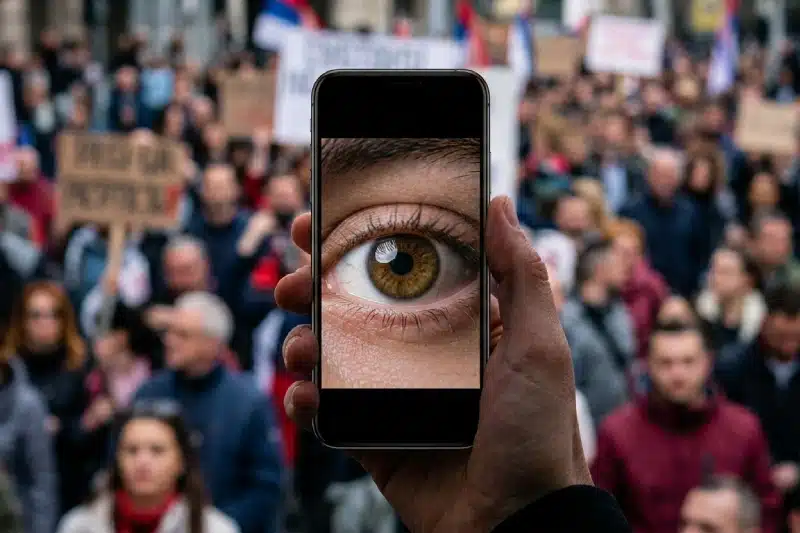
Pegasus, Pegasus Spyware, Serbia, Serbia Protests, Smartphone screen forming an eye shape against an abstract protest crowd, illustrating spyware targeting of Serbian student activists.

At least 14 people connected to Serbia's student protest movement and opposition politics have been targeted with mercenary spyware since early 2026, the Belgrade-based digital rights organization SHARE Foundation said, in what it called the largest documented wave of such targeting in the country.

The group said the cohort includes student movement members, civil society activists, a member of parliament and a local councilor. Forensic analysis was independently confirmed by the Citizen Lab at the University of Toronto and by Amnesty International's Security Lab.

Citizen Lab, in its own findings, said it verified an infection with NSO Group's Pegasus on the iPhone of a student activist who asked not to be named. High-confidence infection indicators span December 2025 through January 2026, delivered by a zero-click iMessage exploit that required no interaction from the target. Apple has since patched the underlying flaw; the fix shipped in iOS 18.4.1. Pegasus grants an operator access to notes, photographs and messages decrypted on the device, and can silently activate the microphone and camera.

Amnesty's Security Lab confirmed a new variant of NoviSpy, an Android implant first identified in Serbia in 2024, on two additional devices. SHARE said the rebuilt version was designed to evade the detection methods that exposed its predecessor.

Also read: Investigative Journalists in Serbia Hit by Advanced Spyware Attack

The circumstances of two infections are what elevate the findings beyond routine spyware reporting. SHARE said one NoviSpy infection appeared after police seized a student's phone during questioning, and another after private messages from that device were published by a pro-government media outlet. Donncha Ó Cearbhaill, who heads Amnesty's Security Lab, said the evidence suggests "infections are being carried out during detention by Serbian authorities."

Suspicion centers on Serbia's Security Information Agency, or BIA. Amnesty's December 2024 report "A Digital Prison" found earlier NoviSpy samples configured to send collected data to IP addresses associated with BIA servers, and documented the agency's parallel use of Cellebrite extraction tools on journalists and activists. In March 2025, Amnesty reported that two journalists at the Balkan Investigative Reporting Network were targeted with Pegasus.

The current cases surfaced through Apple's threat notification wave of Aug. 13, which reached users in 110 countries. The timing is politically loaded. The targeting overlaps with protests that followed the November 2024 collapse of a railway station canopy in Novi Sad, spans local elections held March 29 in 10 municipalities, and precedes October parliamentary elections widely read as a test of the ruling Serbian Progressive Party.

Ana Toskic Cvetinovic, a legal expert cited in the reporting, noted that deploying intrusive software without judicial authorization is unlawful under Serbian law. SHARE published an analysis of the domestic legal framework in January arguing the same. Criminal complaints filed over the 2024 cases remain pending before Serbian courts, with no resolution.

Also read: 7 New Pegasus Infections Found on Media and Activists’ Devices in the EU

NSO has been on the U.S. Commerce Department's Entity List since 2021.

Serbia is an accession candidate, the European Parliament has previously questioned the Commission over unlawful spyware use in the country, and the Commission published its 2026 enlargement country report in July. Amnesty's submission for that package raised surveillance directly.

Both groups urged at-risk users to enable Lockdown Mode on iOS or Advanced Protection on Android.

CrowdStrike Disrupts Sality Botnet After More Than 20 Years

Cybersecurity expert Ken Underhill reports from CrowdStrike on the disruption of the 20-year-old Sality botnet and what security teams need to know.

The post CrowdStrike Disrupts Sality Botnet After More Than 20 Years appeared first on TechRepublic.

Enriched URL Reports: VirusTotal URL Scanning 2.0

Introduction

In today's fast-moving cybersecurity landscape, threat analysts must move beyond basic, binary reputation scores to successfully defend against modern, highly adaptive web threats. Traditional URL analysis has been redefined by the launch of URL Scanning 2.0, an update that significantly expands VirusTotal's URL analysis capabilities by introducing automated visits with a full browser instance and deeper historical visibility.

Instead of relying on static reputation scores alone, URL Scanning 2.0 enriches reports with "under-the-hood" headless browser telemetry, including the DOM, full-page screenshots, web technologies, and network request logs. Crucially, it introduces historical analysis pivoting, giving analysts the ability to track how a page has changed over time.

URL Scanning 2.0

To successfully defend against modern, highly adaptive web threats, threat analysts must move beyond basic, binary reputation scores. With the debut of URL Scanning 2.0, VirusTotal introduces robust headless browser integration that captures how a page behaves dynamically in a clean sandbox environment.

Every scan now generates rich, granular telemetry that provides a blueprint of the target page's execution:

- Headless Browser Data: Full-page visual screenshots, full DOM (Document Object Model) trees, and web technologies (e.g., Cloudflare, PHP, HTTP/3).

- Page and Network Statistics: Highly detailed counters of individual network requests, encrypted HTTPS transactions, unique contacted domains/subdomains, and serving IP address mappings with geographic tracking.

- Anti-Phishing Fingerprints: Automatic identification of brands, cloned-website tags, password input fields, tracker IDs, and favicon dhashes.

- Historical Pivoting: A timeline containing historical analyses of a URL with its corresponding risk score, allowing analysts to track exactly how its metadata and content have shifted over time.

Access Levels in VirusTotal

Public Access (Free for VirusTotal Users)
The core enhancements of the URL Scanning 2.0 engine are available to everyone. For the latest scan, analysts can access rich telemetry generated by headless browser execution, including visual screenshots, extracted JavaScript globals, console messages, and a list of all loaded network resources.

VirusTotal Premium Customers
For paid VirusTotal customers, the platform unlocks deeper retrospective capabilities and exclusive data fields. Analysts have the ability to pivot to and review the full historical analyses of a URL as it was observed at specific points in time, and access advanced telemetry like the full DOM captures of the execution. Furthermore, premium access unlocks advanced infrastructure relationships, allowing users to pivot on contacted domains, IPs, and downloaded files.

Note: The aforementioned Google Threat Intelligence and Automatic Brand Identification features are exclusively available to Google Threat Intelligence customers.

Investigating a Phishing Case

Initially, when an analyst navigates to the mentioned URL to view the report generated by VirusTotal, they would see something similar to the following with the new URL Scanning features:

At the top of the interface, we can see that the URL has been scanned three times. This means there are three distinct reports for the same URL, each potentially containing different information that could be highly useful for an analyst. In the top right corner, we can view these past analyses by clicking on "History".

This is where the new historical analysis pivoting comes into play: it allows analysts to travel back through a URL's timeline with point-in-time snapshots.

By clicking on "History", we can view all the historical analyses for that URL, including response codes, detections, screenshots, and other metadata. You can also apply filters to narrow down the timeline and view only the historical records you are interested in, based on specific response codes, URL actions, and other criteria.

In this case, if we click on the initial historical analysis performed on July 6, 2026 (as shown in the screenshot above), we can examine its specific information across the "Summary", "Details", and "Detection" tabs. A key feature of URL Scanning 2.0 is that the information within these report tabs will dynamically re-render to match the exact historical state of the snapshot you select.

As observed in the history timeline, after clicking on this specific analysis included a live screenshot and other relevant metadata, indicating the scan occurred while the website was fully operational and actively distributed. The previous screenshot gives us a clear view of how the phishing page was visually structured.

Furthermore, diving into the "Details" tab reveals other interesting technical artifacts from the campaign. These details are incredibly useful for pivoting and identifying new malicious URLs that share similar characteristics.

Among the wealth of information generated by URL Scanning 2.0, analysts will find HTTP transactions, detected JavaScript variables, console messages, external outbound links, and other critical metadata. These key technical markers serve as pivotable and searchable attributes, allowing teams to conduct advanced footprint hunting and instantly find other malicious URLs exhibiting the exact same technical fingerprint.

Furthermore, every snapshot taken during each analysis provides the complete Document Object Model (DOM) tree captured by the full browser instances. It allows you to inspect the exact structure of the page as it was dynamically rendered to the victim, exposing elements that static scans might miss. As can be seen in the following image, having direct access to this point-in-time DOM data empowers analysts to dig deep into the page's architecture.

Advanced Threat Hunting: Scaling the Investigation

Let's scale our investigation using VirusTotal Intelligence queries based on the artifacts discovered via URL Scanning 2.0.

During the analysis of the financial phishing site, we discovered that the page relied on static assets hosted on a third-party domain: jiaoyisuo.thai2570[.]com. We can pivot on this finding using an advanced query:

VT Query
entity:url (outgoing_link:jiaoyisuo.thai2570.com OR content:jiaoyisuo.thai2570.com)

The results demonstrate a multi-brand operation, including fake cryptocurrency exchange portals and typosquatting domains for other financial services. By further pivoting on the hosting domain with entity:domain "thai2570.com", analysts can map out a highly segmented subdomain tree used for hosting assets, capturing payments, and backend control panels.

Conclusion

URL Scanning 2.0 represents a paradigm shift in how security analysts investigate web-based threats. Investigations are no longer limited to static verdicts. By surfacing powerful metadata directly inside the workflow—such as historical DOM captures, live screenshots, and pivotable technical identifiers—analysts can now turn a single indicator into a comprehensive infrastructure map.

Log in to VirusTotal to explore the new URL Scanning 2.0 features today, and consider upgrading to VirusTotal Premium to unlock the full power of historical pivoting and advanced threat hunting.

Kali365 Exploits Microsoft Device Login to Access US Corporate Data

Learn how Kali365 has been abusing Microsoft device login to gain OAuth tokens, targeting US firms, and how SOC teams can detect, hunt, and stop these phishing attacks.

Tanaka Dominates Data Leak Landscape With 25 Leak Posts

Tanaka

Ransomware often dominates cybersecurity headlines, but stolen data has become an equally valuable commodity in the cybercrime economy. In the first half of 2026, one threat actor stood out in the data leak ecosystem: Tanaka, a prolific data leak broker responsible for more publicized leak activity than any other actor tracked by Cyble.  Cyble researchers recorded 367 data breach and leak incidents worldwide between January and June 2026. While dozens of actors participated in selling or publishing stolen information, Tanaka emerged as the most active, accounting for 25 distinct leak posts — more than double the activity of several other major actors. 

A Data Leak Operation Without Industry Boundaries 

Unlike threat actors that specialize in a single vertical, Tanaka followed a broad targeting approach across multiple industries and regions. The actor’s campaigns showed no strict preference for a specific sector, instead focusing on organizations where stolen information could hold financial or strategic value.  The Banking, Financial Services, and Insurance (BFSI) sector remained the most targeted industry globally, accounting for 38 breach incidents during the reporting period. Financial organizations continue to attract attackers due to the value of customer information, account data, and personally identifiable information (PII).  Government and Technology organizations were also frequent targets, reflecting the wider value of sensitive records, intellectual property, and institutional data. 

Regional Presence Across Major Markets 

Tanaka’s activity was visible across multiple regions. In North America, the actor was responsible for seven leak posts, making it the most active data leak actor in the region alongside other prominent sellers.  Europe and the UK also saw significant activity, with Tanaka linked to six leak posts during H1 2026. The region’s BFSI, Telecommunications, and Retail sectors faced heightened exposure due to the amount of valuable customer and financial data they hold.  The actor’s global footprint demonstrates how modern data leak operations can function independently of geography. Instead of focusing on a single country or industry, operators like Tanaka exploit opportunities wherever valuable information becomes available. 

The Rise of the Data Leak Marketplace 

Tanaka’s activity reflects a broader shift in the cybercrime ecosystem. Data leaks are no longer only a byproduct of ransomware attacks; they have become a standalone business model.  Threat actors monetize stolen information through underground marketplaces, using leaked databases for fraud, extortion, intelligence gathering, or resale. This specialization mirrors other parts of the cybercrime economy, where access brokers, ransomware affiliates, and data sellers perform separate roles.  For organizations, this means a breach does not always begin with a ransomware demand. A stolen database appearing in underground channels may indicate an earlier compromise that requires immediate investigation. 

Staying Ahead of Data Exposure Risks 

Security teams must treat underground data exposure monitoring as part of their broader defense strategy. Identifying leaked credentials, compromised databases, or mentions in cybercrime marketplaces can provide early warning before stolen information is weaponized.  To understand the 2026 data breach landscape, including the most active threat actors, targeted industries, and regional trends, access the full Cyble H1 2026 Cyber Threat Landscape Report. 

One Country Absorbed Nearly Half of the World’s Ransomware Attacks in Just Six Months – The United States

Ransomware Attacks, Qilin, US, Ransomware Attacks on US

Strip away the geopolitics, the hacktivist noise, and the espionage headlines, and one number from the first half of 2026 stands out above everything else: 1,721. That's how many ransomware attacks hit organizations in the United States between January and June, according to new research from Cyble Research and Intelligence Labs (CRIL). It's not just the highest total of any country tracked in the report — it's more than the next nine most-targeted countries combined.

Canada, in second place worldwide, recorded 179 attacks. Germany logged 155. The United Kingdom, 138. Add up the rest of the global top 10 — France, Italy, Spain, Thailand, India and Brazil — and the total still falls more than 600 attacks short of the U.S. figure alone. Out of 3,836 ransomware attacks CRIL tracked worldwide this half, roughly 45% landed on American soil.

Also read: Fairlife Ransomware Attack Hits Production Systems, U.S. Operations Suspended

A Single Region, an Outsized Share

Widen the lens slightly and the picture holds. North America as a whole recorded 1,981 ransomware attacks in H1 2026 — more than half of every ransomware incident Cyble observed globally — alongside 35 data breach and leak incidents and 9 initial access sale listings. The report describes the region as home to "a mature, persistently active RaaS ecosystem operating at high volume across a wide range of industries and geographies."

Two ransomware-as-a-service operators did much of the damage. Qilin, the single most prolific gang worldwide, claimed 370 of those North American attacks on its own — nearly 19% of the regional total. Akira followed with 268, and INC Ransom added another 164. Together, Qilin and Akira alone accounted for more than half of all recorded ransomware activity across the region, a level of concentration that points to a small number of highly organized affiliate networks doing the bulk of the damage rather than a diffuse swarm of opportunists.

Also read: Qilin Ransomware Group’s TTPs Examined by Researchers

Where the Pressure Lands

Professional Services bore the brunt of North American ransomware activity, with INC Ransom showing a marked preference for law firms and other high-value services with sensitive client data. Construction, Manufacturing and Healthcare followed close behind.

One operator, AiLock, stood out for a coordinated wave of victim disclosures that all landed on the same day — March 3 — a pattern consistent with a mass-exploitation campaign rather than isolated intrusions. LockBit, despite years of law enforcement pressure and takedown attempts, kept up a steady tempo against public-sector and educational targets throughout the period, showcasing how difficult the group has been to fully dismantle.

On the data breach side, Technology and financial services (BFSI) were the most frequently targeted sectors in North America, together accounting for roughly 43% of incidents — a reflection of how much intellectual property and monetizable personal data those industries hold.

Notably, Agriculture & Livestock emerged as a significant target for initial access brokers, accounting for a third of all access listings tied to the region. Cyble flags this as a sign of "growing risk in the food supply chain," an area that has historically drawn less attention from ransomware operators than finance or healthcare.

The initial access market itself was strikingly concentrated: two sellers, tracked under the handles "redpin" and "xpl0itrs," accounted for nearly all listings targeting North American organizations. Threat actors also continued to lean on known and zero-day vulnerabilities in widely deployed enterprise platforms — including products from Ivanti and Palo Alto Networks — as their preferred way into corporate networks.

Hacktivism Blurs into Cybercrime

North America wasn't spared the hacktivism wave sweeping the rest of the world either. Collectives including SOLDADOS DIGITALES – UNIÓN AMERICANA and LYSTIC TEAM #ID drove roughly 56 data leak or dump posts and touched about 360 unique domains across the region, with Government, Technology, financial services and telecommunications entities most frequently in the crosshairs.

Cyble's broader findings suggest many groups marketing themselves as ideologically driven hacktivists are, in practice, running side businesses in stolen data brokerage and DDoS-for-hire services — a blurring of motive that complicates how defenders triage the threat.

The scale of the U.S. numbers doesn't necessarily mean American companies have weaker defenses than their global peers — the concentration also reflects the sheer size and digital density of the U.S. economy, and its outsized share of the high-value targets ransomware affiliates chase. But the data does argue for a shift in posture.

Cyble's broader recommendations — treating data exfiltration, not just encryption, as the primary risk; prioritizing patches for the recurring vendor list; and monitoring initial access markets as a leading indicator rather than an afterthought — apply nowhere more urgently than in a country absorbing this much of the world's ransomware volume on its own.

CVE-2026-48907 and LiteSpeed cPanel Plugin Flaws Come Under Active Attack

CVE-2026-48907

Security researchers and software vendors warn that attackers are actively exploiting vulnerabilities in both Joomla and the LiteSpeed cPanel plugin, posing significant risks to website administrators and shared hosting environments.  One of the most urgent issues is CVE-2026-48907, a critical vulnerability affecting the Joomla Content Editor (JCE). The flaw stems from an improper access-control weakness that allows unauthenticated attackers to upload editor profiles and, ultimately, execute arbitrary PHP code on vulnerable servers. Security experts say threat actors are already abusing the bug in real-world attacks.  The JCE security update was first released on June 3, 2026, with JCE version 2.9.99.5 addressing the vulnerability. A second release, version 2.9.99.6, followed on June 6 and introduced additional hardening measures. All JCE Pro versions before 2.9.99.5 are affected.  Over the weekend, Joomla urged administrators to update immediately, warning that CVE-2026-48907 is being exploited in the wild. The project stated: “The vulnerability is being actively exploited, working exploit code is public, and the attacks are automated, so a site with no public registration is not safe.” 

How CVE-2026-48907 Works 

According to the JCE security update advisory, attackers exploit the flaw by importing a malicious editor profile that permits uploads of executable files. Once the profile is installed, arbitrary PHP files can be uploaded and executed on the server.  Administrators are advised to review Components → JCE Editor → Editor Profiles for unfamiliar profiles, particularly those with randomly generated names or configurations allowing PHP uploads through plugins such as Image Manager or File Browser. Another warning sign is a front-end editor displaying a stripped-down toolbar.  The most reliable evidence of compromise is found in web server logs. Administrators should search for unauthenticated requests targeting index.php?option=com_jce&task=profiles.import. The earliest matching request can help determine when an intrusion began and identify a safe backup point for restoration. 

Indicators of Compromise and Response Steps 

The JCE security update guidance warns administrators to investigate any unexpected PHP files located in images, media, or tmp directories. Files containing “php” in their names, such as foo.php.xml, should also be treated as suspicious.  If compromise is suspected, administrators should preserve suspicious files for forensic analysis, install JCE 2.9.99.6 or later, remove rogue profiles, delete malicious uploads, change administrator, database, hosting, and FTP passwords, and perform a full server-side malware scan.  The advisory stresses that updating alone does not remove malicious files already planted on a compromised system. Closing the vulnerability prevents reinfection but does not clean an existing breach. 

Legacy Sites and LiteSpeed Risks 

For older deployments unable to meet the requirements of JCE 2.9.99.6—PHP 7.4 and 3.10 or later—a free patch is available for JCE 2.7.x, 2.8.x, and 2.9.x branches. However, the patch only fixes CVE-2026-48907 and does not include the additional hardening found in the latest release.  Separately, attackers are also targeting a vulnerability in the LiteSpeed cPanel plugin. The flaw can be exploited for privilege escalation, potentially allowing attackers to obtain root-level access on shared hosting servers. Together, the Joomla and LiteSpeed cPanel plugin vulnerabilities highlight the growing threat posed by actively exploited web hosting and content management system weaknesses. 

Defend against frontier cyber models: Cloudflare's architecture as customer zero

A few weeks ago, we wrote about Project Glasswing and what we observed when we pointed cyber frontier models at our own code. Since then, we’ve seen that the part of the post that has resonated most deeply is the argument that the architecture around the vulnerability matters more than the speed of the patch.

In the conversations we've had with CISOs and security teams since, the questions have been consistent: what does our architecture actually look like, what should we monitor for, where do we start, and how can Cloudflare help?

Before getting into the details: the architecture below is built almost entirely from Cloudflare's own products, because Cloudflare security is customer zero for the security products we build. The Cloudflare stack already exists in front of our code, employees, and customer-facing applications. If you're a Cloudflare customer, every layer below is available to you today. If you're not, the principles still apply to whatever stack you've built.

What a cyber frontier model actually changes

In the previous post, we showed how a cyber frontier model like Mythos changes the attacker’s timeline. It can find vulnerabilities, reason through exploit chains, and generate working proofs faster than earlier models. While models like Mythos do not change the shape of an intrusion — reconnaissance, initial access, lateral movement, persistence, and exfiltration still have to happen — the difference is in the speed and scale. When pointed at the open web, a model can find and hit low-hanging fruit quickly. Against a hardened target, it still has to probe, and adapt, and it often produces more noise than a careful human operator would.

Discovery, exploit chain construction, and proof-of-concept generation used to be the gating constraints on producing a working attack. A frontier model handles all three in a fraction of the time. Work that used to be slow and methodical is now fast and indiscriminate.

While AI is accelerating how fast developer teams at Cloudflare and many other companies can ship code, the security team’s work has not compressed the same way. An attacker only needs one opening to get in, while security teams need to find and close them all. Writing a fix, regressing it, and shipping it without breaking the code around it has constraints that AI doesn't remove. We learned this the hard way when we let an AI coding assistant write its own patches against our own bugs, as we described at the end of the previous post. Some of those patches fixed the original bug while quietly breaking something else the code depended on.

As these models become more competent and capable, our main focus from a threat standpoint comes down to three things. Each one shapes the architecture we walk through in the rest of this post.

  • The first is the speed of discovery. Frontier models make it easier to search large bodies of public code, including the open-source libraries that many companies depend on. That does not mean every bug in a library is exploitable, or that library bugs are where most vulnerabilities live. Exploitability still depends on how the code is used, whether attacker-controlled input can reach the vulnerable path, and the protections that sit around it. But widely used open-source libraries and frameworks give attackers a shared surface to study at scale. When a real, reachable vulnerability exists there, a model can help find it, reason about possible exploit paths, and generate proof-of-concept variants faster than maintainers and defenders can review every downstream use. The gap between when an attacker discovers a vulnerability and when defenders learn it exists is what worries us most. If you are not running these models against your own code, it is safe to assume someone else is.
  • The second is exploit volume and adaptation. A model can produce thousands of variations of a single exploit and run reconnaissance at the same scale. All that volume gives an attacker an advantage, but it won’t necessarily get them past signature-based detections. Many of those iterations will have the same underlying signature, so a rule that catches the first one will catch the rest. Adaptation is how they will get past signature-based detections. Ask a model to show you a SQL injection, and it will return a textbook example. Tell it there is a WAF in the way, and it will start probing, learning what gets blocked, and rewriting the payload until it can slip past the rule blocking it.
  • The third is the impact when a vulnerability is inevitably exploited. No architecture catches everything. After the vulnerability is exploited, the question we ask ourselves is: where can the attacker get to with one identity, one path, or one credential, before something else stops them? If the answer is "anywhere they want," the vulnerability was never the problem. The architecture around the vulnerability was.

Cloudflare’s superpower: visibility

We see roughly a fifth of the web and that tells us, in real time, which payloads are mutating, which patterns are picking up, and where attacker tooling is moving next. Two teams turn that visibility into defense.

First is Cloudforce One, our threat intelligence, research, and operations team, which sits within the Cloudflare security organization. They turn what we see across the network into insights the rest of the stack can act on: tracked adversaries, emerging campaigns, and indicators of compromise (IOCs). The hard part of this work was never knowing what is malicious — it was the delay in mitigation. Knowledge of a new threat normally has to travel from a threat report, into a feed, and then into a company’s defense before it can be used to block anything. Attackers have learned to move faster than that. Our network closes that gap: Cloudflare customers can now use Cloudforce One threat intelligence directly within the WAF to block high-risk traffic.

Second is the team that owns the WAF engine that does the actual detecting: the managed rulesets that run in front of our own properties and are available to every Cloudflare customer, the machine learning behind WAF Attack Score, and the relationships that sometimes let us ship a rule before a CVE is publicly disclosed. The team is globally distributed and moves fast, releasing rules within hours of a proof-of-concept of an attack becoming known. Once a detection is deployed, it reaches our entire network, along with every Cloudflare customer, in under 30 seconds. React2Shell is a recent example: a managed WAF rule was protecting our own properties, and everyone else's on Cloudflare, hours before the official advisory was published.

The scoring layer, the defenses we put in front of the application, and the containment around the vulnerability all build on what these two teams see. 

Scores over signatures

Signature-based defenses were built for a world where novel exploits were scarce and variations took weeks. Cloudflare's traditional SLA from a fresh proof-of-concept to a live, deployed rule has been 12 hours. With the advent of frontier models, this is not good enough anymore. Detections need to be in place before a CVE is discovered. This is why we layer ML-based detection in front of the traditional signature-based WAF.

The model is trained on a large body of past attack traffic, and it catches new variants of vulnerabilities before they're publicly known. A novel SQL injection or remote code execution chain is almost always a rearrangement of attack shapes the model has seen before, even when the specific exploit is brand new. We run the model on every request and assign a WAF Attack Score between 1 and 99, based on how closely the request resembles those underlying shapes, not against a list of known-bad signatures. The lower the score, the more aggressively we treat the request. That score determines whether we let the request through. We apply a similar scoring methodology to AI prompts with AI Security for Apps: rather than check each prompt against a list of known malicious prompts, we score how closely a prompt resembles an actual attack. 

The architecture around the vulnerability

Those capabilities only matter once they're stacked in front of an application, and the first layer in our defense-in-depth approach is the WAF. Anything that matches a known-bad pattern gets dropped before it reaches the application, which clears the bulk of the obvious traffic and lets the more specialized layers below focus on what's left.

On the API surface, we run a positive security model through API Shield. Instead of trying to anticipate every bad request, we describe what a valid request to each API looks like, either from the API's own definition or learned from our real traffic, and anything that doesn't fit doesn't get through. This neutralizes the advantage of frontier AI models: because we only permit validated traffic, generating thousands of new attack variations fails to bypass the system.

Cloudflare’s layered architecture

Bot Management catches probing traffic on our network before frontier models can build a map. It scores every request on how likely it is to be automated, using the same signals across our whole network: how the client behaves, whether it looks like a real browser, and whether the connection matches a known-bad pattern. An attack only lands if it can find a soft spot. 

Zero Trust Network Access is used for every internal application. The implicit trust of being inside the network is replaced with explicit per-request identity and policy for every employee accessing every tool. The value of this was clear when one of our engineers shipped a misconfigured tool. A flat network would have exposed everything on the same segment, but in our deployment, the exposure stopped at the tool itself. We built Require Access Protection afterwards so newly deployed or misconfigured applications can't be reachable before an access policy is in place.

IdP Federation makes that secure by default posture easier to keep consistent across every Cloudflare account — which becomes even more necessary when more people are shipping internal tools quickly. Instead of asking each team to wire up SSO separately, we configure our identity provider (IdP) once and share it across the organization. New accounts get SSO automatically, recipient-side IdP connections are read-only, and Access policies in each account still evaluate the resulting identity as part of the normal request flow. 

MCP Server Portal gives teams a controlled way to connect AI agents to enterprise systems. Agents access MCP servers that are centrally managed through a single portal, with every action logged. That way when an agent acts on someone's behalf, we know what it did, what it touched, and whether it should have been allowed to. The full picture of how we built it is in our post on enterprise MCP.

AI Gateway runs in front of our internal AI tools the same way AI Security for Apps runs in front of customer-facing AI features, with the same scoring and the same visibility. Inside the company, the visibility piece is more useful than the blocking, because we needed to see what engineers were actually building before we could write meaningful policy on it.

Where your teams can start 

Frontier models can help attackers find vulnerabilities, adapt payloads, and move faster, but they still have to pass through the layered defense you deploy in front of your application. That is where teams should start:

  • Put inspection in front of public applications.
  • Define what valid API traffic looks like.
  • Use bot detection to limit automated probing.
  • Require identity and access policy before any internal tool is reachable.

For AI and agentic systems:

  • Route model traffic through a gateway.
  • Keep agents connected through approved MCP servers.
  • Log what they do. 

The goal is to make sure that when one layer misses, the next layer limits what the attacker can see, reach, or change.

That is the point of the architecture around the vulnerability: to limit the scope of an attack. The vulnerability may be what starts the attack, but the architecture determines how far it can go.

How do we know this approach works?

Plenty of security stacks look impenetrable on a whiteboard but fall over in practice. That is why we test ours continuously, both at the perimeter and inside our environment, with our red team involved across both.

At the perimeter, frontier models are one tool we use to test our application security stack as an adaptive attacker. These models sit alongside the rest of our red team and detection workflows including: manual testing, threat intelligence, observed traffic patterns, proof-of-concept analysis, and signals from our own network. Together, those inputs help us decide where to aim testing: newly launched products, recently changed surfaces, and the paths an attacker is most likely to probe first. The most important part is the process that follows. When something gets through, we identify the gap, use the right mix of tools to understand it, write the rule or mitigation, ship the update, and test again to make sure the gap is closed.

Inside the environment, our red team starts from the assumption that the perimeter has already failed. They look at what has changed, where sensitive systems carry risk, and whether one compromised identity, path, or credential can reach farther than it should. When we change the architecture based on what they find, they run the scenario again against the new version to confirm the gap is actually closed.

We confirm that this architecture is working by continuously testing its behavior during failures, rather than relying on the perfection of individual layers.

If your team is working on the same problems and would like to compare notes, reach out to us at security-ai-research@cloudflare.com.

Indonesian Media Outlet Tempo Targeted by 24.9 Million DDoS Requests

cyberattacks on Tempo

A major wave of cyberattacks on Tempo has disrupted access to one of Indonesia's leading news websites, with the media outlet reporting millions of malicious requests directed at its servers over several days. The Tempo cyberattack, which began on Friday, June 5, 2026, involved a distributed denial-of-service (DDoS) assault designed to overwhelm the company's infrastructure and hinder public access to its journalism. According to Tempo's technology team, the attacks generated an extraordinary volume of fake internet traffic, placing significant pressure on the organization's servers and temporarily affecting the availability of the website for readers in Indonesia and elsewhere.

24.9 Million Requests Recorded During Cyberattacks on Tempo 

Tempo Digital Chief Technology Officer Heru Tjatur Tjahja said the cyberattacks on Tempo had reached an unprecedented scale. By Monday, June 8, 2026, the company's monitoring systems had logged a total of 24.9 million requests aimed at its servers.  “The total attacks flooding our website as of June 8 reached 24.9 million requests,” Tjahja said on Monday, June 8, 2026.  The Tempo cyberattack relied on bot-generated traffic, a common tactic used in DDoS incidents. Such attacks typically involve networks of compromised devices sending enormous numbers of requests simultaneously, overwhelming targeted systems and making websites difficult or impossible to access.  Tjahja explained that preliminary findings indicated the attacks occurred intermittently but intensified dramatically during certain periods. 

Largest Wave Hit During Evening Hours 

The investigation into the cyberattacks on Tempo revealed a pattern in the timing of the attacks. According to Tjahja, the attackers frequently launched their operations during evening and early morning hours, when activity surged sharply.  One of the most significant attack waves occurred between 8:30 p.m. and midnight. During that period alone, Tempo recorded 12.97 million attack requests within a span of just two hours.  “For example, the first major wave consisted of 12.97 million attacks in only two hours. From 8:30 p.m. until midnight, the attackers carried out a digital assault,” he said.  The intensity of the attack highlighted the scale of resources being used against the Indonesian media organization. 

Attack Traffic Traced Beyond Indonesia 

Early analysis conducted by Tempo's technology team suggested that the sources of the malicious traffic extended well beyond Indonesia's borders.  While the exact identities of those responsible remain unclear, investigators traced attack activity to multiple countries. According to Tempo, traffic associated with the cyberattacks on Tempo originated from Colombia, the United States, the Philippines, Bangladesh, Mexico, and Indonesia.  The international nature of the attack traffic reflects the complexity of modern DDoS operations, which often use distributed networks of compromised devices globally to conceal the origin of an attack. 

Possible Link to Earlier CMS Breach Attempt 

Tjahja believes the Tempo cyberattack may be connected to an earlier security incident that targeted the organization's content management system (CMS) at the end of May 2026.  During that earlier intrusion attempt, attackers managed to unpublish several articles that had already been published on the website. According to Tjahja, the content affected by the breach involved corruption-related reporting.  However, the CMS architecture limited the level of access available to unauthorized users. As a result, the attackers were unable to permanently remove the articles and could only temporarily unpublish them.  According to Tjahja, the sequence of events suggests a possible connection between the two incidents.  “It appears that those behind the attacks were unhappy and then proceeded with the DDoS attack,” he said. 

Turning Cloudflare’s threat indicators into real-time WAF rules

Cloudflare’s Threat Events provides security analysts with a window into the global threat landscape. The platform offers a peek into the immense traffic that Cloudflare processes every day, so you can see in real time which IPs are attacking specific industries or which threat actors are trending globally. However, translating that visibility into active mitigation has often been a manual, reactive process.

Security teams have faced a recurring frustration: knowing that certain IP addresses were associated with specific threat actors (like Tycoon 2FA or RaccoonO365) or had been seen targeting their specific industry in other regions, but they couldn't easily automate the blocking of these high-risk IPs within their own WAF unless they manually configured the rules. 

We are excited to announce a new integration that brings Cloudflare’s vast threat intelligence directly into your WAF engine: you can now write proactive rules using live intelligence data. This means you can add more intelligence context to protect your application against known bad actors — before they even attempt to touch your infrastructure.

By populating specialized fields during the early stages of a request, the WAF can now screen traffic based on:

  • Who is attacking by matching specific threat actor names
  • Who they are targeting via the industry or country filters to see who the IP has targeted in the past
  • What type of attack using enriched threat context, filtering by attack type (DDoS, WAF, cybercrime, etc.) and the timeframe it was last seen

Always-on detection

This new capability is built on the same always-on detection framework we recently introduced for Attack Signature Detection, a system that identifies common attack patterns in real time without requiring pre-configured rules. By separating detection from mitigation, we ensure that threat intelligence is constantly running in the background, enriching your HTTP request analytics with insightful threat metadata before you even decide to take an action.

The primary advantage of an "always-on" model is the elimination of the traditional "log vs. block" trade-off: visibility in log mode, or protection in block mode. That’s because when a rule blocks a request, you lose visibility into how other signatures would have assessed it — insight that could have helped you strengthen your defenses.

If you have a Cloudforce One subscription, these insights appear in your analytics automatically. You can see which threat actors are hitting your site and which industries those IPs usually target, allowing you to verify traffic patterns before "flipping the switch" to block.

These detections execute with negligible latency, ensuring your performance remains lightning-fast while providing the high-confidence data needed to build robust security policies. While this initial release focuses on IP-based matching, we are already looking toward extending these capabilities to JA3 fingerprints and domain-based matching. This will allow you to block malicious traffic even when attackers rotate IPs, by identifying the unique software signatures or malicious destination links they use in their payloads.

New WAF fields

To make this possible, we've exposed the following specific signals directly to the WAF engine:

Example rule expressions

Because a single IP address could be associated with multiple threat actors or targeted industries simultaneously, these fields are represented as arrays. We use the any() function and [*] wildcard to check whether any value within that threat profile matches your criteria:

  • Block known DDoS participants targeting your region: any(cf.intel.ip.target_countries[*] == "FR") and any(cf.intel.ip.datasets[*] == "ddos")
  • Protect against specific threat actors targeting the Finance sector: any(cf.intel.ip.target_industries[*] == "Banking & Financial Services") and any(cf.intel.ip.attacker_names[*] == "BLACKBASTA")
  • Broad protection against specific high-risk origin countries: any(cf.intel.ip.attacker_countries[*] == "IR")

How to use Threat Events data in your workflows

Whether you prefer a UI-driven approach or Infrastructure as Code, these fields are integrated into your existing workflows.

The WAF rule builder (API & Terraform)

For teams that prefer Infrastructure as Code, the new cf.intel fields are fully integrated into the WAF rule builder for WAF custom rules and rate limiting. You can write complex expressions using the same syntax you use today. Because these are standard WAF fields, they are fully supported via the Cloudflare API and Terraform, allowing you to automate threat blocking across your selected domains or even on your whole account.

New fields added to the WAF rule builder to allow users to choose the relevant configuration based on the Threat Events indicators. 

Visibility in Security Analytics

Deployment is only half the battle. All matches triggered by these threat intelligence fields are logged in Security Analytics. You can drill down into your traffic to see exactly which rule was triggered and which specific indicator matched. These enriched logs allow for faster auditing and postmortem analysis when a rule triggers.

Threat event matches surface in Security Analytics, with full context and a one-click option to create a custom security rule.

One-click rule from the Threat Events dashboard

If you are already using the Threat Intelligence Dashboard to investigate trends, you don't have to copy and paste IP lists. You can create Saved Views based on your specific filters, such as "IPs seen attacking the Financial sector in the last seven days." With a single click, you can export these filters directly into a WAF rule.

Saved Views now allow users to easily create WAF rules to match the saved view configuration. 

Global intelligence across our network

Visibility and ease of use are only possible if the underlying engine is fast. How do we handle millions of threat indicators without slowing down your traffic?

These threat intelligence datasets are compressed into a high-performance format and distributed to every single Cloudflare data center globally. When a request hits our network, the Cloudflare WAF performs an O(1) constant-time lookup against these local datasets. This ensures that whether we are checking against ten indicators or ten million, the latency overhead remains effectively zero (measured in microseconds).

Because an IP can be associated with multiple threat vectors, our engine doesn't stop at the first match. It evaluates the set of all signals associated with that IP simultaneously. This ensures that a rule looking for "Attacker = RU" AND "Target Industry = Banking" will trigger correctly by evaluating the intersection of these attributes in a single pass, providing maximum coverage against multi-vector actors without increasing computational complexity.

Ready to get started?

This feature is available today for customers with any active Cloudforce One subscription:

  • Cloudforce One Essentials allows customers to access the default datasets in Threat Events, search for indicators, and conduct threat-hunting investigations
  • Cloudforce One Advantage allows customers to access our Threat Intelligence Analyst custom insights via requests for information
  • Cloudforce One Elite — our most complete package — includes brand protection, a high number of requests for information, and access to all Threat Events datasets

Ready to turn global insights into local defense? Head over to Threat Events or the WAF section of your Cloudflare Dashboard to start building your first Threat Intel rule, or contact your account team to learn more about subscribing to Cloudforce One.

❌