
Visualização de leitura

From flat networks to locked up domains with tiering models

I’ve been performing internal assessments for seven years and out of all the things I have learnt, one is certain: without a proper tiering model, security tools alone won’t stop your organization from collapsing after a major compromise.

In this post I’ll explain what a tiering model is, how to break a flat network even when protections are present, and, most importantly, how to build a defense-in-depth network providing practical tips and diagrams.
Tooble for the win.. piracy++ ??

For those of you who have not yet tried it, check out Tooble. Its a point and click tool that lets you download videos from the youtube.. its pretty cool and allows u to pull/convert videos pretty trivially.. [for all my “dont do piracy” holier than thou-ness, i now have to wondr if pulling a google-tech-talk, which doesnt have a download link (i.e. the authors did not want us to download it) is any different to pandas cat internet > home_nas behaviour..)

select * from projectdiscovery join steampipe

Recently, I decided to take a look at Steampipe again. I like SQL and the structure it provides, and after playing around a bit I figured: “Wouldn’t it be cool to write a plugin for the immensely popular projectdiscovery tools?”. That is exactly what I did and you can find the source code for it here: https://github.com/sensepost/steampipe-plugin-projectdiscovery.

overview

For the purposes of footprinting, everything you can do with steampipe you can do with a bash script. You technically don’t need SQL. However, with bash you always need to bust out some text wrangling with tools like sed and awk. That in itself isn’t bad, but the data is inherently unstructured and error-prone as a result. Instead, if we could have our data in a database, we could do arbitrary lookups, join and more!

an offensive look at docker desktop extensions

For our annual internal hacker conference dubbed SenseCon in 2023, I decided to take a quick look at Docker Desktop Extensions. Almost exactly a year after being announced, I wondered what the risks of a malicious docker extension could be. This is a writeup of what I learned, a few tricks I used to get some answers and how I found a “non-issue” command injection in the extensions SDK. Everything in this post was tested on macOS and Docker Desktop 4.19.0 (106363).

Investigating the Wink Hub 2

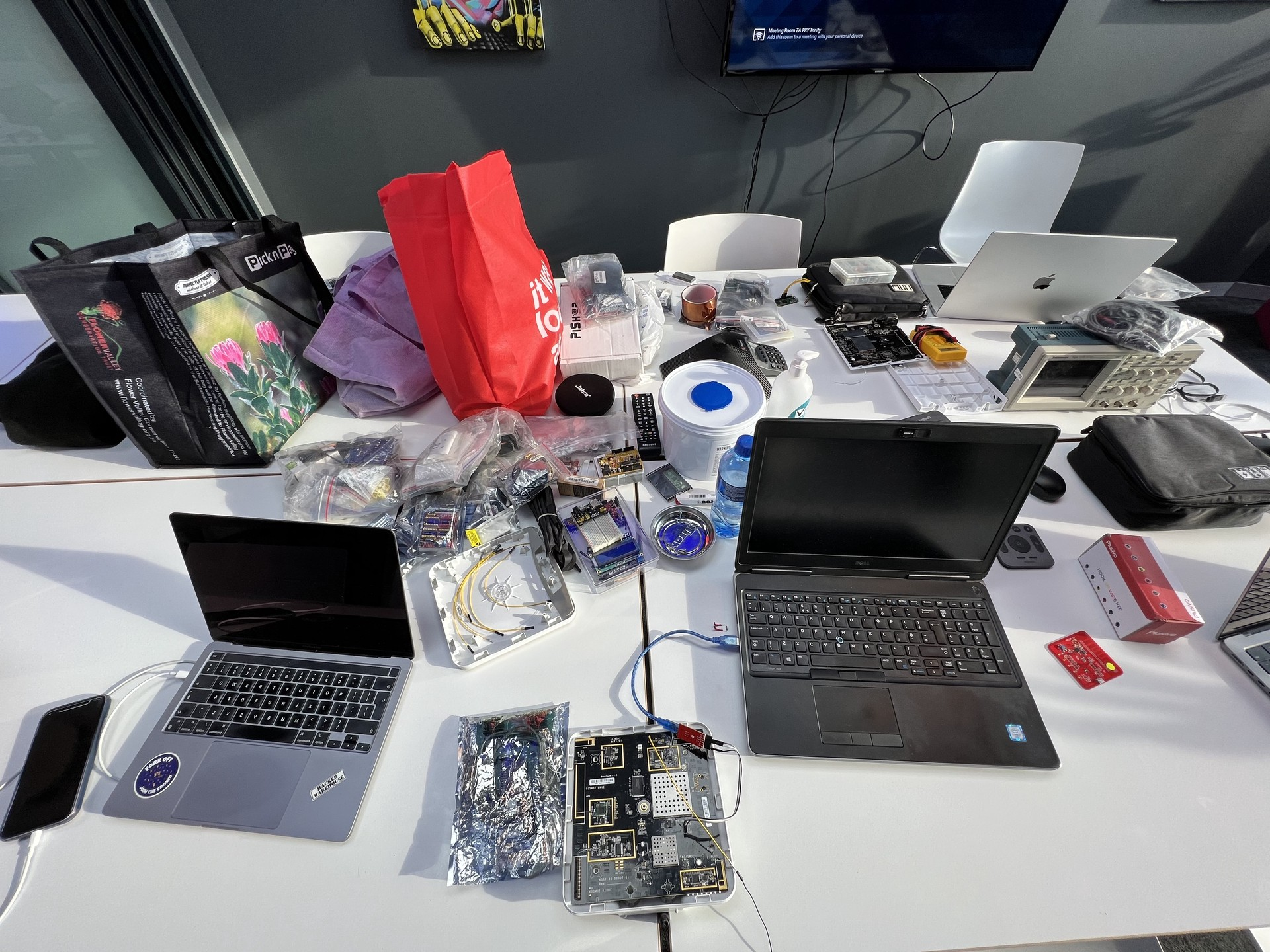
Rogan brought half of his hardware parts bin to the hackathon!

Michael Rodger, Daniel Scragg, Isak van der Walt, Thulani Mabuza and Rogan Dawes formed the Chubby Hackers team to investigate the Wink Hub 2 during SenseCon 2023. This was building on our project from SenseCon 2022 where we looked at the Wink Hub 1, particularly the various debug interfaces for the main i.MX28 and the peripheral radio controller chips. There is quite a lot of detailed information available online for the Wink Hub 1, but not a whole lot for the Wink Hub 2. In fact, there is practically nothing! We aimed to change that.

hash-cracker – password cracking done effectively

Intro

I wrote a tool to help with cracking of hashes, today I finally decided to blog about it. The idea was to take what I’d learned about common patterns in passwords, and put my experience into practice to make password cracking more efficient on future engagements. Below is a short history of how we got to where we are, as well as some examples of how to use it.

Protected Users: you thought you were safe uh?

On the 31st of October 2022, a PR on CrackMapExec from Thomas Seigneuret (@Zblurx) was merged. This PR fixed Kerberos authentication in the CrackMapExec framework. Seeing that, I instantly wanted to try it out and play a bit with it. While doing so I discovered a weird behaviour with the Protected Users group. In this blogpost I’ll explain what the Protected Users group is, why it is a nice security feature and yet why it is incomplete for the Administrator (RID500) user.

From BitLocker-Suspended to Virtual Machine

On a recent red-team I was given a client laptop from which I was expected to simulate an insider-threat/employee laptop compromise scenario over their VPN.

I was given a normal employee user account and did not have local administrator privileges. The laptop itself was riddled with security products and snitchware, threatening to report back every action taken on the system to the SOC/SIEM. My first objective was to obtain local administrative access, so that I could disable these security products.

Decoding BlazorPack

TL;DR: I couldn’t make a custom BlazorPack editor work in Burp, so I used Mallet instead. From an indecipherable binary mess to this, in about 100 lines:

Decoded BlazorPack messages

For details on how to do this yourself, even for other protocols, read on!

On a recent assessment, Marianka ran into a website using BlazorPack. As Microsoft describes it: “Today’s modern apps are expected to deliver up-to-date information without hitting a refresh button. Add real-time functionality to your dashboards, maps, games and more.”

Jumping into SOCKS

On a recent internal assessment, we ran into a problem. While holding low-privileged access to an internal Windows host, we realised the software on the host was communicating to a remote API endpoint over HTTPS. However, the remote endpoint was enforcing authentication using client SSL certificates.

Normally, the above scenario is easily fixed by exporting the local client SSL certificate from the host and importing it into either Burp Suite or Postman. In Burp Suite, when you want to use a client SSL certificate, you must manually load the certificate and private key into it. This implies (on Windows, at least) that you’ll need to export the client SSL certificate. However, this is only possible if you hold appropriate permissions to the certificate and its private key and it allows exporting.

CertPotato – Using ADCS to privesc from virtual and network service accounts to local system

The goal of this blog post is to present a privilege escalation I found while working on ADCS. We will see how it is possible to elevate our privileges to NT AUTHORITY\SYSTEM from virtual and network service accounts of a domain-joined machine (for example from a webshell on a Windows server) using ADCS. I want to call this attack chain “CertPotato” as homage to other *Potato tools and as a way to better remember it.

Abusing Windows’ tokens to compromise Active Directory without touching LSASS

During an internal assessment, I performed an NTLM relay and ended up owning the NT AUTHORITY\SYSTEM account of the Windows server. Looking at the users connected on the same server, I knew that a domain administrator account was connected. All I had to do to compromise the domain, was compromise the account. This could be achieved by dumping the memory of the LSASS process and collecting their credentials or Kerberos TGT’s. Seemed easy until I realised an EDR was installed on the system. Long story short, I ended up compromising the domain admin account without touching the LSASS process. To do so, I relied on an internal Windows mechanism called token manipulation.

WireSocks for Easy Proxied Routing

I built some infrastructure that you could deploy and use to easily tunnel from arbitrary sources over a proxy such as SOCKS, using anything that can run WireGuard. This is convenient in cases where it would be nicer to have a full network route to a target network (with working DNS) vs just having application specific proxy rules. In this post I’ll elaborate a bit on that idea. If you are just looking for the code you can find it here: https://github.com/sensepost/wiresocks.

sensecon 2022 – wait a minute, you got legs? edition

In a world of returning back to, well, “normal” it meant that we could finally have our annual internal hackathon as Orange Cyberdefense in person! And that is exactly what SenseCon 2022 was. An internal, global ethical hacker conference spread across six regions. In this post we’ll talk about exactly that, the challenges as well as the projects people worked on.

As a bonus, we have one of the challenges, BuzzWord, available for you to play via our Discord server, today! Just join using this link, and check out the instructions in the #buzzword-instructions channel.

me vs request smugglingPOST

I’ve come to realise that I wasn’t the only one that has never actually exploited an HTTP Request Smuggling vulnerability, three years after James Kettle reminded the world of it. Like many, I’ve seen the buzz, read it all, thought I understood it, but honestly, I didn’t. While the potential impact sounds great from an attacker perspective, I’ve been mostly confused by a lot of it. That was until the 2022 HackTheBox Business CTF challenge called PhishTale in the web category came around. Focussing less on the overall solving of the challenge and more on the request smuggling, in this post I’ll tell you about my journey of how I finally got to exploit an HTTP desync attack (specifically HTTP2 request smuggling).

Sail away, sail away, sail away

A while back, after some live music and drinks at Railways, I made my way to another city for pleasant weather, some dubious food, the ever-wakeful seagulls, and ultimately – an assessment.

After playing around for a few days, Jason and I had obtained access to a system which contained cleartext credentials, namely ihsadmin:ihsadmin.

Using these credentials, we were also able to SSH into a management server of sorts. While this was great, there were still several other servers in-scope that we had no access to. After scanning the network for a bit, I found out that a couple of these servers ran HTTP services on port 80, 8008 and 9080.

using a cloud mac with a local ios device

Doing iOS mobile assessments without macOS around is not exactly fun. This can be for many reasons that include code signing and app deployment to name a few. Alternatives exist for some of these tasks (like the amazing libimobiledevice project or more recently an attempt to get code signing to work without macOS), but nothing beats using a real macOS device for most of those tasks. Be it to patch mobile apps with a Frida gadget, or to deploy an application from Xcode, whatever your reason for needing this, in this short post I’ll show you how to use @CorelliumHQ‘s usbfluxd project or a simple SSH tunnel to make a locally connected iOS device (eg. your Linux laptop) available to a remote macOS device such that you could expose it to Xcode, in the cloud.

Constrained Delegation Considerations for Lateral Movement

The abuse of constrained delegation configuration, whereby a compromised domain user or computer account configured with constrained delegation can be leveraged to impersonate domain users to preconfigured trusted services, is a common attack path in Active Directory. For each trusted service, a unique service ticket is used, that explicitly corresponds to the service type for which it was requested. For example, to access Windows file shares, a CIFS ticket is required. Meanwhile, to leverage the WinRM protocol, a HTTP service ticket is required instead. Compromise of such service tickets aids in lateral movement and further compromise.

Left To My Own Devices – Fast NTCracking in Rust

When I got a new MacBook with an M1 Pro chip, I was excited to see the performance benefits. The first thing I did was to fire up hashcat which gave an impressive benchmark speed for NT hashes (mode 1000) of around 9 GH/s, a solid doubling of the benchmark speed of my old Intel MacBook Pro. But, when it came to actually cracking things, the speed dropped off considerably. Instead of figuring out why, I decided to try my hand at writing my own NT hash cracker, because I’m kind of addicted to writing single use tooling in rust then taking time to perf optimise it.

SIM Hijacking

Introduction

533 million Facebook users’ phone numbers leaked” was one of the highlighted titles that flooded many social networks’ pages. The leak that was initially for sale in 2020 has more recently been released for free on a hacker forum containing mobile numbers, and a bunch of other related information. This news gave birth to websites like https://haveibeenzucked.com, where you could check if the Facebook data leak contained your data. (https://haveibeenpwned.com allows you to check it now as well).

❌