Visualização de leitura

Defend against frontier cyber models: Cloudflare's architecture as customer zero

A few weeks ago, we wrote about Project Glasswing and what we observed when we pointed cyber frontier models at our own code. Since then, we’ve seen that the part of the post that has resonated most deeply is the argument that the architecture around the vulnerability matters more than the speed of the patch.

In the conversations we've had with CISOs and security teams since, the questions have been consistent: what does our architecture actually look like, what should we monitor for, where do we start, and how can Cloudflare help?

Before getting into the details: the architecture below is built almost entirely from Cloudflare's own products, because Cloudflare security is customer zero for the security products we build. The Cloudflare stack already exists in front of our code, employees, and customer-facing applications. If you're a Cloudflare customer, every layer below is available to you today. If you're not, the principles still apply to whatever stack you've built.

What a cyber frontier model actually changes

In the previous post, we showed how a cyber frontier model like Mythos changes the attacker’s timeline. It can find vulnerabilities, reason through exploit chains, and generate working proofs faster than earlier models. While models like Mythos do not change the shape of an intrusion — reconnaissance, initial access, lateral movement, persistence, and exfiltration still have to happen — the difference is in the speed and scale. When pointed at the open web, a model can find and hit low-hanging fruit quickly. Against a hardened target, it still has to probe, and adapt, and it often produces more noise than a careful human operator would.

Discovery, exploit chain construction, and proof-of-concept generation used to be the gating constraints on producing a working attack. A frontier model handles all three in a fraction of the time. Work that used to be slow and methodical is now fast and indiscriminate.

While AI is accelerating how fast developer teams at Cloudflare and many other companies can ship code, the security team’s work has not compressed the same way. An attacker only needs one opening to get in, while security teams need to find and close them all. Writing a fix, regressing it, and shipping it without breaking the code around it has constraints that AI doesn't remove. We learned this the hard way when we let an AI coding assistant write its own patches against our own bugs, as we described at the end of the previous post. Some of those patches fixed the original bug while quietly breaking something else the code depended on.

As these models become more competent and capable, our main focus from a threat standpoint comes down to three things. Each one shapes the architecture we walk through in the rest of this post.

  • The first is the speed of discovery. Frontier models make it easier to search large bodies of public code, including the open-source libraries that many companies depend on. That does not mean every bug in a library is exploitable, or that library bugs are where most vulnerabilities live. Exploitability still depends on how the code is used, whether attacker-controlled input can reach the vulnerable path, and the protections that sit around it. But widely used open-source libraries and frameworks give attackers a shared surface to study at scale. When a real, reachable vulnerability exists there, a model can help find it, reason about possible exploit paths, and generate proof-of-concept variants faster than maintainers and defenders can review every downstream use. The gap between when an attacker discovers a vulnerability and when defenders learn it exists is what worries us most. If you are not running these models against your own code, it is safe to assume someone else is.
  • The second is exploit volume and adaptation. A model can produce thousands of variations of a single exploit and run reconnaissance at the same scale. All that volume gives an attacker an advantage, but it won’t necessarily get them past signature-based detections. Many of those iterations will have the same underlying signature, so a rule that catches the first one will catch the rest. Adaptation is how they will get past signature-based detections. Ask a model to show you a SQL injection, and it will return a textbook example. Tell it there is a WAF in the way, and it will start probing, learning what gets blocked, and rewriting the payload until it can slip past the rule blocking it.
  • The third is the impact when a vulnerability is inevitably exploited. No architecture catches everything. After the vulnerability is exploited, the question we ask ourselves is: where can the attacker get to with one identity, one path, or one credential, before something else stops them? If the answer is "anywhere they want," the vulnerability was never the problem. The architecture around the vulnerability was.

Cloudflare’s superpower: visibility

We see roughly a fifth of the web and that tells us, in real time, which payloads are mutating, which patterns are picking up, and where attacker tooling is moving next. Two teams turn that visibility into defense.

First is Cloudforce One, our threat intelligence, research, and operations team, which sits within the Cloudflare security organization. They turn what we see across the network into insights the rest of the stack can act on: tracked adversaries, emerging campaigns, and indicators of compromise (IOCs). The hard part of this work was never knowing what is malicious — it was the delay in mitigation. Knowledge of a new threat normally has to travel from a threat report, into a feed, and then into a company’s defense before it can be used to block anything. Attackers have learned to move faster than that. Our network closes that gap: Cloudflare customers can now use Cloudforce One threat intelligence directly within the WAF to block high-risk traffic.

Second is the team that owns the WAF engine that does the actual detecting: the managed rulesets that run in front of our own properties and are available to every Cloudflare customer, the machine learning behind WAF Attack Score, and the relationships that sometimes let us ship a rule before a CVE is publicly disclosed. The team is globally distributed and moves fast, releasing rules within hours of a proof-of-concept of an attack becoming known. Once a detection is deployed, it reaches our entire network, along with every Cloudflare customer, in under 30 seconds. React2Shell is a recent example: a managed WAF rule was protecting our own properties, and everyone else's on Cloudflare, hours before the official advisory was published.

The scoring layer, the defenses we put in front of the application, and the containment around the vulnerability all build on what these two teams see. 

Scores over signatures

Signature-based defenses were built for a world where novel exploits were scarce and variations took weeks. Cloudflare's traditional SLA from a fresh proof-of-concept to a live, deployed rule has been 12 hours. With the advent of frontier models, this is not good enough anymore. Detections need to be in place before a CVE is discovered. This is why we layer ML-based detection in front of the traditional signature-based WAF.

The model is trained on a large body of past attack traffic, and it catches new variants of vulnerabilities before they're publicly known. A novel SQL injection or remote code execution chain is almost always a rearrangement of attack shapes the model has seen before, even when the specific exploit is brand new. We run the model on every request and assign a WAF Attack Score between 1 and 99, based on how closely the request resembles those underlying shapes, not against a list of known-bad signatures. The lower the score, the more aggressively we treat the request. That score determines whether we let the request through. We apply a similar scoring methodology to AI prompts with AI Security for Apps: rather than check each prompt against a list of known malicious prompts, we score how closely a prompt resembles an actual attack. 

The architecture around the vulnerability

Those capabilities only matter once they're stacked in front of an application, and the first layer in our defense-in-depth approach is the WAF. Anything that matches a known-bad pattern gets dropped before it reaches the application, which clears the bulk of the obvious traffic and lets the more specialized layers below focus on what's left.

On the API surface, we run a positive security model through API Shield. Instead of trying to anticipate every bad request, we describe what a valid request to each API looks like, either from the API's own definition or learned from our real traffic, and anything that doesn't fit doesn't get through. This neutralizes the advantage of frontier AI models: because we only permit validated traffic, generating thousands of new attack variations fails to bypass the system.

Cloudflare’s layered architecture

Bot Management catches probing traffic on our network before frontier models can build a map. It scores every request on how likely it is to be automated, using the same signals across our whole network: how the client behaves, whether it looks like a real browser, and whether the connection matches a known-bad pattern. An attack only lands if it can find a soft spot. 

Zero Trust Network Access is used for every internal application. The implicit trust of being inside the network is replaced with explicit per-request identity and policy for every employee accessing every tool. The value of this was clear when one of our engineers shipped a misconfigured tool. A flat network would have exposed everything on the same segment, but in our deployment, the exposure stopped at the tool itself. We built Require Access Protection afterwards so newly deployed or misconfigured applications can't be reachable before an access policy is in place.

IdP Federation makes that secure by default posture easier to keep consistent across every Cloudflare account — which becomes even more necessary when more people are shipping internal tools quickly. Instead of asking each team to wire up SSO separately, we configure our identity provider (IdP) once and share it across the organization. New accounts get SSO automatically, recipient-side IdP connections are read-only, and Access policies in each account still evaluate the resulting identity as part of the normal request flow. 

MCP Server Portal gives teams a controlled way to connect AI agents to enterprise systems. Agents access MCP servers that are centrally managed through a single portal, with every action logged. That way when an agent acts on someone's behalf, we know what it did, what it touched, and whether it should have been allowed to. The full picture of how we built it is in our post on enterprise MCP.

AI Gateway runs in front of our internal AI tools the same way AI Security for Apps runs in front of customer-facing AI features, with the same scoring and the same visibility. Inside the company, the visibility piece is more useful than the blocking, because we needed to see what engineers were actually building before we could write meaningful policy on it.

Where your teams can start 

Frontier models can help attackers find vulnerabilities, adapt payloads, and move faster, but they still have to pass through the layered defense you deploy in front of your application. That is where teams should start:

  • Put inspection in front of public applications.
  • Define what valid API traffic looks like.
  • Use bot detection to limit automated probing.
  • Require identity and access policy before any internal tool is reachable.

For AI and agentic systems:

  • Route model traffic through a gateway.
  • Keep agents connected through approved MCP servers.
  • Log what they do. 

The goal is to make sure that when one layer misses, the next layer limits what the attacker can see, reach, or change.

That is the point of the architecture around the vulnerability: to limit the scope of an attack. The vulnerability may be what starts the attack, but the architecture determines how far it can go.

How do we know this approach works?

Plenty of security stacks look impenetrable on a whiteboard but fall over in practice. That is why we test ours continuously, both at the perimeter and inside our environment, with our red team involved across both.

At the perimeter, frontier models are one tool we use to test our application security stack as an adaptive attacker. These models sit alongside the rest of our red team and detection workflows including: manual testing, threat intelligence, observed traffic patterns, proof-of-concept analysis, and signals from our own network. Together, those inputs help us decide where to aim testing: newly launched products, recently changed surfaces, and the paths an attacker is most likely to probe first. The most important part is the process that follows. When something gets through, we identify the gap, use the right mix of tools to understand it, write the rule or mitigation, ship the update, and test again to make sure the gap is closed.

Inside the environment, our red team starts from the assumption that the perimeter has already failed. They look at what has changed, where sensitive systems carry risk, and whether one compromised identity, path, or credential can reach farther than it should. When we change the architecture based on what they find, they run the scenario again against the new version to confirm the gap is actually closed.

We confirm that this architecture is working by continuously testing its behavior during failures, rather than relying on the perfection of individual layers.

If your team is working on the same problems and would like to compare notes, reach out to us at security-ai-research@cloudflare.com.

Managed OAuth for Access: make internal apps agent-ready in one click

We have thousands of internal apps at Cloudflare. Some are things we’ve built ourselves, others are self-hosted instances of software built by others. They range from business-critical apps nearly every person uses, to side projects and prototypes.

All of these apps are protected by Cloudflare Access. But when we started using and building agents — particularly for uses beyond writing code — we hit a wall. People could access apps behind Access, but their agents couldn’t.

Access sits in front of internal apps. You define a policy, and then Access will send unauthenticated users to a login page to choose how to authenticate. 

Example of a Cloudflare Access login page

This flow worked great for humans. But all agents could see was a redirect to a login page that they couldn’t act on.

Providing agents with access to internal app data is so vital that we immediately implemented a stopgap for our own internal use. We modified OpenCode’s web fetch tool such that for specific domains, it triggered the cloudflared CLI to open an authorization flow to fetch a JWT (JSON Web Token). By appending this token to requests, we enabled secure, immediate access to our internal ecosystem.

While this solution was a temporary answer to our own dilemma, today we’re retiring this workaround and fixing this problem for everyone. Now in open beta, every Access application supports managed OAuth. One click to enable it for an Access app, and agents that speak OAuth 2.0 can easily discover how to authenticate (RFC 9728), send the user through the auth flow, and receive back an authorization token (the same JWT from our initial solution). 

Now, the flow works smoothly for both humans and agents. Cloudflare Access has a generous free tier. And building off our newly-introduced Organizations beta, you’ll soon be able to bridge identity providers across Cloudflare accounts too.

How managed OAuth works

For a given internal app protected by Cloudflare Access, you enable managed OAuth in one click:

Once managed OAuth is enabled, Cloudflare Access acts as the authorization server. It returns the www-authenticate header, telling unauthorized agents where to look up information on how to get an authorization token. They find this at https://<your-app-domain>/.well-known/oauth-authorization-server. Equipped with that direction, agents can just follow OAuth standards: 

  1. The agent dynamically registers itself as a client (a process known as Dynamic Client Registration — RFC 7591), 
  2. The agent sends the human through a PKCE (Proof Key for Code Exchange) authorization flow (RFC 7636)
  3. The human authorizes access, which grants a token to the agent that it can use to make authenticated requests on behalf of the user

Here’s what the authorization flow looks like:

If this authorization flow looks familiar, that’s because it’s what the Model Context Protocol (MCP) uses. We originally built support for this into our MCP server portals product, which proxies and controls access to many MCP servers, to allow the portal to act as the OAuth server. Now, we’re bringing this to all Access apps, so agents can access not only MCP servers that require authorization, but also web pages, web apps, and REST APIs.

Mass upgrading your internal apps to be agent-ready

Upgrading the long tail of internal software to work with agents is a daunting task. In principle, in order to be agent-ready, every internal and external app would ideally have discoverable APIs, a CLI, a well-crafted MCP server, and have adopted the many emerging agent standards.

AI adoption is not something that can wait for everything to be retrofitted. Most organizations have a significant backlog of apps built over many years. And many internal “apps” work great when treated by agents as simple websites. For something like an internal wiki, all you really need is to enable Markdown for Agents, turn on managed OAuth, and agents have what they need to read protected content.

To make the basics work across the widest set of internal applications, we use Managed OAuth. By putting Access in front of your legacy internal apps, you make them agent-ready instantly. No code changes, no retrofitting. Instead, just immediate compatibility.

It’s the user’s agent. No service accounts and tokens needed

Agents need to act on behalf of users inside organizations. One of the biggest anti-patterns we’ve seen is people provisioning service accounts for their agents and MCP servers, authenticated using static credentials. These have their place in simple use cases and quick prototypes, and Cloudflare Access supports service tokens for this purpose.

But the service account approach quickly shows its limits when fine-grained access controls and audit logs are required. We believe that every action an agent performs must be easily attributable to the human who initiated it, and that an agent must only be able to perform actions that its human operator is likewise authorized to do. Service accounts and static credentials become points at which attribution is lost. Agents that launder all of their actions through a service account are susceptible to confused deputy problems and result in audit logs that appear to originate from the agent itself.

For security and accountability, agents must use security primitives capable of expressing this user–agent relationship. OAuth is the industry standard protocol for requesting and delegating access to third parties. It gives agents a way to talk to your APIs on behalf of the user, with a token scoped to the user’s identity, so that access controls correctly apply and audit logs correctly attribute actions to the end user.

Standards for the win: how agents can and should adopt RFC 9728 in their web fetch tools

RFC 9728 is the OAuth standard that makes it possible for agents to discover where and how to authenticate. It standardizes where this information lives and how it’s structured. This RFC became official in April 2025 and was quickly adopted by the Model Context Protocol (MCP), which now requires that both MCP servers and clients support it.

But outside of MCP, agents should adopt RFC 9728 for an even more essential use case: making requests to web pages that are protected behind OAuth and making requests to plain old REST APIs.

Most agents have a tool for making basic HTTP requests to web pages. This is commonly called the “web fetch” tool. It’s similar to using the fetch() API in JavaScript, often with some additional post-processing on the response. It’s what lets you paste a URL into your agent and have your agent go look up the content.

Today, most agents’ web fetch tools won’t do anything with the www-authenticate header that a URL returns. The underlying model might choose to introspect the response headers and figure this out on its own, but the tool itself does not follow www-authenticate, look up /.well-known/oauth-authorization-server, and act as the client in the OAuth flow. But it can, and we strongly believe it should! Agents already do this to act as remote MCP clients.

To demonstrate this, we’ve put up a draft pull request that adapts the web fetch tool in Opencode to show this in action. Before making a request, the adapted tool first checks whether it already has credentials ; if it does, it uses them to make the initial request. If the tool gets back a 401 or a 403 with a www-authenticate header, it asks the user for consent to be sent through the server’s OAuth flow.

Here’s how that OAuth flow works. If you give the agent a URL that is protected by OAuth and complies with RFC 9728, the agent prompts the human for consent to open the authorization flow:

…sending the human to the login page:

…and then to a consent dialog that prompts the human to grant access to the agent:

Once the human grants access to the agent, the agent uses the token it has received to make an authenticated request:

Any agent from Codex to Claude Code to Goose and beyond can implement this, and there’s nothing bespoke to Cloudflare. It’s all built using OAuth standards.

We think this flow is powerful, and that supporting RFC 9728 can help agents with more than just making basic web fetch requests. If a REST API supports RFC 9728 (and the agent does too), the agent has everything it needs to start making authenticated requests against that API. If the REST API supports RFC 9727, then the client can discover a catalog of REST API endpoints on its own, and do even more without additional documentation, agent skills, MCP servers or CLIs. 

Each of these play important roles with agents — Cloudflare itself provides an MCP server for the Cloudflare API (built using Code Mode), Wrangler CLI, and Agent Skills, and a Plugin. But supporting RFC 9728 helps ensure that even when none of these are preinstalled, agents have a clear path forward. If the agent has a sandbox to execute untrusted code, it can just write and execute code that calls the API that the human has granted it access to. We’re working on supporting this for Cloudflare’s own APIs, to help your agents understand how to use Cloudflare.

Coming soon: share one identity provider (IdP) across many Cloudflare accounts

At Cloudflare our own internal apps are deployed to dozens of different Cloudflare accounts, which are all part of an Organization — a newly introduced way for administrators to manage users, configurations, and view analytics across many Cloudflare accounts. We have had the same challenge as many of our customers: each Cloudflare account has to separately configure an IdP, so Cloudflare Access uses our identity provider. It’s critical that this is consistent across an organization — you don’t want one Cloudflare account to inadvertently allow people to sign in just with a one-time PIN, rather than requiring that they authenticate via single-sign on (SSO).

To solve this, we’re currently working on making it possible to share an identity provider across Cloudflare accounts, giving organizations a way to designate a single primary IdP for use across every account in their organization.

As new Cloudflare accounts are created within an organization, administrators will be able to configure a bridge to the primary IdP with a single click, so Access applications across accounts can be protected by one identity provider. This removes the need to manually configure IdPs account by account, which is a process that doesn’t scale for organizations with many teams and individuals each operating their own accounts.

What’s next

Across companies, people in every role and business function are now using agents to build internal apps, and expect their agents to be able to access context from internal apps. We are responding to this step function growth in internal software development by making the Workers Platform and Cloudflare One work better together — so that it is easier to build and secure internal apps on Cloudflare. 

Expect more to come soon, including:

  • More direct integration between Cloudflare Access and Cloudflare Workers, without the need to validate JWTs or remember which of many routes a particular Worker is exposed on.
  • wrangler dev --tunnel — an easy way to expose your local development server to others when you’re building something new, and want to share it with others before deploying
  • A CLI interface for Cloudflare Access and the entire Cloudflare API
  • More announcements to come during Agents Week 2026

Enable Managed OAuth for your internal apps behind Cloudflare Access

Managed OAuth is now available, in open beta, to all Cloudflare customers. Head over to the Cloudflare dashboard to enable it for your Access applications. You can use it for any internal app, whether it’s one built on Cloudflare Workers, or hosted elsewhere. And if you haven’t built internal apps on the Workers Platform yet — it’s the fastest way for your team to go from zero to deployed (and protected) in production.

From reactive to proactive: closing the phishing gap with LLMs

Email security has always been defined by impermanence. It is a perpetual call-and-response arms race, where defenses are only as strong as the last bypass discovered and attackers iterate relentlessly for even marginal gains. Every control we deploy eventually becomes yesterday’s solution.

What makes this challenge especially difficult is that our biggest weaknesses are, by definition, invisible.

This problem is best illustrated by a classic example from World War II. Mathematician Abraham Wald was tasked with helping Allied engineers decide where to reinforce bomber aircraft. Engineers initially focused on the bullet holes visible on planes returning from missions. Wald pointed out the flaw: they were reinforcing the areas where planes could already take damage and survive. The true vulnerabilities were on the planes that never came back.

Email security faces an identical hurdle: our detection gaps are unseen. By integrating LLMs, we advance email phishing protection and move from reactive to proactive detection improvement.

The limits of reactive defense

Traditional email security systems improve primarily through user-reported misses. For example, if we marked a spam message as clean, customers can send us the original EML to our pipelines for our analysts to analyze and update our models. This feedback loop is necessary and valuable, but it is inherently reactive. It depends on someone noticing a failure after the fact and taking the time to report it.

That means detection improvements are often driven by what attackers already succeeded at, rather than by what they are about to exploit next.

To close this gap, we need a way to systematically observe the “planes that didn’t make it back.”

Mapping the threat landscape with LLMs

Large Language Models (LLMs) hit the mainstream market in late 2022 and early 2023, fundamentally changing how we process unstructured data. At their core, LLMs use deep learning and massive datasets to predict the next token in a sequence, allowing them to understand context and nuance. They are particularly well-suited for email security because they can read natural language and characterize complex concepts (like intent, urgency, and deception) across millions of messages.

Every day, Cloudflare processes millions of unwanted emails. Historically, it was not feasible to deeply characterize each message beyond coarse classifications. Manually mapping emails to nuanced threat vectors simply did not scale. 

Now, Cloudflare has integrated LLMs into our email security tools to identify threats before they strike. By using the power of LLMs, as we’ll describe below, we can finally see a clear and comprehensive picture of the evolving threat landscape.

Our LLM-driven categorization shows clear spikes and persistent trends across several distinct categories, including "PrizeNotification" and "SalesOutreach".

These LLM-generated tags provide Cloudflare analysts with high-fidelity signals in near real time. Tasks that previously required hours of manual investigation and complex querying can now be surfaced automatically, with relevant context attached. This directly increases the velocity at which we can build new targeted Machine Learning models or retrain existing ones to address emerging behaviors.

Because Cloudflare operates at global Internet scale, we can gather these insights earlier than ever before, often before a new technique becomes widely visible through customer-reported misses.

The Sales Outreach threat

One of the clearest patterns we’ve identified using this new intelligence is the continued persistence of malicious messages structured to look like Sales Outreach-style phishing. These emails are designed to mimic legitimate B2B communication, often presenting opportunities to purchase or receive "special deals" on unique items or services, to lure targets into clicking malicious links or providing credentials.

Once LLM categorization surfaced Sales Outreach as a dominant vector, we moved from broad visibility to targeted data collection. 

Using LLM-generated tags, we began systematically isolating messages that exhibited Sales Outreach characteristics across our global dataset. This produced a continuously growing, high-precision corpus of real-world examples, including confirmed malicious messages as well as borderline cases that traditional systems struggled to classify. From this corpus, we built a dedicated training pipeline.

First, we curated training data by grouping messages based on shared linguistic and structural traits identified by the LLMs. These traits included persuasive framing, manufactured urgency, transactional language, and subtle forms of social proof.

Next, we focused feature extraction on sentiment and intent rather than static indicators. The model learns how requests are phrased, how credibility is established, and how calls to action are embedded within otherwise normal business conversations.

Finally, we trained a purpose-built sentiment analysis model optimized specifically for Sales Outreach behavior. This avoided overloading a general phishing classifier and allowed us to tune precision and recall for this threat class.

Turning language into enforcement

The output of this model is a risk score that reflects how closely a message aligns with known Sales Outreach attack patterns. That score is evaluated alongside existing signals such as sender reputation, link behavior, and historical context to determine whether a message should be blocked, quarantined, or allowed.

This process is continuous. As attackers adapt their language, newly observed messages are fed back into the pipeline and used to refine the model without waiting for large volumes of user-reported misses. LLMs act as the discovery layer by surfacing new linguistic variants, while the specialized model performs fast and scalable enforcement.

This is what an all-out offensive looks like in practice. It is a feedback loop where large-scale language understanding drives focused, high-precision detection. The result is earlier intervention against a threat class that thrives on subtlety, and fewer malicious sales emails reaching the inbox.

Results of the undertaking

The visibility unlocked by LLM-driven mapping fundamentally changed how we improve detections. Instead of waiting for attackers to succeed and relying on downstream user reports, we gained the ability to identify systemic gaps earlier and address them at the source. This shift from reactive remediation to proactive reinforcement translated directly into measurable customer impact.

The most immediate signal of success was a marked reduction in customer friction. Sales Outreach–related phishing has historically generated a high volume of user-reported misses, largely because these messages closely resemble legitimate business communication and often evade traditional rule-based or reputation-driven systems. As our targeted models came online and were continuously refined using LLM-derived insights, fewer of these messages reached end users in the first place.

The data reflects this change clearly. Average daily Sales Outreach submissions — messages that we labeled as clean but were in fact Sales Outreach phishing emails, flagged by end users — dropped from 965 in Q3 2025 to 769 in Q4 2025, representing a 20.4% reduction in reported misses in a single quarter.

This reduction is not just a metric improvement; it represents thousands fewer disruptive moments per day for security teams and end users alike. Each avoided submission is a phishing attempt that was stopped before it could erode trust, consume analyst time, or force a user to make a security judgment mid-workflow. We have seen this trend continue in Q1 of 2026 with average daily submissions decreasing by two-thirds.

In effect, LLMs allowed us to “see” the planes that never made it back. By illuminating previously invisible failure modes, we were able to reinforce defenses precisely where attackers were concentrating their efforts. The result is a system that improves not only detection rates, but also the day-to-day experience of the people relying on it.

The next front in the arms race

Our work with LLMs is just beginning. 

To stay ahead of the next evolution of attacks, we are moving toward a model of total environmental awareness by refining LLM specificity to extract forensic-level detail from every interaction. This granular mapping allows us to identify specific tactical signatures rather than relying on broad labels. 

Simultaneously, we are deploying specialized machine learning models purpose-built to hunt for emerging, high-obfuscation vectors at the "fringes" that traditional defenses miss. By leveraging this real-time LLM data as a strategic compass, we can shift our human expertise away from known noise and toward the critical gaps where the next strike is likely to land.

By illuminating the "planes that didn't make it back," we are doing more than just reacting to missed email; we are systematically narrowing the battlefield. In the email arms race, the advantage belongs to the side that can see the invisible first.

Ready to enhance your email security?

We provide all organizations (whether a Cloudflare customer or not) with free access to our Retro Scan tool, allowing them to use our predictive AI models to scan existing inbox messages in Microsoft 365. 

Retro Scan will detect and highlight any threats found, enabling organizations to remediate them directly in their email accounts. With these insights, organizations can implement further controls, either using Cloudflare Email Security or their preferred solution, to prevent similar threats from reaching their inboxes in the future.

If you are interested in how Cloudflare can help secure your inboxes, sign up for a phishing risk assessment here.

Building a serverless, post-quantum Matrix homeserver

* This post was updated at 11:45 a.m. Pacific time to clarify that the use case described here is a proof of concept and a personal project. Some sections have been updated for clarity.

Matrix is the gold standard for decentralized, end-to-end encrypted communication. It powers government messaging systems, open-source communities, and privacy-focused organizations worldwide. 

For the individual developer, however, the appeal is often closer to home: bridging fragmented chat networks (like Discord and Slack) into a single inbox, or simply ensuring your conversation history lives on infrastructure you control. Functionally, Matrix operates as a decentralized, eventually consistent state machine. Instead of a central server pushing updates, homeservers exchange signed JSON events over HTTP, using a conflict resolution algorithm to merge these streams into a unified view of the room's history.

But there is a "tax" to running it. Traditionally, operating a Matrix homeserver has meant accepting a heavy operational burden. You have to provision virtual private servers (VPS), tune PostgreSQL for heavy write loads, manage Redis for caching, configure reverse proxies, and handle rotation for TLS certificates. It’s a stateful, heavy beast that demands to be fed time and money, whether you’re using it a lot or a little.

We wanted to see if we could eliminate that tax entirely.

Spoiler: We could. In this post, we’ll explain how we ported a Matrix homeserver to Cloudflare Workers. The resulting proof of concept is a serverless architecture where operations disappear, costs scale to zero when idle, and every connection is protected by post-quantum cryptography by default. You can view the source code and deploy your own instance directly from Github.

From Synapse to Workers

Our starting point was Synapse, the Python-based reference Matrix homeserver designed for traditional deployments. PostgreSQL for persistence, Redis for caching, filesystem for media.

Porting it to Workers meant questioning every storage assumption we’d taken for granted.

The challenge was storage. Traditional homeservers assume strong consistency via a central SQL database. Cloudflare Durable Objects offers a powerful alternative. This primitive gives us the strong consistency and atomicity required for Matrix state resolution, while still allowing the application to run at the edge.

We ported the core Matrix protocol logic — event authorization, room state resolution, cryptographic verification — in TypeScript using the Hono framework. D1 replaces PostgreSQL, KV replaces Redis, R2 replaces the filesystem, and Durable Objects handle real-time coordination.

Here’s how the mapping worked out:

From monolith to serverless

Moving to Cloudflare Workers brings several advantages for a developer: simple deployment, lower costs, low latency, and built-in security.

Easy deployment: A traditional Matrix deployment requires server provisioning, PostgreSQL administration, Redis cluster management, TLS certificate renewal, load balancer configuration, monitoring infrastructure, and on-call rotations.

With Workers, deployment is simply: wrangler deploy. Workers handles TLS, load balancing, DDoS protection, and global distribution.

Usage-based costs: Traditional homeservers cost money whether anyone is using them or not. Workers pricing is request-based, so you pay when you’re using it, but costs drop to near zero when everyone’s asleep. 

Lower latency globally: A traditional Matrix homeserver in us-east-1 adds 200ms+ latency for users in Asia or Europe. Workers, meanwhile, run in 300+ locations worldwide. When a user in Tokyo sends a message, the Worker executes in Tokyo. 

Built-in security: Matrix homeservers can be high-value targets: They handle encrypted communications, store message history, and authenticate users. Traditional deployments require careful hardening: firewall configuration, rate limiting, DDoS mitigation, WAF rules, IP reputation filtering.

Workers provide all of this by default. 

Post-quantum protection 

Cloudflare deployed post-quantum hybrid key agreement across all TLS 1.3 connections in October 2022. Every connection to our Worker automatically negotiates X25519MLKEM768 — a hybrid combining classical X25519 with ML-KEM, the post-quantum algorithm standardized by NIST.

Classical cryptography relies on mathematical problems that are hard for traditional computers but trivial for quantum computers running Shor’s algorithm. ML-KEM is based on lattice problems that remain hard even for quantum computers. The hybrid approach means both algorithms must fail for the connection to be compromised.

Following a message through the system

Understanding where encryption happens matters for security architecture. When someone sends a message through our homeserver, here’s the actual path:

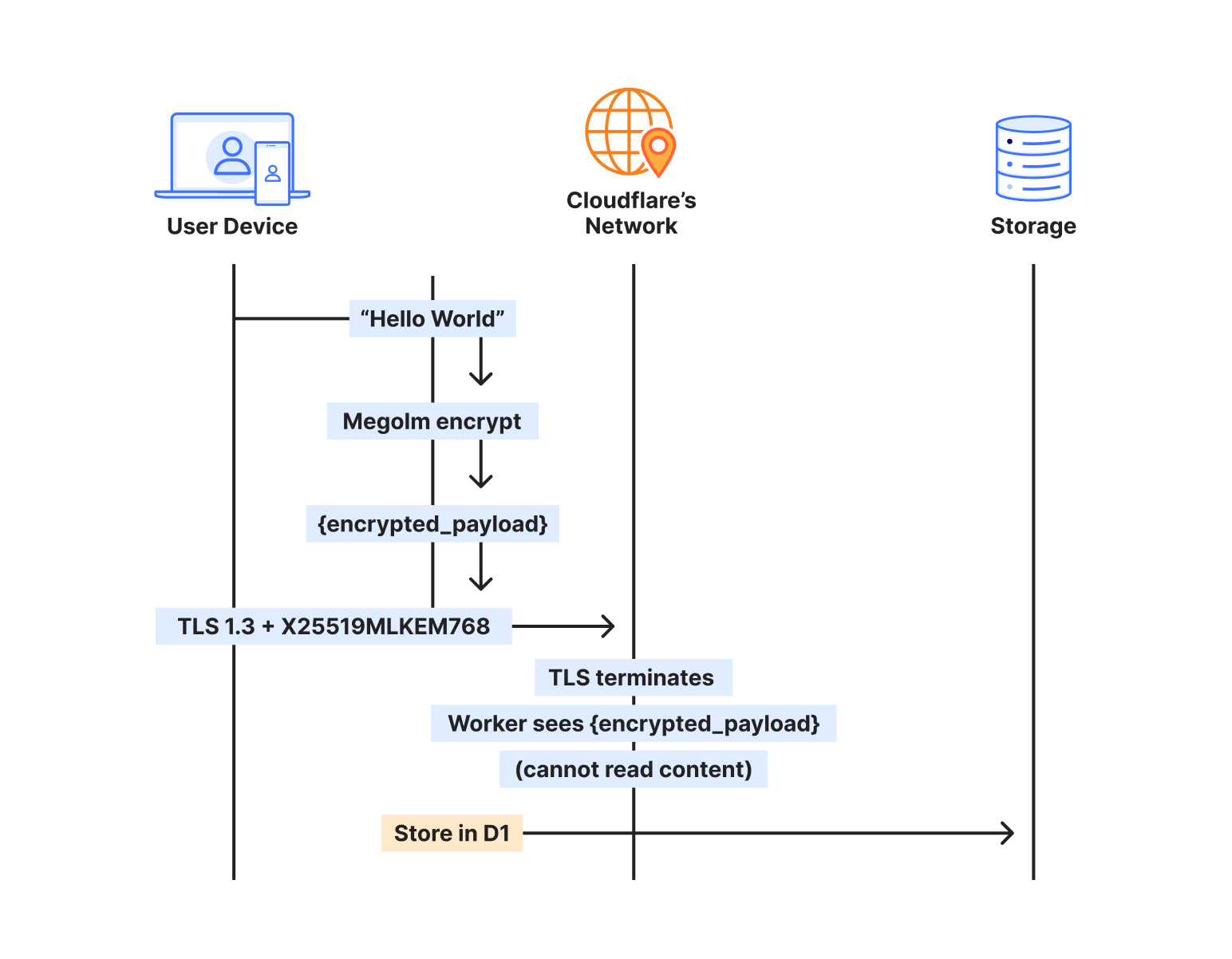
The sender’s client takes the plaintext message and encrypts it with Megolm — Matrix’s end-to-end encryption. This encrypted payload then gets wrapped in TLS for transport. On Cloudflare, that TLS connection uses X25519MLKEM768, making it quantum-resistant.

The Worker terminates TLS, but what it receives is still encrypted — the Megolm ciphertext. We store that ciphertext in D1, index it by room and timestamp, and deliver it to recipients. But we never see the plaintext. The message “Hello, world” exists only on the sender’s device and the recipient’s device.

When the recipient syncs, the process reverses. They receive the encrypted payload over another quantum-resistant TLS connection, then decrypt locally with their Megolm session keys.

Two layers, independent protection

This protects via two encryption layers that operate independently:

The transport layer (TLS) protects data in transit. It’s encrypted at the client and decrypted at the Cloudflare edge. With X25519MLKEM768, this layer is now post-quantum.

The application layer (Megolm E2EE) protects message content. It’s encrypted on the sender’s device and decrypted only on recipient devices. This uses classical Curve25519 cryptography.

Who sees what

Any Matrix homeserver operator — whether running Synapse on a VPS or this implementation on Workers — can see metadata: which rooms exist, who’s in them, when messages were sent. But no one in the infrastructure chain can see the message content, because the E2EE payload is encrypted on sender devices before it ever hits the network. Cloudflare terminates TLS and passes requests to your Worker, but both see only Megolm ciphertext. Media in encrypted rooms is encrypted client-side before upload, and private keys never leave user devices.

What traditional deployments would need

Achieving post-quantum TLS on a traditional Matrix deployment would require upgrading OpenSSL or BoringSSL to a version supporting ML-KEM, configuring cipher suite preferences correctly, testing client compatibility across all Matrix apps, monitoring for TLS negotiation failures, staying current as PQC standards evolve, and handling clients that don’t support PQC gracefully.

With Workers, it’s automatic. Chrome, Firefox, and Edge all support X25519MLKEM768. Mobile apps using platform TLS stacks inherit this support. The security posture improves as Cloudflare’s PQC deployment expands — no action required on our part.

The storage architecture that made it work

The key insight from porting Tuwunel was that different data needs different consistency guarantees. We use each Cloudflare primitive for what it does best.

D1 for the data model

D1 stores everything that needs to survive restarts and support queries: users, rooms, events, device keys. Over 25 tables covering the full Matrix data model.

CREATE TABLE events (
	event_id TEXT PRIMARY KEY,
	room_id TEXT NOT NULL,
	sender TEXT NOT NULL,
	event_type TEXT NOT NULL,
	state_key TEXT,
	content TEXT NOT NULL,
	origin_server_ts INTEGER NOT NULL,
	depth INTEGER NOT NULL
);

D1’s SQLite foundation meant we could port Tuwunel’s queries with minimal changes. Joins, indexes, and aggregations work as expected.

We learned one hard lesson: D1’s eventual consistency breaks foreign key constraints. A write to rooms might not be visible when a subsequent write to events checks the foreign key. We removed all foreign keys and enforce referential integrity in application code.

KV for ephemeral state

OAuth authorization codes live for 10 minutes, while refresh tokens last for a session.

// Store OAuth code with 10-minute TTL
kv.put(&format!("oauth_code:{}", code), &token_data)?
	.expiration_ttl(600)
	.execute()
	.await?;

KV’s global distribution means OAuth flows work fast regardless of where users are located.

R2 for media

Matrix media maps directly to R2, so you can upload an image, get back a content-addressed URL – and egress is free.

Durable Objects for atomicity

Some operations can’t tolerate eventual consistency. When a client claims a one-time encryption key, that key must be atomically removed. If two clients claim the same key, encrypted session establishment fails.

Durable Objects provide single-threaded, strongly consistent storage:

#[durable_object]
pub struct UserKeysObject {
	state: State,
	env: Env,
}

impl UserKeysObject {
	async fn claim_otk(&self, algorithm: &str) -> Result<Option<Key>> {
    	// Atomic within single DO - no race conditions possible
    	let mut keys: Vec<Key> = self.state.storage()
        	.get("one_time_keys")
        	.await
        	.ok()
        	.flatten()
        	.unwrap_or_default();

    	if let Some(idx) = keys.iter().position(|k| k.algorithm == algorithm) {
        	let key = keys.remove(idx);
        	self.state.storage().put("one_time_keys", &keys).await?;
        	return Ok(Some(key));
    	}
    	Ok(None)
	}
}

We use UserKeysObject for E2EE key management, RoomObject for real-time room events like typing indicators and read receipts, and UserSyncObject for to-device message queues. The rest flows through D1.

Complete end-to-end encryption, complete OAuth

Our implementation supports the full Matrix E2EE stack: device keys, cross-signing keys, one-time keys, fallback keys, key backup, and dehydrated devices.

Modern Matrix clients use OAuth 2.0/OIDC instead of legacy password flows. We implemented a complete OAuth provider, with dynamic client registration, PKCE authorization, RS256-signed JWT tokens, token refresh with rotation, and standard OIDC discovery endpoints.

curl https://matrix.example.com/.well-known/openid-configuration
{
  "issuer": "https://matrix.example.com",
  "authorization_endpoint": "https://matrix.example.com/oauth/authorize",
  "token_endpoint": "https://matrix.example.com/oauth/token",
  "jwks_uri": "https://matrix.example.com/.well-known/jwks.json"
}

Point Element or any Matrix client at the domain, and it discovers everything automatically.

Sliding Sync for mobile

Traditional Matrix sync transfers megabytes of data on initial connection,  draining mobile battery and data plans.

Sliding Sync lets clients request exactly what they need. Instead of downloading everything, clients get the 20 most recent rooms with minimal state. As users scroll, they request more ranges. The server tracks position and sends only deltas.

Combined with edge execution, mobile clients can connect and render their room list in under 500ms, even on slow networks.

The comparison

For a homeserver serving a small team:


Traditional (VPS)

Workers

Monthly cost (idle)

$20-50

<$1

Monthly cost (active)

$20-50

$3-10

Global latency

100-300ms

20-50ms

Time to deploy

Hours

Seconds

Maintenance

Weekly

None

DDoS protection

Additional cost

Included

Post-quantum TLS

Complex setup

Automatic

*Based on public rates and metrics published by DigitalOcean, AWS Lightsail, and Linode as of January 15, 2026.

The economics improve further at scale. Traditional deployments require capacity planning and over-provisioning. Workers scale automatically.

The future of decentralized protocols

We started this as an experiment: could Matrix run on Workers? It can—and the approach can work for other stateful protocols, too.

By mapping traditional stateful components to Cloudflare’s primitives — Postgres to D1, Redis to KV, mutexes to Durable Objects — we can see  that complex applications don't need complex infrastructure. We stripped away the operating system, the database management, and the network configuration, leaving only the application logic and the data itself.

Workers offers the sovereignty of owning your data, without the burden of owning the infrastructure.

I have been experimenting with the implementation and am excited for any contributions from others interested in this kind of service. 

Ready to build powerful, real-time applications on Workers? Get started with Cloudflare Workers and explore Durable Objects for your own stateful edge applications. Join our Discord community to connect with other developers building at the edge.

Keeping the Internet fast and secure: introducing Merkle Tree Certificates

The world is in a race to build its first quantum computer capable of solving practical problems not feasible on even the largest conventional supercomputers. While the quantum computing paradigm promises many benefits, it also threatens the security of the Internet by breaking much of the cryptography we have come to rely on.

To mitigate this threat, Cloudflare is helping to migrate the Internet to Post-Quantum (PQ) cryptography. Today, about 50% of traffic to Cloudflare's edge network is protected against the most urgent threat: an attacker who can intercept and store encrypted traffic today and then decrypt it in the future with the help of a quantum computer. This is referred to as the harvest now, decrypt later threat.

However, this is just one of the threats we need to address. A quantum computer can also be used to crack a server's TLS certificate, allowing an attacker to impersonate the server to unsuspecting clients. The good news is that we already have PQ algorithms we can use for quantum-safe authentication. The bad news is that adoption of these algorithms in TLS will require significant changes to one of the most complex and security-critical systems on the Internet: the Web Public-Key Infrastructure (WebPKI).

The central problem is the sheer size of these new algorithms: signatures for ML-DSA-44, one of the most performant PQ algorithms standardized by NIST, are 2,420 bytes long, compared to just 64 bytes for ECDSA-P256, the most popular non-PQ signature in use today; and its public keys are 1,312 bytes long, compared to just 64 bytes for ECDSA. That's a roughly 20-fold increase in size. Worse yet, the average TLS handshake includes a number of public keys and signatures, adding up to 10s of kilobytes of overhead per handshake. This is enough to have a noticeable impact on the performance of TLS.

That makes drop-in PQ certificates a tough sell to enable today: they don’t bring any security benefit before Q-day — the day a cryptographically relevant quantum computer arrives — but they do degrade performance. We could sit and wait until Q-day is a year away, but that’s playing with fire. Migrations always take longer than expected, and by waiting we risk the security and privacy of the Internet, which is dear to us.

It's clear that we must find a way to make post-quantum certificates cheap enough to deploy today by default for everyone — not just those that can afford it. In this post, we'll introduce you to the plan we’ve brought together with industry partners to the IETF to redesign the WebPKI in order to allow a smooth transition to PQ authentication with no performance impact (and perhaps a performance improvement!). We'll provide an overview of one concrete proposal, called Merkle Tree Certificates (MTCs), whose goal is to whittle down the number of public keys and signatures in the TLS handshake to the bare minimum required.

But talk is cheap. We know from experience that, as with any change to the Internet, it's crucial to test early and often. Today we're announcing our intent to deploy MTCs on an experimental basis in collaboration with Chrome Security. In this post, we'll describe the scope of this experiment, what we hope to learn from it, and how we'll make sure it's done safely.

The WebPKI today — an old system with many patches

Why does the TLS handshake have so many public keys and signatures?

Let's start with Cryptography 101. When your browser connects to a website, it asks the server to authenticate itself to make sure it's talking to the real server and not an impersonator. This is usually achieved with a cryptographic primitive known as a digital signature scheme (e.g., ECDSA or ML-DSA). In TLS, the server signs the messages exchanged between the client and server using its secret key, and the client verifies the signature using the server's public key. In this way, the server confirms to the client that they've had the same conversation, since only the server could have produced a valid signature.

If the client already knows the server's public key, then only 1 signature is required to authenticate the server. In practice, however, this is not really an option. The web today is made up of around a billion TLS servers, so it would be unrealistic to provision every client with the public key of every server. What's more, the set of public keys will change over time as new servers come online and existing ones rotate their keys, so we would need some way of pushing these changes to clients.

This scaling problem is at the heart of the design of all PKIs.

Trust is transitive

Instead of expecting the client to know the server's public key in advance, the server might just send its public key during the TLS handshake. But how does the client know that the public key actually belongs to the server? This is the job of a certificate.

A certificate binds a public key to the identity of the server — usually its DNS name, e.g., cloudflareresearch.com. The certificate is signed by a Certification Authority (CA) whose public key is known to the client. In addition to verifying the server's handshake signature, the client verifies the signature of this certificate. This establishes a chain of trust: by accepting the certificate, the client is trusting that the CA verified that the public key actually belongs to the server with that identity.

Clients are typically configured to trust many CAs and must be provisioned with a public key for each. Things are much easier however, since there are only 100s of CAs instead of billions. In addition, new certificates can be created without having to update clients.

These efficiencies come at a relatively low cost: for those counting at home, that's +1 signature and +1 public key, for a total of 2 signatures and 1 public key per TLS handshake.

That's not the end of the story, however. As the WebPKI has evolved, so have these chains of trust grown a bit longer. These days it's common for a chain to consist of two or more certificates rather than just one. This is because CAs sometimes need to rotate their keys, just as servers do. But before they can start using the new key, they must distribute the corresponding public key to clients. This takes time, since it requires billions of clients to update their trust stores. To bridge the gap, the CA will sometimes use the old key to issue a certificate for the new one and append this certificate to the end of the chain.

That's +1 signature and +1 public key, which brings us to 3 signatures and 2 public keys. And we still have a little ways to go.

Trust but verify

The main job of a CA is to verify that a server has control over the domain for which it’s requesting a certificate. This process has evolved over the years from a high-touch, CA-specific process to a standardized, mostly automated process used for issuing most certificates on the web. (Not all CAs fully support automation, however.) This evolution is marked by a number of security incidents in which a certificate was mis-issued to a party other than the server, allowing that party to impersonate the server to any client that trusts the CA.

Automation helps, but attacks are still possible, and mistakes are almost inevitable. Earlier this year, several certificates for Cloudflare's encrypted 1.1.1.1 resolver were issued without our involvement or authorization. This apparently occurred by accident, but it nonetheless put users of 1.1.1.1 at risk. (The mis-issued certificates have since been revoked.)

Ensuring mis-issuance is detectable is the job of the Certificate Transparency (CT) ecosystem. The basic idea is that each certificate issued by a CA gets added to a public log. Servers can audit these logs for certificates issued in their name. If ever a certificate is issued that they didn't request itself, the server operator can prove the issuance happened, and the PKI ecosystem can take action to prevent the certificate from being trusted by clients.

Major browsers, including Firefox and Chrome and its derivatives, require certificates to be logged before they can be trusted. For example, Chrome, Safari, and Firefox will only accept the server's certificate if it appears in at least two logs the browser is configured to trust. This policy is easy to state, but tricky to implement in practice:

  1. Operating a CT log has historically been fairly expensive. Logs ingest billions of certificates over their lifetimes: when an incident happens, or even just under high load, it can take some time for a log to make a new entry available for auditors.

  2. Clients can't really audit logs themselves, since this would expose their browsing history (i.e., the servers they wanted to connect to) to the log operators.

The solution to both problems is to include a signature from the CT log along with the certificate. The signature is produced immediately in response to a request to log a certificate, and attests to the log's intent to include the certificate in the log within 24 hours.

Per browser policy, certificate transparency adds +2 signatures to the TLS handshake, one for each log. This brings us to a total of 5 signatures and 2 public keys in a typical handshake on the public web.

The future WebPKI

The WebPKI is a living, breathing, and highly distributed system. We've had to patch it a number of times over the years to keep it going, but on balance it has served our needs quite well — until now.

Previously, whenever we needed to update something in the WebPKI, we would tack on another signature. This strategy has worked because conventional cryptography is so cheap. But 5 signatures and 2 public keys on average for each TLS handshake is simply too much to cope with for the larger PQ signatures that are coming.

The good news is that by moving what we already have around in clever ways, we can drastically reduce the number of signatures we need.

Crash course on Merkle Tree Certificates

Merkle Tree Certificates (MTCs) is a proposal for the next generation of the WebPKI that we are implementing and plan to deploy on an experimental basis. Its key features are as follows:

  1. All the information a client needs to validate a Merkle Tree Certificate can be disseminated out-of-band. If the client is sufficiently up-to-date, then the TLS handshake needs just 1 signature, 1 public key, and 1 Merkle tree inclusion proof. This is quite small, even if we use post-quantum algorithms.

  2. The MTC specification makes certificate transparency a first class feature of the PKI by having each CA run its own log of exactly the certificates they issue.

Let's poke our head under the hood a little. Below we have an MTC generated by one of our internal tests. This would be transmitted from the server to the client in the TLS handshake:

-----BEGIN CERTIFICATE-----
MIICSzCCAUGgAwIBAgICAhMwDAYKKwYBBAGC2ksvADAcMRowGAYKKwYBBAGC2ksv
AQwKNDQzNjMuNDguMzAeFw0yNTEwMjExNTMzMjZaFw0yNTEwMjgxNTMzMjZaMCEx
HzAdBgNVBAMTFmNsb3VkZmxhcmVyZXNlYXJjaC5jb20wWTATBgcqhkjOPQIBBggq
hkjOPQMBBwNCAARw7eGWh7Qi7/vcqc2cXO8enqsbbdcRdHt2yDyhX5Q3RZnYgONc
JE8oRrW/hGDY/OuCWsROM5DHszZRDJJtv4gno2wwajAOBgNVHQ8BAf8EBAMCB4Aw
EwYDVR0lBAwwCgYIKwYBBQUHAwEwQwYDVR0RBDwwOoIWY2xvdWRmbGFyZXJlc2Vh
cmNoLmNvbYIgc3RhdGljLWN0LmNsb3VkZmxhcmVyZXNlYXJjaC5jb20wDAYKKwYB
BAGC2ksvAAOB9QAAAAAAAAACAAAAAAAAAAJYAOBEvgOlvWq38p45d0wWTPgG5eFV
wJMhxnmDPN1b5leJwHWzTOx1igtToMocBwwakt3HfKIjXYMO5CNDOK9DIKhmRDSV
h+or8A8WUrvqZ2ceiTZPkNQFVYlG8be2aITTVzGuK8N5MYaFnSTtzyWkXP2P9nYU
Vd1nLt/WjCUNUkjI4/75fOalMFKltcc6iaXB9ktble9wuJH8YQ9tFt456aBZSSs0
cXwqFtrHr973AZQQxGLR9QCHveii9N87NXknDvzMQ+dgWt/fBujTfuuzv3slQw80
mibA021dDCi8h1hYFQAA
-----END CERTIFICATE-----

Looks like your average PEM encoded certificate. Let's decode it and look at the parameters:

$ openssl x509 -in merkle-tree-cert.pem -noout -text
Certificate:
    Data:
        Version: 3 (0x2)
        Serial Number: 531 (0x213)
        Signature Algorithm: 1.3.6.1.4.1.44363.47.0
        Issuer: 1.3.6.1.4.1.44363.47.1=44363.48.3
        Validity
            Not Before: Oct 21 15:33:26 2025 GMT
            Not After : Oct 28 15:33:26 2025 GMT
        Subject: CN=cloudflareresearch.com
        Subject Public Key Info:
            Public Key Algorithm: id-ecPublicKey
                Public-Key: (256 bit)
                pub:
                    04:70:ed:e1:96:87:b4:22:ef:fb:dc:a9:cd:9c:5c:
                    ef:1e:9e:ab:1b:6d:d7:11:74:7b:76:c8:3c:a1:5f:
                    94:37:45:99:d8:80:e3:5c:24:4f:28:46:b5:bf:84:
                    60:d8:fc:eb:82:5a:c4:4e:33:90:c7:b3:36:51:0c:
                    92:6d:bf:88:27
                ASN1 OID: prime256v1
                NIST CURVE: P-256
        X509v3 extensions:
            X509v3 Key Usage: critical
                Digital Signature
            X509v3 Extended Key Usage:
                TLS Web Server Authentication
            X509v3 Subject Alternative Name:
                DNS:cloudflareresearch.com, DNS:static-ct.cloudflareresearch.com
    Signature Algorithm: 1.3.6.1.4.1.44363.47.0
    Signature Value:
        00:00:00:00:00:00:02:00:00:00:00:00:00:00:02:58:00:e0:
        44:be:03:a5:bd:6a:b7:f2:9e:39:77:4c:16:4c:f8:06:e5:e1:
        55:c0:93:21:c6:79:83:3c:dd:5b:e6:57:89:c0:75:b3:4c:ec:
        75:8a:0b:53:a0:ca:1c:07:0c:1a:92:dd:c7:7c:a2:23:5d:83:
        0e:e4:23:43:38:af:43:20:a8:66:44:34:95:87:ea:2b:f0:0f:
        16:52:bb:ea:67:67:1e:89:36:4f:90:d4:05:55:89:46:f1:b7:
        b6:68:84:d3:57:31:ae:2b:c3:79:31:86:85:9d:24:ed:cf:25:
        a4:5c:fd:8f:f6:76:14:55:dd:67:2e:df:d6:8c:25:0d:52:48:
        c8:e3:fe:f9:7c:e6:a5:30:52:a5:b5:c7:3a:89:a5:c1:f6:4b:
        5b:95:ef:70:b8:91:fc:61:0f:6d:16:de:39:e9:a0:59:49:2b:
        34:71:7c:2a:16:da:c7:af:de:f7:01:94:10:c4:62:d1:f5:00:
        87:bd:e8:a2:f4:df:3b:35:79:27:0e:fc:cc:43:e7:60:5a:df:
        df:06:e8:d3:7e:eb:b3:bf:7b:25:43:0f:34:9a:26:c0:d3:6d:
        5d:0c:28:bc:87:58:58:15:00:00

While some of the parameters probably look familiar, others will look unusual. On the familiar side, the subject and public key are exactly what we might expect: the DNS name is cloudflareresearch.com and the public key is for a familiar signature algorithm, ECDSA-P256. This algorithm is not PQ, of course — in the future we would put ML-DSA-44 there instead.

On the unusual side, OpenSSL appears to not recognize the signature algorithm of the issuer and just prints the raw OID and bytes of the signature. There's a good reason for this: the MTC does not have a signature in it at all! So what exactly are we looking at?

The trick to leave out signatures is that a Merkle Tree Certification Authority (MTCA) produces its signatureless certificates in batches rather than individually. In place of a signature, the certificate has an inclusion proof of the certificate in a batch of certificates signed by the MTCA.

To understand how inclusion proofs work, let's think about a slightly simplified version of the MTC specification. To issue a batch, the MTCA arranges the unsigned certificates into a data structure called a Merkle tree that looks like this:

Each leaf of the tree corresponds to a certificate, and each inner node is equal to the hash of its children. To sign the batch, the MTCA uses its secret key to sign the head of the tree. The structure of the tree guarantees that each certificate in the batch was signed by the MTCA: if we tried to tweak the bits of any one of the certificates, the treehead would end up having a different value, which would cause the signature to fail.

An inclusion proof for a certificate consists of the hash of each sibling node along the path from the certificate to the treehead:

Given a validated treehead, this sequence of hashes is sufficient to prove inclusion of the certificate in the tree. This means that, in order to validate an MTC, the client also needs to obtain the signed treehead from the MTCA.

This is the key to MTC's efficiency:

  1. Signed treeheads can be disseminated to clients out-of-band and validated offline. Each validated treehead can then be used to validate any certificate in the corresponding batch, eliminating the need to obtain a signature for each server certificate.

  2. During the TLS handshake, the client tells the server which treeheads it has. If the server has a signatureless certificate covered by one of those treeheads, then it can use that certificate to authenticate itself. That's 1 signature,1 public key and 1 inclusion proof per handshake, both for the server being authenticated.

Now, that's the simplified version. MTC proper has some more bells and whistles. To start, it doesn’t create a separate Merkle tree for each batch, but it grows a single large tree, which is used for better transparency. As this tree grows, periodically (sub)tree heads are selected to be shipped to browsers, which we call landmarks. In the common case browsers will be able to fetch the most recent landmarks, and servers can wait for batch issuance, but we need a fallback: MTC also supports certificates that can be issued immediately and don’t require landmarks to be validated, but these are not as small. A server would provision both types of Merkle tree certificates, so that the common case is fast, and the exceptional case is slow, but at least it’ll work.

Experimental deployment

Ever since early designs for MTCs emerged, we’ve been eager to experiment with the idea. In line with the IETF principle of “running code”, it often takes implementing a protocol to work out kinks in the design. At the same time, we cannot risk the security of users. In this section, we describe our approach to experimenting with aspects of the Merkle Tree Certificates design without changing any trust relationships.

Let’s start with what we hope to learn. We have lots of questions whose answers can help to either validate the approach, or uncover pitfalls that require reshaping the protocol — in fact, an implementation of an early MTC draft by Maximilian Pohl and Mia Celeste did exactly this. We’d like to know:

What breaks? Protocol ossification (the tendency of implementation bugs to make it harder to change a protocol) is an ever-present issue with deploying protocol changes. For TLS in particular, despite having built-in flexibility, time after time we’ve found that if that flexibility is not regularly used, there will be buggy implementations and middleboxes that break when they see things they don’t recognize. TLS 1.3 deployment took years longer than we hoped for this very reason. And more recently, the rollout of PQ key exchange in TLS caused the Client Hello to be split over multiple TCP packets, something that many middleboxes weren't ready for.

What is the performance impact? In fact, we expect MTCs to reduce the size of the handshake, even compared to today's non-PQ certificates. They will also reduce CPU cost: ML-DSA signature verification is about as fast as ECDSA, and there will be far fewer signatures to verify. We therefore expect to see a reduction in latency. We would like to see if there is a measurable performance improvement.

What fraction of clients will stay up to date? Getting the performance benefit of MTCs requires the clients and servers to be roughly in sync with one another. We expect MTCs to have fairly short lifetimes, a week or so. This means that if the client's latest landmark is older than a week, the server would have to fallback to a larger certificate. Knowing how often this fallback happens will help us tune the parameters of the protocol to make fallbacks less likely.

In order to answer these questions, we are implementing MTC support in our TLS stack and in our certificate issuance infrastructure. For their part, Chrome is implementing MTC support in their own TLS stack and will stand up infrastructure to disseminate landmarks to their users.

As we've done in past experiments, we plan to enable MTCs for a subset of our free customers with enough traffic that we will be able to get useful measurements. Chrome will control the experimental rollout: they can ramp up slowly, measuring as they go and rolling back if and when bugs are found.

Which leaves us with one last question: who will run the Merkle Tree CA?

Bootstrapping trust from the existing WebPKI

Standing up a proper CA is no small task: it takes years to be trusted by major browsers. That’s why Cloudflare isn’t going to become a “real” CA for this experiment, and Chrome isn’t going to trust us directly.

Instead, to make progress on a reasonable timeframe, without sacrificing due diligence, we plan to "mock" the role of the MTCA. We will run an MTCA (on Workers based on our StaticCT logs), but for each MTC we issue, we also publish an existing certificate from a trusted CA that agrees with it. We call this the bootstrap certificate. When Chrome’s infrastructure pulls updates from our MTCA log, they will also pull these bootstrap certificates, and check whether they agree. Only if they do, they’ll proceed to push the corresponding landmarks to Chrome clients. In other words, Cloudflare is effectively just “re-encoding” an existing certificate (with domain validation performed by a trusted CA) as an MTC, and Chrome is using certificate transparency to keep us honest.

Conclusion

With almost 50% of our traffic already protected by post-quantum encryption, we’re halfway to a fully post-quantum secure Internet. The second part of our journey, post-quantum certificates, is the hardest yet though. A simple drop-in upgrade has a noticeable performance impact and no security benefit before Q-day. This means it’s a hard sell to enable today by default. But here we are playing with fire: migrations always take longer than expected. If we want to keep an ubiquitously private and secure Internet, we need a post-quantum solution that’s performant enough to be enabled by default today.

Merkle Tree Certificates (MTCs) solves this problem by reducing the number of signatures and public keys to the bare minimum while maintaining the WebPKI's essential properties. We plan to roll out MTCs to a fraction of free accounts by early next year. This does not affect any visitors that are not part of the Chrome experiment. For those that are, thanks to the bootstrap certificates, there is no impact on security.

We’re excited to keep the Internet fast and secure, and will report back soon on the results of this experiment: watch this space! MTC is evolving as we speak, if you want to get involved, please join the IETF PLANTS mailing list.

15 years of helping build a better Internet: a look back at Birthday Week 2025

Cloudflare launched fifteen years ago with a mission to help build a better Internet. Over that time the Internet has changed and so has what it needs from teams like ours.  In this year’s Founder’s Letter, Matthew and Michelle discussed the role we have played in the evolution of the Internet, from helping encryption grow from 10% to 95% of Internet traffic to more recent challenges like how people consume content. 

We spend Birthday Week every year releasing the products and capabilities we believe the Internet needs at this moment and around the corner. Previous Birthday Weeks saw the launch of IPv6 gateway in 2011,  Universal SSL in 2014, Cloudflare Workers and unmetered DDoS protection in 2017, Cloudflare Radar in 2020, R2 Object Storage with zero egress fees in 2021,  post-quantum upgrades for Cloudflare Tunnel in 2022, Workers AI and Encrypted Client Hello in 2023. And those are just a sample of the launches.

This year’s themes focused on helping prepare the Internet for a new model of monetization that encourages great content to be published, fostering more opportunities to build community both inside and outside of Cloudflare, and evergreen missions like making more features available to everyone and constantly improving the speed and security of what we offer.

We shipped a lot of new things this year. In case you missed the dozens of blog posts, here is a breakdown of everything we announced during Birthday Week 2025. 

Monday, September 22

What In a sentence …
Help build the future: announcing Cloudflare’s goal to hire 1,111 interns in 2026 To invest in the next generation of builders, we announced our most ambitious intern program yet with a goal to hire 1,111 interns in 2026.
Supporting the future of the open web: Cloudflare is sponsoring Ladybird and Omarchy To support a diverse and open Internet, we are now sponsoring Ladybird (an independent browser) and Omarchy (an open-source Linux distribution and developer environment).
Come build with us: Cloudflare’s new hubs for startups We are opening our office doors in four major cities (San Francisco, Austin, London, and Lisbon) as free hubs for startups to collaborate and connect with the builder community.
Free access to Cloudflare developer services for non-profit and civil society organizations We extended our Cloudflare for Startups program to non-profits and public-interest organizations, offering free credits for our developer tools.
Introducing free access to Cloudflare developer features for students We are removing cost as a barrier for the next generation by giving students with .edu emails 12 months of free access to our paid developer platform features.
Cap’n Web: a new RPC system for browsers and web servers We open-sourced Cap'n Web, a new JavaScript-native RPC protocol that simplifies powerful, schema-free communication for web applications.
A lookback at Workers Launchpad and a warm welcome to Cohort #6 We announced Cohort #6 of the Workers Launchpad, our accelerator program for startups building on Cloudflare.

Tuesday, September 23

What In a sentence …
Building unique, per-customer defenses against advanced bot threats in the AI era New anomaly detection system that uses machine learning trained on each zone to build defenses against AI-driven bot attacks.
Why Cloudflare, Netlify, and Webflow are collaborating to support Open Source tools To support the open web, we joined forces with Webflow to sponsor Astro, and with Netlify to sponsor TanStack.
Launching the x402 Foundation with Coinbase, and support for x402 transactions We are partnering with Coinbase to create the x402 Foundation, encouraging the adoption of the x402 protocol to allow clients and services to exchange value on the web using a common language
Helping protect journalists and local news from AI crawlers with Project Galileo We are extending our free Bot Management and AI Crawl Control services to journalists and news organizations through Project Galileo.
Cloudflare Confidence Scorecards - making AI safer for the Internet Automated evaluation of AI and SaaS tools, helping organizations to embrace AI without compromising security.

Wednesday, September 24

What In a sentence …
Automatically Secure: how we upgraded 6,000,000 domains by default Our Automatic SSL/TLS system has upgraded over 6 million domains to more secure encryption modes by default and will soon automatically enable post-quantum connections.
Giving users choice with Cloudflare’s new Content Signals Policy The Content Signals Policy is a new standard for robots.txt that lets creators express clear preferences for how AI can use their content.
To build a better Internet in the age of AI, we need responsible AI bot principles A proposed set of responsible AI bot principles to start a conversation around transparency and respect for content creators' preferences.
Securing data in SaaS to SaaS applications New security tools to give companies visibility and control over data flowing between SaaS applications.
Securing today for the quantum future: WARP client now supports post-quantum cryptography (PQC) Cloudflare’s WARP client now supports post-quantum cryptography, providing quantum-resistant encryption for traffic.
A simpler path to a safer Internet: an update to our CSAM scanning tool We made our CSAM Scanning Tool easier to adopt by removing the need to create and provide unique credentials, helping more site owners protect their platforms.

Thursday, September 25

What In a sentence …
Every Cloudflare feature, available to everyone We are making every Cloudflare feature, starting with Single Sign On (SSO), available for anyone to purchase on any plan.
Cloudflare's developer platform keeps getting better, faster, and more powerful Updates across Workers and beyond for a more powerful developer platform – such as support for larger and more concurrent Container images, support for external models from OpenAI and Anthropic in AI Search (previously AutoRAG), and more.
Partnering to make full-stack fast: deploy PlanetScale databases directly from Workers You can now connect Cloudflare Workers to PlanetScale databases directly, with connections automatically optimized by Hyperdrive.
Announcing the Cloudflare Data Platform A complete solution for ingesting, storing, and querying analytical data tables using open standards like Apache Iceberg.
R2 SQL: a deep dive into our new distributed query engine A technical deep dive on R2 SQL, a serverless query engine for petabyte-scale datasets in R2.
Safe in the sandbox: security hardening for Cloudflare Workers A deep-dive into how we’ve hardened the Workers runtime with new defense-in-depth security measures, including V8 sandboxes and hardware-assisted memory protection keys.
Choice: the path to AI sovereignty To champion AI sovereignty, we've added locally-developed open-source models from India, Japan, and Southeast Asia to our Workers AI platform.
Announcing Cloudflare Email Service’s private beta We announced the Cloudflare Email Service private beta, allowing developers to reliably send and receive transactional emails directly from Cloudflare Workers.
A year of improving Node.js compatibility in Cloudflare Workers There are hundreds of new Node.js APIs now available that make it easier to run existing Node.js code on our platform.

Friday, September 26

What In a sentence …
Cloudflare just got faster and more secure, powered by Rust We have re-engineered our core proxy with a new modular, Rust-based architecture, cutting median response time by 10ms for millions.
Introducing Observatory and Smart Shield New monitoring tools in the Cloudflare dashboard that provide actionable recommendations and one-click fixes for performance issues.
Monitoring AS-SETs and why they matter Cloudflare Radar now includes Internet Routing Registry (IRR) data, allowing network operators to monitor AS-SETs to help prevent route leaks.
An AI Index for all our customers We announced the private beta of AI Index, a new service that creates an AI-optimized search index for your domain that you control and can monetize.
Introducing new regional Internet traffic and Certificate Transparency insights on Cloudflare Radar Sub-national traffic insights and Certificate Transparency dashboards for TLS monitoring.
Eliminating Cold Starts 2: shard and conquer We have reduced Workers cold starts by 10x by implementing a new "worker sharding" system that routes requests to already-loaded Workers.
Network performance update: Birthday Week 2025 The TCP Connection Time (Trimean) graph shows that we are the fastest TCP connection time in 40% of measured ISPs – and the fastest across the top networks.
How Cloudflare uses performance data to make the world’s fastest global network even faster We are using our network's vast performance data to tune congestion control algorithms, improving speeds by an average of 10% for QUIC traffic.
Code Mode: the better way to use MCP It turns out we've all been using MCP wrong. Most agents today use MCP by exposing the "tools" directly to the LLM. We tried something different: Convert the MCP tools into a TypeScript API, and then ask an LLM to write code that calls that API. The results are striking.

Come build with us!

Helping build a better Internet has always been about more than just technology. Like the announcements about interns or working together in our offices, the community of people behind helping build a better Internet matters to its future. This week, we rolled out our most ambitious set of initiatives ever to support the builders, founders, and students who are creating the future.

For founders and startups, we are thrilled to welcome Cohort #6 to the Workers Launchpad, our accelerator program that gives early-stage companies the resources they need to scale. But we’re not stopping there. We’re opening our doors, literally, by launching new physical hubs for startups in our San Francisco, Austin, London, and Lisbon offices. These spaces will provide access to mentorship, resources, and a community of fellow builders.

We’re also investing in the next generation of talent. We announced free access to the Cloudflare developer platform for all students, giving them the tools to learn and experiment without limits. To provide a path from the classroom to the industry, we also announced our goal to hire 1,111 interns in 2026 — our biggest commitment yet to fostering future tech leaders.

And because a better Internet is for everyone, we’re extending our support to non-profits and public-interest organizations, offering them free access to our production-grade developer tools, so they can focus on their missions.

Whether you're a founder with a big idea, a student just getting started, or a team working for a cause you believe in, we want to help you succeed.

Until next year

Thank you to our customers, our community, and the millions of developers who trust us to help them build, secure, and accelerate the Internet. Your curiosity and feedback drive our innovation.

It’s been an incredible 15 years. And as always, we’re just getting started!

(Watch the full conversation on our show ThisWeekinNET.com about what we launched during Birthday Week 2025 here.)

❌