Visualização de leitura

Mozilla: Anthropic's Mythos found 271 security vulnerabilities in Firefox 150

Earlier this month, Anthropic said its Mythos Preview model was so good at finding cybersecurity vulnerabilities that the company was limiting its initial release to "a limited group of critical industry partners." Since then, debate has raged over whether the model presages an era of turbocharged AI-aided hacking or if Anthropic is just building hype for what is a relatively normal step up on the ladder of advancing AI capabilities.

Mozilla added some important data to that debate Tuesday, writing in a blog post that early access to Mythos Preview had helped it pre-identify 271 security vulnerabilities in this week's release of Firefox 150. The results were significant enough to get Firefox CTO Bobby Holley to enthuse that, in the never-ending battle between cyberattackers and cyberdefenders, "defenders finally have a chance to win, decisively."

"We've rounded the curve"

Holley didn't go into detail on the severity of the hundreds of vulnerabilities that Mythos reportedly detected simply by analyzing the unreleased source code of Firefox's latest version. But by way of comparison, he noted that Anthropic's Opus 4.6 model found only 22 security-sensitive bugs when analyzing Firefox 148 last month.


Read full article

Comments

© Getty Images

UK gov's Mythos AI tests help separate cybersecurity threat from hype

Last week, Anthropic announced it was restricting the initial release of its Mythos Preview model to "a limited group of critical industry partners," giving them time to prepare for a model that it said is "strikingly capable at computer security tasks." Now, the UK government's AI Security Institute (AISI) has published an initial evaluation of the model's cyberattack capabilities that adds some independent public verification to those Anthropic reports.

AISI's findings show that Mythos isn't significantly different from other recent frontier models in tests of individual cybersecurity-related tasks. But Mythos could set itself apart from previous models through its ability to effectively chain these tasks into the multistep series of attacks necessary to fully infiltrate some systems.

"The Last Ones" finally falls

AISI has been putting various AI models through specially designed Capture the Flag challenges since early 2023, when GPT-3.5 Turbo struggled to complete any of the group's relatively low-level "Apprentice" tasks. Since then, the performance of subsequent models has risen steadily, to the point where Mythos Preview can complete north of 85 percent of those same Apprentice-level CTF tasks.

Read full article

Comments

© Getty Images
Millions of iPhones can be hacked with a new tool found in the wild

iPhone hacking techniques have sometimes been described almost like rare and elusive animals: Hackers have used them so stealthily and carefully against such a small number of hand-picked targets that they're only rarely seen in the wild. Now a recent spate of espionage and cybercriminal campaigns has instead deployed those same phone-takeover tools, embedded in infected websites, to indiscriminately hack phones by the thousands. And one new technique in particular—capable of taking over any of hundreds of millions of iOS devices—has appeared on the web in an easily reusable form, putting a significant fraction of the world's iPhone users at risk.

Researchers at Google and cybersecurity firms iVerify and Lookout on Wednesday jointly revealed the discovery of a sophisticated iPhone hacking technique known as DarkSword that they've seen in use on infected websites, capable of instantly and silently hacking iOS devices that visit those sites. While the technique doesn't affect the latest updated versions of iOS, it does work against iOS devices running versions of Apple's previous operating system release, iOS 18, which as of last month still accounted for close to a quarter of iPhones, according to Apple's own count.

“A vast number of iOS users could have all of their personal data stolen simply for visiting a popular website,” says Rocky Cole, iVerify's cofounder and CEO. “Hundreds of millions of people who are still using older Apple devices or older operating system versions remain vulnerable.”

Read full article

Comments

© Getty Images Europe

How World ID wants to put a unique human identity on every AI agent

Over the last few months, tools like OpenClaw have shown what tech-savvy AI users can do by setting a virtual cadre of automated agents on a task. But that individual convenience can be a DDOS-level pain for online service providers faced with a torrent of Sybil attack-style requests from thousands of such agents at once.

Identity startup World thinks its "proof of human" World ID technology can provide a potential solution to this problem. Today, the company launched a beta of Agent Kit, a new way for humans to prove they are directing their AI agents and for websites to limit access to AI agents working on behalf of an actual human.

If you recognize the name World, it's probably as the organization behind WorldCoin, the Sam Altman-founded cryptocurrency outfit that launched in 2023 alongside an offer to give free WorldCoin to anyone who scanned their iris in a physical "orb". While WorldCoin still exists (at a current value well below its early 2024 peaks), World has now pivoted to focus on World ID, which uses the same iris-scanning technology as the basis for a cryptographically secure, unique online identity token stored on your phone.

Read full article

Comments

© Getty Images

Researchers disclose vulnerabilities in IP KVMs from four manufacturers

Researchers are warning about the risks posed by a low-cost device that can give insiders and hackers unusually broad powers in compromising networks.

The devices, which typically sell for $30 to $100, are known as IP KVMs. Administrators often use them to remotely access machines on networks. The devices, not much bigger than a deck of cards, allow the machines to be accessed at the BIOS/UEFI level, the firmware that runs before the loading of the operating system.

This provides power and convenience to admins, but in the wrong hands, the capabilities can often torpedo what might otherwise be a secure network. Risks are posed when the devices—which are exposed to the Internet—are deployed with weak security configurations or surreptitiously connected to by insiders. Firmware vulnerabilities also leave them open to remote takeover.

Read full article

Comments

© Getty Images
With developer verification, Google's Apple envy threatens to dismantle Android's open legacy

It's been nearly 20 years since Google revealed Android, which the company described as the first "truly open" mobile operating system, setting Google-powered phones apart from the iPhone's aggressively managed experience. Over time, though, Android has become more aligned with Apple's approach. For the moment, users still have the final say in what software runs on their increasingly locked-down smartphones. Later this year, though, Google plans to seriously curtail that freedom in the name of security.

In the coming weeks, Google will officially debut Android developer verification, which will require app makers outside the Play Store to register with their real names and pay a fee to Google. Failure to do so will block their apps from installation (sometimes called sideloading) on virtually all Android devices. Google says this is a necessary evolution of the platform's security model, but upending the status quo could push developers away from Android and risk the privacy of those that remain.

This might make your phone a little safer, sure, but it won't stop people from getting scammed. At the same time, it could rob the Android ecosystem of what made it special in the first place.

Read full article

Comments

© Aurich Lawson | Getty Images
New AirSnitch attack bypasses Wi-Fi encryption in homes, offices, and enterprises

It’s hard to overstate the role that Wi-Fi plays in virtually every facet of life. The organization that shepherds the wireless protocol says that more than 48 billion Wi-Fi-enabled devices have shipped since it debuted in the late 1990s. One estimate pegs the number of individual users at 6 billion, roughly 70 percent of the world’s population.

Despite the dependence and the immeasurable amount of sensitive data flowing through Wi-Fi transmissions, the history of the protocol has been littered with security landmines stemming both from the inherited confidentiality weaknesses of its networking predecessor, Ethernet (it was once possible for anyone on a network to read and modify the traffic sent to anyone else), and the ability for anyone nearby to receive the radio signals Wi-Fi relies on.

Ghost in the machine

In the early days, public Wi-Fi networks often resembled the Wild West, where ARP spoofing attacks that allowed renegade users to read other users' traffic were common. The solution was to build cryptographic protections that prevented nearby parties—whether an authorized user on the network or someone near the AP (access point)—from reading or tampering with the traffic of any other user.

Read full article

Comments

© Getty Image | BlackJack3D

Millions of people imperiled through sign-in links sent by SMS

Websites that authenticate users through links and codes sent in text messages are imperiling the privacy of millions of people, leaving them vulnerable to scams, identity theft, and other crimes, recently published research has found.

The links are sent to people seeking a range of services, including those offering insurance quotes, job listings, and referrals for pet sitters and tutors. To eliminate the hassle of collecting usernames and passwords—and for users to create and enter them—many such services instead require users to provide a cell phone number when signing up for an account. The services then send authentication links or passcodes by SMS when the users want to log in.

Easy to execute at scale

A paper published last week has found more than 700 endpoints delivering such texts on behalf of more than 175 services that put user security and privacy at risk. One practice that jeopardizes users is the use of links that are easily enumerated, meaning scammers can guess them by simply modifying the security token, which usually appears at the right of a URL. By incrementing or randomly guessing the token—for instance, by first changing 123 to 124 or ABC to ABD and so on—the researchers were able to access accounts belonging to other users. From there, the researchers could view personal details, such as partially completed insurance applications.

Read full article

Comments

Many Bluetooth devices with Google Fast Pair vulnerable to “WhisperPair” hack

Pairing Bluetooth devices can be a pain, but Google Fast Pair makes it almost seamless. Unfortunately, it may also leave your headphones vulnerable to remote hacking. A team of security researchers from Belgium’s KU Leuven University has revealed a vulnerability dubbed WhisperPair that allows an attacker to hijack Fast Pair-enabled devices to spy on the owner.

Fast Pair is widely used, and your device may be vulnerable even if you've never used a Google product. The bug affects more than a dozen devices from 10 manufacturers, including Sony, Nothing, JBL, OnePlus, and Google itself. Google has acknowledged the flaw and notified its partners of the danger, but it's up to these individual companies to create patches for their accessories. A full list of vulnerable devices is available on the project's website.

The researchers say that it takes only a moment to gain control of a vulnerable Fast Pair device (a median of just 10 seconds) at ranges up to 14 meters. That's near the limit of the Bluetooth protocol and far enough that the target wouldn't notice anyone skulking around while they hack headphones.

Read full article

Comments

© Ryan Whitwam

Google will end dark web reports that alerted users to leaked data

Google began offering "dark web reports" a while back, but the company has just announced the feature will be going away very soon. In an email to users of the service, Google says it will stop telling you about dark web data leaks in February. This probably won't negatively impact your security or privacy because, as Google points out in its latest email, there's really nothing you can do about the dark web.

The dark web reports launched in March 2023 as a perk for Google One subscribers. The reports were expanded to general access in 2024. Now, barely a year later, Google has decided it doesn't see the value in this type of alert for users. Dark web reports provide a list of partially redacted user data retrieved from shadowy forums and sites where such information is bought and sold. However, that's all it is—a list.

The dark web consists of so-called hidden services hosted inside the Tor network. You need a special browser or connection tools in order to access Tor hidden services, and its largely anonymous nature has made it a favorite hangout for online criminals. If a company with your personal data has been hacked, that data probably lives somewhere on the dark web.

Read full article

Comments

© Getty Images | 400tmax

Leaker reveals which Pixels are vulnerable to Cellebrite phone hacking

Despite being a vast repository of personal information, smartphones used to have little by way of security. That has thankfully changed, but companies like Cellebrite offer law enforcement tools that can bypass security on some devices. The company keeps the specifics quiet, but an anonymous individual recently logged in to a Cellebrite briefing and came away with a list of which of Google's Pixel phones are vulnerable to Cellebrite phone hacking.

This person, who goes by the handle rogueFed, posted screenshots from the recent Microsoft Teams meeting to the GrapheneOS forums (spotted by 404 Media). GrapheneOS is an Android-based operating system that can be installed on select phones, including Pixels. It ships with enhanced security features and no Google services. Because of its popularity among the security-conscious, Cellebrite apparently felt the need to include it in its matrix of Pixel phone support.

The screenshot includes data on the Pixel 6, Pixel 7, Pixel 8, and Pixel 9 family. It does not list the Pixel 10 series, which launched just a few months ago. The phone support is split up into three different conditions: before first unlock, after first unlock, and unlocked. The before first unlock (BFU) state means the phone has not been unlocked since restarting, so all data is encrypted. This is traditionally the most secure state for a phone. In the after first unlock (AFU) state, data extraction is easier. And naturally, an unlocked phone is open season on your data.

Read full article

Comments

© Ryan Whitwam

A biological 0-day? Threat-screening tools may miss AI-designed proteins.

On Thursday, a team of researchers led by Microsoft announced that they had discovered, and possibly patched, what they're terming a biological zero-day—an unrecognized security hole in a system that protects us from biological threats. The system at risk screens purchases of DNA sequences to determine when someone's ordering DNA that encodes a toxin or dangerous virus. But, the researchers argue, it has become increasingly vulnerable to missing a new threat: AI-designed toxins.

How big of a threat is this? To understand, you have to know a bit more about both existing biosurveillance programs and the capabilities of AI-designed proteins.

Catching the bad ones

Biological threats come in a variety of forms. Some are pathogens, such as viruses and bacteria. Others are protein-based toxins, like the ricin that was sent to the White House in 2003. Still others are chemical toxins that are produced through enzymatic reactions, like the molecules associated with red tide. All of them get their start through the same fundamental biological process: DNA is transcribed into RNA, which is then used to make proteins.

Read full article

Comments

© Historical / Contributor

Google confirms Android dev verification will have free and paid tiers, no public list of devs

As we careen toward a future in which Google has final say over what apps you can run, the company has sought to assuage the community's fears with a blog post and a casual "backstage" video. Google has said again and again since announcing the change that sideloading isn't going anywhere, but it's definitely not going to be as easy. The new information confirms app installs will be more reliant on the cloud, and devs can expect new fees, but there will be an escape hatch for hobbyists.

Confirming app verification status will be the job of a new system component called the Android Developer Verifier, which will be rolled out to devices in the next major release of Android 16. Google explains that phones must ensure each app has a package name and signing keys that have been registered with Google at the time of installation. This process may break the popular FOSS storefront F-Droid.

It would be impossible for your phone to carry a database of all verified apps, so this process may require Internet access. Google plans to have a local cache of the most common sideloaded apps on devices, but for anything else, an Internet connection is required. Google suggests alternative app stores will be able to use a pre-auth token to bypass network calls, but it's still deciding how that will work.

Read full article

Comments

© Ryan Whitwam

Former WhatsApp security boss in lawsuit likens Meta’s culture to a “cult”

Over the past year, Meta has blanketed TV screens around the world with commercials touting the privacy of Whatsapp, its encrypted messenger with a monthly user base of 3 billion people.

“It’s private,” one ad campaign featuring the former cast of the Modern Family TV show says. “On Whatsapp, no one can see or hear your personal messages … not even us,” a different series of ads declares.

“Serious risks to user data”

On Monday, the former head of security for the Meta-owed messaging app filed a federal whistleblower lawsuit that tells a far different narrative. The suit, filed in US District Court for the District of Northern California, recites a litany of purported security and privacy flaws that Meta not only didn’t fix after becoming aware of them, but also kept secret, allegedly in violation of a $5 billion settlement then-Whatsapp parent company Facebook reached with the Federal Trade Commission. The complaint was filed by Attaullah Baig, who became head of WhatsApp security in 2021.

Read full article

Comments

© Getty Images | NurPhoto

Google says Gmail security is “strong and effective” as it denies major breach

The sky is falling, and Gmail has supposedly been hacked to bits by malicious parties unknown. Or has it? Reports circulated last week claiming that Gmail was the subject of a major data breach, citing a series of warnings Google has distributed and increasing reports of phishing attacks. The hysteria was short-lived, though. In a brief post on its official blog, Google says that Gmail's security is "strong and effective," and reports to the contrary are mistaken.

This story seems to have developed due to a random confluence of security events. Google experienced a Gmail data breach in June, but the attack was limited to the company's corporate Salesforce server. The hacker was able to access publicly available information like business names and contact details, but no private information was compromised.

Over the following weeks, Google alerted Gmail users to an increase in phishing attacks in July and August. It didn't offer many details, but many believed the spike in phishing was related to the corporate server breach. Indeed, more people are talking about hacking attempts on social media right now. This led to the claim that Gmail's entire user base of 2.5 billion people was about to be hacked at any moment, with some reports advising everyone to change their passwords and enable two-factor authentication. While that's generally good security advice, Google says the truth is much less dramatic.

Read full article

Comments

© Ryan Whitwam

After $380M hack, Clorox sues its “service desk” vendor for simply giving out passwords

Hacking is hard. Well, sometimes.

Other times, you just call up a company's IT service desk and pretend to be an employee who needs a password reset, an Okta multifactor authentication reset, and a Microsoft multifactor authentication reset... and it's done. Without even verifying your identity.

So you use that information to log in to the target network and discover a more trusted user who works in IT security. You call the IT service desk back, acting like you are now this second person, and you request the same thing: a password reset, an Okta multifactor authentication reset, and a Microsoft multifactor authentication reset. Again, the desk provides it, no identity verification needed.

Read full article

Comments

Browser extensions turn nearly 1 million browsers into website-scraping bots

Extensions installed on almost 1 million devices have been overriding key security protections to turn browsers into engines that scrape websites on behalf of a paid service, a researcher said.

The 245 extensions, available for Chrome, Firefox, and Edge, have racked up nearly 909,000 downloads, John Tuckner of SecurityAnnex reported. The extensions serve a wide range of purposes, including managing bookmarks and clipboards, boosting speaker volumes, and generating random numbers. The common thread among all of them: They incorporate MellowTel-js, an open source JavaScript library that allows developers to monetize their extensions.

Intentional weakening of browsing protections

Tuckner and critics say the monetization works by using the browser extensions to scrape websites on behalf of paying customers, which include AI startups, according to MellowTel founder Arsian Ali. Tuckner reached this conclusion after uncovering close ties between MellowTel and Olostep, a company that bills itself as "the world's most reliable and cost-effective Web scraping API." Olostep says its service “avoids all bot detection and can parallelize up to 100K requests in minutes.” Paying customers submit the locations of browsers they want to access specific webpages. Olostep then uses its installed base of extension users to fulfill the request.

Read full article

Comments

Unless users take action, Android will let Gemini access third-party apps

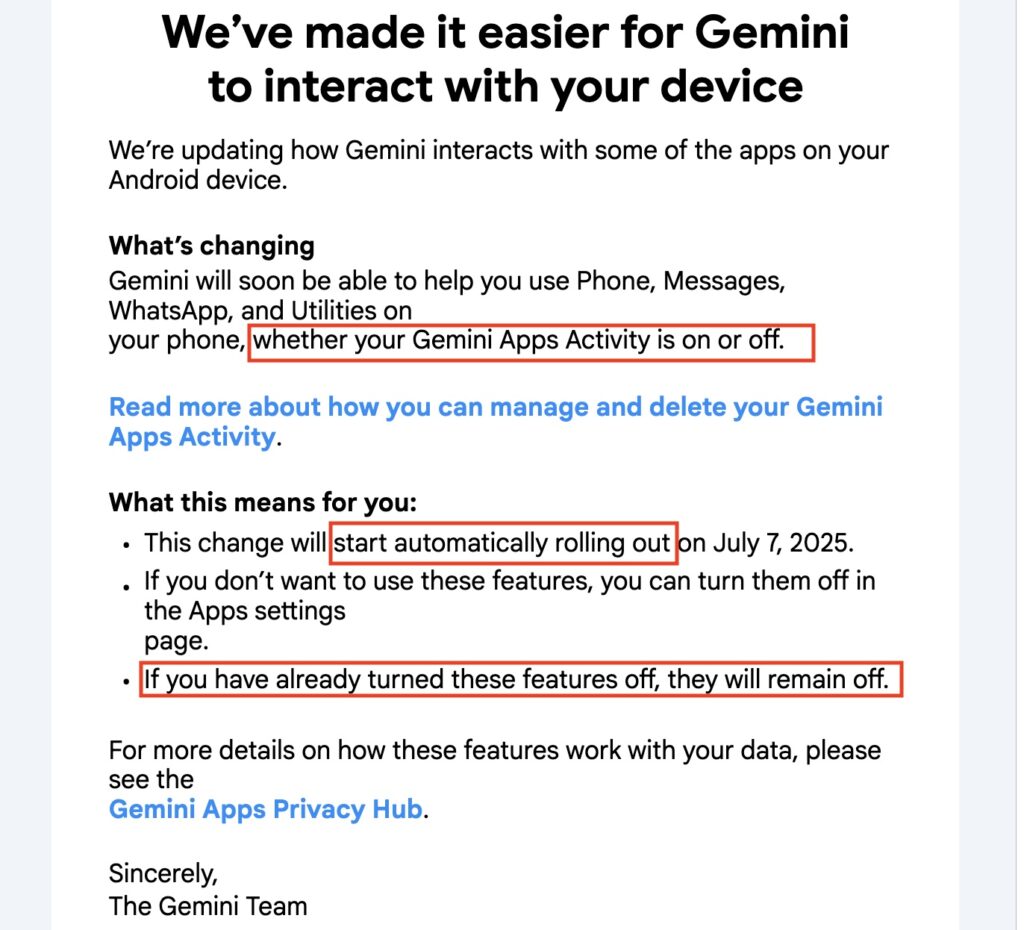
Starting today, Google is implementing a change that will enable its Gemini AI engine to interact with third-party apps, such as WhatsApp, even when users previously configured their devices to block such interactions. Users who don't want their previous settings to be overridden may have to take action.

An email Google sent recently informing users of the change linked to a notification page that said that “human reviewers (including service providers) read, annotate, and process” the data Gemini accesses. The email provides no useful guidance for preventing the changes from taking effect. The email said users can block the apps that Gemini interacts with, but even in those cases, data is stored for 72 hours.

An email Google recently sent to Android users.

No, Google, it’s not good news

The email never explains how users can fully extricate Gemini from their Android devices and seems to contradict itself on how or whether this is even possible. At one point, it says the changes “will automatically start rolling out” today and will give Gemini access to apps such as WhatsApp, Messages, and Phone “whether your Gemini apps activity is on or off.” A few sentences later, the email says, “If you have already turned these features off, they will remain off.” Nowhere in the email or the support pages it links to are Android users informed how to remove Gemini integrations completely.

Read full article

Comments

Nintendo warns Switch 2 GameChat users: “Your chat is recorded”

Last month, ahead of the launch of the Switch 2 and its GameChat communication features, Nintendo updated its privacy policy to note that the company "may also monitor and record your video and audio interactions with other users." Now that the Switch 2 has officially launched, we have a clearer understanding of how the console handles audio and video recorded during GameChat sessions, as well as when that footage may be sent to Nintendo or shared with partners, including law enforcement.

Before using GameChat on Switch 2 for the first time, you must consent to a set of GameChat Terms displayed on the system itself. These terms warn that chat content is "recorded and stored temporarily" both on your system and the system of those you chat with. But those stored recordings are only shared with Nintendo if a user reports a violation of Nintendo's Community Guidelines, the company writes.

That reporting feature lets a user "review a recording of the last three minutes of the latest three GameChat sessions" to highlight a particular section for review, suggesting that chat sessions are not being captured and stored in full. The terms also lay out that "these recordings are available only if the report is submitted within 24 hours," suggesting that recordings are deleted from local storage after a full day.

Read full article

Comments

© Aurich Lawson | Nintendo

Spy-catcher saw “stupid” tech errors others made. FBI says he then made his own.

Twenty-eight-year-old Nathan Laatsch was, until yesterday, a cybersecurity employee at the Defense Intelligence Agency (DIA). He had a Top Secret clearance and worked in the Insider Threat Division. Laatsch spent his days—you'll understand the past tense in a moment—"enabling user monitoring on individuals with access to DIA systems," including employees under surreptitious internal investigation.

Given that Laatsch was one of those who "watched the watchers," he appears to have had supreme confidence in his own ability to avoid detection should he decide to go rogue. "Stupid mistakes" made by other idiots would "not be difficult for me to avoid," he once wrote. DIA couldn't even launch an investigation of Laatsch without him knowing that something was up.

The Greeks had a word for this: hubris.

Read full article

Comments

© Getty Images

❌