Visualização de leitura

With developer verification, Google's Apple envy threatens to dismantle Android's open legacy

It's been nearly 20 years since Google revealed Android, which the company described as the first "truly open" mobile operating system, setting Google-powered phones apart from the iPhone's aggressively managed experience. Over time, though, Android has become more aligned with Apple's approach. For the moment, users still have the final say in what software runs on their increasingly locked-down smartphones. Later this year, though, Google plans to seriously curtail that freedom in the name of security.

In the coming weeks, Google will officially debut Android developer verification, which will require app makers outside the Play Store to register with their real names and pay a fee to Google. Failure to do so will block their apps from installation (sometimes called sideloading) on virtually all Android devices. Google says this is a necessary evolution of the platform's security model, but upending the status quo could push developers away from Android and risk the privacy of those that remain.

This might make your phone a little safer, sure, but it won't stop people from getting scammed. At the same time, it could rob the Android ecosystem of what made it special in the first place.


Read full article

Comments

© Aurich Lawson | Getty Images

Unless users take action, Android will let Gemini access third-party apps

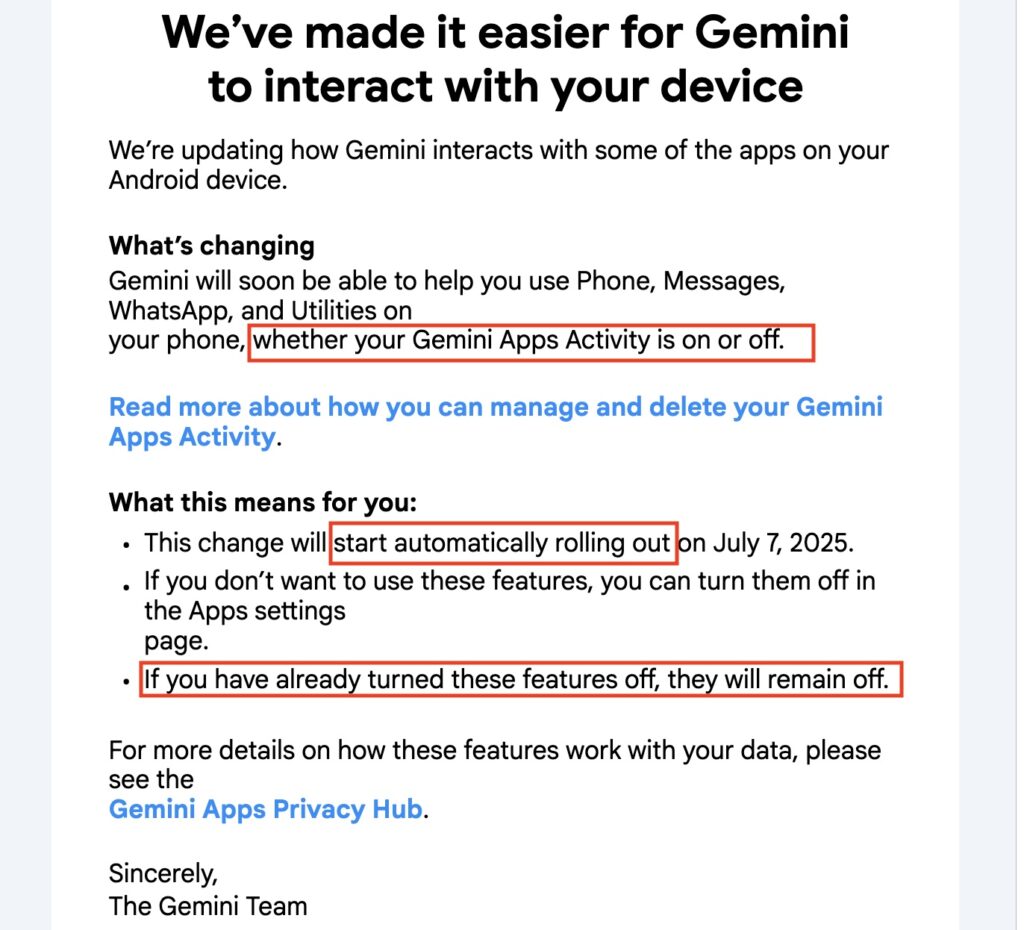
Starting today, Google is implementing a change that will enable its Gemini AI engine to interact with third-party apps, such as WhatsApp, even when users previously configured their devices to block such interactions. Users who don't want their previous settings to be overridden may have to take action.

An email Google sent recently informing users of the change linked to a notification page that said that “human reviewers (including service providers) read, annotate, and process” the data Gemini accesses. The email provides no useful guidance for preventing the changes from taking effect. The email said users can block the apps that Gemini interacts with, but even in those cases, data is stored for 72 hours.

An email Google recently sent to Android users.
No, Google, it’s not good news

The email never explains how users can fully extricate Gemini from their Android devices and seems to contradict itself on how or whether this is even possible. At one point, it says the changes “will automatically start rolling out” today and will give Gemini access to apps such as WhatsApp, Messages, and Phone “whether your Gemini apps activity is on or off.” A few sentences later, the email says, “If you have already turned these features off, they will remain off.” Nowhere in the email or the support pages it links to are Android users informed how to remove Gemini integrations completely.

Read full article

Comments

Google introduces Advanced Protection mode for its most at-risk Android users

Google is adding a new security setting to Android to provide an extra layer of resistance against attacks that infect devices, tap calls traveling through insecure carrier networks, and deliver scams through messaging services.

On Tuesday, the company unveiled the Advanced Protection mode, most of which will be rolled out in the upcoming release of Android 16. The setting comes as mercenary malware sold by NSO Group and a cottage industry of other exploit sellers continues to thrive. These players provide attacks-as-a-service through end-to-end platforms that exploit zero-day vulnerabilities on targeted devices, infect them with advanced spyware, and then capture contacts, message histories, locations, and other sensitive information. Over the past decade, phones running fully updated versions of Android and iOS have routinely been hacked through these services.

A core suite of enhanced security features

Advanced Protection is Google’s latest answer to this type of attack. By flipping a single button in device settings, users can enable a host of protections that can thwart some of the most common techniques used in sophisticated hacks. In some cases, the protections hamper performance and capabilities of the device, so Google is recommending the new mode mainly for journalists, elected officials, and other groups who are most often targeted or have the most to lose when infected.

Read full article

Comments

© Getty Images

iOS and Android juice jacking defenses have been trivial to bypass for years

About a decade ago, Apple and Google started updating iOS and Android, respectively, to make them less susceptible to “juice jacking,” a form of attack that could surreptitiously steal data or execute malicious code when users plug their phones into special-purpose charging hardware. Now, researchers are revealing that, for years, the mitigations have suffered from a fundamental defect that has made them trivial to bypass.

“Juice jacking” was coined in a 2011 article on KrebsOnSecurity detailing an attack demonstrated at a Defcon security conference at the time. Juice jacking works by equipping a charger with hidden hardware that can access files and other internal resources of phones, in much the same way that a computer can when a user connects it to the phone.

An attacker would then make the chargers available in airports, shopping malls, or other public venues for use by people looking to recharge depleted batteries. While the charger was ostensibly only providing electricity to the phone, it was also secretly downloading files or running malicious code on the device behind the scenes. Starting in 2012, both Apple and Google tried to mitigate the threat by requiring users to click a confirmation button on their phones before a computer—or a computer masquerading as a charger—could access files or execute code on the phone.

Read full article

Comments

© Aurich Lawson | Getty Images

Android phones will soon reboot themselves after sitting unused for 3 days

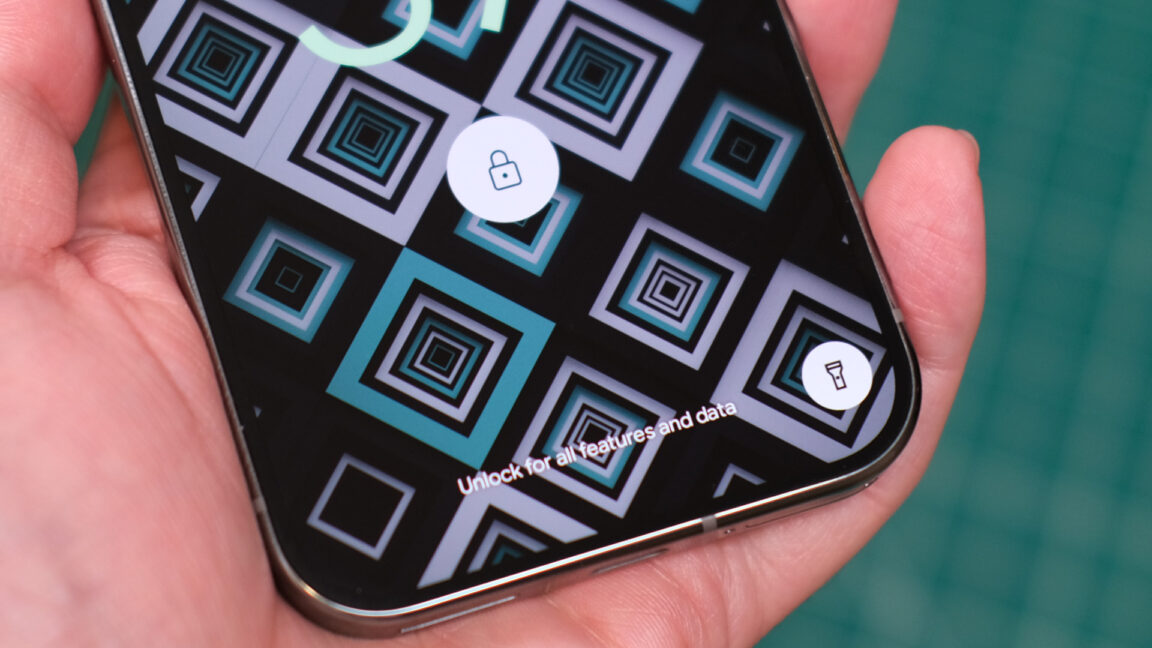
A silent update rolling out to virtually all Android devices will make your phone more secure, and all you have to do is not touch it for a few days. The new feature implements auto-restart of a locked device, which will make your personal data harder to extract. It's coming as part of a Google Play Services update, though, so there's nothing you can do to speed along the process.

Google is preparing to release a new update to Play Services (v25.14), which brings a raft of tweaks and improvements. First spotted by 9to5Google, the update was officially released on April 14, but as with all Play Services updates, it could take a week or more to reach all devices. When 25.14 arrives, Android devices will see a few minor improvements, including prettier settings screens, improved connection with cars and watches, and content previews when using Quick Share.

Most importantly, Play Services 25.14 adds a feature that Google describes thusly: "With this feature, your device automatically restarts if locked for 3 consecutive days."

Read full article

Comments

© Ryan Whitwam

❌