Visualização de leitura

CVE-2026-23918: Critical Apache HTTP/2 Flaw Can Trigger DoS and Possible RCE

Apache has patched CVE-2026-23918, a critical flaw in Apache HTTP Server’s HTTP/2 handling that Apache describes as a “double free and possible RCE.” The issue affects Apache HTTP Server 2.4.66 and was fixed in 2.4.67, released on May 4, 2026.

The CVE-2026-23918 vulnerability matters because it can be abused remotely and without authentication. Public reporting says the bug can cause a denial-of-service condition and, under certain conditions, may also open a path to remote code execution, making it one of the most serious issues addressed in Apache’s latest security release.

Apache credits Bartlomiej Dmitruk of striga.ai and Stanislaw Strzalkowski of isec.pl with reporting the flaw. Apache’s own vulnerability page shows it was reported to the security team on December 10, 2025, fixed in source on December 11, 2025, and shipped to users in the 2.4.67 release months later.

CVE-2026-23918 analysis

According to Apache and researcher commentary cited by The Hacker News, the bug is a double-free in mod_http2, specifically in the stream cleanup path. It can be triggered when a client sends an HTTP/2 HEADERS frame and then immediately sends RST_STREAM with a non-zero error code before the stream is fully registered by the multiplexer.

That sequence can cause two callbacks to run in a way that pushes the same stream object into the cleanup array twice. When Apache later destroys the stream entries, memory that has already been freed gets released again. In practical terms, the vulnerability in CVE-2026-23918 is a memory-management flaw that can crash worker processes and, in the right environment, be shaped into code execution.

The denial-of-service path appears to be the easiest outcome. The researchers told The Hacker News that one TCP connection and two HTTP/2 frames are enough to crash a worker in default deployments that use mod_http2 with a multi-threaded MPM. They also noted that MPM prefork is not affected, while the possible RCE path depends on an APR configuration using the mmap allocator, which is said to be the default on Debian-derived systems and in the official httpd Docker image.

As for exploitation maturity, public reporting says the researchers built a working CVE-2026-23918 poc for x86_64 in lab conditions. They also said practical exploitation still needs helpful conditions such as an information leak and favorable memory reuse, so code execution is more demanding than simple service disruption.

At this stage, public details for CVE-2026-23918 point much more clearly to process crashes and worker instability than to widely reproducible RCE in the field. There are also no vendor-published CVE-2026-23918 iocs, so defenders should focus on version exposure, unexpected worker crashes, and suspicious HTTP/2 reset patterns rather than on a stable signature set.

Explore Detections

CVE-2026-23918 Mitigation

The core fix is to upgrade Apache HTTP Server from 2.4.66 to 2.4.67. Apache’s security advisory explicitly recommends moving to the patched version, and SecurityWeek notes that the release fixes 11 vulnerabilities, including this critical HTTP/2 issue.

For immediate triage, defenders should identify internet-facing systems where mod_http2 is enabled and where threaded MPMs are in use. That is the most practical way to detect CVE-2026-23918 exposure because the attack hinges on HTTP/2 request handling, not on a dropped malware artifact or traditional post-exploitation beacon.

If emergency patching is delayed, reducing exposure to HTTP/2 traffic may help shrink the attack surface until updates are applied. The CVE-2026-23918 payload described publicly is not a conventional file or binary but a crafted sequence of HTTP/2 frames designed to force the faulty cleanup path, so network-facing Apache instances should be prioritized first.

From a risk perspective, CVE-2026-23918 affects organizations that rely on Apache HTTP Server 2.4.66 for public web workloads, especially where HTTP/2 is enabled by default or broadly deployed for performance reasons. That includes standard Linux-based web servers as well as containerized deployments using the official Apache image.

FAQ

What is CVE-2026-23918 and how does it work?

It is a critical double-free flaw in Apache HTTP Server’s HTTP/2 handling. A specially timed sequence of HTTP/2 frames can push the same stream object into cleanup twice, leading to worker crashes and potentially enabling remote code execution under favorable conditions.

When was CVE-2026-23918 first discovered?

Apache’s vulnerability page says the issue was reported to the security team on December 10, 2025. The fix landed in source on December 11, 2025, and the patched 2.4.67 release was published on May 4, 2026.

What is the impact of CVE-2026-23918 on systems?

The most immediate impact is denial of service through crashed Apache workers. Public reporting also says the flaw may allow remote code execution, although that path appears more complex and environment-dependent than the crash scenario.

Can CVE-2026-23918 still affect me in 2026?

Yes. Systems can still be exposed in 2026 if they are running Apache HTTP Server 2.4.66 with mod_http2 enabled and have not yet been updated to 2.4.67. The risk is especially relevant for deployments using threaded MPMs.

How can I protect myself from CVE-2026-23918?

Upgrade to Apache HTTP Server 2.4.67 as soon as possible, identify exposed HTTP/2-enabled deployments, and prioritize externally reachable servers for remediation. Where patching cannot happen immediately, reducing HTTP/2 exposure can help lower short-term risk.


The post CVE-2026-23918: Critical Apache HTTP/2 Flaw Can Trigger DoS and Possible RCE appeared first on SOC Prime.


CVE-2026-0300: Palo Alto PAN-OS Zero-Day Enables Root RCE on Exposed Firewalls

Edge security appliances remain high-value targets, especially when a flaw can be exploited before a patch is widely available. The CVE-2026-0300 vulnerability is a critical buffer overflow in the User-ID Authentication Portal, also known as Captive Portal, in Palo Alto Networks PAN-OS. Palo Alto rates it 9.3/10 when the portal is exposed to the internet or other untrusted networks, and says an unauthenticated attacker can execute arbitrary code with root privileges on affected PA-Series and VM-Series firewalls by sending specially crafted packets.

For teams beginning CVE-2026-0300 analysis, the most important details for CVE-2026-0300 are the exposure conditions: the issue applies only when User-ID Authentication Portal is enabled, and Palo Alto says risk is greatly reduced when access is limited to trusted internal IP addresses. The company also says limited exploitation has already been observed against portals exposed to untrusted IP space or the public internet.

In practice, CVE-2026-0300 affects only PA-Series and VM-Series firewalls configured to use the User-ID Authentication Portal. Prisma Access, Cloud NGFW, and Panorama are not impacted, which makes configuration review as important as version review when triaging exposure.

CVE-2026-0300 analysis

The vulnerability in CVE-2026-0300 is a buffer overflow in PAN-OS’s User-ID Authentication Portal service. According to Palo Alto, exploitation does not require credentials or user interaction, and the attacker’s goal is remote code execution as root through specially crafted network packets. SecurityWeek likewise describes the flaw as a zero-day used to hack some firewall models, underscoring that this is not a theoretical issue.

The publicly described CVE-2026-0300 payload is not a malware file dropped to disk but a malicious packet sequence sent to the Captive Portal component. Neither the vendor advisory nor the cited media reports includes a public CVE-2026-0300 poc, but the confirmed in-the-wild exploitation means defenders should assume capable threat actors already understand the triggering conditions well enough to weaponize them.

From a risk standpoint, CVE-2026-0300 detection should focus on externally reachable Authentication Portal instances and signs of attempted access to that service from untrusted networks. Palo Alto’s advisory does not publish packet-level CVE-2026-0300 iocs, so defenders are better served by identifying exposed portal configurations, narrowing allowed source IP ranges, and prioritizing internet-facing firewalls for remediation.

Explore Detections

CVE-2026-0300 Mitigation

Effective CVE-2026-0300 mitigation starts with reducing exposure before fixes land. Palo Alto recommends either restricting User-ID Authentication Portal access to trusted zones/internal IP addresses or disabling the portal entirely if it is not required. That advice is especially important because, at disclosure, the flaw was still unpatched, with the first wave of fixes expected on May 13, 2026 and additional releases on May 28, 2026 across supported 12.1, 11.2, 11.1, and 10.2 trains.

To Detect CVE-2026-0300 exposure in your environment, verify whether Device > User Identification > Authentication Portal Settings has the portal enabled and determine whether it is reachable from the internet or any untrusted network segment. Palo Alto’s advisory makes clear that customers following this hardening model are at greatly reduced risk compared with deployments that leave the service publicly accessible.

Organizations should also map affected firewalls to Palo Alto’s target fixed versions and prepare an upgrade plan as soon as the relevant release becomes available. Because limited exploitation is already underway, this is a case where configuration hardening and emergency change control should happen in parallel rather than waiting for normal maintenance windows.

FAQ

What is CVE-2026-0300 and how does it work?

CVE-2026-0300 is a critical PAN-OS buffer overflow in the User-ID Authentication Portal (Captive Portal). Palo Alto says an unauthenticated attacker can send specially crafted packets to the service and achieve arbitrary code execution with root privileges on affected PA-Series and VM-Series firewalls.

When was CVE-2026-0300 first discovered?

Palo Alto’s advisory says the issue was discovered in production use and was published on May 5, 2026. The public coverage from The Hacker News and SecurityWeek followed on May 6, 2026.

What is the impact of CVE-2026-0300 on systems?

The impact is severe: unauthenticated remote code execution as root on exposed firewalls. Because the flaw affects security infrastructure at the network edge, successful exploitation could give an attacker privileged control over a highly sensitive enforcement point.

Can CVE-2026-0300 still affect me in 2026?

Yes. Any affected PA-Series or VM-Series firewall can still be at risk in 2026 if it has User-ID Authentication Portal enabled and exposed to untrusted IP addresses or the public internet, especially until the relevant patched PAN-OS release is installed.

How can I protect myself from CVE-2026-0300?

Restrict User-ID Authentication Portal access to trusted internal IPs, disable it if it is unnecessary, and move to Palo Alto’s fixed PAN-OS builds as soon as they are available for your release train. The vendor explicitly says these steps materially reduce risk while active exploitation continues.


The post CVE-2026-0300: Palo Alto PAN-OS Zero-Day Enables Root RCE on Exposed Firewalls appeared first on SOC Prime.

CVE-2026-41940: Critical cPanel & WHM Authentication Bypass Exposes Hosting Servers to Admin Takeover

A newly disclosed CVE-2026-41940 vulnerability in cPanel & WHM has put internet-facing hosting infrastructure under urgent scrutiny. The flaw carries a CVSS score of 9.8 and can let an unauthenticated remote attacker bypass authentication and gain administrative access, while cPanel’s advisory says the issue affects cPanel software, including DNSOnly, across all versions after 11.40.

For defenders, CVE-2026-41940 detection should focus on exposed control panel instances, emergency patch validation, and session-file triage rather than malware hunting. Hosting provider KnownHost said the flaw was being actively exploited in the wild, and that a public technical analysis plus exploit code had already been released by watchTowr, raising the likelihood of broader opportunistic abuse.

The business risk is substantial because successful exploitation can give attackers control over the cPanel host, its configurations and databases, and the websites it manages. A simple Shodan query returned roughly 1.5 million exposed cPanel instances, underscoring how much attack surface may be available to both targeted and mass scanning activity.

CVE-2026-41940 analysis

The bug is describes as an authentication bypass rooted in CRLF injection during the login and session-loading process in cPanel & WHM. According to its technical overview, cpsrvd writes a new session file to disk before authentication completes, and an attacker can manipulate the whostmgrsession cookie so attacker-controlled values avoid the expected encryption path and are written into the session file unsanitized.

In practical terms, the vulnerability in CVE-2026-41940 lets an attacker inject arbitrary properties such as user=root into a session file, then trigger a reload so the application treats the session as administrative. That is why this issue is especially dangerous for shared hosting environments and server operators: it is not merely a login bug, but a route to privileged control over the management plane itself.

Unlike a malware dropper, the CVE-2026-41940 payload is a crafted authentication request that abuses newline injection and malformed session values to poison pre-auth session data. A public CVE-2026-41940 poc was already available through third-party research.

Official details for CVE-2026-41940 are broader than the exploit mechanics alone. cPanel says the issue affects cPanel software including DNSOnly, while patched builds were issued for 11.86.0.41, 11.110.0.97, 11.118.0.63, 11.126.0.54, 11.130.0.19, 11.132.0.29, 11.134.0.20, and 11.136.0.5, alongside WP Squared 136.1.7. TheCyberExpress also highlighted that administrators must verify the installed version and restart cpsrvd after updating.

Just as importantly, CVE-2026-41940 affects not only directly exposed cPanel & WHM systems but also operational workflows that rely on pinned builds or disabled automatic updates. That matters because cPanel warned that such servers will not auto-update and must be manually remediated as a priority, while unsupported versions may also remain exposed until organizations move to supported release tracks.

Explore Detections

CVE-2026-41940 Mitigation

The vendor’s primary guidance is straightforward: update immediately to one of the fixed versions using /scripts/upcp –force, confirm the installed build with /usr/local/cpanel/cpanel -V, and restart the service with /scripts/restartsrv_cpsrvd. cPanel also says administrators should manually identify systems where updates are disabled or version pinning prevents automatic remediation.

When patching cannot happen right away, cPanel recommends temporary containment steps that include blocking inbound traffic on ports 2083, 2087, 2095, and 2096 at the firewall or stopping cpsrvd and cpdavd. TheCyberExpress echoed the same short-term advice and noted that some providers restricted panel access while broader patch rollout was underway.

To detect CVE-2026-41940, defenders should use the vendor’s filesystem-based detection script and review suspicious entries under /var/cpanel/sessions. cPanel’s script looks for session artifacts such as token_denied appearing together with cp_security_token, authenticated attributes inside pre-auth sessions, suspicious tfa_verified states, and malformed multi-line password values. Those published checks effectively act as CVE-2026-41940 iocs for post-exploitation triage.

If the script flags likely compromise, cPanel says defenders should purge affected sessions, force password resets for root and all WHM users, audit /var/log/wtmp and WHM access logs, and look for persistence such as cron entries, SSH keys, or backdoors. In other words, CVE-2026-41940 mitigation should be handled as both patching and incident response, not just a routine version upgrade. When patching cannot happen right away, cPanel recommends temporary containment steps that include blocking inbound traffic on ports 2083, 2087, 2095, 2096 and http ports 2082, 2086 at the firewall.

FAQ

What is CVE-2026-41940 and how does it work?

It is a critical cPanel & WHM authentication bypass flaw that stems from session handling and CRLF injection in the login/session-loading flow. Attackers can manipulate pre-auth session data and ultimately create administrator-level access without valid credentials.

When was CVE-2026-41940 first discovered?

The private discovery date has not been publicly disclosed in the sources reviewed. Publicly, cPanel acknowledged the issue in a security advisory published on April 28, 2026.

What is the impact of CVE-2026-41940 on systems?

Successful exploitation can give an unauthenticated attacker administrative access to cPanel & WHM, which can translate into control over the host system, configurations, databases, and hosted websites. In shared hosting environments, that can turn a panel compromise into a full platform compromise.

Can CVE-2026-41940 still affect me in 2026?

Yes. Any exposed system that has not been updated to a fixed build can still be at risk in 2026, especially if automatic updates are disabled, the server is pinned to a vulnerable version, or it is running an unsupported release that has not yet been moved to a supported patched branch.

How can I protect myself from CVE-2026-41940?

Apply the vendor’s patched build immediately, restart cpsrvd, run the detection script against /var/cpanel/sessions, review for suspicious session artifacts, and treat any confirmed hit as a possible compromise requiring session purges, password resets, and log review. Short-term firewall restrictions can reduce exposure, but cPanel make clear that patching is the priority.


The post CVE-2026-41940: Critical cPanel & WHM Authentication Bypass Exposes Hosting Servers to Admin Takeover appeared first on SOC Prime.
CVE-2026-28950: Apple Fixes iOS Flaw That Retained Deleted Notification Data

Apple has released security updates to address a Notification Services issue in iOS and iPadOS that could cause alerts marked for deletion to remain stored on a device. The fix was delivered in iOS 26.4.2 / iPadOS 26.4.2 and iOS 18.7.8 / iPadOS 18.7.8, where Apple says the problem was resolved through improved data redaction.

The issue drew attention because it was patched outside Apple’s normal release cycle and was publicly linked to concerns that deleted notification content could remain recoverable on affected devices. Based on public reporting, the flaw may have allowed sensitive message previews to persist in internal notification storage longer than users would reasonably expect.

For defenders and privacy-focused users, the key concern is not traditional remote exploitation but unintended data retention. At the time of disclosure, Apple did not publish exploit samples, telemetry artifacts, or a public proof-of-concept, leaving many technical details for CVE-2026-28950 limited to the vendor advisory and media reporting.

CVE-2026-28950 analysis

Apple describes the issue as a logging-related flaw in Notification Services that allowed notifications intended for deletion to be unexpectedly retained on the device. In practice, this means content visible in alerts, such as message previews or other app-generated text, may continue to exist in local storage after the user assumes it has been removed.

Public reporting connected the patch to earlier forensic concerns involving message content recovered from notification storage on iPhones. While Apple did not explicitly confirm those reports as the direct trigger for the update, the description of the flaw closely aligns with the broader privacy risk described in public coverage.

Explore Detections

The main security impact is on confidentiality rather than integrity or availability. The problem is especially relevant in environments where lock-screen notifications or mobile message previews may expose regulated, operational, or otherwise sensitive information. From that standpoint, the CVE-2026-28950 vulnerability is best understood as a privacy and data-remanence issue rather than a conventional code-execution bug.

Public reporting also leaves several gaps. Apple did not assign a public CVSS score in the cited coverage, and there are no published network indicators or forensic signatures that would support classic threat hunting. As a result, organizations should focus on version validation and privacy controls rather than looking for a known CVE-2026-28950 payload or a fixed list of CVE-2026-28950 IOCs.

CVE-2026-28950 Mitigation

The primary response is to install Apple’s fixed releases across affected iPhone and iPad fleets. Security teams should verify that supported devices have moved to the patched versions and prioritize users who regularly handle confidential communications, executive discussions, legal material, or regulated data on mobile devices.

An additional defense-in-depth step is to reduce the amount of sensitive information shown in notifications. Public reporting notes that Signal users, for example, can limit what appears in alerts by changing notification content settings to display less message text. While that does not replace patching, it can reduce exposure where private data might otherwise remain accessible in notification storage.

From an operational perspective, the most practical path is simple: inventory devices, confirm version compliance, and review notification-preview policies for high-risk user groups. This is a more realistic protection strategy than trying to Detect CVE-2026-28950 through conventional threat indicators, because the issue centers on retained local data rather than a well-documented exploit chain.

Additionally, by leveraging SOC Prime’s AI-Native Detection Intelligence Platform backed by top cyber defense expertise, global organizations can adopt a resilient security posture and transform their SOC to always stay ahead of emerging threats tied to zero-day exploitation.

FAQ

What is CVE-2026-28950 and how does it work?

It is an iOS and iPadOS Notification Services flaw that could cause deleted notifications to remain stored on a device. Apple says the problem was caused by a logging issue and addressed it through improved data redaction.

When was CVE-2026-28950 first discovered?

The public sources do not provide a private discovery date. What is confirmed is that Apple released fixes on April 22, 2026.

What is the impact of CVE-2026-28950 on systems?

The main impact is exposure of sensitive notification content that may remain on the device after deletion. This can matter in forensic, privacy, or device-access scenarios where retained alert data could reveal message previews or other confidential content.

Can CVE-2026-28950 still affect me in 2026?

Yes. Devices that have not been updated to the patched releases may still be exposed during 2026, particularly if apps display sensitive content in notifications.

How can I protect myself from CVE-2026-28950?

Install Apple’s updates, verify device compliance, and reduce sensitive notification previews where possible. For privacy-sensitive environments, limiting the amount of message content shown in alerts is a sensible additional safeguard. If you want, I can now also make the meta title, meta description, and excerpt match this less-keyword-stuffed style.


The post CVE-2026-28950: Apple Fixes iOS Flaw That Retained Deleted Notification Data appeared first on SOC Prime.

CVE-2026-40372: Critical ASP.NET Core Flaw May Let Attackers Gain SYSTEM Privileges

CVE-2026-40372 detection

Microsoft has released out-of-band updates for CVE-2026-40372, a high-impact ASP.NET Core privilege-escalation vulnerability tied to the platform’s Data Protection cryptographic APIs. Public reporting says the flaw carries a CVSS score of 9.1 and could allow an unauthenticated attacker to forge authentication material and ultimately obtain SYSTEM privileges on affected systems.

The issue stands out not only because of its severity, but also because it was serious enough to trigger an emergency release outside the normal patch cycle. BleepingComputer reports Microsoft investigated after customers saw decryption failures following the .NET 10.0.6 update, while The Hacker News notes the bug was reported by an anonymous researcher and fixed in ASP.NET Core 10.0.7.

CVE-2026-40372 Analysis

According to Microsoft details cited by both publications, CVE-2026-40372 stems from improper verification of a cryptographic signature in ASP.NET Core. More specifically, the affected Microsoft.AspNetCore.DataProtection 10.0.0–10.0.6 NuGet packages could compute the HMAC validation tag over the wrong bytes of the payload and then discard the computed hash in some cases. That breaks the trust model behind protected application data and opens the door to forged payloads that pass authenticity checks.

The attack surface is narrower than a generic “all ASP.NET Core apps are vulnerable” headline might suggest. The Hacker News says successful exploitation depends on three conditions: the application must use Microsoft.AspNetCore.DataProtection 10.0.6 from NuGet either directly or through a dependent package, the NuGet copy must actually be loaded at runtime, and the application must run on Linux, macOS, or another non-Windows operating system.

Explore Detections

If those conditions are met, the impact can be severe. The affected validation routine may let an attacker forge payloads and decrypt previously protected values stored in items such as authentication cookies, antiforgery tokens, TempData, and OpenID Connect state. Microsoft also says exploitation could enable file disclosure and data modification, although it does not affect availability.

The most dangerous enterprise scenario is privilege escalation through trust abuse rather than noisy code execution. If an attacker can authenticate as a privileged user during the vulnerable window, the application may issue legitimately signed follow-on artifacts to the attacker, including refreshed sessions, API keys, or password-reset links. Those artifacts can remain valid even after the package is upgraded unless defenders also rotate the Data Protection key ring.

CVE-2026-40372 Mitigation

The primary fix is straightforward: update Microsoft.AspNetCore.DataProtection to version 10.0.7 and redeploy affected applications. Microsoft’s guidance, as quoted by BleepingComputer, is to apply the new package as soon as possible so the broken validation routine is corrected and forged payloads are rejected going forward.

That said, patching alone may not fully close the exposure. Both reports note that tokens issued during the vulnerable period can remain valid after upgrading unless the Data Protection key ring is rotated. In practice, organizations should treat key rotation as part of the remediation workflow, especially for internet-facing apps that rely heavily on cookies, antiforgery tokens, password-reset flows, or other signed application state. That last prioritization is an operational inference based on the affected token types and exploit preconditions.

A practical response plan is to identify non-Windows ASP.NET Core applications that loaded the vulnerable NuGet package at runtime, patch them to 10.0.7, rotate the Data Protection key ring, and review whether privileged sessions or other signed artifacts may have been issued while the application was exposed. Where feasible, teams should also consider expiring or reissuing sensitive session material after remediation. The package-and-runtime triage criteria come directly from Microsoft’s published conditions; the token review and reissuance step is a reasonable defensive inference from Microsoft’s warning that legitimately signed tokens may survive the upgrade.

Additionally, by leveraging SOC Prime’s AI-Native Detection Intelligence Platform backed by top cyber defense expertise, global organizations can adopt a resilient security posture and transform their SOC to always stay ahead of emerging threats tied to zero-day exploitation.

FAQ

What is CVE-2026-40372 and how does it work?

CVE-2026-40372 is an ASP.NET Core privilege-escalation flaw in the Data Protection cryptographic APIs. The affected packages can validate the wrong bytes and discard the computed HMAC in some cases, which can let attackers forge protected payloads and abuse application trust mechanisms such as authentication cookies and other signed state.

When was CVE-2026-40372 first discovered?

The precise private discovery date is not stated in the two reports. What is public is that Microsoft released out-of-band fixes on April 22, 2026, and BleepingComputer says Microsoft began investigating after customers reported decryption failures following the .NET 10.0.6 update. The Hacker News also says an anonymous researcher was credited with reporting the flaw.

What is the impact of CVE-2026-40372 on systems?

Successful exploitation can allow forged payloads, disclosure of protected data, file disclosure, data modification, and privilege escalation up to SYSTEM on affected systems. The reports also note that availability is not impacted.

Can CVE-2026-40372 still affect me in 2026?

Yes. Systems may still be exposed in 2026 if they continue to run the vulnerable Data Protection package under the affected conditions, especially on Linux, macOS, or other non-Windows hosts. Even after patching, artifacts issued during the vulnerable window may remain valid until the Data Protection key ring is rotated.

How can I protect myself from CVE-2026-40372?

Update Microsoft.AspNetCore.DataProtection to 10.0.7, redeploy affected applications, rotate the Data Protection key ring, and review whether sensitive signed artifacts such as authentication cookies, refresh sessions, API keys, or reset links should be invalidated or reissued. The package update and key-ring rotation are directly supported by Microsoft’s guidance; invalidation and reissuance are prudent follow-on actions based on the risk Microsoft described.


The post CVE-2026-40372: Critical ASP.NET Core Flaw May Let Attackers Gain SYSTEM Privileges appeared first on SOC Prime.

UAC-0247 Attack Detection: AGINGFLY Malware Targets Hospitals, Local Governments, and FPV Operators in Ukraine

Phishing remains one of the most effective tactics in the cybercriminal playbook, particularly when attackers exploit urgent humanitarian themes, trusted online resources, and legitimate system tools to increase victim engagement. Europol also notes that phishing continues to serve as a primary delivery vector for data-stealing malware. This pattern is clearly reflected in the latest activity tracked by CERT-UA, where threat actors used humanitarian-aid themed lures and multi-stage malware delivery to target Ukrainian organizations.

In a CERT-UA article, researchers described a UAC-0247 campaign targeting local self-government bodies, communal healthcare institutions, and likely representatives of Ukraine’s Defense Forces. The operation ultimately deployed AGINGFLY and related malicious tools, combining phishing, deceptive web delivery, and abuse of legitimate Windows utilities to establish access and support follow-on compromise.

CERT-UA’s latest reporting highlights another wave of phishing-driven intrusions targeting Ukraine’s civilian and potentially defense-adjacent sectors. In the campaign described in the article, attackers used humanitarian-aid themed emails to lure victims into opening malicious content that eventually deployed AGINGFLY, a malware family associated with remote access, credential theft, and follow-on post-compromise activity. The observed targets included local self-government bodies, communal healthcare institutions, including clinical and emergency hospitals, and likely individuals connected to FPV drone operations.

Sign up for the SOC Prime Platform to proactively defend your organization against UAC-0247 attacks. Just press Explore Detections below and access a relevant detection rule stack, enriched with AI-native CTI, mapped to the MITRE ATT&CK® framework, and compatible with a wide range of SIEM, EDR, and Data Lake technologies.

Security teams can search the Threat Detection Marketplace using the “UAC-0247” tag to identify relevant detections and monitor related content updates. Cyber defenders can also rely on Uncoder AI to convert raw threat intelligence into performance-optimized queries, document and improve rule logic, and generate Attack Flows based on the latest CERT-UA reporting.

Explore Detections

Analyzing UAC-0247 Attacks Delivering AGINGFLY via Humanitarian-Themed Phishing Lures

According to CERT-UA, the attack chain began with phishing emails disguised as humanitarian aid proposals. Victims were prompted to click a link that redirected either to a legitimate website compromised through cross-site scripting (XSS) or to a fake website generated with AI tools. In both scenarios, the objective was to persuade the victim to download and open an archive containing a malicious LNK file.

Once launched, the shortcut file abused mshta.exe to retrieve and execute a remote HTA file. The HTA displayed a decoy form to distract the victim while simultaneously downloading an executable that injected shellcode into a legitimate process, such as RuntimeBroker.exe. CERT-UA also noted that more recent stages of the campaign relied on a two-stage loader, with the second stage using a proprietary executable format and the final payload additionally compressed and encrypted to complicate detection and analysis.

Among the next-stage components identified in the campaign were RAVENSHELL, which acted as a reverse-shell style stager, SILENTLOOP, a PowerShell-based tool capable of executing commands and obtaining command-and-control data, and AGINGFLY, the primary malware family used in the operation. CERT-UA-linked reporting indicates that AGINGFLY is designed for remote control, data theft, and follow-on compromise activity.

The campaign also supported credential theft, reconnaissance, and lateral movement. Investigators observed the use of tooling to extract data from Chromium-based browsers, access messaging-related data, scan internal networks, and tunnel traffic across compromised environments. In one of the investigated cases, forensic evidence suggested that representatives of Ukraine’s Defense Forces may have been targeted using malicious ZIP archives distributed via Signal and designed to deploy AGINGFLY through DLL side-loading.

To reduce exposure to this activity, CERT-UA recommends restricting the execution of risky file types such as LNK, HTA, and JS, while also limiting or closely monitoring the use of native Windows tools frequently abused in the infection chain, including mshta.exe, powershell.exe, and wscript.exe.

MITRE ATT&CK Context

Leveraging MITRE ATT&CK helps contextualize the latest UAC-0247 activity. Based on the reported TTPs, the most relevant techniques likely include Phishing: Spearphishing Link (T1566.002), Command and Scripting Interpreter, Process Injection (T1055), Web Protocols / WebSockets for C2, Credential Access, and Lateral Movement via tunneling and proxying tools. This mapping reflects the phishing lures, deceptive web delivery, LNK-to-HTA execution, shellcode injection, AGINGFLY deployment, and follow-on credential theft and internal reconnaissance.


The post UAC-0247 Attack Detection: AGINGFLY Malware Targets Hospitals, Local Governments, and FPV Operators in Ukraine appeared first on SOC Prime.

UAC-0255 Attack Detection: Threat Actors Impersonate CERT-UA to Infect Ukrainian Public and Private Sector Organizations With AGEWHEEZE RAT

UAC-0255 Attack Detection

Phishing remains one of the most effective tools in the cybercriminal arsenal, especially when threat actors abuse the credibility of trusted institutions and familiar digital services to increase victim interaction. In late March 2026, CERT-UA revealed a phishing campaign tracked as UAC-0255 in which attackers impersonated the agency and attempted to infect organizations across Ukraine’s public and private sectors with the AGEWHEEZE RAT.

Detect UAC-0255 Attacks Covered in CERT-UA#21075

Europol notes that phishing remains the main distribution vector for data-stealing malware, reflecting how email- and URL-driven social engineering remains central to malware delivery. The same pattern is visible across the phishing activity CERT-UA has been documenting against Ukraine throughout 2026. 

Earlier this year, CERT-UA reported a UAC-0190 campaign targeting the Ukrainian Armed Forces with the PLUGGYAPE backdoor, and later disclosed UAC-0252 activity in which emails impersonating central executive authorities and regional administrations lured victims into running SHADOWSNIFF and SALATSTEALER payloads. The latest UAC-0255 attack covered in CERT-UA#21075 alert fits the same broader trend, with threat actors now abusing CERT-UA’s own identity to make the lure more convincing and expand targeting across both public and private sector organizations. 

Register for the SOC Prime Platform to proactively detect UAC-0255 and similar attacks at the earliest stages possible. Just press Explore Detections below and access a relevant detection rule stack, enriched with AI-native CTI, mapped to the MITRE ATT&CK® framework, and compatible with multiple SIEM, EDR, and Data Lake technologies.

Explore Detections

Security experts can also use the “CERT-UA#21075” tag based on the relevant CERT-UA alert identifier to search for the detection stack directly and track any content changes. For more rules to detect adversary-related attacks, cyber defenders can search the Threat Detection Marketplace library using the “UAC-0255” tag.

Cybersecurity professionals can also rely on Uncoder AI to analyze threat intelligence in real time, generate Attack Flows, Sigma rules, simulations and validations, design detections in 56 languages, and create custom agentic workflows. Visit https://socprime.ai/ to learn more.

Analyzing UAC-0255 Attacks Impersonating CERT-UA to Deploy AGEWHEEZE

On March 26–27, 2026, CERT-UA identified a phishing campaign in which attackers impersonated the agency and urged recipients to download password-protected archives from the Files.fm service, including “CERT_UA_protection_tool.zip” and “protection_tool.zip.” The archives contained malicious content presented as specialized software to be installed by targeted organizations. 

Malicious emails were distributed broadly across Ukraine and targeted government organizations, medical centers, security firms, educational institutions, financial organizations, software development companies, and other entities, highlighting the campaign’s reach across both public and private sectors.

​​CERT-UA#21075 alert also details the discovery of the fraudulent website cert-ua[.]tech, which reused materials from the official cert.gov.ua website and included instructions for downloading the fake protection tool. This helped the attackers reinforce the legitimacy of the lure and increase the chances of user interaction by abusing trust in Ukraine’s Computer Emergency Response Team.

The executable offered for installation was determined to be a multifunctional remote access malware strain tracked by CERT-UA as AGEWHEEZE. AGEWHEEZE is a Go-based RAT that supports a broad set of remote administration capabilities. In addition to standard functions such as command execution and file management, the malware can stream screen content, emulate mouse and keyboard input, interact with the clipboard, manage processes and services, and open URLs on the compromised host.

The malware’s command-and-control infrastructure was hosted on the network of French provider OVH (AS16276). On port 8443/tcp, researchers observed a web page titled “The Cult” containing an authentication form, while the HTML source included russian-language strings noting about blocked access to the service. CERT-UA also found that the associated self-signed SSL certificate had been created on March 18, 2026, and that the Organization field contained the value “TVisor.”

During a review of the AI-generated cert-ua[.]tech website, CERT-UA found embedded references to the CyberSerp Telegram channel, including the phrase “With Love, CYBER SERP.” On March 28, 2026, the same Telegram channel publicly claimed responsibility for the attack, helping remove uncertainty around the technical attribution. Based on these findings, CERT-UA assigned the activity the identifier UAC-0255.

Despite the breadth of targeting, CERT-UA assessed the attack as unsuccessful. Investigators identified only several infected personal devices belonging to employees of educational institutions, and the response team provided the necessary practical and methodological assistance. 

MITRE ATT&CK Context

Leveraging MITRE ATT&CK offers in-depth insight into the latest UAC-0255 phishing campaign impersonating CERT-UA. The table below displays all relevant Sigma rules mapped to the associated ATT&CK tactics, techniques, and sub-techniques.

Tactics

Techniques

Sigma Rules

Initial Access

Phishing: Spearphishing Attachment (T1566)

Execution

Scheduled Task/Job: Scheduled Task (T1053.005)


Defense Evasion

Obfuscated Files or Information (T1027)

Command and Control

Application Layer Protocol: Web Protocols (T1071.001)


Ingress Tool Transfer (T1105)


The post UAC-0255 Attack Detection: Threat Actors Impersonate CERT-UA to Infect Ukrainian Public and Private Sector Organizations With AGEWHEEZE RAT appeared first on SOC Prime.

CVE-2026-20643: Vulnerability in WebKit Navigation API May Bypass Same Origin Policy

CVE-2026-20643 in WebKit Navigation API fixed by Apple

Just a little over a month after fixing the actively exploited CVE-2026-20700 zero-day, Apple has now issued its first Background Security Improvements release to address CVE-2026-20643, a WebKit vulnerability that could allow maliciously crafted web content to bypass the Same Origin Policy, one of the browser’s core security boundaries.

The issue in the limelight adds to the constantly rising vulnerability threat. Experts forecast that 2026 will be the first year to surpass 50,000 published CVEs, with a median estimate of 59,427 and a realistic possibility of far higher totals. At the same time, the NIST has already recorded over 13K+ vulnerabilities this year, underscoring the growing scale defenders must monitor.

Sign up for the SOC Prime Platform to access the global marketplace of 800,000+ detection rules and queries made by detection engineers, updated daily, and enriched with AI-native threat intel to proactively defend against emerging threats. 

Just click the Explore Detections below and immediately reach the extensive detection stack filtered out by “CVE” tag. All detections are compatible with dozens of SIEM, EDR, and Data Lake formats and are mapped to MITRE ATT&CK®. 

Explore Detections

Security experts can also leverage Uncoder AI to accelerate detection engineering end-to-end by generating rules directly from live threat reports, refining and validating detection logic, visualizing Attack Flows, converting IOCs into custom hunting queries, and instantly translating detection code across diverse language formats.

CVE-2026-20643 Analysis

CVE-2026-20643 affects WebKit, the browser engine behind Safari and a wide range of Apple web content handling across iPhone, iPad, and Mac. Apple’s advisory says the flaw could allow maliciously crafted web content to bypass the Same Origin Policy because of a cross-origin issue in the Navigation API.

Notably, the Same Origin Policy is one of the web’s foundational protections. It is meant to stop one website from reaching into the data, sessions, or active content of another. When this boundary is breached, a malicious webpage may access data from another site, undermining one of the basic rules browsers rely on to keep web activity separate and private.

The exposure is broader than Safari alone. WebKit powers Safari, many third-party browsers on iOS and iPadOS, and in-app web views across Apple platforms. In practice, that means the vulnerable component is exercised not only when a user browses the web directly, but also when apps load embedded web content. 

Apple has not mentioned that CVE-2026-20643 was exploited in the wild, and its advisory focuses on the technical impact rather than observed attack activity. Still, the issue resides in a high-exposure component that processes untrusted web content constantly. In enterprise environments, a flaw that weakens browser isolation can increase the risk of session abuse, cross-site data access, and follow-on compromise through malicious or compromised web content. 

What makes Apple’s latest release especially notable is how the vendor delivered the fix. Background Security Improvements is designed to ship smaller security patches between full software updates. It is currently available on the latest versions of iOS, iPadOS, and macOS. In the case of CVE-2026-20643, Apple used the new mechanism to push a WebKit fix directly to supported devices instead of waiting for a broader release.

CVE-2026-20643 Mitigation

Apple addressed CVE-2026-20643 through its first Background Security Improvements release for supported iPhone, iPad, and Mac devices. The fix was shipped as the corresponding “(a)” update for iOS 26.3.1, iPadOS 26.3.1, macOS 26.3.1, and macOS 26.3.2, with Apple citing improved input validation as the remediation. Security researcher Thomas Espach was credited with reporting the flaw.

Apple says Background Security Improvements are managed from the Privacy & Security menu. Apple recommends keeping Automatically Install enabled so devices receive these fixes between normal software releases.

Notably, if Background Security Improvements are turned off, the device will not receive these protections until they are included in a later software update. Apple also says that removing an installed Background Security Improvement reverts the device to the baseline software version without any applied background security patches. For that reason, the safest path is to leave automatic installation on and avoid removing the update unless a compatibility issue makes it necessary.

Additionally, by leveraging SOC Prime’s AI-Native Detection Intelligence Platform backed by top cyber defense expertise, global organizations can adopt a resilient security posture and transform their SOC to always stay ahead of emerging threats tied to zero-day exploitation.

FAQ

What is CVE-2026-20643 and how does it work?

CVE-2026-20643 is a WebKit vulnerability affecting iOS, iPadOS, and macOS. Apple describes it as a cross-origin issue in the Navigation API that may allow maliciously crafted web content to bypass the Same Origin Policy.

When was CVE-2026-20643 disclosed?

Apple published the security advisory for CVE-2026-20643 on March 17, 2026, alongside its first Background Security Improvements release covering this flaw.

What is the impact of CVE-2026-20643 on systems?

The main impact is a breakdown in browser isolation. If exploited, the flaw may let malicious web content bypass the Same Origin Policy, which is designed to prevent one site from accessing data or active content from another.

Can CVE-2026-20643 still affect me in 2026?

Yes. Devices that have not received the relevant Background Security Improvements release, or where those protections were disabled or removed, may still remain exposed while running affected versions.

How can I protect from CVE-2026-20643?

Install the applicable Background Security Improvements release for your current Apple OS version and make sure Automatically Install is enabled under Privacy & Security so future fixes are applied without delay.


The post CVE-2026-20643: Vulnerability in WebKit Navigation API May Bypass Same Origin Policy appeared first on SOC Prime.

CVE-2026-3910: Chrome V8 Zero-Day Used for In-the-Wild Attacks

Chrome zero-days continue to pose a major risk for cyber defenders. Earlier this year, Google patched CVE-2026-2441, the first actively exploited Chrome zero-day of 2026. Now, another emergency update has been released, fixing two more flaws already exploited in the wild, CVE-2026-3910 in Chrome’s V8 JavaScript and WebAssembly engine and CVE-2026-3909, an out-of-bounds write bug in Skia.

Google describes CVE-2026-3910 as an inappropriate implementation issue in Chrome V8. In essence, a crafted HTML page may allow a remote attacker to execute arbitrary code inside the browser sandbox. 

The latest Chrome emergency patch lands against an increasing zero-day threat. Google Threat Intelligence Group tracked 90 zero-days exploited in the wild in 2025, up from 78 in 2024, and found that enterprise technologies accounted for 43 cases, or a record 48% of observed exploitation.

Register for SOC Prime’s AI-Native Detection Intelligence Platform, backed by cutting-edge technologies and top cybersecurity expertise to outscale cyber threats and build a resilient cybersecurity posture. Click Explore Detections to access the comprehensive collection of SOC content for vulnerability exploit detection, filtered by the custom “CVE” tag.

Explore Detections

Detections from the dedicated rule set can be applied across 40+ SIEM, EDR, and Data Lake platforms and are mapped to the latest MITRE ATT&CK® framework v18.1. Security teams can also leverage Uncoder AI to accelerate detection engineering end-to-end by generating rules directly from live threat reports, refining and validating detection logic, auto-visualizing Attack Flows, converting IOCs into custom hunting queries, and instantly translating detection code across diverse language formats.

CVE-2026-3910 Analysis 

According to Google’s security advisory, CVE-2026-3910 is a high-severity vulnerability in V8, the JavaScript and WebAssembly engine used by Chrome. It can be triggered through a crafted HTML page and may allow arbitrary code execution inside the browser sandbox. Because V8 processes active content during normal browsing, exploitation can begin with something as simple as visiting a malicious or compromised website.

The risk is substantial because Chrome is deeply embedded in daily enterprise work. An actively exploited V8 flaw can turn ordinary browsing into a path for credential theft, malicious code delivery, or broader compromise, especially when combined with other bugs or phishing.

Google has confirmed that CVE-2026-3910 is being exploited in the wild, but has not published technical details about the exploitation chain. 

The same Chrome update also fixed CVE-2026-3909, a high-severity out-of-bounds write vulnerability in the Skia graphics library. Google says the flaw is also being exploited in the wild. Because it affects another core browser component and was fixed in the same emergency release, organizations should apply the full update without delay rather than focus on CVE-2026-3910 alone.

CVE-2026-3910 Mitigation

The recommended mitigation is to update Chrome immediately to the latest patched Stable Channel build. Google says the fixed desktop versions are 146.0.7680.75 and 146.0.7680.76 for Windows and macOS and 146.0.7680.75 for Linux. Because Google has confirmed in-the-wild exploitation, organizations should prioritize the update across employee endpoints, administrator workstations, and shared systems used for browsing.

Organizations using Chromium-based browsers such as Microsoft Edge, Brave, Opera, and Vivaldi should also monitor for corresponding vendor patches, since those products may inherit exposure from the same underlying codebase. 

Additionally, by leveraging SOC Prime’s AI-Native Detection Intelligence Platform backed by top cyber defense expertise, global organizations can adopt a resilient security posture and transform their SOC to always stay ahead of emerging threats tied to zero-day exploitation.

FAQ

What is CVE-2026-3910 and how does it work?

CVE-2026-3910 is a high-severity vulnerability in Chrome’s V8 JavaScript and WebAssembly engine. Google describes it as an inappropriate implementation flaw that can be triggered with a crafted HTML page, allowing a remote attacker to execute arbitrary code inside the browser sandbox.

When was CVE-2026-3910 first discovered?

Google’s advisory says the vulnerability was reported on March 10, 2026.

What is the impact of CVE-2026-3910 on systems?

The main risk is that malicious web content could trigger code execution inside Chrome’s browser sandbox. In real attacks, that can turn routine browsing into an entry point for credential theft, malware delivery, or further compromise when paired with other techniques.

Can CVE-2026-3910 still affect me in 2026?

Yes. Any Chrome installation that has not yet been updated to the patched build may still be exposed. Google explicitly says exploits for CVE-2026-3910 exist in the wild.

How can I protect from CVE-2026-3910?

Update Chrome to version 146.0.7680.75 or 146.0.7680.76 on Windows and macOS or 146.0.7680.75 on Linux, then relaunch the browser to make sure the patched build is running. Organizations using Chromium-based alternatives should apply vendor fixes as soon as they become available.


The post CVE-2026-3910: Chrome V8 Zero-Day Used for In-the-Wild Attacks appeared first on SOC Prime.

CVE-2026-21262: SQL Server Zero-Day Fixed in Microsoft’s March Patch Tuesday Release

CVE-2026-21262 zero-day in SQL Server

The beginning of 2026 has brought a wave of zero-day vulnerabilities affecting Microsoft products, including the actively exploited Windows Desktop Window Manager flaw (CVE-2026-20805), the Microsoft Office zero-day (CVE-2026-21509) that prompted an out-of-band fix, and the Windows Notepad RCE bug (CVE-2026-20841). Microsoft’s March Patch Tuesday release keeps defenders busy again, this time shifting attention to CVE-2026-21262, a publicly disclosed SQL Server Elevation of Privilege (EoP) vulnerability that puts enterprise environments at risk. 

Microsoft describes CVE-2026-21262 as an improper access control flaw that allows an authorized attacker to elevate privileges over a network. The bug carries a CVSS score of 8.8 and was one of two publicly disclosed zero-days addressed in March’s Patch Tuesday. While there is no confirmed evidence of active exploitation, the combination of public exposure, low attack complexity, and the possibility of privilege escalation inside a core database platform makes this one hard to dismiss as a routine patch.

In view of Microsoft’s broad reach across enterprise and consumer environments, vulnerabilities in its products can have a devastating impact. BeyondTrust reported that Microsoft disclosed a record 1,360 vulnerabilities in 2024, with Elevation of Privilege flaws being a top category. That continued into 2025, when Microsoft patched 1,129 vulnerabilities across the year, while EoP issues stayed at 50% of all fixes as of December 2025. Google Threat Intelligence Group adds another layer of context. It tracked 90 in-the-wild zero-days in 2025 and found that enterprise technologies made up a record 48% of observed exploitation.

Sign up for SOC Prime Platform to access the world’s largest detection intelligence dataset backed by an AI-powered product suite, helping SOC teams seamlessly handle everything from threat detection to simulation. Defenders can drill down to a relevant detection stack for vulnerability exploitation activity by pressing Explore Detections.

Explore Detections

All rules are mapped to the latest MITRE ATT&CK® framework and are compatible with multiple SIEM, EDR, and Data Lake platforms. Additionally, each rule comes packed with broad metadata, including CTI references, attack flows, audit configurations, and more.

Cyber defenders can also use Uncoder AI to streamline their detection engineering routine. Turn raw threat reports into actionable behavior rules, test your detection logic, map out attack flows, turn IOCs into hunting queries, or instantly translate detection code across languages backed by the power of AI and deep cybersecurity expertise behind every step.

CVE-2026-21262 Analysis

Microsoft’s March 2026 Patch Tuesday addressed over 80 vulnerabilities, including two publicly disclosed zero-days. Across the release, privilege escalation flaws dominated, with the total list containing 46 EoP bugs, 18 RCE flaws, 10 information disclosure bugs, 4 denial-of-service issues, 4 spoofing vulnerabilities, and 2 security feature bypass flaws. 

CVE-2026-21262 stands out because it affects SQL Server, a platform many organizations rely on to run core applications and store high-value data. Successful exploitation can let attackers move from a low-privileged authenticated account to SQL sysadmin, which effectively means full control over the affected database instance. From there, hackers can access or alter data, change configuration, create new logins, or establish persistence inside the SQL environment.

The flaw does not provide initial access on its own. An attacker still needs valid credentials and network reachability to a vulnerable SQL Server instance. That limitation matters, but it should not create false confidence. In many enterprise environments, low-privileged database accounts are spread across applications, integration services, automation tooling, and legacy workloads, which makes post-compromise abuse a realistic scenario. 

Microsoft’s March Patch Tuesday release also included several other vulnerabilities defenders should keep in focus. The second publicly disclosed zero-day is a .NET denial-of-service flaw (CVE-2026-26127). Microsoft also fixed two notable Office remote code execution bugs (CVE-2026-26110, CVE-2026-26113), which can be exploited through the Preview Pane. Another important issue is an Excel information disclosure flaw (CVE-2026-26144)  that researchers say could potentially be abused to exfiltrate data through Copilot Agent mode.

CVE-2026-21262 Mitigation

According to Microsoft’s advisory, organizations running SQL Server should first identify the exact product version and current build, then install the March 10 security update that matches the instance’s servicing path. 

Notably, the vendor distinguishes between the GDR path, which delivers security fixes only, and the CU path, which includes both security and functional fixes. If an instance has been following the GDR track, install the matching GDR package. If it has already been receiving CU releases, install the corresponding CU security update. Microsoft also notes that organizations can move from GDR to CU once, but cannot roll back from CU to GDR afterward.

The affected supported branches and corresponding updates include the following:

Alongside patching, defenders should review SQL logins and role assignments, reduce unnecessary privileges for service and application accounts, restrict network exposure to database servers, and monitor for unusual permission changes or newly assigned high-privilege roles. Because exploitation requires valid credentials, it is also worth reviewing embedded database credentials, shared service accounts, and secrets management practices across the environment. 

Also, by enhancing the defenses with SOC Prime’s AI-Native Detection Intelligence Platform, SOC teams can source detection content from the largest and up-to-date repository, seamlessly adopt the full pipeline from detection to simulation into their security processes, orchestrate workflows in their natural language, and smoothly navigate the ever-changing threat landscape while strengthening defenses at scale.

FAQ

What is CVE-2026-21262 and how does it work?

CVE-2026-21262 is a high-severity Elevation of Privilege vulnerability in Microsoft SQL Server. Microsoft describes it as an improper access control flaw that allows an authorized attacker to elevate privileges over a network. In practice, that means an attacker with valid low-privileged access to a vulnerable SQL Server instance may be able to abuse the flaw to gain far higher permissions

When was CVE-2026-21262 first discovered?

The vulnerability was officially disclosed and published on March 10, 2026, as part of Microsoft’s March Patch Tuesday release. Microsoft credited Erland Sommarskog with discovering the flaw.

What is the impact of CVE-2026-21262 on systems?

CVE-2026-21262 can let an authenticated attacker escalate privileges inside a vulnerable SQL Server instance, potentially reaching SQL sysadmin-level access. In practical terms, that could give an attacker broad control over the database environment, including the ability to access or alter sensitive data, change server settings, create new logins, and establish persistence within the affected SQL Server instance.

Can CVE-2026-21262 still affect me in 2026?

Yes. Any unpatched supported SQL Server deployment can still be exposed in 2026 if it is running a vulnerable build and an attacker has valid credentials plus network access to the instance. The flaw was publicly disclosed, which increases the chance of follow-on abuse even though Microsoft had not listed it as actively exploited at release time.

How can you protect from CVE-2026-21262?

Microsoft’s guidance is to identify your exact SQL Server version and then install the matching March 2026 security update for that servicing path. That means applying the correct GDR or CU package for SQL Server 2016 SP3, 2017, 2019, 2022, or 2025, depending on your current branch.


The post CVE-2026-21262: SQL Server Zero-Day Fixed in Microsoft’s March Patch Tuesday Release appeared first on SOC Prime.

CVE-2026-21385: Google Patches Qualcomm Zero-Day Exploited in Targeted Android Attacks

Steady cadence of Android zero-days marked as exploited in the wild makes its path to 2026. Following CVE-2025-48633 and CVE-2025-48572, two Android Framework bugs Google flagged for active exploitation, defenders keep seeing the same familiar pattern. Mobile-chain vulnerabilities can move fast from limited attacks to real enterprise risk when patching lags. 

In March 2026, that storyline continues with CVE-2026-21385, a high-severity vulnerability in a Qualcomm Graphics subcomponent. Google’s Android Security Bulletin warns that there are indications that CVE-2026-21385 may be under limited, targeted exploitation.

As of early 2026, data indicates that 2025 was a record-breaking year for cybersecurity vulnerabilities, with Android remaining a primary target for mobile threats. The first half of 2025 saw Android malware rise by 151%, according to Malwarebytes. More vulnerabilities and more mobile malware together shrink the margin for delayed patching, especially when attackers focus on high-value targets.

Sign up for SOC Prime Platform, aggregating the world’s largest detection intelligence dataset and offering a complete product suite that empowers SOC teams to seamlessly handle everything from detection to simulation. The Platform features a large collection of rules addressing critical exploits. Just press Explore Detections and immediately drill down to a relevant detection stack filtered by “CVE” tag.

Explore Detections

All rules are mapped to the latest MITRE ATT&CK® framework and are compatible with multiple SIEM, EDR, and Data Lake platforms. Additionally, each rule comes packed with broad metadata, including CTI references, attack flows, audit configurations, and more.

Cyber defenders can also use Uncoder AI to streamline their detection engineering routine. Turn raw threat reports into actionable behavior rules, test your detection logic, map out attack flows, turn IOCs into hunting queries, or instantly translate detection code across languages backed by the power of AI and deep cybersecurity expertise behind every step.

CVE-2026-21385 Analysis

Google has recently issued its March 2026 Android Security Bulletin, addressing 129 security vulnerabilities across multiple components, including the Framework, System, and hardware-related areas such as Qualcomm drivers. Google confirmed that one of the fixed flaws, CVE-2026-21385 in a Qualcomm display and graphics component, has signals of real-world abuse. 

While Google did not provide further details about the attacks, Qualcomm described the bug in its own advisory as an integer overflow or wraparound in the Graphics subcomponent that can be exploited by a local attacker to trigger memory corruption. The vendor also notes that CVE-2026-21385 affects 235 Qualcomm chipsets, expanding exposure across device models and OEM update timelines.

Qualcomm stated it was alerted to the vulnerability on December 18 by Google’s Android Security team and notified customers on February 2. CVE-2026-21385 has also been added to CISA’s Known Exploited Vulnerabilities catalog as of March 3, 2026, requiring Federal Civilian Executive Branch agencies to apply fixes by March 24, 2026.

CVE-2026-21385 Mitigation

Fixes for CVE-2026-21385 were included in the second part of the March 2026 Android updates, delivered to devices as the 2026-03-05 security patch level. This patch level addresses over 60 vulnerabilities across Kernel and third-party components, including Arm, Imagination Technologies, MediaTek, Unisoc, and Qualcomm.

The first part of the March updates, rolling out as the 2026-03-01 security patch level, contains fixes for over 50 vulnerabilities in the Framework and System components, including critical issues that could lead to remote code execution and denial of service.

Devices running a security level of 2026-03-05 or higher contain patches for all vulnerabilities listed in the March 2026 bulletin. In enterprise environments, it is important to apply the latest security updates provided for each device model, validate patch levels across managed devices, and prioritize remediation for high-risk users where update rollout is slow or device diversity complicates coverage.

FAQ

What is CVE-2026-21385 and how does it work?

CVE-2026-21385 is a high-severity vulnerability in a Qualcomm Graphics subcomponent, described as an integer overflow or wraparound that can lead to memory corruption.

When was CVE-2026-21385 first discovered?

Qualcomm states it was alerted to the vulnerability on December 18, 2025, by Google’s Android Security team. Qualcomm then notified customers on February 2, 2026, and Google addressed it in the March 2026 Android Security Bulletin.

What is the impact of CVE-2026-21385 on organizations and users?

Because CVE-2026-21385 is a memory corruption flaw and is flagged for limited, targeted exploitation, it can create a path to device compromise on unpatched Android systems. For organizations, this can translate into a higher risk of credential theft, access to corporate apps and data on the device, and follow-on intrusion activity if the compromised user has privileged access. For individual users, exploitation can mean loss of device integrity and exposure of sensitive personal or work information until the device is updated.

Can CVE-2026-21385 still affect me in 2026?

Yes. Devices that have not received the March 2026 Android Security Bulletin updates, or are running a security patch level below 2026-03-05, may remain exposed.

How can you protect from CVE-2026-21385?

Update Android devices to the latest available security release for your device model and verify the security patch level is 2026-03-05 or higher.


The post CVE-2026-21385: Google Patches Qualcomm Zero-Day Exploited in Targeted Android Attacks appeared first on SOC Prime.
UAC-0252 Attack Detection: SHADOWSNIFF and SALATSTEALER Fuel Phishing Campaigns in Ukraine

Since January 2026, CERT-UA has been tracking a series of intrusions attributed to UAC-0252 and built around SHADOWSNIFF and SALATSTEALER infostealers. The campaigns rely on well-crafted phishing lures, payload staging on legitimate infrastructure, and user-driven execution of disguised EXE files.

Detect UAC-0252 Attacks Covered in CERT-UA#20032

According to the Phishing Trends Q2 2025 research by Check Point, phishing remains a core tool for cybercriminals, and the impersonation of widely trusted, high-usage brands continues to rise. Against the backdrop of more coordinated and sophisticated operations aimed at critical infrastructure and government organizations, CISA published its 2025–2026 International Strategic Plan to advance global risk reduction and improve collective resilience.

Sign up for the SOC Prime Platform to proactively defend your organization against UAC-0252 attacks. Just press Explore Detections below and access a relevant detection rule stack, enriched with AI-native CTI, mapped to the MITRE ATT&CK® framework, and compatible with a wide range of SIEM, EDR, and Data Lake technologies.

Explore Detections

Security experts can also use the “CERT-UA#20032” tag based on the relevant CERT-UA alert identifier to search for the detection stack directly and track any content changes. For more rules to detect adversary-related attacks, cyber defenders can search the Threat Detection Marketplace library using the “UAC-0252” tag.

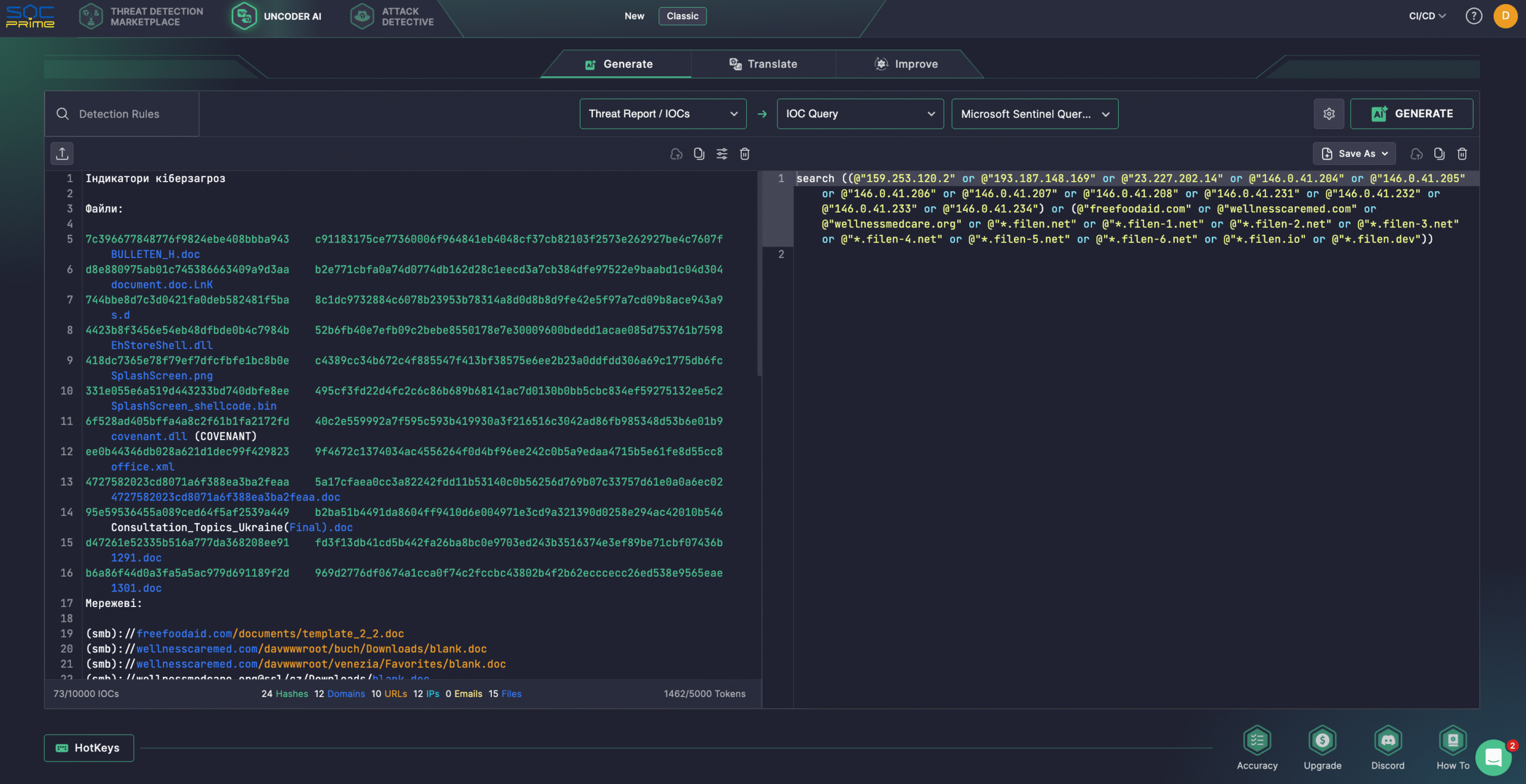
SOC Prime users can also rely on Uncoder AI to create detections from raw threat reports, document and optimize rule code, and generate Attack Flows in a couple of clicks. By leveraging threat intel from the latest CERT-UA alert, teams can easily convert IOCs into performance-optimized queries ready to hunt in the chosen SIEM or EDR environment.

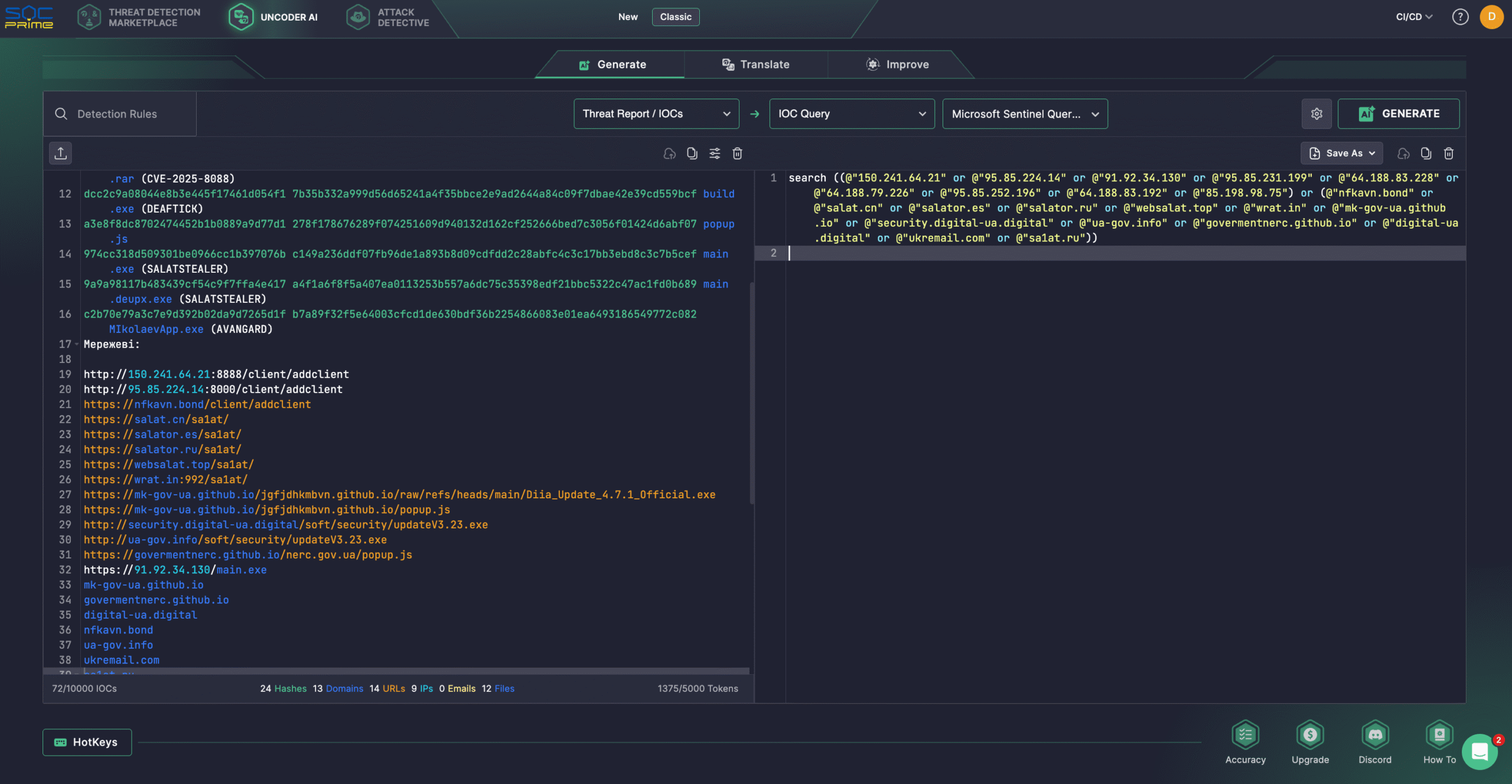
IOC-to-query conversion via Uncoder based on UAC-0252 IOCs from CERT-UA

Analyzing UAC-0252 Attacks Using SHADOWSNIFF and SALATSTEALER

Since January 2026, CERT-UA has been tracking repeated phishing campaigns targeting entities in Ukraine. The email messages are crafted to impersonate central government bodies or regional administrations and typically urge recipients to update mobile apps used in widely deployed civilian and military systems.

CERT-UA#20032 alert describes two common delivery paths. In the first one, the email includes an attached archive that contains an EXE file. The attacker relies on the recipient to open the archive and run the executable. In the second one, the email contains a link to a legitimate website that is vulnerable to cross-site scripting (XSS). When the victim visits the page, the injected JavaScript runs in the browser and downloads an executable file onto the computer. In both scenarios, CERT-UA notes that the EXE files and scripts are hosted on the legitimate GitHub service, which helps the activity blend into normal web traffic and makes basic domain blocking less effective in many environments.

During January and February 2026, CERT-UA confirmed that the activity used several malicious tools, including SHADOWSNIFF, SALATSTEALER, and DEAFTICK. 

SHADOWSNIFF was reported as being hosted on GitHub, while SALATSTEALER is commonly described as a Go-based infostealer that targets browser credentials, steals active sessions, and collects crypto-related data, operating under a Malware-as-a-Service (MaaS) model. In the same toolset, CERT-UA also reported DEAFTICK, a primitive backdoor written in Go that likely helps attackers maintain basic access on compromised hosts and support follow-on actions.


During repository analysis, CERT-UA reports discovering a program with characteristics of a ransomware encryptor, internally named «AVANGARD ULTIMATE v6.0». The same GitHub ecosystem also contained an archive with an exploit for WinRAR (CVE-2025-8088), a path traversal issue in Windows WinRAR that can enable arbitrary code execution via crafted archives and has been reported as exploited in the wild. This suggests the operators were not only stealing credentials, but also experimenting with additional tooling that could expand impact.

Based on the investigation details and the tooling overlaps, including experiments with publicly available instruments, CERT-UA links the described activity to individuals discussed in the «PalachPro» Telegram channel, while continuing to track the campaign under UAC-0252.

MITRE ATT&CK Context

Leveraging MITRE ATT&CK offers in-depth insight into the latest UAC-0252 phishing campaigns targeting Ukrainian entities. The table below displays all relevant Sigma rules mapped to the associated ATT&CK tactics, techniques, and sub-techniques.

Tactics

Techniques

Sigma Rules

Initial Access

Phishing: Spearphishing Attachment (T1566)


Execution

Exploitation for Client Execution (T1203)

User Execution: Malicious File (T1204.002)

Persistence

Boot or Logon Autostart Execution: Registry Run Keys / Startup Folder (T1547.001)

Defense Evasion

Masquerading: Masquerade Task or Service (T1036.004)

Masquerading: Match Legitimate Resource Name or Location (T1036.005)

Process Injection: Process Hollowing (T1055.012)

Impair Defenses: Disable or Modify Tools (T1562.001)

Hide Artifacts: Hidden Files and Directories (T1564.001)

Hide Artifacts: File/Path Exclusions (T1564.012)

Command and Control

Application Layer Protocol: Web Protocols (T1071.001)


The post UAC-0252 Attack Detection: SHADOWSNIFF and SALATSTEALER Fuel Phishing Campaigns in Ukraine appeared first on SOC Prime.

CVE-2026-20127: Cisco SD-WAN Zero-Day Exploited Since 2023

CVE-2026-20127 in Cisco Catalyst SD-WAN Controller

New day, new vulnerability in the spotlight. We’re once again seeing how quickly weaponized flaws in widely deployed platforms turn into real operational risk. Coverage of maximum-severity Cisco bugs (CVE-2025-20393, CVE-2026-20045), as well as the Dell RecoverPoint zero-day CVE-2026-22769, shows that attackers are increasingly prioritizing edge-facing infrastructure that quietly controls traffic flows, identity paths, and service availability.

That story continues with CVE-2026-20127, a critical authentication bypass affecting Cisco Catalyst SD-WAN Controller (formerly vSmart) and Cisco Catalyst SD-WAN Manager (formerly vManage). Cisco Talos reports the flaw is being actively exploited and tracks the activity as UAT-8616, assessing with high confidence that a highly sophisticated threat actor has been exploiting it since at least 2023.

GreyNoise’s 2026 State of the Edge Report shows why confirmed exploitation in edge-facing network control systems demands urgent action. In H2 2025, GreyNoise observed 2.97 billion malicious sessions from 3.8 million unique source IPs targeting internet-facing infrastructure, underscoring how quickly exploitation traffic scales once attackers focus on an exposed surface.

Register for SOC Prime’s AI-Native Detection Intelligence Platform, backed by cutting-edge technologies and top cybersecurity expertise to outscale cyber threats and build a resilient cybersecurity posture. Click Explore Detections to access the comprehensive collection of SOC content for vulnerability exploit detection, filtered by the custom “CVE” tag.

Explore Detections

Detections from the dedicated rule set can be applied across multiple SIEM, EDR, and Data Lake platforms and are mapped to the latest MITRE ATT&CK® framework v18.1. Security teams can also leverage Uncoder AI to accelerate detection engineering end-to-end by generating rules directly from live threat reports, refining and validating detection logic, auto-visualizing Attack Flows, converting IOCs into custom hunting queries, and instantly translating detection code across diverse language formats.

CVE-2026-20127 Analysis

Cisco Talos describes CVE-2026-20127 as an issue that allows an unauthenticated remote attacker to bypass authentication and obtain administrative privileges on the affected system by sending crafted requests. Cisco’s public advisory ties the root cause to a peering authentication mechanism that is not working properly.

A successful exploit can let an attacker log in to a Catalyst SD-WAN Controller as an internal, high-privileged, non-root account, then use that access to reach NETCONF and manipulate SD-WAN fabric configuration. That kind of control-plane access is exactly what makes SD-WAN incidents so disruptive, as the attackers are in a position to shape how the network behaves.

Multiple government and partner advisories describe a common post-exploitation path. After exploiting CVE-2026-20127, actors have been observed adding a rogue peer and then moving toward root access and long-term persistence within SD-WAN environments. Talos adds that intelligence partners observed escalation involving a software version downgrade, exploitation of CVE-2022-20775, and then restoration back to the original version, a sequence that can complicate detection if teams only validate the “current” running version.

Because exploitation is confirmed and impacts systems used to manage connectivity across sites and clouds, CISA issued Emergency Directive 26-03 for U.S. federal civilian agencies, with an accelerated requirement to complete required actions by 5:00 PM (ET) on February 27, 2026. FedRAMP also relayed the same urgency to cloud providers supporting federal environments. 

CVE-2026-20127 Mitigation 

According to Cisco’s advisory, CVE-2026-20127 affects Cisco Catalyst SD-WAN Controller and Cisco Catalyst SD-WAN Manager regardless of device configuration, across these deployment types:

  • On-Prem Deployment
  • Cisco Hosted SD-WAN Cloud
  • Cisco Hosted SD-WAN Cloud – Cisco Managed
  • Cisco Hosted SD-WAN Cloud – FedRAMP Environment 

Cisco also notes there are no workarounds that fully address this vulnerability. The durable fix is upgrading to a patched release, with the exact fixed versions listed in Cisco’s advisory under the Fixed Software section.

Users are urged to start by prioritizing patching as the only complete remediation and verify the fixes are actually in place across every in-scope Catalyst SD-WAN Controller and Manager instance.

Next, to reduce the attack surface while users patch and validate, CISA and the UK NCSC guidance emphasize restricting network exposure, placing SD-WAN control components behind firewalls, and isolating management interfaces from untrusted networks. In parallel, SD-WAN logs should be forwarded to external systems so attackers cannot easily erase local evidence.

Finally, it is better to treat this as both a patching and an investigation event. Cisco recommends auditing /var/log/auth.log for entries like “Accepted publickey for vmanage-admin” coming from unknown or unauthorized IP addresses, then comparing those source IPs against the configured System IPs listed in the Manager UI (WebUI > Devices > System IP). If users suspect compromise, Cisco advises engaging Cisco TAC and collecting the admin-tech output (for example, via request admin-tech) so it can be reviewed.

Because the reported activity can include version downgrade and unexpected reboot behavior as part of the post-compromise chain, public guidance also recommends checking the following logs for downgrade/reboot indicators:

  • /var/volatile/log/vdebug
  • /var/log/tmplog/vdebug
  • /var/volatile/log/sw_script_synccdb.log

To strengthen coverage beyond patching and mitigation steps, rely on the SOC Prime Platform to reach the world’s largest detection intelligence dataset, adopt an end-to-end pipeline that spans detection through simulation while streamlining security operations and speeding up response workflows, reduce engineering overhead, and stay ahead of emerging threats.


FAQ

What is CVE-2026-20127 and how does it work?

CVE-2026-20127 is a critical authentication bypass in Cisco Catalyst SD-WAN Controller and SD-WAN Manager that lets an unauthenticated attacker send crafted requests and gain administrative access due to a broken peering authentication check.

When was CVE-2026-20127 first discovered?

Cisco disclosed it in late February 2026, while Cisco Talos reports evidence that CVE-2026-20127 has already been exploited in real attacks since at least 2023.

What risks does CVE-2026-20127 pose to systems?

It can hand attackers control-plane access, enabling them to add a rogue peer, change SD-WAN fabric configuration via NETCONF, and move toward persistence and root-level control, including downgrade-and-restore activity tied to chaining with CVE-2022-20775.

Can CVE-2026-20127 still affect me in 2026?

Yes. If you have not patched, or you patched without checking for compromise, you may still be at risk.

How can you protect from CVE-2026-20127?

Upgrade to Cisco’s fixed releases, restrict exposure of SD-WAN control components, and review logs for signs of suspicious access; involve Cisco TAC if anything looks abnormal.


The post CVE-2026-20127: Cisco SD-WAN Zero-Day Exploited Since 2023 appeared first on SOC Prime.

CVE-2026-22769: Critical Dell RecoverPoint Zero-Day Exploited in the Wild

CVE-2026-22769 Zero-Day in Dell

SOC Prime has recently covered a wave of actively exploited zero-days across major ecosystems, including Apple’s CVE-2026-20700 and Microsoft’s CVE-2026-20805, alongside a fresh Chrome zero-day case. But the avalanche of threats keeps marching into 2026. Recently, researchers from Mandiant and Google Threat Intelligence Group (GTIG) detailed the active exploitation of CVE-2026-22769, a maximum-severity hardcoded-credential vulnerability in Dell products.

The spotlight is on Dell RecoverPoint for Virtual Machines, a VMware-focused backup and disaster recovery solution that has become the target of an in-the-wild zero-day campaign attributed to suspected China-nexus activity. Tracked with a CVSS score of 10.0, CVE-2026-22769 has reportedly been exploited by the China-linked cluster UNC6201 since at least mid-2024, enabling attackers to establish access and deploy multiple malware families, including BRICKSTORM and GRIMBOLT.

SOC Prime Platform helps security teams close the gap between “a CVE was disclosed” and “we have detection intel.” Sign up now to access the world’s largest detection intelligence dataset, backed by advanced solutions to take your SOC to the next level. Click Explore Detections to reach vulnerability-focused detection content pre-filtered by the “CVE” tag. 

Explore Detections

All rules are compatible with dozens of SIEM, EDR, and Data Lake formats and mapped to MITRE ATT&CK®. Additionally, each rule is enriched with extensive metadata, including CTI references, Attack Flow visualization, triage recommendations, audit configurations, and more.

Security teams can also leverage Uncoder AI to accelerate detection engineering end-to-end by generating rules directly from live threat reports, refining and validating detection logic, converting IOCs into custom hunting queries, and instantly translating detection code across diverse language formats.

CVE-2026-22769 Analysis

In its advisory from February 17, 2026, Dell describes CVE-2026-22769 as a hardcoded credential vulnerability in RecoverPoint for Virtual Machines prior to 6.0.3.1 HF1, and assigns it a highest severity rating. Dell warns that an unauthenticated remote attacker who knows the hardcoded credential could gain unauthorized access to the underlying operating system and even establish root-level persistence. 

GTIG and Mandiant’s investigation adds the operational detail behind that impact. Security experts observed activity against the appliance’s Apache Tomcat Manager, including web requests using the admin username that resulted in the deployment of a malicious WAR file containing the SLAYSTYLE web shell. The researchers then traced this back to hard-coded default credentials for the admin user in Tomcat Manager configuration at /home/kos/tomcat9/tomcat-users.xml. Using those credentials, an attacker could authenticate to Tomcat Manager and deploy a WAR via the /manager/text/deploy endpoint, leading to command execution as root on the appliance. 

UNC6201 is assessed to have used this foothold for lateral movement, persistence, and malware deployment, with the earliest identified exploitation dating back to mid-2024. The initial access vector was not confirmed in these cases, but GTIG notes UNC6201 is known for targeting edge appliances as an entry point.

The post-compromise tooling also evolved over time. Mandiant reports finding BRICKSTORM binaries and then observing a replacement with GRIMBOLT in September 2025. GRIMBOLT is described as a C# backdoor compiled using native ahead-of-time (AOT) compilation and packed with UPX, providing remote shell capability while using the same C2 as BRICKSTORM. The researchers note it is unclear whether the swap was a planned upgrade or a response to incident response pressure.

The activity did not stop at the RecoverPoint appliance. Mandiant reports that UNC6201 pushed deeper into victims’ virtualized environments by creating temporary virtual network ports on VMware ESXi servers, effectively spinning up hidden network connectivity commonly referred to as “Ghost NICs.” This technique allowed the attackers to move quietly from compromised VMs into broader internal networks and, in some cases, toward SaaS environments.

Researchers also report overlaps between UNC6201 and another China-nexus cluster tracked as UNC5221, known for exploiting Ivanti zero-days and previously linked in reporting to Silk Typhoon, though GTIG notes these clusters are not considered identical.

CVE-2026-22769 Mitigation

Dell’s remediation guidance is clear, but it requires follow-through. For the 6.x line, Dell points customers to upgrade to 6.0.3.1 HF1 or apply the vendor remediation script referenced in the advisory, and it also provides migration/upgrade paths for affected 5.3 service pack builds.

To strengthen coverage beyond patching, rely on the SOC Prime Platform to reach the world’s largest detection intelligence dataset, adopt an end-to-end pipeline that spans detection through simulation while streamlining security operations and speeding up response workflows, reduce engineering overhead, and stay ahead of emerging threats.

FAQ

What is CVE-2026-22769 and how does it work?

CVE-2026-22769 is a critical hardcoded-credential vulnerability in Dell RecoverPoint for Virtual Machines. The flaw allows an unauthenticated remote attacker with knowledge of the hardcoded credential to gain unauthorized access to the underlying operating system and achieve root-level persistence.

When was CVE-2026-22769 first discovered?

Dell published its advisory on February 17, 2026, while GTIG and Mandiant report the earliest identified exploitation activity occurred in mid-2024.

What risks does CVE-2026-22769 pose to organizations?

Successful exploitation can provide remote access to the appliance and enable root-level persistence, which can support malware deployment, stealthy long-term access, and pivoting deeper into VMware and enterprise infrastructure.

Can CVE-2026-22769 still affect me in 2026?

Yes. If RecoverPoint for Virtual Machines is running a vulnerable version prior to 6.0.3.1 HF1, or an affected 5.3 build that has not been upgraded per Dell guidance, the environment can remain exposed.

How can you protect from CVE-2026-22769?

Apply Dell’s remediation immediately by upgrading to 6.0.3.1 HF1 or using the vendor’s remediation script path, then confirm version compliance across all appliances and related management surfaces.


The post CVE-2026-22769: Critical Dell RecoverPoint Zero-Day Exploited in the Wild appeared first on SOC Prime.

CVE-2026-2441: Google Patches Chrome Zero-Day Exploited in the Wild

CVE-2026-2441 zero-day in Google Chrome

Right after Apple’s CVE-2026-20700 zero-day under active exploitation made headlines, Google released security updates for Chrome to address the first actively exploited Chrome zero-day of 2026.

CVE-2026-2441 Analysis

The high-severity flaw, tracked as CVE-2026-2441, is a use-after-free vulnerability in Chrome’s CSS component. NIST’s NVD description notes that the issue could allow a remote attacker to execute arbitrary code inside the sandbox via a crafted HTML page. In fact, a user only needs to land on a maliciously-crafted page for the attacker to trigger the bug and run code within the browser’s sandboxed environment.

Zero-day exploitation is rising. In 2024, Google’s Threat Intelligence Group reported 75 zero-days exploited in real attacks, and by 2025 exploits were still the top initial access method, accounting for 33% of intrusion paths. In that context, browser vulnerabilities remain a persistent threat for defenders. Browsers are everywhere, they continuously handle untrusted web content, and the trigger can be as simple as a user opening a link.

Sign up for SOC Prime Platform to access the global marketplace of 750,000+ detection rules and queries made by detection engineers, updated daily, and enriched with AI-native threat intel to proactively defend against existing and current threats anticipated most. Just click the Explore Detections below and immediately reach the extensive detection stack filtered out by “CVE” tag. All detections are compatible with dozens of SIEM, EDR, and Data Lake formats and are mapped to MITRE ATT&CK®. 

Explore Detections

Security experts can also leverage Uncoder AI to accelerate detection engineering end-to-end by generating rules directly from live threat reports, refining and validating detection logic, visualizing Attack Flows, converting IOCs into custom hunting queries, and instantly translating detection code across diverse language formats.

CVE-2026-2441 Mitigation

Google’s advisory notes that a fix for CVE-2026-2441 was delivered in the Stable channel update released on February 13, 2026. The patched builds are Chrome 145.0.7632.75/76 for Windows and macOS and 144.0.7559.75 for Linux, with rollout expected over the following days and weeks.

Google has shared very little technical detail, but it has confirmed it is aware of in-the-wild exploitation of CVE-2026-2441. Security researcher Shaheen Fazim has been credited with discovering and reporting the issue on February 11, 2026.

Users are advised to update Chrome to the fixed build on every endpoint and make sure the browser is restarted so the patched version is actually running. Additionally, by leveraging SOC Prime’s AI-Native Detection Intelligence Platform backed by top cyber defense expertise, global organizations can adopt a resilient security posture and transform their SOC to always stay ahead of emerging threats.

FAQ

What is CVE-2026-2441 and how does it work?

CVE-2026-2441 is a high-severity use-after-free vulnerability in Chrome’s CSS component that can be triggered by a crafted HTML page and used to execute arbitrary code inside the Chrome sandbox.

When was CVE-2026-2441 first discovered?

Google’s Chrome release notes credit Shaheen Fazim with reporting the issue on February 11, 2026, and the Stable channel fix shipped on February 13, 2026.

What risks does CVE-2026-2441 pose to organizations?

Because exploitation is confirmed in the wild, the risk is practical and immediate. A successful exploit can turn normal browsing into an entry point for malware delivery, credential theft through session hijacking or token access, and follow-on compromise when paired with additional vulnerabilities or social engineering.

Can CVE-2026-2441 still affect me in 2026?

Yes. Any system running Chrome versions prior to 145.0.7632.75/76 for Windows and macOS and 144.0.7559.75 for Linux, or systems that downloaded the update but have not restarted Chrome, can remain exposed.

How can you protect from CVE-2026-2441?

Update Chrome to the latest Stable build for your OS and restart the browser to apply it, then verify version compliance across endpoints.


The post CVE-2026-2441: Google Patches Chrome Zero-Day Exploited in the Wild appeared first on SOC Prime.

CVE-2026-20700: Apple Patches Zero-Day Exploited in Sophisticated Cyber Attacks

SOC Prime previously highlighted Apple’s actively exploited WebKit zero-day CVE-2025-14174, a case that showed how quickly weaponized iOS flaws can move from targeted activity to real operational risk for organizations and high-value users. That same case later led to additional fixes, with CVE-2025-14174 and CVE-2025-43529 both issued in response to it, reinforcing a familiar pattern in which separate bugs are addressed as part of a broader security incident rather than in isolation. 

In February 2026, that story continued with CVE-2026-20700, an exploited memory corruption vulnerability in dyld, Apple’s Dynamic Link Editor. Apple states that an attacker with memory write capability may be able to achieve arbitrary code execution, and notes the issue may have been used in an “extremely sophisticated attack” against specific targeted individuals.

Notably, with the latest update, Apple has addressed its first actively exploited zero-day in 2026. Public reporting also notes that the company patched nine zero-day vulnerabilities exploited in the wild in 2025.

Register for SOC Prime’s AI-Native Detection Intelligence Platform, backed by cutting-edge technologies and top cybersecurity expertise to outscale cyber threats and build a resilient cybersecurity posture. Click Explore Detections to access the comprehensive collection of SOC content for vulnerability exploit detection, filtered by the custom “CVE” tag.

Explore Detections

Detections from the dedicated rule set can be applied across 40+ SIEM, EDR, and Data Lake platforms and are mapped to the latest MITRE ATT&CK® framework v18.1. Security teams can also leverage Uncoder AI to accelerate detection engineering end-to-end by generating rules directly from live threat reports, refining and validating detection logic, auto-visualizing Attack Flows, converting IOCs into custom hunting queries, and instantly translating detection code across diverse language formats.

CVE-2026-20700 Analysis

Apple clarifies that CVE-2026-20700 resides in dyld, the system component responsible for loading dynamic libraries into memory and bridging application code with system frameworks. That placement matters because vulnerabilities in foundational loader components can be valuable in real-world exploit chains that depend on how code is mapped and executed at runtime.

Apple keeps technical details limited, but it confirms two points defenders should prioritize. Apple is aware of exploitation tied to highly targeted activity, which suggests mature tradecraft rather than opportunistic attacks. Apple also confirms the impact is arbitrary code execution, which means the outcome is not only stability issues, but attacker-controlled instruction execution on the device under the right conditions.

Patches for CVE-2026-20700 are available in iOS 26.3 and iPadOS 26.3, macOS Tahoe 26.3, watchOS 26.3, tvOS 26.3, and visionOS 26.3. Apply the latest Apple security updates across all supported devices, confirm that systems are running the remediated versions, and enforce and validate compliance. Users are also prompted to enable automatic updates on personal devices.

To strengthen coverage beyond patching, rely on the SOC Prime Platform to reach the world’s largest detection intelligence dataset, adopt an end-to-end pipeline that spans detection through simulation while streamlining security operations and speeding up response workflows, reduce engineering overhead, and stay ahead of emerging threats.

FAQ

What is CVE-2026-20700 and how does it work?

CVE-2026-20700 is a memory corruption vulnerability in Apple’s dyld component. Apple states that an attacker with memory write capability may be able to exploit the flaw to execute arbitrary code.

When was CVE-2026-20700 first discovered?

Apple publicly disclosed and patched CVE-2026-20700 in its February 11, 2026 security release.

What is the impact of CVE-2026-20700 on organizations and users?

Successful exploitation can result in arbitrary code execution, which is dangerous because it can enable deeper compromise depending on the attacker’s access and the device’s role in the environment.

Can CVE-2026-20700 still affect me in 2026?

Yes. Devices running vulnerable versions, especially those not updated to the patched OS releases, can remain exposed.

How can you protect from CVE-2026-20700?

Update Apple devices to the latest available security release for your OS line, including iOS 26.3,iPadOS 26.3, and macOS Tahoe 26.3, where applicable. Enable automatic updates where possible and verify patch coverage, particularly if you maintain older OS branches that may require separate backported fixes.


The post CVE-2026-20700: Apple Patches Zero-Day Exploited in Sophisticated Cyber Attacks appeared first on SOC Prime.

CVE-2026-20841: Windows Notepad RCE Fixed in Microsoft’s February Patch Tuesday Release

Microsoft’s 2026 Patch Tuesday cadence continues to shape patching priorities. January set the pace with fixes for an actively exploited Windows Desktop Window Manager zero-day (CVE-2026-20805). Now, the February release adds another practical concern. Applications that gain richer features can also inherit richer risks, as shown by the built-in Windows 11 Notepad app now associated with a remote code execution vulnerability. An attacker can lure a user into opening a crafted Markdown file in Notepad and clicking a malicious link, which can trigger untrusted protocol handling that pulls down remote content and executes it.

The vulnerability, tracked as CVE-2026-20841, was addressed in Microsoft’s February 10, 2026 security updates and carries a CVSS score of 8.8, rated Important.

Given Microsoft’s dominant role in enterprise and consumer environments, vulnerabilities in its software scale fast and often become repeatable attacker playbooks. Tenable’s Patch Tuesday 2025 review shows the volume defenders face, with Microsoft addressing 1,130 CVEs across 2025 releases and remote code execution making up 30.8% of those fixes. That is why CVE-2026-20841 should not be treated as a routine Important patch. It is an 8.8-rated RCE in the modern Windows Notepad app that can turn a simple Markdown file and a single click into a code execution path.

Register for the SOC Prime Platform, the industry-first AI-Native Detection Intelligence Platform for real-time defense, to explore a collection of 600,000+ detection rules addressing the latest threats and equip your team with AI and top cybersecurity expertise. Click Explore Detections to reach the extensive rule set for vulnerability exploit detection, pre-filtered using the custom “CVE” tag.

Explore Detections

All rules are portable across leading SIEM, EDR, and Data Lake platforms and are aligned with the latest MITRE ATT&CK framework v18.1. Go deeper with AI-native detection intelligence, including CTI references, attack timelines, audit configuration guidance, triage recommendations, and additional context that helps analysts move from alert to action faster.

To further cut detection engineering overhead, security teams can use Uncoder AI to instantly translate detection logic across multiple language formats, generate detections directly from raw threat reports, visualize Attack Flows, accelerate enrichment and tuning, and streamline validation workflows end to end.

CVE-2026-20841 Analysis

Microsoft’s February 2026 Patch Tuesday delivered security updates for 58 vulnerabilities, including six actively exploited issues and three publicly disclosed zero-days.

One of the notable flaws in this release is CVE-2026-20841, a nasty remote code execution issue in the modern Windows Notepad app. The vulnerability is rooted in command injection, where specially crafted input can be interpreted as executable instructions rather than treated as plain text.

Microsoft’s advisory describes a straightforward abuse path that relies on user interaction. An attacker can trick a Windows user into opening a crafted Markdown (.md) file in Notepad and clicking a malicious hyperlink. That click can cause Notepad to launch unverified protocols that load and execute remote files, enabling code execution with the same permissions as the logged-in user. In practical terms, the “weapon” is a text file, delivery can be as simple as email or a download link, and the compromise moment is the click.

If successfully exploited, the attacker inherits the user’s access level, including local files, network shares, and internal tools. In many environments, that is enough to steal data, deploy additional malware, or stage follow-on actions that expand the intrusion.

The affected component is the Microsoft Store-distributed Notepad app, not the legacy Notepad.exe that many teams can think of. This distinction matters operationally because Store apps can fall out of date when automatic updates are disabled or when enterprises do not enforce app version compliance. The fix for CVE-2026-20841 is shipped via the Microsoft Store as an updated Notepad release, with the build 11.2510 and later marked as remediated, and Microsoft listing it as customer action required.

Organizations that rely on affected Windows environments are urged to apply the February updates without delay and to confirm that the Microsoft Store Notepad version is updated to a remediated build. To strengthen coverage beyond patching, SOC teams can enhance defenses with SOC Prime’s AI-Native Detection Intelligence Platform by sourcing detection content from the largest and continuously updated repository, adopting an end-to-end pipeline from detection to simulation, orchestrating workflows in natural language, and staying resilient against emerging threats.

FAQ

What is CVE-2026-20841 and how does it work?

CVE-2026-20841 is a high-severity remote code execution vulnerability in the modern Windows Notepad app. It can be triggered when a user opens a crafted Markdown (.md) file and clicks a malicious hyperlink, causing Notepad to invoke untrusted protocol handling that can download and execute attacker-controlled content under the user’s permissions.

When was CVE-2026-20841 first discovered?

CVE-2026-20841 was publicly disclosed and fixed in Microsoft’s February Patch Tuesday security updates released on February 10, 2026.

What is the impact of CVE-2026-20841 on systems?

If exploited, it can allow an attacker to run code in the context of the logged-in user. That can lead to data theft, malware deployment, credential access, and follow-on intrusion activity, especially in environments where users have broad access to shared resources or elevated privileges.

Can CVE-2026-20841 still affect me in 2026?

Yes. The risk remains for any system running an affected Microsoft Store version of Notepad, particularly in environments where Store apps are not updated automatically or app version compliance is not enforced.

How can you protect from CVE-2026-20841?

Update Notepad immediately from the Microsoft Store, and confirm it runs on a remediated build. Enable automatic app updates in Windows Settings so Store apps do not lag behind. Reduce exposure by avoiding untrusted Markdown files and not clicking links inside unexpected .md documents, especially those received via email or downloads.


The post CVE-2026-20841: Windows Notepad RCE Fixed in Microsoft’s February Patch Tuesday Release appeared first on SOC Prime.

CVE-2026-21643: Critical FortiClient EMS Vulnerability Enables Unauthenticated Remote Code Execution

CVE-2026-21643 SQL Injection Vulnerability in FortiClient EMS

Shortly after our recent coverage of high-impact FortiOS SSO zero-day exploitation (CVE-2026-24858), defenders are facing another urgent patching priority in the Fortinet ecosystem. On February 6, Fortinet released a fix for a critical SQL injection flaw that can be triggered remotely and doesn’t require authentication, potentially leading to unauthorized code or command execution. 

Although there are currently no signs of exploitation in the wild, CVE-2026-21643 requires immediate attention and patching as SQL injection remains one of the most dangerous web vulnerability classes. OWASP Top 10 2025 links Injection to 62,445 known CVEs, including more than 14,000 SQL injection issues. The risk is straightforward. If an application lets untrusted input reach the database interpreter, an attacker can make the database run unintended commands, steal or change data, and, in some cases, escalate to full system compromise.

Sign up for the SOC Prime Platform to access real-time detection intelligence and ready-to-go use cases for emerging risks like vulnerability exploitation. Click Explore Detections to view the full collection of rules filtered by the “CVE” tag.

Explore Detections

All rules are compatible with multiple SIEM, EDR, and Data Lake platforms and are mapped to the MITRE ATT&CK® framework. Each rule includes CTI links, attack timelines, audit settings, triage guidance, and more relevant metadata.

Cyber defenders can also use Uncoder AI to empower their detection engineering workflows. Generate detection algorithms from raw threat reports, enable fast IOC sweeps, predict ATT&CK tags, optimize query code with AI tips, and translate it across multiple SIEM, EDR, and Data Lake languages.

CVE-2026-21643 Analysis

On February 6, 2026, Fortinet released an advisory describing CVE-2026-21643 as an improper neutralization of special elements used in an SQL Command (SQL Injection) in FortiClient EMS, where a remote attacker can send specially crafted HTTP requests to trigger the flaw. Because the issue is pre-auth, an exposed or reachable EMS administrative interface becomes a high-value target for initial access, potentially leading to rapid foothold establishment, follow-on tooling, and lateral movement from a system that often has broad visibility into endpoints. 

CVE-2026-21643 obtains a critical CVSS score of 9.8, highlighting the urgent need for patching. The good news for defenders is that the scope is clear. Fortinet’s advisory highlights that only FortiClientEMS 7.4.4 is affected and that upgrading to 7.4.5 or later addresses the issue, while 7.2 and 8.0 are not impacted.

Enhancing proactive cybersecurity strategies is crucial for reducing exploitation risk. By leveraging SOC Prime’s AI-Native Detection Intelligence Platform for enterprise-grade cyber defense, organizations can scale detection operations and strengthen their security posture. Register now to improve visibility into threats most relevant to your business and to accelerate response when new critical threats like CVE-2026-21643 appear.

FAQ

What is CVE-2026-21643 and how does it work?

CVE-2026-21643 is a critical SQL injection vulnerability in Fortinet FortiClientEMS 7.4.4. The issue is caused by improper handling of special characters in SQL commands, so a remote attacker can send specially crafted HTTP requests and potentially execute unauthorized code or commands.

When was CVE-2026-21643 first discovered?

Fortinet has released an advisory describing CVE-2026-21643 on February 6, 2026, which is also the day when the vulnerability was recorded by NVD. Gwendal Guégniaud from the Fortinet Product Security team has been credited for discovering and reporting the flaw.

Which risks does CVE-2026-21643 pose to systems?

The main risk is remote compromise of the FortiClient EMS server. If a vulnerable EMS instance is reachable, an attacker can abuse the SQL injection through crafted HTTP requests to run unauthorized actions and potentially escalate to code or command execution. This can lead to data access or tampering, service disruption, and a foothold that can be used to pivot deeper into the environment.

Can CVE-2026-21643 still affect me in 2026?

Yes, if you are running FortiClient EMS 7.4.4 and have not applied the fix. Fortinet states the issue is resolved in 7.4.5 and later, and notes that 7.2 and 8.0 are not affected.

How can you protect against CVE-2026-21643?

Upgrade FortiClient EMS to 7.4.5 or later and limit access to the EMS web interface to trusted admin networks only. Until patching is complete, increase monitoring on the EMS host and its web traffic for unusual requests and unexpected process activity.


The post CVE-2026-21643: Critical FortiClient EMS Vulnerability Enables Unauthenticated Remote Code Execution appeared first on SOC Prime.

UAC-0001 (APT28) Attack Detection: russia-Backed Actor Actively Exploits CVE-2026-21509 Targeting Ukraine and the EU

Right after Microsoft disclosed an actively exploited Office zero-day (CVE-2026-21509) on January 26, 2026, CERT-UA reported UAC-0001 (APT28) leveraging the vulnerability in the wild. The russia-backed threat actor targeted organizations in Ukraine and the EU with malicious Office documents, and metadata shows one sample was created on January 27 at 07:43 UTC, illustrating the rapid weaponization of CVE-2026-21509.

Detect UAC-0001 aka APT28 Activity Based on the CERT-UA#19542 Alert

APT28 (UAC-0001) has a long record of conducting cyber operations aligned with russian state interests, with a persistent focus on Ukraine and its allied partners. Ukraine frequently serves as an initial testing environment for newly developed tactics, techniques, and procedures that are later scaled to broader international targets. 

The latest UAC-0001 campaign in the limelight follows the same pattern. According to CERT-UA#19542, UAC-0001 targeted Ukrainian state bodies with malicious Office documents exploiting CVE-2026-21509 to deploy the COVENANT framework. The same attack pattern was later observed against EU organizations, demonstrating rapid operational expansion beyond Ukraine.

Sign up for the SOC Prime Platform to proactively defend your organization against UAC-0001 (APT28) attacks exploiting CVE-2026-21509. Just press Explore Detections below and access a relevant detection rule stack, enriched with AI-native CTI, mapped to the MITRE ATT&CK® framework, and compatible with a wide range of SIEM, EDR, and Data Lake technologies.

Explore Detections

Security experts can also use the “CERT-UA#19542” tag based on the relevant CERT-UA alert identifier to search for the detection stack directly and track any content changes.  For more rules to detect attacks related to the UAC-0001 adversary activity, security teams can search the Threat Detection Marketplace library leveraging the “UAC-0001” or “APT28” tags based on the group identifier, as well as the relevant “CVE-2026-21509” tag addressing the Microsoft Office zero-day exploitation.

Additionally, users can refer to a dedicated Active Threats item on the UAC-0001 (APT28) latest attacks to access the AI summary, related detection rules, simulations, and the attack flow in one place.

Security teams can also rely on Uncoder AI to create detections from raw threat reports, document and optimize code, and generate Attack Flows. Additionally, cyber defenders can easily convert IOCs from the latest CERT-UA#19542 alert into performance-optimized queries compatible with your security stack.

Analyzing UAC-0001 (APT28) Attacks Exploiting CVE-2026-21509

In late January 2026, CERT-UA observed a series of targeted cyber attacks attributed to UAC-0001 (APT28) that leveraged an actively exploited Microsoft Office vulnerability tracked as CVE-2026-21509. The malicious activity emerged shortly after Microsoft publicly disclosed the flaw and was initially directed at Ukrainian government entities before expanding to organizations across the European Union.

To establish initial access, attackers distributed specially crafted Microsoft Word documents exploiting CVE-2026-21509. One document, titled “Consultation_Topics_Ukraine(Final).doc,” referenced COREPER, the Committee of Permanent Representatives of the EU, which prepares decisions and coordinates policy among EU member states. Although the file became publicly accessible on January 29, metadata analysis showed it had been created on January 27 (one day after Microsoft’s advisory), indicating rapid weaponization of the vulnerability.

In parallel, CERT-UA received reports of phishing emails impersonating official correspondence from the Ukrainian Hydrometeorological Center. These messages, sent to more than 60 recipients primarily within central executive authorities of Ukraine, contained malicious DOC attachments. When opened in Microsoft Office, the documents established a network connection to an external resource over WebDAV and downloaded a shortcut file containing code designed to retrieve and launch an executable file.

Successful execution of the downloaded payload results in the creation of a malicious DLL file, EhStoreShell.dll, masquerading as the legitimate Enhanced Storage Shell Extension library, and an image file (SplashScreen.png) containing shellcode. The attack also modifies the Windows registry path for CLSID {D9144DCD-E998-4ECA-AB6A-DCD83CCBA16D}, implementing COM hijacking, and creates a scheduled task named OneDriveHealth.

Scheduled execution of the task causes the explorer.exe process to terminate and restart, which (due to the COM hijacking) ensures the loading of EhStoreShell.dll. The DLL executes shellcode from the image file, ultimately resulting in the launch of the COVENANT framework. Command-and-control communications for COVENANT relied on legitimate cloud storage infrastructure provided by Filen (filen.io).

Toward the end of January 2026, CERT-UA identified additional documents using the same exploit chain and delivery mechanisms in attacks against EU-based organizations. Technical overlaps in document structure, embedded URLs, and supporting infrastructure suggest these incidents were part of a coordinated UAC-0001 (APT28) campaign, demonstrating the rapid scaling of the operation beyond its initial Ukrainian targets.

Given the active exploitation of a Microsoft Office zero-day and the challenges many organizations face in promptly applying patches or mitigations, further abuse of CVE-2026-21509 is expected in the near term. 

To reduce the attack surface, organizations should implement the mitigation measures outlined in Microsoft’s advisory, including recommended Windows registry configurations. In addition, as UAC-0001 (APT28) leverages legitimate Filen cloud infrastructure for COVENANT command-and-control operations, network interactions with Filen-related domains and IP addresses should be restricted or placed under enhanced monitoring.

Additionally, security experts can rely on SOC Prime’s AI-Native Detection Intelligence Platform, which equips SOC teams with cutting-edge technologies and top cybersecurity expertise to stay ahead of APT28 attacks while maintaining operational effectiveness. 

MITRE ATT&CK Context

Leveraging MITRE ATT&CK offers in-depth insight into the latest UAC-0001 (APT28) attacks leveraging CVE-2026-21509 exploit to target Ukrainian and EU entities. The table below displays all relevant Sigma rules mapped to the associated ATT&CK tactics, techniques, and sub-techniques.

Tactics 

Techniques

Sigma Rule

Persistence

Scheduled Task/Job: Scheduled Task (T1053.005)

Event Triggered Execution: Component Object Model Hijacking (T1546.015)

Defense Evasion

Masquerading: Match Legitimate Resource Name or Location (T1036.005)

Command and Control

Application Layer Protocol: Web Protocols (T1071.001)

Ingress Tool Transfer (T1105)

Impact

Service Stop (T1489)


The post UAC-0001 (APT28) Attack Detection: russia-Backed Actor Actively Exploits CVE-2026-21509 Targeting Ukraine and the EU appeared first on SOC Prime.

CVE-2025-15467: OpenSSL Vulnerability Leads to Denial-of-Service, Remote Code Execution

CVE-2025-15467 OpenSSL vulnerability

Just as organizations were working to patch the Microsoft Office zero-day (CVE-2026-21509), the cybersecurity world is confronted with another serious threat. OpenSSL disclosed a high-severity stack buffer overflow issue that can trigger denial-of-service (DoS) conditions and, under specific circumstances, enable remote code execution (RCE).

Tracked as CVE-2025-15467, the vulnerability was promptly patched by the vendor alongside another 11 security bugs in the open source SSL/TLS toolkit.

OpenSSL is a widely used open-source library that powers SSL/TLS security across websites, VPNs, email servers, and apps worldwide, protecting data integrity and privacy. But with such widespread use comes the risk layer. The 2025 OSSRA Report states that 86% of commercial codebases contained open-source vulnerabilities, 81% of them high or critical.

Sign up for the SOC Prime Platform to access the global Active Threats feed, providing real-time detection intelligence and ready-to-use detection rules for emerging risks, including open-source software vulnerabilities. Click Explore Detections to view the full detection library and filter by “CVE” for proactive defense.

Explore Detections

All rules are compatible with multiple SIEM, EDR, and Data Lake platforms and are mapped to the MITRE ATT&CK® framework. Each rule includes CTI links, attack timelines, audit settings, and triage guidance.

Cyber defenders can also use Uncoder AI to empower their detection engineering workflows. Generate detection algorithms from raw threat reports, enable fast IOC sweeps, predict ATT&CK tags, optimize query code with AI tips, and translate it across multiple SIEM, EDR, and Data Lake languages.

CVE-2025-15467 Analysis

According to the OpenSSL advisory released on January 27, CVE-2025-15467 impacts the handling of Cryptographic Message Syntax (CMS) AuthEnvelopedData structures within OpenSSL’s cryptographic library. Specifically, it arises from a stuck buffer overflow during the parsing of CMS AuthEnvelopedData when processing maliciously crafted AEAD parameters.

When parsing CMS AuthEnvelopedData structures that use AEAD ciphers such as AES-GCM, the IV (Initialization Vector) encoded in the ASN.1 parameters is copied into a fixed-size stack buffer without verifying that its length fits the destination,” OpenSSL explains.

As a result, the flaw allows an attacker to supply a specially crafted CMS message with an oversized IV, causing a stack-based out-of-bounds write before any authentication or tag checks are performed.

Any application or service that processes untrusted CMS or PKCS#7 content with AEAD ciphers (such as S/MIME AuthEnvelopedData using AES-GCM) is at risk. The vulnerability is particularly concerning because the overflow occurs before authentication, meaning an attacker does not need valid key material to exploit it.

OpenSSL versions 3.0 through 3.6 are affected, while 1.1.1 and 1.0.2 remain safe. Users should update to the 3.6.1, 3.5.5, 3.4.4, 3.3.6, and 3.0.19 patched releases, depending on their version.

Notably, CVE-2025-15467 may be exploited to achieve remote code execution. While the success of such attacks depends on platform-specific conditions and compiler-level protections, the presence of a stack buffer overflow significantly lowers the barrier to exploitation, requiring immediate patching. 

Enhancing proactive cybersecurity strategies is crucial for organizations to reduce the risks of vulnerability exploitation. By leveraging SOC Prime’s complete product suite for enterprise-ready cyber defense backed by top expertise and AI, and built on zero-trust milestones, global organizations can future-proof defenses at scale and strengthen their security posture.


The post CVE-2025-15467: OpenSSL Vulnerability Leads to Denial-of-Service, Remote Code Execution appeared first on SOC Prime.

❌