It’s about maintainers who review pull requests late at night. Volunteers who respond to security reports from strangers. And communities that quietly power the world’s software.
The reality behind the commits is that maintainers get stretched thin. The effort of responding to pull requests and comments, while also being expected to merge and ship, adds up quickly. Late nights turn into burnout, one-person projects become critical infrastructure overnight without even realizing it, and “thank you” doesn’t pay the bills. Plus, AI is an accelerating force that’s changing how the open source community secures the ecosystem. The requirements of always-on security take more time and energy in addition to not always having the knowledge and expertise.
At GitHub, we believe supporting open source means more than hosting code. It means investing in the people who maintain it, giving them the tools they need to succeed, and standing with them as the ecosystem evolves rapidly in the AI era. Open source maintainers deserve better support and security, and we’re listening and investing.
Strengthening open source security, together
Today, we are joining Anthropic, Amazon Web Services (AWS), Google, and OpenAI with a combined commitment of $12.5 million to support the Linux Foundation’sAlpha-Omega initiative to advance open source security. This collaboration is aimed at helping maintainers make emerging AI security capabilities accessible and integrated into existing project workflows, and at further advancing our OSS security programs, to strengthen the security of critical open source software projects.
This effort builds on years of GitHub’s work as a steward of open source and software security. Real impact comes from pairing investment with practical tools, education, and long-term support designed to help maintainers.
Today, over 280,000 maintainers on GitHub across hundreds of millions of public repositories are eligible for free access to core GitHub platform services, GitHub Copilot Pro, GitHub Actions, and security capabilities, like code scanning and Autofix, secret scanning, push protection, and dependency alerts. Our GitHub Security Lab works with the open source community to educate and protect at scale against the most common threats, and it publishes security advisories that help the entire ecosystem respond faster.
On top of recent and ongoing support across our core platform and GitHub Copilot, we are also reaffirming our commitment to helping maintainers to secure their open source projects by announcing:
GitHub Secure Open Source Fund is adding an additional $5.5 million in Azure credits and funding to provide training and expertise; community to improve outcomes; and new partners, including Datadog, Open WebUI, Atlantic Council, and OWASP.
We have learned through programs like the GitHub Secure Open Source Fund that the most effective security outcomes happen when you link maintainer funding and resources to specific outcomes like improving security. After supporting 138 projects with over 200 maintainers across 38 countries, we have seen 191 new CVEs issued, 250+ new secrets prevented from leaking, and 600+ leaked secrets detected and resolved, impacting billions of monthly downloads from alumni projects. We also learned that providing hands-on coding with education and expertise, drives self-reported learning and action.
The outcome: when maintainers are empowered rather than overwhelmed, given time to learn with space to focus, and provided access to tools that fit naturally into their workflows, security improves for everyone downstream. This creates a community reinforcement flywheel. Those lessons shape everything we are doing next.
This work centers on helping maintainers defend and secure the projects that underpin the global software supply chain, at a time when AI is fundamentally changing both how vulnerabilities are discovered and how they are exploited.
Putting AI to work for maintainers
AI has dramatically increased the speed and scale of vulnerability discovery. That’s true for defenders and for attackers. Now, more than ever, maintainers sit on the front lines of software security. They often face a surge of automated pull requests and security reports with low signal-to-noise ratio. The result is increasing burnout.
As Christian Grobmeier, maintainer for Log4j, put it: “our AI has to be better than the attacking AI.” We agree. That is why our focus is not just on finding more issues. It is on helping maintainers triage, understand, and fix them effectively, without losing the joy or sustainability of maintaining open source. For example, our recent AI-powered security research framework was open sourced because we believe it should be used to empower maintainers and not only security teams.
Looking ahead, GitHub will continue investing in tools like pull request controls, while also ensuring AI is a force multiplier for maintainers from issue triage, pull request reviews, security vulnerability identification, and remediation, and more. It should not be another source of pressure. Maintainers of impactful open source projects already have access to Copilot Pro, which includes AI-assisted code review, agentic security remediation workflows, and access to a broad set of leading models all designed to help maintainers find and remediate risks faster.
AI should reduce maintainer burden, not increase it. Our goals are simple:
Meeting maintainers where they already work on GitHub
Helping prioritize actual issues over noise
Accelerating fixes, not just findings
Supporting secure defaults and healthy workflows
We will continue refining this alongside the community, informed by real world feedback and outcomes.
Open source is a shared responsibility
No single company or group can secure open source alone. The software we all depend on is built by a global community, and protecting it requires collaboration across ecosystems and global economies.
By working with maintainers and partners like Alpha-Omega, we aim to scale impact without fragmenting effort. By pairing GitHub’s platform, tools, and programs with shared community governance and trust, and providing maintainers with the latest models and AI-assisted coding tools, we can achieve this.
Most importantly, we are still committed to investing in people, not just projects. Because open source thrives when maintainers are supported, respected, and empowered to do their best work. We are grateful to every maintainer building the future with us.
Activate the tools available, and consider applying for GitHub Secure OSS Fund. Session 4 runs late April with each project receiving $10,000, Copilot Pro, $100K of Azure Credits, and 3 weeks of security education and a dedicated community. As always, your feedback helps shape what we build next.
When the Log4j zero day broke in December 2021, everyone learned the same lesson: One under-resourced library can send shockwaves through the entire software supply chain. Today the average cloud workload includes over 500 dependencies, many of them tended by unpaid volunteers. The need to support and secure this ecosystem has never been more urgent.
In response, GitHub launched the GitHub Secure Open Source Fund in November 2024, which provides maintainers with financial support to participate in a three-week program that delivers security education, mentorship, tooling, certification, community of security-minded maintainers, and more. By linking this funding to programmatic security outcomes, our goal is to increase security impact, reduce risk, and help secure the software supply chain at scale.
Already, we’re seeing measurable impact from proactive work. Our first two sessions brought together 125 maintainers from 71 important and fast growing open source projects Early outcomes include:
Remediated over 1,100 vulnerabilities detected by CodeQL, reducing their risk surfaces.
Participants issued more than 50 new Common Vulnerabilities and Exposures (CVEs), informing and protecting their downstream dependents.
Prevented 92 new secrets from being leaked and 176 leaked secrets were detected and resolved
Empowered maintainers for long-term success, with 100% saying they left with actionable next stepsfor the following year’s roadmap.
Accelerated adoption of security best practices, with 80% of projects enablingthree or more GitHub-based security features.
Prepared projects for the future of development, as 63% said they have a better understanding of AI and MCP security.
Maintainers found novel ways to partner with and use AI to accelerate learnings and implement solutions, with many consulting GitHub Copilot to conduct vulnerability scans and security audits, define and implement fuzzing strategies, and more.
These results show direct security impact immediately from the sessions, and the momentum is just beginning. Maintainers have embraced a culture of security, built out security backlogs, and are actively sharing insights with the maintainers in the community, and with their direct project contributors and consumers. As a result, the entire ecosystem benefits — and the security impact will continue to grow.
And we’re not done. Session 3 starts in September 2025, and we want to bring more maintainers that work deeper in the dependency tree and those that manage critical dependencies by themselves. To see the immediate impact following Sessions 1 and 2, let’s look at what changed inside the categories of code that power almost everything you build.
These projects are the bedrock of the current AI work with LLMs, agents, orchestration layers, and model toolchains. Together they rack up tens of millions of installs and git clone commands each month, and they’re baked into cloud notebooks like Jupyter, Google Collab, AWS SageMaker, and Microsoft Azure ML. A prompt-injection flaw or poisoned weight file here could spill into thousands of downstream apps overnight, and the teams who rely on them often won’t even know which component failed.
Project spotlight: Ollama
This project makes running large language models locally possible.
Ollama is the easiest way to chat and build with open models. They used this opportunity to threat-model every moving part of their system – from their use of GitHub Actions, DNS security, model distribution, how the models are executed in Ollama’s engine, auto-update checker, and more — then they pruned unused dependencies.
The GitHub Secure Open Source Program is a safe space to ask leading experts security questions, and learn how other high-impact projects address similar challenges.
Project spotlight: GravitasML by AutoGPT
GravitasML is an MIT licensed XML parser for LLMs, built by the team that launched AutoGPT to be simple and secure by design.
Fresh out of the sprint, the AutoGPT team wired CodeQL into every pull request across the AutoGPT Platform and GravitasML, and built a lightweight “security agent” that nudges contributors to tighten controls as they code. This helped turn passive checks into continuous coaching. The maintainers overhauled their security policy, stood up a formal incident-response workflow, and mapped out 28 follow-up tasks (from fuzzing their XML parser to completing the OSS Scorecard) to build a durable roadmap for safer LLM agents at large.
The AI-agent ecosystem is safer — and will keep getting safer — because of the Secure Open Source Fund.
Front-end and full-stack frameworks / UI libraries 📚
These frameworks ship the pixels users touch and often bundle their own server-side routing. Their install bases number in the millions, and improving their security posture closes off potential XSS, template-injection, and supply-chain hop points. The Bootstrap project alone powers nearly 17.5% of the world’s websites, and Next.js drives the frontends for Notion and Adobe, among many others.
Project spotlight: shadcn/ui
This React component library is trusted by leading organizations, like OpenAI’s cookbook, and was able to turn security learning into an interactive practice.
Over the three-week sprint, this project audited every GitHub Actions workflow and secret, refreshed SECURITY.md, licenses, and dependencies, and following a Secure by Design UX workshop — created a framework of how malicious threat actors might attack their project and developed strategies to reduce risks or block entirely. They turned on CodeQL (the first scan caught an unsafe dangerouslySetInnerHTML path), and drafted a formal vulnerability-reporting flow and threat model — laying a clear, public security roadmap that future contributors must follow. After learning about fuzzing, this project also used GitHub Copilot to set up and implement fuzz testing.
Security went from something we should do to something we actively do.
If a process is listening on port 443, chances are one of these web-server or gateway projects is in the stack. Hardening them protects every cookie, auth header, and JSON payload that crosses the wire. Node.js alone underpins most server-side JavaScript, and has a huge impact in the wider ecosystem.
Project spotlight: A quick win for Node.js
During the sprint, the Node.js security-WG revamped the project’s threat model and kicked off a pull request to wire CodeQL into core — backed by a new workflow that automatically reviews code scanning alerts and flags least-clear errors for refactoring. Those upgrades, plus planned signature checks on future releases, will ripple to every server-side JavaScript workload that ships Node binaries — from serverless functions to speeding server-side rendering from Netflix.
This program reinforced that we’re on the right path, but security is a continuous journey of improvement and collaboration.
These tools touch every commit and deploy. If an attacker lands here, they own the pipeline. Flux alone manages thousands of production GitOps clusters, and Turborepo’s build cache now accelerates builds at Vercel, among other organizations.
Project spotlight: Turborepo
During the three-week sprint, Turborepo switched on GitHub private vulnerability reporting, tightened overly permissive workflow tokens, and shipped a production-ready IRP while using CodeQL to scan every pull request. Those guardrails protect the Rust-powered build cache thousands of monorepos rely on, and the team is already drafting a public threat model and provider-notification playbook, so zero-days can be handled quietly before they spread.
Secure Open Source Fund pushed us to specialize our IRP and ship it.
These libraries are the locks, ledgers, and audit logs of the internet. Making these projects safer ripples through the ecosystem and makes everyone else safer. CycloneDX SBOMs, for instance, now appear in every major container registry while OAuthlib backs the auth flow for Pinterest and Reddit. And Zitadel issues millions of access tokens daily for European banks and healthcare platforms. Log4J and Scancode were both highlighted as critical elements in IT systems across governments and companies by Microsoft, too.
Project spotlight: Log4j
The Apache Log4j team hardened every GitHub Actions workflow against script-injection, drafted a brand-new threat model, and deepened collaborations across the open source community. Next up, they’re bundling a CodeQL pack to flag unsafe logging patterns in downstream code and rolling out in-house fuzzing tests. Working hand in hand with the ASF security team, they aim to set a standard that will echo across many other ASF projects.
We learned it the hard way: Ignorance is the biggest security hole. If this training had existed five years ago, maybe Log4Shell wouldn’t be here today.
These popular helpers run on laptops and CI nodes worldwide. Hardening them snips off phishing routes and lateral-movement paths. Oh My Zsh alone has 160,000-plus GitHub stars and boots every time millions of devs open a terminal.
While much of supply chain security work has concentrated on runtime libraries, attacks on maintainers and the tools they depend on, show us that developer tools are critical to include in our security hardening work.
Project spotlight: Charset-Normalizer
Downloaded around 20 million times a day on PyPI, this 4,000-line encoding helper tightened its defenses by ditching weak SMS 2FA in favor of stronger passkey-based MFA, switching on GitHub secret scanning, and patching risky GitHub Actions it hadn’t noticed before. The maintainer is now automating SBOM generation for every release — work that will soon make one of Python’s most ubiquitous transitive dependencies both audit-ready and CRA compliant (which is a big deal, and worthy of emphasis!).
A tiny library born out of a personal challenge will be CRA compliant amongst being one of the top OpenSSF scorecard projects.
Project spotlight: nvm
The go-to Node version manager used the sprint to publish its first incident-response plan and sketch a roadmap for a public vulnerability-disclosure policy — turning lessons from a recent audit into concrete guardrails.
For the first time in this program, nvm’s maintainer learned how to use Copilot for security guidance and input.
Next up, the maintainer is wiring custom CodeQL queries and fuzzing harnesses to stress-test nvm’s Bash internals, then sharing the playbook with sibling OpenJS projects like Express, so dev environments everywhere inherit the upgrade.
The Secure Open Source Program helped nvm validate our security practices, implement an IRP, and set clear fuzzing and custom CodeQL goals, while deepening collaboration across OpenJS maintainers.
Project spotlight: JUnit
Through the three-week sprint, JUnit rolled out end-to-end CodeQL scanning across all of its repositories — and fixing the first wave of findings — formalized a public incident-response plan, and locked down every workflow by switching GITHUB_TOKEN to explicit, least-privilege permissions.
We immediately improved our GitHub Action’s security, enabled MFA, and created an IRP.
Academic research, climate models, financial market, and lab notebooks all depend on this stack. Data integrity and traceability are non-negotiable. Jupyter Notebooks execute on more than 10 million cloud kernels per month, and Matplotlib charts appear in everything from NASA to high-school science fair papers.
Project spotlight: Matplotlib
The scientific Python staple tightened its GitHub Actions permission boundaries, reviewed and expanded SECURITY.md, and kicked off a formal threat-modeling process (that sparked immediate work). With OSS-Fuzz already catching crashes in its C extensions and an encrypted disclosure channel on the way, Matplotlib is turning “unknown unknowns” into a public checklist other data-science projects can copy-paste.
The program reduced our uncertainty and gave us new tools to manage risk.
Patterns that actually moved the needle
Money matters, but timeboxing matters more. $10,000 USD (about $500 per hour) might help maintainers focus, but the three-week cap kept momentum and focus high. Several maintainers said a longer program would have been too much.
Focused themes, interactive coding, quick activation: Weekly security themes helped maintainers go from theory to practice quickly, absorb key security concepts, practice with real-time coding experiences, implement changes, and enable security features with confidence.
A security-focused community is the unlock. Fast rapport in Slack meant maintainers quickly asked critical questions, which was vital for topics like supply-chain subpoenas and disclosure timelines. We even had projects bring urgent questions for quick feedback that wouldn’t be able to be asked anywhere else.
Help us make open source more secure
Securing open source isn’t a one-off sprint or a feel-good badge. It’s basic maintenance for the internet. By giving 71 heavily used projects real money, three focused weeks, and direct help, we watched maintainers ship fixes that now protect millions of builds a day. This training allows us to go beyond one-to-one education, and enable one-to-many impact. For example, many maintainers are working to make their playbooks public; the incident-response plans they rehearsed are forkable; the signed releases they now ship flow downstream to every package manager and CI pipeline that depends on them.
This wasn’t just us either. In 2025 alone, we received $1.38 million in commitments, credits, and contributions from our funding and ecosystem partners.
Join us in this mission to secure the software supply chain at scale. We are looking for maintainers managing critical and important projects, funding partners who know that prevention is cheaper than the next zero-day, and ecosystem partners that bring unique insights and networks to help us scale their impact.
If you write code, rely on open source, or just want the software supply chain to stay upright, there’s room at the table. So, let’s keep the flywheel turning and build from here.
> Projects & Maintainers: Apply now to the GitHub Secure Open Source Fund and help make open source safer for everyone.
> Funding and Ecosystem Partners: Become a Funding or Ecosystem Partner and support a more secure open source future. Join us on this mission to secure the software supply chain — at scale!
CVE IDs are a widely-used system for tracking software vulnerabilities. When a vulnerable dependency affects your software, you can create a repository security advisory to alert others. But if you want your insight to reach the most upstream data source possible, you’ll need to contact the CVE Numbering Authority (CNA) that issued the vulnerability’s CVE ID.
GitHub, as part of a community of over 400 CNAs, can help in cases when GitHub issued the CVE (such as with this community contribution). And with just a few key details, you can identify the right CNA and reach out with the necessary context. This guide shows you how.
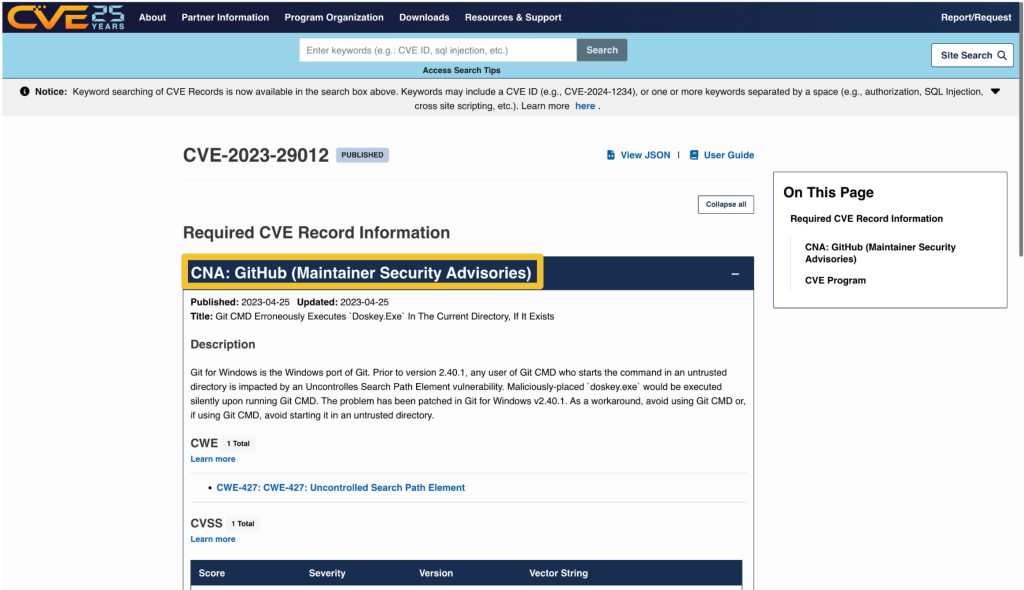
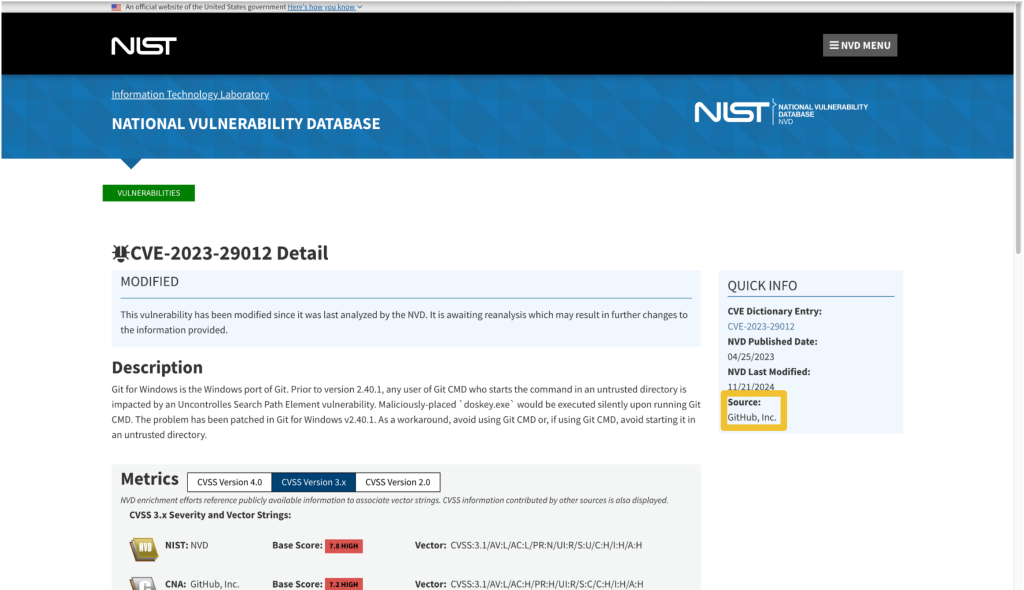
Every CVE record contains an entry that includes the name of the CNA that issued the CVE ID. The CNA is responsible for updating the CVE record after its initial publication, so any requests should be directed to them.
On cve.org, the CNA is listed as the first piece of information under the “Required CVE Record Information” header. The information is also available on the right side of the page.
On nvd.nist.gov, information about the issuing CNA is available in the “QUICK INFO” box. The issuing CNA is called “Source”.
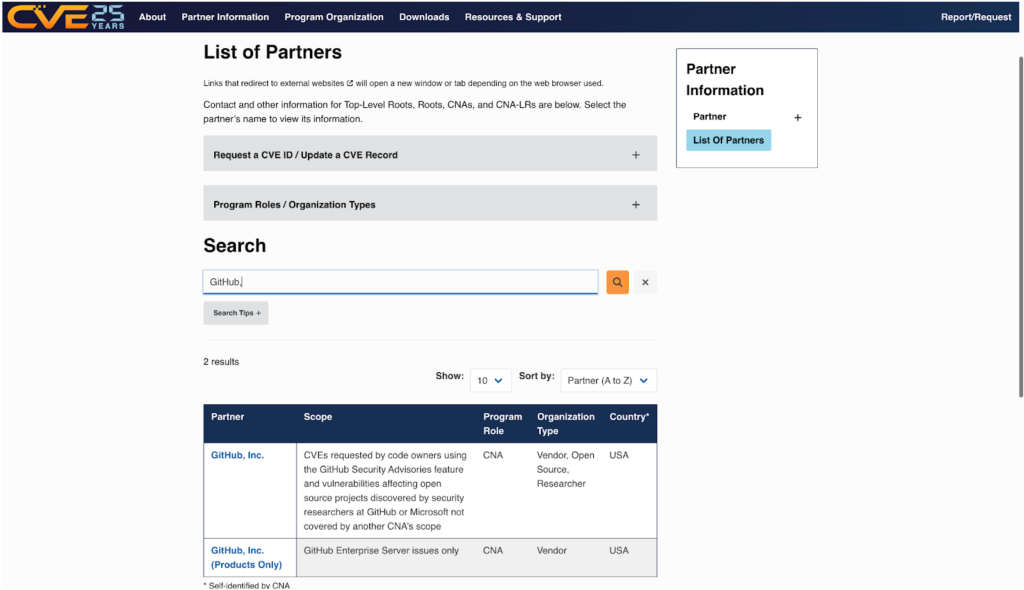
After identifying the CNA from the CVE record, locate their official contact information to request updates or changes. That information is available on the CNA partners website at https://www.cve.org/PartnerInformation/ListofPartners.
Search for the CNA’s name in the search bar. Some organizations may have more than one CNA, so make sure that the CVE you want corresponds to the correct CNA.
The left column, under “Partner,” has the name of the CNA that links to a profile page with its scope and contact information.
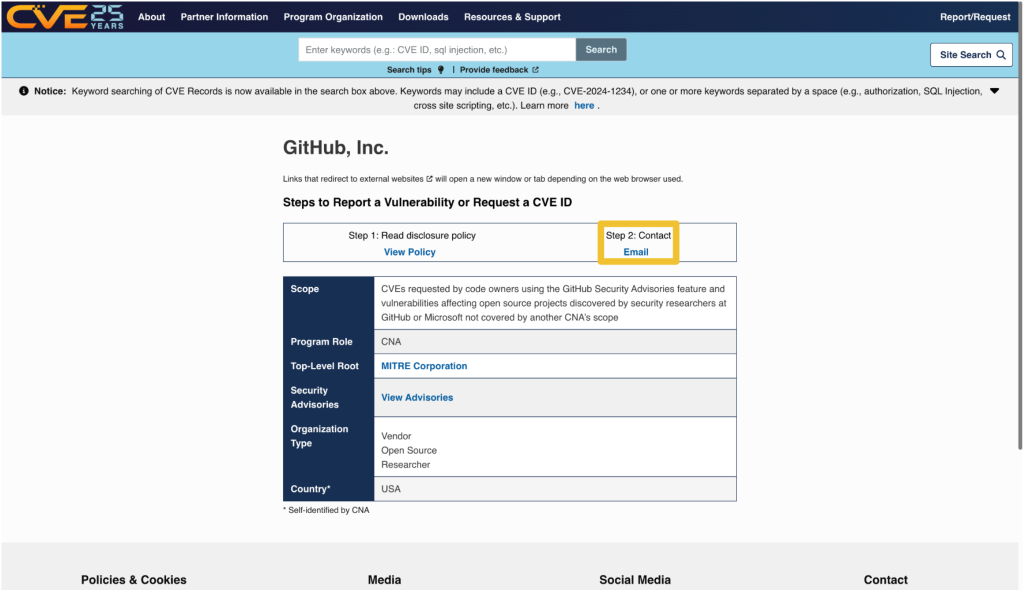
Most CNAs have an email address for CVE-related communications. Click the link under “Step 2: Contact” that says Email to find the CNA’s email address.
The most notable exception to the general preference for email communication among CNAs is the MITRE Corporation, the world’s most prolific CVE Numbering Authority. MITRE uses a webform at https://cveform.mitre.org/ for submitting requests to create, update, dispute, or reject CVEs.
The information you want to add, remove, or change within the CVE record
Why you want to change the information
Supporting evidence, usually in the form of a reference link
Including publicly available reference links is important, as they justify the changes. Examples of reference links include:
A publicly available vulnerability report, advisory, or proof-of-concept
A fix commit or release notes that describe a patch
An issue in the affected repository in which the maintainer discusses the vulnerability in their software with the community
A community contribution pull request that suggests a change to the CVE’s corresponding GitHub Security Advisory
When submitting changes, keep in mind that the CNA isn’t your only audience. Clear context around disclosure decisions and vulnerability details helps the broader developer and security community understand the risks and make informed decisions about mitigation.
“3.2.4.1 Subject to their respective CNA Scope Definitions, CNAs MUST respond in a timely manner to CVE ID assignment requests submitted through the CNA’s public POC.
3.2.4.2 CNAs SHOULD document their expected response times, including those for the public POC.”
The CNA rules establish firm timelines for assignment of CVE IDs to vulnerabilities that are already public knowledge. For CVE ID assignment or record publication in particular, section 4.2 and section 4.5 of the CVE CNA rules establish 72 hours as the time limit in which CNAs should issue CVE IDs or publish CVE records for publicly-known vulnerabilities. However, no such guidance exists for changing a CVE record.
If the CNA doesn’t respond or you cannot reach an agreement about the content of the CVE record, the next step is to engage in the dispute process.
The CVE Program Policy and Procedure for Disputing a CVE Record provides details on how you may go about disputing a CVE record and escalating a dispute. The details of that process are beyond the scope of this post. However, if you end up disputing a CVE record, it’s good to know who the root or top-level root of the CNA is that reviews the dispute.
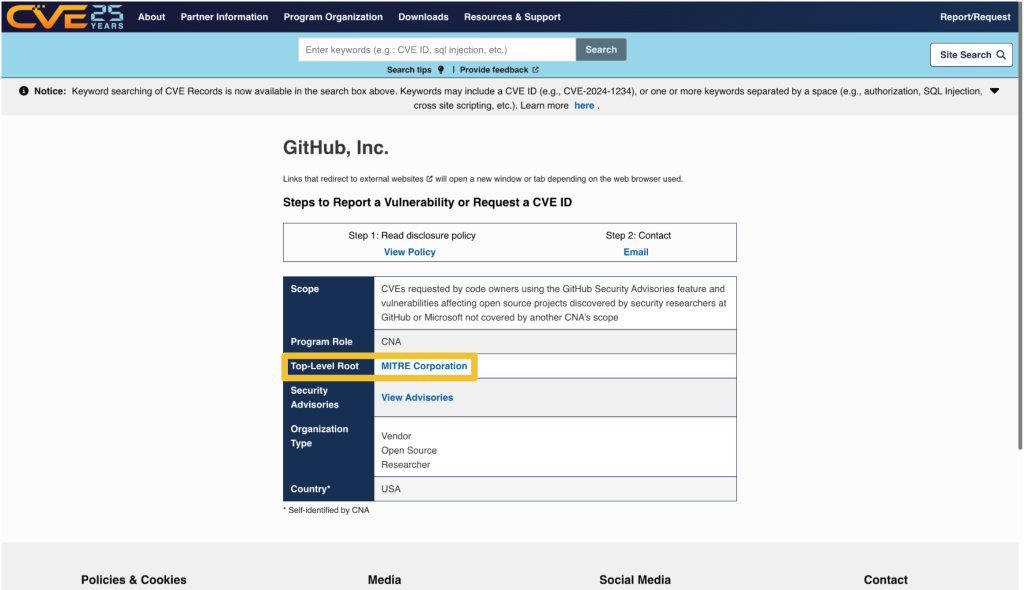
When viewing a CNA’s partner page linked from https://www.cve.org/PartnerInformation/ListofPartners, you can find the CNA’s root under the column “Top-Level Root.” For most CNAs, their root is the Top-Level Root, MITRE.

 Entrar