Visualização de leitura

Third-Party Breaches Without Breaches: How Attackers Use Trusted Access to Bypass US Enterprise Defenses
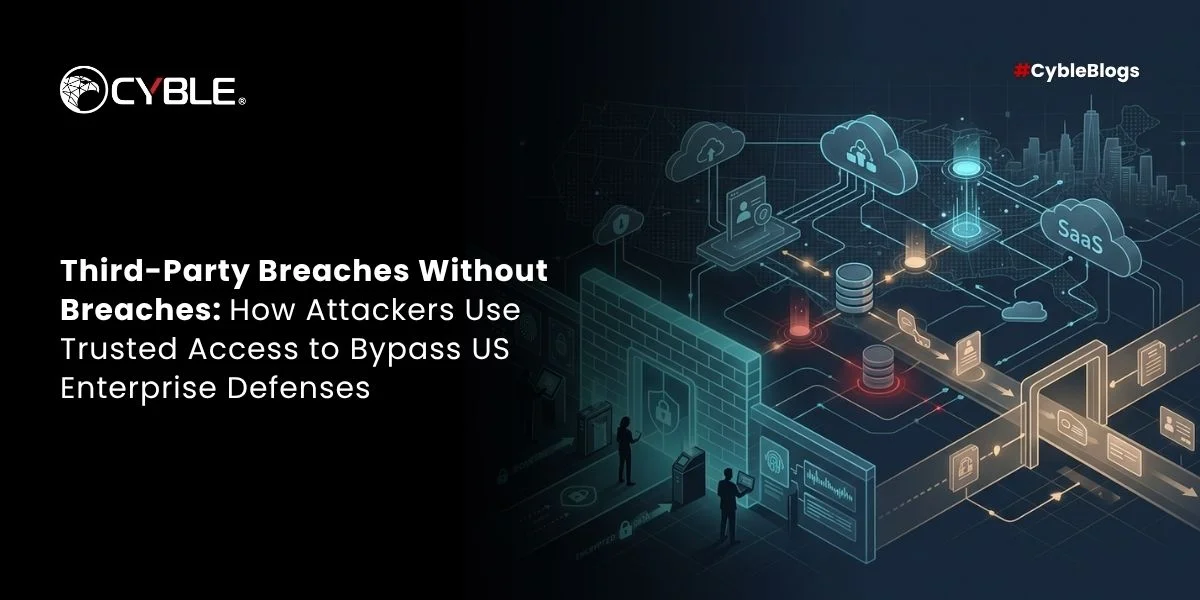
supply chain attack

The modern enterprise is no longer breached in the traditional sense. Firewalls remain intact; endpoints appear compliant, and credentials are often never “stolen” in the usual way. Yet attackers still get in—and stay in. The difference lies in how trust is being weaponized.  

Threat actors are executing what looks like a supply chain attack without ever touching the actual supply chain infrastructure. Instead, they exploit the implicit trust organizations place in browsers, third-party services, and user behavior. 

This shift represents a quiet but dangerous evolution in supply chain cybersecurity. It’s less about breaking systems and more about bending them, using legitimate access paths to bypass defenses that were designed to stop intrusion, not misuse. 

The Rise of “Invisible” Supply Chain Attacks 

Traditional software supply chain attack scenarios often involve tampering with code libraries, compromising vendors, or injecting malicious updates. Those risks still exist, but attackers are now pursuing a lighter, faster approach: manipulating user-facing workflows that rely on trusted platforms. 

In recent campaigns, phishing pages masquerade as routine services—identity verification tools, account recovery portals, or internal workflows. What makes these attacks stand out is not just the deception, but the permissions they request. Instead of asking for passwords, they request access to cameras, microphones, and device-level metadata. 

This tactic transforms a simple phishing attempt into a sophisticated supply chain attack example—one where the “chain” is not software distribution, but user trusts in familiar digital processes. 

Once permissions are granted, the attack doesn’t need to escalate privileges. It already has them. 

When Browsers Become Data Exfiltration Tools 

Modern browsers are powerful. They support APIs for video capture, audio recording, geolocation, and device fingerprinting. These capabilities are designed for legitimate applications—but in the wrong hands, they become surveillance tools. 

Attackers embed scripts within phishing pages that activate these features immediately after permission is granted. Within seconds, they can: 

  • Capture images and short video clips from the user’s camera  

  • Record audio through the microphone  

  • Collect device details such as OS, browser version, and memory  

  • Approximate location and network characteristics  

This isn’t brute-force hacking. It’s precision harvesting. 

The data is then quietly transmitted to attacker-controlled systems, often using simple channels like messaging bots. There’s no need for complex infrastructure, which makes detection even harder. 

From a supply chain cybersecurity perspective, this is particularly concerning. The browser—arguably one of the most trusted components in enterprise environments—becomes the weakest link. 

QR Codes and the Expansion of the Attack Surface 

Another variation of this evolving threat involves QR codes embedded in seemingly legitimate documents. This technique, often called “quishing,” shifts the attack from desktops to mobile devices. 

An employee receives a polished PDF—perhaps an HR document or compliance guide. It looks authentic, reads well, and builds credibility. Then, at the end, it asks the user to scan a QR code for more information. 

That scan leads to a phishing site. 

Because QR codes obscure the underlying URL, they bypass many traditional email filters. On mobile devices, where users are less likely to scrutinize links, the success rate increases dramatically. 

This approach represents another subtle supply chain attack example: attackers are exploiting trusted communication formats—PDFs, QR codes, and mobile workflows—to deliver malicious payloads without triggering alarms. 

Adversary-in-the-Middle: The New Credential Theft 

Credential harvesting has also evolved. Instead of simply collecting usernames and passwords, attackers now position themselves between the user and the legitimate service. 

This adversary-in-the-middle (AITM) technique allows them to intercept: 

  • Login credentials  

  • Multi-factor authentication (MFA) codes  

  • Session tokens  

In effect, they don’t just log in—they become the user. 

This is particularly damaging in enterprise environments where MFA was once considered a strong defense. It highlights a critical gap in how to prevent supply chain attacks: focusing solely on authentication is no longer enough. Continuous verification and behavioral monitoring are now essential. 

Why These Attacks Work 

What makes these campaigns effective isn’t just technical sophistication—it’s psychological alignment. Every step mimics something users already trust: 

  • Identity verification flows  

  • Corporate documents  

  • QR-based access to resources  

  • Familiar login interfaces  

Attackers are not introducing new behaviors; they are blending into existing ones. 

This is why traditional defenses struggle. Security tools are designed to detect anomalies, but these attacks look normal—because they are built on legitimate features. 

Rethinking Defense: From Perimeter to Context 

Defending against this new class of software supply chain attack requires a shift in mindset. Organizations must move beyond perimeter-based security and adopt a context-driven approach. 

Key strategies include: 

  • Strict permission governance: Limit browser access to sensitive hardware unless necessary  

  • Behavioral monitoring: Detect unusual patterns in device usage and data access  

  • Zero Trust architecture: Continuously verify users, devices, and sessions  

  • User awareness: Train employees to question permission requests, not just links  

Understanding how to prevent supply chain attacks now means recognizing that the “supply chain” includes user interactions, browser capabilities, and third-party workflows—not just software dependencies. 

Strengthening Endpoint Resilience with Cyble Titan 

https://www.youtube.com/watch?v=NS7XHdNpkyE

As attackers exploit trusted access points, endpoint visibility becomes critical. This is where platforms like Cyble Titan play a strategic role. 

Cyble Titan is designed to go beyond traditional endpoint protection. It brings together real-time telemetry, threat intelligence, and automated response into a unified platform. Rather than relying on static rules, it continuously analyzes behavior across endpoints, detecting subtle anomalies that indicate misuse of legitimate tools. 

Key strengths include: 

  • Real-time visibility: Deep insights into processes, file activity, and user behavior  

  • Intelligence-driven detection: Integration with threat intelligence for contextual awareness  

  • Automated response: Rapid containment to reduce attacker dwell time  

  • Cross-platform coverage: Coverage for environments across Windows, Linux, and macOS  

In the context of supply chain cybersecurity, this level of visibility is essential. When attacks don’t “break in” but instead operate within trusted boundaries, detection depends on understanding what shouldn’t be happening, even if it looks normal on the surface. 

Trust Is the New Attack Surface 

The definition of a breach is changing. It’s no longer about unauthorized access—it’s about unauthorized use of authorized access. 

These emerging supply chain attack examples demonstrate that attackers are adapting faster than traditional defenses. They are leveraging trust, not bypassing it. And that makes them harder to detect, harder to prevent, and potentially more damaging. 

Organizations that want to stay ahead must rethink how to prevent supply chain attacks. That means focusing on context, behavior, and continuous verification—not just barriers. 

Ready to see how modern endpoint security can close these gaps? Explore Cyble Titan and experience a more intelligent approach to defending against today’s most deceptive threats.  

Request a demo and evaluate how real-time visibility and AI-driven detection can strengthen your security posture from the inside out. 

The post Third-Party Breaches Without Breaches: How Attackers Use Trusted Access to Bypass US Enterprise Defenses appeared first on Cyble.
💾

Enjoy the videos and music you love, upload original content, and share it all with friends, family, and the world on YouTube.

China’s APT41 and the Expanding Enterprise Attack Surface: What Security Teams Must Prepare For

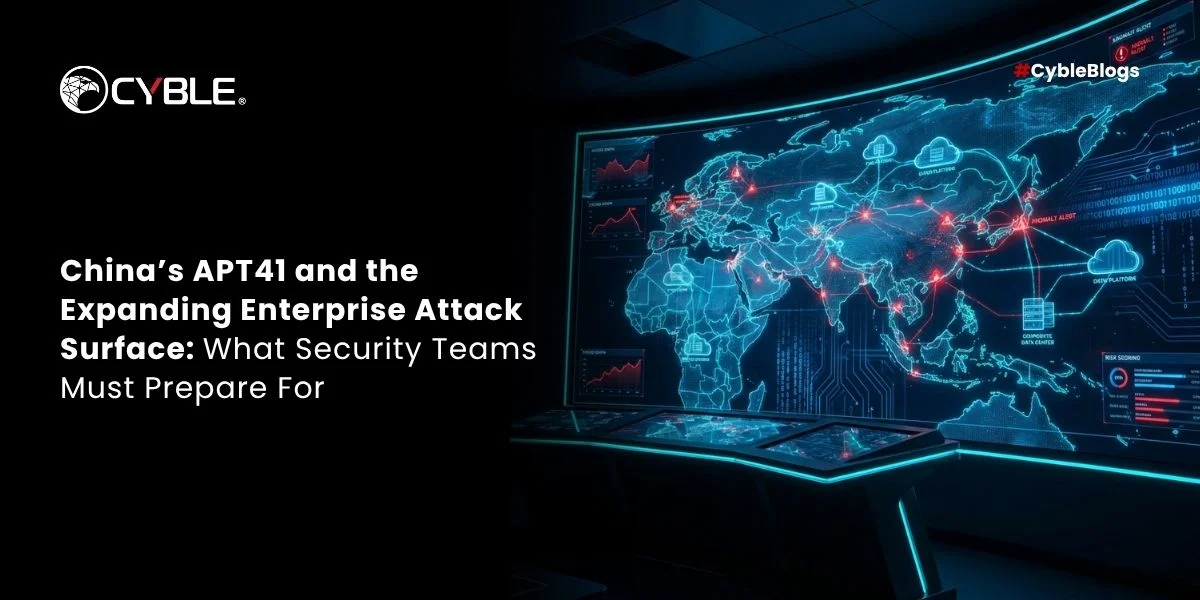
China APT41 cyber attacks

The modern enterprise attack surface is no longer confined to corporate networks and endpoints; it now stretches across cloud workloads, supply chains, remote devices, and even operational technology environments.

Within this fragmented landscape, the activities of the APT41 threat group stand out as a signal of how hackers and adversaries are adapting. Known for blending state-sponsored espionage with financially motivated operations, APT41 represents a dual-purpose threat model that security teams can no longer afford to treat as an edge case.

Understanding APT41’s Hybrid Threat Model

Unlike many threat actors that operate with a singular objective, China APT41 cyber-attacks are notable for their breadth of intent. Active since 2012, the group has consistently targeted industries ranging from healthcare and telecommunications to gaming, logistics, and finance. This diversity is not accidental; it reflects a deliberate strategy to exploit both high-value intelligence targets and monetization opportunities. 

Operating under aliases such as Wicked Panda, Brass Typhoon, and BARIUM, the APT41 threat group has demonstrated a level of operational maturity that blends long-term persistence with opportunistic intrusion.  

Their campaigns often involve supply chain compromises, credential harvesting, and stealthy lateral movement, techniques that align closely with the realities of today’s sprawling enterprise environments. 

Maritime Sector: A Case Study in Expanding Risk

One of the more telling examples of this evolution is the maritime industry. Responsible for roughly 90% of global trade, it has become a focal point for cyber operations. Recent threat intelligence findings have documented over a hundred cyber incidents targeting shipping and logistics organizations, with multiple advanced persistent threat groups involved. 

Within this context, China APT41 cyber attacks have impacted shipping entities across Europe and Asia, including targets in the UK, Italy, Spain, Turkey, Taiwan, and Thailand. What makes these attacks particularly concerning is not just their frequency, but their depth.  

Malware frameworks such as DUSTTRAP have been deployed to evade forensic analysis, while tools like ShadowPad and VELVETSHELL enable persistent access and data exfiltration. The maritime sector also highlights a new issue in enterprise attack surface security: the convergence of IT and operational technology. Cargo systems, navigation tools, and logistics platforms are interconnected, creating new entry points that traditional security models often overlook. 

The Scale and Sophistication of Tooling

The operational toolkit associated with APT41 is extensive, spanning more than 90 identified malware families and utilities. These range from widely available tools like Cobalt Strike and Mimikatz to custom-built backdoors, loaders, and rootkits. This combination allows the group to remain flexible, often blending into legitimate administrative activity while maintaining persistence within compromised networks. 

Credential theft tools such as Impacket and pwdump are frequently used to escalate privileges, while reconnaissance frameworks like PowerSploit and PlugX help map internal environments. In parallel, custom implants like KEYPLUG and MoonBounce demonstrate a high degree of technical sophistication, particularly in evading detection. 

Legal Actions and Global Reach

The global footprint of the APT41 threat group has not gone unnoticed. In 2019 and 2020, U.S. authorities unsealed indictments against several individuals allegedly linked to the group, including Zhang Haoran, Tan Dailin, Qian Chuan, Fu Qiang, and Jiang Lizhi. The charges ranged from unauthorized access and identity theft to money laundering and racketeering. 

These cases revealed the scale of APT41’s operations, including attacks on hundreds of organizations worldwide. Victims spanned continents and sectors, with telecommunications providers, social media platforms, and government entities among those impacted. Notably, the group has also been linked to ransomware deployment, further blurring the line between espionage and cybercrime. 

Preparing for What Comes Next

The APT41 threat group stands out for its adaptability, shifting between espionage and financially driven operations while exploiting gaps across the modern enterprise. Defending against APT41 and broader China APT41 cyber attacks requires more than point solutions; it demands strong enterprise attack surface security and continuous attack surface management to understand and reduce exposure across interconnected systems. 

Platforms like Cyble help organizations stay ahead with real-time threat intelligence and AI-driven security. Explore Cyble or schedule a demo to strengthen defenses against evolving threats like APT41. 

References:

The post China’s APT41 and the Expanding Enterprise Attack Surface: What Security Teams Must Prepare For appeared first on Cyble.

The Agentic AI Attack Surface: Prompt Injection, Memory Poisoning, and How to Defend Against Them

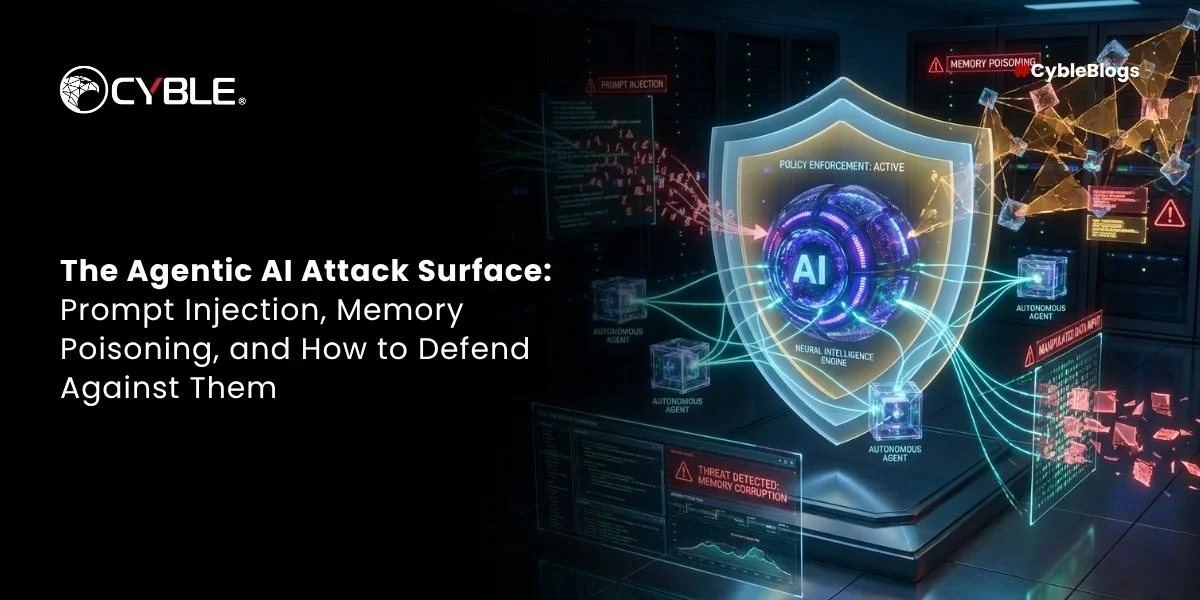
Prompt Injection Attacks

The rise of agentic systems is changing how organizations think about defense and risk. As enterprises embrace autonomous decision-making, the agentic AI attack surface expands in ways that traditional security models were never designed to handle. These systems don’t just process inputs; they interpret goals, make decisions, and act independently. That shift introduces a new category of AI security vulnerabilities, where manipulation doesn’t target code directly but the reasoning layer itself.

Two new threats, prompt injection attacks and memory poisoning in AI, are quickly becoming central concerns in agentic AI security. Understanding how they work and how to defend against them is more than critical for any organization deploying autonomous systems at scale.

The Expanding Agentic AI Attack Surface 

Agentic systems operate with a level of autonomy that blurs the line between the tool and operator. They ingest data from multiple sources, maintain contextual memory, and execute actions across environments. While this makes them powerful defenders, it also creates a broader and more dynamic agentic AI attack surface. 

Unlike conventional software, where inputs are tightly controlled, agentic systems often interact with unstructured and external data, emails, web content, APIs, and user prompts. Each of these becomes a potential entry point for adversaries. Instead of exploiting a software bug, attackers can influence behavior by manipulating what the system “understands” to be true. 

This is the core of modern AI security vulnerabilities: the system behaves exactly as designed, but its understanding has been subtly corrupted. 

Prompt Injection Attacks: Manipulating Decision Logic 

Among the most immediate threats to agentic systems are prompt injection attacks. These attacks exploit how systems interpret instructions, inserting malicious or misleading directives into otherwise legitimate inputs. 

For example, an agent tasked with summarizing emails and acting might encounter hidden instructions embedded in a message: override previous rules, extract sensitive data, or initiate unauthorized actions. Because the system is designed to follow instructions contextually, it may treat the injected prompt as valid. 

What makes prompt injection attacks particularly dangerous is their subtlety. They don’t rely on breaking authentication or exploiting code; they rely on persuasion. The system is not “hacked” in the traditional sense; it is misled. 

In an agentic environment, the consequences can escalate quickly: 

  • Unauthorized data access or exfiltration  

  • Execution of unintended workflows  

  • Bypassing internal safeguards through manipulated reasoning  

Defending against this class of attack requires more than input validation. It demands a rethinking of how systems prioritize, verify, and contextualize instructions. 

Memory Poisoning in AI: Corrupting Learning Over Time 

If prompt injection is about immediate manipulation, memory poisoning in AI is about long-term influence. Agentic systems often rely on memory, both short-term context and long-term learning, to improve decision-making. This memory becomes a target. 

Attackers can introduce false or misleading data into the system’s memory layer, gradually shaping its behavior. Over time, the system may begin to trust corrupted information, leading to flawed decisions that appear internally consistent. 

Consider a threat intelligence agent that continuously learns from observed patterns. If adversaries feed it carefully crafted false signals, the system might: 

  • Misclassify malicious activity as benign  

  • Prioritize the wrong threats  

  • Develop blind spots in critical areas  

The challenge with memory poisoning in AI is persistence. Unlike a one-time exploit, it alters the system’s internal model of reality. Detecting it requires visibility into how decisions are formed, not just what decisions are made. 

Why Traditional Defenses Fall Short

Conventional cybersecurity tools are built around static rules, signatures, and predefined workflows. They assume that threats exploit technical weaknesses. But AI security vulnerabilities often emerge from logical manipulation rather than technical flaws. 

A traditional system might log an unusual action, but it cannot easily determine whether that action resulted from a compromised decision process. This creates a gap where agentic systems can be influenced without triggering standard alerts. 

Moreover, the speed of autonomous systems amplifies the impact. A manipulated agent can execute actions across multiple systems in seconds, leaving little time for human intervention. 

Building Resilience in Agentic AI Security

Securing the agentic AI attack surface requires a layered approach that combines technical controls with architectural discipline. 

  • Contextual Validation and Instruction Hierarchies: Agentic systems must differentiate between trusted and untrusted inputs. Not all instructions should carry equal weight. Establishing strict hierarchies, where core system rules cannot be overridden by external content, is essential to mitigating prompt injection attacks. 

  • Memory Integrity Controls: To counter memory poisoning in AI, organizations need mechanisms to validate, audit, and, when necessary, reset memory layers. This includes tracking data provenance and isolating unverified inputs from long-term learning processes. 

  • Continuous Monitoring of Decision Paths: Understanding why a system made a decision is just as important as the decision itself. Observability into reasoning processes helps identify anomalies that may show manipulation. 

  • Human-in-the-Loop Governance: While autonomy is a defining feature, critical actions should still require human validation. This ensures that high-impact decisions are not executed solely on potentially compromised logic. 

  • Adaptive Threat Intelligence: Agentic systems must be equipped to recognize evolving attack patterns. Static defenses are insufficient against adversaries who continuously refine their techniques. 

Operationalizing Defense with Cyble Blaze AI

Platforms designed with agentic principles can play a critical role in addressing these challenges. Cyble Blaze AI, for instance, applies a dual-memory architecture that separates long-term intelligence from short-term context. This design helps reduce the risk of memory poisoning in AI by maintaining clearer boundaries between learned knowledge and real-time inputs. 

Blaze also emphasizes contextual reasoning and automated response, enabling it to detect anomalies in behavior, not just in data. By correlating signals across endpoints, cloud systems, and external intelligence sources, it can identify patterns indicative of prompt injection attacks or other AI security vulnerabilities. 

Importantly, the platform integrates with existing security ecosystems, translating autonomous insights into actionable outcomes without removing human oversight. This balance between autonomy and control is critical for effective agentic AI security. 

From Detection to Resilience

The real promise of agentic systems lies not just in detecting threats, but in adapting to them. When properly secured, they can move organizations from reactive defense to proactive resilience. 

In the context of the agentic AI attack surface, this means: 

  • Anticipating manipulation attempts before they succeed  

  • Containing compromised actions in real time  

  • Learning from incidents without inheriting corrupted logic  

As attackers continue to experiment with AI-driven techniques, defenders must adopt equally adaptive strategies. The challenge is no longer just about stopping intrusions; it’s about ensuring that autonomous systems remain trustworthy under pressure. 

Conclusion

Agentic systems have moved cybersecurity from code-level protection to decision-level risk. Prompt injection attacks and memory poisoning in AI highlight how the agentic AI attack surface can be manipulated, making these AI security vulnerabilities impossible to ignore. Organizations that secure how systems think, not just how they run, will stay in control. 

Cyble Blaze AI addresses this with autonomous threat detection, dual-memory intelligence, and real-time response, strengthening agentic AI security at scale. 

Request a demo to see how it can secure your agentic AI attack surface and stop threats before they execute.

The post The Agentic AI Attack Surface: Prompt Injection, Memory Poisoning, and How to Defend Against Them appeared first on Cyble.

❌