Microsoft’s Patch Tuesday April 2026 release has introduced one of the most extensive security update rollouts of the year, addressing a total of 167 vulnerabilities across Windows operating systems and associated software. This latest Microsoft Patch Tuesday also includes fixes for two zero-day vulnerabilities, one of which was actively exploited in real-world attacks, alongside critical flaws affecting SharePoint Server, Microsoft Defender, and Microsoft Office.The April edition of Microsoft Patch Tuesday highlights the complexity of modern cyber threats. Among the 167 vulnerabilities patched, eight are classified as “Critical.” Of these, seven involve remote code execution (RCE), while one relates to a denial-of-service (DoS) issue. The remaining vulnerabilities fall under various categories:
Additionally, the security update addresses two zero-day vulnerabilities and several flaws in Microsoft Office applications.
Microsoft Patch Tuesday: Zero-Day Vulnerabilities in Focus
A major focus of this Patch Tuesday April 2026 cycle is the remediation of two zero-day vulnerabilities. One of the most concerning issues is an actively exploited spoofing vulnerability in Microsoft SharePoint Server. According to Microsoft, “Improper input validation in Microsoft Office SharePoint allows an unauthorized attacker to perform spoofing over a network.” The company further explained that a successful attack could allow threat actors to access sensitive information and modify it, affecting both confidentiality and integrity, though not availability. Microsoft has not disclosed details about how the vulnerability was exploited or who discovered it.The second zero-day, tracked as CVE-2026-33825, affects Microsoft Defender and allows attackers to gain SYSTEM-level privileges. This flaw has been resolved in Microsoft Defender Antimalware Platform version 4.18.26050.3011, which is being distributed automatically. Users can also manually install the update via Windows Security settings. The vulnerability was discovered by Zen Dodd and Yuanpei XU from HUST working with Diffract.
Critical Vulnerabilities and Exploitation Risks
Beyond zero-days, Microsoft Patch Tuesday April 2026, includes several critical vulnerabilities that demand immediate attention. For instance, CVE-2026-23666 affects the .NET framework and could allow attackers to execute a denial-of-service attack over a network.Another critical flaw, CVE-2026-32157, impacts the Remote Desktop Client. It is a use-after-free vulnerability that can lead to code execution if a user connects to a malicious server. Similarly, multiple Microsoft Office vulnerabilities, such as CVE-2026-32190, CVE-2026-33114, and CVE-2026-33115, require local code execution but can be triggered remotely, often through malicious documents or even the preview pane. This makes them particularly dangerous in environments where users frequently handle email attachments.CVE-2026-33824 targets the Windows Internet Key Exchange (IKE) extension and allows unauthenticated attackers to send specially crafted packets to achieve remote code execution. Microsoft recommends blocking inbound UDP ports 500 and 4500 if IKE is not in use as a mitigation step.Other notable critical issues include vulnerabilities in Active Directory (CVE-2026-33826) and Windows TCP/IP (CVE-2026-33827), both of which could enable remote code execution under specific conditions.
Office and SharePoint Remain High-Risk Targets
This Patch Tuesday April also noted the risk posed by Microsoft Office and SharePoint. Multiple RCE vulnerabilities in Word and Excel can be exploited through malicious files, reinforcing the need for users to update their Office installations promptly.Another vulnerability, CVE-2026-32201, affects SharePoint and allows spoofing attacks that can expose and alter sensitive data. This issue has already been observed in active exploitation.While most vulnerabilities are rated as “Important,” security researchers have flagged several as more likely to be exploited. These include flaws in UEFI Secure Boot (CVE-2026-0390), Windows Kernel memory disclosure (CVE-2026-26169), and multiple elevation-of-privilege issues affecting components like WinSock, BitLocker, and the Desktop Window Manager.Other notable vulnerabilities include spoofing issues in Remote Desktop and Windows Shell, as well as security bypass flaws in Windows Hello and BitLocker.Outside of Microsoft, this Patch Tuesday April period also saw Google release fixes for its fourth Chrome zero-day vulnerability of 2026. Meanwhile, Adobe issued an emergency update for Acrobat Reader to address an actively exploited remote code execution flaw.
On March 4, 2026, Google and iVerify published reports about a highly sophisticated exploit kit targeting Apple iPhone devices. According to Google, the exploit kit was first discovered in targeted attacks conducted by a customer of an unnamed surveillance vendor. It was later used by other attackers in watering-hole attacks in Ukraine and in financially motivated attacks in China. Additionally, researchers discovered an instance with the debug version of the exploit kit, which revealed the internal names of the exploits and the framework name used by its developers — Coruna. Analysis of the kit showed that it relies on the exploitation of many previously patched vulnerabilities and also includes exploits for CVE-2023-32434 and CVE-2023-38606. These two vulnerabilities particularly caught our attention because they had been first discovered as zero-days used in Operation Triangulation.
Operation Triangulation is a complex mobile APT campaign targeting iOS devices. We discovered it while monitoring the network traffic of our own corporate Wi-Fi network. We noticed suspicious activity that originated from several iOS-based phones. Following the investigation, we learned that this campaign employed a sophisticated spyware implant and multiple zero-day exploits. The investigation lasted for over six months, during which we disclosed our findings in connection to the attack. Kaspersky GReAT experts also presented these findings at the 37th Chaos Communication Congress (37C3).
Although all the details of both CVE-2023-32434 and CVE-2023-38606 have long been publicly available, and other researchers have developed their own exploits without ever seeing the Triangulation code, we decided to closely investigate the exploits used in Coruna. Some of the exploit kit distribution links provided by Google remained active at the time the report was published, which allowed us to collect, decrypt, and analyze all components of Coruna.
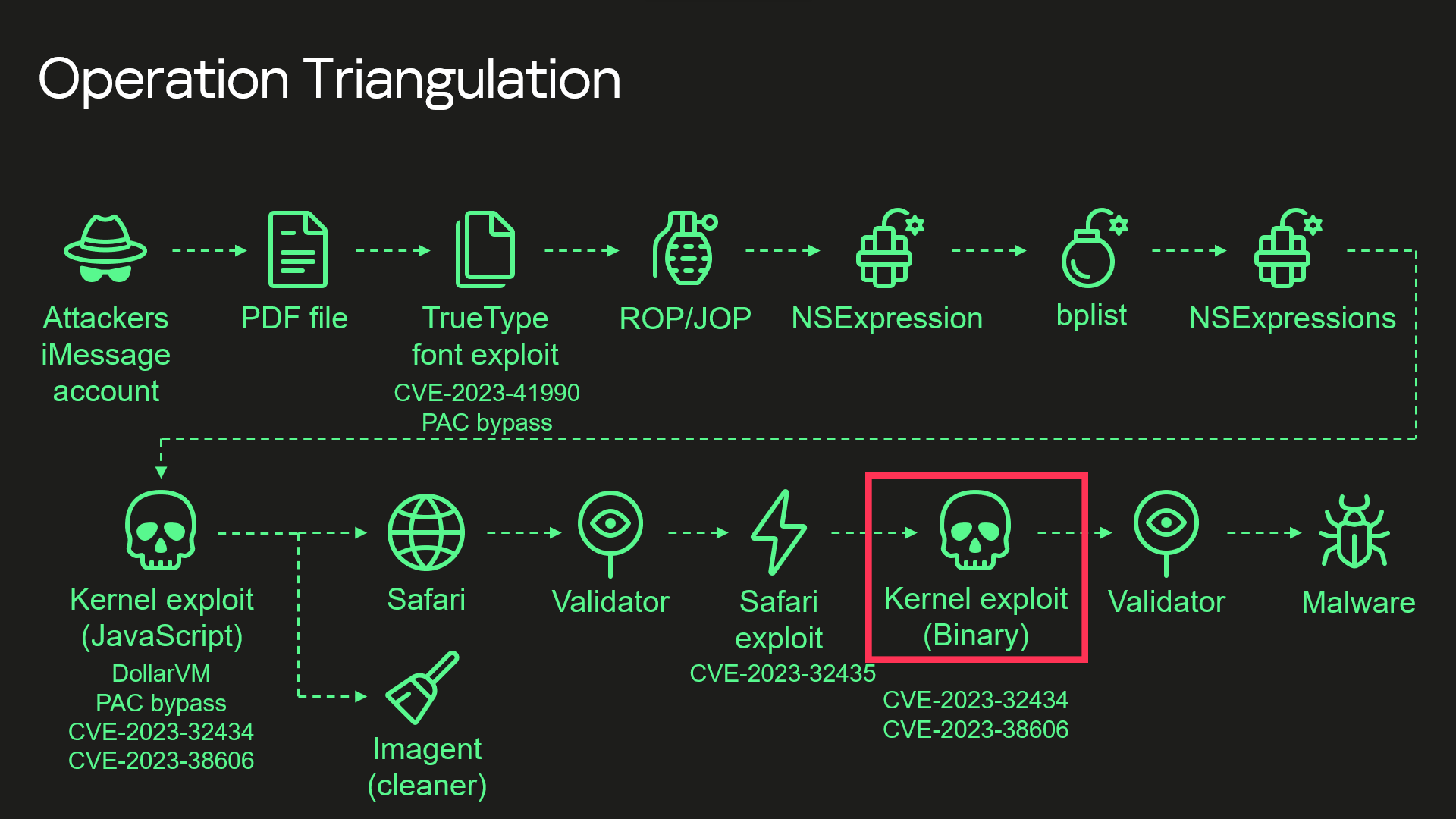
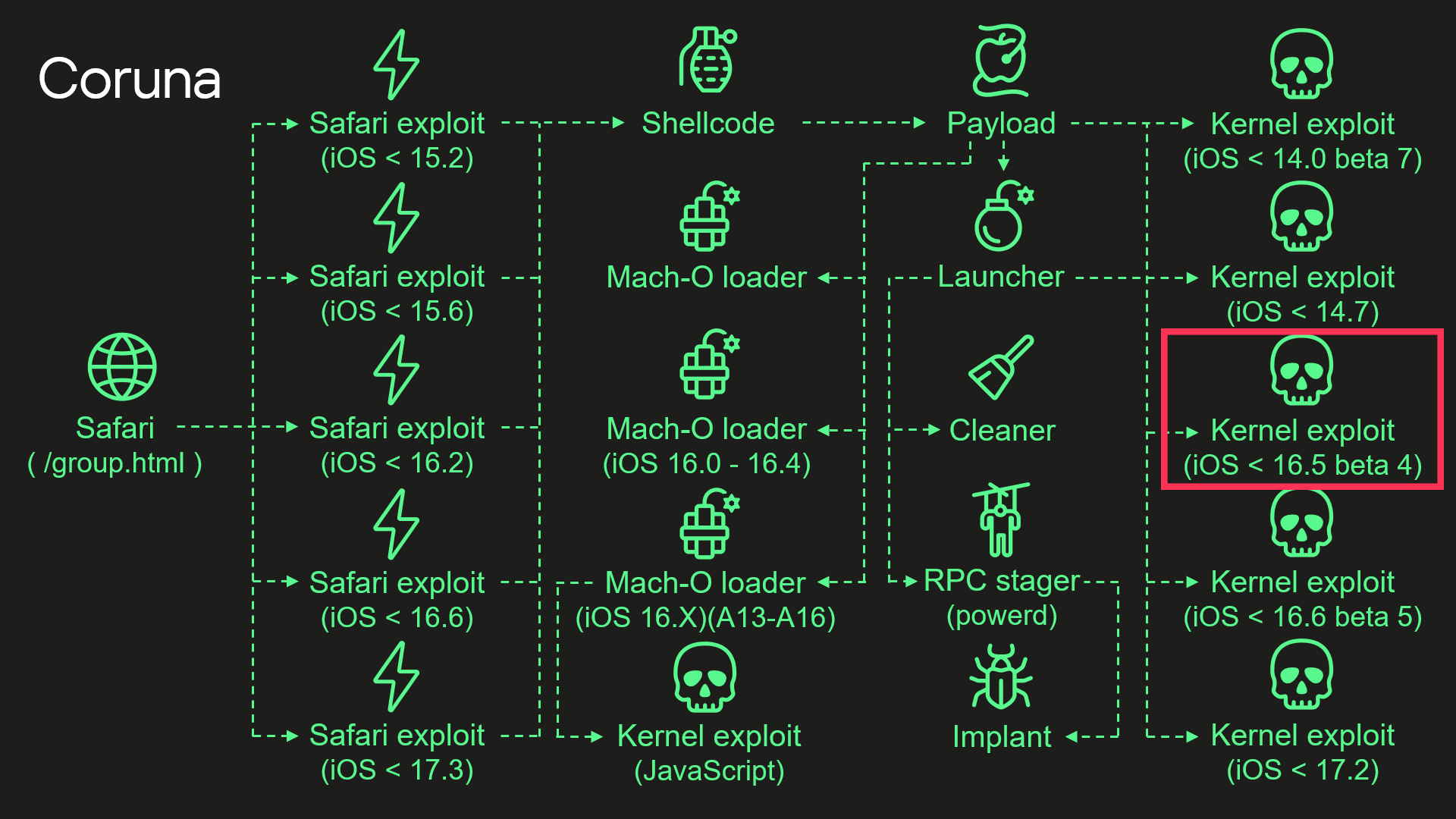
During our analysis, we discovered that the kernel exploit for CVE-2023-32434 and CVE-2023-38606 vulnerabilities used in Coruna, in fact, is an updated version of the same exploit that had been used in Operation Triangulation. The images below illustrate a high-level overview of the two attack chains. The exploit in question is highlighted with a red rectangle.
Attack chain of Operation Triangulation (simplified)
Attack chain of Coruna (simplified)
Moreover, we discovered that Coruna includes four additional kernel exploits that we had not seen used in Operation Triangulation, two of which were developed after the discovery of Operation Triangulation. All of these exploits are built on the same kernel exploitation framework and share common code. Code similarities from kernel exploits can also be found in other components of Coruna. These findings led us to conclude that this exploit kit was not patchworked but rather designed with a unified approach. We assume that it’s an updated version of the same exploitation framework that was used — at least to some extent — in Operation Triangulation.
Technical details
While we continue to investigate all exploits and vulnerabilities used by Coruna, this post provides a high-level overview of the exploit kit and attack chain.
Safari
Exploitation begins with a stager that fingerprints the browser and selects and executes appropriate remote code execution (RCE) and pointer authentication code (PAC) exploits depending on the browser version. It also contains a URL to an encrypted file with information about all available packages containing exploits and other components. The stager also includes a 256-bit key used to decrypt it. The URL and decryption key are passed to a payload embedded in PAC exploits.
Payload
The payload is responsible for initiating the exploitation of the kernel. After initialization, the payload first downloads a file with information about other available components. To extract it, the payload performs several steps processing multiple file formats.
First, the downloaded file is decrypted using the ChaCha20 stream cipher. Decryption yields a container with the magic number 0xBEDF00D, which stores LZMA-compressed data.
The file format used by the exploit kit to store compressed data
Offset
Field
0x00
Magic number (0xBEDF00D)
0x04
Decompressed data size
0x08
LZMA-compressed data
The decompressed data presents another container with the magic number 0xF00DBEEF. This file format is used in the exploit kit to store and retrieve files by their IDs.
The file format used by the exploit kit to store files
Offset
Field
0x00
Magic number (0xF00DBEEF)
0x04
Number of entries
0x08
Entry[0].File ID
0x0C
Entry[0].Status
0x10
Entry[0].File offset
0x14
Entry[0].File size
We provide a description of all possible File ID values below. At this stage, when the payload gathers information about all available file packages, this container holds only one file, and its File ID is 0x70000.
Finally, we get to the file with information about all available file packages. It starts with the magic value 0x12345678. The exploit kit uses this file format to obtain URLs and decryption keys for additional components that need to be downloaded.
The file format used by the exploit kit to store information about file packages
Offset
Field
0x00
Magic number (0x12345678)
0x04
Flags
0x08
Directory path
0x108
Number of entries
0x10C
Entry[0].Package ID
0x110
Entry[0].ChaCha20 key
0x130
Entry[0].File name
The components required for exploiting a targeted device are selected using the Package ID. Its high byte specifies the package type and required hardware. We’ve seen the following package types:
0xF2 – exploit for ARM64,
0xF3 – exploit for ARM64E,
0xA2 – Mach-O loader for ARM64,
0xA3 – Mach-O loader for ARM64E,
2 – implant for ARM64,
0xE2 – implant for ARM64E.
The payload code also supports additional package types, such as 0xF1, an exploit for older ARM devices that do not support 64-bit architecture. Interestingly, however, the files for such exploits are missing.
Other bytes of the Package ID define the supported firmware version and CPU generation.
Some of the observed Package IDs (those with unique content)
Package ID
Description
0xF3300000
Kernel exploit (iOS < 14.0 beta 7) and other components
0xF3400000
Kernel exploit (iOS < 14.7) and other components
0xF3700000
Kernel exploit (iOS < 16.5 beta 4) and other components
0xF3800000
Kernel exploit (iOS < 16.6 beta 5) and other components
0xF3900000
Kernel exploit (iOS < 17.2) and other components
0xA3030000
Mach-O loader (iOS 16.X) (A13 – A16)
0xA3050000
Mach-O loader (iOS 16.0 – 16.4)
The files inside these packages are also stored in encrypted and compressed 0xF00DBEEF containers, but this time compression is optional and is determined by the second bit in the Flags field. Different packages contain different sets of files. A description of all possible File IDs is given in the table below.
Observed File IDs
File ID
Description
0x10000
Implant
0x50000
Mach-O loader (default)
0x70000
List of additional components
0x70005
Launcher config
0x80000
Launcher in 0xF2/0xF3 packages, or Mach-O loader in 0xA2/0xA3
0x90000
Kernel exploit
0x90001
Kernel exploit (for Mach-O loader)
0xA0000
Logs cleaner
0xA0001
Mach-O loader component
0xA0002
Mach-O loader component
0xF0000
RPC stager
After downloading the necessary components, the payload begins executing kernel exploits, Mach-O loaders, and the malware launcher. The payload selects an appropriate Mach-O loader based on the firmware version, CPU, and presence of the iokit-open-service permission.
Kernel exploits
We analyzed all five kernel exploits from the kit and discovered that one of them is an updated version of the same exploit we discovered in Operation Triangulation. There are many small changes, but the most noticeable are as follows:
The code takes into account more values from XNU version strings, allowing for more accurate version checking.
Added a check for iOS 17.2. We assume that this was the latest version of iOS at the time of development (released in December 2023).
Added checks for newer Apple processors: A17, M3, M3 Pro, M3 Max (released in fall 2023).
Added a check for iOS version 16.5 beta 4. This version patched the exploit after our report to Apple.
Why does the exploit need to check for iOS 17.2 and newer CPUs if the targeted vulnerabilities were fixed in iOS 16.5 beta 4? The answer can be found by examining other exploits: they are all based on the same source code. The only difference is in the vulnerabilities they exploit, so these checks were added to support the newer exploits and appeared in the older version after recompilation.
Launcher
The launcher is responsible for orchestrating the post-exploitation activities. It also uses the kernel exploit and the interface it provides. However, since the exploit creates special kernel objects during its execution that provide the ability to read and write to kernel memory, the launcher simply reuses these objects without the need to trigger vulnerabilities and go through the entire exploitation path again. The launcher cleans up exploitation artifacts, retrieves the process name for injection from a config with the 0xDEADD00F magic number, injects a stager into the target process, uses it to execute itself, and launches the implant.
Conclusions
This case demonstrates once again the dangers associated with such malicious tools that lie in their potential wide usage. Originally developed for cyber-espionage purposes, this framework is now being used by cybercriminals of a broader kind, placing millions of users with unpatched devices at risk. Given its modular design and ease of reuse, we expect that other threat actors will begin incorporating it into their attacks. We strongly recommend that users install the latest security updates as soon as possible, if they have not already done so.
Google patches two actively exploited Chrome vulnerabilities that could allow attackers to crash browsers or run malicious code. Billions of users urged to update.
The Microsoft Patch Tuesday March 2026 release introduces security updates addressing 79 vulnerabilities, including two publicly disclosed zero-day vulnerabilities and several high-risk issues tied to remote code execution. The monthly security rollout includes fixes across multiple Microsoft products such as SQL Server, .NET, Microsoft Office, SharePoint Server, and Azure services.Among the vulnerabilities patched in the Microsoft Patch Tuesday March 2026, three have been categorized as “Critical.” Two of these critical issues involve remote code execution, while the third is an information disclosure of vulnerability affecting Microsoft Excel. Although two zero-day vulnerabilities were publicly disclosed before the update, Microsoft reported no evidence that attackers had exploited them in real-world attacks.
Microsoft Patch Tuesday March 2026 Breakdown
The Microsoft Patch Tuesday March security updates address a wide range of vulnerabilities across multiple categories. In total, Microsoft fixed 46 elevation of privilege vulnerabilities, 18 remote code execution vulnerabilities, 10 information disclosure vulnerabilities, four denial of service vulnerabilities, four spoofing vulnerabilities, and two security feature bypass vulnerabilities.The significant number of remote code execution flaws is particularly concerning because these types of vulnerabilities can allow attackers to run malicious code on targeted systems. As a result, applying the Microsoft Patch Tuesday March updates quickly is critical to reducing the risk posed by these security issues.
Two Zero-Day Vulnerabilities
Two zero-day vulnerabilities were publicly disclosed before patches became available. Microsoft defines a zero-day vulnerability as a flaw that becomes publicly known or actively exploited before an official fix is released.
CVE-2026-21262 – SQL Server Elevation of Privilege Vulnerability
One of the zero-day vulnerabilities fixed during Microsoft Patch Tuesday March affects SQL Server. The flaw allows attackers with authorized access to escalate privileges over a network and potentially obtain SQL administrator permissions.Microsoft explained:“Improper access control in SQL Server allows an authorized attacker to elevate privileges over a network.”Security researcher Erland Sommarskog discovered the issue and previously discussed it in an article titled “Packaging Permissions in Stored Procedures.” The vulnerability carries a CVSS score of 8.8 and could allow attackers to gain SQL sysadmin privileges once logged in to a vulnerable system.
The second publicly disclosed zero-day vulnerability affects Microsoft .NET. It stems from an out-of-bounds read that could allow an unauthenticated attacker to cause a denial-of-service condition remotely.Microsoft stated:“Out-of-bounds read in .NET allows an unauthorized attacker to deny service over a network.”The flaw was reported by an anonymous researcher. Despite being publicly disclosed, Microsoft indicated that exploitation appears unlikely.
Critical Remote Code Execution Bugs in Microsoft Office
The Microsoft Patch Tuesday March release also addresses two critical remote code execution vulnerabilities in Microsoft Office:
Both vulnerabilities could allow attackers to execute malicious code locally and can be triggered through the Preview Pane, meaning a user might not need to open a file for exploitation to occur. Because of the remote code execution risk, Microsoft recommends prioritizing updates for Office installations.Another Office-related issue, CVE-2026-26109, is an “Important” vulnerability in Excel caused by an out-of-bounds read. Successful exploitation could allow attackers to execute code locally and compromise affected systems.
Excel Vulnerability Raises Data Exfiltration Concerns
One of the most notable issues patched during Microsoft Patch Tuesday March is CVE-2026-26144, a critical information disclosure vulnerability affecting Microsoft Excel with a CVSS score of 7.5.The vulnerability stems from improper neutralization of input in Excel, potentially allowing attackers to extract sensitive information through a zero-click attack involving Microsoft Copilot.Microsoft explained:“An attacker who successfully exploited this vulnerability could potentially cause Copilot Agent mode to exfiltrate data via unintended network egress, enabling a zero-click information disclosure attack.”The flaw does not use the Preview Pane as an attack vector and currently has no known exploit code, with Microsoft assessing exploitation as unlikely.However, security analysts from Project Overwatch warned about the potential implications. They described the issue as an unusual attack technique that leverages AI features:“CVE-2026-26144 is unlike anything I’ve seen in 15 years of cybersecurity. This isn’t just another Office vulnerability. It’s a zero-click attack that weaponizes Copilot Agent to silently exfiltrate sensitive data from Excel spreadsheets.”According to their analysis, the attack could manipulate Copilot into sending sensitive data outside an organization through unintended network connections.
And don't miss our bug of the month! Each patch Tuesday we'll be selecting our very favorite patch to highlight. This month, it CVE-2026-26144 - a Critical-rated info disclosure in Excel that uses the Copilot Agent to exfiltrate data. Neat! pic.twitter.com/2UC9cOz15c
TrendAI Zero Day Initiative also noted its take on the vulnerability. According to a video posted on X, the researchers stressed that “CVE-2026-26144 is a critically rated Excel info disclosure. And how do you get Excel info disclosure that is critical-rated? Well, you open an Excel doc, and then it allows Copilot to exfiltrate data out of your network. As Microsoft says, it’s a zero-click data exfiltration. Which is crazy. I count it as one click because you do have to open the doc. Preview pain is not an attack vector here, but it’s crazy. It’s really cool to see a bug that could use the AI component to do things that you don’t want to do. “
SharePoint and Azure Security Issues
The Microsoft Patch Tuesday March update also includes fixes for remote code execution vulnerabilities affecting Microsoft SharePoint Server:
Both vulnerabilities allow authenticated attackers with Site Member permissions to execute code remotely on a SharePoint Server.Another issue, CVE-2026-26118, affects Azure MCP Server Tools. This elevation-of-privilege vulnerability is caused by server-side request forgery (SSRF). Attackers could exploit it by sending crafted input to a Model Context Protocol server tool, potentially capturing a managed identity token and accessing resources associated with that identity.
Additional Privilege Escalation Risks
Several vulnerabilities rated “Important” were also marked as more likely to be exploited, including issues affecting:
Windows Graphics Component
Windows Kernel
Windows Accessibility Infrastructure (ATBroker.exe)
Windows SMB Server
WinSock Ancillary Function Driver
Winlogon
One such flaw, CVE-2026-26128, affects Windows SMB Server and allows attackers to gain SYSTEM privileges if successfully exploited.
The fourth quarter of 2025 went down as one of the most intense periods on record for high-profile, critical vulnerability disclosures, hitting popular libraries and mainstream applications. Several of these vulnerabilities were picked up by attackers and exploited in the wild almost immediately.
In this report, we dive into the statistics on published vulnerabilities and exploits, as well as the known vulnerabilities leveraged with popular C2 frameworks throughout Q4 2025.
Statistics on registered vulnerabilities
This section contains statistics on registered vulnerabilities. The data is taken from cve.org.
Let’s take a look at the number of registered CVEs for each month over the last five years, up to and including the end of 2025. As predicted in our last report, Q4 saw a higher number of registered vulnerabilities than the same period in 2024, and the year-end totals also cleared the bar set the previous year.
Total published vulnerabilities by month from 2021 through 2025 (download)
Now, let’s look at the number of new critical vulnerabilities (CVSS > 8.9) for that same period.
Total number of published critical vulnerabilities by month from 2021 to 2025< (download)
The graph shows that the volume of critical vulnerabilities remains quite substantial; however, in the second half of the year, we saw those numbers dip back down to levels seen in 2023. This was due to vulnerability churn: a handful of published security issues were revoked. The widespread adoption of secure development practices and the move toward safer languages also pushed those numbers down, though even that couldn’t stop the overall flood of vulnerabilities.
Exploitation statistics
This section contains statistics on the use of exploits in Q4 2025. The data is based on open sources and our telemetry.
Windows and Linux vulnerability exploitation
In Q4 2025, the most prevalent exploits targeted the exact same vulnerabilities that dominated the threat landscape throughout the rest of the year. These were exploits targeting Microsoft Office products with unpatched security flaws.
Kaspersky solutions detected the most exploits on the Windows platform for the following vulnerabilities:
CVE-2018-0802: a remote code execution vulnerability in Equation Editor.
CVE-2017-11882: another remote code execution vulnerability, also affecting Equation Editor.
CVE-2017-0199: a vulnerability in Microsoft Office and WordPad that allows an attacker to assume control of the system.
The list has remained unchanged for years.
We also see that attackers continue to adapt exploits for directory traversal vulnerabilities (CWE-35) when unpacking archives in WinRAR. They are being heavily leveraged to gain initial access via malicious archives on the Windows operating system:
CVE-2023-38831: a vulnerability stemming from the improper handling of objects within an archive.
CVE-2025-6218 (formerly ZDI-CAN-27198): a vulnerability that enables an attacker to specify a relative path and extract files into an arbitrary directory. This can lead to arbitrary code execution. We covered this vulnerability in detail in our Q2 2025 report.
CVE-2025-8088: a vulnerability we analyzed in our previous report, analogous to CVE-2025-6218. The attackers used NTFS streams to circumvent controls on the directory into which files were being unpacked.
As in the previous quarter, we see a rise in the use of archiver exploits, with fresh vulnerabilities increasingly appearing in attacks.
Below are the exploit detection trends for Windows users over the last two years.
Dynamics of the number of Windows users encountering exploits, Q1 2024 – Q4 2025. The number of users who encountered exploits in Q1 2024 is taken as 100% (download)
The vulnerabilities listed here can be used to gain initial access to a vulnerable system. This highlights the critical importance of timely security updates for all affected software.
On Linux-based devices, the most frequently detected exploits targeted the following vulnerabilities:
CVE-2022-0847, also known as Dirty Pipe: a vulnerability that allows privilege escalation and enables attackers to take control of running applications.
CVE-2019-13272: a vulnerability caused by improper handling of privilege inheritance, which can be exploited to achieve privilege escalation.
CVE-2021-22555: a heap overflow vulnerability in the Netfilter kernel subsystem.
CVE-2023-32233: another vulnerability in the Netfilter subsystem that creates a use-after-free condition, allowing for privilege escalation due to the improper handling of network requests.
Dynamics of the number of Linux users encountering exploits, Q1 2024 – Q4 2025. The number of users who encountered exploits in Q1 2024 is taken as 100% (download)
We are seeing a massive surge in Linux-based exploit attempts: in Q4, the number of affected users doubled compared to Q3. Our statistics show that the final quarter of the year accounted for more than half of all Linux exploit attacks recorded for the entire year. This surge is primarily driven by the rapidly growing number of Linux-based consumer devices. This trend naturally attracts the attention of threat actors, making the installation of security patches critically important.
Most common published exploits
The distribution of published exploits by software type in Q4 2025 largely mirrors the patterns observed in the previous quarter. The majority of exploits we investigate through our monitoring of public research, news, and PoCs continue to target vulnerabilities within operating systems.
Distribution of published exploits by platform, Q1 2025 (download)
Distribution of published exploits by platform, Q2 2025 (download)
Distribution of published exploits by platform, Q3 2025 (download)
Distribution of published exploits by platform, Q4 2025 (download)
In Q4 2025, no public exploits for Microsoft Office products emerged; the bulk of the vulnerabilities were issues discovered in system components. When calculating our statistics, we placed these in the OS category.
Vulnerability exploitation in APT attacks
We analyzed which vulnerabilities were utilized in APT attacks during Q4 2025. The following rankings draw on our telemetry, research, and open-source data.
TOP 10 vulnerabilities exploited in APT attacks, Q4 2025 (download)
In Q4 2025, APT attacks most frequently exploited fresh vulnerabilities published within the last six months. We believe that these CVEs will remain favorites among attackers for a long time, as fixing them may require significant structural changes to the vulnerable applications or the user’s system. Often, replacing or updating the affected components requires a significant amount of resources. Consequently, the probability of an attack through such vulnerabilities may persist. Some of these new vulnerabilities are likely to become frequent tools for lateral movement within user infrastructure, as the corresponding security flaws have been discovered in network services that are accessible without authentication. This heavy exploitation of very recently registered vulnerabilities highlights the ability of threat actors to rapidly implement new techniques and adapt old ones for their attacks. Therefore, we strongly recommend applying the security patches provided by vendors.
C2 frameworks
In this section, we will look at the most popular C2 frameworks used by threat actors and analyze the vulnerabilities whose exploits interacted with C2 agents in APT attacks.
The chart below shows the frequency of known C2 framework usage in attacks against users during Q4 2025, according to open sources.
TOP 10 C2 frameworks used by APTs to compromise user systems in Q4 2025 (download)
Despite the significant footprints it can leave when used in its default configuration, Sliver continues to hold the top spot among the most common C2 frameworks in our Q4 2025 analysis. Mythic and Havoc were second and third, respectively. After reviewing open sources and analyzing malicious C2 agent samples that contained exploits, we found that the following vulnerabilities were used in APT attacks involving the C2 frameworks mentioned above:
CVE-2025-55182: a React2Shell vulnerability in React Server Components that allows an unauthenticated user to send commands directly to the server and execute them from RAM.
CVE-2023-36884: a vulnerability in the Windows Search component that allows the execution of commands on a system, bypassing security mechanisms built into Microsoft Office applications.
CVE-2025-53770: a critical insecure deserialization vulnerability in Microsoft SharePoint that allows an unauthenticated user to execute commands on the server.
CVE-2020-1472, also known as Zerologon, allows for compromising a vulnerable domain controller and executing commands as a privileged user.
CVE-2021-34527, also known as PrintNightmare, exploits flaws in the Windows print spooler subsystem, enabling remote access to a vulnerable OS and high-privilege command execution.
CVE-2025-8088 and CVE-2025-6218 are similar directory-traversal vulnerabilities that allow extracting files from an archive to a predefined path without the archiving utility notifying the user.
The set of vulnerabilities described above suggests that attackers have been using them for initial access and early-stage maneuvers in vulnerable systems to create a springboard for deploying a C2 agent. The list of vulnerabilities includes both zero-days and well-known, established security issues.
Notable vulnerabilities
This section highlights the most noteworthy vulnerabilities that were publicly disclosed in Q4 2025 and have a publicly available description.
React2Shell (CVE-2025-55182): a vulnerability in React Server Components
We typically describe vulnerabilities affecting a specific application. CVE-2025-55182 stood out as an exception, as it was discovered in React, a library primarily used for building web applications. This means that exploiting the vulnerability could potentially disrupt a vast number of applications that rely on the library. The vulnerability itself lies in the interaction mechanism between the client and server components, which is built on sending serialized objects. If an attacker sends serialized data containing malicious functionality, they can execute JavaScript commands directly on the server, bypassing all client-side request validation. Technical details about this vulnerability and an example of how Kaspersky solutions detect it can be found in our article.
CVE-2025-54100: command injection during the execution of curl (Invoke-WebRequest)
This vulnerability represents a data-handling flaw that occurs when retrieving information from a remote server: when executing the curl or Invoke-WebRequest command, Windows launches Internet Explorer in the background. This can lead to a cross-site scripting (XSS) attack.
CVE-2025-11001: a vulnerability in 7-Zip
This vulnerability reinforces the trend of exploiting security flaws found in file archivers. The core of CVE-2025-11001 lies in the incorrect handling of symbolic links. An attacker can craft an archive so that when it is extracted into an arbitrary directory, its contents end up in the location pointed to by a symbolic link. The likelihood of exploiting this vulnerability is significantly reduced because utilizing such functionality requires the user opening the archive to possess system administrator privileges.
This vulnerability was associated with a wave of misleading news reports claiming it was being used in real-world attacks against end users. This misconception stemmed from an error in the security bulletin.
RediShell (CVE-2025-49844): a vulnerability in Redis
The year 2025 saw a surge in high-profile vulnerabilities, several of which were significant enough to earn a unique nickname. This was the case with CVE-2025-49844, also known as RediShell, which was unveiled during a hacking competition. This vulnerability is a use-after-free issue related to how the load command functions within Lua interpreter scripts. To execute the attack, an attacker needs to prepare a malicious script and load it into the interpreter.
As with any named vulnerability, RediShell was immediately weaponized by threat actors and spammers, albeit in a somewhat unconventional manner. Because technical details were initially scarce following its disclosure, the internet was flooded with fake PoC exploits and scanners claiming to test for the vulnerability. In the best-case scenario, these tools were non-functional; in the worst, they infected the system. Notably, these fraudulent projects were frequently generated using LLMs. They followed a standardized template and often cross-referenced source code from other identical fake repositories.
CVE-2025-24990: a vulnerability in the ltmdm64.sys driver
Driver vulnerabilities are often discovered in legitimate third-party applications that have been part of the official OS distribution for a long time. Thus, CVE-2025-24990 has existed within code shipped by Microsoft throughout nearly the entire history of Windows. The vulnerable driver has been shipped since at least Windows 7 as a third-party driver for Agere Modem. According to Microsoft, this driver is no longer supported and, following the discovery of the flaw, was removed from the OS distribution entirely.
The vulnerability itself is straightforward: insecure handling of IOCTL codes leading to a null pointer dereference. Successful exploitation can lead to arbitrary command execution or a system crash resulting in a blue screen of death (BSOD) on modern systems.
CVE-2025-59287: a vulnerability in Windows Server Update Services (WSUS)
CVE-2025-59287 represents a textbook case of insecure deserialization. Exploitation is possible without any form of authentication; due to its ease of use, this vulnerability rapidly gained traction among threat actors. Technical details and detection methodologies for our product suite have been covered in our previous advisories.
Conclusion and advice
In Q4 2025, the rate of vulnerability registration has shown no signs of slowing down. Consequently, consistent monitoring and the timely application of security patches have become more critical than ever. To ensure resilient defense, it is vital to regularly assess and remediate known vulnerabilities while implementing technology designed to mitigate the impact of potential exploits.
Continuous monitoring of infrastructure, including the network perimeter, allows for the timely identification of threats and prevents them from escalating. Effective security also demands tracking the current threat landscape and applying preventative measures to minimize risks associated with system flaws. Kaspersky Next serves as a reliable partner in this process, providing real-time identification and detailed mapping of vulnerabilities within the environment.
Securing the workplace remains a top priority. Protecting corporate devices requires the adoption of solutions capable of blocking malware and preventing it from spreading. Beyond basic measures, organizations should implement adaptive systems that allow for the rapid deployment of security updates and the automation of patch management workflows.
A expansão internacional do grupo de cibercriminosos conhecido como Scattered Spider acendeu um sinal de alerta entre empresas latino-americanas. Especialistas em segurança apontam que, embora não haja registros confirmados de ataques desse grupo no Brasil ou vizinhos até o momento, seu alcance global e métodos sofisticados representam um risco iminente para organizações na região.
Com táticas de engenharia social elaboradas e capacidade de driblar defesas tradicionais, o Scattered Spider tem mirado grandes empresas em diversos países. “A questão não é mais ‘se’ seremos atacados, mas de ‘quando’ e ‘como’, afirma Felipe Guimarães, Chief Information Security Officer da Solo Iron. “As táticas empregadas pelo grupo exploram fragilidades universais, presentes em empresas em todo o mundo – o que inclui as empresas latino-americanas”, pondera o especialista.
Um dos maiores riscos é que os setores visados pelo Scattered Spider no exterior também são pilares econômicos na América Latina. O grupo historicamente focou suas ações em empresas de telecomunicações, terceirização de processos de negócios (BPO) e grandes empresas de tecnologia – indústrias que possuem ampla presença na região. Nos últimos tempos, foi observado um aumento de interesse do grupo pelo setor financeiro global, o que inclui bancos e instituições presentes no Brasil e países vizinhos.
“Isso significa que companhias latino-americanas, seja diretamente ou através de filiais e parceiras, podem entrar na mira à medida que o Scattered Spider amplia seu raio de atuação. Mesmo empresas que não operam internacionalmente devem se precaver, pois os criminosos podem enxergar organizações locais como pontes de entrada para fornecedores ou clientes globais, ou simplesmente como alvos lucrativos por si sós, caso identifiquem falhas de segurança exploráveis”, pontua Guimarães.
Na mira das agências de inteligência
Relatórios do FBI e da Agência de Segurança Cibernética e de Infraestrutura (CISA) dos EUA descrevem o Scattered Spider como “especialista em engenharia social”, empregando diversas técnicas para roubar credenciais e burlar autenticações.
Entre os métodos documentados estão phishing por e-mail e SMS (smishing), ataques de vishing (ligações telefônicas fraudulentas) em que os criminosos se passam por equipe de TI da própria empresa, e até esquemas elaborados de SIM swap – quando convencem operadoras de telefonia a transferir o número de celular de uma vítima para um chip sob controle deles. Essas táticas permitem interceptar códigos de autenticação multifator (MFA) enviados via SMS ou aplicativos, dando aos invasores as chaves para acessar sistemas internos.
Ainda segundo o especialista, o modelo de ataque do Scattered Spider pode inspirar quadrilhas locais. “As táticas de engenharia social eficazes tendem a se espalhar rapidamente nos submundos virtuais. Mesmo que o próprio grupo original não atue diretamente na América Latina, outros agentes maliciosos regionais podem adotar técnicas semelhantes – como push bombing de MFA ou golpes contra centrais de atendimento – ao verem o sucesso obtido lá fora”, explica Guimarães.
Alguns incidentes recentes no cenário latino-americano já envolveram vetores parecidos, como uso de ferramentas legítimas em ataques e exploração de credenciais vazadas, o que reforça a necessidade de vigilância. Em 2024, por exemplo, houve casos de gangues de ransomware operando na região que abusaram de softwares legítimos e brechas em procedimentos internos de empresas, aplicando práticas muito similares ao do Scattered Spider.
Estratégias de mitigação
Diante da crescente ameaça representada por grupos como o Scattered Spider, Guimarães recomenda a adoção de estratégias com foco especial em fortalecer métodos avançados de autenticação multifator (MFA), preferencialmente resistentes a phishing, como chaves físicas de segurança ou soluções baseadas em certificados digitais. Técnicas como MFA com validação numérica e a restrição do uso de SMS para autenticação são essenciais para reduzir o risco de engenharia social e ataques por fadiga de notificações, muito usados pelo grupo.
Além disso, a adoção de uma abordagem mais robusta em relação à gestão de identidades e acessos (IAM) é uma estratégia muito importante na contenção desse tipo de ameaça. “As identidades digitais estão se tornando uma nova superfície de ataque; por isso, é fundamental que as empresas implementem políticas rígidas de gestão de identidades, controle granular de acessos e monitoramento contínuo das atividades dos usuários”, destaca.
“Também é muito importante o controle rigoroso sobre ferramentas de acesso remoto e a implantação de monitoramento avançado. É recomendável que as organizações restrinjam o uso dessas ferramentas por meio de listas autorizadas e adotem sistemas robustos como EDR e DLP para identificar rapidamente atividades suspeitas”, finaliza o especialista.
A escalada de tensões entre Irã e Israel ganha um novo e perigoso capítulo no ciberespaço. Um relatório divulgado pela Check Point Research revela que o grupo de ciberespionagem iraniano conhecido como Educated Manticore, com ligações diretas ao Corpo da Guarda Revolucionária Islâmica (IRGC-IO), intensificou campanhas direcionadas contra acadêmicos, jornalistas e especialistas de tecnologia israelenses.
Alvos: Especialistas e Acadêmicos de Prestígio
De acordo com a investigação, o Educated Manticore concentrou esforços em atacar profissionais de alto nível, incluindo professores de ciência da computação de universidades renomadas de Israel, pesquisadores de cibersegurança e jornalistas. As ações, sofisticadas e cuidadosamente planejadas, fazem parte de uma ofensiva de espionagem digital que visa obter acesso indevido a contas de e-mail e outros serviços críticos.
Os invasores se passam por pesquisadores, executivos ou analistas de empresas de cibersegurança fictícias, estabelecendo contato inicial por e-mail ou até mesmo por mensagens no WhatsApp. Com uma comunicação polida, bem estruturada e aparentemente legítima — muitas vezes auxiliada por inteligência artificial —, os criminosos buscam conquistar a confiança das vítimas e direcioná-las para links maliciosos.
Phishing Personalizado e Engenharia Social Avançada
Uma vez estabelecido o contato, os alvos são conduzidos para falsas páginas de login do Gmail, Outlook ou Yahoo, desenvolvidas com tecnologia moderna baseada em Single Page Applications (SPA) usando React. Essas páginas simulam com precisão o fluxo de autenticação de grandes provedores de e-mail, incluindo etapas de autenticação multifator (2FA), captura de senhas e códigos de verificação.
Além disso, o kit de phishing desenvolvido pelo grupo conta com keyloggers ocultos, capazes de registrar todas as teclas digitadas, mesmo que o usuário não finalize o processo. As informações são transmitidas em tempo real para os servidores dos atacantes, potencializando o roubo de credenciais e comprometendo ainda mais as contas das vítimas.
Um aspecto que chamou atenção dos analistas foi o uso de convites falsos do Google Meet, hospedados no próprio serviço Google Sites, o que dá uma aparência ainda mais legítima às páginas maliciosas. Ao clicarem nas imagens desses convites, as vítimas são redirecionadas a sites sob o controle dos atacantes.
Infraestrutura Robusta e Expansão da Campanha
A infraestrutura da Educated Manticore é ampla e bem estruturada. Desde janeiro de 2025, o grupo registrou mais de 130 domínios diferentes — muitos relacionados a temas como tecnologia, comunicação e educação —, utilizados para hospedar as páginas de phishing e gerenciar as operações clandestinas. A maioria desses domínios foi registrada através do provedor NameCheap.
Os especialistas também identificaram uma sobreposição significativa com outra célula de operações, conhecida como GreenCharlie, o que sugere uma possível ramificação ou subgrupo da Educated Manticore atuando de forma coordenada.
Entre os domínios maliciosos monitorados estão sendly-ink[.]shop, idea-home[.]online, live-meet[.]info, bestshopu[.]online, entre muitos outros. Além disso, diversos endereços IP associados à operação foram mapeados, fortalecendo as evidências de uma infraestrutura técnica bem organizada.
Ameaça Persistente e Alerta Global
Apesar da crescente exposição e dos esforços da comunidade de segurança cibernética, o Educated Manticore segue atuando com rapidez e agressividade, demonstrando grande capacidade de adaptação e evasão. A campanha atual, ao explorar o contexto geopolítico e acadêmico, representa uma ameaça grave à integridade das instituições israelenses e ao ecossistema global de cibersegurança.
“Esses ataques evidenciam como o ciberespaço se tornou um dos principais campos de batalha no atual conflito Irã-Israel”, alertam os pesquisadores da Check Point. A expectativa é de que o grupo continue investindo em táticas de roubo de identidade e coleta de informações, principalmente de indivíduos envolvidos em ambientes acadêmicos, científicos e tecnológicos estratégicos.
Indicadores de Comprometimento (IOCs)
A Check Point Research divulgou uma lista de domínios e endereços IP associados à infraestrutura maliciosa do Educated Manticore. Profissionais e empresas de tecnologia são fortemente aconselhados a implementar medidas de monitoramento e bloqueio desses indicadores em suas redes.
Entre os principais IOCs identificados estão:
Endereços IP:
185.130.226[.]71
45.12.2[.]158
45.143.166[.]230
91.222.173[.]141
194.11.226[.]9
Domínios Notórios:
sendly-ink[.]shop
idea-home[.]online
live-meet[.]info
bestshopu[.]online
live-message[.]online
A lista completa de domínios e IPs está disponível no relatório técnico da Check Point.
Conclusão
O caso do Educated Manticore reforça o papel crítico da cibersegurança no cenário geopolítico atual. A sofisticação técnica, combinada a uma estratégia agressiva de engenharia social, demonstra que grupos apoiados por Estados seguem explorando vulnerabilidades humanas e tecnológicas para alcançar seus objetivos de espionagem.
Especialistas recomendam vigilância redobrada, treinamentos contínuos de conscientização e o uso de autenticação forte e verificada, especialmente entre profissionais que atuam em áreas sensíveis de tecnologia e pesquisa.

 Entrar