Visualização de leitura

CVE-2026-21262: SQL Server Zero-Day Fixed in Microsoft’s March Patch Tuesday Release

CVE-2026-21262 zero-day in SQL Server

The beginning of 2026 has brought a wave of zero-day vulnerabilities affecting Microsoft products, including the actively exploited Windows Desktop Window Manager flaw (CVE-2026-20805), the Microsoft Office zero-day (CVE-2026-21509) that prompted an out-of-band fix, and the Windows Notepad RCE bug (CVE-2026-20841). Microsoft’s March Patch Tuesday release keeps defenders busy again, this time shifting attention to CVE-2026-21262, a publicly disclosed SQL Server Elevation of Privilege (EoP) vulnerability that puts enterprise environments at risk. 

Microsoft describes CVE-2026-21262 as an improper access control flaw that allows an authorized attacker to elevate privileges over a network. The bug carries a CVSS score of 8.8 and was one of two publicly disclosed zero-days addressed in March’s Patch Tuesday. While there is no confirmed evidence of active exploitation, the combination of public exposure, low attack complexity, and the possibility of privilege escalation inside a core database platform makes this one hard to dismiss as a routine patch.

In view of Microsoft’s broad reach across enterprise and consumer environments, vulnerabilities in its products can have a devastating impact. BeyondTrust reported that Microsoft disclosed a record 1,360 vulnerabilities in 2024, with Elevation of Privilege flaws being a top category. That continued into 2025, when Microsoft patched 1,129 vulnerabilities across the year, while EoP issues stayed at 50% of all fixes as of December 2025. Google Threat Intelligence Group adds another layer of context. It tracked 90 in-the-wild zero-days in 2025 and found that enterprise technologies made up a record 48% of observed exploitation.

Sign up for SOC Prime Platform to access the world’s largest detection intelligence dataset backed by an AI-powered product suite, helping SOC teams seamlessly handle everything from threat detection to simulation. Defenders can drill down to a relevant detection stack for vulnerability exploitation activity by pressing Explore Detections.

Explore Detections

All rules are mapped to the latest MITRE ATT&CK® framework and are compatible with multiple SIEM, EDR, and Data Lake platforms. Additionally, each rule comes packed with broad metadata, including CTI references, attack flows, audit configurations, and more.

Cyber defenders can also use Uncoder AI to streamline their detection engineering routine. Turn raw threat reports into actionable behavior rules, test your detection logic, map out attack flows, turn IOCs into hunting queries, or instantly translate detection code across languages backed by the power of AI and deep cybersecurity expertise behind every step.

CVE-2026-21262 Analysis

Microsoft’s March 2026 Patch Tuesday addressed over 80 vulnerabilities, including two publicly disclosed zero-days. Across the release, privilege escalation flaws dominated, with the total list containing 46 EoP bugs, 18 RCE flaws, 10 information disclosure bugs, 4 denial-of-service issues, 4 spoofing vulnerabilities, and 2 security feature bypass flaws. 

CVE-2026-21262 stands out because it affects SQL Server, a platform many organizations rely on to run core applications and store high-value data. Successful exploitation can let attackers move from a low-privileged authenticated account to SQL sysadmin, which effectively means full control over the affected database instance. From there, hackers can access or alter data, change configuration, create new logins, or establish persistence inside the SQL environment.

The flaw does not provide initial access on its own. An attacker still needs valid credentials and network reachability to a vulnerable SQL Server instance. That limitation matters, but it should not create false confidence. In many enterprise environments, low-privileged database accounts are spread across applications, integration services, automation tooling, and legacy workloads, which makes post-compromise abuse a realistic scenario. 

Microsoft’s March Patch Tuesday release also included several other vulnerabilities defenders should keep in focus. The second publicly disclosed zero-day is a .NET denial-of-service flaw (CVE-2026-26127). Microsoft also fixed two notable Office remote code execution bugs (CVE-2026-26110, CVE-2026-26113), which can be exploited through the Preview Pane. Another important issue is an Excel information disclosure flaw (CVE-2026-26144)  that researchers say could potentially be abused to exfiltrate data through Copilot Agent mode.

CVE-2026-21262 Mitigation

According to Microsoft’s advisory, organizations running SQL Server should first identify the exact product version and current build, then install the March 10 security update that matches the instance’s servicing path. 

Notably, the vendor distinguishes between the GDR path, which delivers security fixes only, and the CU path, which includes both security and functional fixes. If an instance has been following the GDR track, install the matching GDR package. If it has already been receiving CU releases, install the corresponding CU security update. Microsoft also notes that organizations can move from GDR to CU once, but cannot roll back from CU to GDR afterward.

The affected supported branches and corresponding updates include the following:

Alongside patching, defenders should review SQL logins and role assignments, reduce unnecessary privileges for service and application accounts, restrict network exposure to database servers, and monitor for unusual permission changes or newly assigned high-privilege roles. Because exploitation requires valid credentials, it is also worth reviewing embedded database credentials, shared service accounts, and secrets management practices across the environment. 

Also, by enhancing the defenses with SOC Prime’s AI-Native Detection Intelligence Platform, SOC teams can source detection content from the largest and up-to-date repository, seamlessly adopt the full pipeline from detection to simulation into their security processes, orchestrate workflows in their natural language, and smoothly navigate the ever-changing threat landscape while strengthening defenses at scale.

FAQ

What is CVE-2026-21262 and how does it work?

CVE-2026-21262 is a high-severity Elevation of Privilege vulnerability in Microsoft SQL Server. Microsoft describes it as an improper access control flaw that allows an authorized attacker to elevate privileges over a network. In practice, that means an attacker with valid low-privileged access to a vulnerable SQL Server instance may be able to abuse the flaw to gain far higher permissions

When was CVE-2026-21262 first discovered?

The vulnerability was officially disclosed and published on March 10, 2026, as part of Microsoft’s March Patch Tuesday release. Microsoft credited Erland Sommarskog with discovering the flaw.

What is the impact of CVE-2026-21262 on systems?

CVE-2026-21262 can let an authenticated attacker escalate privileges inside a vulnerable SQL Server instance, potentially reaching SQL sysadmin-level access. In practical terms, that could give an attacker broad control over the database environment, including the ability to access or alter sensitive data, change server settings, create new logins, and establish persistence within the affected SQL Server instance.

Can CVE-2026-21262 still affect me in 2026?

Yes. Any unpatched supported SQL Server deployment can still be exposed in 2026 if it is running a vulnerable build and an attacker has valid credentials plus network access to the instance. The flaw was publicly disclosed, which increases the chance of follow-on abuse even though Microsoft had not listed it as actively exploited at release time.

How can you protect from CVE-2026-21262?

Microsoft’s guidance is to identify your exact SQL Server version and then install the matching March 2026 security update for that servicing path. That means applying the correct GDR or CU package for SQL Server 2016 SP3, 2017, 2019, 2022, or 2025, depending on your current branch.


The post CVE-2026-21262: SQL Server Zero-Day Fixed in Microsoft’s March Patch Tuesday Release appeared first on SOC Prime.
March 2026 Patch Tuesday fixes two zero-day vulnerabilities

Microsoft patched 79 security vulnerabilities this month, including bugs that could let attackers escalate privileges or crash critical services.

The post March 2026 Patch Tuesday fixes two zero-day vulnerabilities appeared first on Security Boulevard.

March 2026 Patch Tuesday fixes two zero-day vulnerabilities

Microsoft patched 79 security vulnerabilities this month, including bugs that could let attackers escalate privileges or crash critical services.

The post March 2026 Patch Tuesday fixes two zero-day vulnerabilities appeared first on Security Boulevard.

March 2026 Patch Tuesday fixes two zero-day vulnerabilities

Microsoft patched 79 security vulnerabilities this month, including bugs that could let attackers escalate privileges or crash critical services.

The post March 2026 Patch Tuesday fixes two zero-day vulnerabilities appeared first on Security Boulevard.

March 2026 Patch Tuesday fixes two zero-day vulnerabilities

Microsoft releases important security updates on the second Tuesday of every month, known as Patch Tuesday. This month’s update fixes 79 Microsoft CVEs including two zero-day vulnerabilities.

Microsoft defines a zero-day as “a flaw in software for which no official patch or security update is available yet.” So, since the patch is now available, those two are no longer zero-days. There is also no reason to believe they were ever actively exploited.

But let’s have a look at the possible consequences if you don’t install the update.

The vulnerability tracked as CVE-2026-21262 (CVSS score 8.8 out of 10) is a bug in Microsoft SQL Server that lets a logged-in user quietly climb the privilege ladder and potentially become a full database administrator (sysadmin). With that level of control, they can read, change, or delete data, create new accounts, and tamper with database configurations or jobs. Where SQL Server is supposed to check what each user is allowed to do, in this case it can be tricked into granting more power than intended.

There is no user interaction required once the attacker has that foothold: exploitation can happen over the network using crafted SQL requests that abuse the flawed permission checks. In a typical real‑world scenario, this bug would be the second act in an attack chain: first get in with low privileges, then use CVE-2026-21262 to quietly promote yourself to database king and start rewriting the script.

CVE-2026-26127 (CVSS score 7.5 out of 10) is a bug in Microsoft’s .NET platform that lets an attacker remotely crash .NET applications, effectively taking them offline for a while. The flaw lives in Microsoft .NET 9.0 and 10.0, across Windows, macOS, and Linux, in the .NET runtime or libraries, not in a specific app. In other words, it’s a bug in the engine that runs .NET code, so any app created with affected .NET versions could be at risk until patched.

The main outcome is denial of service: an attacker can cause targeted .NET processes to crash or become unstable, leading to downtime or degraded performance. For a public‑facing web API, a payment service, or any line‑of‑business app built on .NET, this can mean real‑world outages and angry users while services are repeatedly knocked over.

Vulnerabilities affecting Microsoft Office users are two remote code execution flaws in Microsoft Office (CVE-2026-26110 and CVE-2026-26113) which can both be exploited via the preview pane, and a Microsoft Excel information disclosure flaw (CVE-2026-26144), which could be used to exfiltrate data via Microsoft Copilot. Office vulnerabilities appear regularly in Patch Tuesday releases, and in this case none have been reported as actively exploited.

How to apply fixes and check if you’re protected

These updates fix security problems and keep your Windows PC protected. Here’s how to make sure you’re up to date:

1. Open Settings

  • Click the Start button (the Windows logo at the bottom left of your screen).
  • Click on Settings (it looks like a little gear).

2. Go to Windows Update

  • In the Settings window, select Windows Update (usually at the bottom of the menu on the left).

3. Check for updates

  • Click the button that says Check for updates.
  • Windows will search for the latest Patch Tuesday updates.
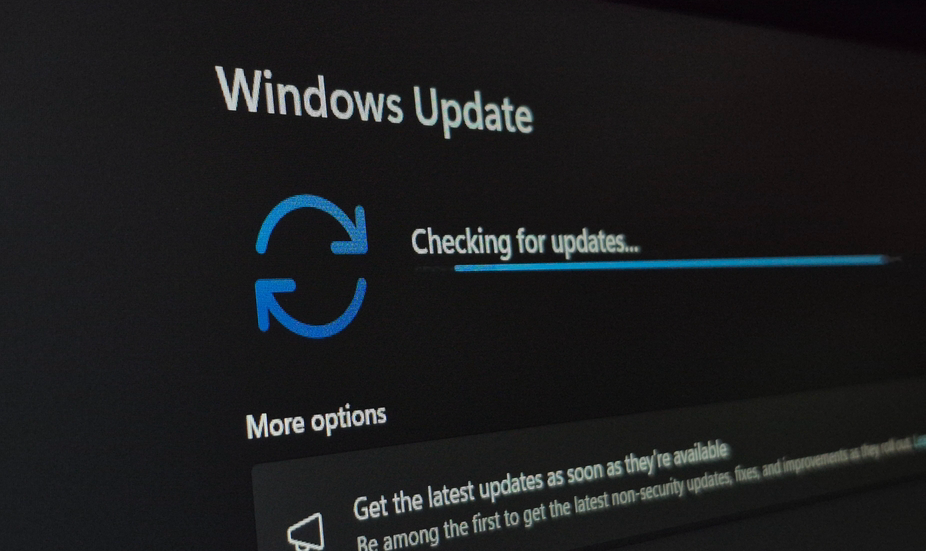
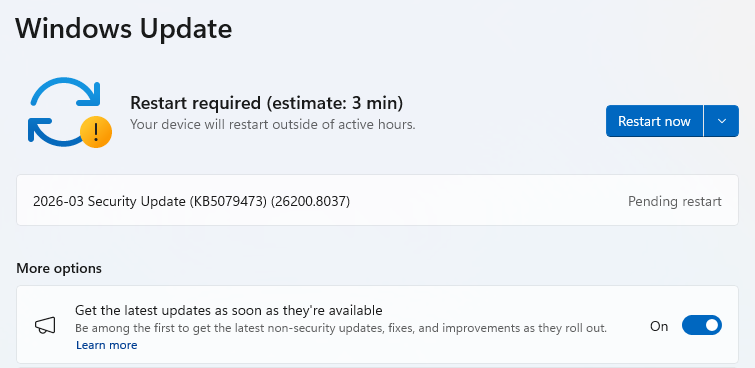
  • If you have selected to get the latest updates as soon as they’re available, you may see this under More options.
  • In which case you may see a Restart required message. Restart your system and the update will complete.
    Restart now to apply patches
  • If not, continue with the steps below.

4. Download and Install

  • If updates are found, they’ll start downloading right away. Once complete, you’ll see a button that says Install or Restart now.
  • Click Install if needed and follow any prompts. Your computer will usually need a restart to finish the update. If it does, click Restart now.
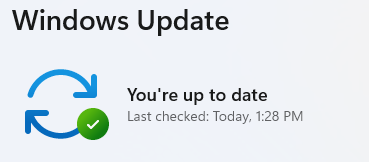
    Windows up to date

5. Double-check you’re up to date

  • After restarting, go back to Windows Update and check again. If it says You’re up to date, you’re all set!

We don’t just report on threats—we remove them

Cybersecurity risks should never spread beyond a headline. Keep threats off your devices by downloading Malwarebytes today.

Microsoft Patch Tuesday, March 2026 Edition

Microsoft Corp. today pushed security updates to fix at least 77 vulnerabilities in its Windows operating systems and other software. There are no pressing “zero-day” flaws this month (compared to February’s five zero-day treat), but as usual some patches may deserve more rapid attention from organizations using Windows. Here are a few highlights from this month’s Patch Tuesday.

Image: Shutterstock, @nwz.

Two of the bugs Microsoft patched today were publicly disclosed previously. CVE-2026-21262 is a weakness that allows an attacker to elevate their privileges on SQL Server 2016 and later editions.

“This isn’t just any elevation of privilege vulnerability, either; the advisory notes that an authorized attacker can elevate privileges to sysadmin over a network,” Rapid7’s Adam Barnett said. “The CVSS v3 base score of 8.8 is just below the threshold for critical severity, since low-level privileges are required. It would be a courageous defender who shrugged and deferred the patches for this one.”

The other publicly disclosed flaw is CVE-2026-26127, a vulnerability in applications running on .NET. Barnett said the immediate impact of exploitation is likely limited to denial of service by triggering a crash, with the potential for other types of attacks during a service reboot.

It would hardly be a proper Patch Tuesday without at least one critical Microsoft Office exploit, and this month doesn’t disappoint. CVE-2026-26113 and CVE-2026-26110 are both remote code execution flaws that can be triggered just by viewing a booby-trapped message in the Preview Pane.

Satnam Narang at Tenable notes that just over half (55%) of all Patch Tuesday CVEs this month are privilege escalation bugs, and of those, a half dozen were rated “exploitation more likely” — across Windows Graphics Component, Windows Accessibility Infrastructure, Windows Kernel, Windows SMB Server and Winlogon. These include:

CVE-2026-24291: Incorrect permission assignments within the Windows Accessibility Infrastructure to reach SYSTEM (CVSS 7.8)
CVE-2026-24294: Improper authentication in the core SMB component (CVSS 7.8)
CVE-2026-24289: High-severity memory corruption and race condition flaw (CVSS 7.8)
CVE-2026-25187: Winlogon process weakness discovered by Google Project Zero (CVSS 7.8).

Ben McCarthy, lead cyber security engineer at Immersive, called attention to CVE-2026-21536, a critical remote code execution bug in a component called the Microsoft Devices Pricing Program. Microsoft has already resolved the issue on their end, and fixing it requires no action on the part of Windows users. But McCarthy says it’s notable as one of the first vulnerabilities identified by an AI agent and officially recognized with a CVE attributed to the Windows operating system. It was discovered by XBOW, a fully autonomous AI penetration testing agent.

XBOW has consistently ranked at or near the top of the Hacker One bug bounty leaderboard for the past year. McCarthy said CVE-2026-21536 demonstrates how AI agents can identify critical 9.8-rated vulnerabilities without access to source code.

“Although Microsoft has already patched and mitigated the vulnerability, it highlights a shift toward AI-driven discovery of complex vulnerabilities at increasing speed,” McCarthy said. “This development suggests AI-assisted vulnerability research will play a growing role in the security landscape.”

Microsoft earlier provided patches to address nine browser vulnerabilities, which are not included in the Patch Tuesday count above. In addition, Microsoft issued a crucial out-of-band (emergency) update on March 2 for Windows Server 2022 to address a certificate renewal issue with passwordless authentication technology Windows Hello for Business.

Separately, Adobe shipped updates to fix 80 vulnerabilities — some of them critical in severity — in a variety of products, including Acrobat and Adobe Commerce. Mozilla Firefox v. 148.0.2 resolves three high severity CVEs.

For a complete breakdown of all the patches Microsoft released today, check out the SANS Internet Storm Center’s Patch Tuesday post. Windows enterprise admins who wish to stay abreast of any news about problematic updates, AskWoody.com is always worth a visit. Please feel free to drop a comment below if you experience any issues apply this month’s patches.

❌