Polymarket is a platform where people can bet on real-world events, political and otherwise. Leaving the ethical considerations of this aside (for one, it facilitates assassination), one of the issues with making this work is the verification of these real-world events. Polymarket gamblers have threatened a journalist because his story was being used to verify an event. And now, gamblers are taking hair dryers to weather sensors to rig weather bets.
This article is the result of a collaboration with Josimar. You can find Josimar’s corresponding piece here.
Dragon Z6 said it became the Croatian national team’s “official sponsor” in May 2024.
A European academic used a false name to represent an opaque Asian-facing bookmaker that is sponsoring Croatia’s national football team in the run up to the 2026 FIFA World Cup.
Croatia’s national governing body of football, the Croatian Football Federation (HNS), struck the deal to make gambling website Dragon Z6 the team’s “exclusive betting partner” across Asia in May 2024.
Promotional footage of the ceremony to ink the two-year agreement was filmed in Zagreb, with Croatian national team players Marco Pašalić, Lovro Majer and Josip Juranović in attendance.
A video posted to Dragon Z6’s website shows HNS International’s chief executive Dennis Lukančić and the federation’s head of marketing Ante Cicvarić signing the contract with the bookmaker’s representative.
“We hold Dragon Z6.com in high regard,” Cicvarić said in the clip. “A brand with a 25 year legacy and a stellar reputation for providing an exceptional gaming experience. Their motto, ‘Life is a gamble’, resonates deeply with us.”
“Alexander Smith” (centre) at the signing ceremony with HNS executives. Source: Dragon Z6
Dragon Z6’s representative, who is named on screen and in a placard as “Alexander Smith”, described the deal as a “momentous partnership”.
He said: “The Dragon Z6.com family proudly welcomes the Croatian national football team. We embark on an exciting journey to realise our shared ambitions.”
“Alexander Smith’s” signature does not appear when he signs the banner, but based on the movements of his marker he is not writing his real name. Source: Dragon Z6
But the man who appears in the footage on behalf of Dragon Z6 is not Alexander Smith. He is Branko Balon, a senior lecturer in computer science at Algebra Bernays University in Zagreb.
The Croatian national was identified using facial recognition search engine PimEyes, with images from his Facebook, university profile and media reports confirming the match.
Branko Balon’s university profile. Source: Algebra Bernays University
In addition to his university position, Balon is the president of non-profit group the Croatian-Chinese Friendship Society for Cultural, Scientific and Economic Cooperation (CCFS).
He appears to have visited China on several occasions, including last July when he took part in a visiting scholar programme with the Nishan World Center of Confucian Studies in eastern China’s Shandong province, according to his Facebook posts.
Top: Branko Balon in a news report and on a cookery programme. Bottom: Photos posted to Branko Balon’s Facebook page. Source: New China TV / YouTube, 24sata / YouTube, Branko Balon / Facebook
Six months before the signing ceremony with HNS, Balon reportedly addressed a Zagreb sports and tourism symposium whose attendees included representatives from the Croatian Football Federation.
After initially confirming receipt of an email from Bellingcat, Branko Balon did not respond to questions. Dragon Z6 did not respond to multiple emails.
Dennis Lukančić said the Croatia Football Federation respected the rules and regulations of the sport’s governing bodies as well as Croatian law, but did not answer specific questions about how it became involved with Dragon Z6 or if it was previously aware of Balon’s real identity.
“Regarding the signing ceremony, we note that the Croatian Football Federation did not publish or officially communicate the identity of the Dragon Z6 representative present at the event,” he said. “As is customary with such ceremonies, the event itself was of a promotional nature and did not constitute the formal execution of contractual documentation.”
This photo, published on the Croatia Football Federation’s website in a post about its deal with Dragon Z6, shows Lukančić sitting next to Branko, who had a fake name displayed in front of him. Source: Croatia Football Federation
“The Croatian Football Federation is not in a position to comment on the internal decisions, communications, or presentation choices of Dragon Z6, including the use of names or identities in their own materials or appearances. Any questions regarding the identity or representation of Dragon Z6 at promotional events are best addressed to Dragon Z6 or their representatives.
“In any of our proceedings we always negotiate in good faith and we respect all rights and obligations that arise from any agreement.”
Lukančić said the federation had carried out “standard compliance and due diligence procedures” before entering the deal and that the agreement was executed between the relevant legal entities, with Dragon Z6 “represented by their duly authorised signatories”.
Asked which country Dragon Z6 was headquartered in, who its beneficial owner was, and for the name of the person who signed the contract on behalf of the gambling company, Lukančić said: “In our previous email we gave you already all answers and our position in this matter.”
We also asked if the Dragon Z6 deal includes sponsorship during the upcoming FIFA World Cup, but did not receive a response. England is Croatia’s first opponent, facing off against the Three Lions in Dallas on June 17.
The Many-Headed Dragon
Open source findings suggest that Dragon Z6 – sometimes referred to in Chinese as “Zunlong Kaisheng” – is just the latest iteration of an Asian-facing online gambling platform that has been sponsoring Western sports teams under different names for more than a decade. Dragon Z6 appears to be associated with the Hong Kong-linked gambling company KashBet, also known as KB88.
Screenshots of games available on Dragon Z6.
Gambling does not occur directly on the Z6.com domain. The site is essentially a gateway that redirects users to a fluctuating number of mirror websites with alphanumeric string domains. These Chinese-language sites host the gambling content, including live-streamed card games, and provide clues about Dragon Z6’s association with KashBet.
The image of Dutch former professional footballer Robin van Persie is featured prominently on Dragon Z6’s mirror sites. In the “About” section of these websites, the online casino says it signed van Persie as its brand ambassador in 2021. The same photograph of him is used interchangeably to promote both Dragon Z6 and the KashBet brand.
Branding on Robin van Persie’s jacket and the football shows KashBet (left) and the Dragon Z6 logo (right). Source: Z6.com proxy website
Van Persie’s agent, Kees Vos, said the footballer had not entered into a partnership with Kashbet, was not involved with Dragon Z6, and had not been aware that his image was being used on these websites.
“We have taken notice of the abuse of the image of our client Robin van Persie by several Asian gambling platforms, and we will instruct our lawyers to take legal action against these parties,” Vos said.
Z6’s mirror sites also say Zunlong Kaisheng is the “official sponsor” of Bundesliga clubs Bayer Leverkusen and Augsburg, Brazilian side Fluminense, Italian club Roma, English league team Wigan Athletic and Dutch club Ajax.
However, it was KashBet that signed sponsorship deals with these football teams in 2017 and 2019. No record of a sponsorship with FC Augsburg was found, but KB88 was promoted in pitchside advertising during one of the team’s 2019 home games.
In 2019, Australian football team Melbourne Victory dropped their AFC Champions League sponsor “Kaishi Entertainment” after concerns were raised about the company’s link to Kashbet.
KashBet’s representative at the signing with Bayer Leverkusen was the same person who represented Kaishi Entertainment during the Melbourne Victory announcement in the same year.
The same woman who represented KB88 when it signed with Bayer Leverkusen also represented Kaishi Entertainment when it signed with Melbourne Victory. Identical Chinese branding is also visible on both jerseys. Source: Daim.net, Bayer Leverkusen official website
A YouTube channel branded as “Zunlong Kaisheng” and featuring the Dragon Z6 logo hosts a 2024 video titled “Welcome to Dragon Casino”. It shows a tour of a facility where female croupiers are live-streamed operating table games.
The video also features framed photographs purporting to show various ceremonies. These include the KashBet image of van Persie, as well as club teams AS Roma and AFC Ajax’s Asian betting partnerships with KB88 in 2017. Another photo claims to show former Real Madrid, Chelsea and Belgium footballer Eden Hazard becoming a Dragon Casino “brand ambassador” in 2020.
Bellingcat’s emails to representatives for Eden Hazard, who was recently announced as a “global ambassador” for online gambling platform Stake, were not returned.
Top: TheYouTube video includes a photo wall purporting to show Dragon Casino and KB88 sponsorship signings. Bottom: 1 – AFC Ajax; 2 – Eden Hazard; 3 – AS Roma; 4 – Robin van Persie. Source: 尊龙凯时AG旗舰厅 (“Zunlong Kaisheng AG Flagship Hall”) YouTube channel
The location of the facility is not stated but open source evidence shows it was filmed in the Philippines, where offshore gaming operators were banned in 2024. Reverse image searches confirm one section of the promotional video was shot in the five-star Peninsula Hotel in Makati City, Manila.
Offshore Corporate Labyrinth
Dutch club Ajax, who were sponsored by KB88 in 2017, said their deal involved Hong Kong firm KB88 Entertainment Culture Limited. A company based in the British Virgin Islands is also behind trade names linked to KB88, according to a 2023 investigation by Dutch outlet NRC. But the entities purportedly in control of the gambling platform do not stop there.
Dragon Z6’s site links to a 2012 statement posted by English Championship club, Queen’s Park Rangers (QPR), announcing a one year deal to make KashBet the club’s international betting partner. The press release, which was removed from QPR’s website earlier this year, said KashBet was “fully owned and operated by Keen Ocean Entertainment (IOM) Limited” and licensed and regulated by the Gambling Supervision Commission (GSC) on the Isle of Man.
Screenshots of live-streamed card games and other offerings on Dragon Z6.
Records from the Isle of Man company registry show a company named Goldenway Investments (UK) Limited was incorporated in 2010 and changed its name to Keen Ocean Entertainment (IOM) Limited a month later. The company’s two directors were all residents of the Isle of Man, adding Hong Kong resident Yong Tang as the third director in November of that year. A company acting as the secretary, Rivercroft Limited, is also named in documents.
An archive of the Isle of Man’s Gambling Supervision Commission’s 2012-13 annual report shows that Keen Ocean Entertainment obtained a full online gambling license. This enabled it to enter into the QPR deal as the regulated body behind Kashbet.
Filings on the Isle of Man register are low on detail. Balance sheets are not filed, and the only documented activity about the company was the occasional movement of Isle of Man-based directors. By November 2015, Yong Tang was the sole director of the company.
In 2016, Keen Ocean Entertainment was informed by the Companies Registry that it did not have the authority to maintain its registered office at the address it had given as its premises. Yong Tang did not respond to this correspondence, according to the available documents, and the company was subsequently struck off the register.
Buildings where Keen Ocean and KB88 Entertainment Culture were registered in the Isle of Man and Hong Kong. Source: Google Maps
Gaming Compliance International (GCI), a regulatory intelligence firm that monitors the global online gambling market, said Dragon Z6 and KashBet did not have a current gaming license in any credible jurisdiction.
Ismail Vali, GCI president and the founder and former chief executive of Yield Sec, which tracks gambling and streaming marketplaces, said Dragon Z6 “ruthlessly” targeted audiences in China – where gambling is illegal – but that did not mean the operators were based there.
“Generally, in the illegal gambling model, they use triangulation and separation,” he said. “It’s the most basic form of organised crime: operate your business in one place, incorporate your business in another, make your money from many places, bank your money in many places, and, finally, invest and spend it everywhere to create more crime. Separating the elements of the illegal activity creates problems for tracing, policing and enforcement.”
Vali said Western football associations that are struggling to operate on shrinking budgets could be lured into sponsorship deals with unregulated and illegal gambling companies, which were focused on building brand recognition through live-broadcast games.
“The illegal gambling companies aren’t focused upon making money from the direct audience of the clubs or from the football association’s footprint in Croatia,” he said. “What they are making money from is the audience the football matches are broadcast to globally. They want to communicate what the brand is and because it’s associated with international soccer people think it must be trustworthy.
“The whole point here is to recruit you through sports. That’s the cheapest way to get you interested because you want to place a bet on Croatia versus the Czech Republic in the World Cup qualifiers. Once they recruit a customer cheaply via sports events, they can then cross-sell or migrate them into casino and more products – where the profit margin is far higher.
“Unregulated gambling companies want a blended customer – they don’t just want you for sports betting, they want you for everything.”
Ross Higgins and Connor Plunkett contributed to this article.
Bellingcat is a non-profit and the ability to carry out our work is dependent on the kind support of individual donors. If you would like to support our work, you can do so here. You can also subscribe to our Patreon channel here. Subscribe to our Newsletter and follow us on Bluesky here, Instagram here, Reddit here and YouTube here.
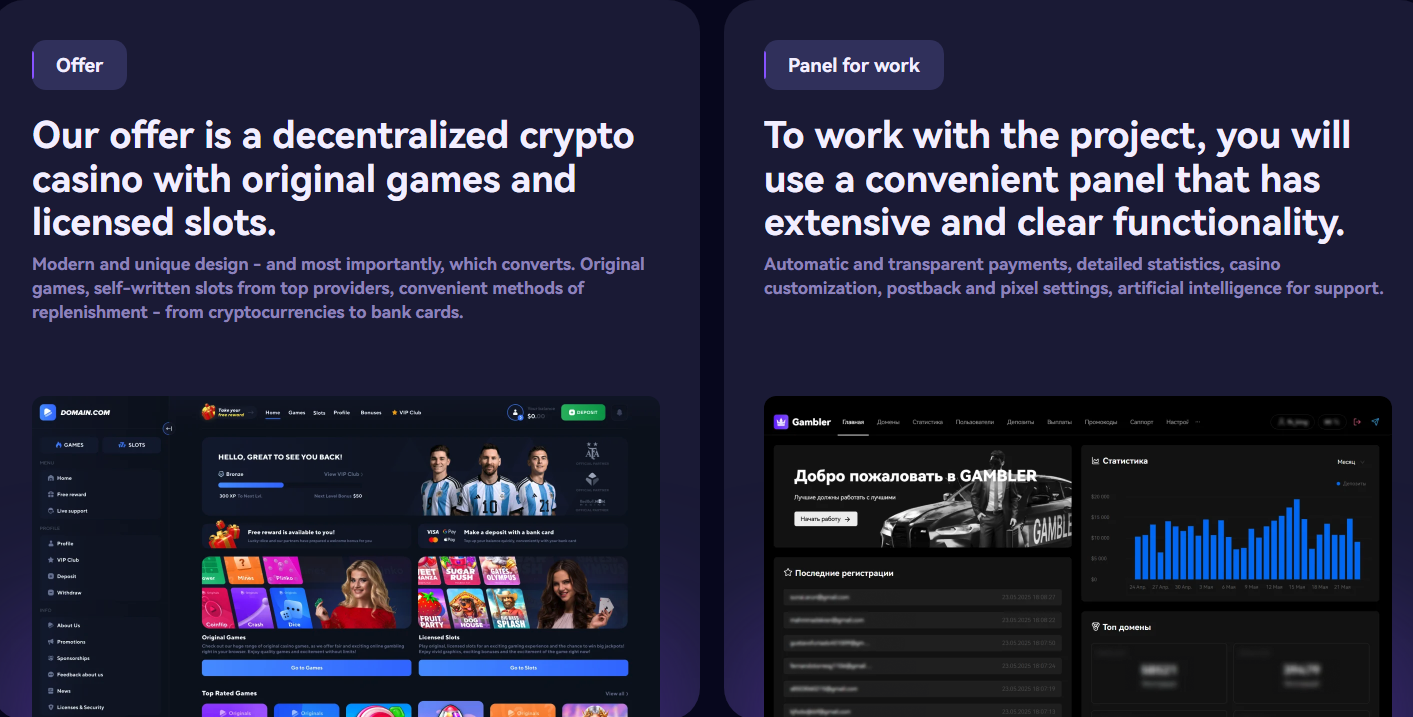
Last month, KrebsOnSecurity tracked the sudden emergence of hundreds of polished online gaming and wagering websites that lure people with free credits and eventually abscond with any cryptocurrency funds deposited by players. We’ve since learned that these scam gambling sites have proliferated thanks to a new Russian affiliate program called “Gambler Panel” that bills itself as a “soulless project that is made for profit.”
A machine-translated version of Gambler Panel’s affiliate website.
The scam begins with deceptive ads posted on social media that claim the wagering sites are working in partnership with popular athletes or social media personalities. The ads invariably state that by using a supplied “promo code,” interested players can claim a $2,500 credit on the advertised gaming website.
The gaming sites ask visitors to create a free account to claim their $2,500 credit, which they can use to play any number of extremely polished video games that ask users to bet on each action. However, when users try to cash out any “winnings” the gaming site will reject the request and prompt the user to make a “verification deposit” of cryptocurrency — typically around $100 — before any money can be distributed.
Those who deposit cryptocurrency funds are soon pressed into more wagering and making additional deposits. And — shocker alert — all players eventually lose everything they’ve invested in the platform.
The number of scam gambling or “scambling” sites has skyrocketed in the past month, and now we know why: The sites all pull their gaming content and detailed strategies for fleecing players straight from the playbook created by Gambler Panel, a Russian-language affiliate program that promises affiliates up to 70 percent of the profits.
Gambler Panel’s website gambler-panel[.]com links to a helpful wiki that explains the scam from cradle to grave, offering affiliates advice on how best to entice visitors, keep them gambling, and extract maximum profits from each victim.
“We have a completely self-written from scratch FAKE CASINO engine that has no competitors,” Gambler Panel’s wiki enthuses. “Carefully thought-out casino design in every pixel, a lot of audits, surveys of real people and test traffic floods were conducted, which allowed us to create something that has no doubts about the legitimacy and trustworthiness even for an inveterate gambling addict with many years of experience.”
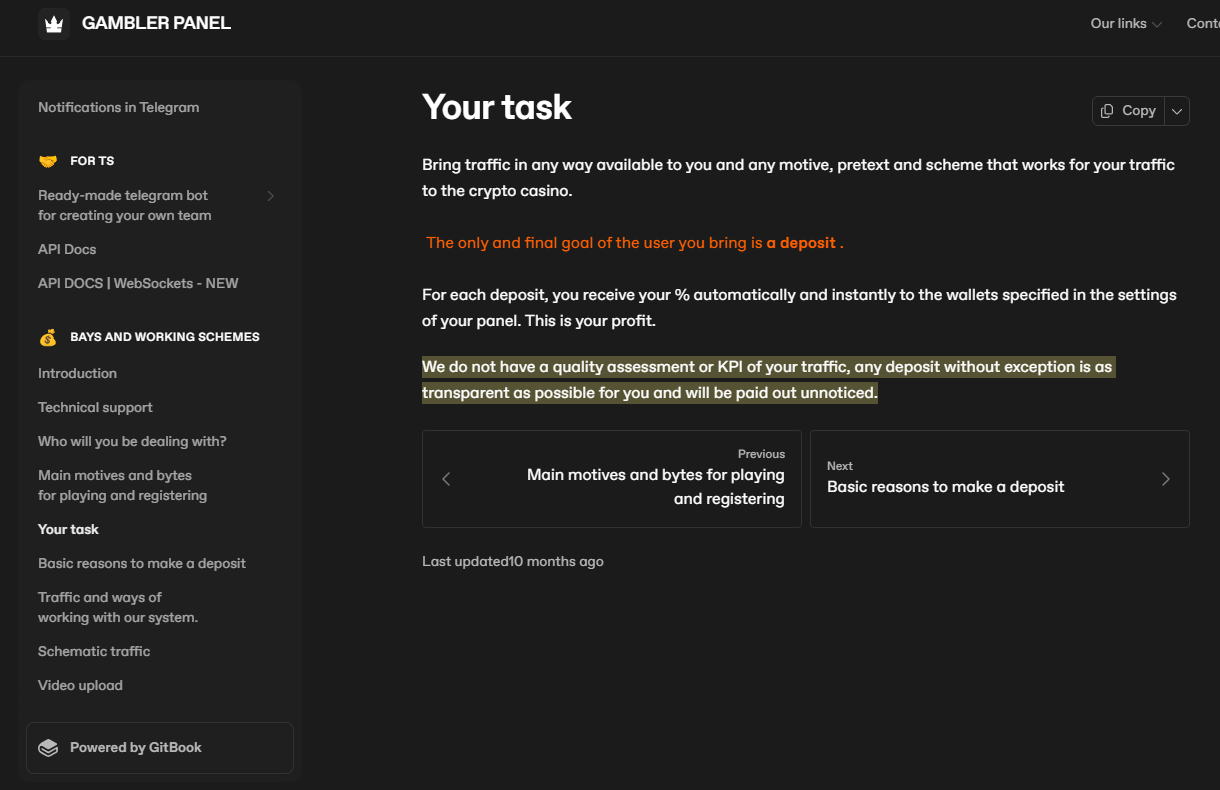
Gambler Panel explains that the one and only goal of affiliates is to drive traffic to these scambling sites by any and all means possible.
A machine-translated portion of Gambler Panel’s singular instruction for affiliates: Drive traffic to these scambling sites by any means available.
“Unlike white gambling affiliates, we accept absolutely any type of traffic, regardless of origin, the only limitation is the CIS countries,” the wiki continued, referring to a common prohibition against scamming people in Russia and former Soviet republics in the Commonwealth of Independent States.
The program’s website claims it has more than 20,000 affiliates, who earn a minimum of $10 for each verification deposit. Interested new affiliates must first get approval from the group’s Telegram channel, which currently has around 2,500 active users.
The Gambler Panel channel is replete with images of affiliate panels showing the daily revenue of top affiliates, scantily-clad young women promoting the Gambler logo, and fast cars that top affiliates claimed they bought with their earnings.
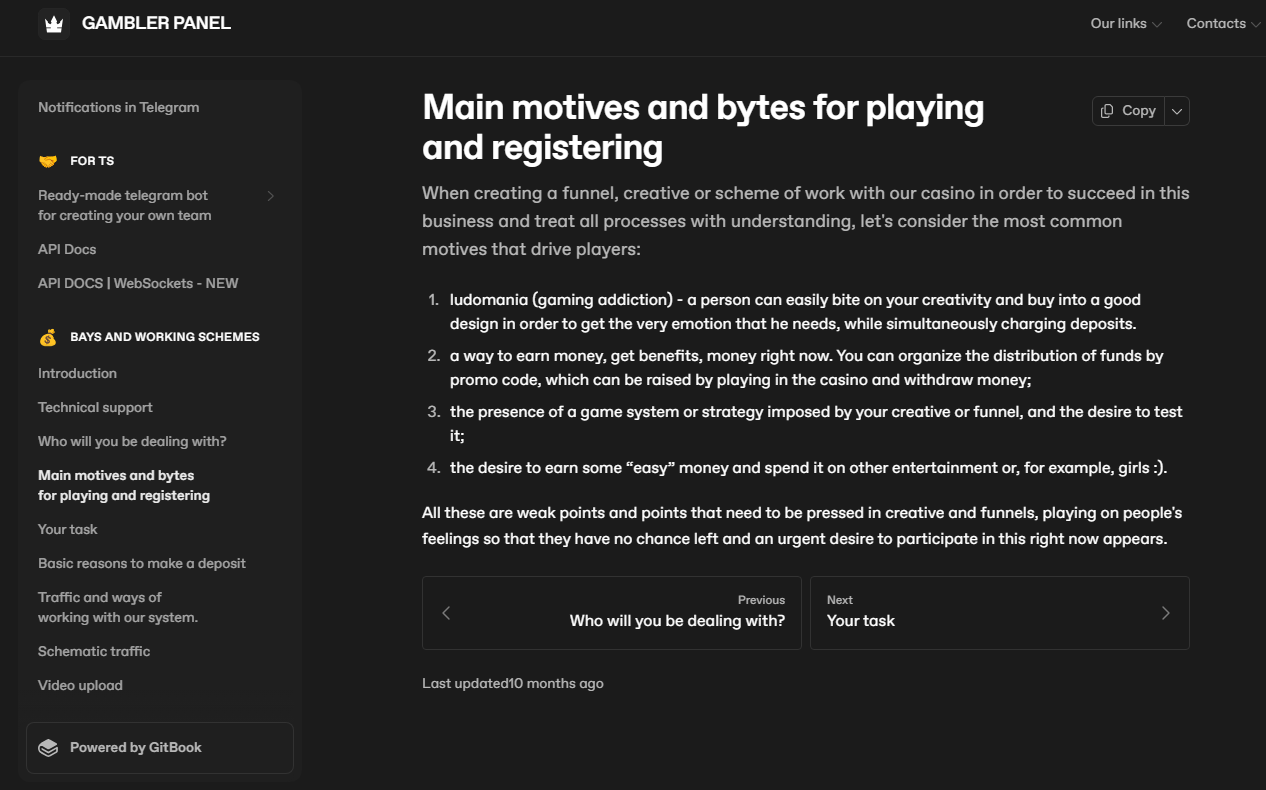
A machine-translated version of the wiki for the affiliate program Gambler Panel.
The apparent popularity of this scambling niche is a consequence of the program’s ease of use and detailed instructions for successfully reproducing virtually every facet of the scam. Indeed, much of the tutorial focuses on advice and ready-made templates to help even novice affiliates drive traffic via social media websites, particularly on Instagram and TikTok.
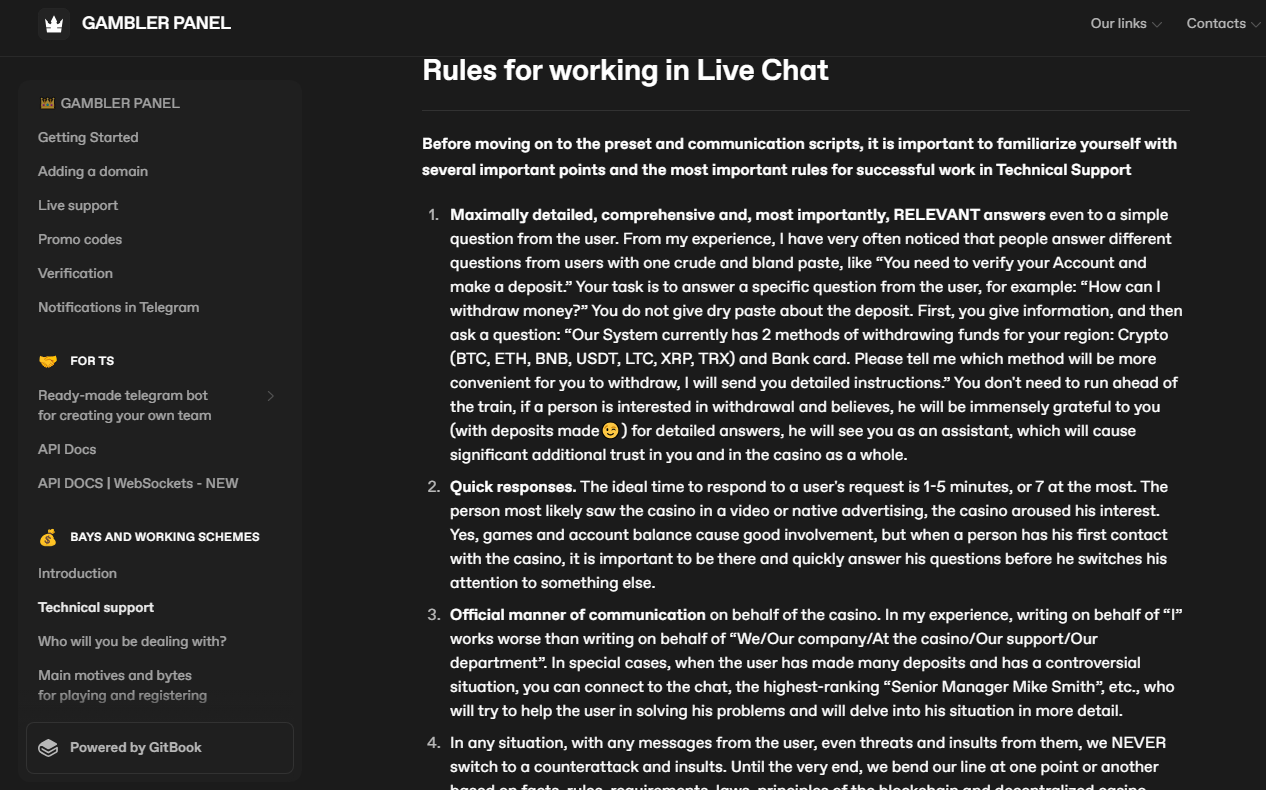
Gambler Panel also walks affiliates through a range of possible responses to questions from users who are trying to withdraw funds from the platform. This section, titled “Rules for working in Live chat,” urges scammers to respond quickly to user requests (1-7 minutes), and includes numerous strategies for keeping the conversation professional and the user on the platform as long as possible.
A machine-translated version of the Gambler Panel’s instructions on managing chat support conversations with users.
The connection between Gambler Panel and the explosion in the number of scambling websites was made by a 17-year-old developer who operates multiple Discord servers that have been flooded lately with misleading ads for these sites.
The researcher, who asked to be identified only by the nickname “Thereallo,” said Gambler Panel has built a scalable business product for other criminals.
“The wiki is kinda like a ‘how to scam 101’ for criminals written with the clarity you would expect from a legitimate company,” Thereallo said. “It’s clean, has step by step guides, and treats their scam platform like a real product. You could swap out the content, and it could be any documentation for startups.”
“They’ve minimized their own risk — spreading the links on Discord / Facebook / YT Shorts, etc. — and outsourced it to a hungry affiliate network, just like a franchise,” Thereallo wrote in response to questions.
“A centralized platform that can serve over 1,200 domains with a shared user base, IP tracking, and a custom API is not at all a trivial thing to build,” Thereallo said. “It’s a scalable system designed to be a resilient foundation for thousands of disposable scam sites.”
The security firm Silent Push has compiled a list of the latest domains associated with the Gambler Panel, available here (.csv).

 Entrar